
Life, 1913-01-23 · page 14 of 40
Life — January 23, 1913 — page 14: what you’re looking at
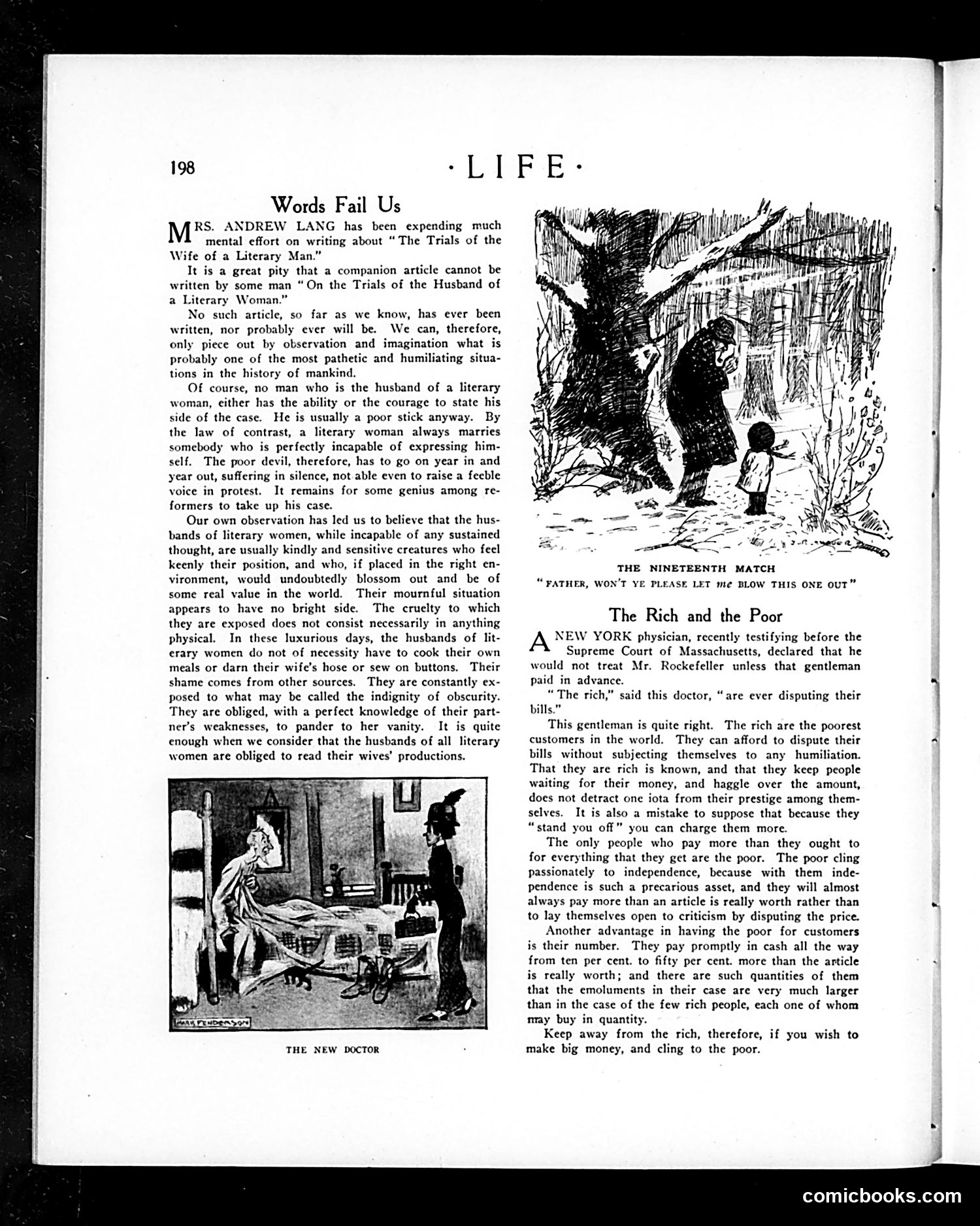
A restored page from Life, 1913-01-23. Page through the whole issue in the reader above.
📄 Transcribed text from this page (OCR, searchable)
Machine-transcribed from the original scan — historical spelling and the odd misread are preserved.
198 Words Fail Us RS. ANDREW LANG has been expending much mental effort on writing about “The Trials of the Wife of a Literary Man.” It is a great pity that a companion article cannot be written by some man “On the Trials of the Husband of a Literary Woman.” No such article, so far as we know, has ever been written, nor probably ever will be. We can, therefore, only piece out by observation and imagination what is probably one of the most pathetic and humiliating situa- tions in the history of mankind. Of course, no man who is the husband of a literary woman, cither has the ability or the courage to state his side of the case. He is usually a poor stick anyway. By the law of contrast, a literary woman always marries somebody who is perfectly incapable of expressing him- self. The poor devil, therefore, has to go on year in and year out, suffering in silence, not able even to raise a feeble voice in protest. It remains for some genius among re- formers to take up his case. Our own observation has led us to believe that the hus- bands of literary women, while incapable of any sustained thought, are usually kindly and sensitive creatures who feel keenly their position, and who, if placed in the right en- vironment, would undoubtedly blossom out and be of some real value in the world. Their mournful situation appears to have no bright side. The cruelty to which they are exposed does not consist necessarily in anything physical. In these luxurious days, the husbands of lit- erary women do not of necessity have to cook their own meals or darn their wife’s hose or sew on buttons. Their shame comes from other sources. They are constantly ex- posed to what may be called the indignity of obscurity. They are obliged, with a perfect knowledge of their part- ner’s weaknesses, to pander to her vanity. It is quite enough when we consider that the husbands of all literary women are obliged to read their wives’ productions. THE NEW DOCTOR THE NINETEENTH MATCH “FATHER, WON'T YE PLEASE LET me BLOW THIS ONE OUT” The Rich and the Poor A NEW YORK physician, recently testifying before the Supreme Court of Massachusetts, declared that he would not treat Mr. Rockefeller unless that gentleman paid in advance. “The rich,” said this doctor, “are ever disputing their bills.” This gentleman is quite right. The rich are the poorest customers in the world. They can afford to dispute their bills without subjecting themselves to any humiliation. That they are rich is known, and that they keep people waiting for their money, and haggle over the amount, does not detract one iota from their prestige among them- selves. It is also a mistake to suppose that because they “stand you off” you can charge them more. The only people who pay more than they ought to for everything that they get are the poor. The poor cling passionately to independence, because with them inde- pendence is such a precarious asset, and they will almost always pay more than an article is really worth rather than to lay themselves open to criticism by disputing the price. Another advantage in having the poor for customers is their number. They pay promptly in cash all the way from ten per cent. to fifty per cent. more than the article is really worth; and there are such quantities of them that the emoluments in their case are very much larger than in the case of the few rich people, each one of whom may buy in quantity. Keep away from the rich, therefore, if you wish to make big money, and cling to the poor. comicbooks.com