
Life, 1913-01-23 · page 9 of 40
Life — January 23, 1913 — page 9: what you’re looking at
What you’re looking at
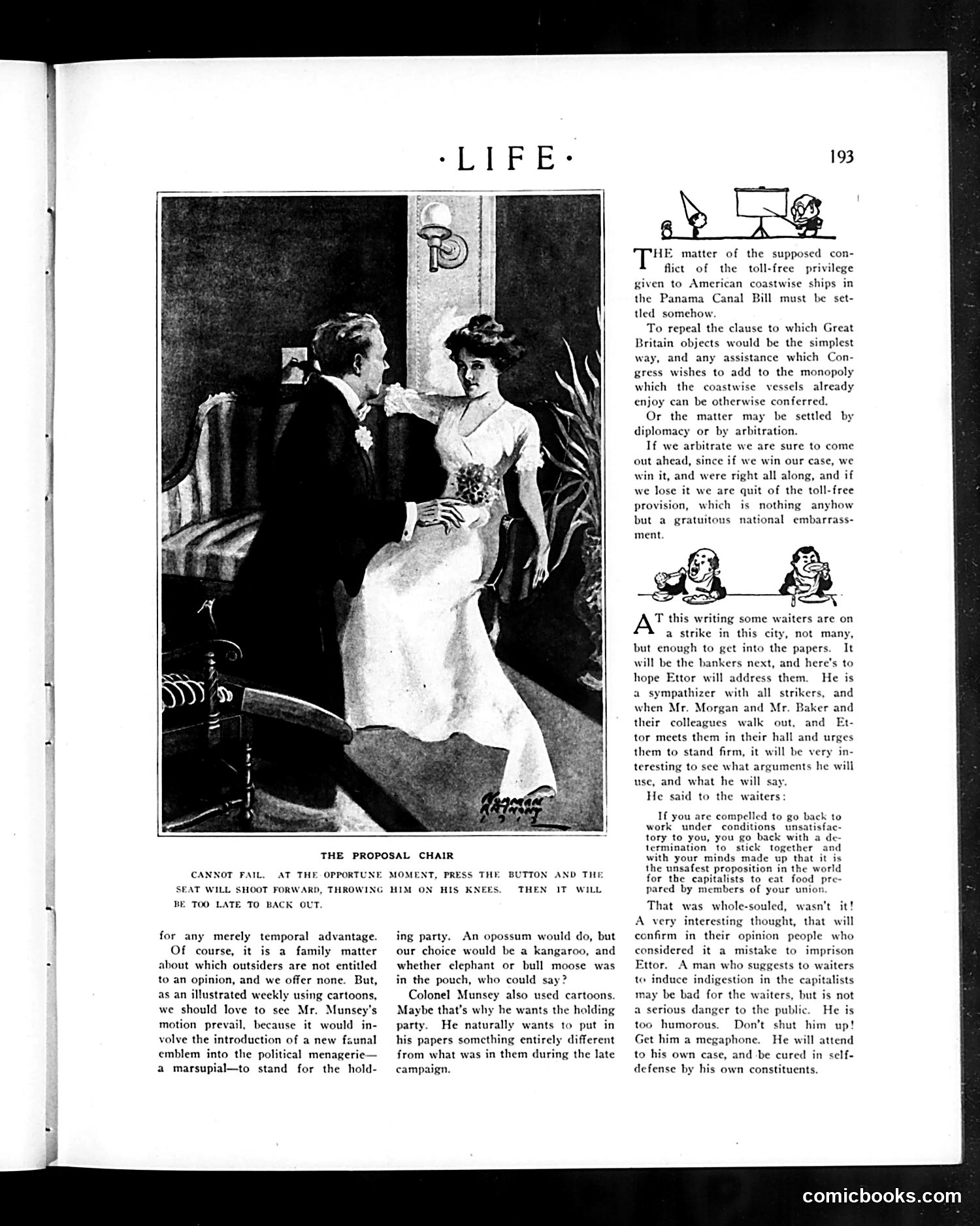
This cartoon depicts a man proposing to a woman in an elegant interior. The caption beneath reads: "CANNOT FAIL. AT THE OPPORTUNE MOMENT, PRESS THE BUTTON AND THE SEAT WILL SHOOT FORWARD, THROWING HIM ON HIS KNEES. THEN IT WILL BE TOO LATE TO BACK OUT." The satire mocks the anxiety surrounding marriage proposals—suggesting a mechanical device could force a man into marriage against his hesitation. It plays on contemporary gender dynamics and male reluctance about commitment. The article text discusses labor disputes and workers' rights, suggesting this humorous piece about marriage proposals appears alongside serious political commentary, typical of Life's satirical approach to American social and political issues of the era.
📄 Transcribed text from this page (OCR, searchable)
Machine-transcribed from the original scan — historical spelling and the odd misread are preserved.
THE PROPOSAL CHAIR CANNOT FAIL. AT THE OPPORTU SEAT WILL SHOOT FORWARD, THROWIN BE TOO LATE TO BACK OUT. for any merely temporal advantage. Of course, it is a family matter about which outsiders are not entitled to an opinion, and we offer none. But, as an illustrated weekly using cartoons, we should love to see Mr. Munsey’s motion prevail, because it would in- volve the introduction of a new faunal emblem into the political menagerie— a marsupial—to stand for the hold- MOMENT, PRESS THE BUTTON AND THE HIM ON HIS K) EES. THEN IT WILL ing party. An opossum would do, but our choice would be a kangaroo, and whether elephant or bull moose was in the pouch, who could say? Colonel Munsey also used cartoons. Maybe that’s why he wants the holding part He naturally wants to put in his papers something entirely different from what was in them during the late campaign. HE matter of the supposed con- flict. of the toll-free privilege given to American coastwise ships in the Panama Canal Bill must be set- tled somehow. To repeal the clause to which Great Britain objects would be the simplest way, and any assistance which Con- gress wishes to add to the monopoly which the coastwise vessels already enjoy can be otherwise conferred. Or the matter may be settled by diplomacy or by arbitration. If we arbitrate we are sure to come out ahead, since if we win our case, we win it, and were right all along, and if we lose it we are quit of the toll-free provision, which is nothing anyhow but a gratuitous national embarrass- ment this writing some waiters are on a strike in this city, not many, but enough to get into the papers. It will be the bankers next, and here's to hope Ettor will address them. He is a sympathizer with all strikers, and when Mr. Morgan and Mr. Baker and their colleagues walk out, and Ei tor meets them in their hall and urges them to stand firm, it will be very in- teresting to see what arguments he will use, and what he will say. He said to the waiters: If you are compelled to go back to work under conditions unsatisfac- tory to you, you go back with a di termination to stick together and with your minds made up that it is the unsafest proposition in the world for the capitalists to eat food pr pared by members of your union. That was whole-souled, wasn't it! A very interesting thought, that will confirm in their opinion people who considered it a mistake to imprison Ettor. man who suggests to waiters to induce indigestion in the capitalists may be bad for the waiters, but is not a serious danger to the public. He is too humorous. Don’t shut him up! Get him a megaphone, He will attend to his own case, and be cured in self defense by his own constituents. comicbooks.com