
A complete issue · 44 pages · 1912
Life — November 28, 1912
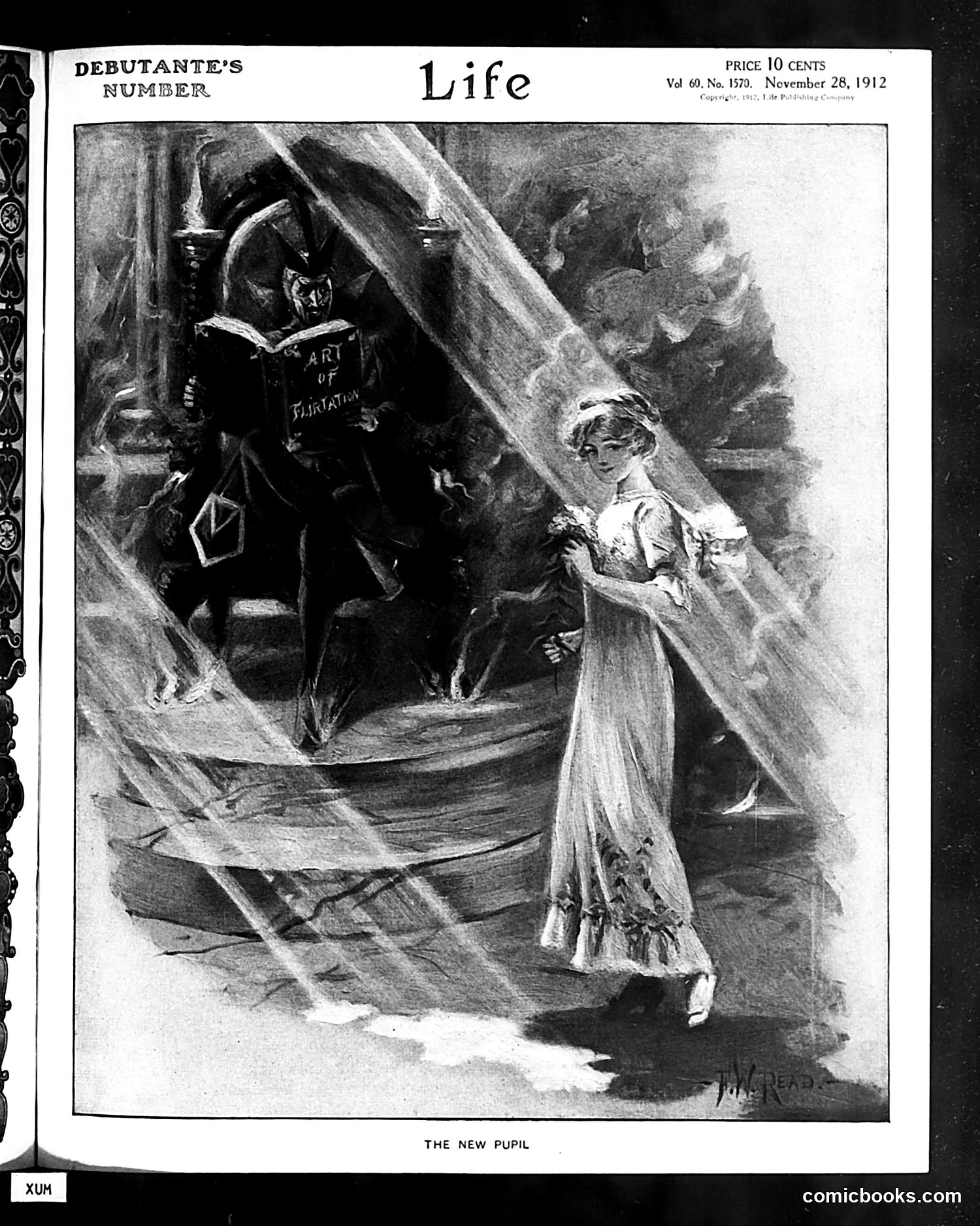
This cartoon depicts a young woman ("The New Pupil") encountering a skeletal, demonic figure labeled "Art of Flirtation." The ominous instructor looms in shadow while ghostly faces appear above—likely representing women who previously fell under this figure's influence. The satire addresses anxieties about young women's education and morality in the Progressive Era. Rather than formal schooling, this "new pupil" is being initiated into the dangerous "art of flirtation"—a critique of how society misdirects female development toward romantic manipulation rather than serious learning or self-improvement. The cartoon reflects contemporary concerns about women's roles, dating practices, and the perceived moral dangers facing the younger generation during a period of rapidly changing social norms.
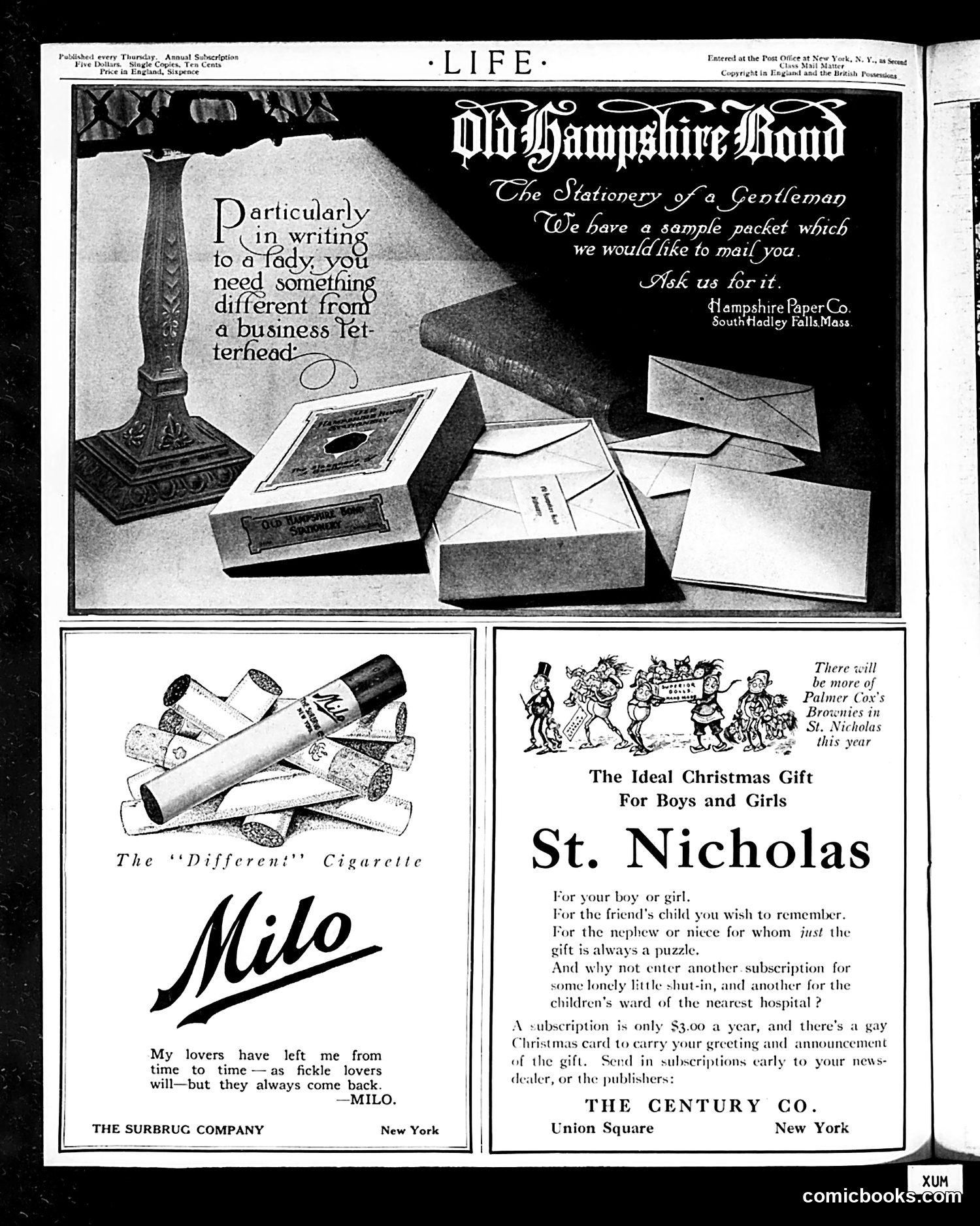
This page is **primarily advertising**, not satire or political commentary. It contains three commercial advertisements from what appears to be an early 20th-century issue of *Life* magazine: 1. **Old Hampshire Road stationery** - promotes gentlemen's writing paper and envelopes 2. **Milo cigarettes** - uses a romantic tagline ("My lovers have left me...but they always come back") to market cigarettes as reliable companions 3. **St. Nicholas magazine** - advertises a children's publication as an ideal Christmas gift subscription The only potentially satirical element is the *Milo* ad's personification of cigarettes as romantic partners, reflecting early 20th-century advertising's uninhibited tobacco marketing. Otherwise, this is straightforward period advertising with no political content or cartoon commentary.
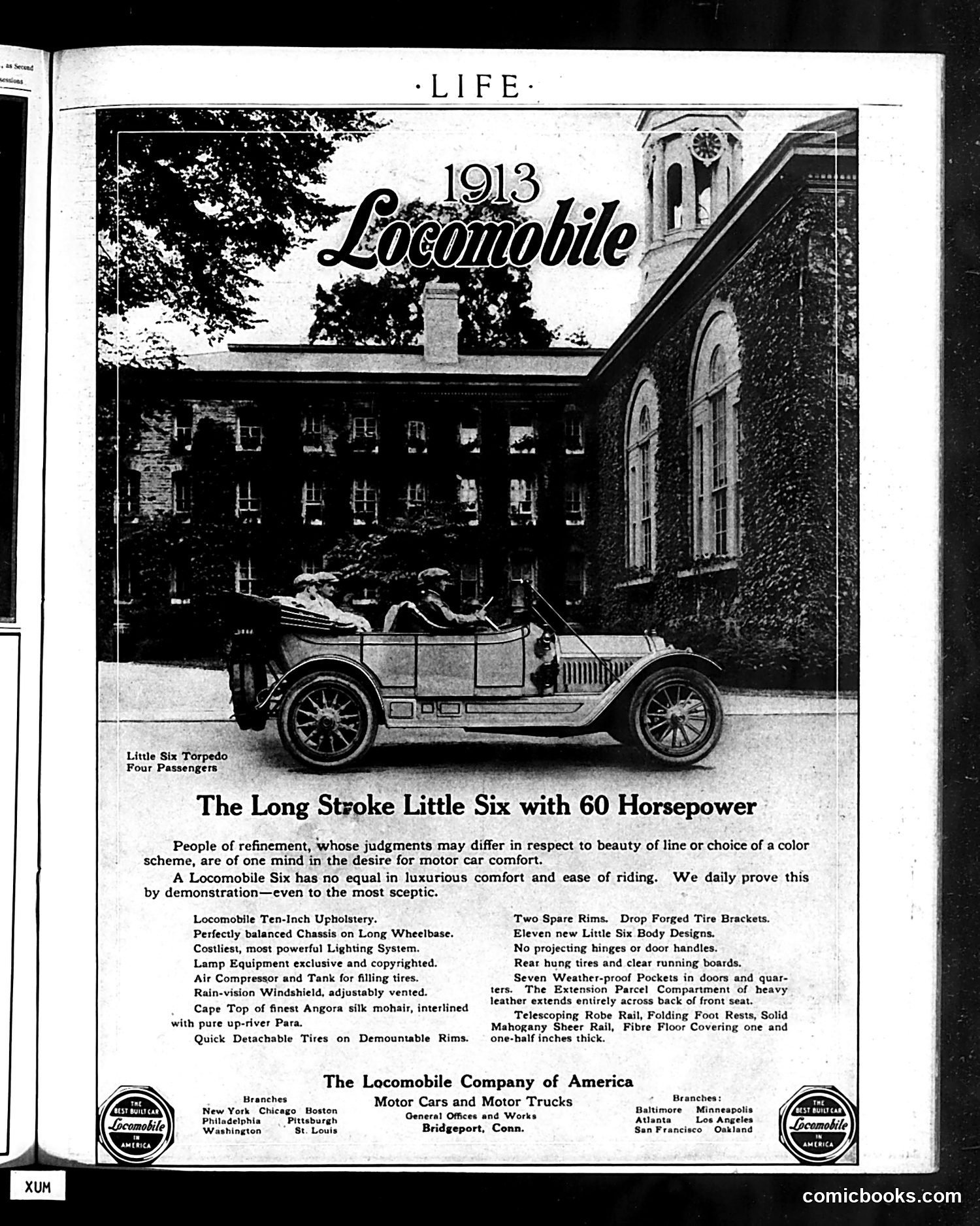
This page is **not satirical content** — it's a straightforward advertisement for the Locomobile automobile company. The image shows their "Little Six" model, a four-passenger torpedo-style car with 60 horsepower, positioned in front of an elegant brick building with ivy. The ad targets affluent buyers, emphasizing luxury features: comfortable seating, advanced lighting, detachable tires, and various mechanical innovations. It appeals to "people of refinement" seeking "motor car comfort." The Locomobile Company was a legitimate automobile manufacturer operating from Bridgeport, Connecticut, with branches nationwide. This represents early automotive advertising in *Life* magazine, which carried both humor and commercial content. There is no political satire present.
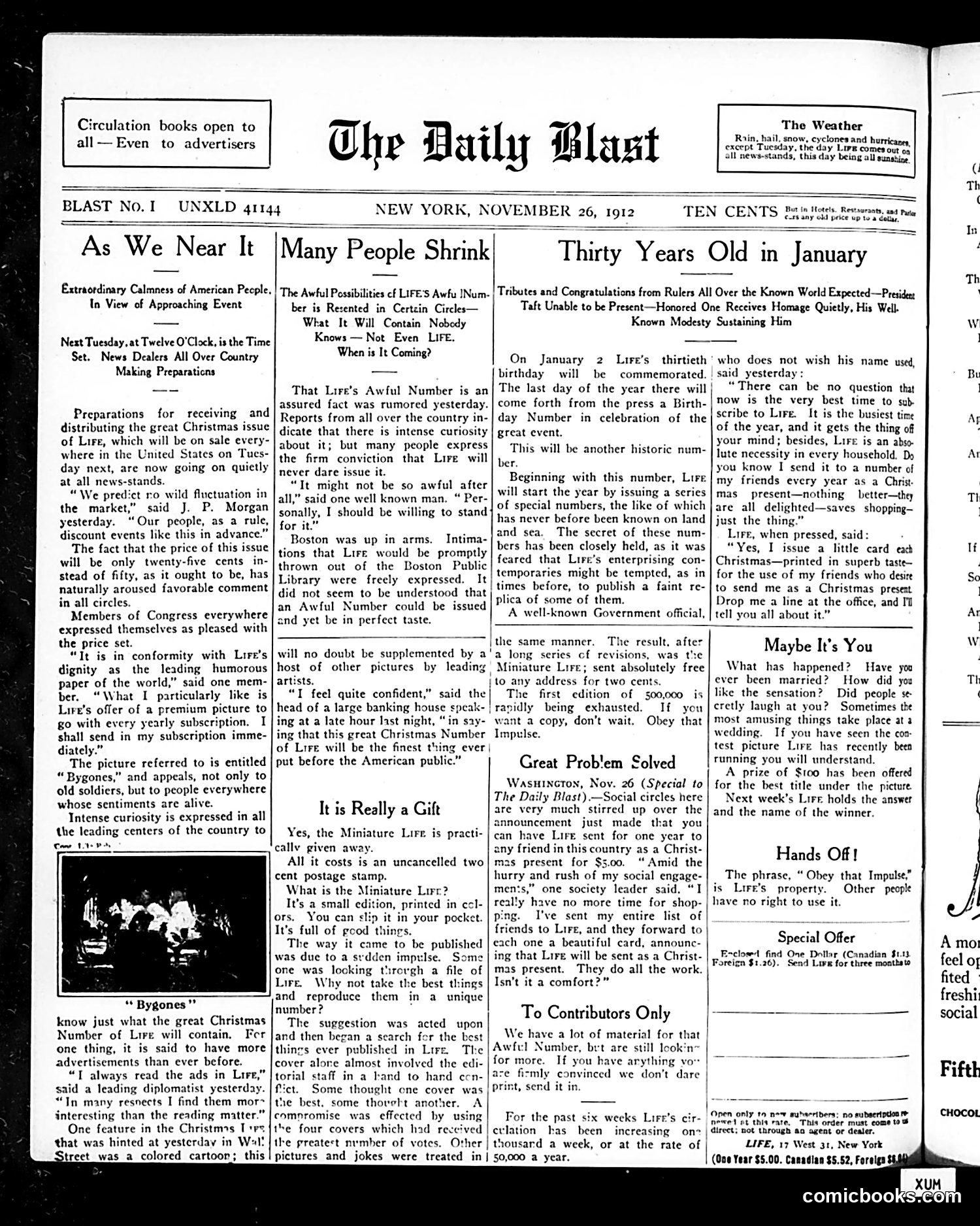
The cartoon titled **"Bygones"** (lower left) depicts what appears to be a Christmas scene with figures in silhouette. Based on the accompanying text discussing Life magazine's upcoming Christmas issue, this likely satirizes the commercialization of the holiday—a recurring Life theme. The main content focuses on Life's 30th anniversary issue arriving in January and its famous "Awful Number" featuring special content. Articles discuss debates about Life's identity, references to the upcoming presidential transition (Theodore Roosevelt having left office), and social commentary on gift-giving and consumerism. The satire targets American materialism and media hype around special publications, typical of Life's early 20th-century social criticism. The exact figures in the cartoon remain unclear without additional context.
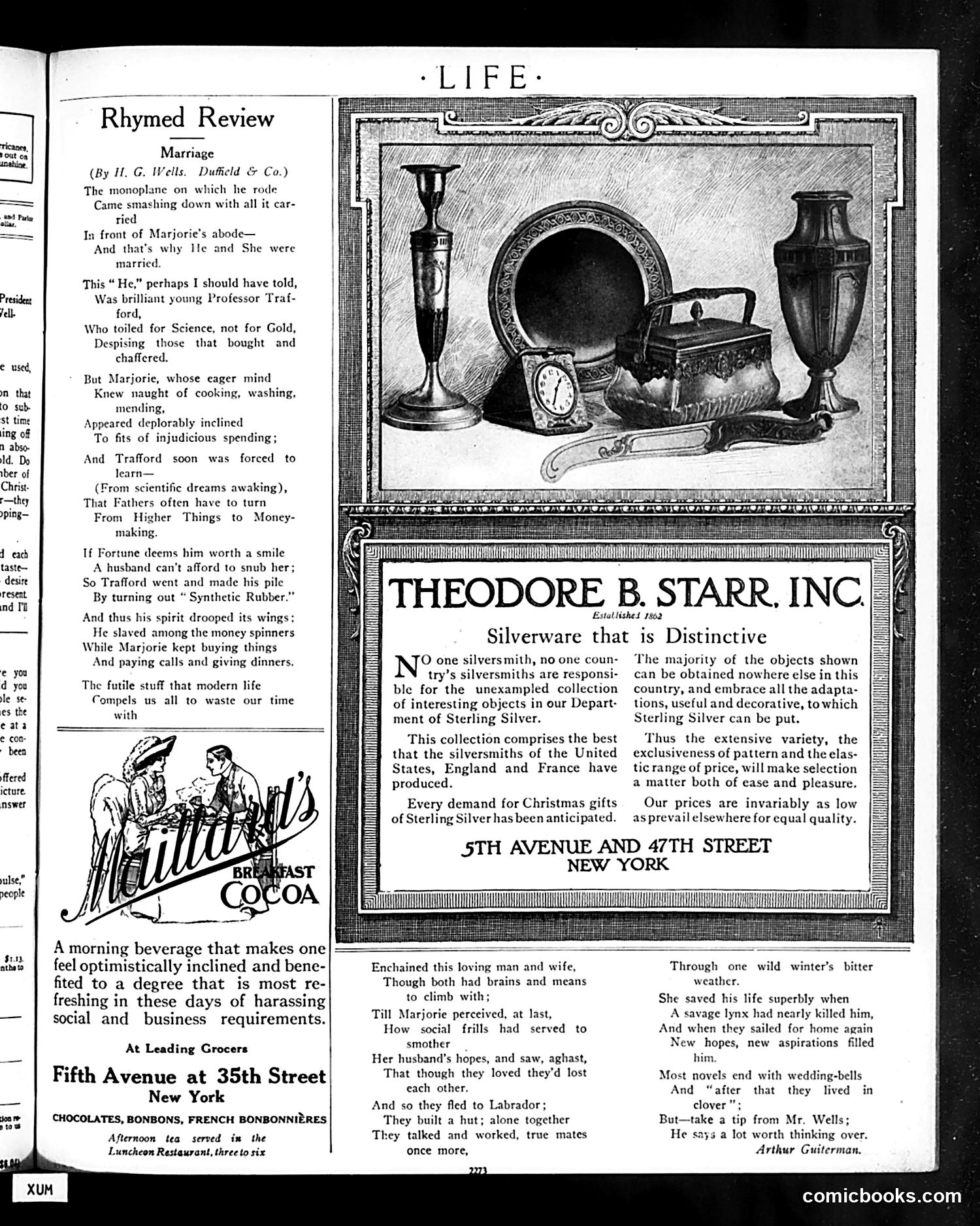
This page is primarily **advertising and light satirical content**, not political commentary. The left column features a "Rhymed Review" poem about a marriage by H.G. Wells, satirizing a young professor (Trafford) who abandons scientific ambition after marrying Marjorie. The joke targets how domestic life and household expenses force idealistic men into practical compromises—a common early-20th-century social observation about marriage's constraining effects on male ambition. Below is a Mallard Breakfast Cocoa advertisement. The right side shows a **Theodore B. Starr silverware advertisement** featuring decorative objects (urns, vases, clock). This is pure commercial content promoting Sterling Silver goods at a Fifth Avenue New York location. The bottom contains continuation of the Wells poem with pastoral imagery of the couple finding contentment in Labrador.
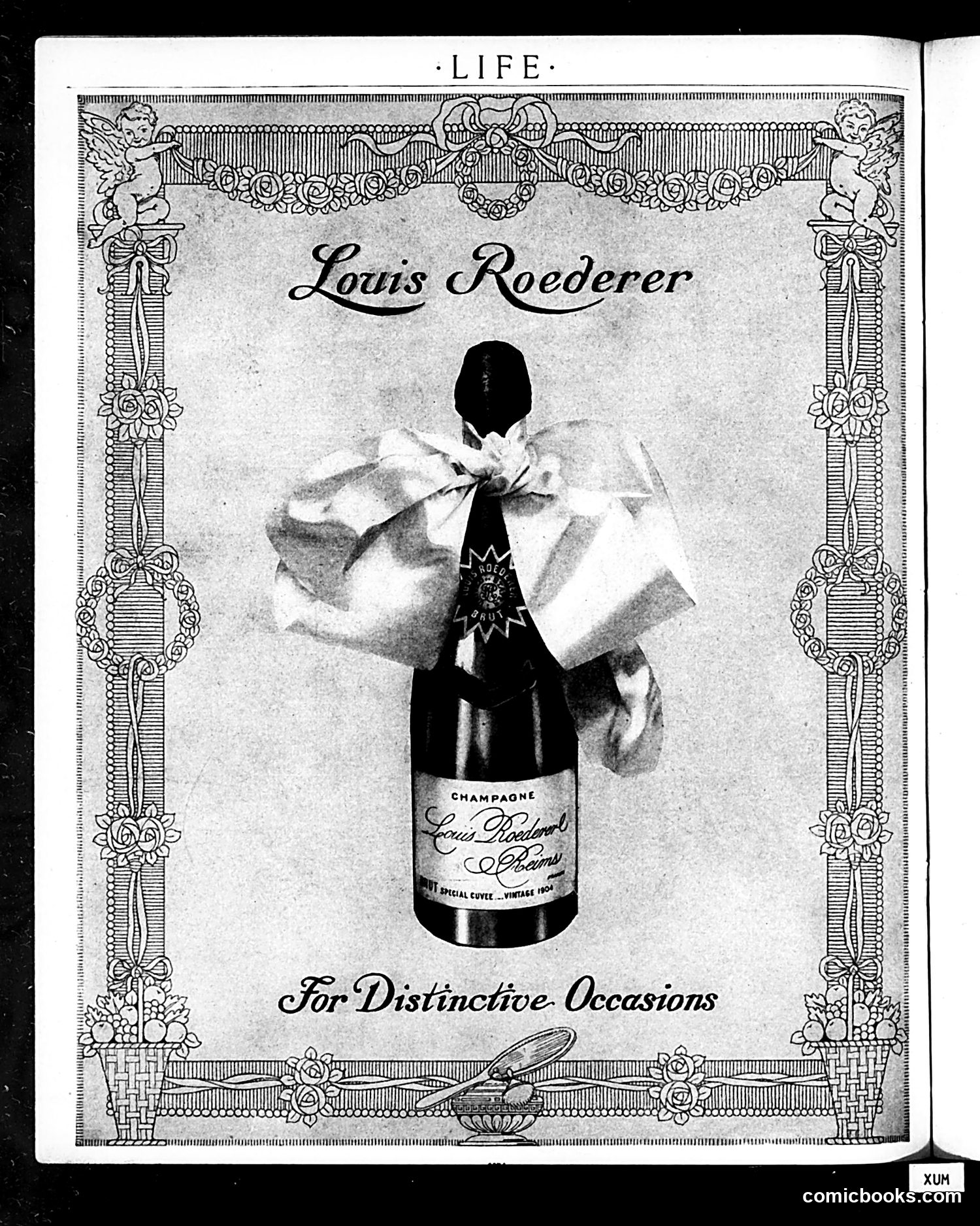
This is a **straightforward advertisement**, not satire or political commentary. The page promotes **Louis Roederer Champagne** from the Champagne region of France. The elegant Art Deco-style border with cherubs and ornamental design signals luxury goods marketed to wealthy consumers. The bottle is displayed prominently with a large bow, presenting champagne as appropriate "For Distinctive Occasions"—a marketing pitch emphasizing exclusivity and refinement. There is no political cartoon or social satire present. This represents typical early-20th-century *Life* magazine advertising, which often appeared alongside satirical content. The presentation reflects period conventions: champagne as a status symbol for the upper class, feminine imagery (the bow), and aspirational marketing language common to luxury goods of this era.
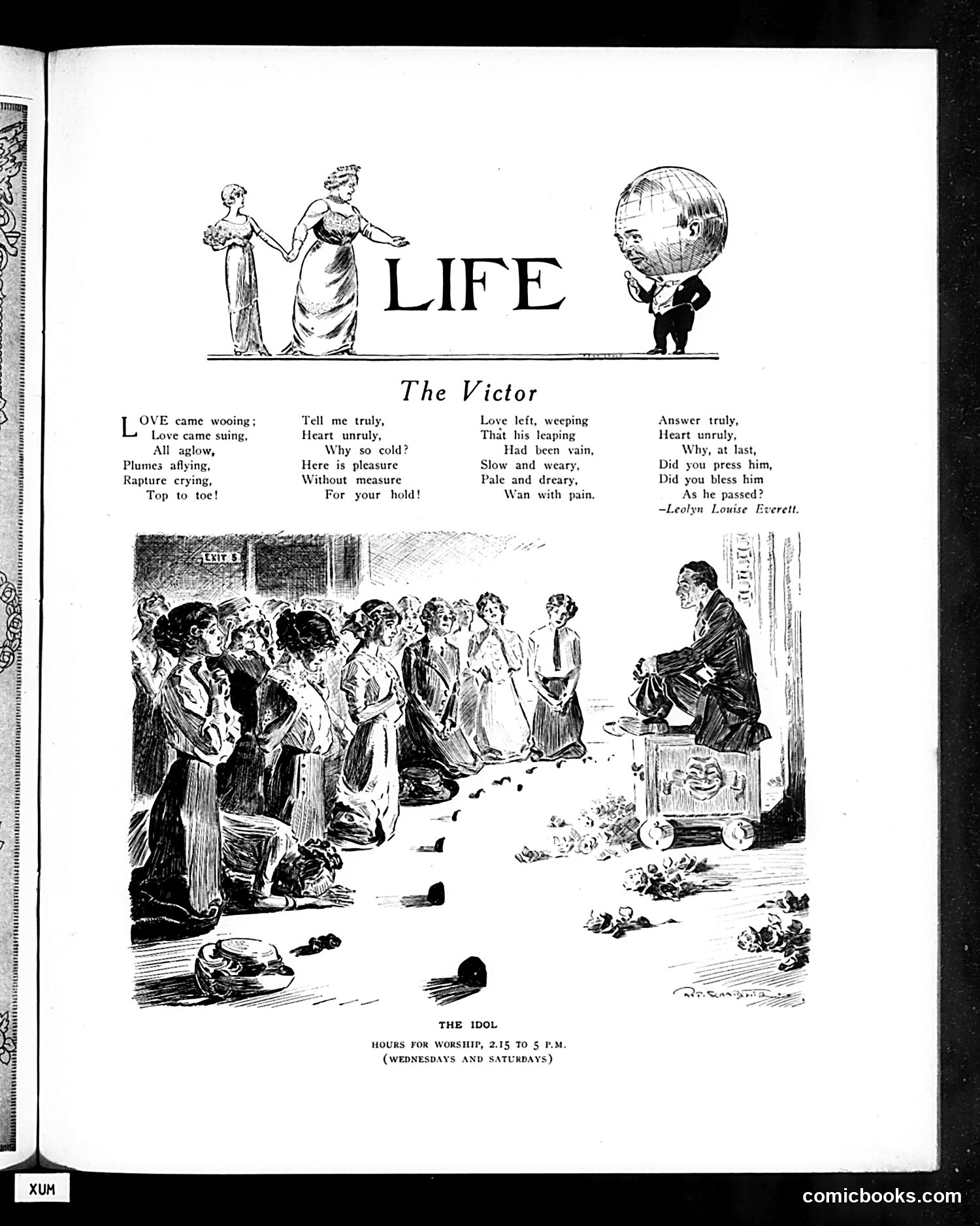
This page presents a poem titled "The Victor" by Loellyn Louise Everett, accompanied by a satirical illustration labeled "The Idol." The cartoon depicts a man sitting on a pedestal, holding an enormous globe, while a crowd of women gather below, apparently worshipping or adoring him. The poem's text—contrasting questions about love's coldness with inquiries about blessing—suggests the satire targets male ego and the worship of masculine authority. The illustration mocks how society elevates certain men to idol status despite their emotional inadequacy or moral failings. The "idol" sits literally above the crowd, suggesting the artificial elevation of mediocre male figures. The scattered flowers and devoted postures of the women below emphasize the satirical critique of female adoration toward unworthy men, a common theme in early 20th-century American satire about gender dynamics.
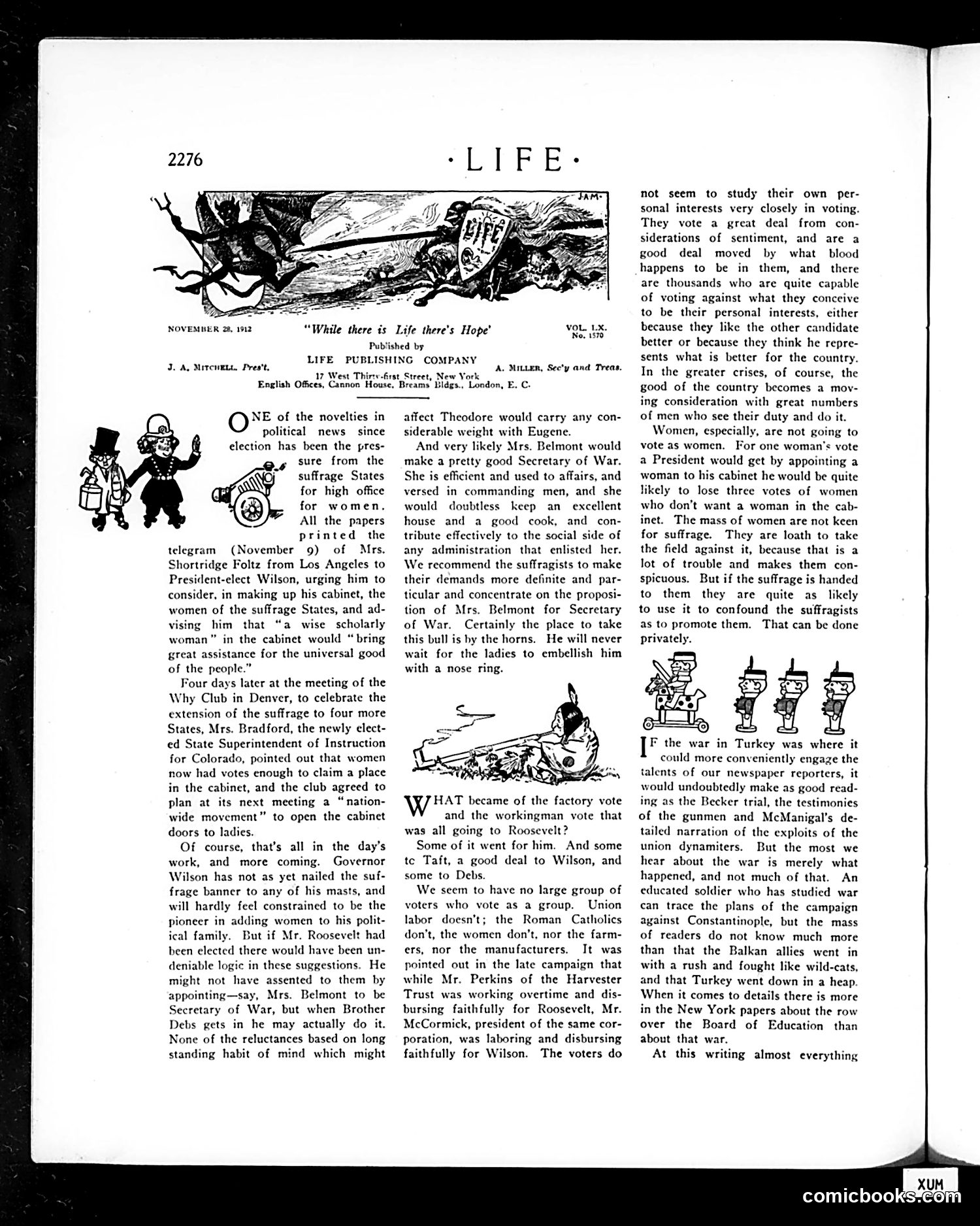
This page discusses the 1912 presidential election's aftermath, particularly women's voting participation. The main cartoon depicts a figure (appears to be President-elect Wilson based on context) lying exhausted or defeated, labeled with what looks like "PIPE," suggesting he's "smoked out" by election pressures. The text critiques women's voting patterns, noting they don't vote as a unified bloc like unions or manufacturers might. It discusses proposals to appoint women to cabinet positions—specifically mentioning Mrs. Belmont for Secretary of War as a satirical suggestion. The cartoon mockingly illustrates women suffragists' influence on the election, with the satire targeting both the new voting power women possessed and political figures attempting to court that vote.
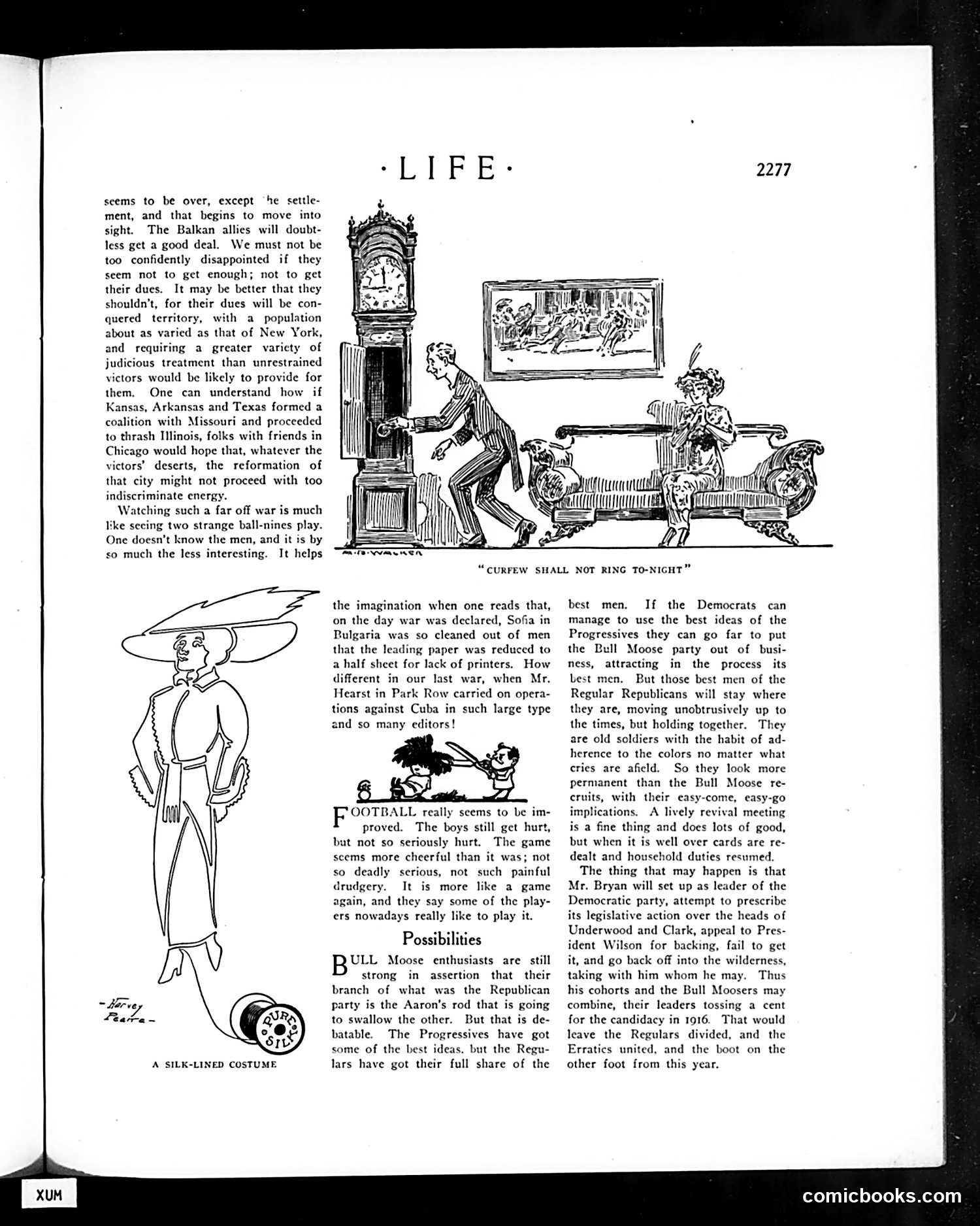
The page contains political commentary on the 1912 election. The main illustration captioned "Curfew Shall Not Ring To-Night" depicts an older man (likely representing a political figure) being put to bed by children, satirizing loss of power or influence. The text discusses the Bull Moose party (Theodore Roosevelt's Progressive split from Republicans) and suggests they may lack staying power. It references potential Democratic strategy under William Jennings Bryan, implying the Progressives could spoil Republican chances while remaining politically unstable. The fashion illustration labeled "A Silk-Lined Costume" appears unrelated to the political content. The commentary suggests uncertainty about whether the Bull Moose faction will maintain independence or reunite with Republicans before the 1916 election.
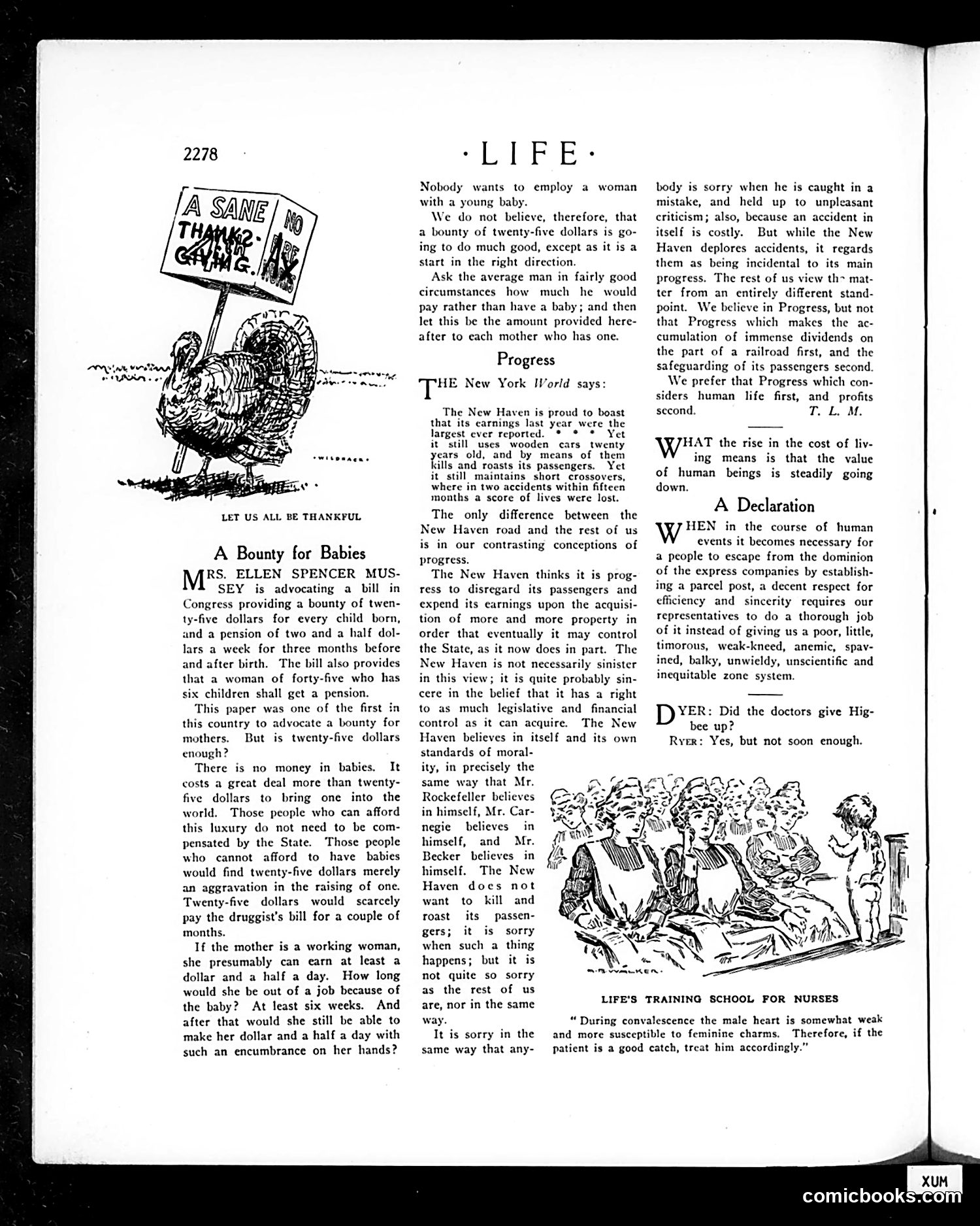
The main cartoon depicts a **turkey** holding a protest sign reading "A SANG THANK-GIVING" with additional text that appears sarcastic. The caption reads "LET US ALL BE THANKFUL." This is **Thanksgiving Day satire** — the cartoon ironically presents the turkey's perspective on a holiday where turkeys are traditionally killed and eaten. The turkey's protest sign mocks the notion of giving thanks, since the holiday is fundamentally about consuming poultry. The surrounding articles discuss social progress and industrial safety, contrasting sharply with the cartoon's dark humor about whose perspective matters during national celebrations. The satire critiques selective gratitude — Americans give thanks while ignoring the "sacrifices" required to make those celebrations possible.
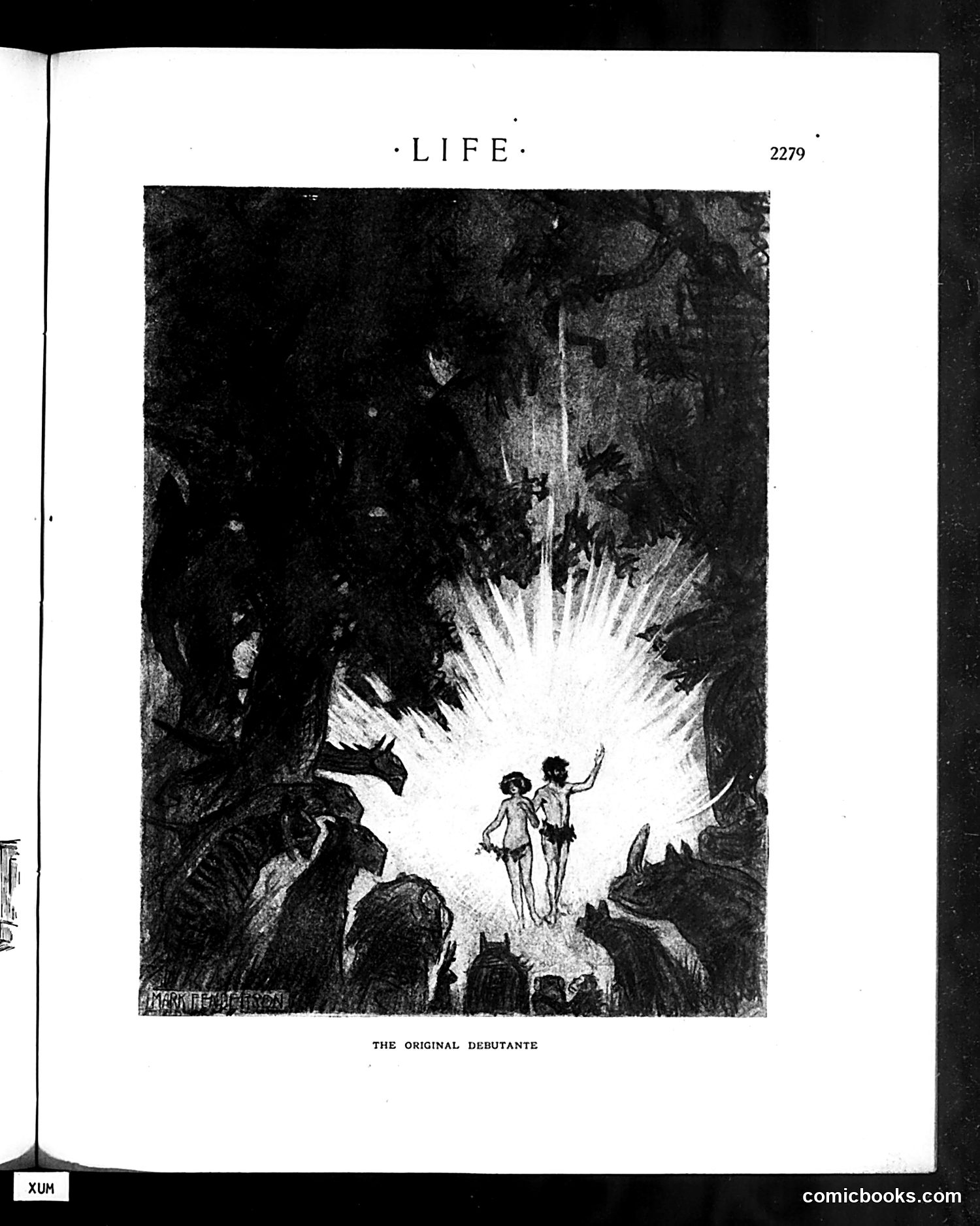
This cartoon satirizes the concept of a "debutante"—a young woman from an upper-class family making her formal social debut in society. The image shows two young figures standing in bright light, surrounded by dark, demonic or monstrous silhouettes, suggesting they are emerging from Hell or the underworld. The satire appears to mock debutante culture by implying these young women are "the original" debutantes—suggesting the tradition is infernal or morally corrupt in origin. The contrast between the innocent-looking young figures and the hellish surroundings creates dark humor about high society's pretensions and artificiality. Life magazine frequently lampooned wealthy society customs and their hypocrisy.
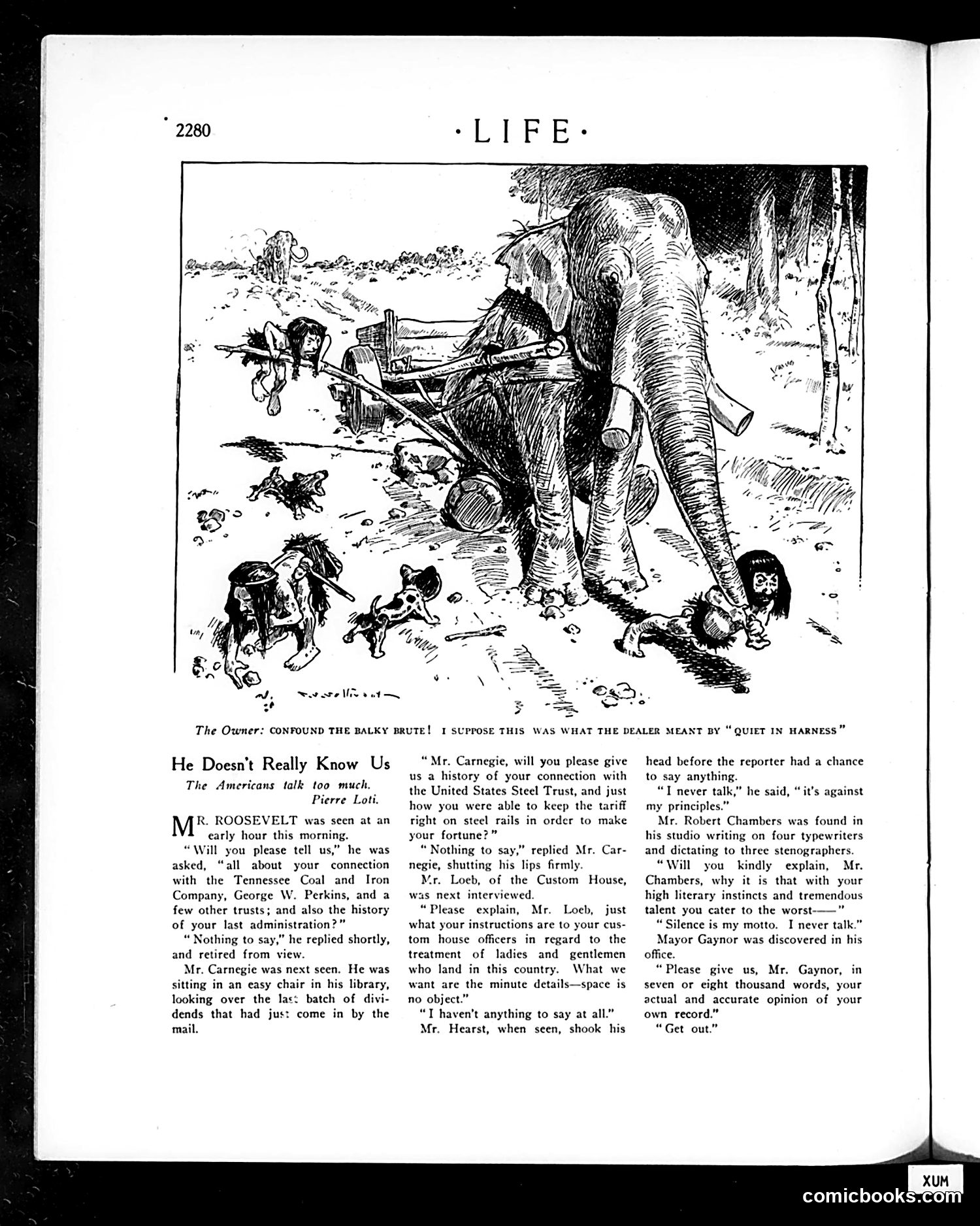
This cartoon satirizes **Andrew Carnegie**, the steel magnate, during a period when reporters sought interviews about his business practices and philanthropic activities. The image depicts Carnegie as a large elephant (a common metaphor for industrial power and monopoly) being ridden or controlled by smaller figures—likely representing business associates or political interests. The caption "COMPOUND THE BALKY BRUTE" suggests Carnegie is difficult to manage or uncooperative with the press. The accompanying text shows reporters trying unsuccessfully to get Carnegie to explain his connection to the **Tennessee Coal and Iron Company** and his influence on steel tariffs that benefited his fortune. The satire criticizes both Carnegie's reluctance for transparency and the broader public perception of industrialists as unaccountable powers.
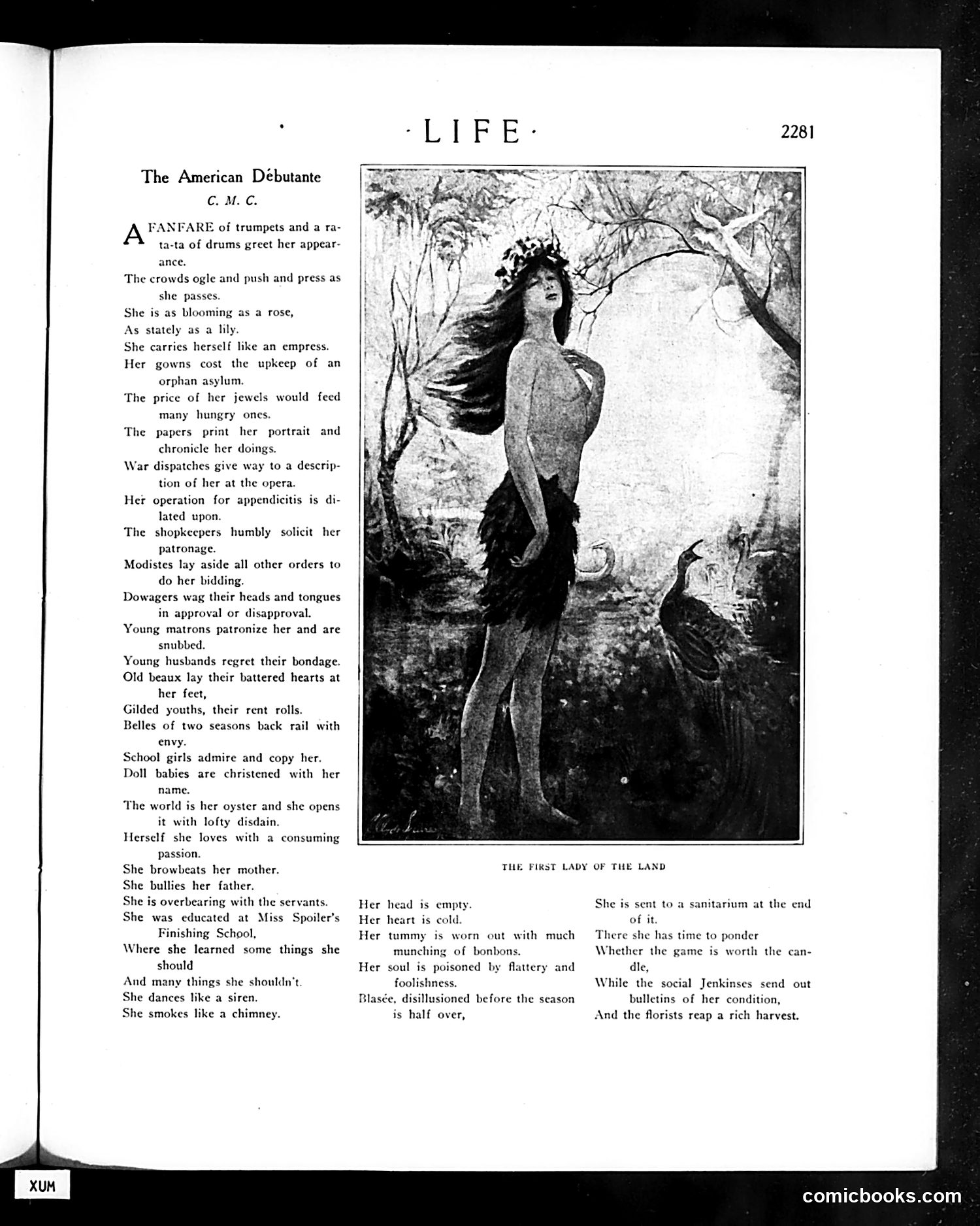
This poem mocks the privileged American debutante—a young woman presented to society. The accompanying illustration shows "The First Lady of the Land," a glamorous woman in an elegant gown. The satire critiques how society fawns over debutantes: crowds push to see her, newspapers cover her activities, wealthy suitors compete for her attention, and even servants seek her patronage. Yet beneath the glamour, the poem suggests emptiness—her "head is empty," "heart is cold," and "soul is poisoned by flattery." The commentary suggests that despite her education at exclusive schools and social prominence, she's intellectually hollow, morally compromised by vanity, and ultimately destined for sanitarium care—implying mental/moral breakdown. It's a cutting critique of aristocratic excess and the emptiness of status-obsessed society.
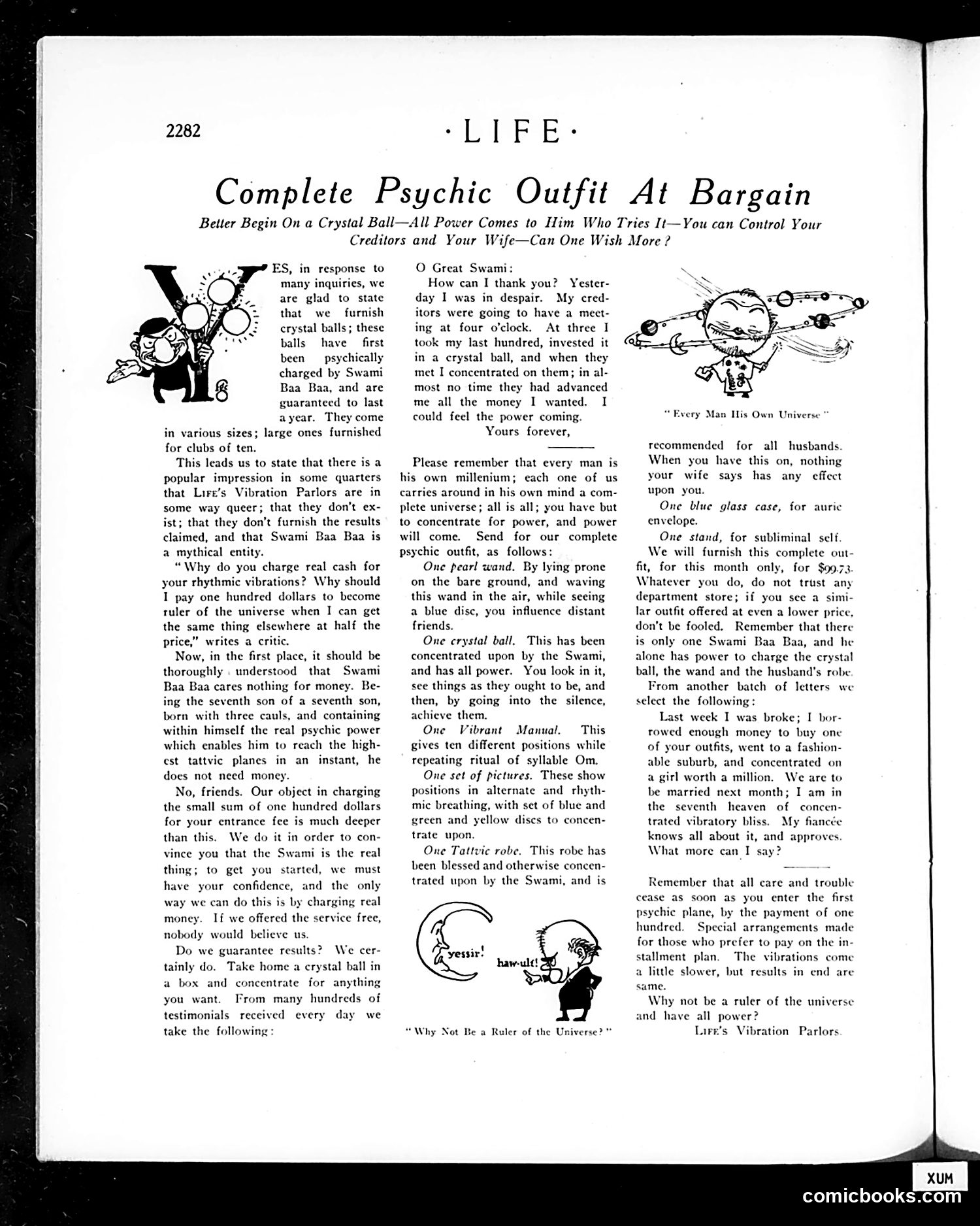
This page satirizes fraudulent psychic services and occult merchandise being marketed to the desperate and gullible. The main article mocks "Swami Baa Baa" (a play on words suggesting fakery), who charges high fees for crystal balls, wands, and robes purportedly blessed with psychic power. The cartoons ridicule the absurdity: one shows a man concentrating on a crystal ball while cosmic symbols float around him; another depicts someone asking "Why Not Be a Ruler of the Universe?" The satire exposes how practitioners exploit vulnerability—promising control over creditors, improving marriages, and gaining wealth through mystical concentration. The piece emphasizes the con: real results never materialize, yet customers pay premium prices for items available elsewhere at half the cost. Life mocks both the fake gurus and their credulous clientele.
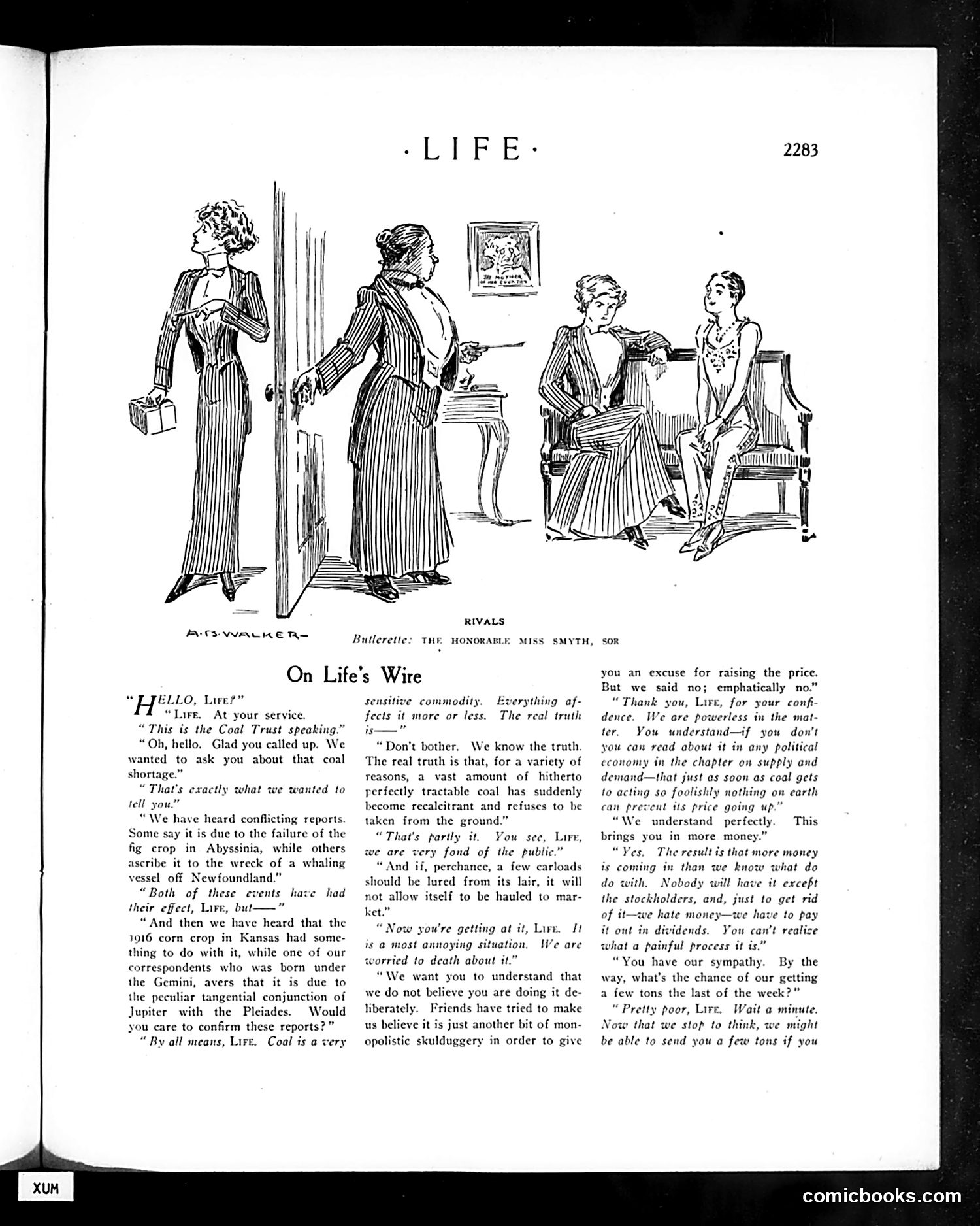
This is a satirical dialogue between "Life" (the magazine, personified) and representatives of the Coal Trust—the major coal companies monopolizing American energy supply. The joke exposes corporate dishonesty: the Coal Trust blames absurd external factors (Abyssinian fig crops, planetary conjunctions, Kansas corn) for coal shortages, when the real cause is deliberately withholding supply to artificially raise prices. Life's interviewer pretends to accept these ridiculous excuses while sarcastically pointing out the monopoly's true motive: profiteering. The Trust's complaint about having "too much money" from dividends is presented as laughably absurd. This mocks early 20th-century monopolistic practices and the public relations spin companies used to justify price gouging during shortages. The cartoon's female figures represent wealthy beneficiaries of the scheme, indifferent to ordinary citizens' suffering.
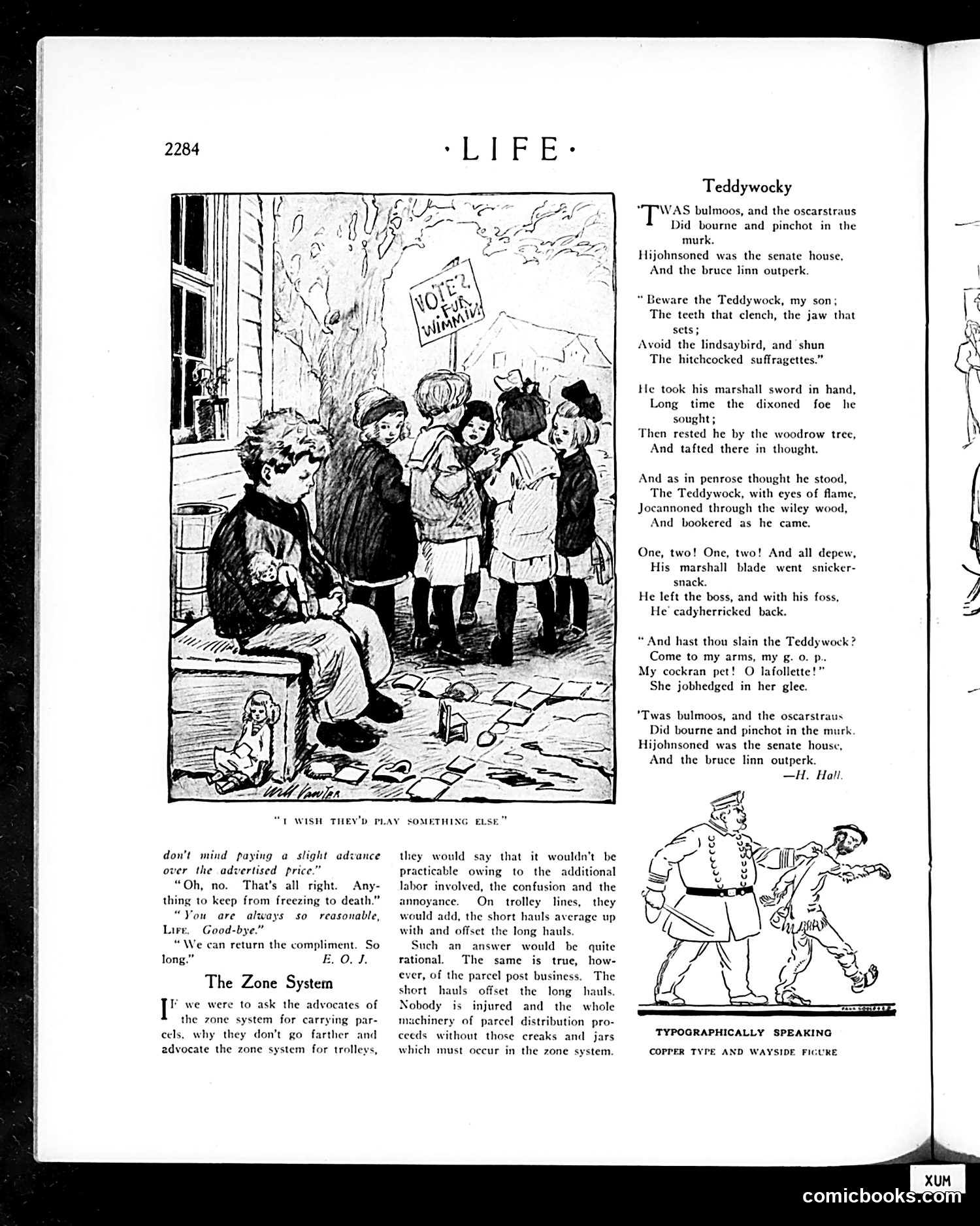
The main illustration shows children playing with a sign reading "NO TRESPASSING" while an adult sits nearby, captioning "I WISH THEY'D PLAY SOMETHING ELSE"—satirizing how children mimic adult anxieties about property and rules. **"Teddywocky"** is a parody of Lewis Carroll's "Jabberwocky," inserting early 1900s American political figures as nonsense words: Theodore Roosevelt ("Teddywock"), various senators and politicians ("Hijohnsoned," "Tafted," "Bookered"). The poem mocks Roosevelt's aggressive political style and the Senate's complex internal struggles, presenting political combat as absurdist fantasy. The satire suggests the political drama is theatrical and somewhat meaningless. **"The Zone System"** discusses parcel post pricing—a contemporary policy debate about whether mail should cost more for longer distances. The author argues the logic is flawed, since short hauls already offset long ones in the system, mirroring trolley-line economics.
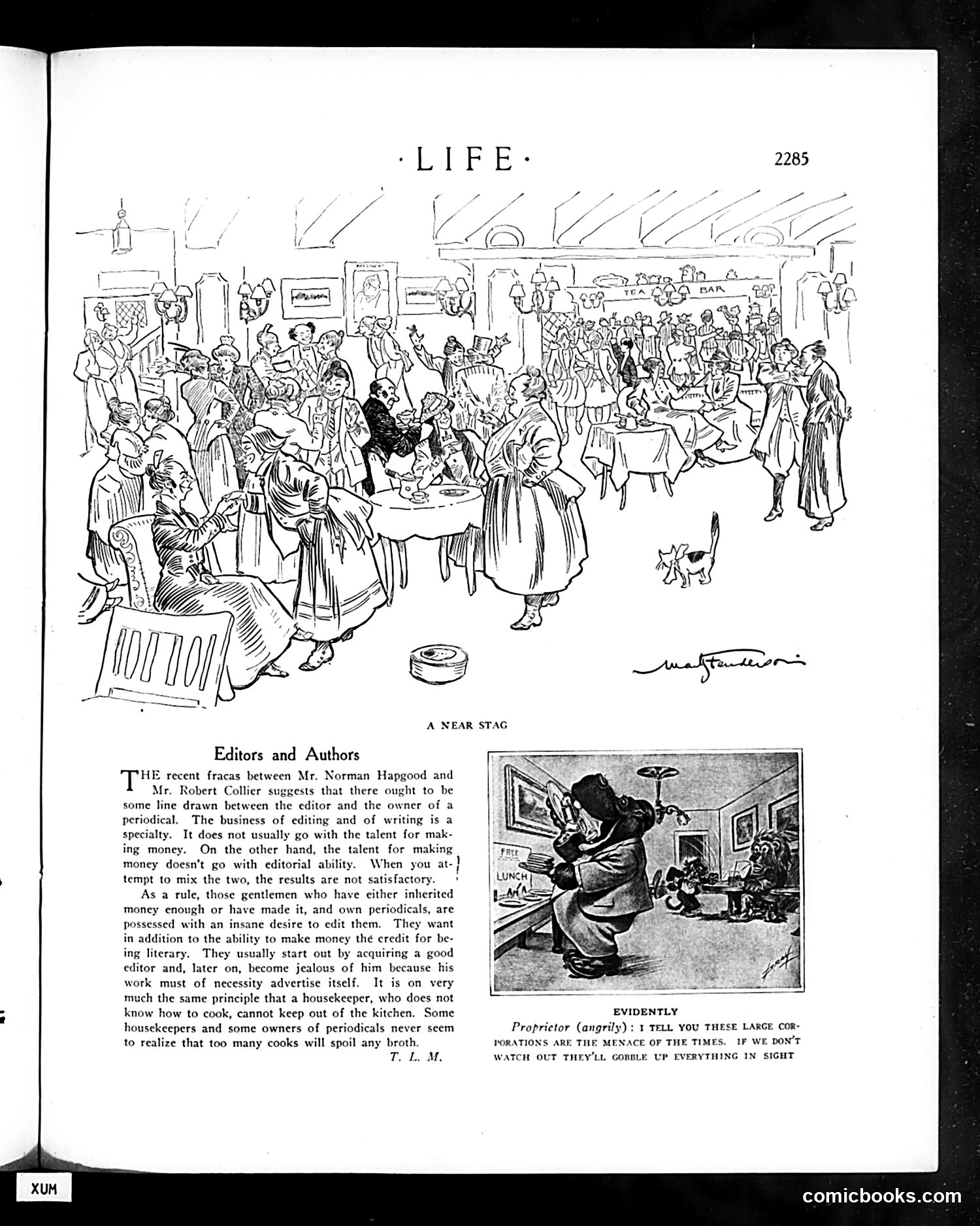
This page satirizes the conflict between magazine owners and editors. The text references a real dispute between Norman Hapgood (editor) and Robert Collier (owner of Collier's magazine), arguing they represent incompatible skill sets. The article's central point: wealthy men who own periodicals often insist on editing them too, driven by vanity—wanting literary credit alongside financial success. This creates dysfunction, as business acumen differs fundamentally from editorial talent. The "too many cooks" metaphor emphasizes how owner interference ruins editorial quality. The small cartoon below illustrates this hypocrisy: a proprietor rants about large corporations threatening small businesses, apparently unaware (or unconcerned with) his own exploitative practices. The joke is the proprietor's blindness to how he himself embodies the corporate menace he denounces—a wealthy owner meddling in operations beyond his expertise.
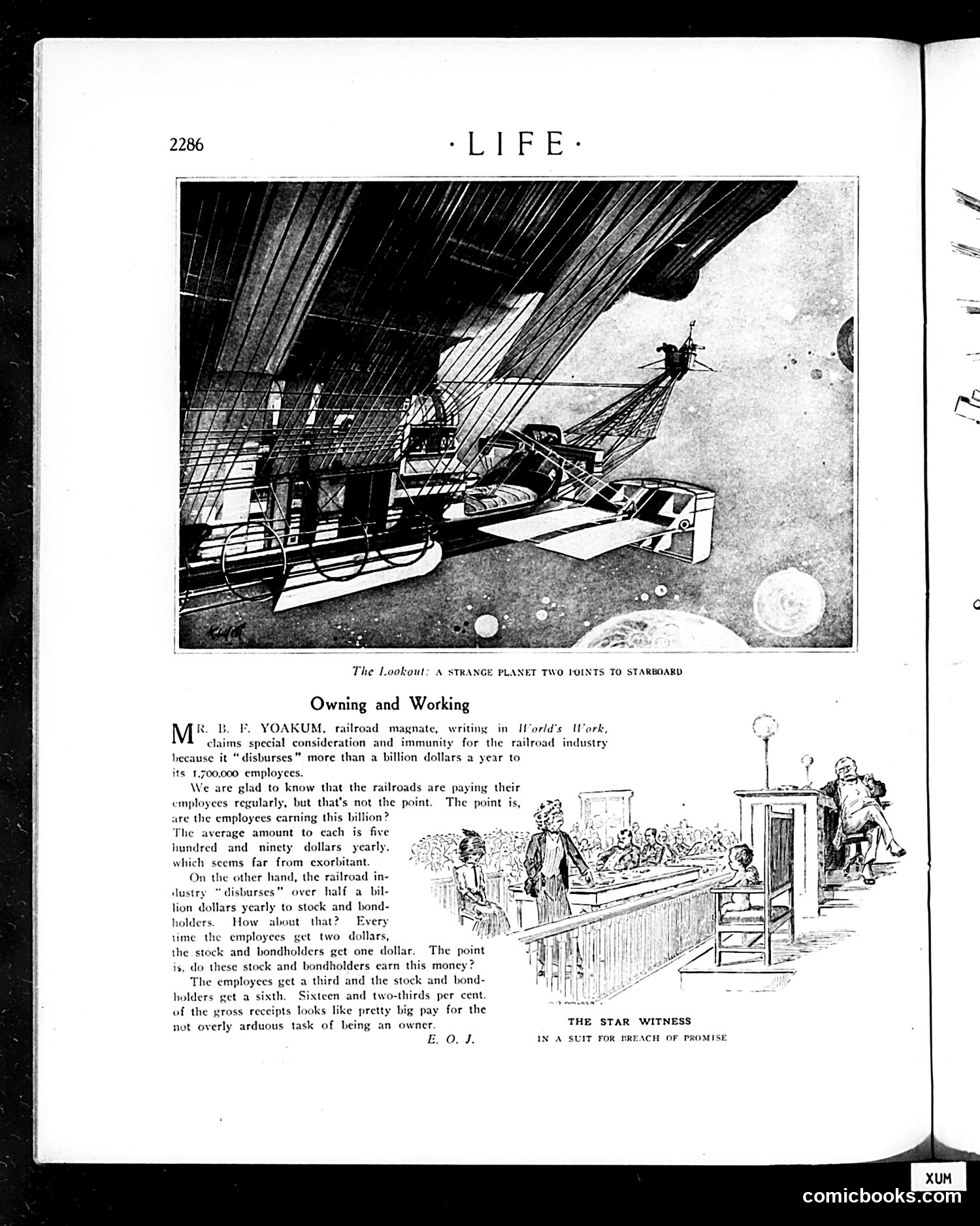
This page critiques railroad industry inequality through commentary on railroad magnate **H.B.F. Yoakum's** claims in *World's Work* magazine. **The Argument:** Yoakum argued railroads deserved special consideration because they paid $1 billion yearly to 1.7 million employees (averaging $590/year). Life's response: that's not generous—it's the *minimum*. **The Satire's Point:** Life exposes the real disparity: while employees receive one-third of gross receipts, stockholders and bondholders receive one-sixth—yet do no actual work. For every $2 workers earn, owners pocket $1, despite merely owning (the "not overly arduous task of being an owner"). **The Cartoons:** - Top: "The Lookout"—appears to be science-fiction satire (unrelated to main article) - Bottom: "The Star Witness"—depicts a courtroom breach-of-promise suit, likely illustrating broken promises to workers or the public **Context:** This reflects Progressive Era criticism of railroad monopolies and wealth inequality—questioning whether mere ownership justified such outsized profits.
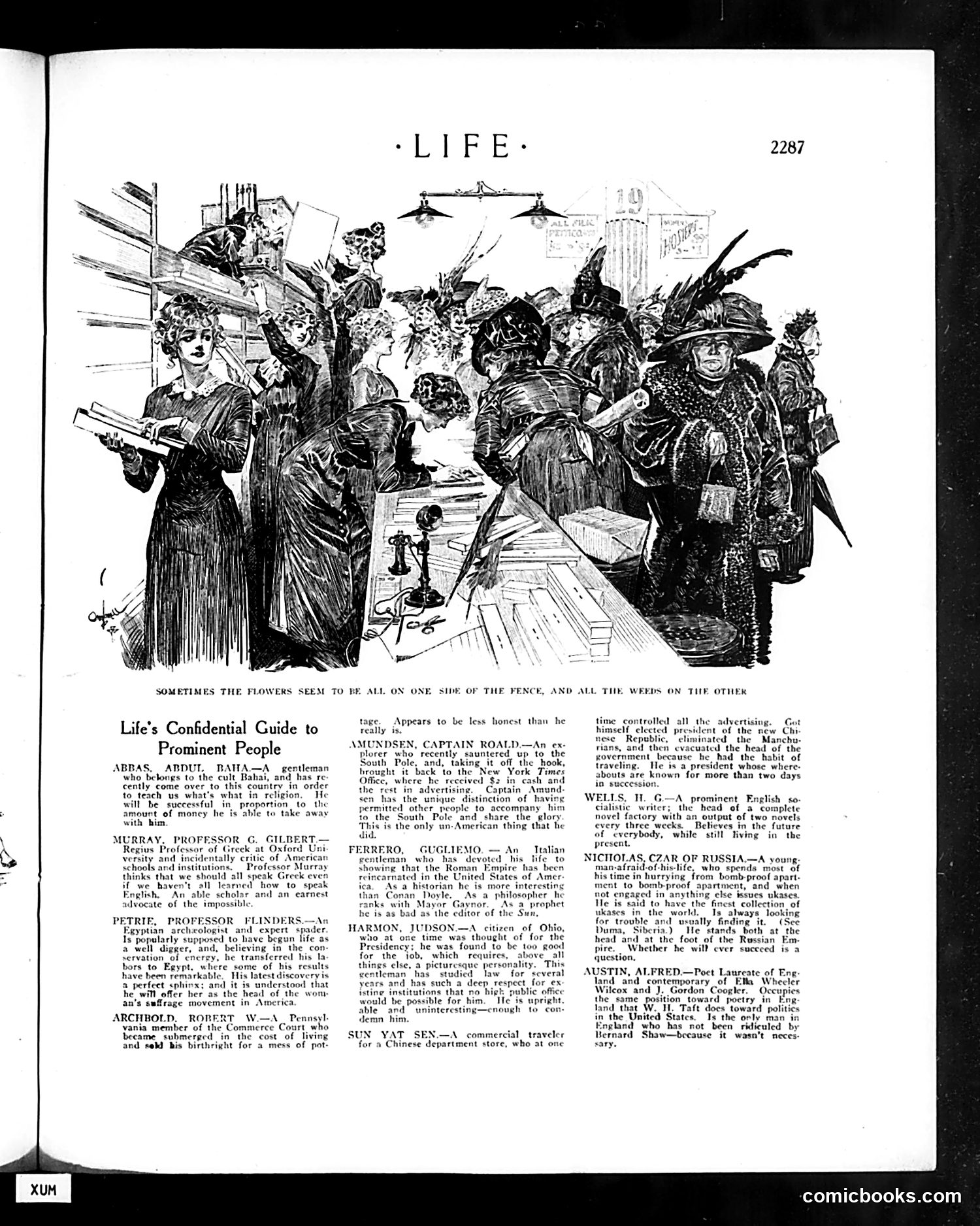
This is a satirical character guide mocking famous public figures of the early 1900s. The illustrated header shows elaborately dressed socialites and prominent people of the era. The satirical entries use humor to critique their subjects: - **Abdul Baha** (Bahai religious leader): Accused of coming to America primarily for money - **Captain Roald Amundsen** (Arctic explorer): Mocked for letting the New York Times profit from his South Pole expedition - **Judson Harmon** (Ohio politician/presidential prospect): Too honest and upright for politics - **Sun Yat Sen** (Chinese revolutionary): Portrayed dismissively as merely a "commercial traveler" whose location is unpredictably mobile - **H.G. Wells**: Criticized as a prolific but superficial novelist - **Tsar Nicholas II**: Depicted as paranoid and ineffectual, constantly fleeing bomb threats - **Alfred Austin** (Poet Laureate): So mediocre that even George Bernard Shaw wouldn't bother ridiculing him The satire targets pomposity, incompetence, and hypocrisy among the international elite.
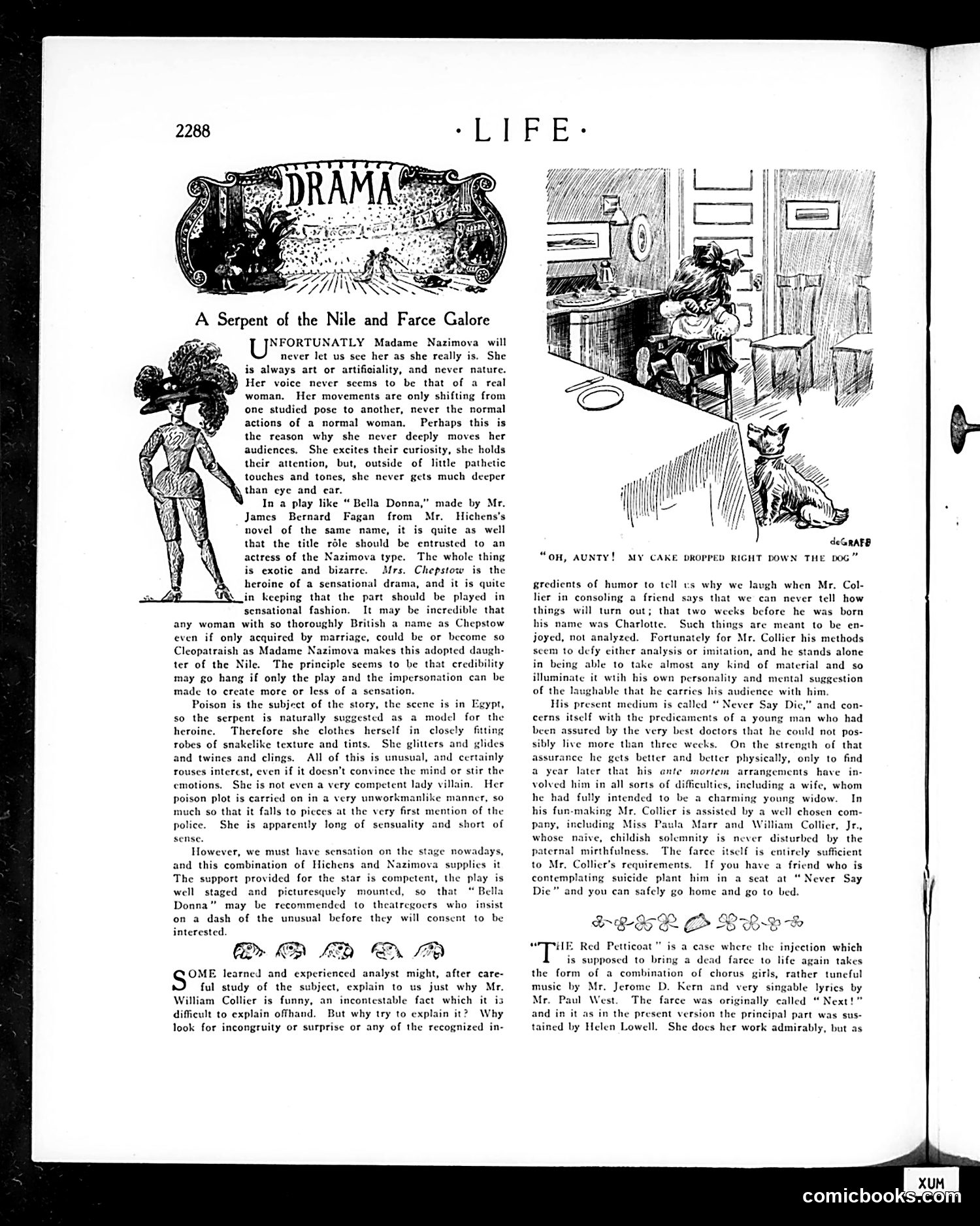
This page reviews two theatrical productions from the early 20th century. **"Bella Donna"** features actress Alla Nazimova in an exotic Egyptian drama about poisoning. The critic dismisses her performance as artificially stylized—all studied poses and "sensational" costuming (snakelike robes, glittering movements) designed to excite curiosity rather than genuine emotion. The review suggests her theatricality works here *because* the play itself is implausibly bizarre, though the poisoning plot itself falls apart unconvincingly. **"Never Say Die"** stars William Collier in a comedy about a man doctors gave three weeks to live who unexpectedly survives, creating matrimonial complications. The critic admits Collier's humor defies analysis—his comedy comes from personality and timing rather than traditional joke construction (illustrated by the example about being named "Charlotte" before birth). A cartoon caption shows a domestic mishap ("My cake dropped right down the dog"). Both reviews praise competent production values while noting the appeal lies in spectacle and star personality rather than narrative substance.
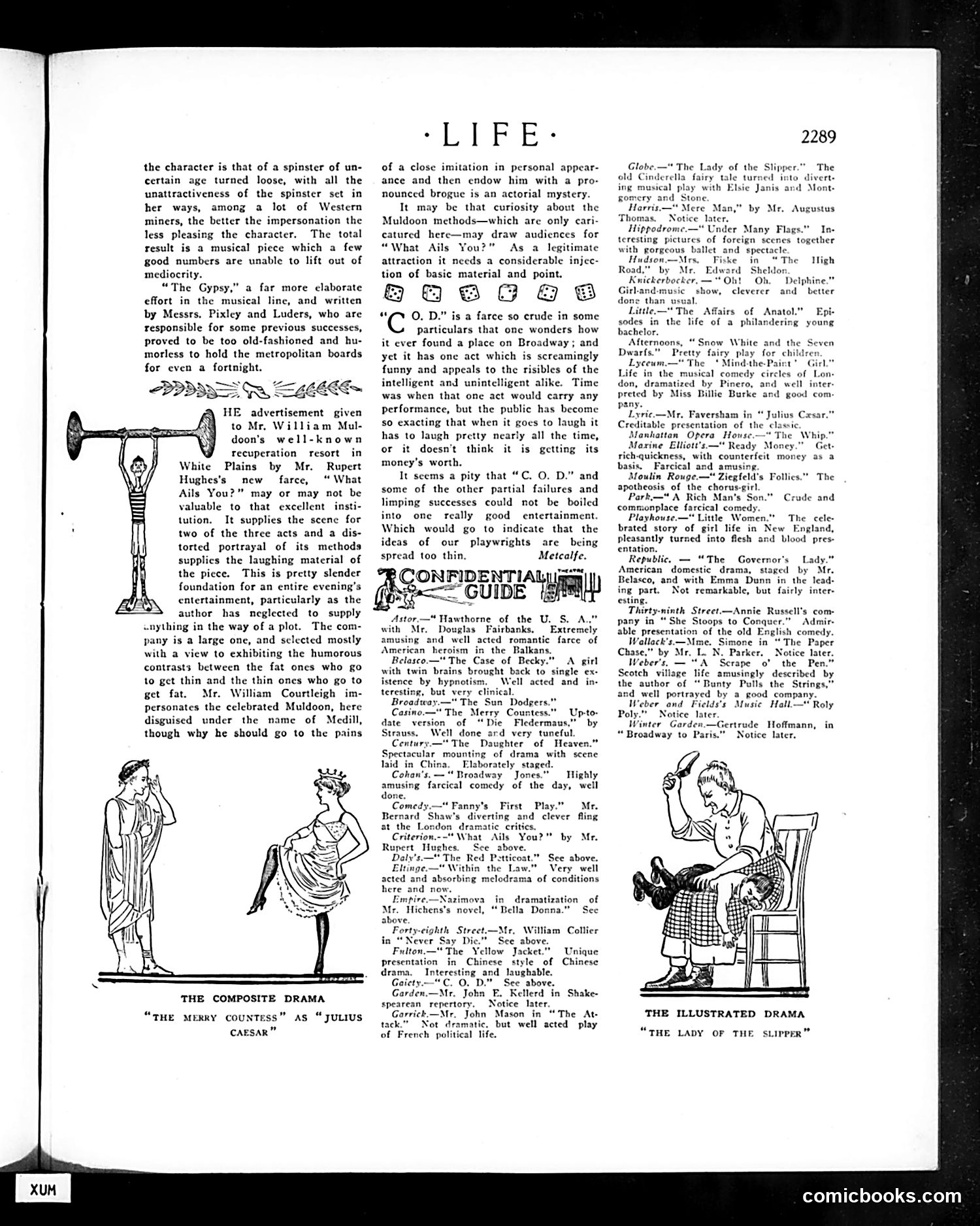
This page reviews Broadway plays with satirical commentary. The left cartoon shows "The Merry Countess" (an operetta based on Strauss's "Die Fledermaus") reimagined as Shakespeare's "Julius Caesar"—a visual joke about how the same production could be reinterpreted with different costumes and framing, mocking theatrical pretension. The main text critiques several shows: "What Ails You?" by Rupert Hughes is dismissed for using William Muldoon's real health resort as mere scenery without genuine plot; "C.O.D." is called crudely written but has one genuinely funny act; the reviewer laments that Broadway's public now demands consistent entertainment throughout rather than accepting single standout moments. The right illustration shows "The Lady of the Slipper," likely another contemporary production. The "Confidential Guide" lists current Broadway shows with brief reviews, typical of Life's theater criticism of this era.
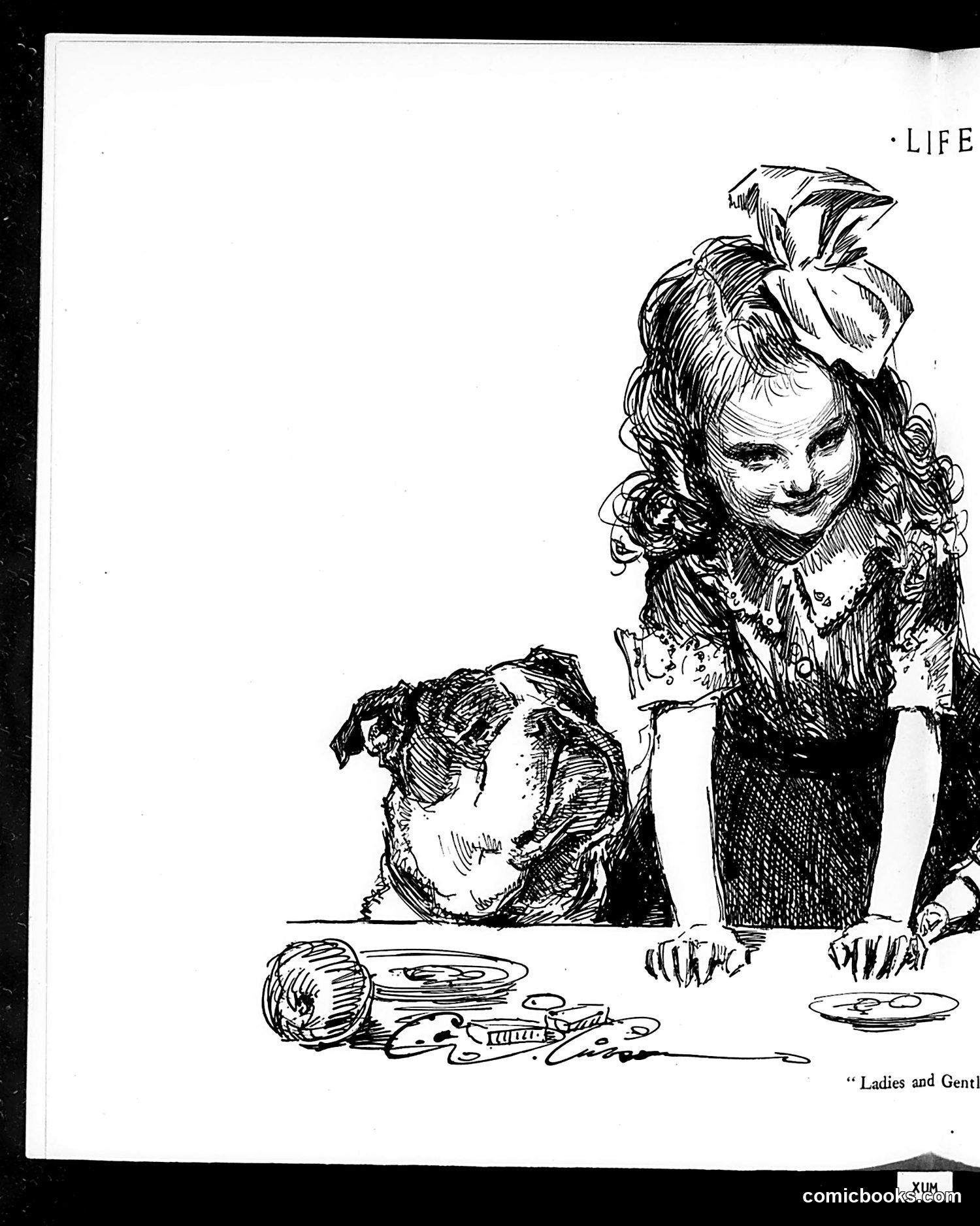
This page from *Life* magazine shows a sketch of a young girl with a large bow in her hair standing at a table with a dog. On the table are plates, utensils, and what appears to be food. The girl looks down at the dog with a slight smile. The caption begins "Ladies and Gentl[emen]" (cut off), suggesting this is likely a humorous domestic scene about children's behavior or manners at mealtime. The dog's presence and positioning suggests the joke concerns a child secretly feeding food to a pet under the table—a common mischievous behavior. The satire appears to target either children's sneaky habits or parental supervision during meals, typical subject matter for *Life*'s social commentary on American family life.
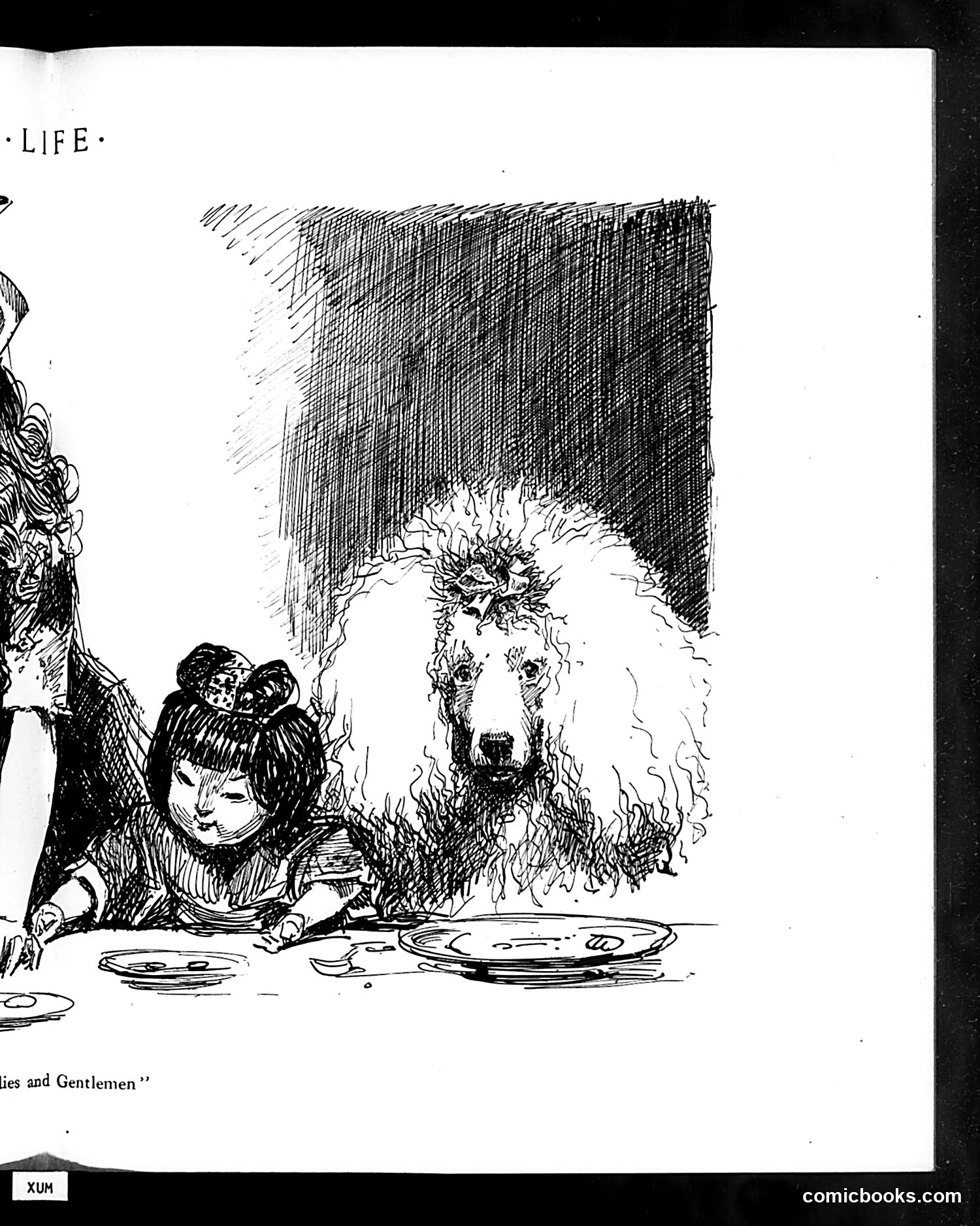
This *Life* magazine cartoon depicts a young child and a large, fluffy dog (possibly a Standard Poodle or similar breed) sitting at a dining table with empty plates. The dark background suggests an interior domestic scene. The cartoon appears to satirize wealth disparity or class differences—likely commenting on contrasting living conditions or meal quality between the privileged and less fortunate. The juxtaposition of the well-groomed, well-fed dog alongside the child suggests irony about priorities: perhaps critiquing how pets receive better care than children, or how the wealthy lavish resources on animals while others go hungry. The phrase "Ladies and Gentlemen" (partially visible) hints at formal social pretense masking uncomfortable realities—a common *Life* magazine satirical device.
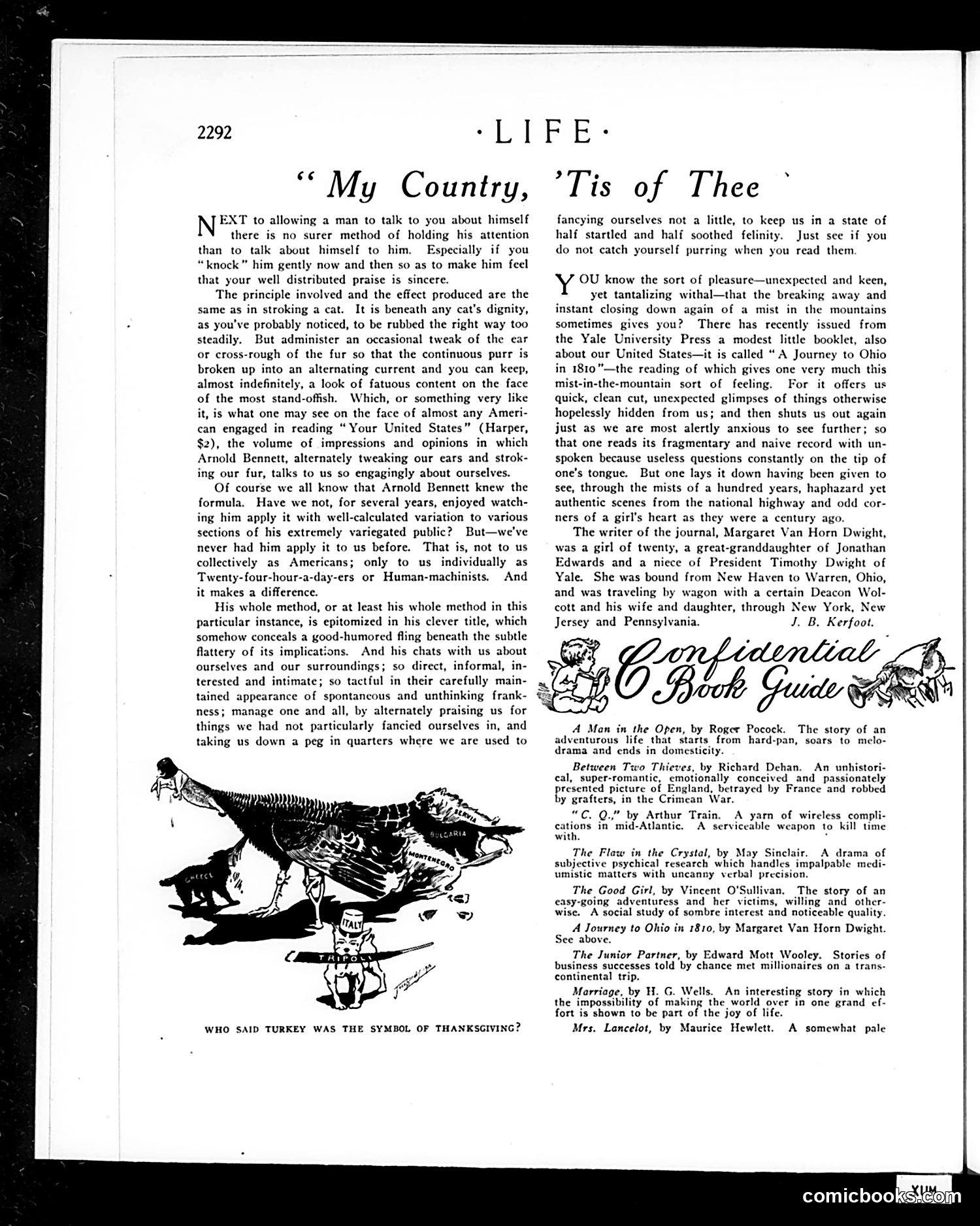
This page contains two distinct items: **Main Article**: A review of Arnold Bennett's book *"Your United States"* (Harper, $2). The critic uses an extended metaphor comparing Bennett's flattery technique to stroking a cat—he alternately praises and gently mocks Americans to keep them engaged and "purring." The satire suggests Bennett has mastered the formula of making people feel simultaneously complimented and subtly insulted, keeping them reading despite (or because of) the backhanded compliments. **Secondary Review**: A notice of *"A Journey to Ohio in 1810,"* a Yale University Press publication featuring the diary of Margaret Van Horn Dwight, a twenty-year-old great-granddaughter of Jonathan Edwards traveling westward. It's praised for offering brief, authentic historical glimpses. **The Cartoon**: Shows a turkey being stroked/manipulated, illustrating the "cat-stroking" metaphor discussed in the Bennett review—a visual joke about how skillful manipulation keeps subjects compliant.
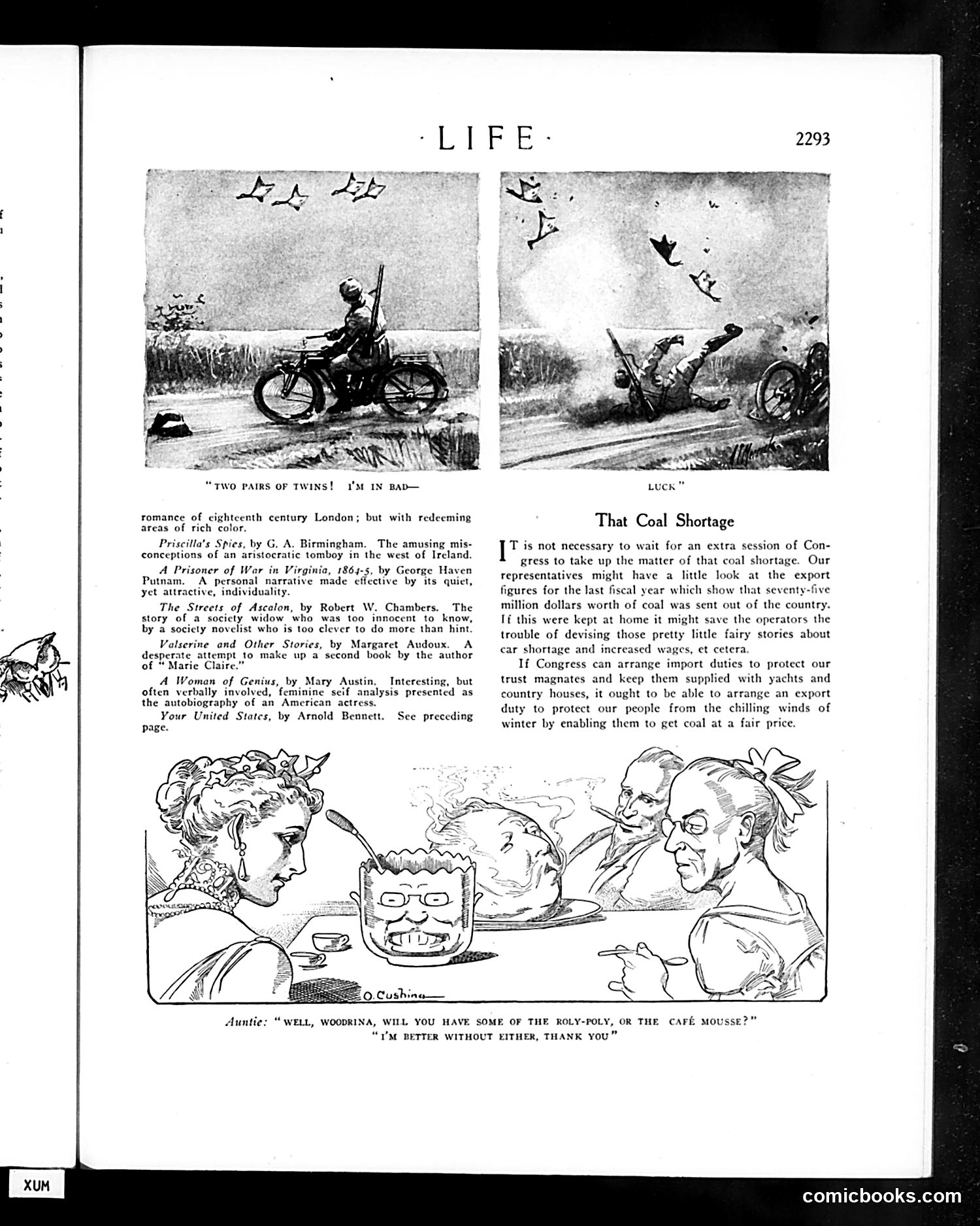
This page contains book reviews, a political editorial, and two cartoons. **Top images:** Two comic panels showing a motorcycle accident sequence, captioned "Two Pairs of Twins! I'm in Bad—" and "Luck." This is a sight gag about a rider causing a crash. **"That Coal Shortage" editorial:** A pointed critique of wartime/postwar economic policy. The author argues Congress shouldn't need a special session to address coal shortages—the real problem is that seventy million dollars worth of coal was *exported* rather than kept domestic. The piece sarcastically suggests that if Congress can impose import duties to protect wealthy industrialists' yachts and country houses, it should impose export duties to ensure common people can afford heating coal at fair prices. This reflects frustration with perceived government favoritism toward business interests over working people's welfare. **Bottom cartoon by O. Cushing:** Shows an aunt offering a young woman ("Woodrina") elaborate desserts—"roly-poly" and "café mousse"—while the girl declines both. The joke appears to mock overly fancy or pretentious food offerings, likely satirizing upper-class affectation or wartime food rationing/scarcity concerns.
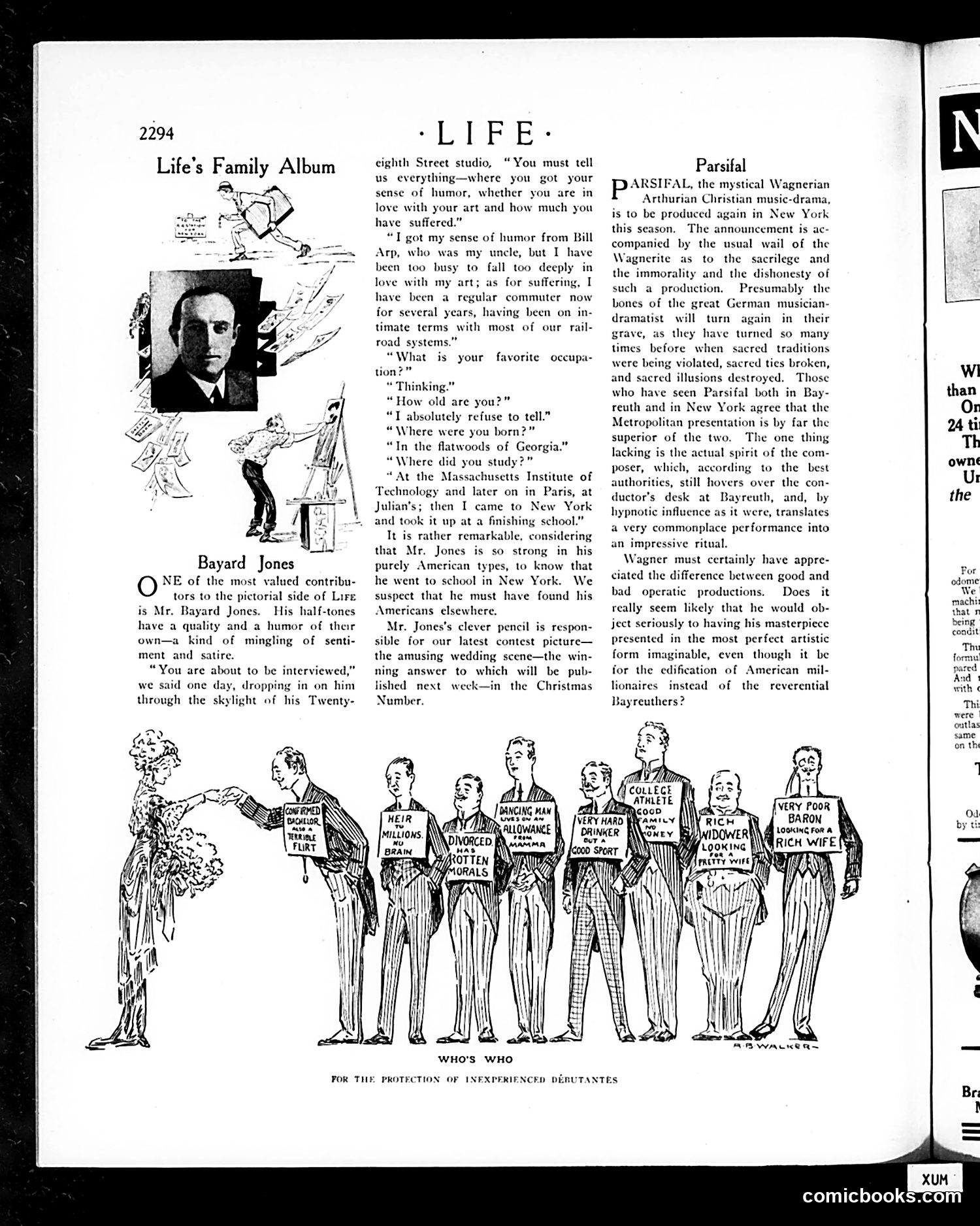
**Main Content: Bayard Jones Profile** This is a biographical feature on cartoonist/illustrator Bayard Jones, a regular contributor to *Life* magazine. The interview covers his background (trained in Paris and New York), sense of humor (inherited from Uncle Bill Arp), and current work on a wedding-scene cartoon contest for the Christmas issue. **Bottom Cartoon: "Who's Who"** The satirical cartoon depicts various male "types" available as potential husbands, each labeled with stereotypical characteristics: "Heir with Brain," "Divorced with Morals," "College Athlete," "Very Hard Drinker," "Rich Widower," and "Very Poor Baron." The caption reads "FOR THE PROTECTION OF INEXPERIENCED DEBUTANTES," sarcastically suggesting this is a guide to help young wealthy women choose suitable (or unsuitable) matches. The humor lies in exposing how debutantes actually evaluated marriage prospects—wealth, social status, and moral compromises often outweighed character. **Parsifal Section** Brief commentary on the upcoming Metropolitan Opera production of Wagner's opera, dismissing hand-wringing about American productions violating the composer's intentions.
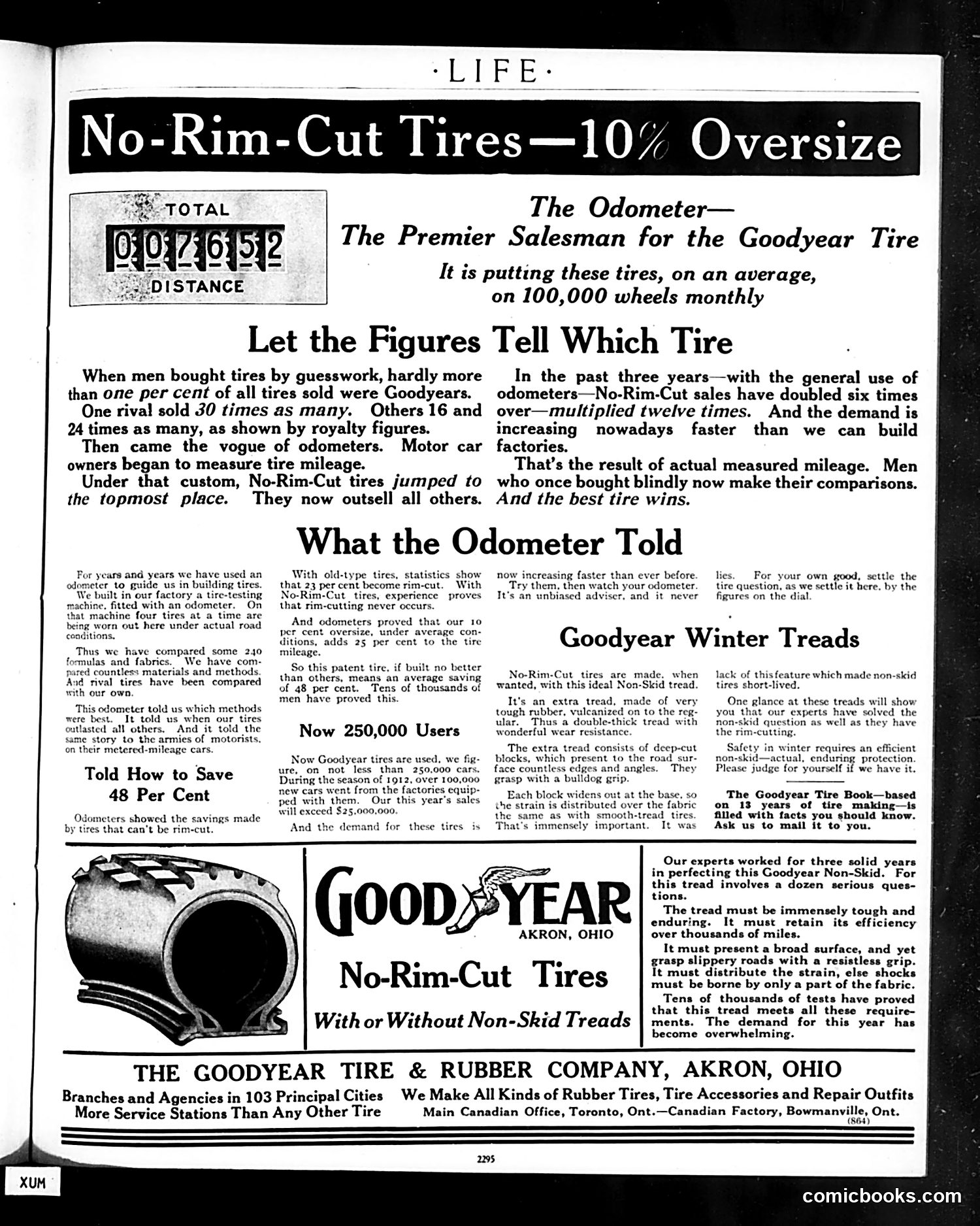
This is **not satire or political commentary**—it's a straightforward Goodyear Tire Company advertisement from around 1912-1913. The "cartoon" is simply a drawing of a tire with an odometer dial, illustrating the ad's central claim: that Goodyear proved their tires' superiority through **measured, objective testing** rather than guesswork or marketing hype. The key argument: when car owners began using odometers to track actual mileage, Goodyear No-Rim-Cut tires dramatically outsold competitors (jumping from minimal market share to 250,000 users). The implication is that empirical data—what the odometer "tells"—reveals the best product wins. For modern readers, this reflects early 20th-century marketing's pivot toward **scientific claims and measurable proof**, contrasting with older "blind" purchasing based on brand loyalty or salesmanship alone. The ad appeals to a newly mechanized, measurement-conscious consumer.
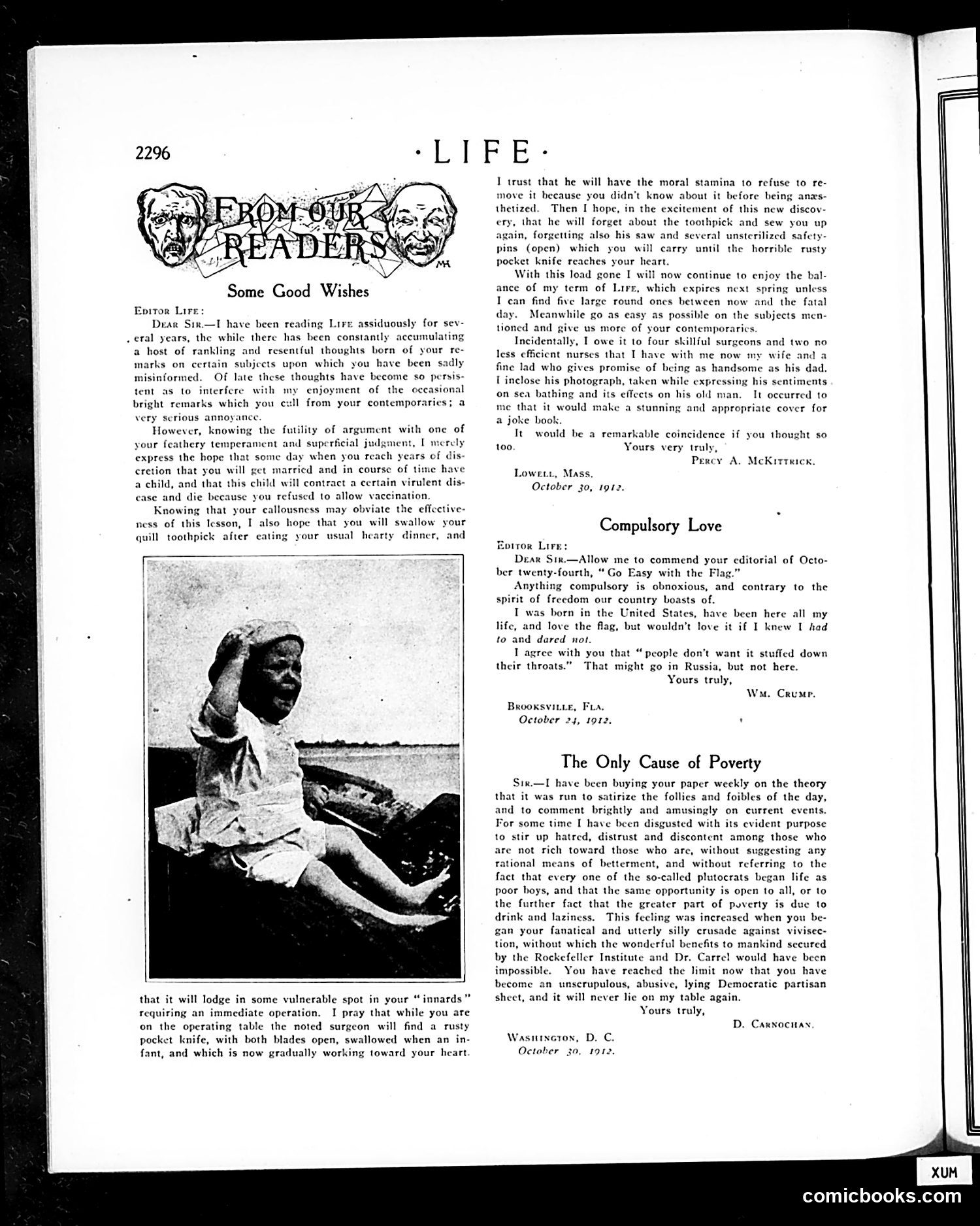
This page contains three reader letters to Life's editor—a format common in magazines of this era. Rather than a political cartoon, it's a "Letters to the Editor" section showcasing reader response to Life's editorial positions. The letters reveal Life's satirical stance on contemporary issues: The first writer sarcastically condemns Life's anti-vaccination stance with dark wishes for the editor's demise. The second defends Life's editorial against "compulsory" patriotism, criticizing forced flag reverence. The third accuses Life of fomenting class hatred by attacking the wealthy without acknowledging that "plutocrats began life as poor boys." Together, these letters show Life wielded considerable influence on Progressive-era debates about public health, nationalism, and wealth inequality—and that readers engaged actively with its positions, whether in agreement or protest.

This is primarily a **commercial advertisement**, not satire or political commentary. It promotes Garford trucks by emphasizing their selection for the Catskill Aqueduct project—a massive infrastructure undertaking supplying water to New York City (600 million gallons daily to 6 million people, costing over $209 million and spanning 85+ miles). The advertisement uses the aqueduct's scale and importance as credibility. It stresses that contractors chose Garford trucks after testing competitors, and highlights how time-sensitive this project was (contracts included penalty clauses for delays). The copy argues that if Garford trucks proved essential for "the world's biggest contracting job," they can help any business needing hauling services. The illustration shows Garford trucks operating at the aqueduct's construction site. This is straightforward industrial-era marketing: leverage a prestigious public project to sell commercial vehicles to other businesses.
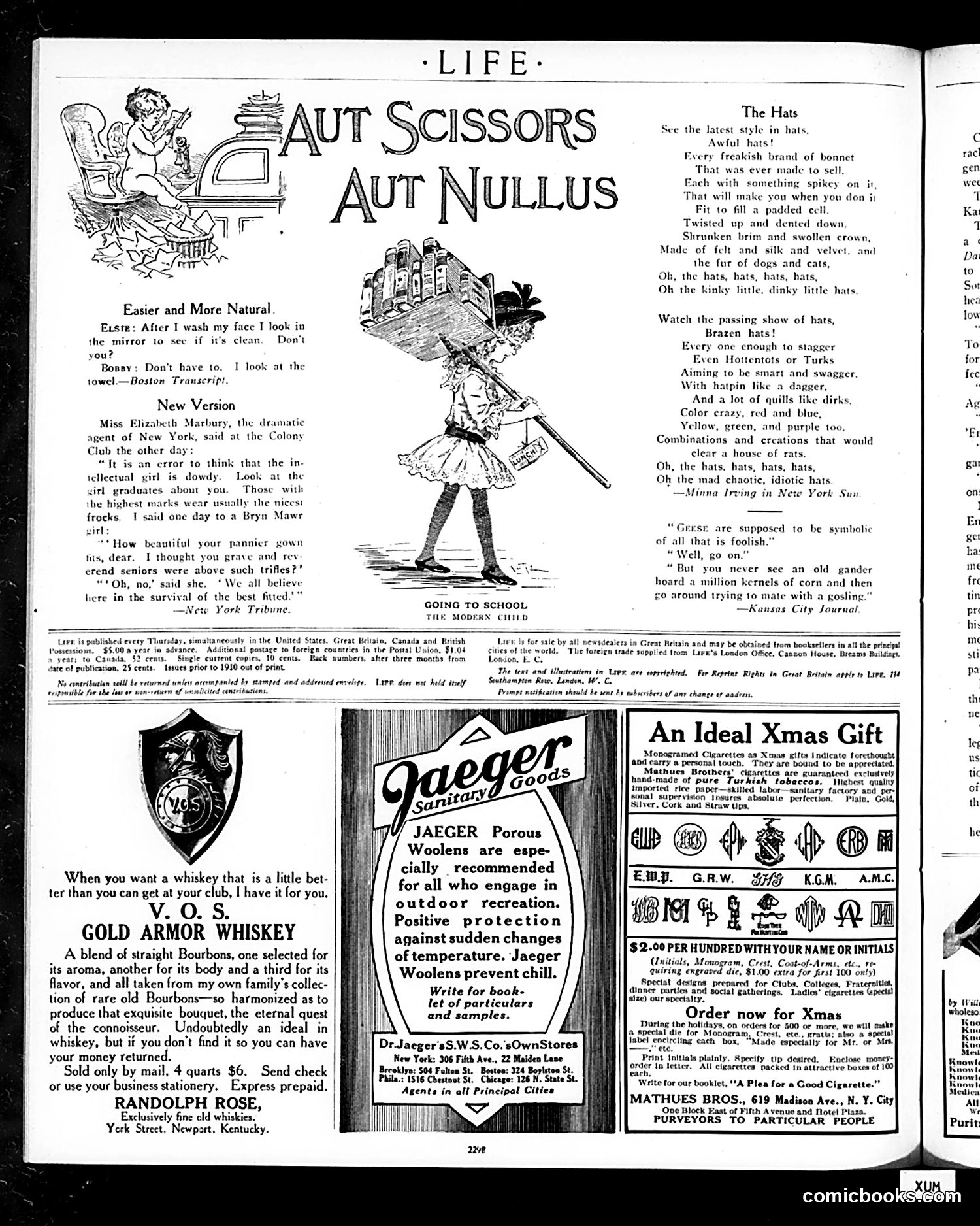
This page from the American satirical magazine *Life* contains humor pieces and advertisements typical of the early 20th century. ## Main Cartoons/Humor: **"Aut Scissors, Aut Nullus"** ("Scissors or Nothing") features a satirical poem mocking fashionable women's hats. The accompanying illustration shows an exaggerated woman carrying an enormous, ornate hat. The satire targets the absurdity of contemporary hat fashion—hats decorated with feathers, quills, and impractical embellishments that the poem suggests border on insanity ("Fit to fill a padded cell"). The short jokes above satirize gender stereotypes: one about women's cleanliness habits, another suggesting educated women paradoxically care about fashionable appearance despite intellectual pretensions, and a third joking that women prioritize stylish clothing over intellectual virtue. ## Context: Early 1900s women's fashion featured extraordinarily elaborate millinery, often featuring bird feathers and excessive ornamentation—a target of contemporary satire. The page also includes period advertisements for whiskey, cigarettes, and woolens, reflecting commercial practices of the era.
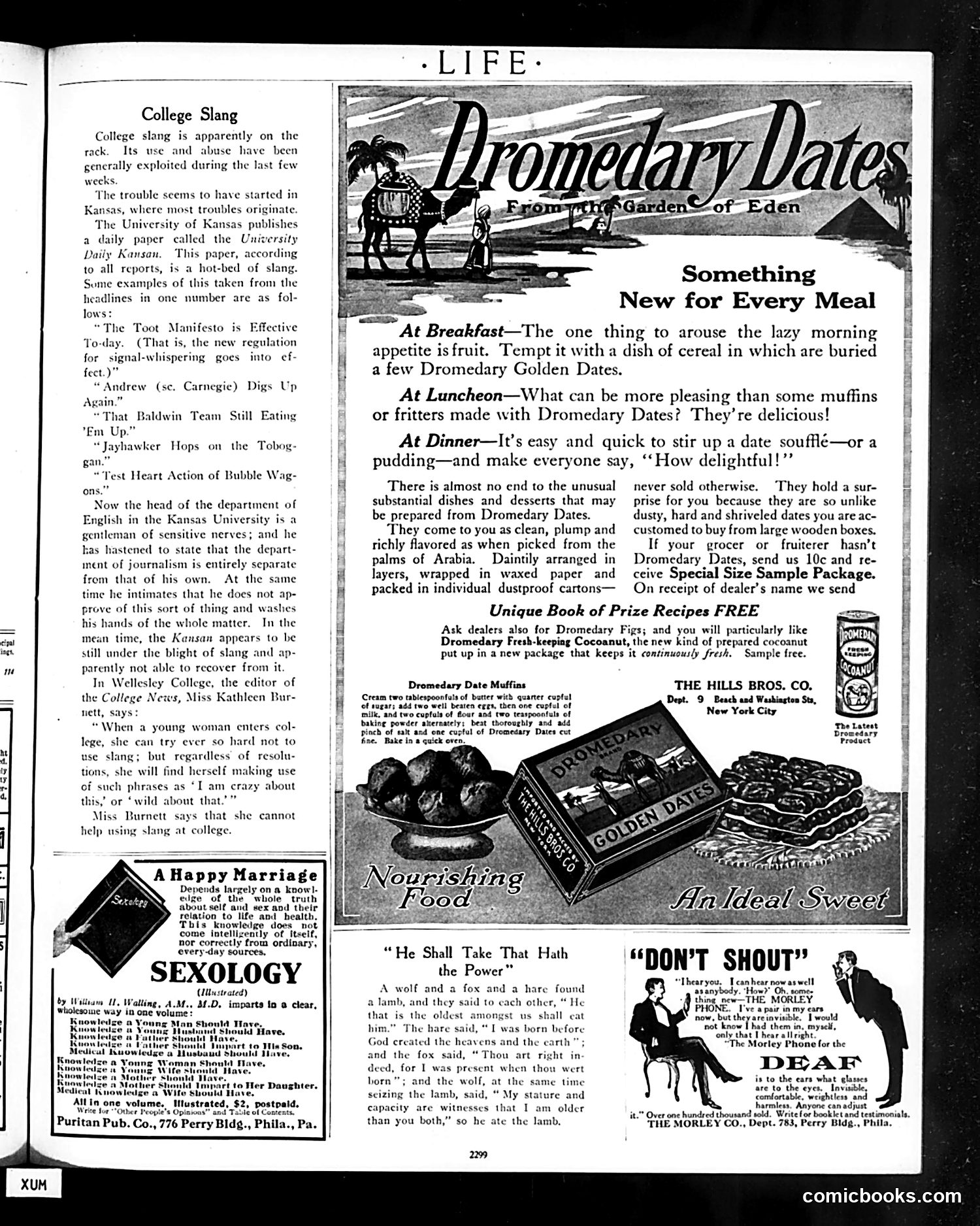
This page primarily consists of **advertisements and light editorial commentary**, not political cartoons. The main content includes: 1. **"College Slang" article**: Commentary on slang usage at University of Kansas, noting the English department's disapproval of phrases like "I am crazy about this" used by students. 2. **Dromedary Dates advertisement**: The dominant visual content—a large ad campaign promoting packaged dates as food for breakfast, lunch, and dinner, emphasizing their cleanliness and convenience compared to loose dates from wooden boxes. 3. **Secondary ads**: Including "Sexology" (a relationship/health book), "A Happy Marriage" book advertisement, and "The Morley Phone" for the deaf. The page reflects **early 20th-century consumer culture** and middle-class anxieties about propriety (slang usage) and modern convenience foods. There is **no political satire or cartoon** present—the page demonstrates how Life magazine mixed editorial content with commercial advertising.
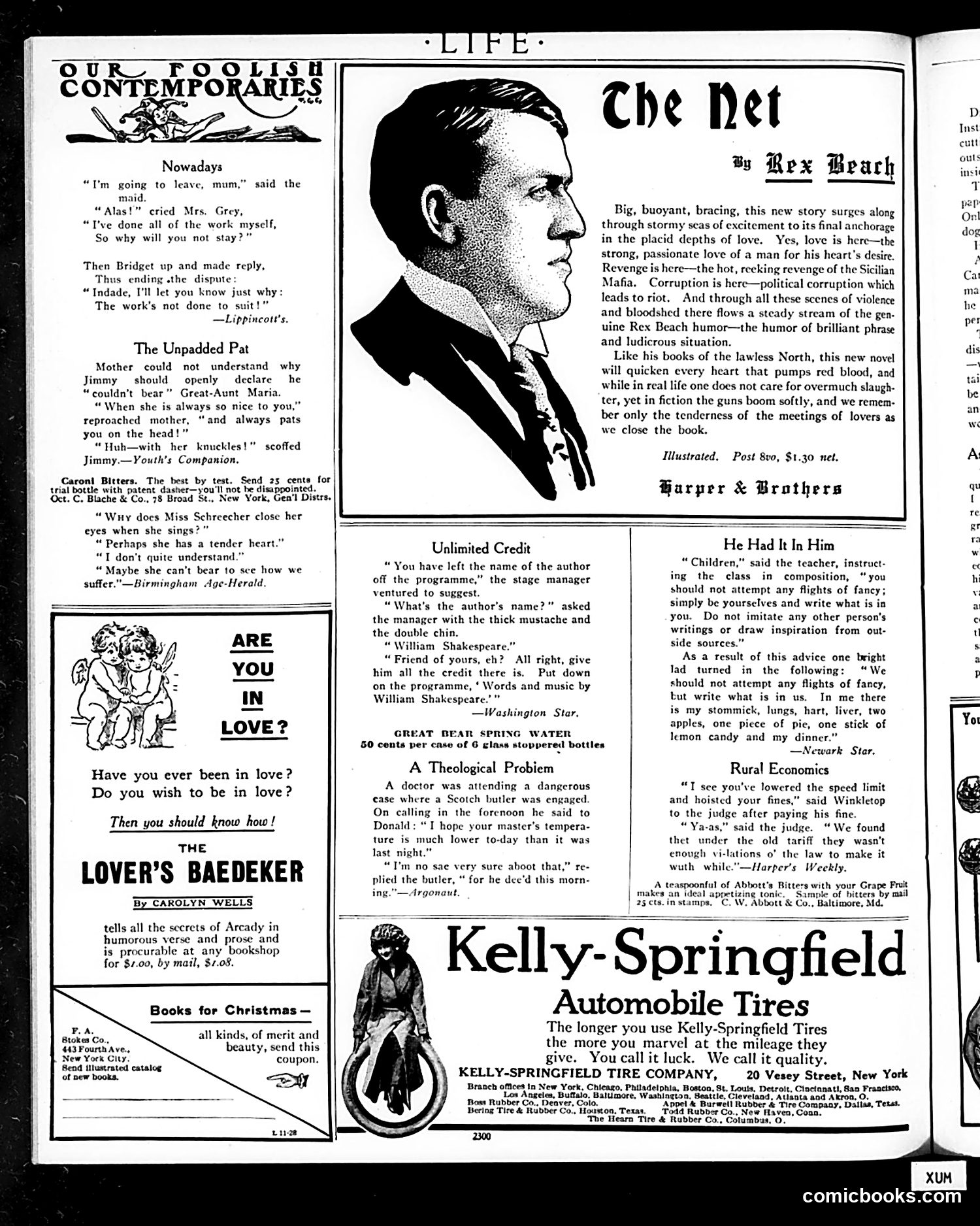
This page from *Life* magazine contains several short humorous pieces typical of early 20th-century American satire: **"Our Foolish Contemporaries"** section presents brief comedic anecdotes mocking social situations—a maid rejecting her employer's pleas to stay, a child disliking an aunt's physical affection, a singer closing her eyes while performing badly. **The main feature** advertises Rex Beach's novel *The Net*, describing it as a dramatic story combining romance, Sicilian Mafia revenge plots, and political corruption—typical adventure fiction of the era. **Other short jokes** mock workplace credit-taking (a theater manager attributing Shakespeare's work to a personal friend), a theological dark humor piece about a Scottish butler's master dying, and a rural economics joke about a small town raising fines to compensate for lowered speed limits. The page is primarily **entertainment and advertising**—books, patent medicine (Caront Bitters), a dating advice book (*The Lover's Baedeker*), and Kelly-Springfield Automobile Tires dominate the layout. The humor is gentle, domestic, and decidedly non-political.
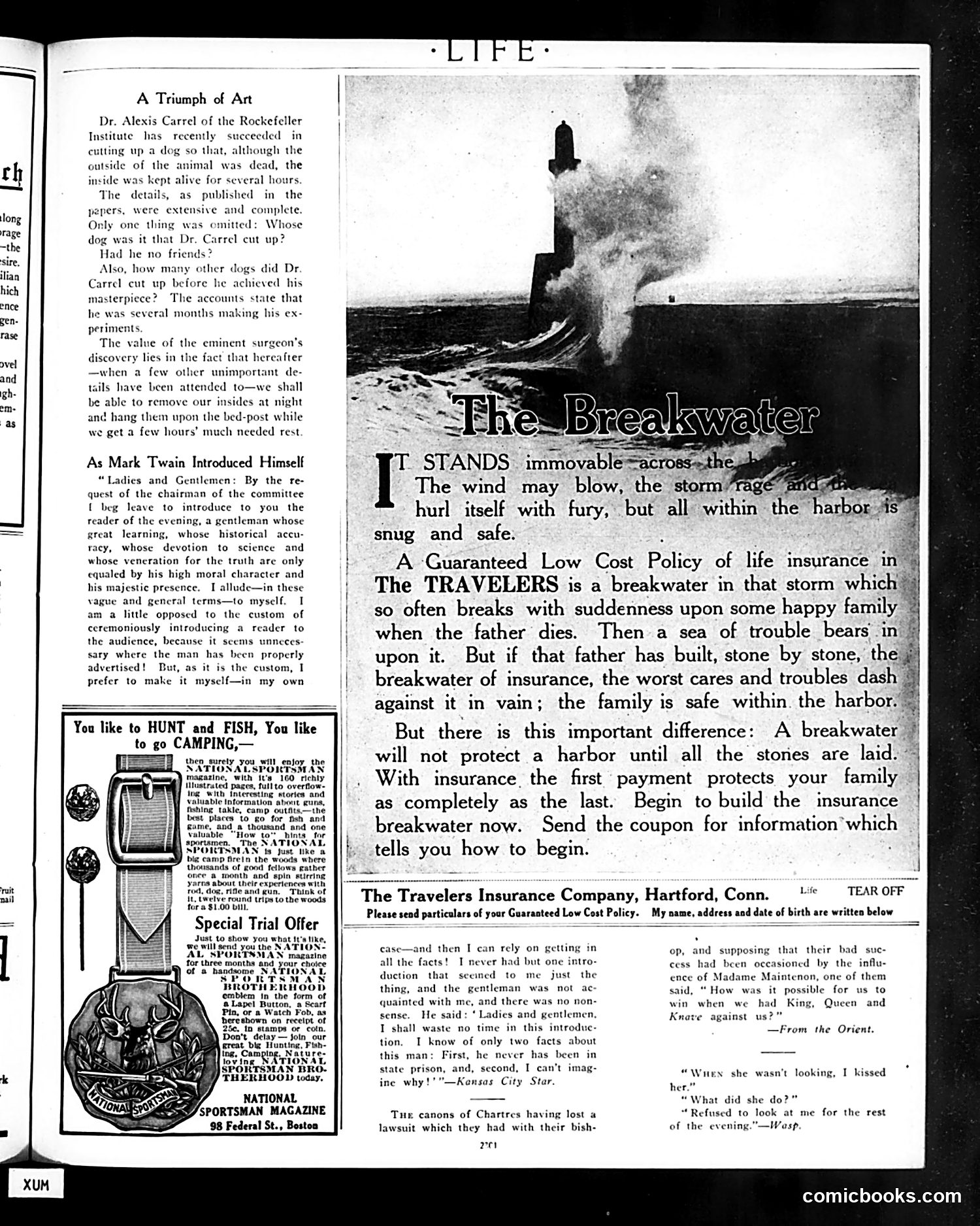
This page contains two distinct satirical pieces: **"A Triumph of Art"** mocks Dr. Alexis Carrel's celebrated 1912 experiment keeping a dog's internal organs alive after death. Life's satire highlights the omissions from published accounts: whose dog was used? How many dogs died in experiments? The joke imagines absurd future applications—removing one's insides nightly like false teeth. This critiques sensationalized scientific reporting and questions the ethics behind celebrated "breakthroughs." **"As Mark Twain Introduced Himself"** presents Twain's self-deprecating introduction speech, where he sarcastically praises himself before admitting he knows only two facts about himself: he's never been in state prison and can't recall the third point. This exemplifies Twain's characteristic humor—mock-formal language undercut by irreverence and absurdity. The page also contains period advertisements (National Sportsman magazine, Travelers Insurance) typical of Life's revenue model.
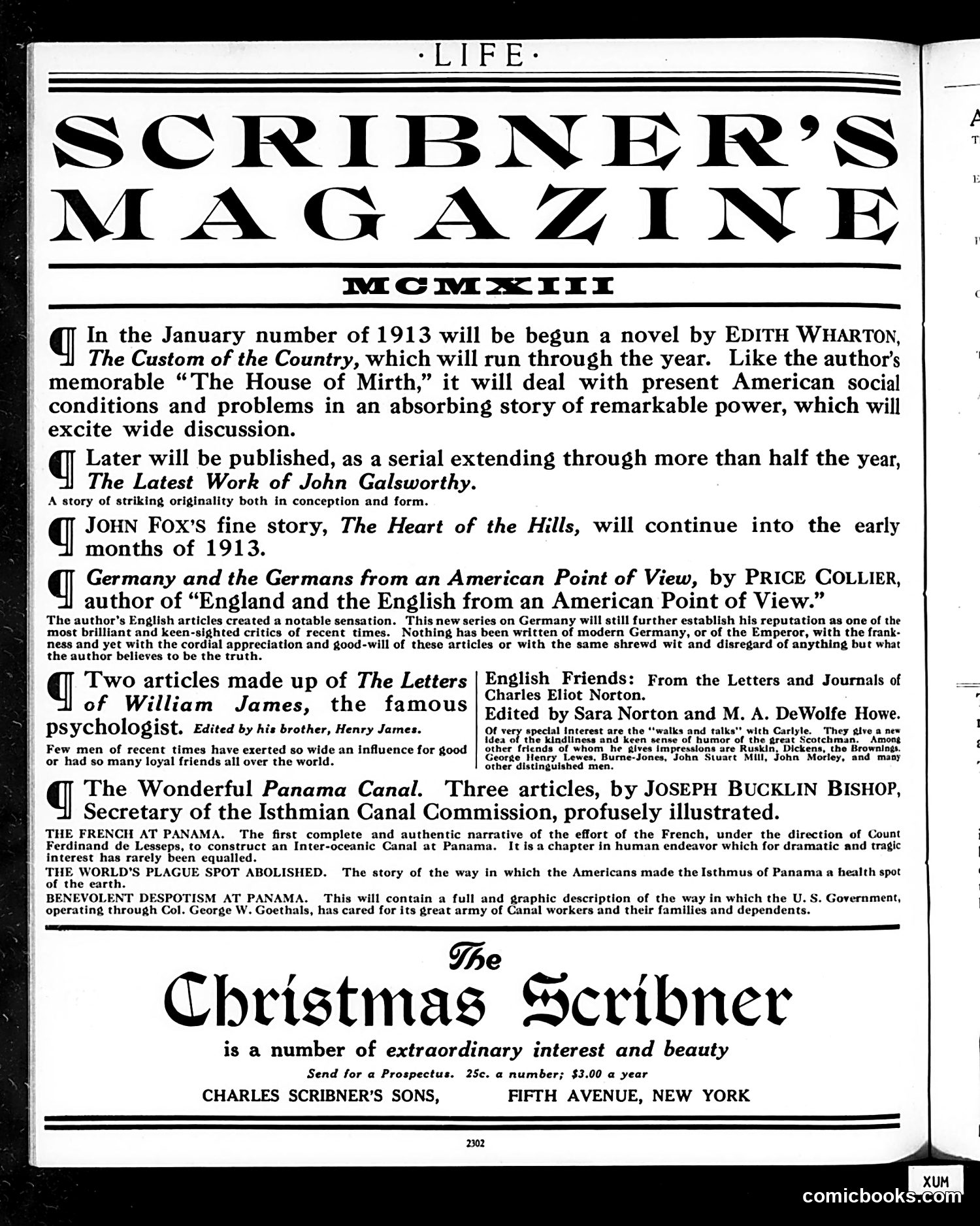
This is **not a cartoon page**, but rather a **table of contents/advertising page** for Scribner's Magazine (MCMXIII = 1913). The page announces upcoming serialized content, emphasizing prestige literary and intellectual content: - **Edith Wharton's novel** about American social conditions - **John Galsworthy's work** (celebrated British author) - **Price Collier's series on Germany**—notably written with "frank" appreciation despite pre-WWI tensions - **William James's letters**, emphasizing his influence and friendships - **Panama Canal coverage** by an official commission secretary, celebrating American engineering achievement and health improvements The **implicit satire/point**: Scribner's positions itself as the magazine for serious, cultivated Americans—featuring major literary figures and progressive achievements (the Canal as "benevolent" American intervention). This reflects early-20th-century American confidence in both cultural sophistication and expansionist projects, before WWI disrupted such optimism. No individual caricatures appear on this page.
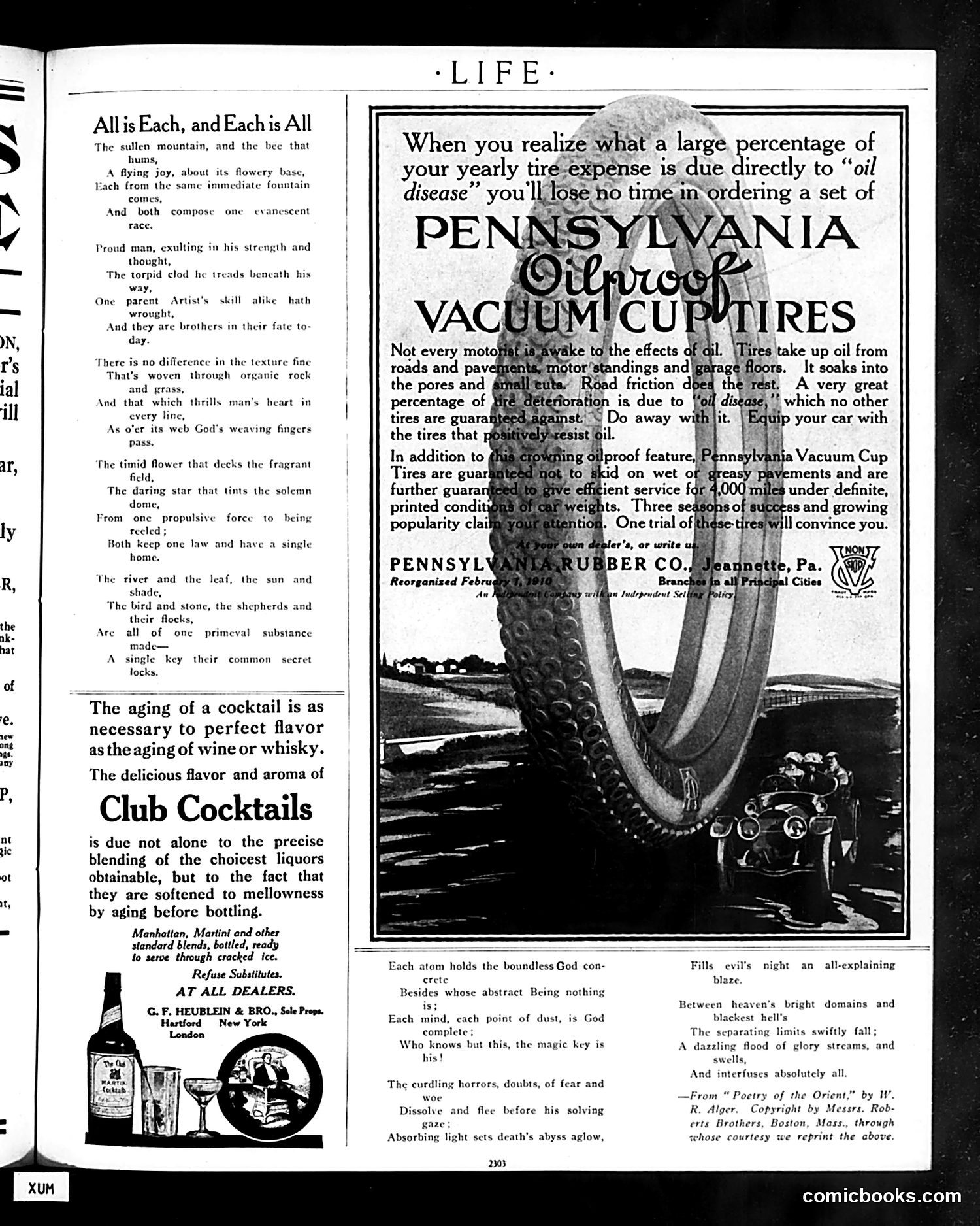
This page contains **two unrelated items**: poetry and advertising, typical of Life's mixed-content format. **Left side:** A philosophical poem titled "All is Each, and Each is All" explores pantheistic themes—the idea that all creation (mountains, bees, humans, flowers, stars) share divine unity and origin. It's reflective rather than satirical. **Right side:** A full-page advertisement for Pennsylvania Vacuum Cup Tires. The ad addresses a practical consumer concern: "oil disease"—oil soaking into tires from roads and garage floors, causing deterioration. The company claims their tires resist this problem better than competitors. This is straightforward product marketing, not satire. The page juxtaposes spiritual philosophy with commercial materialism—a characteristic Life editorial approach. No political cartoon or satire is present; this is primarily a poetry-and-advertising page from an early 20th-century magazine.
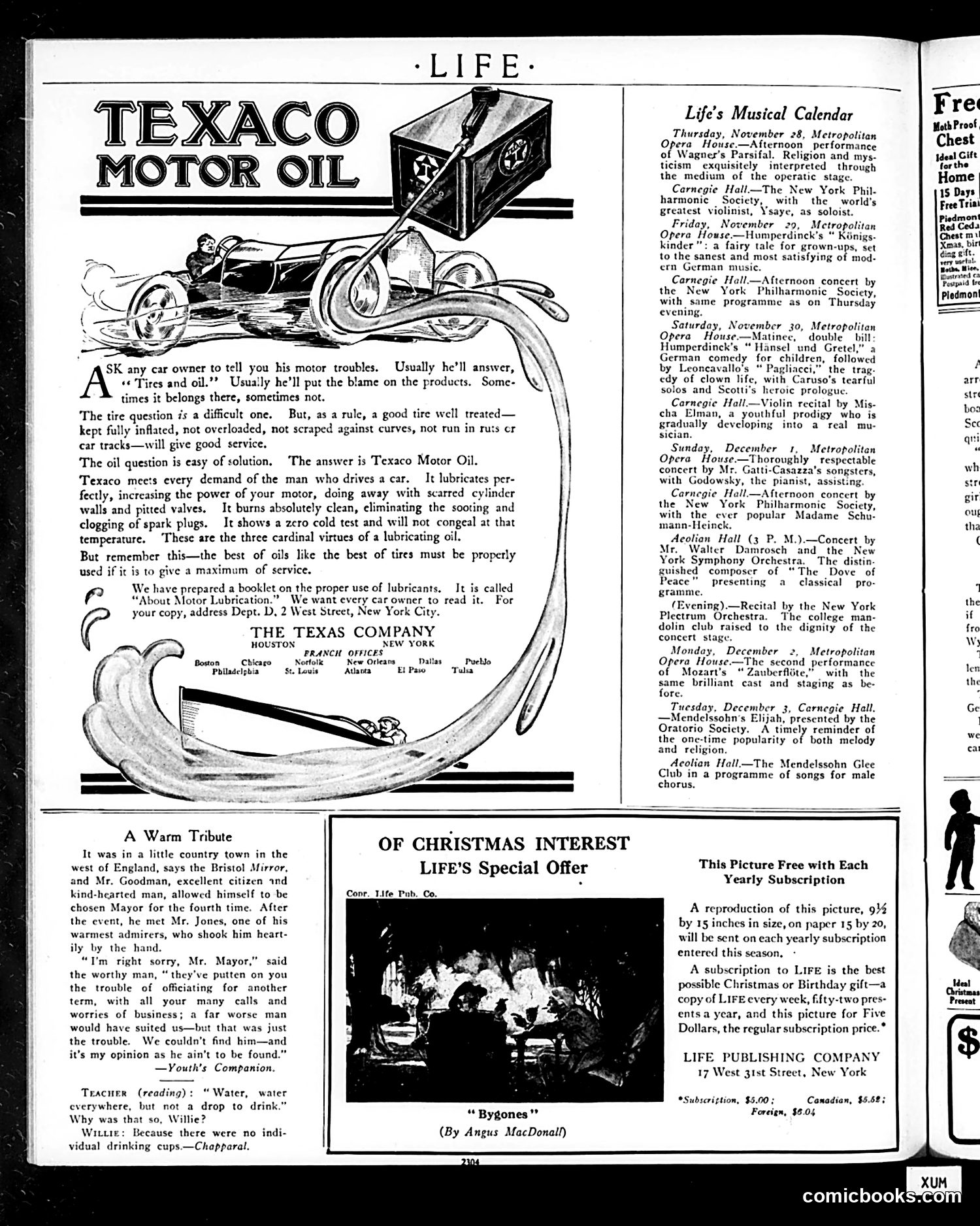
This page is primarily a **motor oil advertisement** for Texaco, not a political cartoon. The main content explains that car troubles typically stem from poor oil quality rather than driver error or tire problems. The advertisement uses a humorous framing device—asking car owners about their motor troubles—to pitch Texaco as the solution. The accompanying illustration depicts motor oil being applied to engine components. The page also includes: - **Life's Musical Calendar**: concert listings for late November/early December at venues like Carnegie Hall and the Metropolitan Opera House - **"A Warm Tribute"**: a brief humorous anecdote about an English mayor - **"Bygones"**: what appears to be a story or illustration (details unclear from OCR) - **Life's Special Christmas Offer**: promoting subscription with a free picture This is straightforward **commercial content** typical of early 20th-century magazine advertising, not satire or political commentary.
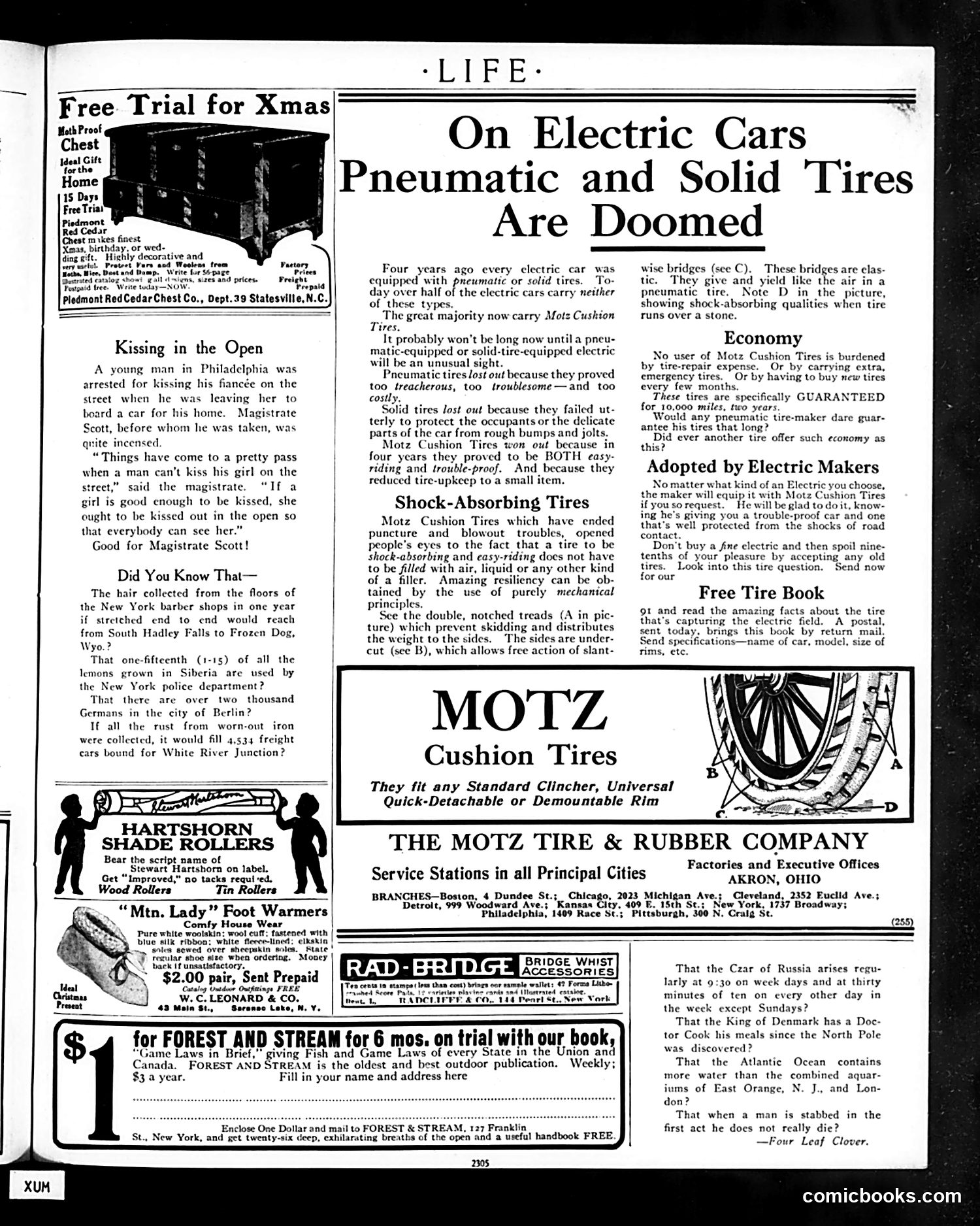
This page is primarily **advertising**, not satirical cartooning. The dominant content is a major advertisement for Motz Cushion Tires, promoting their superiority over pneumatic and solid tires for electric automobiles—a technology context modern readers may find unfamiliar. The page's modest humor appears in the "Did You Know That—" section, which presents absurdist "facts" (e.g., barber shop hair stretching to Wyoming; Russians in Berlin; rust filling freight cars). These are deliberately nonsensical trivia meant as light comedy. The brief "Kissing in the Open" anecdote describes a magistrate's progressive ruling that public displays of affection shouldn't be criminalized—reflecting early 20th-century attitudes about propriety. The remaining small advertisements (Hartshorn Shade Rollers, foot warmers) are typical period product promotions. There is no political cartoon or caricature on this page.
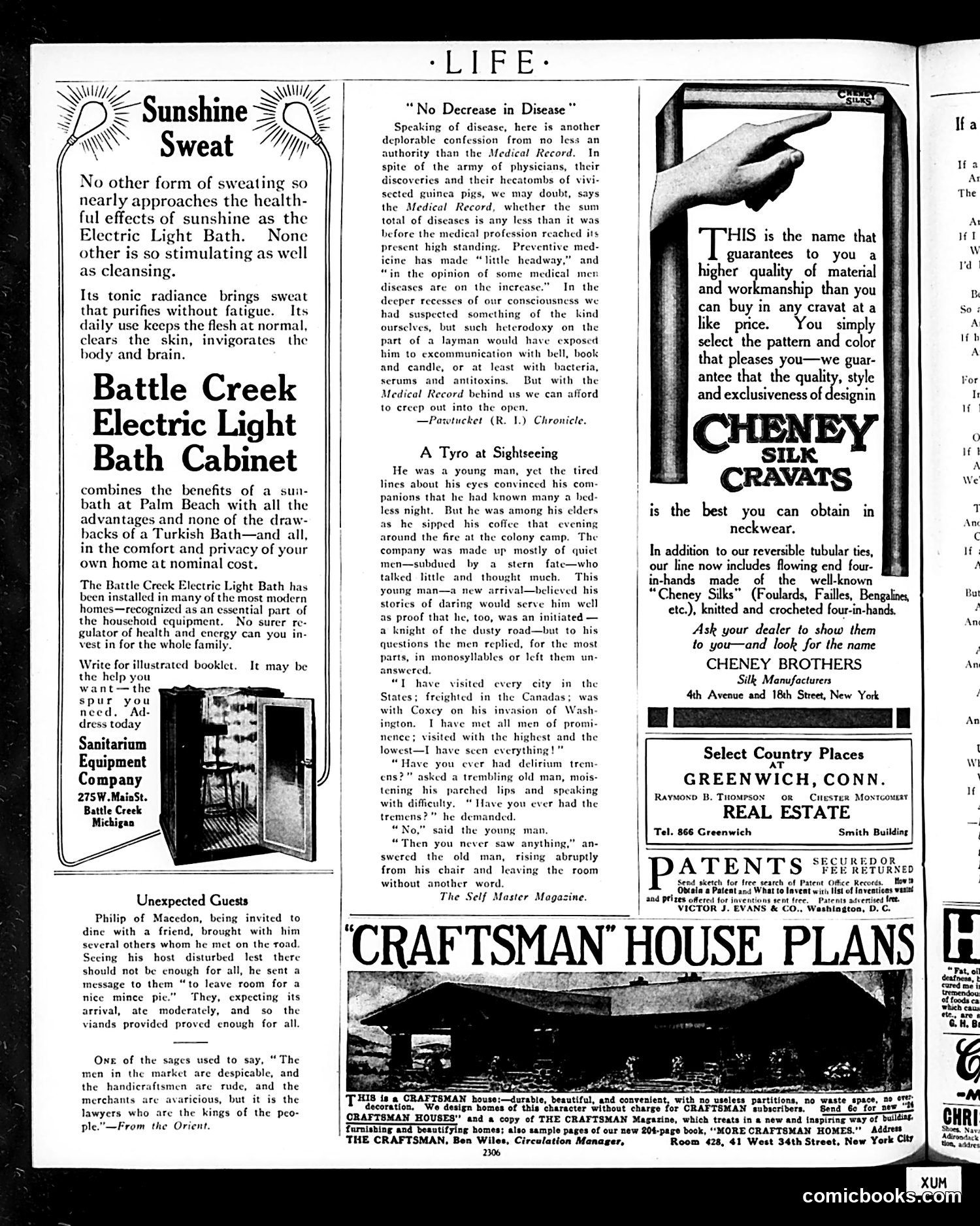
This page is primarily **advertising** with brief satirical commentary interspersed. The main content includes: **Advertisements:** - Battle Creek Electric Light Bath Cabinet (health device promising detoxification via electric light) - Cheney Silk Cravats (neckwear) - Craftsman House Plans - Patents and real estate listings **Satirical Commentary:** The page includes small editorial pieces mocking contemporary attitudes. Most notably, "No Decrease in Disease" sarcastically cites the *Medical Record* admitting that despite physicians' efforts and animal testing, disease hasn't actually decreased—contradicting the medical profession's claims of progress. The piece uses this to critique medicine's overconfidence. A brief anecdote about Philip of Macedon illustrates hospitality, while "A Tyro at Sightseeing" depicts a young man claiming adventurous stories to impress elders. **Historical Context:** This appears to be early 20th-century *Life* magazine, when it functioned as a satirical publication mixing social commentary with commercial advertisements—before its later transformation into a photojournalism magazine.
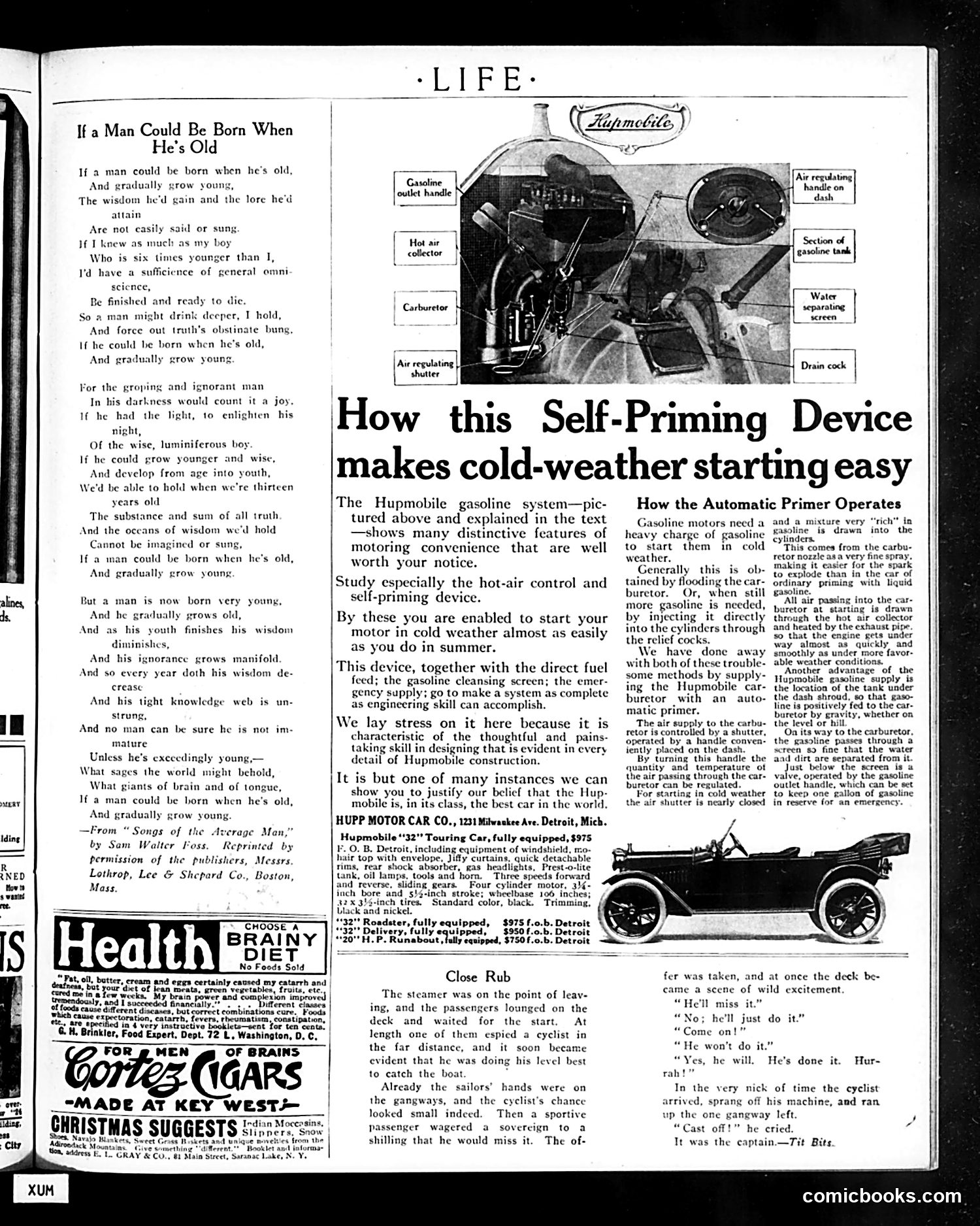
This page combines poetry and automobile advertising. The left side features "If a Man Could Be Born When He's Old," a reflective poem by Sam Walter Foss questioning human aging—imagining how much wiser we'd be if we gained knowledge in youth then retained it into old age, rather than losing wisdom as we age. The right side advertises the Hupmobile automobile, specifically its "self-priming device" for cold-weather engine starting. Technical diagrams show the gasoline system's components. The advertisement emphasizes engineering sophistication, claiming the Hupmobile offers convenience features—particularly reliable cold-start capability—that justify its superiority over competing cars. There's no apparent connection between poem and advertisement; they simply share the page. The Hupmobile ad represents early-1910s automotive marketing emphasizing mechanical innovation as a selling point.
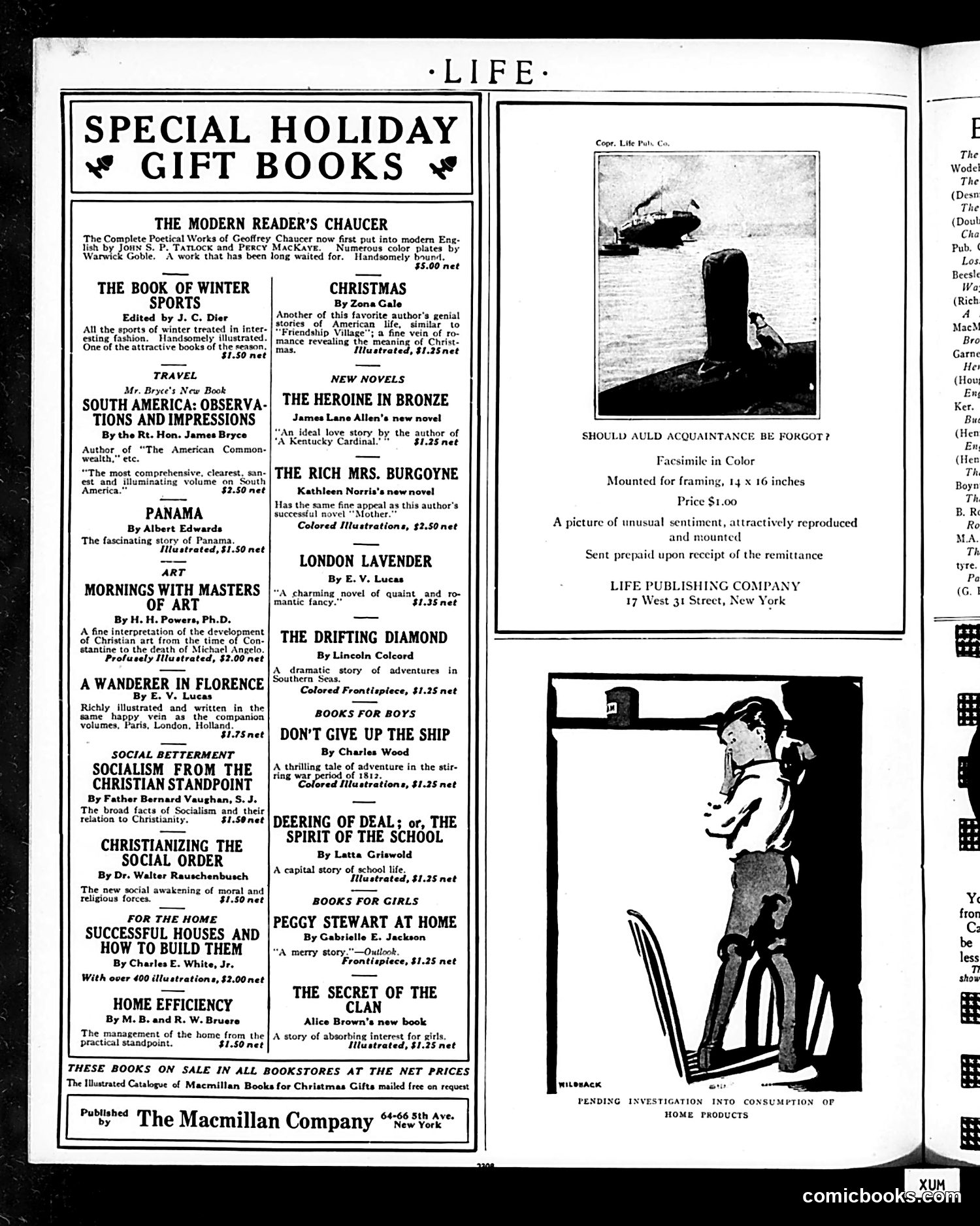
This page is primarily **advertising for holiday gift books** from The Macmillan Company, not political satire. The left side lists recommended books across categories (classics, travel, art, social reform, home management, and novels). The right side features two visual elements: 1. **Top image**: A sepia-toned photograph titled "Should Auld Acquaintance Be Forgot?" — a sentimental scene of what appears to be people in a boat, offered as a framed facsimile print for $1.00. 2. **Bottom cartoon**: Labeled "Pending Investigation into Consumption of Home Products," it depicts a boy on a bicycle carrying what appears to be a large home product. The caption suggests mild satire about government inspection or regulation of domestic goods — a Progressive-era concern about product safety and quality control. Both images use nostalgic or humorous appeals to sell holiday gift merchandise. This reflects early 20th-century commercial publishing rather than political commentary.
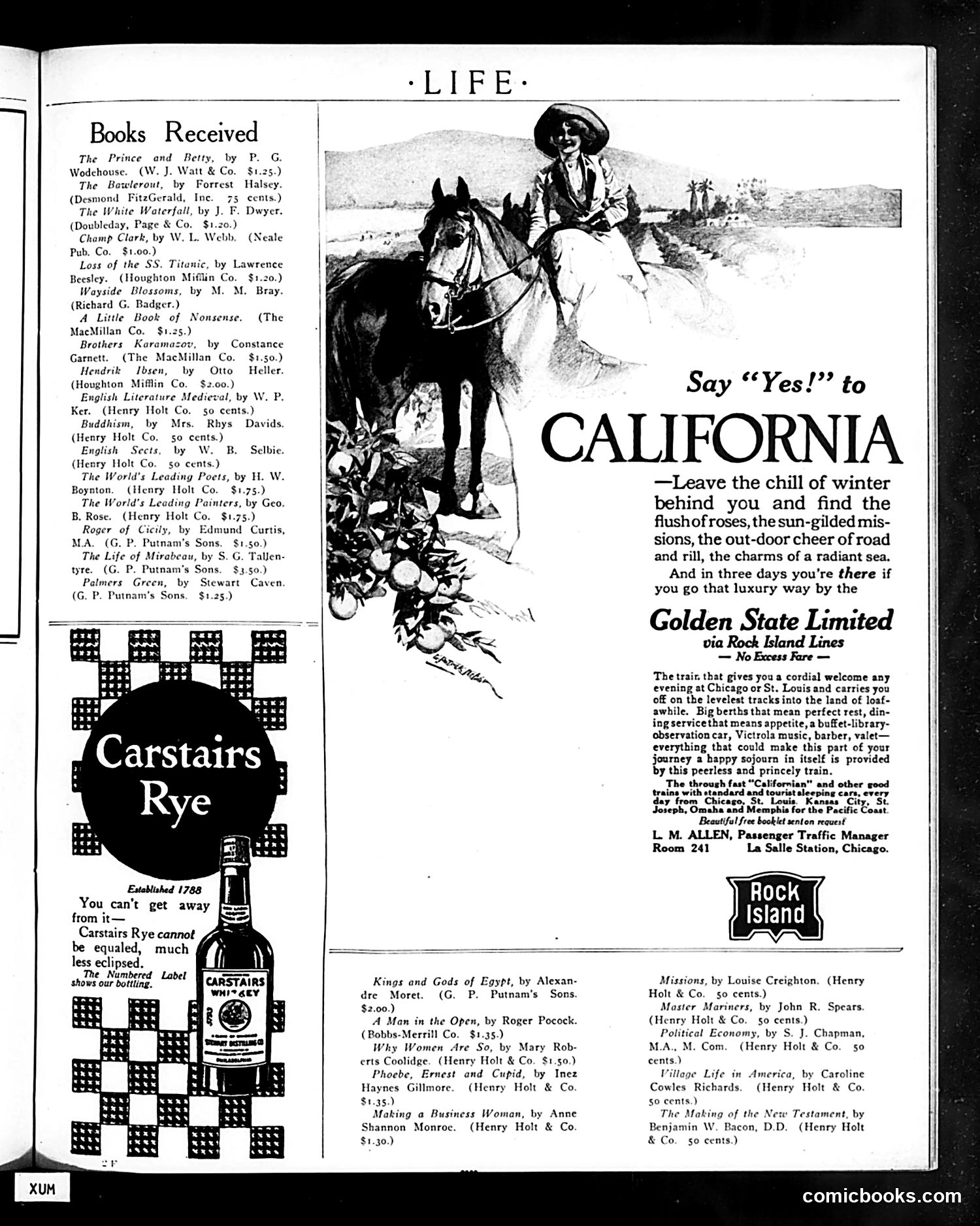
This page is primarily **book reviews and advertisements** rather than political satire. The upper left lists recent book publications with prices—typical literary fare of the era including works by P.G. Wodehouse and references to the Titanic disaster (indicating this is post-1912). The main visual content comprises two **product advertisements**: 1. **Carstairs Rye whiskey** (lower left): A standard alcohol ad claiming superiority ("cannot be equaled, much less eclipsed"), with a numbered-label bottle illustration. 2. **Golden State Limited train service** (right): A romantic travel advertisement for the Rock Island Lines route to California, featuring an illustration of a cowboy on horseback and flowery language about escaping winter for sunshine and luxury rail travel. Both ads are straightforward commercial appeals typical of Life's era—no political commentary or satire is evident. The page reflects early 20th-century consumer culture and leisure advertising.
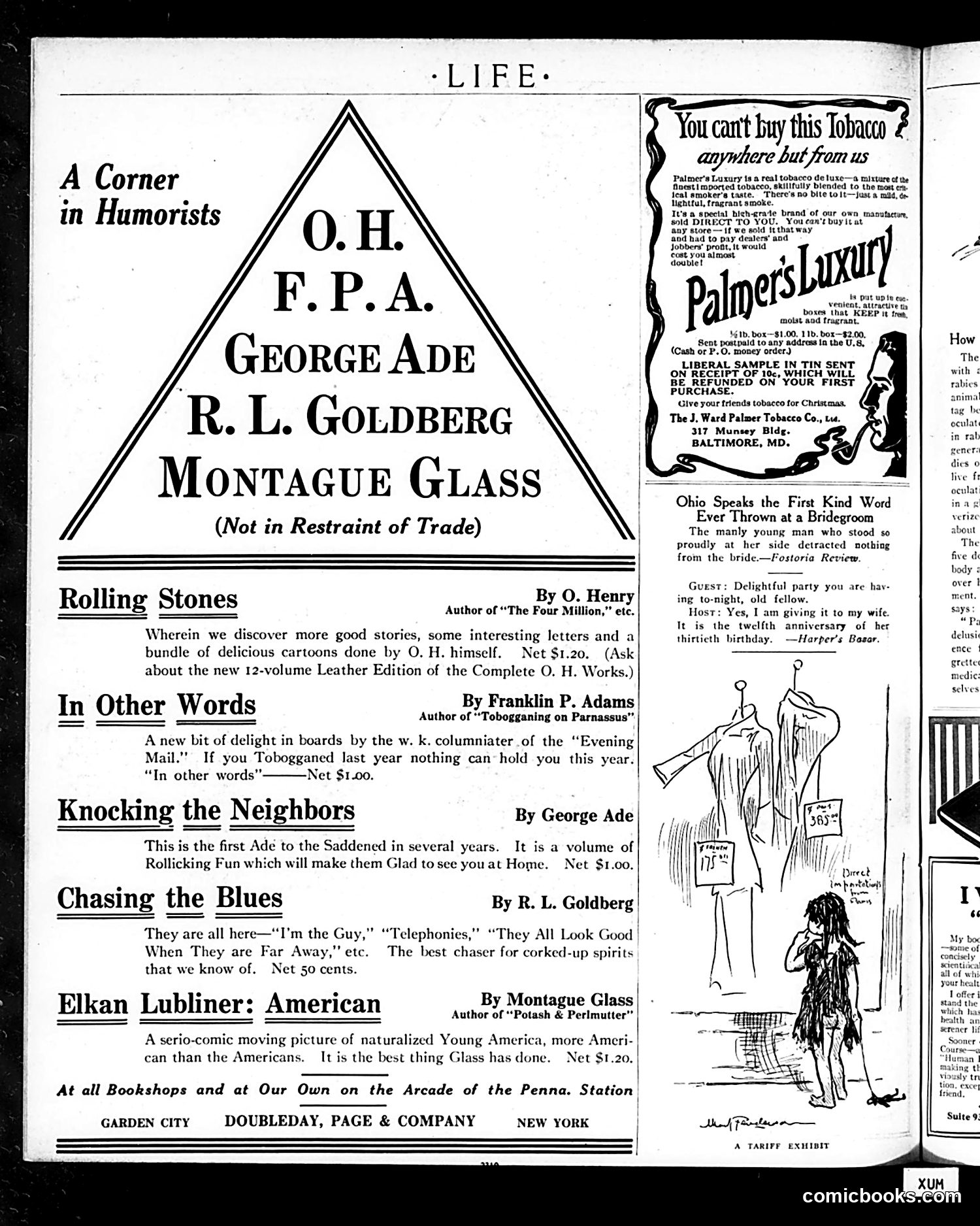
This page is primarily **advertising and book promotion**, not political satire. The left side features a "Corner in Humorists"—a pyramid listing five humorist-authors (O.H., F.P.A., George Ade, R.L. Goldberg, Montague Glass), followed by promotional descriptions of their books. These appear to be humorous essays and comic collections popular in the early 20th century. The right side contains a **Palmer's Luxury tobacco advertisement** and a brief anecdote titled "Ohio Speaks the First Kind Word Ever Thrown at a Bridegroom" (satirizing typical wedding remarks). Below is a cartoon labeled "A Tariff Exhibit," showing a woman at a tariff exhibit with a child—likely commenting on tariff policy's effect on ordinary families, though the specific joke remains unclear without additional context. The page is fundamentally commercial rather than overtly political satire.
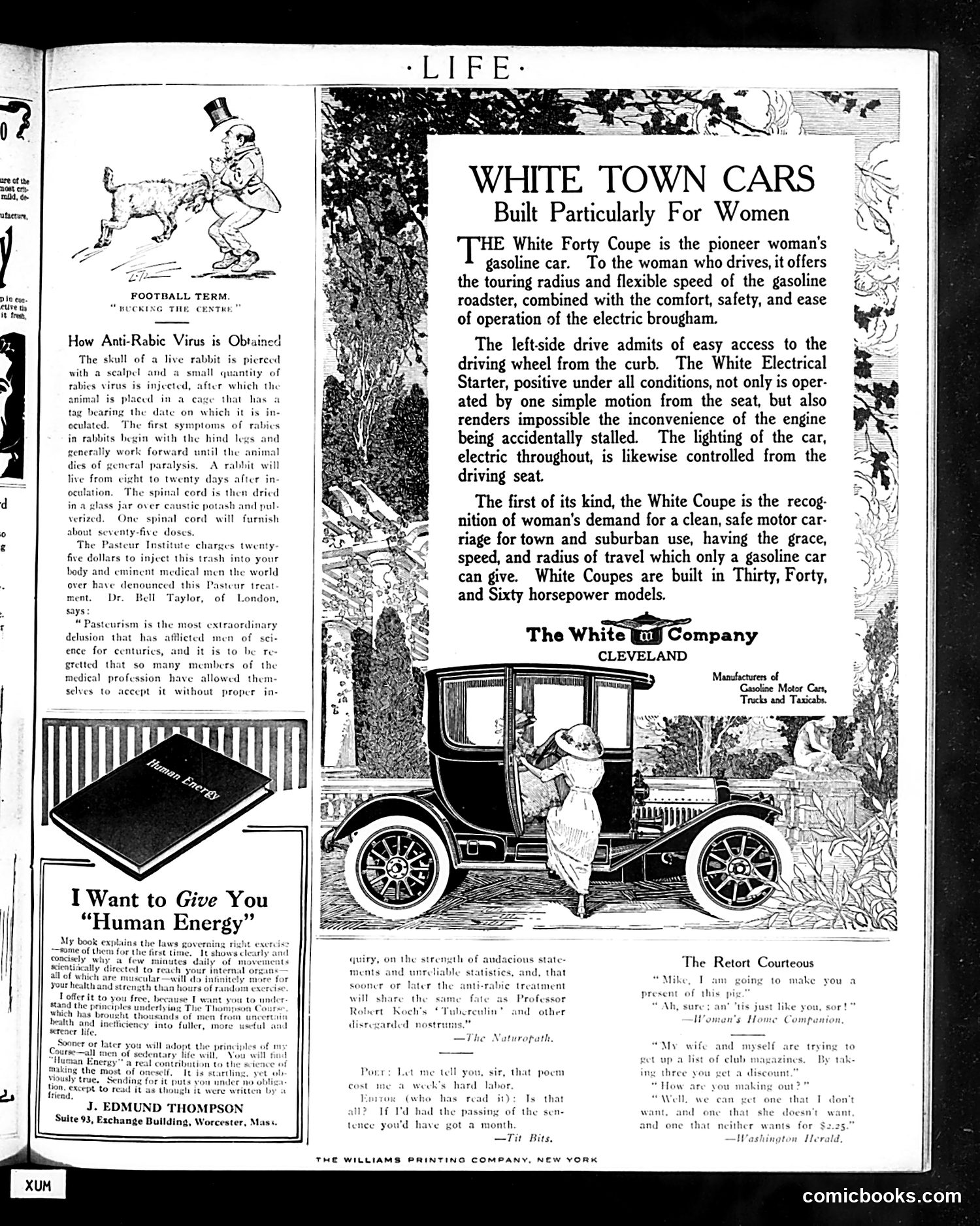
This page contains **primarily advertising** for White automobiles, alongside unrelated editorial content about rabies treatment and miscellaneous humor pieces. **The main content:** A White Motor Company advertisement markets the "White Forty Coupe" as a car "Built Particularly For Women." This reflects early 1900s marketing that positioned automobiles as appealing to female drivers by emphasizing ease of operation—left-side steering wheel access, electric starter (no hand-cranking), and controls accessible from the driving seat. The car offers a middle ground between gasoline power and electric vehicle convenience. **The satire/context:** The advertisement assumes women drivers need special accommodation and simplified machinery, reflecting period gender attitudes about women's mechanical capability and physical strength. Modern readers should note this reflects genuine engineering innovations marketed with patronizing gendered messaging. **Other content** includes a cartoon labeled "Bucking the Centre" (football reference), medical commentary questioning rabies vaccination, and brief humorous exchanges—typical Life magazine miscellany of the era.
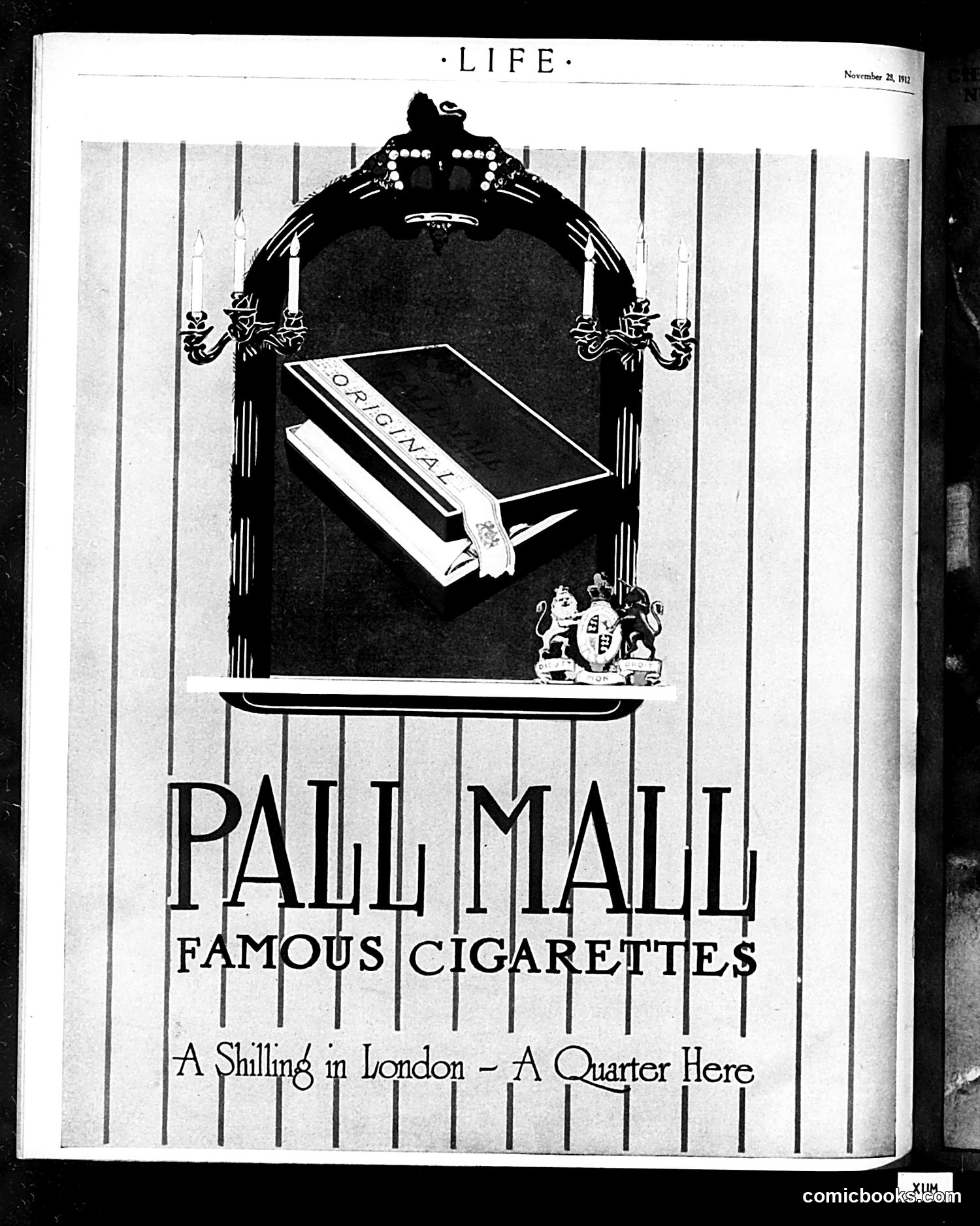
This is a full-page advertisement for Pall Mall cigarettes from Life magazine (dated November 28, 1912, visible in top right). The image shows an ornate heraldic display featuring a book labeled "ORIGINAL" positioned prominently on a dark background, flanked by decorative candelabras and topped with a coat of arms. The tagline reads: "A Shilling in London—A Quarter Here," comparing British and American prices. This is commercial advertising rather than political satire. The heraldic styling emphasizes the product's prestige and British heritage, appealing to early 20th-century consumer associations between British goods and sophistication. The price comparison highlights affordability for American consumers relative to imported British cigarettes.