
Life, 1912-11-28 · page 12 of 44
Life — November 28, 1912 — page 12: what you’re looking at
What you’re looking at
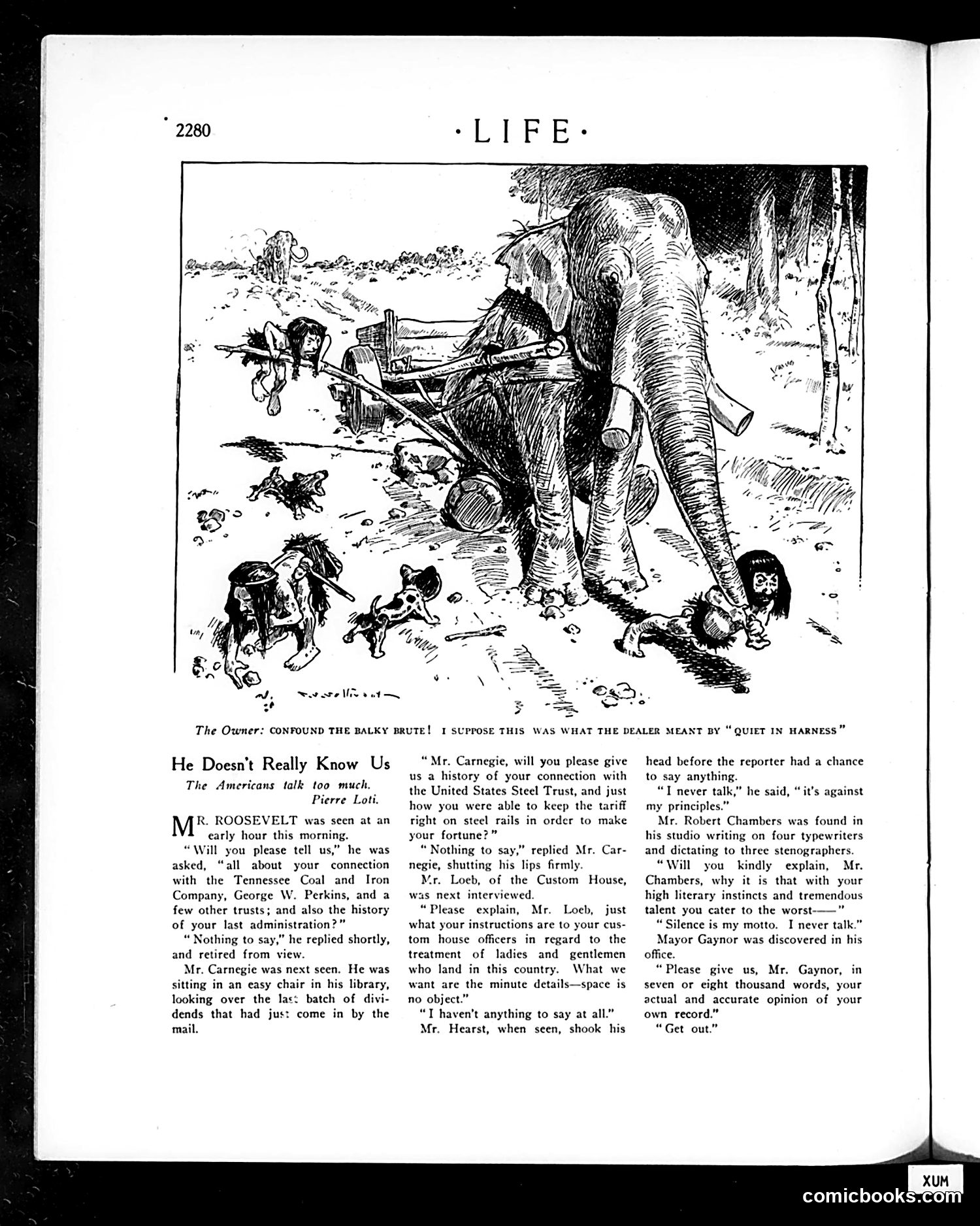
This cartoon satirizes **Andrew Carnegie**, the steel magnate, during a period when reporters sought interviews about his business practices and philanthropic activities. The image depicts Carnegie as a large elephant (a common metaphor for industrial power and monopoly) being ridden or controlled by smaller figures—likely representing business associates or political interests. The caption "COMPOUND THE BALKY BRUTE" suggests Carnegie is difficult to manage or uncooperative with the press. The accompanying text shows reporters trying unsuccessfully to get Carnegie to explain his connection to the **Tennessee Coal and Iron Company** and his influence on steel tariffs that benefited his fortune. The satire criticizes both Carnegie's reluctance for transparency and the broader public perception of industrialists as unaccountable powers.
📄 Transcribed text from this page (OCR, searchable)
Machine-transcribed from the original scan — historical spelling and the odd misread are preserved.
wes ore IR et The Owner: CONFOUND THE BALKY BRUTE! He Doesn't Really Know Us The Americans talk too much, Pierre Loti. R. ROOSEVELT was seen at an early hour this morning. “Will you please tell us,” he was asked, “all about your connection with the Tennessee Coal and Iron Company, George W. Perkins, and a few other trusts; and also the history of your last administration?” “ Nothing to say,” he replied shortly, and retired from view. Mr. Carnegie was next seen. He was sitting in an easy chair in his library, looking over the las: batch of divi- dends that had jus: come in by the mail. “Mr. Carnegie, will you please give us a history of your connection with the United States Steel Trust, and just how you were able to keep the tariff right on steel rails in order to make your fortune?” “ Nothing to say,” replied Mr. Car- negie, shutting his lips firmly. Mr. Loeb, of the Custom House, was next interviewed. “Please explain, Mr. Loeb, just what your instructions are to your cus- tom house officers in regard to the treatment of ladies and gentlemen who land in this country. What we want are the minute details—space is no object.” “T haven't anything to say at all.” Mr. Hearst, when seen, shook his I SUPPOSE THIS WAS WHAT THE DEALER MEANT BY “ QUIET IN HARNESS” head before the reporter had a chance to say anything. “T never talk,” he said, “it’s against my principles.’ Mr. Robert Chambers was found in his studio writing on four typewriters and dictating to three stenographers. “Will you kindly explain, Mr. Chambers, why it is that with your high literary instincts and tremendous talent you cater to the worst-—” “Silence is my motto. I never talk.” Mayor Gaynor was discovered in his office. “Please give us, Mr. Gaynor, in seven or eight thousand words, your actual and accurate opinion of your own record.” “Get out.” comicbook $.co