
Life, 1912-11-28 · page 10 of 44
Life — November 28, 1912 — page 10: what you’re looking at
What you’re looking at
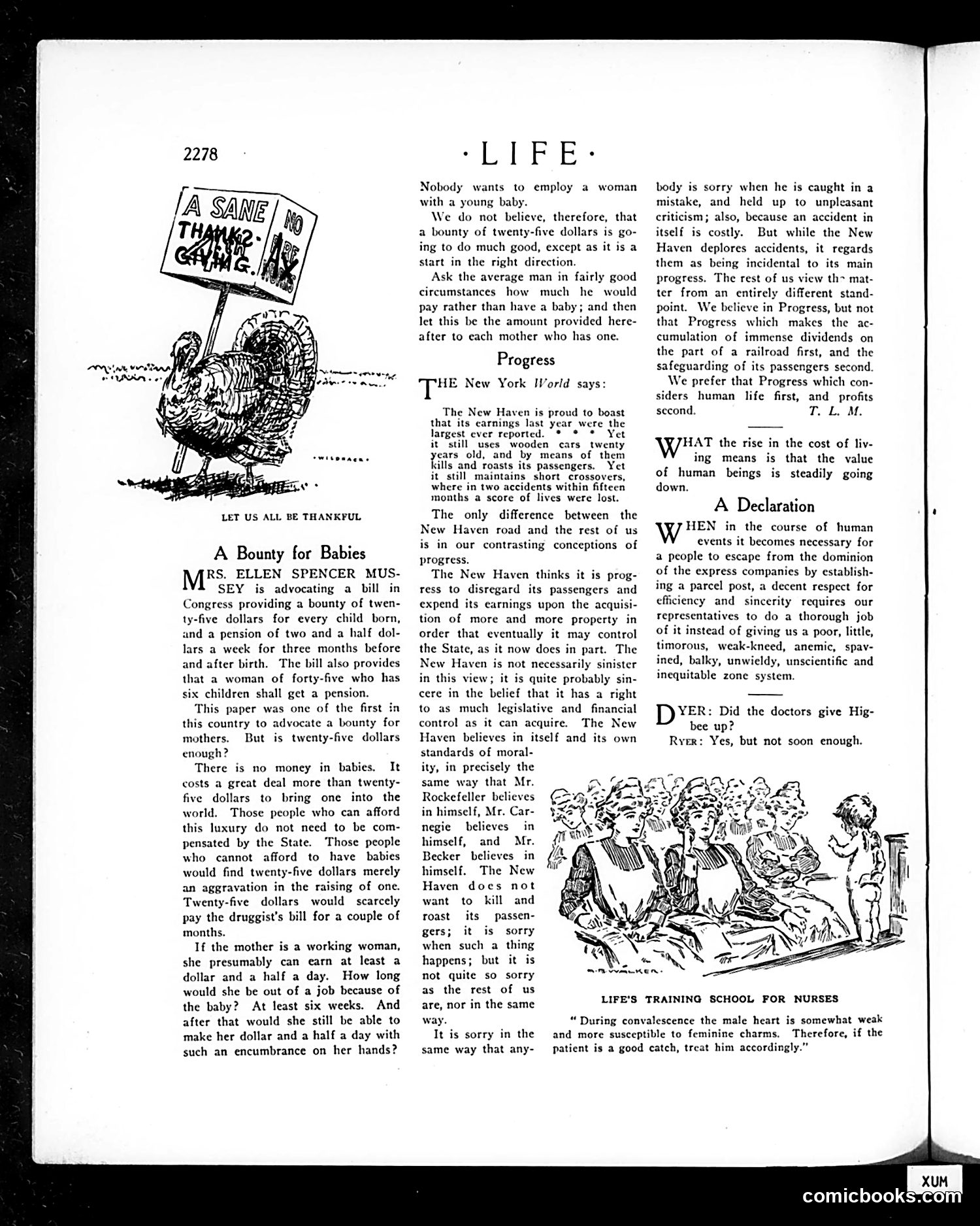
The main cartoon depicts a **turkey** holding a protest sign reading "A SANG THANK-GIVING" with additional text that appears sarcastic. The caption reads "LET US ALL BE THANKFUL." This is **Thanksgiving Day satire** — the cartoon ironically presents the turkey's perspective on a holiday where turkeys are traditionally killed and eaten. The turkey's protest sign mocks the notion of giving thanks, since the holiday is fundamentally about consuming poultry. The surrounding articles discuss social progress and industrial safety, contrasting sharply with the cartoon's dark humor about whose perspective matters during national celebrations. The satire critiques selective gratitude — Americans give thanks while ignoring the "sacrifices" required to make those celebrations possible.
📄 Transcribed text from this page (OCR, searchable)
Machine-transcribed from the original scan — historical spelling and the odd misread are preserved.
LET US ALL BE THANKFUL A Bounty for Babies RS. ELLEN SPENCER MUS- SEY is advocating a Dill in Congress providing a bounty of twen- ty-five dollars for every child born, and a pension of two and a half dol- lars a week for three months before and after birth. The bill also provides that a woman of forty-five who has six children shall get a pension. This paper was one of the first in this country to advocate a bounty for mothers. But is twenty-five dollars enough? There is no money in babies. It costs a great deal more than twenty- five dollars to bring one into the world, Those people who can afford this luxury do not need to be com- pensated by the State. Those people who cannot afford to have babies would find twenty-five dollars merely an aggravation in the raising of one. Twenty-five dollars would scarcely pay the druggist’s bill for a couple of months. If the mother is a working woman, she presumably can earn at least a dollar and a half a day. How long would she be out of a job because of the baby? At least six weeks. And after that would she still be able to make her dollar and a half a day with such an encumbrance on her hands? “LIFE: Nobody wants to employ a woman with a young baby. We do not believe, therefore, that a bounty of twenty-five dollars is go- ing to do much good, except as it is a start in the right direction. Ask the average man in fairly good circumstances how much he would pay rather than have a baby; and then let this be the amount provided here- after to cach mother who has one. Progress THe New York World says: The New Haven is proud to boast that its carnings last year were the largest ever reported. * * * Yet it still uses wooden cars twenty rar old, and by means of them Ils and roasts its passengers. Yet it still maintains short crossovers, where in two accidents within fifteen months a score of lives were lost. The only difference between the New Haven road and the rest of us is in our contrasting conceptions of progress. The New Haven thinks it is prog- ress to disregard its passengers and expend its earnings upon the acqui tion of more and more property in order that eventually it may control the State, as it now does in part. The New Haven is not necessarily sinister in this view; it is quite probably sin- cere in the belief that it has a right to as much legislative and financial control as it can acquire. The New Haven believes in itself and its own standards of moral- ity, in precisely the same way that Mr. Rockefeller believes in himself, Mr. Car- negie believes in himself, and = Mr. Becker believes in himself. The New Haven docs not want to kill and roast its passen- gers; it is sorry when such a thing happens; but it is not quite so sorry as the rest of us are, nor in the same way. It is sorry in the same way that any- body is sorry when he is caught in a mistake, and held up to unpleasant criticism; also, because an accident in itself is costly. But while the New Haven deplores accidents, it regards them as being incidental to its main progress. The rest of us view th> mat- ter from an entirely different stand- point. We believe in Progress, but not that Progress which makes the ac- cumulation of immense dividends on the part of a railroad first, and the safeguarding of its passengers second. We prefer that Progress which con- siders human life first, and profits second. T. L. M. HAT the rise in the cost of liv- ing means is that the value of human beings is steadily going down. A Declaration HEN in the course of human events it becomes necessary for a people to escape from the dominion of the express companies by establish- ing a parcel post, a decent respect for efficiency and sincerity requires our representatives to do a thorough job of it instead of giving us a poor, little, timorous, weak-kneed, anemic, spav- ined, balky, unwieldy, unscientific and inequitable zone system. YER: Did the doctors give Hi; bee up? Ryer: Yes, but not soon enough. LIFE’S TRAINING SCHOOL FOR NURSES “During convalescence the male heart is somewhat weak and more susceptible to feminine charms. patient is a good catch, treat him accordingly.” Therefore, if the comicbook s.com