
Life, 1912-11-28 · page 20 of 44
Life — November 28, 1912 — page 20: what you’re looking at
What you’re looking at
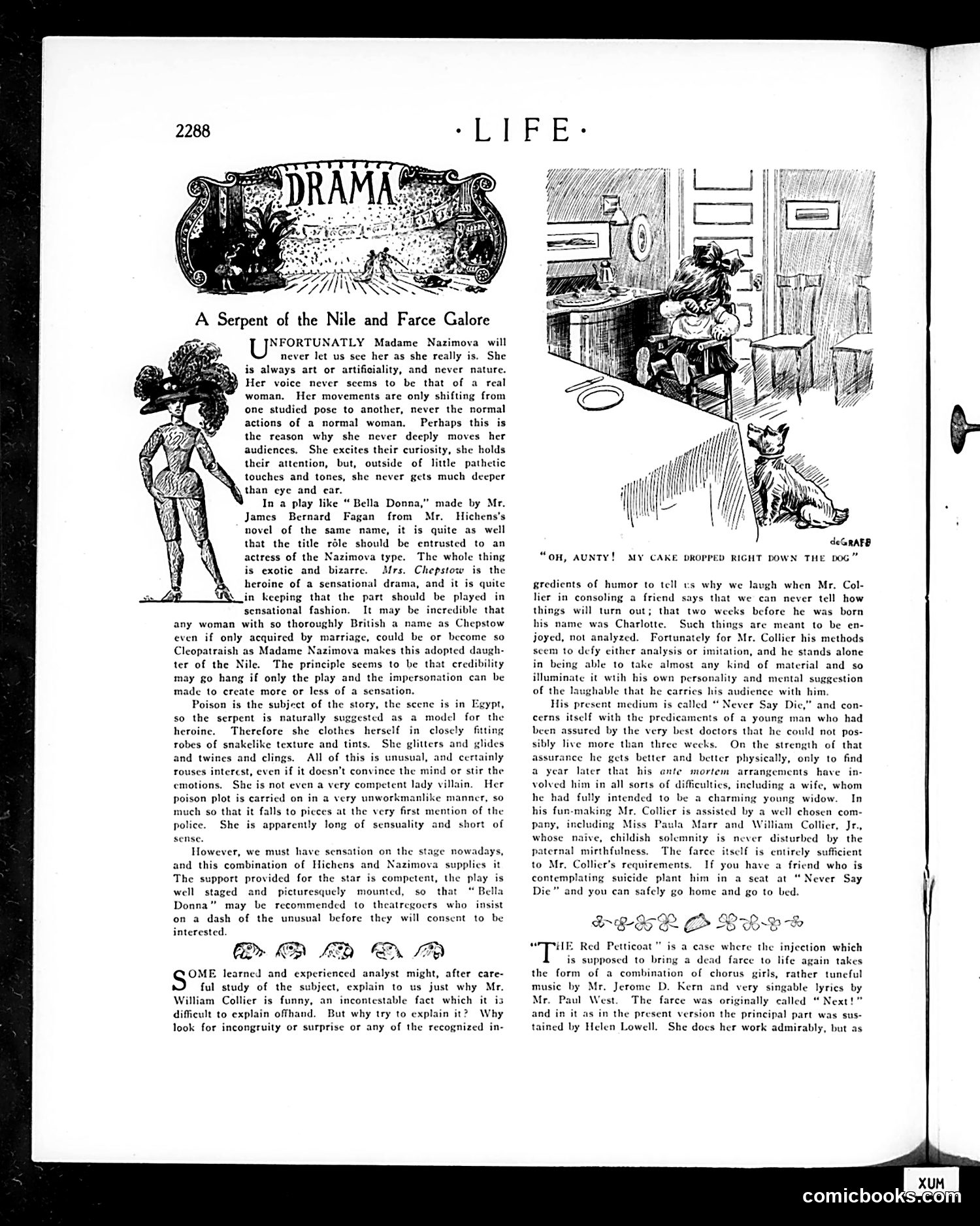
This page reviews two theatrical productions from the early 20th century. **"Bella Donna"** features actress Alla Nazimova in an exotic Egyptian drama about poisoning. The critic dismisses her performance as artificially stylized—all studied poses and "sensational" costuming (snakelike robes, glittering movements) designed to excite curiosity rather than genuine emotion. The review suggests her theatricality works here *because* the play itself is implausibly bizarre, though the poisoning plot itself falls apart unconvincingly. **"Never Say Die"** stars William Collier in a comedy about a man doctors gave three weeks to live who unexpectedly survives, creating matrimonial complications. The critic admits Collier's humor defies analysis—his comedy comes from personality and timing rather than traditional joke construction (illustrated by the example about being named "Charlotte" before birth). A cartoon caption shows a domestic mishap ("My cake dropped right down the dog"). Both reviews praise competent production values while noting the appeal lies in spectacle and star personality rather than narrative substance.
📄 Transcribed text from this page (OCR, searchable)
Machine-transcribed from the original scan — historical spelling and the odd misread are preserved.
A Serpent of the Nile and Farce Galore NFORTUNATLY Madame Nazimova will never let us sce her as she really is. She is always art or artificiality, and never nature. Her voice never scems to be that of a real woman. Her movements are only shifting from one studied pose to another, never the normal actions of a normal woman. Perhaps this is the reason why she never deeply moves her audiences. She excites their curiosity, she holds their attention, but, outside of little pathetic touches and tones, she never gets much deeper than eye and ear. In a play like “Bella Donna,” made by Mr. James Bernard Fagan from Mr. Hichens’s novel of the same name, it is quite as well that the title rdle should be entrusted to an actress of the Nazimova type. The whole thing is exotic and bizarre. Mrs. Chepstow is the heroine of a sensational dra: and it is quite in keeping that the part should be played in sensational fashion. It may be incredible that any woman with so thoroughly British a name as Chepstow even if only acquired by marriage, could be or become so Cleopatraish as Madame Nazimova makes this adopted daugh- ter of the Nile. The principle seems to be that credibility may go hang if only the play and the impersonation can be made to create more or less of a sensation. Poison is the subject of the story, the scene is in Egypt, so the serpent is naturally suggested as a model for the heroine. Therefore she clothes herself in closely fitting robes of snakelike texture and tints. She glitters and glides and twines and clings. All of this is unusual, and certainly rouses interest, even if it doesn’t convince the mind or stir the emotions, She is not even a very competent lady villain. Her poison plot is carried on in a very unworkmanlike manner, so much so that it falls to picces at the very first mention of the police. She is apparently long of sensuality and short of sense. However, we must have sensation on the stage nowadays, and this combination of Hichens and Nazimova supplies it The support provided for the star is compctent, the play is well staged and picturesquely mounted, so that “ Bella Donna” may be recommended to theatregocrs who insist on a dash of the unusual before they will consent to be interested. OME learned and experienced analyst might, after care- ful study of the subject, explain to us just why Mr. William Collier is funny, an incontestable fact which it is difficult to explain offhand. But why try to explain it? Why look for incongruity or surprise or any of the recognized in- H(i \| m MY CAKE DROPPED RIGHT DOWN THE DOG” OH, AUNTY! gredients of humor to tell cs why we lavgh when Mr, Col- lier in consoling a friend says that we can never tell how things will turn out; that two weeks before he was born his name was Charlotte. Such things are meant to be en- joyed, not analyzed. Fortunately for Mr. Collier his methods scem to defy cither analysis or imitation, and he in being able to take almost any kind of mater illuminate it wtih his own personality and mer of the laughable that he carries his audience with him His present medium is called “ Never Say Die,” and con- cerns itself with the predicaments of a young man who had been assured by the very best doctors that he could not pos- sibly live more than three weeks. On the strength of that assurance he gets better and better physically, only to find a year later that his ante mortem arrangements have in- volved him in all sorts of difficulties, including a wife, whom he had fully intended to be a charming young widow. In his fun-making Mr. Collicr is assisted by a well chosen com- pany, including Miss Paula Marr and William Collier, Jr, whose naive, childish solemnity is never disturbed by the paternal mirthfulness. The farce itself is entirely sufficient to Mr, Collier's requirements. If you have a friend who is contemplating suicide plant him in a seat at “N Die” and you can safely go home and go to bed. Qe B& THe Red Petticoat" is a case where the injection which is supposed to bring a dead farce to life again takes the form of a combination of chorus girls, rather tuneful music by Mr. Jerome D. Kern and very singable lyrics by Mr. Paul West. The farce was originally called “ Next!" and in it as in the present version the principal part was sus- tained by Helen Lowell. She docs her work admirably, but as comicboolenee