
Life, 1912-11-28 · page 24 of 44
Life — November 28, 1912 — page 24: what you’re looking at
What you’re looking at
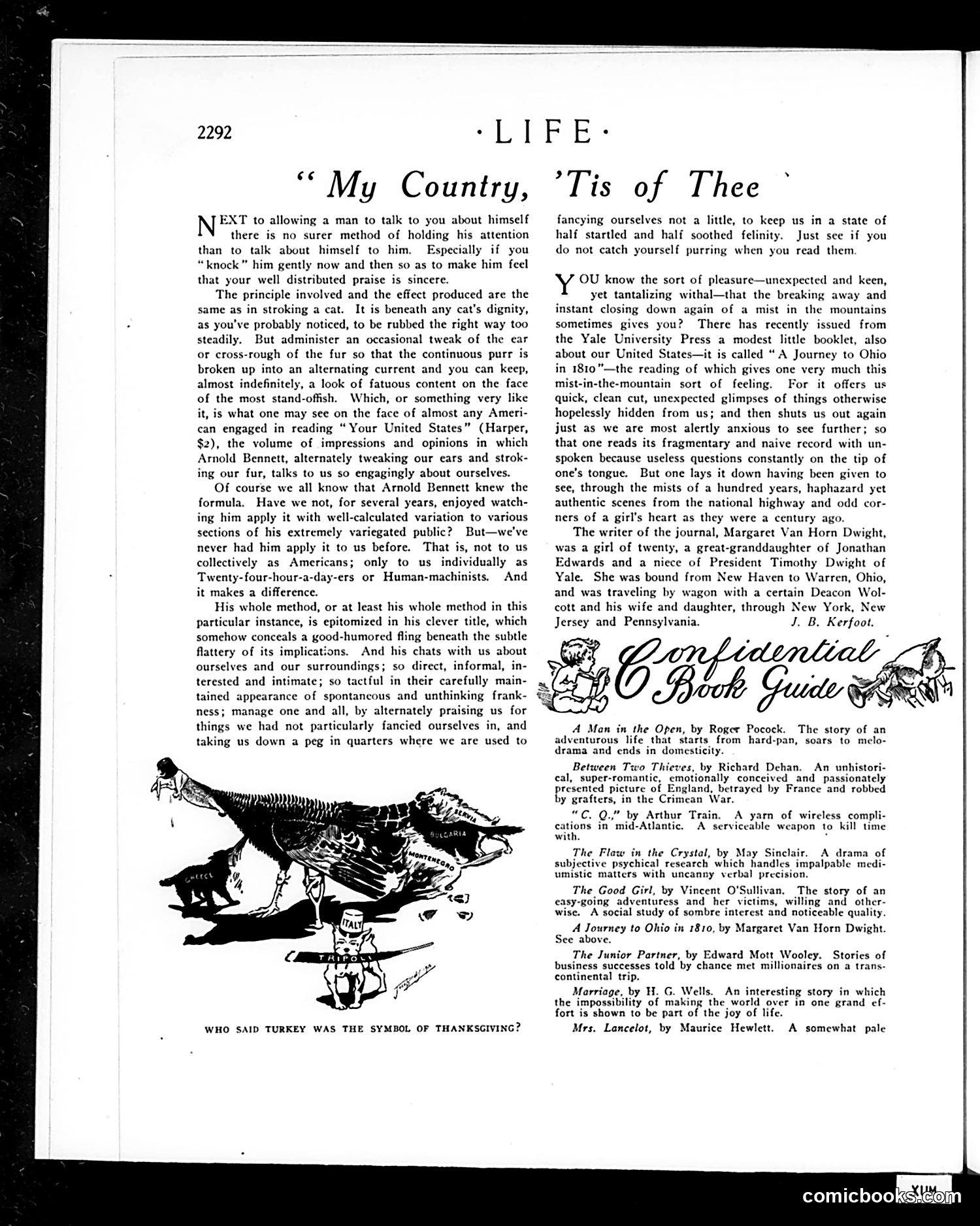
This page contains two distinct items: **Main Article**: A review of Arnold Bennett's book *"Your United States"* (Harper, $2). The critic uses an extended metaphor comparing Bennett's flattery technique to stroking a cat—he alternately praises and gently mocks Americans to keep them engaged and "purring." The satire suggests Bennett has mastered the formula of making people feel simultaneously complimented and subtly insulted, keeping them reading despite (or because of) the backhanded compliments. **Secondary Review**: A notice of *"A Journey to Ohio in 1810,"* a Yale University Press publication featuring the diary of Margaret Van Horn Dwight, a twenty-year-old great-granddaughter of Jonathan Edwards traveling westward. It's praised for offering brief, authentic historical glimpses. **The Cartoon**: Shows a turkey being stroked/manipulated, illustrating the "cat-stroking" metaphor discussed in the Bennett review—a visual joke about how skillful manipulation keeps subjects compliant.
📄 Transcribed text from this page (OCR, searchable)
Machine-transcribed from the original scan — historical spelling and the odd misread are preserved.
“LTP 'E * “My Country, N XT to allowing a man to talk to you about himself there is no surer method of holding his attention than to talk about himself to him. Especially if you “knock” him gently now and then so as to make him feel that your well distributed praise is sincere. The principle involved and the effect produced are the same as in stroking a cat. It is beneath any cat's dignity, as you've probably noticed, to be rubbed the right way too steadily. But administer an occasional tweak of the ear or cross-rough of the fur so that the continuous purr is broken up into an alternating current and you can keep, almost indefinitely, a look of fatuous content on the face of the most stand-offish. Which, or something very like it, is what one may see on the face of almost any Ameri- can engaged in reading “Your United States” (Harper, $2), the volume of impressions and opinions in which Arnold Bennett, alternately tweaking our ears and strok- ing our fur, talks to us so engagingly about ourselves. Of course we all know that Arnold Bennett knew the formula. Have we not, for several years, enjoyed watch- ing him apply it with well-calculated variation to various sections of his extremely variegated public? But—we'v never had him apply it to us before. That is, not to us collectively as Americans; only to us individually as Twenty-four-hour-a-day-ers or Human-machinists. And it makes a difference. His whole method, or at least his whole method in this particular instance, is epitomized in his clever title, which somehow conceals a good-humored fling beneath the subtle flattery of its implications. And his chats with us about ourselves and our surroundings; so direct, informal, in- terested and intimate; so tactful in their carefully main- tained appearance of spontancous and unthinking frank- ness; manage one and all, by alternately praising us for things we had not particularly fancied ourselves in, and taking us down a peg in quarters where we are used to WHO SAID TURKEY WAS THE SYMBOL OF THANKSGIVING? ’Tis of Thee ~ fancying ourselves not a little, to keep us in a state of half startled and half soothed felinity. Just see if you do not catch yourself purring when you read them OU know the sort of pleasure—unexpected and keen, yet tantalizing withal—that the breaking away and instant closing down again of a mist in the mountains sometimes gives you? There has recently issued from the Yale University Press a modest little booklet, also about our United States—it is called “ A Journey to Ohio in 1810"—the reading of which gives one very much this mist-in-the-mountain sort of feeling. For it offers us quick, clean cut, unexpected glimpses of things otherwise hopelessly hidden from us; and then shuts us out again just as we are most alertly anxious to see further; so that one reads its fragmentary and naive record with un- spoken because useless questions constantly on the tip of one’s tongue. But one lays it down having been given to see, through the mists of a hundred years, haphazard yet authentic scenes from the national highway and odd cor- ners of a girl’s heart as they were a century ago. The writer of the journal, Margaret Van Horn Dwight, was a girl of twenty, a great-granddaughter of Jonathan Edwards and a niece of President Timothy Dwight of Yale. She was bound from New Haven to Warren, Ohio, and was traveling by wagon with a certain Deacon Wol- cott and his wife and daughter, through New York, New Jersey and Pennsylvania. J. B. Kerfoot. A Man in the Open, by Roger Pocock. The story of an adventurous life that starts from hard-pan, soars to melo- drama and ends in domesticity. Between Two Thieves, by Richard Dehan. An unhistori- cal, super-romantic, emotionally conceived_and passionately presented picture of England, betrayed by France and robbed by grafters, in the Crimean War. “C,. Q..” by Arthur Train. A yarn of wireless compli- cations in mid-Atlantic. A serviceable weapon to kill time with. . The Flaw in the Crystal, by May Sinclair. drama of subjective psychical research which handles impalpable medi- umistic matters with uncanny verbal precision. The Good Girl, by Vincent O'Sullivan. The story of an easy-going adventuress and her victims, willing and other- wise. A so study of sombre interest and noticeable quality. A Journey to Ohio in 1810, by Margaret Van Horn Dwight. See above. The Junior Partner, by Edward Mott Wooley. Stories of business successes told by chance met millionaires on a trans- continental trip. Marriage, by H. G. Wells. An interesting story in which the impossibility of making the world over in one grand ef- fort is shown to be part of the joy of life. Mrs. Lancelot, by Maurice Hewlett. A somewhat pale comicboo!