
A complete issue · 44 pages · 1912
Life — November 21, 1912
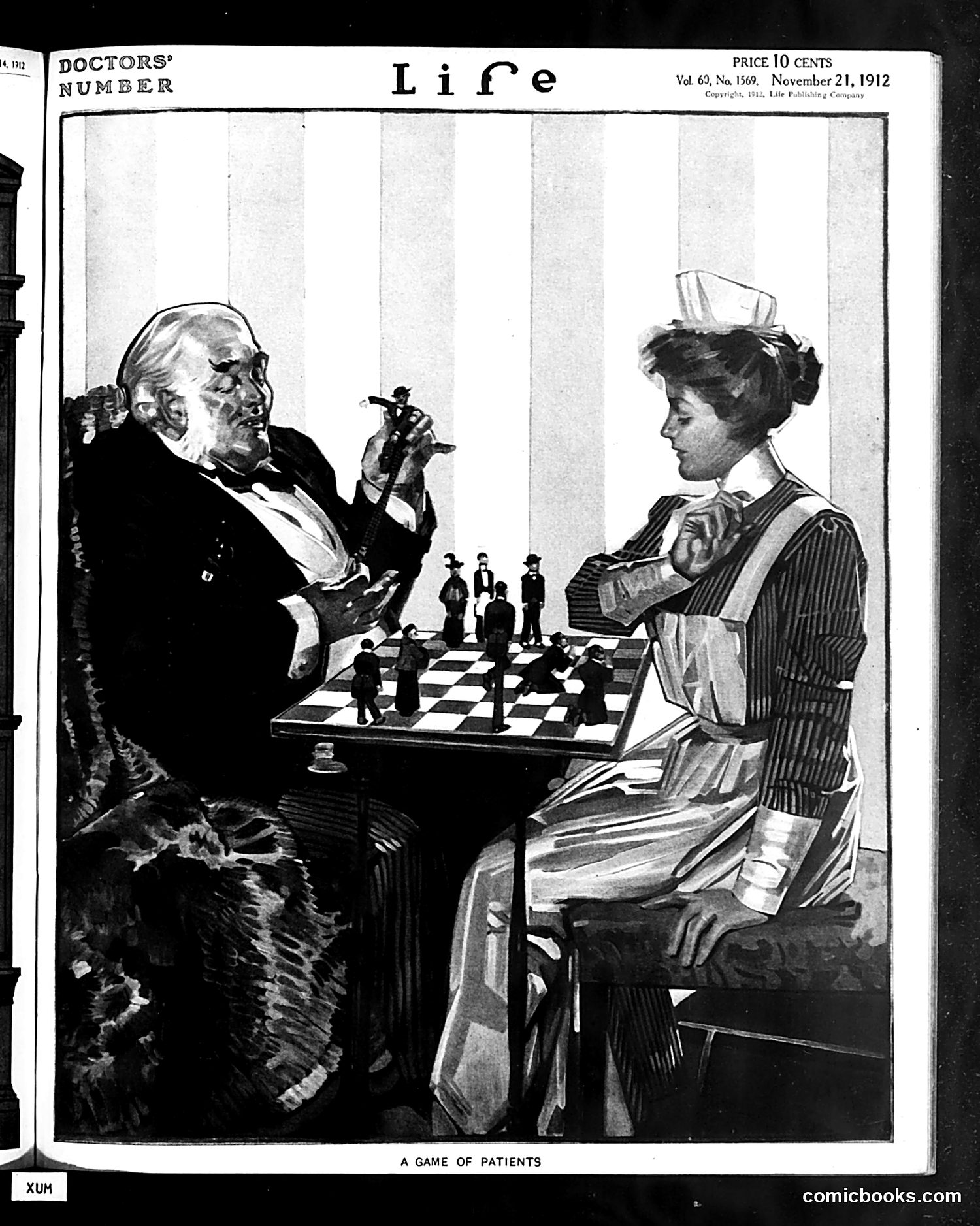
This **Life** magazine cover from November 21, 1912 uses chess as a metaphor for medical practice. An elderly physician (left) manipulates his patients like chess pieces on a board, while a nurse (right) watches. The title "A Game of Patients" is a pun: "patients" sounds like "patiences," suggesting doctors treat sick people as mere game pieces rather than human beings deserving genuine care. The satire critiques the medical profession's tendency to view patients as objects to be strategically managed for profit or professional advancement, rather than as individuals needing compassionate treatment. The chess board emphasizes the calculated, impersonal nature of such practice. This reflects Progressive Era concerns about medical ethics and professionalism during the early 20th century.
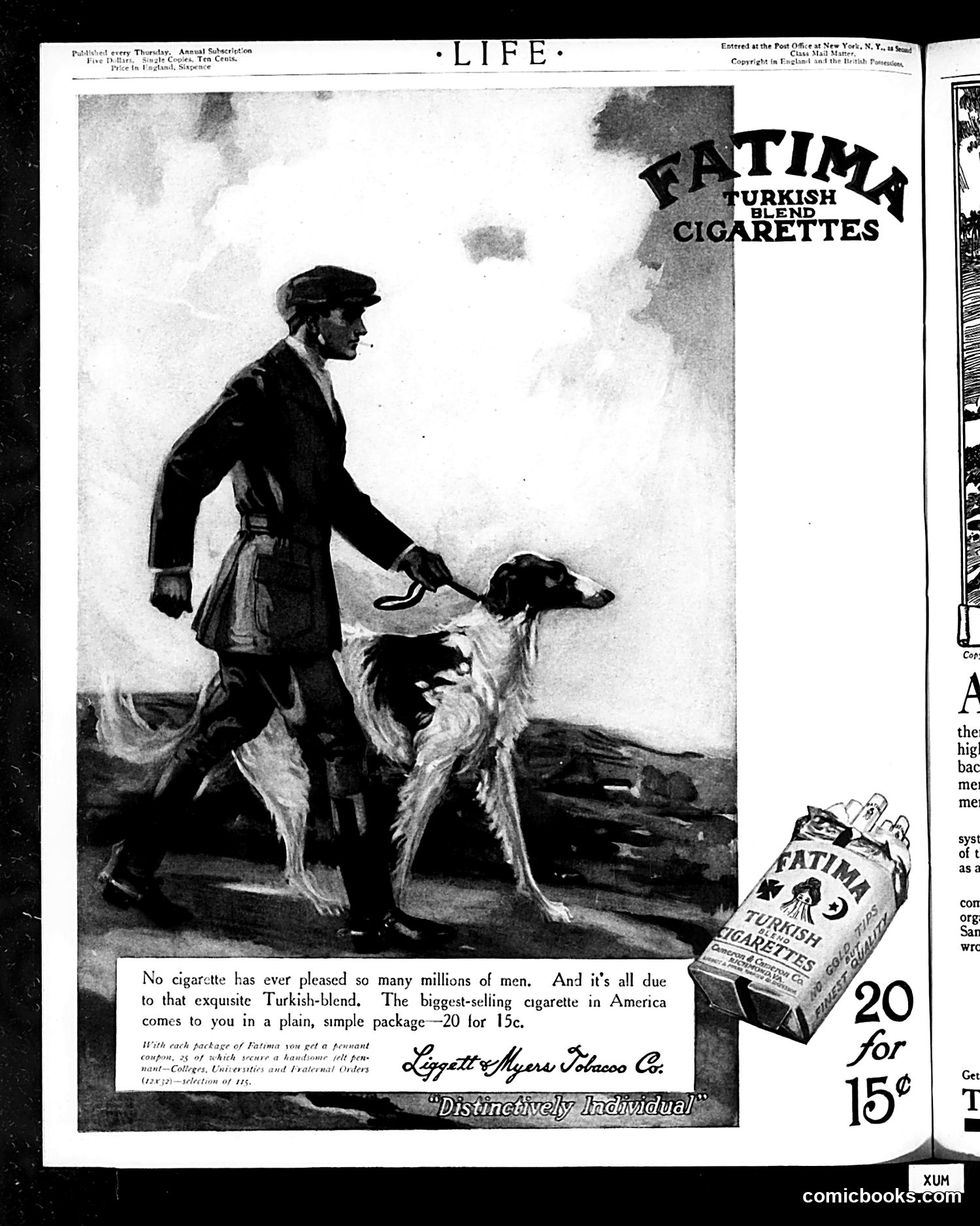
This page is primarily a **cigarette advertisement**, not political satire. It advertises Fatima Turkish Blend cigarettes by Liggett & Myers Tobacco Co. The image shows a man in early 20th-century clothing walking a dog, with text claiming: "No cigarette has ever pleased so many millions of men. And it's all due to that exquisite Turkish-blend. The biggest-selling cigarette in America comes to you in a plain, simple package—20 for 15c." The tagline reads "Distinctively Individual." The ad emphasizes the product's popularity and accessibility through affordable pricing. This appears to be a straightforward commercial advertisement rather than editorial content or political commentary, typical of LIFE magazine's revenue model during this era.
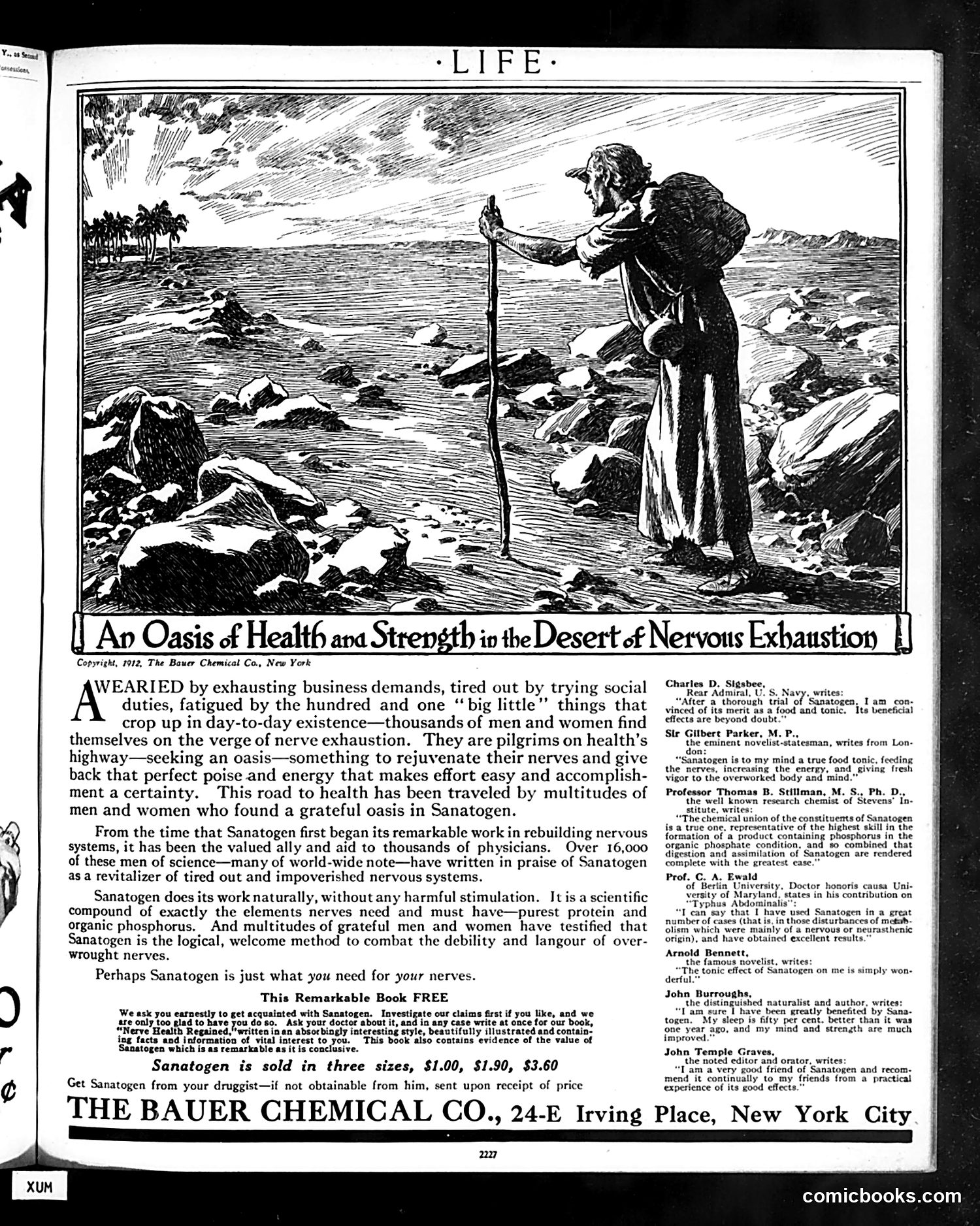
This page is primarily **advertising, not satire or political commentary**. The illustration depicts a robed figure standing by water, holding a staff—an image evoking spiritual or healing authority. The ad promotes "Sanatogen," a commercial nerve tonic sold by The Bauer Chemical Co. The text claims it treats "nervous exhaustion" caused by modern life's demands. The "oasis" metaphor in the headline suggests Sanatogen offers relief and rejuvenation. The page includes testimonials from named figures (including a Navy Admiral and a Professor), lending credibility to the product's health claims—a common early 20th-century marketing tactic before modern FDA regulations. This reflects the era's unregulated patent medicine industry, where tonics promised cure-alls for vaguely-defined conditions like "nervous exhaustion."
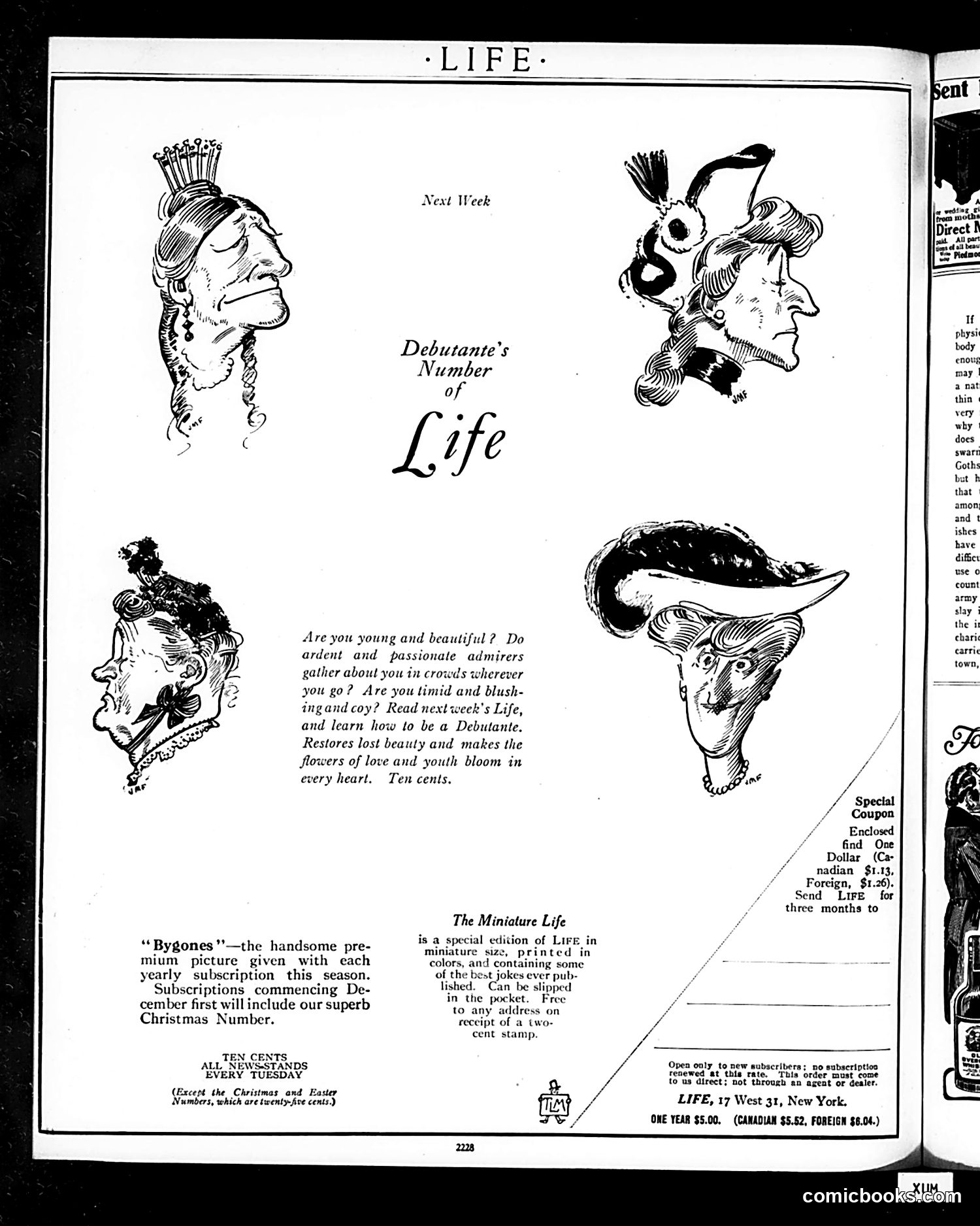
This is a **promotional page for Life magazine's upcoming "Debutante's Number,"** not a political cartoon. The four caricatured heads represent stylized female types, likely illustrating different "debutante" personalities or archetypes for humorous effect. The central text promises that next week's issue will feature content aimed at "young and beautiful" readers—specifically about becoming a "Debutante." The satirical angle appears to be gently mocking debutante culture itself: the exaggerated facial features and ornate styling suggest Life is poking fun at the pretensions and artificiality of high-society debut rituals. The advertisement emphasizes the magazine's appeal to fashionable, romantic audiences while promoting subscriptions at ten cents. "Bygones" prints are offered as subscription bonuses.
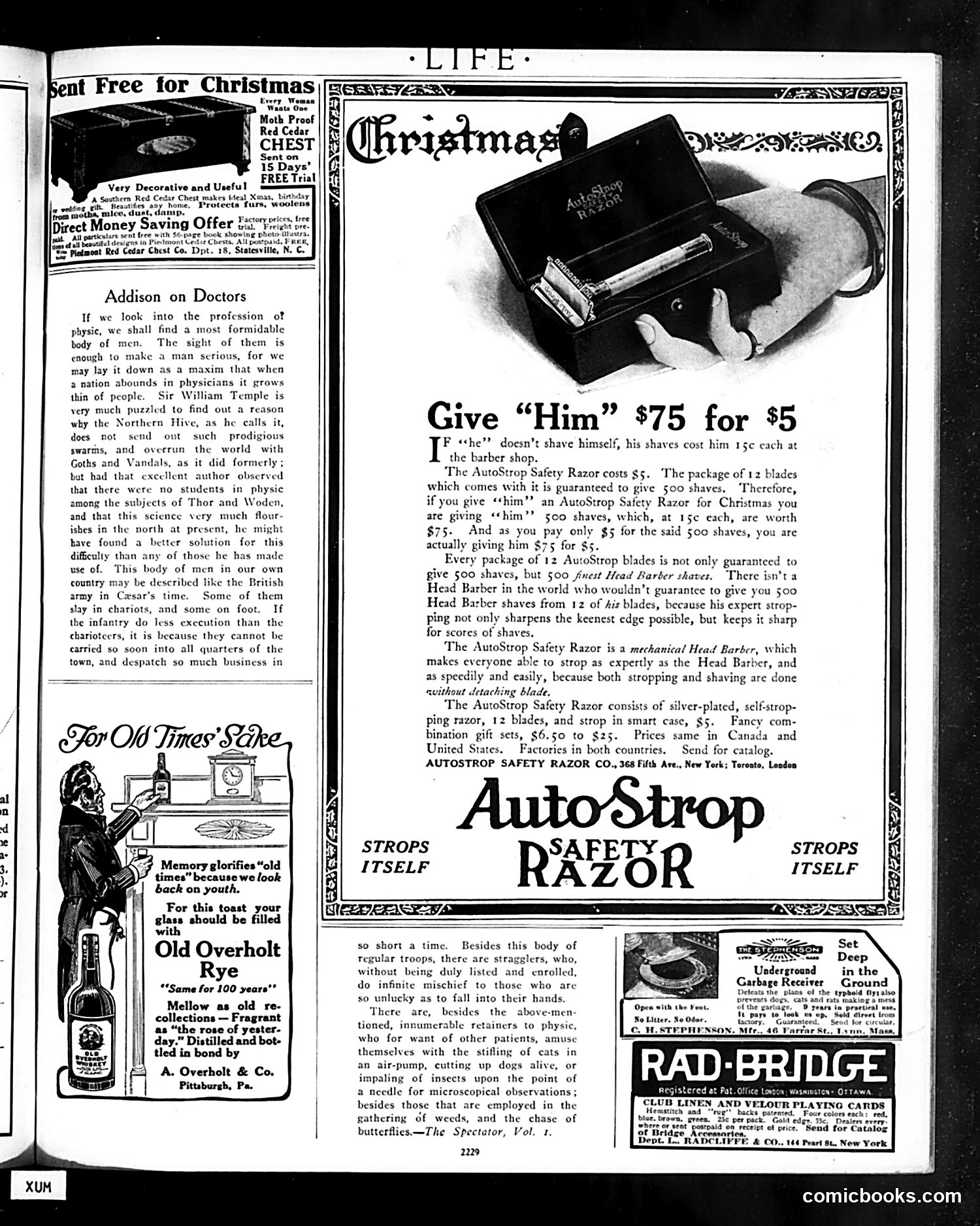
This page is primarily **advertising rather than satire or political cartoon**. The dominant content is a full-page advertisement for the AutoStrop Safety Razor, positioned as a Christmas gift ("Give 'Him' $75 for $5"). The ad emphasizes the razor's mechanical self-stropping feature and includes testimonial language about its superiority. The left column contains an article titled "Addison on Doctors" discussing the medical profession's importance to society, referencing historical physicians and Sir William Temple. Below that is an Old Overholt Rye whiskey advertisement. Additional small advertisements appear for a Red Cedar Chest, Rad-Bridge playing cards, and other products. **No political satire or caricature is evident**—this is a standard commercial magazine page from the early 20th century showcasing period Christmas gift suggestions and lifestyle products.
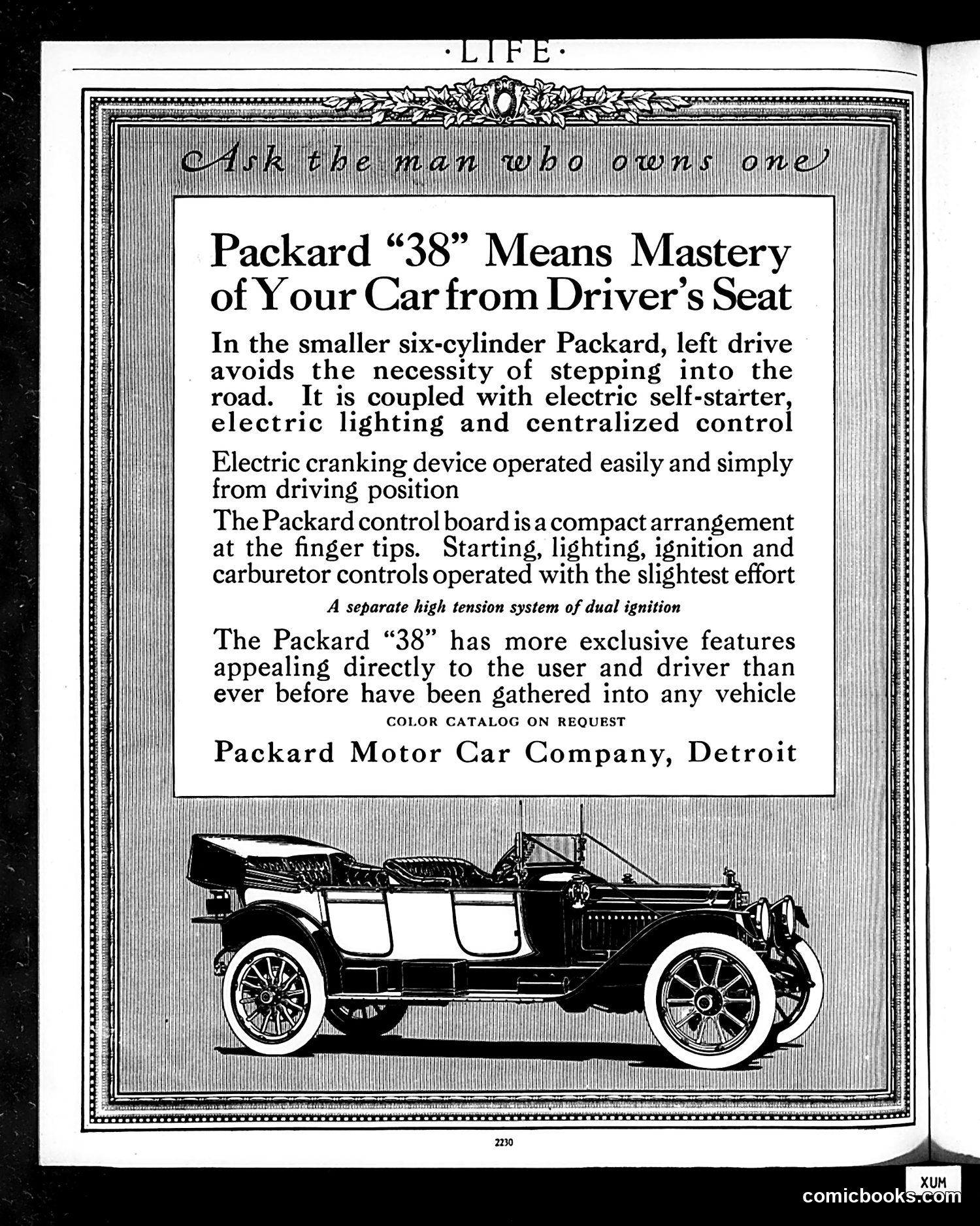
This page is primarily a **Packard automobile advertisement**, not political satire. It promotes the Packard "38" luxury car, emphasizing driver convenience features for the era: left-hand drive, electric self-starter, electric lighting, and centralized controls on a dashboard. The headline "Ask the man who owns one" appears at the top—a famous Packard advertising slogan. The ad targets wealthy buyers by highlighting technological sophistication: the electric starter eliminated hand-cranking (dangerous and difficult), and consolidated controls meant drivers could operate the vehicle "from driving position" without leaving their seat. This reflects early 1910s automotive marketing, when such features were novel luxuries signaling both engineering prowess and owner status. There is no cartoon or political content on this page.
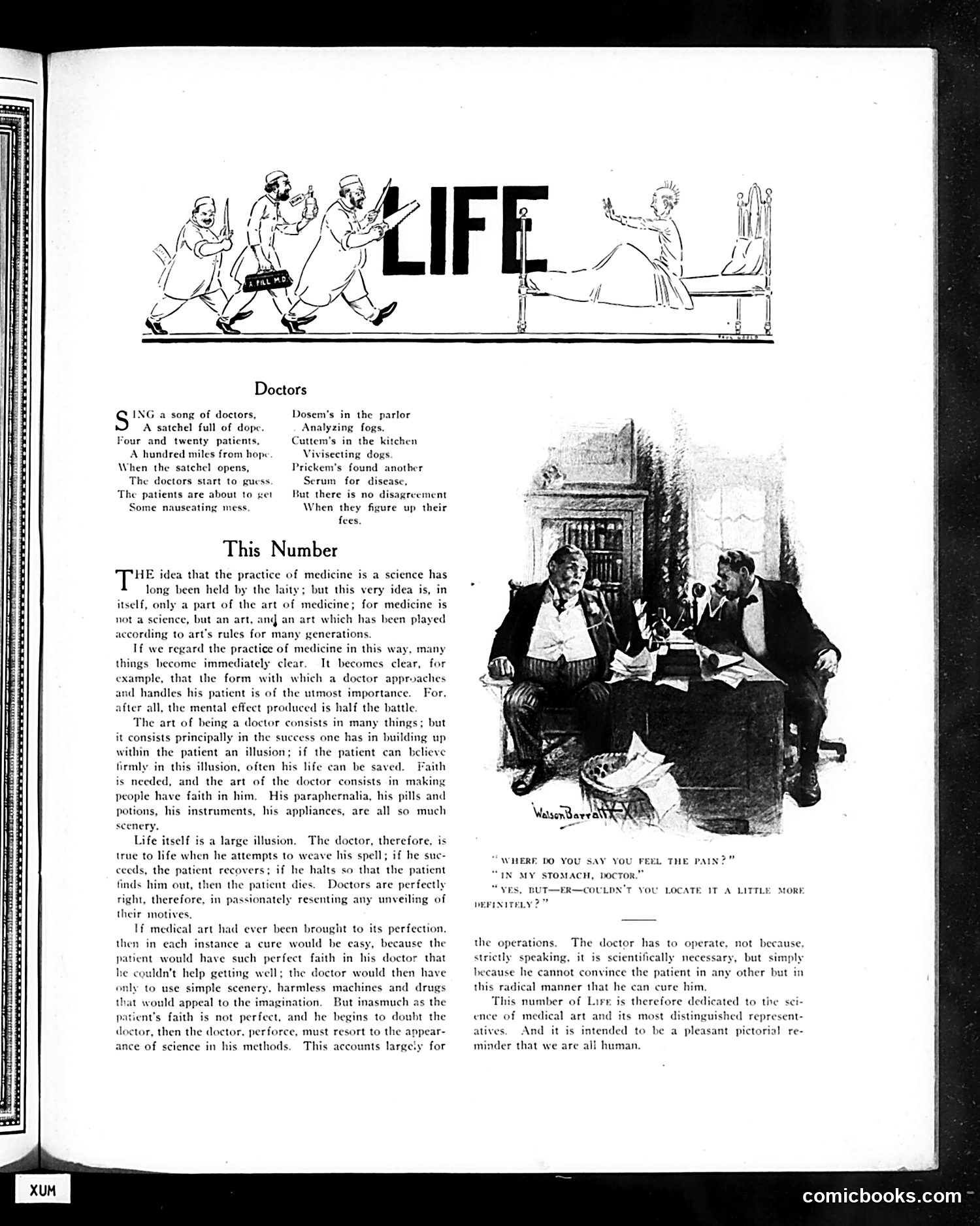
This page satirizes the medical profession's reliance on performance and faith over science. The header cartoon shows doctors as theatrical performers—literally pushing a patient through the word "LIFE"—suggesting medicine is spectacle rather than genuine healing. The accompanying essay argues that medicine's *art* (bedside manner, appearance, confidence) matters as much as its *science*. The illustrated scene shows a doctor reassuring a patient about stomach pain with vague, confident gestures—the humor being that the doctor may lack actual diagnostic clarity. The satire's point: doctors succeed partly through convincing patients they'll recover, using props, instruments, and authority as "scenery." The patient's faith in the doctor matters more than rigorous medicine—a critique of early 20th-century medical practice's theatrical elements masking limited actual scientific knowledge.
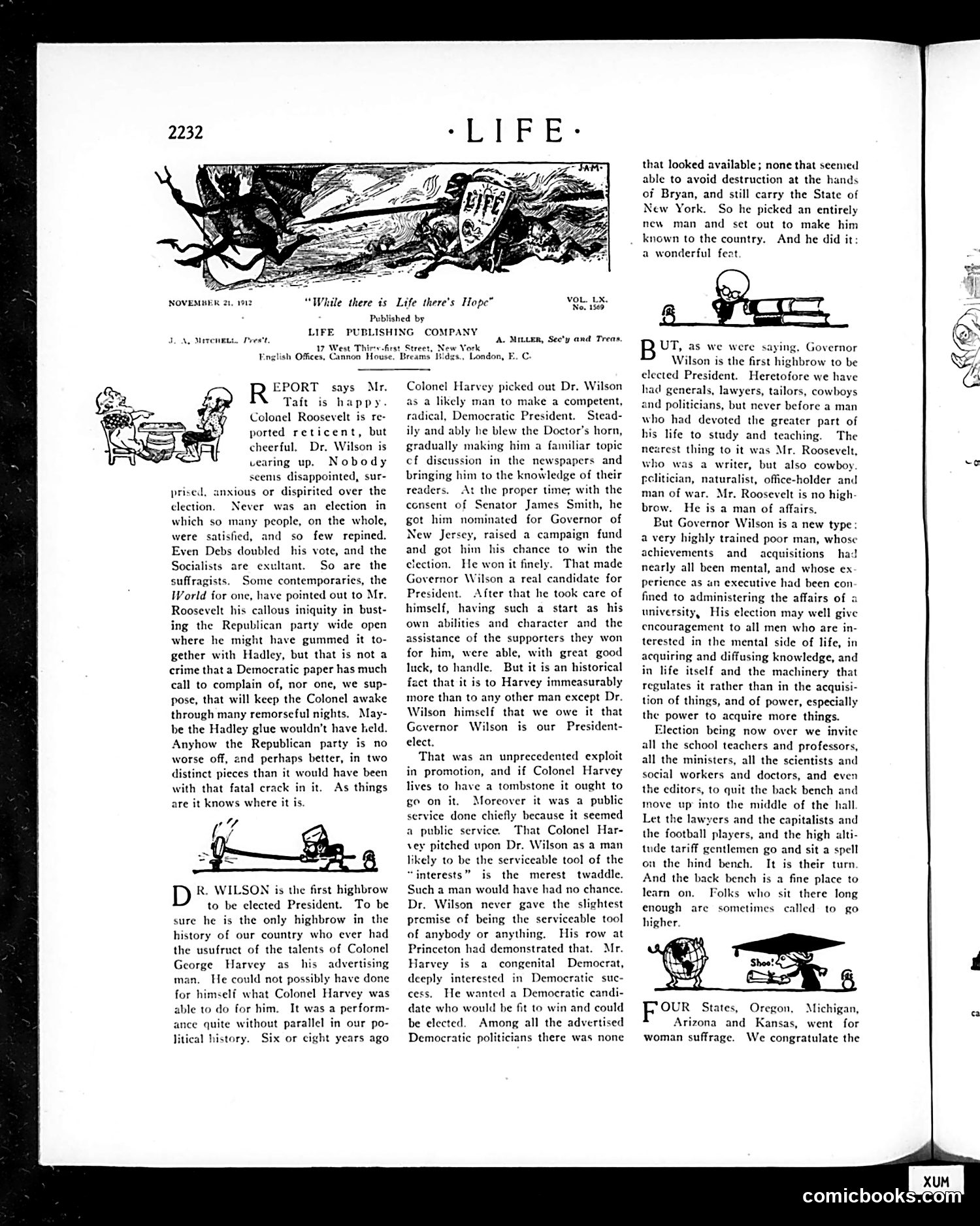
This editorial page celebrates Woodrow Wilson's election as President. The text praises Wilson as an intellectual and capable administrator, contrasting him favorably with Colonel Harvey (a Republican promoter) who had initially supported Wilson but is now dismissed as having merely been a convenient tool. The satirical cartoons mock Harvey's overconfidence in believing he "made" Wilson's presidency. Small illustrations show figures in humorous, diminished poses—typical Life magazine style mocking of political figures. The underlying joke: Harvey thought he controlled Wilson, but Wilson proved to be the superior political talent who outmaneuvered his supposed kingmaker. The page also congratulates four states—Oregon, Michigan, Arizona, and Kansas—for voting for women's suffrage, showing Life's progressive stance on that issue.
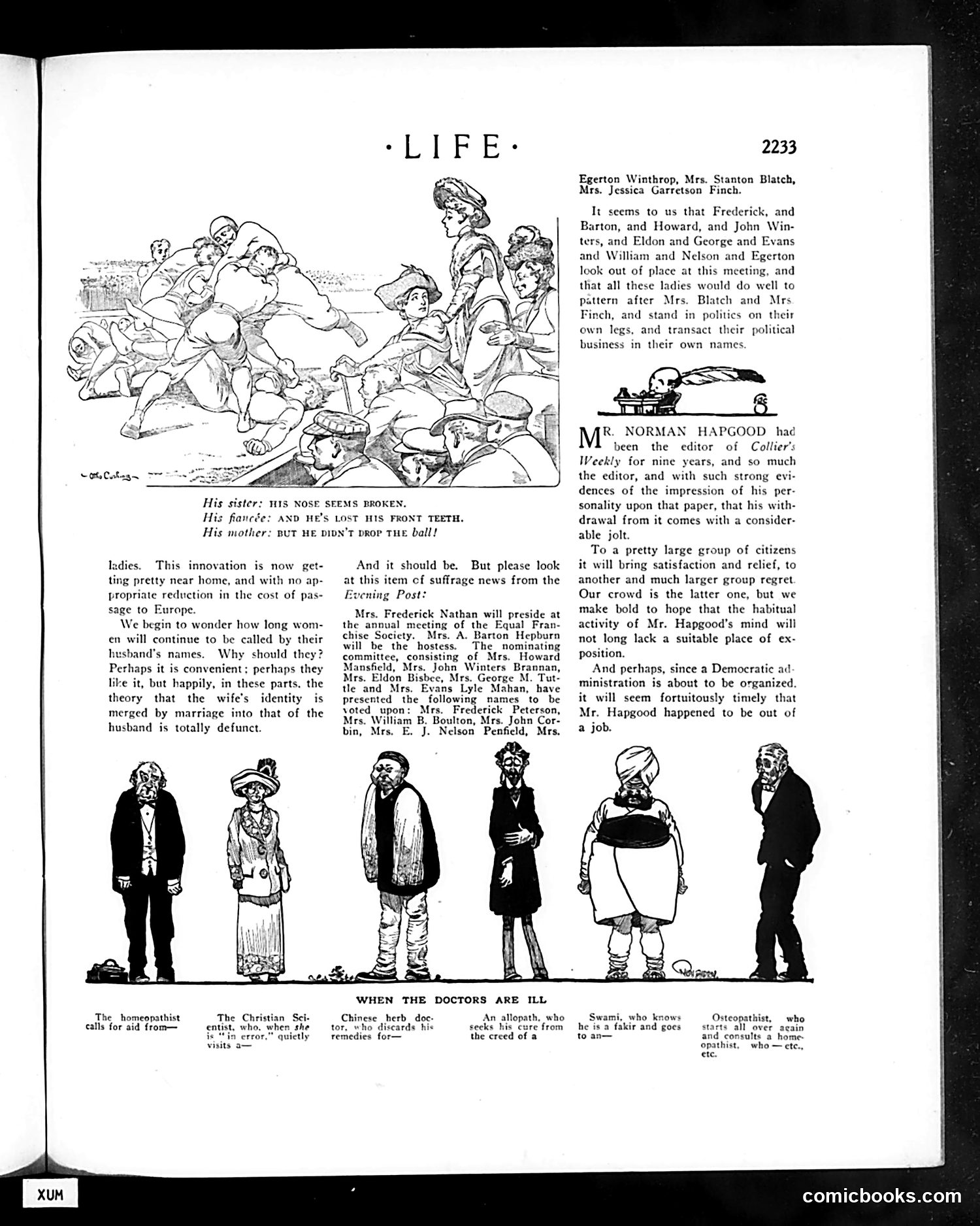
This page satirizes women's suffrage and political participation. The top cartoon mocks men reacting to women entering politics, showing physical chaos and disorder. The text argues wives should adopt their husbands' names in politics to avoid confusion—a transparent argument *against* women's independent political identity. The lower cartoon, "When the Doctors Are Ill," depicts six alternative practitioners (homeopath, Christian Scientist, herb doctor, allopath, alternative healer, osteopath) as quacks. This satirizes competing medical philosophies of the era. The references to the "Equal Franchise Society" meeting and specific women's names indicate this was written during early-20th-century suffrage debates. The satire mocks both women's political aspirations and non-conventional medicine simultaneously.
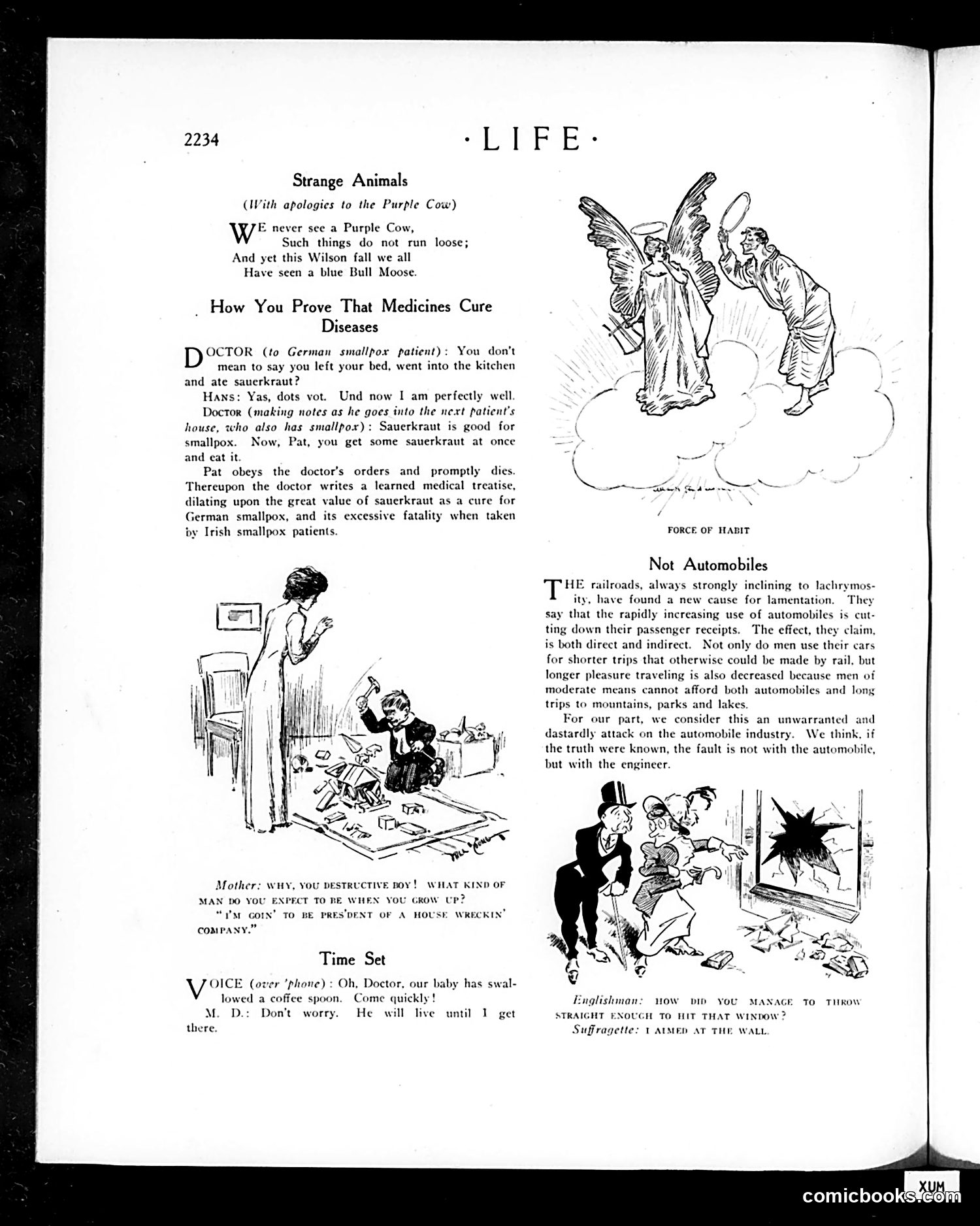
This satirical page contains three separate humorous pieces mocking contemporary issues: 1. **"Strange Animals"**: A brief joke about never seeing a purple cow, yet claiming to have seen a blue bull moose—poking fun at tall tales and exaggeration. 2. **"How You Prove That Medicines Cure Diseases"**: A doctor-patient dialogue satirizing medical quackery. A German doctor prescribes sauerkraut to a smallpox patient, who dies. The doctor then publishes a medical treatise claiming sauerkraut's value—mocking how doctors claimed credit for cures while ignoring deaths, particularly among Irish patients. 3. **"Not Automobiles"**: Criticizes the automobile industry's impact on railroads and leisure travel, blaming engineers rather than cars themselves. 4. **"Time Set"**: A brief comedic phone exchange about a swallowed coffee spoon. The page reflects early-20th-century concerns about medicine, technology, and social change.
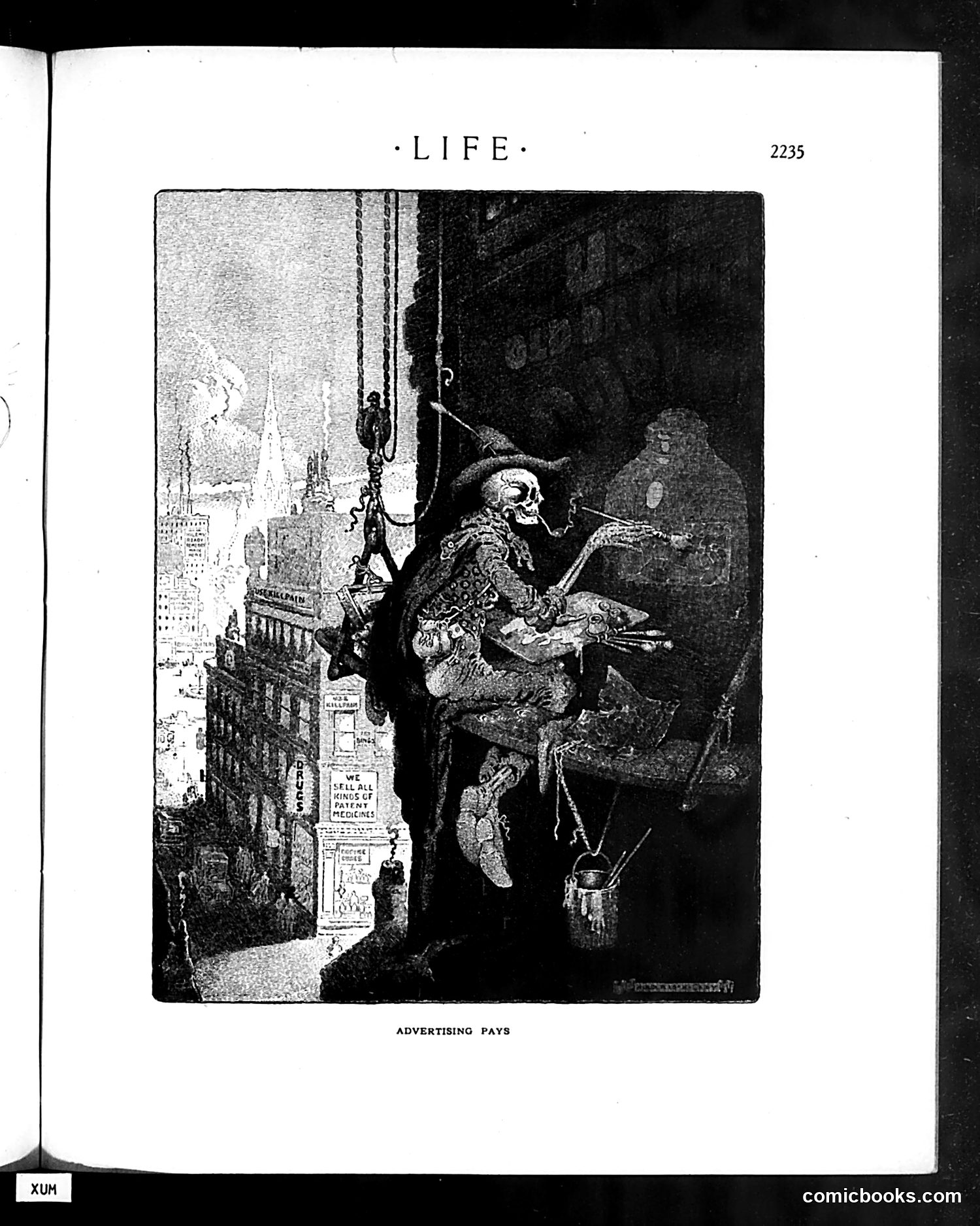
This satirical cartoon depicts Death (shown as a skeletal figure) as a successful businessman or advertiser, sitting at a desk in what appears to be a modern office or shop. The left side shows an urban cityscape with tall buildings and signs. The caption "Advertising Pays" suggests the cartoon is critiquing how advertising and commercialism have become so pervasive and powerful that even death profits from it. The skeleton figure, traditionally a memento mori symbol, is recast as a capitalist thriving in the commercial world. This appears to be social commentary on the era's explosive growth in advertising and consumer culture, satirizing how commercial forces seem to benefit from human vulnerability, mortality, or perhaps illness and pharmaceutical sales.
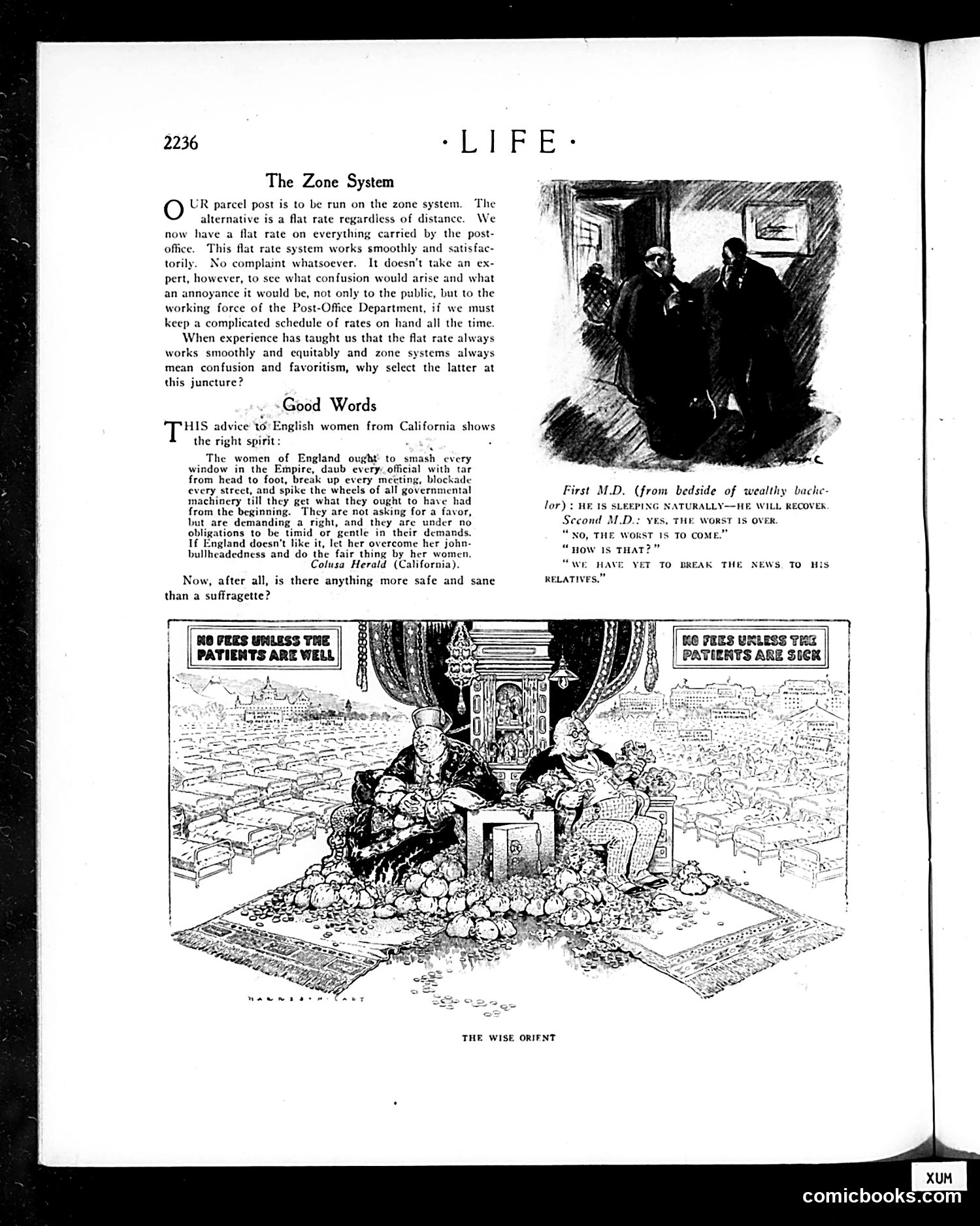
This cartoon satirizes British imperial management of colonial territories. The figure on the left appears to represent a British official or ruler, surrounded by wealth (money bags, jewels) extracted from colonized lands depicted on either side. The caption contrasts two approaches: "Dr. Pules Unless the Patients Are Well" versus "Dr. Pules Unless the Patients Are Sick"—suggesting contradictory or self-serving policies. The cartoon implies that British colonial administration prioritizes extraction of resources ("well patients") while neglecting actual welfare. The title "The Wise Orient" is likely ironic, suggesting that Eastern rulers understood how to govern more ethically than the depicted British official who hoards wealth while colonial populations suffer.
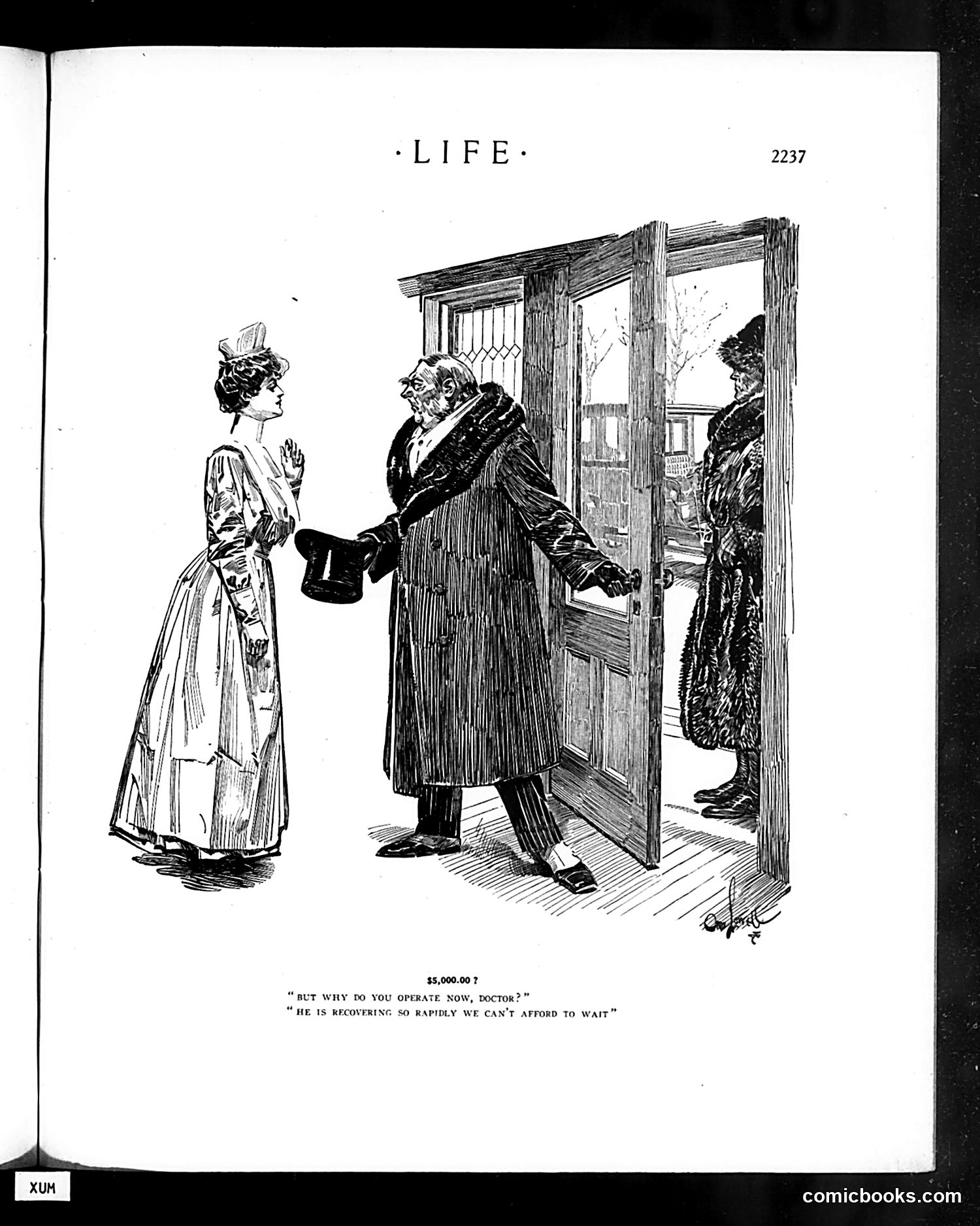
This is a single-panel cartoon from *Life* magazine satirizing medical costs and urgency. The scene shows a doctor at a doorway speaking to a woman, while another figure waits inside. The caption reads: "$5,000.00?" / "BUT WHY DO YOU OPERATE NOW, DOCTOR?" / "HE IS RECOVERING SO RAPIDLY WE CAN'T AFFORD TO WAIT" The joke targets the financial incentives of doctors and surgeons. The doctor's paradoxical reasoning—that he must operate *immediately* precisely *because* the patient is improving—suggests the physician profits more from surgery than from recovery. The satire implies doctors prioritize lucrative procedures over patients' actual medical needs, performing unnecessary operations on those who are healing naturally. This reflects early-20th-century concerns about medical profiteering and the tension between patient welfare and physician income.
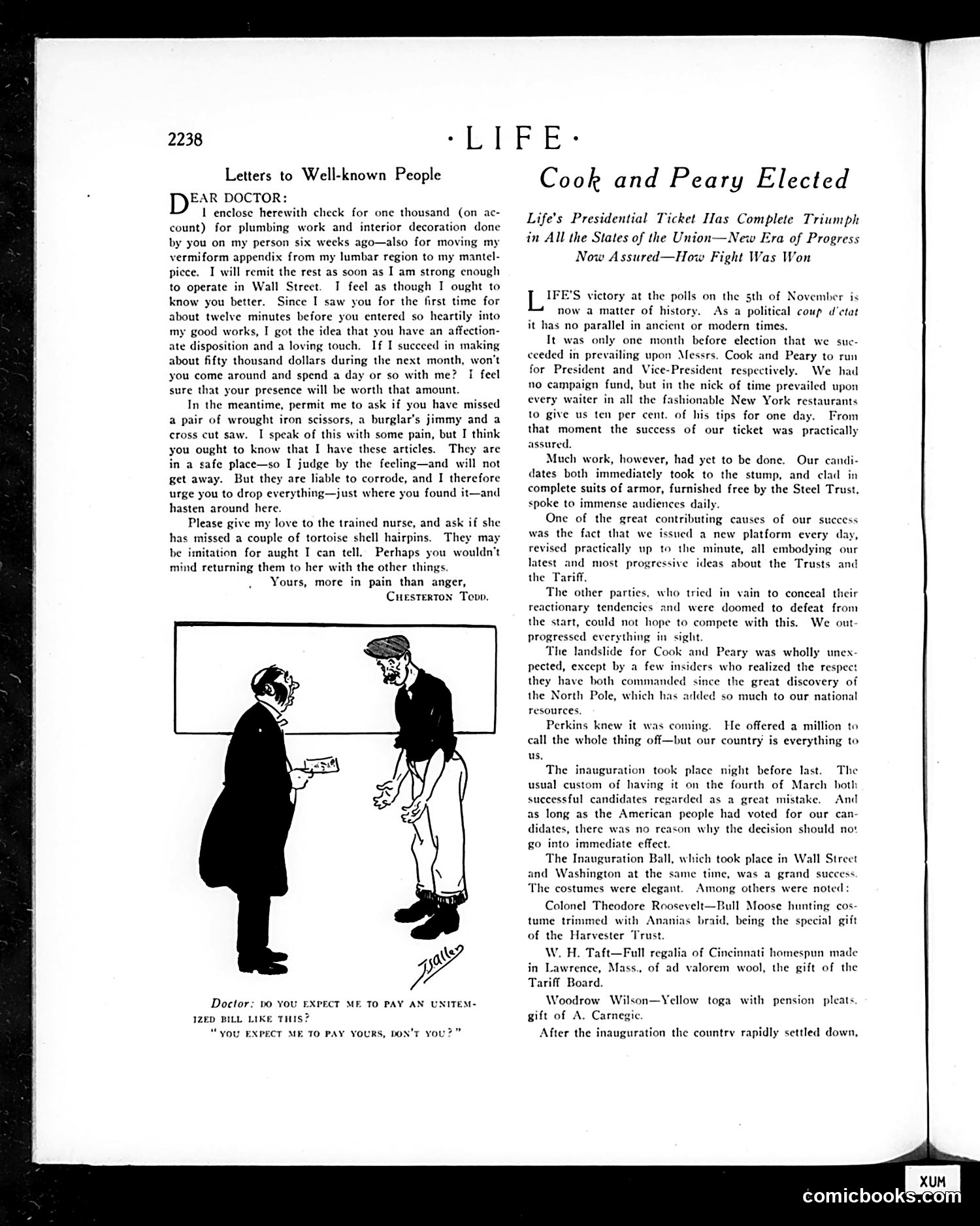
This cartoon depicts a financial dispute between a doctor and patient. The doctor demands payment for an "itemized bill," while the patient protests. The joke's caption reads: "Do you expect me to pay an unitemized bill like this?" / "You expect me to pay yours, don't you?" The satire targets the medical profession's perceived hypocrisy regarding billing transparency. The doctor demands itemized bills from others but provides vague invoices to patients. This reflects early 20th-century frustration with unclear medical costs and professional double standards. The accompanying article celebrates Cook and Peary's presidential campaign victory, suggesting this Life issue addresses both political triumph and everyday consumer grievances—typical of the magazine's satirical approach to American life.
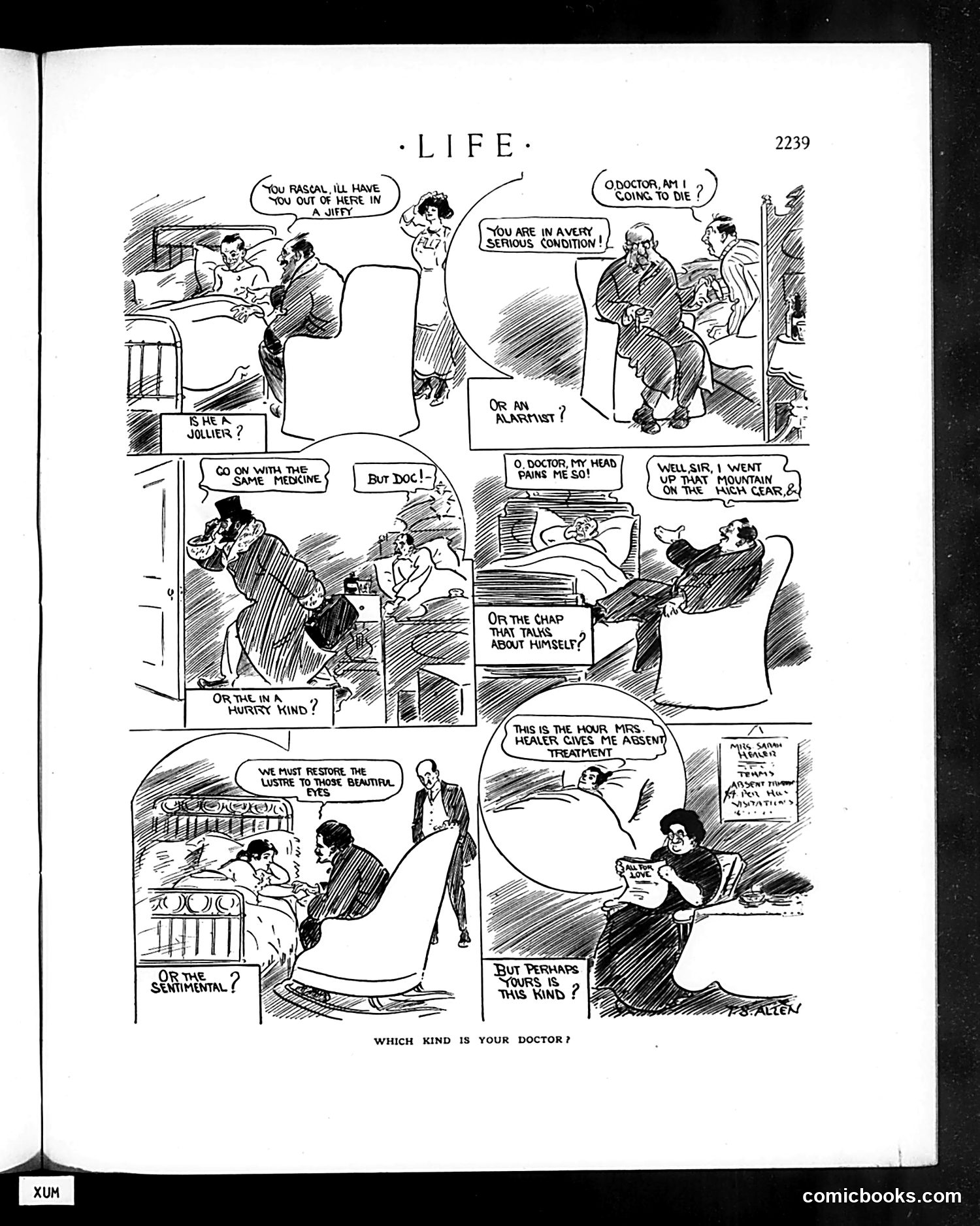
This satirical comic by P.S. Allen depicts various doctor "types" through a patient's hospital experience. The humor contrasts different medical personalities: - A brusque doctor rushing the patient out in a "hurry" - An alarmist who declares the patient dying - A sentimental physician focused on "beautiful" aesthetics over treatment - A nervous, anxious doctor - One obsessed with absent treatments ("Mrs. Healer gives me arsenic treatment") - A gossipy doctor concerned with patients' personal affairs The comic satirizes how doctors' personalities and bedside manner vary widely, questioning what type of physician is actually most helpful. It reflects early-20th-century anxieties about medical professionalism and the gap between doctors' competence and their interpersonal skills. The exaggerated characterizations suggest no ideal doctor exists—each type has comic flaws.
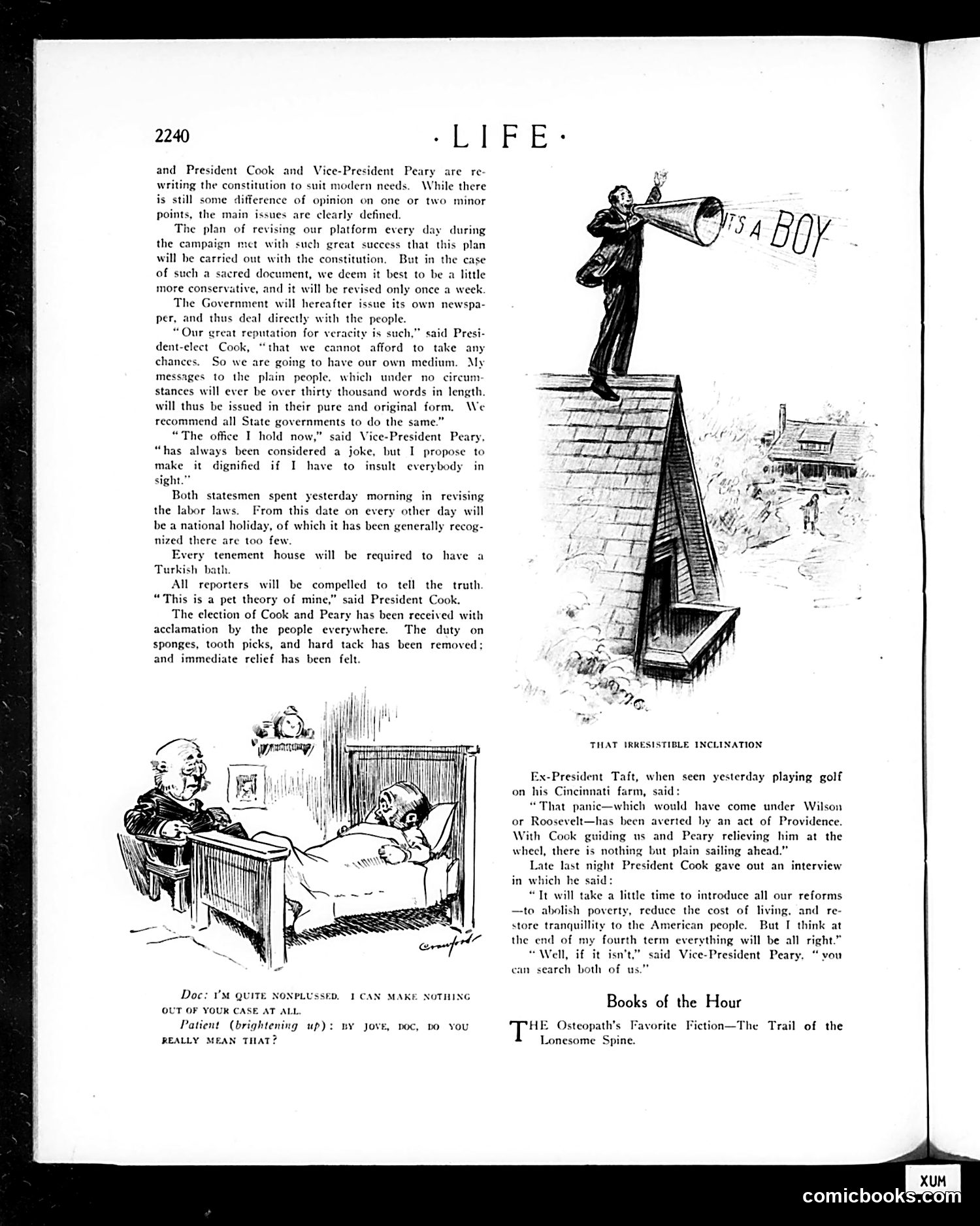
This Life magazine page satirizes the 1908-1909 polar exploration rivalry between Frederick Cook and Robert Peary—both claiming to have reached the North Pole—by imagining them elected President and Vice-President. The satire mocks their credibility and inflated ambitions. The cartoon jokes that these explorers would govern absurdly: rewriting the Constitution weekly, issuing propaganda through government newspapers, mandating Turkish baths in tenements, and forcing reporters to tell truth (Cook's "pet theory," implying he wouldn't). References to abolishing poverty and creating endless national holidays mock utopian campaign promises. The cartoon of the sick patient represents the nation's economic troubles (the 1907 panic). Ex-President Taft's comment that Providence has averted disaster through Cook and Peary's leadership is heavy irony—suggesting these unqualified men are laughably unfit to lead. The satire's core: these arctic celebrities are completely unqualified for governance despite public enthusiasm.
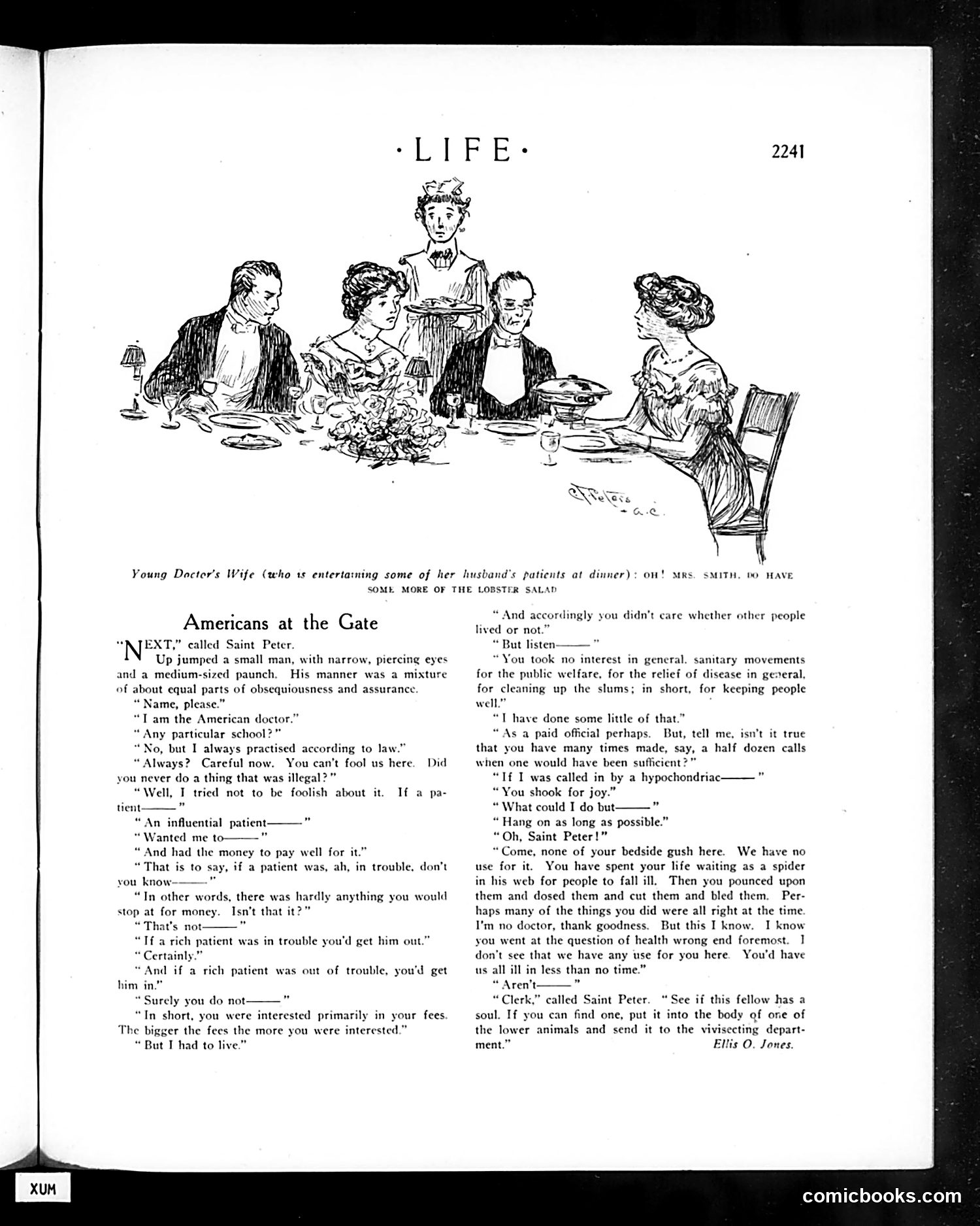
This page contains two distinct pieces of social satire from *Life* magazine: **"Young Doctor's Wife"** (top illustration): A dinner scene mocking the hypocrisy of a doctor's wife entertaining her husband's patients. The caption's emphasis on lobster salad suggests irony about affluence and pretense—the doctor profits from patients while his wife performs gracious hospitality. **"Americans at the Gate"** (main text): A dialogue between Saint Peter and an American doctor at Heaven's gate. The satire attacks physicians for: - Prioritizing fees over patient welfare - Unnecessary treatments and prolonged care for profit - Indifference to public health and sanitation - Opportunistic behavior toward wealthy patients Saint Peter ultimately rejects the doctor as morally corrupt, suggesting doctors care only for money, not genuine healing. The vivisection joke at the end implies the doctor lacks a soul worthy of human reincarnation. The satire reflects early-20th-century concerns about medical ethics, profiteering, and whether doctors served public health or private gain.
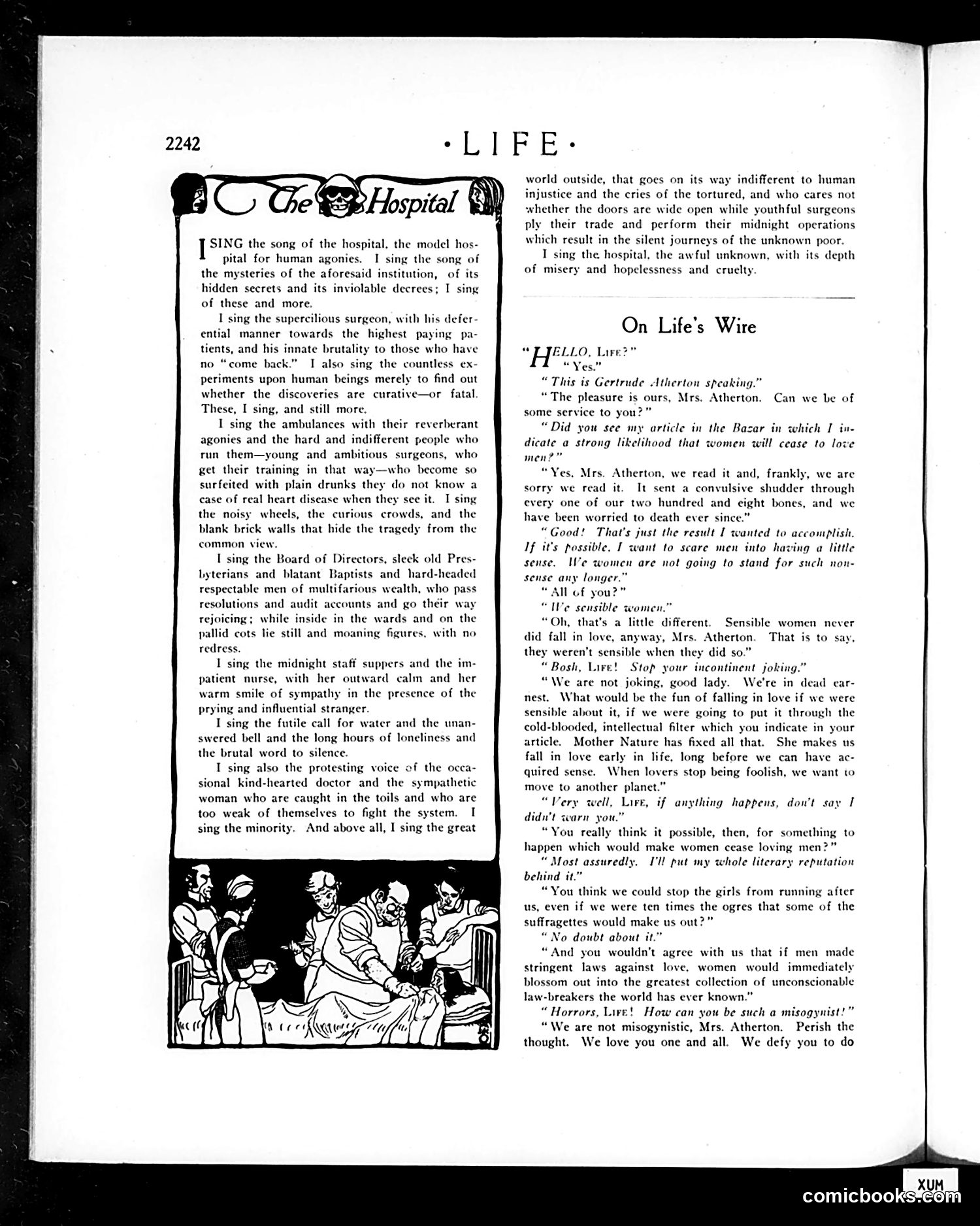
This Life magazine page contains two distinct pieces of social satire. **"The Hospital"** is a scathing poem attacking medical institutions for prioritizing wealthy patients while neglecting the poor, conducting dangerous experiments on vulnerable patients, and maintaining a facade of respectability through wealthy board directors who ignore suffering within the wards. It critiques both the callous medical establishment and the indifferent public. **"On Life's Wire"** is a humorous dialogue between Life magazine and writer Gertrude Atherton (a real author of the period), who claims women will cease loving men. Life playfully argues that women's sensibility would ruin romantic love entirely—that passion requires irrationality. The satire mocks both Atherton's serious feminist stance and the magazine's flippant dismissal of her concerns about women's agency in relationships. Both pieces reflect early 20th-century progressive critique of institutional hypocrisy and gender relations.
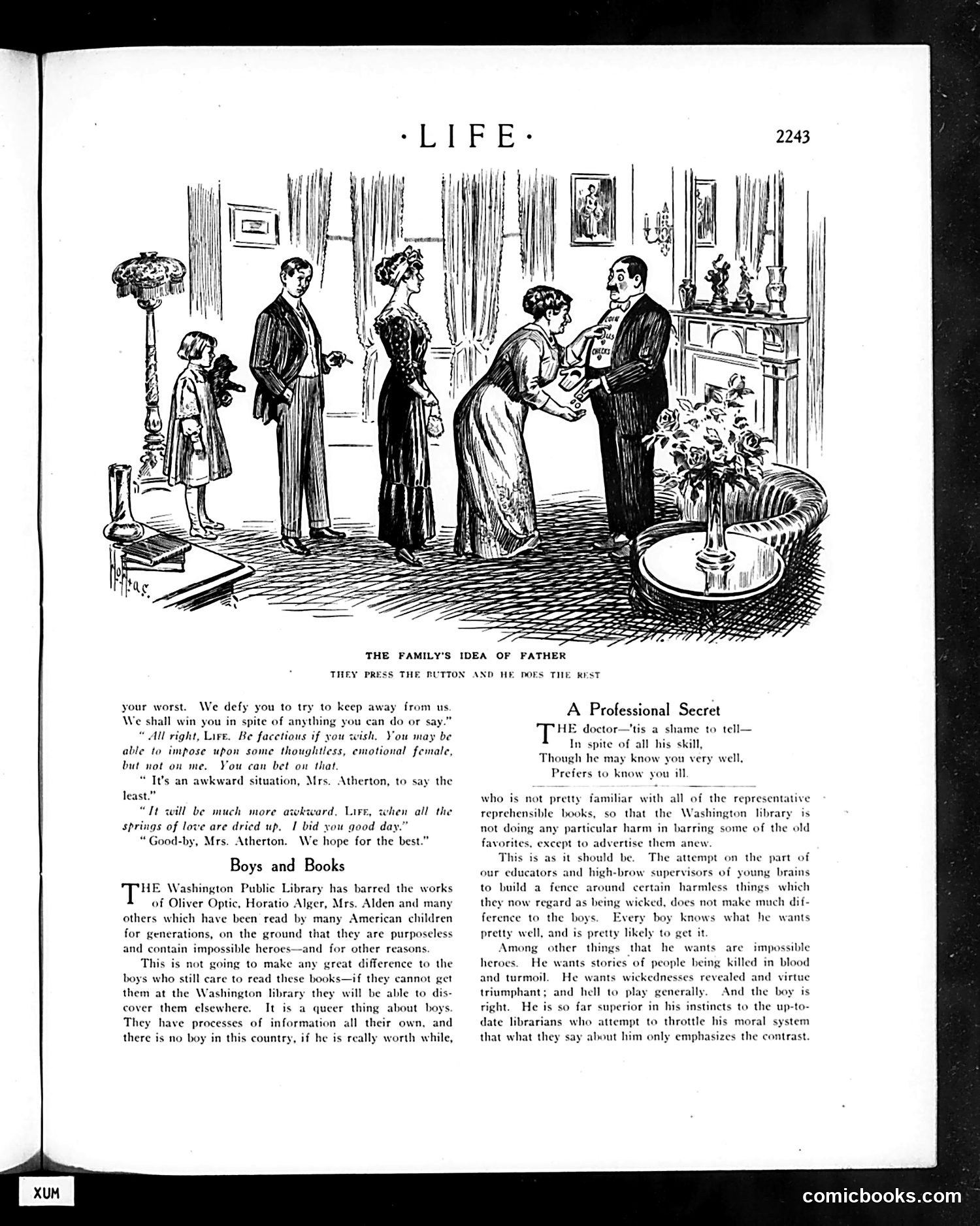
The cartoon satirizes the domestic power dynamic between husbands and wives. The caption reads: "They press the button and he does the rest"—suggesting fathers are merely servants responding to family demands rather than household authorities. The dialogue depicts a marital conflict where the wife (Mrs. Atherton) threatens to withdraw marital affection ("springs of love are dried up") if the husband doesn't comply with her wishes. The husband protests he won't be manipulated by "emotional female" appeals, yet the cartoon's composition (with the family arrayed against him) visually undermines his authority. This reflects early 20th-century anxieties about shifting gender dynamics and women's increasing domestic power—humor derived from the reversal of traditional patriarchal expectations. The joke targets fathers who imagine themselves in control but are actually managed by their families through emotional pressure.
This page contains theater reviews of classical stage productions. The main content discusses three plays: **"Julius Caesar"**: Reviews a production starring actor Faversham as Antony. The critic notes Faversham modernizes the character, making him a "modern politician" appealing to the crowd rather than a classical figure. Other cast members (Tyrone Power, Keenan, Mellish) receive mixed reviews for their traditional, formal delivery styles—described as wearing with "elocutionary pauses and statuesque poses." **"She Stoops to Conquer"**: Praises Annie Russell's comic production of this classic English comedy, highlighting her performance as Kate Hardcastle and noting the quality ensemble work. The reviews reflect early 20th-century theatrical debates between classical formality and emerging realism. The small cartoon illustration (top left) appears to be decorative, showing a figure in classical dress—likely referencing the Julius Caesar production.
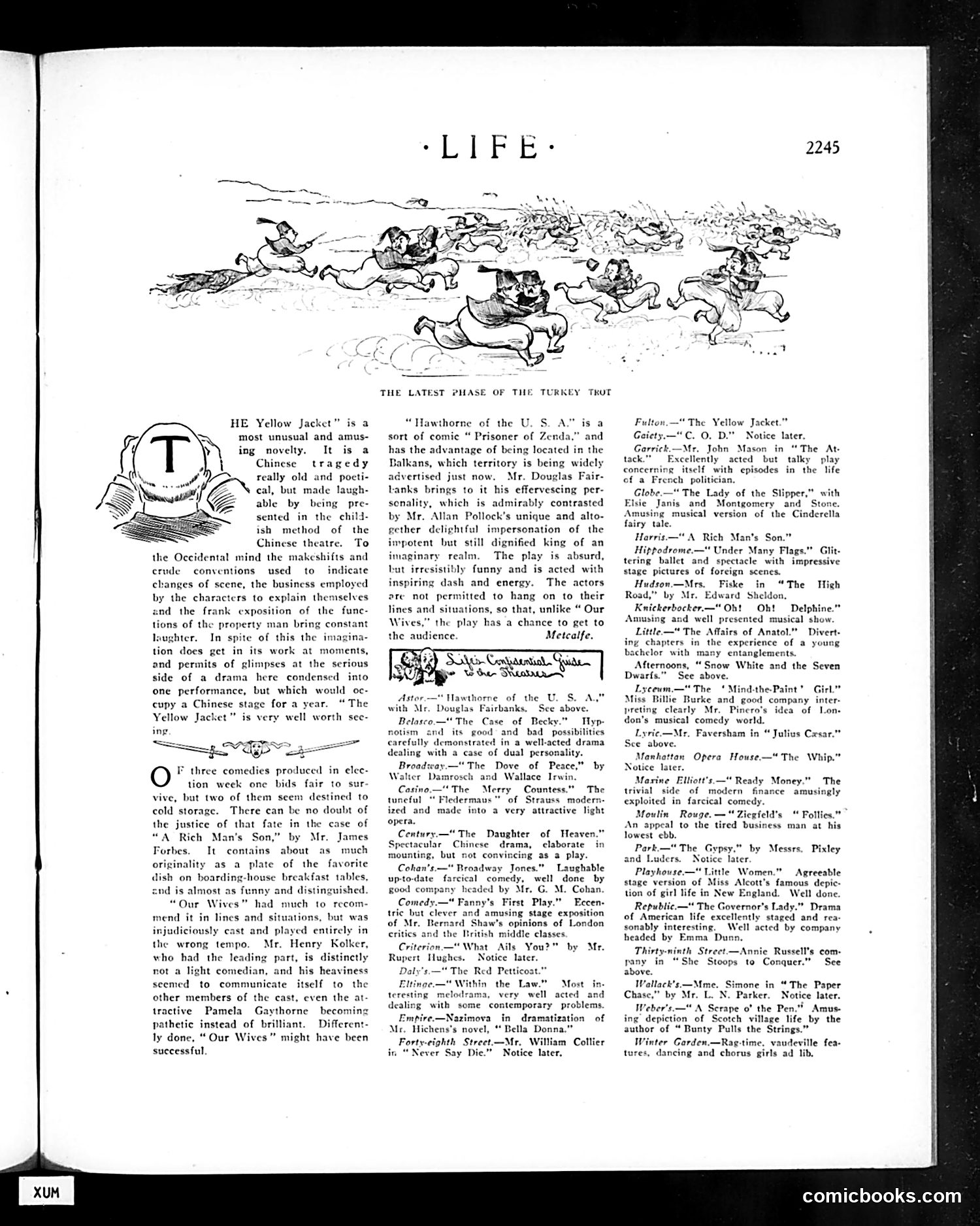
This cartoon satirizes the "Turkey Trot," a popular ragtime dance craze of the early 1910s that shocked genteel society. The image shows figures energetically performing the dance—characterized by jerky, undignified movements that scandalized conservative Americans who viewed it as vulgar and sexually suggestive. The title's reference to "latest phase" suggests the dance keeps evolving and spreading despite social disapproval. The exaggerated, crude cartoon style emphasizes how absurd and undignified respectable people found the dance. This was a common Life magazine tactic: using humor and caricature to mock both the dance's enthusiasts and the moral panic it generated among the establishment. The page's theater reviews above provide context—Life was a sophisticated publication critiquing modern entertainment while simultaneously mocking popular culture's lowbrow trends.
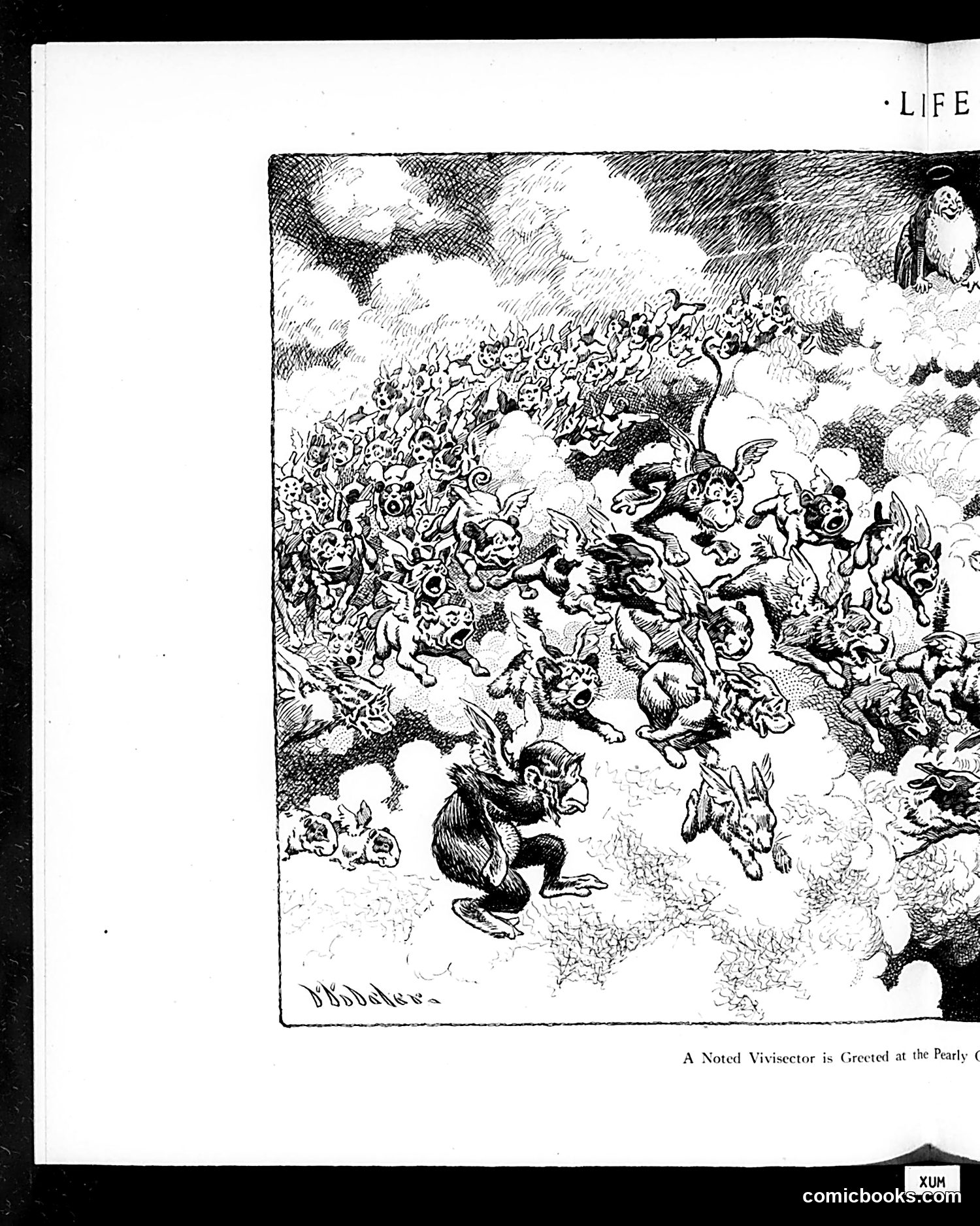
This cartoon depicts a figure labeled "A Noted Vivisector is Greeted at the Pearly Gates" (text is cut off). The drawing shows what appears to be a scientist or medical researcher arriving at heaven, where they're greeted by a massive crowd of animals—dogs, cats, rabbits, and other creatures—in an apparent confrontation or judgment scene. The satire targets vivisection (animal experimentation), which was a contentious ethical issue in early 20th-century America. The cartoon suggests the vivisector faces divine retribution from the animals they experimented upon, implying moral judgment for animal cruelty. This reflects Life magazine's satirical stance on scientific practices deemed inhumane, attacking researchers through dark humor about the afterlife consequences of animal testing.
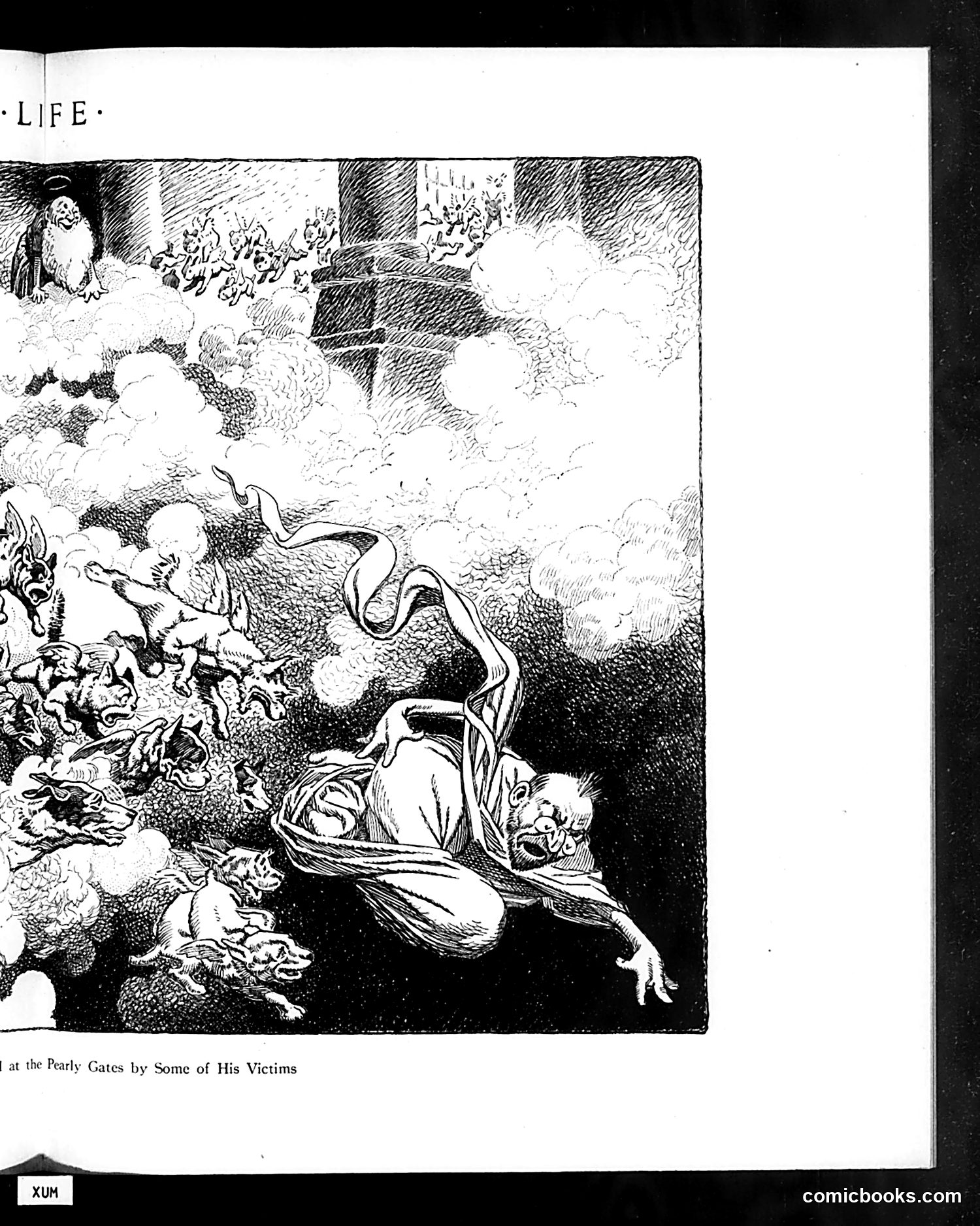
This is a satirical illustration titled "at the Pearly Gates by Some of His Victims." The image depicts a figure (appearing distressed or fleeing) confronted by numerous accusatory figures in what seems to be an afterlife or judgment scene. The artistic style and composition suggests this is commentary on a powerful person facing consequences from those they harmed. Without the magazine's publication date or additional context visible on the page, I cannot definitively identify the specific historical figure depicted. However, the satire's core message is clear: it imagines a reckoning where someone faces their victims in judgment. This reflects Life magazine's tradition of sharp political and social criticism, using religious imagery (the Pearly Gates reference) to suggest moral accountability.
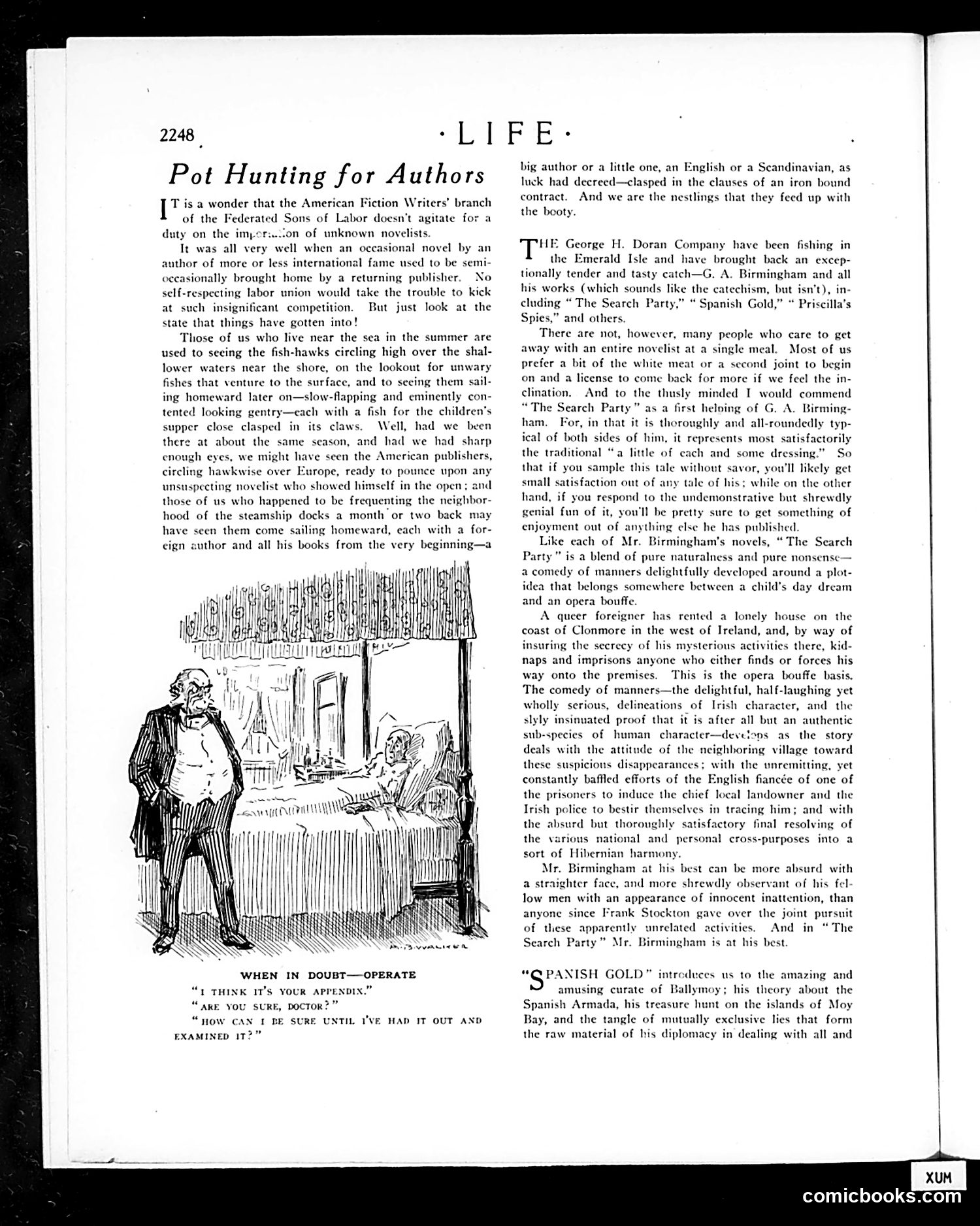
This article satirizes American publishers' aggressive recruitment of foreign authors. The central metaphor compares publishers to fish hawks circling European waters, "pouncing" on unsuspecting foreign novelists and bringing them home "clasped in the clauses of an iron bound contract." The accompanying cartoon labeled "When in Doubt—Operate" shows a doctor and patient—a separate, unrelated medical satire about unnecessary surgery (the doctor admits he won't know if appendicitis exists until he removes the organ). The main text reviews G.A. Birmingham's novel *The Search Party*, published by the George H. Doran Company. The review praises Birmingham as a "tender and tasty catch" of Irish literature, recommending his work as a good introduction to his style—blending naturalism with absurdist comedy, set in rural Ireland with kidnapping and mystery elements. The satire critiques the transatlantic literary import business as exploitative labor competition, while the book review itself is earnestly promotional.
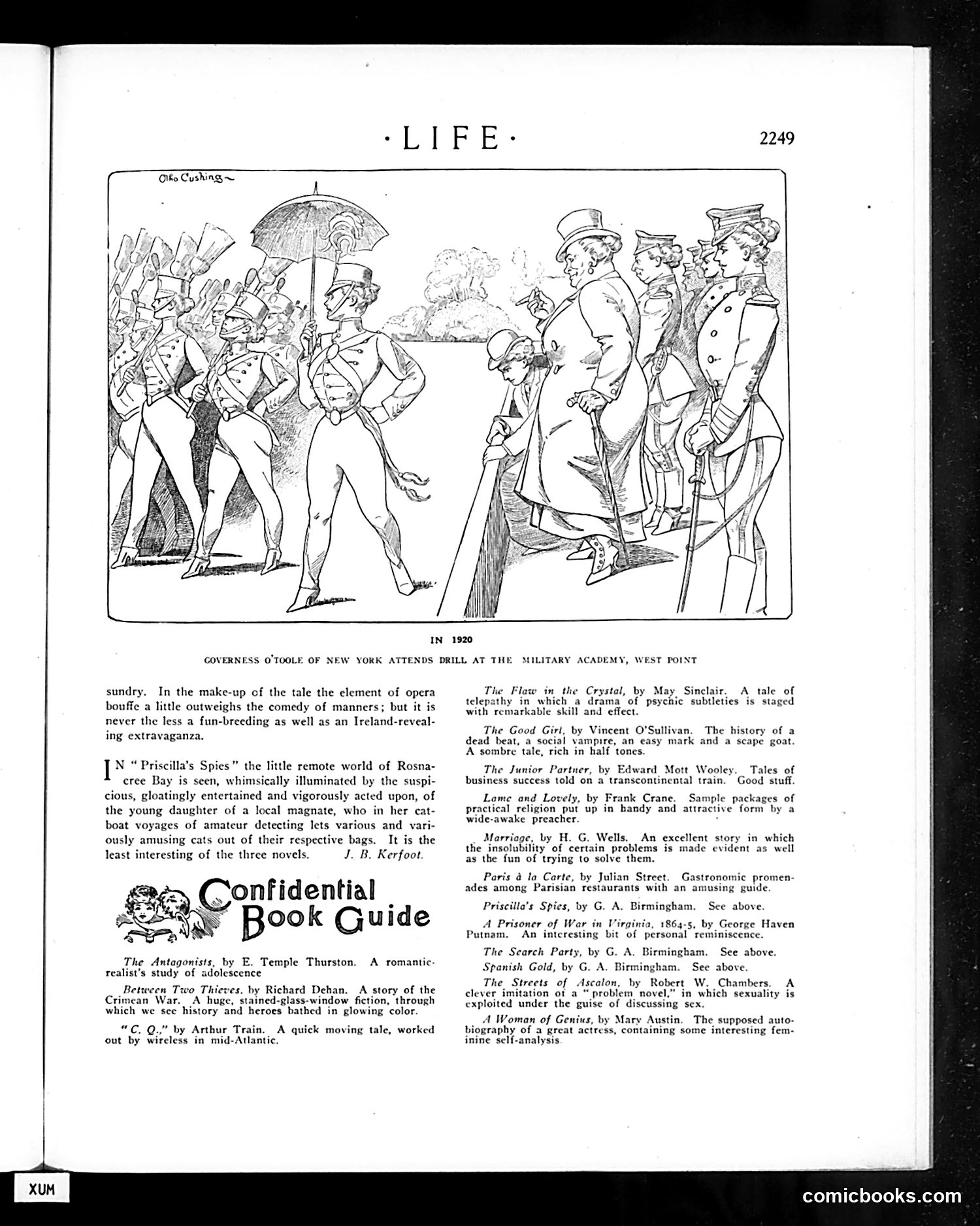
The cartoon shows "Governor O'Toole of New York" attending a military drill at West Point. On the left, soldiers stand at attention with rifles and an umbrella. On the right, military officers in formal dress observe. The satire appears to target the incongruity of a politician (O'Toole) attending serious military training. The umbrella and the exaggerated, somewhat ridiculous posture of the soldiers suggest the scene is being mocked as absurd theater rather than genuine military readiness. This likely comments on political posturing—politicians performing patriotic duty or military engagement for public appearance rather than substantive military preparedness. The 1920 date and New York governor reference suggest this may allude to specific contemporary political figures or situations, though the specific identity of "O'Toole" remains unclear without additional context. The overall tone mocks the performative nature of political involvement in military affairs.
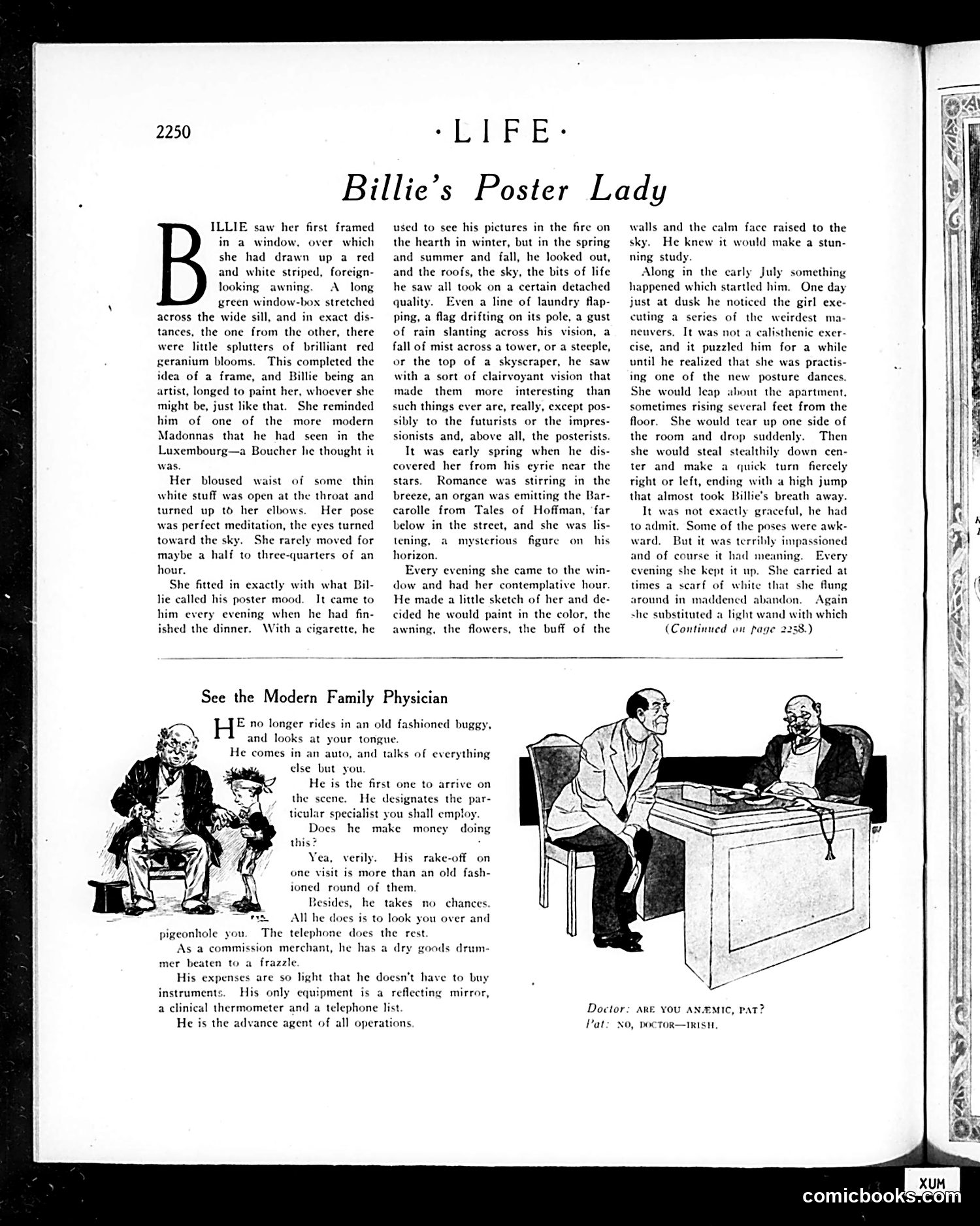
**Upper Story:** A serialized narrative (continued from earlier) about an artist named Billie who becomes fascinated by a woman he observes from his window—a contemplative figure framed by red geraniums and a striped awning. His artistic "poster mood" is disrupted when she begins practicing the "new posture dances," performing athletic, expressive movements with scarves and wands that the narrator finds passionate but ungraceful. **Lower Cartoon:** A satirical critique of modern medical practice. The "Modern Family Physician" no longer makes house calls in a buggy but arrives in an auto. Rather than examining patients thoroughly, he designates specialists, takes commissions from referrals (his "rake-off"), avoids risk, and uses the telephone for actual treatment. The satire compares him unfavorably to old-fashioned doctors, suggesting contemporary medicine prioritizes profit and efficiency over genuine care—he's less a healer than a "commission merchant."
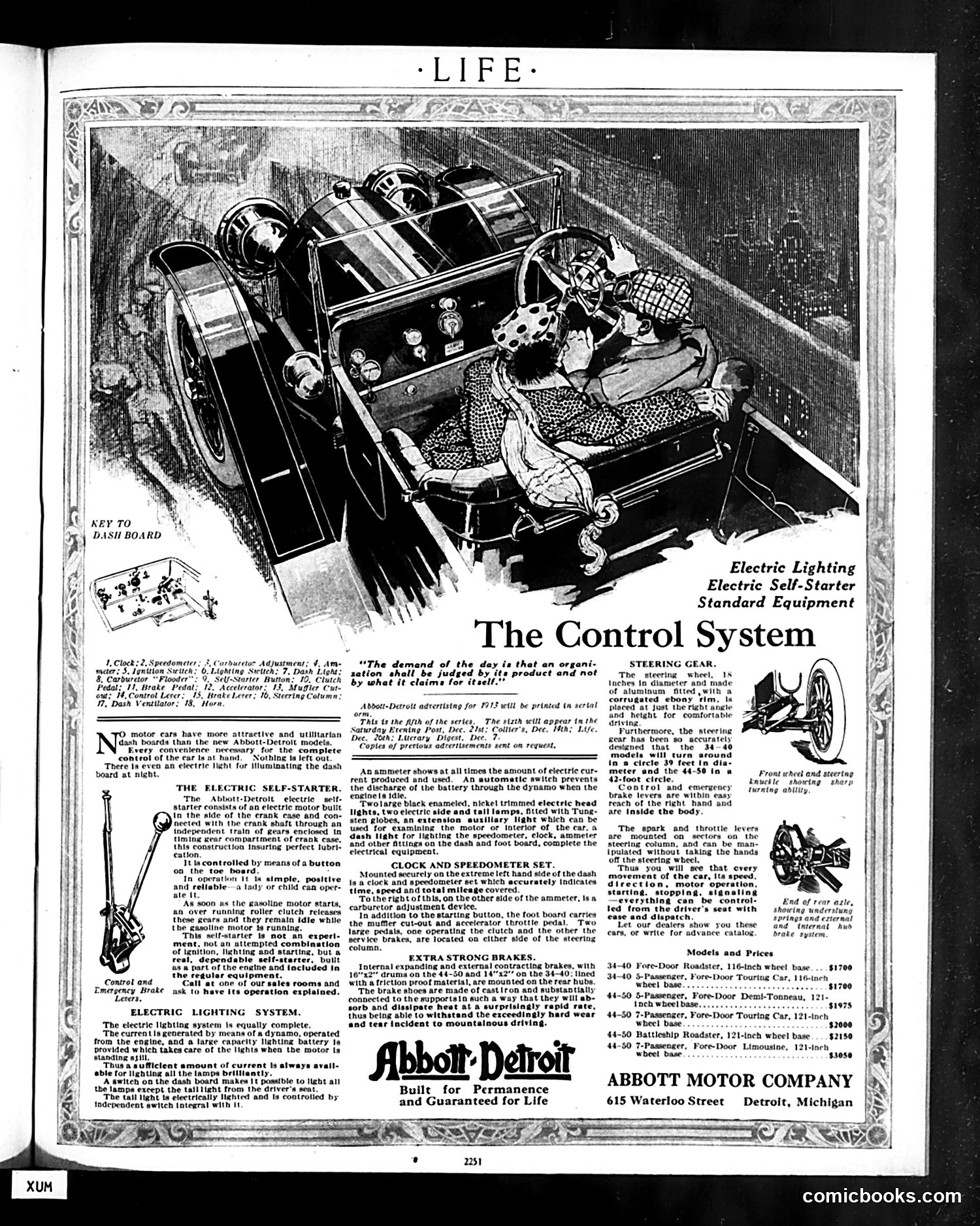
This is primarily an **automobile advertisement**, not political satire. It promotes Abbott-Detroit motor cars, emphasizing their modern control systems and electrical features—the selling points of 1910s-era automobiles. The illustration shows a steering wheel and dashboard with labeled components. The accompanying text describes innovations: an electric self-starter (eliminating hand-cranking), electric lighting, an ammeter, speedometer, and clock. These were cutting-edge features positioning Abbott-Detroit as a technologically advanced manufacturer. The satire is gentle: the epigraph quotes an organizational maxim about judging by results rather than claims—a subtle boast that Abbott-Detroit's innovations speak for themselves. The detailed technical descriptions aim to convince readers of the car's superiority through substance rather than mere advertising hype. This reflects early 20th-century industrial competition, where American automakers marketed technological advancement to affluent buyers.
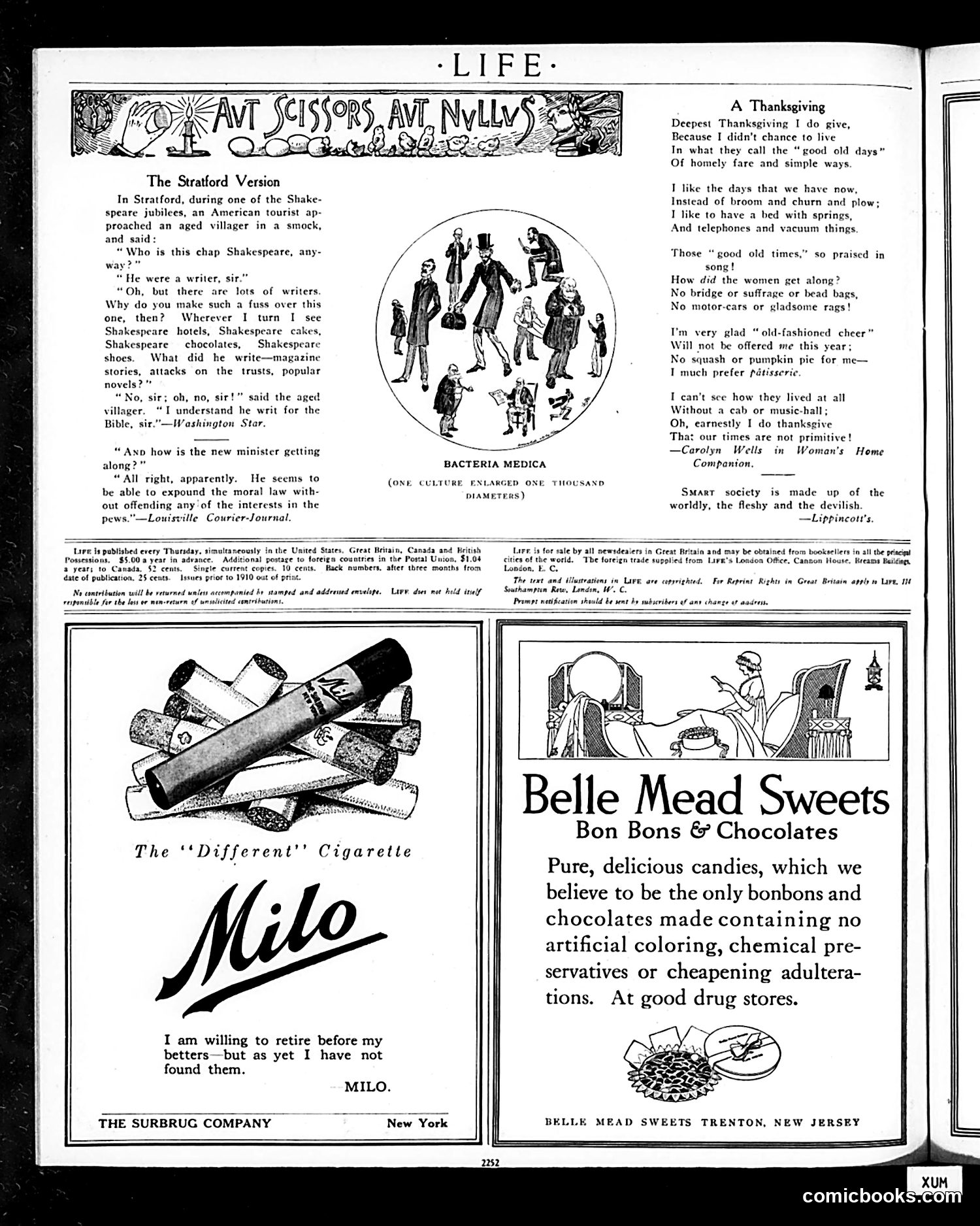
This page contains two satirical pieces flanking period advertisements. **"The Stratford Version"** mocks American tourists' ignorance of Shakespeare. An American visitor asks an English villager about Shakespeare, treating him as a contemporary commercial figure (comparing him to magazine writers and trust-attackers). The joke is the American's complete unfamiliarity with the canonical writer, reducing England's greatest literary figure to a brand name for hotels, cakes, and shoes—suggesting American commercialism trivializes cultural heritage. **"A Thanksgiving" poem** (attributed to Carolyn Wells) employs ironic satire to critique nostalgia for "the good old days." The speaker celebrates modern conveniences (beds with springs, telephones, vacuum cleaners, motor-cars) while mock-lamenting the absence of these in the past, sarcastically dismissing romanticized pre-industrial life. The satire targets those who sentimentally idealize earlier eras while ignoring women's lack of rights and the genuine hardships of pre-modern living. Both pieces ridicule contemporary attitudes: American philistinism in one, false nostalgia in the other.
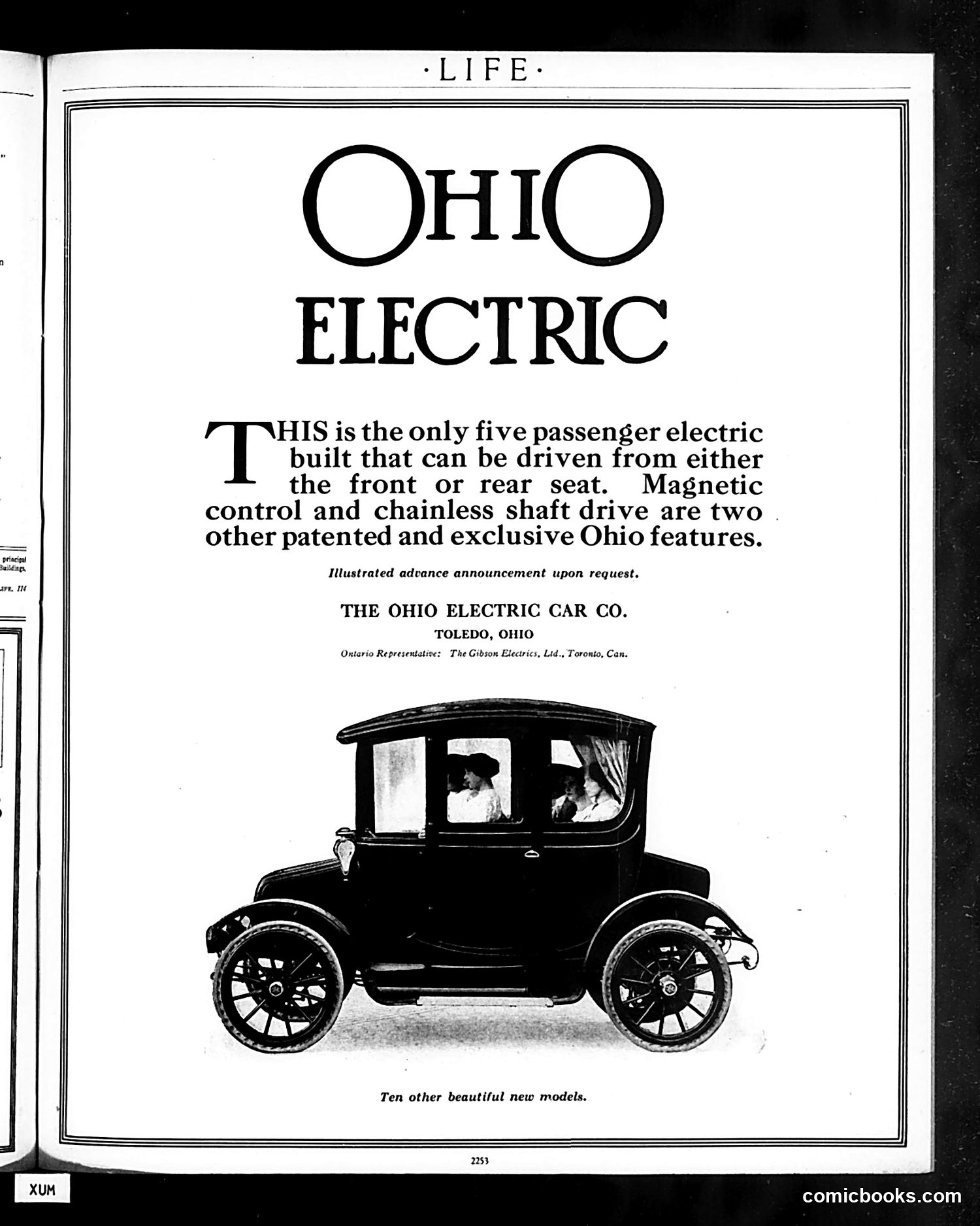
This is a **product advertisement**, not a political cartoon. It promotes the Ohio Electric Car Company's five-passenger electric automobile, highlighting its unique selling points: the ability to be driven from either front or rear seat, magnetic control, and chainless shaft drive. The image shows a well-dressed family (appearing to be middle or upper-class) in the vehicle, suggesting electric cars as modern, safe, family transportation. For a modern reader: This reflects the early 1900s when electric vehicles competed seriously with gasoline cars—they were considered cleaner, quieter, and more refined, particularly appealing to wealthy families and women drivers. The emphasis on being "patented and exclusive" speaks to competitive marketing in that era. Electric cars would largely disappear after cheaper gasoline vehicles dominated the market.
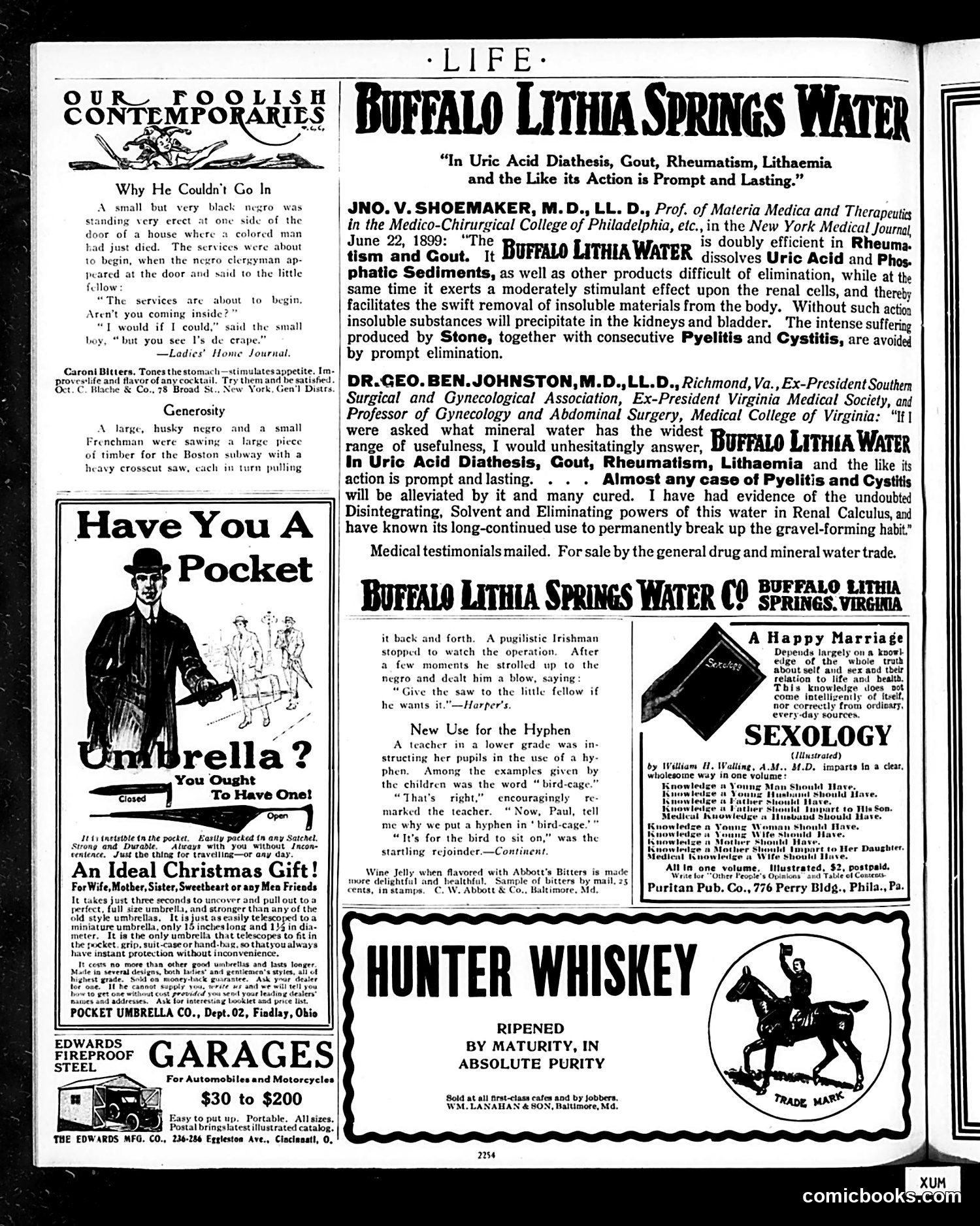
This page contains **primarily advertisements** for patent medicines and products typical of early 1900s America, interspersed with brief humorous anecdotes. The main cartoons/jokes illustrate racial stereotypes common to that era: 1. **"Why He Couldn't Go In"**: A small Black child is turned away from a funeral service, explaining he cannot enter because he "is de crape" (is the crepe/mourning cloth). The "joke" relies on dialect humor and plays on the child's physical appearance. 2. **"Generosity"**: Two workers—a "large, husky negro" and a Frenchman—saw wood together. An Irish bystander hits the Black worker, telling him to let the smaller man do the work, reversing expected racial hierarchies for comedic effect. 3. **"New Use for the Hyphen"**: A child misunderstands grammar instruction, claiming hyphens exist "for the bird to sit on" in "bird-cage." The advertisements promote Buffalo Lithia Springs Water (for gout and urinary ailments) with doctor endorsements, pocket umbrellas, and whiskey—reflecting period patent medicine marketing practices.
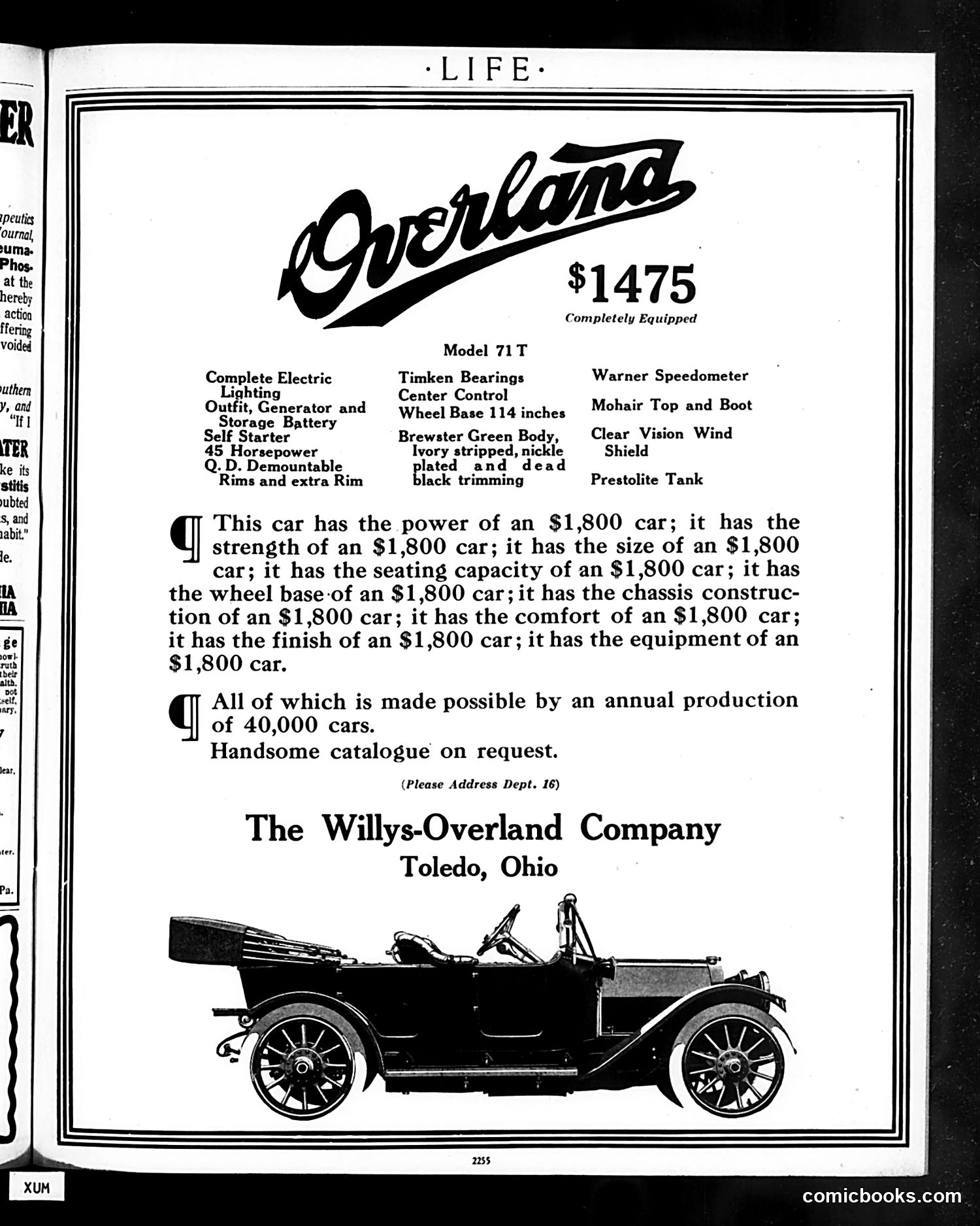
This is a **straightforward automobile advertisement**, not satire or political commentary. The Willys-Overland Company is marketing their Model 71T car at $1,475—a competitive price point for early 1910s automobiles. The repeated claim that the car matches an $1,800 vehicle in "power," "strength," "size," "seating," "chassis construction," "comfort," "finish," and "equipment" is **value-proposition marketing**: the advertiser argues you get luxury-car features at a budget price through mass production (40,000 annual units). The appeal emphasizes affordability and quality parity with more expensive competitors. This reflects the automotive industry's shift toward volume manufacturing making cars accessible to middle-class buyers. There is no hidden joke—it's a direct pitch to potential customers comparing their product favorably to premium alternatives at a lower cost.
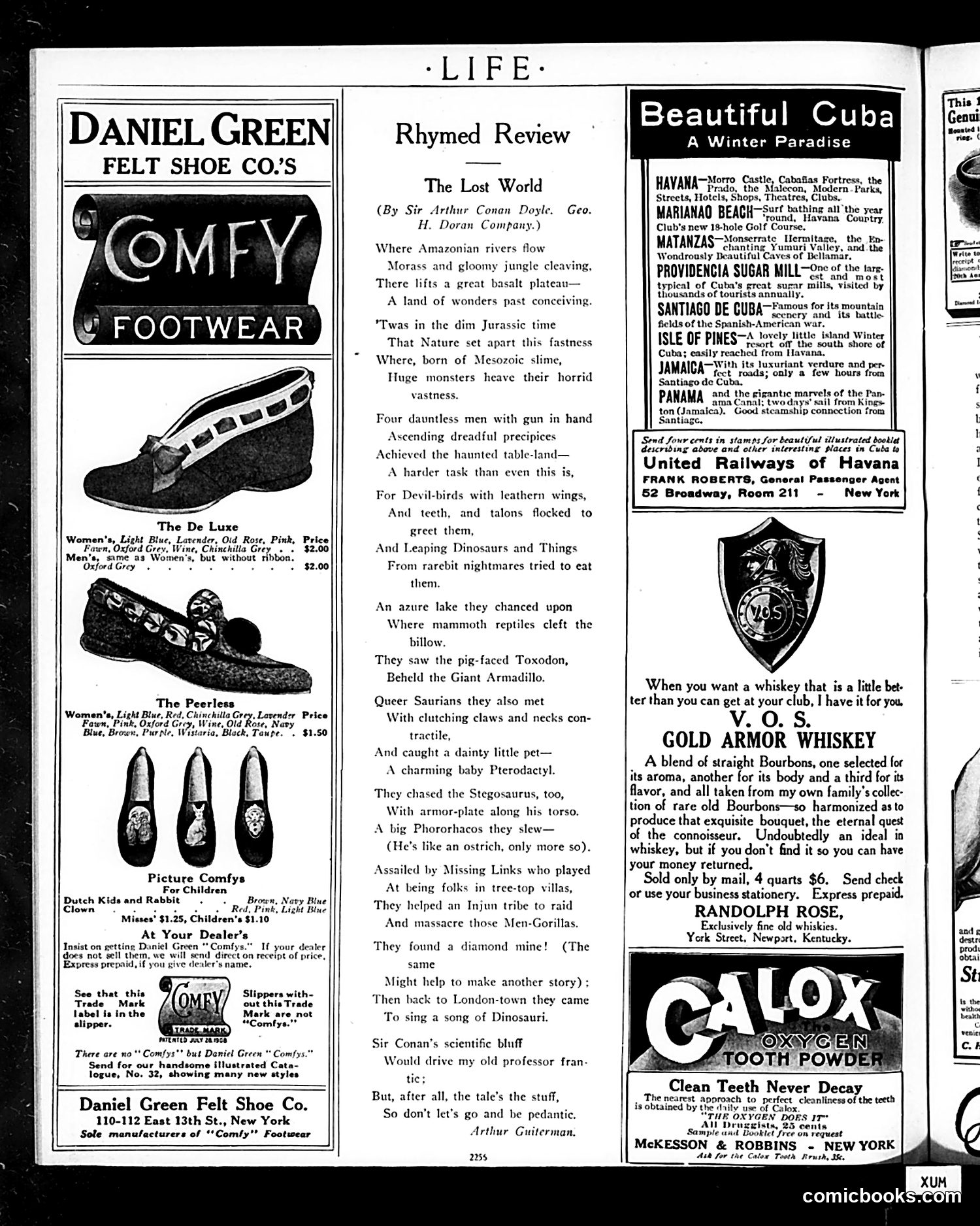
This page is predominantly **advertising and literary content**, not political cartoons. The main elements are: 1. **Daniel Green Felt Shoe Co. advertisements** (left) promoting "Comfy" slippers in various colors and styles for women, men, and children—typical early-20th-century footwear marketing. 2. **"The Lost World" rhymed review** (center) by Arthur Guiterman reviewing Sir Arthur Conan Doyle's novel. It humorously summarizes the book's plot: explorers discovering prehistoric creatures (dinosaurs, pterodactyls, armadillos) on an isolated plateau, then returning to London. Guiterman acknowledges Doyle's "scientific bluff" isn't realistic but defends the adventure as entertaining fiction. 3. **Tourism advertisements** (right) promoting Cuba, Jamaica, and Panama as winter destinations, emphasizing beaches, sugar mills, caves, and the Panama Canal. There is **no satire or political commentary** visible. This is a straightforward magazine page mixing consumer goods advertising with book review and travel promotion.
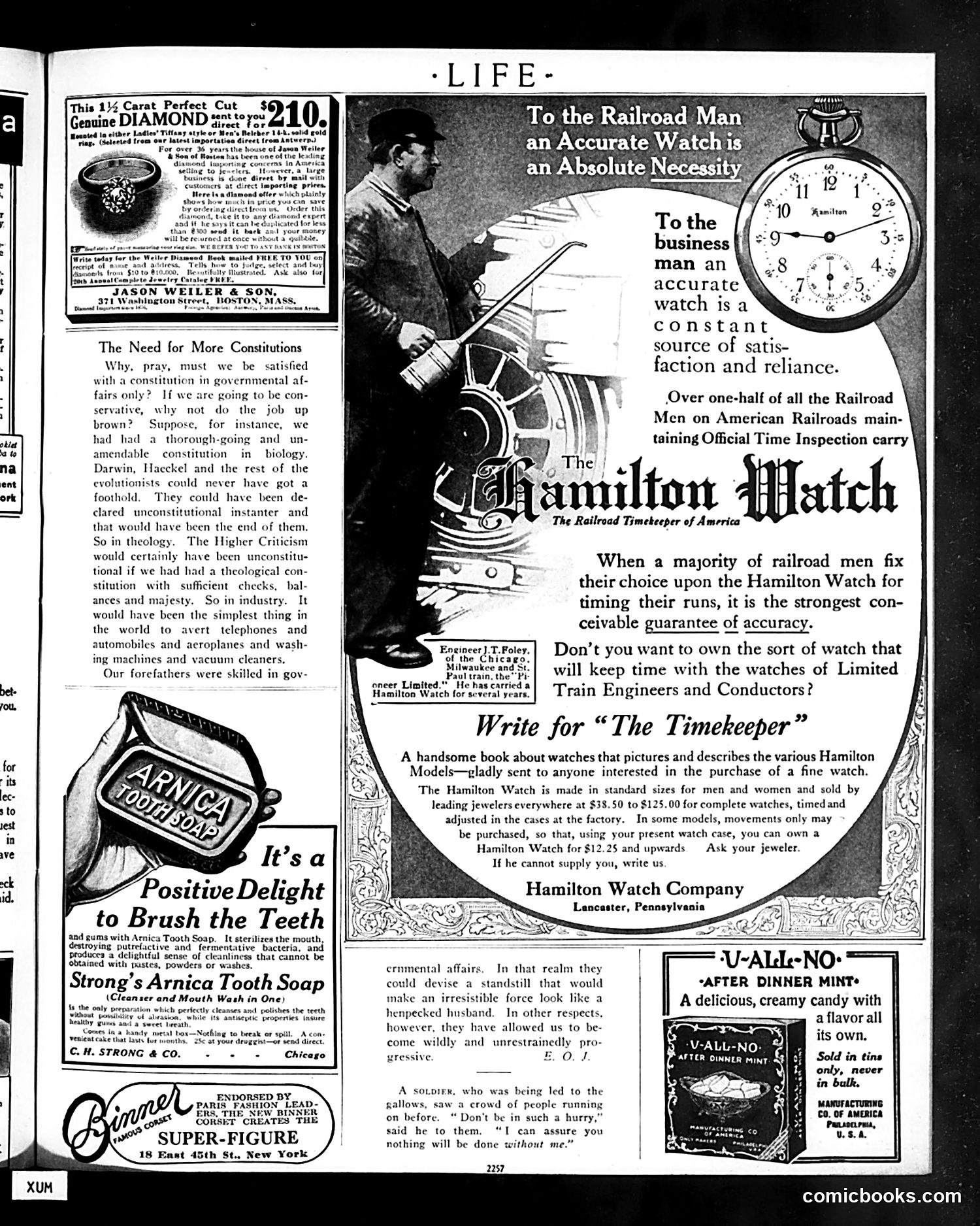
This page's main satirical piece is the essay titled "The Need for More Constitutions." It's a reductio ad absurdum argument against rigid, unchangeable governance. The author argues ironically that if we truly believed in constitutional constraints, we should apply them everywhere—not just government. He points out that a "thorough-going and unamendable constitution in biology" would have prevented Darwin and evolutionists from working. Similarly, a theological constitution would have blocked scientific criticism; an industrial one would have prevented telephones, automobiles, and other innovations. The satire targets **conservatives who championed constitutional rigidity** while paradoxically supporting technological and industrial progress. The piece exposes the contradiction: those advocating strict constitutional constraints benefit from societies that *rejected* such constraints in other domains. The accompanying anecdote about a soldier going to the gallows—reassuring the crowd "nothing will be done without me"—reinforces the theme: progress requires active participation and flexibility, not passive adherence to fixed rules. The page also contains period advertising for diamonds, toothsoap, and Hamilton watches—typical Life magazine content of this era.
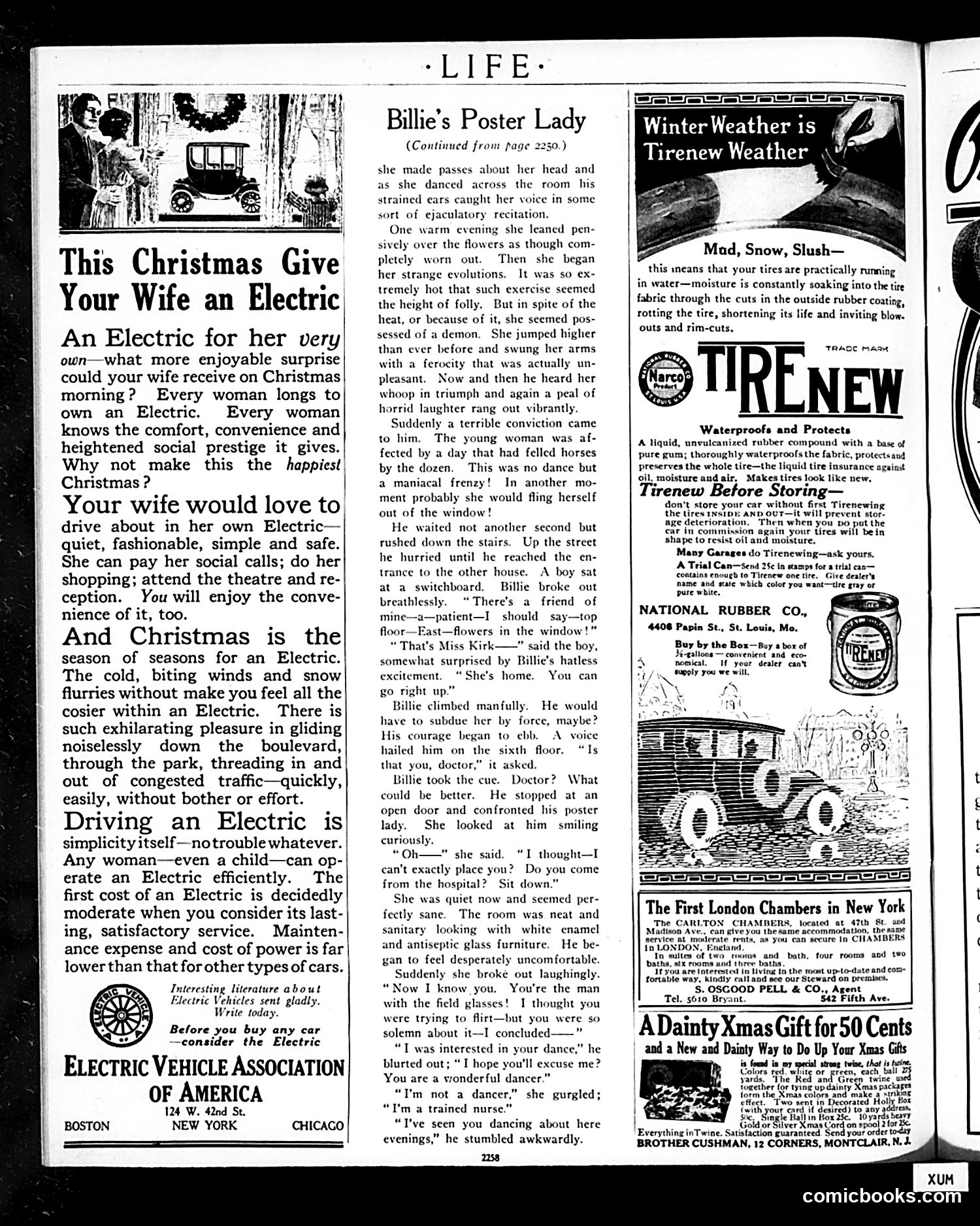
This page combines a satirical advertisement with serialized fiction. The large ad promotes electric automobiles as Christmas gifts for wives, emphasizing that they're "simple and safe" enough for women to operate—revealing period gender assumptions about technology and driving. The pitch appeals to husbands by highlighting social prestige and convenience, reflecting early 1900s marketing toward affluent households. The serialized story "Billie's Poster Lady" (continued from a previous issue) depicts a comedic misunderstanding: a man observes a woman dancing frantically in her apartment window during hot weather and assumes she's having a mental breakdown. He rushes to "rescue" her, only to discover she's a composed nurse who recognizes him as the man with field glasses—implying he's been spying on her. The humor derives from his mistaken diagnosis and her knowing amusement at his embarrassment.
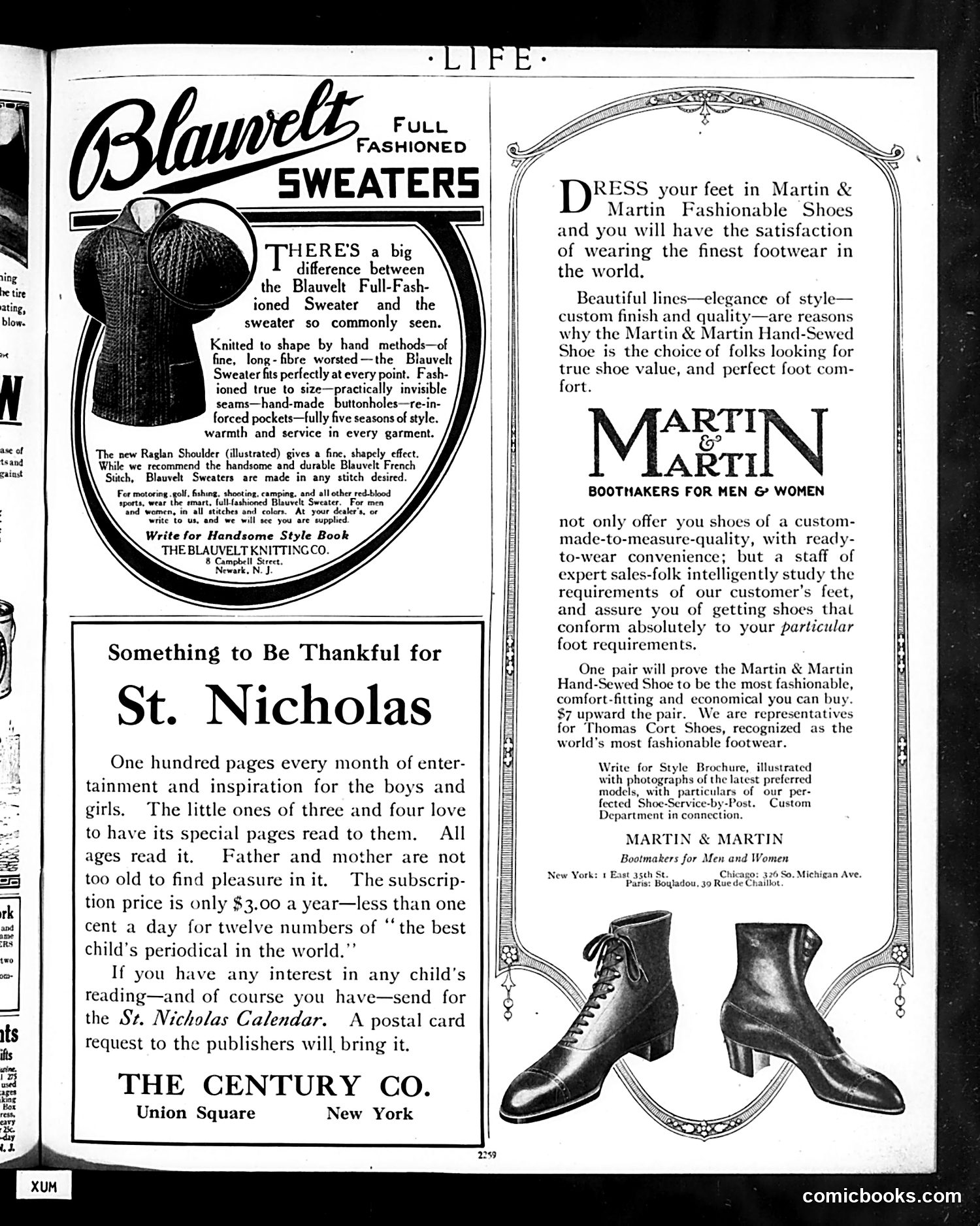
This page is primarily **advertising**, not satire or political commentary. It contains three product advertisements typical of early 20th-century *Life* magazine: 1. **Blauvelt Full-Fashioned Sweaters** — emphasizing hand-knitted quality, invisible seams, and durability for sports and outdoor activities. 2. **St. Nicholas magazine** — a children's periodical promoted as wholesome family entertainment, positioning itself as affordable ($3/year) and suitable for all ages. 3. **Martin & Martin Shoes** — luxury hand-sewn footwear marketed as custom-fitted and fashionable for men and women. There are **no cartoons, caricatures, or political references** on this page. The illustrated shoe images and sweater sketch are product showcases, not satirical commentary. The page reflects early-1900s consumer culture and advertising conventions—emphasizing quality craftsmanship, family values, and social aspiration through branded goods.
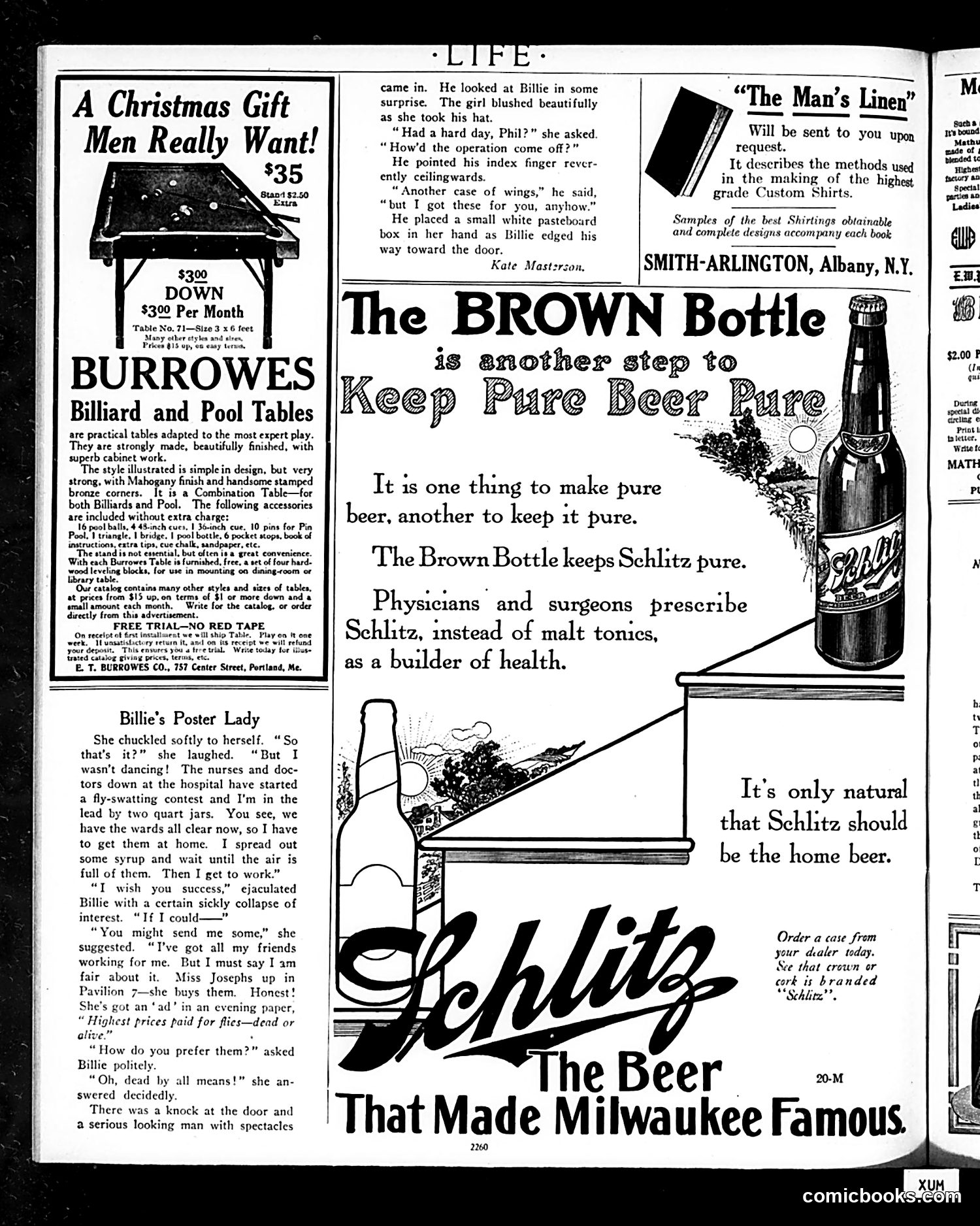
This page contains primarily **advertisements and a satirical short story**, not political cartoons. The main story, "Billie's Poster Lady," is a humorous piece about a woman running a fly-swatting competition at a hospital during what appears to be a disease-control effort. The absurdist joke centers on her treating this public health initiative as a competitive sport—spreading syrup to attract flies and recruiting friends to help, even placing newspaper ads to buy dead flies. The punchline involves a doctor character bringing her flies as a romantic gesture, suggesting she's become locally famous for this unusual enterprise. The advertisements include billiard tables, custom shirts, and notably **Schlitz beer**, which claims physicians prescribe it as a health tonic rather than malt tonics—reflecting pre-Prohibition-era marketing that positioned beer as medicinal. This health claim would be obsolete post-Prohibition and seems quaint today. The page reflects early 20th-century concerns about disease control and contemporary advertising claims now recognized as false or absurd.
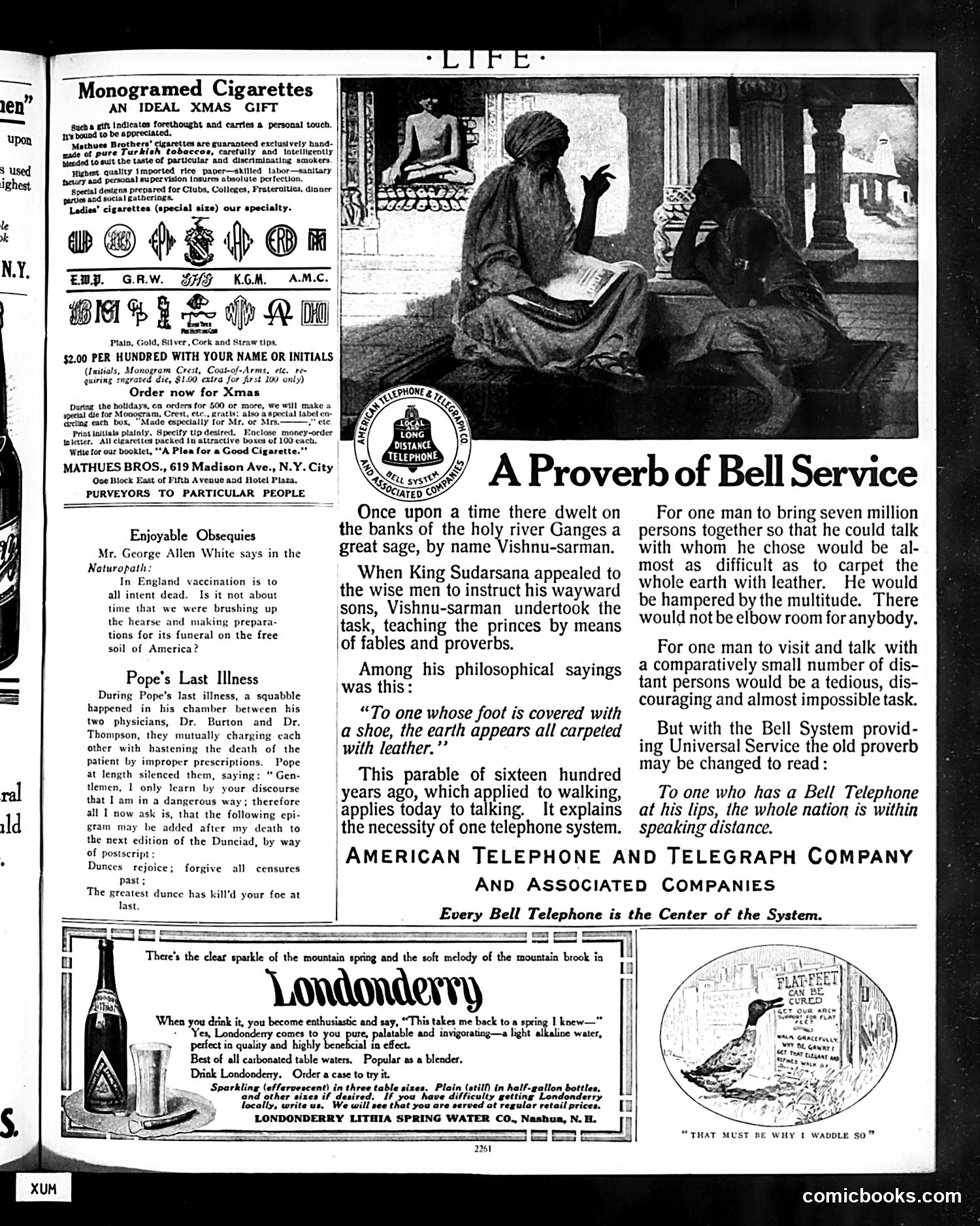
This page is primarily **advertising**, not political satire. The main content consists of three advertisements: 1. **Monogrammed Cigarettes** (Mathues Bros.): A luxury Christmas gift advertisement for personalized Turkish tobacco cigarettes with various monogram options. 2. **"A Proverb of Bell Service"** (American Telephone & Telegraph): An extended advertisement using an ancient Indian parable about a wise sage. The ad reframes the old proverb—"to one whose foot is covered with a shoe, the earth appears all carpeted with leather"—to argue that Bell Telephone service makes the entire nation accessible to the individual user. This is corporate propaganda promoting telephone monopoly as universal necessity. 3. **Londonderry Lithia Spring Water**: An advertisement for sparkling water. The page also contains brief humorous items ("Enjoyable Obsequies," "Pope's Last Illness") typical of Life's satirical filler content, but these are unrelated to the main advertisements. The Bell ad is the most noteworthy: it uses pseudo-philosophical rhetoric to justify telecommunications monopoly as a natural, inevitable good.
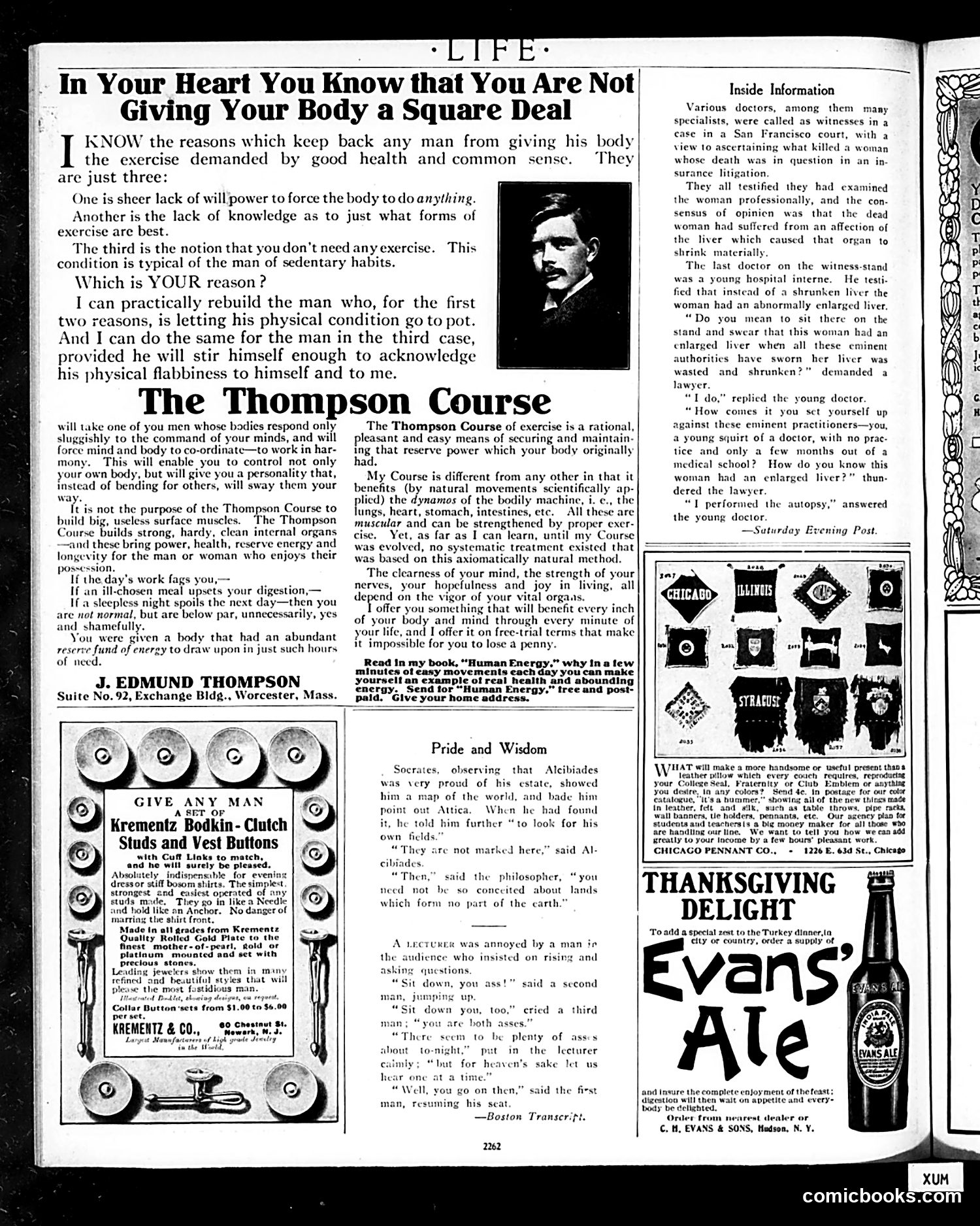
This page contains **health/fitness advertising** rather than political satire. The dominant content is J. Edmund Thompson's promotional campaign for "The Thompson Course"—an early 20th-century exercise regimen claiming to strengthen internal organs (lungs, heart, stomach, intestines) through "natural movements." The pitch targets sedentary men, claiming three barriers prevent exercise: lack of willpower, ignorance about what exercises help, or believing exercise is unnecessary. Thompson promises his course will coordinate mind and body, build internal strength, and restore "reserve energy." The page also includes period **advertisements** (Krementz jewelry studs, Evans' Ale) and a brief **philosophical anecdote** about Socrates and Alcibiades on pride and humility. **For modern readers**: This reflects early 1900s fitness culture before gyms existed—mail-order exercise programs were marketed with quasi-scientific language about "vital organs" and "human energy," targeting anxieties about sedentary lifestyles.
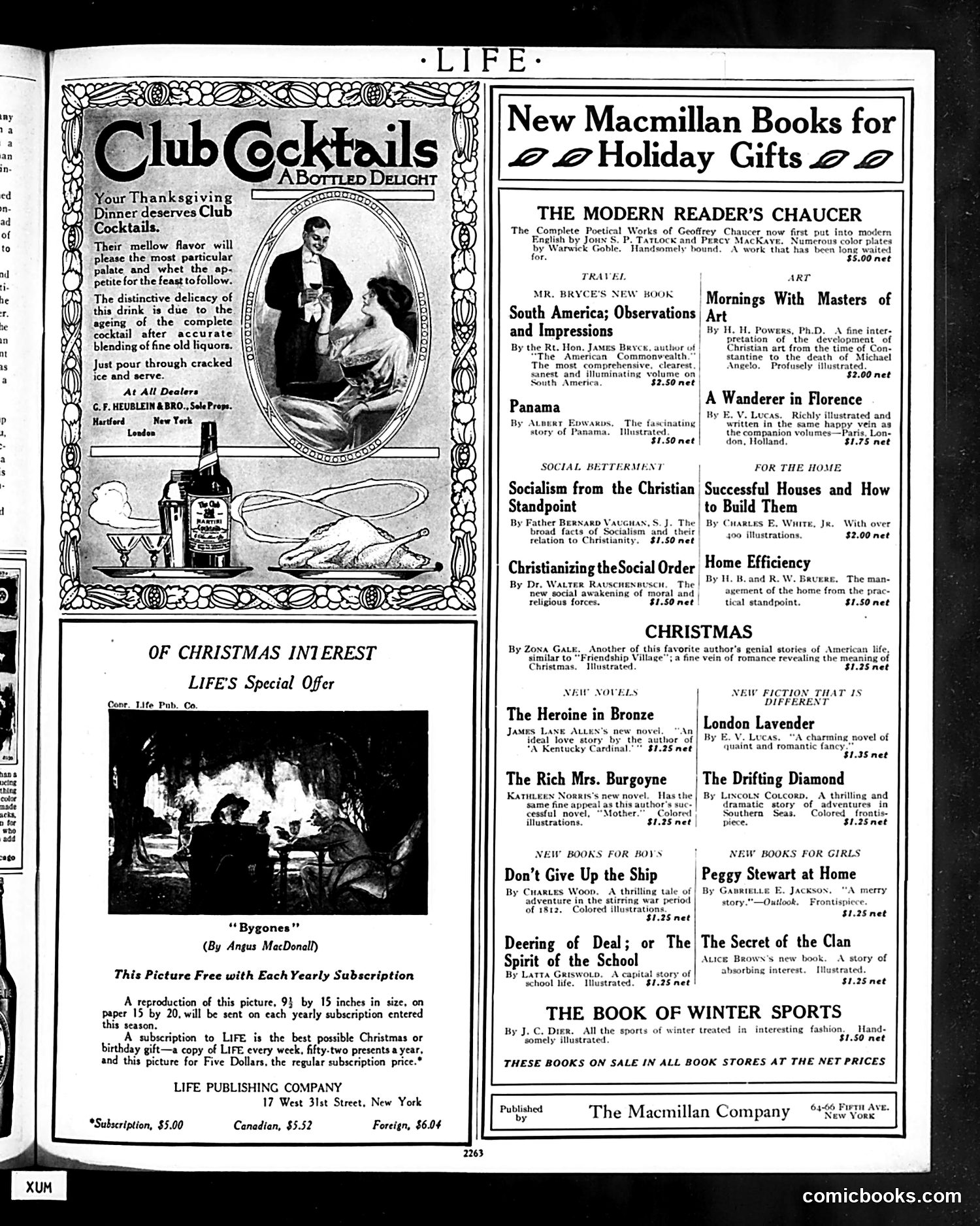
This page is primarily **advertising**, not editorial content with cartoons or satire. It contains two main advertisements: 1. **Club Cocktails** (left): A liquor ad capitalizing on Thanksgiving dinner, showing a couple enjoying cocktails. The appeal is straightforward—sophisticated product placement during holiday season. 2. **New Macmillan Books** (right): A holiday gift catalog listing books across categories (travel, art, home, fiction, children's books) with prices. Notable titles include Chaucer adaptations, James Bryce on South America, and adventure novels. The only image is "Bygones" by Angus MacDonall—a sentimental scene (appears to show a family around a fireplace) offered free with yearly Life subscriptions. This is a **commercial page typical of early 1900s magazines**, mixing advertisements with promotional offers. There is no political satire or editorial cartooning present.
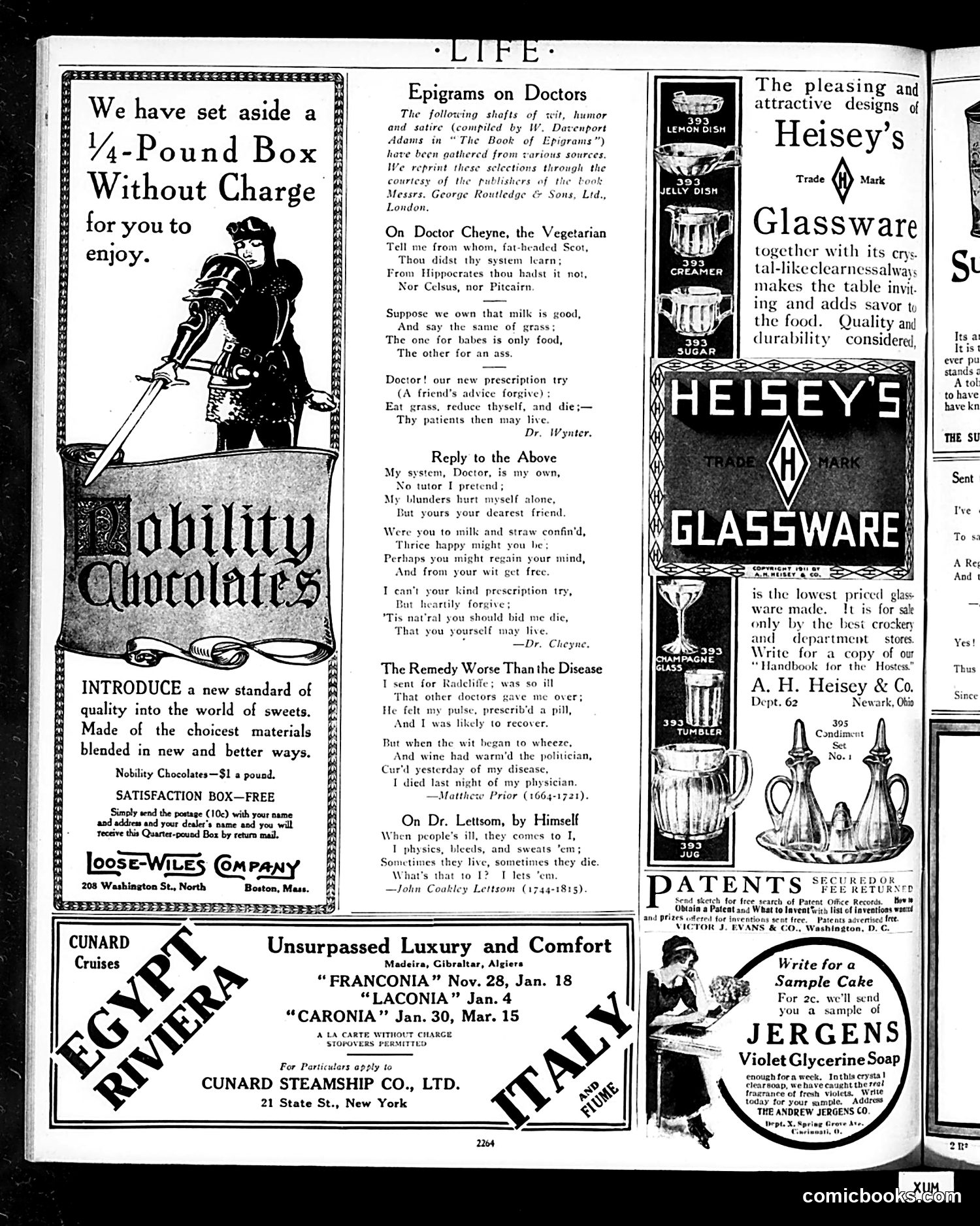
This page is primarily **advertising**, not political satire. However, the "Epigrams on Doctors" section offers historical humor worth noting. The epigrams are witty 18th-century poems mocking specific physicians and medical practices. They satirize: - **Dr. Cheyne**, a Scottish vegetarian doctor, ridiculed for his dietary theories (compared to feeding grass to donkeys) - **Dr. Radcliffe**, criticized for over-prescribing pills that cause side effects worse than the original illness - **Dr. Lettsom**, whose name becomes a pun: treating patients indiscriminately ("I physics, bleeds, and sweats 'em"), with the dark joke that patients sometimes die anyway The humor reflects **pre-modern medical skepticism**—bloodletting, purging, and arbitrary prescriptions were standard but often harmful. These verses mock the medical profession's confidence despite limited actual effectiveness. The rest of the page consists of period advertisements for chocolates, ocean cruises, glassware, and patent services—typical early 20th-century magazine content.
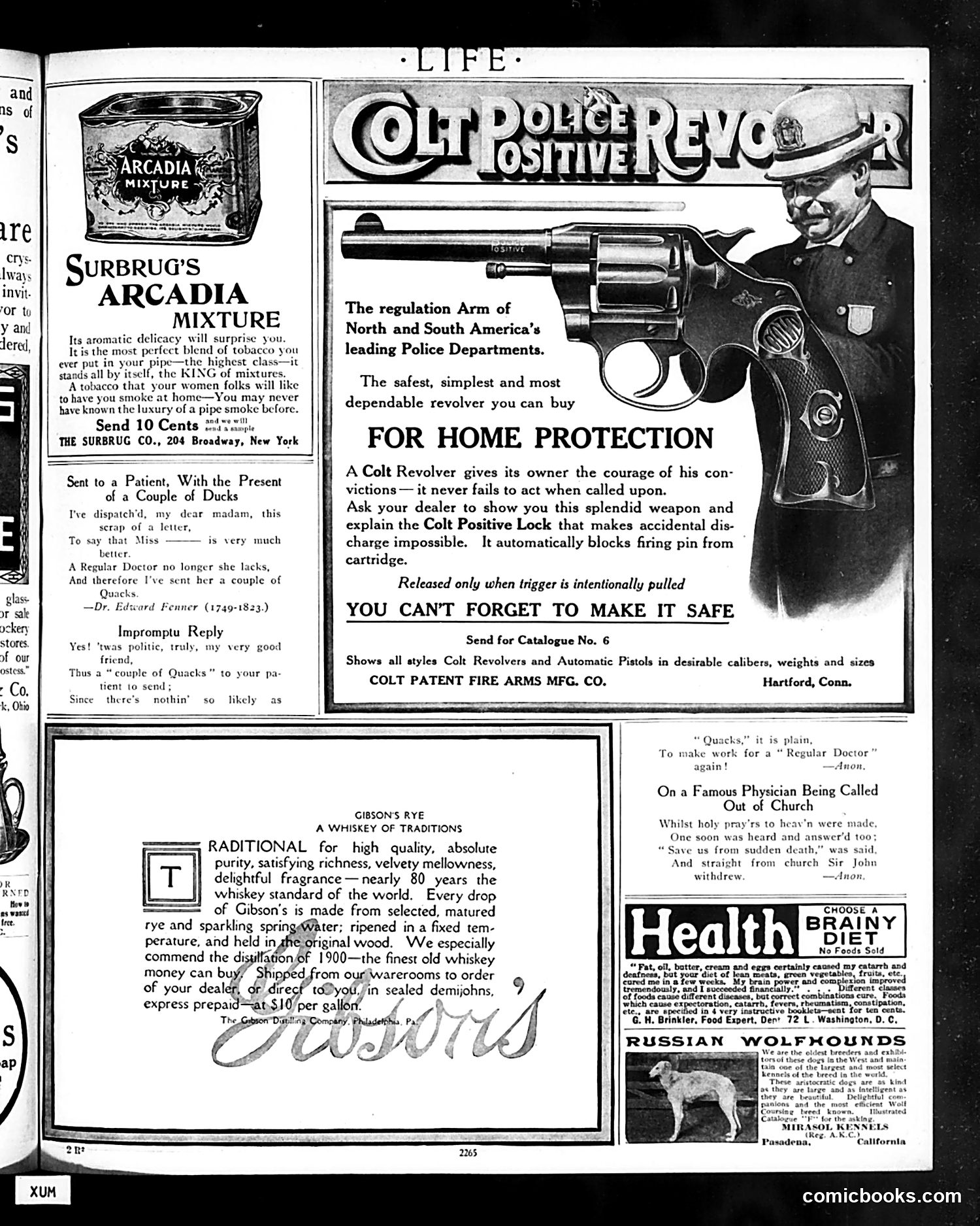
This page contains **primarily advertisements** rather than satirical cartoons. The main content includes: 1. **Tobacco and whiskey ads** (Surburg's Arcadia Mixture, Gibson's Rye) — typical early 20th-century luxury product marketing. 2. **Colt Revolver advertisement** — the largest feature, marketed as "the regulation Arm of North and South America's leading Police Departments" for "home protection." The ad emphasizes a safety feature (the "Positive Lock") that prevents accidental discharge. This reflects contemporary anxieties about household gun safety. 3. **Small humorous poems** about doctors and "quacks," playing on period attitudes toward medical practitioners. 4. **Minor ads** for a "brainy diet" and Russian wolfhounds. The page reflects early 1900s consumer culture: domesticity concerns (home safety), masculine protection narratives, and unregulated advertising for weapons and patent medicines—content that would face modern regulatory restrictions.
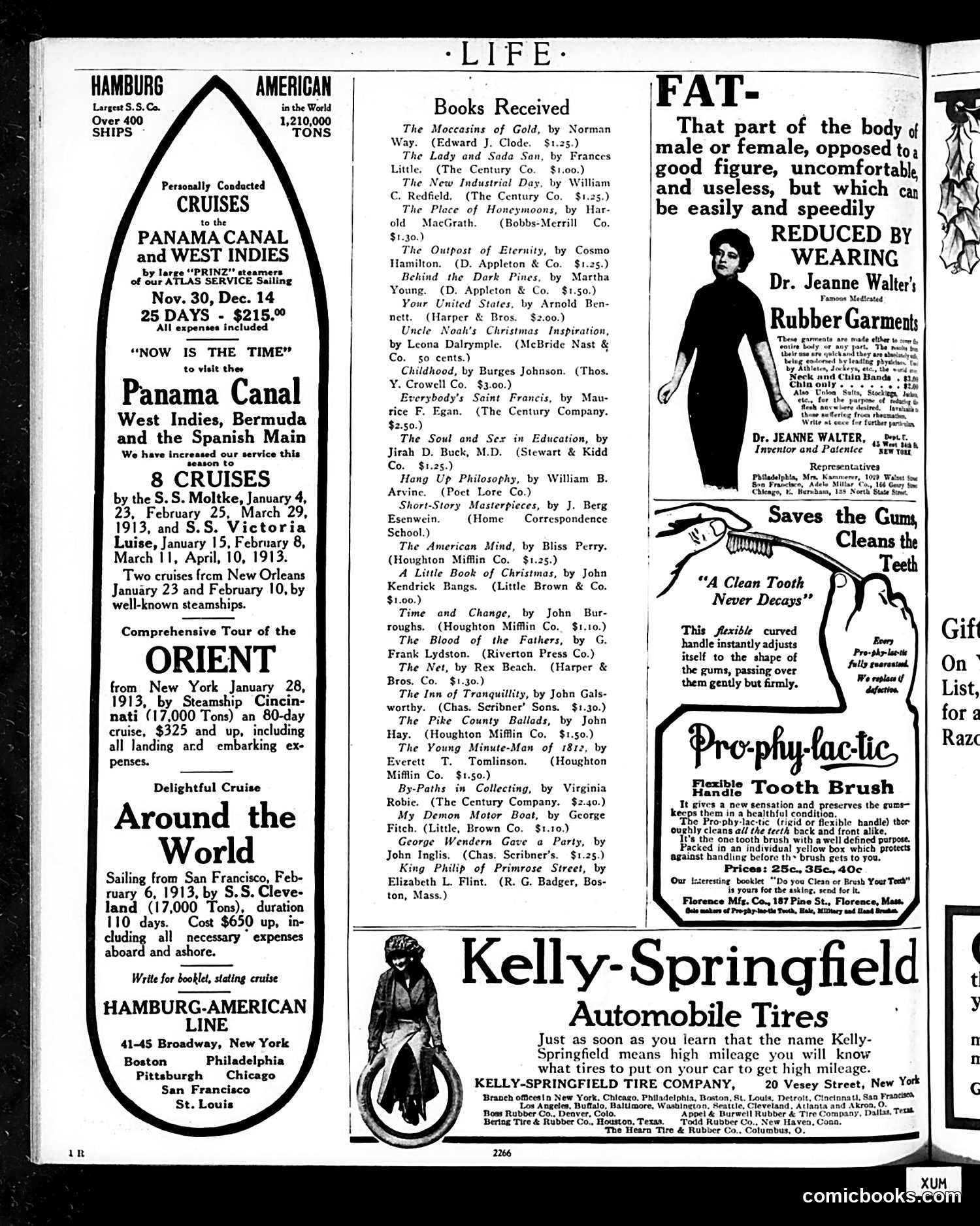
This page is primarily **advertising and book reviews** rather than satirical editorial content. The left side features cruise advertisements from the Hamburg-American Line, promoting luxury ocean voyages to the Panama Canal, West Indies, and around the world—typical leisure travel marketing for wealthy 1912-1913 readers. The right side contains two notable advertisements: 1. **Dr. Jeanne Walter's Rubber Garments**: A weight-loss corset marketed to reduce "fat" on the body. This reflects early 20th-century attitudes toward women's appearance and the commercial exploitation of body-image anxiety. 2. **Pro-phy-lac-tic Toothbrush**: An advertisement for a curved-handle toothbrush with the slogan "A Clean Tooth Never Decays"—promoting dental hygiene. The middle section lists recently published books, many with moralistic or sentimental titles typical of the era. There is **no apparent political cartoon or satire** on this page. It's a straightforward commercial and literary page reflecting consumer culture and concerns of the 1912 period.
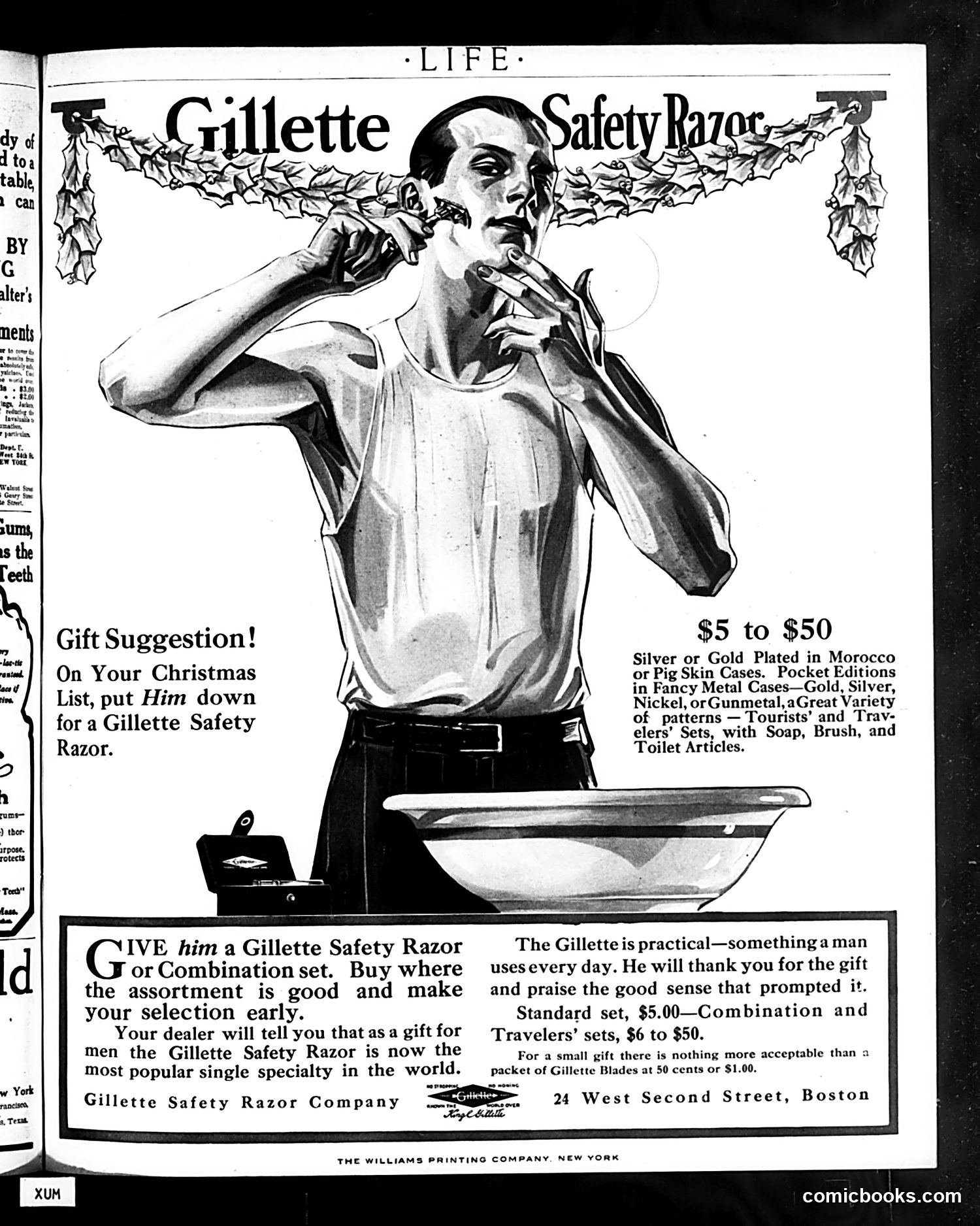
This is a **Gillette Safety Razor advertisement**, not satire or political commentary. The illustration depicts a man shaving—a straightforward product endorsement positioned as a Christmas gift suggestion for the early 20th century. The ad's appeal is practical: it frames the safety razor as an everyday necessity ("something a man uses every day"), positioning gift-giving around utility rather than luxury. The price range ($5–$50) reflects premium packaging options in materials like morocco leather and gold plating, targeting middle- and upper-class consumers. The historical context: Gillette's safety razor was a relatively recent innovation (patented 1901), revolutionary for making shaving safer and easier than straight razors. This advertisement capitalizes on that novelty by suggesting it as the ideal masculine gift—practical, modern, and refined. There is no satire or cartoon humor here—it's a straightforward product advertisement in a commercial magazine section.
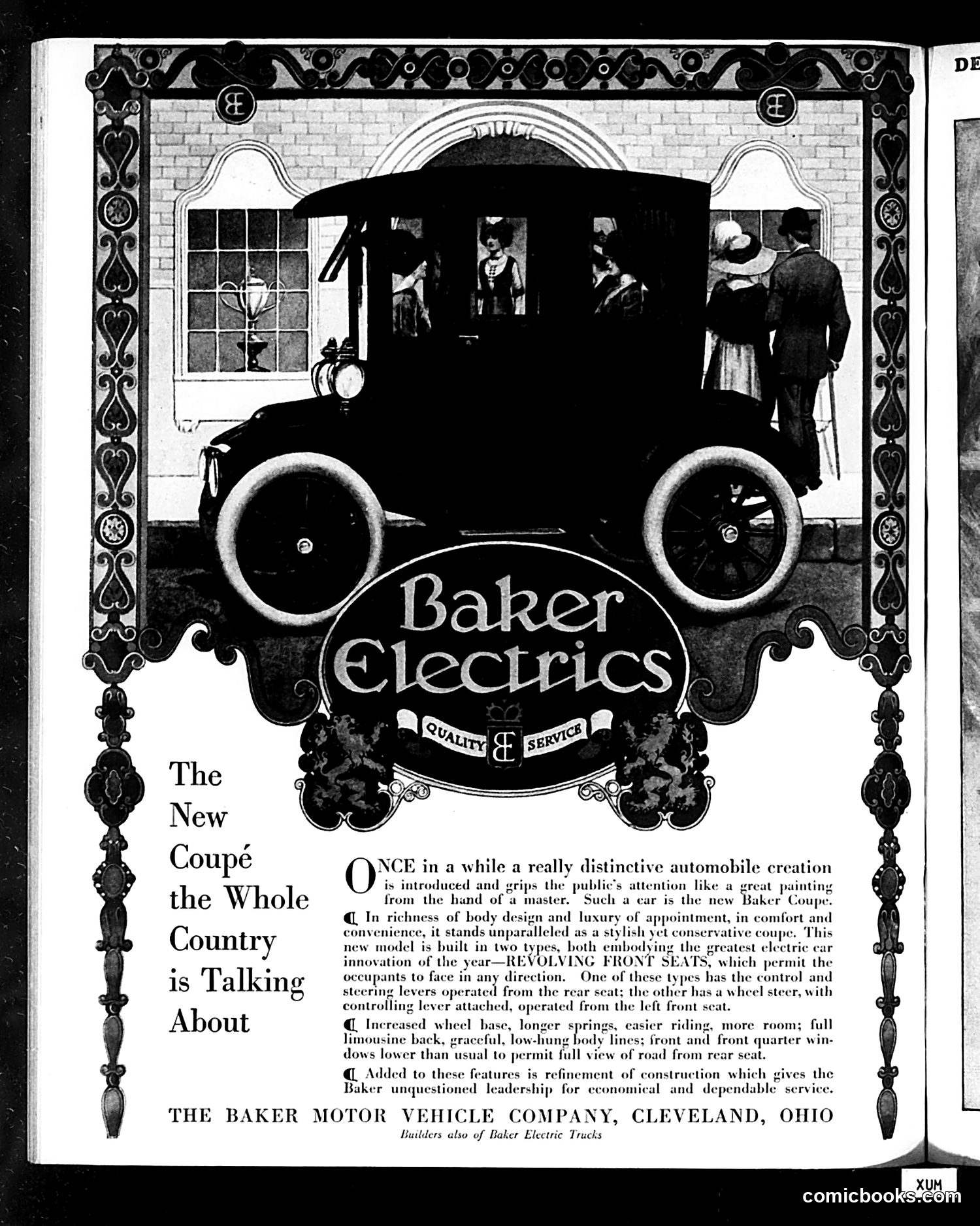
This is not a political cartoon—it's a **vintage automobile advertisement** for Baker Electrics, likely from the early 1910s. The silhouetted illustration shows a luxury electric coupe with passengers, parked outside an elegant building with large windows. The ad's headline promises "The New Coupé the Whole Country is Talking About," positioning this vehicle as a prestigious status symbol. The text emphasizes innovative features like "revolving front seats" that allow occupants to face different directions, an extended wheelbase, and a refined body design. Baker Motor Vehicle Company, based in Cleveland, Ohio, promoted electric cars as symbols of comfort and sophistication for wealthy customers. The elegant Art Deco border design and refined illustration style reinforce the luxury market positioning. This represents an era when electric vehicles competed seriously with gasoline cars before being displaced by cheaper, mass-produced alternatives.