
Life, 1912-11-21 · page 7 of 44
Life — November 21, 1912 — page 7: what you’re looking at
What you’re looking at
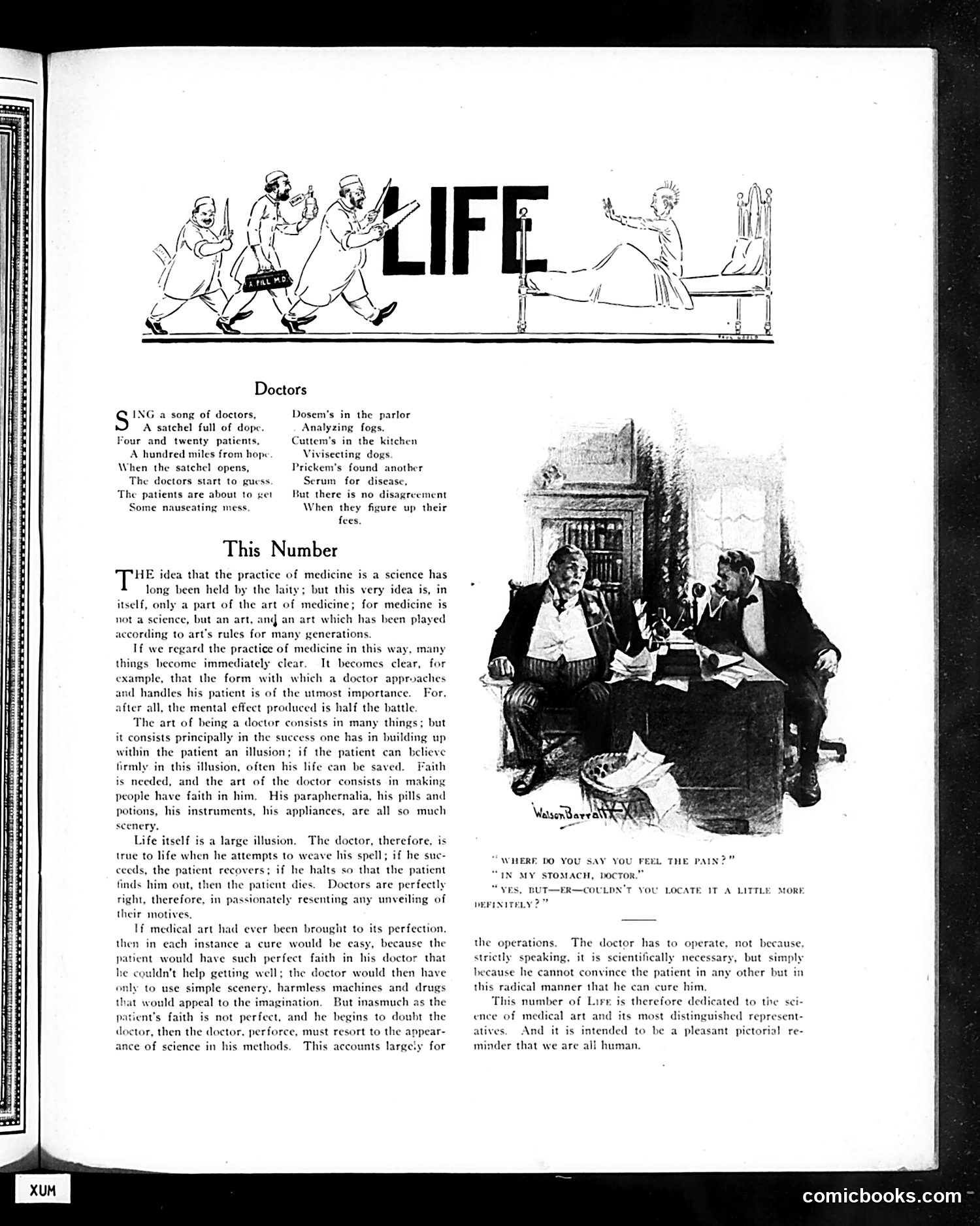
This page satirizes the medical profession's reliance on performance and faith over science. The header cartoon shows doctors as theatrical performers—literally pushing a patient through the word "LIFE"—suggesting medicine is spectacle rather than genuine healing. The accompanying essay argues that medicine's *art* (bedside manner, appearance, confidence) matters as much as its *science*. The illustrated scene shows a doctor reassuring a patient about stomach pain with vague, confident gestures—the humor being that the doctor may lack actual diagnostic clarity. The satire's point: doctors succeed partly through convincing patients they'll recover, using props, instruments, and authority as "scenery." The patient's faith in the doctor matters more than rigorous medicine—a critique of early 20th-century medical practice's theatrical elements masking limited actual scientific knowledge.
📄 Transcribed text from this page (OCR, searchable)
Machine-transcribed from the original scan — historical spelling and the odd misread are preserved.
ING a song of doctors, A satchel full of dope. Four and twenty patients, A hundred miles from hop« When the satchel opens, The doctors start to guess The patients are about to get Some nauseating mess Dosem’s in the parlor Analyzing fog: Cuttem’s in the kitchen Vivisecting dogs Prickem’s found another Scrum for disease, But there is no disagreement When they figure up their fees. This Number HE idea that the practice of medicine is a science has long been held by the laity; but this very idea is, in itself, only a part of the art of medicine; for medicine is not a science, but an art, ang an art which has been played according to art's rules for many generations. lf we regard the practice of medicine in this way, many things hecome immediately clear. It becomes clear, for ample, that the form with which a doctor approaches and handles his patient is of the utmost importance. after all, the mental effect produced is half the battle. The art of being a doctor consists in many things; but it consists principally in the success one has in building up within the patient an illusion; if the patient can believe firmly in this illusion, often his life can be saved. Faith is needed, and the art of the doctor consists in making people have faith in him. His paraphernalia, his pills and potions, his instruments, his appliances, are all so much. scenery. Life itself is a large illusion. The doctor, therefore, is true to life when he attempts to weave his spell; if he suc- ceeds, the patient recovers; if he halts so that the patient finds him out, then the patient dies. Doctors are perfectly right, therefore, in passionately resenting any unveiling of their motives, If medical art had ever been brought to its perfection. then in each instance a cure would be easy, because the patient would have such perfect faith in his doctor that he couldn't help getting well; the doctor would then have only to use simple scenery, harmless machines and drugs that would appeal to the imagination. But inasmuch as the patient’s faith is not perfect, and he begins to doubt the doctor, then the doctor, perforce, must resort to the appear- ance of science in his methods. This accounts largely for WHERF DO YOU SAY YOU FEEL THE PAIN? N MY STOMACH, DOCTOR “VES, BUT—ER—COULPN'’T YOU LOCATE IT A LITTLE MORE DEFINITELY 2” the operations. The doctor has to operate, not because, strictly speaking, it is scientifically necessary, but simply because he cannot convince the patient in any other but in this radical manner that he can cure him, This number of Lire is therefore dedicated to tie sci- ence of medical art and its most distinguished represent- atives. And it is intended to be a pleasant pictorial re- minder that we are ail human. comicbooks.com ~