
Life, 1912-11-21 · page 24 of 44
Life — November 21, 1912 — page 24: what you’re looking at
What you’re looking at
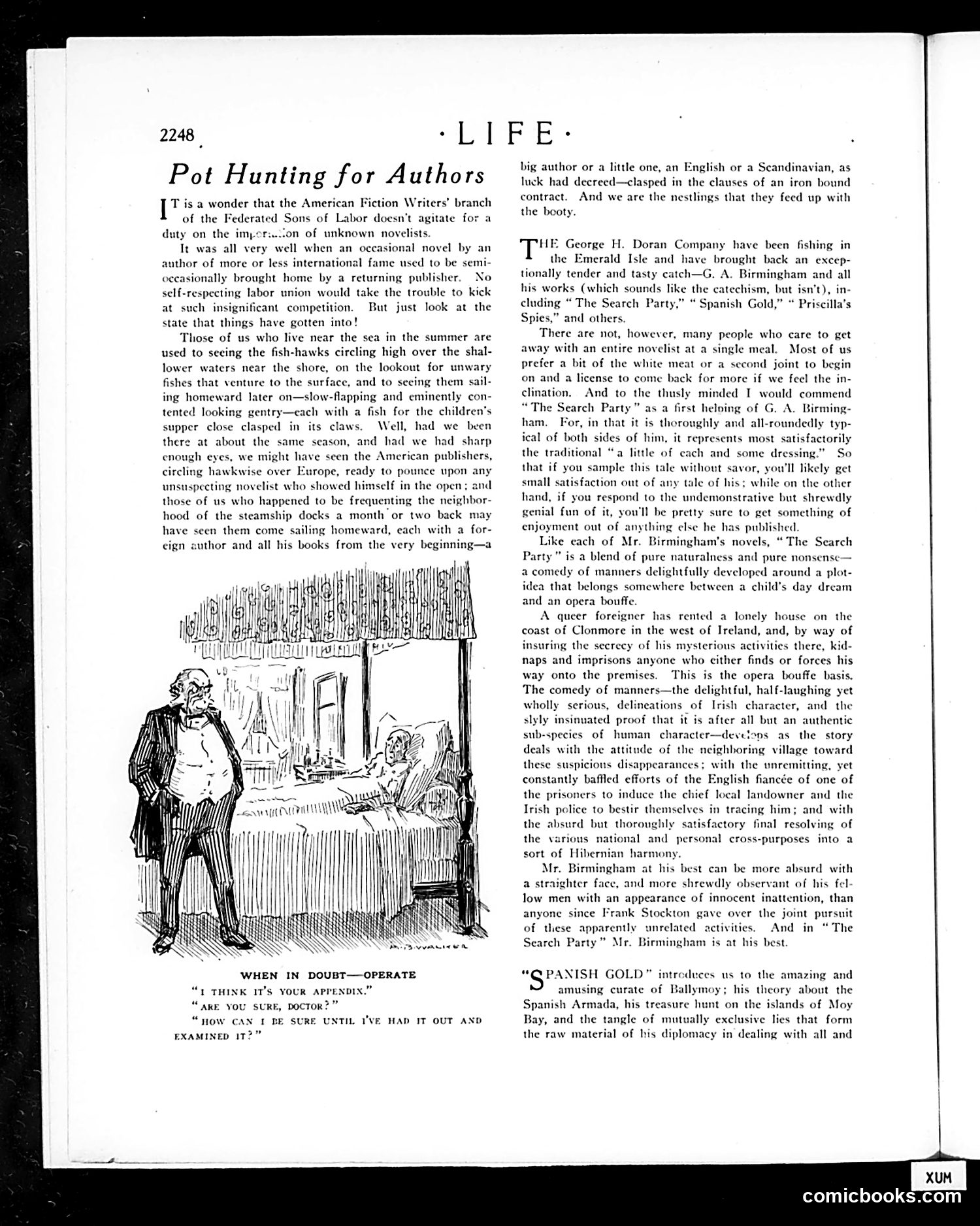
This article satirizes American publishers' aggressive recruitment of foreign authors. The central metaphor compares publishers to fish hawks circling European waters, "pouncing" on unsuspecting foreign novelists and bringing them home "clasped in the clauses of an iron bound contract." The accompanying cartoon labeled "When in Doubt—Operate" shows a doctor and patient—a separate, unrelated medical satire about unnecessary surgery (the doctor admits he won't know if appendicitis exists until he removes the organ). The main text reviews G.A. Birmingham's novel *The Search Party*, published by the George H. Doran Company. The review praises Birmingham as a "tender and tasty catch" of Irish literature, recommending his work as a good introduction to his style—blending naturalism with absurdist comedy, set in rural Ireland with kidnapping and mystery elements. The satire critiques the transatlantic literary import business as exploitative labor competition, while the book review itself is earnestly promotional.
📄 Transcribed text from this page (OCR, searchable)
Machine-transcribed from the original scan — historical spelling and the odd misread are preserved.
2248 | Pot Hunting for Authors T is a wonder that the American Fiction Writers’ branch of the Federated Sons of Labor doesn’t agitate for a duty on the imp n of unknown novelists. It was all very well when an occasional novel by author of more or less international fame used to be sem occasionally brought home by a returning publisher. No self-respecting labor union would take the trouble to kick at such insignificant competition. But just look at the state that things have gotten into! Those of us who live near the sea in the summer are used to seeing the fish-hawks circling high over the shal- lower waters near the shore, on the lookout for unwary fishes that venture to the surface, and to seeing them sail- ing homeward later on—slow-flapping and eminently con- tented looking gentry—each with a fish for the children’s supper close clasped in its claws. Well, had we been there at about the same season, and had we had sharp enough eyes, we might have seen the American publishe: circling hawkwise over Europe, ready to pounce upon any unsuspecting novelist who showed himself in the open; and those of us who happened to be frequenting the neighbor- hood of the steamship docks a month’ or two back may have seen them come sailing homeward, each with a for- eign cuthor and all his books from the very beginning—a ll WHEN IN DOUBT—OPERATE “1 THINK IT’S YOUR APPENDIX.” “ARE YOU SURE, DOCTOR “HOW CAN 1 BE SURE UNTIL I'VE HAD IT OUT AND EXAMINED 17?” “LIFE - big author or a little one, an English or a Scandinavian, as luck had decreed—clasped in the clauses of an iron bound contract. And we are the nestlings that they feed up with the beoty. HE George H. Doran Company have been fishing in the Emerald Isle and have brought back an excep- tionally tender and tasty catch—G,. A. Birmingham and all his works (which sounds like the catechism, but isn’t), in- cluding “ The Search Party,” “ Spanish Gold,” “ Priscilla’s Spies,” and others. There are not, however, many people who care to get away with an entire novelist at a single meal. Most of us prefer a bit of the white meat or a second joint to begin on and a license to come back for more if we feel the in- clination, And to the thusly minded I would commend “The Search Party” as a first heloing of G. A. Birming- ham. For, in that it is thoroughly and all-roundedly typ- ical of both sides of him, it represents most satisfactorily the traditional “a little of cach and some dressing.” So that if you sample this tale without savor, you'll likely get small satisfaction out of any tale of his; while on the other hand, if you respond to the undemonstrative but shrewdly genial fun of it, you'll be pretty sure to get something of enjoyment out of anything else he has published Like each of Mr. Birmingham's novels, “The Search Party" is a blend of pure naturalness and pure nonsense— a comedy of manners delightfully developed around a plot- idea that belongs somewhere between a child's day dream and an opera bouffe. A queer foreigner has rented a lonely house on the coast of Clonmore in the west of Ireland, and, by way of insuring the secrecy of his mysterious activities there, kid- naps and imprisons anyone who cither finds or forces his way onto the premises. This is the opera bouffe basis. The comedy of manners—the delightful, half-laughing yet wholly serious, delineations of Irish character, and the slyly insinuated proof that it is after all but an authentic sub-species of human character—devetops as the story deals with the attitude of the neighboring village toward these suspicions disappearances; with the unremitting, yet constantly baffled efforts of the English fiancée of one of the prisoners to induce the chief local landowner and the Irish police to bestir themselves in tracing him; and with the absurd but thoroughly satisfactory final resolving of the various national and personal cross-purposes into a sort of Hibernian harmony. Mr. Birmingham at his best can be more absurd with a straighter face, and more shrewdly observant of his fel low men with an appearance of innocent inattention, than anyone since Frank Stockton gave over the joint pursuit of these apparently unrelated activities. And in “The Search Party” Mr. Birmingham is at his best. “GPANISH GOLD” intreduces us to the amazing and amusing curate of Ballymoy; his theory about the Spanish Armada, his treasure hunt on the islands of Moy Bay, and the tangle of mutually exclusive lies that form the raw material of his diplomacy in dealing with all and comicbooks.com