
Life, 1912-11-21 · page 21 of 44
Life — November 21, 1912 — page 21: what you’re looking at
What you’re looking at
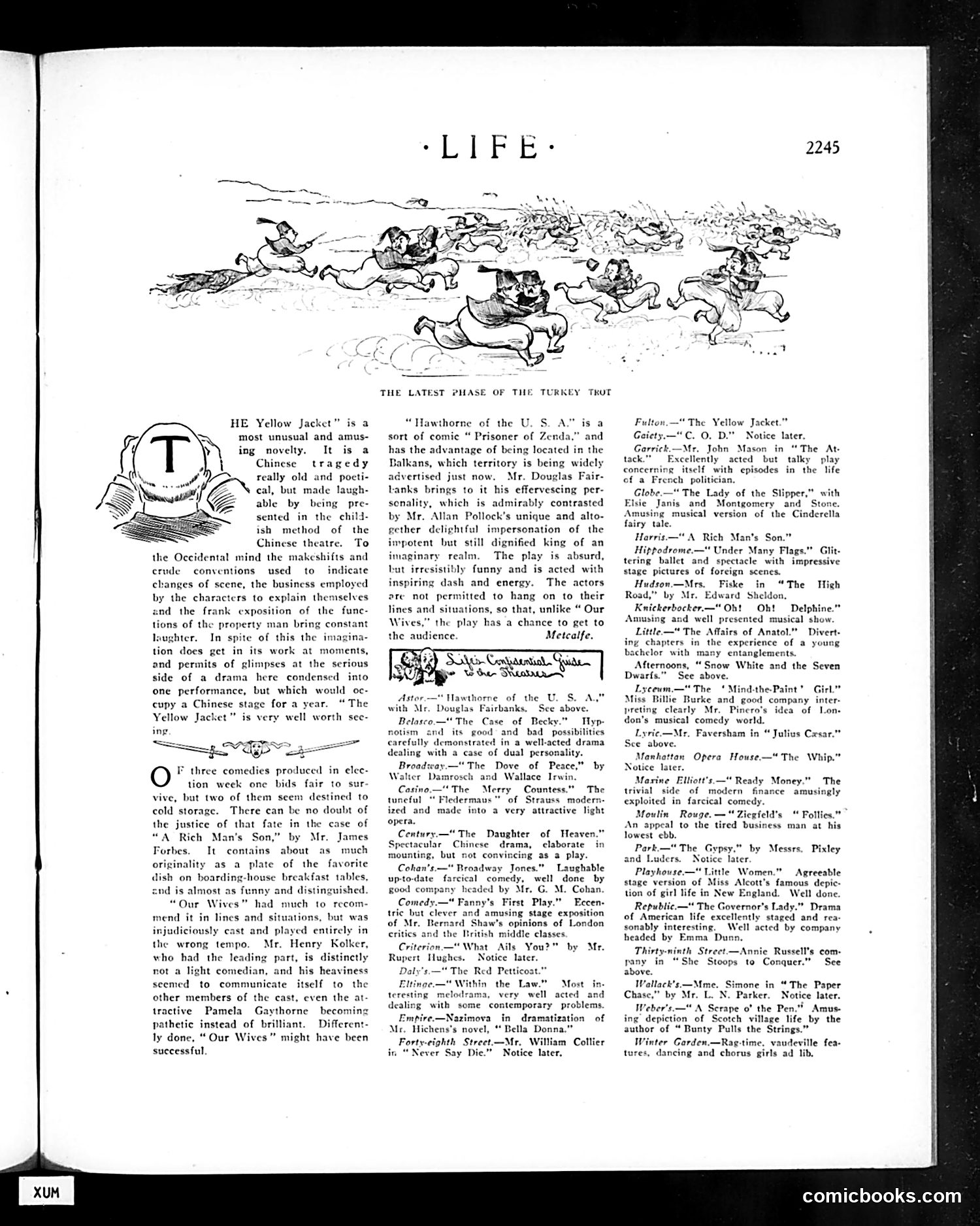
This cartoon satirizes the "Turkey Trot," a popular ragtime dance craze of the early 1910s that shocked genteel society. The image shows figures energetically performing the dance—characterized by jerky, undignified movements that scandalized conservative Americans who viewed it as vulgar and sexually suggestive. The title's reference to "latest phase" suggests the dance keeps evolving and spreading despite social disapproval. The exaggerated, crude cartoon style emphasizes how absurd and undignified respectable people found the dance. This was a common Life magazine tactic: using humor and caricature to mock both the dance's enthusiasts and the moral panic it generated among the establishment. The page's theater reviews above provide context—Life was a sophisticated publication critiquing modern entertainment while simultaneously mocking popular culture's lowbrow trends.
📄 Transcribed text from this page (OCR, searchable)
Machine-transcribed from the original scan — historical spelling and the odd misread are preserved.
HE Yellow Jacket” is a most unusual and amus- ing novelty, It is a Chinese tragedy really old and pocti- cal, but made laugh- able by being pre- sented in the ch ish method of the Chinese theatre. To the Occidental mind the makeshifts and crude conventions used to indicate changes of scene, the business employed by the characters to explain themselves and the frank exposition of the fune- tions of the property man bring consts laughter. In spite of this the in tion does get in its work at moments, and permits of glimpses at the serious side of a drama here condensed into one performance, but which would oc- cupy a Chinese stage fora year. “The Yellow Jacket” is very well worth see- ing gina- three comedies produced in elec- tion week one bids fair vive, but two of them seem dest cold storage. There can be no doubt of the justice of that fate in the case of “A Rich Man's Son,” by Mr. James Forbes. It contains about as much originality as a plate of the favorite dish on boarding-house breakfast tables, end is almost as funny and distinguished “Our Wives” had much to recom- mend it in lines and situations, but was injudiciously cast and played entirely in the wrong tempo. Mr. Henry Kolker, who had the leading part, is distinctly not a light comedian, and his heaviness seemed to communicate itself to the other members of the cast, even the at tractive Pamela Gaythorne becoming pathetic instead of brilliant. Different- ly done, “ Our Wives” might have been successful to sur. ed to THE LATEST PHASE OF THE TURKEY TkUT “Hawthorne of the U. S. A.” is a sort of comic “ Prisoner of Zenda,” and has the advantage of being located in the Balkans, which territory is being widel advertised just now. Mr. Douglas Fair- Lanks brings to it his effervescing per- sonality, which is admirably contrasted by Mr. Allan Pollock's unique and alto- gether delightful impersonation of the impotent but still dignified king of an realm. The play is absurd, Lut irresistibly funny and is acted with inspiring dash and energy. The actors are not permitted to hang on to their lines and situations, so that, unlike “ Our Wives,” the play has a chance to get to the audience. Metcalfe. imaginary Astor —"Mawthorne of the U. § with Mr. Douglas Fairbanks. See above. Belasco. —"' The Case of Beck Hyp- notism and its good and bad possibilities carefully demonstrated in a well-acted drama dealing with a case of dual personality. Broadway.—" The Dove of Peace,” by Walter Damrosch and Wallace Irwin. Casino.—' The Merry Countess." The tuneful “Fledermaus of Strauss modern- ized and made into a very attractive light opera. Century.—" The Daughter of Heaven. Spectacular Chinese drama, claborate mounting, but not convincing as a play. Cohan’s.—"* Broadway Jones.” Laughable uptodate farcical comedy, well done by good co eaded by Mr. G. M. Cohan. Comedy y's First Play.” Eccen- tric but clever and amusing stage exposition of Mr. Bernard Shaw's opinions of London critics and the Rritish middle classes Criterion. —" What Ails You?" by Rupert Hughes. Notice later. Daly's.—" The Red Petticoat.” the Law.” Most ins well acted and some contemporary problems. Mr. Empire.—Nazimova in dramatization of Mr. Hichens's novel, * Bella Donna.’ Forty-eighth Street.—Mr. William Collier Never Say Die.” Notice later, Fulton.—" The Yellow Jacket.” Gaiety.—“C. 0. D.”" Notice later. Garrick.—Mr, John Mason in “The Ate tack.” Excellently acted but talky play concerning itself with episodes in the life of a French politician, Globe.—" The Lady of the Slipper, Elsie Janis and Montgomery and St Amusing musical version of the Cinderella fairy tale. Horris.—" A Rich Man's Son.” Hippodrome.—" Under Many Flags." Glit- tering ballet and spectacle with impressive stage pictures of foreign scenes. Hudson.—Mrs. Fiske in “The Road,” by Mr. Edward Knickerbocker.—" Ot Delphine.” Amusing and well presented musical show. Little —" The Affairs of Anatol.” Divert: ing chapters in the experience of a young helor with m: entanglements. Afternoons, “Snow White and the Seven Dwarfs.” See above. ‘Mind-the-Paint’ Girl.” Rillie Burke and good company inter- preting clearly Mr. Pinero’s idea of lone don's musical comedy world. Lyrie.—Mr, Faversham in “ Julius Cxsar.” Sce above. Manhatta Notice late High Opera House-—" The Whip. Hiott's.—" Ready Money.” of modern finance exploited in farcical comedy. Moulin Rouge. —“ Zicgicld's “Follies.” An appeal to the tired business man at his lowest ebb. Park.—" The Gypsy.” and Luders. Notice later Playhous ttle Women.” Agreeable stage version of Miss Alcott’s famous depic- tion of girl life in New England. Well done. Republic. —" The Governor's Lady.” Drama of American life excellently staged and rea. sonably interesting. Well acted by company headed by Emma Dunn. Thirty-ninth Street—Annie Russell's com- rany in “She Stoops to Conquer.” See above. Wallack's.—Mme. Simone in “The Paper Chase,” by Mr. L. N. Parker. Notice later. Weber’s—" N Scrape o' the Pen.” Amus- ing’ depiction of Scotch village life by the author of “Bunty Pulls the Strings.” Winter Garden.—Rag-time. vaudeville fea- tures, dancing and chorus girls ad lib, The amusingly by Messrs. Pixley comicbooks.com