
Life, 1912-11-21 · page 17 of 44
Life — November 21, 1912 — page 17: what you’re looking at
What you’re looking at
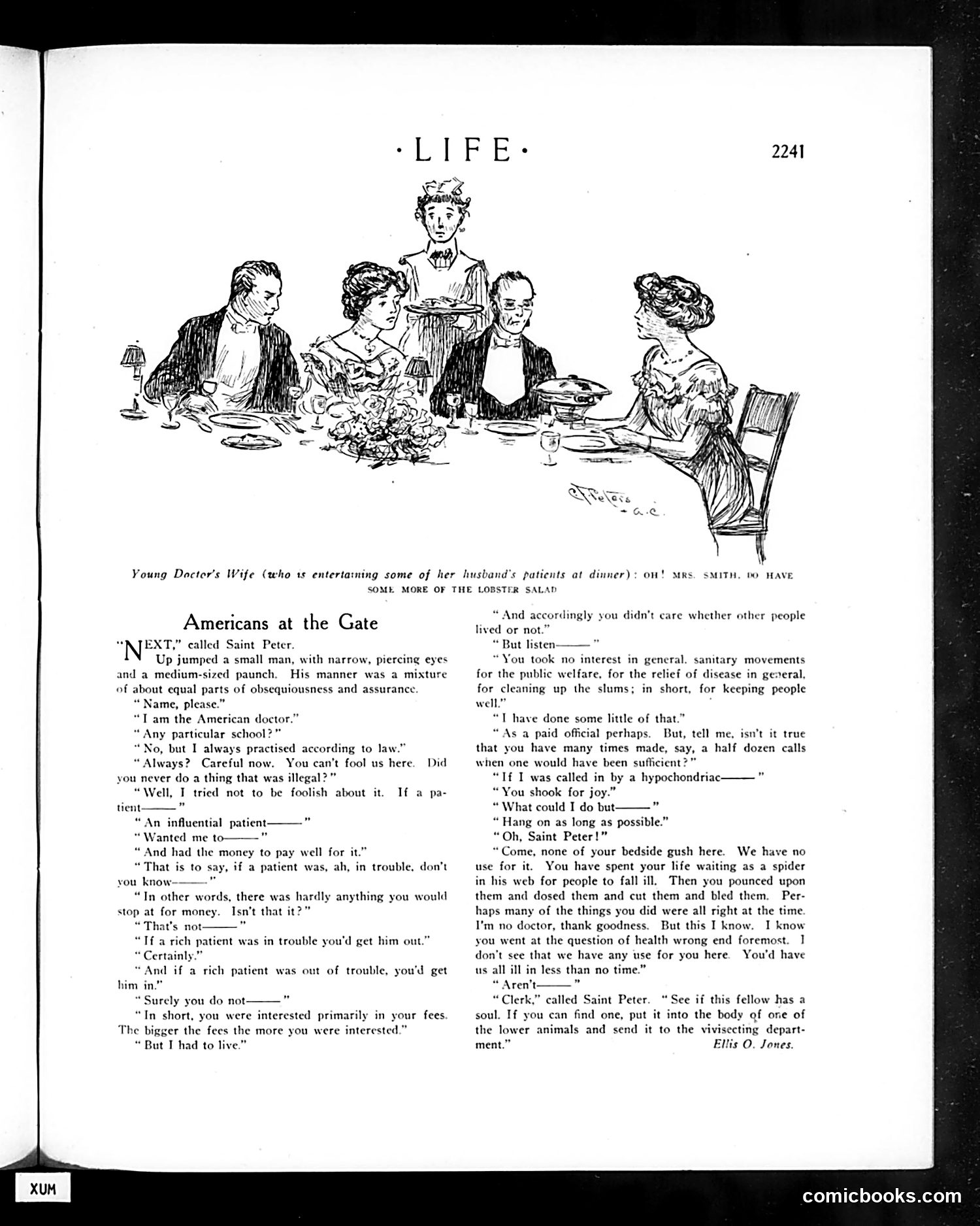
This page contains two distinct pieces of social satire from *Life* magazine: **"Young Doctor's Wife"** (top illustration): A dinner scene mocking the hypocrisy of a doctor's wife entertaining her husband's patients. The caption's emphasis on lobster salad suggests irony about affluence and pretense—the doctor profits from patients while his wife performs gracious hospitality. **"Americans at the Gate"** (main text): A dialogue between Saint Peter and an American doctor at Heaven's gate. The satire attacks physicians for: - Prioritizing fees over patient welfare - Unnecessary treatments and prolonged care for profit - Indifference to public health and sanitation - Opportunistic behavior toward wealthy patients Saint Peter ultimately rejects the doctor as morally corrupt, suggesting doctors care only for money, not genuine healing. The vivisection joke at the end implies the doctor lacks a soul worthy of human reincarnation. The satire reflects early-20th-century concerns about medical ethics, profiteering, and whether doctors served public health or private gain.
📄 Transcribed text from this page (OCR, searchable)
Machine-transcribed from the original scan — historical spelling and the odd misread are preserved.
Young Doctor's Wife (who 1 entertaining some of her husband's patients at dinner): ow! MRS. SMITH. DO HAVE SOME MORE OF THE LOBSTER SALAD Americans at the Gate “ATEXT,” called int Peter. Up jumped a small man, with narrow, piercing eyes and a medium-sized paunch, His manner was a mixture of about equal parts of obsequiousness and assurance. “Name, please.” “Tam the American doctor.” “Any particular school?” “No, but I always practised according to law.” “Always? Careful now. You can’t fool us here. Did you never do a thing that was illegal?” “Well, I tried not to be foolish about it. tient * If a pa- An influential patient “Wanted me to——" “And had the money to pay well for it.” “That is to say, if a patient was, ah, in trouble, don’t you know " “Tn other words, there was hardly anything you would stop at for money. Isn't that it?” “That's not. id If a rich patient was in trouble you'd get him out.” * Certainl, “And if a rich patient was out of trouble, you'd get him in.” “Surely you do not “In short, you were interested primarily in your fees. c bigger the fees the more you were interested.” “ But T had to live.” “And accordingly you didn’t care whether other people lived or not.” “ But listen: “You took no interest in general. sanitary movements for the public welfare, for the relief of disease in geeral, ining up the slums; in short, for keeping people I have done some little of that.” “As a paid official perhaps. But, tell me, isn’t it true that you have many times made, say, a half dozen calls when one would have been sufficient? “Tf 1 was called in by a hypochondriac- “You shook for joy.” “What could I do but J “ Hang on as long as possible.” “Oh, Saint Peter!” “Come, none of your bedside gush here. We have no use for it. You have spent your life waiting as a spider in his web for people to fall ill, Then you pounced upon them and dosed them and cut them and bled them. Per- haps many of the things you did were all right at the time. I'm no doctor, thank goodness. But this I know. I know you went at the question of health wrong end foremost. 1 don’t see that we have any use for you here. You'd have us all ill in less than no time.” .” called Saint Peter. “See if this fellow has a soul. If you can find one, put it into the body of one of the lower animals and send it to the vivisecting depart- ment.” Ellis O. Jones. comicbooks.com