
Life, 1912-11-21 · page 25 of 44
Life — November 21, 1912 — page 25: what you’re looking at
What you’re looking at
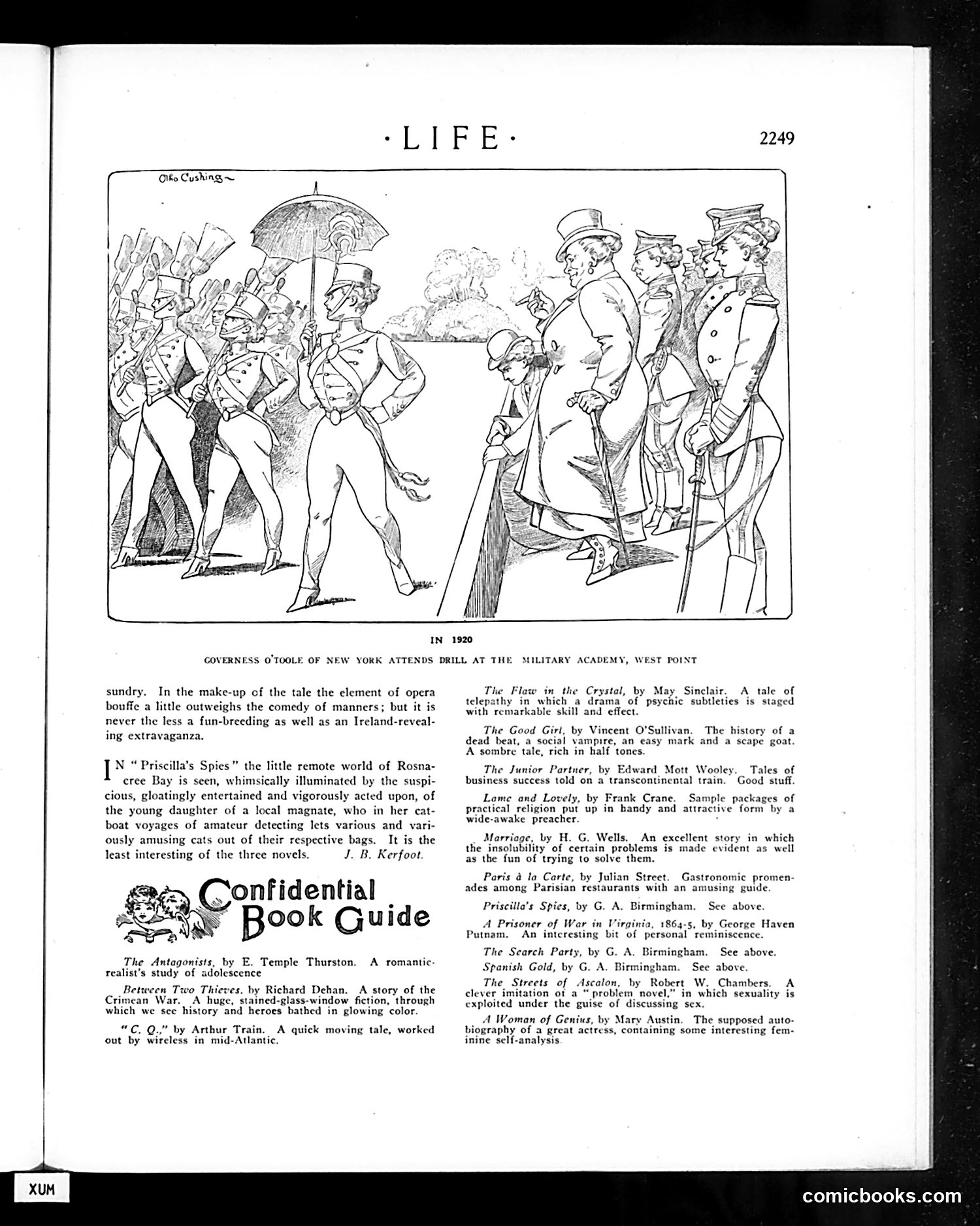
The cartoon shows "Governor O'Toole of New York" attending a military drill at West Point. On the left, soldiers stand at attention with rifles and an umbrella. On the right, military officers in formal dress observe. The satire appears to target the incongruity of a politician (O'Toole) attending serious military training. The umbrella and the exaggerated, somewhat ridiculous posture of the soldiers suggest the scene is being mocked as absurd theater rather than genuine military readiness. This likely comments on political posturing—politicians performing patriotic duty or military engagement for public appearance rather than substantive military preparedness. The 1920 date and New York governor reference suggest this may allude to specific contemporary political figures or situations, though the specific identity of "O'Toole" remains unclear without additional context. The overall tone mocks the performative nature of political involvement in military affairs.
📄 Transcribed text from this page (OCR, searchable)
Machine-transcribed from the original scan — historical spelling and the odd misread are preserved.
Cio Cushing ~ COVERNE: sundry, In the make-up of the tale the element of opera bouffe a little outweighs the comedy of manners; but it is never the less a fun-breeding as well as an Ireland-reveal- ing extravaganza. I N “ Priscilla’s Spies” the little remote world of Rosna- eree Bay is seen, whimsically illuminated by the suspi- cious, gloatingly entertained and vigorously acted upon, of the young daughter of a local magnate, who in her cat- boat voyages of amateur detecting Iets various and vari- ously amusing cats out of their respective bags. It is the least interesting of the three novels. J. B. Kerfoot. ~onfidential | ¥ Book Guide by E. Temple Thurston. lolescence A romantic- realist’s study of Between Two Thieves. by Richard Dehan. A story of the Crimean War. A huge, stained-glass-window fiction, through which we see history and heroes bathed in glowing ‘color. “C. Q.,.” by Arthur Train. A quick moving tale, worked out by wireless in mid-Atlantic. O'TOOLE OF NEW YORK ATTENDS DRILL AT THE MILITARY ACADEMY, WEST POINT Sinclair, A tale of The Flaw in the Crystal, by Ma: subtleties is staged telepathy in which a drama’ of psyc with remarkable skill and effect. The Good Girl, by Vincent O'Sullivan. The history of a dead beat, a social vampire, an easy mark and a scape goat. A sombre tale, rich in half ‘tones. Tales of The Junior Partner, by Edward Mott Wooley. Good stuff. business success told on a transcontinental train Lame and Lovely, by Frank Crane. Sample packages of practical religion put up in handy and attractive form by a wide-awake preacher. Marriage, by H. G. Wells. An excellent story in which the insolubility of certain problems is made evident as well as the fun of trying to solve them. Paris @ la Carte, by Julian Street. Gastronomic promen- ades among Parisian resiaurants with an amusing guide See above A Prisoner of Wor in Virginia, 1864-5, by George Haven Putnam. An interesting bit of personal reminiscence. The Search Party, by G. A. Birmingham. See above. Spanish Gold, by G. A. Birmingham. See above. The. Streets of Ascolon, by Robert W. Chambers. A clever imitation ot a “problem novel,” in which sexuality is exploited under the guise of discussing sex. __ A Woman of Genius, by Mary Austin. The supposed auto- biography of a great actress, containing some interesting fem- inine self-analysis Priscillo's Spies, by G. A. Birmingham. comicbooks.com