
Life, 1912-11-21 · page 19 of 44
Life — November 21, 1912 — page 19: what you’re looking at
What you’re looking at
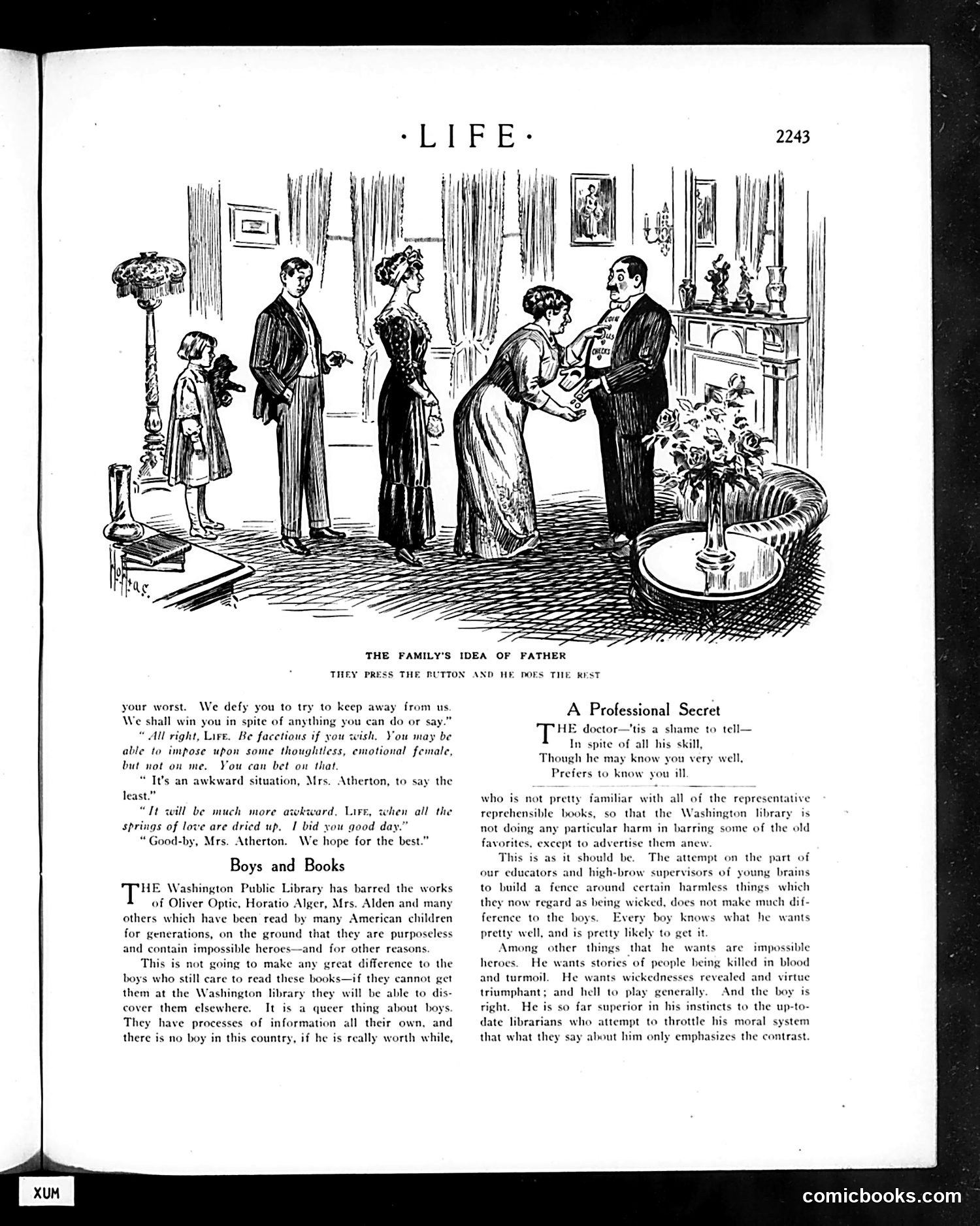
The cartoon satirizes the domestic power dynamic between husbands and wives. The caption reads: "They press the button and he does the rest"—suggesting fathers are merely servants responding to family demands rather than household authorities. The dialogue depicts a marital conflict where the wife (Mrs. Atherton) threatens to withdraw marital affection ("springs of love are dried up") if the husband doesn't comply with her wishes. The husband protests he won't be manipulated by "emotional female" appeals, yet the cartoon's composition (with the family arrayed against him) visually undermines his authority. This reflects early 20th-century anxieties about shifting gender dynamics and women's increasing domestic power—humor derived from the reversal of traditional patriarchal expectations. The joke targets fathers who imagine themselves in control but are actually managed by their families through emotional pressure.
📄 Transcribed text from this page (OCR, searchable)
Machine-transcribed from the original scan — historical spelling and the odd misread are preserved.
THE FAMILY'S IDEA OF FATHER THEY PRESS THE RUTTON your worst. We defy you to try to keep away from us. We shall win you in spite of anything you can do or say “ All right, Lire. Be facetious if you wish. You may be able to impose upon some thoughtless, emotional female, but not on me. You can bet ou that. “It's an awkward situation, Mrs. Atherton, to say the least.” “Tt will be much more awkward. Lire, when all the springs of love are dried up. I bid you good day.” “Good-by, Mrs. Atherton. We hope for the best.” Boys and Books HE Washington Public Library has barred the works of Oliver Optic, Horatio Alger, Mrs. Alden and many others which have been read by many American children for generations, on the ground that they are purposeless and contain impossible heroes—and for other reasons. This is not going to make any great difference to the boys who still care to read these books—if they cannot get them at the Washington library they will be able to dis- cover them elsewhere. It is a queer thing about boys. They have processes of information all their own, and there is no boy in this country, if he is really worth while, AND HE DOES THE REST A Professional Secret HE doctor—'tis a shame to tell— In spite of all his skill, Though he may know you very well, Prefers to know you ill who is not pretty familiar with all of the representative reprehensible books, so that the Washington library is not doing any particular harm in barring some of the old favorites, except to advertise them anew This is as it should be. The attempt on the part of our educators and high-brow supervisors of young brains to build a fence around certain harmless things which they now regard as being wicked, does not make much dif- ference to the boys pretty well, and is pretty likely to get it Among other things that he wants heroes. He wants stories of people being killed in blood and turmoil. He wants wie triumphant; and hell to play generall: right. He is so far superior in his instincts to the up-to- date librarians who attempt to throttle his moral system that what they say about him only emphasizes the contrast. Every boy knows what he wants are impossible Inesses revealed and virtue And the boy is comicbooks.com