
Life, 1912-11-21 · page 18 of 44
Life — November 21, 1912 — page 18: what you’re looking at
What you’re looking at
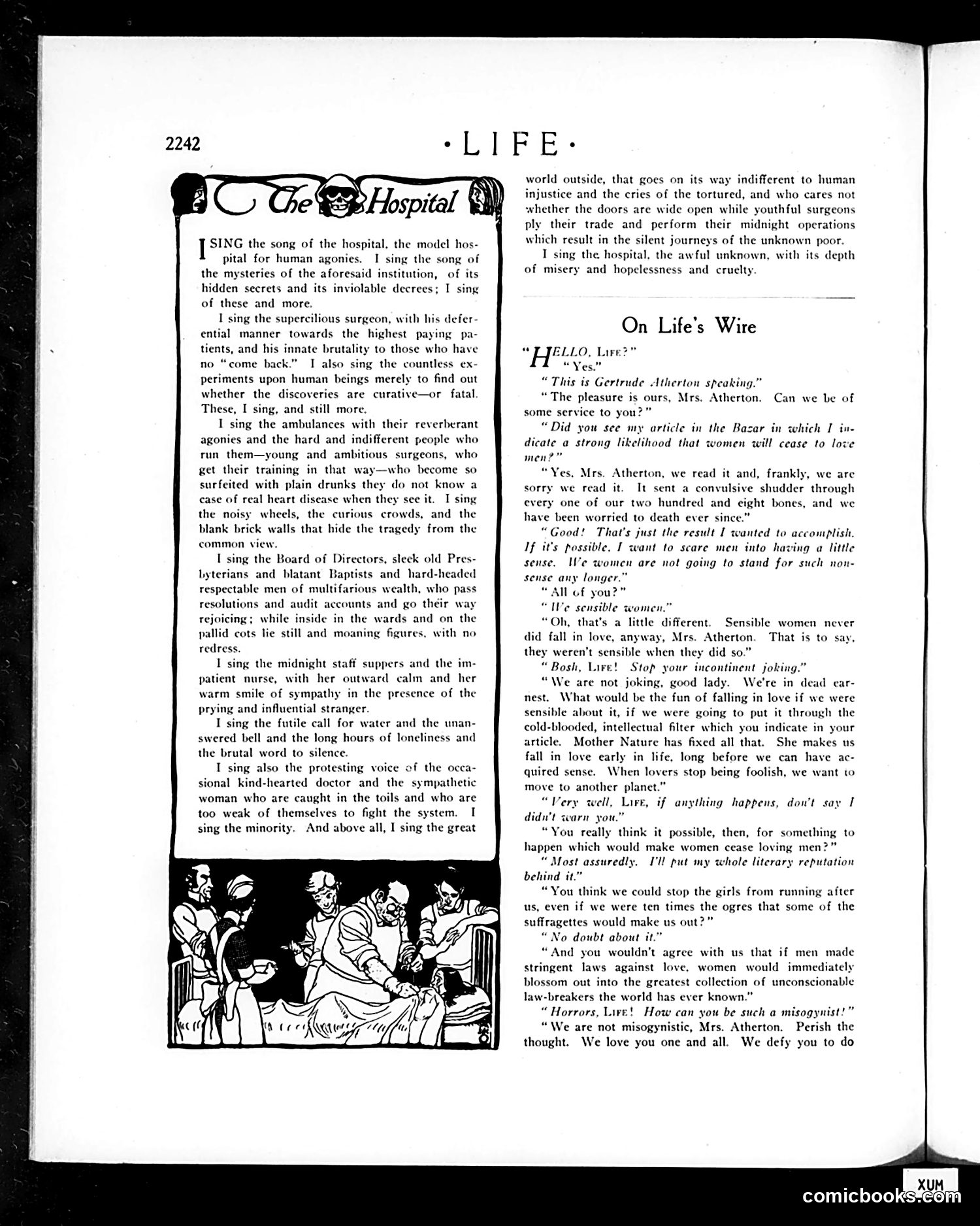
This Life magazine page contains two distinct pieces of social satire. **"The Hospital"** is a scathing poem attacking medical institutions for prioritizing wealthy patients while neglecting the poor, conducting dangerous experiments on vulnerable patients, and maintaining a facade of respectability through wealthy board directors who ignore suffering within the wards. It critiques both the callous medical establishment and the indifferent public. **"On Life's Wire"** is a humorous dialogue between Life magazine and writer Gertrude Atherton (a real author of the period), who claims women will cease loving men. Life playfully argues that women's sensibility would ruin romantic love entirely—that passion requires irrationality. The satire mocks both Atherton's serious feminist stance and the magazine's flippant dismissal of her concerns about women's agency in relationships. Both pieces reflect early 20th-century progressive critique of institutional hypocrisy and gender relations.
📄 Transcribed text from this page (OCR, searchable)
Machine-transcribed from the original scan — historical spelling and the odd misread are preserved.
*LiPeE: SING the song of the hospital, the model hos- pital for human agonies. I sing the song of the mysteries of the aforesaid institution, of its hidden secrets and its inviolable decrees; I sing of these and more. I sing the supercilious surgeon, with his defer- ential manner towards the highest paying pa- tients, and his innate brutality to those who have no “come back.” I also sing the countless ex- periments upon human beings merely to find out whether the discoveries are curative—or fatal. These, I sing, and still more. I sing the ambulances with their reverberant agonies and the hard and indifferent people who run them—young and ambitious surgeons, who get their training in that way—who become so surfeited with plain drunks they do not know a case of real heart disease when they see it. I sing the noisy wheels, the curios crowds, and the blank brick walls that hide the tragedy from the common view. I sing the Board of Directors, sleck old Pres- byterians and blatant Baptists and hard-headed respectable men of multifarious wealth, who pass resolutions and audit accounts and go their way rejoicing; while inside in the wards and on the pallid cots lie still and moaning figures, with no redress. 1 sing the midnight staff suppers and the im- patient nurse, with her outward calm and her warm smile of sympathy in the presence of the prying and influential stranger. I sing the futile call for water and the unan- swered bell and the long hours of loneliness and the brutal word to silence. I sing also the protesting voice of the ocea sional kind-hearted doctor and the sympathetic woman who are caught in the toils and who are too weak of themselves to fight the system. I sing the minority. And above all, I sing the great Los 7 a4 Nia i : thy 1Z world outside, that goes on its way indifferent to human injustice and the cries of the tortured, and who cares not whether the doors are wide open while youthful surgeons ply their trade and perform their midnight operations which result in the silent journeys of the unknown poor. I sing the hospital, the awful unknown, with its depth of misery and hopelessness and cruelty. On Life's Wire LLO, Lire?" “Yes.” “This is Gertrude Atherton speaking.” “The pleasure is ours, Mrs. Atherton. Can we be of some service to you?” “Did you see my article in the Bazar in which I in- dicate a strong likelihood that women will cease to love men?” “Yes, Mrs. Atherton, we read it and, frankly, we are sorry we read it. It sent a convulsive shudder through every one of our two hundred and eight bones, and we have been worried to death ever since.” “Good! That's just the result I wanted to accomplish. If it’s possible, I want to scare men into having a little sense. We women are not going to stand for such non- sense any longer. “All of you?” “We sensible women.” “Oh, that’s a little different. Sensible women never did fall in love, anyway, Mrs. Atherton. That is to they weren't sensible when they did so.” “Bosh, Lire! Stop your incontinent joking.” “We are not joking, good lady. We're in dead ecar- nest. What would be the fun of falling in love if we were sensible about it, if we were going to put it through the cold-blooded, intellectual filter which you indicate in your article. Mother Nature has fixed all that. She makes us fall in love early in life, long before we can have ac- quired sense. When lovers stop being foolish, we want to move to another planet.” “Very well, Lire, if anything happens, don't say 1 didn't warn you.” “You really think it possible, then, for something to happen which would make women cease loving men?” “ Most assuredly. I'll put my whole literary reputation behind it.” “You think we could stop the girls from running after us, even if we were ten times the ogres that some of the suffragettes would make us out?” “No doubt about it.” “And you wouldn't agree with us that if men made stringent laws against love, women would immediately blossom out into the greatest collection of unconscionable law-breakers the world has ever known.” “Horrors, Lire! How can you be such a misogynist!” “We are not misogynistic, Mrs. Atherton. Perish the thought. We love you one and all. We defy you to do comicbooets