
A complete issue · 60 pages · 1912
Life — November 7, 1912
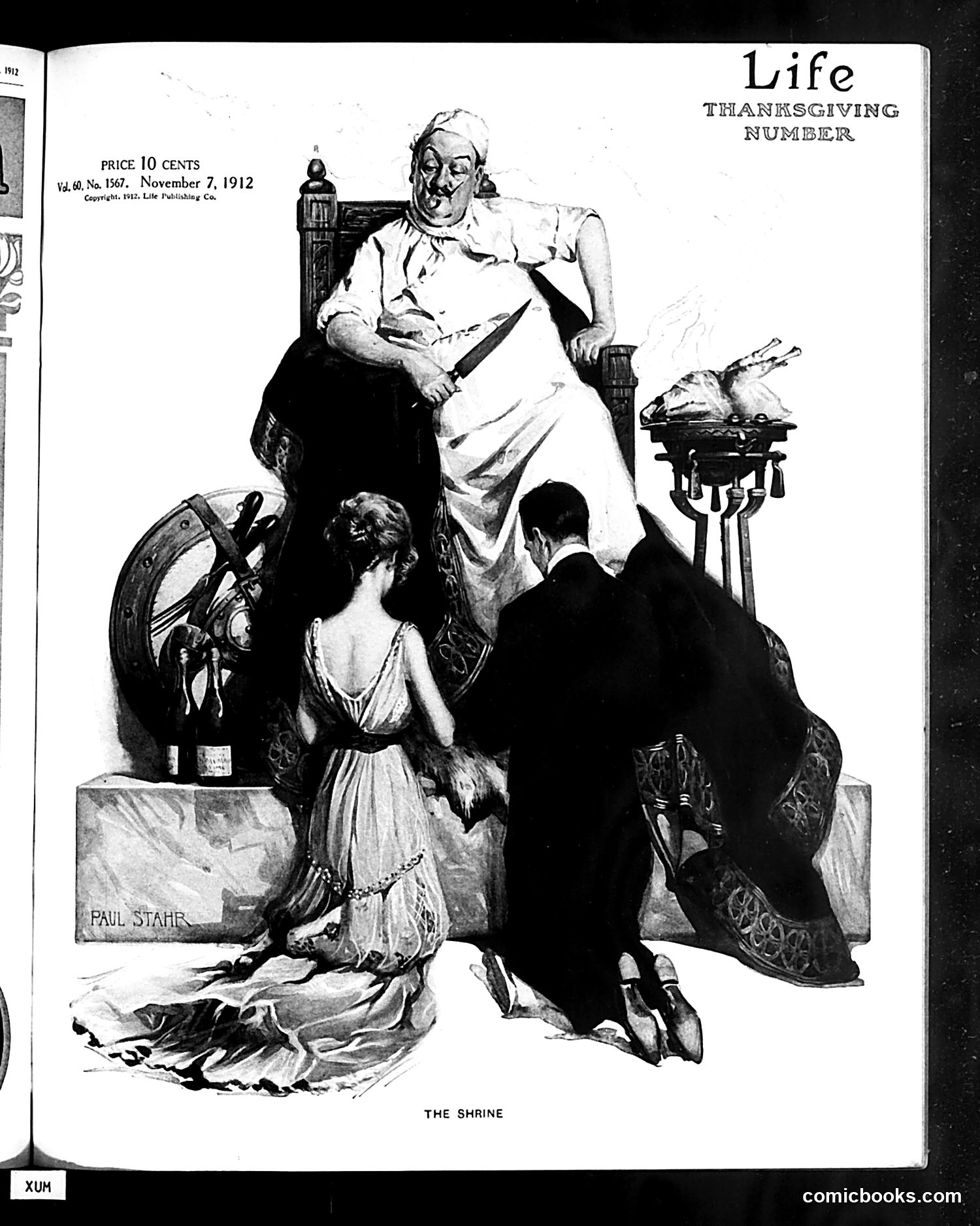
This satirical illustration by Paul Stahr depicts a fat, jovial cook presiding over a shrine where two figures (a woman in classical dress and a man in formal attire) worship before a roasted turkey. The cartoon appears to satirize American Thanksgiving traditions and possibly consumerism or excess around the holiday. The "shrine" framework suggests mockery of how Americans treat the holiday meal—elevating food preparation and consumption to almost religious status. The 1912 date places this during a period when Life magazine frequently critiqued American social customs and materialism. The classical female figure likely represents traditional values or domesticity, while the formal male figure represents modern society, both equally devoted to the culinary centerpiece.
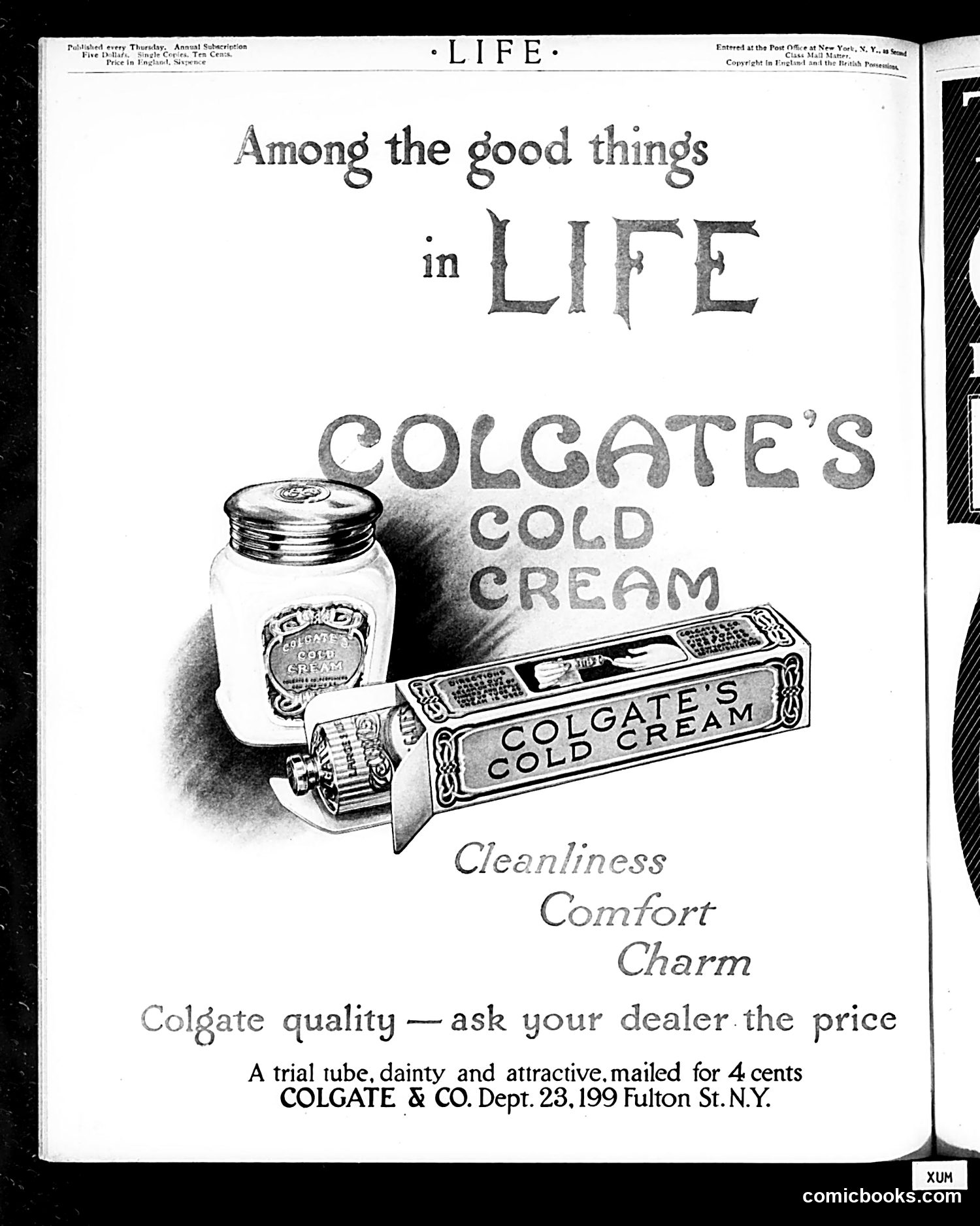
This page is **not a cartoon or satirical content**—it is a **straightforward advertisement** for Colgate's Cold Cream, published in *Life* magazine. The ad features product imagery (a jar and tube of cold cream) and promotes the cosmetic as offering "Cleanliness, Comfort, Charm." The copy emphasizes product quality and offers a trial tube for 4 cents, with ordering details for Colgate & Co.'s New York address. This represents typical early 20th-century advertising, where major brands purchased full-page spreads in popular magazines. There is no satire, political commentary, or caricature present—it is simply a period beauty product advertisement targeting *Life*'s readership.
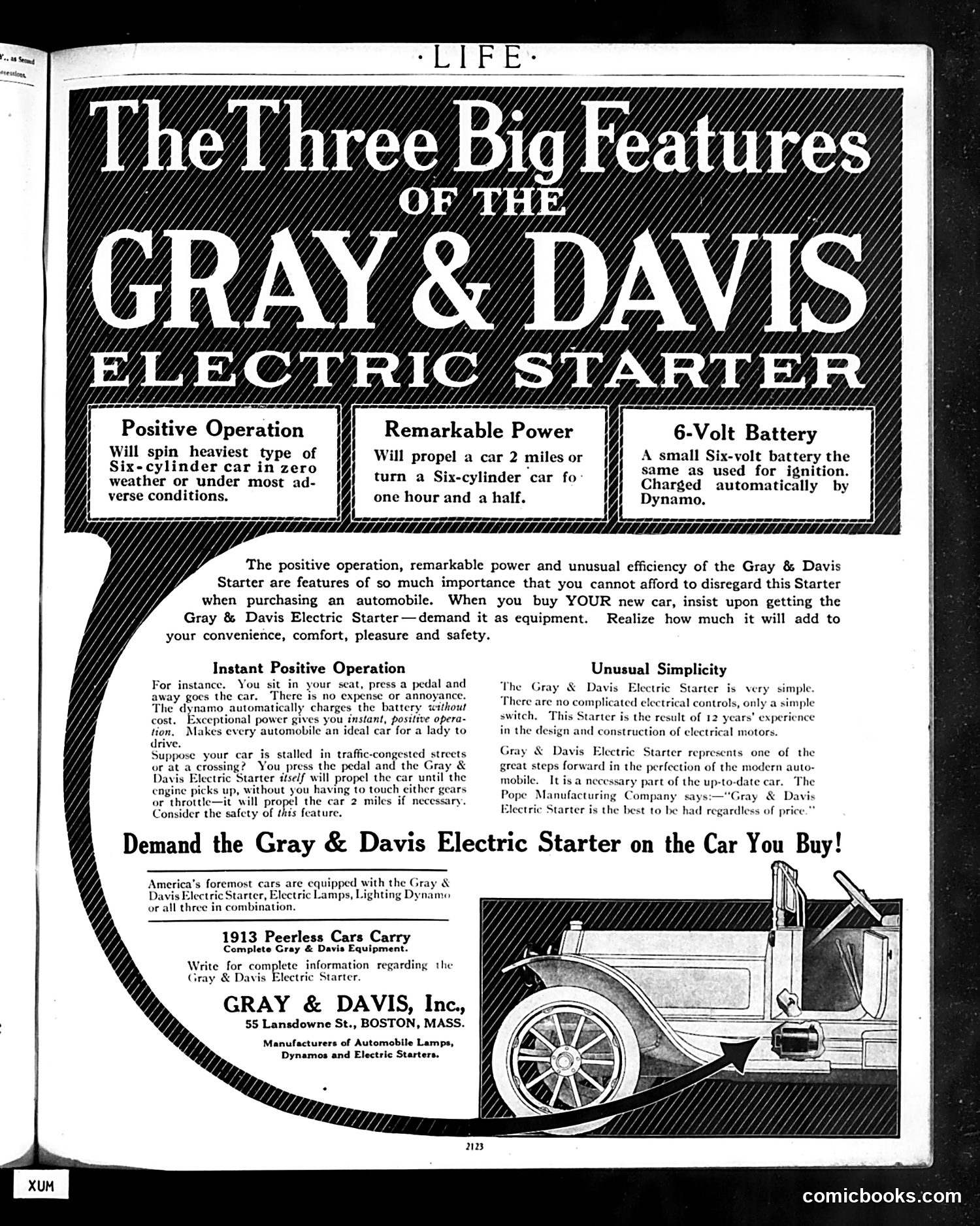
This page is **not a cartoon or satire** — it's a straightforward **advertisement** for the Gray & Davis Electric Starter, published in Life magazine around 1913. The ad promotes an automotive innovation: an electric starter motor that eliminates hand-cranking cars. The "three big features" highlighted are positive operation, remarkable power, and a 6-volt battery system. The appeal emphasizes **convenience and safety** — particularly for women drivers, who found hand-cranking difficult and dangerous. The ad stresses how the electric starter represents modern automotive progress and is becoming standard equipment on "1913 Peerless Cars." The illustration shows a contemporary automobile with the starter mechanism visible. This is **product advertising**, not political or social satire.
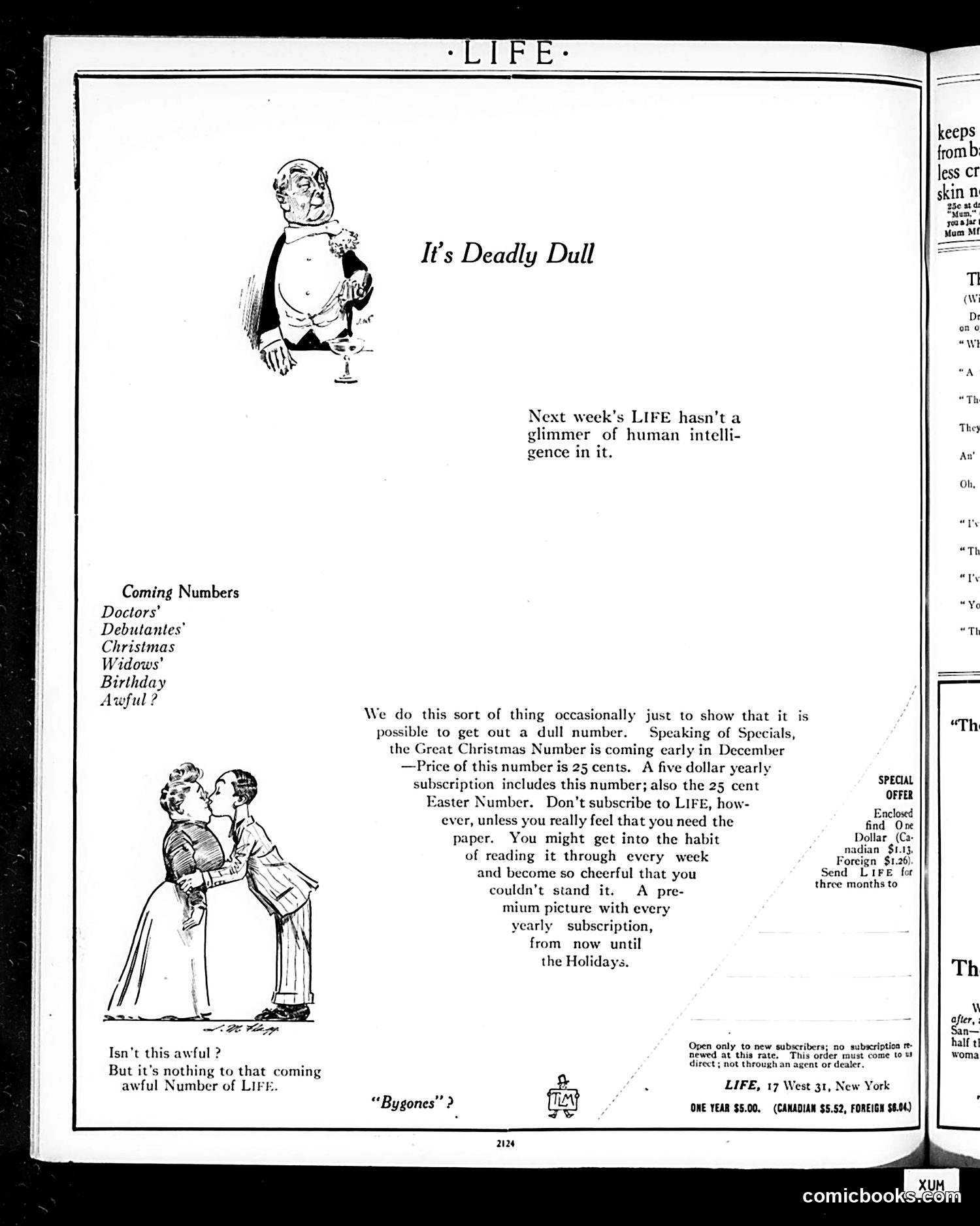
This page announces an upcoming "dull" issue of Life magazine, using self-deprecating humor to promote subscriptions. The top cartoon depicts a well-dressed man holding a cocktail, captioned "It's Deadly Dull," suggesting the forthcoming issue lacks wit or intelligence. Below, another cartoon shows a couple with a child, labeled "Isn't this awful? But it's nothing to that coming awful Number of LIFE"—a tongue-in-cheek admission that next week's issue will be deliberately uninteresting. The page paradoxically uses this negative advertising to market subscriptions and special holiday numbers. The text acknowledges Life occasionally produces intentionally dull issues to prove it's *possible*, while promoting their Christmas "Great Christmas Number" at 25 cents. This is playful, ironic marketing that treats the magazine's occasional mediocrity as entertainment itself.
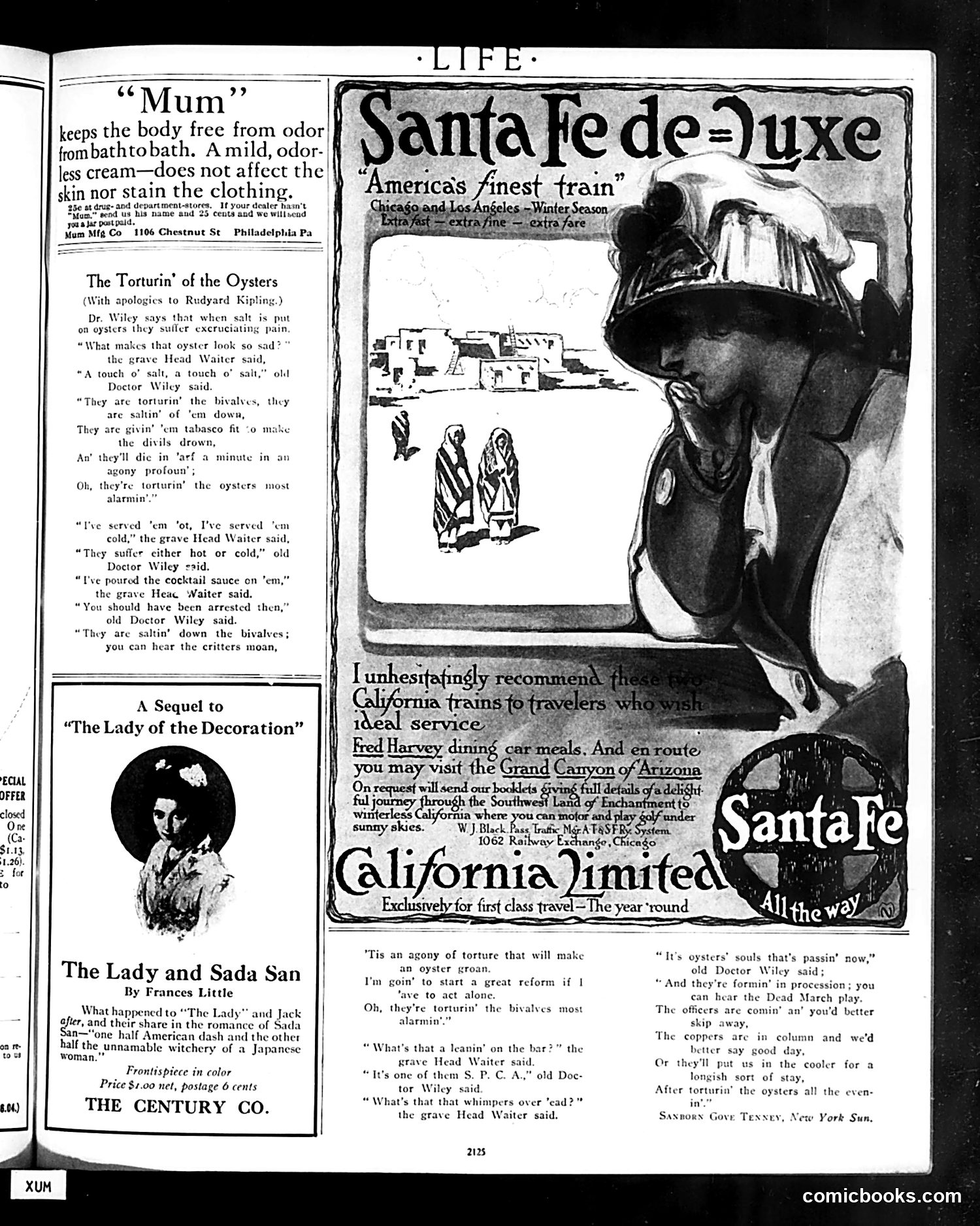
This page is primarily **advertising and fiction**, not political satire. The dominant content is a large advertisement for the "Santa Fe de Luxe" train, promoting first-class travel between Chicago and Los Angeles with dining car service and Grand Canyon visits. Below that is prose fiction: "The Torturin' of the Oysters" (a humorous dialogue between a doctor and head waiter about oysters' suffering when salt is applied) and advertisement for "The Lady and Sada San," a serialized story by Frances Little published by The Century Co. The oyster piece uses absurdist humor—anthropomorphizing shellfish discussing their own demise—but this is literary comedy, not political commentary. The page represents early 20th-century *Life* magazine's mix of entertainment, advertising, and light humor rather than pointed social or political satire.
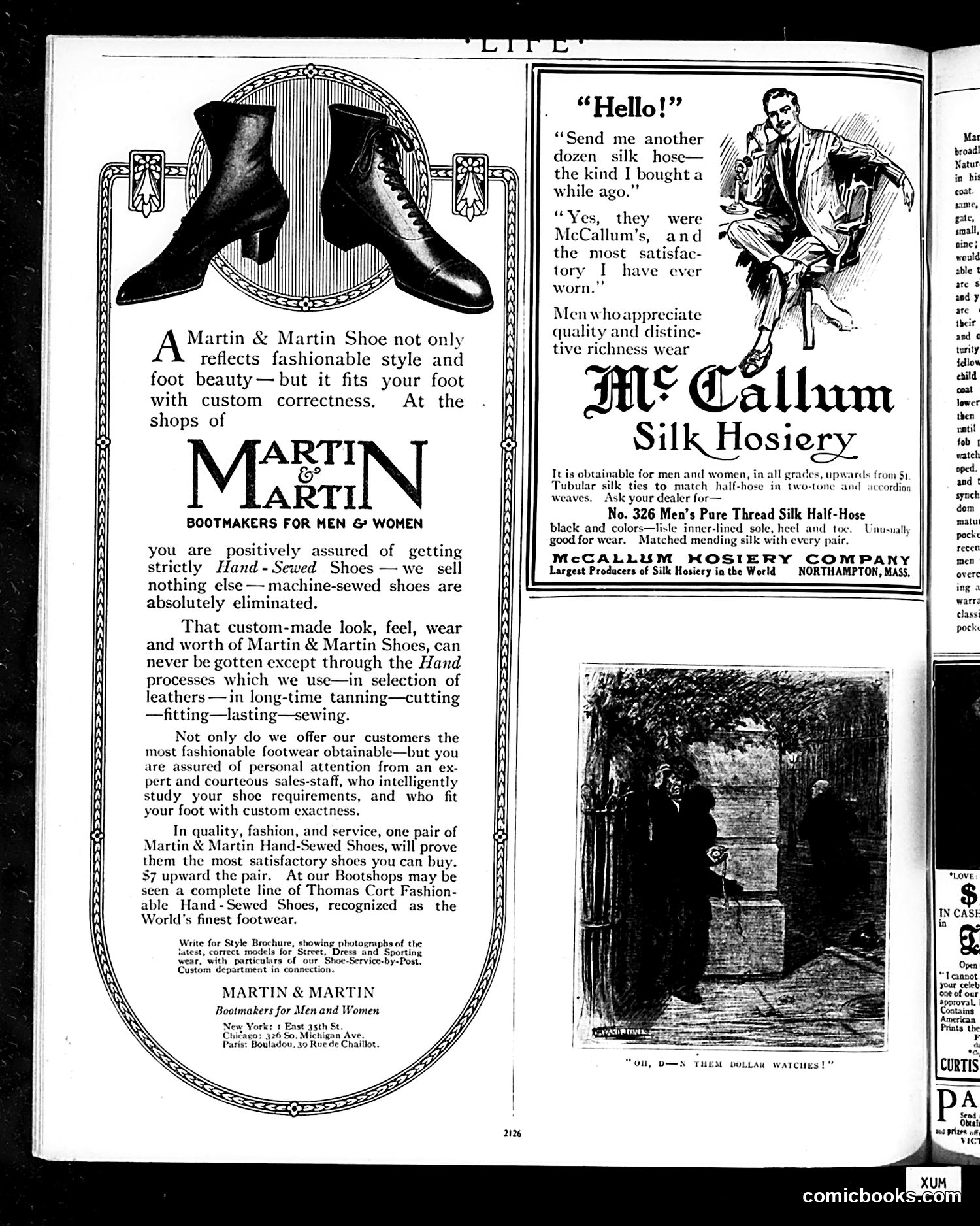
This page is primarily **advertising** rather than satire or political commentary. The left advertisement promotes **Martin & Martin hand-sewn shoes** for men and women, emphasizing quality craftsmanship and custom fit. The copy stresses that their shoes are exclusively hand-sewn (not machine-made), with prices starting at $7 upward. The right advertisement features **McCallum Silk Hosiery**, showing a satisfied customer testimonial about silk hose quality. Below is a small cartoon captioned **"Oh, U—S them dollar watches!"** The image appears darkly printed and unclear, but likely contains a joke about inexpensive American watches, though the specific reference and humor are not discernible from this reproduction quality.
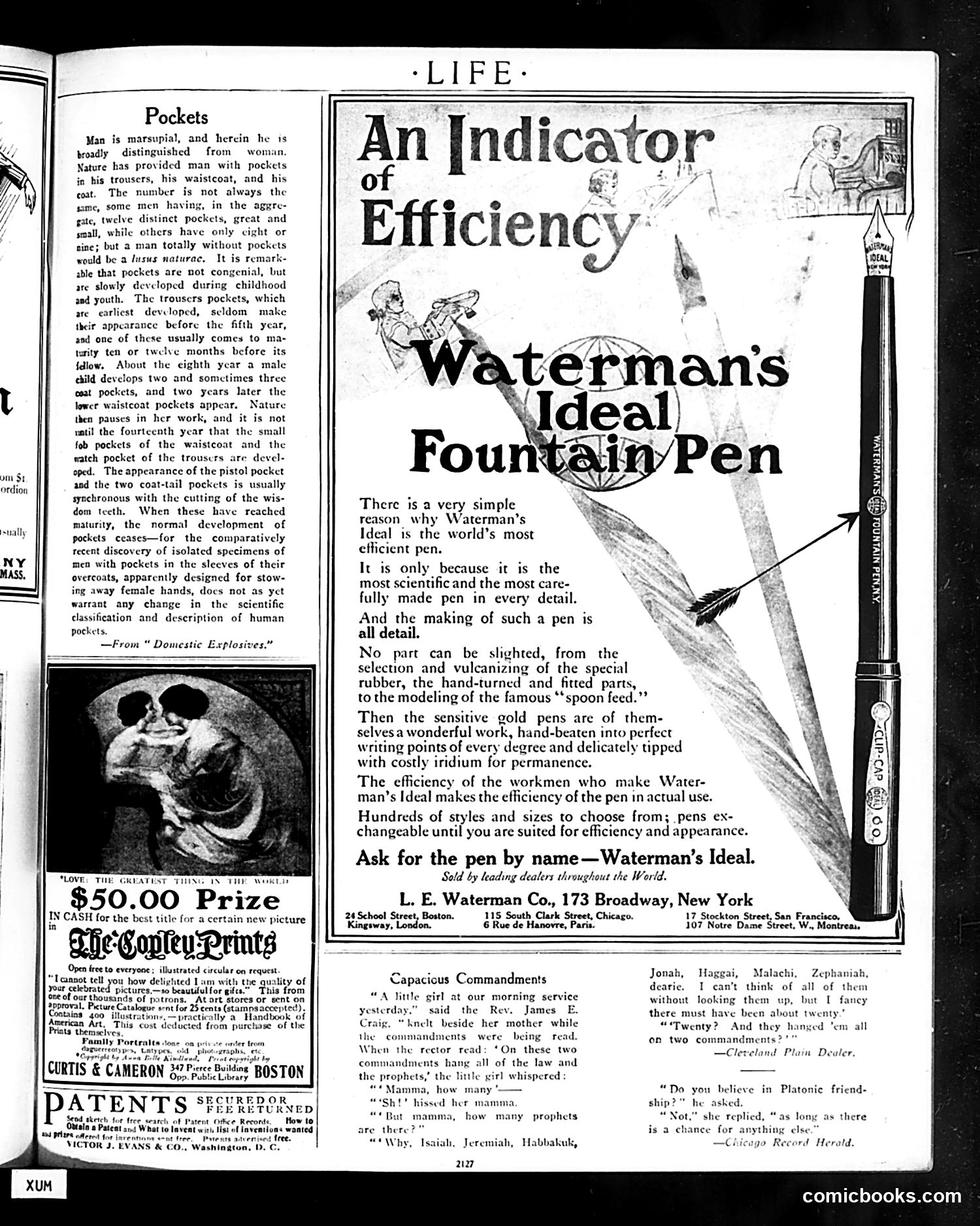
This page is primarily **advertising**, not satire. The dominant content is a full-page advertisement for **Waterman's Ideal Fountain Pen**, emphasizing its efficiency and quality craftsmanship. The ad features illustrations of the pen and promotes its availability worldwide. The left column contains a brief factual essay titled "Pockets," discussing the anatomical and social history of pocket development in clothing—drawn from a source called "Domestic Explosives." Below that is a small contest advertisement for "Life Contest Prints" offering a $50 prize. The bottom section includes unrelated content about biblical commandments and patent information. There is **no political cartoon or satire** on this page—it's a standard magazine layout mixing editorial content with commercial advertisements typical of early-20th-century Life magazine.
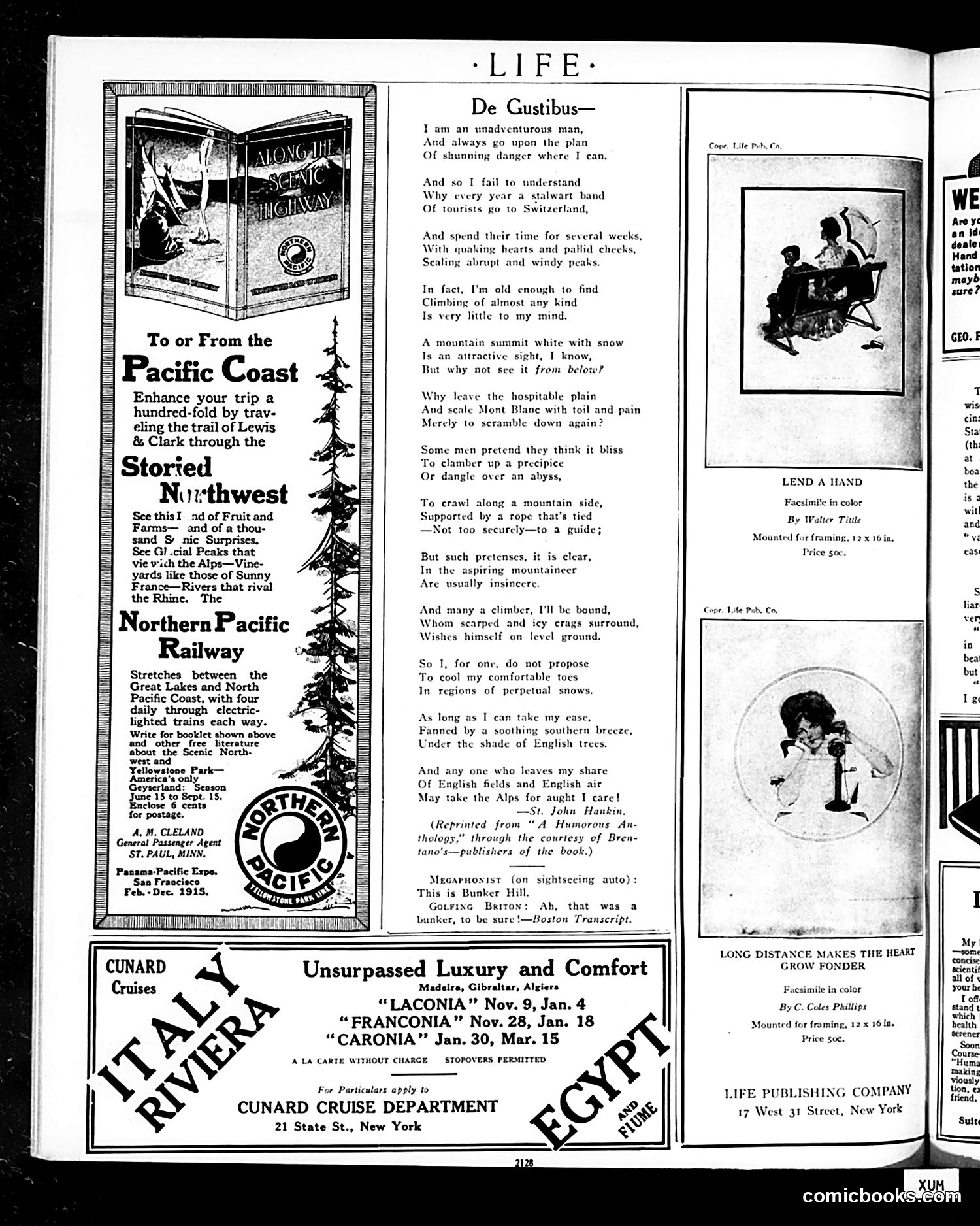
This page is primarily **advertising and light humor**, not political satire. The left side features travel advertisements for the Northern Pacific Railway (promoting scenic Pacific Northwest routes) and Cunard cruise lines (luxury voyages to Mediterranean destinations). The center contains a poem titled **"De Gustibus"** (Latin: "About Taste") by St. John Hawkin, satirizing wealthy tourists. The poem mocks adventurous travelers who annually risk mountain climbing and dangerous Alpine expeditions, questioning why they endure such hardship when comfortable English countryside exists. The satire targets the leisure class's fashionable obsession with extreme tourism. The right side shows two framed illustrations with captions "Lend a Hand" and "Long Distance Makes the Heart Grow Fonder"—sentimental genre scenes typical of Life magazine's visual humor. Overall, this is consumer-oriented magazine content mixing travel marketing with gentle social commentary about upper-class tourist culture.
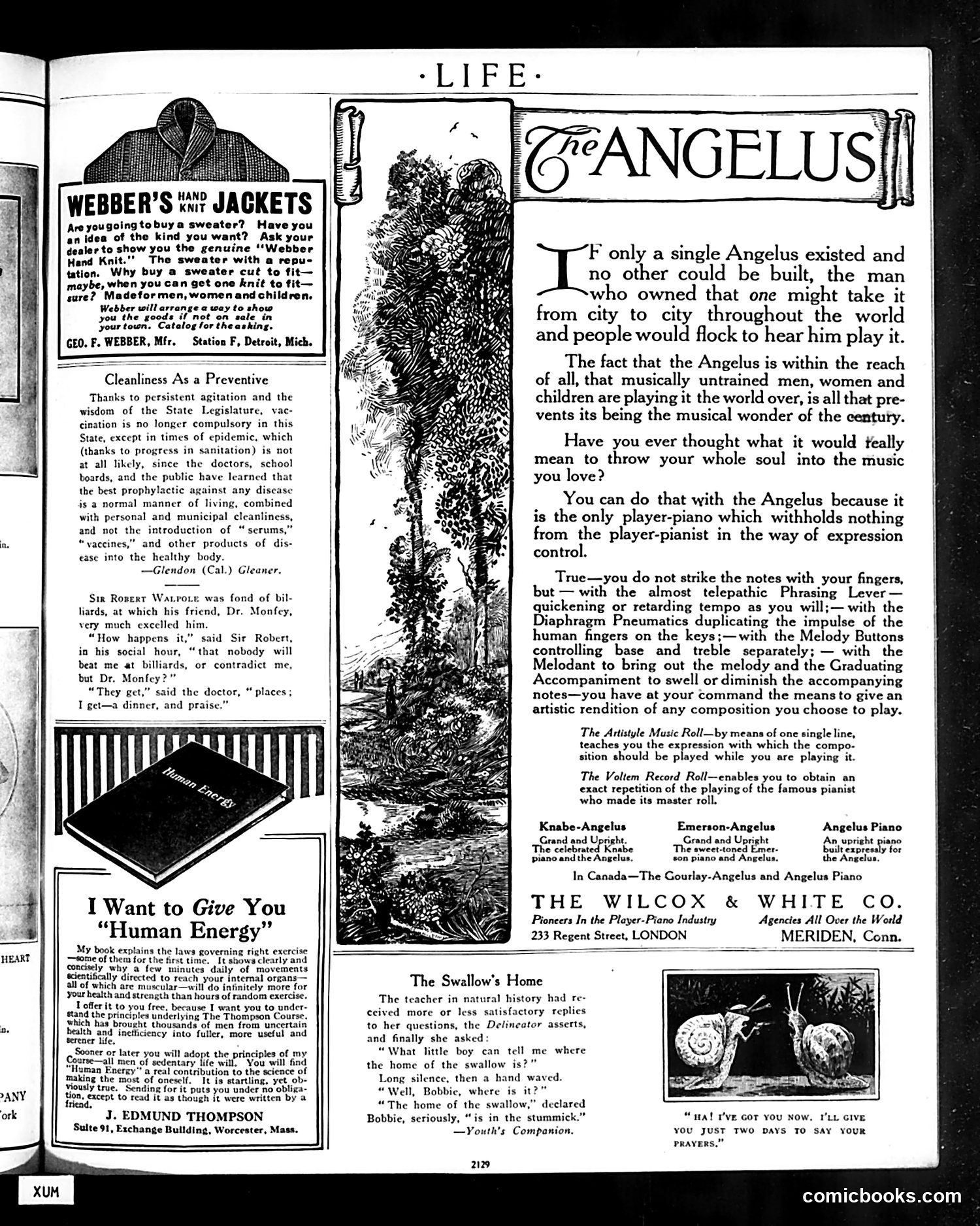
This page is primarily **advertising and light editorial content**, not political satire. The main advertorial piece, "The Angelus," promotes a player piano by the Wilcox & White Company. It uses the famous Millet painting *The Angelus* (shown in the central illustration) as an aspirational reference, arguing that only a single extraordinary piano could allow amateur musicians to "throw your whole soul into the music you love." Side advertisements include Webber's hand-knit jackets, a book on "Human Energy" by J. Edmund Thompson, and a piece about swallows' nests. There is **no political cartoon here**—the page reflects early 20th-century consumer culture marketing, using high art references to sell middle-class Americans luxury goods and self-improvement products.
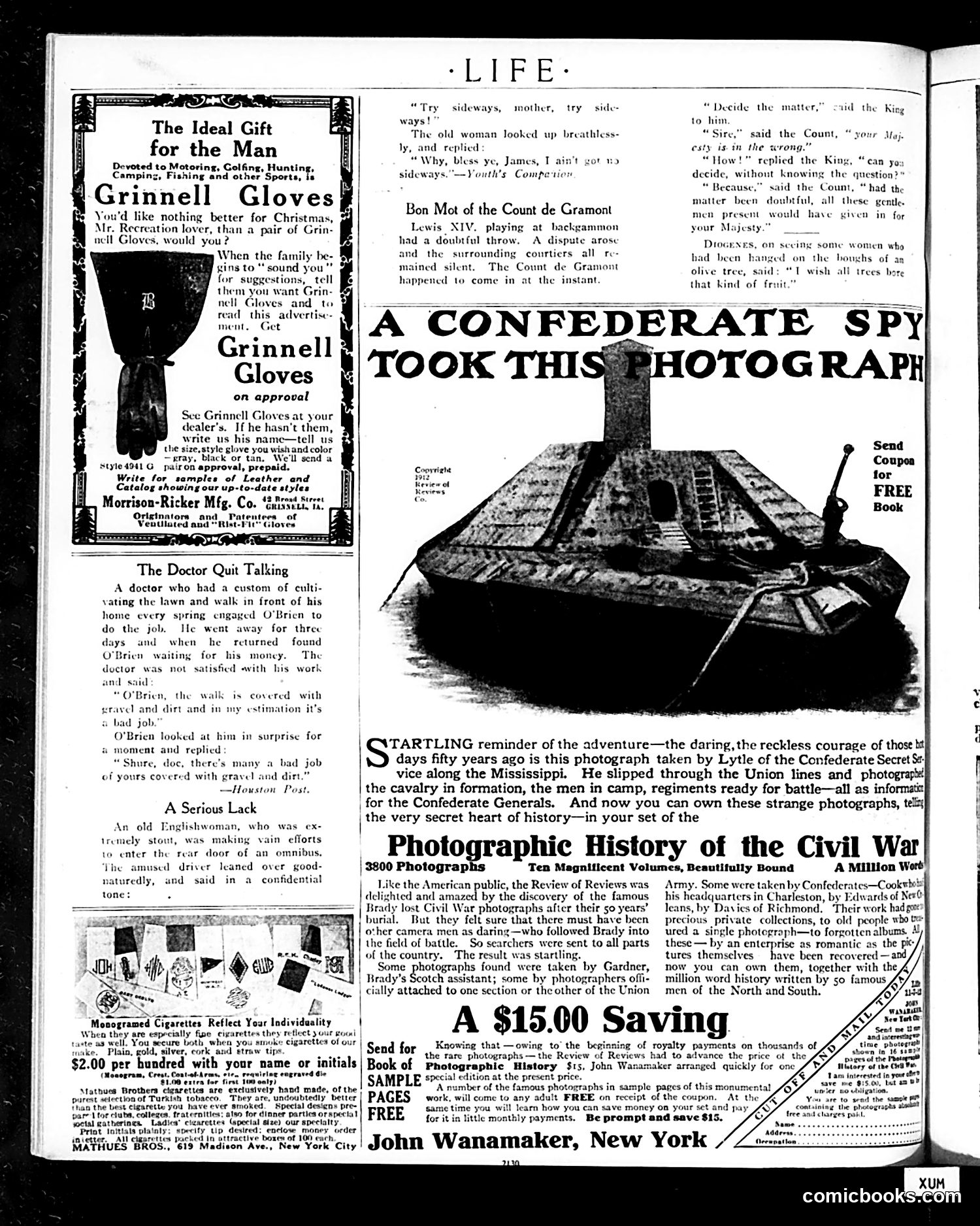
This page is primarily **advertising** rather than satire or political cartoons. The dominant content is a large advertisement for "Photographic History of the Civil War" by John Wanamaker, featuring a photograph allegedly taken by a Confederate spy during the war. The ad emphasizes the historical significance of Civil War photography and offers a $15,000 "saving" on a 3,500-photograph collection spanning ten volumes. Supporting ads include Grinnell Gloves (marketed as ideal gifts for outdoorsmen), cigarette cards, and small articles titled "The Doctor Quit Talking," "Bon Mot of the Count de Gramaont," and "A Serious Lack." Without visible cartoons or caricatures on this page, there is no political satire to analyze. The content reflects early 20th-century consumer culture and historical nostalgia.
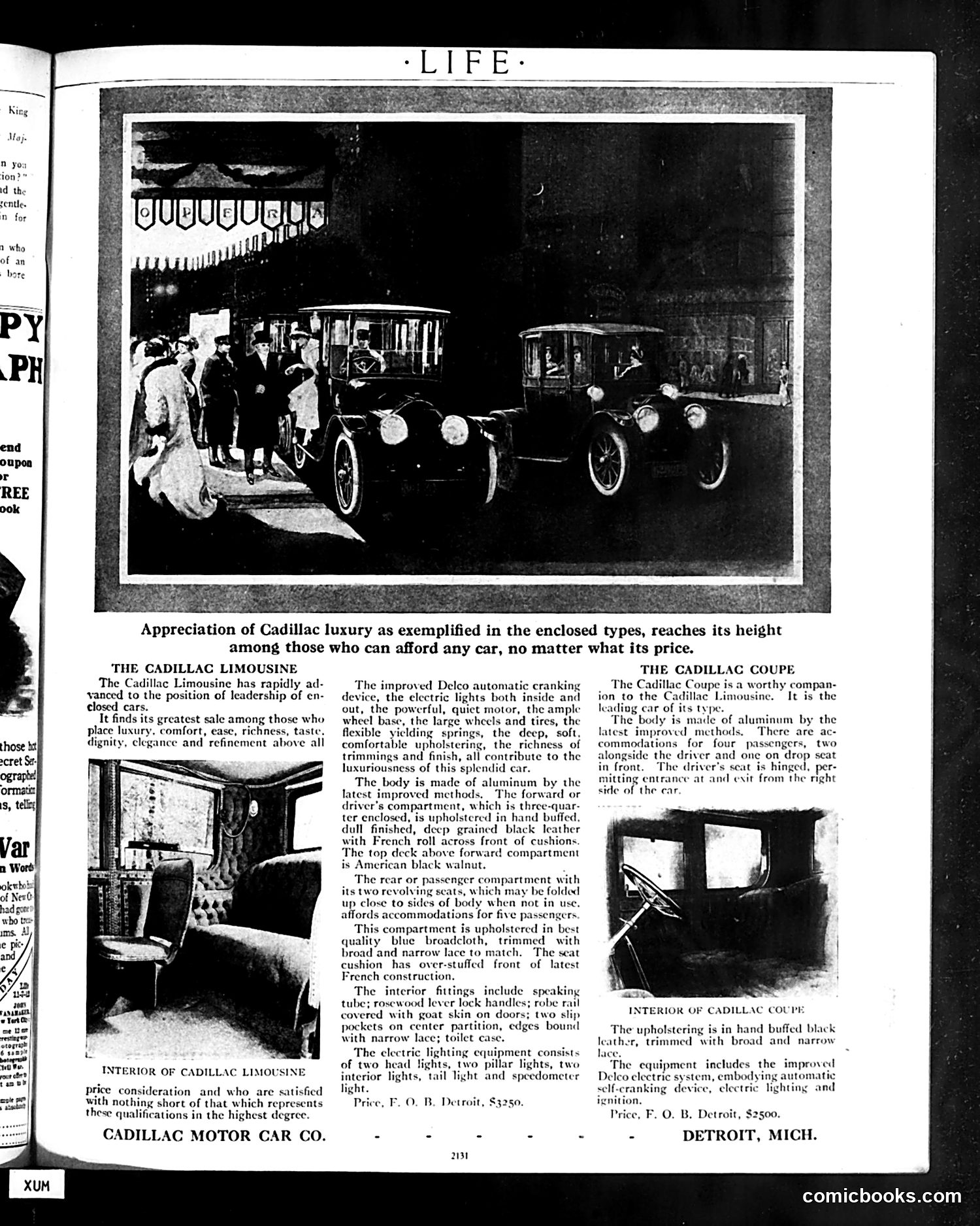
This is a **Cadillac automobile advertisement**, not political satire. The page features two luxury cars and detailed interior photographs showcasing the 1915 Cadillac Limousine and Coupe models. The advertisement emphasizes luxury features—upholstered seating, electric lights, speaking tubes, and other appointments—targeting wealthy buyers. The text stresses that Cadillac represents the pinnacle of automotive refinement, appealing to those seeking "luxury, comfort, ease, richness, taste, dignity, elegance and refinement above all." This reflects the early automotive era when cars were status symbols exclusively for the affluent. The detailed interior photography was a sales technique meant to justify the premium pricing to potential buyers in this wealthy demographic.
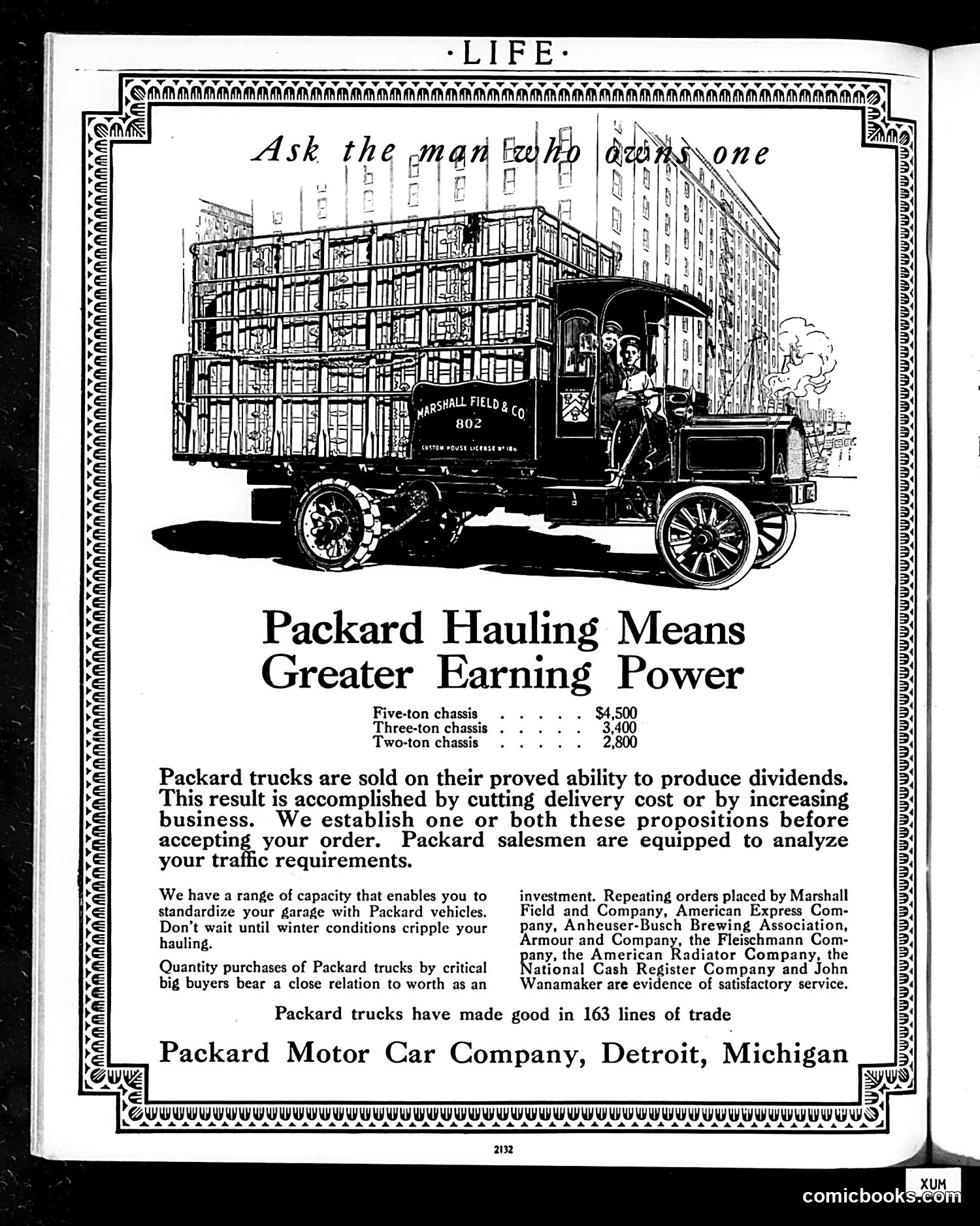
This is a **commercial advertisement**, not political satire or comedy. It's a Packard Motor Car Company truck ad from *Life* magazine promoting commercial hauling vehicles. The ad features an illustration of a delivery truck loaded with cargo passing urban buildings, with the slogan "Ask the man who owns one." The copy emphasizes that Packard trucks generate profits by reducing delivery costs or increasing business volume. It lists three chassis sizes ($4,500–$2,800) and references satisfied corporate clients including Marshall Field & Co., Anheuser-Busch, and Armour. The headline "Packard Hauling Means Greater Earning Power" targets business owners considering commercial vehicles. This represents early automotive marketing positioning trucks as profit-generating business tools rather than mere transportation.
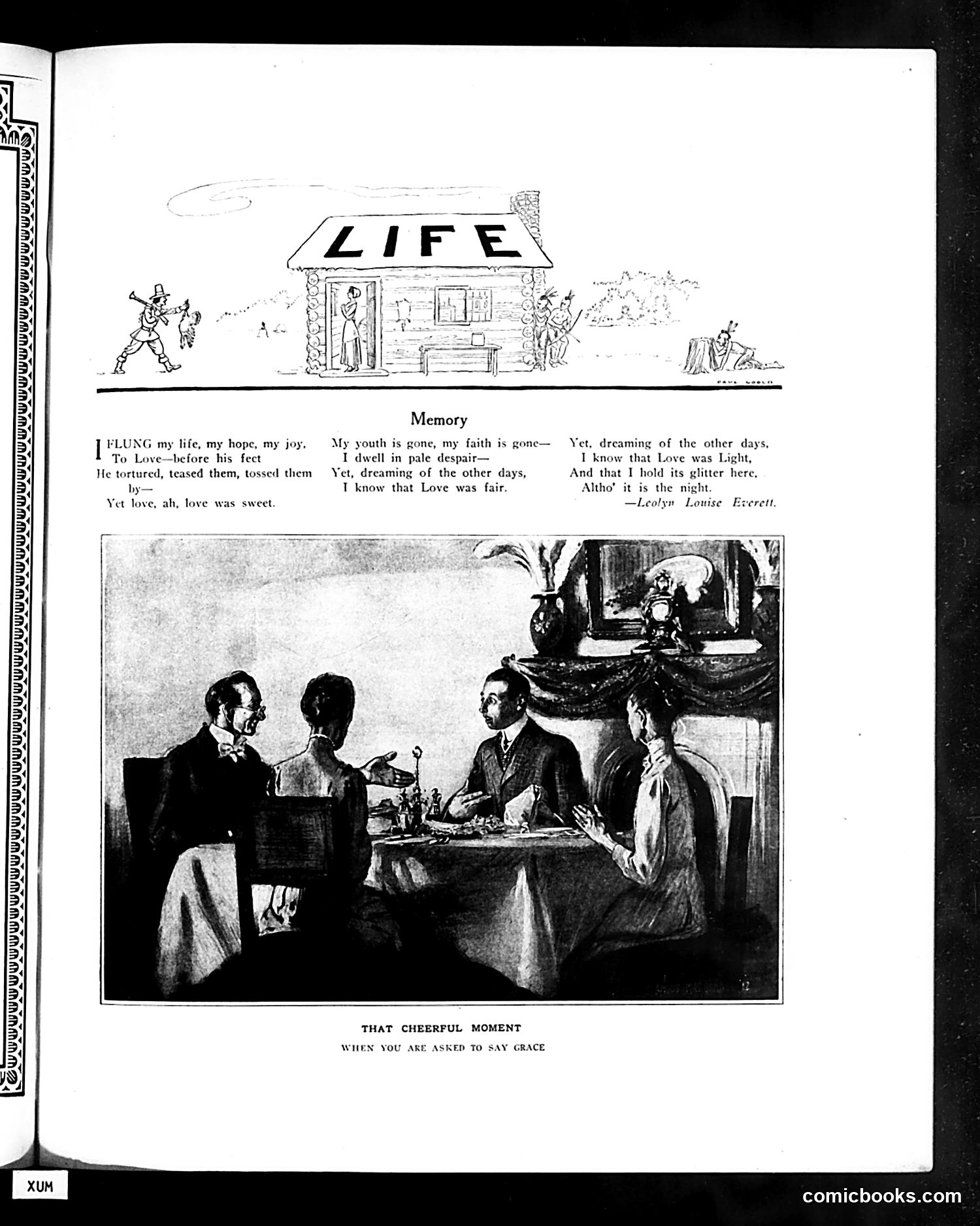
This page features a poem titled "Memory" by Evelyn Louisa Everett, expressing nostalgia for a lost love—a romantic, melancholic piece typical of early 20th-century sentimental literature. The main illustration below, captioned "That Cheerful Moment / When You Are Asked to Say Grace," depicts a dinner party scene showing social awkwardness. Four well-dressed diners sit around a table while one man appears uncomfortable or hesitant—the moment when someone must offer a blessing before the meal. The satire targets the social convention of saying grace, suggesting that this traditionally religious ritual had become an uncomfortable, tension-filled obligation for modern diners, likely reflecting declining religiosity or changing social attitudes toward public prayer.
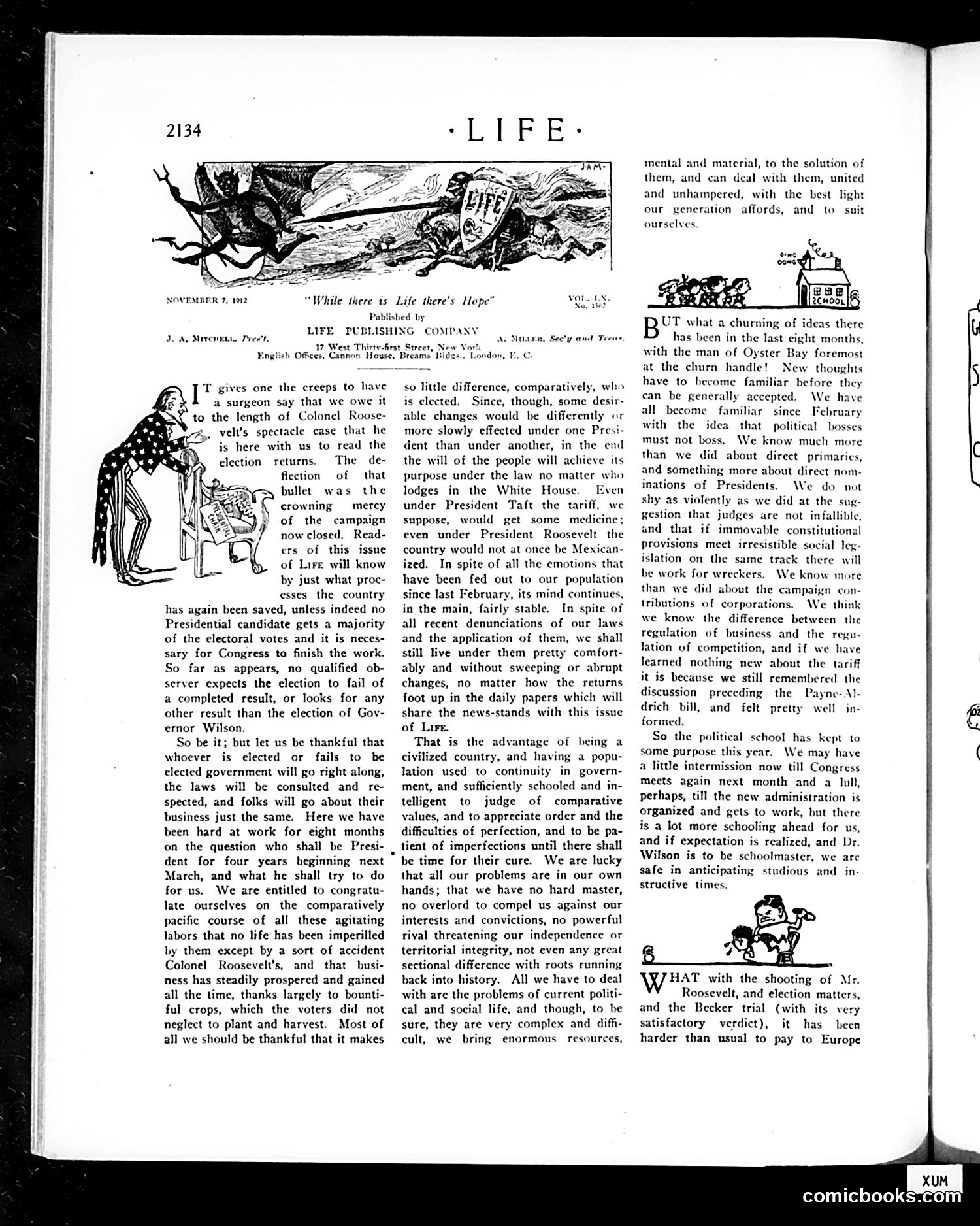
This editorial page discusses the 1912 presidential election, referencing candidates and recent political events. The main illustrated cartoon (upper left) shows a figure in patterned clothing appearing distressed or animated, though the specific identity isn't entirely clear from the image alone. The text discusses presidential candidates getting electoral majorities, mentions President Taft, Roosevelt, and Congress. It references tariff debates, direct primaries, and judicial appointments as key election issues. A second small cartoon (lower right) depicts figures and mentions "the shooting of Mr. Roosevelt, election matters, and the Hecker trial," suggesting this page addresses 1912's turbulent political climate, including Theodore Roosevelt's famous assassination attempt that October. The overall tone expresses hope for stable governance despite political upheaval.
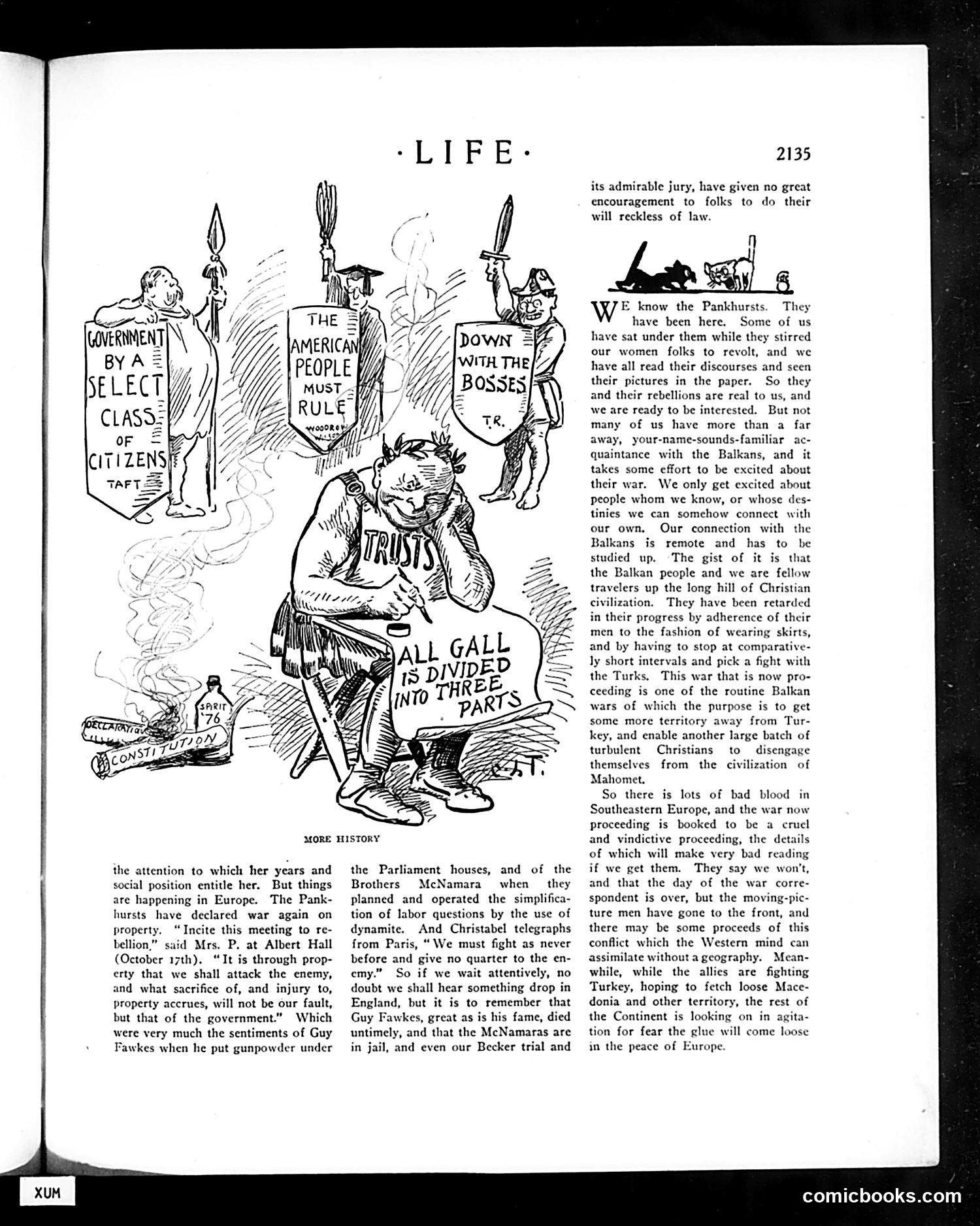
This page satirizes American political movements and international instability circa 1912-1913. **The Main Cartoon** depicts a figure labeled "TRUSTS" sitting atop chaos, with banners reading "Government by a Select Class of Citizens" (Taft), "The American People Must Rule," and "Down with the Bosses." This ridicules competing political factions—likely referencing Theodore Roosevelt's Progressive ("Bull Moose") Party split from Taft's Republicans—all claiming to represent the people while the real power (trusts/corporate interests) remains entrenched. **The Text** criticizes British suffragette Emmeline Pankhurst and her daughters for advocating property destruction (comparing them to Guy Fawkes and the McNamara brothers, who used dynamite). It then pivots to dismissing American interest in the Balkan Wars as geographically remote, while acknowledging the region's Christian "civilization" is being destabilized by routine territorial conflicts with Ottoman Turkey—a condescending, period-typical European perspective on non-Western conflicts.
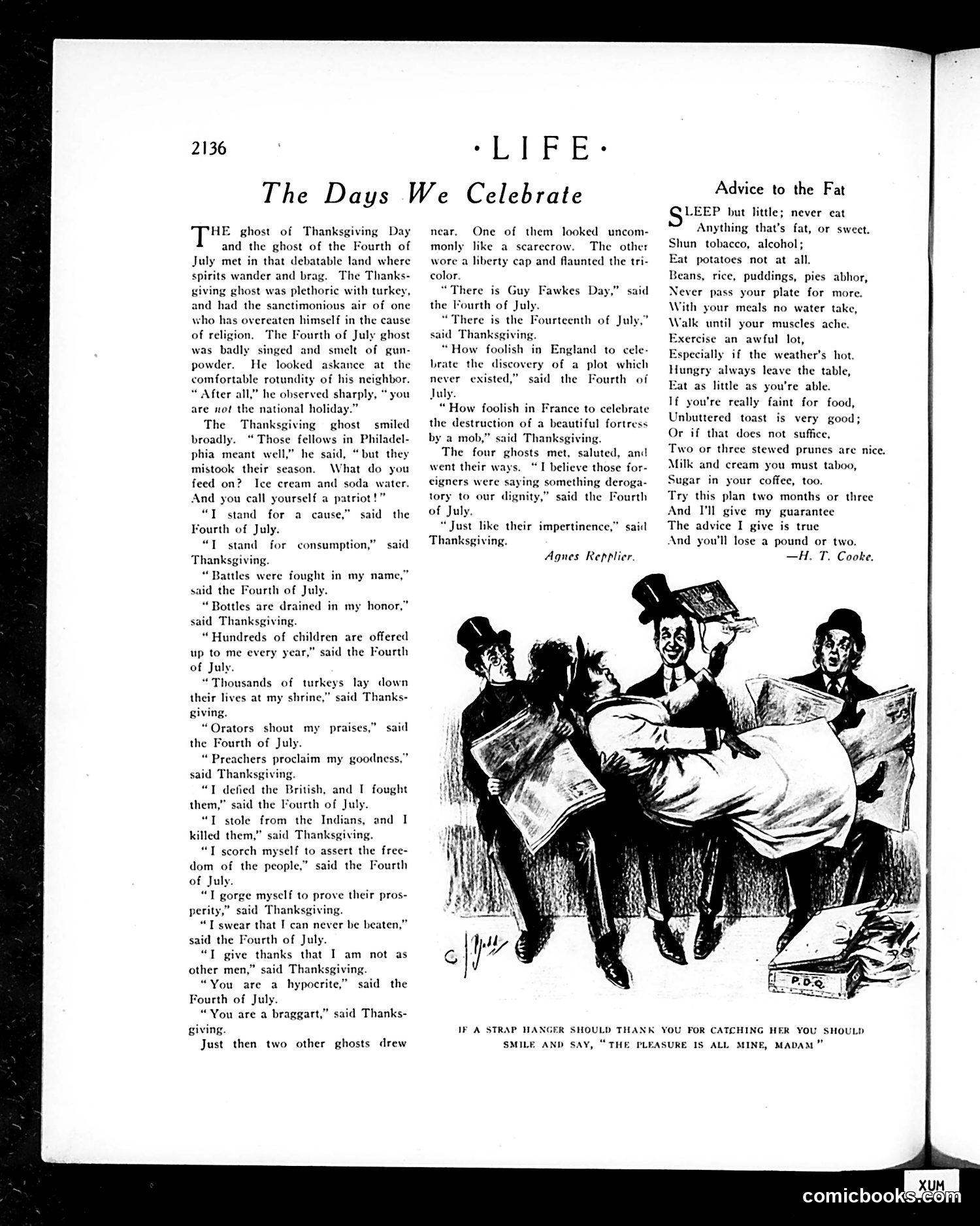
This satirical piece personifies American and foreign national holidays as bickering ghosts. **Thanksgiving** and the **Fourth of July** trade barbed insults—Thanksgiving accuses July of being a violent "braggart," while July calls Thanksgiving a sanctimonious "hypocrite" who gorges herself. They then encounter **Guy Fawkes Day** (Britain) and **Bastille Day** (France), dismissing these as celebrating non-events or mob violence. The satire cuts both ways: Life mocks American self-righteousness while the American holidays themselves dismiss European celebrations as foolish. The humor relies on patriotic holidays being reduced to their least dignified aspects—consumption, destruction, and self-congratulation—exposing the hypocrisy beneath national mythmaking. The sidebar "Advice to the Fat" is unrelated commercial content, typical of Life's mixed editorial format.
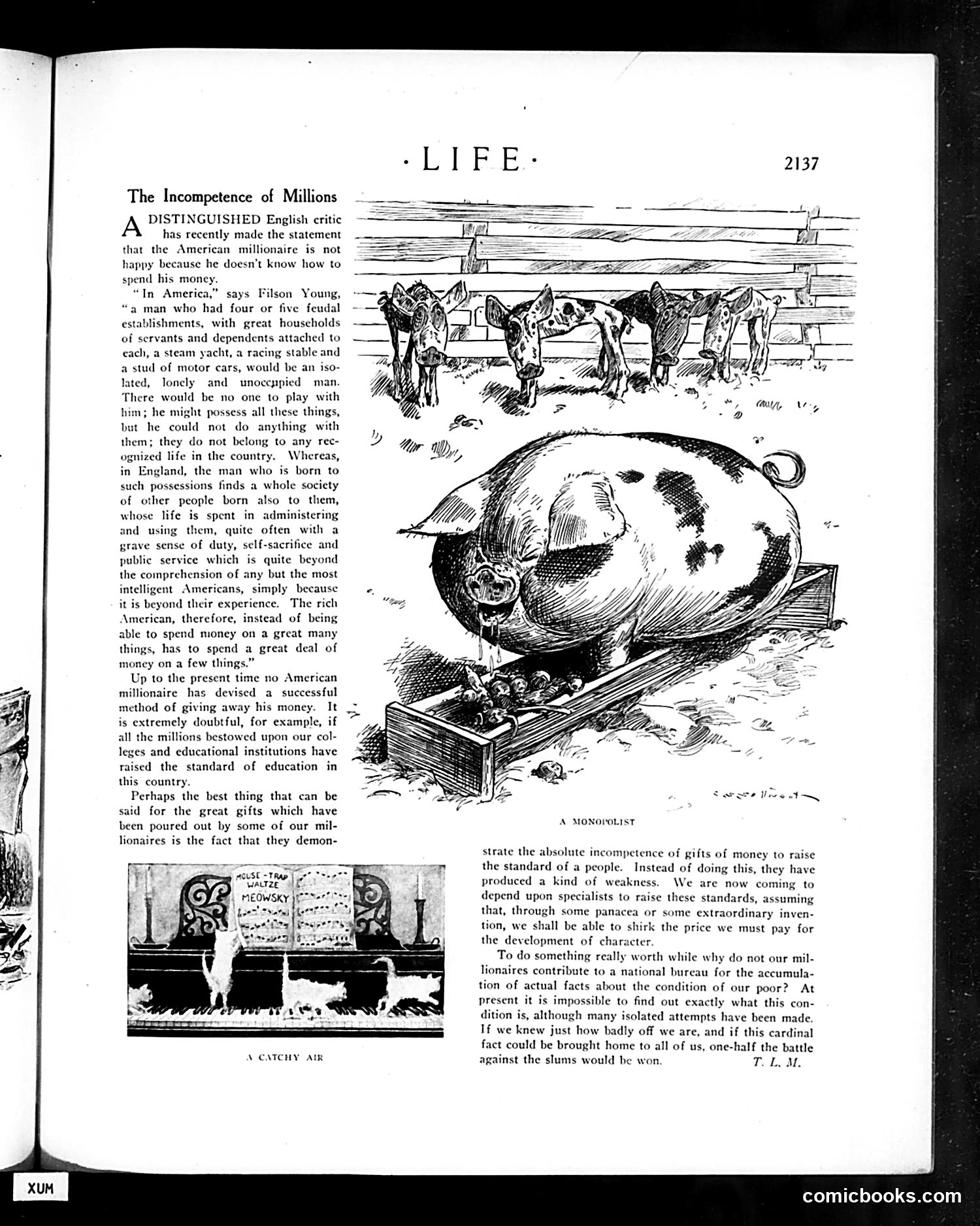
This satirical article critiques American millionaires' inability to spend wealth meaningfully. Drawing on English critic Filson Young's observation, the author argues that American industrialists lack the social infrastructure of European aristocrats—there's no established "society" of dependents and institutions to absorb their spending, leaving them isolated and purposeless despite vast wealth. The two cartoons illustrate the theme: "A Monopolist" shows a bloated plutocrat crushing workers beneath him, and "A Catchy Air" (bottom left, unclear in detail) appears to comment on superficial culture. The article's main point: American philanthropic donations to colleges haven't improved education because money alone cannot develop character or culture. The author proposes instead that millionaires fund research into poverty conditions—suggesting that knowledge and exposure to the poor's actual suffering would more effectively motivate social reform than charitable giving alone.
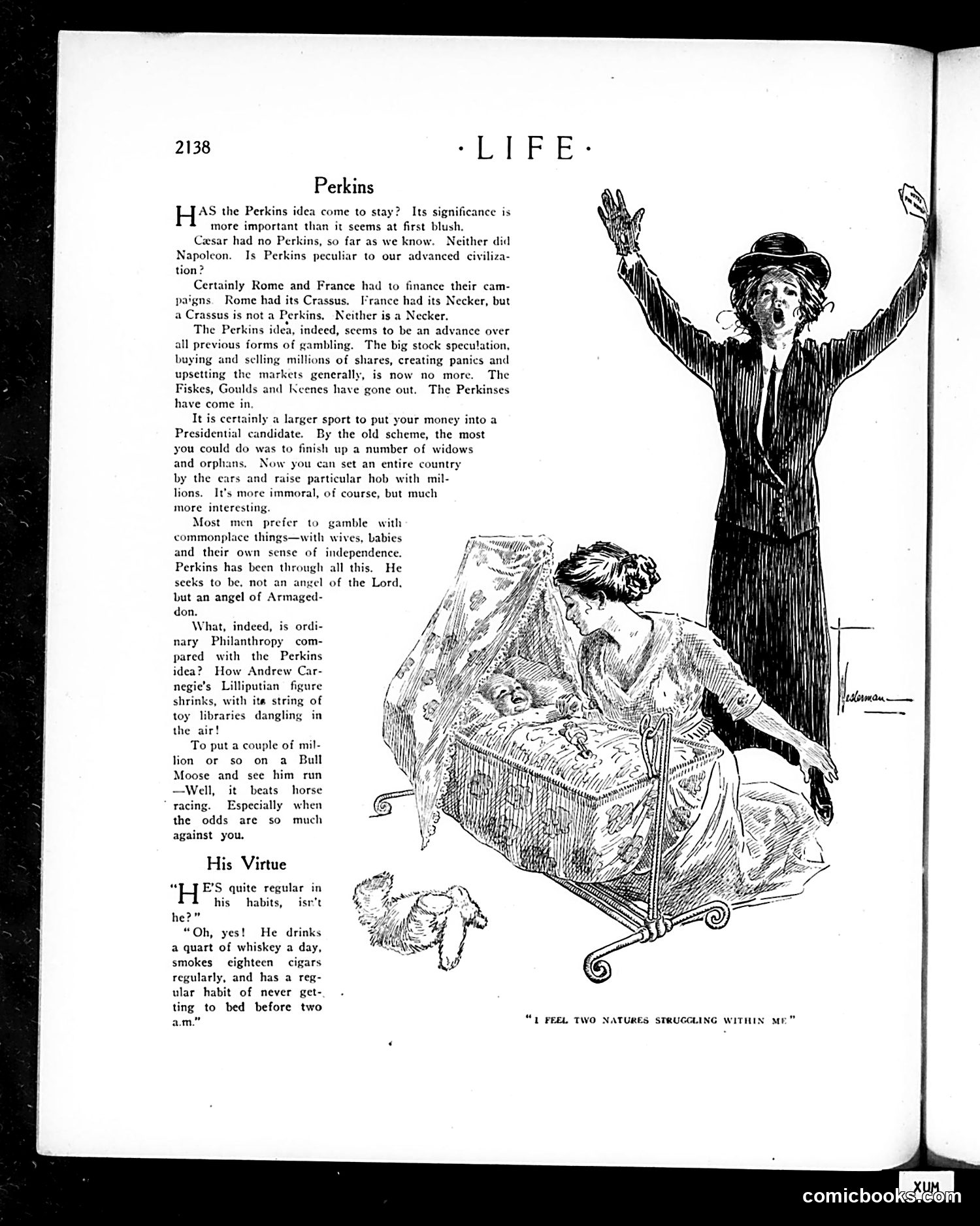
This page satirizes **George Perkins**, a wealthy financier who became a major political donor, likely during the 1912 Progressive ("Bull Moose") campaign. The satire compares Perkins's political spending to gambling—a modern vice replacing older stock-market speculation. The text argues Perkins represents something new: using vast wealth to influence presidential candidates and entire nations, rather than merely manipulating markets or financing traditional philanthropy (like Carnegie's libraries). The illustration shows a man juggling a baby carriage, symbolizing the reckless stakes involved. The section "His Virtue" mockingly portrays Perkins as morally compromised—drinking, smoking excessively, yet claiming virtue through political "philanthropy." The caption "I feel two natures struggling within me" (referencing Jekyll and Hyde) suggests his moral hypocrisy: he presents himself as a public benefactor while engaging in what Life considers corrupt influence-peddling. The satire's point: wealthy individuals bankrolling candidates represents gambling with national destiny.
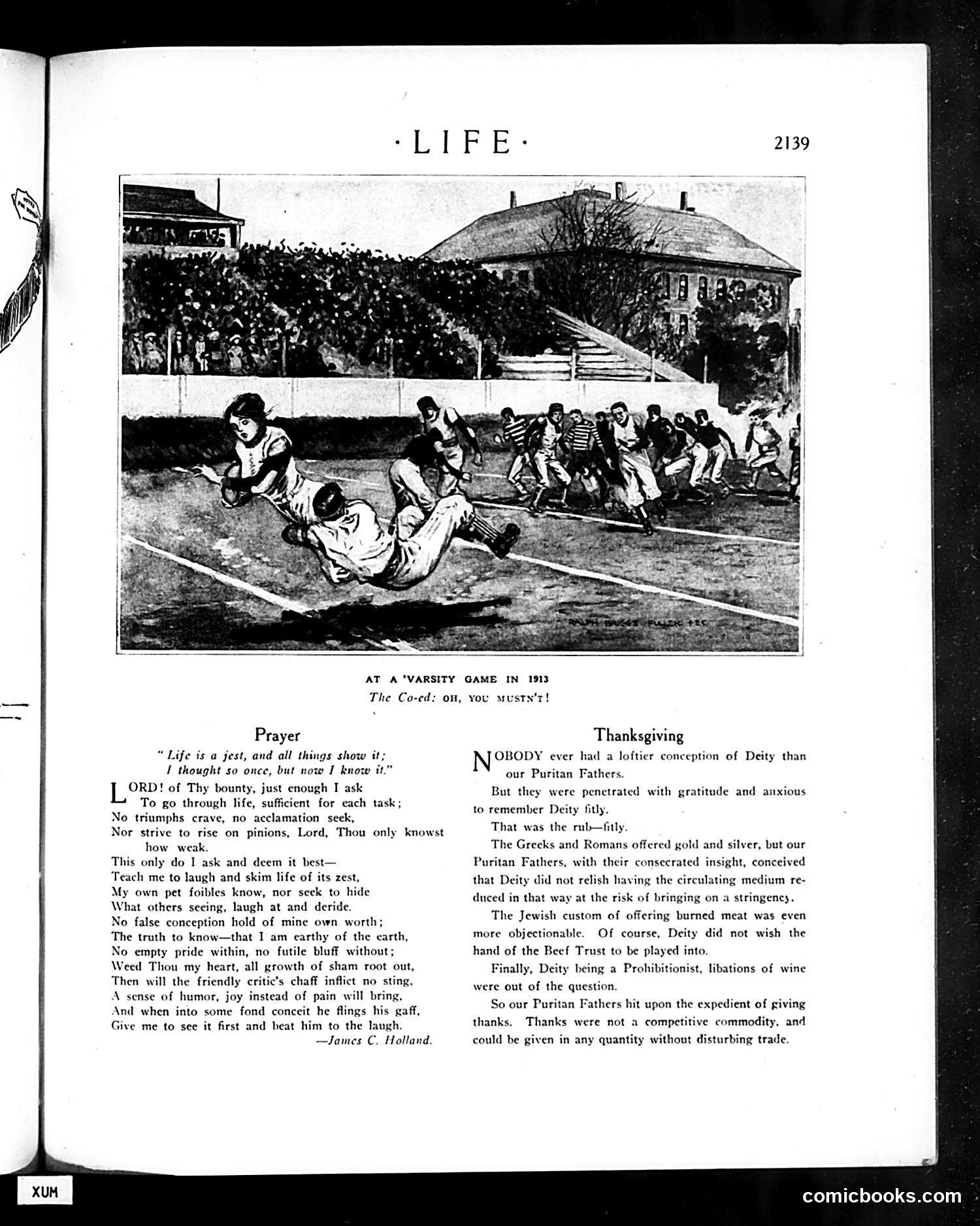
This page contains two distinct pieces of satire: **The Baseball Photograph**: Captioned "At a 'Varsity Game in 1913—The Co-ed: on, you mustn't!" This references the social controversy over women attending college sporting events and their changing role in American society. The co-ed's presence and the implied impropriety of her attendance reflects early 20th-century anxiety about women's independence and participation in public life. **"Thanksgiving" Essay**: This satirizes Puritan religious hypocrisy. The author mockingly suggests that Puritans avoided expensive offerings (gold, meat sacrifices, wine) to God not from piety but to protect economic interests—avoiding currency depletion and the "Beef Trust." The satire implies that Puritan "thanksgiving" was actually a self-interested compromise disguised as religious principle. It's a cynical commentary on how financial concerns masked themselves as moral conviction. Both pieces mock social pretense and institutional contradictions of the era.
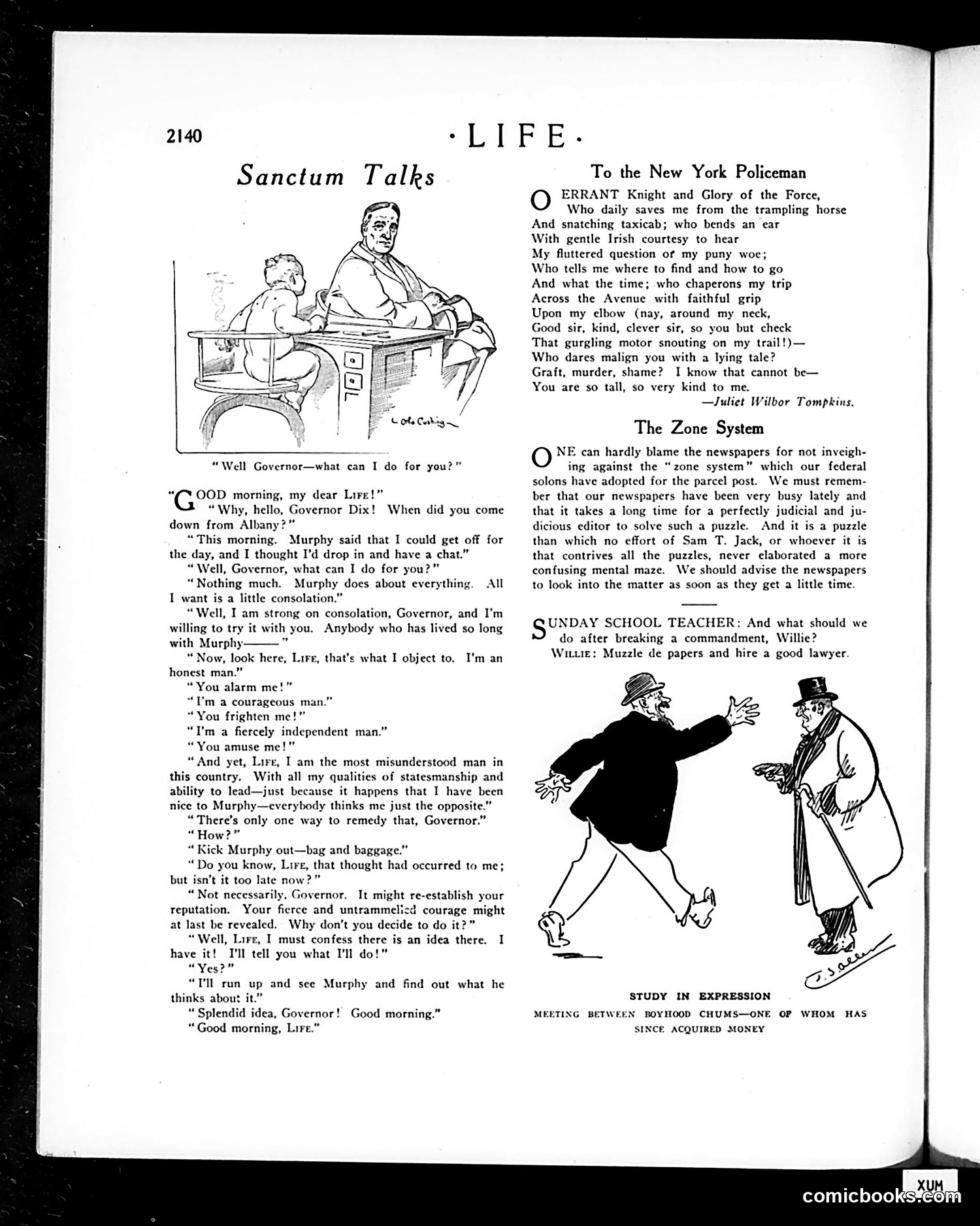
This cartoon mocks New York Governor John A. Dix's political weakness and subordination to political boss **Charles F. Murphy**, the powerful Democratic machine leader. The editor of *Life* magazine interviews the Governor, who claims to be honest, courageous, and independent—yet immediately undermines himself by admitting Murphy "does about everything." When advised to remove Murphy's influence to restore his reputation, the Governor's absurd response is to go ask Murphy what he thinks about it first. The joke: Dix is so completely controlled by Murphy that he cannot even conceive of making a decision without Murphy's approval. His supposed virtues are rendered meaningless by his total political dependence. This satirizes the corruption of machine politics, where nominal leaders are puppets of backroom bosses.
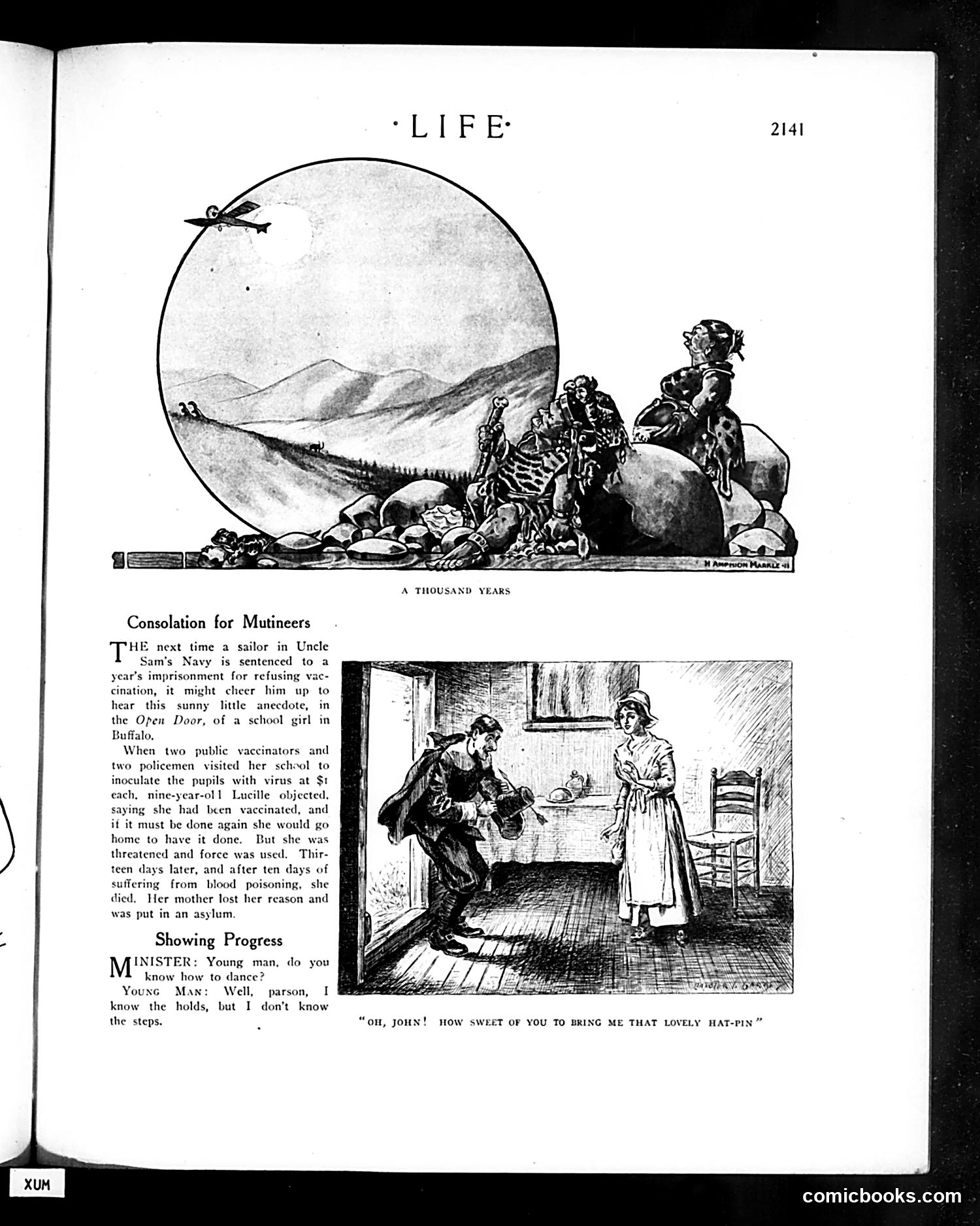
This page satirizes **mandatory vaccination policies** in the U.S. Navy and public health programs circa the early 1900s. The top illustration ("A Thousand Years") depicts a desolate landscape with figures hunched over rocks—likely representing suffering or ruin from compulsory vaccination enforcement. The main article, "Consolation for Mutineers," recounts a tragic true story: a 9-year-old girl named Lucille in Buffalo died from blood poisoning after forced vaccination at school despite her mother's objection. The piece sarcastically frames this as "consolation" for sailors imprisoned for refusing mandatory inoculation, implying the Navy's punishment is unjustly severe. The bottom item, "Showing Progress," is an unrelated joke about a young man claiming ignorance of dance "steps" while knowing the physical "holds"—a double entendre suggesting sexual rather than dancing knowledge. Together, the page critiques aggressive public health mandates as tyrannical and dangerous, reflecting early anti-vaccination sentiment in American satirical journalism.
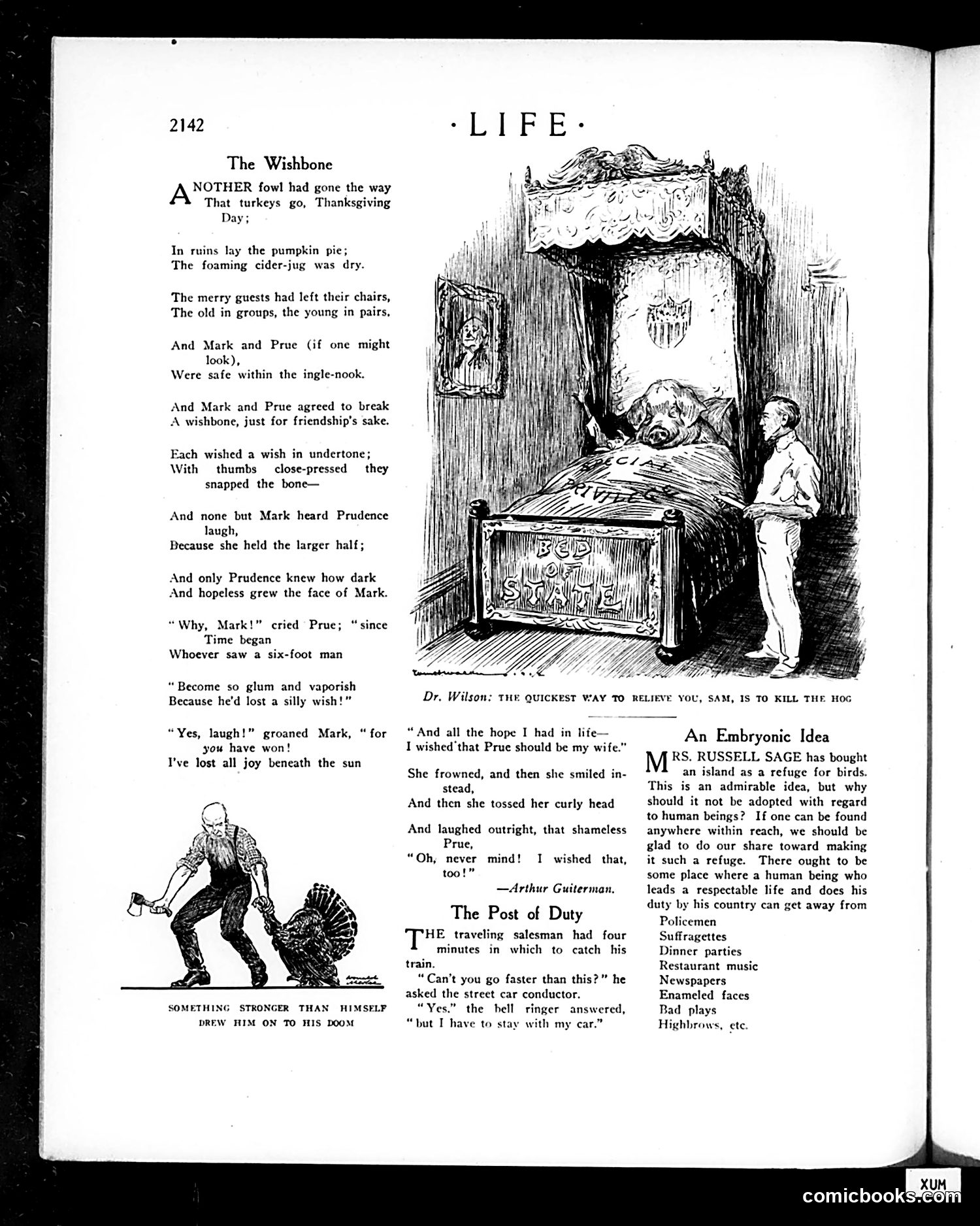
This page contains three satirical pieces typical of early-20th-century Life magazine humor: **"The Wishbone"** (main poem with illustrations): A romantic comedy about two young people, Mark and Prue, who break a turkey wishbone after Thanksgiving dinner. Mark wished Prue would marry him but lost the wish (got the smaller bone piece). He dramatically despairs, but Prue laughs at his overwrought reaction and reveals she *also* wished to marry him—so his wish comes true anyway. The satire mocks male melodrama and courtship anxiety. **"The Post of Duty"** (bottom): A quick joke about a street-car conductor who won't speed up because he must stay with his vehicle—prioritizing duty over customer service. It's gentle mockery of bureaucratic rigidity. **"An Embryonic Idea"**: Social commentary suggesting that if philanthropist Mrs. Russell Sage can create a bird sanctuary, society should create a refuge for respectable citizens to escape modern annoyances: police, suffragettes, formal dinners, newspapers, and "highbrows." It satirizes contemporary urban life as insufferable.
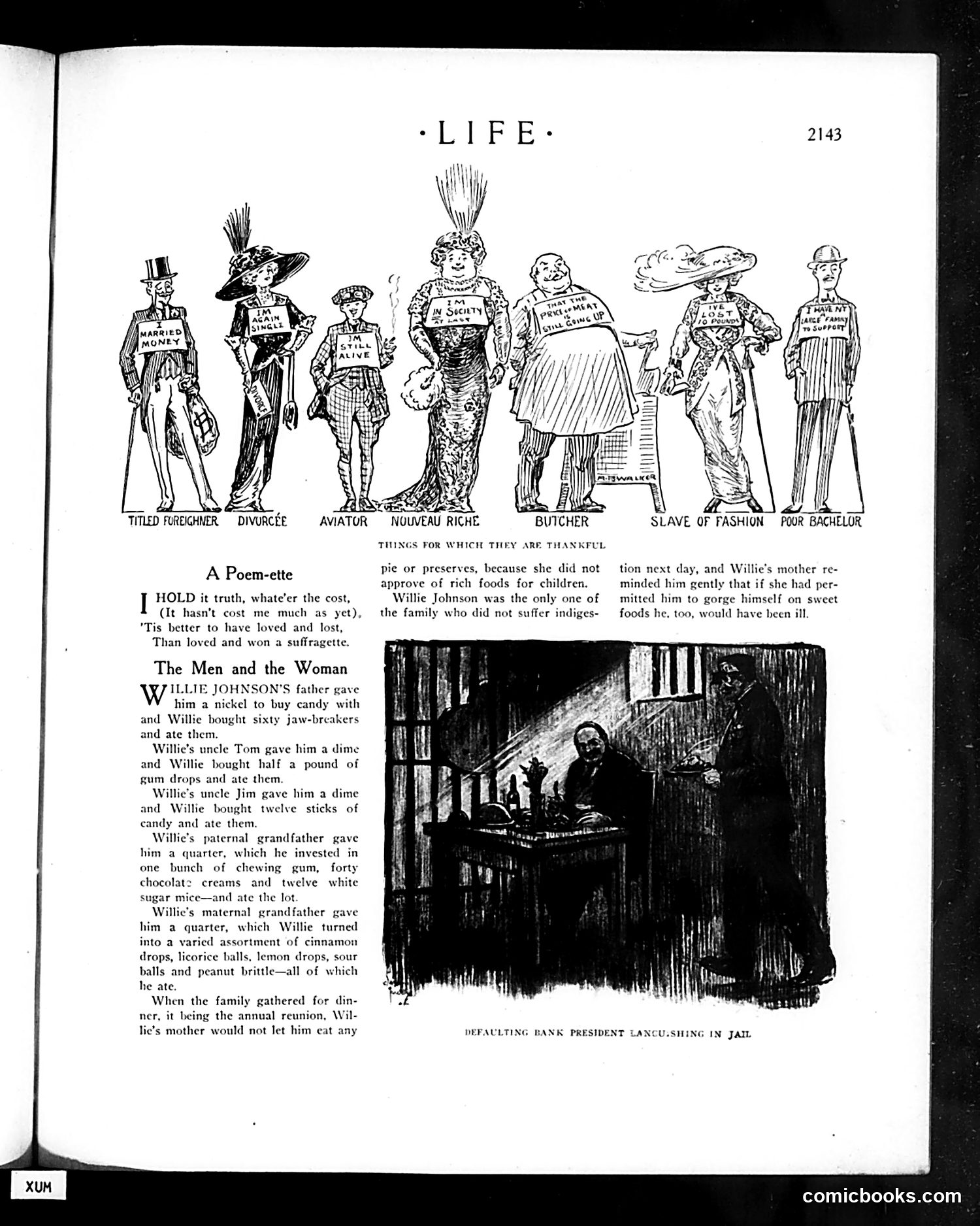
**Top Cartoon:** "Things for Which They Are Thankful" satirizes social types through caricature—a titled forecloser, divorceé, aviator, nouveau riche person, butcher, "slave of fashion," and poor bachelor. Each wears a placard identifying their defining characteristic or scandal, mocking both the wealthy and those obsessed with status symbols and appearance. **Poem:** Anti-suffrage sentiment. The verse jokes that winning a woman's love (especially a suffragette—a women's voting rights activist) is worse than losing it, reflecting opposition to women's suffrage, a major political battle of the early 20th century. **Story & Illustration:** "The Men and the Woman" contrasts how male relatives indulge Willie Johnson with candy while his mother restricts his diet—she alone acts wisely. The illustration shows a bank president in jail, reinforcing that only maternal discipline prevents harm, while unregulated indulgence (or financial recklessness) brings consequences.
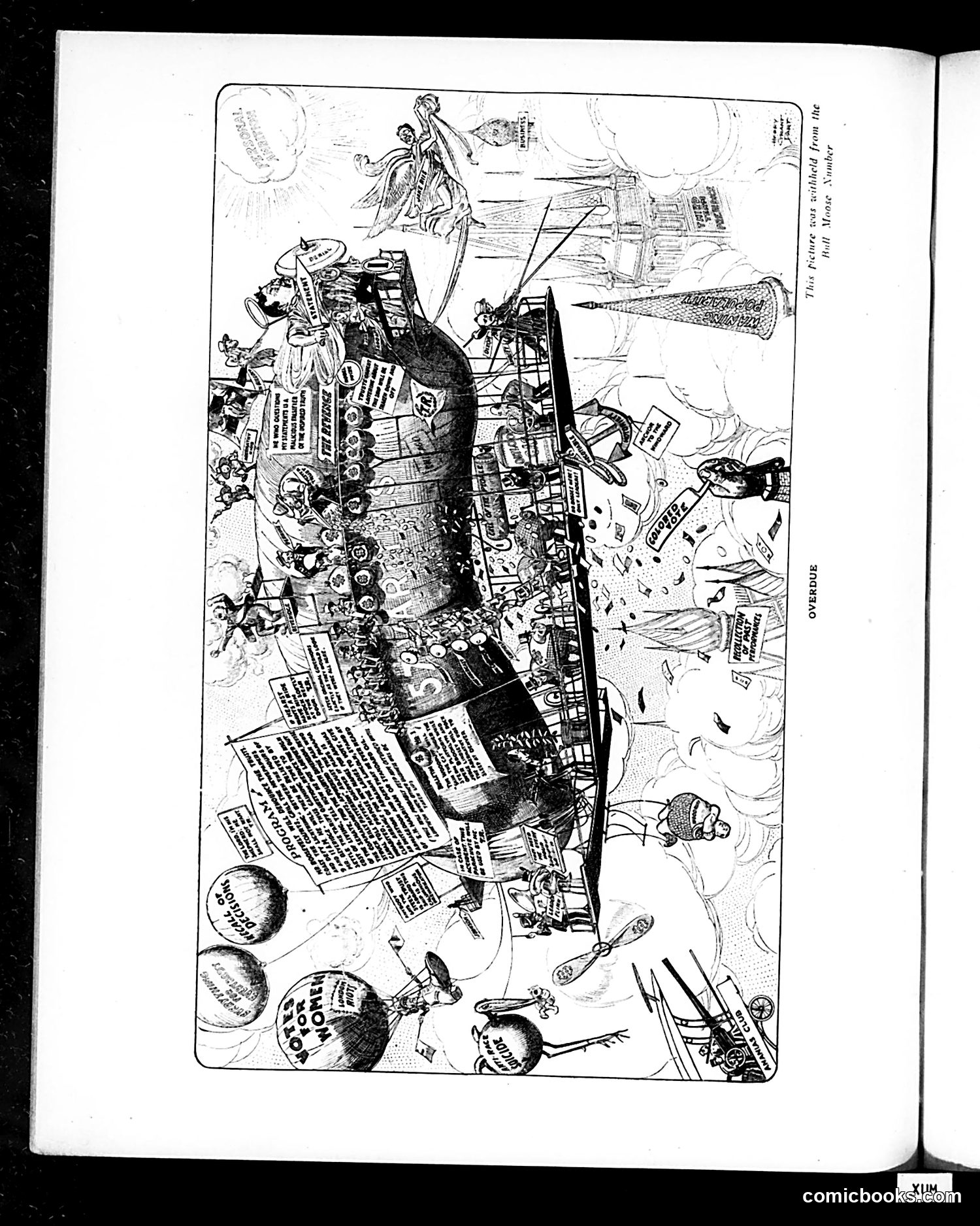
This appears to be a satirical political cartoon titled "OVERDUE" from *Life* magazine. The image is rotated 90 degrees, making precise details difficult to discern, but it depicts what seems to be a large ship or vessel as the central figure, surrounded by various smaller figures, text blocks, and symbolic elements—possibly representing debts, obligations, or administrative matters. The cartoon likely satirizes a government or institutional entity that has failed to meet financial or political obligations. The ship metaphor suggests a large organization struggling under accumulated burdens. The scattered text boxes and figures around it may reference specific unpaid debts or overdue responsibilities. Without clearer text visibility or the specific publication date, I cannot definitively identify which historical event or figure is being critiqued.
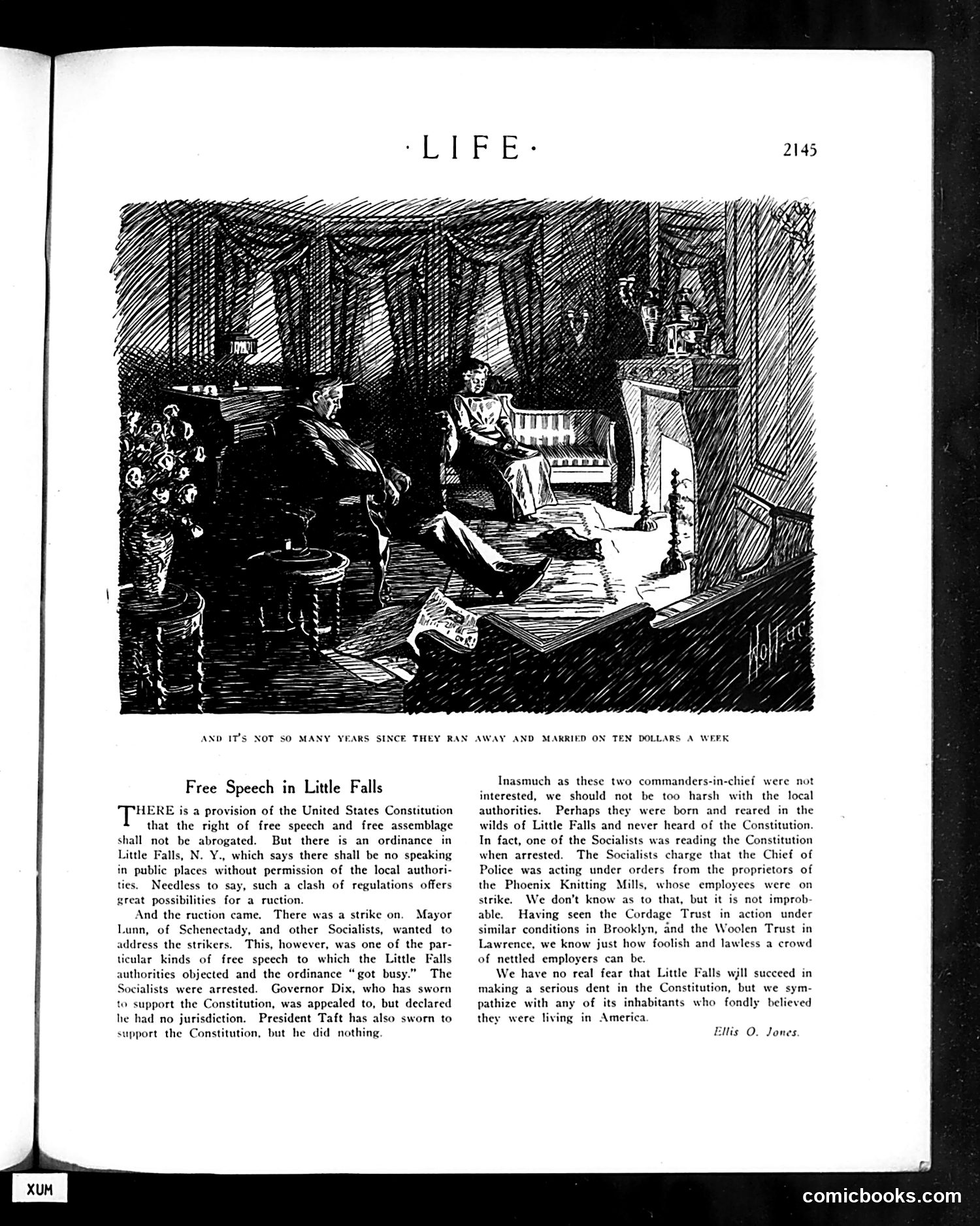
This page critiques the suppression of Socialist speech during a labor strike in Little Falls, New York. The article describes how Mayor Lunn and other Socialists were arrested for violating a local ordinance prohibiting public speaking without permission—directly contradicting the Constitutional right to free speech. The satire targets the hypocrisy of political leaders: Governor Dix and President Taft both swore to uphold the Constitution but took no action. The author suggests local authorities either never learned about the Constitution or were acting under pressure from mill owners to suppress strike-related speech. The cartoon illustrates a domestic scene with the caption "And it's not so many years since they ran away and married on ten dollars a week"—likely contrasting idealistic youth with present political realities, though the specific reference is unclear. The piece satirizes how Constitutional protections prove meaningless when authorities prioritize corporate interests over citizens' rights.
This page announces the winner of Life magazine's humor contest—a competition where readers submitted answers to ten satirical questions. The winning answers, by Maude Bonner of Providence, R.I., exemplify early 20th-century American satirical humor. The jokes target contemporary concerns: women's suffrage ("Should a suffragette marry?"), fashion (the hobble skirt), and gender relations. Several answers mock prominent political figures by name: Theodore Roosevelt (referenced as "Teddy R."), William Taft ("William T."), and Woodrow Wilson. The final answer sarcastically suggests buying "good jokes for Life"—self-promoting humor typical of the magazine. A notable editorial note mentions that some contestants requested answer changes after "the shot fired at Theodore Roosevelt"—referring to the 1912 assassination attempt on Roosevelt during his campaign. The editors declined these requests, maintaining contest integrity. The page demonstrates how Life functioned as a vehicle for topical, often barbed social commentary disguised as lighthearted examination questions.
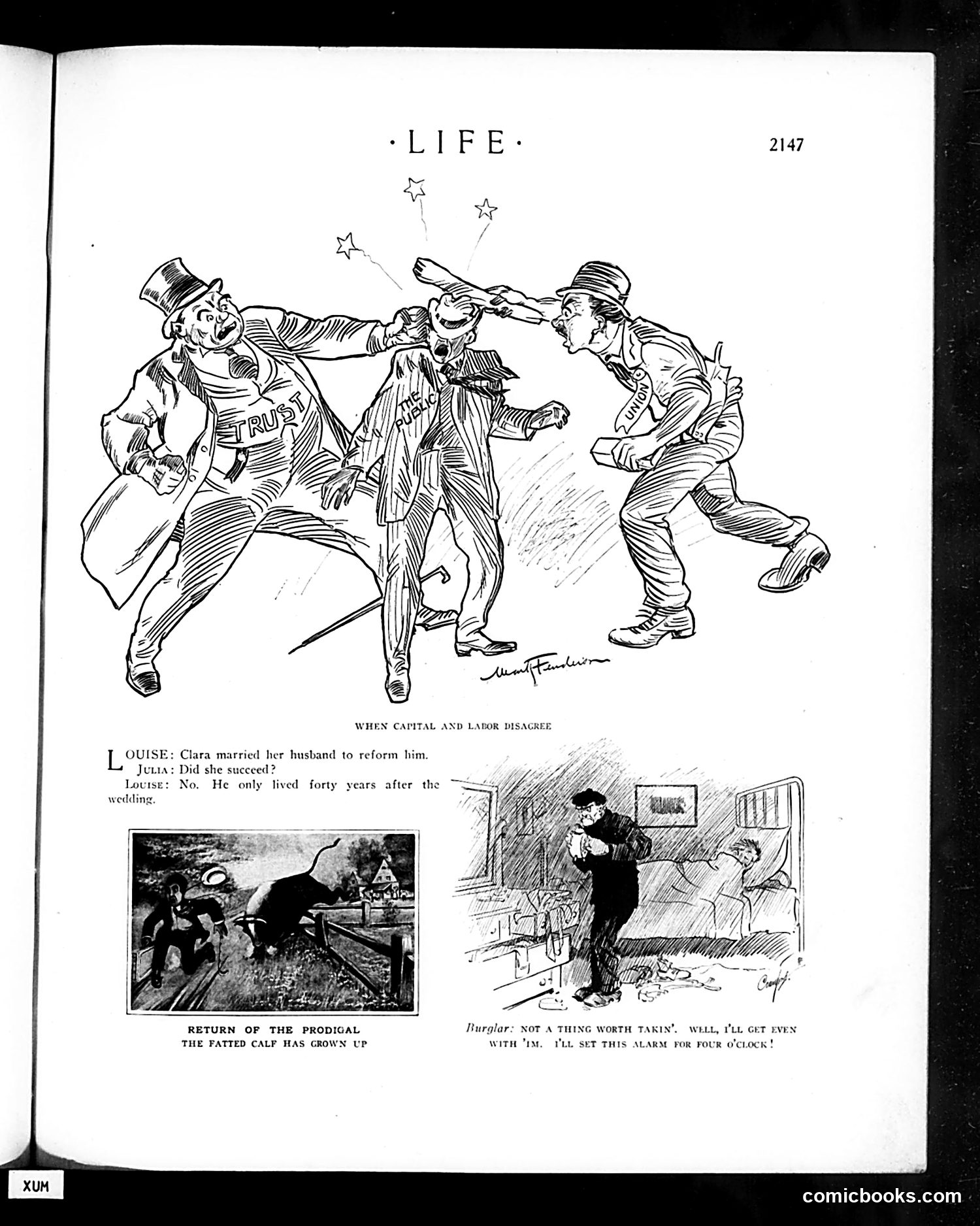
The top cartoon satirizes labor-capital conflict through three figures: one labeled "TRUST" (representing big business monopolies) being attacked by two men representing Capital and Labor. The joke is that these supposed antagonists are actually fighting the same enemy—suggesting they should unite against trusts rather than fight each other. Below are two unrelated comic vignettes: one showing a prodigal son returning home (classical reference to biblical parable), and a burglar setting an alarm to rob a house at 4 AM, joking he'll "get even" since there's nothing worth stealing—satirizing either poverty or worthlessness of the household's possessions. The page appears to be early 20th-century commentary on economic inequality and class struggle.
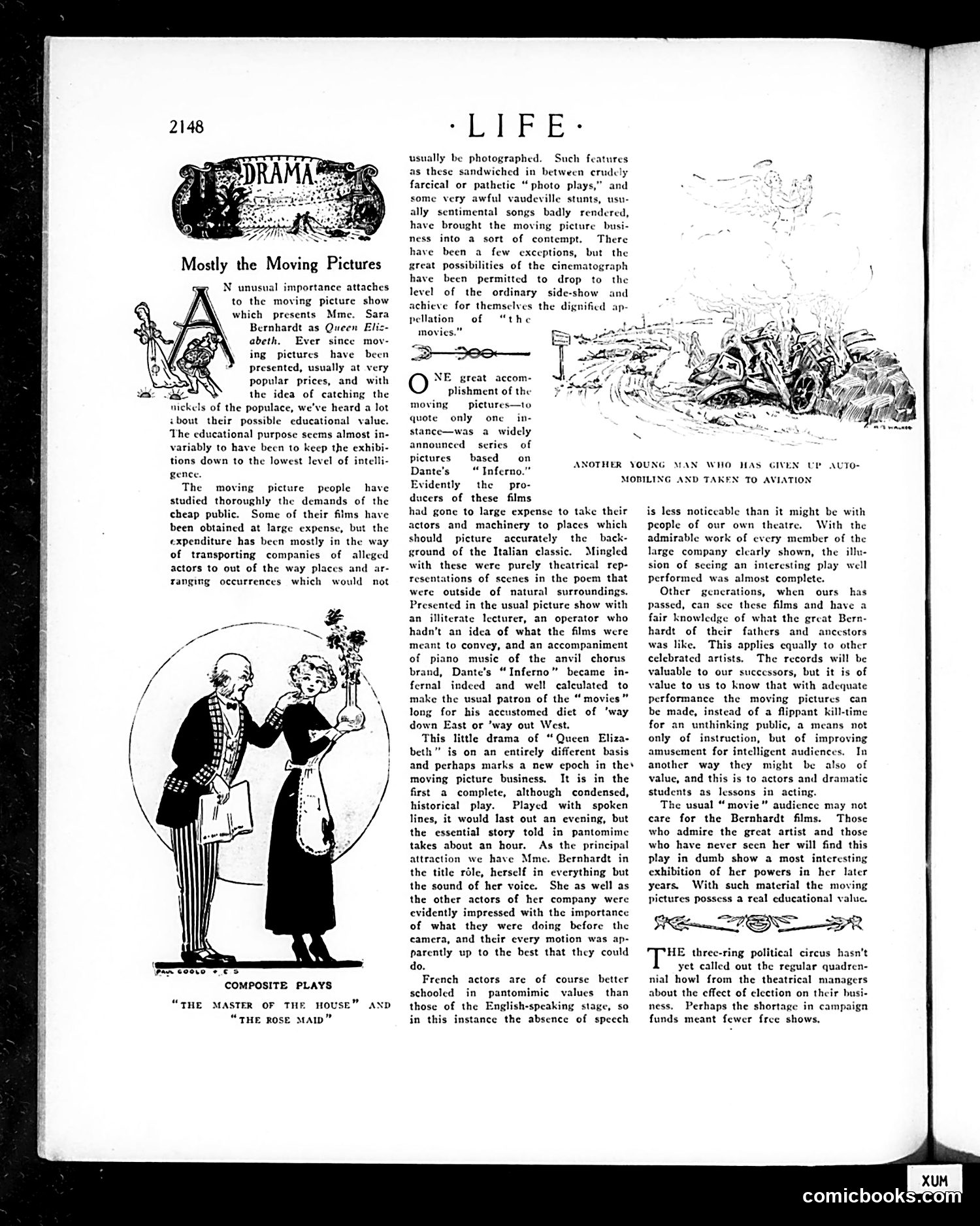
This page discusses early cinema's artistic potential and mediocrity. The article celebrates a film featuring French actress Sarah Bernhardt playing Queen Elizabeth—noting it marks a turning point because it's a serious historical drama performed by trained theatrical actors, rather than cheap entertainment. The critique targets American moving picture producers who exploit "the demands of the cheap public" with poorly made films featuring crude comedy, bad vaudeville, and transported actors performing in random locations for spectacle rather than art. A prior example—a film adaptation of Dante's *Inferno*—is mocked as "infernal" when presented in typical nickelodeons with illiterate lecturers and anvil-chorus piano accompaniment. The Bernhardt film's superiority lies in its serious intent, trained pantomime (crucial since these are silent films), and cultural preservation value. The cartoons show theatrical performers, likely illustrating the contrast between dignified drama and lowbrow entertainment that dominated early cinema.
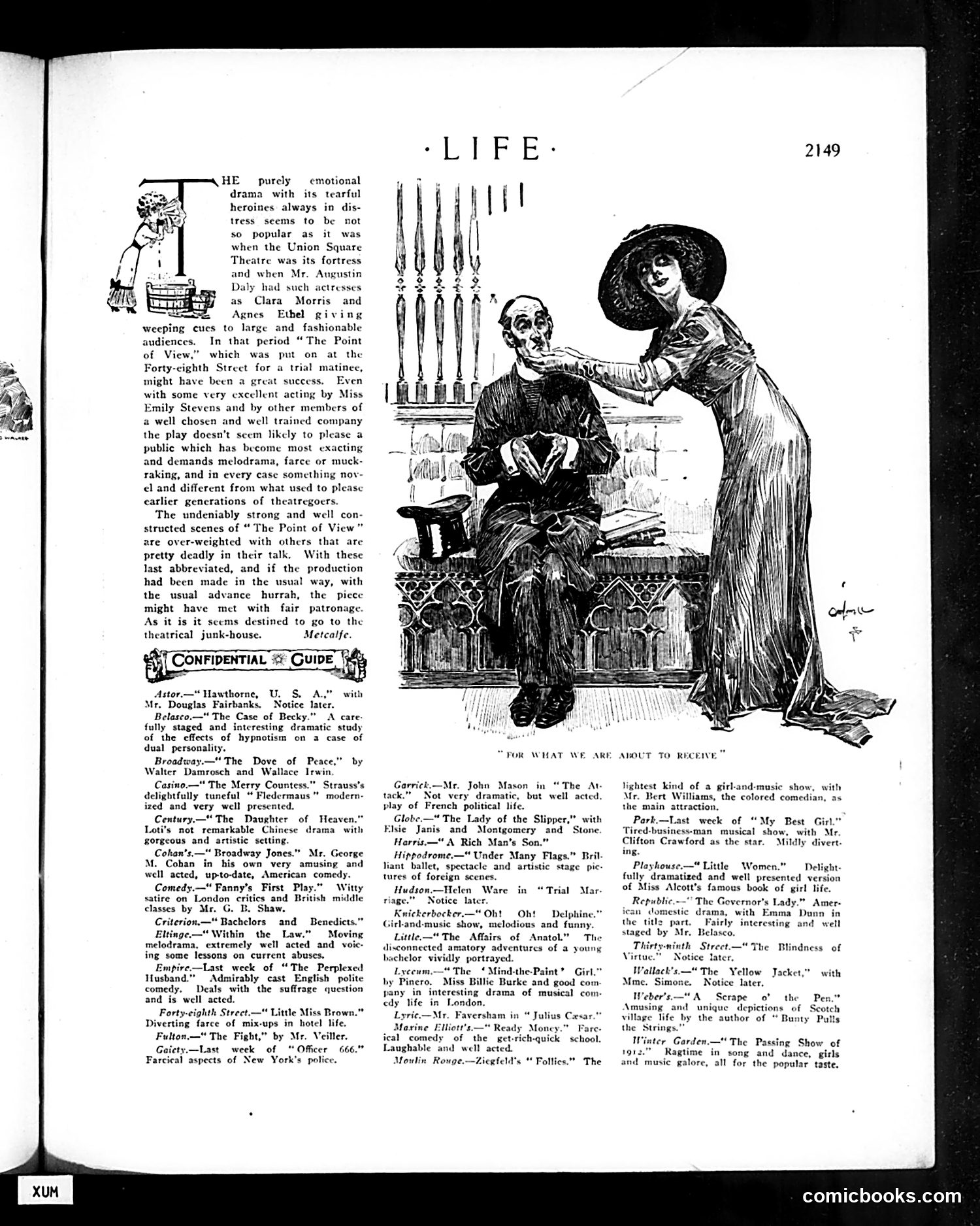
This cartoon satirizes theatrical taste in early 1910s New York. The central figure—a thin, gaunt man seated in a chair—represents the contemporary theater-going public, depicted as skeletal and dying from starvation. A woman in elaborate dress offers him a platter of theatrical productions (shown as candles or spikes), the "menu" of available shows. The satire targets the public's demanding, fickle taste. The accompanying article criticizes how audiences now reject "purely emotional drama" in favor of melodrama, farce, and "muck-raking" content. The starving figure suggests the public's insatiable appetite is actually destroying theatrical art—they consume sensational entertainments but remain spiritually and artistically malnourished. The dark humor implies that catering to lowbrow audience demands produces nothing of substance worth digesting.
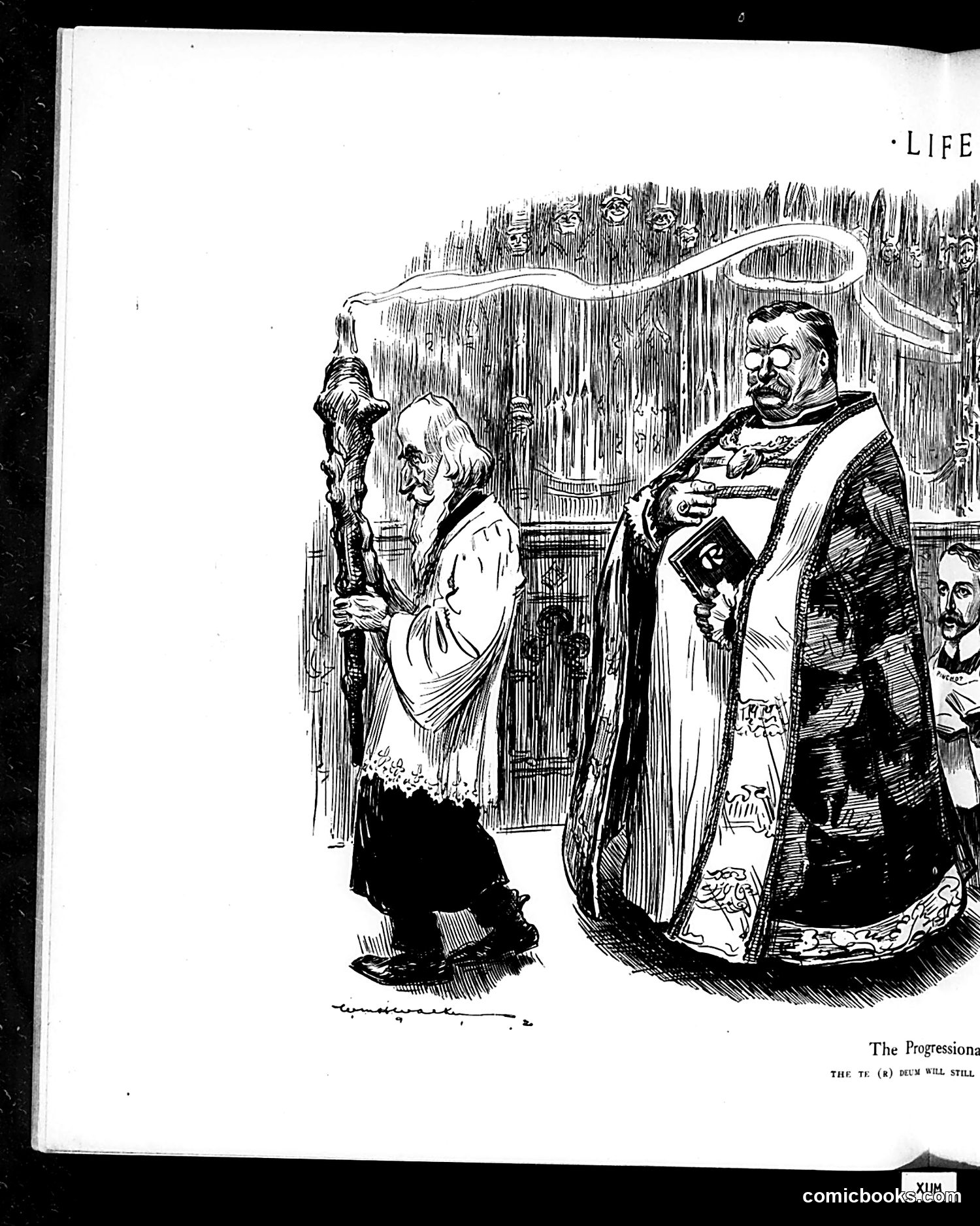
This cartoon depicts a religious procession with clergy in ceremonial robes. The visible text references "The Te Deum Will Still" (likely "The Te Deum Will Still" be sung), a Latin hymn traditionally sung in churches during formal ceremonies. The satirical point appears to target institutional religion or clergy during a period of social change—the "Progressional" title suggests irony about institutions claiming progress while maintaining traditional practices. The figures' formal religious vestments and the processional format suggest this critiques the gap between modernization and entrenched religious/institutional conservatism. Without clearer dating or additional context, the specific political target remains unclear, though Life magazine's typical focus was American social and political satire of the early-to-mid twentieth century.
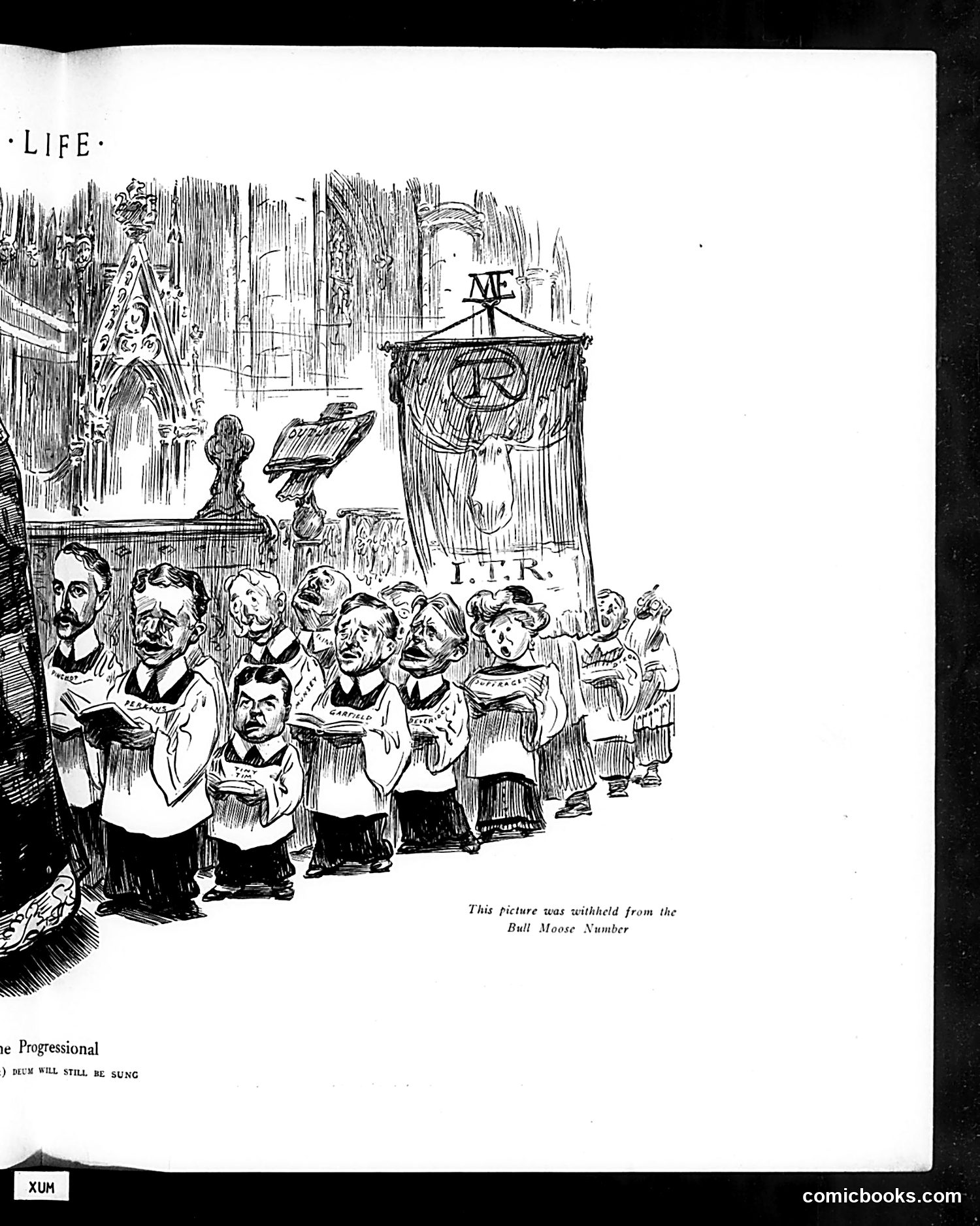
This cartoon satirizes religious hypocrisy during the Progressive era. A group of clergy members wearing robes sing from hymnals inside a cathedral, while "ME" stands atop the building's cross—suggesting self-interest has replaced spiritual values at the church's center. The initials "I.P.R." (likely "Inner Personal Religion") mark the structure. The note explains this image was "withheld from the Bull Moose Number"—referencing Theodore Roosevelt's 1912 Progressive Party campaign. The satire suggests Progressive reformers, despite their moral rhetoric about social justice, were driven by personal ambition rather than genuine principle. The cartoon critiques the disconnect between religious/political ideals and actual motivation.
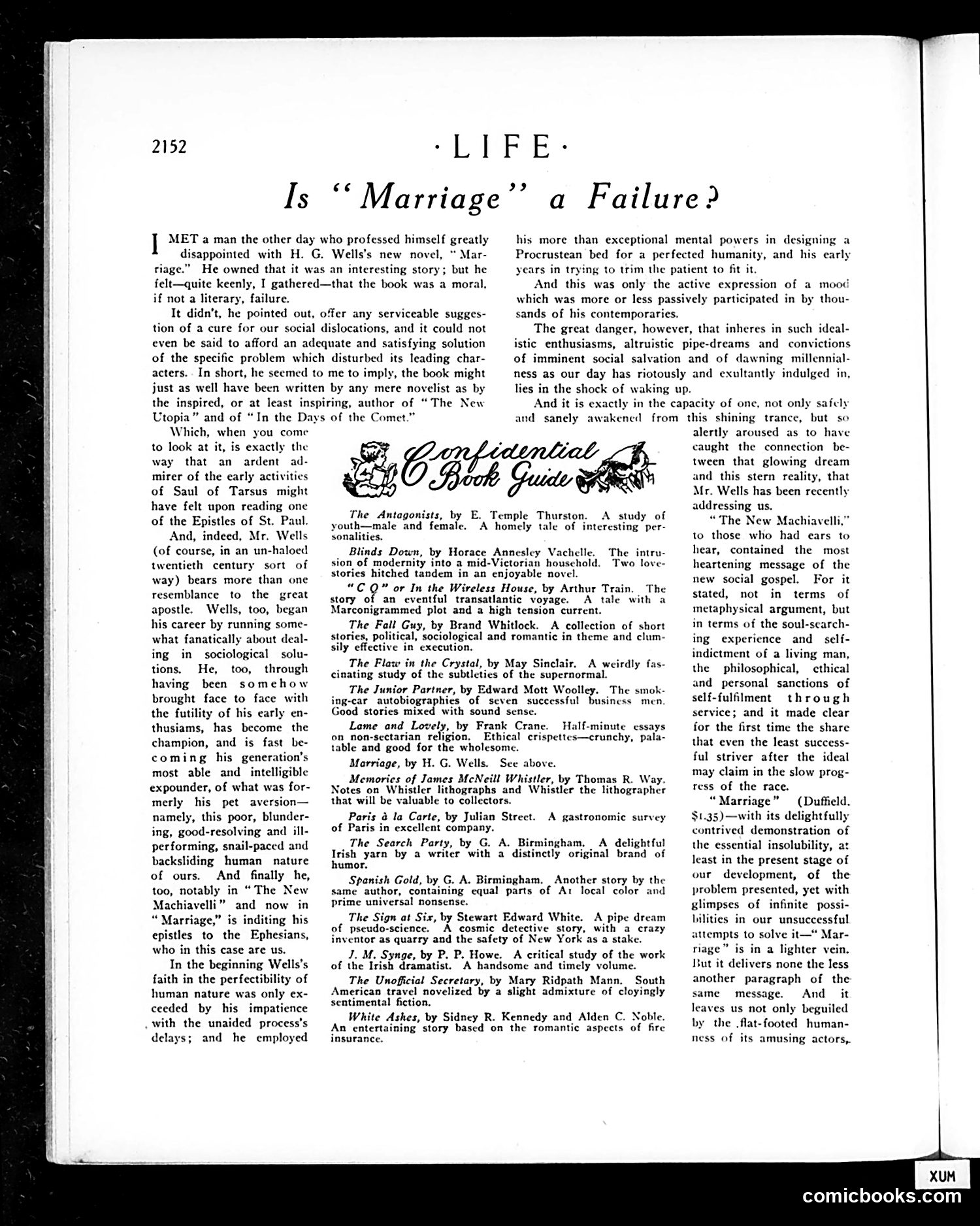
This is a literary essay reviewing H.G. Wells's novel *Marriage*. The author describes meeting a man disappointed that Wells's book, while interesting, failed to offer practical solutions to social problems or character dilemmas—essentially, that it lacked moral utility. The satire compares Wells to Saint Paul: both began as zealous reformers pushing idealistic solutions, then shifted toward accepting human nature's flawed reality. Wells's early works (*The New Utopia*, *In the Days of the Comet*) promoted utopian visions; his later works like *The New Machiavelli* and *Marriage* acknowledge human limitations. The essay warns that idealistic movements of the era—with their "pipe-dreams" of social salvation and millennial reform—face a dangerous "shock of waking up" to reality's resistance. The page also includes a "Confidential Book Guide" listing contemporary novels, anchoring this in early 20th-century literary discourse about whether fiction should serve didactic or purely narrative purposes.
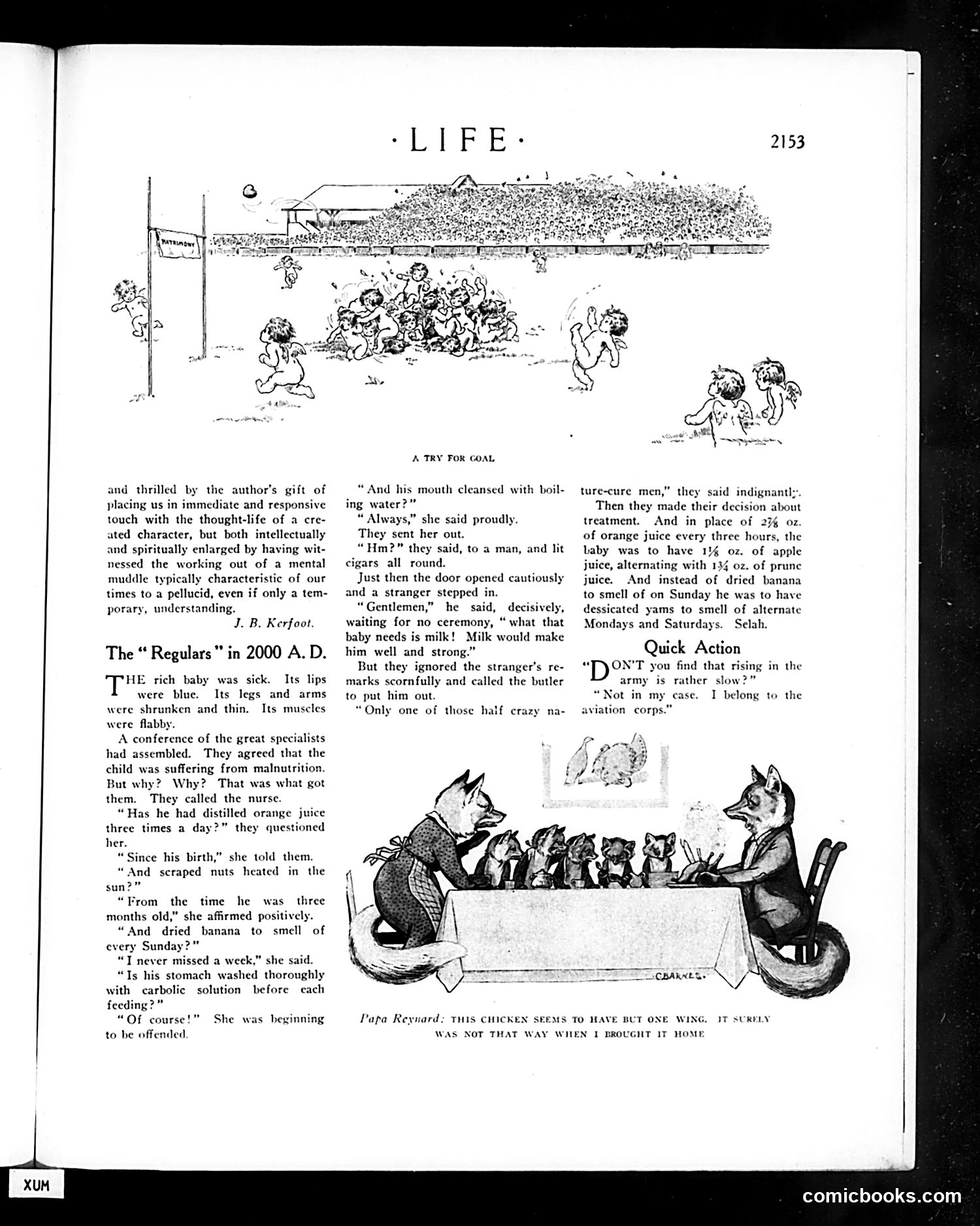
This satirical story mocks early 20th-century medical and nutritional faddism. A sick baby, clearly malnourished, receives treatment from pompous specialists who obsess over fashionable but impractical remedies: distilled orange juice, scraped nuts, dried banana, carbolic solution—elaborate pseudo-scientific treatments popular among the wealthy. When a common-sense stranger suggests simple milk, the doctors dismiss him as a "half crazy nature-cure man" and instead adjust the baby's dosages to slightly different juices and dessicated yams—missing the obvious solution entirely. The satire targets over-intellectualization in medicine: experts so committed to complex theories they ignore basic nutrition. The implicit critique is that sophisticated theory without practical wisdom produces absurd results. It reflects Progressive-era skepticism toward specialized expertise divorced from common sense—a recurring Life magazine theme.
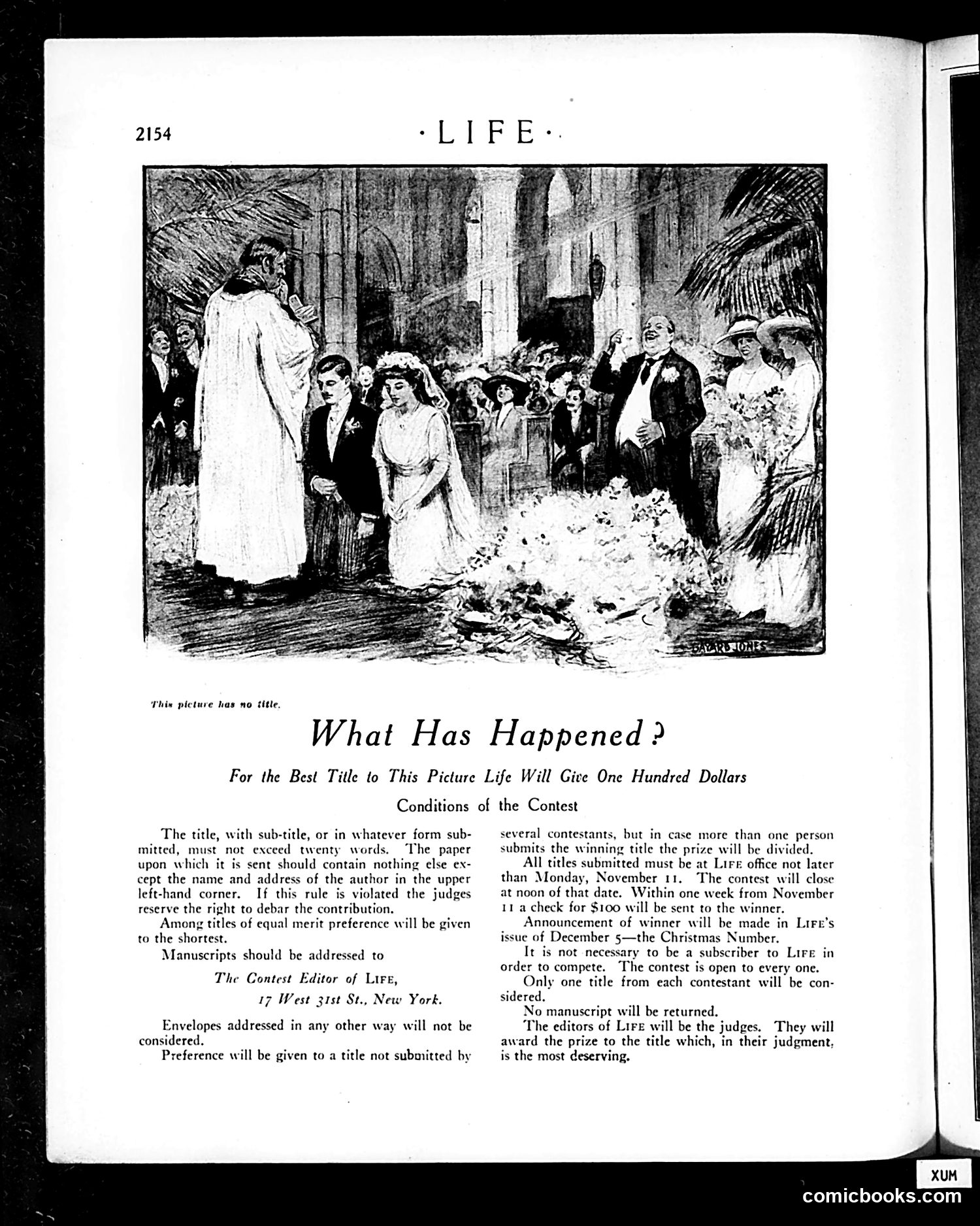
This page presents a **titling contest** rather than a completed cartoon. Life magazine published an untitled illustration and invited readers to submit titles for a $100 prize—substantial money in the early 20th century. The image shows what appears to be a **wedding ceremony** in an ornate interior, with a clergy member in white robes presiding over a couple, surrounded by formally dressed guests. The ambiguity—"What Has Happened?"—suggests the cartoon's humor lies in an unexpected or ironic scenario that readers must identify through their title suggestions. Without additional context, the specific social or political satire remains unclear, but the contest format itself reveals Life's editorial strategy: crowdsourcing wit from readers while generating engagement and promoting the magazine. The deadline of November 11 and December 5 announcement indicate this appeared in an autumn 1912 or similar issue.
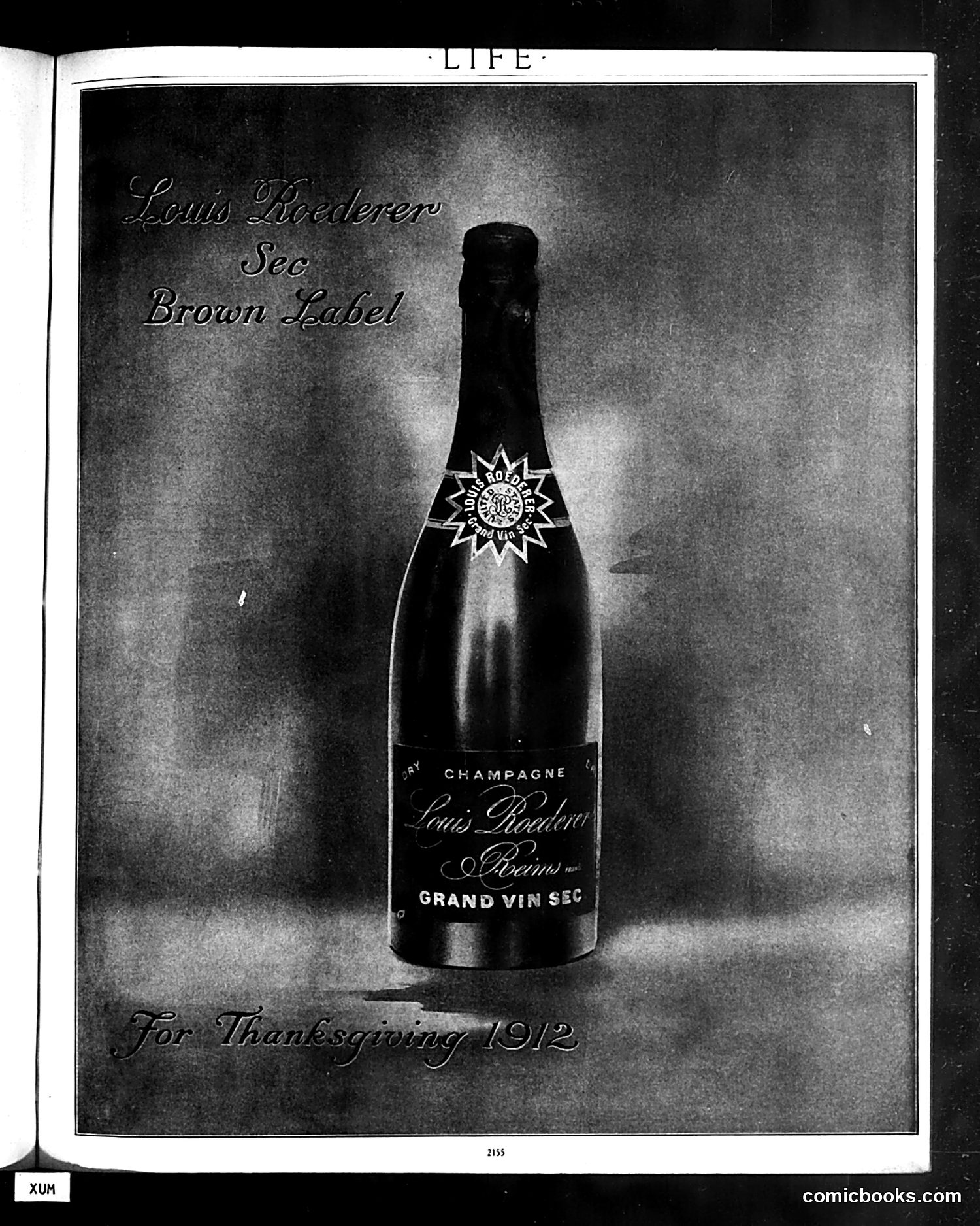
This is a **product advertisement**, not a political cartoon. It promotes Louis Roederer Sec Brown Label champagne, featuring a bottle photograph against a textured background. The advertisement's sole "joke" or selling point is the tagline: **"For Thanksgiving 1912."** This implies the champagne is an appropriate luxury beverage choice for the holiday celebration. The decorative star seal on the bottle label and formal presentation suggest this was premium champagne marketed to affluent readers of *Life* magazine. There is no political satire, caricature, or social commentary present—simply a straightforward luxury goods advertisement leveraging the holiday season to appeal to consumers with disposable income.
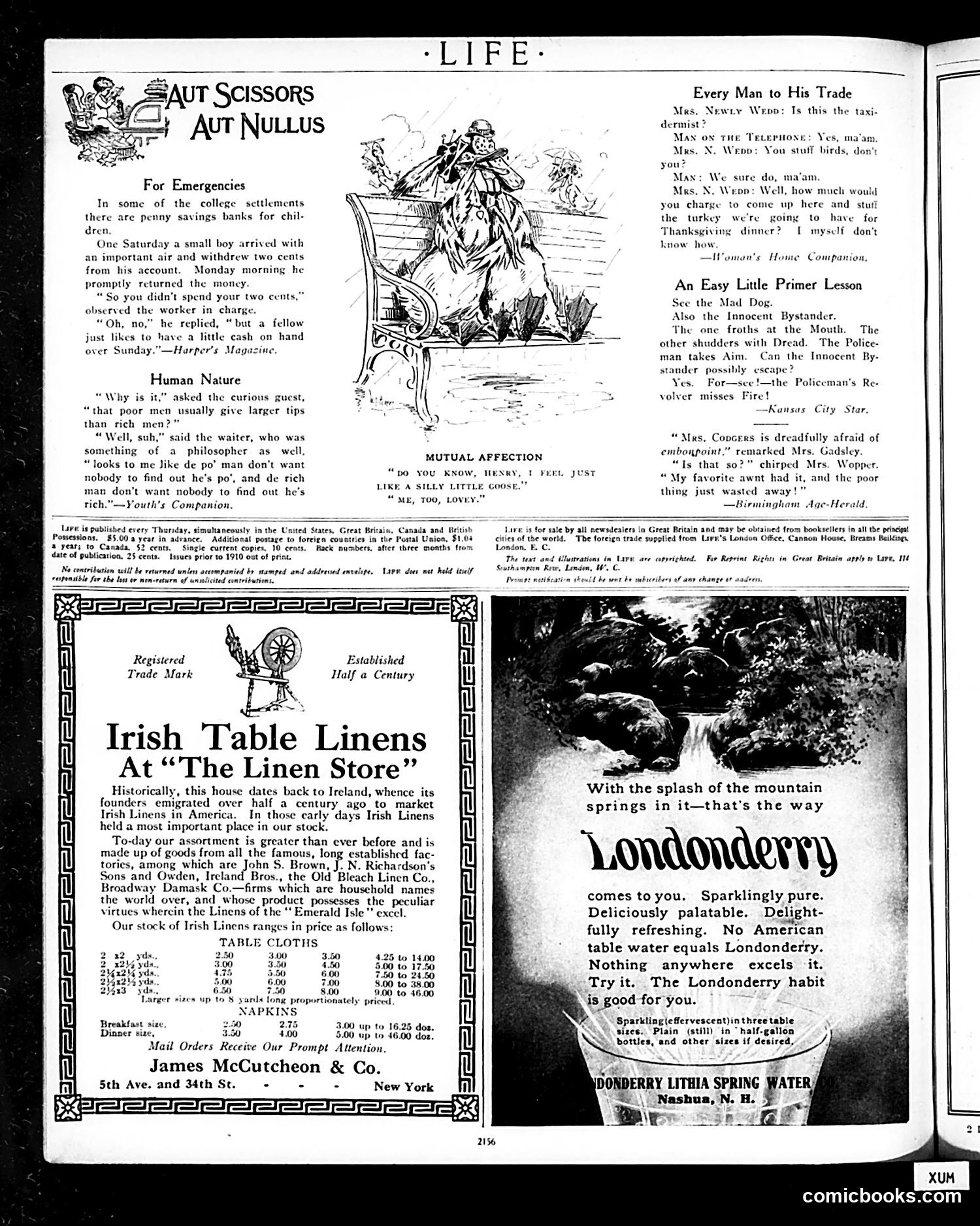
This page from *Life* magazine (a satirical publication) contains several humorous anecdotes and advertisements typical of early 20th-century American humor. The main cartoons/jokes satirize social behavior: 1. **"For Emergencies"** mocks a child's logic—he withdraws savings to have spending money, contradicting the purpose of saving. 2. **"Human Nature"** presents a waiter's cynical observation that poor men over-tip to hide poverty while rich men under-tip to hide wealth—satirizing class anxiety and social pretense. 3. **"Mutual Affection"** (caption visible) appears to reference romantic sentiment. 4. **"Every Man to His Trade"** jokes about a woman calling a taxidermist asking him to "stuff" a turkey for Thanksgiving dinner—confusing his profession with cooking. 5. **"Easy Little Primer Lesson"** presents grim irony: a lesson about a mad dog and bystander where the policeman's shot misses—dark humor about public danger. The page is otherwise dominated by period advertisements for Irish linens and Londonderry spring water, reflecting early 1900s consumer culture.
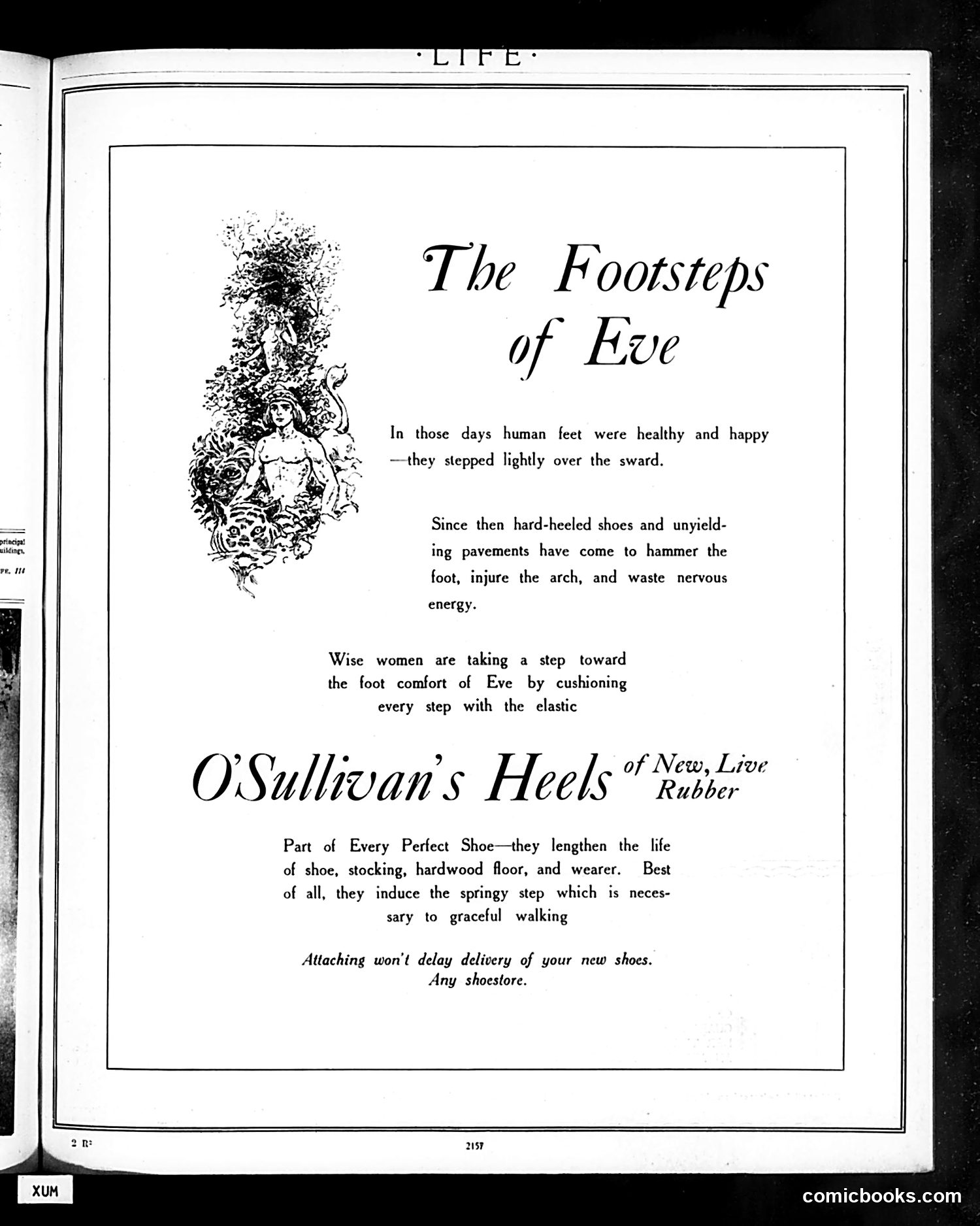
This is an **advertisement**, not satire or political commentary. It promotes O'Sullivan's rubber heels for shoes. The "cartoon" is a decorative illustration of Eve (the biblical first woman) emerging from foliage—establishing the advertisement's central conceit: that Eve walked barefoot in Eden with healthy, comfortable feet, but modern women suffer foot pain from hard shoes and pavement. The ad's argument is straightforward marketing: O'Sullivan's elastic rubber heels restore the natural comfort Eve enjoyed by cushioning steps and promoting graceful walking. The heels allegedly protect shoes, stockings, floors, and the wearer's health. For modern readers, the notable element is the **gendered marketing**—addressing "wise women" and emphasizing "graceful walking," reflecting early-20th-century assumptions about femininity and foot health. The biblical reference to Eve, while now seeming quaint, was a familiar rhetorical device in vintage advertising.
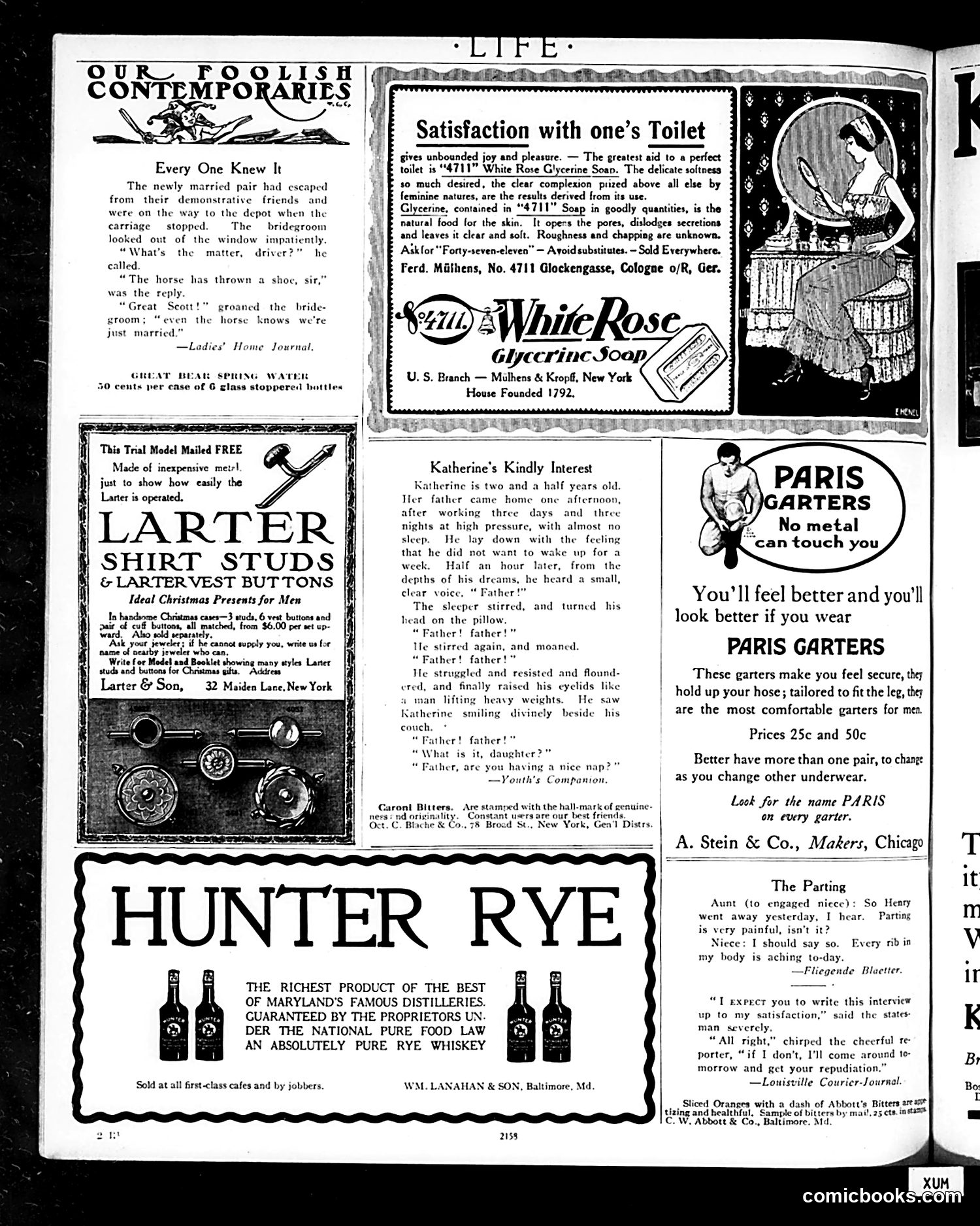
This page is primarily **advertising**, not political or satirical content. It contains several commercial ads (soap, garters, whiskey, shirt studs) interspersed with brief, generic humorous pieces—short jokes about newlyweds, a child waking her napping father, and reporters—unrelated to politics or current events. The only potential satire is the opening cartoon, "Every One Knew It," a joke about a newly married couple whose carriage breaks down because "the horse has thrown a shoe." The groom's exasperated comment—"even the horse knows we're just married"—is a mild joke playing on the idea that their inexperience or distraction is obvious to everyone, even animals. It's gentle domestic humor rather than political commentary. The page reflects early 20th-century *Life* magazine's mixed format of advertisements and light entertainment.
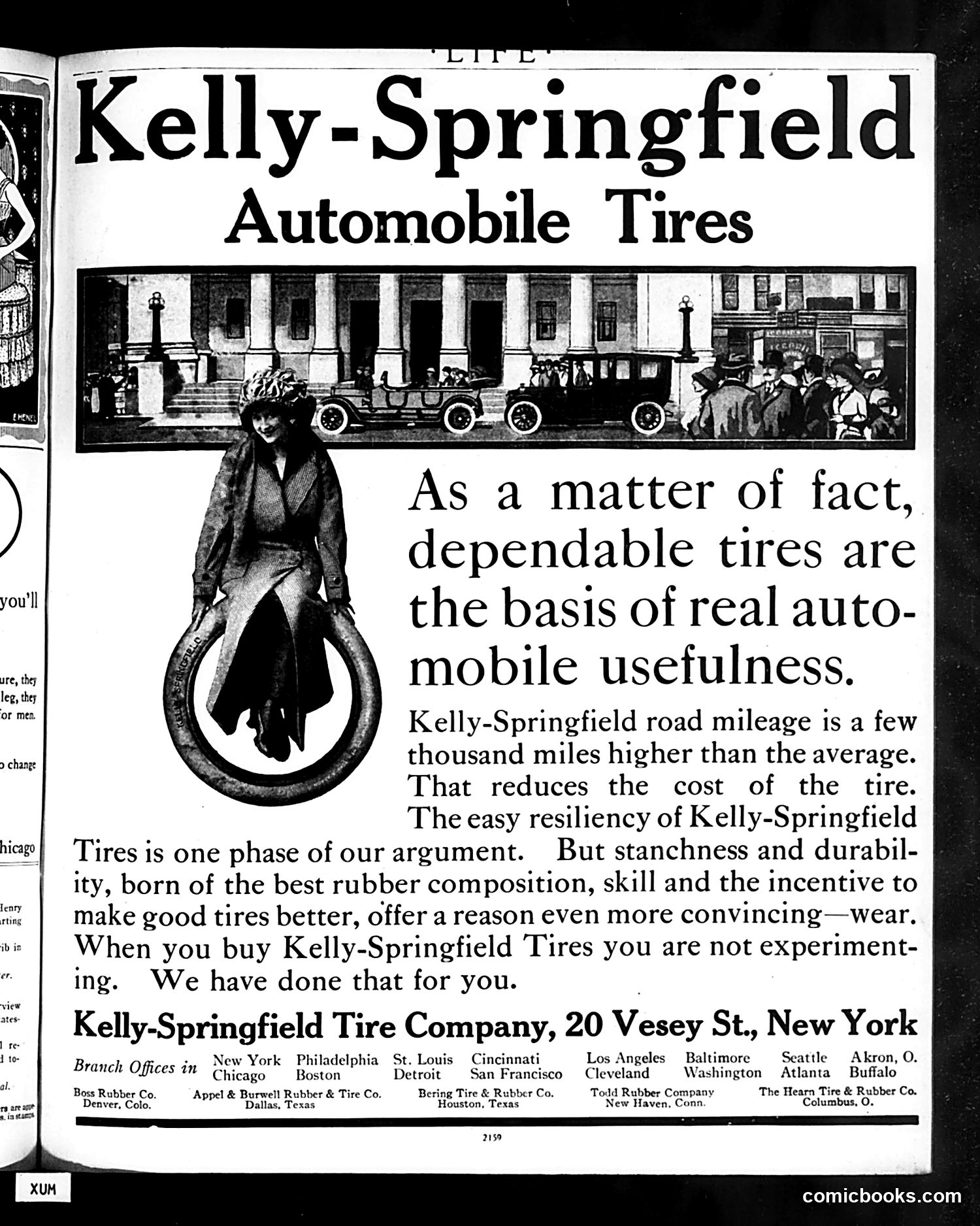
This is a **full-page advertisement**, not satire or political content. It promotes Kelly-Springfield Tires to early automobile owners (likely 1910s-1920s era, based on the vehicle designs shown). The image features a woman in period dress holding a tire, positioned above text emphasizing tire durability and reliability. The top shows a photograph of early automobiles parked in front of what appears to be an official building, suggesting prestige and trustworthiness. The ad's argument is straightforward: Kelly-Springfield tires outlast competitors, reducing replacement costs. The phrase "you are not experimenting" suggests buyers should trust the brand's proven track record rather than risk inferior alternatives. The central message reflects an era when tire quality directly affected automobile practicality—unreliable tires made cars genuinely unusable for long distances. This was a serious selling point, not humor.
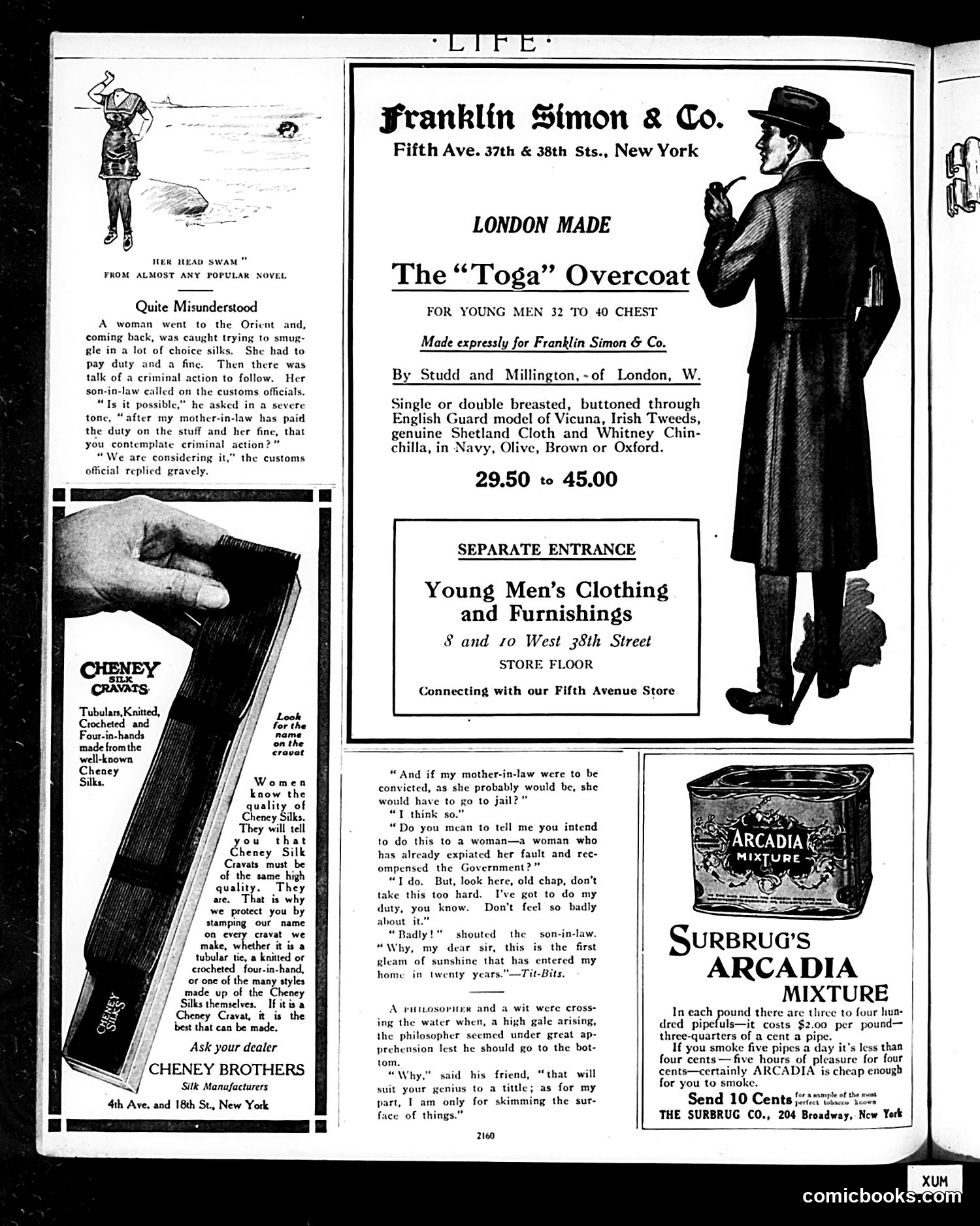
This is primarily an **advertising page** from Life magazine, dominated by four commercial ads for luxury goods (Franklin Simon & Co. overcoats, Cheney Brothers silk cravats, Surbrug's Arcadia tobacco mixture). The only satirical content is a brief anecdote titled **"Quite Misunderstood,"** which satirizes **customs enforcement bureaucracy**. A woman smuggles silks from the Orient, pays duty and fines, but a customs official still threatens criminal prosecution. Her son-in-law argues this is excessive—she's already been punished financially. The official coldly insists on following procedure regardless. The joke's punchline reveals the son-in-law is *pleased* by this outcome: "the first gleam of sunshine that has entered my home in twenty years"—implying he hopes his mother-in-law goes to jail. The satire mocks both rigid, unfeeling bureaucrats and family resentments. A second brief joke about philosophers crossing water provides filler content. The page reflects early 20th-century American attitudes toward tariffs, customs enforcement, and family dynamics—matters Life's affluent readership would recognize.
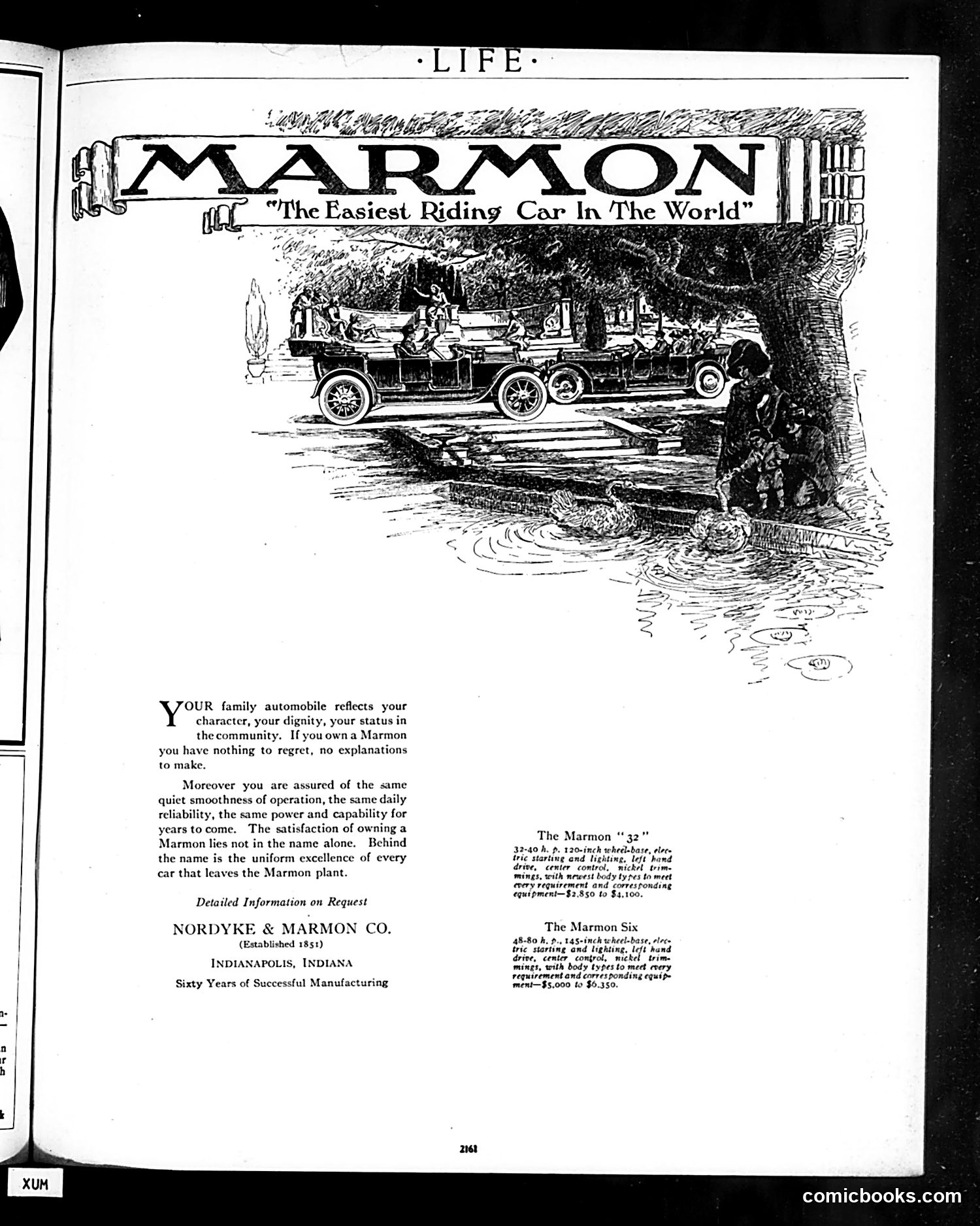
This is **not a cartoon or satire**—it's a straightforward automobile advertisement for the Marmon car company of Indianapolis. The page appeared in *Life* magazine, which published both satirical content and paid advertisements. The advertisement uses a pastoral illustration showing a Marmon automobile passing by a tree-lined rural path, with figures observing it. The marketing pitch emphasizes that owning a Marmon reflects one's "character," "dignity," and "status in the community," appealing to early 20th-century class consciousness and social aspiration. Two Marmon models are promoted: the "32" and the "Six," with technical specifications and price ranges ($2,850–$6,350). The company claims "sixty years of successful manufacturing" to establish credibility. There is no political satire or social commentary here—it's period advertising showcasing automotive engineering and luxury aspirations typical of the era.
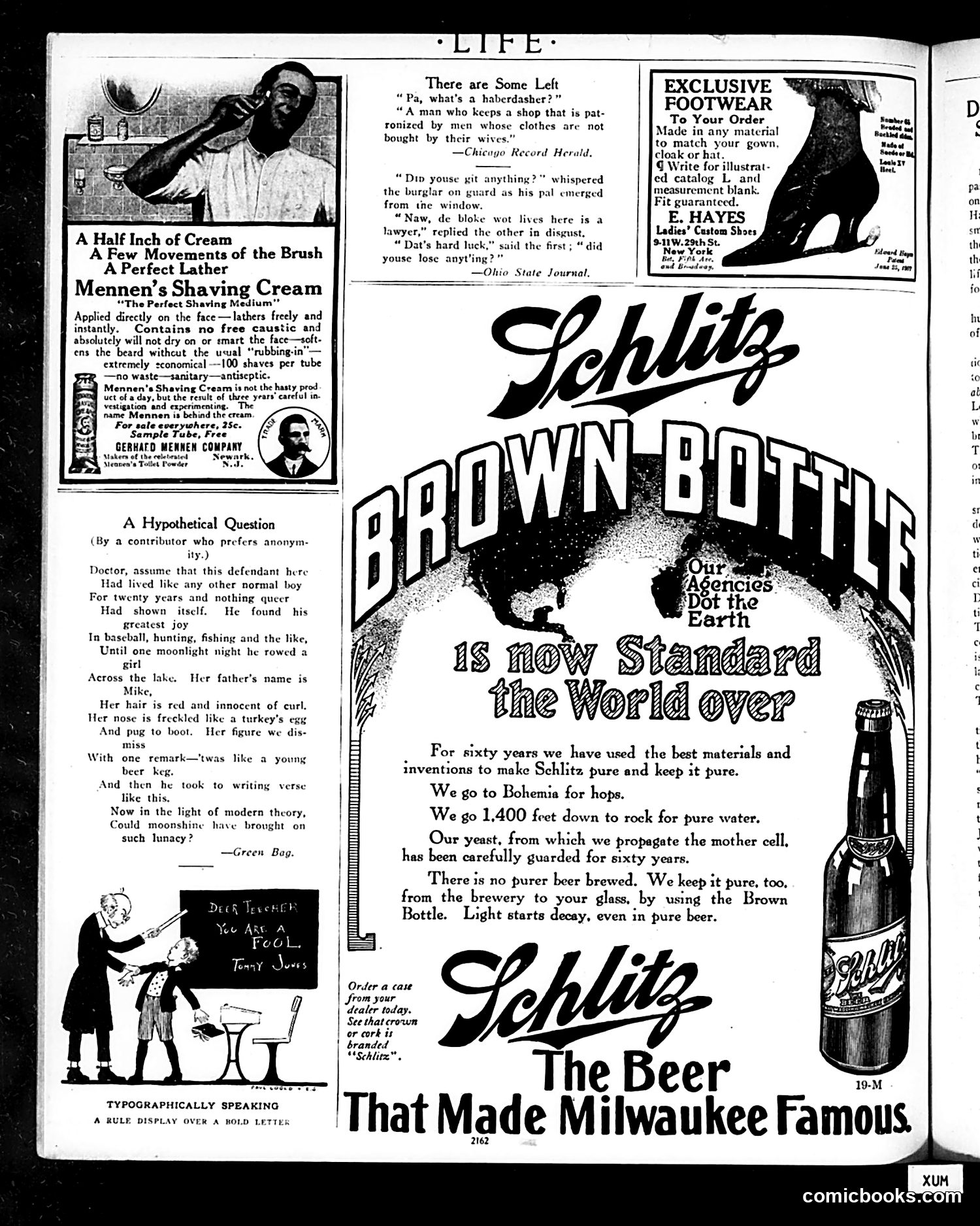
This page mixes advertisements with humorous content typical of early 20th-century American satirical magazines. **Advertisements:** Mennen's Shaving Cream (emphasizing efficiency and hygiene) and Schlitz Beer dominate the page. The beer ad claims 60 years of purity, using brown bottles to prevent light decay—marketing appeals common to the era. **Humor Pieces:** 1. "There are Some Left"—a joke defining "haberdasher" as a shop for men whose wives don't buy their clothes, satirizing marital dynamics. 2. "A Hypothetical Question"—a lengthy poem asking whether moonshine could cause madness after a man meets an unattractive girl and becomes a poet. It's absurdist humor playing on romantic clichés. 3. A small cartoon about a burglar asking his partner if he "got anything," replied to with "Naw, de bloke wot lives here is a lawyer"—mocking lawyers as having nothing worth stealing, using exaggerated criminal dialect. The page reflects period attitudes toward gender, class, and occupational stereotypes presented as harmless amusement.
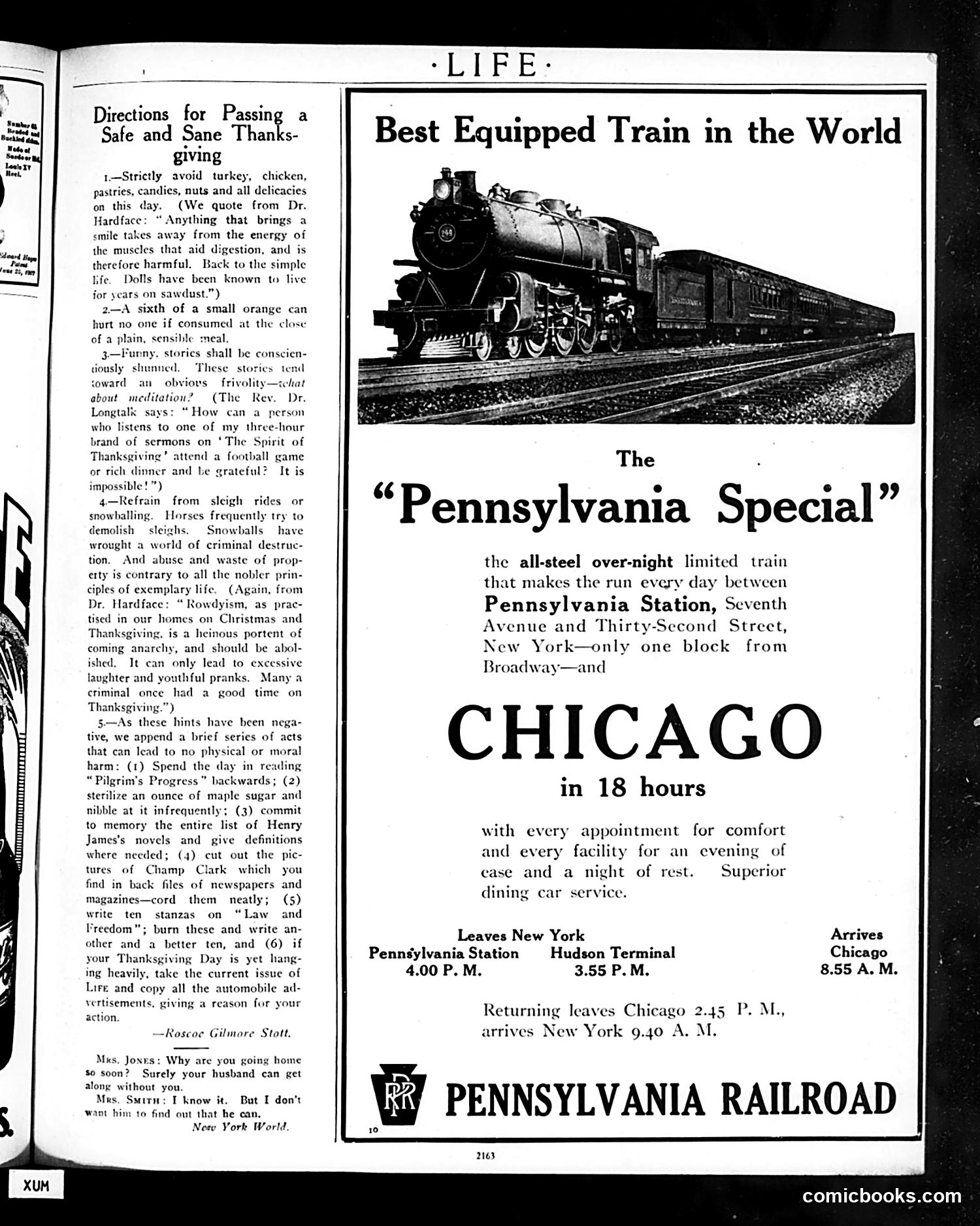
This page mixes satirical humor with advertising. The left column, titled "Directions for Passing a Safe and Sane Thanksgiving," is **satirical advice** mocking overly restrictive, joyless approaches to the holiday. It quotes fictional killjoys like "Dr. Hardface" and "Rev. Dr. Longtalk" who advocate avoiding all pleasure—no rich food, fun, laughter, or play—treating Thanksgiving as a solemn duty rather than celebration. The joke is that the "helpful suggestions" (reading *Pilgrim's Progress* backward, memorizing Henry James novels, copying car ads) are absurdly tedious, suggesting that denying yourself enjoyment leads to pointless busywork. This mocks puritanical or excessively austere attitudes toward holidays. The right side is a straightforward **Pennsylvania Railroad advertisement** for the "Pennsylvania Special" train to Chicago, unrelated to the satire. A small humor item at bottom features a wife's domestic joke. The satire reflects early 20th-century debates about modern leisure, morality, and whether holidays should emphasize restraint or enjoyment.
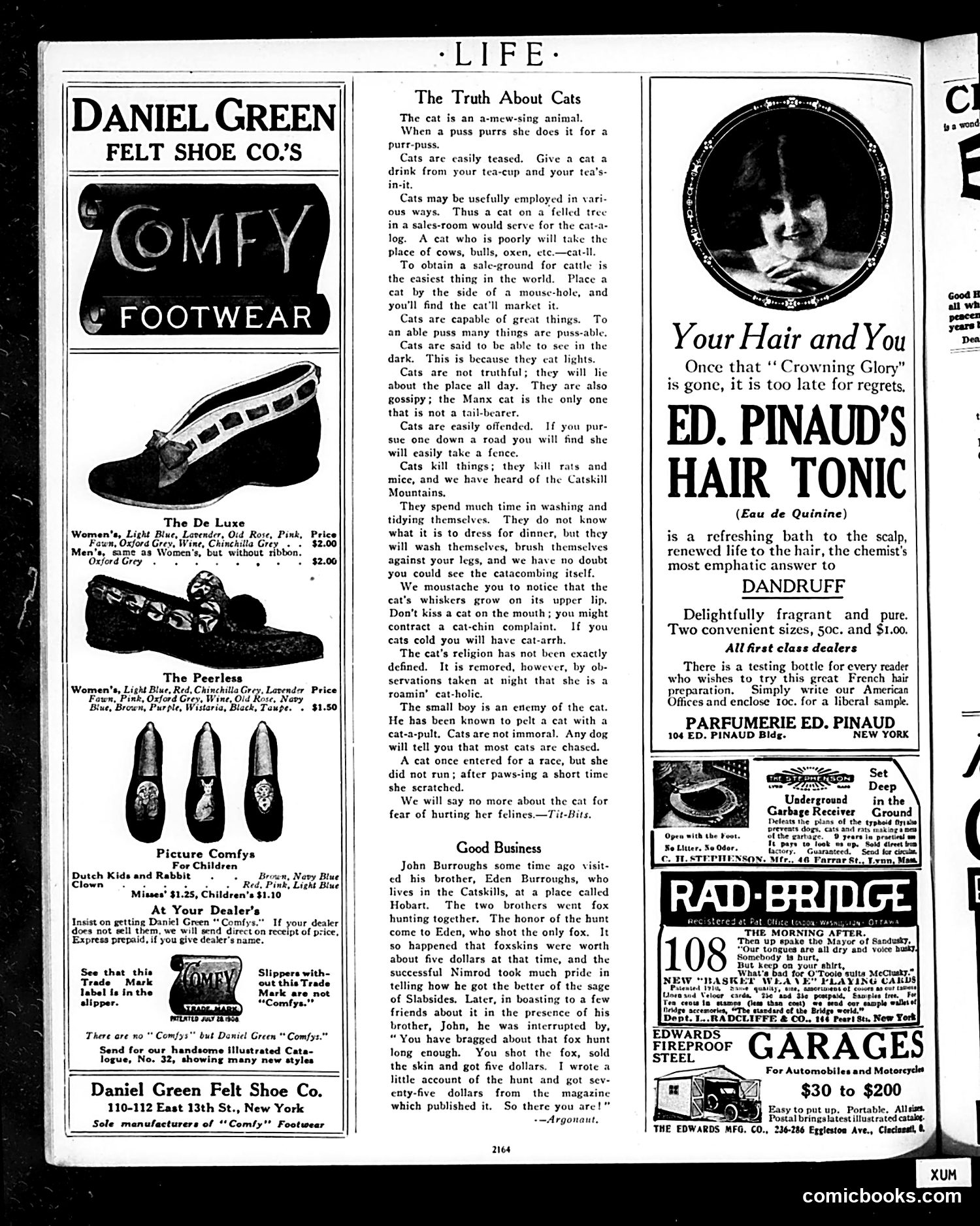
This page is primarily **advertisements and filler content**, not political satire. The main piece is "The Truth About Cats"—a humorous essay full of puns rather than meaningful commentary. It consists almost entirely of cat-related wordplay: "cat-a-log," "cat-ill," "cat-chin complaint," "cat-arrh," "cat-a-pult," and "cat-holic." These forced puns are the entire point of the humor. The accompanying story, "Good Business," is a straightforward anecdote about brothers hunting foxes in the Catskills—selected mainly because it contains the word "Catskills," allowing it to loosely tie into the cat-pun theme. The page otherwise contains shoe and hair tonic advertisements typical of the era. There is **no political cartoon, caricature, or social satire** visible here—just light, pun-based humor and period advertising.
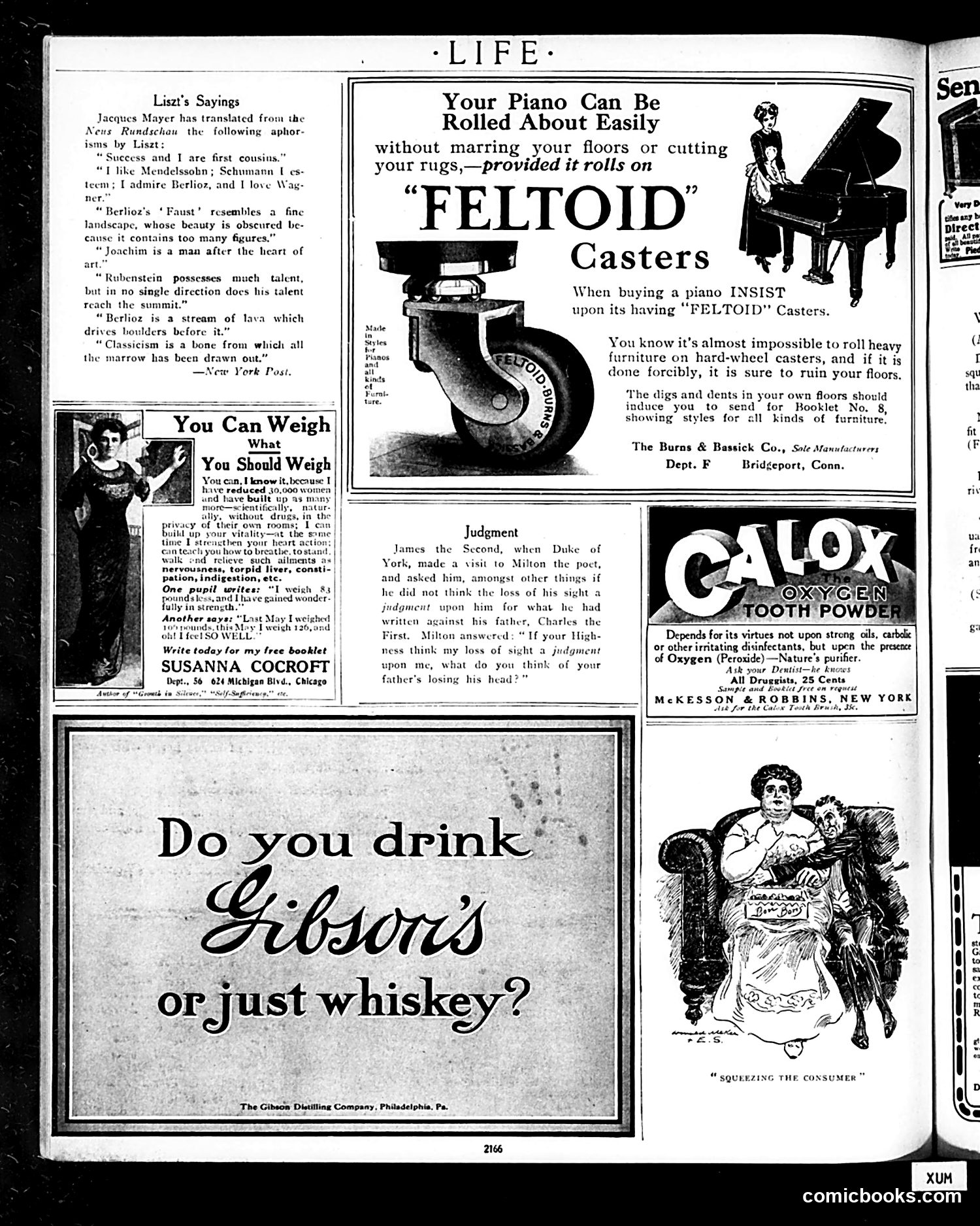
This page from *Life* magazine contains primarily **advertisements and literary content**, not political satire requiring historical context. The main items are: **"Liszt's Sayings"** — A column of translated aphorisms by composer Franz Liszt comparing other musicians (Mendelssohn, Berlioz, Rubinstein). This requires no special context; it's straightforward music criticism. **"Judgment"** — An anecdote about King James II visiting poet John Milton, joking about Milton's blindness. The humor is based on a pun: when the King suggests Milton's blindness is divine punishment for writings against his father Charles I, Milton replies by asking what God thought of the King "losing his head" (an allusion to Charles I's execution). This requires knowing Charles I was beheaded in 1649. **Advertisements** dominate the page: Feltoid piano casters, weight-loss treatments, Gibson whiskey, Calox tooth powder, and Susanna Cocroft's diet booklet. The page is essentially a **commercial publication with light literary content**, not satirical commentary.
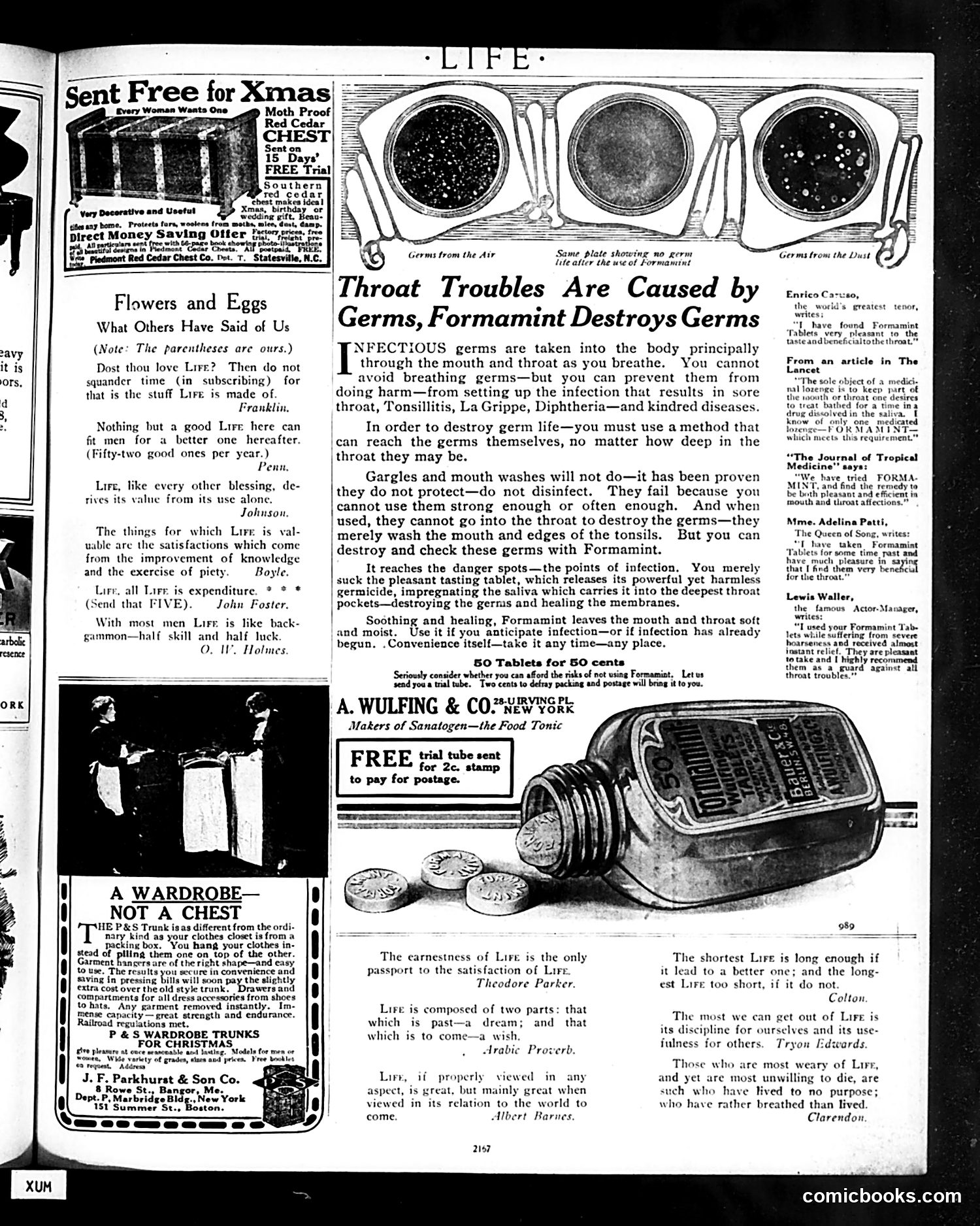
This page is primarily **advertising**, not political satire. It contains: 1. **Main content**: A Formamint advertisement claiming to cure throat infections by destroying germs. The three circular images at top purport to show germs "from the air," "before/after use," highlighting early 20th-century fascination with germ theory as a marketing tool. 2. **Supporting testimonials**: Quotes from opera singer Enrico Caruso and others endorsing the product—a common advertising technique. 3. **Sidebar ads**: For cedar chests, P&S trunks, and other consumer goods. The page reflects the **era's optimistic belief in scientific solutions** to health problems. The text dismisses gargling as ineffective while promoting Formamint tablets as superior—typical of patent medicine marketing before FDA regulations. The philosophical quotes about "Life" (the magazine's namesake) are filler content separating advertisements, not satirical commentary.
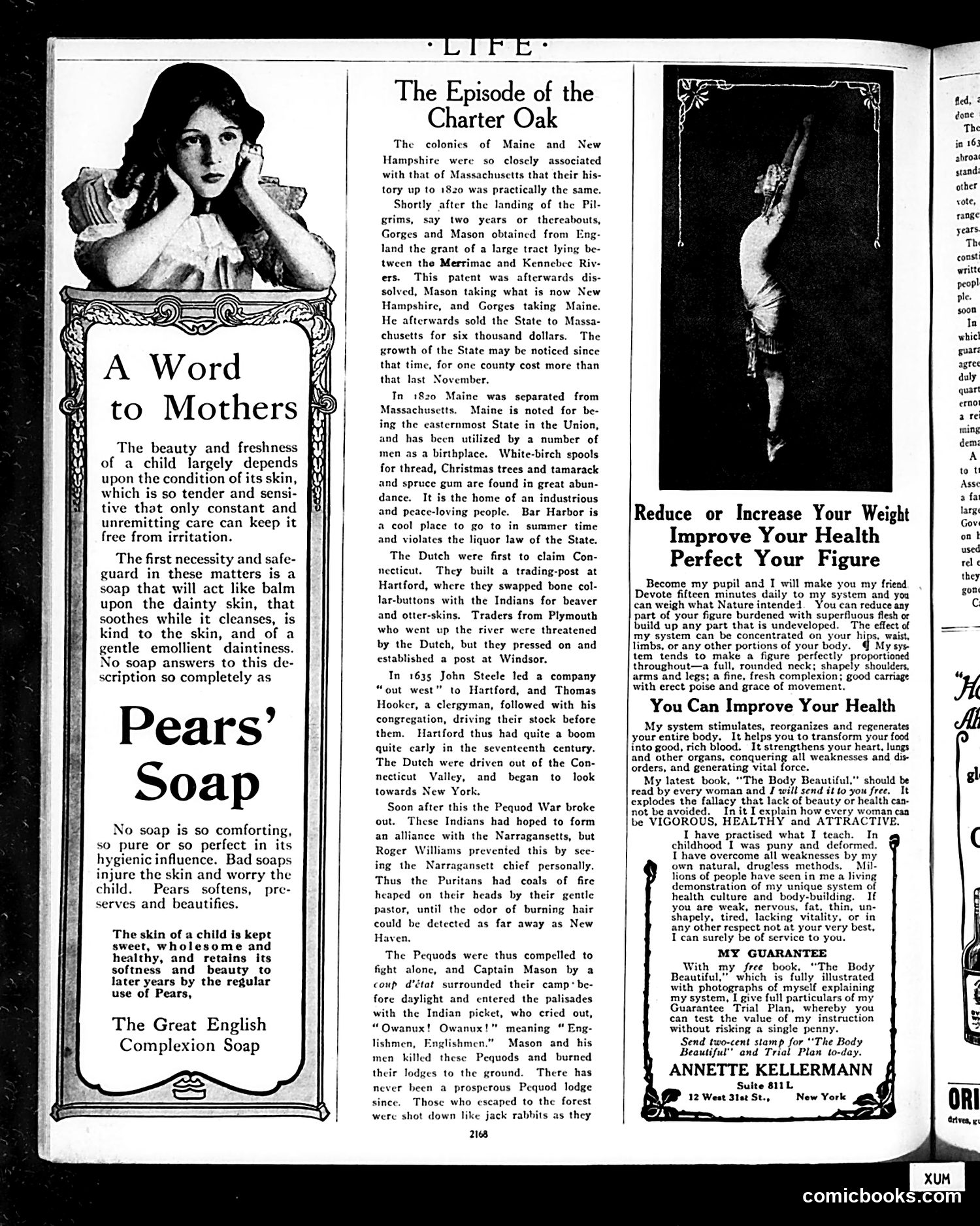
This Life magazine page combines satirical historical articles with period advertisements. The left side features "A Word to Mothers" advertising Pears' Soap, a genuine British product popular in early 20th-century America. The center article, "The Episode of the Charter Oak," presents satirical pseudo-history of Maine, New Hampshire, and Connecticut. Life magazine was known for humorous, tongue-in-cheek pieces mixing real and fabricated details. The text contains obvious jokes—claiming one Maine county's cost "more than that last November" (a 1920 election reference), and the absurdist description of Connecticut's Dutch traders "swapping bone collar-buttons" with Indians. The Pequod War section, while based on actual history, uses exaggerated language ("shot down like jack rabbits") typical of Life's satirical tone. The right side advertises Annette Kellermann's "Body Beautiful" system, exploiting period anxieties about weight and appearance. This juxtaposes with the Pears' Soap advertisement, both targeting women's insecurities about physical appearance—the page's underlying satirical commentary on consumer culture.
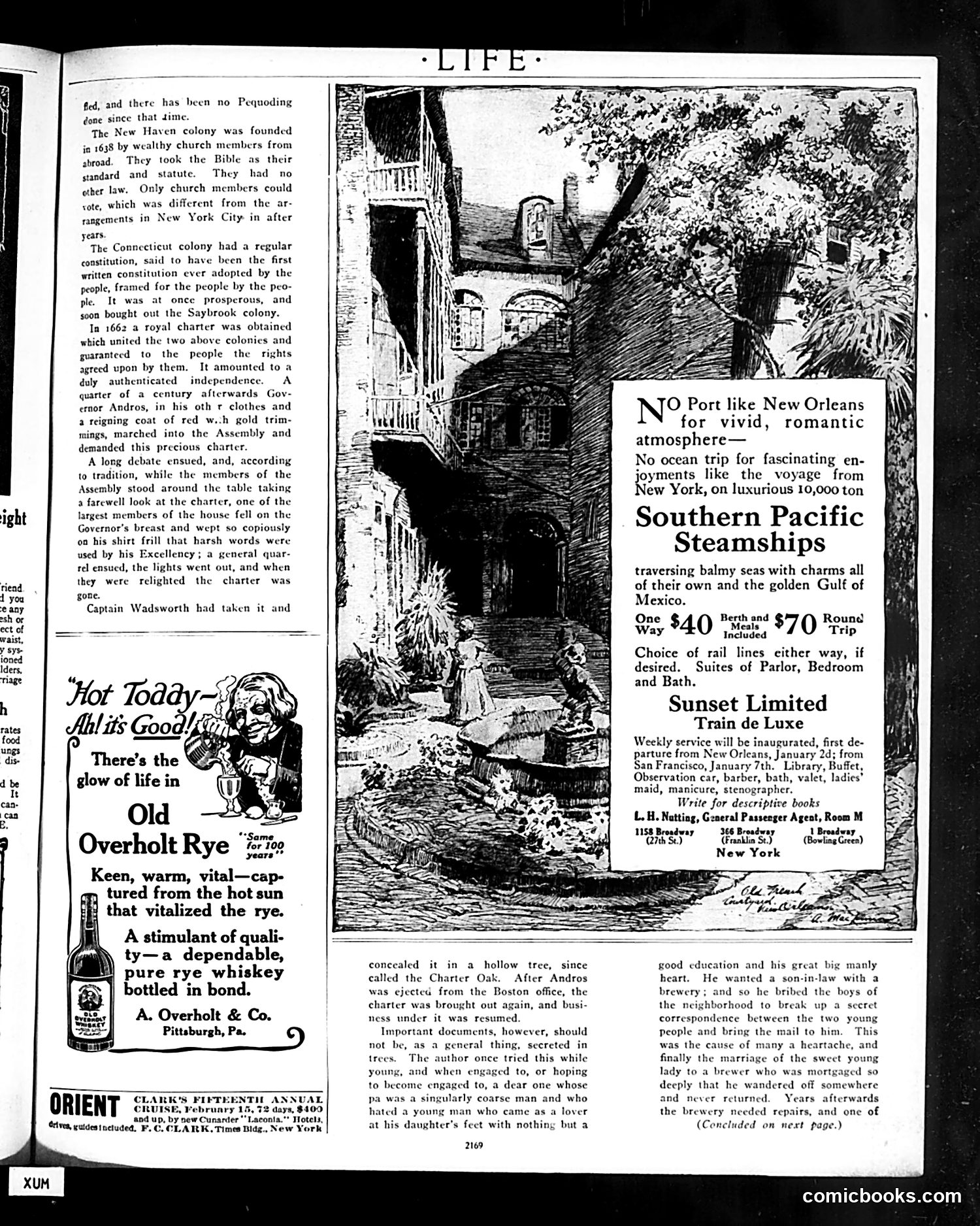
This page contains **mostly advertising and historical narrative** rather than political cartoons. The main content is a historical account of Connecticut colonial governance, focusing on the legendary "Charter Oak" incident of 1662, when Governor Andros demanded Connecticut's charter and a colonist allegedly hid it in a tree. The single **cartoon/advertisement** is for "Old Overholt Rye" whiskey (lower left), featuring a jovial character embodying the product's warmth and vitality—typical early-20th-century liquor marketing using personification. The remainder consists of travel and shipping advertisements (Southern Pacific Steamships to New Orleans, Sunset Limited train) and a tangential anecdote by the author about hiding love letters in trees as a youth—an attempt at humorous personal connection to the historical narrative. The page reflects **Life magazine's editorial blend**: mixing genuine historical storytelling with commercial advertisements and light humor. The Charter Oak story itself celebrates colonial resistance to British authority—a patriotic historical touchstone for American readers.
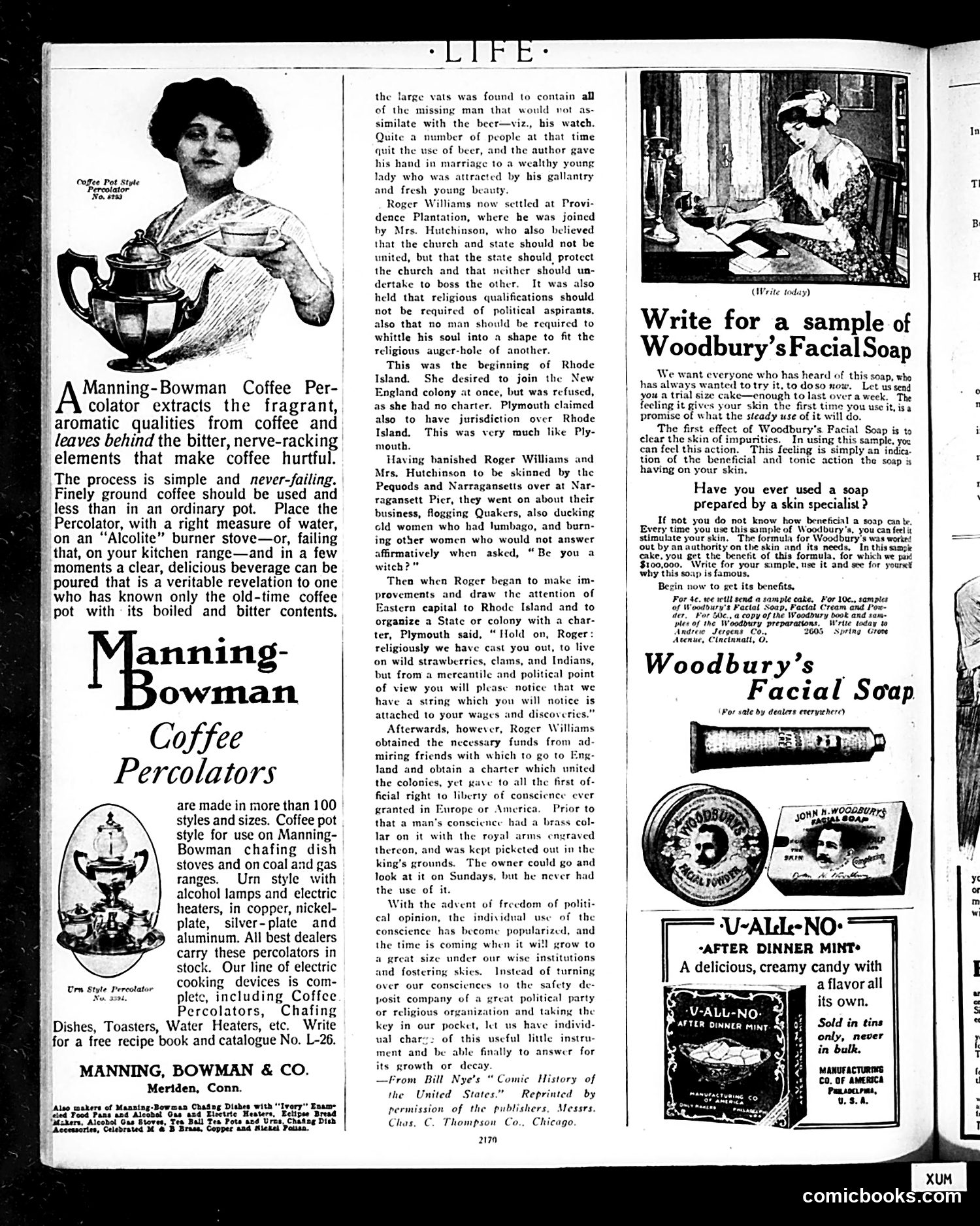
This page is primarily **advertising**, not political satire. It contains two major ads: 1. **Manning-Bowman Coffee Percolators** (left/center): Promotes kitchen appliances, emphasizing that their percolator extracts coffee's good qualities while removing "bitter, nerve-racking elements." Available in 100+ styles for various stoves and heat sources. 2. **Woodbury's Facial Soap** (right): Appeals to women with claims the soap "clears the skin of impurities" and offers free sample cakes. The page also includes a lengthy **historical narrative** about Roger Williams and Rhode Island's founding, discussing religious freedom, separation of church and state, and conscience rights—likely part of a serialized history feature. The small illustrated vignettes show a woman at a vanity (Woodbury's ad) and product packaging. **No political cartoons or satire are present.** This is a straightforward commercial/editorial page typical of early-20th-century Life magazine's mixed content.
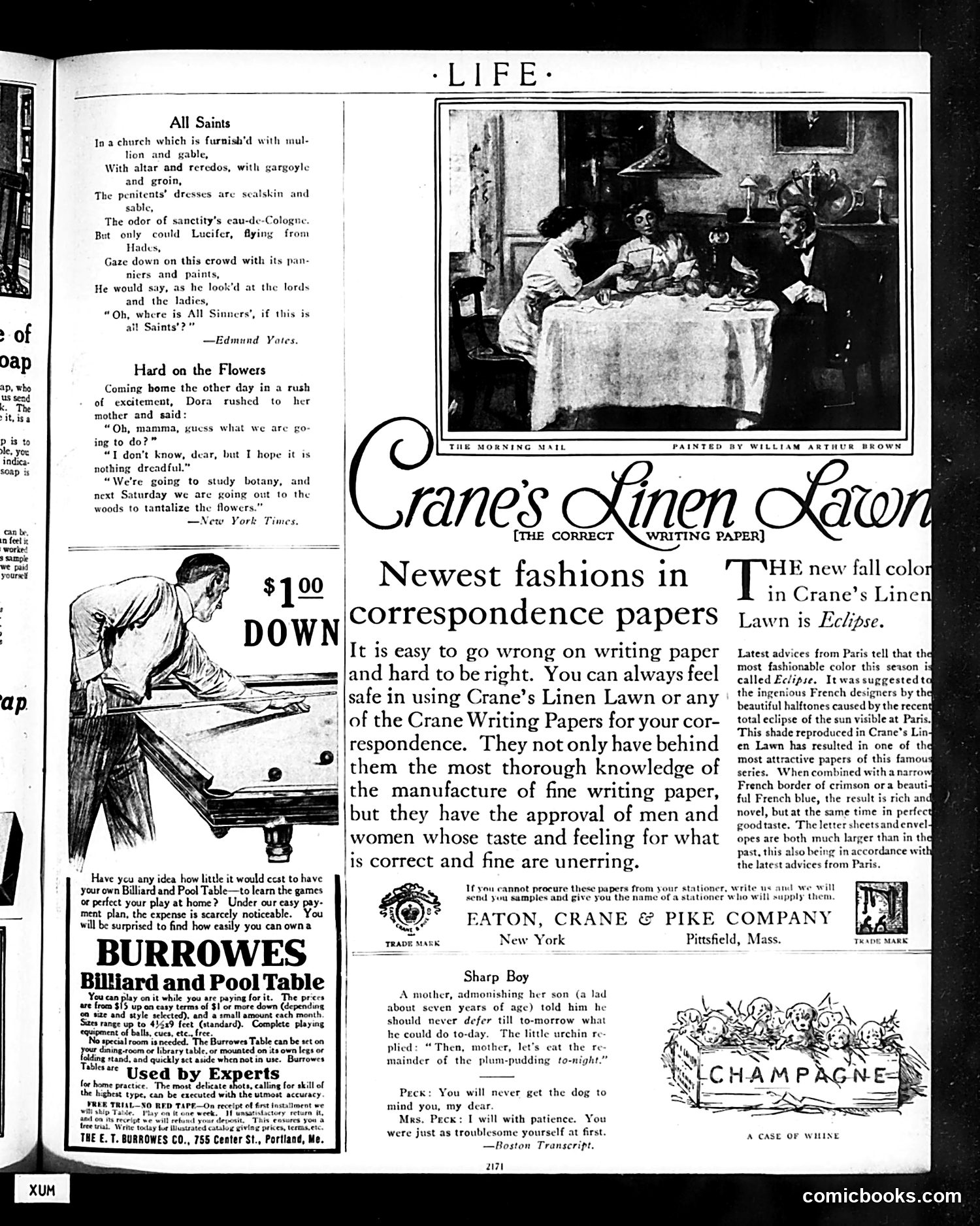
This page is primarily **advertising and light satirical content**, typical of Life magazine's format. **The satirical pieces** are brief, witty social commentary: - **"All Saints"** satirizes wealthy church-goers whose fine clothing (sealskin, sable, cologne) contradicts Christian virtue—Lucifer wouldn't recognize "sinners" among such fashionable, perfumed people. - **"Hard on the Flowers"** jokes about a child misusing the word "tantalize," suggesting they'll "study botany" but actually just bother flowers. - **"Sharp Boy"** uses a child's logic against his mother: if you shouldn't defer tasks, she should give him pudding now rather than save it for later. - **"A Case of Whine"** plays on words: a stubborn dog owner and her husband both being troublesome. These are **gentle social satire** mocking propriety, logic, and domestic manners—not political commentary. The bulk of the page is **product advertising** (Burrowes Pool Tables, Crane's Linen Lawn writing paper), making this essentially a **branded content vehicle** with entertainment filler.
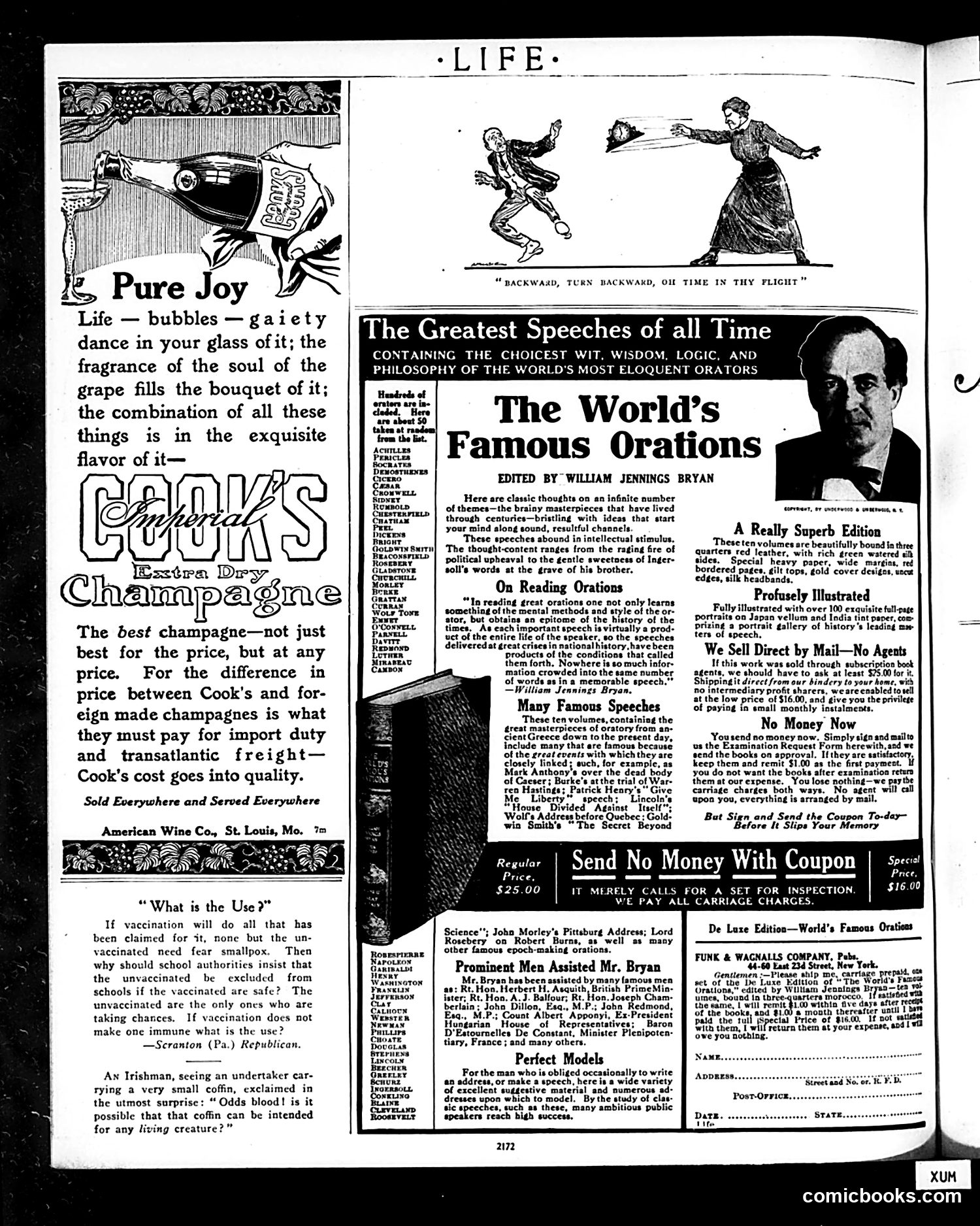
This page is primarily **advertising and book promotion**, not political satire. The main content advertises "The World's Famous Orations," a ten-volume set edited by William Jennings Bryan (visible in the portrait). The book collects speeches from history's great orators—from ancient Greece to the present day—including famous addresses like Mark Antony's funeral oration for Caesar and Burke's speech on the impeachment of Warren Hastings. The small cartoon at top shows a figure in period dress performing theatrical gestures, illustrating the dramatic nature of great oratory. The page also includes advertisements for Cook's champagne and brief humorous items (an Irish joke about a coffin, a vaccination debate). These are typical filler content for *Life* magazine of this era. **No specific political figures or events are satirized here**—this is a straightforward commercial promotion for a historical books collection aimed at educated readers interested in rhetoric and political philosophy.
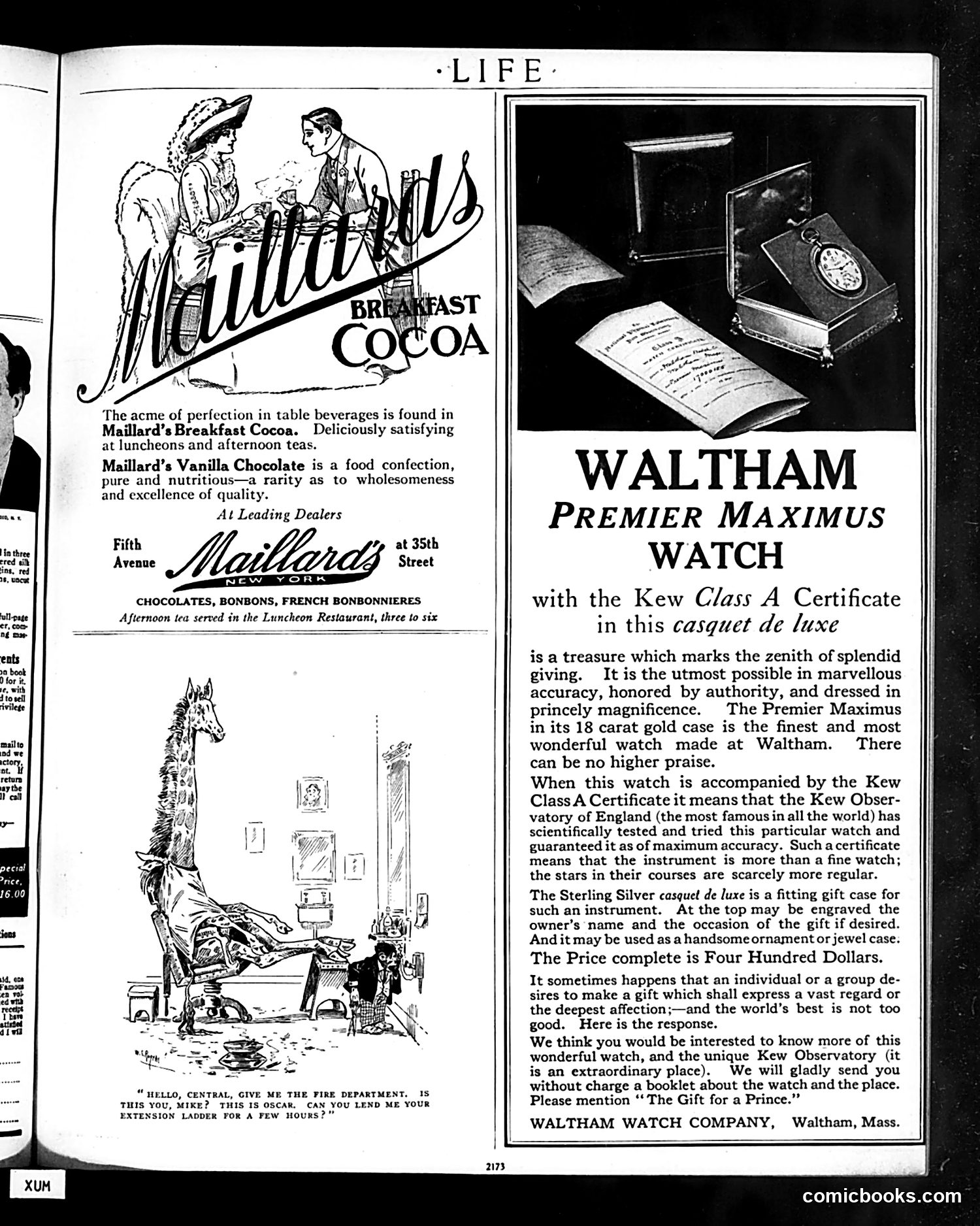
This page is primarily **advertising**, not satire or political commentary. It contains two luxury product advertisements from the early 20th century: **Left side:** Maillard's Breakfast Cocoa and chocolate confections, positioned as upscale refreshments for "luncheons and afternoon teas" at their Fifth Avenue shop in New York. **Right side:** A Waltham Premier Maximus watch in an 18-carat gold case ($400 complete)—presented as the ultimate luxury gift. The ad emphasizes its accuracy by referencing certification from England's Kew Observatory, appealing to wealthy gift-givers seeking to express "vast regard or deepest affection." **Bottom:** A small cartoon with a fire department phone gag (appears unrelated to the advertisements). Both ads target affluent early-1900s consumers through appeals to refinement, precision, and status. The language ("casquet de luxe," "princely magnificence") reflects the era's taste for French-influenced elegance among the wealthy.
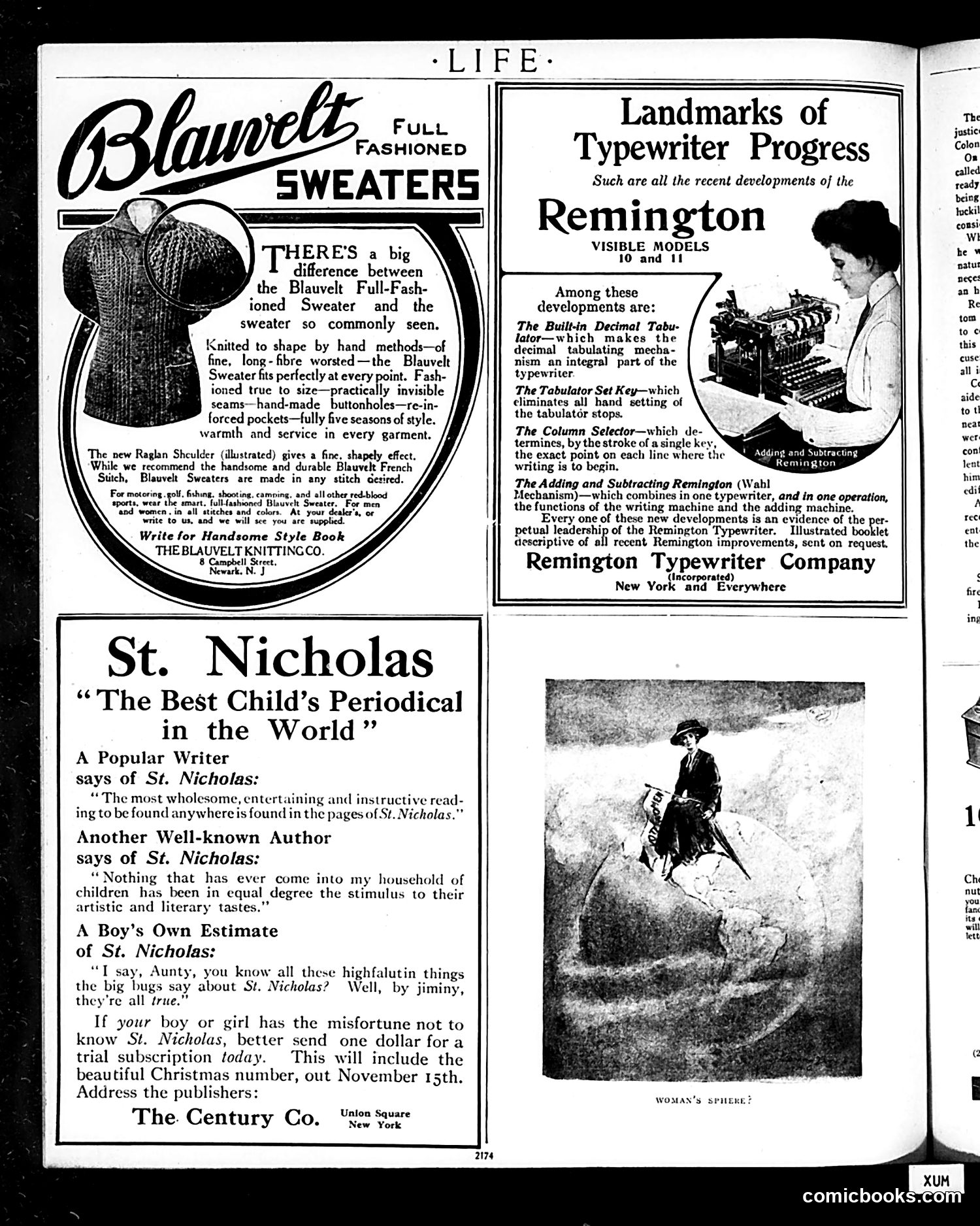
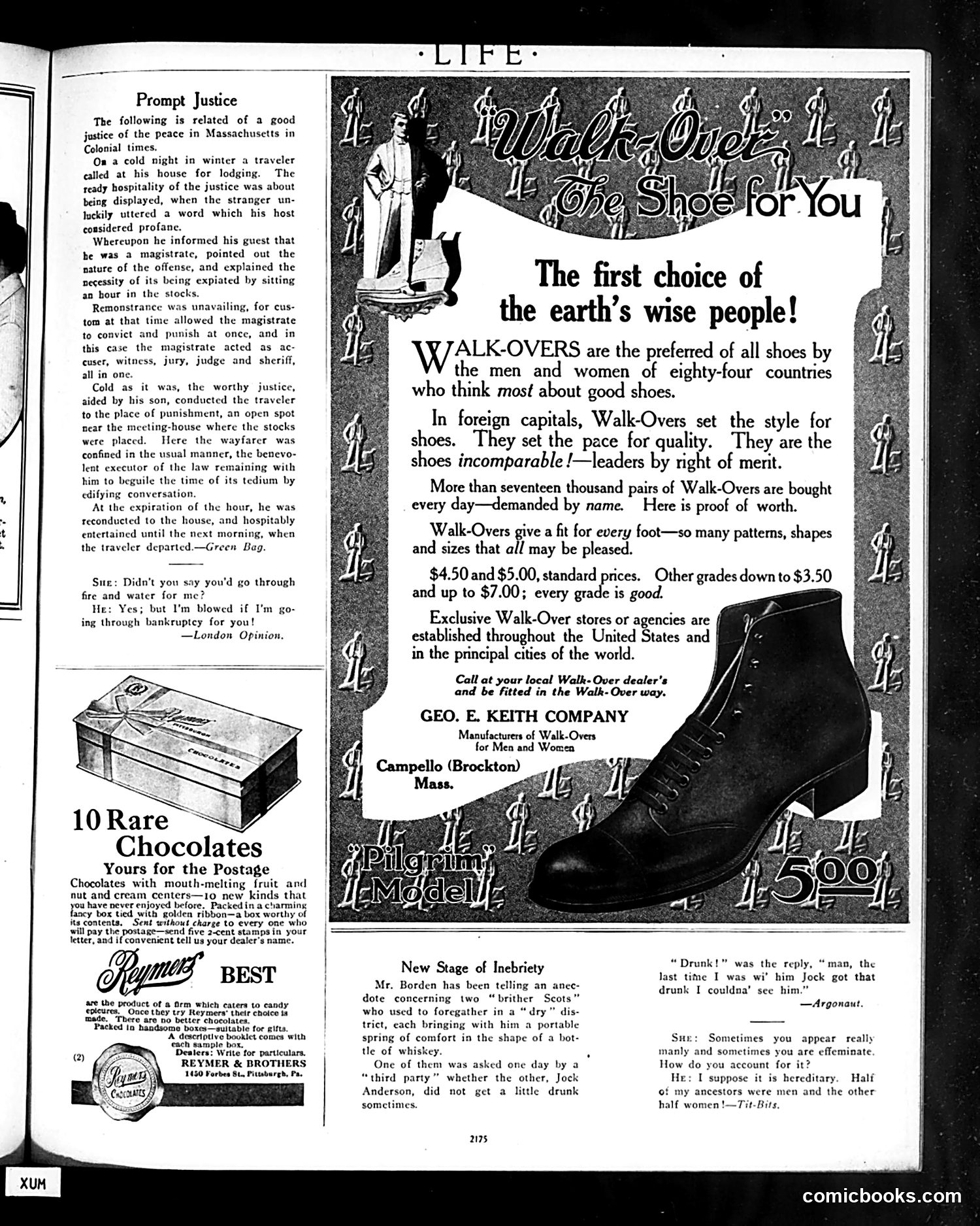
This page's main content is "Prompt Justice," a humorous anecdote from colonial Massachusetts. It satirizes early American magistrates' unchecked power: a traveling guest is punished for swearing by the same official who is simultaneously accuser, judge, jury, and sheriff—then hospitably entertained afterward by his punisher. The satire targets the absurdity of consolidated judicial authority with no checks or oversight. The magistrate's willingness to inflict punishment (stocks in freezing weather) while maintaining social courtesy illustrates how colonial justice prioritized order and decorum over proportional punishment or due process. The anecdote critiques a legal system where one person holds all power, making justice arbitrary rather than impartial. The humor derives from the contradiction between the severity of punishment and the casual, friendly treatment afterward—exposing how capricious colonial law could be.
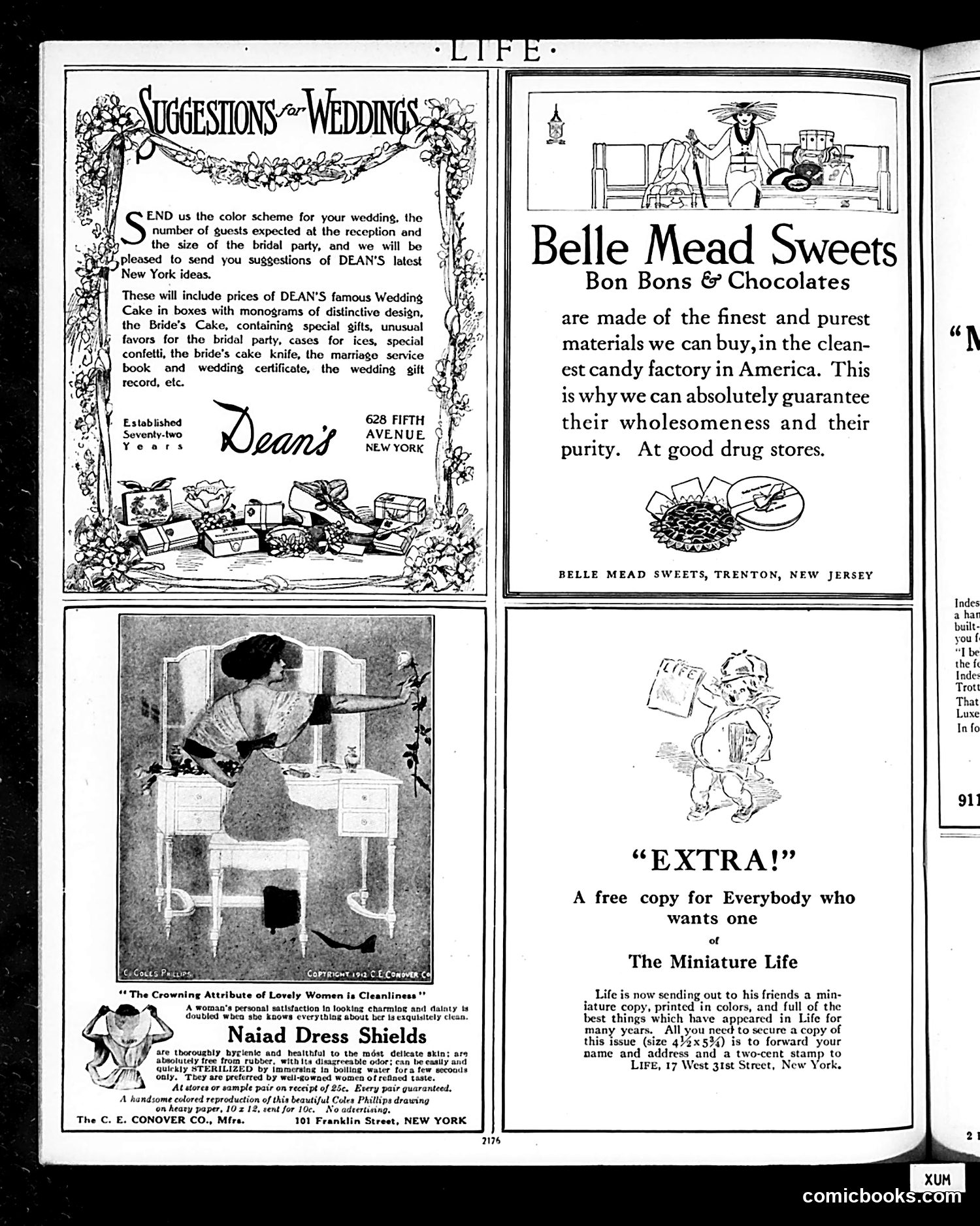
This is primarily an **advertising page** from Life magazine, containing four distinct ads rather than satirical content. **Key Advertisements:** 1. **Dean's Weddings** (top left): Offers customized wedding planning services, cakes with monograms, favors, and ceremonial items for bridal parties. 2. **Naiad Dress Shields** (bottom left): Promotes underarm protection products, emphasizing hygiene and cleanliness—a significant concern in the pre-deodorant era. Features a Coles Phillips illustration and plays on contemporary anxieties about feminine propriety and bodily discretion. 3. **Belle Mead Sweets** (top right): Candy manufacturer guarantees purity and wholesomeness, marketed through drugstores—common distribution for confections then. 4. **The Miniature Life** (bottom right): Life magazine's self-promotion offering a miniature promotional copy to readers. The page reflects early 20th-century consumer culture, emphasizing cleanliness, propriety, and quality assurances—common advertising themes of the era.
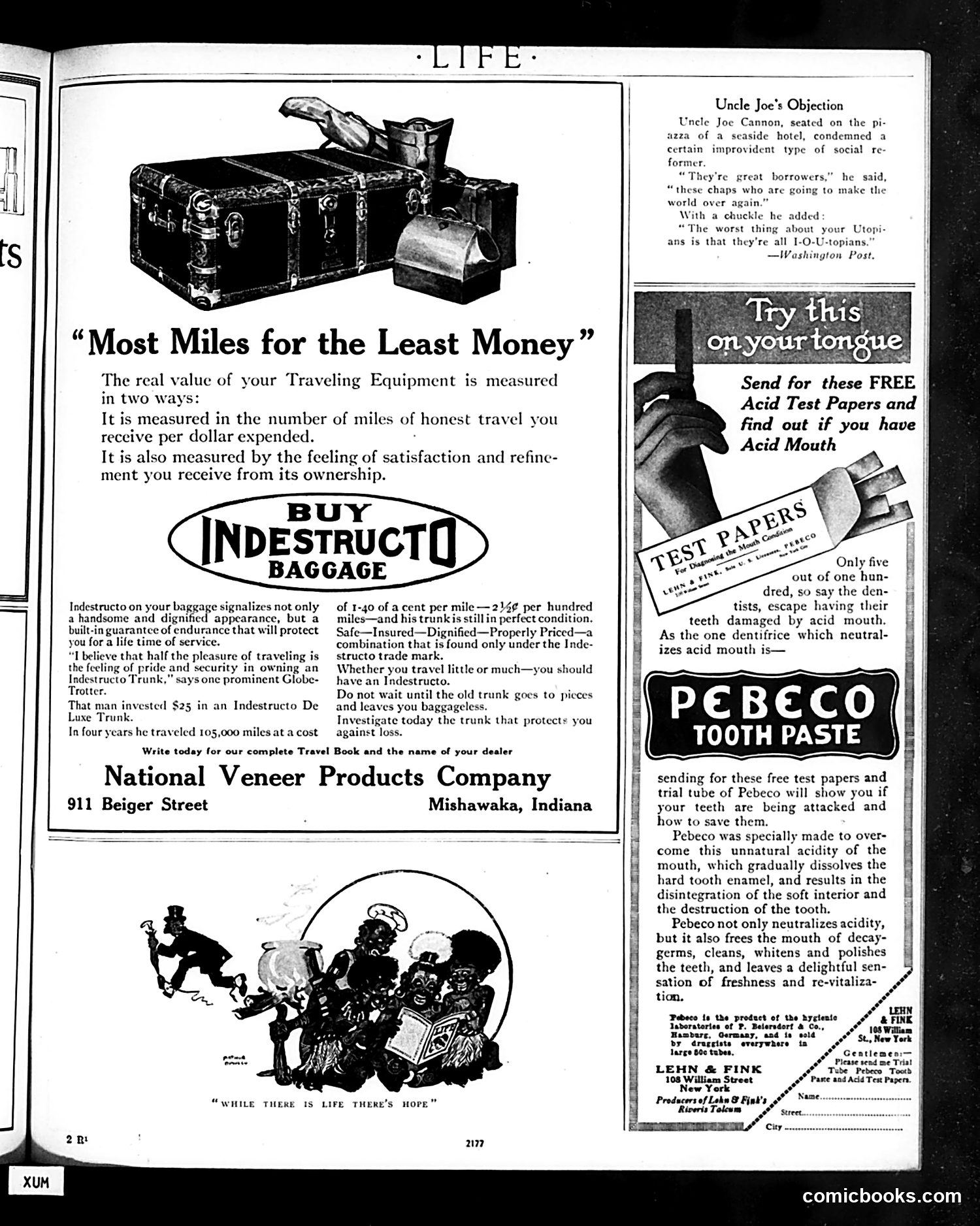
This page is primarily **advertising**, with one brief satirical item about a political figure. The main advertisement promotes **Indestructo baggage/trunks**, emphasizing durability and value for travelers. A second ad markets **Pebeco toothpaste**, claiming to neutralize "acid mouth" and offering free test papers. The satirical content is the small "Uncle Joe's Objection" piece, featuring **Uncle Joe Cannon** (a prominent Republican congressman), who mocks social reformers as "I-O-U-topians" rather than "Utopians"—a pun suggesting they're financial borrowers rather than genuine idealists. The Washington Post quote indicates this was contemporary political humor, likely targeting Progressive Era reformers whom conservative figures like Cannon viewed skeptically. The cartoon illustration below ("While There Is Life There's Hope") appears unrelated to the text above it.
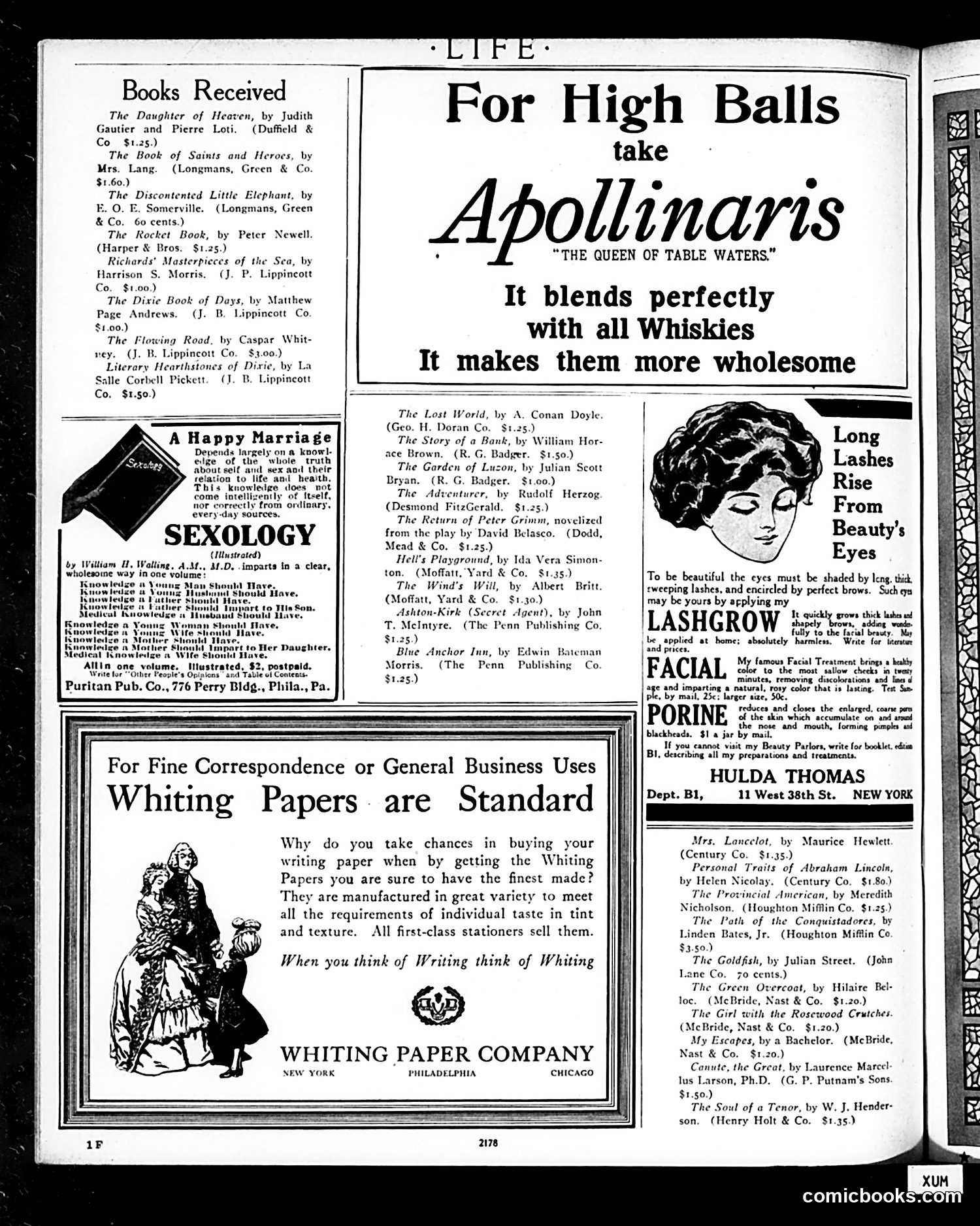
This is primarily a **book review and advertising page** with minimal satirical content. The page lists new book releases and includes several product advertisements typical of early 20th-century magazines. **Notable advertising includes:** - **Apollinaris water**: Marketed as improving whiskey consumption—reflecting the era's casual attitude toward alcohol - **"Sexology" book**: A frank illustrated guide to sex education by William H. Walling, M.D., emphasizing that marriage knowledge shouldn't rely on "ordinary, every-day sources"—indicating Victorian-era discomfort with sex education - **Whiting Papers**: Standard writing paper with conventional marketing copy - **Beauty products**: "Lashgrow" and facial treatments by Hulda Thomas, promising dramatic cosmetic results—typical of early beauty industry advertising with exaggerated claims **Social context:** The page reflects Edwardian/early modern attitudes toward propriety, consumerism, and emerging discussions about sex education. No specific political satire or cartoon figures are present.
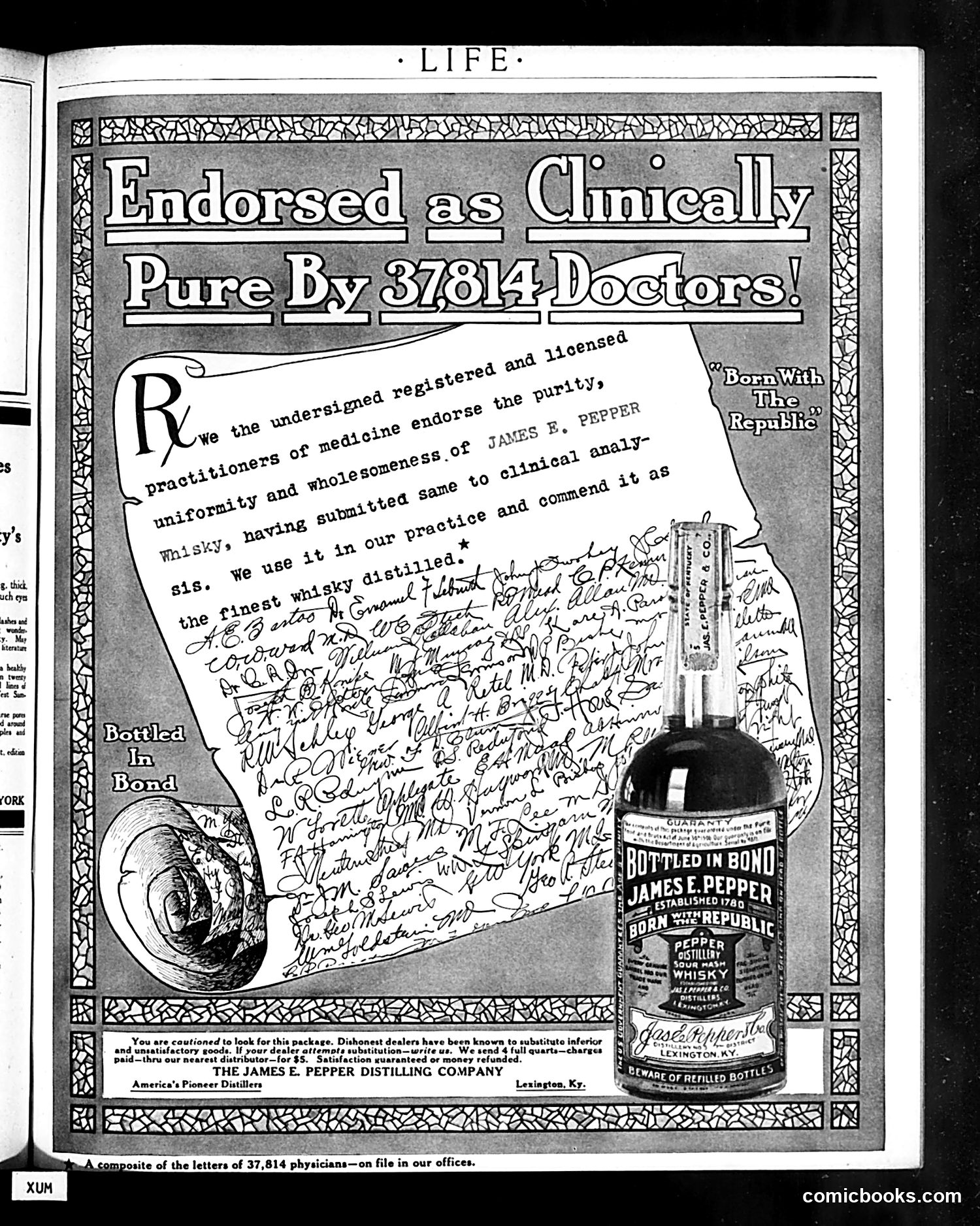
This is a **whiskey advertisement**, not a political cartoon. It promotes James E. Pepper bourbon, claiming endorsement by 37,814 doctors who attest to its "clinical purity." The ad exploits Prohibition-era marketing tactics: doctors could legally prescribe whiskey for medicinal purposes, so distillers fabricated medical endorsements to bypass alcohol sales bans. The document shown is supposedly a composite of physicians' letters endorsing the product. The "Born With The Republic" tagline references the company's founding in 1780, suggesting patriotic legitimacy. A warning about counterfeit bottles indicates black-market whiskey was common. **For modern readers**: This reveals how businesses used fraudulent doctor endorsements and exploited legal loopholes during Prohibition (1920-1933) to sell alcohol as "medicine"—a scam now instantly recognizable but apparently persuasive propaganda then.
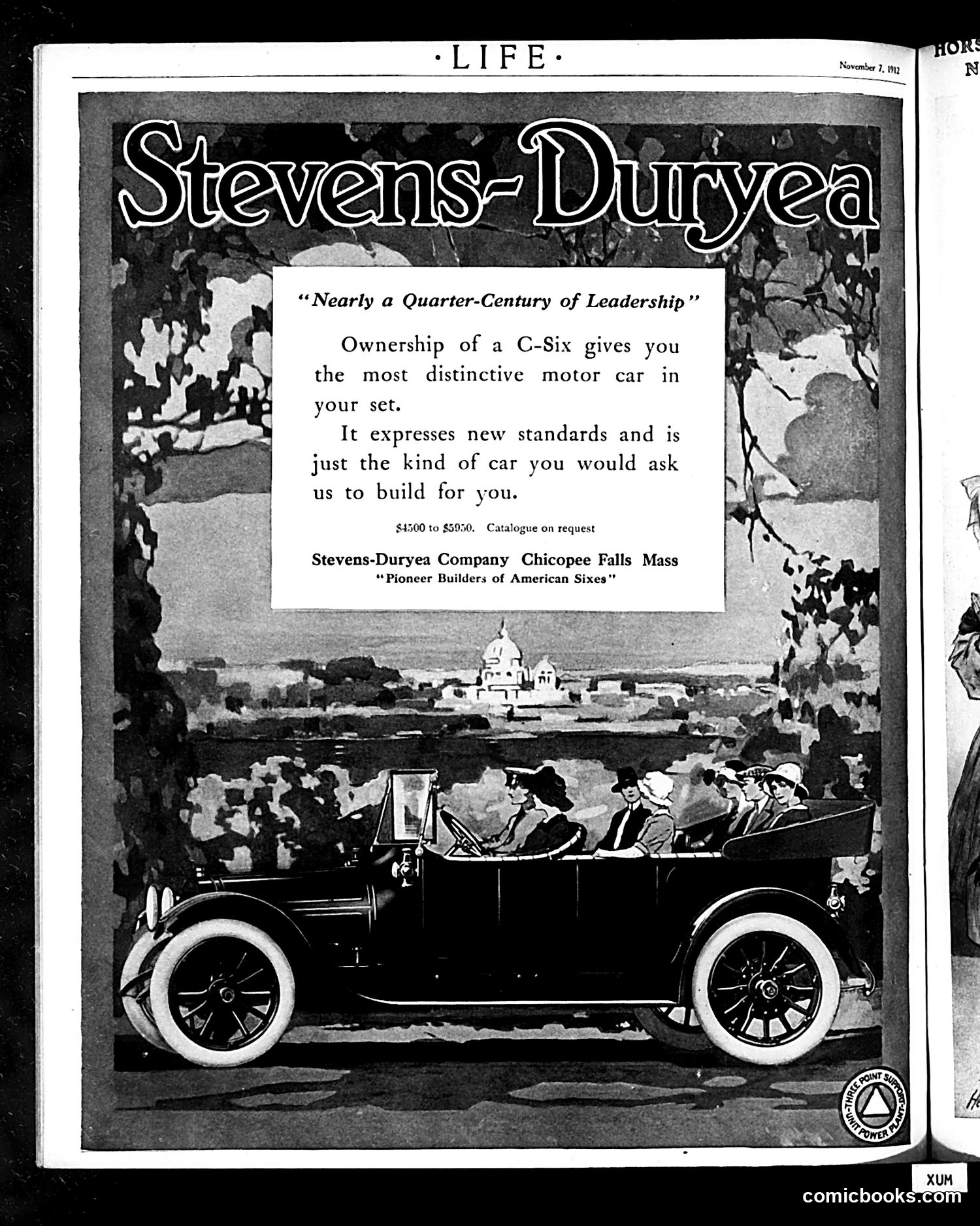
This is a **automobile advertisement**, not political satire. It promotes the Stevens-Duryea C-Six motorcar, manufactured in Chicopee Falls, Massachusetts. The ad claims "Nearly a Quarter-Century of Leadership" in automotive design. The image shows a luxury car with well-dressed passengers (appearing to be upper-class figures) driving through an idealized American landscape, with a capitol building visible in the background. The advertisement emphasizes exclusivity and social status—ownership signals membership in an elite "set." The price range ($4,500-$5,950) indicates this was a high-end vehicle. The tagline "Pioneer Builders of American Sixes" references the car's six-cylinder engine, then a modern feature. This is straightforward commercial advertising rather than satirical commentary.