
Life, 1912-11-07 · page 32 of 60
Life — November 7, 1912 — page 32: what you’re looking at
What you’re looking at
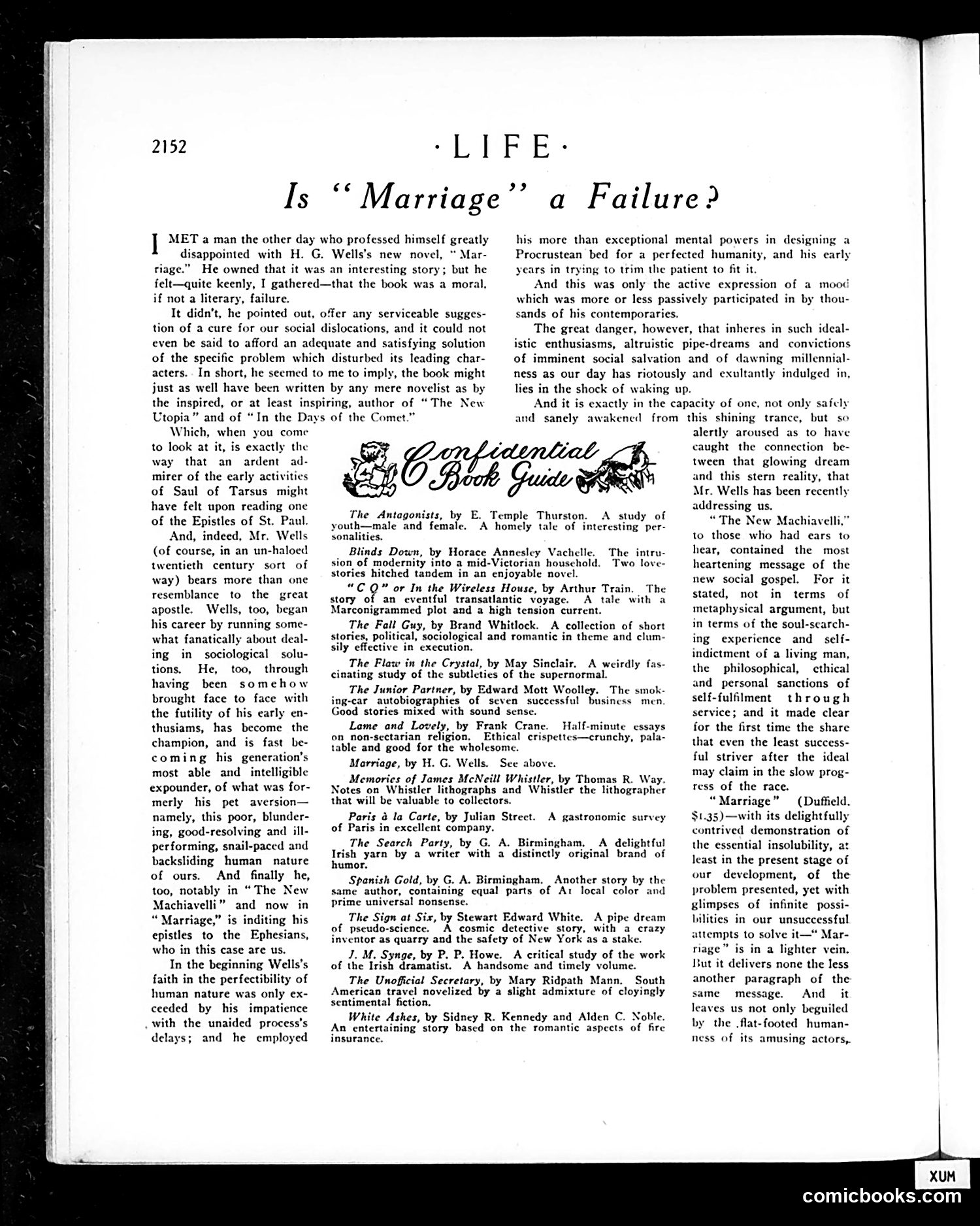
This is a literary essay reviewing H.G. Wells's novel *Marriage*. The author describes meeting a man disappointed that Wells's book, while interesting, failed to offer practical solutions to social problems or character dilemmas—essentially, that it lacked moral utility. The satire compares Wells to Saint Paul: both began as zealous reformers pushing idealistic solutions, then shifted toward accepting human nature's flawed reality. Wells's early works (*The New Utopia*, *In the Days of the Comet*) promoted utopian visions; his later works like *The New Machiavelli* and *Marriage* acknowledge human limitations. The essay warns that idealistic movements of the era—with their "pipe-dreams" of social salvation and millennial reform—face a dangerous "shock of waking up" to reality's resistance. The page also includes a "Confidential Book Guide" listing contemporary novels, anchoring this in early 20th-century literary discourse about whether fiction should serve didactic or purely narrative purposes.
📄 Transcribed text from this page (OCR, searchable)
Machine-transcribed from the original scan — historical spelling and the odd misread are preserved.
MET a man the other day who professed himself greatly disappointed with H. G. Wells's new novel, “ Mar- riage.” He owned that it was an interesting story; but he felt—quite keenly, I gathered—that the book was a moral, if not a literary, failure. It didn’t, he pointed out, offer any serviceable sugges- tion of a cure for our social dislocations, and it could not even be said to afford an adequate and satisfying solution of the specific problem which disturbed its leading char- acters. In short, he seemed to me to imply, the book might just as well have been written by any mere novelist as by ‘LTPP E> Is ‘* Marriage”’ a Failure? his more than exceptional mental powers in designing a Procrustean bed for a perfected humanity, and his early years in trying to trim the patient to fit it. And this was only the active expression of a mood which was more or less passively participated in by thou- sands of his contemporaries. The great danger, however, that inheres in such ideal- istic enthusiasms, altruistic pipe-dreams and convictions of imminent social salvation and of dawning millennial- ness as our day has riotously and exultantly indulged in, lies in the shock of waking up. the inspired, or at least inspiring, author of “The New Utopia” and of “In the Days of the Comet.” Which, when you come to look at it, is exactly the way that an ardent ad- mirer of the early activities of Saul of Tarsus might have felt upon reading one of the Epistles of St. Paul. And, indeed, Mr. Wells (of course, in an un-haloed twentieth century sort of way) bears more than one resemblance to the great apostle. Wells, too, began his career by running some- what fanatically about deal- ing in sociological solu- tions. He, too, through having been somehow brought face to face with the futility of his early en- thusiams, has become the champion, and is fast be- coming his generation’s most able and_ intelligible expounder, of what was for- merly his pet aversion— namely, this poor, blunder- ing, good-resolving and ill- performing, snail-paced and backsliding human nature of ours. And finally he, too, notably in “The New Machiavelli” and now in “Marriage,” is inditing his epistles to the Ephesians, who in this case are us. In the beginning Wells's faith in the perfectibility of human nature was only ex- ceeded by his impatience . with the unaided process's delays; and he employed And it is exact! NOB Ga fe The Antagonists, by E. Temple Thurston. A study of youth—male and female. A homely tale of interesting per- sonalities. _ Blinds Down, by Horace Annesley Vachelle. The intru- sion of modernity into a mid-Victorian houschold. Two love- stories hitched tandem in an enjoyable novel. “CQ” or In the Wireless House, by Arthur Train. The story of an cventful transatlantic voyage. A tale with a Marconigrammed plot and a high tension current. The Fall Guy, by Brand Whitlock. A collection of short stories, political, sociological and romantic in theme and clum- sily effective in’ execution. The Flaw in the Crystal, by May Sinclair, A weirdly fas- cinating study of the subtleties of the supernormal. The Junior Partner, by Edward Mott Woolley. The smok- ing-car autobiographies of seven successful business men. Good stories mixed with sound sense. Lame and Lovely, by Frank Crane. Half-minute essays on non-sectarian religion, Ethical crispettes—crunchy, pala- table and good for the wholesome. Marriage, by H. G. Wells. See above. Memories of James McNeill Whistler, by Thomas R. Way. Notes on Whistler lithographs and Whistler the lithographer that will be valuable to collectors. Paris & la Carte, by Julian Strect. A gastronomic survey of Paris in excellent company. The Search Party, by G. A. Birmingham. A delightful Irish yarn by a writer with a distinctly original brand of humor. Spanish Gold, by G. A. Birmingham. Another story by the same author, containing equal parts of Ar local color and prime universal nonsense. The Sign at Six, by Stewart Edward White. A pipe dream of pseudo-science. A cosmic detective story, with a crazy inventor as quarry and the safety of New York’as a stake. J. M. Synge, by P. P. Howe. A critical study of the work of the Irish dramatist. A handsome and timely volume. The Unofficial Secretary, by Mary Ridpath Mann. South American travel novelized by a slight admixture of cloyingly sentimental fiction, White Ashes, by Sidney R. Kennedy and Alden C. Noble. An entert: g story based on the romantic aspects of fire insurance. y in the capa and sanely awakened from th y of one, not only safely s shining trance, but so alertly aroused as to have caught the connection be- tween that glowing dream and this stern reality, that Mr. Wells has been recently addressing us. “The New Machiavelli,” to those who had ears to hear, contained the most heartening message of the new social gospel. For it stated, not in terms of metaphysical argument, but in terms of the soul-search- ing experience and self- indictment of a living man, the philosophical, cthical and personal sanctions of self-fulflment through service; and it made clear for the first time the share that even the least success- ful striver after the ideal may claim in the slow prog- ress of the race. “Marriage” (Duffield. 5)—with its delightfully contrived demonstration of the essential insolubility, at least in the present stage of our development, of the problem presented, yet with glimpses of infinite possi- ities in our unsuccessful attempts to solve it—* Mar- riage” is in a lighter vein. Lut it delivers none the less another paragraph of the same message. And it leaves us not only beguiled by the . flat-footed human- ness of its amusing actors, St. comicbooks.com