
Life, 1912-11-07 · page 17 of 60
Life — November 7, 1912 — page 17: what you’re looking at
What you’re looking at
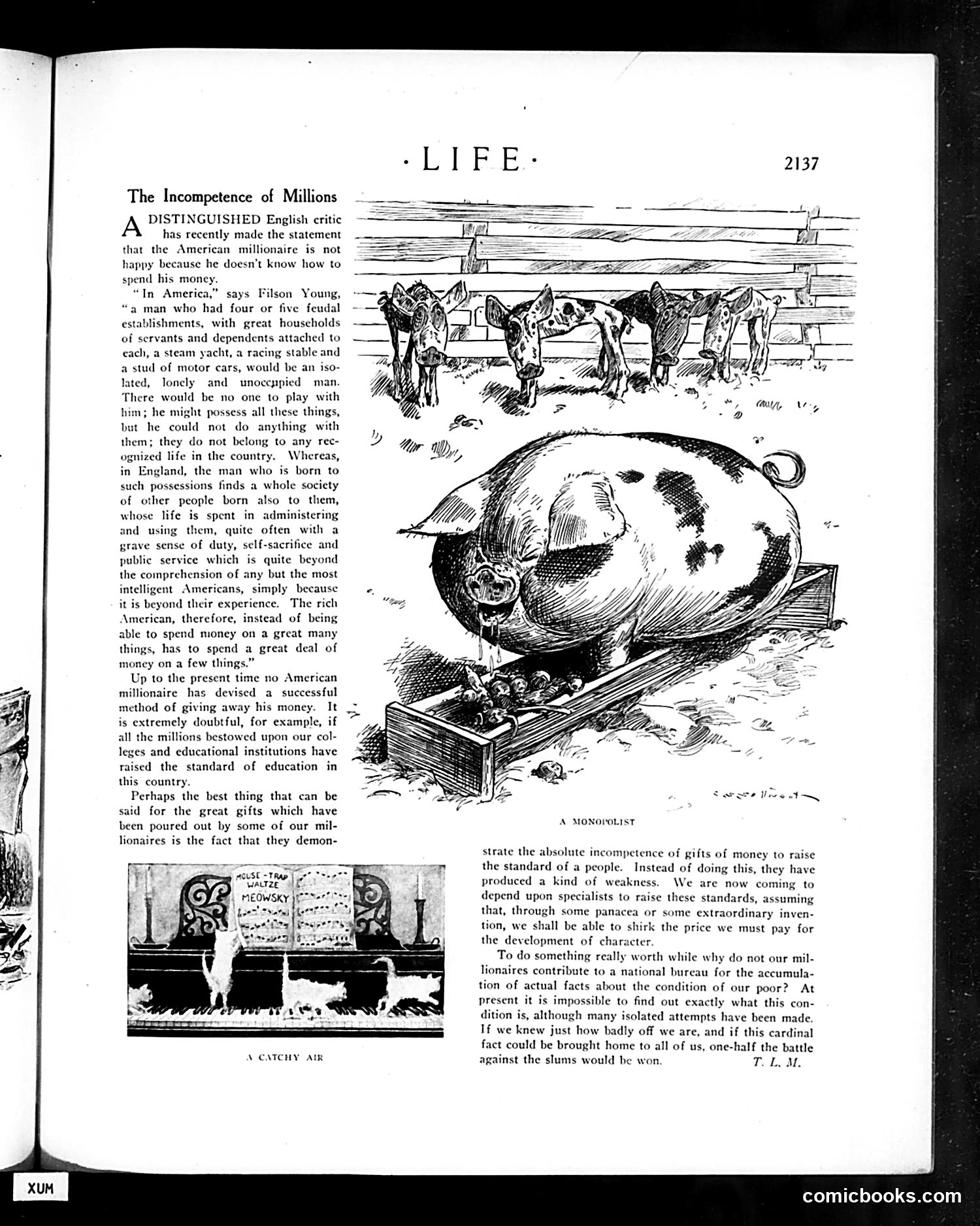
This satirical article critiques American millionaires' inability to spend wealth meaningfully. Drawing on English critic Filson Young's observation, the author argues that American industrialists lack the social infrastructure of European aristocrats—there's no established "society" of dependents and institutions to absorb their spending, leaving them isolated and purposeless despite vast wealth. The two cartoons illustrate the theme: "A Monopolist" shows a bloated plutocrat crushing workers beneath him, and "A Catchy Air" (bottom left, unclear in detail) appears to comment on superficial culture. The article's main point: American philanthropic donations to colleges haven't improved education because money alone cannot develop character or culture. The author proposes instead that millionaires fund research into poverty conditions—suggesting that knowledge and exposure to the poor's actual suffering would more effectively motivate social reform than charitable giving alone.
📄 Transcribed text from this page (OCR, searchable)
Machine-transcribed from the original scan — historical spelling and the odd misread are preserved.
The Incompetence of Millions DISTINGUISHED English critic has recently made the statement that the American millionaire is not happy because he doesn’t know how to spend his money. “In America,” says Filson Young, “a man who had four or five feudal establishments, with great houscholds of servants and dependents attached to each, a steam yacht, a racing stable and a stud of motor cars, would be an iso- lated, lonely and unoceppied man. There would be no one to play with him; he might possess all these things, but he could not do anything with them; they do not belong to any rec- ognized life in the countr; Whereas, in England, the man who is born to such possessions finds a whole society of other people born also to them, whose life is spent in administering and using them, quite often with a grave sense of duty, self-sacrifice and public service which is quite beyond the comprehension of any but the most intelligent: Americans, simply because it is beyond their experience. The rich American, therefore, instead of being able to spend money on a great many things, has to spend a great deal of money on a few things.” Up to the present time no American millionaire has devised a successful method of giving away his money. It is extremely doubtful, for example, if all the millions bestowed upon our col- leges and educational institutions have raised the standard of education in this country. Perhaps the best thing that can be said for the great gifts which have been poured out by some of our mil- lionaires is the fact that they demon- \ CATCHY AIR A MONOVOLIST strate the absolute incompetence of gifts of money to raise the standard of a people. Instead of doing this, they have produced a kind of weakness. We are now coming to depend upon specialists to raise these standards, assuming that, through some panace s ¢ extraordinary inven- tion, we shall be able to shirk the price we must pay for the development of chara To do something really worth while why do not our mil- lionaires contribute to a national bureau for the accumula- tion of actual facts about the condition of our poor? At Present it is impossible to find out exactly what this con- dition is, although many isolated attempts have been made. If we knew just how badly off we are, and if this cardinal fact could be brought home to all of us, one-half the battle against the slums would be won. T. L. M. comicbooks.com