
Life, 1912-11-07 · page 19 of 60
Life — November 7, 1912 — page 19: what you’re looking at
What you’re looking at
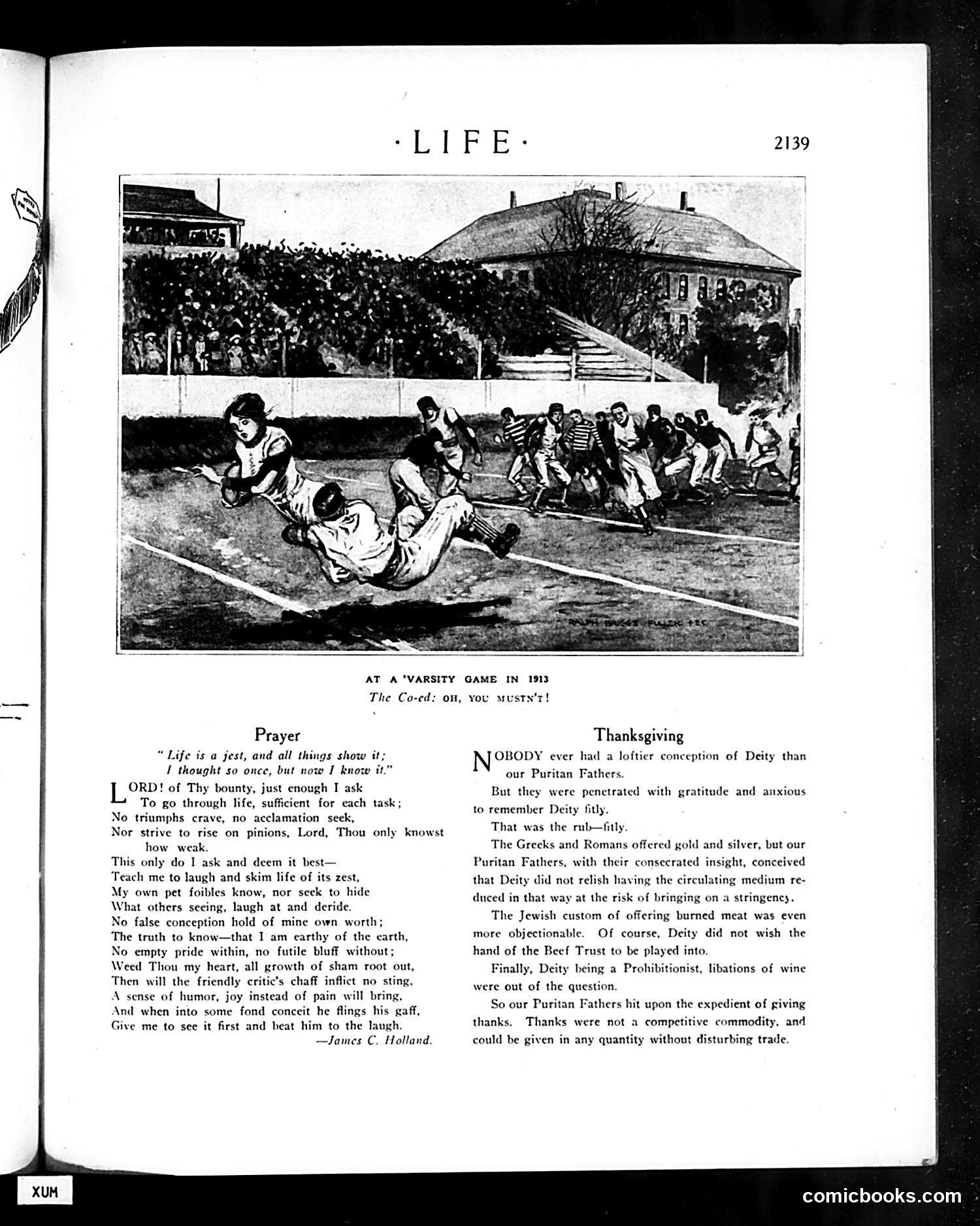
This page contains two distinct pieces of satire: **The Baseball Photograph**: Captioned "At a 'Varsity Game in 1913—The Co-ed: on, you mustn't!" This references the social controversy over women attending college sporting events and their changing role in American society. The co-ed's presence and the implied impropriety of her attendance reflects early 20th-century anxiety about women's independence and participation in public life. **"Thanksgiving" Essay**: This satirizes Puritan religious hypocrisy. The author mockingly suggests that Puritans avoided expensive offerings (gold, meat sacrifices, wine) to God not from piety but to protect economic interests—avoiding currency depletion and the "Beef Trust." The satire implies that Puritan "thanksgiving" was actually a self-interested compromise disguised as religious principle. It's a cynical commentary on how financial concerns masked themselves as moral conviction. Both pieces mock social pretense and institutional contradictions of the era.
📄 Transcribed text from this page (OCR, searchable)
Machine-transcribed from the original scan — historical spelling and the odd misread are preserved.
AT A ‘VARSITY GAME IN 1913 The Co-ed: on, you musty’t! Prayer “ Life is a jest, and all things show it; I thought so once, but now I know it.” ORD! of Thy bounty, just enough I ask To go through life, sufficient for each task; No triumphs crave, no acclamation seek, Nor strive to rise on pinions, Lord, Thou only knowst how weak. This only do I ask and deem it best— Teach me to laugh and skim life of its zest, My own pet foibles know, nor seck to hide What others seeing, laugh at and deride. No false conception hold of mine own worth; The truth to know—that I am earthy of the carth, No empty pride within, no futile bluff without; Weed Thou my heart, all growth of sham root out, Then will the friendly critic’s chaff inflict no sting, A sense of humor, joy instead of pain will bring, And when into some fond conceit he flings his gaff, Give me to see it first and beat him to the laugh. —James C. Holland. Thanksgiving OBODY ever had a loftier conception of Deity than our Puritan Fathers. But they were penetrated with gratitude and anxious to remember Deity fitly. That was the rub—fitly. The Greeks and Romans offered gold and silver, but our Puritan Fathers, with their consecrated insight, conceived that Deity did not relish having the circulating medium re- duced in that way at the risk of bringing on a stringency. The Jewish custom of offering burned meat was even more objectionable. Of course, Deity did not wish the hand of the Beef Trust to be played into. inally, Deity being a Prohibitionist, libations of wine were out of the question. So our Puritan Fathers hit upon the expedient of giving thanks. Thanks were not a competitive commodity, and could be given in any quantity without disturbing trade. comicbooks.com