
Life, 1912-11-07 · page 28 of 60
Life — November 7, 1912 — page 28: what you’re looking at
What you’re looking at
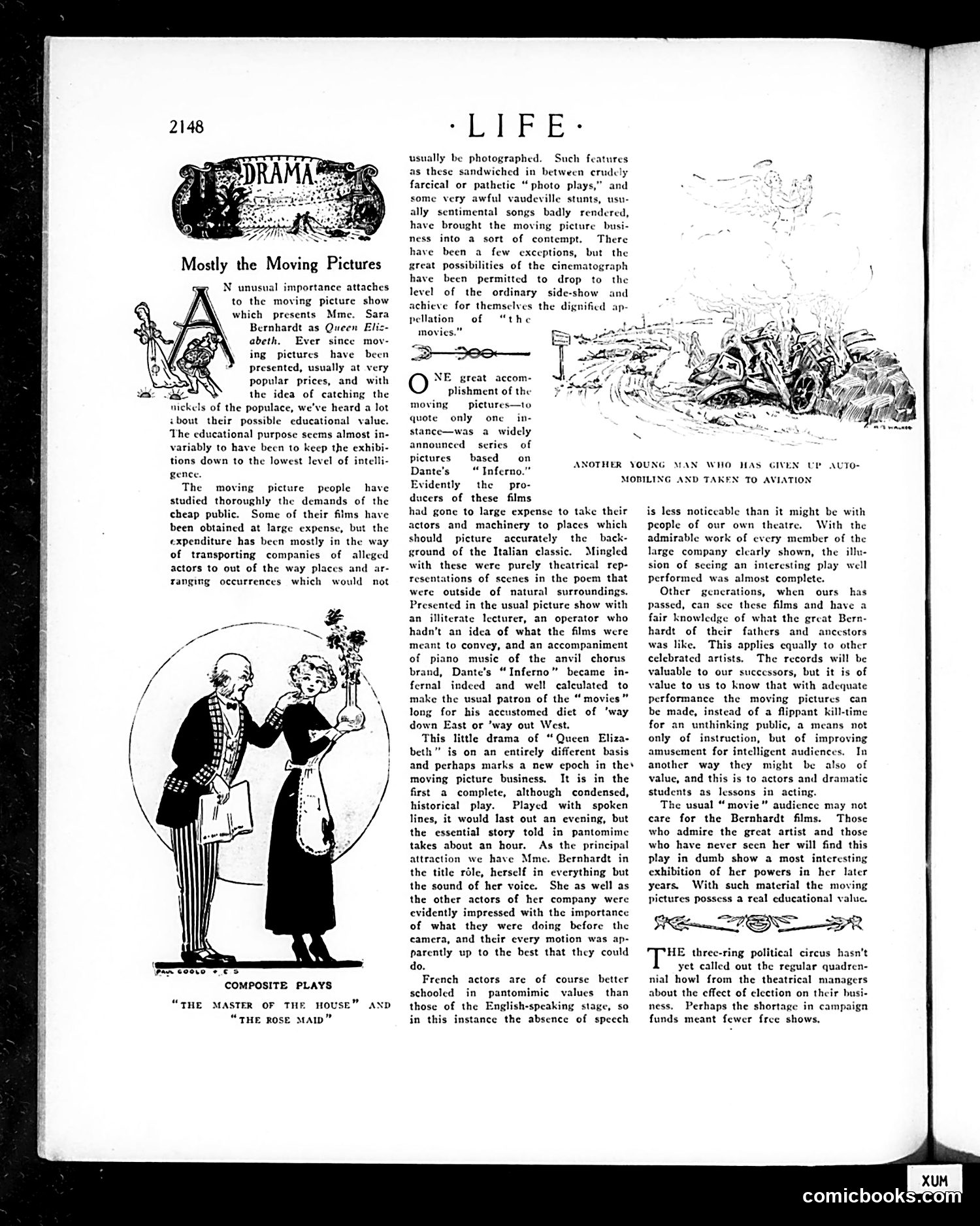
This page discusses early cinema's artistic potential and mediocrity. The article celebrates a film featuring French actress Sarah Bernhardt playing Queen Elizabeth—noting it marks a turning point because it's a serious historical drama performed by trained theatrical actors, rather than cheap entertainment. The critique targets American moving picture producers who exploit "the demands of the cheap public" with poorly made films featuring crude comedy, bad vaudeville, and transported actors performing in random locations for spectacle rather than art. A prior example—a film adaptation of Dante's *Inferno*—is mocked as "infernal" when presented in typical nickelodeons with illiterate lecturers and anvil-chorus piano accompaniment. The Bernhardt film's superiority lies in its serious intent, trained pantomime (crucial since these are silent films), and cultural preservation value. The cartoons show theatrical performers, likely illustrating the contrast between dignified drama and lowbrow entertainment that dominated early cinema.
📄 Transcribed text from this page (OCR, searchable)
Machine-transcribed from the original scan — historical spelling and the odd misread are preserved.
Mostly the Moving Pictures N unusual importance attaches to the moving picture show which presents Mme. Sara Bernhardt as Queen Eliz abeth. Ever since mov ing pictures have been presented, usually at very popular prices, and with the idea of catching the nickels of the populace, we've heard a lot ibout their possible educational value. The educational purpose seems almost in- variably to have becn to keep the exhibi- tions down to the lowest level of intelli- gence. The moving picture people have studied thoroughly the demands of the cheap public. Some of their films have been obtained at large expense, but the expenditure has been mostly in the way of transporting companies of alleged actors to out of the way places and ar- ranging occurrences which would not Paw coco + 6 5 COMPOSITE PLAYS “THE MASTER OF THE HOUSE” AND “THE ROSE MAID” “LTP E* usually be photographed. Such features as these sandwiched in between crudely farcical or pathetic “ photo plays,” and some very awful vaudeville stunts, usu- ally sentimental songs badly rendered, have brought the moving picture busi- ness into a sort of contempt. There have been a few exceptions, but the great possibilities of the cinematograph have been permitted to drop to the level of the ordinary side-show and achieve for themselves the di pellation of “the movies.” O NE great accom- plishment of the moving — pictures—to quote only one in- stance—was a widely announced pictures based on Dante's “Inferno.” Evidently the — pro- ducers of these films had gone to large expense to take their actors and machinery to places which should picture accurately the back- ground of the Italian classic. Mingled with these were purcly theatrical rep- resentations of scenes in the poem that were outside of natural surroundings. Presented in the usual picture show with an illiterate Iccturer, an operator who hadn't an idea of what the films were meant to convey, and an accompaniment of piano music of the anvil chorus brand, Dante's “Inferno” became in- fernal indeed and well calculated to make the usual patron of the “ movies” long for his accustomed diet of ‘way down East or ‘way out West. This little drama of “Queen Eliza- beth” is on an entirely different basis and perhaps marks a new epoch in the moving picture business, It is in the first a complete, although condensed, historical play. Played with spoken lines, it would last out an evening, but the essential story told in pantomime takes about an hour. As the principal attraction we have Mme. Bernhardt in the title rdle, herself in everything but the sound of her voice. She as well as the other actors of her company were evidently impressed with the importance of what they were doing before the camera, and their every motion was ap- parently up to the best that they could do. French actors are of course better schooled in pantomimic values than those of the English-speaking stage, so in this instance the absence of speech series of ANOTHER YOUNG MAN WHO MAS GIVEN UP AUTO- MOBILING AND TAKEN TO AVIATION is less noticcable than it might be with people of our own theatre. With the admirable work of every member of the large company clearly shown, the illu sion of sccing an interesting play well performed was almost complete. Other gencrations, when ours has passed, can sce these films and have a fair knowledge of what the great Bern- hardt of their fathers and ancestors was like. This applies equally to other celebrated artists. The records will be valuable to our successors, but it is of value to us to know that with adequate performance the moving pictures can be made, instead of a flippant kill-time for an unthinking public, a means not only of instruction, but of improving amusement for intelligent audiences. In another way they might be also of value, and this is to actors and dramatic students as lessons in acting. The usual “ movie" audience may not care for the Bernhardt films. Those who admire the great artist and those who have never seen her will find this play in dumb show a most interesting exhibition of her powers in her later years, With such material the moving pictures possess a real educational valuc. HE three-ring political circus hasn't yet called out the regular quadren- nial howl from the theatrical managers about the effect of election on their busi- ness. Perhaps the shortage in campaign funds meant fewer free shows, comicbook $.co