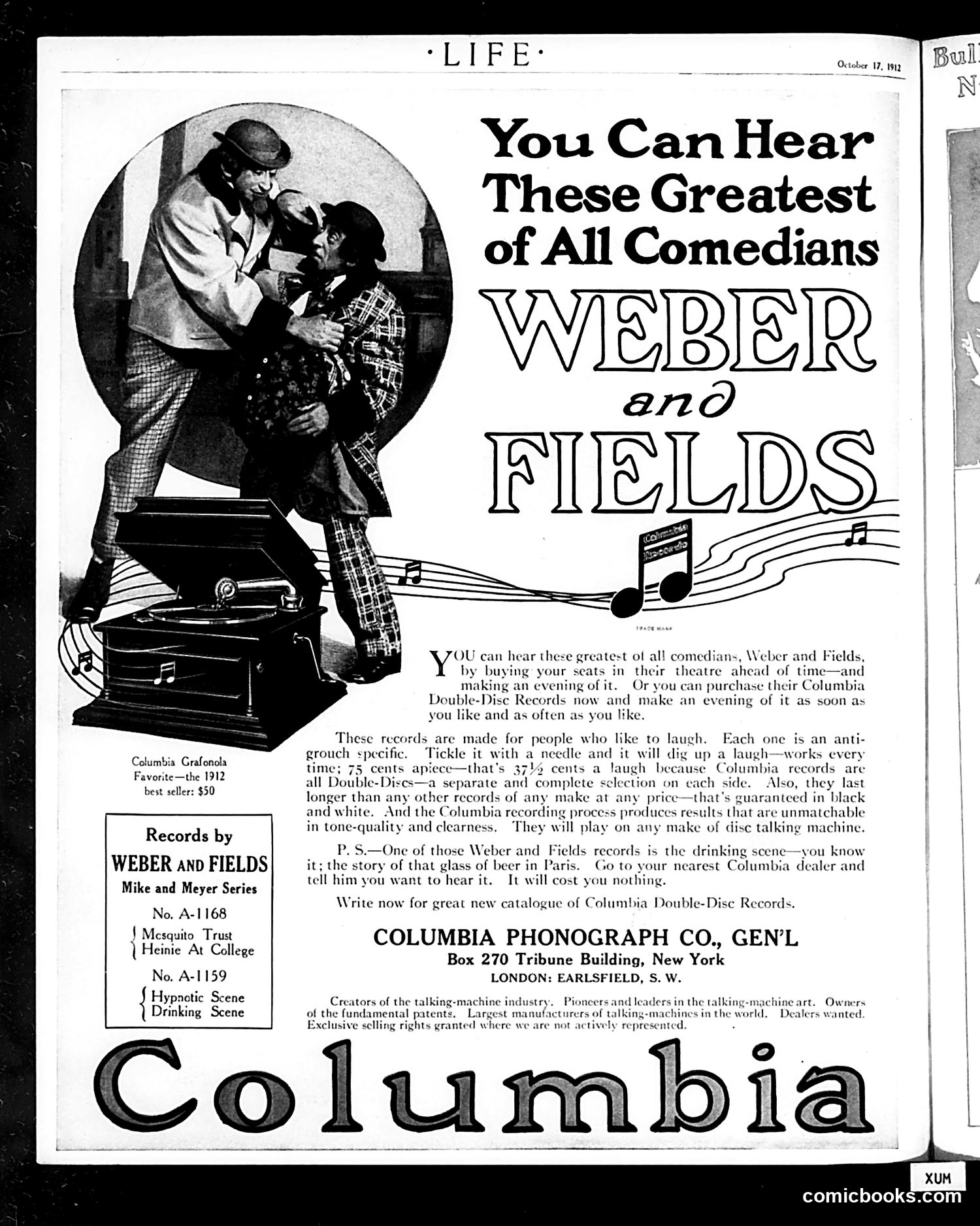
A complete issue · 44 pages · 1912
Life — October 17, 1912
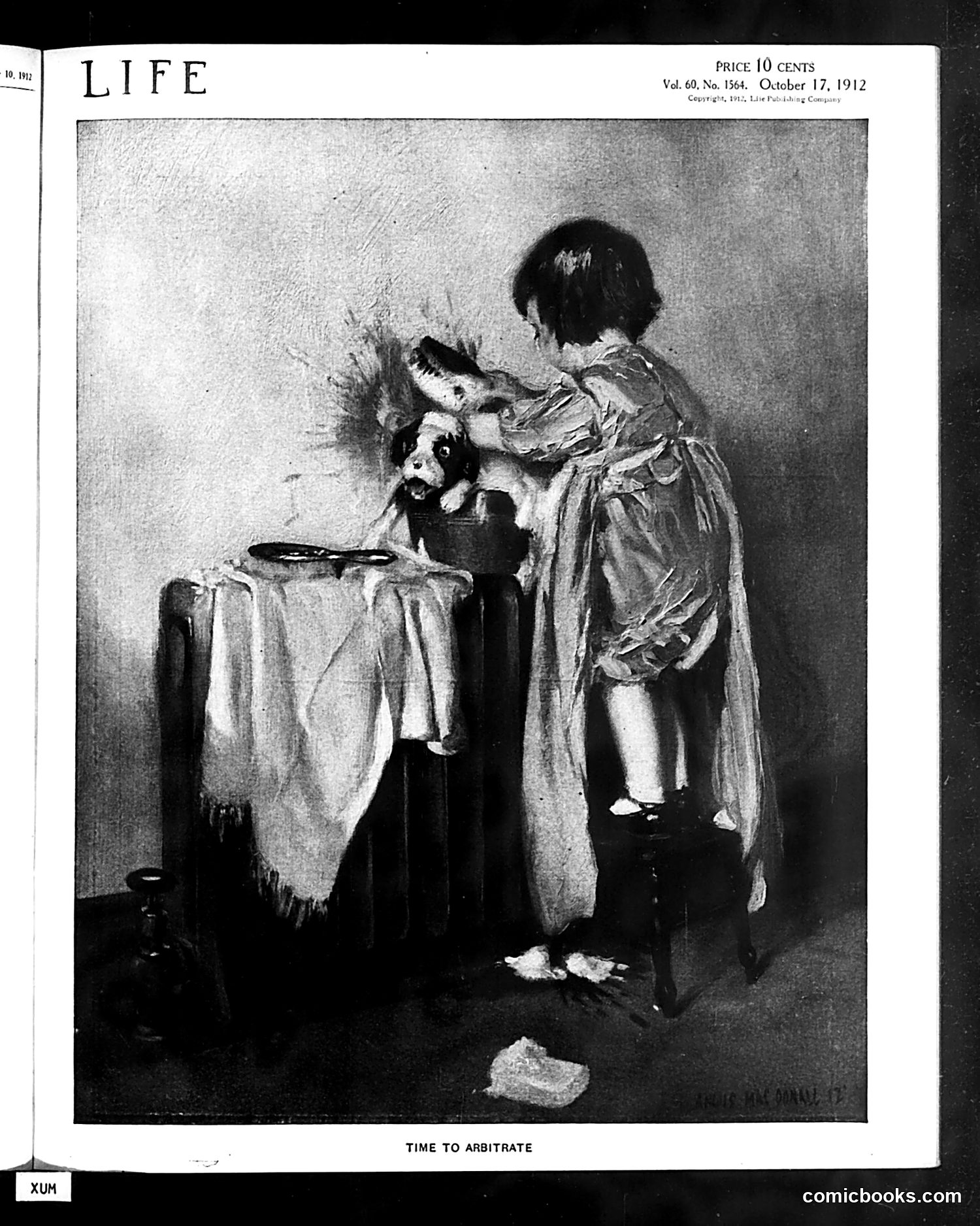
This October 1912 cartoon depicts a domestic dispute—a woman and man appear to be arguing over a table, with the woman holding what looks like a frying pan or plate. The caption "TIME TO ARBITRATE" suggests the satire comments on labor disputes and arbitration, a contemporary political issue. The cartoon likely uses the household quarrel as a metaphor for industrial labor conflicts that were prominent in 1912. The arbitration referenced probably relates to the Progressive Era's efforts to resolve worker-management disputes through mediation rather than strikes. The humor derives from applying formal arbitration language to a common domestic squabble, satirizing how arbitration was being promoted as a solution to social conflict during this turbulent period.
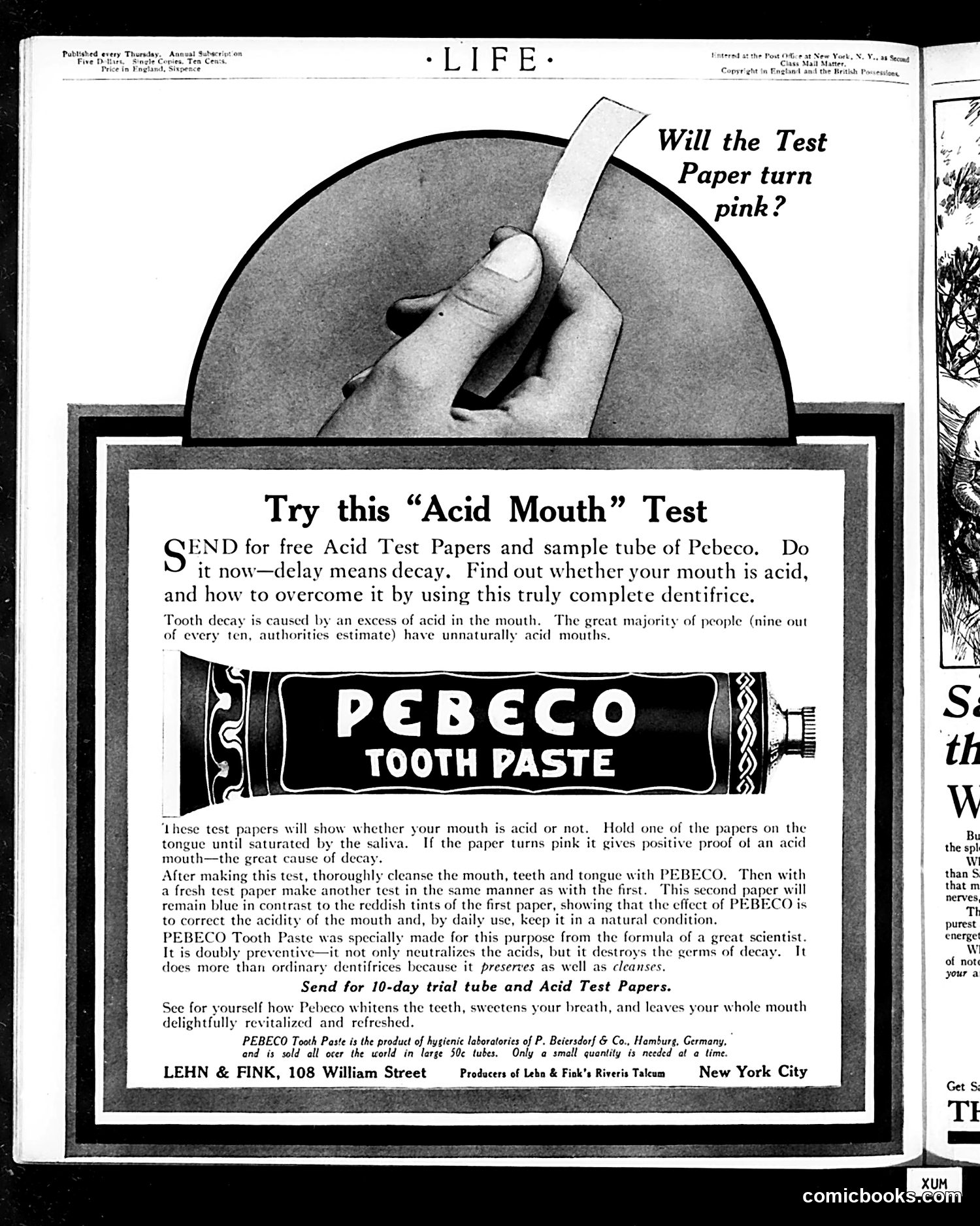
This page is primarily a **toothpaste advertisement**, not political satire. It promotes Pebeco Tooth Paste by Lehn & Fink, a real product from the early 20th century. The ad presents an "Acid Mouth" test using litmus paper—a legitimate (if now-outdated) marketing concept. The headline "Will the Test Paper turn pink?" refers to the paper changing color in acidic conditions. Consumers were invited to request free test papers and sample tubes. The advertisement claims Pebeco neutralizes mouth acid to prevent tooth decay, positioning it as scientifically advanced dentifrice. The emotional appeal suggests "decay" is an urgent problem most people face. This reflects early 20th-century advertising's use of pseudo-scientific claims and home testing kits to sell health products—a practice now heavily regulated.
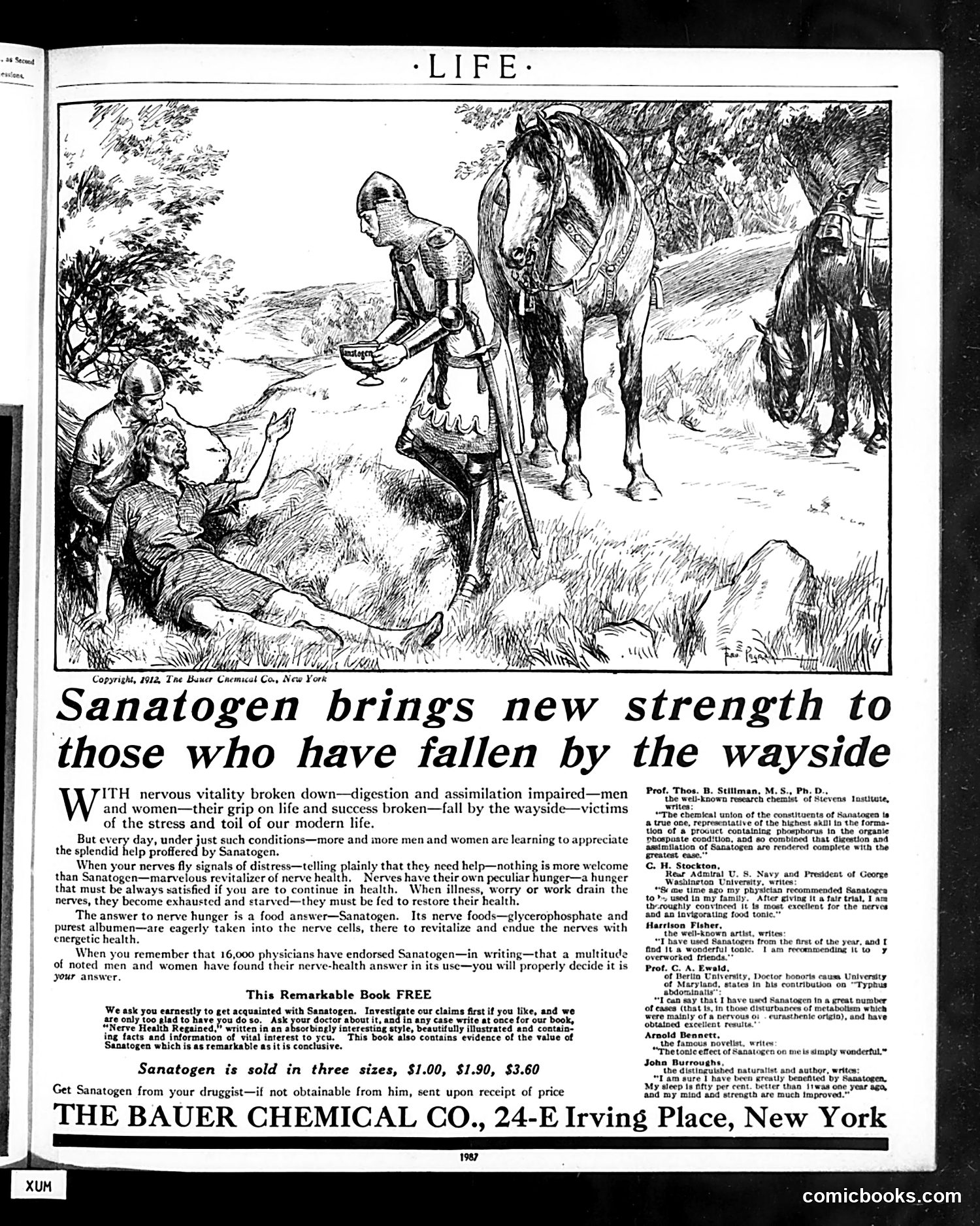
This is primarily a **patent medicine advertisement**, not satire. The illustration depicts a medieval knight on horseback encountering exhausted travelers by a roadside—a visual metaphor for Sanatogen as a "rescuer" of the weak and ill. The ad claims Sanatogen restores "nerve health" to those suffering from "nervous vitality broken down" and digestive problems. It cites endorsements from 16,000 physicians and includes testimonials from named professionals. The medieval imagery is purely decorative, chosen to suggest timeless, proven strength. This reflects early 1900s advertising conventions before modern medical regulation—making extravagant health claims with vague scientific language ("glycerophosphate," "nerve foods") was standard practice. The page is commercial promotion, not political commentary.
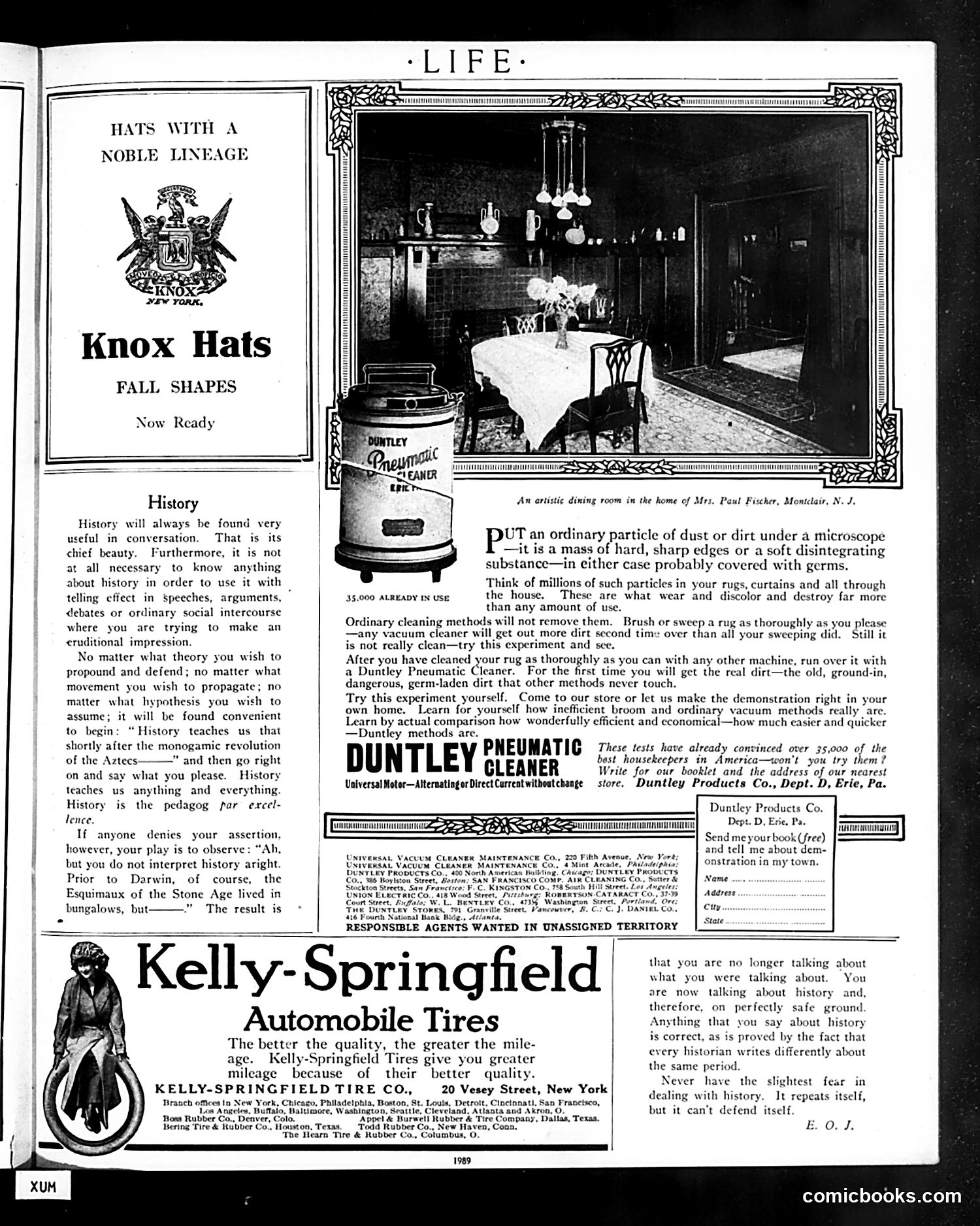
This page is primarily **advertising**, not satire or political commentary. It contains three distinct advertisements: 1. **Knox Hats** (left): Promotes fall hat styles with a company coat-of-arms, emphasizing that knowledge of history is useful in conversation—a marketing angle suggesting refined gentlemen wear Knox hats. 2. **Duntley Pneumatic Cleaner** (center): A lengthy product advertisement for a home cleaning device, with an accompanying photograph of an elegant dining room. The text discusses microscopic dust and germs, contrasting the cleaner's effectiveness against ordinary methods. 3. **Kelly-Springfield Automobile Tires** (bottom): Promotes tire quality and mileage, with a philosophical aside about history's repeatability. No political cartoons or satirical commentary appears on this page. It represents typical early 20th-century *Life* magazine advertising content.
This page is **not a cartoon or satirical content** — it is a **paid advertisement** for Vintage Louis Roederer Champagne, placed in Life magazine. The ad promotes the 1906 vintage champagne vintage to American "Connoisseurs," explaining that England purchased supplies in 1911, and that earlier vintages (1890, 1904) are nearly exhausted and rising in price. The advertiser appeals to wealthy American gentlemen and private clubs, positioning the champagne as an exclusive luxury product. The tone is marketing-based rather than satirical. Contact information directs readers to "Messrs. E. La Montagne's Sons" in New York City for pricing and availability.
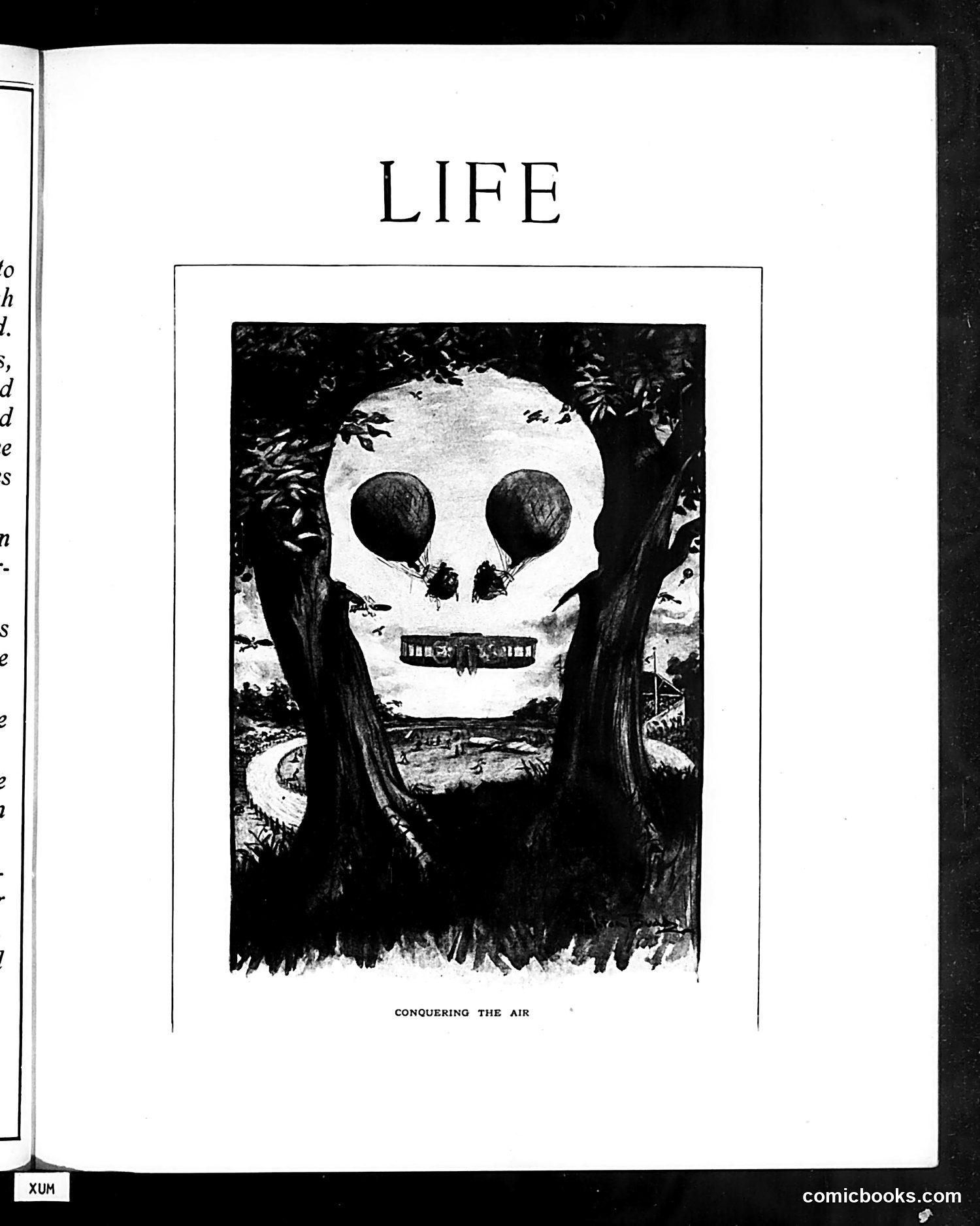
This is a title page for a Life magazine section labeled "LIFE." The illustration shows a human skull positioned between two dark tree trunks in a forest setting. The skull has large round eye sockets and what appears to be a mechanical or structured jaw. The caption reads "CONQUERING THE AIR." This appears to be satirical commentary on early aviation, likely from the early 20th century. The skull imagery suggests the page is commenting darkly on the dangers and fatalities associated with early aircraft development—depicting aviation as a deadly pursuit. The juxtaposition of death symbolism with the phrase "conquering the air" creates ironic commentary on whether humanity's attempts to master flight were worth the human cost in lives lost during this experimental period.
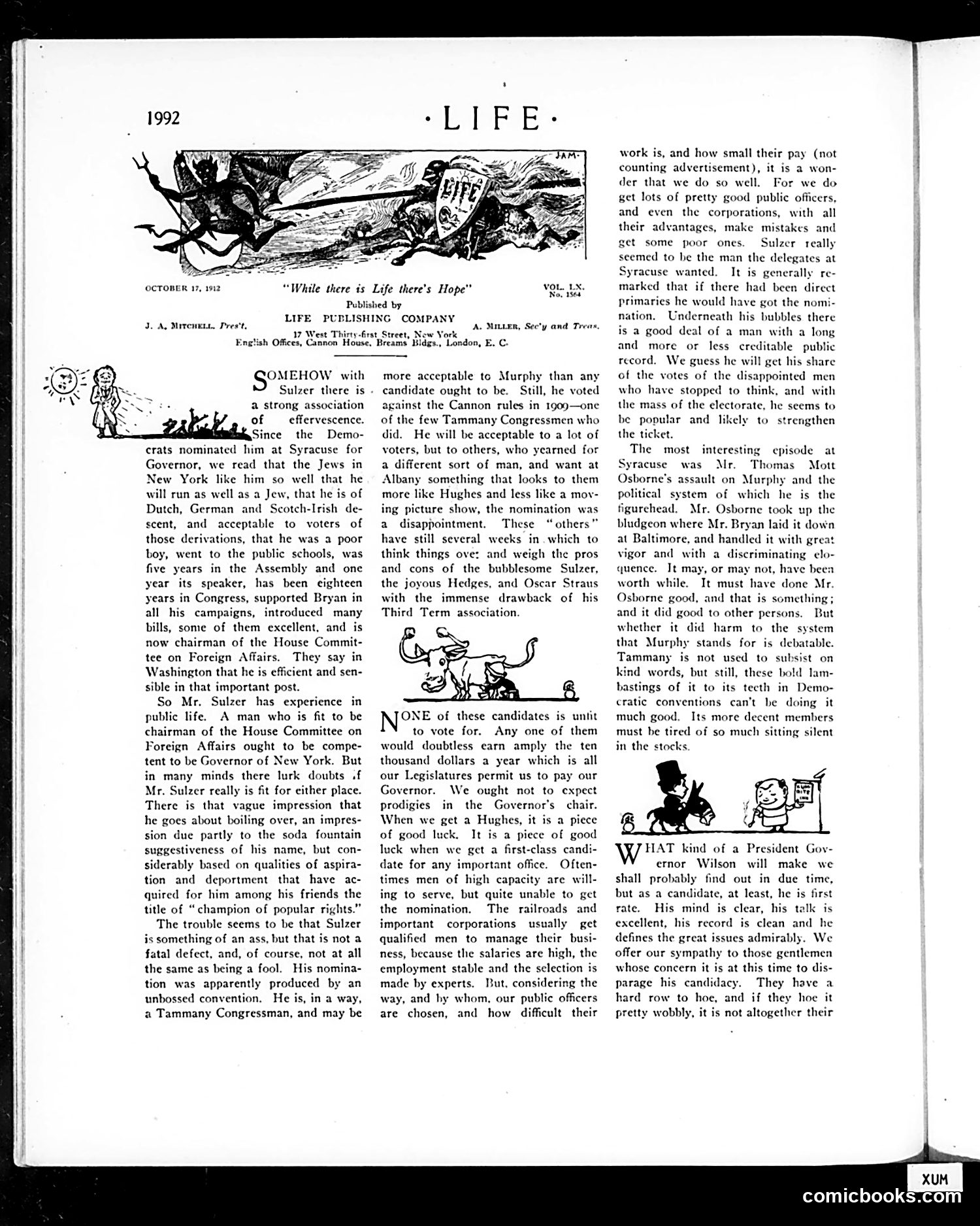
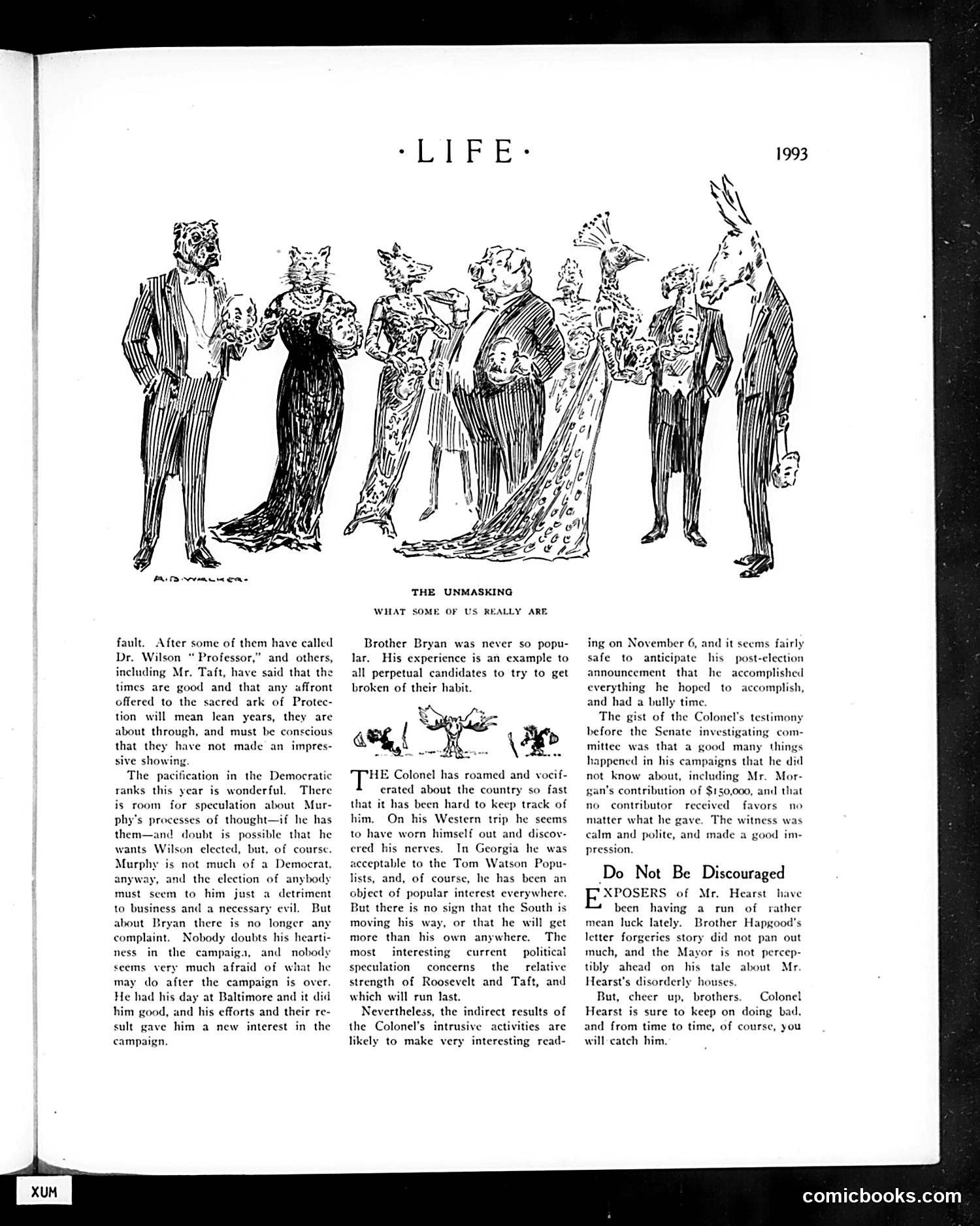
This political cartoon depicts figures in formal dress revealing their animal heads—a visual metaphor for exposing politicians' "true natures." The accompanying article discusses Colonel Roosevelt's recent activities and upcoming election prospects, suggesting the cartoon satirizes political hypocrisy during the 1912 election cycle. The text references "Brother Bryan" (likely William Jennings Bryan), Roosevelt, Taft, and various Democratic and Republican political maneuvers. The article criticizes Colonel Hearst's involvement in politics while defending Roosevelt's campaign efforts and suggesting his opponents should "not be discouraged." The "unmasking" metaphor suggests the cartoon is about revealing hidden character flaws or true intentions beneath politicians' respectable public appearances—a common satirical device in Progressive Era political commentary.
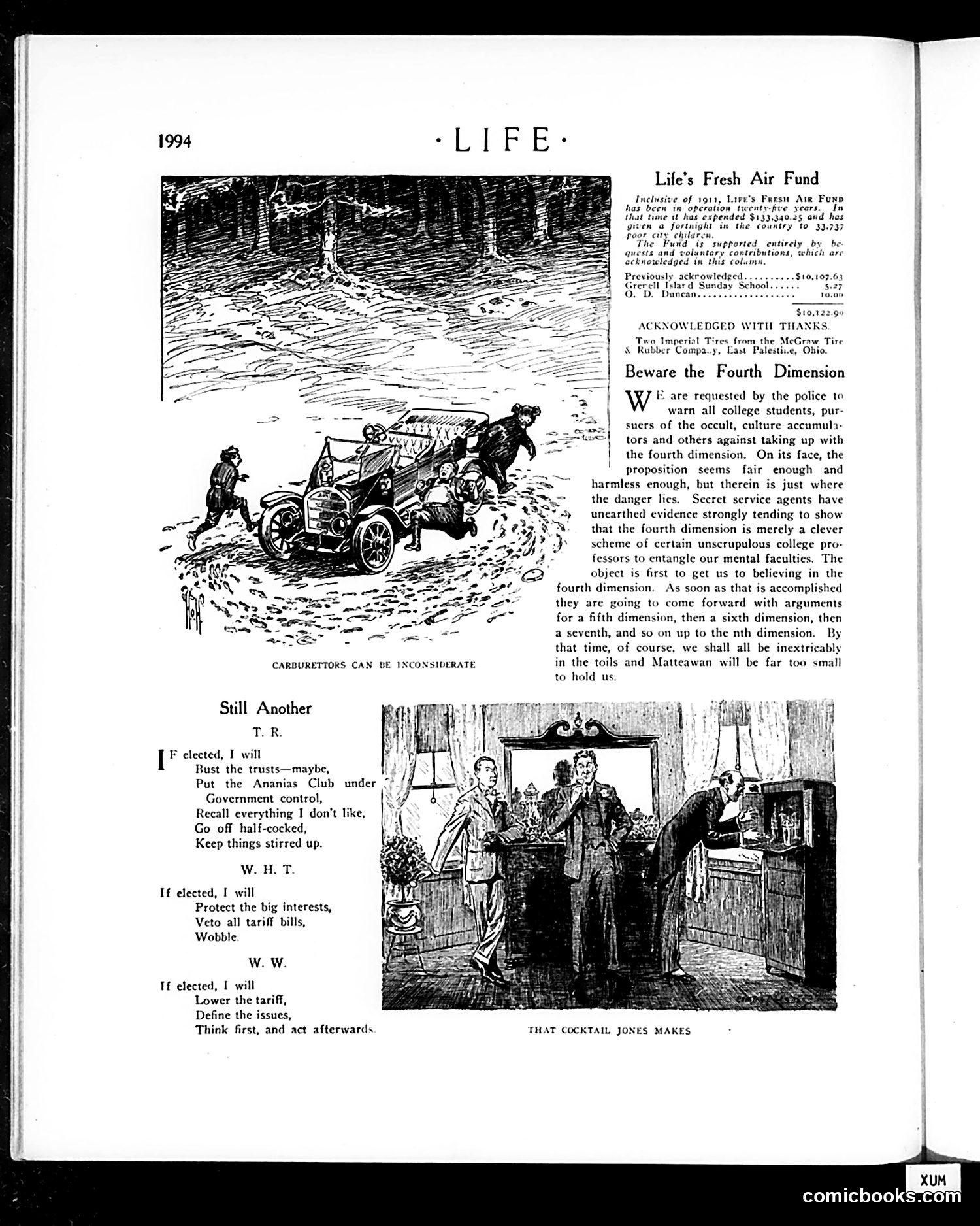
This page contains satirical political commentary titled "Still Another," presenting three competing campaign promises from candidates with initials T.R., W.H.T., and W.W. Each proposes contradictory solutions—one promises radical change and chaos, another protects big business interests, the third promises tariff reduction and careful deliberation. The accompanying illustration "That Cocktail Jones Makes" shows two men in what appears to be a speakeasy during Prohibition, likely satirizing how politicians make empty promises while ordinary citizens navigate illegal drinking. The page's overall message critiques political candidates as insincere, offering vague or contradictory platforms designed to appeal to different constituencies rather than address real issues. The contrast between lofty campaign rhetoric and actual governance is the central satirical target.
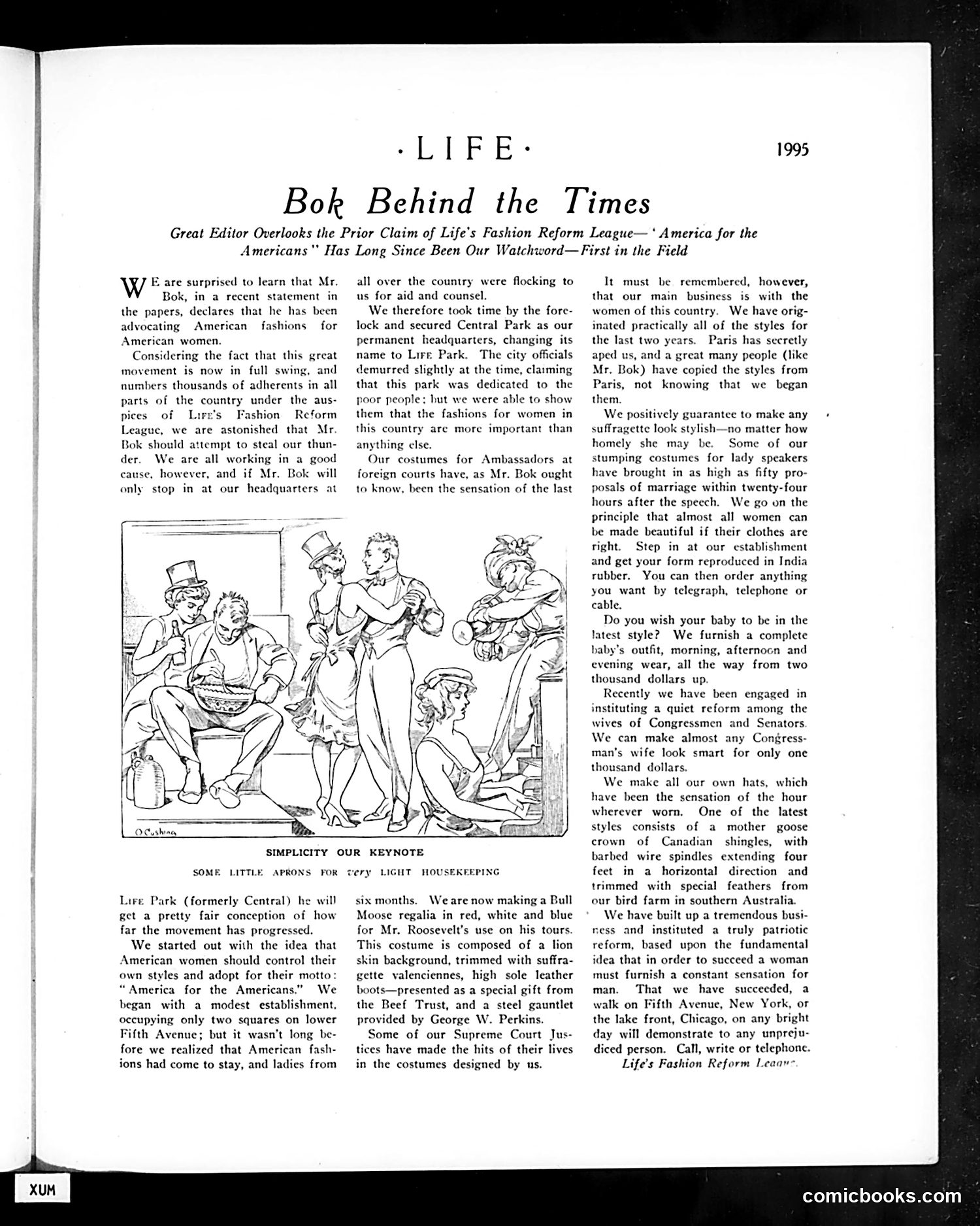
This page satirizes **Life's Fashion Reform League** and its advocacy for "America for the Americans," a campaign promoting American women's fashion independence. The cartoon, captioned "SIMPLICITY OUR KEYNOTE: SOME LITTLE APRONS FOR VERY LIGHT HOUSEKEEPING," depicts figures in domestic scenes wearing simple attire—apparently mocking the League's push for practical, American-made clothing over imported European fashions. The accompanying article boasts that the League controls fashions for American women and has even dressed Supreme Court Justices and Congressional wives' costumes. The satire targets Life magazine's editorial crusade promoting nationalist fashion reform and American textile industry interests, while claiming to champion women's practical interests. The cartoon's domestic imagery undercuts grand claims about women's autonomy through fashion.
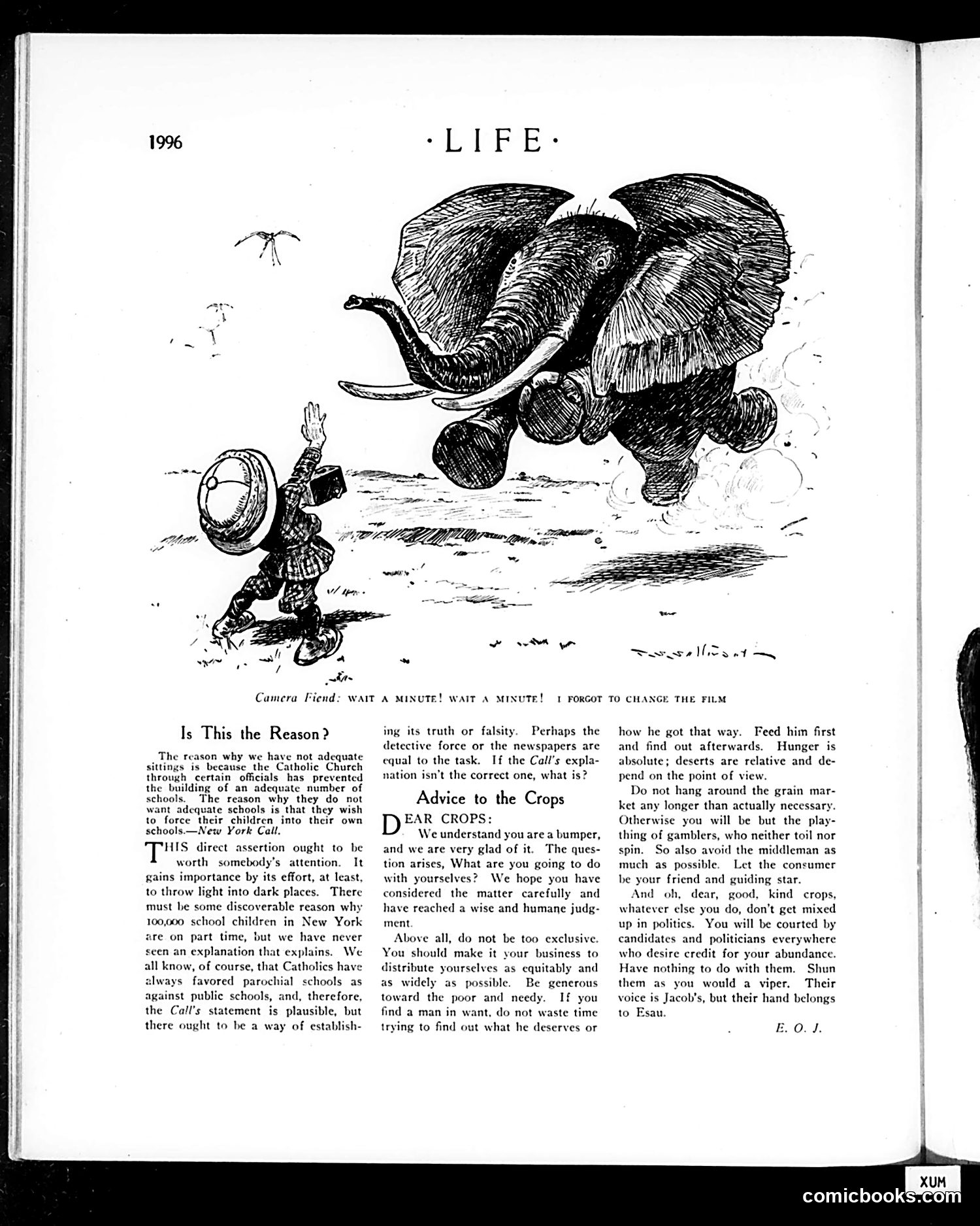
The cartoon depicts a tiny photographer with a large camera and shield confronting a charging elephant. The caption reads "WAIT A MINUTE! WAIT A MINUTE! I FORGOT TO CHANGE THE FILM." This appears to be satirizing aggressive photojournalism or news media pursuit. The elephant likely represents a powerful public figure or institution, while the small photographer symbolizes the press attempting to document or expose it. The humor lies in the journalist's comic obsession with capturing the moment even while facing danger—suggesting that members of the media prioritize getting the story over personal safety or reasonable judgment. The surrounding text about Catholic schools and crop advice indicates this is from Life magazine's satirical editorial section.
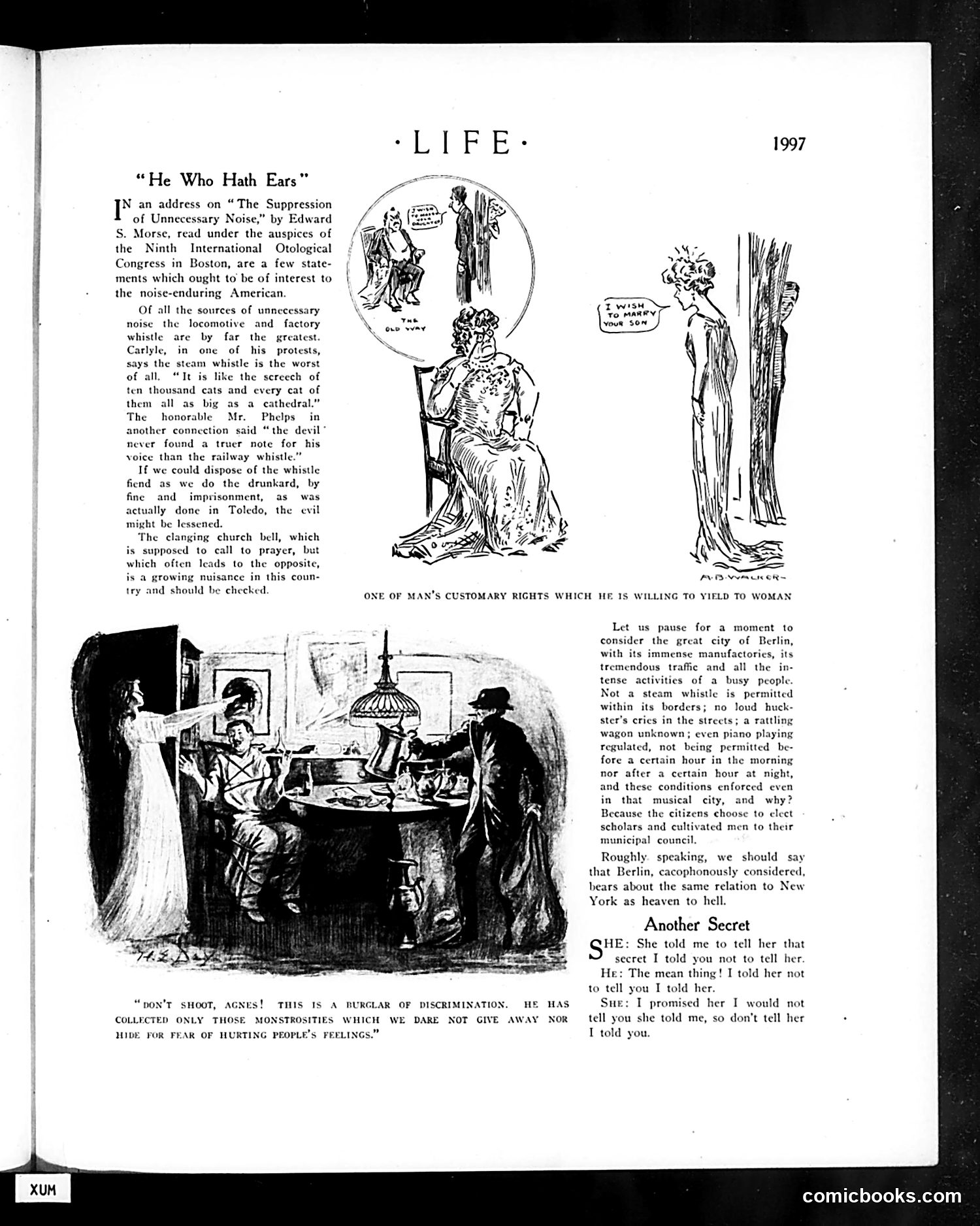
This 1897 *Life* magazine page satirizes noise pollution in urban life. The main article discusses Edward S. Morse's address on "suppressing unnecessary noise," citing locomotives and factory whistles as major offenders. Church bells and other urban sounds are criticized as growing nuisances. The top cartoon depicts a woman yielding to a man—illustrating gender dynamics of the era through the caption about "man's customary rights." The lower illustration shows what appears to be a burglar or suspicious figure among household items, captioning discrimination in collecting "monstrosities." The dialogue snippet "Another Secret" is a humor piece about keeping secrets in relationships. The satire reflects Progressive Era concerns about industrial modernization's quality-of-life impacts on city dwellers.
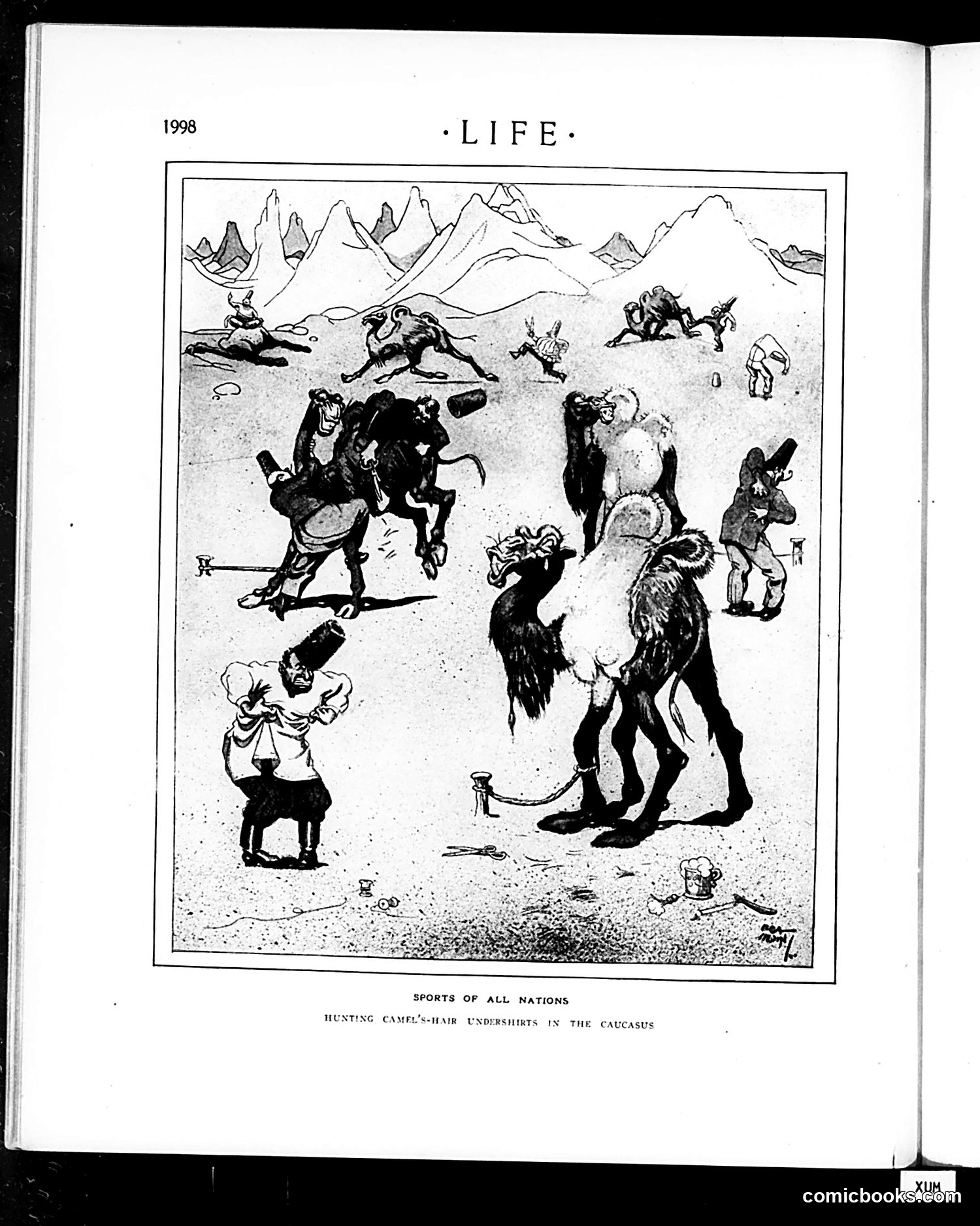
This is a humorous satirical cartoon from Life magazine presenting a mock "sport" that plays on two concepts: the marketing of camel's-hair clothing (a luxury fabric popular in the late 19th/early 20th century) and the exotic Caucasus region. The illustration shows people hunting actual camels in a mountainous landscape, literally pursuing the animals as if engaged in sport—a visual pun on acquiring "camel's-hair" products. The absurdist humor comes from treating commercial textile sourcing as an international sporting activity, poking fun at both the luxury goods market and orientalist fascination with exotic locales. The "undershirts" reference suggests these expensive garments were marketed to American consumers as desirable status symbols.
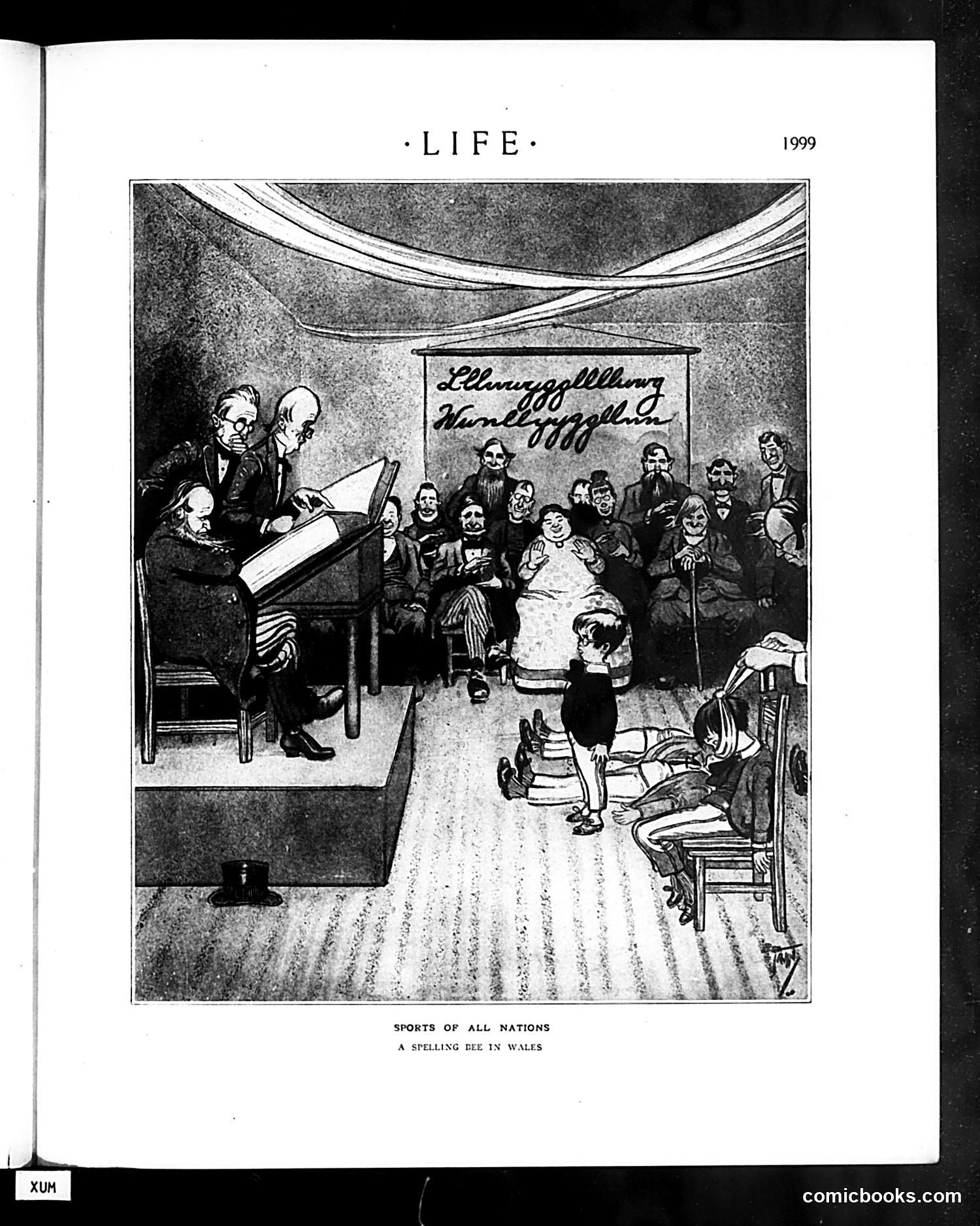
This cartoon satirizes Welsh cultural practices as a "sport of all nations." The image depicts what appears to be a public spelling competition in Wales, with an audience gathered to watch contestants attempt to spell words aloud. The joke likely plays on the perceived difficulty of Welsh language and spelling—Welsh uses unfamiliar letter combinations and pronunciation rules to English speakers. By labeling a spelling bee as a Welsh "sport," the cartoon humorously suggests that spelling in Welsh is so challenging it qualifies as a competitive athletic event rather than a simple educational exercise. The sketch style and presentation indicate this is social satire targeting Welsh linguistic and cultural identity, typical of early 20th-century American periodical humor.
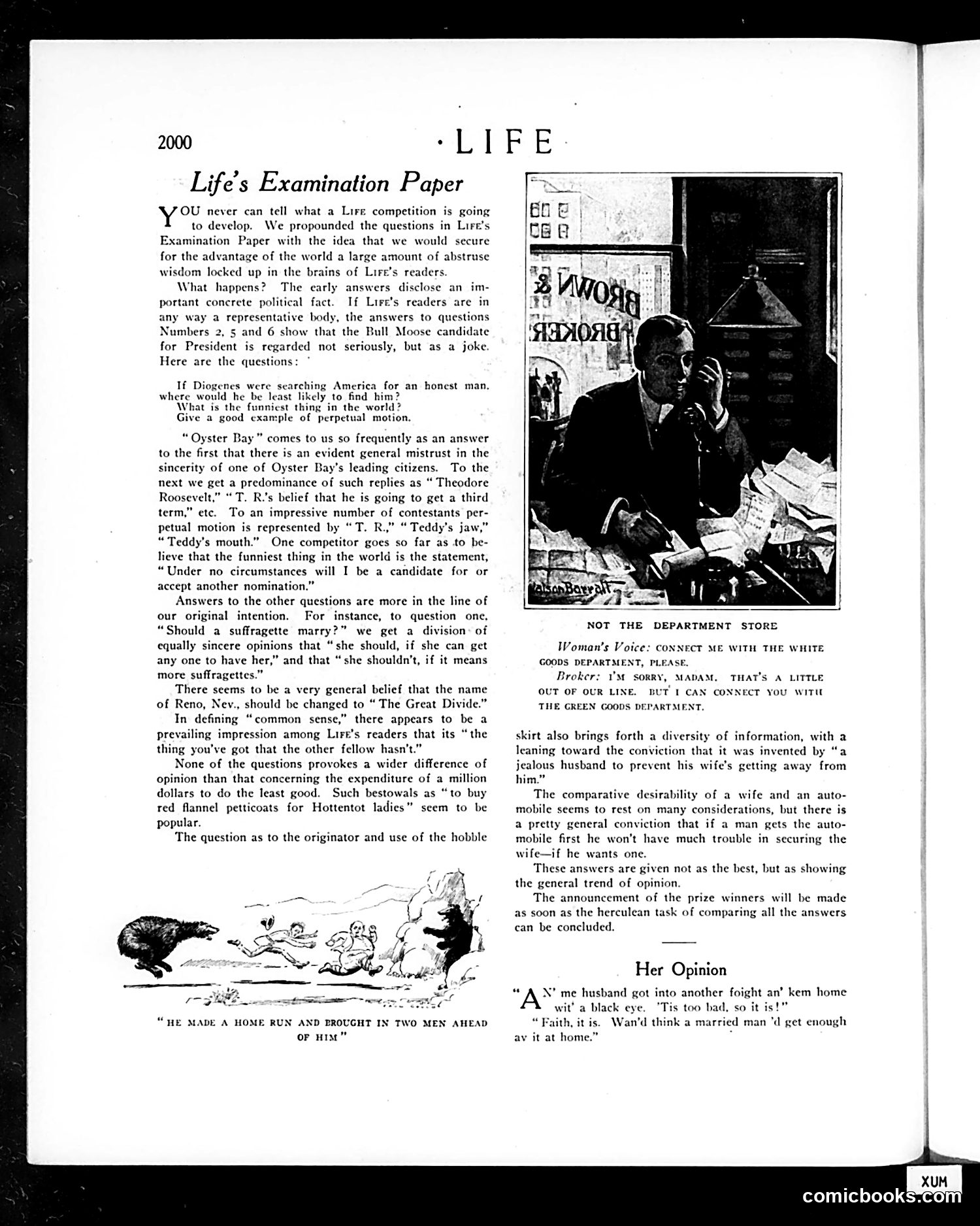
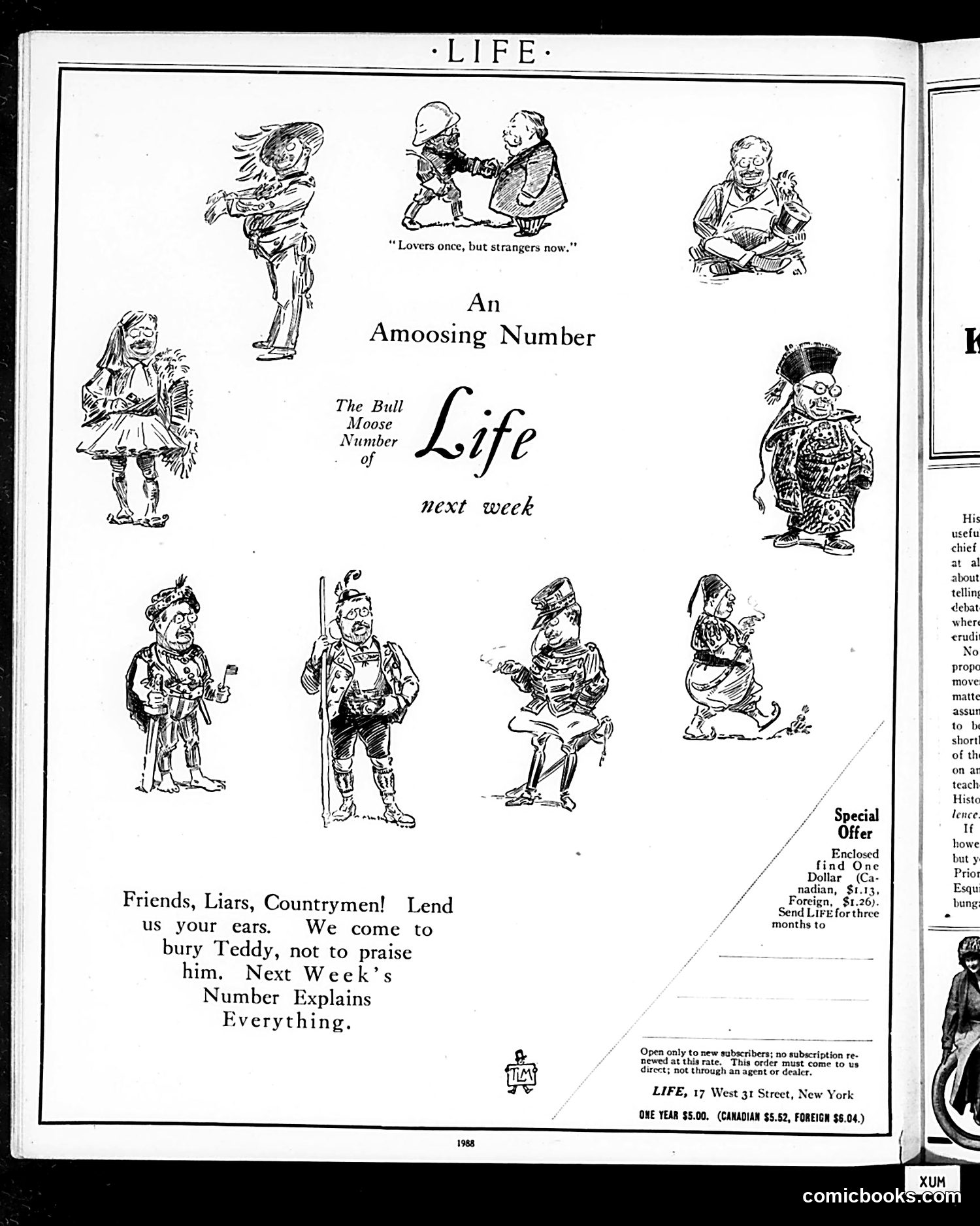
This page satirizes President Theodore Roosevelt's political standing circa 1912. The "Bull Moose candidate" reference indicates Roosevelt's third-party Progressive ("Bull Moose") presidential run that year, which Life's editors note readers treat as a joke rather than serious threat. The examination questions mock Roosevelt through repeated answers: "Oyster Bay" (his home, implying dishonesty), "Theodore Roosevelt" as the funniest thing, and "T.R." representing perpetual motion. The phrase "Under no circumstances will I be a candidate" satirizes Roosevelt's earlier declarations he wouldn't seek another term—which he broke. The cartoon "Not the Department Store" is an unrelated gag about phone confusion between white goods and green goods (slang for counterfeit money). The final snippet, "Her Opinion," shows working-class domestic humor about a wife accepting her husband's fighting. The overall effect ridicules Roosevelt's political credibility among Life's educated readership.
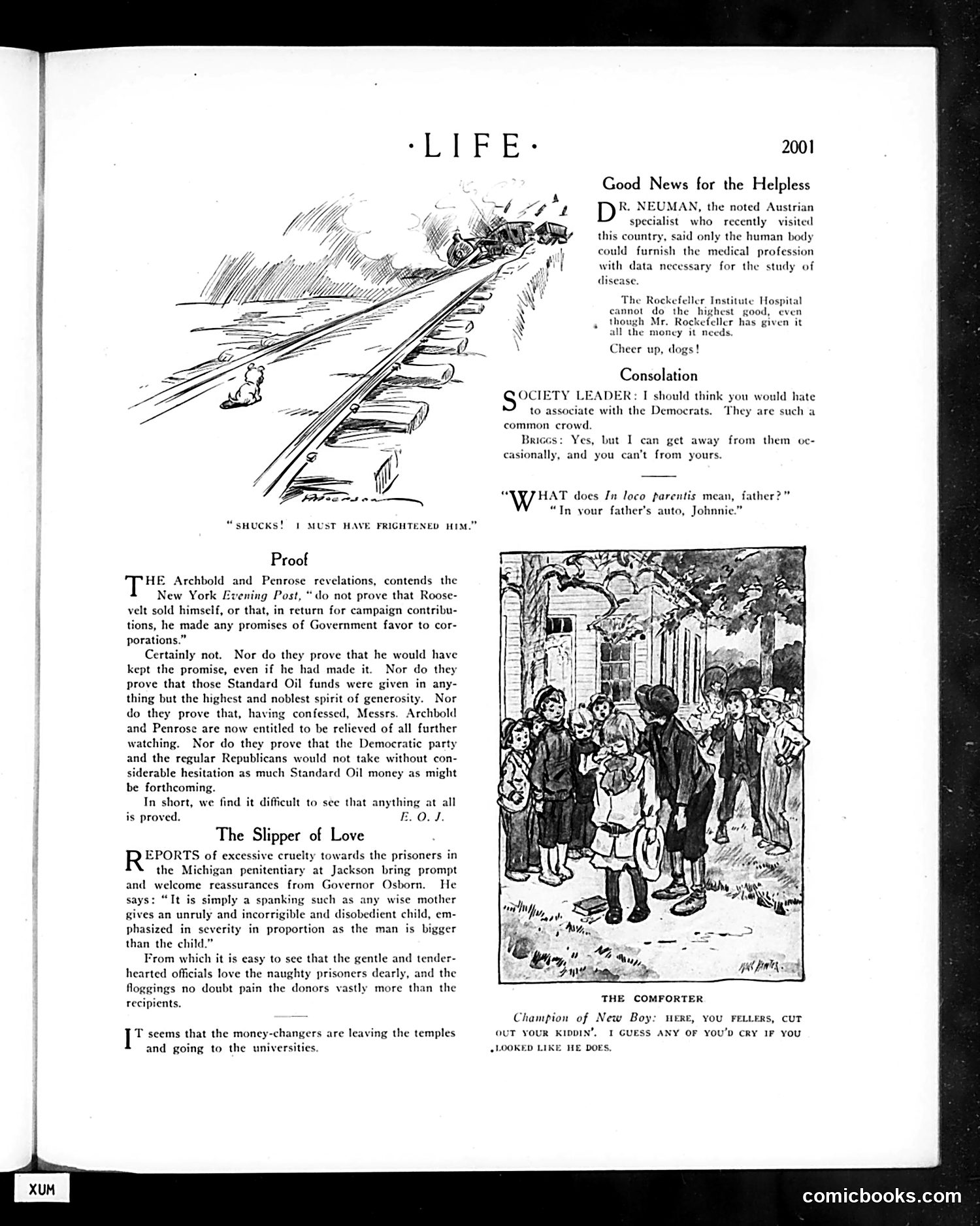
This page contains several short political satires typical of early 1900s Life magazine: **"Proof"** mocks the Archbold-Penrose revelations regarding Standard Oil's political donations to President Roosevelt. Life sarcastically catalogs what the scandal *doesn't* prove—that Roosevelt sold favors, would have kept corrupt promises, or that the money wasn't given generously. The point: the evidence reveals obvious corruption, yet powerful interests use technical arguments to obscure accountability. **"Consolation"** satirizes class hypocrisy: a society leader criticizes Democrats as "common," but a Briggs character retorts he can occasionally escape Democrats while she cannot escape her own social circle—implying Republican elites are equally (or more) common. **"The Slipper of Love"** attacks Governor Osborn's defense of brutal prison conditions at Jackson penitentiary. His comparison of severe floggings to maternal discipline is presented as absurd rationalization for institutional cruelty. The unnamed cartoon at top appears to show someone startled by a motorcycle or vehicle, captioned "SHUCKS! I MUST HAVE FRIGHTENED HIM."
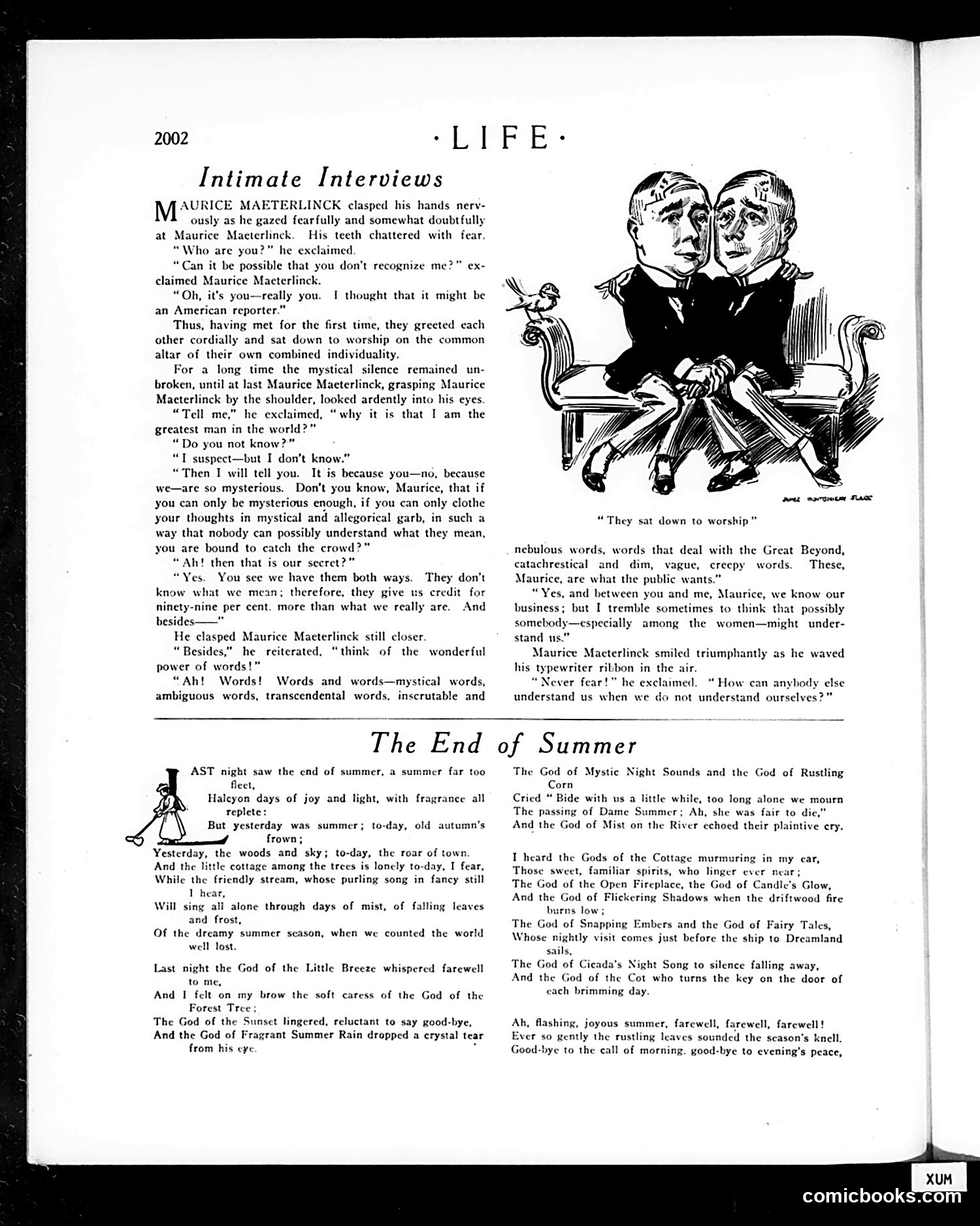
The cartoon mocks **Maurice Maeterlinck**, the Belgian symbolist playwright and writer. The joke: Maeterlinck encounters himself and they discuss how their success relies entirely on **deliberate obscurity**. The satire targets the pretentious literary establishment of the era. Maeterlinck's character admits that by cloaking mundane thoughts in "mystical and allegorical garb" that nobody understands, they receive undeserved credit for profundity. The punchline—"How can anybody else understand us when we do not understand ourselves?"—exposes this as pure bluffing. The cartoon illustrates a common Modernist-era critique: that avant-garde artists and writers hide mediocrity behind impenetrable language. The image shows two identical figures worshiping their own "combined individuality," emphasizing the narcissism and absurdity of the whole enterprise.
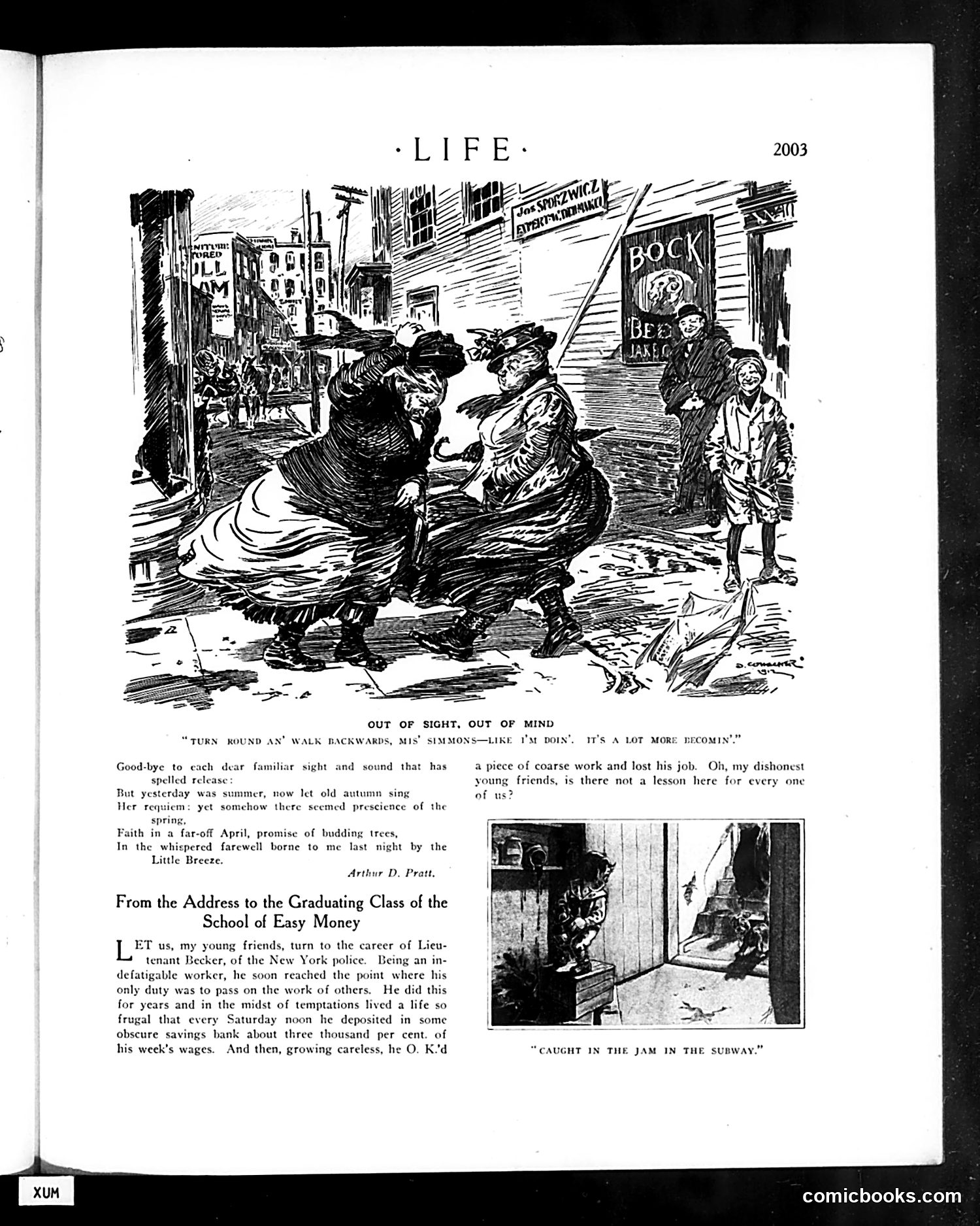
The main cartoon satirizes urban poverty and willful ignorance. Two working-class women are depicted on a city street; one advises the other to "walk backwards" to avoid seeing the deterioration around them—a visual metaphor for denying uncomfortable social realities. The accompanying text references **Lieutenant Becker of the New York police**, likely alluding to the real Becker corruption scandal (early 1900s), where a police official accumulated wealth through graft. The "School of Easy Money" satirizes how officials rationalized corrupt gains as legitimate savings. The two photographs below show urban squalor—cramped tenements and subway conditions—contrasting sharply with the text's ironic tone about "easy money" and moral lessons. The overall message critiques both individual moral corruption among authority figures and society's tendency to ignore the poverty and injustice underlying urban life—hence the title "Out of Sight, Out of Mind."
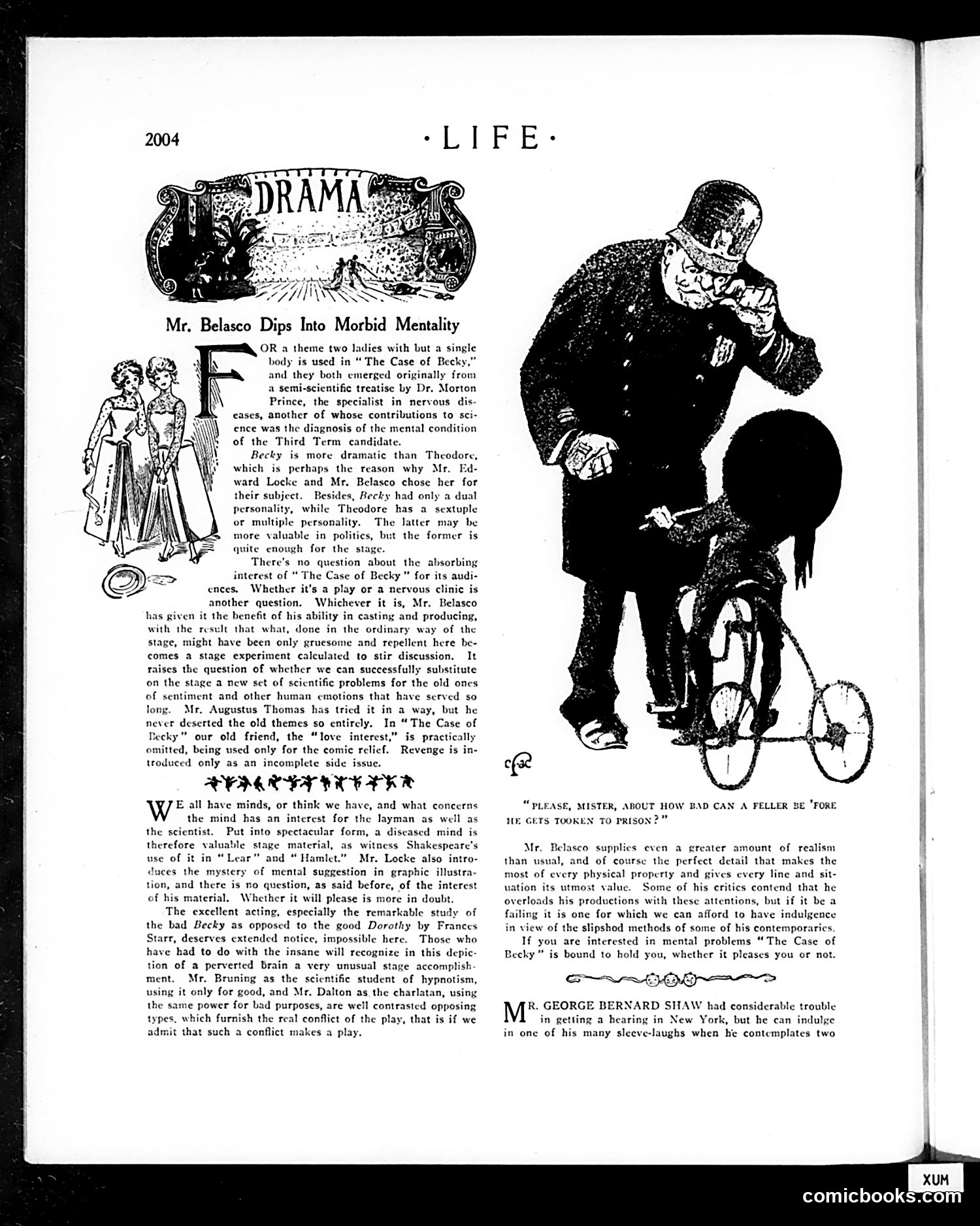
This page reviews David Belasco's theatrical production of "The Case of Becky," based on Dr. Morton Prince's scientific work on dual personality disorder. The satire compares the play's protagonist Becky—who has a split personality—to Theodore Roosevelt, depicted as having a "sextuple or multiple personality." The joke is that while Becky's dual nature makes for dramatic theater, Roosevelt's volatile, contradictory political positions are far more chaotic in actual governance. The text praises the play's ambition in treating psychiatric science as stage material rather than relying on sentiment and "love interest." The cartoon shows a well-dressed man on a tricycle, illustrating the play's exploration of mental pathology as entertainment. The review credits actress Frances Starr's performance and producer Belasco's meticulous realism, while questioning whether scientific problems can successfully replace traditional dramatic emotions on stage.
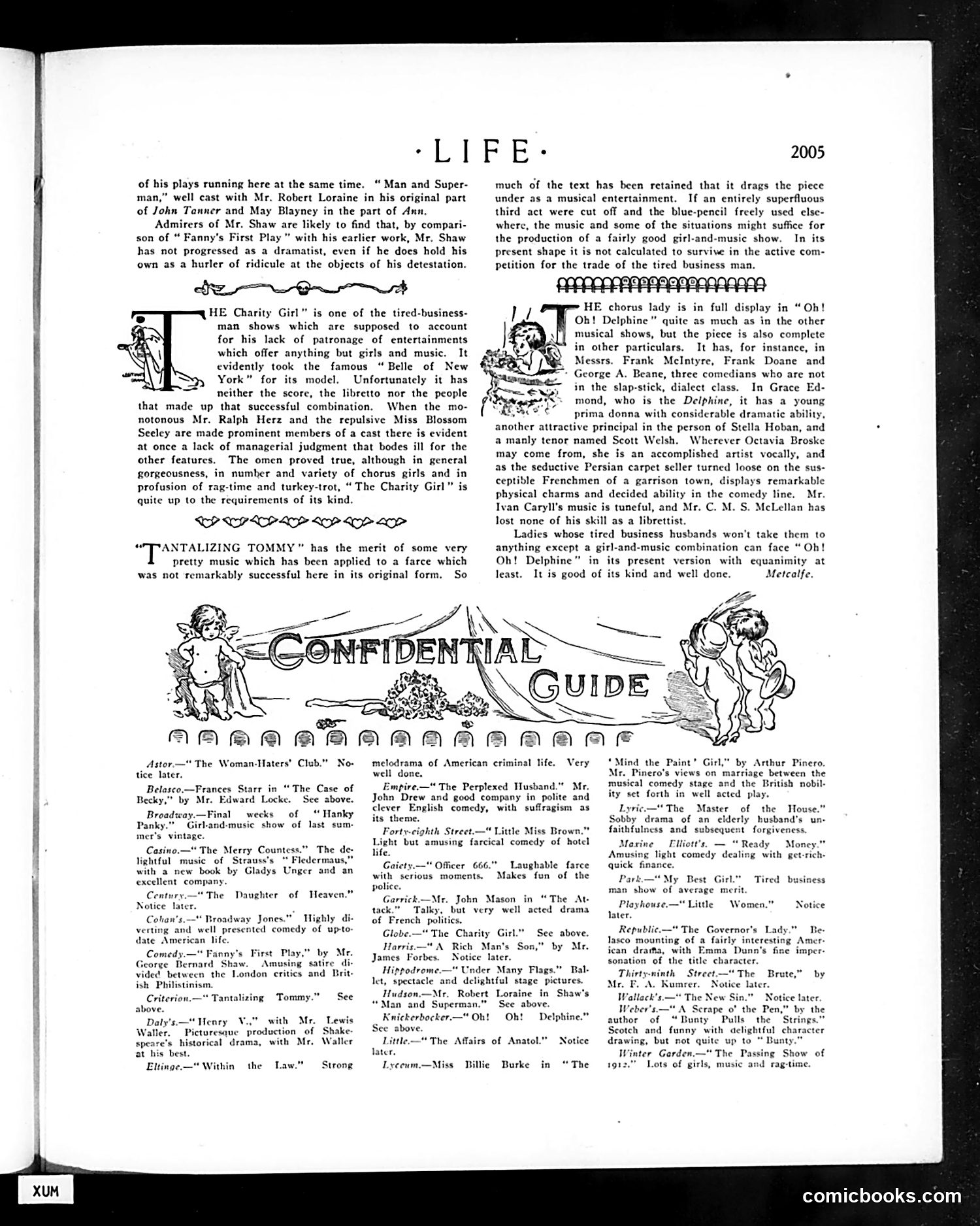
This page reviews several Broadway productions from the early 1900s, focusing on musical comedies and farces targeting "tired businessmen"—a period euphemism for male audiences seeking escapist entertainment featuring chorus girls and music rather than serious drama. The reviews are notably dismissive of shows like "The Charity Girl" and "Tantalizing Tommy," criticizing them as formulaic and poorly constructed despite their spectacle. "Oh! Delphine" receives slightly better treatment for offering comedic talent beyond slapstick. The underlying satire critiques both the entertainment industry's pandering to male audiences and society's leisure culture. The repeated reference to "tired businessmen" suggests middle-class men seeking distraction from work through mindless entertainment—a social commentary on urban commercial life and gender dynamics of the era.
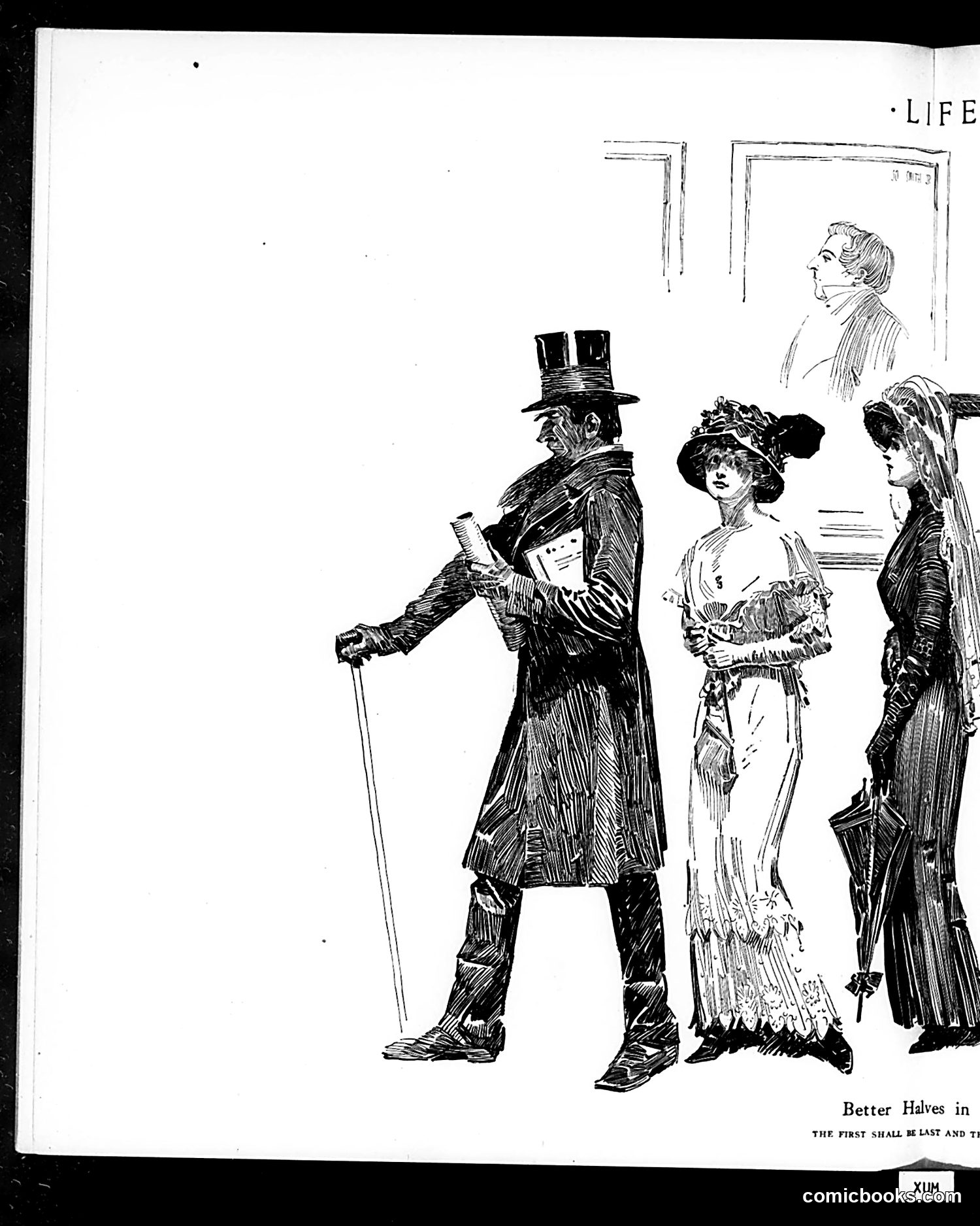
This page from *Life* magazine features a satirical illustration about marital dynamics, titled "Better Halves in" (the full title is cut off). The cartoon shows a well-dressed gentleman in a top hat and coat, holding a cane, conversing with two fashionably-dressed women. A third figure appears in the background. The phrase "better halves" was a common euphemism for wives in this era. The partially visible caption reads "THE FIRST SHALL BE LAST AND TH[E]..." suggesting a biblical reference, likely playing on Matthew 19:30 to make a joke about marital hierarchy or role-reversal—implying wives have power despite the period's formal male authority. The satire likely critiques contemporary gender relations or women's increasing social influence, a relevant topic during the early-to-mid 20th century when women's rights were expanding.
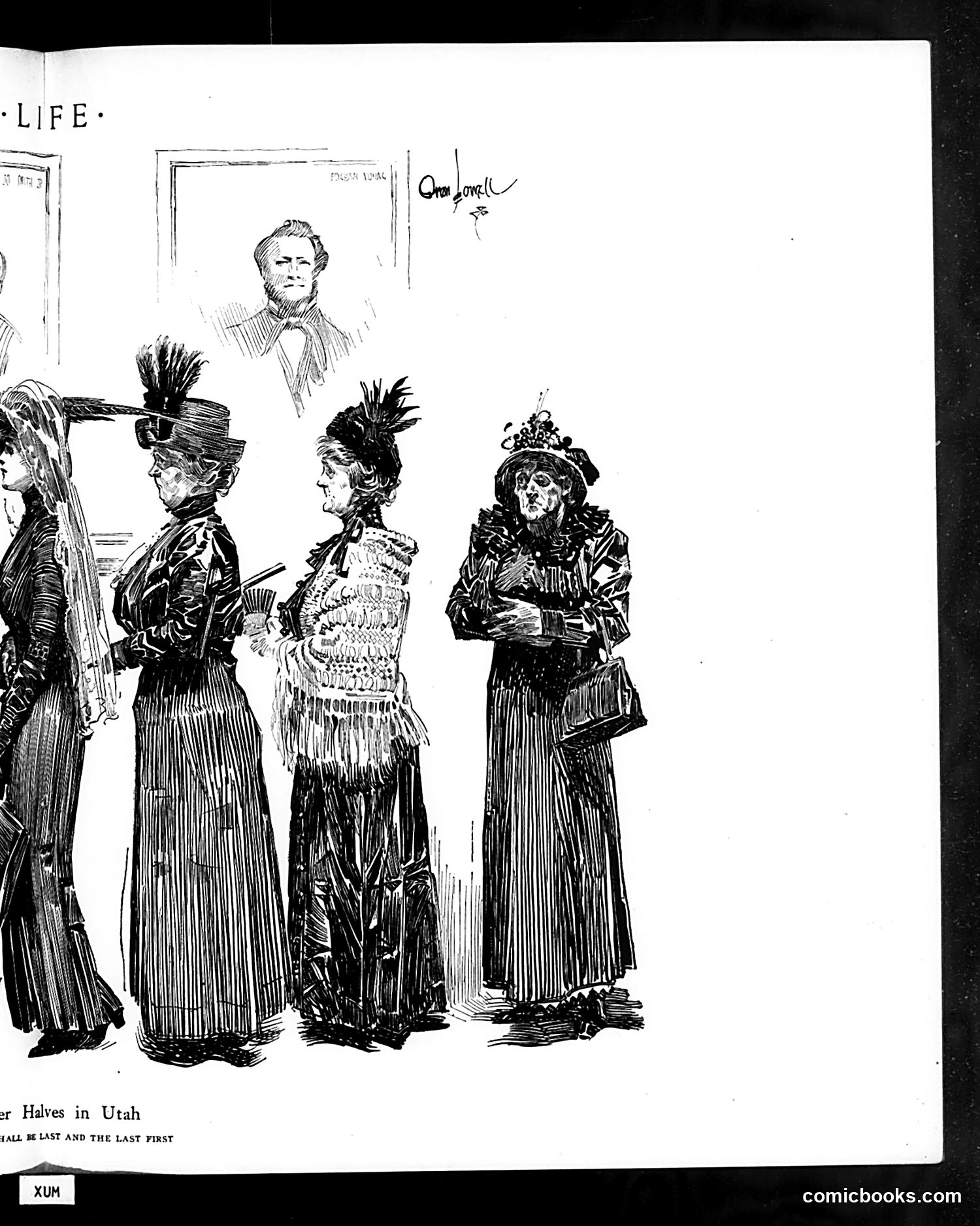
This Life magazine page shows a satirical illustration titled "All Be Last and the Last First" (likely referencing Matthew 19:30). The cartoon depicts four elaborately dressed women in fashionable late 19th or early 20th-century attire, with the figure on the right appearing particularly aged or worn, contrasting sharply with the ornate costumes and headpieces. The partial caption references "Halves in Utah," suggesting commentary on polygamy practices in Utah. The satire likely critiques wealthy or prominent women associated with Mormon polygamy or related social practices, using their exaggerated finery to mock them. The "last and first" phrase implies social reversal or ironic commentary on status and moral standing. Without the complete caption, the specific targets remain unclear.
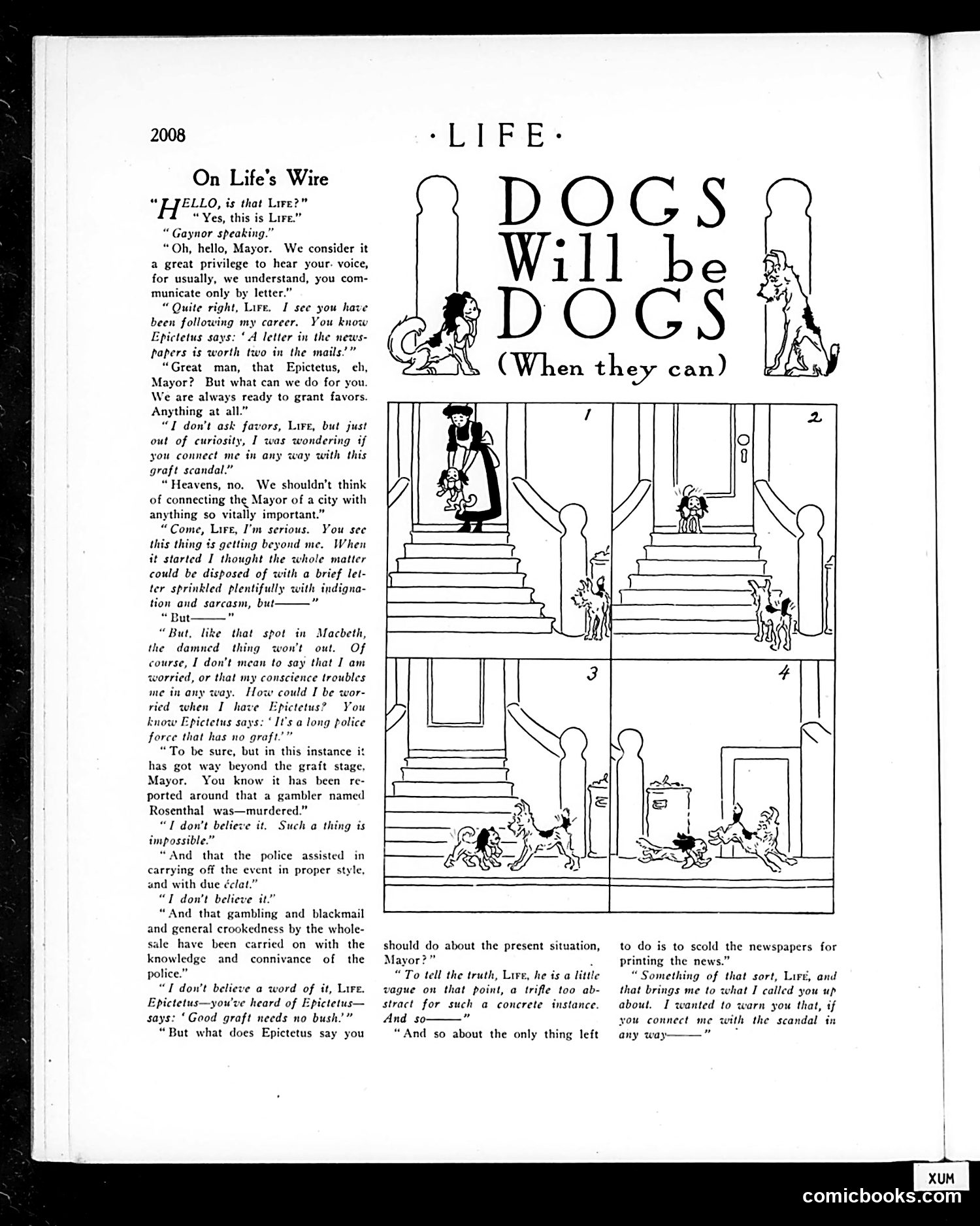
This 1908 dialogue satirizes New York City Mayor William J. Gaynor's response to the murder of gambler Herman Rosenthal and subsequent revelations of police corruption. The cartoon mocks Gaynor's strategy of dismissive denial and philosophical deflection. **The Setup:** Life presents a phone conversation where Gaynor repeatedly invokes the Stoic philosopher Epictetus to avoid responsibility for systemic graft, blackmail, and police involvement in Rosenthal's murder—a genuine scandal that implicated the NYPD. **The Joke:** Rather than address the corruption, Gaynor suggests the real problem is newspapers *reporting* the scandal. His repeated citation of Epictetus as justification for inaction becomes absurd, especially the fabricated quote "Good graft needs no bush" (playing on "good wine needs no bush"). **The Point:** Life ridicules how public officials use rhetoric and philosophy to evade accountability, proposing that suppressing journalism is preferable to confronting actual criminal misconduct by government agencies. The accompanying four-panel comic strip (right) appears to illustrate dogs behaving as dogs do—likely a separate, lighter feature.
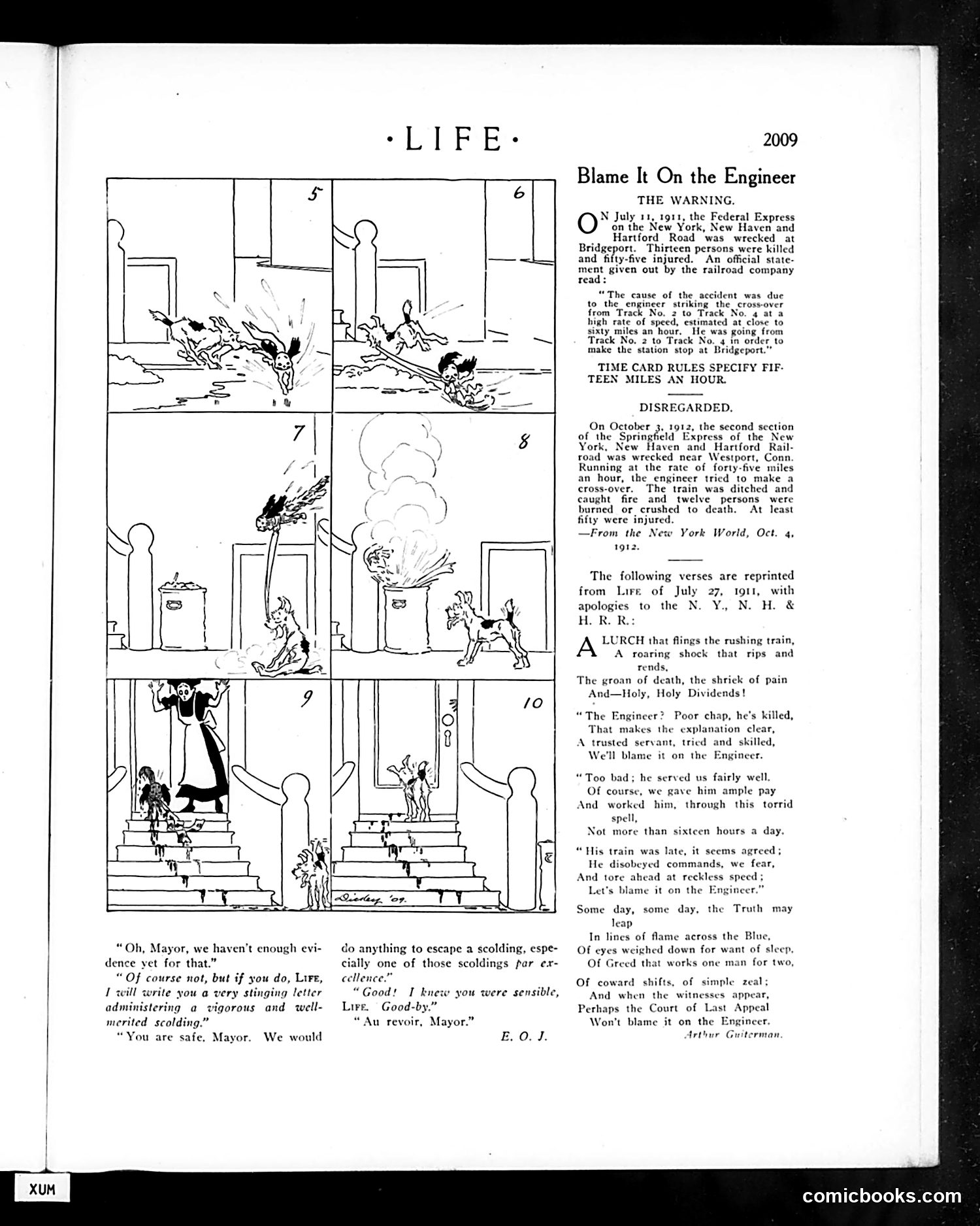
This page satirizes railroad corporations' practice of blaming engineers for crashes while avoiding accountability. Following two real 1911-1912 accidents on the New York, New Haven & Hartford Railroad (killing dozens, injuring many), the company officially blamed the engineers for excessive speed. The comic dialogue mocks a Mayor threatening merely a "scolding letter" rather than genuine investigation. The accompanying poem (by Arthur Guiterman) is the real bite: it sarcastically praises blaming the dead engineer while exposing the actual culprits—corporate greed, exhaustion (engineers worked 16+ hours daily), disregarded safety rules (15 mph limits ignored), and profit prioritization ("Holy, Holy Dividends!"). The verses suggest divine justice might eventually expose these injustices. The satire critiques how corporations used expendable workers as scapegoats to escape liability and regulation during the Progressive Era.
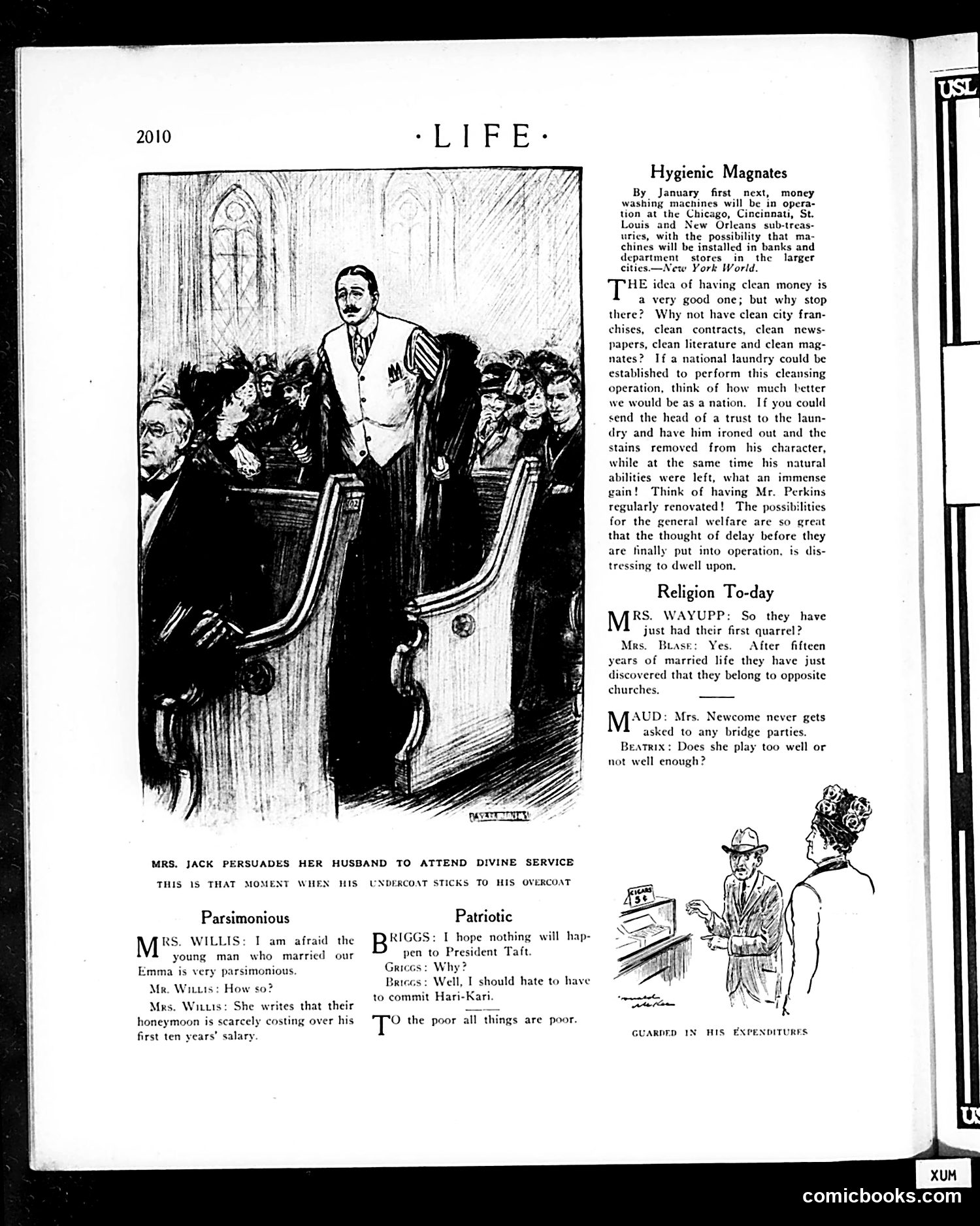
This page contains several distinct satirical pieces mocking early-20th-century American society: **"Hygienic Magnates"** satirizes the introduction of money-washing machines by suggesting the country should metaphorically "launder" corrupt business leaders—specifically naming "Mr. Perkins" (likely George W. Perkins, J.P. Morgan associate and trust executive). The satire equates financial corruption with literal dirt needing removal. **"Religion To-day"** mocks shallow marriage conflicts and social climbing, suggesting couples discover religious differences only after years together, while bridge parties determine social status. **The main cartoon** depicts a husband's undercoat clinging to his overcoat during reluctant attendance at church—physical comedy about marital pressure regarding religious observance. **"Parsimonious" and "Patriotic"** are brief character sketches: one mocks a stingy newlywed, the other satirizes exaggerated patriotism (the "Hari-Kari" reference suggests overblown devotion to President Taft). The overall tone reflects Progressive-era criticism of corporate malfeasance and social hypocrisy.
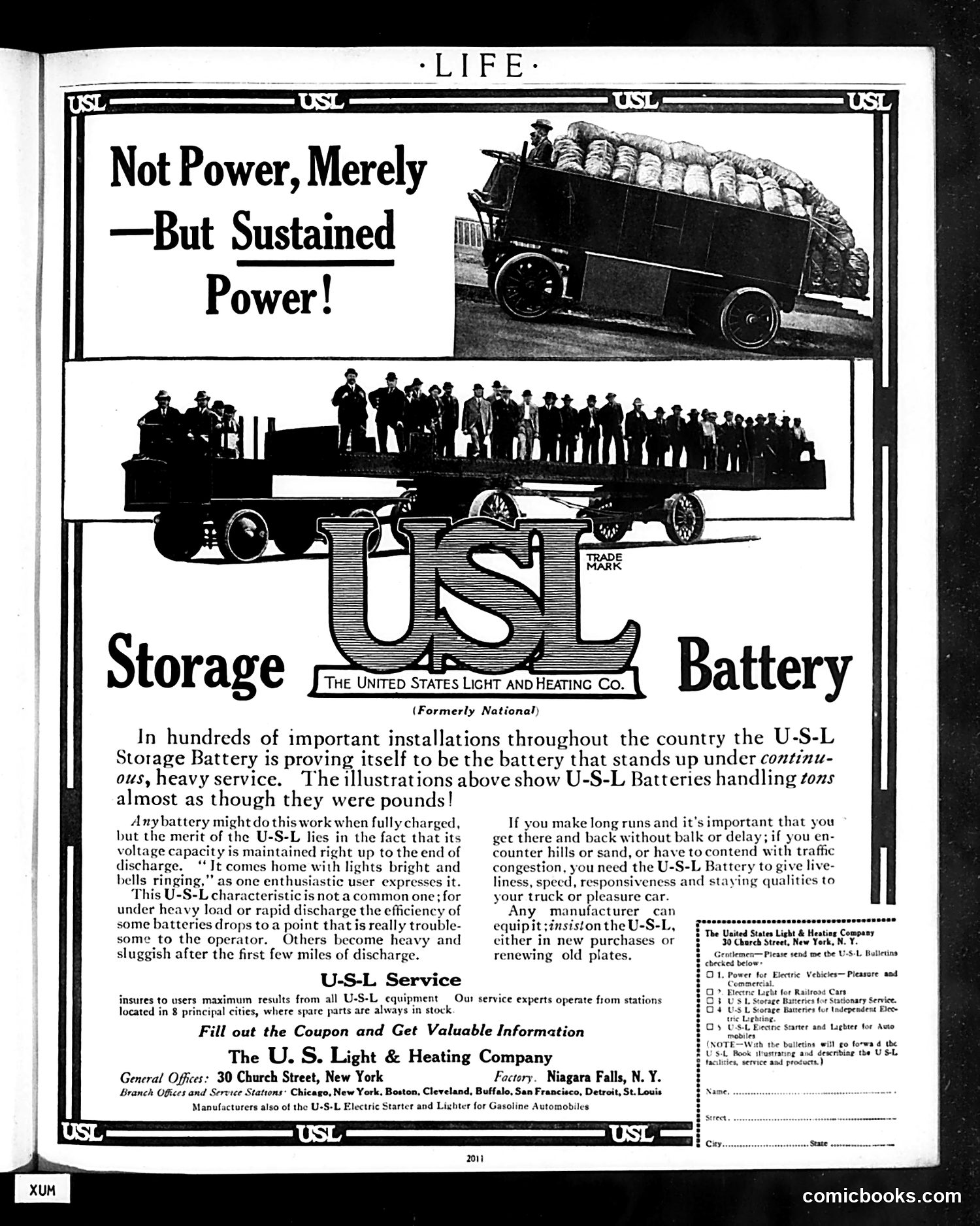
This is a **product advertisement**, not political satire. The United States Light & Heating Company promotes its U-S-L Storage Battery for commercial vehicles and automobiles. The page uses two visual demonstrations of the battery's strength: a truck hauling an enormous load of cargo, and a steam locomotive pulling a flatcar full of workers. The headline's wordplay—"Not Power, Merely—But Sustained Power!"—emphasizes that the U-S-L maintains consistent voltage throughout discharge, unlike competitors whose batteries lose efficiency under heavy load. The copy addresses commercial users (truck operators, manufacturers) facing practical problems: hills, sand, traffic congestion, and the need for reliable long-distance travel. The advertisement includes a coupon for more information and lists service stations in eight major cities. This reflects early-20th-century commercial culture when industrial reliability claims were central to marketing.
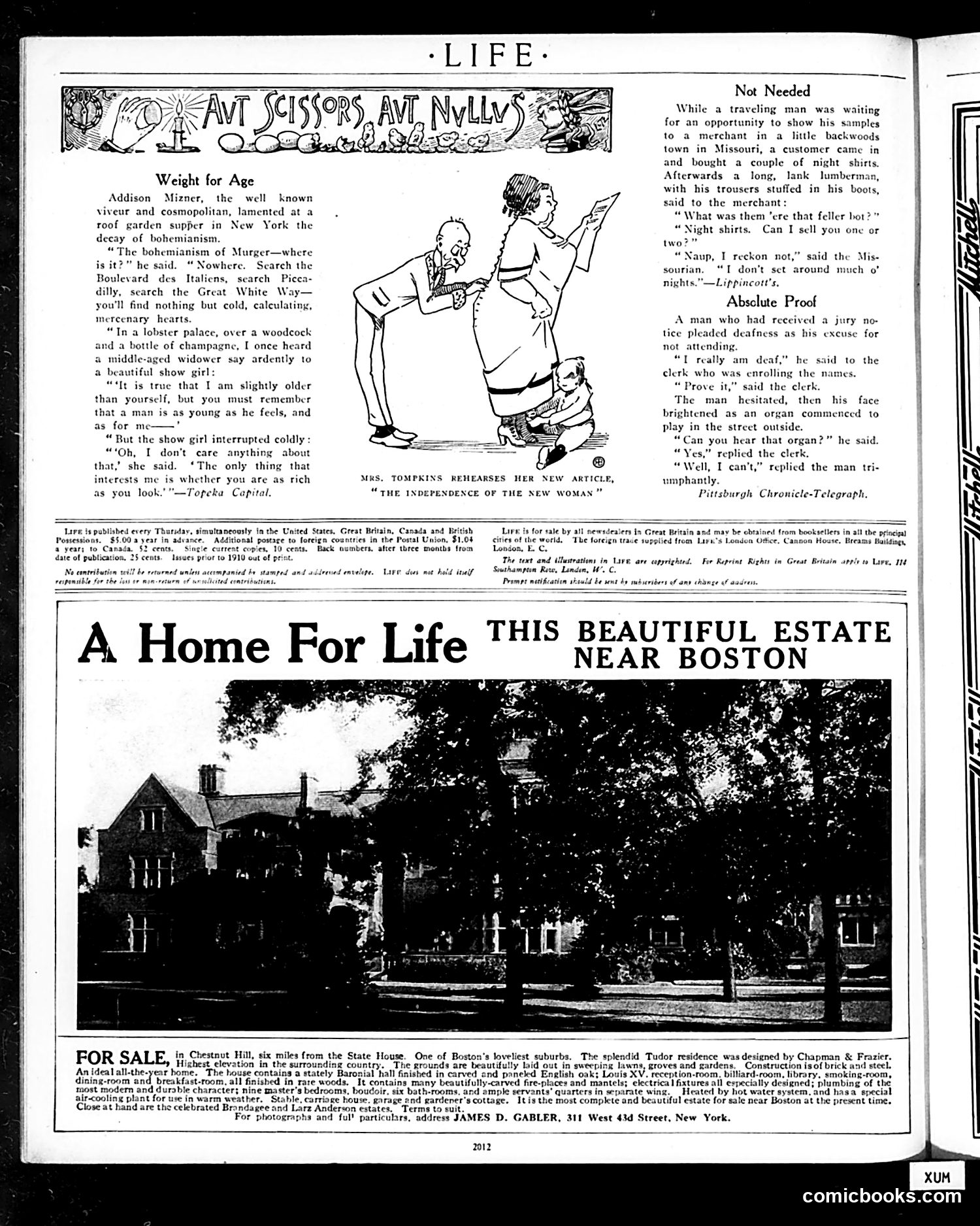
This page contains three humorous anecdotes satirizing social hypocrisy and changing values: **"Weight for Age"**: A cosmopolitan named Addison Mizner laments the death of bohemian romance, telling a story about a middle-aged man wooing a young showgirl with poetic language about feeling young. She interrupts coldly: the only thing that matters is whether he's *rich*. The joke mocks both nostalgic romanticism and mercenary modern attitudes—suggesting true bohemian idealism has been replaced by crude materialism. **"Not Needed"**: A backwoods lumberman refuses to buy nightshirts because he "don't set around much of nights." Simple rural humor about a man's practical confusion. **"Absolute Proof"**: A deaf man claims he can't hear an organ-grinder's music playing outside the courthouse to prove his deafness to a skeptical clerk. Dark humor about someone successfully faking a disability. The page primarily advertises a Boston estate for sale. The cartoons reflect *Life* magazine's typical early-20th-century satirical approach: mocking social pretension, urbanization, and changing gender dynamics.
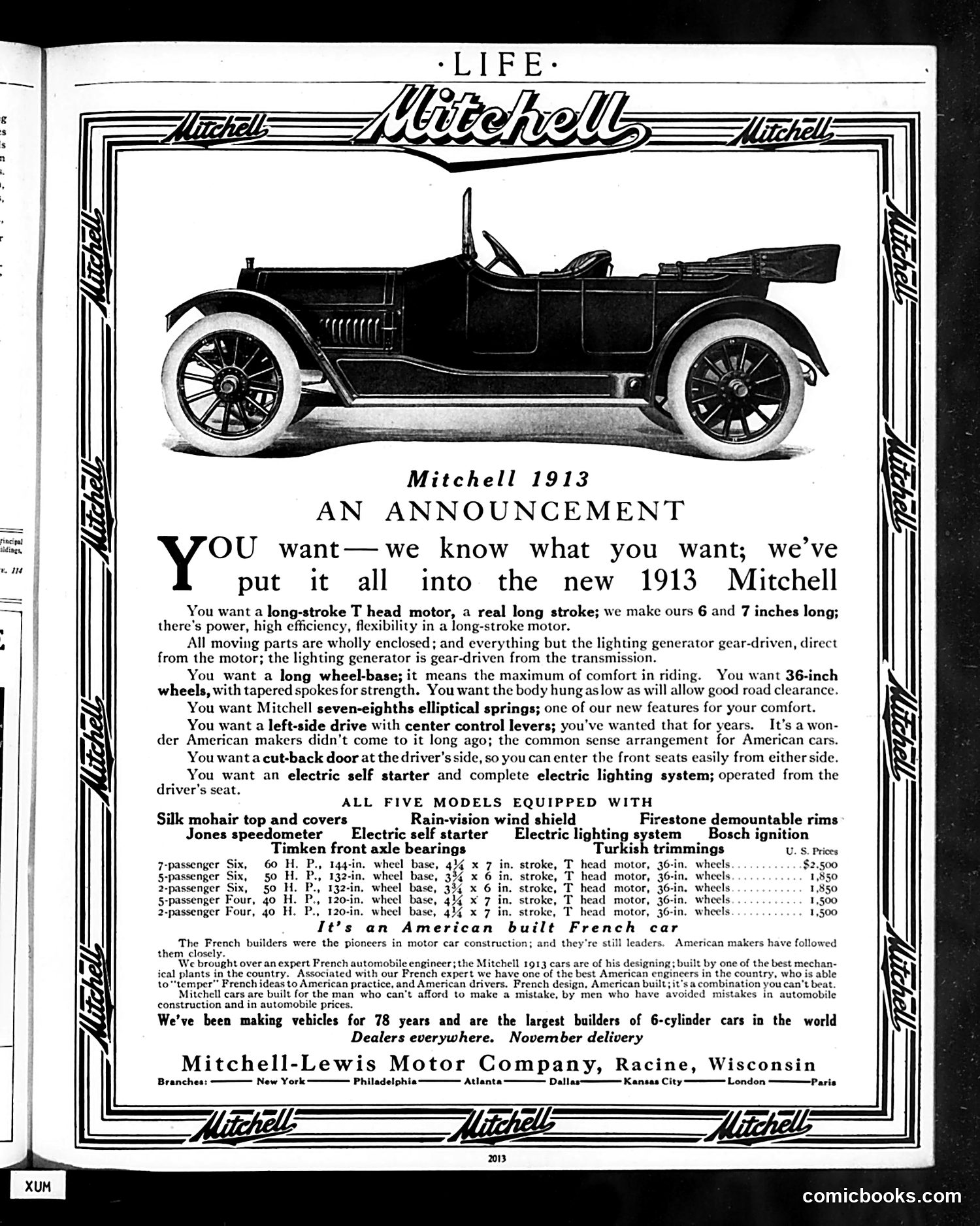
This is not satire or political commentary—it's a straightforward automobile advertisement for the Mitchell-Lewis Motor Company of Racine, Wisconsin, appearing in *Life* magazine. The ad announces the 1913 Mitchell automobile model and uses rhetorical framing ("You want...we know what you want") to list desired features: long-stroke T-head motors, 36-inch wheels, left-side drive with center controls, electric self-starters, and complete electric lighting. A key selling point is that it's "an American built French car"—the company emphasizes it was designed by an expert French automobile engineer but manufactured by Americans using American practice. This positioning reflects the early automotive industry's respect for French engineering expertise while appealing to American buyers. The ad lists five models (ranging from $1,500–$2,500) and boasts the company has been "making vehicles for 78 years" and is "the largest builders of 6-cylinder cars in the world." This is primarily marketing material, not commentary or satire.
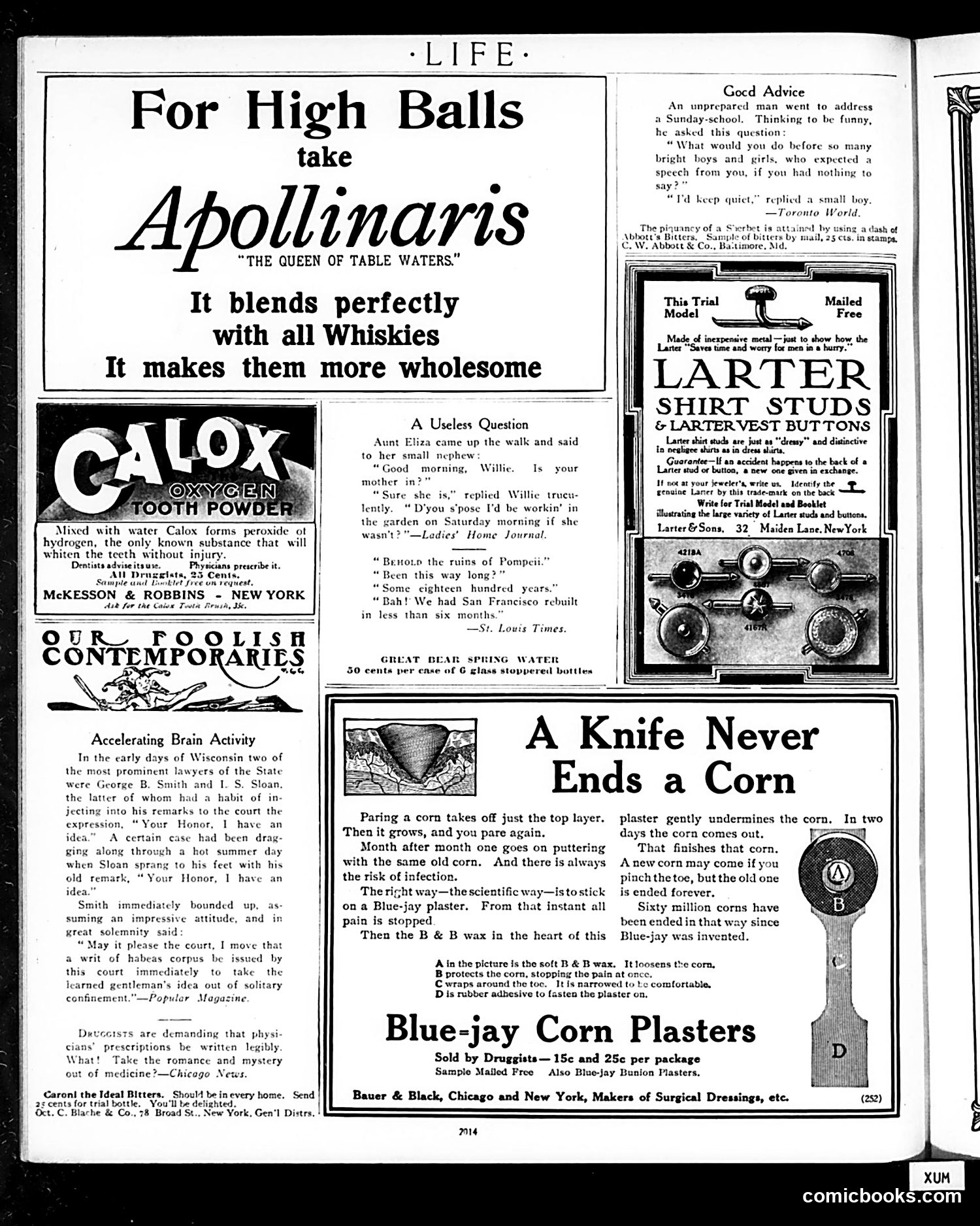
This page is **primarily advertising** with brief humorous anecdotes interspersed. The main content includes: **"A Useless Question"**: A brief joke where a boy asks why someone would work in the garden Saturday morning if their mother were home—implying mothers keep children from working. It's gentle domestic humor about parental authority. **"Accelerating Brain Activity"**: An anecdote about Wisconsin lawyers Smith and Sloan. Sloan habitually interrupts court with "Your Honor, I have an idea." Smith responds by sarcastically moving that Sloan's idea be removed to solitary confinement. The humor mocks repetitive courtroom behavior and intellectual pretension. The page is otherwise filled with product advertisements (Apollinaris water, Calox tooth powder, Blue-jay corn plasters, Larter shirt studs), reflecting early 20th-century Life magazine's reliance on advertising revenue. The humor is mild, office-friendly satire typical of the era.
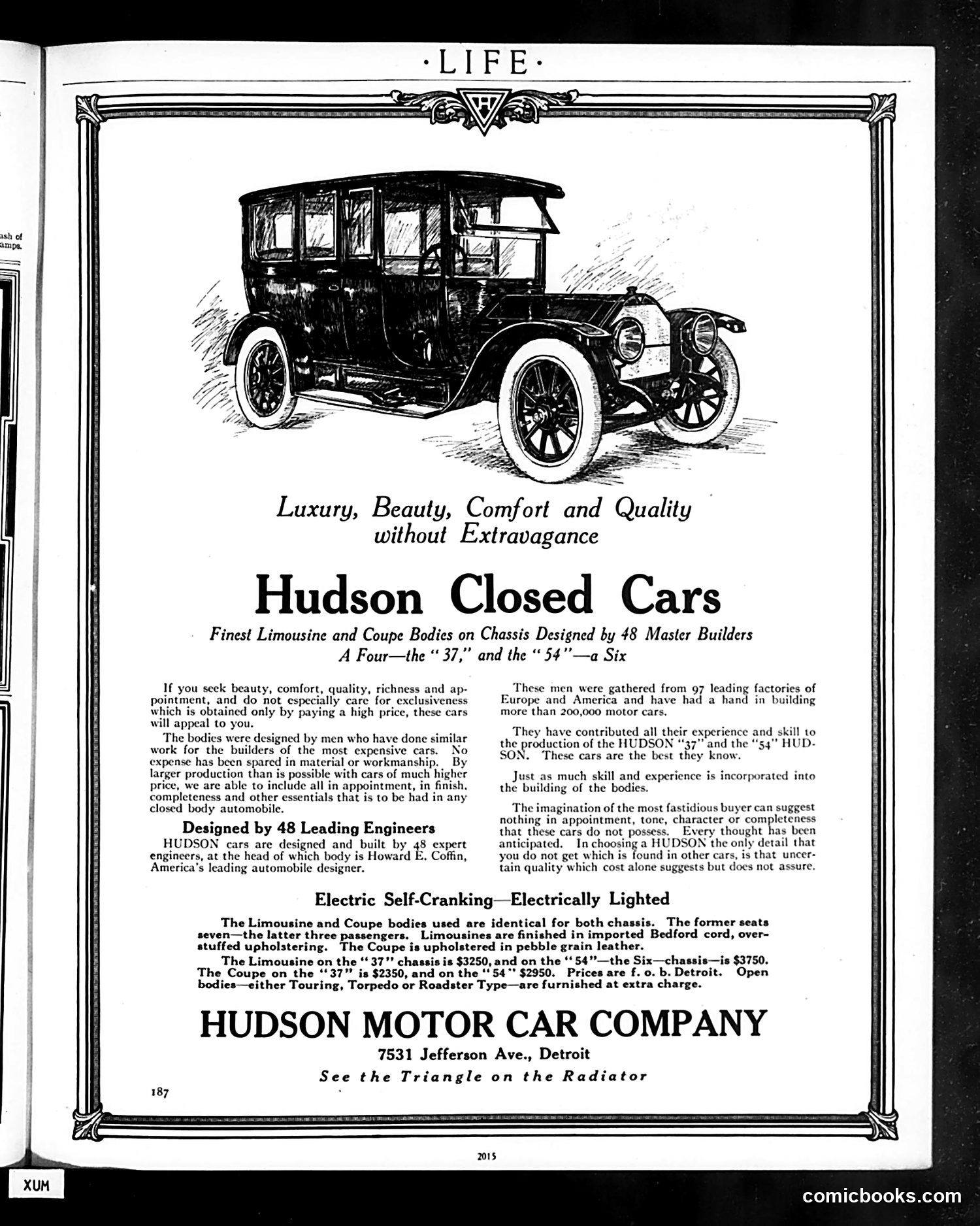
This is **not a cartoon or satire**—it's a straightforward automobile advertisement from Life magazine's advertising pages. The page promotes Hudson Motor Car Company's luxury vehicles, the "37" and "54" models. The ad emphasizes that Hudson cars offer high-end quality and comfort without excessive cost. It highlights that 48 leading engineers designed the cars (headed by Howard E. Coffin, a real automobile designer), drawing expertise from 97 European and American factories and 200,000+ previously built vehicles. The key sales pitch: Hudson achieves luxury through mass production efficiency rather than exclusivity. The ad contrasts this with expensive cars that cost more simply for prestige, claiming Hudson provides equivalent craftsmanship and appointments at lower prices. Features mentioned include electric self-cranking, electric lighting, and fine upholstery. Prices ranged from $2,350 to $3,750 depending on model. The "triangle on the radiator" was Hudson's trademark symbol.
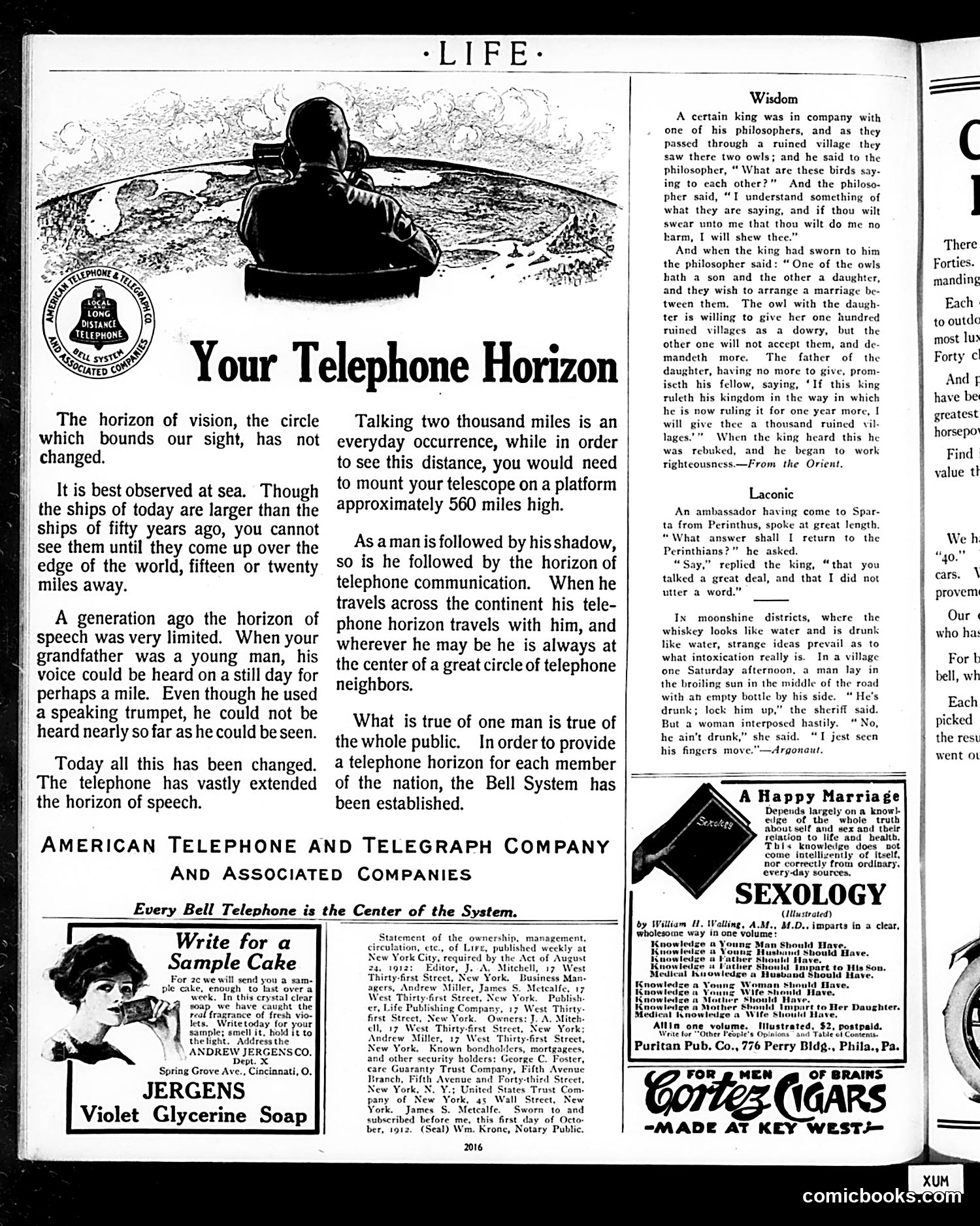
This page is primarily **advertising and corporate messaging**, not political satire. The main feature is a **Bell Telephone System advertisement** titled "Your Telephone Horizon." It uses an extended metaphor comparing visual horizon limits (what the eye can see) to communication horizons (how far voice travels). The illustration shows a man using a telephone, emphasizing the technology's revolutionary reach—talking 2,000 miles versus needing a 560-mile-high telescope to *see* that distance. The ad's central argument: just as one's shadow follows a person, the telephone "horizon" follows the user across the country, making them always "at the center of a great circle of telephone neighbors." This promotes the Bell System's national network as essential infrastructure. The page also contains **filler content**: moral tales ("Wisdom," "Laconie") and period advertisements (Jergens soap, Cortez cigars, a "Sexology" book). The tone is aspirational corporate messaging about technological progress, not social commentary or political satire.
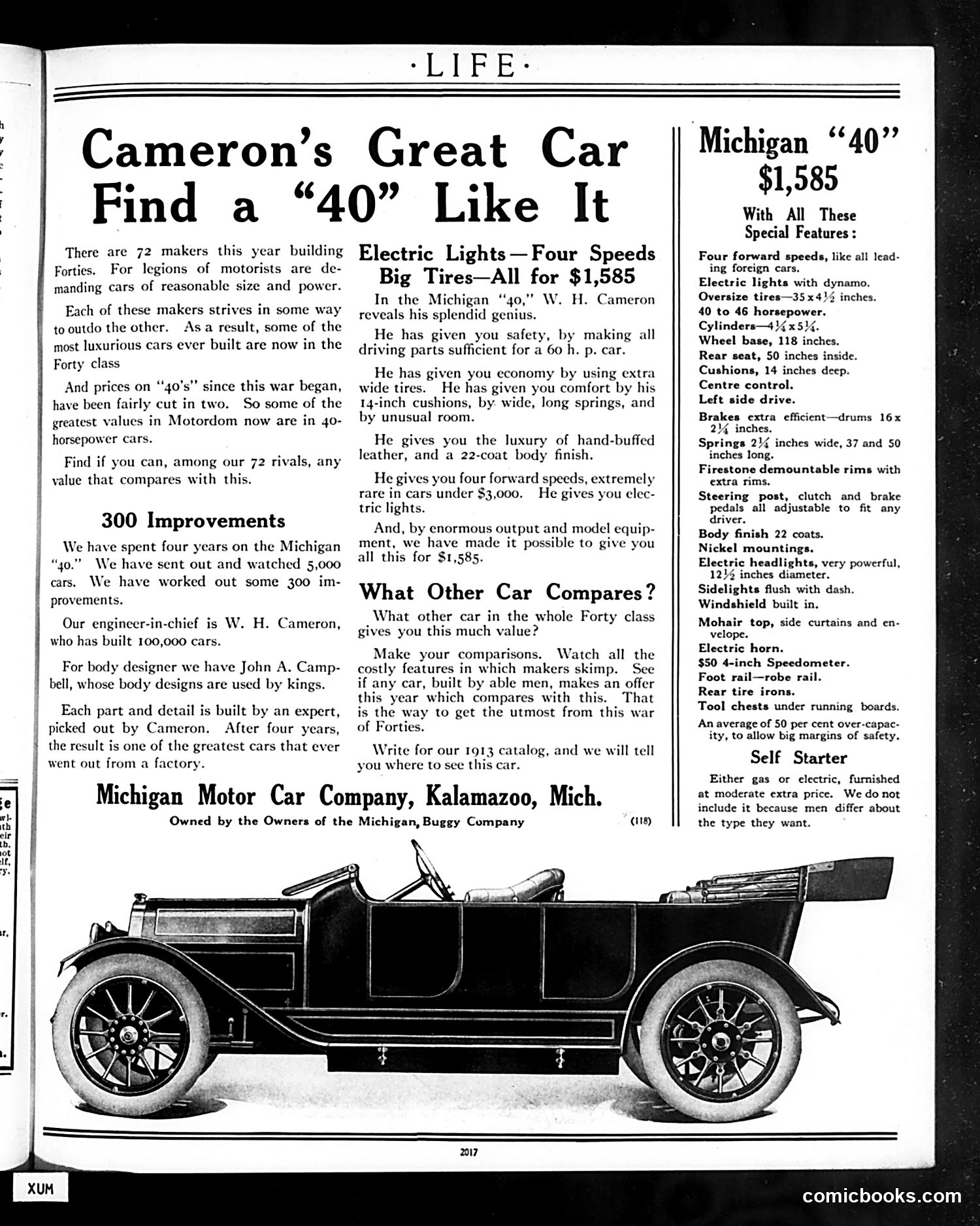
This is **not satire or political content**—it's a straightforward automobile advertisement from Life magazine, circa 1913. The page advertises the Michigan "40," a moderately-priced motorcar ($1,585) manufactured by Michigan Motor Car Company in Kalamazoo. The "40" refers to 40 horsepower. The ad emphasizes competitive value: with 72 manufacturers building "Forty-class" cars that year, the Michigan "40" claims superior features (four forward speeds, electric lights, hand-buffed leather, 22-coat finish) at a lower price than rivals charging over $3,000. The text highlights engineer W.H. Cameron's credentials (100,000 cars built) and 300 design improvements developed over four years. The challenge "Find if you can, among our 72 rivals, any value that compares with this" is straightforward competitive marketing, not satire. The accompanying technical specifications and side-view illustration serve as product documentation for potential buyers evaluating options in a crowded automotive market.
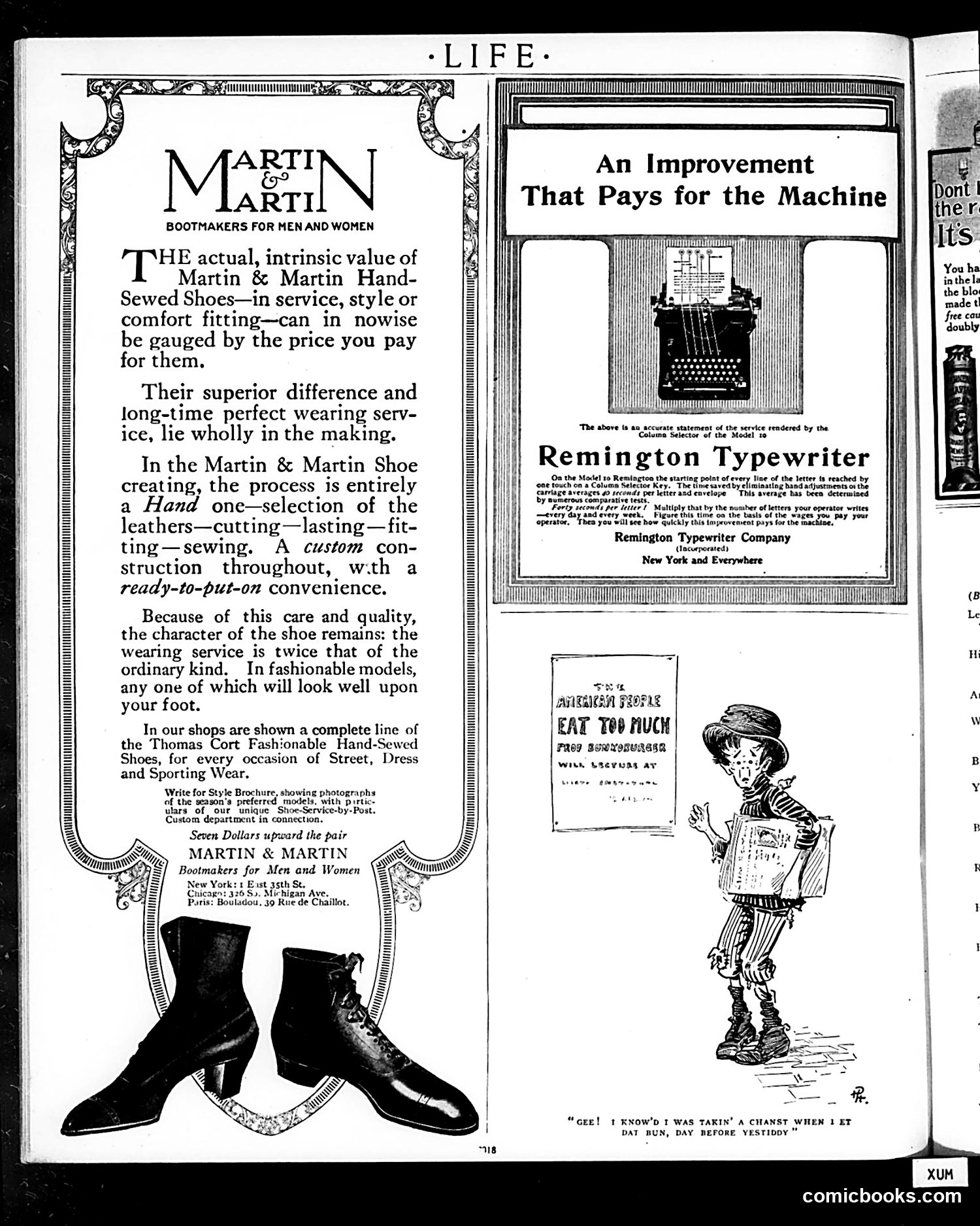
This page consists primarily of **advertisements** rather than political satire. The left side advertises Martin & Martin hand-sewn boots, emphasizing craftsmanship and durability to justify premium pricing. The top right promotes the Remington Typewriter's "Column Selector" feature, calculating time-savings that justify the machine's cost. The cartoon at bottom right is a humorous **street scene** showing a working-class character (drawn in period dialect spelling: "creel," "dat," "yestiddy") who ate a questionable bun the day before and is now suffering digestive consequences. The joke is simple physical comedy—food poisoning humor with no political content. The page reflects early 20th-century advertising strategy: justifying expensive products (handmade shoes, typewriters) through demonstrated value and efficiency gains, while using cartoon humor to entertain readers amid commercial messaging.
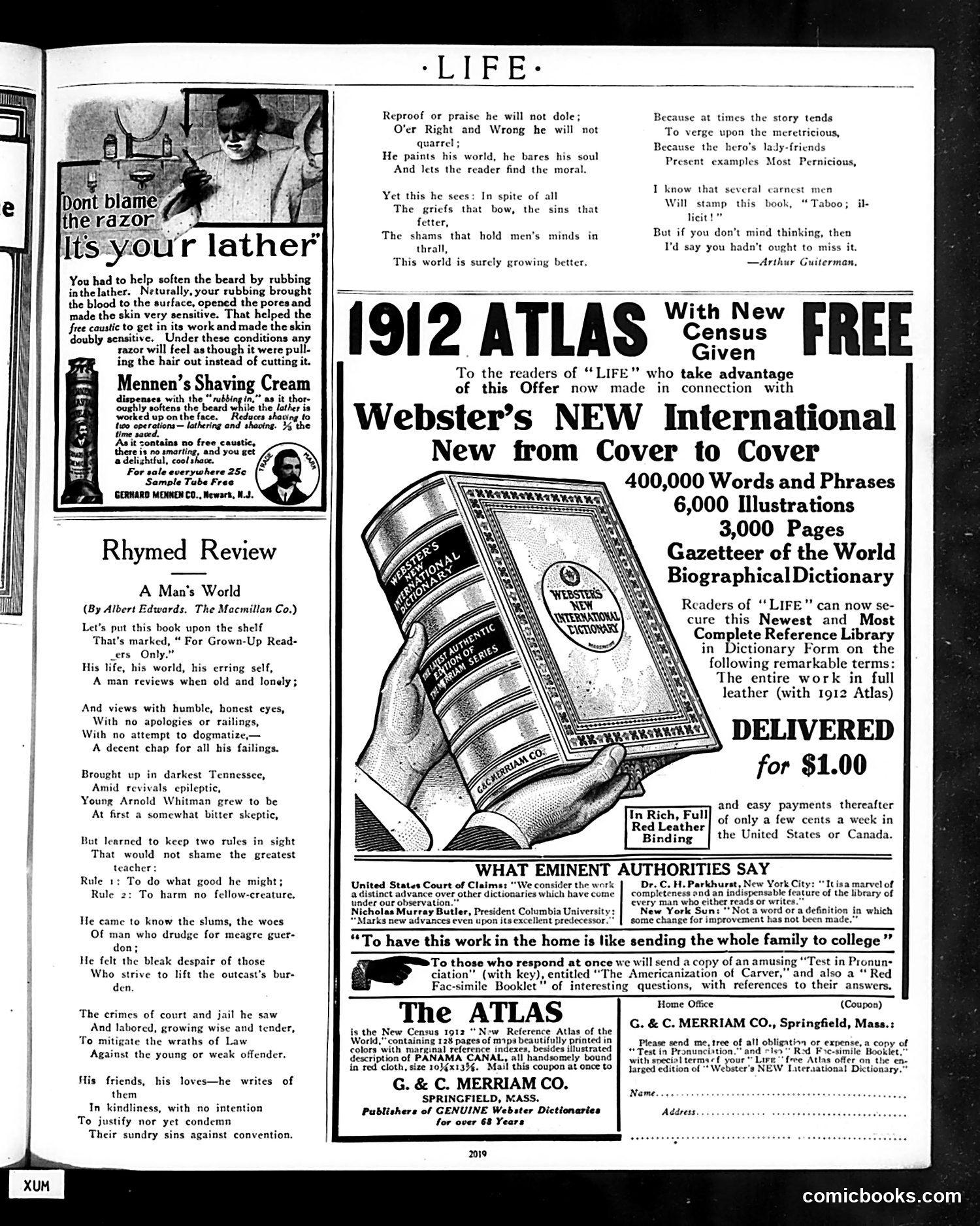
This page is primarily **advertising and book reviews**, not political satire. The "Rhymed Review" critiques Albert Edwards' novel *A Man's World*, about Arnold Whitman, a Tennessee-born man who learns compassion for the poor and marginalized. The reviewer praises Whitman's moral philosophy—doing good and harming no one—while noting the book may offend "earnest men" who find its treatment of morality and romance objectionable. The main advertising dominates: Webster's 1912 Atlas and International Dictionary, promoted as a comprehensive reference work (400,000 words, 3,000 pages). There's also a shaving cream ad explaining product benefits. **No political figures, caricatures, or satire appear on this page.** It reflects early 1900s publishing and consumer marketing rather than political commentary.
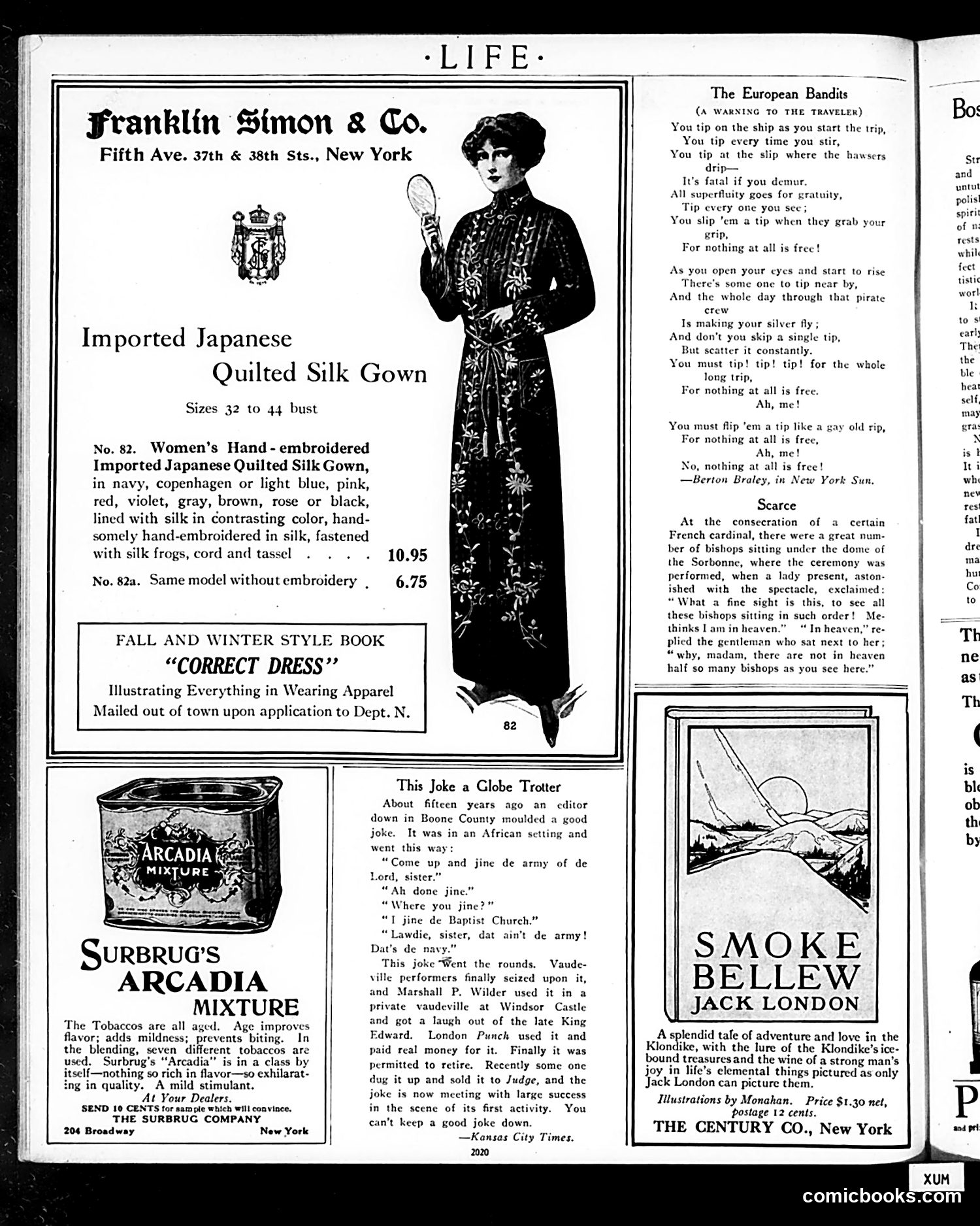
This poem by Berton Braley mocks the ubiquitous tipping culture that American tourists encountered in Europe, particularly in port cities. The "bandits" are not criminals but rather porters, waiters, ship workers, and service staff who expected—and demanded—constant gratuities from travelers. The satire's point: European service workers operated a systematic extraction of money from wealthy American visitors. Every interaction, from boarding ship to daily activities, required a tip. The poem emphasizes the inescapability ("nothing at all is free") and the pirates' relentless pursuit of American wallets ("the whole day through that pirate crew / Is making your silver fly"). This reflects early 20th-century American anxieties about European travel costs and perceived exploitation. The exaggeration—that tipping is "fatal if you demur"—underscores how culturally entrenched and socially enforced these expectations were for travelers abroad.
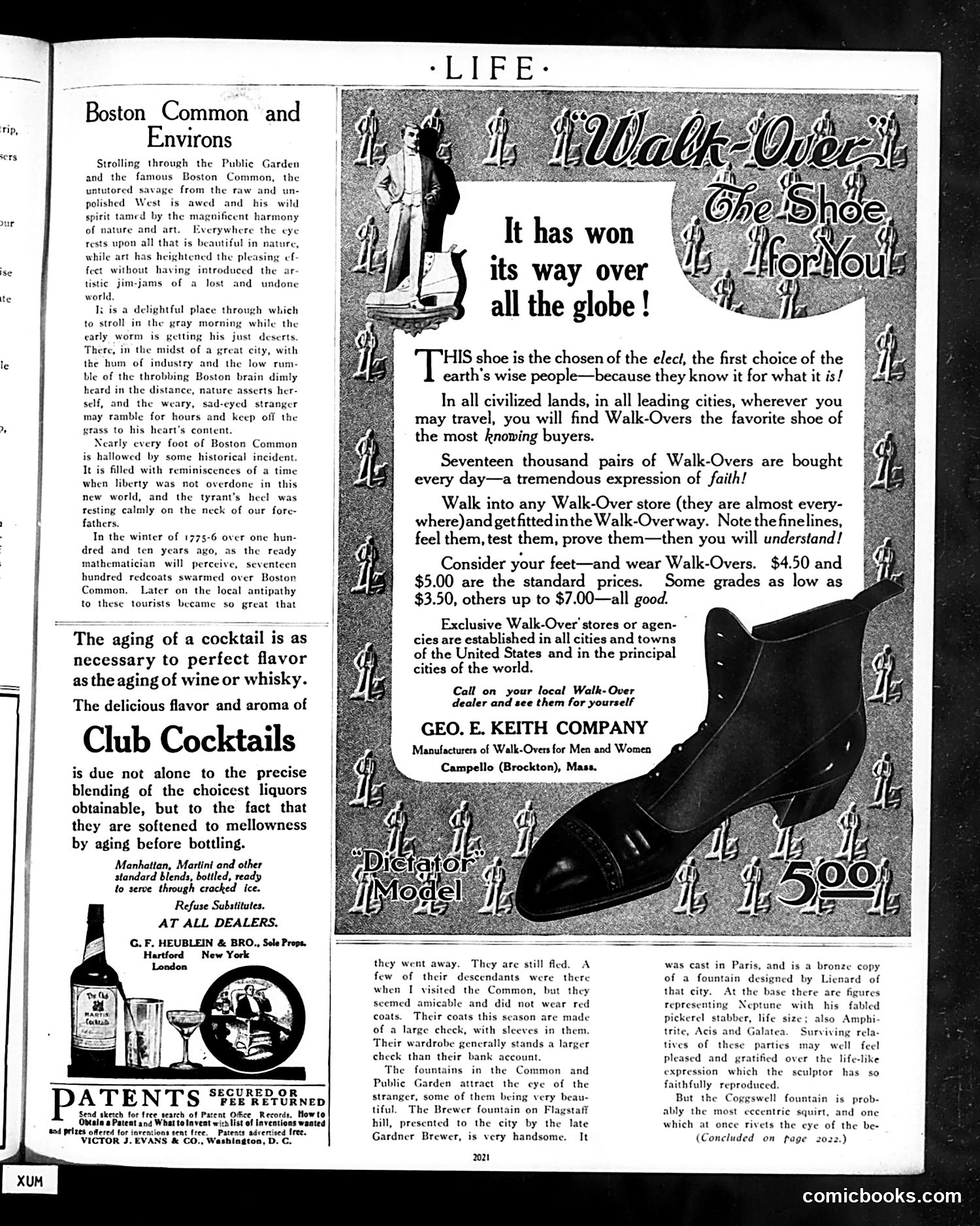
This page is primarily **advertising**, not satire or political commentary. The dominant content is a large advertisement for Walk-Over shoes (center-right), which claims the shoe has "won its way over all the globe" and is "the chosen of the elect, the first choice of the earth's wise people." The ad emphasizes quality, affordability ($3.50–$7.00), and availability in stores nationwide. The left column contains a brief, earnest (not satirical) travel piece about Boston Common and the Public Garden, praising their historical significance and natural beauty. Below that is an advertisement for Club Cocktails by Heublein & Bros., using pseudo-scientific language about aging spirits to justify premium pricing. A small patent advertisement appears at the bottom. **For modern readers:** This represents early 20th-century magazine advertising—before modern consumer skepticism. The grandiose claims ("chosen of the elect") and appeals to status ("knowing buyers") are typical of period advertising. There is no discernible cartoon or satire on this particular page.
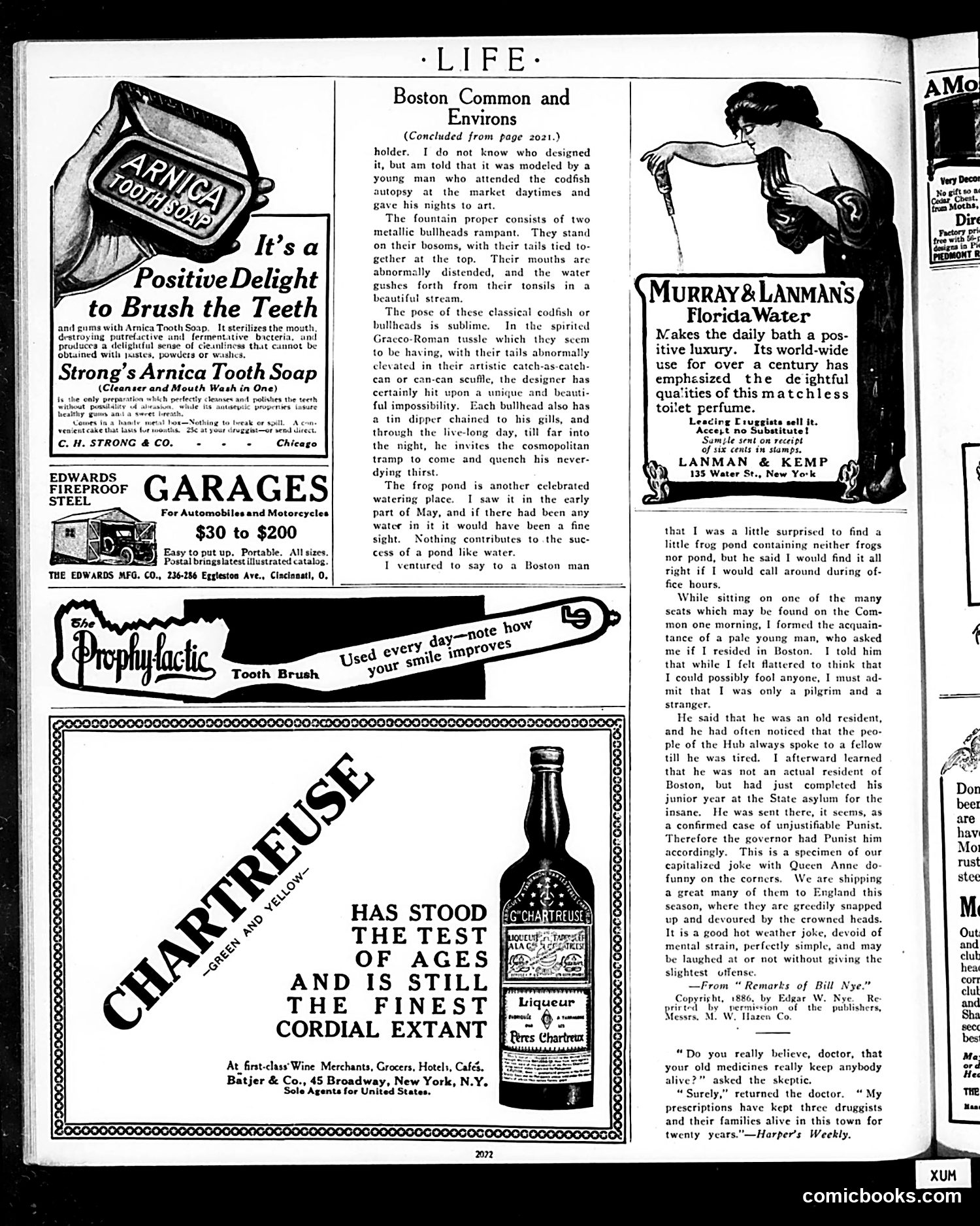
This page presents a humorous essay about Boston landmarks, interspersed with period advertisements. The main text mocks Boston's public spaces through mock-serious descriptions. The author ridicules the Boston Common's fountain, featuring two "metallic bullheads" (codfish heads) with their tails tied together—described ironically as "sublime" and artistically impossible. He sarcastically notes the fountain's frog pond contains no water, undermining its purpose as a "watering place." A key anecdote involves meeting a pale young man claiming to be a Boston resident who recently completed his "junior year at the State asylum for the insane"—a joke about Bostonians' supposed tendency to lecture strangers relentlessly. The author calls this "unjustifiable Purist" behavior, suggesting Boston's reputation for self-righteous moralism. The advertisements (tooth soap, garages, liqueur) are unrelated to the satire. The closing quote critiques patent medicines—a contemporary concern about medical quackery.
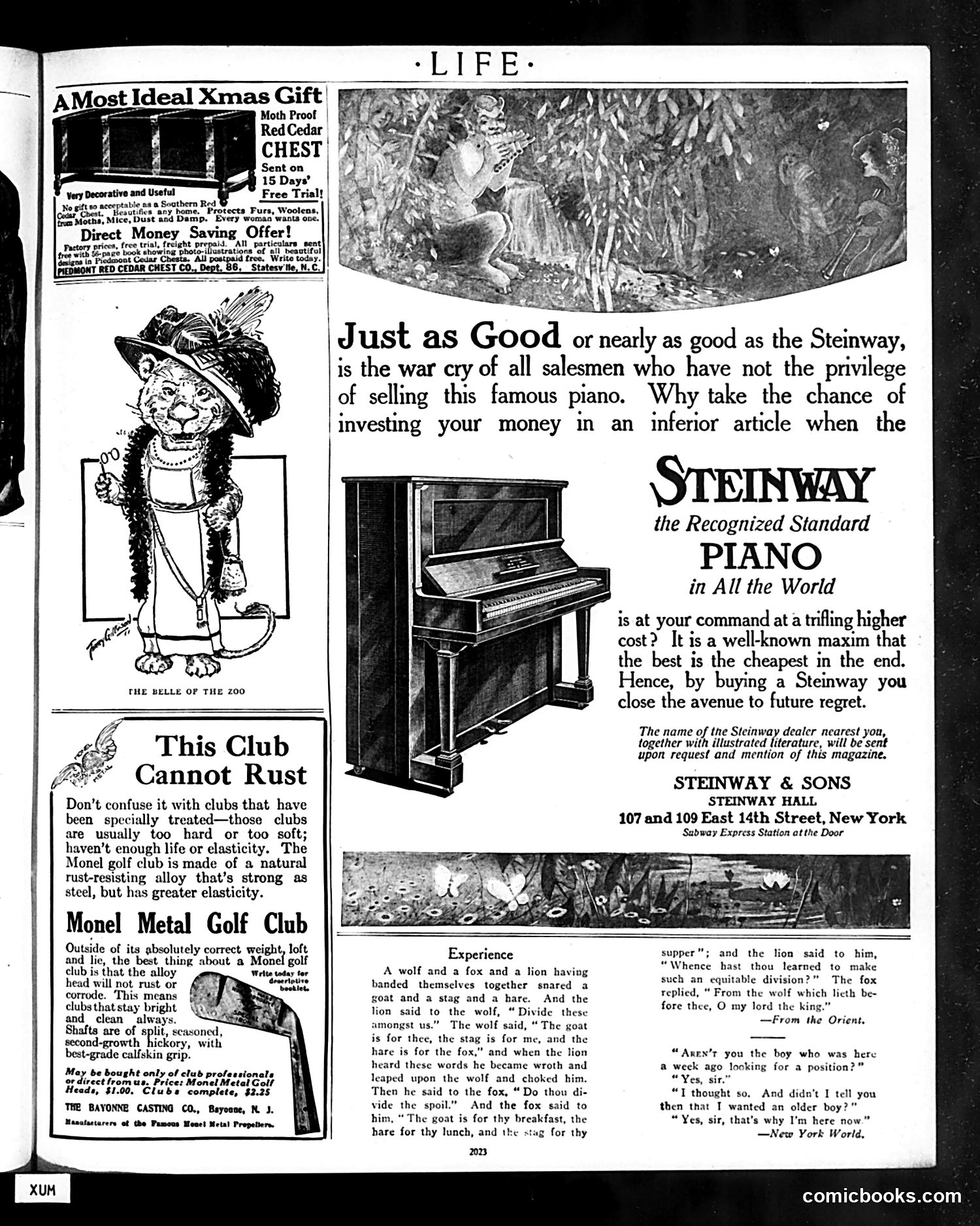
This page mixes advertisements with two distinct pieces of content: **Advertisements** dominate: a Red Cedar chest, Steinway pianos (emphasizing superiority over cheaper alternatives), and Monel Metal golf clubs (promoting rust-resistance). **"The Belle of the Zoo"** (left): A satirical cartoon depicting a fashionably dressed female lion or big cat, likely mocking high society women or "society dames" of the era—the "belle" being an ironic reference to an attractive woman. **"Experience" Fable** (bottom right): An Aesop's fable adaptation where a fox learns diplomacy by observing a wolf's fatal mistake, rewarding the lion's violence with flattery. The moral suggests learning through others' misfortunes. **"Aren't You the Boy..." Joke** (bottom): A brief comedic exchange where a boy returns job-hunting, claiming he's now older—implying time has passed or he's merely aging in place. It's gentle period humor about employment persistence. The page reflects early 20th-century Life magazine's mix of consumer advertising, animal satire, moral fables, and light jokes targeting contemporary manners and social pretension.
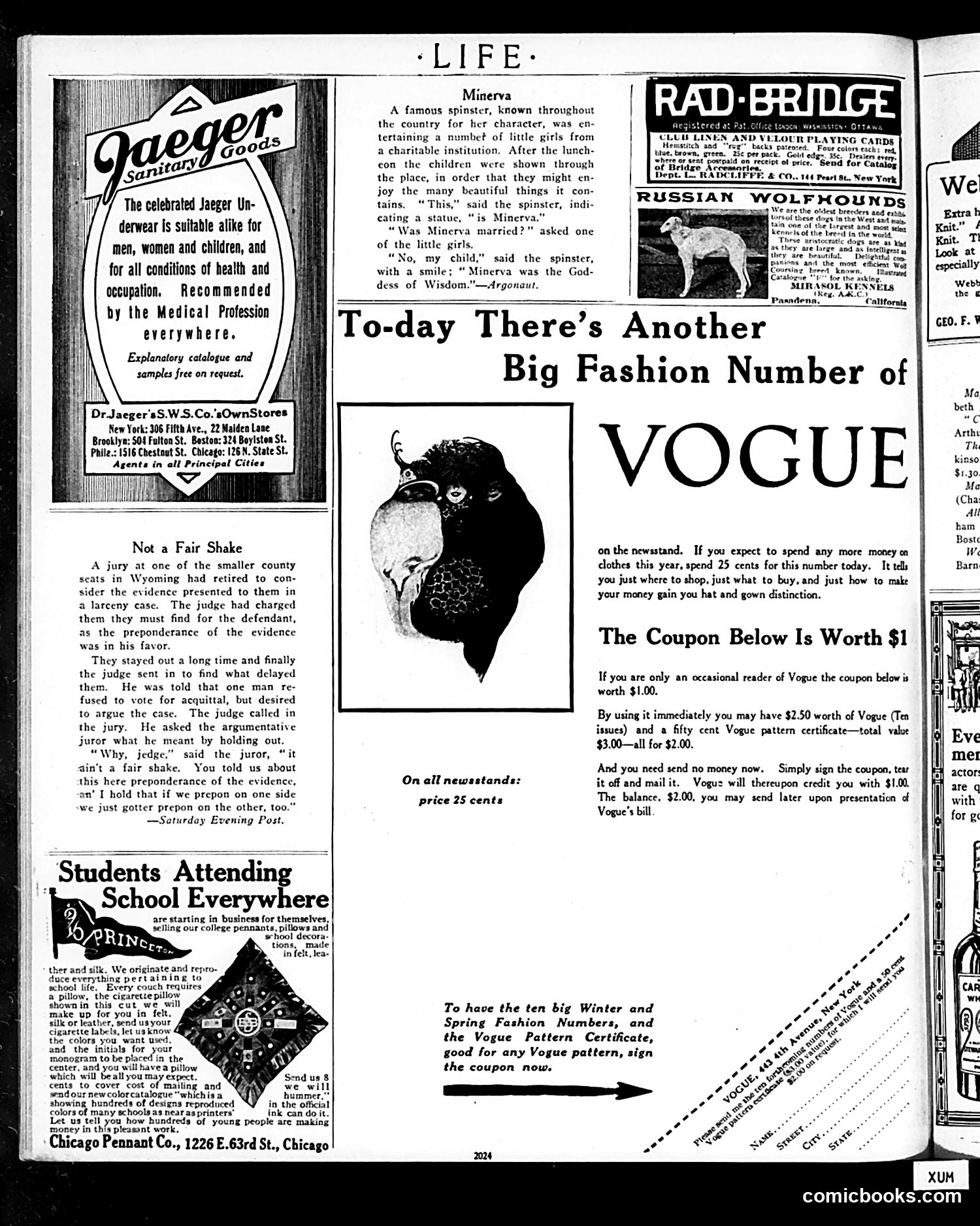
This brief humorous piece depicts a spinster showing charity-school children her home. When she points to a statue of Minerva (Roman goddess of wisdom), a child asks innocently if Minerva was married. The spinster replies "No"—Minerva was a goddess, not a woman. The joke's satire lies in the implicit contrast: the spinster, herself unmarried, identifies with the goddess of wisdom, suggesting her unmarried status reflects intellectual virtue rather than social failure. For early 20th-century readers, this would be gently mocking both the spinster's self-justifying pretension and society's anxiety about unmarried women. The child's naive question reveals the unstated assumption that an adult woman *should* be married—a cultural norm the spinster cleverly deflects through mythological reference.
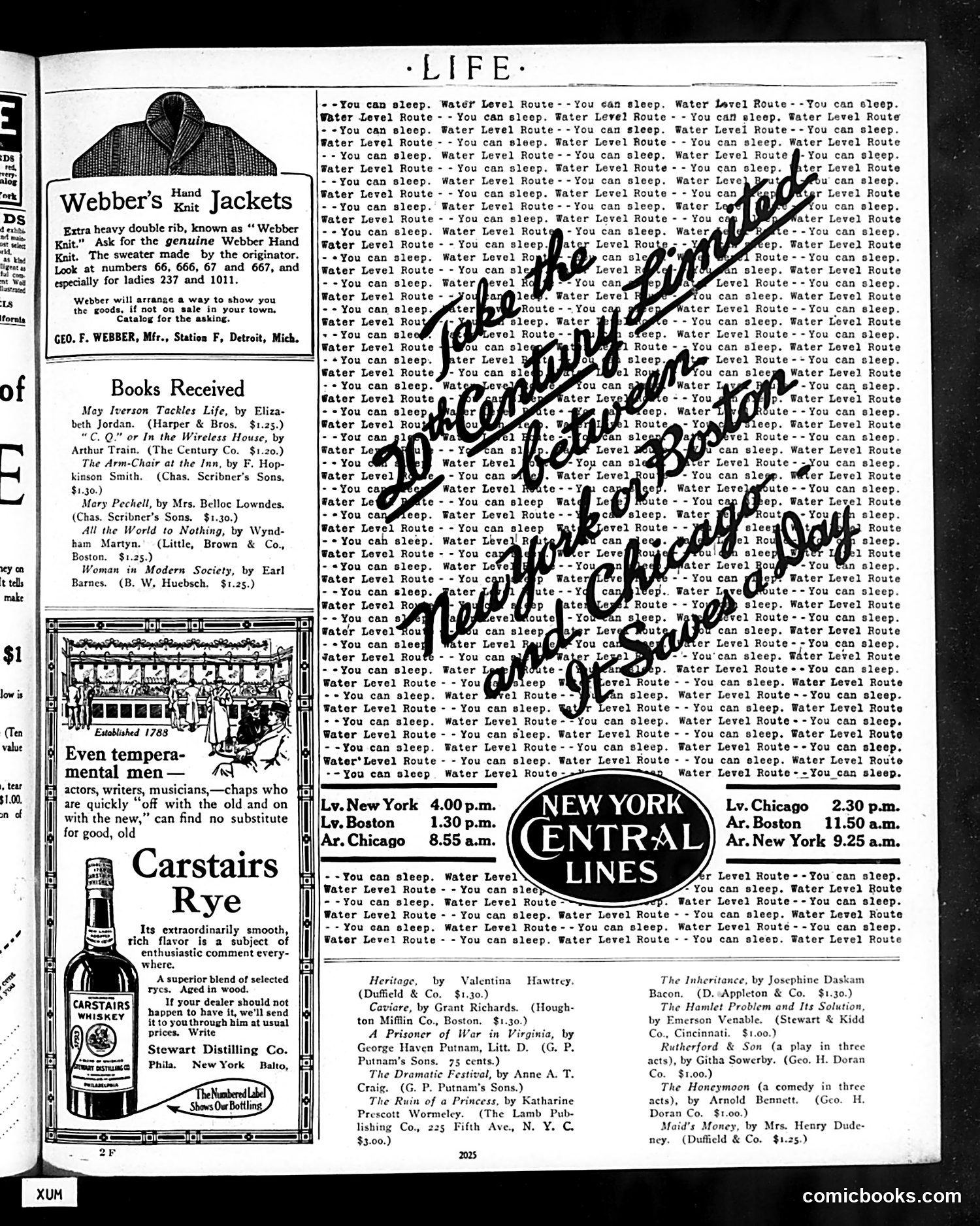
This page is primarily **advertising and book listings**, not political satire. The dominant visual element is a large diagonal advertisement for the **New York Central Lines** railroad, featuring repeated text "You can sleep" overlaid on the company name—a straightforward promotional claim about sleeping accommodations on their Water Level Route trains. The ad includes departure/arrival times for routes between New York, Boston, and Chicago, appealing to travelers. The page also contains: - **Webber's Hand Knit Jackets** ad (Detroit manufacturer) - **Carstairs Rye whiskey** ad - **Books Received** section listing recent publications - **New York Central Lines** schedule There is **no discernible political cartoon or satirical content** visible in the image itself. This appears to be a standard editorial/advertising page from *Life* magazine, likely from the 1910s-1920s based on typography and product styles.
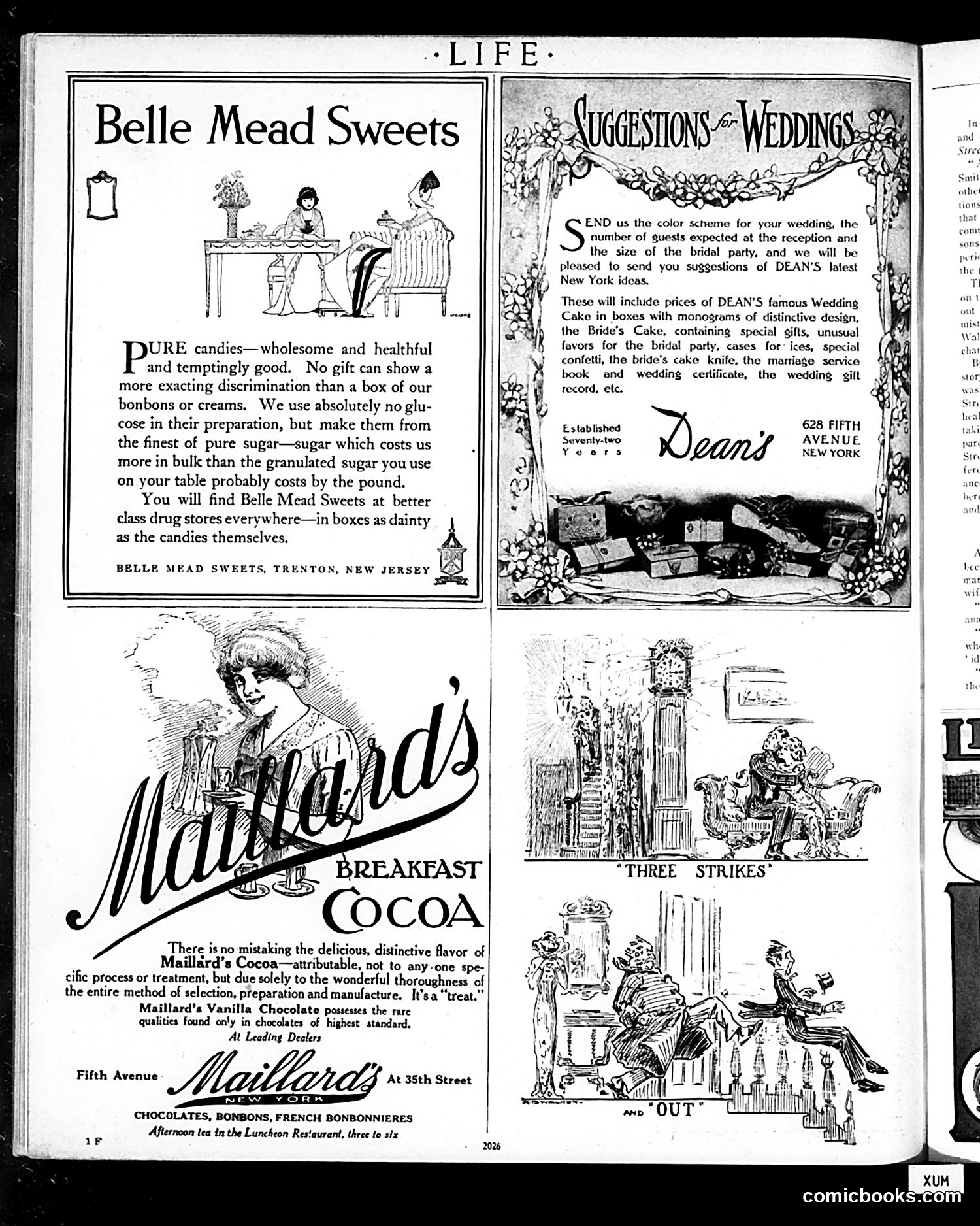
This page is primarily **advertising**, not satire or political commentary. It contains four commercial advertisements: 1. **Belle Mead Sweets** (top left): A candy company emphasizing pure sugar ingredients and quality packaging as gifts. 2. **Dean's Wedding Suggestions** (top right): A wedding planning service offering customized cakes, favors, and ceremonial items based on client specifications. 3. **Maillard's Breakfast Cocoa** (bottom left): A chocolate company claiming distinctive flavor from superior manufacturing methods. 4. **Three Strikes / Out** (right side): Appears to be comic strips or illustrations, likely unrelated entertainment content. The page reflects early 20th-century luxury consumer culture, targeting affluent readers with premium confectionery and wedding services. No political figures or satirical commentary are present—this is straightforward commercial promotion typical of *Life* magazine's revenue model.
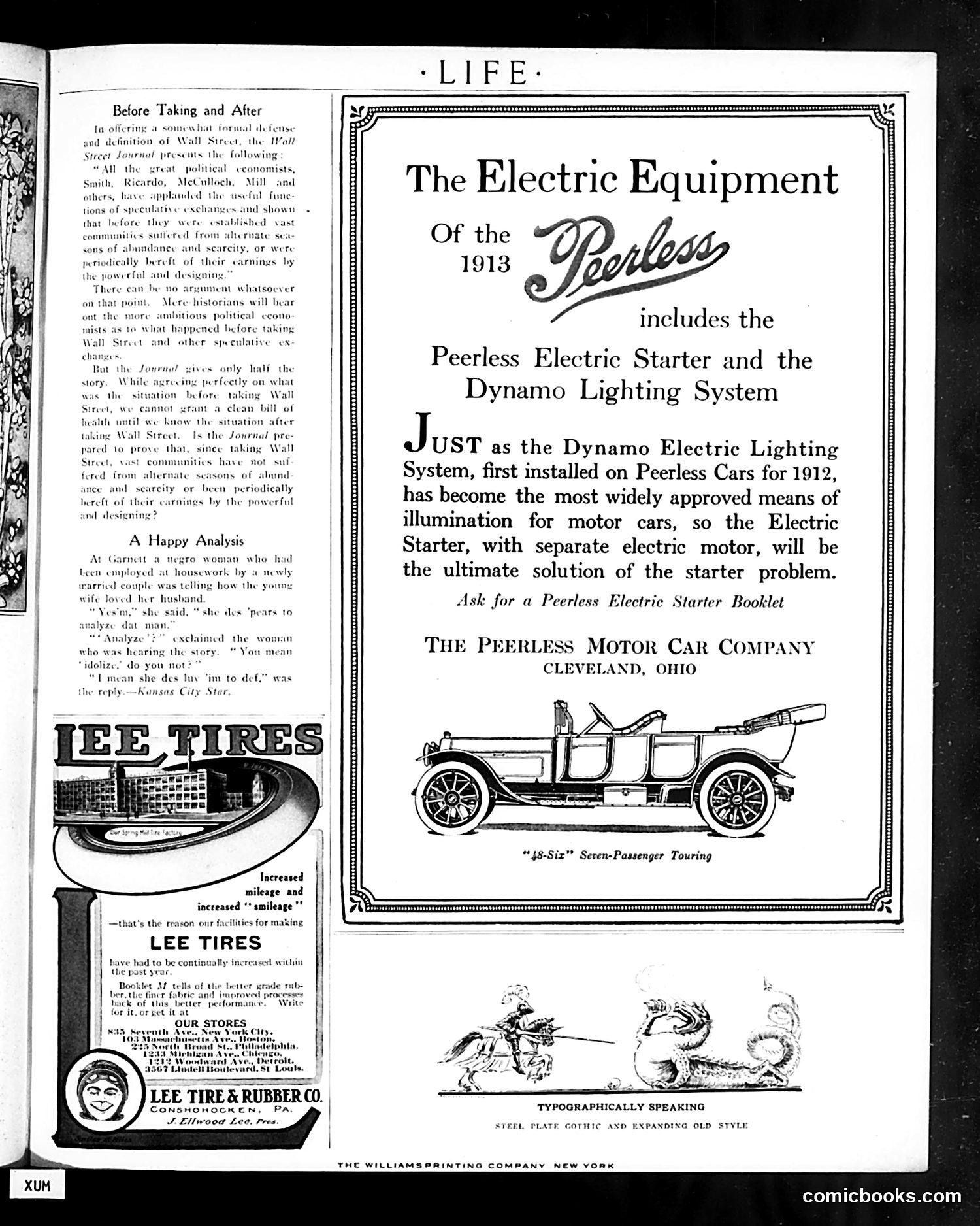
This page contains **primarily advertisements** with minimal editorial content. The main items are: **Left column:** Two brief text pieces—"Before Taking and After" (discussing Wall Street speculation and political economy, though OCR is heavily corrupted) and "A Happy Analysis" (a brief anecdote about a Black domestic worker's malapropism, reflecting the era's casual racist humor). **Right side:** A full-page advertisement for the Peerless Motor Car Company showcasing their 1913 electric starter and dynamo lighting system—technological innovations marketed as solutions to the "starter problem" in automobiles. **Bottom left:** An advertisement for Lee Tires, emphasizing increased production capacity. **Bottom right:** A decorative typographic sample labeled "Typographically Speaking." The page lacks coherent satirical cartoons or political commentary. The "Happy Analysis" represents period attitudes toward race and dialect humor that modern readers would find offensive. The overall page reflects 1913 concerns: technological advancement in automobiles and the ongoing debate about Wall Street's economic role.