
Life, 1912-10-17 · page 24 of 44
Life — October 17, 1912 — page 24: what you’re looking at
What you’re looking at
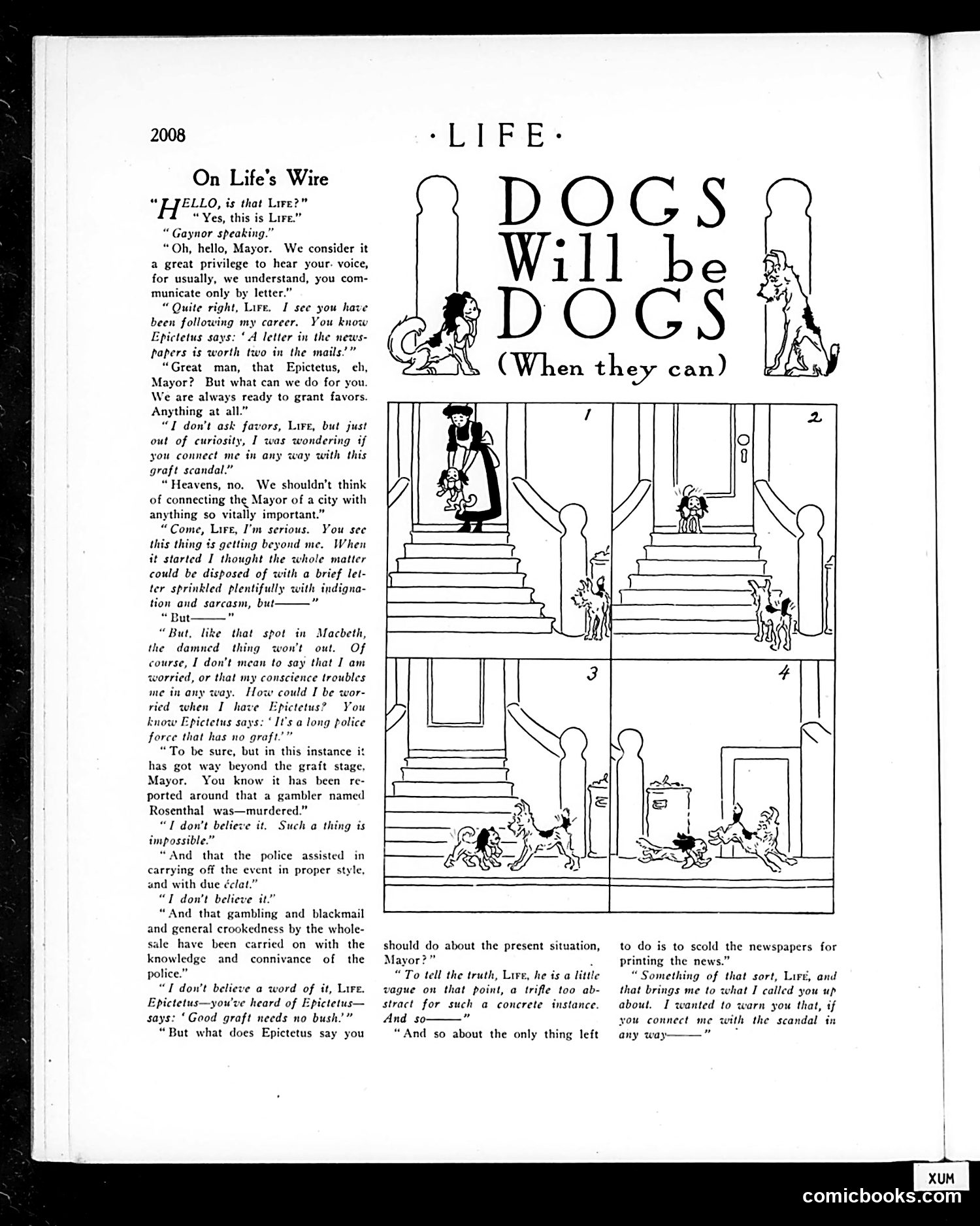
This 1908 dialogue satirizes New York City Mayor William J. Gaynor's response to the murder of gambler Herman Rosenthal and subsequent revelations of police corruption. The cartoon mocks Gaynor's strategy of dismissive denial and philosophical deflection. **The Setup:** Life presents a phone conversation where Gaynor repeatedly invokes the Stoic philosopher Epictetus to avoid responsibility for systemic graft, blackmail, and police involvement in Rosenthal's murder—a genuine scandal that implicated the NYPD. **The Joke:** Rather than address the corruption, Gaynor suggests the real problem is newspapers *reporting* the scandal. His repeated citation of Epictetus as justification for inaction becomes absurd, especially the fabricated quote "Good graft needs no bush" (playing on "good wine needs no bush"). **The Point:** Life ridicules how public officials use rhetoric and philosophy to evade accountability, proposing that suppressing journalism is preferable to confronting actual criminal misconduct by government agencies. The accompanying four-panel comic strip (right) appears to illustrate dogs behaving as dogs do—likely a separate, lighter feature.
📄 Transcribed text from this page (OCR, searchable)
Machine-transcribed from the original scan — historical spelling and the odd misread are preserved.
2008 On Life’s Wire a ELLO, is that Lire?” “Yes, this is Lire.” “Gaynor speaking.” “Oh, hello, Mayor. We consider it a great privilege to hear your. voice, for usually, we understand, you com- municate only by letter.” “Quite right, Lire. I see you have been following my career. You know Epictetus says: ‘A letter in the news- papers is worth two in the mails?” “Great man, that Epictetus, eh, Mayor? But what can we do for you We are always ready to grant favors. Anything at all.” “I don’t ask favors, Lire, but just out of curiosity, I was wondering if you connect me in any way with this graft scandal.” “Heavens, no. We shouldn't think of connecting the Mayor of a city with anything so vitally important.” “Come, Lire, I’m serious. You see this thing és getting beyond me. When it started I thought the whole matter could be disposed of with a brief lel- ter sprinkled plentifully with indigna- tion and sarcasm, but. a] “ But——" “But, like that spot in Macbeth, the damned thing won't out. Of course, I don't mean to say that I am worried, or that my conscience troubles me in any way. How could I be wor- ried when I have ictetus? You know Epictetus says: ‘It’s a long police force that has no graft!” “To be sure, but in this instance it has got way beyond the graft stage, Mayor. You know it has been re- ported around that a gambler named Rosenthal was—murdered.” “T don’t bel it, Such a thing is impossible.” “And that the police assisted in carrying off the event in proper style, and with due éclat.” “T don’t believe it.” “And that gambling and blackmail and general crookedness by the whole- sale have been carried on with the knowledge and connivance of the police.” “T don’t believe a word of it, Lire. Epictetus—you've heard of Epictetus— says: ‘Good graft needs no bush.” “But what does Epictetus say you should do about the present situation, Mayor?” . “To tell the truth, Lire, he is a little vague on that point, a trifle too ab- stract for such a concrete instance. And so- o “And so about the only thing left to do is to scold the newspapers for printing the news.” “Something of that sort, Lire, and that brings me to what I called you up about. I wanted to warn you that, if you connect me with the scandal in any way- ad : comicbooks.com