
Life, 1912-10-17 · page 20 of 44
Life — October 17, 1912 — page 20: what you’re looking at
What you’re looking at
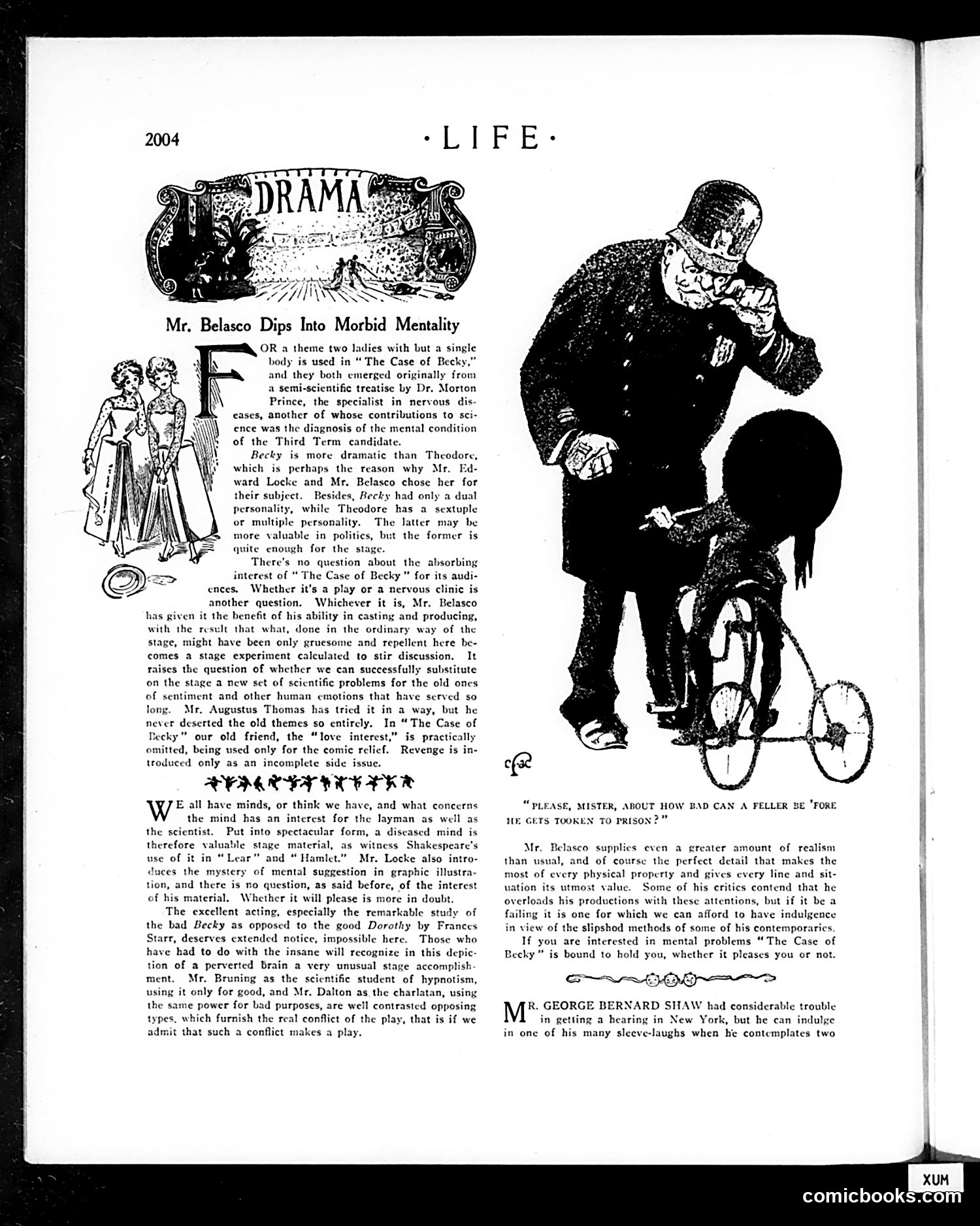
This page reviews David Belasco's theatrical production of "The Case of Becky," based on Dr. Morton Prince's scientific work on dual personality disorder. The satire compares the play's protagonist Becky—who has a split personality—to Theodore Roosevelt, depicted as having a "sextuple or multiple personality." The joke is that while Becky's dual nature makes for dramatic theater, Roosevelt's volatile, contradictory political positions are far more chaotic in actual governance. The text praises the play's ambition in treating psychiatric science as stage material rather than relying on sentiment and "love interest." The cartoon shows a well-dressed man on a tricycle, illustrating the play's exploration of mental pathology as entertainment. The review credits actress Frances Starr's performance and producer Belasco's meticulous realism, while questioning whether scientific problems can successfully replace traditional dramatic emotions on stage.
📄 Transcribed text from this page (OCR, searchable)
Machine-transcribed from the original scan — historical spelling and the odd misread are preserved.
NS 77/6 CSS Mr. Belasco Dips Into Morbid Mentality OR a theme two ladies with but a single body is used in “ The Case of Becky,” and they both emerged originally from a semi-scientific treatise by Dr. Morton Prince, the specialist in nervous dis- eases, another of whose contributions to sci- ence was the diagnosis of the mental condition of the Third Term candidate. Becky is more dramatic than Theodore, which is perhaps the reason why Mr. E ward Locke and Mr. Belasco chose her for their subject. Besides, Becky had only a dual personality, while Theodore has a sextuple or multiple personality, The latter may be more valuable in politics, but the former is quite enough for the There's no question about the absorbing interest of “ The Case of Becky” for its audi- ences. Whether it’s a play or a nervous clinic is another question. Whichever it is, Mr. Belasco has given it the benefit of his ability in casting and producing, with the result that what, done in the ordinary way of the stage, might have been only gruesome and repellent here be- comes a stage experiment calculated to stir discussion. It raises the question of whether we can successfully substitute on the stage a new set of scientific problems for the old ones of sentiment and other human emotions that have served so long. Mr, Augustus Thomas has tried it in a way, but he never deserted the old themes so entircly. In “The Case of Becky” our old friend, the “love interest,” is practical! omitted, being used only for the comic relicf. Revenge is in- troduced only as an incomplete side issue. PERL IT PTE KR E all have minds, or think we have, and what concerns the mind has an interest for the layman as well as the scientist. Put into spectacular form, a diseased mind is therefore luable stage material, as witness use of it in “Lear” and “ Hamlet.” Mr. Locke als: duces the mystery of mental suggestion in graphic illustr: tion, and there is no question, as said before, of the interest of his material, Whether it will please is more in doubt. The excellent acting, especially the remarkable study the bad Becky as opposed to the good Dorothy by Frances Starr, deserves extended notice, impossible here. Those who have had to do with the insane will recognize in this depic- tion of a perverted Brain a very unusual stage accomplish ment. Mr. Bruning as the scientific student of hypnotism, using it only for good, and Mr. Dalton as the charlatan, using the same power for bad purposes, are well contrasted opposing types, which furnish the real conflict of the play, that is if we admit that such a conflict makes a play. “PLEASE, MISTER, ABOUT HOW BAD CAN A FELLER BE 'FORE. ME GETS TOOKEN TO PRISON?” Mr. Belasco supplies even a greater ount of realism than usual, and of course the perfect detail that makes the most of every physical property and gives every line and sit- uation its utmost value. Some of his critics contend that he overloads his productions with these attentions, but if it be fail it is one for which we can afford to have indulgence in view of the slipshod methods of some of his contemporarics. If you are interested in mental problems “The Case of Becky" is bound to hold you, whether it pleases you or not. R. GEORGE BERNARD SHAW had considerable trouble in getting a hearing in w York, but he can indulge in one of his many sleeve-laughs when he contemplates two comicbook $.co