
Life, 1912-10-17 · page 18 of 44
Life — October 17, 1912 — page 18: what you’re looking at
What you’re looking at
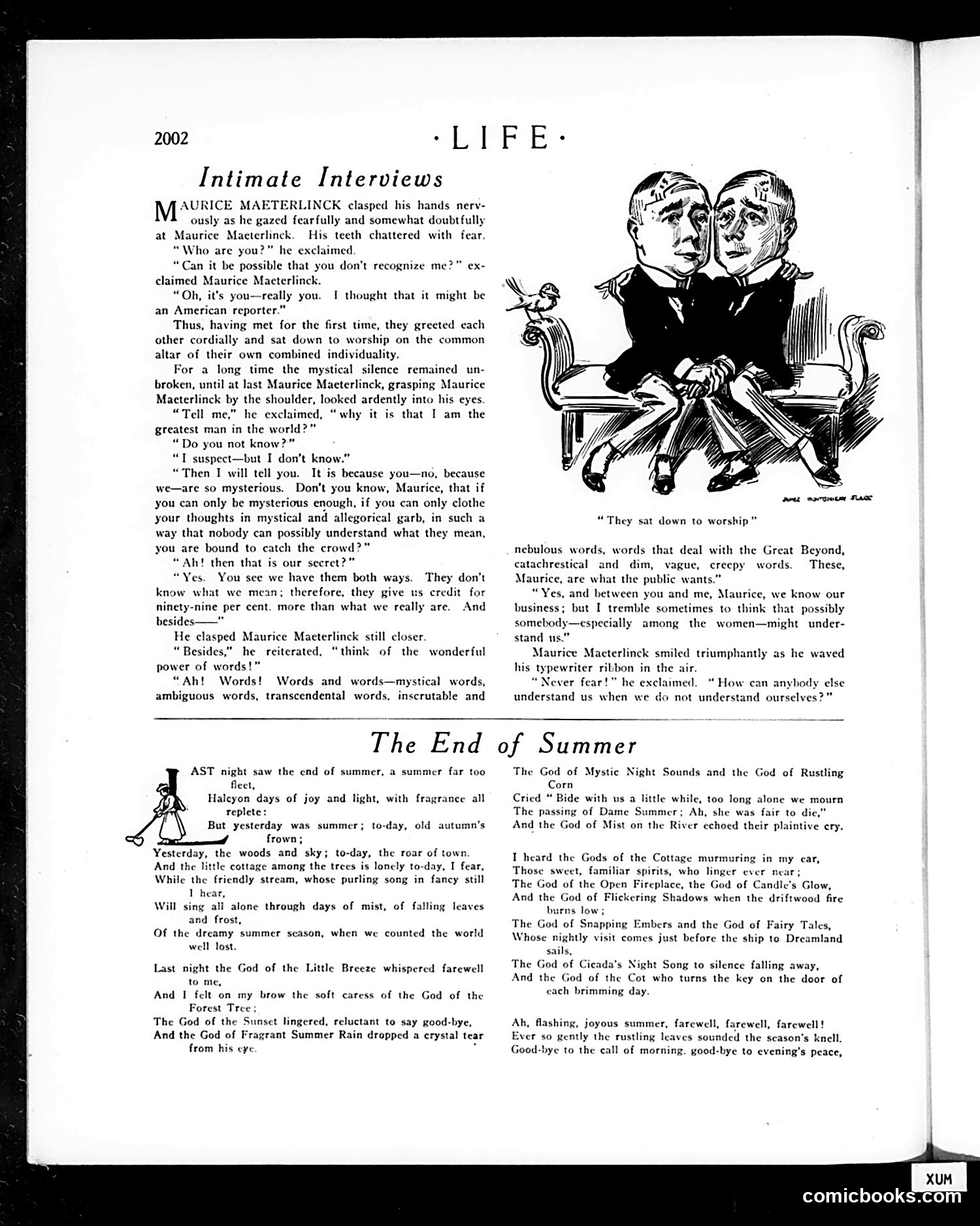
The cartoon mocks **Maurice Maeterlinck**, the Belgian symbolist playwright and writer. The joke: Maeterlinck encounters himself and they discuss how their success relies entirely on **deliberate obscurity**. The satire targets the pretentious literary establishment of the era. Maeterlinck's character admits that by cloaking mundane thoughts in "mystical and allegorical garb" that nobody understands, they receive undeserved credit for profundity. The punchline—"How can anybody else understand us when we do not understand ourselves?"—exposes this as pure bluffing. The cartoon illustrates a common Modernist-era critique: that avant-garde artists and writers hide mediocrity behind impenetrable language. The image shows two identical figures worshiping their own "combined individuality," emphasizing the narcissism and absurdity of the whole enterprise.
📄 Transcribed text from this page (OCR, searchable)
Machine-transcribed from the original scan — historical spelling and the odd misread are preserved.
2002 -LIFE- Intimate Interviews AURICE MAETERLIN clasped his hands nerv- ously as he gazed fearfully and somewhat doubtfully at Maurice Maeterlinck. His teeth chattered with fear. “Who are you?” he exclaimed “Can it be possible that you don’t recognize me?” ex- claimed Maurice Maeterlinck. “Oh, it’s you—really you. I thought that it might be an American reporter.” Thus, having met for the first time, they greeted each other cordially and sat down to worship on the common altar of their own combined individuality, For a long time the mystical silence remained un- broken, until at last Maurice Maeterlinck, grasping Maurice Maeterlinck by the shoulder, looked ardently into his eyes. “Tell he exclaimed, “why it is that I am the greatest man in the world?” “Do you not know?” “T suspect—but I don’t know “Then I will tell you. It is because you—no, because we—are so mysterious. Don't you know, Maurice, that if you can only be mysterious enough, if you can only clothe your thoughts in mystical and allegorical garb, in such a way that nobody can possibly understand what they mean, you are bound to catch the crowd?” “Ah! then that is our secret?” oy You see we have them both ways. They don’t know what we mean; therefore, they give us credit for ninety-nine per cent. more than what we really are. And besides——" He clasped Maurice Maeterlinck still closer. “Besides,” he reiterated, “think of the wonderful power of words!” “Ah! Words! Words and words—mystical words, ambiguous words, transcendental words, inscrutable and “They sat down to worship” nebulous words, words that deal with the Great Beyond, catachrestical and dim, vague, creepy words. These, Maurice, are what the public wants.” “Yes, and between you and me, Maurice, we know our business; but I tremble sometimes to think that possibly somebody—especially among the women—might under- stand us.” Maurice Maeterlinck smiled triumphantly as he waved his typewriter ribbon in the air. er fear!” he exclaimed. “ How can anybody else understand us when we do not understand ourselves? The End AST night saw the end of summer, a summer far too fleet, Halcyon days of joy and light, with fragrance all replete: But yesterday was summer; to-day, old autumn’s frown ; Yesterday, the woods and sky; to-day, the roar of town And the little cottage among the trees is lonely to-day, I fear, While the friendly stream, whose purling song in fancy still I hear, Will sing all alone through days of mist, of falling leaves and frost, Of the dreamy summer scason, when we counted the world well lost. Last night the God of the Little Breeze whispered farewell to me, And I felt on my brow the soft caress of the God of the Forest Tree; The God of the Sunset lingered, reluctant to say good-bye, And the God of Fragrant Summer Rain dropped a crystal tear from his eye . of Summer The God of Mystic Night Sounds and the God of Rustling Corn Cried “ Bide with us a little while, too long alone we mourn The passing of Dame Summer; Ah, she was fair to die,” And the God of Mist on the River echoed their plaintive ery. I heard the Gods of the Cottage murmuring in my car, Those sweet, familiar spirits, who linger ever near; The God of the Open Fireplace, the God of Candle’s Glow, And the God of Flickering Shadows when the driftwood fire burns lov ¢ God of Snapping Embers and the God of Fairy Tales, Whose nightly visit comes just before the ship to Dreamland sails, The God of Cicada’s Night Song to silence falling away, And the God of the Cot who turns the key on the door of cach brimming day. Ah, flashing, joyous summer, farewell, farewell, farewell! Ever so gently the rustling leaves sounded the season's knell. Good-bye to the call of morning. good-bye to evening's peace, comicbooks.co