
Life, 1912-10-17 · page 19 of 44
Life — October 17, 1912 — page 19: what you’re looking at
What you’re looking at
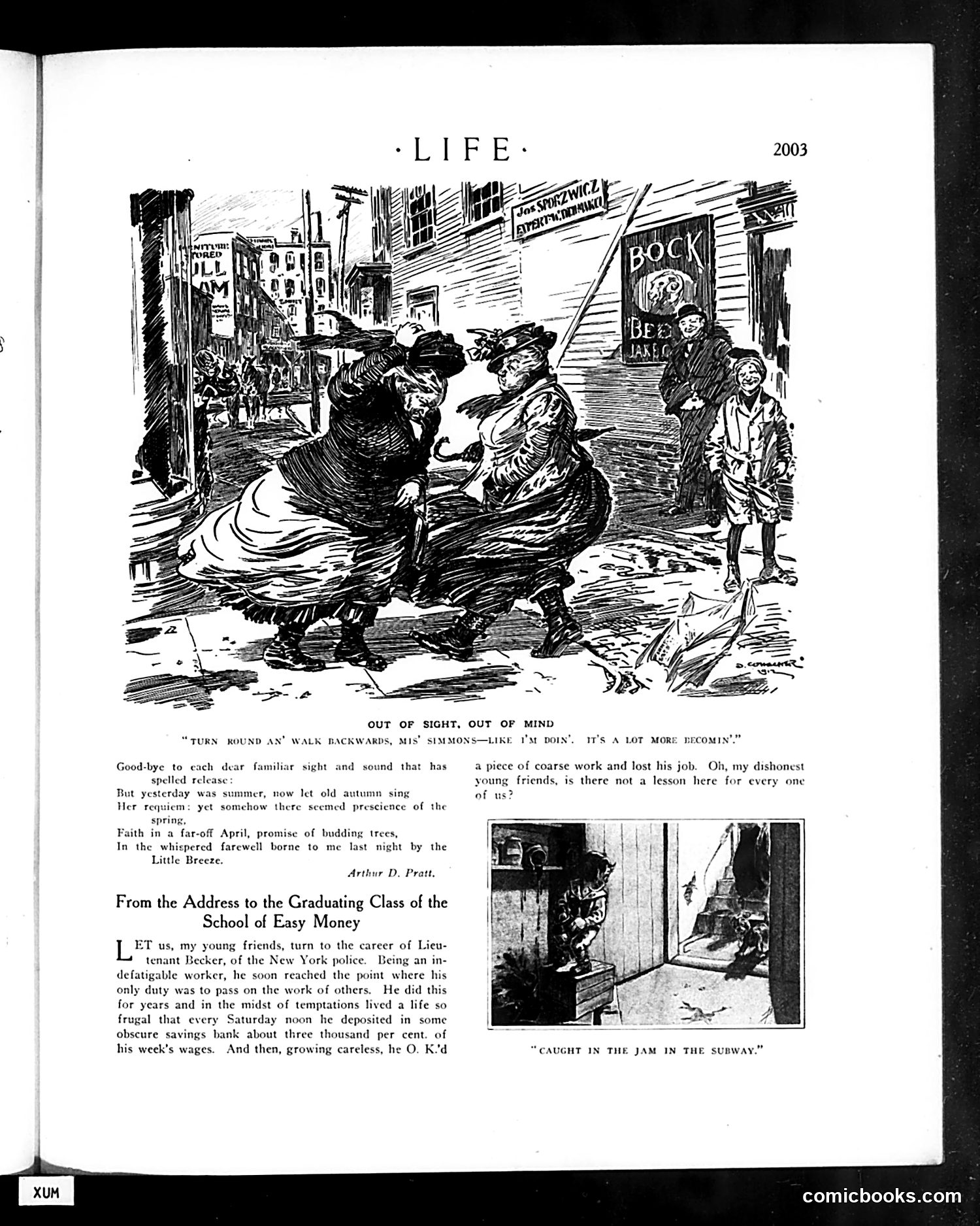
The main cartoon satirizes urban poverty and willful ignorance. Two working-class women are depicted on a city street; one advises the other to "walk backwards" to avoid seeing the deterioration around them—a visual metaphor for denying uncomfortable social realities. The accompanying text references **Lieutenant Becker of the New York police**, likely alluding to the real Becker corruption scandal (early 1900s), where a police official accumulated wealth through graft. The "School of Easy Money" satirizes how officials rationalized corrupt gains as legitimate savings. The two photographs below show urban squalor—cramped tenements and subway conditions—contrasting sharply with the text's ironic tone about "easy money" and moral lessons. The overall message critiques both individual moral corruption among authority figures and society's tendency to ignore the poverty and injustice underlying urban life—hence the title "Out of Sight, Out of Mind."
📄 Transcribed text from this page (OCR, searchable)
Machine-transcribed from the original scan — historical spelling and the odd misread are preserved.
OUT OF SIGHT, OUT OF MIND “TURN KOUND AN’ WALK BACKWARDS, MIS’ SIMMONS—LIKE I'M DOIN’. IT'S A LOT MORE PECOMIN'.” Good-bye to cach dear familiar sight and sound that has a piece of coarse work and lost his job. Oh, my dishonest spelled rele: young friends, is there not a lesson here for every one But yesterday was summer, now let old autumn sing of us? Her requiem: yet somehow there seemed prescience of the spring, Faith in a far-off April, promise of budding trees, In the whispered farewell borne to me last night by the Little Breeze. Arthur D. Pratt, From the Address to the Graduating Class of the School of Easy Money L* us, my young friends, turn to the career of Lieu- tenant Becker, of the New York police. Being an in- defatigable worker, he soon reached the point where his only duty was to pass on the work of others. He did this for years and in the midst of temptations lived a life so frugal that every Saturday noon he deposited in some obscure savings bank about three thousand per cent. of his week’s wages. And then, growing careless, he O. K.'d te UGHT IN THE JAM IN THE SUBWAY.” comicbooks.com