
Life, 1912-10-17 · page 21 of 44
Life — October 17, 1912 — page 21: what you’re looking at
What you’re looking at
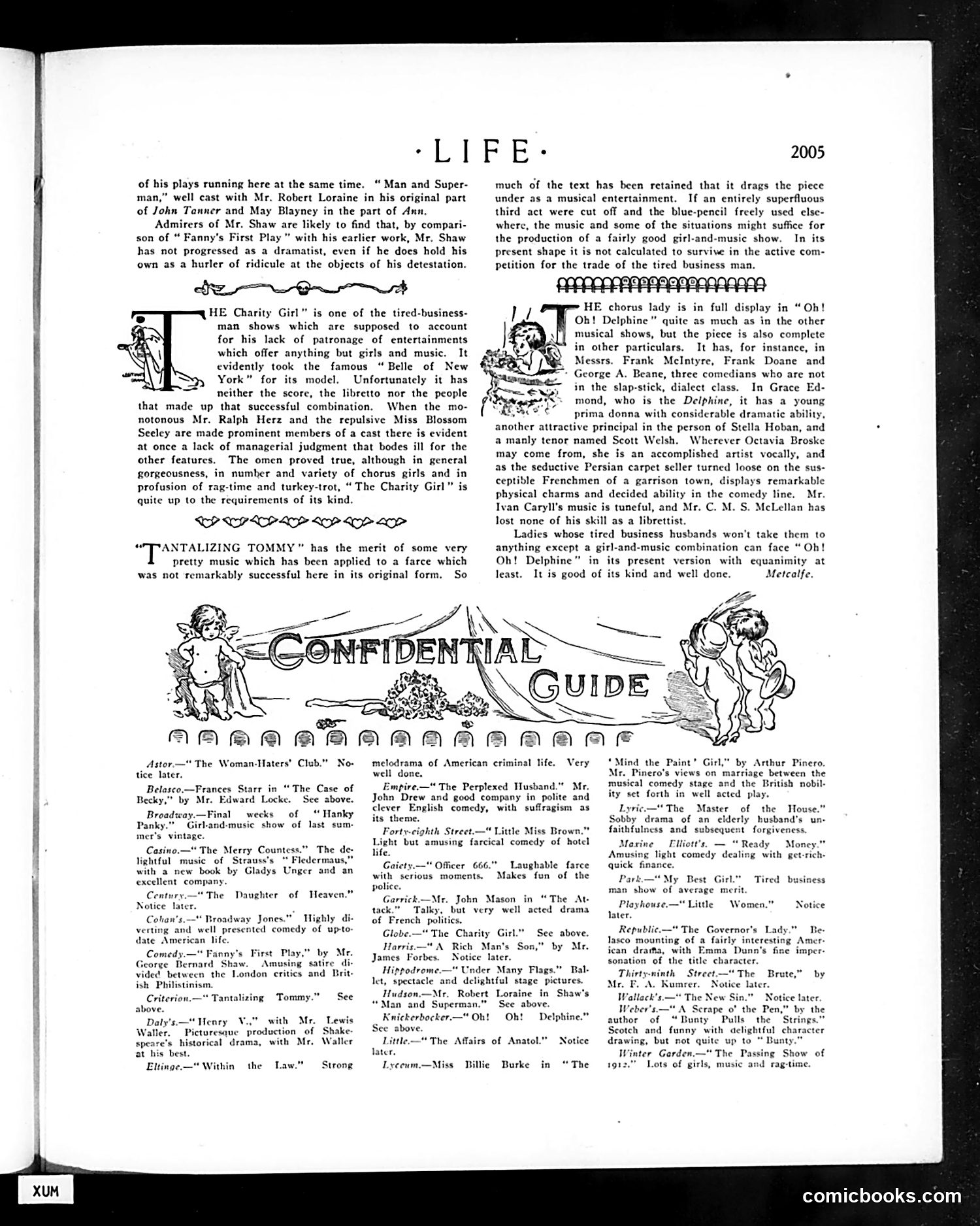
This page reviews several Broadway productions from the early 1900s, focusing on musical comedies and farces targeting "tired businessmen"—a period euphemism for male audiences seeking escapist entertainment featuring chorus girls and music rather than serious drama. The reviews are notably dismissive of shows like "The Charity Girl" and "Tantalizing Tommy," criticizing them as formulaic and poorly constructed despite their spectacle. "Oh! Delphine" receives slightly better treatment for offering comedic talent beyond slapstick. The underlying satire critiques both the entertainment industry's pandering to male audiences and society's leisure culture. The repeated reference to "tired businessmen" suggests middle-class men seeking distraction from work through mindless entertainment—a social commentary on urban commercial life and gender dynamics of the era.
📄 Transcribed text from this page (OCR, searchable)
Machine-transcribed from the original scan — historical spelling and the odd misread are preserved.
Sr L | of his plays running here at the same time. “ Man and Super- man,” well cast with Mr. Robert Loraine in his original part of John Tonner and May Blayney in the part of Ann. Admirers of Mr. Shaw are likely to find that, by compari- son of “ Fanny's First Play with his earlier work, Mr. Shaw has not progressed as a dramatist, even if he does hold his own as a hurler of ridicule at the objects of his detestation. Re Ot HE Charity Girl” is one of the tired-business- man shows which are supposed to account for his lack of patronage of entertainments which offer anything but girls and music. It evidently took the famous “Belle of New York” for its model, Unfortunately it has neither the score, the libretto nor the people that made up that successful combination. When the mo- notonous Mr. Ralph Herz and the repulsive Miss Blossom Seeley are made prominent members of a cast there is evident at once a lack of managerial judgment that bodes ill for the other features. The omen proved true, although in general gorgeousness, in number and variety of chorus girls and in profusion of rag-time and turkey-trot, “The Charity Girl” is quite up to the requirements of its kind. WIPE OP LO EO ANTALIZING TOMMY” has the merit of some very pretty music which has been applied to a farce which was not remarkably successful here in its original form. So “ PE» 2005 much of the text has been retained that it drags the piece under as a musical entertainment. If an entirely superfluous third act were cut off and the blue-pencil freely used else- where, the music and some of the situations might suffice for the production of a fairly good girl-and-music show. In its present shape it is not calculated to survive in the active com- petition for the trade of the tired business man. HE chorus lady is in full display in “Oh! Ob! Delphine” quite as much as in the other musical shows, but the piece is also complete in other particulars. It has, for instance, in Messrs. Frank McIntyre, Frank Doane and * George A. Beane, three comedians who are not in the slap-stick, dialect class. In Grace E f' > mond, who is the Delphine, it has a young 74C2"C" prima donna with considerable dramatic ability, another attractive principal in the person of Stella Hoban, and a manly tenor named Scott Welsh. Wherever Octavia Broske may come from, she is an accomplished artist vocally, and as the seductive Persian carpet seller turned loose on the sus- ¢ Frenchmen of a garrison town, displays remarkable physical charms and decided ability in the comedy line. Mr. Ivan Caryll’s music is tuneful, and Mr. C. M. S. McLellan has lost none of his skill as a librettist. Ladies whose tired business husbands won't take them to anything except a girl-and-music combination can face “Ob! Oh! Delphine” in its present version with equanimity at least. It is good of its kind and well done. Metcalfe. Astor.—" The Woman-Haters’ Club." No- melodrama of American criminal life. Very ‘Mi tice later. well done. Belasco.—Frances Starr in “The Case of Becky,” by Mr. Edward Locke. Sce above. John Drew and good company in polite and clever English comedy, with suffragism as Broadway.—Final weeks of“ Hanky Panky.” Girland-music show of last sum- mer’s vintage. Casino.—" The Merry Countess.” The de hife. lightful music of Strauss’s ** Fledermaus,” with a new book by Gladys Unger a excellent. company. Century.—" The Daughter of Heaven. its theme. Forty-ei police. Garrick.—Mr. John Mason in “The Ate ind the Paint’ Girl," by Arthur Pinero, Mr. Pinero’s views on marriage between the Empire-—" The Perplexed Husband.” Mr, ™usical comedy stage and the British nobil- ity set forth in well acted play. “The Master of the House.” drama of an elderly husband's un- ghth Street.—" Little Miss Brown.” faithfulness and subsequent forgiveness. Light but amusing farcical comedy of hotel Maxine Eliot's. — “Ready Money." Amusing light comedy dealing with get-rich- Gaiety.—“ Officer 666." Laughable farce quick finance. with serious moments, Makes fun of the Park—My est Girl" Tired bu man show of average merit. ness Notice later. ; , Talky, but very well acted drama, Pavhouse. Little Women.” Notice Cohan's.—" Broadway Jones." Highly di- inch polities. later. verting and well presented comedy of upto Globe.—" The Charity Girl.” See above. Republie.—" The Governor's Lady.” Be- Ai date Americ Comedy.—* Fanny's First Play," by Mr. George Bernard Shaw. Amusing satire di- vided between the London eritics and Brit- ish Philistinism. —" Tantalizing Tommy.” Harris. Hippodrome. let, spectacle ar See Hudson. * with Mr. Lewis —" Henry “A Rich James Forbes. Notice later. Under Many Flags.” Bal- delightful stage pictures. gy fr, Robert Loraine in Shaw's Walteck’ “Man and Superman.” allack's Knickerbocker—" Oh! Oh! Delphine.” guthor of lasco mounting of a fairly interesting Amer- ican drarta, with Emma Dunn’s fine imper- sonation of the title character. Thirty-ninth Strect.—" The Brute,” by A. Kumrer. Notice later. The New Sin.” Notice later. A Scrape o the Pen,” by the Bunty Pulls the Strings.” Man's Soi by Mr. See above. Weber's.— Waller. Picturesque production of Shake- See above. Scotch and funny with delightful character speare’s historical drama, with Mr, Waller Little —"The Affairs of Anatol.” Notice drawing, but not quite up to “ Bunty. at his best. later, Winter Garden.—" The Passing Show of Eltinge.—" Within the Taw. Strong Lyecum.—Miss Billie Burke in “The 191 Lots of girls, music and rag-time, comicbooks.com