
A complete issue · 44 pages · 1912
Life — May 30, 1912
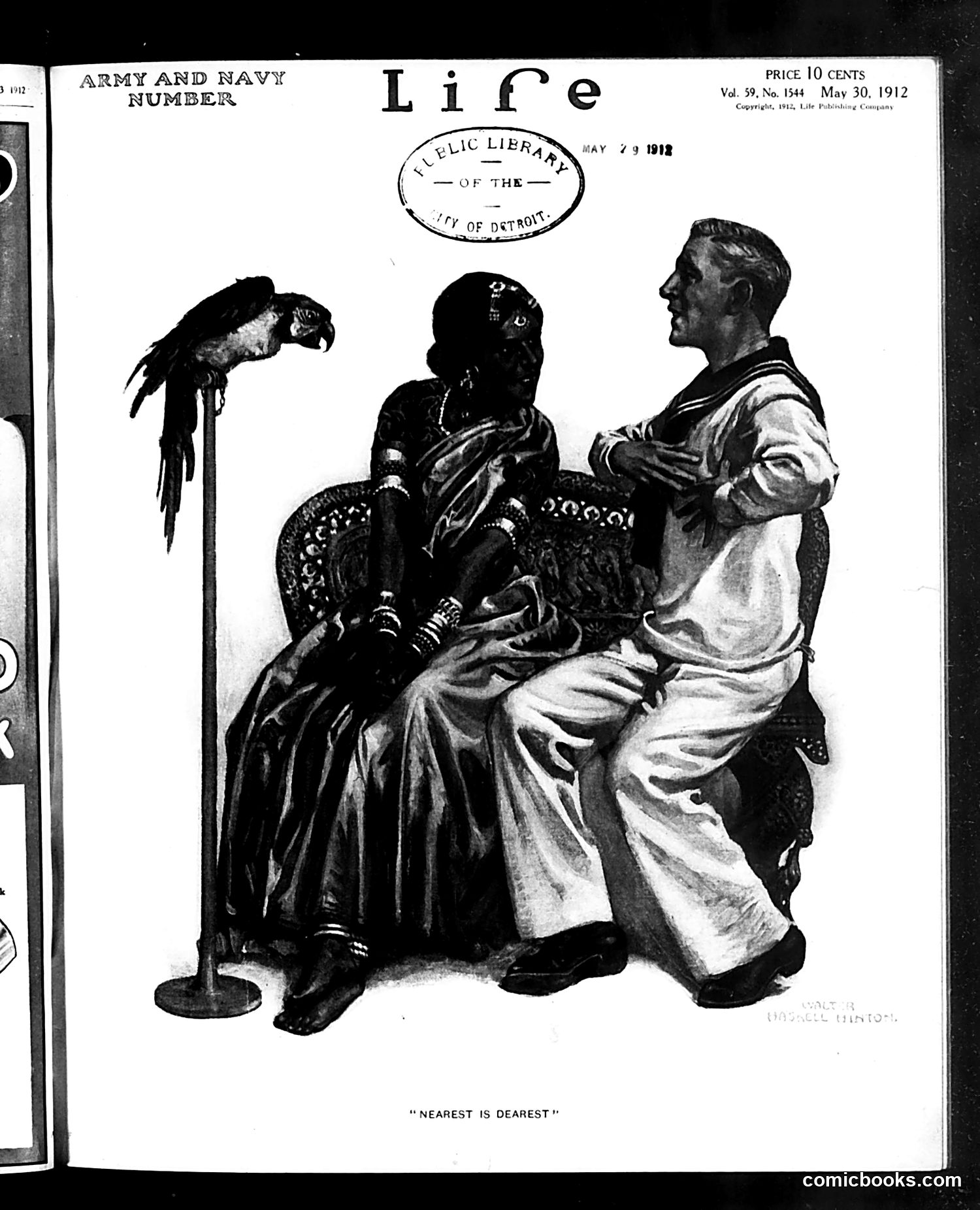
This Army and Navy issue cartoon depicts a sailor courting a woman while a parrot perches nearby on a stand. The caption "Nearest is Dearest" suggests a commentary on romantic proximity and sailor relationships. The satire likely reflects early 20th-century attitudes about sailors' shore leave behavior—the joke being that sailors formed attachments based on immediate availability rather than genuine affection. The woman's elaborate dress and jewelry suggest she may be a paid companion or entertainer, a common trope in period naval humor. The parrot, a typical sailor's pet, possibly reinforces the exotic/nautical setting. The cartoon exemplifies how Life magazine used domestic romantic scenarios to satirize military culture and social mores of the era.
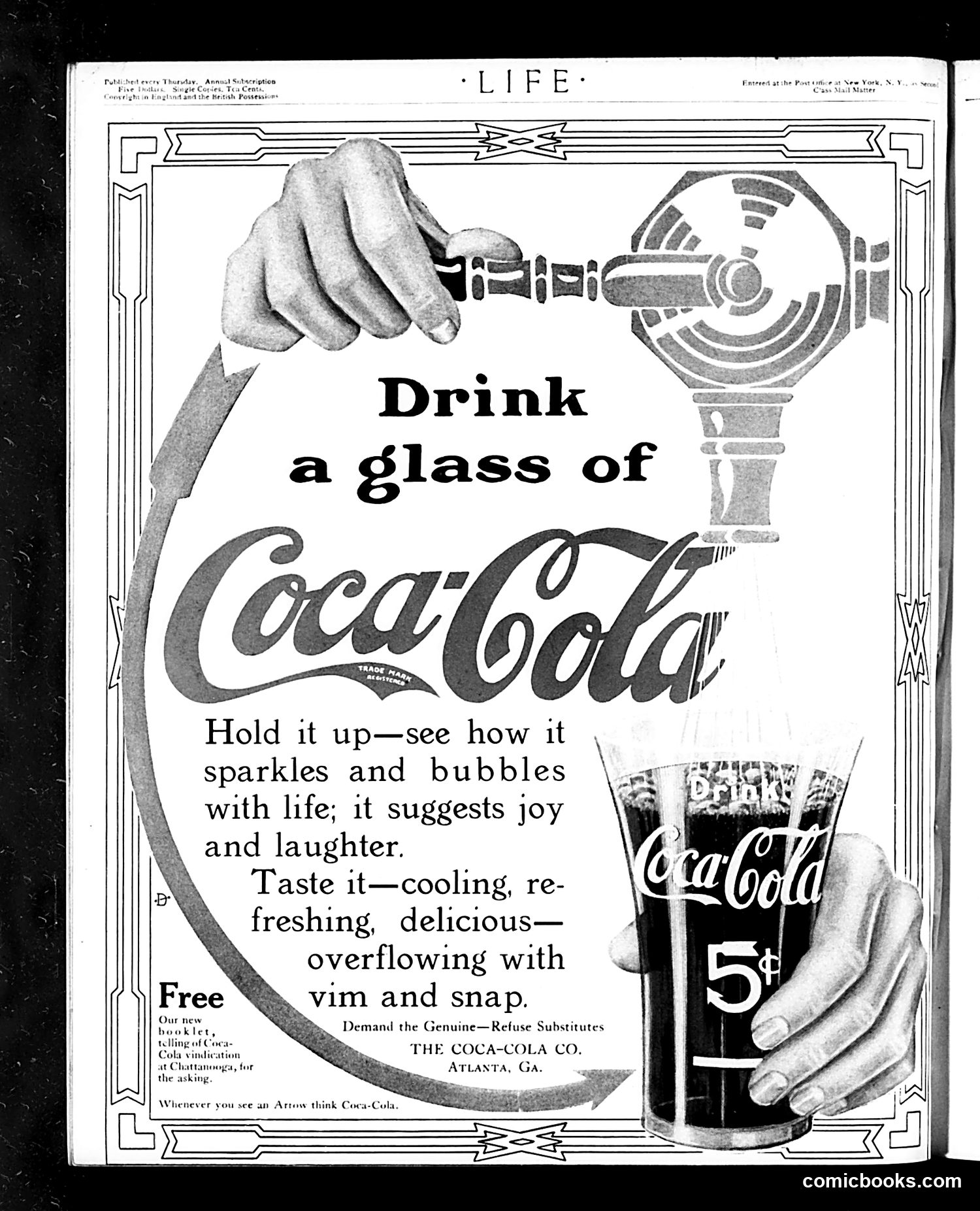
This is primarily a **Coca-Cola advertisement**, not satirical content. The page shows a hand holding a fountain dispenser (top) and another hand holding a 5-cent glass of Coca-Cola (bottom). The ad uses marketing language typical of early 20th-century advertising: "sparkles and bubbles with life," "cooling, refreshing, delicious," emphasizing the drink's sensory appeal and association with joy. The price of 5 cents anchors it to a specific historical period. The decorative border and layout are characteristic of *Life* magazine's design. There's a note about "Our new booklet telling of Coca-Cola vindication at Chattanooga" referencing legal disputes, likely the famous 1911 Supreme Court case questioning Coca-Cola's safety. This is commercial content, not political satire.
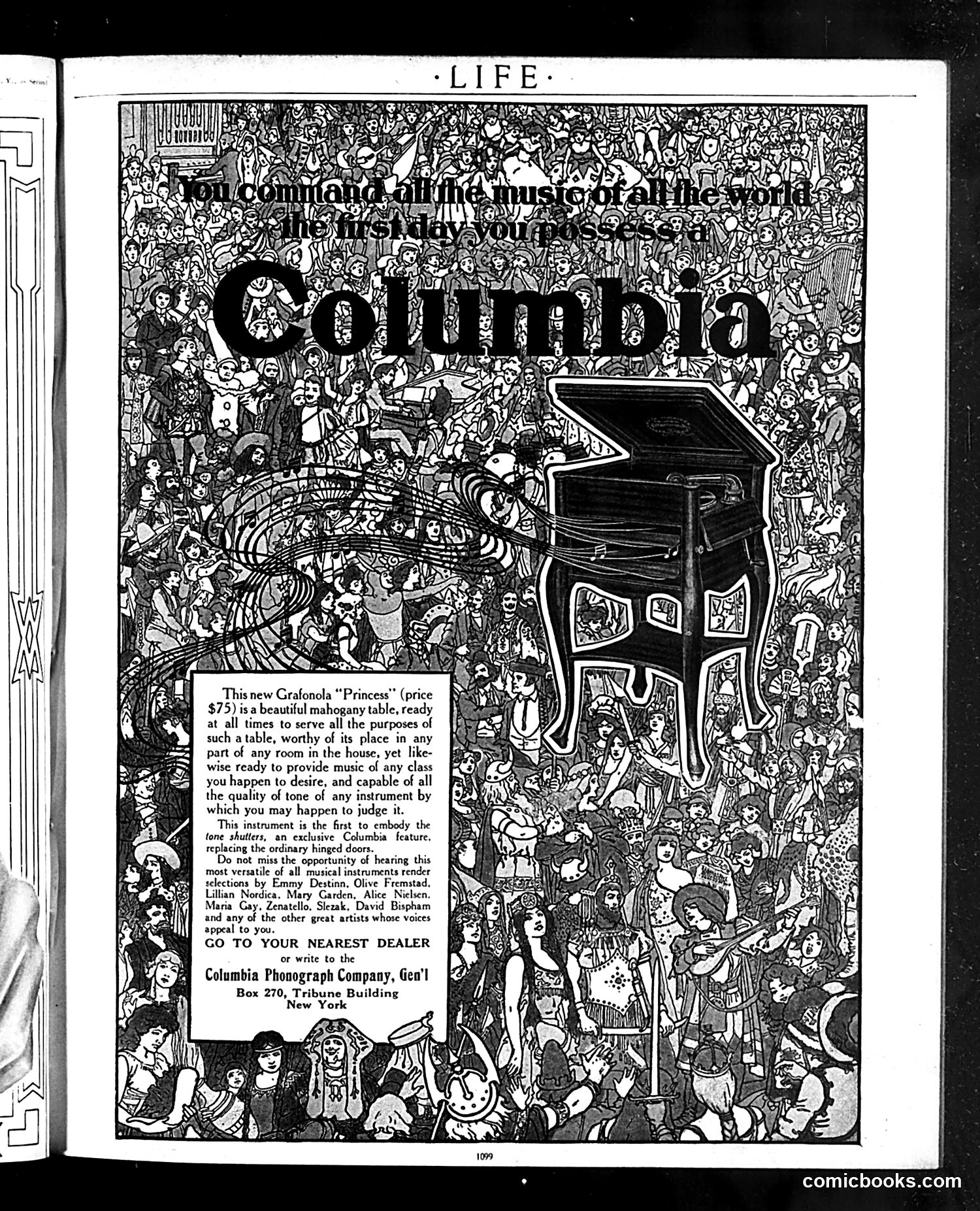
This page is primarily a **Columbia Phonograph Company advertisement** for their "Princess" model Grafonola (an early phonograph/record player), priced at $75. The large decorative illustration shows a densely packed crowd of figures in what appears to be a concert hall or musical gathering—a common artistic convention of the era to suggest cultural sophistication and mass appeal. The advertisement emphasizes the machine's quality by referencing famous opera singers and classical musicians whose recordings are available, including names like Caruso, Galli-Curci, and others. This marketing approach associated the product with high-culture prestige. The ornate art style and lavish imagery are typical of 1920s luxury goods advertising, designed to appeal to middle-class aspirations for refinement and entertainment in the home.
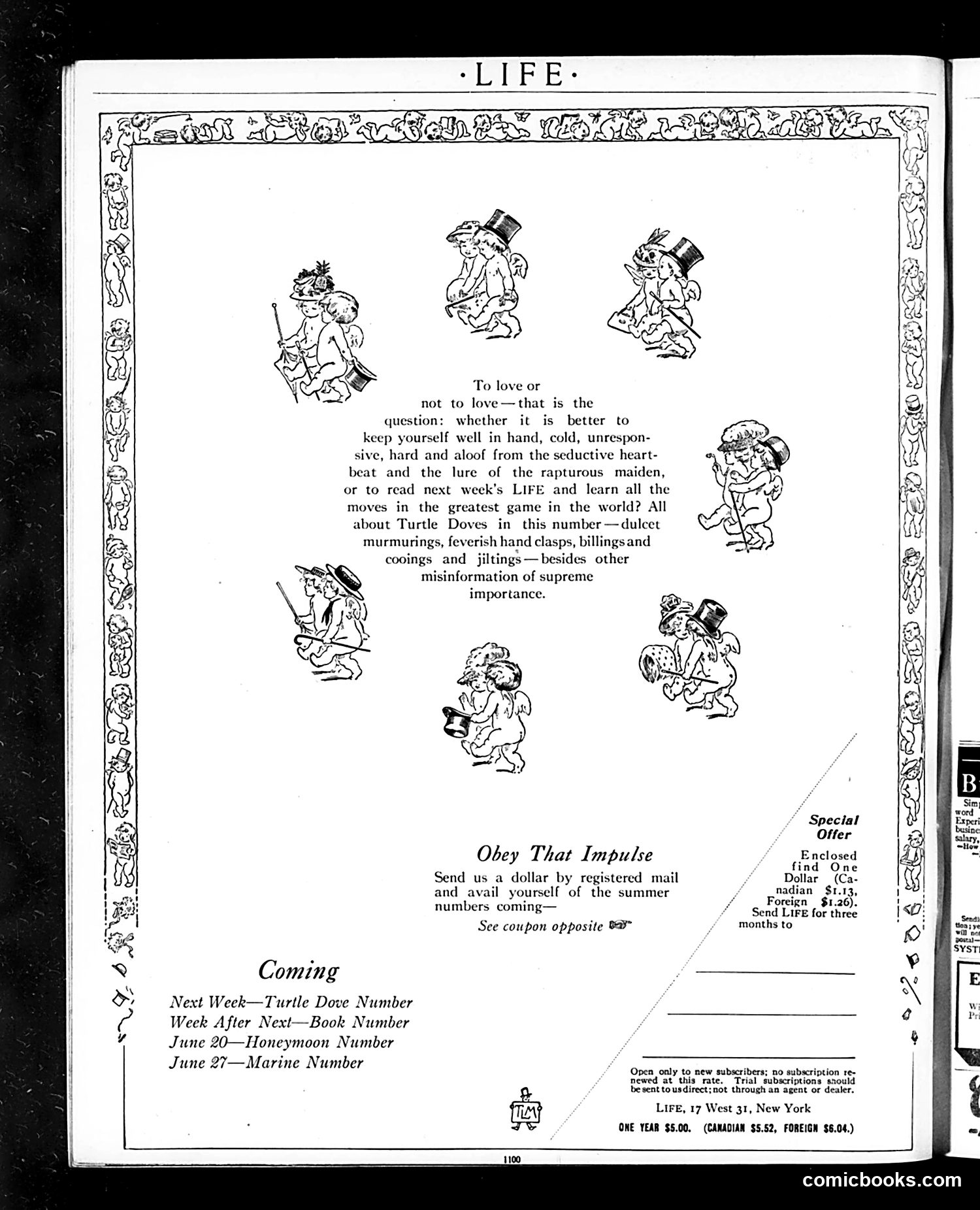
This page is primarily an advertisement for *Life* magazine subscriptions, not a political cartoon. The central text poses a philosophical question about love—whether it's better to remain emotionally detached or to embrace romantic feelings—framed as content readers can explore in the magazine. The decorative illustrations surrounding the text are generic cherub/cupid figures in various playful poses, visually reinforcing the romantic theme rather than depicting specific political or social commentary. They appear designed simply to complement the love-focused messaging. The bottom section announces forthcoming special issues: "Turtle Dove Number," "Book Number," "Honeymoon Number," and "Marine Number," indicating thematic editorial content planned for upcoming weeks. This is essentially a subscription pitch using romance as its marketing angle.
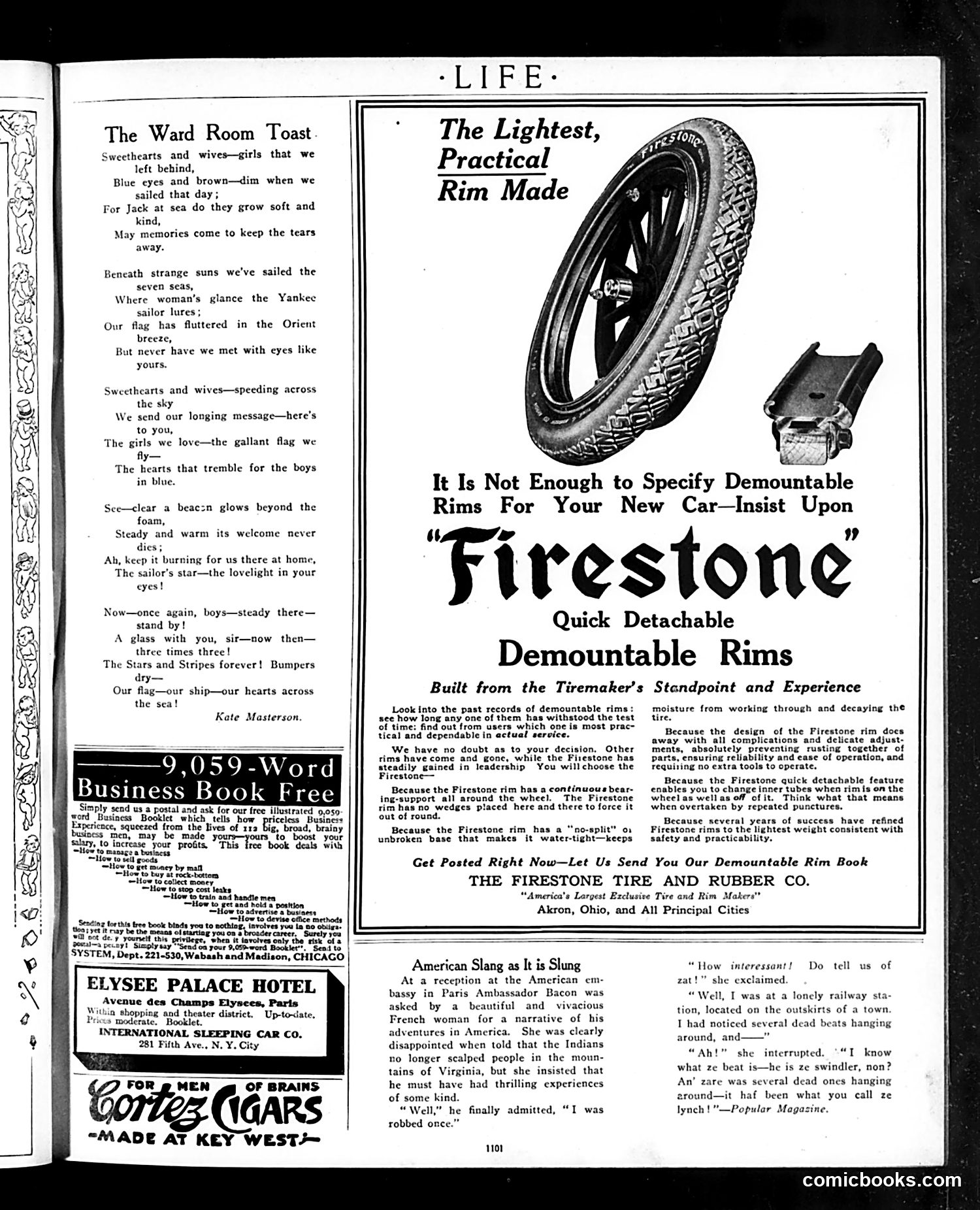
This page contains **no political cartoons**. Instead, it features: 1. **"The Ward Room Toast"** - A patriotic poem by Kate Masterson celebrating American sailors and their sweethearts during what appears to be World War I, referencing naval service and separation from loved ones. 2. **Advertisements**, including: - Firestone Demountable Rims (tire/automobile ad) - Elysee Palace Hotel (NYC lodging) - Cortez Cigars ("for men of brains") - A 9,059-word Business Book offer 3. **"American Slang As It Is Slung"** - A brief humorous anecdote about a French woman at the American embassy in Paris mishearing the phrase "scalped" in a narrative about Native Americans. The page is primarily **commercial content with patriotic poetry**, not satirical political commentary.
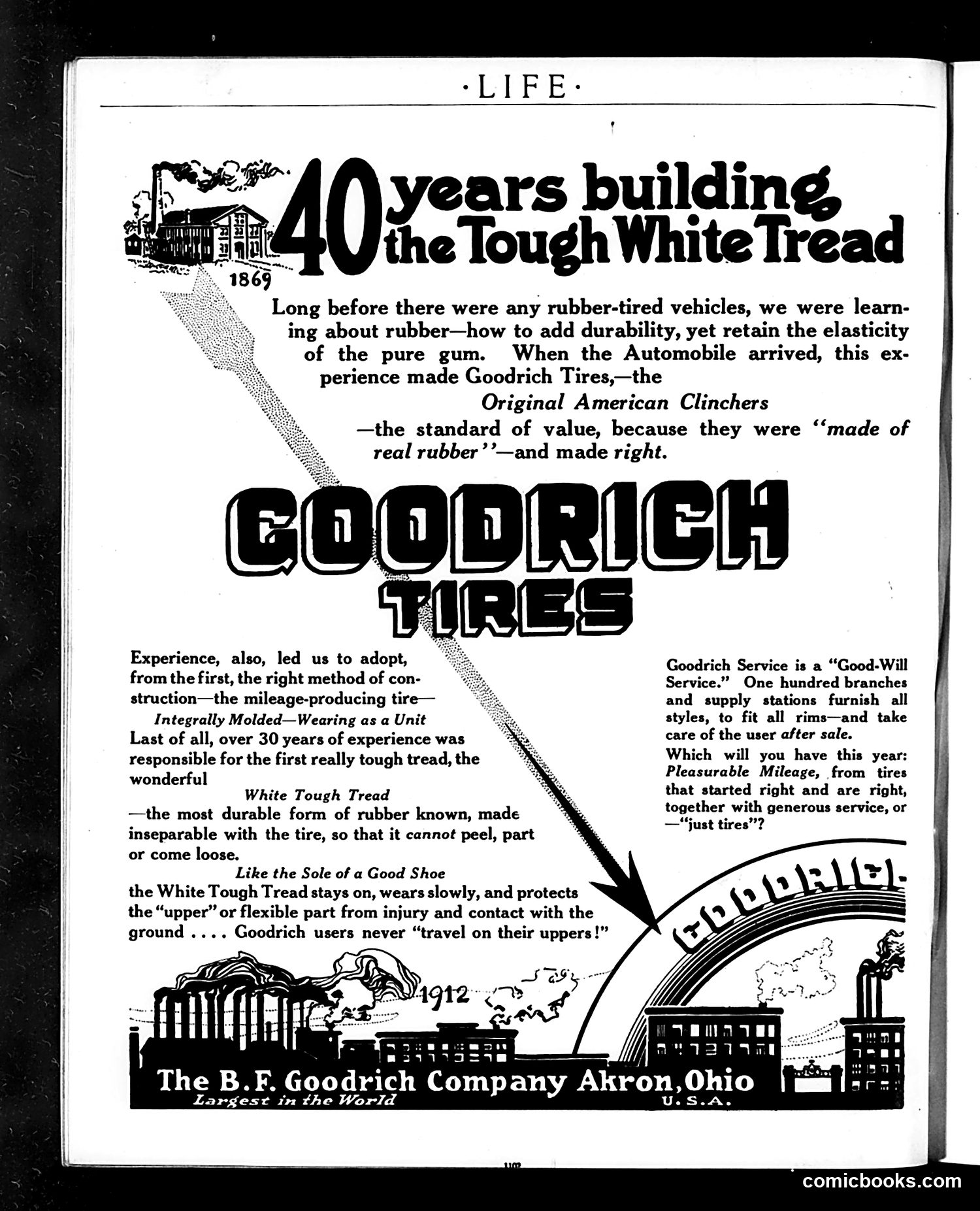
This is **not a cartoon or satire page**—it's a **straightforward advertisement** for Goodrich Tires, placed in Life magazine. The ad celebrates Goodrich's 40-year history (dating the company's founding to approximately 1872) and emphasizes their innovation: developing durable rubber tires before automobiles became common. Key selling points include the "White Tough Tread" design, which the ad claims won't peel or loosen and stays on the tire like a shoe's sole. The ad includes a factory silhouette dated 1912, establishing Goodrich's Akron, Ohio headquarters as "Largest in the World." The message is purely commercial: durability, longevity, and after-sale service distinguish Goodrich from competitors. There is no satire or political commentary present.
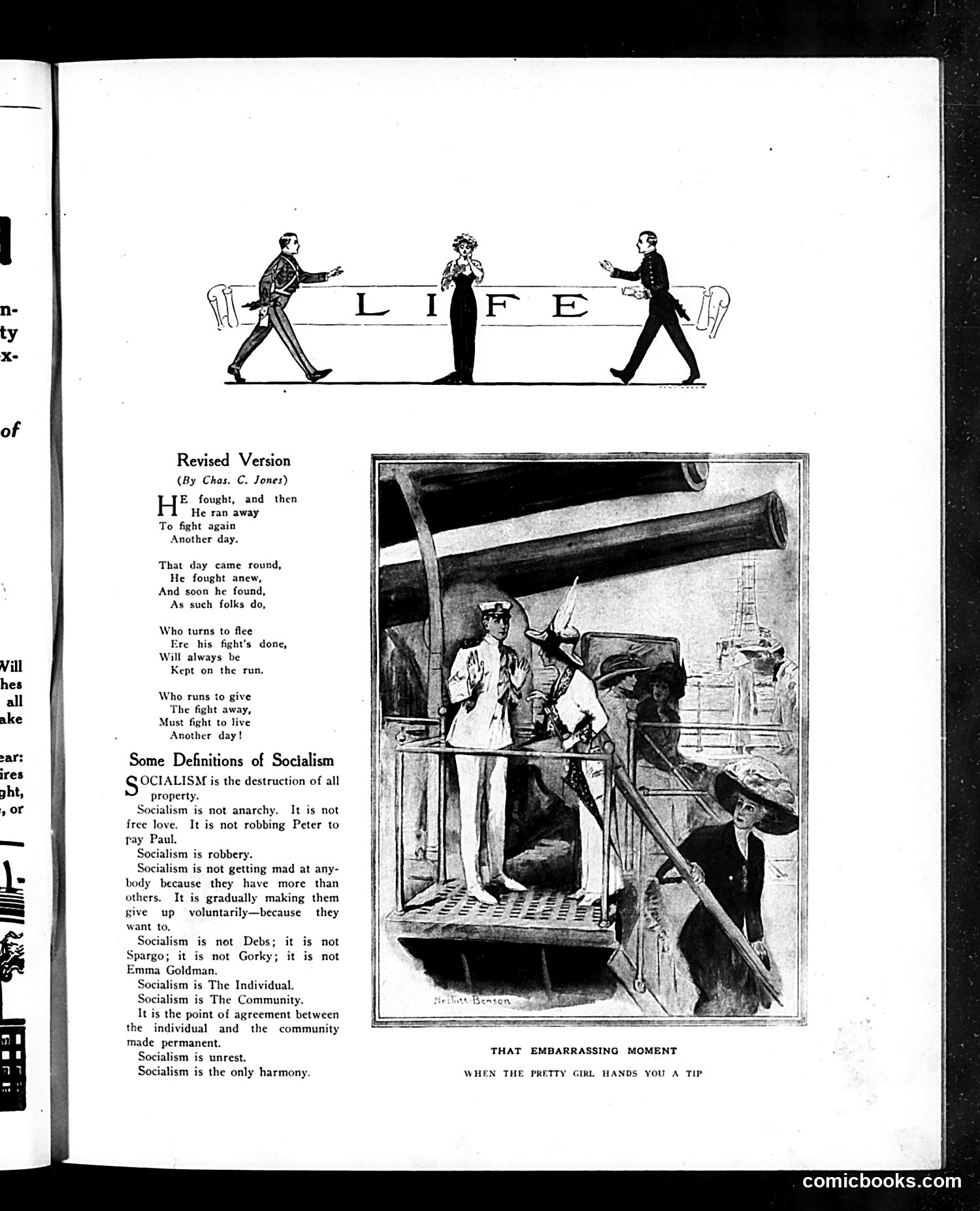
**Top Illustration ("LIFE"):** Three men in business attire pull a horizontal banner labeled "LIFE" in opposite directions, symbolizing conflict over the magazine's direction or competing ideological viewpoints about what "life" means—likely referencing contemporary political divisions. **"Revised Version" Poem:** A satirical poem by Charles C. Jones describes a fighter who repeatedly returns to battle despite losing, mocking someone's persistent struggle (appears to reference a political or social figure engaged in repeated failed confrontations). **"Some Definitions of Socialism":** The text offers deliberately contradictory, absurdist definitions of socialism—claiming it's simultaneously "destruction of property" yet "not robbery," "unrest" yet "only harmony." This satirizes the era's confused, competing definitions of socialism, likely mocking both socialist advocates and their critics who couldn't agree on the term's meaning. **Bottom Illustration:** Shows an awkward social encounter where a woman tips a worker—captioned as an "embarrassing moment." This appears to satirize class-consciousness and social etiquette confusion in the era.
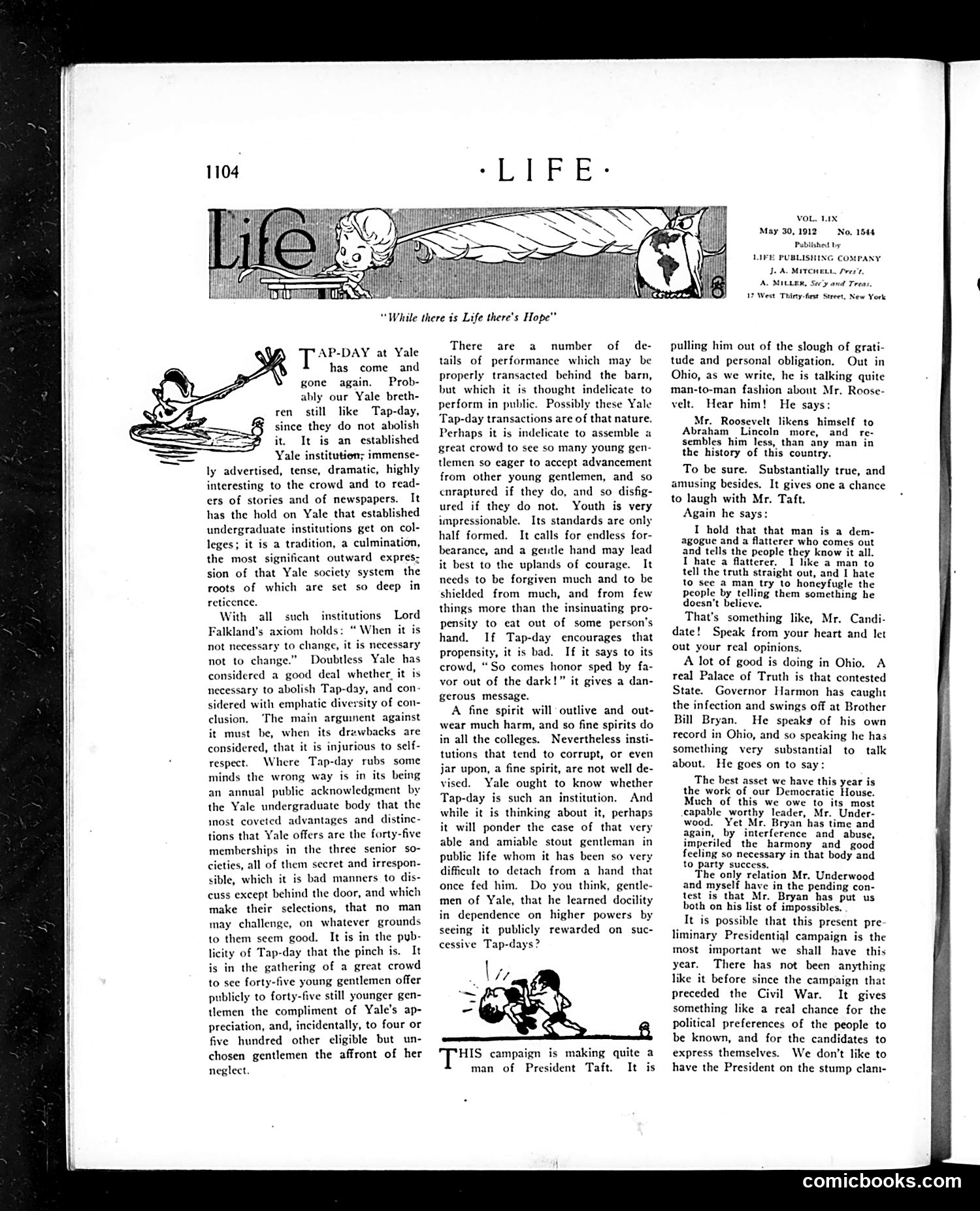
This page contains editorial commentary on Yale University's "Tap-Day" tradition—an annual event where senior societies publicly acknowledge new members. The author critiques whether Tap-Day properly reflects Yale's values, noting it encourages youth to seek public recognition and advancement. The text then shifts to discussing the 1912 presidential campaign, praising Ohio Governor James M. Harmon (identified as "Under" candidate) and criticizing President Taft's campaign activities. The author argues the election offers a genuine opportunity for voters to express political preferences without presidential interference. The small illustrations show casual Yale scenes, likely mocking the pretentious nature of student society rituals. The overall tone satirizes both academic pretension and contemporary political theater.
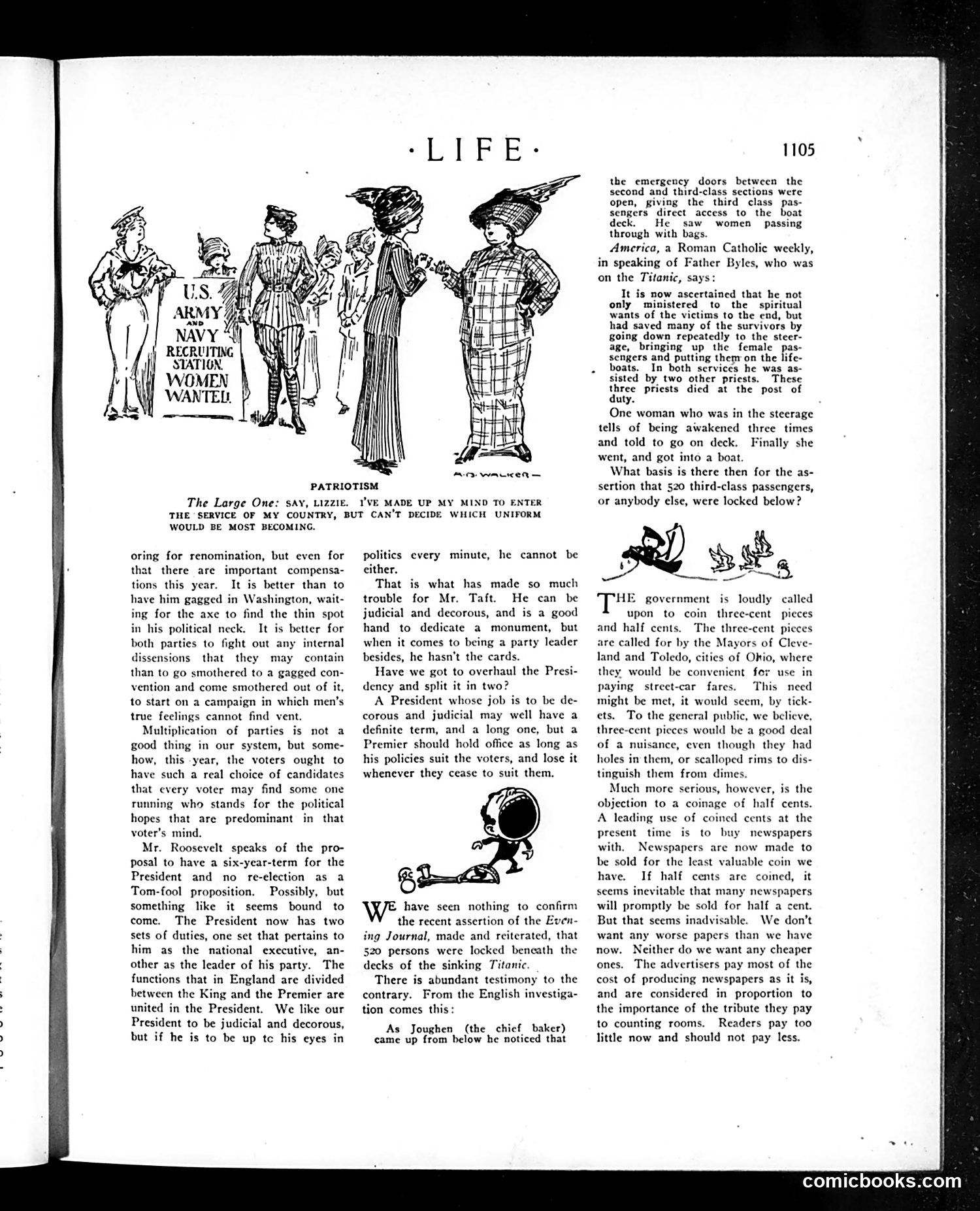
**The "Patriotism" Cartoon (top left):** Shows a figure at a U.S. Army/Navy recruitment station, expressing internal conflict about military service versus political affiliation—unable to decide which uniform to wear. The satire critiques how partisanship interferes with patriotic duty during wartime. **The Titanic References (main text):** The page discusses Father Byles from the *Titanic* disaster, criticizing claims that third-class passengers were locked below decks. It argues this narrative falsely portrays class discrimination to score political points against whoever is currently in power. **Overall Point:** The page satirizes how Americans weaponize real tragedies (like the *Titanic*) to pursue partisan politics rather than addressing genuine problems. It argues both parties exploit patriotism opportunistically.
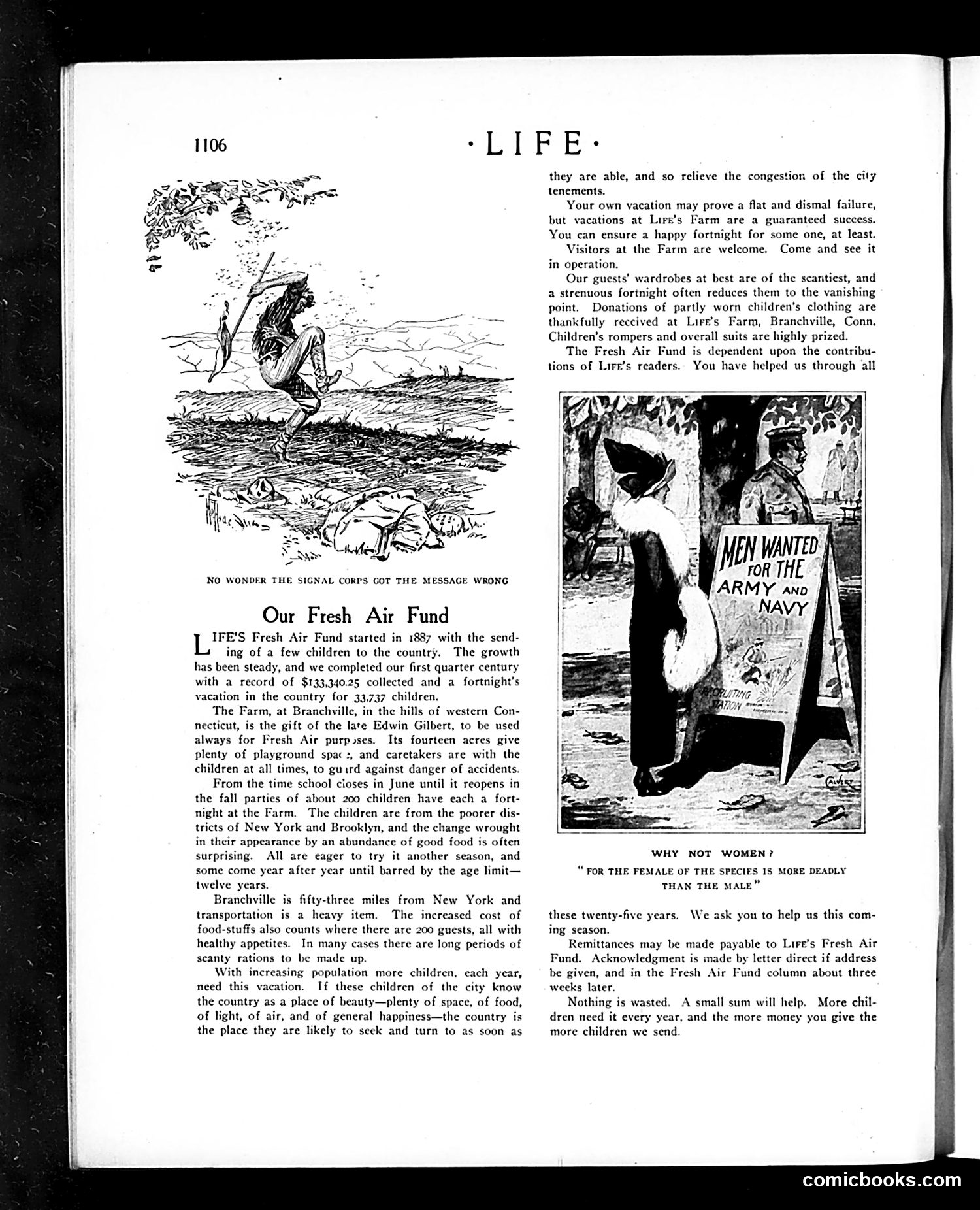
This page promotes **Life's Fresh Air Fund**, established in 1887 to send poor city children to a working farm (Brantville, Connecticut) for summer vacations. The left illustration shows a child experiencing rural pleasures—fishing and nature—contrasting with urban poverty. The right image, titled "Why Not Women?" depicts a woman pointing to a military recruitment poster ("Men Wanted for the Army and Navy"). The caption quotes: "For the female of the species is more deadly than the male"—a reference to Kipling's poem. This sardonically questions why women aren't recruited, likely during World War I when manpower shortages were critical. The juxtaposition suggests women deserve similar opportunities or recognition for service as men.
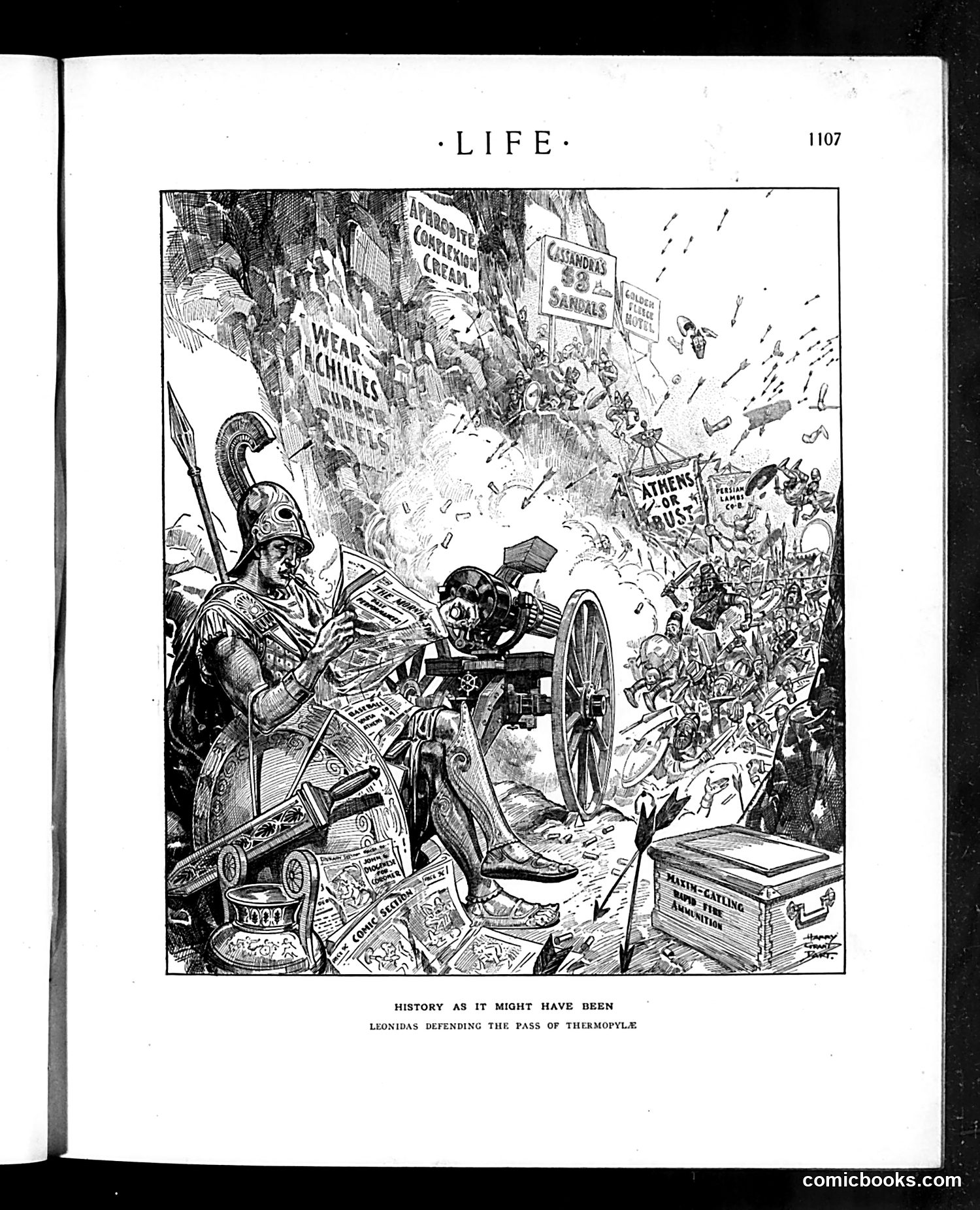
This satirical cartoon depicts a military figure in classical Greek armor (suggesting Leonidas defending Thermopylae) defending a mountain pass against invading forces. The defender wields a cannon while facing a crowd of attackers carrying commercial product advertisements and signs. The visible signage includes consumer goods like "Wear Achilles' Rubber," "Cassandra's Sandals," and "Athens Must" — brand names disguised as classical references. The cartoon satirizes commercial advertising's "invasion" of American culture and public spaces. The classical Greek military hero becomes a defender against not foreign armies, but relentless consumer marketing. The joke suggests advertisers are laying siege to traditional values and public discourse, treating commercialism as an overwhelming force that ordinary citizens must resist.
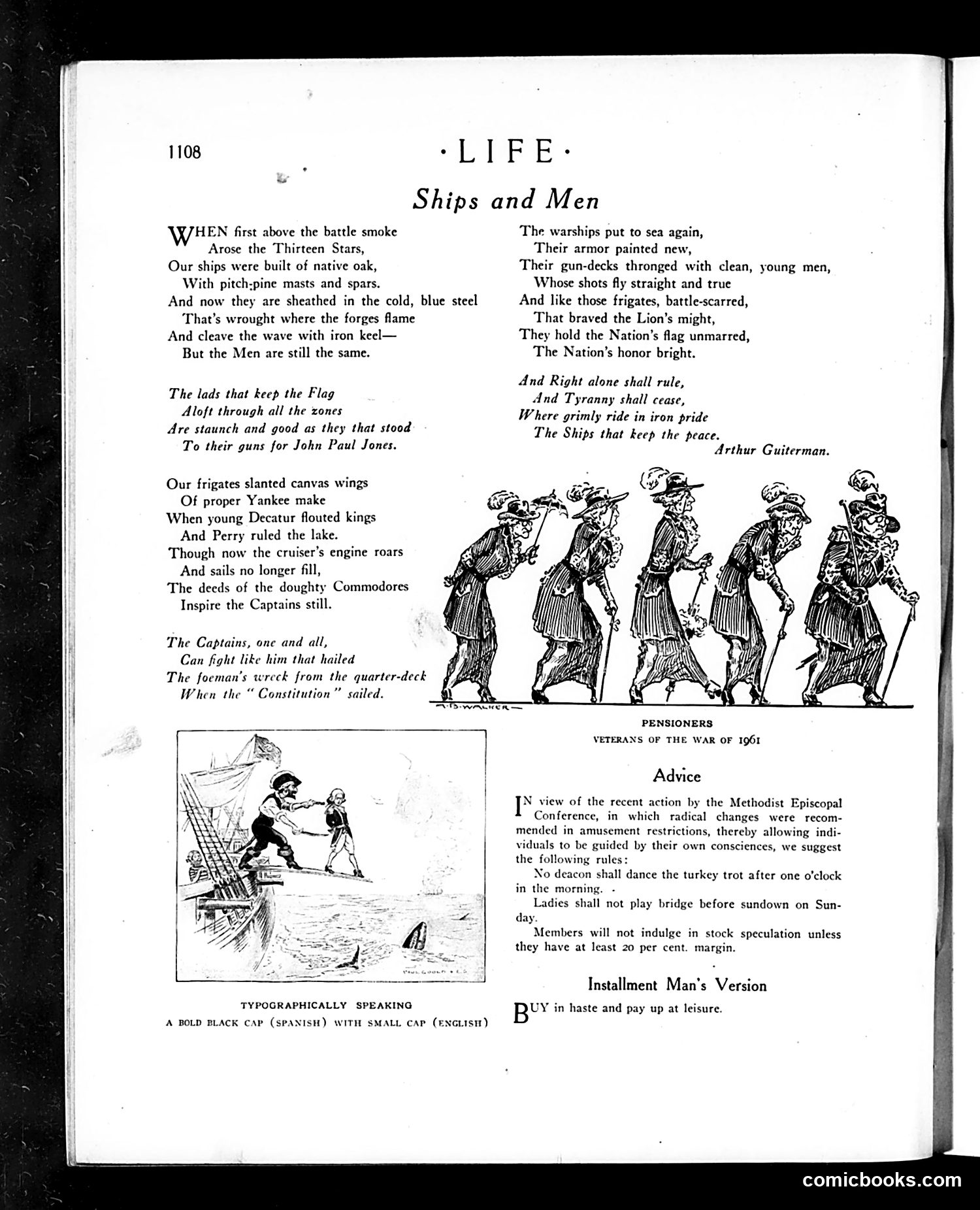
This page combines patriotic naval poetry with social satire. The top section celebrates American naval power during what appears to be the Spanish-American War era (references to "Thirteen Stars" and "John Paul Jones"), praising warships and sailors who maintain national honor. The lower half satirizes Methodist Episcopal Church restrictions on amusement. The cartoon shows a skeletal Death figure dancing with a fashionable woman, illustrating the satirical point: the church's severe moral rules (no turkey trot dancing after 1 o'clock, no bridge on Sundays, stock speculation restrictions) are portrayed as absurdly restrictive—almost deathly. The "Installment Man's Version" mocks the hypocrisy of buying on credit while preaching restraint. The satire targets religious institutions' attempts to control leisure and consumer behavior.
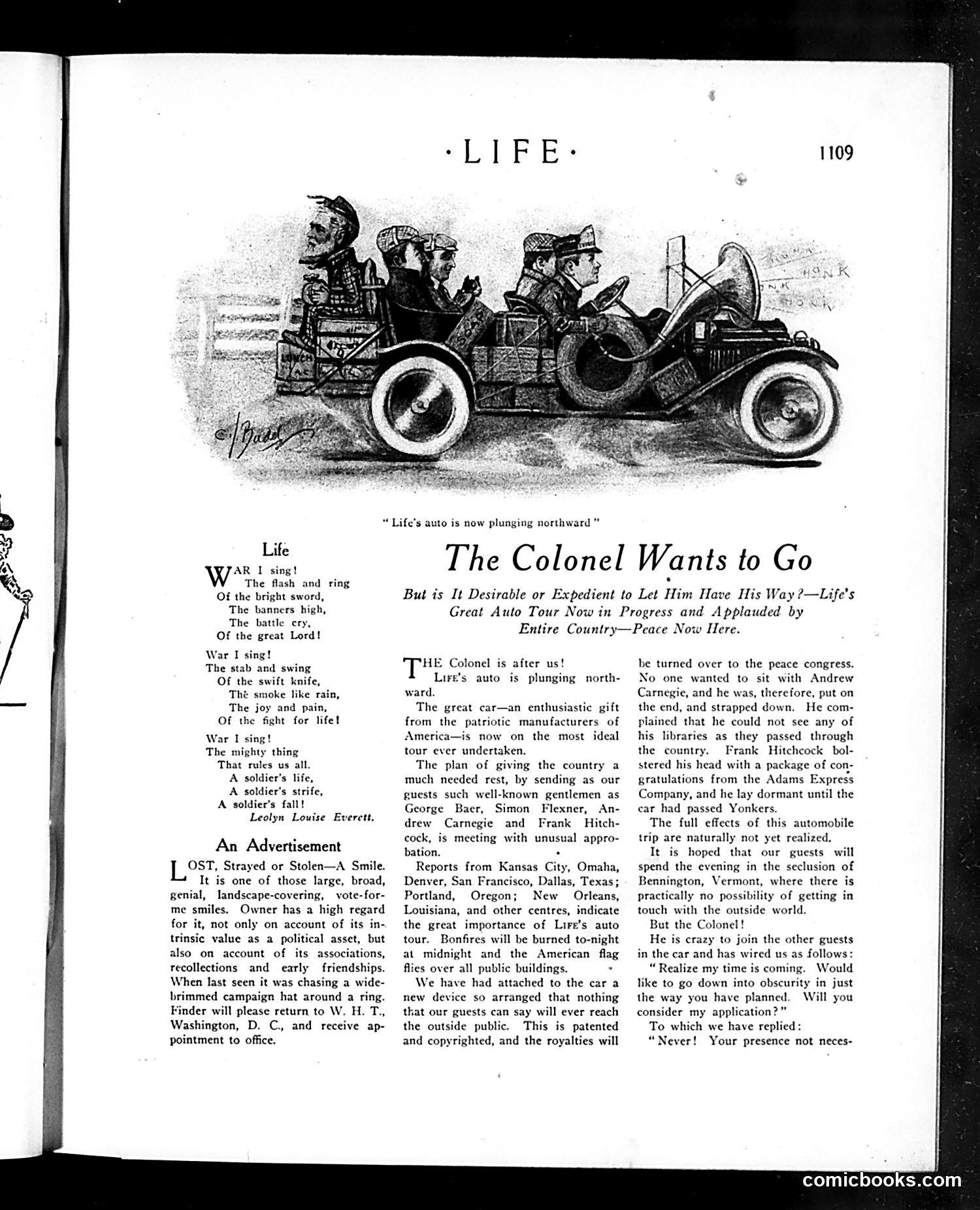
This satirical piece depicts an early 1900s automobile trip featuring military and political figures. The main illustration shows four men in an ornate early motorcar heading "northward." The accompanying article indicates "The Colonel" (likely Theodore Roosevelt, given the military title and prominence in Life magazine of that era) wants to tour the country in this vehicle as a gift from patriotic manufacturers. The satire centers on the tension between Roosevelt's desire for a post-presidential "rest" and the chaos such a high-profile auto tour would cause. The poem "War! I sing!" mocks militaristic rhetoric, while the article notes the Colonel will inevitably attract attention and disruption, contradicting any hopes for a quiet journey—poking fun at the impossibility of Roosevelt traveling inconspicuously.
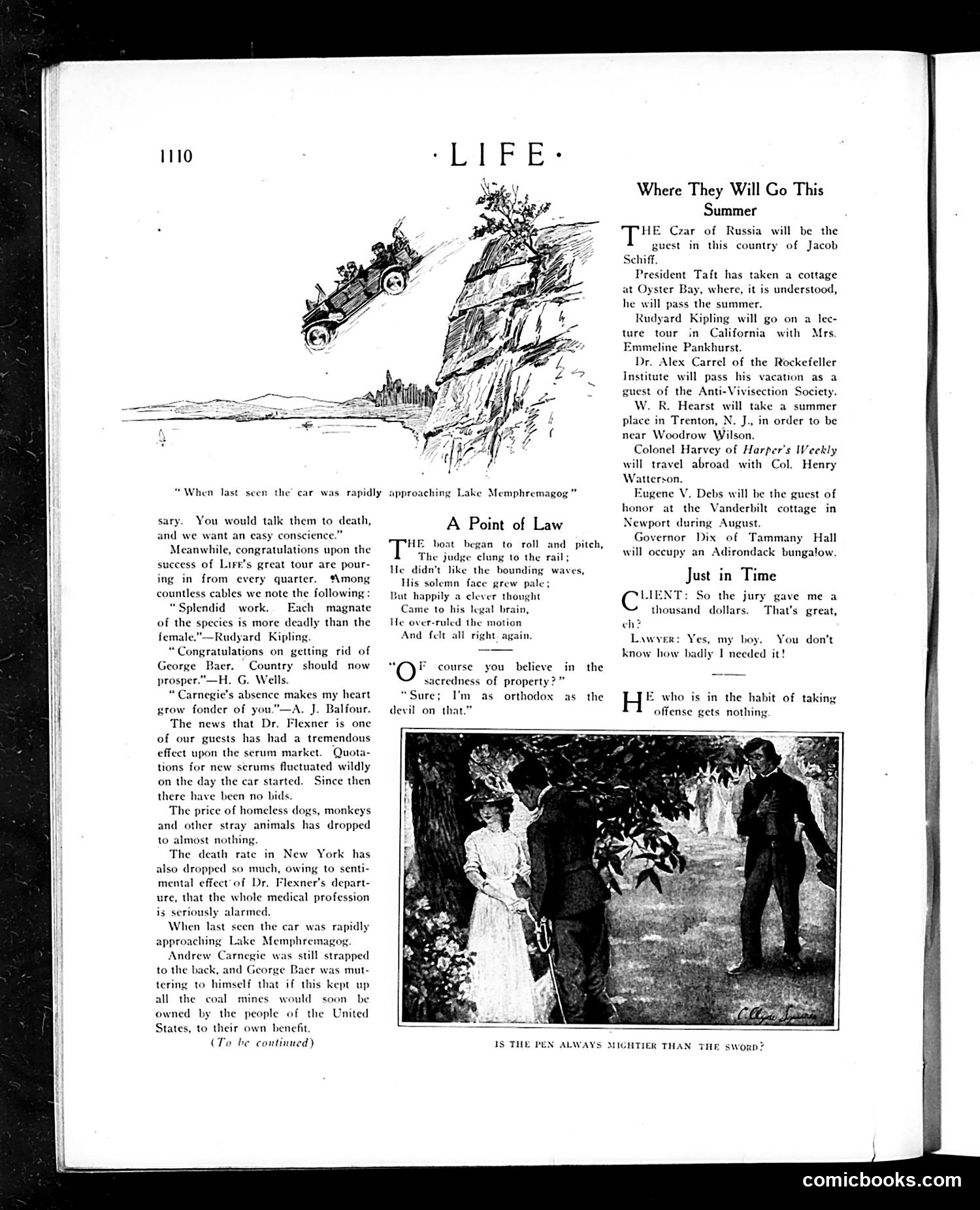
This page contains satirical commentary about wealthy Americans' summer plans. The top section lists notable figures' vacation destinations: the Czar of Russia visiting Jacob Schiff, President Taft at Oyster Bay, Rudyard Kipling lecturing in California, and various other prominent individuals. The cartoon and accompanying story titled "A Point of Law" satirizes the tension between property rights and social conscience during an era of significant wealth inequality. The dialogue between characters debates whether "the secretness of property" justifies hoarding resources while others suffer. The bottom illustration appears to relate to a separate piece titled "Is the Pen Always Mightier than the Sword?" The overall page satirizes Gilded Age excess and debates about wealth distribution among early 20th-century American elites.
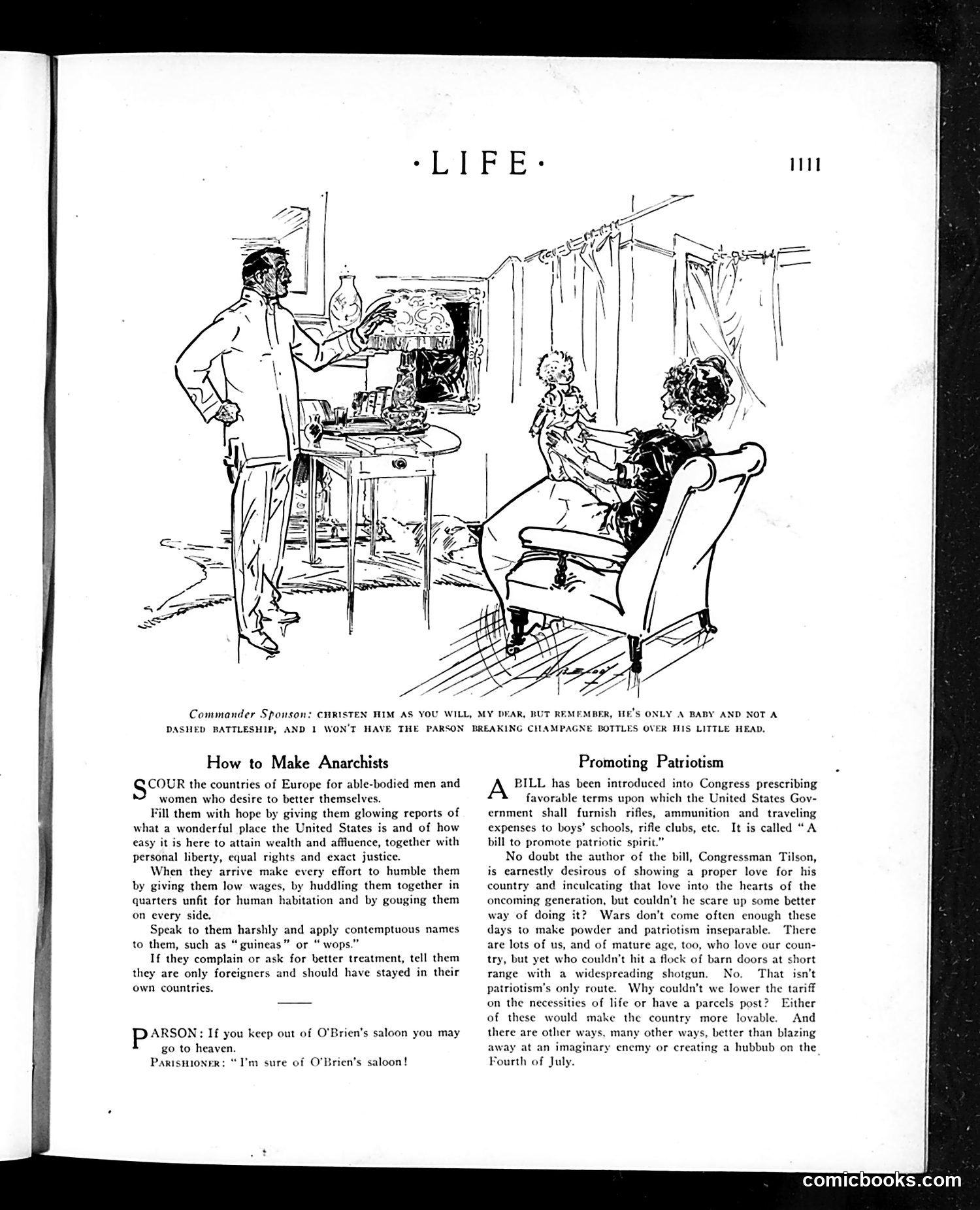
This page contains three satirical pieces critiquing early 20th-century American social and political issues: **Top cartoon**: A humorous domestic scene where a military officer (labeled "Commander Sponson") warns against christening a newborn baby like a battleship—a joke about militaristic excess and the absurdity of applying military ceremony to civilian life. **"How to Make Anarchists"**: Biting satire on immigrant treatment. It describes the deliberate process of radicalizing newcomers: lure Europeans with promises of prosperity and freedom, then subject them to low wages, poor housing, and contempt (using slurs like "guineas" and "wops"). The implication: discriminatory treatment creates revolutionary sentiment. **"Promoting Patriotism"**: Critique of Congressman Tilson's bill providing rifles to boys' schools as "patriotic." Life argues this conflates militarism with genuine patriotism, suggesting better routes would be lowering tariffs or establishing parcel post—policies that improve citizens' actual lives. Both pieces expose how official narratives mask systemic mistreatment.
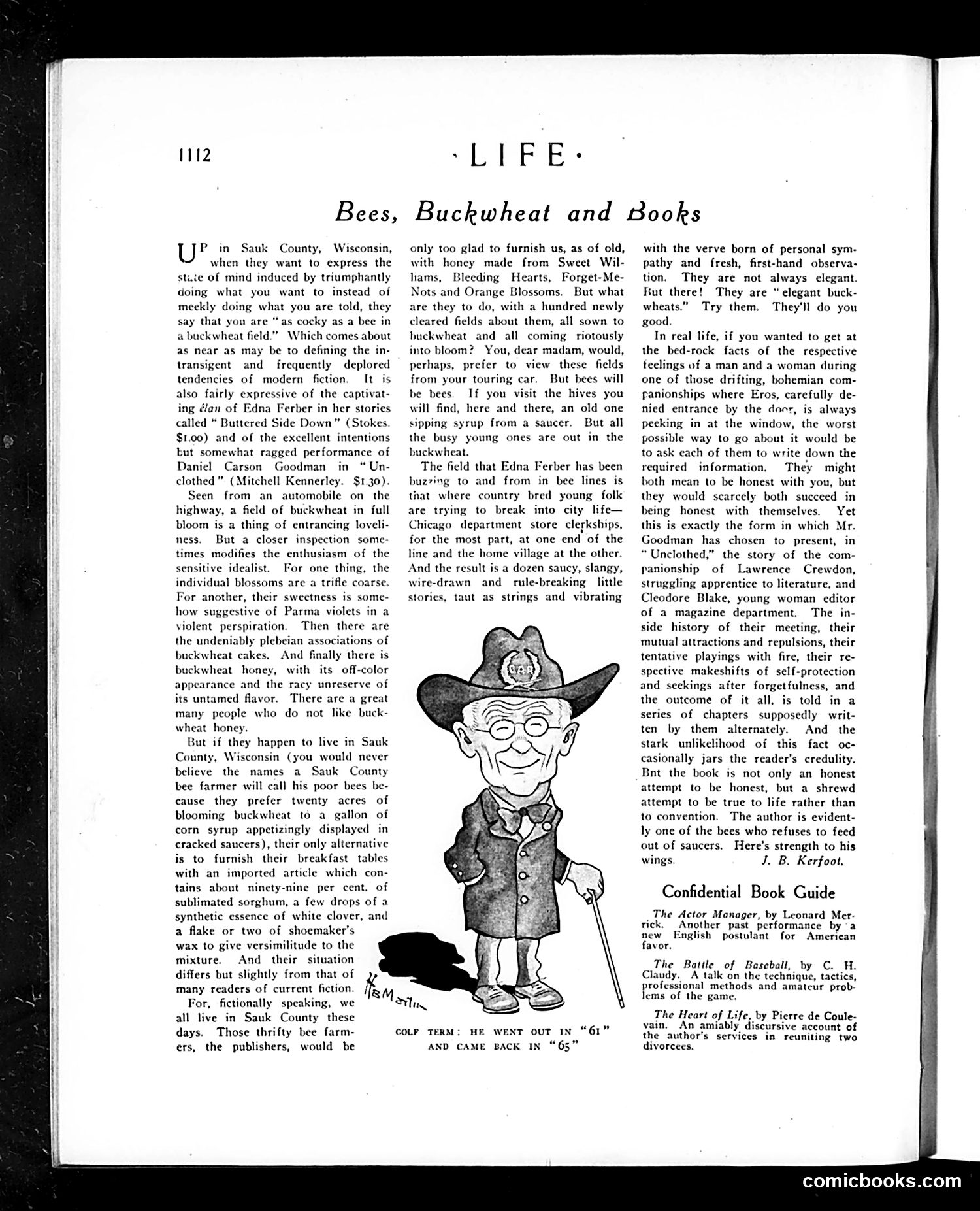
This page reviews two books by contemporary authors: Edna Ferber's *Buttered Side Down* and Daniel Carson Goodman's *Unclothed*. The critic uses an extended metaphor comparing modern fiction to buckwheat—initially attractive but crude upon closer inspection. The cartoon depicts a cheerful bee farmer (likely representing Edna Ferber or the publishing industry generally). The caption "He went out in '61 and came back in '65" is a golf joke: a poor golfer's score, suggesting time wasted. The satire argues that publishers, like Wisconsin bee farmers preferring abundant buckwheat to fine flowers, settle for commercially viable but artistically inferior "new fiction" rather than classic romantic literature. Ferber's stories about country folk seeking city life are dismissed as "saucy, slangy" and inelegant—mere "buckwheat" rather than refined literary honey. The reviewer acknowledges their energy and honesty but questions their artistic merit.
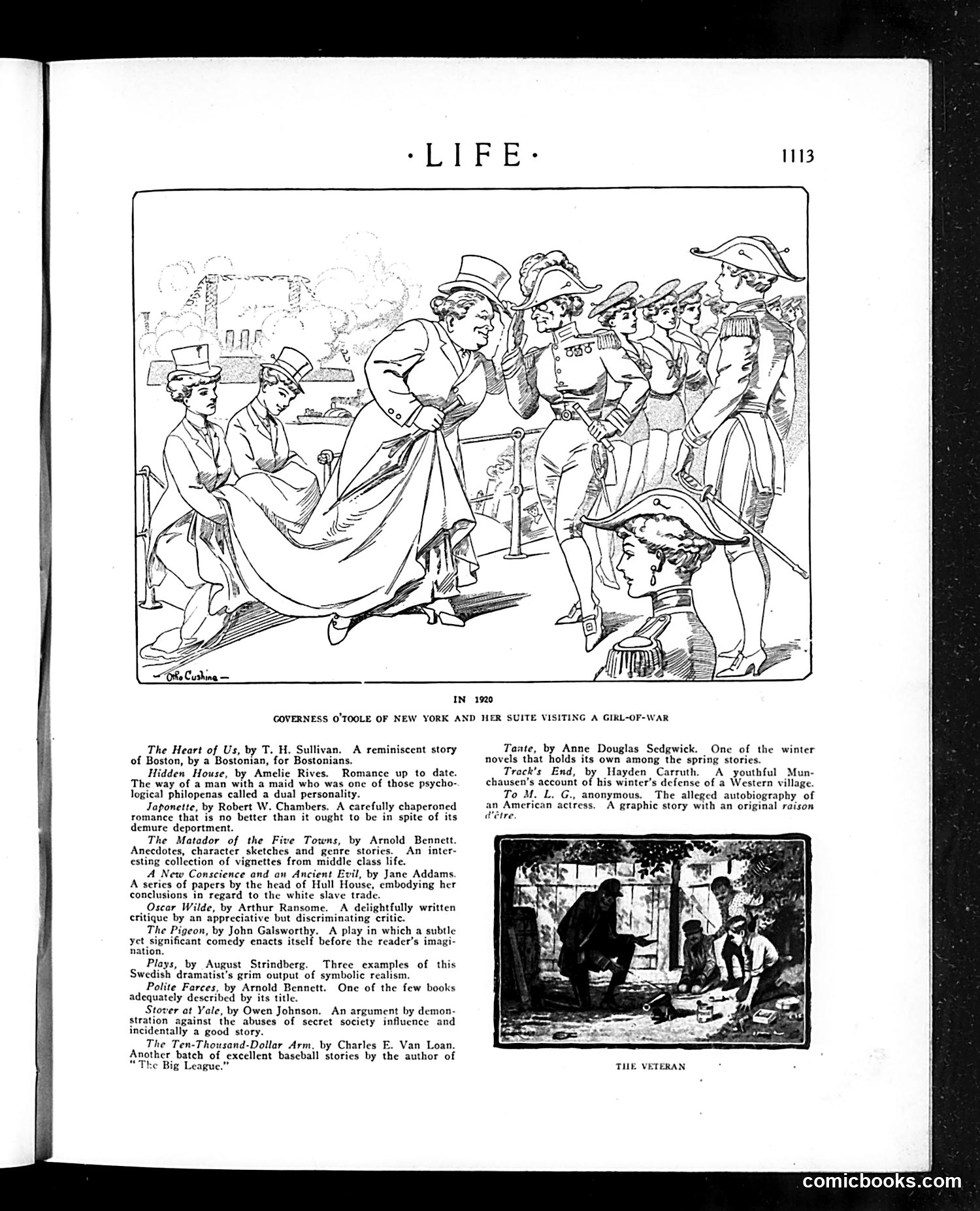
The main cartoon depicts "Governess O'Toole of New York and Her Suite Visiting a Girl-of-War" (a warship). The joke satirizes the contrast between an Irish-American working-class governess (identified by her name and modest dress) and her entourage, who are being received with full military ceremony by uniformed officers. The satire mocks the absurdity of treating a domestic servant with the pomp normally reserved for dignitaries or nobility. This likely reflects post-WWI social commentary on class disruption—perhaps referencing how wartime labor shortages elevated working-class women's status, or satirizing newfound wealth among Irish-Americans. The "suite" accompanying her suggests pretension to high society, which clashes amusingly with her humble occupation. The cartoon's humor depends on recognizing the incongruity between O'Toole's actual social position and the formal respect being shown.
This page satirizes government inefficiency through two pieces: **"Another Investigation Coming"** mocks Congress's tendency to over-investigate trivial matters with absurd bureaucratic formality. Congressman Bourbon proposes an international commission to "scientifically" determine why a chicken crosses the road—a joke question everyone already knows the answer to ("to get on the other side"). The satire ridicules how Congress wastes public money conducting formal investigations into settled questions while ignoring genuinely important issues like the tariff and trusts. The phrase "Great applause from all six of those present" emphasizes the futility—only six congressmen attend. **"America for the Americans"** critiques hypocrisy in protectionist tariff policy. While American manufacturers are heavily protected with tariffs against foreign goods, American steamship owners profit enormously by importing cheap immigrant labor without tariffs or restrictions. The satire highlights the double standard: protective barriers shield goods but not workers, allowing exploitation of immigration for corporate profit while claiming patriotic "America First" principles. Both pieces target government corruption and inconsistency in early 20th-century American policy.
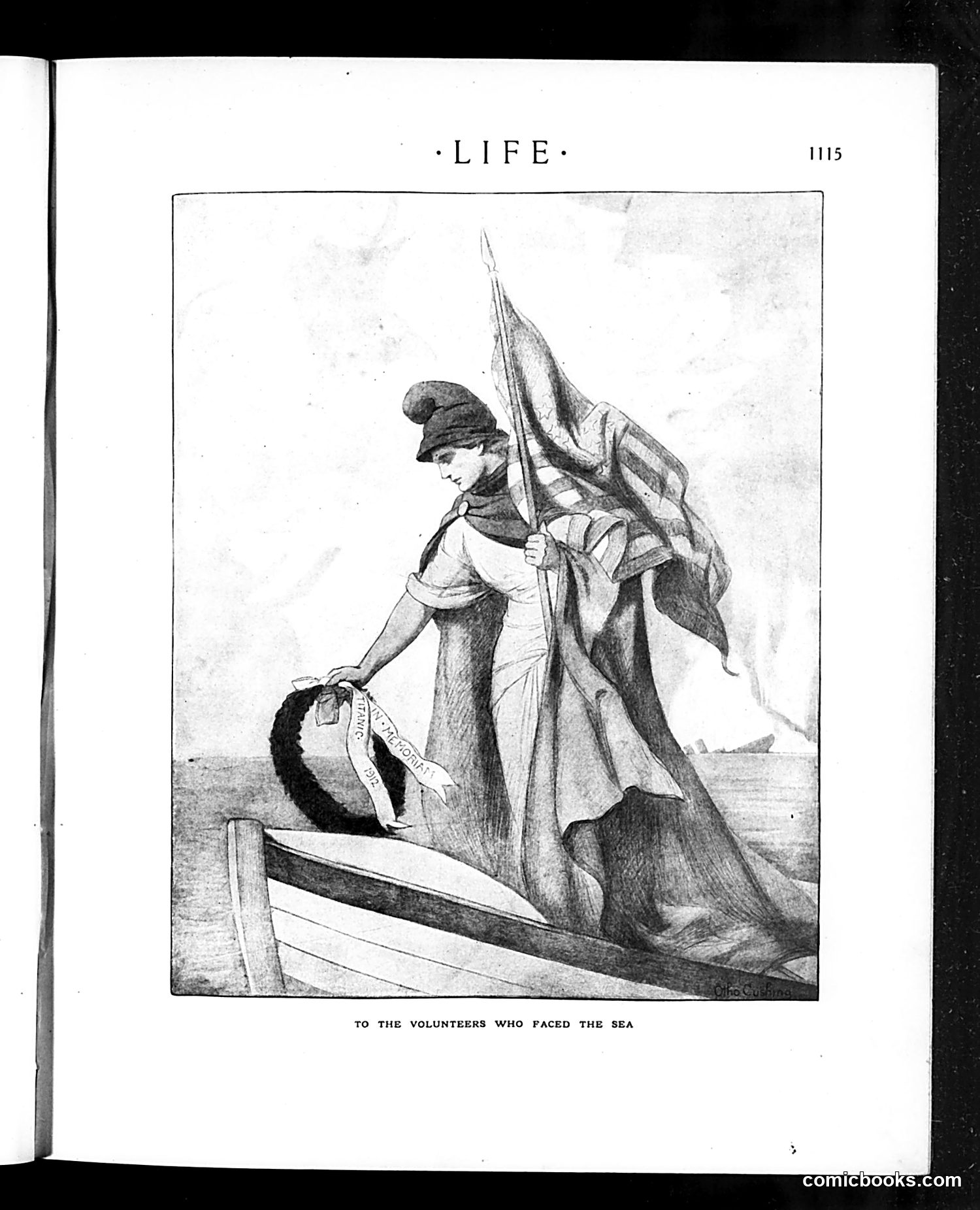
This is a commemorative illustration from *Life* magazine (page 1115) dedicated "To the Volunteers Who Faced the Sea." The image shows a woman in classical allegorical style—wearing a cap and flowing robes while holding a flag—standing over a prone male figure in a boat. The caption suggests this honors military volunteers who engaged in naval operations. The allegorical female figure likely represents either Liberty, Britain, or the nation itself. Without the magazine's date visible, the specific conflict cannot be definitively identified, though the style and naval context suggest either WWI or another early 20th-century conflict. The illustration treats volunteer service as noble sacrifice worthy of commemoration.
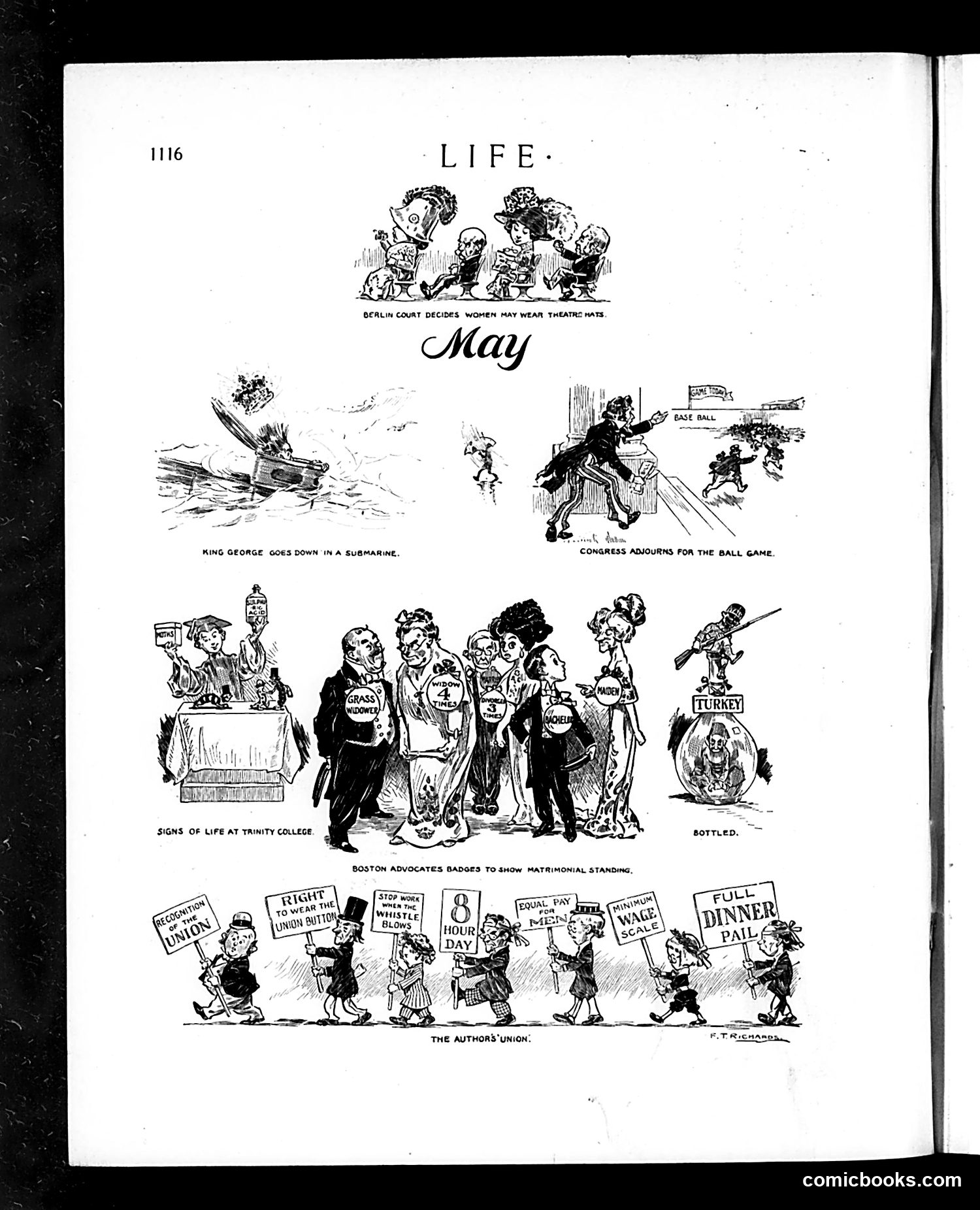
This satirical page depicts various May events through caricatured vignettes. The top sections mock current events: a Berlin court decision on women's theater hats, King George going down in a submarine, and Congress adjourning for baseball season. The central image shows "Boston advocates badges to show matrimonial standing"—women wearing sashes labeled with marital status, satirizing what appears to be a proposed Boston custom. The bottom cartoon, "The Authors' Union," depicts union members carrying placards demanding labor protections: "Recreation," "Right to Join the Union Debate," "Stop Work Before the Whistle Blows," "8 Hour Day," "Equal Pay For Equal Work," "Minimum Wage," and "Full Dinner Pail"—mocking organized labor movements of the era through exaggerated caricature.
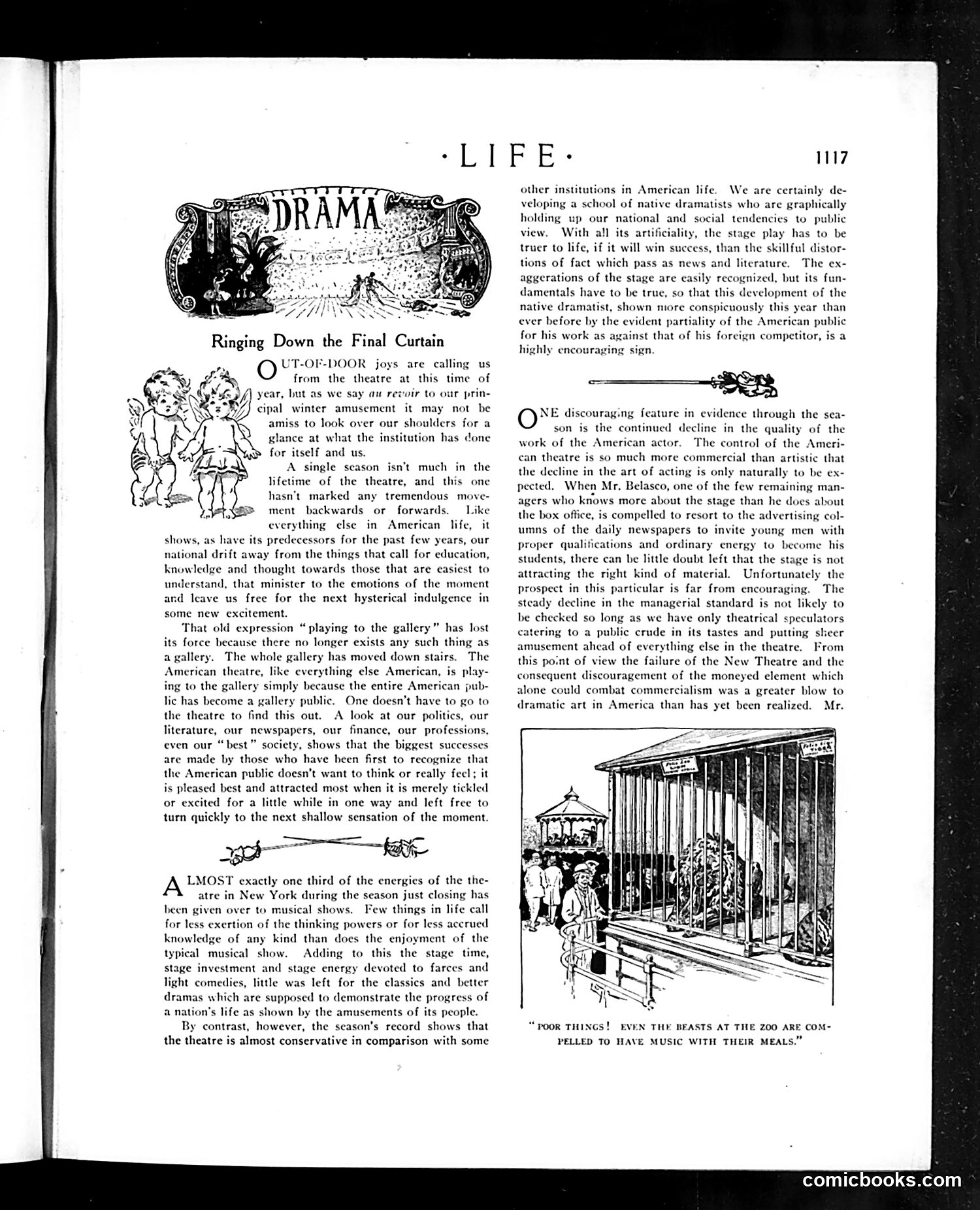
This page critiques the decline of American theater during an unspecified season. The main article, "Ringing Down the Final Curtain," argues that theater—like American culture generally—has abandoned intellectual rigor for shallow entertainment. The author contends that the public no longer distinguishes between "gallery" (cheap seats) and legitimate theater; everyone has become a "gallery public" seeking easy emotional stimulation rather than thought. He notes that one-third of New York theater resources went to musical shows requiring minimal mental engagement. However, the piece offers hope: native American dramatists are gaining prominence over foreign competitors, and American theater remains "almost conservative" compared to other institutions. A secondary complaint addresses the declining quality of American actors, exemplified by David Belasco (a prominent manager) resorting to newspaper advertisements to recruit young talent—suggesting the profession has lost prestige. The zoo cartoon (bottom) appears to mock this situation through absurdist humor.
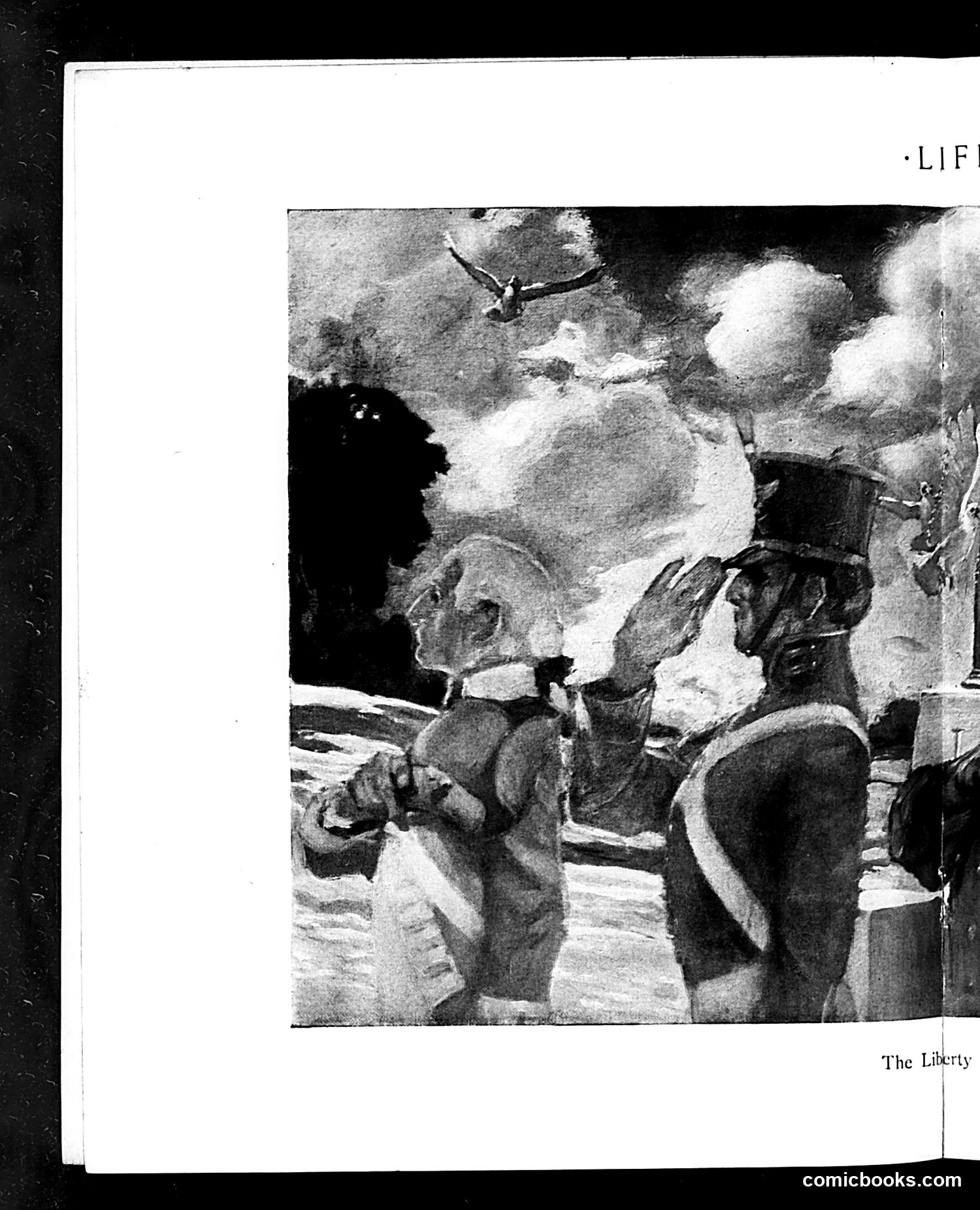
This appears to be a page from *Life* magazine featuring what looks like a patriotic or wartime illustration. The image shows soldiers or military personnel in uniform looking upward at an aircraft in flight, with dramatic clouds in the background. The composition suggests heroic or inspirational messaging typical of wartime propaganda imagery. The caption reads "The Liberty," which likely references American liberty or freedom—a common wartime theme. However, without clearer OCR text or additional context, I cannot definitively identify the specific historical moment, the individuals depicted, or the precise satirical intent. The image's style and subject matter suggest mid-20th century origin, possibly related to World War II era messaging, but I cannot confirm this with certainty from the visible information alone.
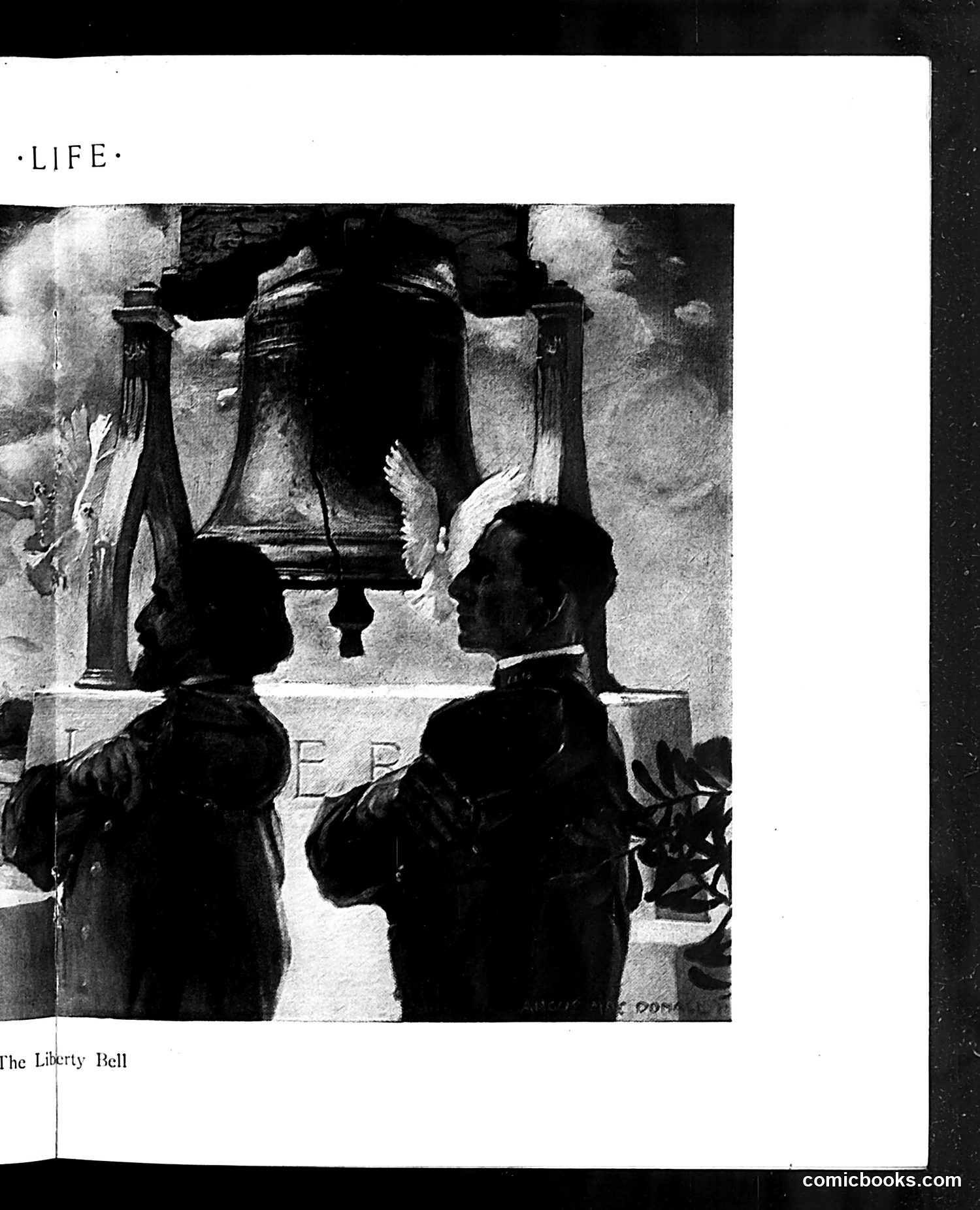
This Life magazine page features a photograph of the Liberty Bell, the historic American symbol of independence housed in Philadelphia. Two figures in silhouette are shown viewing the bell from behind, gazing up at it reverently in what appears to be an indoor exhibition space with classical columns flanking the display. The image appears to be a straightforward historical or patriotic feature rather than satirical commentary. Without additional context from surrounding pages, the exact satirical point—if any—is unclear. It may simply be documenting public interest in American historical artifacts, or potentially commenting on American patriotism during the period Life was published. The composition emphasizes the bell's iconic status through the viewers' solemn contemplation.
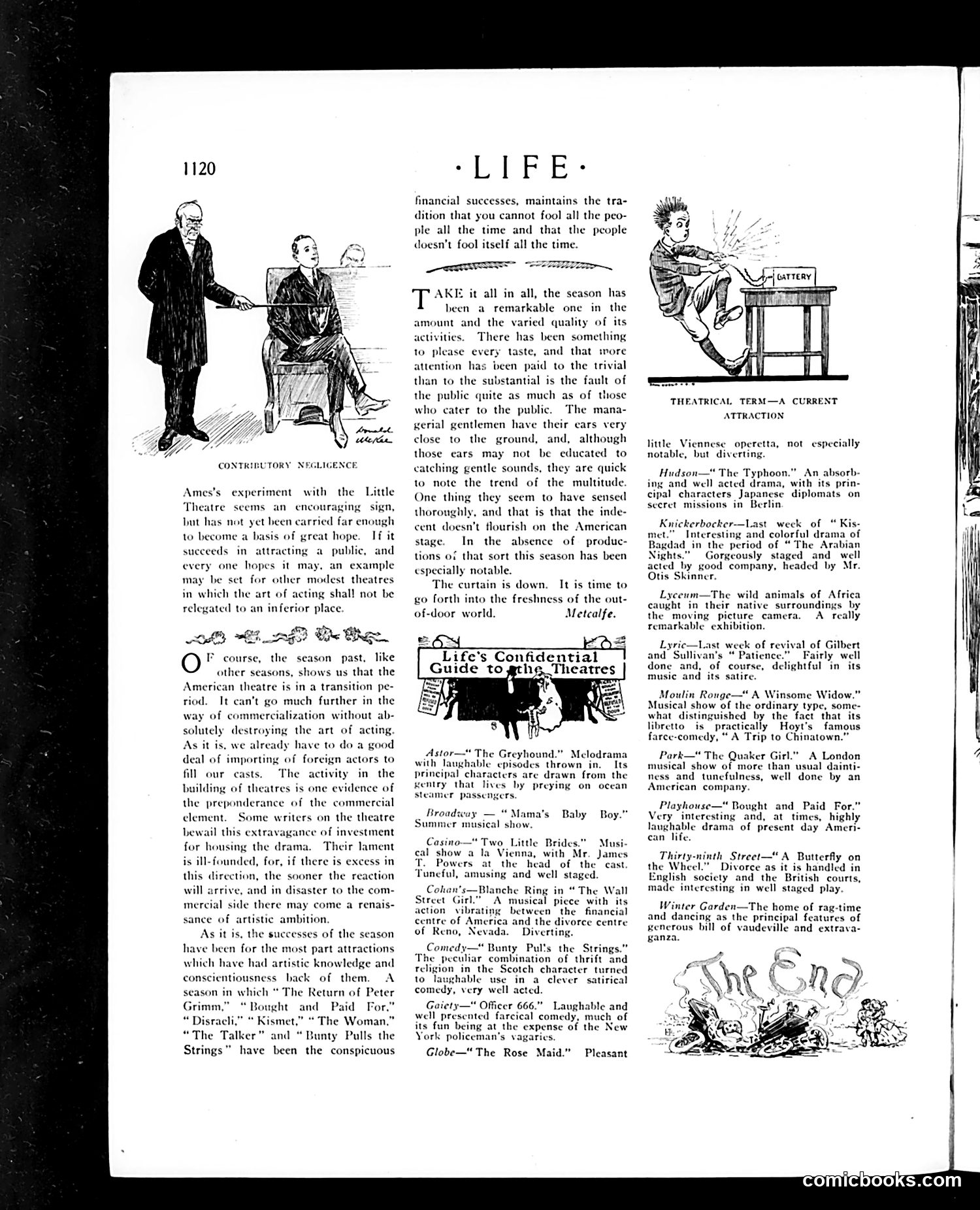
This page from Life magazine contains theatre criticism and reviews, not political cartoons. The main content discusses the American theatrical season, analyzing both its artistic merit and commercial nature. **Key Points:** The left cartoon, "Contributory Negligence," illustrates the theatre world's problem: an older gentleman (likely representing traditional theatre interests) gestures while seated, suggesting how commercial pressures and negligent management undermine serious dramatic art. **Main Argument:** The editorial criticizes American theatre's commercialization, noting it's destroying serious acting. However, it celebrates that successful plays this season—including "Disraeli," "Kismet," and "The Woman"—maintained artistic integrity, proving audiences won't accept mediocre entertainment. **Context for Modern Readers:** This reflects early 20th-century anxiety about art versus profit in entertainment—a tension still relevant today. The "Little Theatre" movement (mentioned as encouraging) represented resistance to Broadway's commercialism, advocating smaller, artistically-focused venues. The theatre listings that follow are straightforward show reviews, mostly light musicals and melodramas popular at the time.
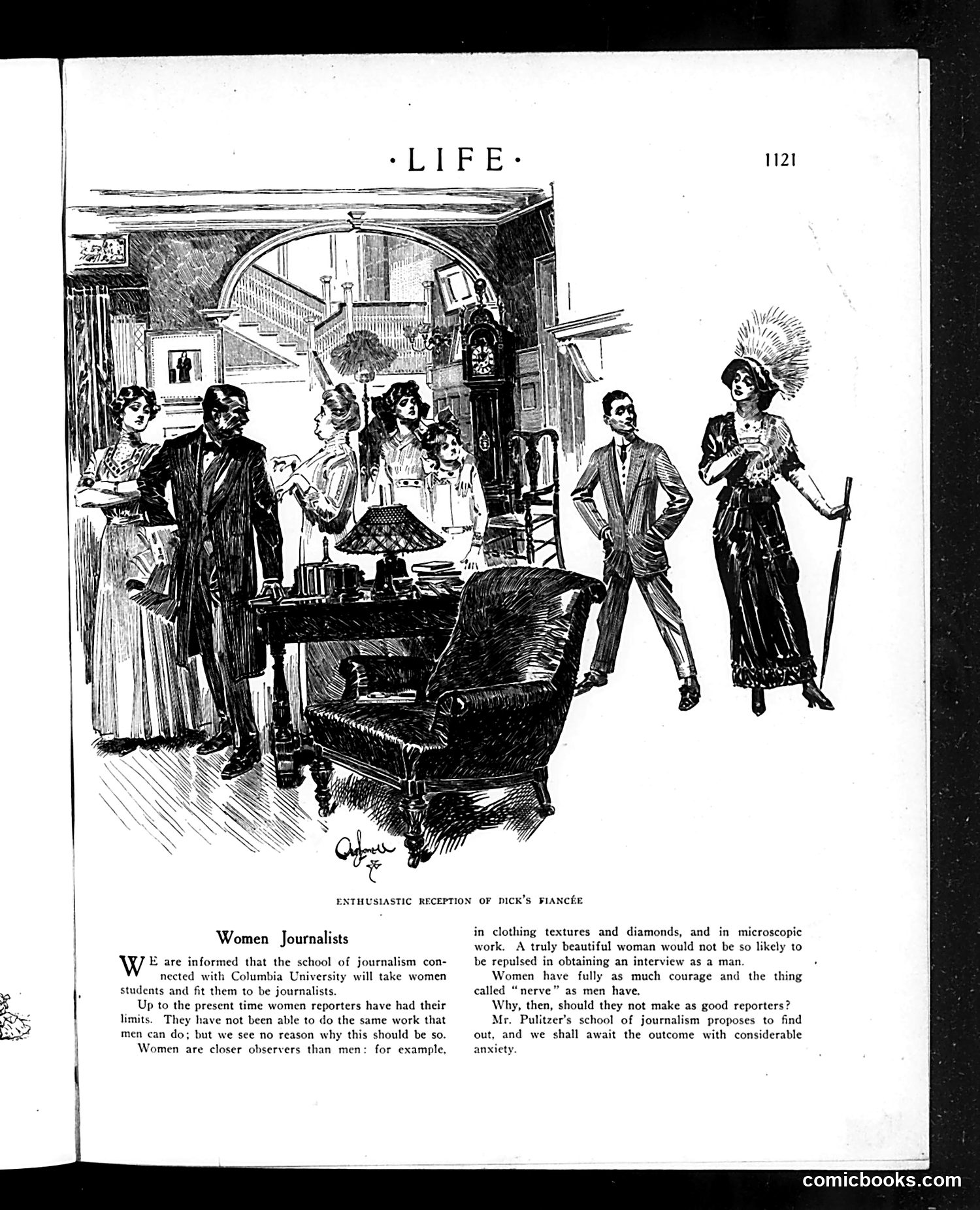
This 1921 *Life* magazine page argues for women's admission to journalism schools, specifically Columbia University's program. The accompanying cartoon satirizes society's skepticism about women journalists by depicting an "enthusiastic reception" for "Dick's fiancée"—showing a woman as a social curiosity rather than a serious professional. The article makes a progressive case: women are better observers (noting their attention to fashion and detail), face fewer barriers in interviews, and possess equal courage and "nerve" as men. Yet the cartoon's ironic title undercuts this argument, suggesting society views women primarily as romantic interests, not journalists. The piece references Joseph Pulitzer's journalism school initiative. The satire targets both social prejudice against female reporters and the magazine's own somewhat patronizing tone—praising women's "beauty" as an interviewing advantage reveals the era's conflation of women's professional capability with their appearance.
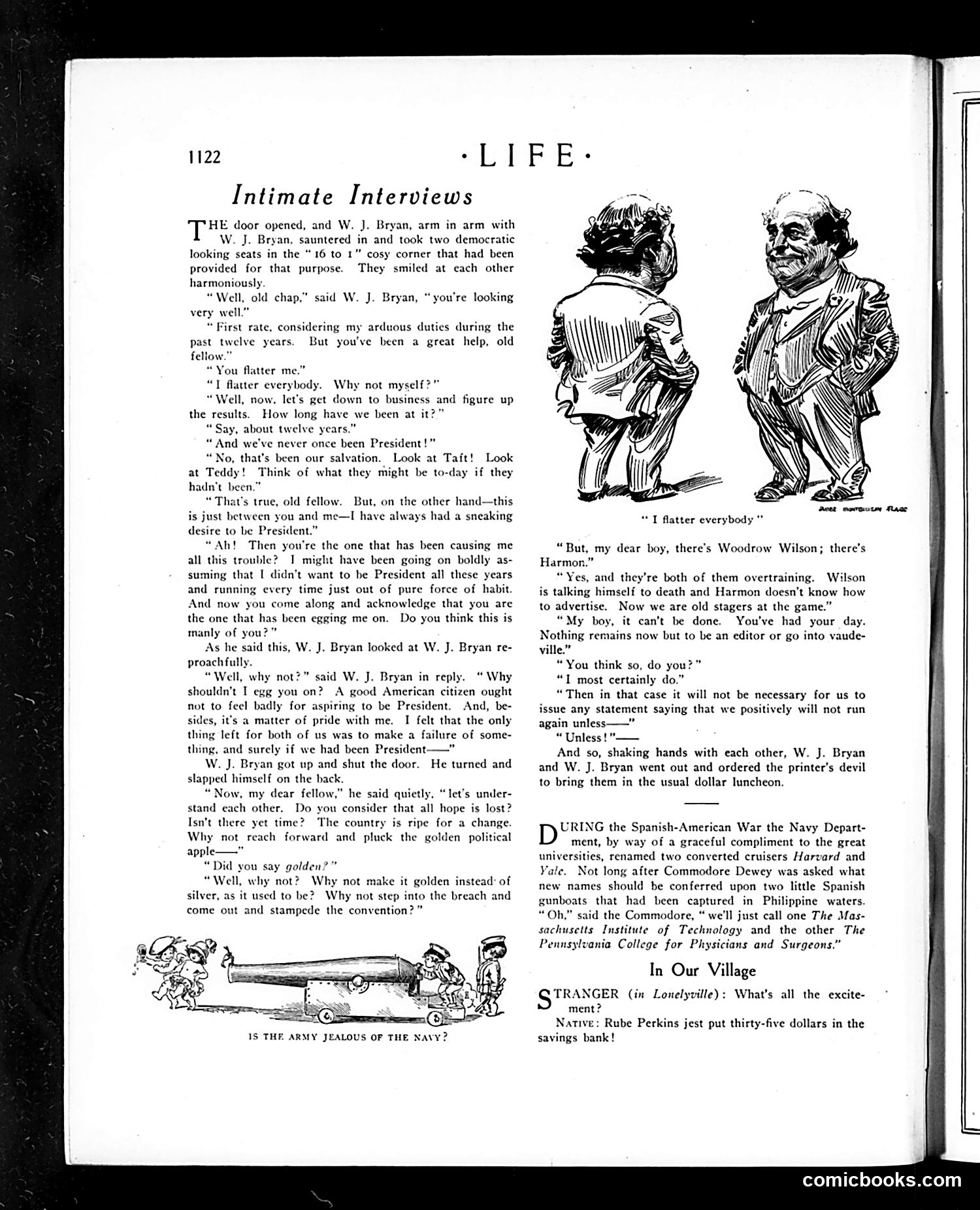
This cartoon mocks William Jennings Bryan's repeated failed presidential campaigns. The joke depicts Bryan interviewing *himself*—two identical figures in conversation—satirizing his narcissism and internal contradictions. Bryan had run for president multiple times (approximately every election cycle for twelve years, as the text states) without winning. The satire highlights the absurdity: one Bryan claims he never wanted the presidency, while the other admits he always did. They debate whether to try again, ultimately deciding against it—yet the punchline suggests they'll issue a statement saying they "positively will not run" with an implicit "unless" (leaving the door open), capturing Bryan's pattern of denial followed by renewed candidacy. The references to Wilson and Harmon indicate contemporary 1912 election context. The cartoon's genius lies in portraying Bryan as so self-absorbed and self-deceiving that he literally argues with himself about his own ambitions and failures.
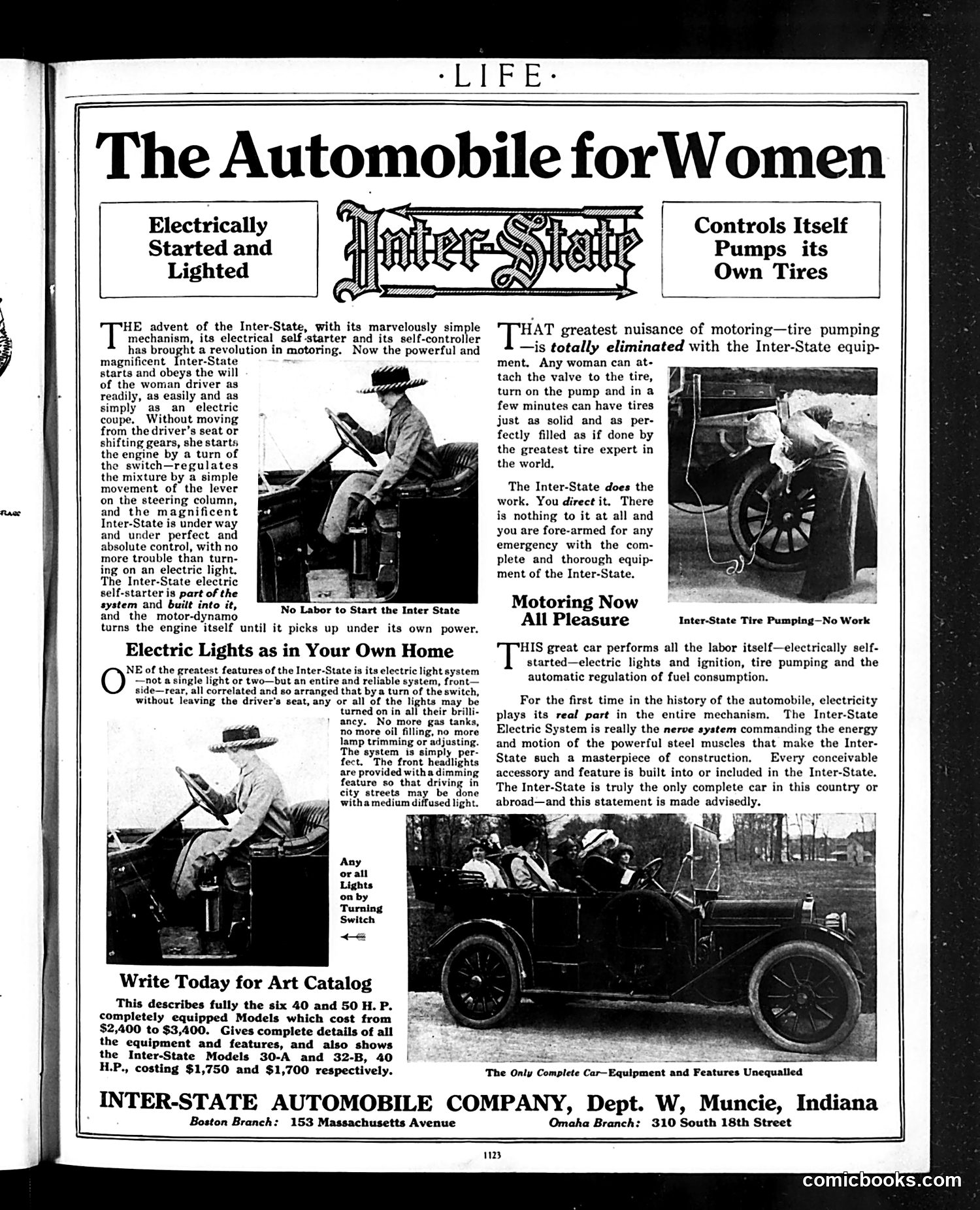
This is primarily a **car advertisement**, not satire, though it reveals period attitudes about women and automobiles. The ad markets the Inter-State automobile to women by emphasizing **labor-saving features**: electric self-starter, automatic lights, and self-operating tire pump. The repeated message is that women needn't perform physical tasks—the car "does the work" while she merely "directs it." The photographs show women operating the vehicle with minimal effort, positioned as the target market. This reflects early 1900s marketing logic: automobiles with electrical systems (versus hand-crank starters) were pitched to women as requiring less strength and mechanical knowledge. The satire is **unintentional but evident to modern readers**: the ad assumes women are incapable of or uninterested in actual mechanical operation, reducing driving to effortless button-pushing. This patronizing approach—marketing cars on the basis of removing "labor" rather than performance or capability—reveals contemporary gender assumptions about what would appeal to female consumers.
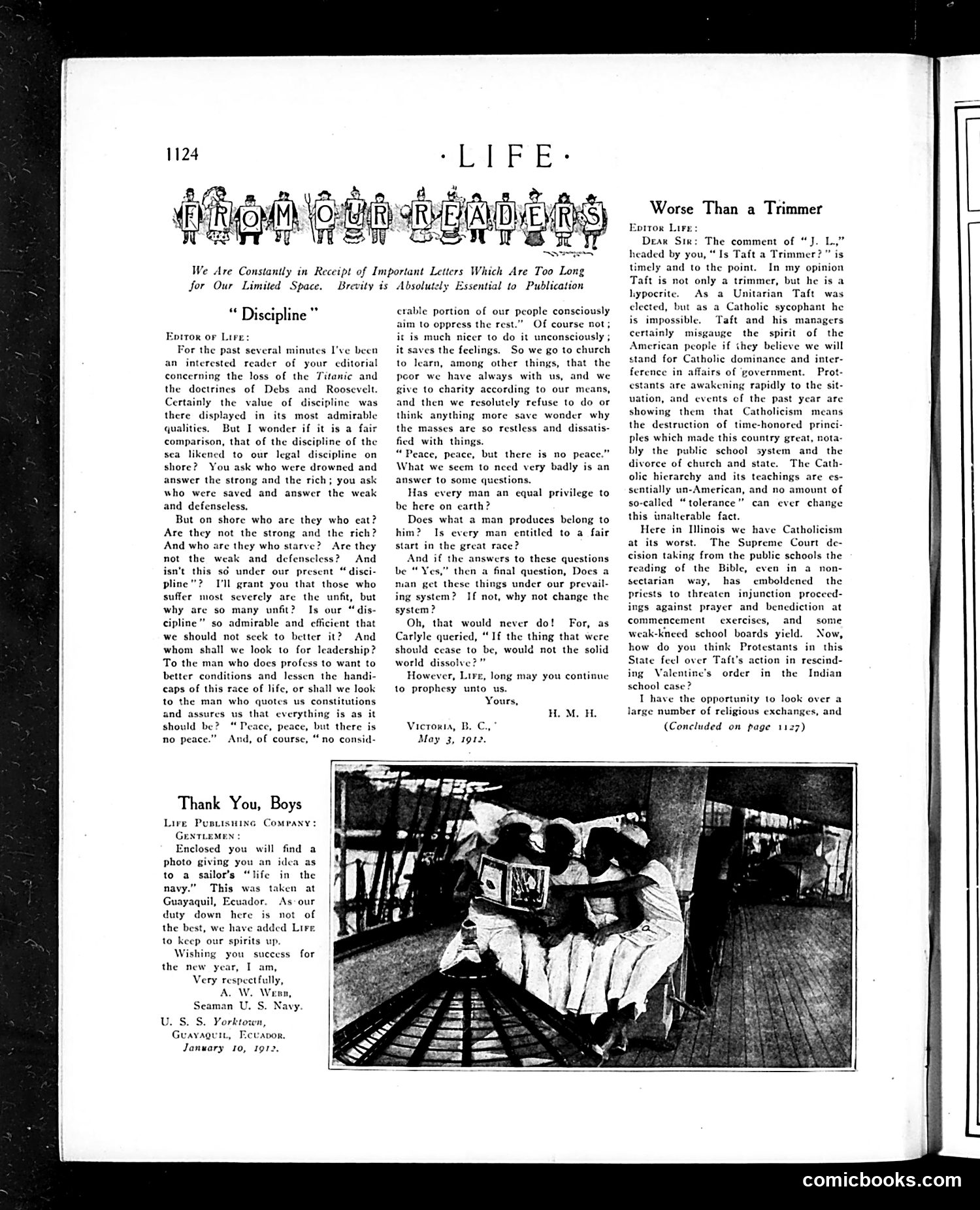
This page presents reader letters addressing contemporary political and social issues, not a cartoon. The first letter critiques American "discipline" and inequality, using the recent Titanic disaster (April 1912) as a reference point. The writer notes that while the wealthy survived and the poor died on the ship, similar class-based suffering exists on shore under the current economic system. The letter questions whether the status quo deserves defense and references socialist Eugene Debs and Progressive Theodore Roosevelt. The second letter attacks President William Howard Taft as a hypocrite, accusing him of pandering to Catholic interests while elected as a Unitarian. The writer expresses anti-Catholic sentiment common in early 20th-century American Protestantism, viewing Catholic influence in government and education as un-American threats to public schools and church-state separation. Both letters reflect 1912's heated debates over class inequality, progressive reform, and religious influence in American politics.
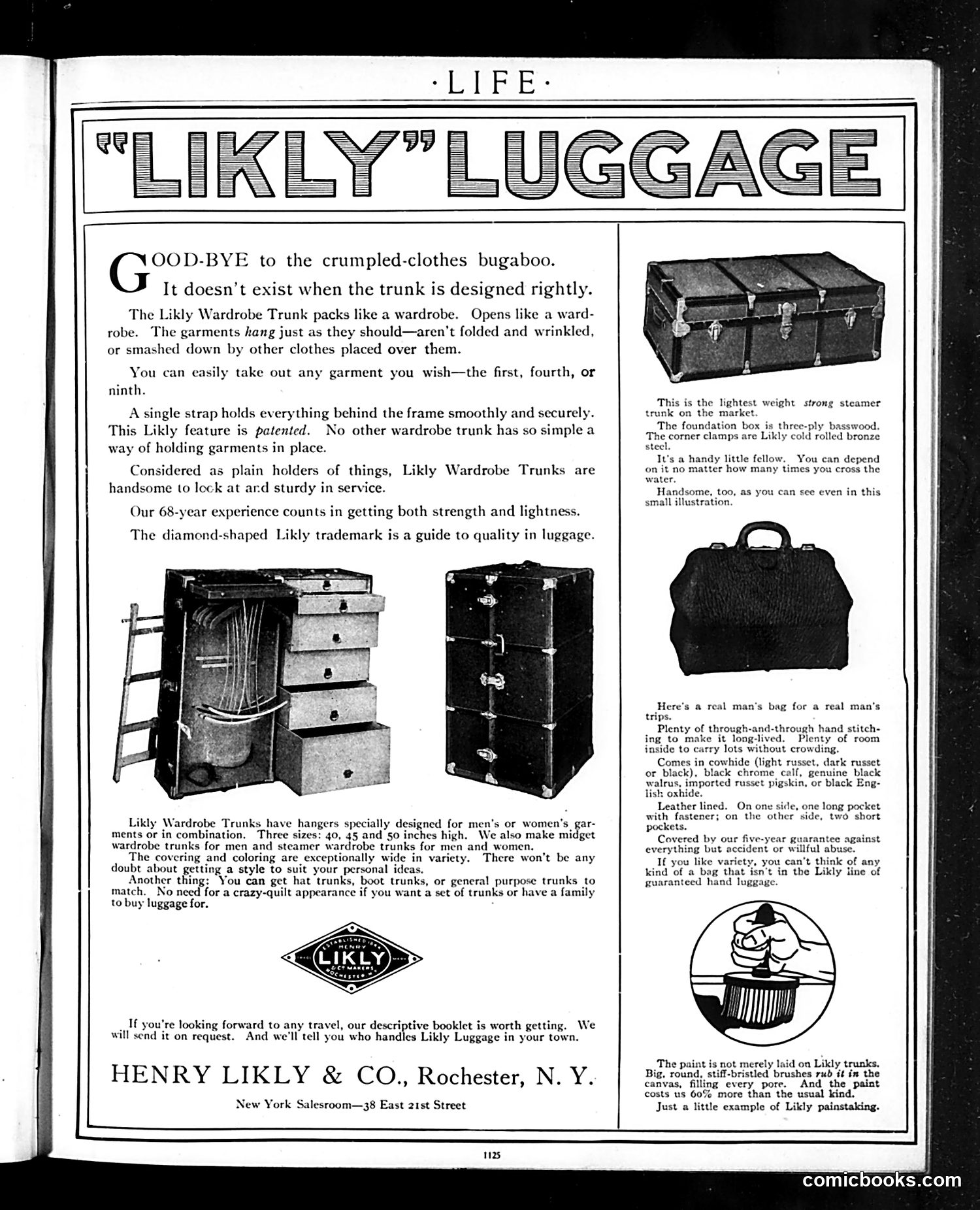
This is **not a political cartoon or satire**—it's a straightforward product advertisement for Likly Wardrobe Trunks by Henry Likly & Co., a Rochester, NY luggage manufacturer. The page promotes innovative trunk design features: hanging garments (like a wardrobe) rather than folding them, patented single-strap security, and easy access to individual items. It emphasizes the company's 68-year track record, quality construction, and variety of trunk types and materials. The advertisement includes product photographs and detailed descriptions of steamer trunks and travel bags, highlighting materials (cowhide, leather) and craftsmanship (hand-stitching, brush-painted finish). **Context for modern readers:** This reflects early 20th-century travel culture when sturdy, well-designed trunks were essential travel equipment for both wealthy and middle-class travelers. The heavy emphasis on durability and "painstaking" construction reflects an era of manufacturing pride before planned obsolescence became standard.
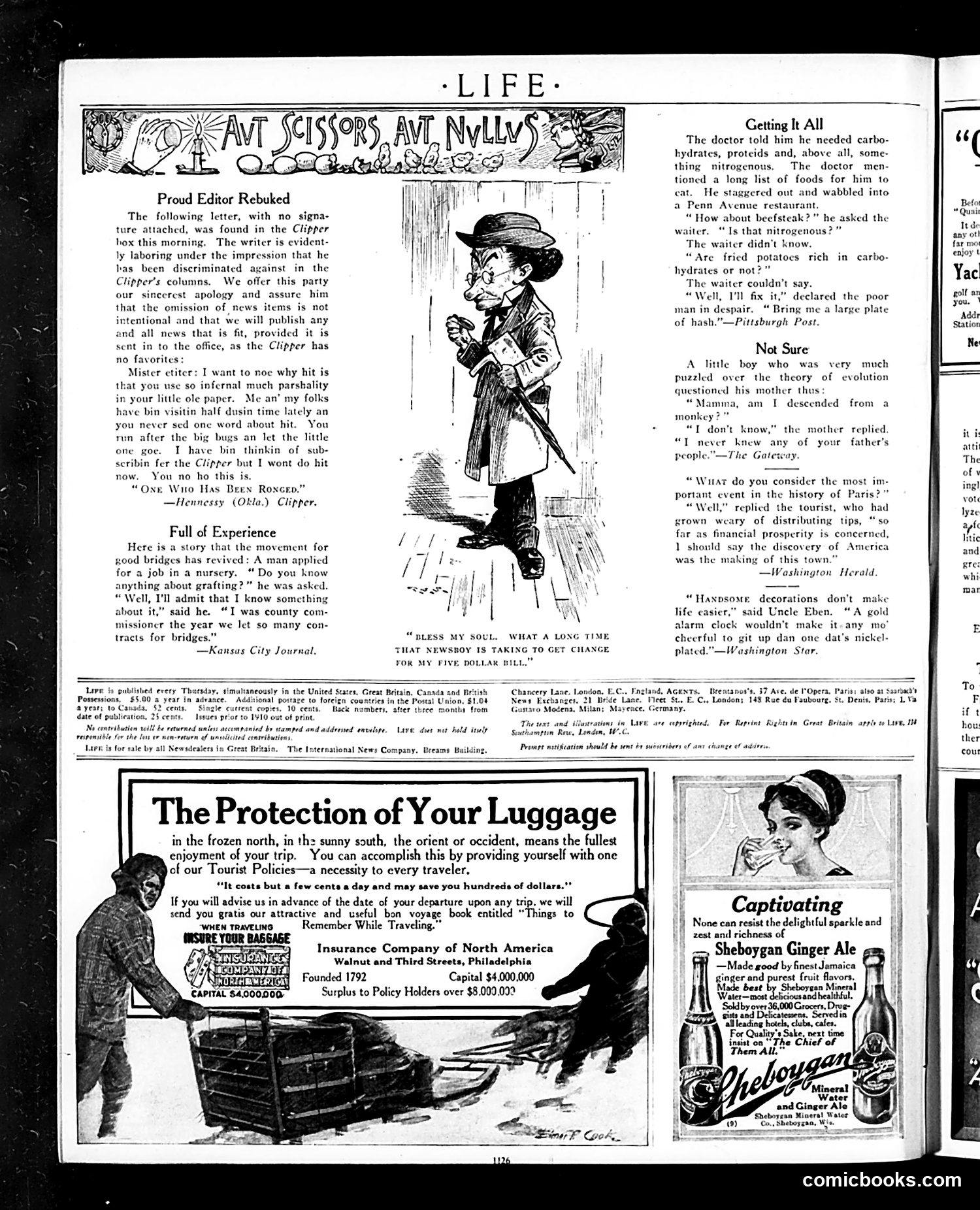
This *Life* magazine page contains several short humorous anecdotes satirizing American social and professional life: 1. **"Proud Editor Rebuked"**: A disgruntled newspaper reader complains (in deliberately misspelled dialect) that the local *Clipper* newspaper ignores ordinary people while favoring prominent citizens. The satire mocks small-town journalism's bias and the reader's semi-literate grammar. 2. **"Full of Experience"**: A man applying for a nursery job admits his "grafting" experience comes from being a county commissioner who awarded bridge contracts—satirizing political corruption and patronage in infrastructure projects. 3. **The main cartoon** shows a newsboy taking an extraordinarily long time making change from a five-dollar bill, with the caption "BLESS MY SOUL, WHAT A LONG TIME THAT NEWSBOY IS TAKING TO GET CHANGE FOR MY FIVE DOLLAR BILL." This appears to mock either incompetent service or monetary inflation making basic transactions slower. The remaining anecdotes mock medical ignorance, evolution skepticism, and tourism.
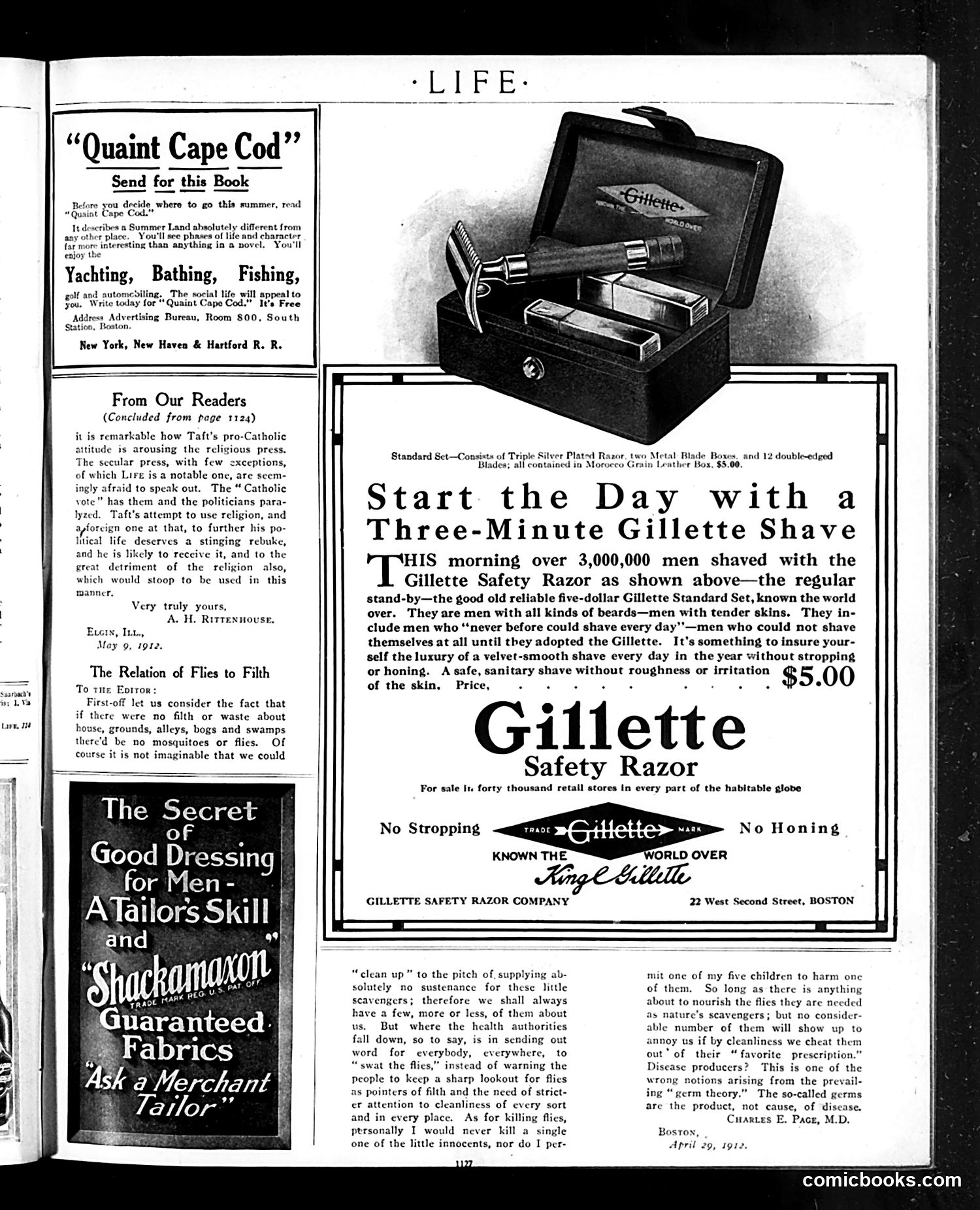
This page is primarily **advertising and reader correspondence**, not political satire. **Content overview:** - **Left column**: Tourism ad for Cape Cod and a "Letters to Editor" section discussing President Taft's Catholic sympathies (apparently controversial to some readers in 1912), plus a letter about fly control - **Right column**: A large **Gillette Safety Razor advertisement** promoting a $5.00 razor set, emphasizing that 3 million men use it daily for smooth, safe shaving without stropping or honing - **Bottom left**: Advertisement for "Shackamaxon Guaranteed Fabrics" for tailoring **Notable context for modern readers:** The Taft letter reveals early 20th-century religious tensions around presidential politics. The Gillette ad represents the razor's novelty—it's still promoting the safety razor as a revolutionary product, not yet the ubiquitous commodity it would become. There is **no significant cartoon or satire** on this page.
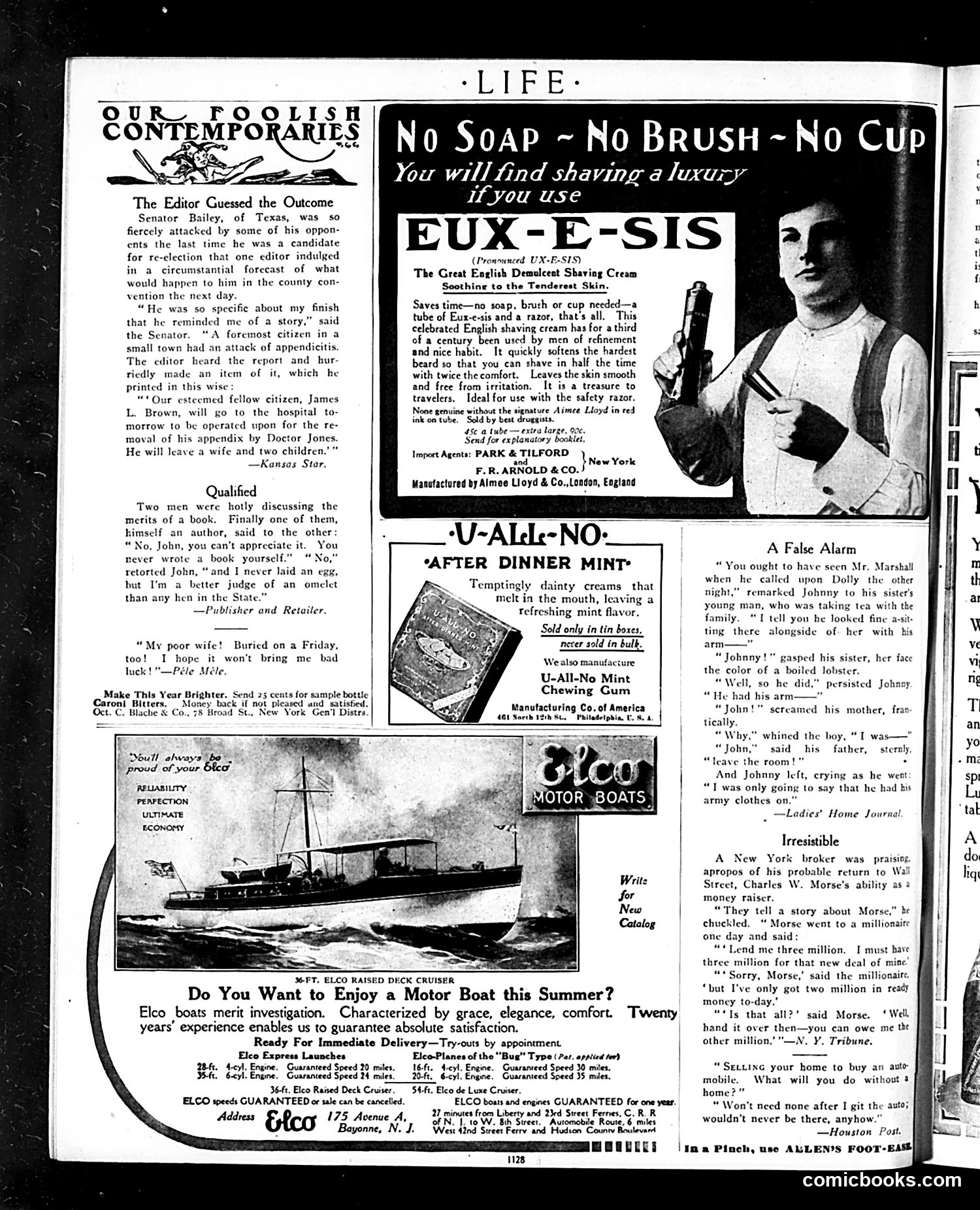
This Life magazine page is primarily **advertising**, with brief humorous anecdotes in the left column under "Our Foolish Contemporary." The featured cartoon/story concerns **Senator Bailey of Texas**. An editor supposedly predicted Bailey would lose his county convention bid so specifically that when Bailey didn't appear, the editor printed an obituary-style item claiming Bailey had died of appendicitis—only to have Bailey unexpectedly show up alive. The joke satirizes overconfident political prediction and the editor's embarrassment at being proven wrong. The remaining anecdotes are light social humor: a dispute between two men about writing books, a widow's superstition about Friday burials, and a story about Charles W. Morse (a noted businessman/financier) borrowing money. The bulk of the page consists of product advertisements: **Eux-e-sis shaving cream**, **U-All-No mint candies**, **Elco motor boats**, and other goods—typical for Life magazine, which relied heavily on advertising revenue.
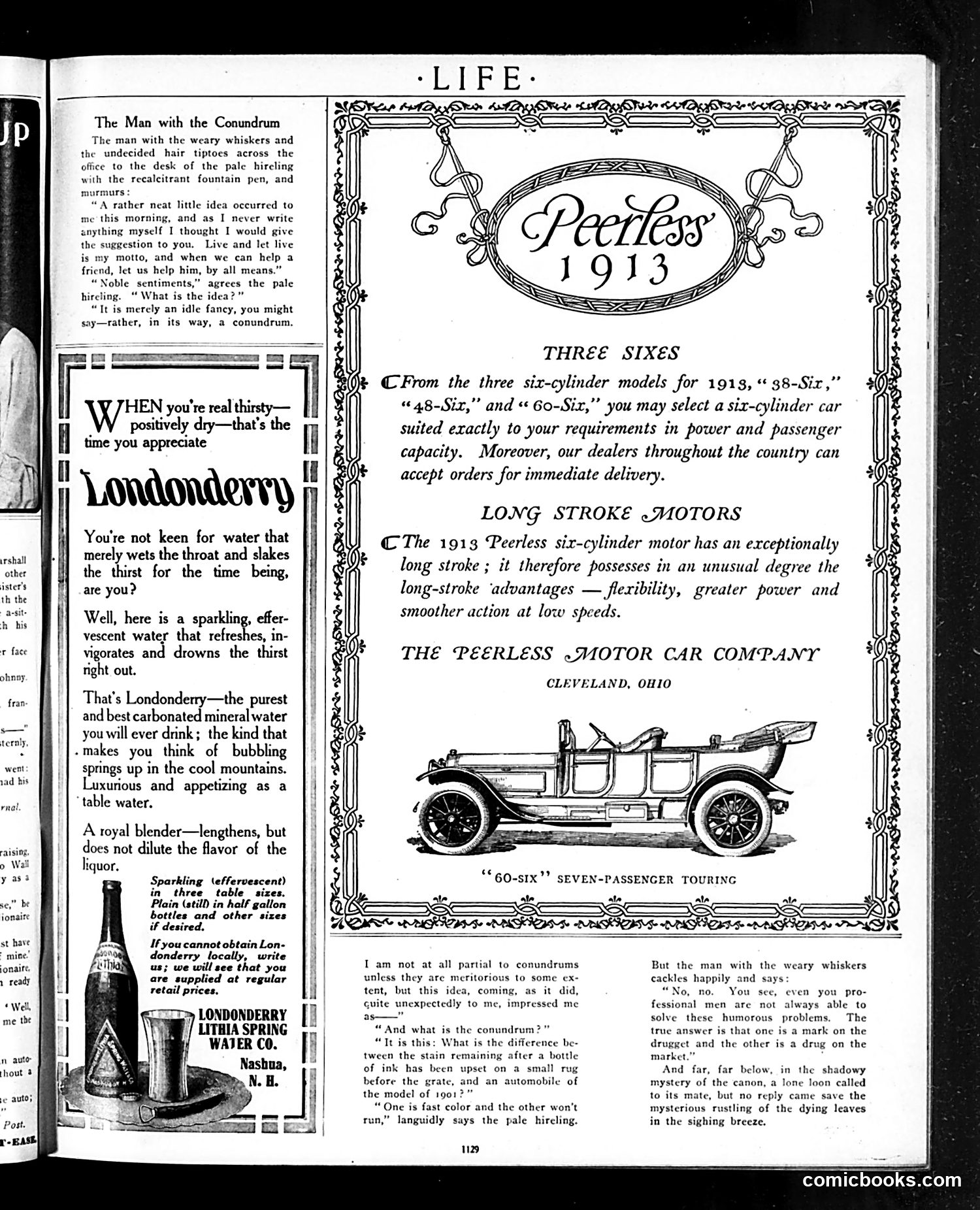
This is a satirical short story about workplace dynamics. A self-important boss with "weary whiskers" visits a pale, overworked office clerk to present what he believes is an original, clever idea—but it's merely a conundrum (riddle). The boss claims he never writes anything himself but generously shares ideas with underlings. The joke: The conundrum compares an ink stain on a rug to a 1901 automobile. The boss thinks the answer is "one is fast color and the other won't run" (mocking outdated cars). But the clerk delivers the real punchline: one is "a mark on the drugget and the other is a drug on the market"—meaning the old car is worthless inventory. The satire mocks pompous bosses who take credit for mediocre ideas while exploiting underpaid workers. The melancholic ending (the lonely loon) emphasizes the clerk's existential isolation. The page also contains period advertisements for Londonderry mineral water and the Peerless automobile.
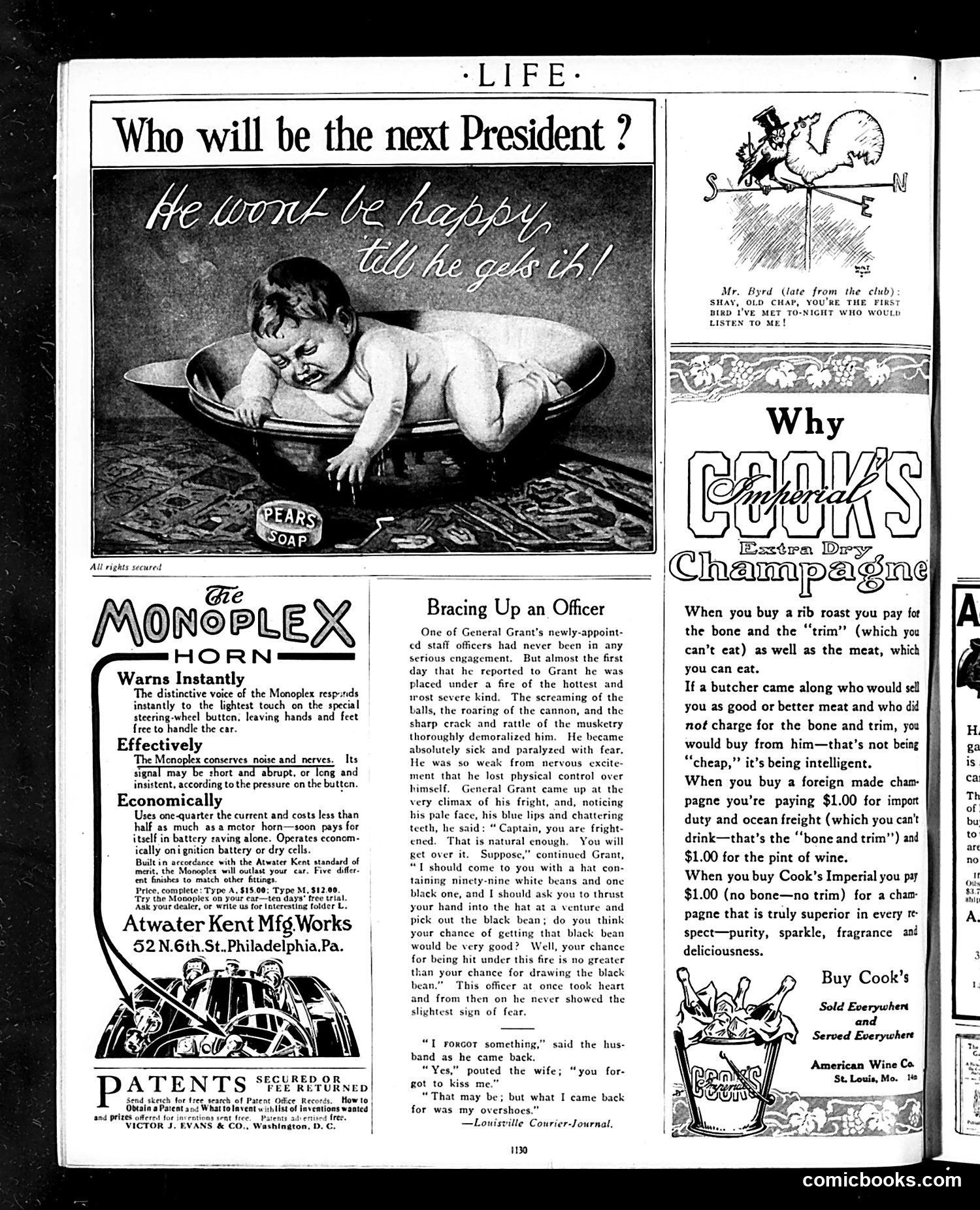
**Main Cartoon (Top Left):** The headline "Who will be the next President?" accompanies an image of a cherub or baby sitting in a bathtub with Pears Soap. The text reads "He won't be happy till he gets it." This is a satirical advertisement mashup—it's unclear which political figure is being referenced, but the joke appears to be that someone's presidential ambitions resemble childish desire for soap, suggesting their aspirations are trivial or silly. **"Bracing Up an Officer" (Center):** A Civil War anecdote about General Grant reassuring a frightened junior officer through a probability lesson: a hat containing 99 white beans and one black bean. Grant argues the officer's chances of being shot are similarly small. The story illustrates Grant's calm, rational leadership during combat. **Advertisements:** The page is largely commercial, featuring the Monoplex car horn, patents services, Atwater Kent auto parts, and champagne/wine advertisements. The page blends political satire with period advertising and historical anecdotes typical of Life magazine's format.
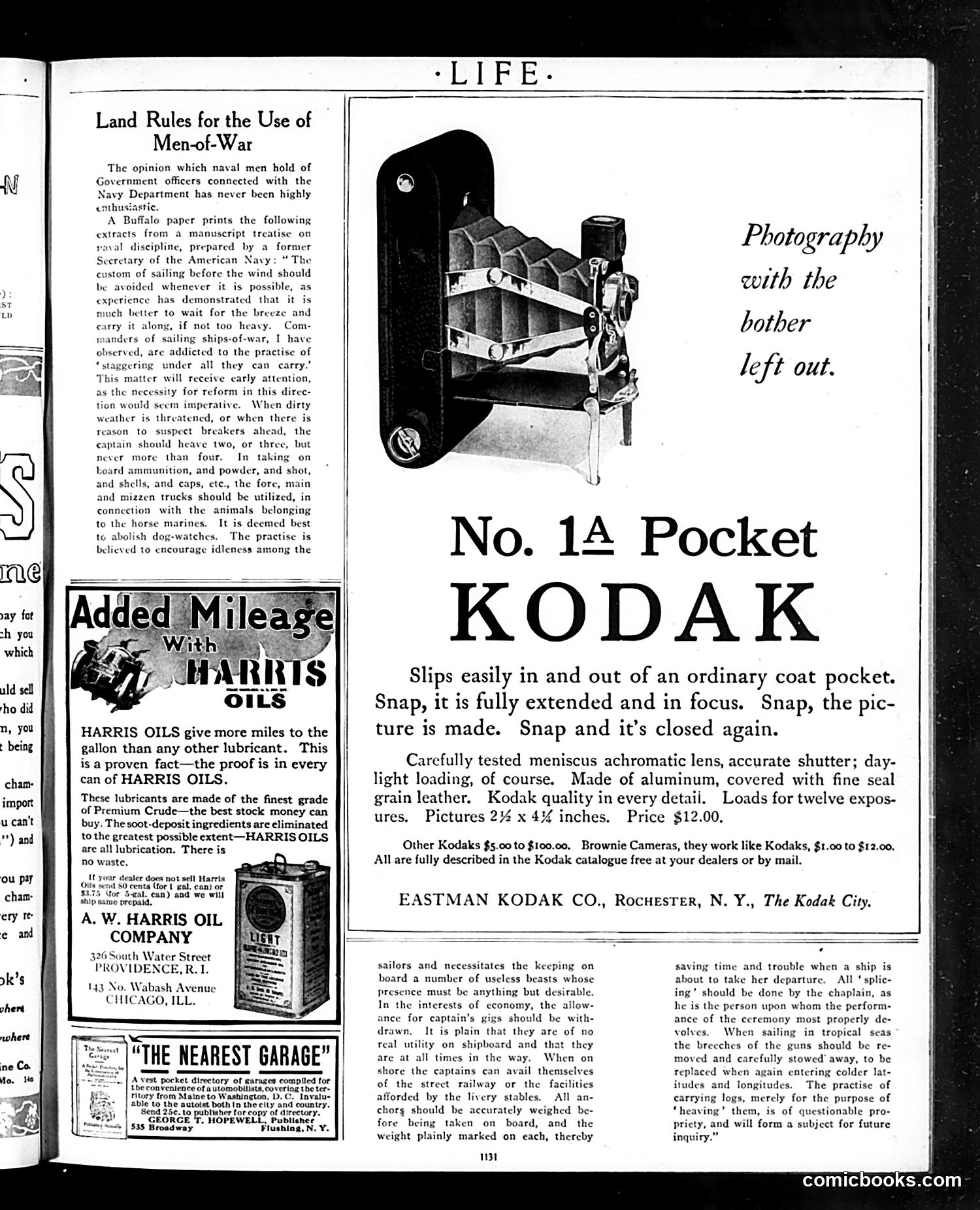
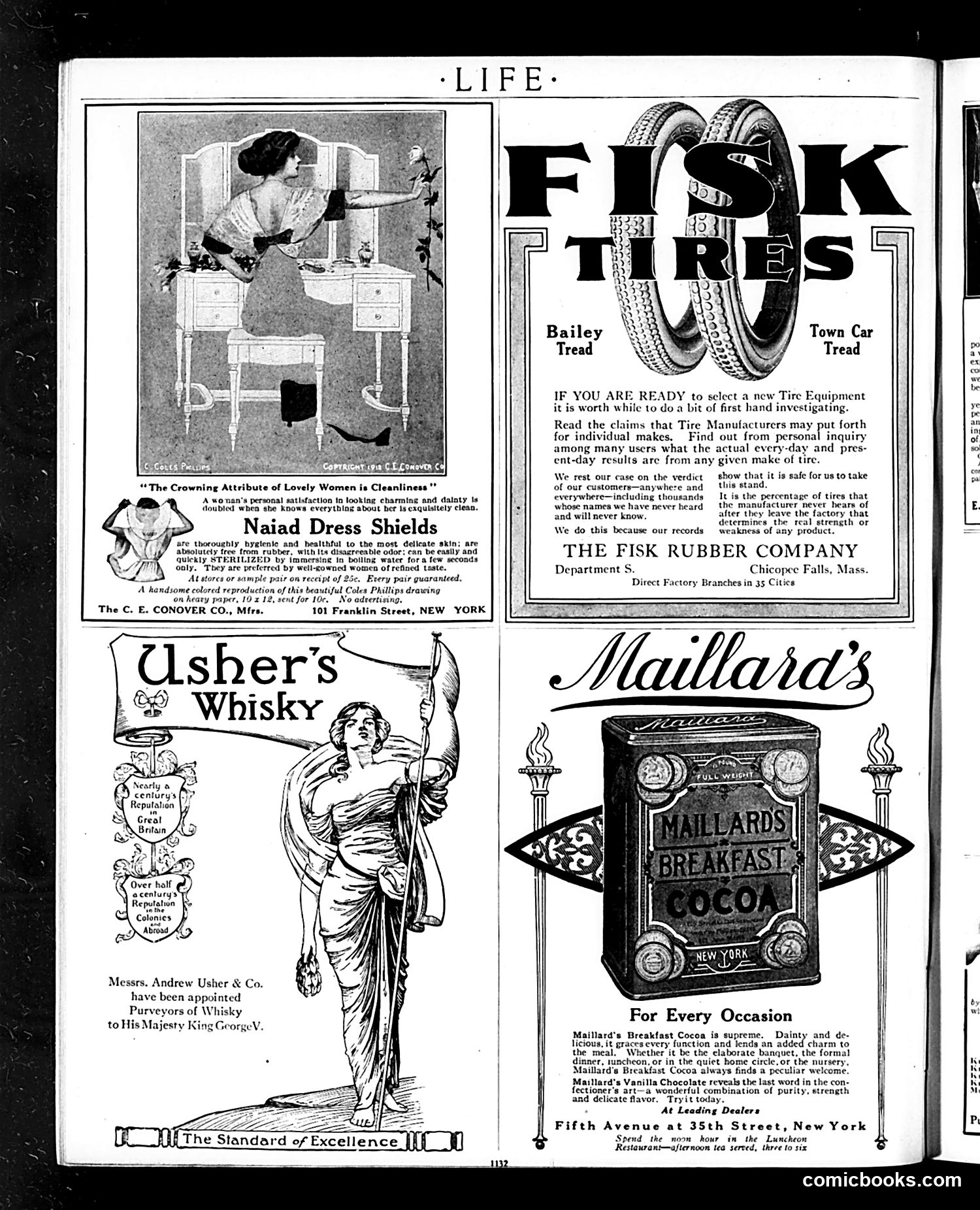
This page is primarily **advertisements** rather than editorial content or political satire. The ads reflect early 20th-century consumer culture and gender norms: **Top left:** Naiad Dress Shields advertises underarm protection, emphasizing that "cleanliness" is women's crowning virtue—a gendered appeal typical of the era. **Top right:** Fisk Tires uses customer testimonials as marketing, positioning reliability as proven by actual users rather than manufacturer claims. **Bottom left:** Usher's Whisky features a classical female figure and notes the brand's appointment as "Purveyor of Whisky to His Majesty King George V"—appealing to prestige and British royal endorsement. **Bottom right:** Maillard's Breakfast Cocoa emphasizes versatility across social occasions, from formal dinners to nurseries, marketing the product as universally appropriate. The page reflects **consumer advertising conventions** of the period, with idealized imagery and appeals to propriety, status, and domestic virtue rather than political satire.
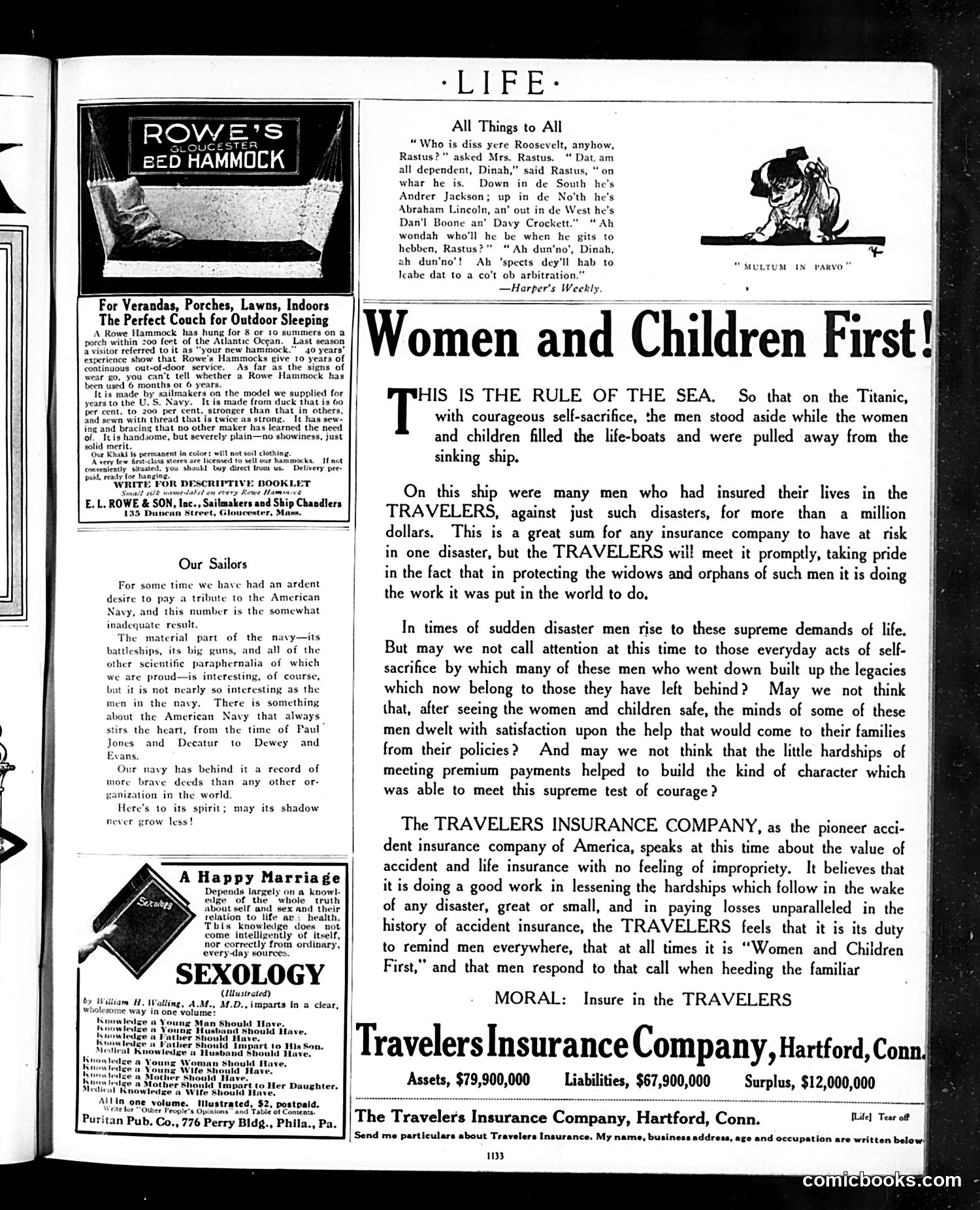
This page is primarily a **Travelers Insurance Company advertisement** capitalizing on the recent Titanic disaster (April 1912). The main content uses the tragedy to promote life insurance, emphasizing that the company will honorably pay out policies to widows and orphans of insured men who perished. The small cartoon labeled **"All Things to All"** satirizes President **Theodore Roosevelt's** political shapeshifting. Two African American characters (rendered in period dialect) discuss how Roosevelt reinvents himself regionally—becoming Andrew Jackson in the South, Abraham Lincoln in the North, and frontier heroes in the West. The joke suggests Roosevelt is all things to all people depending on audience, with the punchline that even arbitration couldn't determine his "true self" in heaven. The advertisement's moral messaging exploits patriotic sentiment around the Titanic's "women and children first" evacuation protocol, framing insurance as duty to families—a shrewd marketing approach to a contemporary tragedy.
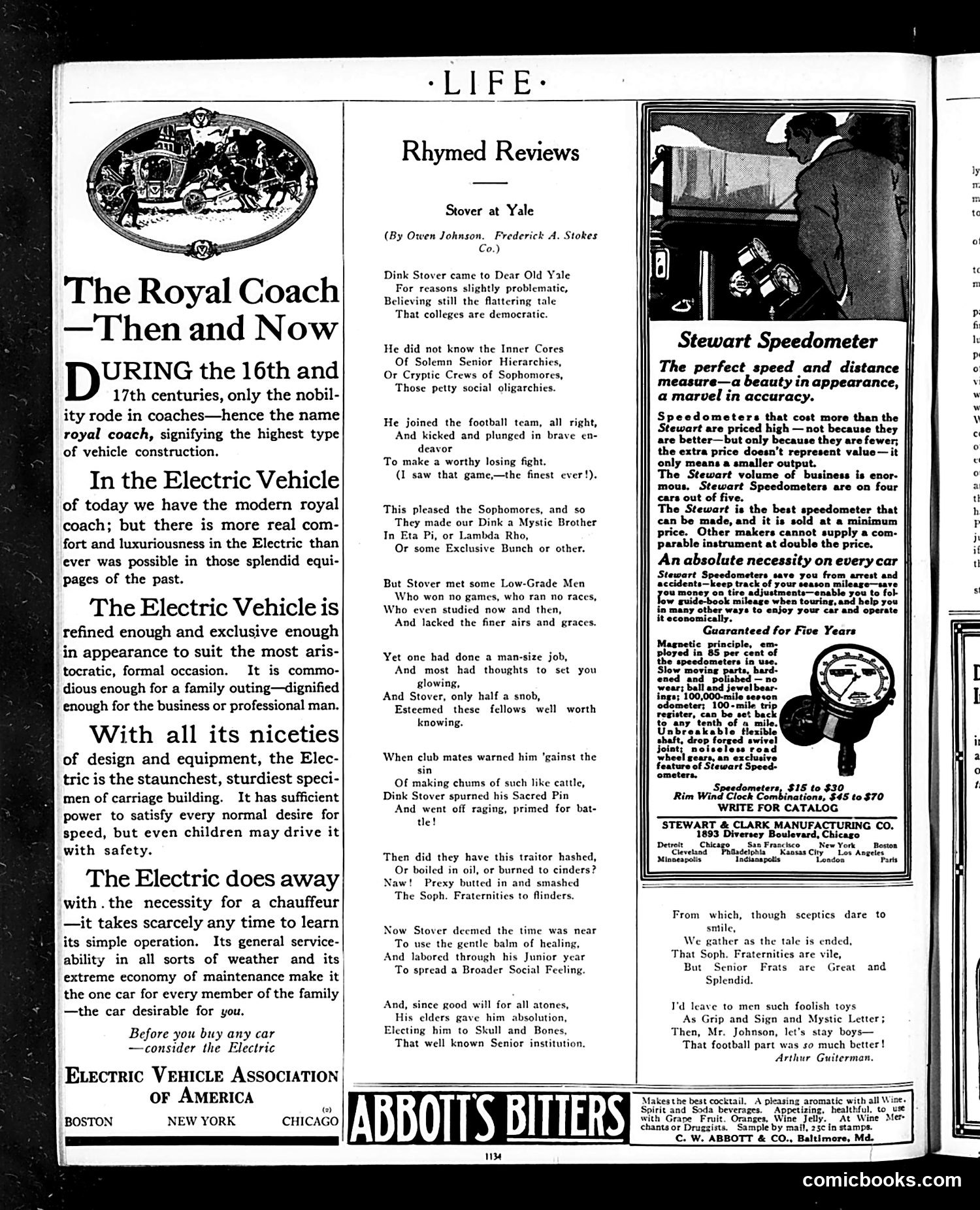
This rhymed review satirizes Owen Johnson's novel about college social hierarchies. The poem mocks Yale's pretense of democracy while describing protagonist Dink Stover's discovery that colleges actually operate as rigid class systems dominated by exclusive fraternities ("Inner Cores," "Cryptic Crews," "Eta Pi, or Lambda Rho"). The satire's point: Stover initially conforms to elite social expectations—joining fraternities and maintaining aristocratic airs—but then befriends intellectually serious "Low-Grade Men" who lack social status. When he breaks his fraternity pin in protest of their snobbery, the college administration (the President) intervenes and crushes the fraternities' power, restoring social equality. The reviewer (Arthur Guiterman, per the signature) presents this ironically—suggesting that genuine merit and "good will" ultimately triumph over superficial social climbing, though the happy ending rings slightly hollow given how much institutional pressure was required to achieve it.
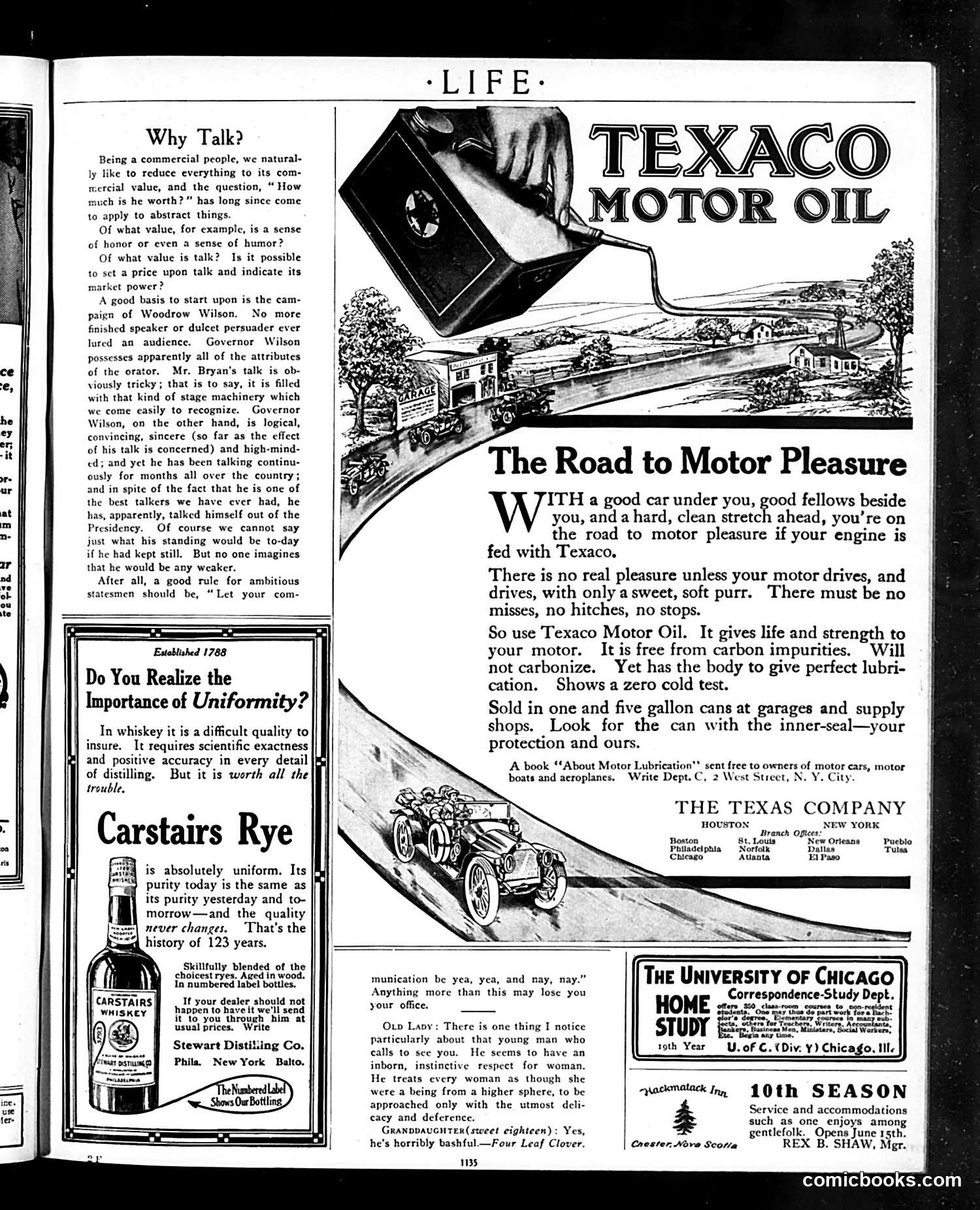
The main article "Why Talk?" critiques Woodrow Wilson's presidency through his relentless public speaking. The satire argues that despite Wilson's superior oratorical abilities—described as "logical, convincing, sincere"—his constant campaigning across the country has paradoxically weakened his political standing rather than strengthened it. The piece ironically concludes that ambitious politicians should follow the rule "Let your communication be yea, yea, and nay, nay"—essentially advising politicians to *speak less* to retain power. This reflects early 1910s frustration with Wilson's verbose leadership style, suggesting that even skilled rhetoric cannot substitute for actual political effectiveness. The satire implies that excessive public persuasion attempts can backfire, making silence a more strategic political tool than eloquence. The remainder of the page consists of period advertisements for Texaco motor oil, Carstairs Rye whiskey, and other services—typical commercial content of *Life* magazine from this era.
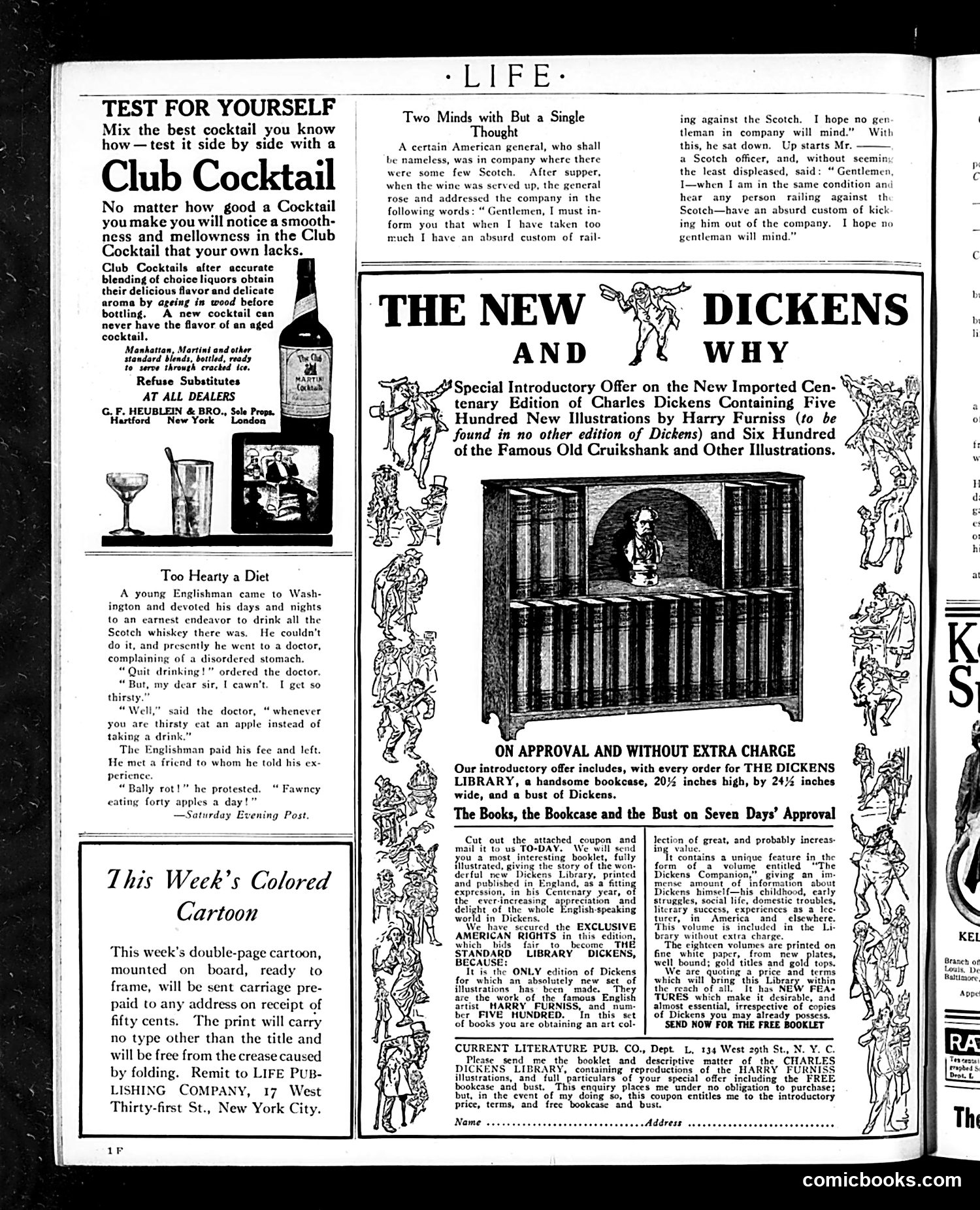
This page consists primarily of **advertisements and humorous anecdotes**, not political cartoons. **The content includes:** 1. **Club Cocktail advertisement** - promoting pre-mixed, aged cocktails as superior to homemade versions 2. **Three brief humorous stories** mocking British and Scottish drinking culture: - A General and Scottish officer trading insults about alcohol-fueled rudeness - An Englishman attempting to drink all Washington's Scotch whiskey, then told by a doctor to eat apples instead—he complains of eating "forty apples a day" - These appear in *Saturday Evening Post* style, playing on period stereotypes of heavy British drinking 3. **Dickens Library promotional offer** - advertising a new centenary edition with 500 new illustrations, available on seven-day approval with a free bookcase and bust The page reflects early 20th-century American attitudes toward British/Scottish excess and drinking customs, presented as lighthearted ethnic humor typical of the era.
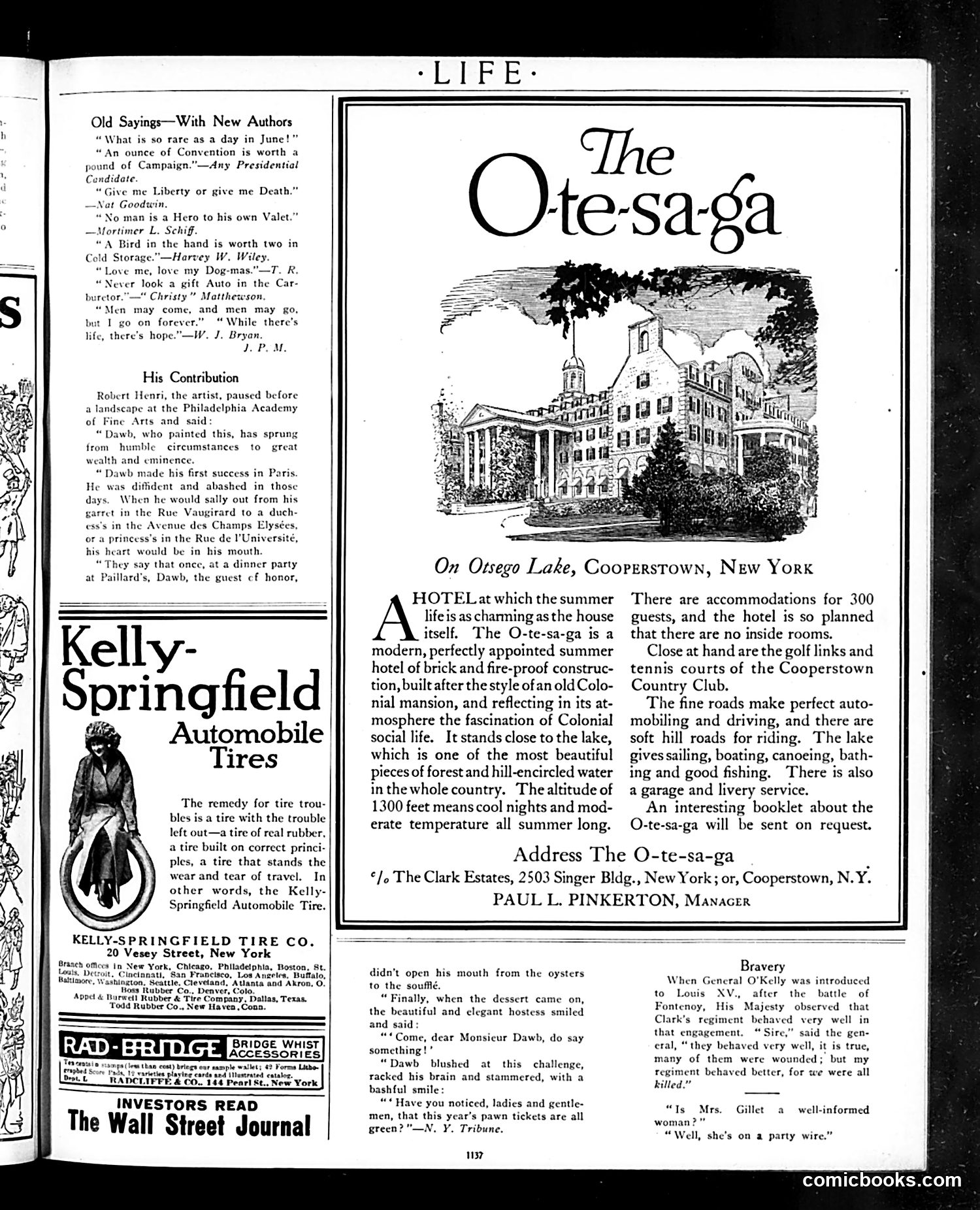
This page combines satirical commentary with advertisements and hotel promotion, typical of Life's mixed format. **"Old Sayings—With New Authors"** is a political satire attributing famous quotations to contemporary figures—likely political candidates and public figures of the era. The joke mocks how politicians adapt or misuse classic phrases. References include a "Presidential Candidate," Nat Goodwin (actor), Mortimer L. Schiff (banker), Harvey W. Wiley (food safety advocate), Theodore Roosevelt ("T.R."), Christy Mathewson (baseball player), and William Jennings Bryan ("W.J. Bryan"). The satire suggests these figures opportunistically invoke noble sentiments for self-promotion. **"His Contribution"** recounts an anecdote about a painter named "Dawb" who, despite achieving success in Paris and becoming wealthy, remains socially awkward. At a formal dinner, when pressed to speak, he absurdly asks about pawn tickets being green—revealing that wealth cannot purchase sophistication or social grace. This satirizes the nouveau riche. The remainder consists of advertisements for Kelly-Springfield tires and the O-te-sa-ga hotel in Cooperstown, New York, plus a brief anecdote about General O'Kelly.
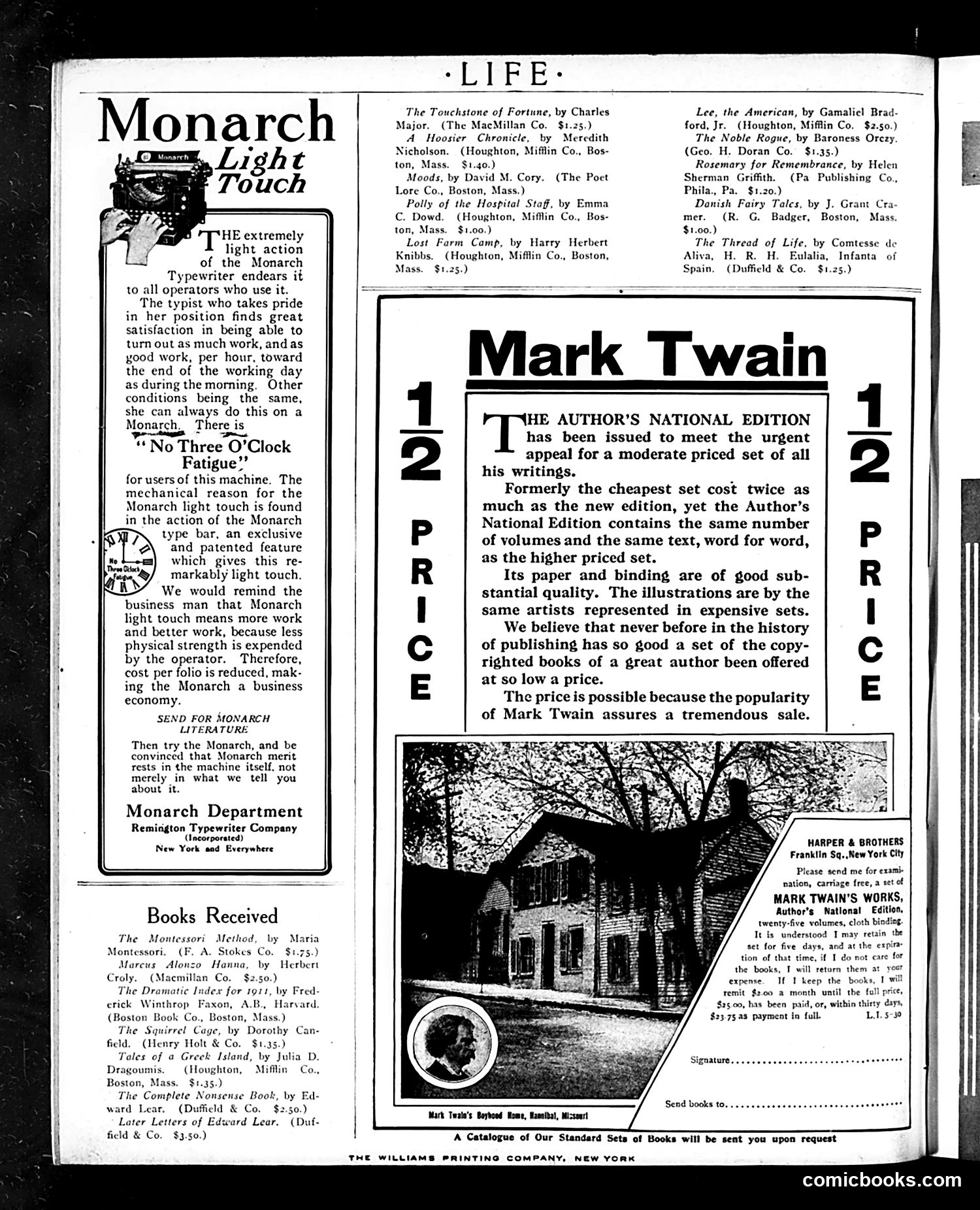
This page is primarily **advertising and book listings**, not political satire. The main content consists of: 1. **Monarch Typewriter advertisement** (left column): Markets the "light touch" feature to typists, emphasizing productivity and reduced physical strain—appealing to female office workers of the era. 2. **Mark Twain's Author's National Edition advertisement** (center/right): Promotes a newly affordable, moderate-priced complete works set. The pitch emphasizes that despite lower cost, it matches the expensive edition in content, paper quality, and illustrations—possible only because Twain's popularity guarantees high sales. 3. **Books Received section** (bottom): A standard literary digest listing recent publications with titles, authors, publishers, and prices. There are **no political cartoons or satirical content** on this page. It represents typical early-20th-century *Life* magazine advertising and book review material.
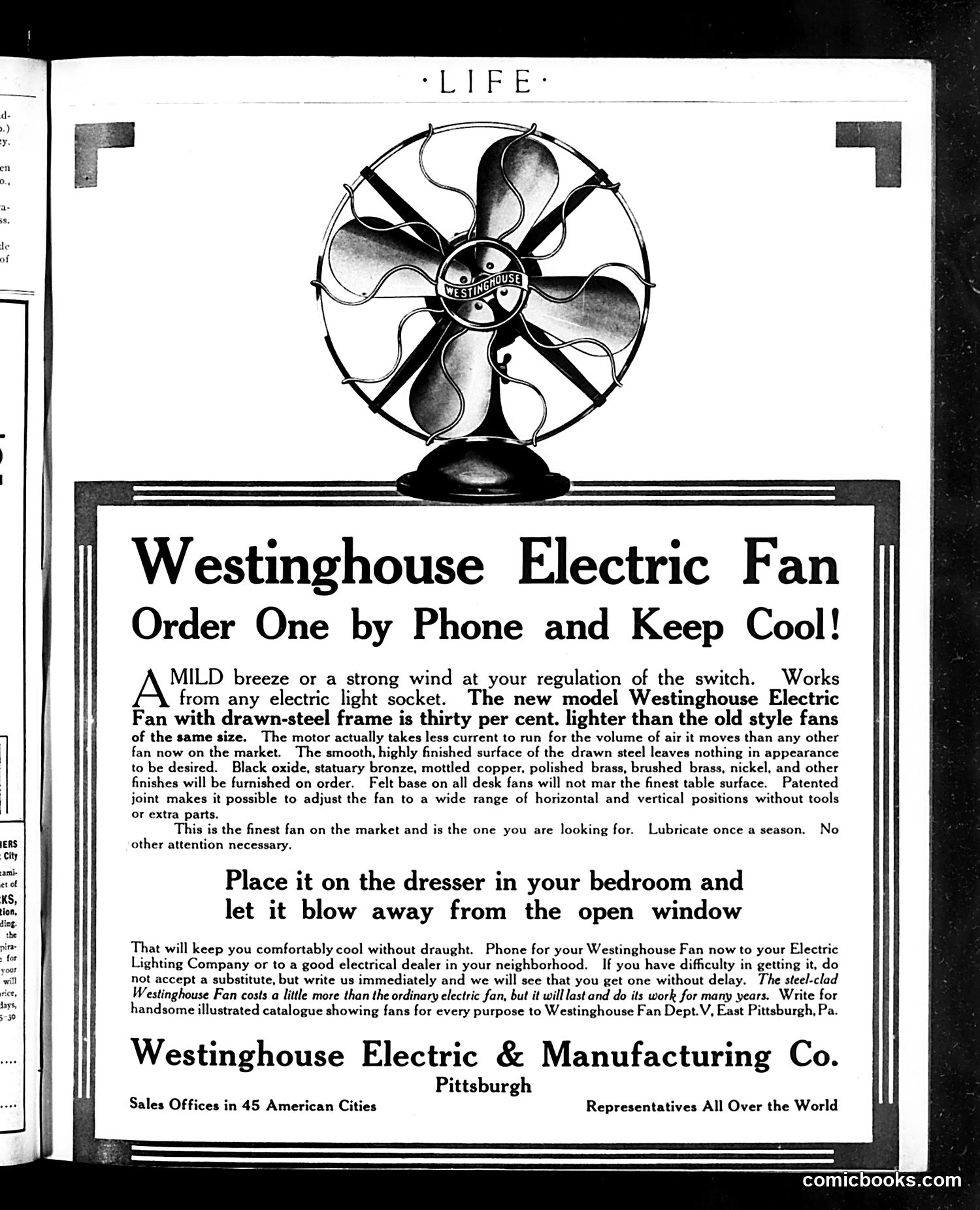
This is a **full-page advertisement**, not satire or editorial content. It promotes the Westinghouse Electric Fan, a new appliance model marketed as superior to competitors. The ad emphasizes technical improvements: the fan is 30% lighter, uses less electricity, and features a durable drawn-steel frame available in multiple finishes (bronze, brass, nickel). The selling point targets early 20th-century consumers without air conditioning—it promises affordable cooling by placing the fan on a bedroom dresser to circulate air from open windows. The language reflects period marketing: "Order One by Phone and Keep Cool!" appeals to modern convenience, while phrases like "finest fan on the market" and assurances about quality ("lubricate once a season") address consumer concerns about durability and maintenance. The illustration shows an ornate pedestal fan typical of the era. This represents Westinghouse's attempt to position electric fans as both functional appliances and attractive home furnishings—a significant selling point when such devices were still relatively new household technology.
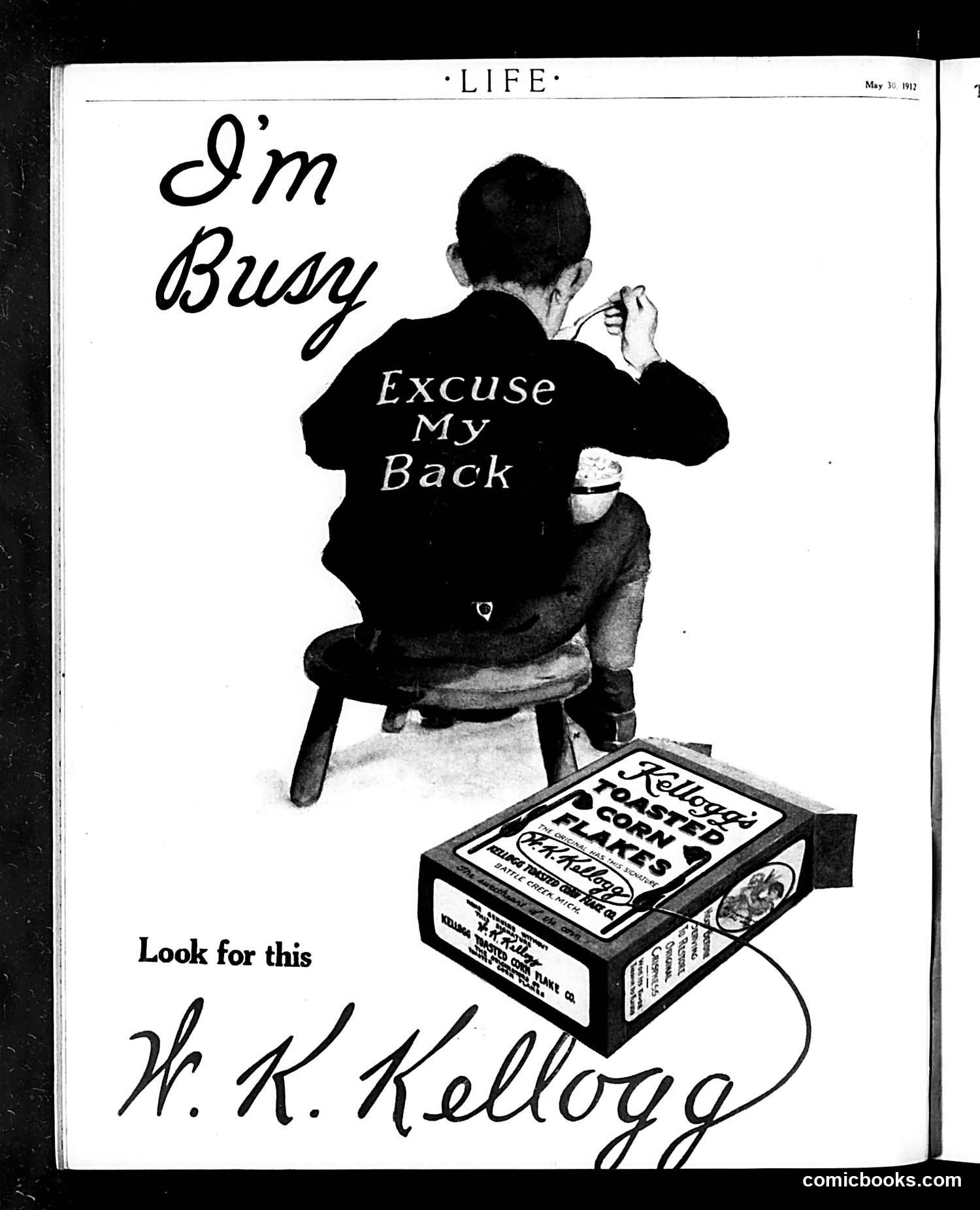
This is a **W.K. Kellogg's cereal advertisement** from *Life* magazine (May 30, 1912), not political satire. The ad features a silhouetted figure seated on a chair, turned away from the viewer, with text reading "I'm Busy—Excuse My Back" overlaid on their jacket. Below sits a Kellogg's Corn Flakes box. The advertisement uses humor to suggest that eating Kellogg's Corn Flakes is so engaging or satisfying that a person would turn their back on other activities—a playful way to tout the product's appeal. The visual pun of literally showing someone's back while making an excuse about being busy creates the joke. This represents early 20th-century advertising's use of witty wordplay and visual humor to promote consumer goods.