
Life, 1912-05-30 · page 8 of 44
Life — May 30, 1912 — page 8: what you’re looking at
What you’re looking at
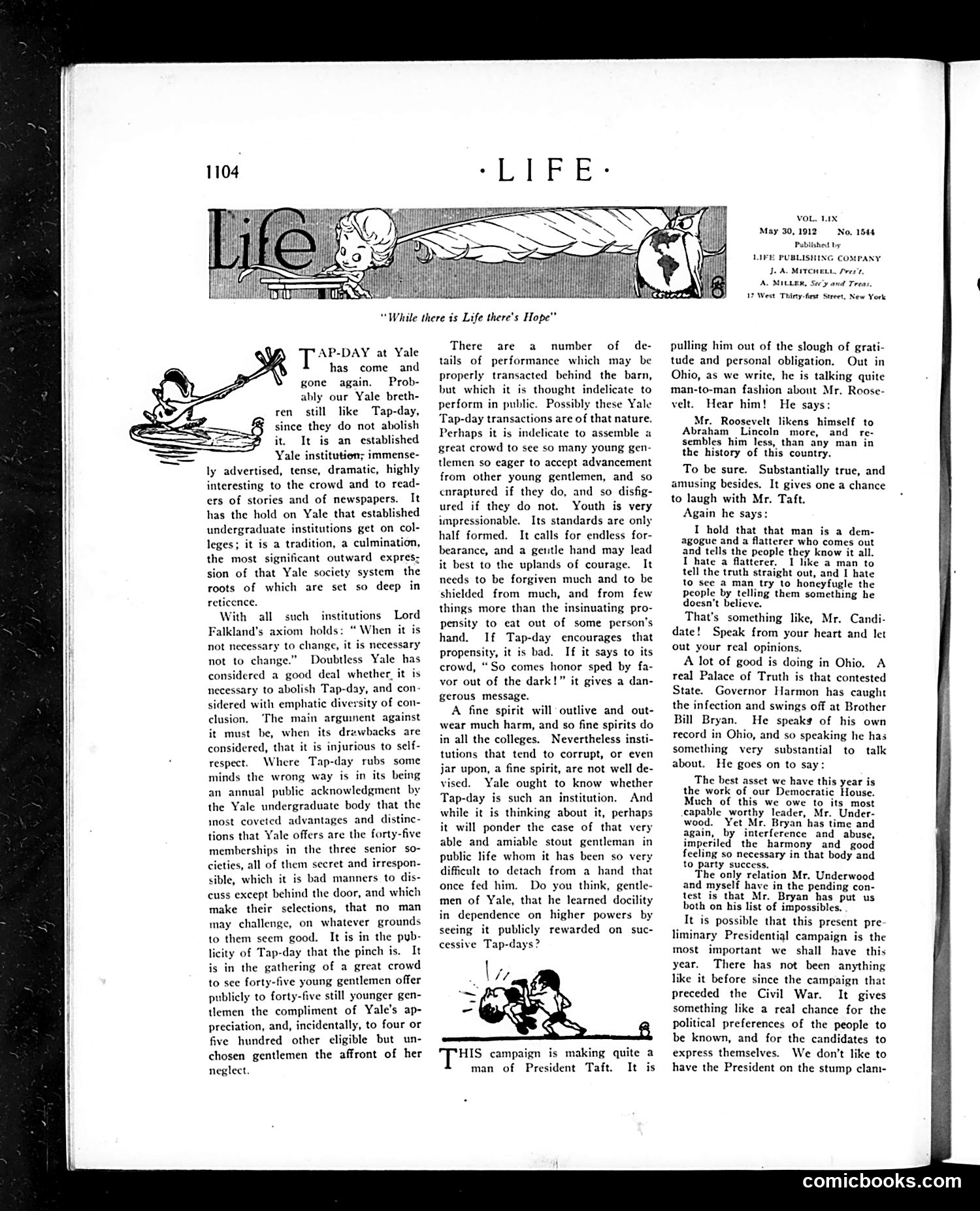
This page contains editorial commentary on Yale University's "Tap-Day" tradition—an annual event where senior societies publicly acknowledge new members. The author critiques whether Tap-Day properly reflects Yale's values, noting it encourages youth to seek public recognition and advancement. The text then shifts to discussing the 1912 presidential campaign, praising Ohio Governor James M. Harmon (identified as "Under" candidate) and criticizing President Taft's campaign activities. The author argues the election offers a genuine opportunity for voters to express political preferences without presidential interference. The small illustrations show casual Yale scenes, likely mocking the pretentious nature of student society rituals. The overall tone satirizes both academic pretension and contemporary political theater.
📄 Transcribed text from this page (OCR, searchable)
Machine-transcribed from the original scan — historical spelling and the odd misread are preserved.
“While there is Life there's Hope” AP-DAY at Yale has come and gone again. Prob- ably our Yale breth- ren still like Tap-day, since they do not abolish it. It is an established Yale institution; immense- ly advertised, tense, dramatic, highly interesting to the crowd and to read- ers of stories and of newspapers. It has the hold on Yale that established undergraduate institutions get on col- leges; it is a tradition, a culmination, the most significant outward expres; sion of that Yale society system the roots of which are set so deep in reticence. With all such institutions Lord Falkland’s axiom holds: “ When it is not necessary to change, it is necessary not to change.” Doubtless Yale has considered a good deal whether, it is necessary to abolish Tap-day, and con sidered with emphatic diversity of con- clusion. The main arguinent against it must be, when its drawbacks are considered, that it is injurious to self- respect. Where Tap-day rubs some minds the wrong way is in its being an annual public acknowledgment by the Yale undergraduate body that the inost coveted advantages and distinc- tions that Yale offers are the forty-five memberships in the three senior so- cicties, all of them secret and irrespon- sible, which it is bad manners to dis- cuss except behind the door, and which make their selections, that no man may challenge, on whatever grounds to them seem good. It is in the pyb- licity of Tap-day that the pinch is. It is in the gathering of a great crowd to see forty-five young gentlemen offer publicly to forty-five still younger gen- tlemen the compliment of Yale's ap- preciation, and, incidentally, to four or five hundred other eligible but un- chosen gentlemen the affront of her neglect. There are a number of de- tails of performance which may be properly transacted behind the barn, but which it is thought indelicate to perform in public. Possibly these Yale Tap-day transactions are of that nature. Perhaps it is indelicate to assemble a great crowd to see so many young gen- tlemen so eager to accept advancement from other young gentlemen, and so enraptured if they do, and so disfig- ured if they do not. Youth is very impressionable. Its standards are only half formed. It calls for endless for- bearance, and a gentle hand may lead it best to the uplands of courage. It needs to be forgiven much and to be shielded from much, and from few things more than the insinuating pro- pensity to eat out of some person’s hand. If Tap-day encourages that propensity, it is bad. If it says to its crowd, “So comes honor sped by fa- vor out of the dark!” it gives a dan- gerous message. A fine spirit will outlive and out- wear much harm, and so fine spirits do in all the colleges. Nevertheless insti- tutions that tend to corrupt, or even jar upon, a fine spirit, are not well de- vised. Yale ought to know whether Tap-day is such an institution. And while it is thinking about it, perhaps it will ponder the case of that very able and amiable stout gentleman in public life whom it has been so very difficult to detach from a hand that once fed him. Do you think, gentle- men of Yale, that he learned docility in dependence on higher powers by seeing it publicly rewarded on suc- cessive Tap-days? HIS campaign is making quite a man of President Taft. It is VoL. 11x May 30, 1912 No, 1544 Publishet by LIFE PUBLISHING COMPANY JA. MiTOHELL. Pres't, A. MILLER, See'y and Treas, 17 West Thiny-first Street, New York pulling him out of the slough of grati- tude and personal obligation. Out in Ohio, as we write, he is talking quite man-to-man fashion about Mr. Roose- velt. Hear him! He says: Mr. Roosevelt likens himself to Abraham Lincoln more, and re- sembles him less, than any man in the history of this country. To be sure. Substantially true, and amusing besides. It gives one a chance to laugh with Mr. Taft. Again he says: I hold that that man is a dem- agogue and a flatterer who comes out and tells the people they know it all. I hate a flatterer. I like a man to tell the truth straight out, and I hate to sce a man try to honeyfugle the people by telling them something he doesn’t believe. That's something like, Mr. Candi- date! Speak from your heart and let out your real opinions. A lot of good is doing in Ohio. A real Palace of Truth is that contested State. Governor Harmon has caught the infection and swings off at Brother Bill Bryan. He speak¢ of his own record in Ohio, and so speaking he has something very substantial to talk about. He goes on to say: The best asset we have this year is the work of our Democratic House. Much of this we owe to its most capable worthy leader, Mr. Under- wood. Yet Mr. Bryan has time and again, by interference and abuse, imperiled the harmony and good feeling so necessary in that body and to party success. The only relation Mr. Underwood and myself have in the pending con- test is that Mr. Bryan has put us both on his list of impossibles. It is possible that this present pre liminary Presidential campaign is the most important we shall have this year. There has not been anything like it before since the campaign that preceded the Civil War. It gives something like a real chance for the political preferences of the people to be known, and for the candidates to express themselves. We don’t like to have the President on the stump clam- comicbooks.com