
Life, 1912-05-30 · page 24 of 44
Life — May 30, 1912 — page 24: what you’re looking at
What you’re looking at
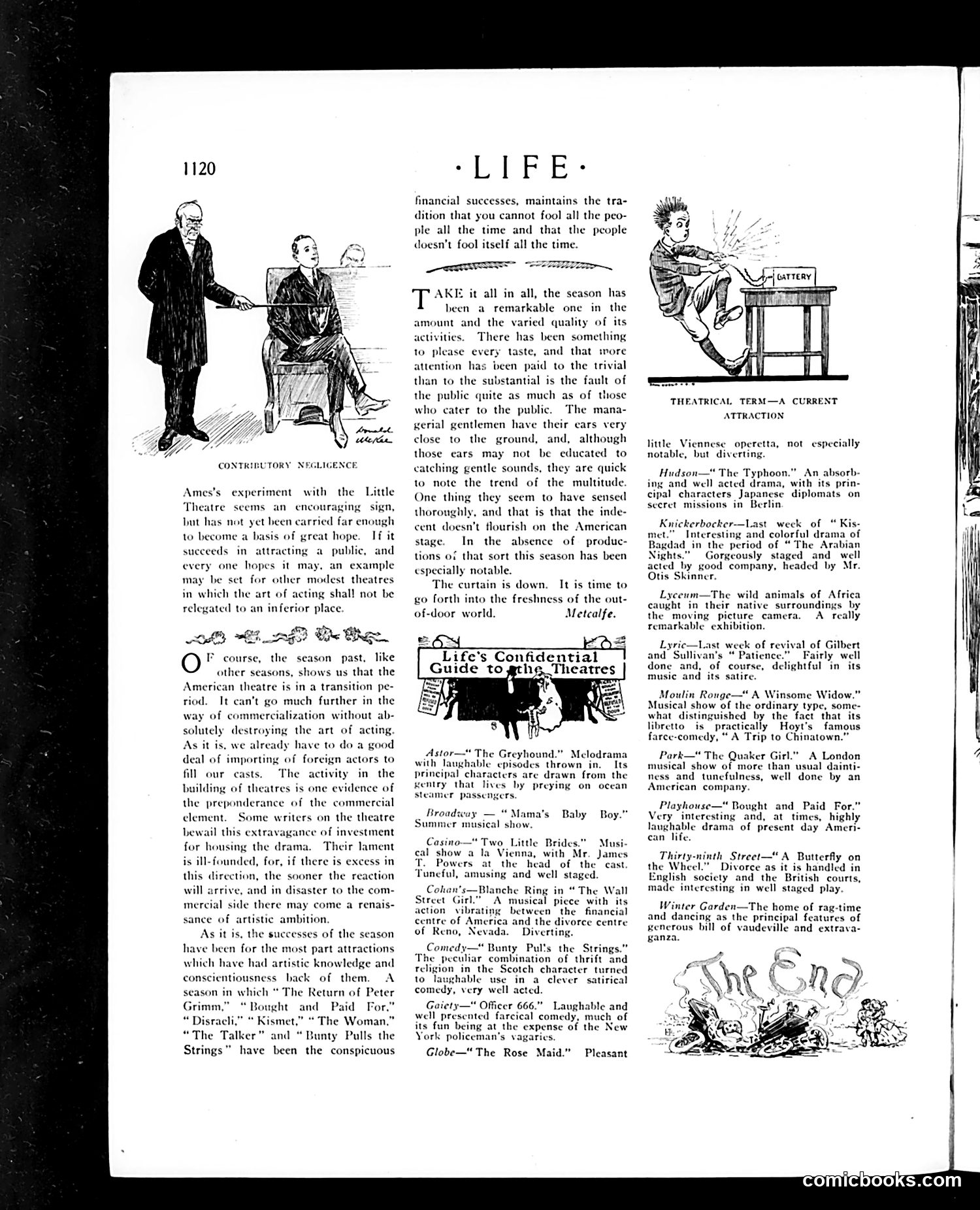
This page from Life magazine contains theatre criticism and reviews, not political cartoons. The main content discusses the American theatrical season, analyzing both its artistic merit and commercial nature. **Key Points:** The left cartoon, "Contributory Negligence," illustrates the theatre world's problem: an older gentleman (likely representing traditional theatre interests) gestures while seated, suggesting how commercial pressures and negligent management undermine serious dramatic art. **Main Argument:** The editorial criticizes American theatre's commercialization, noting it's destroying serious acting. However, it celebrates that successful plays this season—including "Disraeli," "Kismet," and "The Woman"—maintained artistic integrity, proving audiences won't accept mediocre entertainment. **Context for Modern Readers:** This reflects early 20th-century anxiety about art versus profit in entertainment—a tension still relevant today. The "Little Theatre" movement (mentioned as encouraging) represented resistance to Broadway's commercialism, advocating smaller, artistically-focused venues. The theatre listings that follow are straightforward show reviews, mostly light musicals and melodramas popular at the time.
📄 Transcribed text from this page (OCR, searchable)
Machine-transcribed from the original scan — historical spelling and the odd misread are preserved.
CONTRIRUTORY NEGLIGENCE Ames's experiment with the Little Theatre seems raging sign, but has not yet heen carried far enough nen to become a basis of great hope. If it eds in attracting a public, and every one hopes it may, an example may be set for other modest theatres in which the art of acting shall not be relegated to an inferior place. gD Uke Bee. sui O course, the season past, like other seasons, shows us that the American theatre is in a transition pe- riod. It can’t go much further in the way of commercialization without ab- solutely destroying the art of acting. As it is, we already have to do a good deal of importing of foreign actors to fill our casts. The activity in’ the building of theatres is one evidence of the preponderance of the commercial clement. Some writers on the theatre Lewail this extravagance of investment for housing the drama. Their lament is ill-founded, for, if there is excess in this direction, the sooner the reaction will arrive, and in disaster to the com- mercial side there may come a renais- sance of artistic ambition, As it is, the successes of the season have been for the most part attractions which have had artistic knowledge and conscientiousness back of them. A season in which “ The Return of Peter Grimm,” “Bought and Paid) For,” “ Disraeli,” “ Kismet,” “ The Woman,” “The Talker” and “Bunty Pulls the Strings” have been the conspicuous *LIPE: financial successes, maintains the tra- dition that you cannot fool all the peo- ple all the time and that the people doesn’t fool itself all the time. AKE it all in all, the season has been a remarkable one in the amount and the varied quality of its activities. There has been something to please every taste, and that iwore attention has been paid to the trivial than to the substantial is the fault of the public quite as much as of those who cater to the public. The mana- gerial gentlemen have their cars very close to the ground, and, although those ears may not be educated to catching gentle sounds, they are quick to note the trend of the multitude. One thing they seem to have sensed thoroughly, and that is that the inde- cent doesn’t flourish on the American stage. In the absence of produc- tions of that sort this season has been especially notable. The curtain is down. It is time to go forth into the freshness of the out- of-door world. Metcalfe. Life’s Confidential Guide to gthg Theatres Astor—* The Greyhound.” Melodrama with laughable episodes thrown in. Its principal characters are drawn from the kentry that lives by preying on ocean steamer passengers, Broadway — “Mama's Baby Boy.” Summer musical show. Casino—" Two Little Brides.” Mus V show a la Vienna, with Mr. James T. Powers at the head of the’ cast Tuneful, amusing and well staged Cohan's—Blanche Ring in “ The Wall Street Girl.” A musical piece with its action vibrating between the financial centre of America and the divorce centre of Reno, Nevada. Diverting. Comedy— Bunty Pul!s the Strings.” The peculiar combination of thrift and religion in the Scotch character turned to laughable use in a clever satirical comedy, very well acted. Goiety— Officer 666." Laughable and well presented farcical comedy, much of its fun being atthe expense of the York policeman's vagaries, Globe—" The Rose Maid.” Pleasant THEATRICAL TERM—A CURRENT ATTRACTION little Viennese operetta, not especially notable, but diverting. Hudson—" The Typhoon.” An absorb- ing and well acted drama, with its prin- cipal characters Japanese diplomats on seeret missions in Berlin —Last week of “Ki Interesting and colorful drama of d_in the period of “The Arabian Nights.” Gorgcously staged and well acted by good company, headed by Mr: Otis Skinner. Lyceum—The wild animals of Africa caught in their native surroundings by the moving picture camera, A really remarkable exhibition. Lyric—Last week of revival of Gilbert and Sullivan's “ Patience.” Fairly well done and, of course, delightful in its music and its satire. Moulin Rouge— A Winsome Widow.” Musical show of the ordinary type, some- what distinguished by the fact that its libretto is” practically Hoyt’s famous farce-comedy, “A Trip to Chinatown.” Park—" The Quaker Girl." A London musical show of more than usual dainti- ness and tunefulness, well done by an merican company. Playhouse—" Bought and Paid For.” Very interesting and, at times, highly aughable drama of present day’ Ameri- n life. Thirty-ninth Street. the Wheel.” Divorce as it glish society and the Bri made interesting in well sta; Buttery on is handled in Winter Garden—The home of rag and dancing as the principal features of generous bill of vaudeville and extrava- ganza.