
Life, 1912-05-30 · page 21 of 44
Life — May 30, 1912 — page 21: what you’re looking at
What you’re looking at
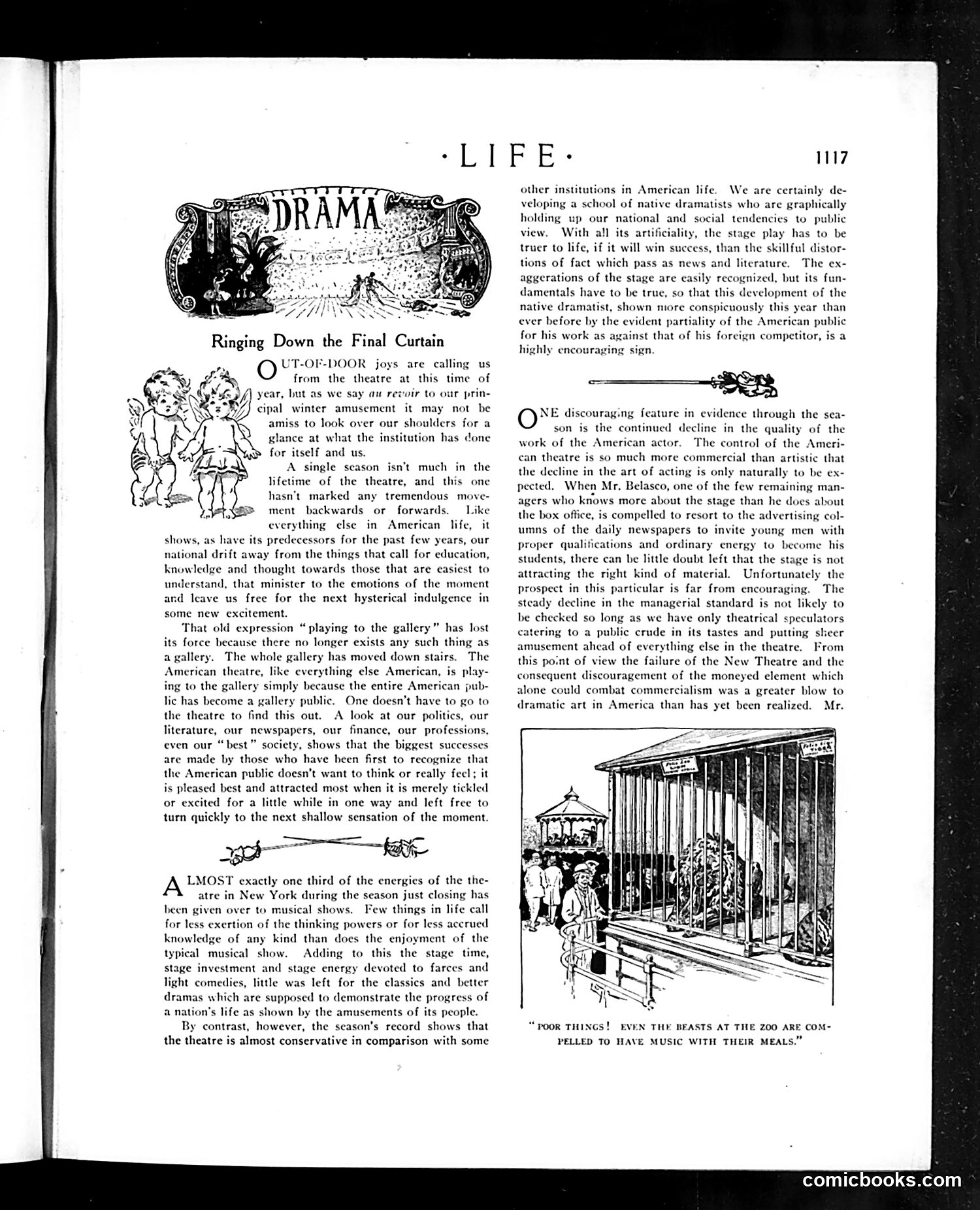
This page critiques the decline of American theater during an unspecified season. The main article, "Ringing Down the Final Curtain," argues that theater—like American culture generally—has abandoned intellectual rigor for shallow entertainment. The author contends that the public no longer distinguishes between "gallery" (cheap seats) and legitimate theater; everyone has become a "gallery public" seeking easy emotional stimulation rather than thought. He notes that one-third of New York theater resources went to musical shows requiring minimal mental engagement. However, the piece offers hope: native American dramatists are gaining prominence over foreign competitors, and American theater remains "almost conservative" compared to other institutions. A secondary complaint addresses the declining quality of American actors, exemplified by David Belasco (a prominent manager) resorting to newspaper advertisements to recruit young talent—suggesting the profession has lost prestige. The zoo cartoon (bottom) appears to mock this situation through absurdist humor.
📄 Transcribed text from this page (OCR, searchable)
Machine-transcribed from the original scan — historical spelling and the odd misread are preserved.
*LIFEs Ringing Down the Final Curtain UT-OF-DOOR joys are calling us from the theatre at this time of year, but as we say au revvir to our prin cipal winter amusement it may not be amiss to look over our shoulders for a glance at what the institution has done for itself and us. A single scason isn’t much in the lifetime of the theatre, and this one hasn't marked any tremendous move- ment backwards or forwards. Like everything else in American life, it shows, as have its predecessors for the past few years, our national drift away from the things that call for education, knowledge and thought towards those that are easiest to understand, that minister to the emotions of the moment and leave us free for the next hysterical indulgence in some new excitement. That old expression “ playing to the gallery” has lost its force because there no longer exists any such thing as agallery. The whole gallery has moved down stairs. The American theatre, like everything else American, is play- ing to the gallery simply because the entire American pub- lic has become a gallery public. One doesn’t have to go to the theatre to find this out. A look at our politics, our literature, our newspapers, our finance, our professions, even our “best” society, shows that the biggest succe: are made by those who have been first to recognize that the American public doesn’t want to think or really feel; it is pleased best and attracted most when it is merely tickled or excited for a little while in one way and left free to turn quickly to the next shallow sensation of the moment. A EMOST exactly one third of the energies of the the- atre in New York during the season just closing has ‘ew things in life call heen given over to musical shows. for less exertion of the thinking powers or for less accrued knowledge of any kind than does the enjoyment of the typical musical show. Adding to this the stage time, stage investment and stage energy devoted to farces and light comedies, little was left for the classics and better dramas which are supposed to demonstrate the progress of a nation’s life as shown by the amusements of its people. By contrast, however, the season’s record shows that the theatre is almost conservative in comparison with some W117 other institutions in American life. We are certainly de- veloping a school of native dramatists who are graphically holding up our national and social tendencies to public view. With all its artificiality, the stage play has to be truer to life, if it will win success, than the skillful distor- tions of fact which pass as news and literature. The ex- aggerations of the stage are easily recognized, but its fun- damentals have to be true, so that this development of the native dramatist, shown more conspicuously this year than ever before by the evident partiality of the American public for his work as against that of his foreign competitor, is a highly encouraging sign. ——es NE discouraging feature in evidence through the sea- son is the continued decline in the quality of the work of the American actor. The control of the Ameri- can theatre is so much more commercial than artistic that the decline in the art of acting is only naturally to be ex- pected. When Mr, Belasco, one of the few remaining man- agers who knows more about the stage than he does about the box office, is compelled to resort to the advertising col- umns of the daily newspapers to invite young men with per qualifications and ordinary energy to become his students, there can be little doubt left that the stage is not attracting the right kind of material. Unfortunately the prospect in this particular is far from encouraging. The steady decline in the managerial standard is not likely to be checked so long as we have only theatrical speculators catering to a public crude in its tastes and putting sheer amusement ahead of everything else in the theatre. From this pownt of view the failure of the New Theatre and the consequent discouragement of the moneyed element which alone could combat commercialism was a greater blow to dramatic art in America than has yet been realized. Mr. — pa > aE: pareT LT “POOR THINGS! EVEN THE BEASTS AT THE Z00 ARE COM- PELLED TO HAVE MUSIC WITH THEIR MEALS.’ comicbooks.com