
Life, 1912-05-30 · page 17 of 44
Life — May 30, 1912 — page 17: what you’re looking at
What you’re looking at
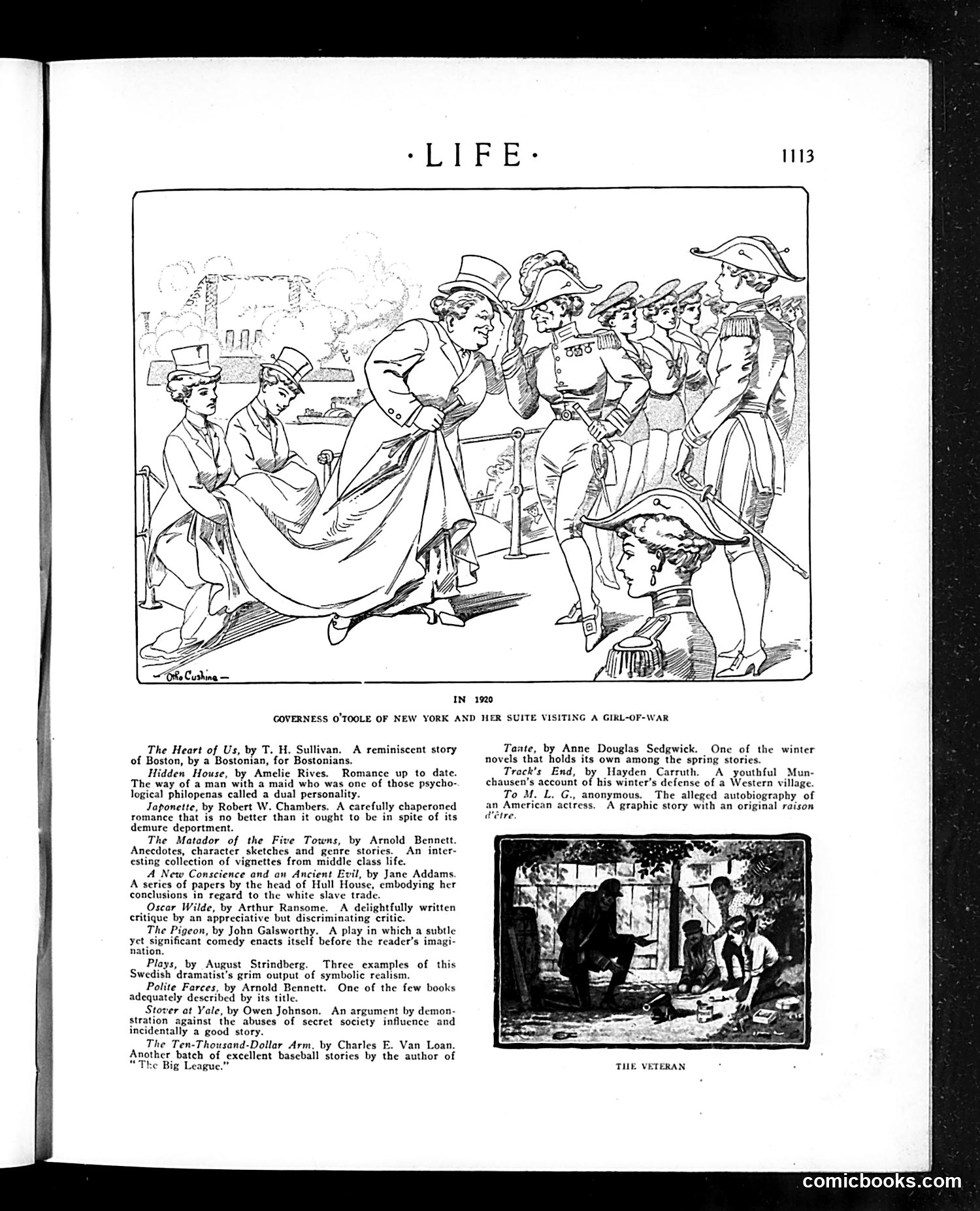
The main cartoon depicts "Governess O'Toole of New York and Her Suite Visiting a Girl-of-War" (a warship). The joke satirizes the contrast between an Irish-American working-class governess (identified by her name and modest dress) and her entourage, who are being received with full military ceremony by uniformed officers. The satire mocks the absurdity of treating a domestic servant with the pomp normally reserved for dignitaries or nobility. This likely reflects post-WWI social commentary on class disruption—perhaps referencing how wartime labor shortages elevated working-class women's status, or satirizing newfound wealth among Irish-Americans. The "suite" accompanying her suggests pretension to high society, which clashes amusingly with her humble occupation. The cartoon's humor depends on recognizing the incongruity between O'Toole's actual social position and the formal respect being shown.
📄 Transcribed text from this page (OCR, searchable)
Machine-transcribed from the original scan — historical spelling and the odd misread are preserved.
SY Ee Cushing — IN 1920 GOVERNESS O'TOOLE OF NEW YORK AND HER SUITE VISITING A GIRL-OF-WAR The Heart of Us, by T. H. Sullivan. A reminiscent story Tante, by Anne Douglas Sedgwick. One of the winter of Boston, by a Bostonian, for Bostonians. novels that holds its own among the spring stories. Hidden House, by Amelie Rives. Romance up to date. Track'’s End, by Wayden Carruth. A youthful Mun- The way of a man with a maid who was one of those psycho- chausen’s account of his winter’s defense of a Western village. logical philopenas called a dual personality. To M. L. G., anonymous. The alleged autobiography of Japonette, by Robert W. Chambers. A carefully chaperoned an American actress. A graphic story with an original raison romance that is no better than it ought to be in spite of its demure deportment. The Matador of the Five Towns, by Arnold Bennett. Anecdotes, character sketches and genre stories. An inter- esting collection of vignettes from middle class life. A New Conscience and an Ancient Evil, by Jane Addams. A series of papers by the head of Hull House, embodying her conclusions in regard to the white slave trad Oscar Wilde, by Arthur Ransome. A delightfully written critique by an appreciative but discriminating critic. The Pigeon, by John Galsworthy. A play in which a subtle (Significant comedy enacts itself before the reader’s imagi- ion. Plays, by August Strindberg. Three examples of this Swedish ‘dramatist's grim output of symbolic realism. Polite Farces, by Arnold Bennett. One of the few books adequately described by its title. Stover at Yale, by Owen Johnson. An argument by demon- stration against the abuses of secret society influence and incidentally a good story. The Ten-Thousand-Dollar Arm, by Charles E. Van Loan, Another batch of excellent baseball stories by the author of “The Big League.” THE VETERAN comicbooks.com