
Life, 1912-05-30 · page 16 of 44
Life — May 30, 1912 — page 16: what you’re looking at
What you’re looking at
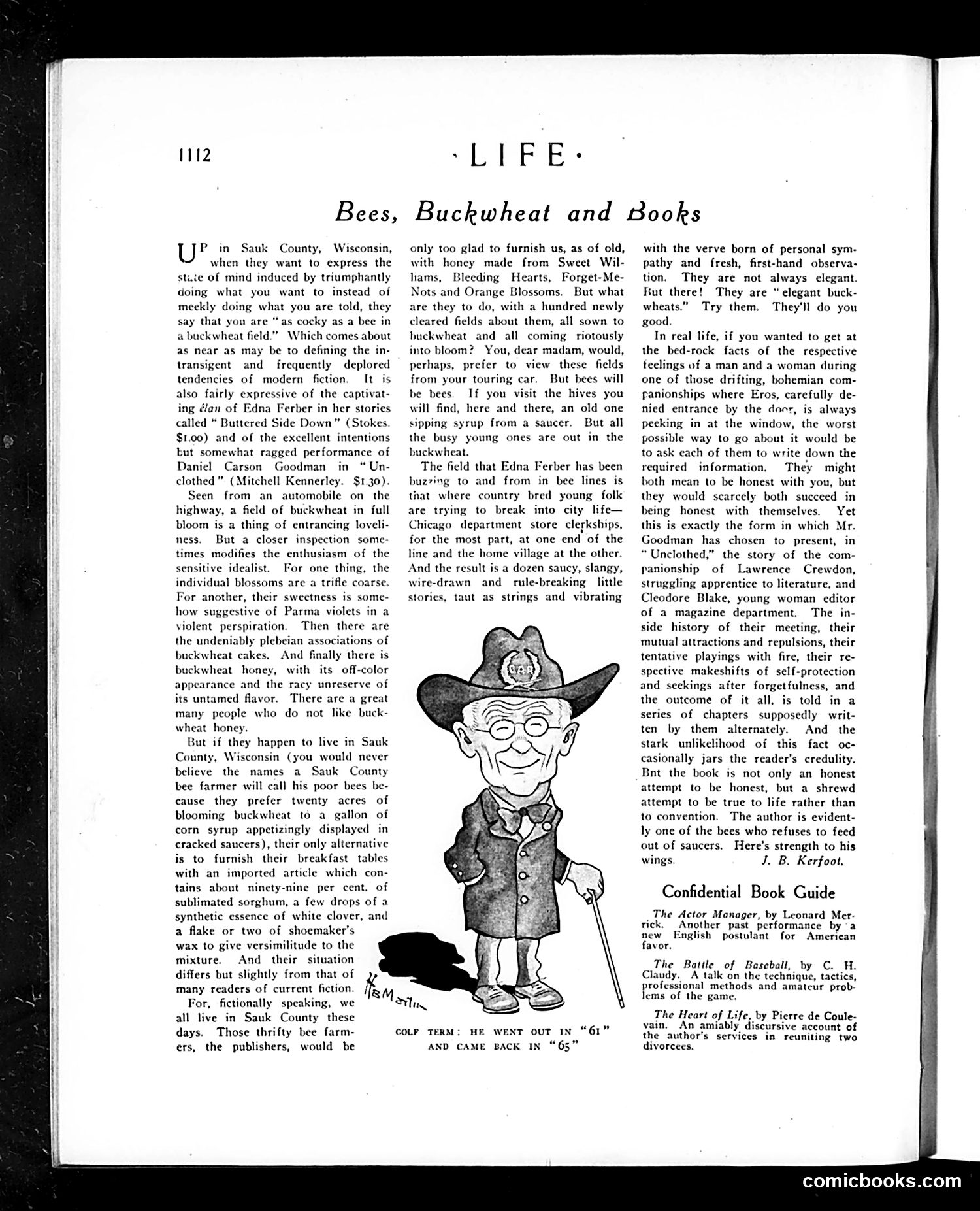
This page reviews two books by contemporary authors: Edna Ferber's *Buttered Side Down* and Daniel Carson Goodman's *Unclothed*. The critic uses an extended metaphor comparing modern fiction to buckwheat—initially attractive but crude upon closer inspection. The cartoon depicts a cheerful bee farmer (likely representing Edna Ferber or the publishing industry generally). The caption "He went out in '61 and came back in '65" is a golf joke: a poor golfer's score, suggesting time wasted. The satire argues that publishers, like Wisconsin bee farmers preferring abundant buckwheat to fine flowers, settle for commercially viable but artistically inferior "new fiction" rather than classic romantic literature. Ferber's stories about country folk seeking city life are dismissed as "saucy, slangy" and inelegant—mere "buckwheat" rather than refined literary honey. The reviewer acknowledges their energy and honesty but questions their artistic merit.
📄 Transcribed text from this page (OCR, searchable)
Machine-transcribed from the original scan — historical spelling and the odd misread are preserved.
«LIFE = Bees, Buckwheat and Books UP in Sauk County, Wisconsin, when they want to express the staie of mind induced by triumphantly doing what you want to instead of meekly doing what you are told, they say that you are “as cocky as a bee in a buckwheat field.”. Which comes about as near as may be to defining the in- transigent and frequently deplored tendencies of modern fiction. It is also fairly expressive of the captivat- ing élan of Edna Ferber in her stories called “ Buttered Side Down” (Stokes. $1.00) and of the excellent intentions but somewhat ragged performance of Daniel Carson Goodman in “ Un- clothed” (Mitchell Kennerley. $1.30). Seen from an automobile on the highway, a field of buckwheat in full bloom is a thing of entrancing loveli- ness. But a closer inspection some- times modifies the enthusiasm of the ve idealist. For one thing, the individual blossoms are a trifle coarse. For another, their sweetness is some- how suggestive of Parma violets in a violent perspiration. Then there are the undeniably plebeian associations of buckwheat cak: And finally there is buckwheat honey, with its off-color appearance and the racy unreserve of its untamed flavor. There are a great many people who do not like buck- wheat honey. But if they happen to live in Sauk County, Wisconsin (you would never believe the names a Sauk County bee farmer will call his poor bees be- cause they prefer twenty acres of blooming buckwheat to a gallon of corn syrup appetizingly displayed in cracked saucers), their only alternative is to furnish their breakfast tables with an imported article which con- tains about ninety-nine per cent. of sublimated sorghum, a few drops of a synthetic essence of white clover, and a flake or two of shoemaker’s wax to give versimilitude to the mixture. And their situation differs but slightly from that of many readers of current fiction. For, fictionally speaking, we all live in Sauk County these days. Those thrifty bee farm- ers, the publishers, would be only too glad to furnish us, as of old, with honey made from Sweet Wil- liams, Bleeding Hearts, Forget-Me- Nots and Orange Blossoms. But what are they to do, with a hundred newly cleared fields about them, all sown to buckwheat and all coming riotously into bloom? You, dear madam, would, perhaps, prefer to view these fields from your touring car. But bees will be be If you visit the hives you will find, here and there, an old one sipping syrup from a saucer. But all the busy young ones are out in the buckwheat. The field that Edna Ferber has been buz7ing to and from in bee lines is that where country bred young folk are trying to break into city life— Chicago department store clerkships, for the most part, at one end of the line and the home village at the other. And the result is a dozen saucy, slangy, wire-drawn and rule-breaking little stories, taut as strings and vibrating Mastin “61” WENT OUT BACK IN GOLF TERM: HE AND CAME with the verve born of personal sym- pathy and fresh, first-hand observa- tion, They are not always elegant. But there! They are “elegant buck- wheats.” good. In real life, if you wanted to get at the bed-rock facts of the respective feelings of a man and a woman during one of those drifting, bohemian com- fanionships where Eros, carefully de- nied entrance by the door, is always pecking in at the window, the worst possible way to go about it would be to ask each of them to write down the required information, They might both mean to be honest with you, but they would scarcely both succeed in being honest with themselves. Yet this is exactly the form in which Mr. Goodman has chosen to present, in “Unclothed,” the story of the com- panionship of Lawrence Crewdon, struggling apprentice to literature, and Cleodore Blake, young woman editor of a magazine department. The in- side history of their meeting, their mutual attractions and repulsions, their tentative playings with fire, their re- spective makeshifts of self-protection and seckings after forgetfulness, and the outcome of it all, is told in a series of chapters supposedly writ- ten by them alternately. And the stark unlikelihood of this fact oc- casionally jars the reader’s credulity. Bnt the book is not only an honest attempt to be honest, but a shrewd attempt to be true to life rather than to convention. The author is evident- ly one of the bees who refuses to feed out of saucers. Here's strength to his wings. J. B. Kerfoot. Confidential Book Guide The Actor Manager, by Leonard Mer- rick. ‘Another past performance by a new English postulant for American favor. The Battle of Baseball, by C. H. Claudy. A talk on the technique, tactics, professional methods and amateur prob- lems of the game. The Heart of Life, by Pierre de Coule- vain, An amiably discursive account of the author's services in reuniting two divorcee Try them. They'll do you comicbooks.com