
Life, 1912-05-30 · page 18 of 44
Life — May 30, 1912 — page 18: what you’re looking at
What you’re looking at
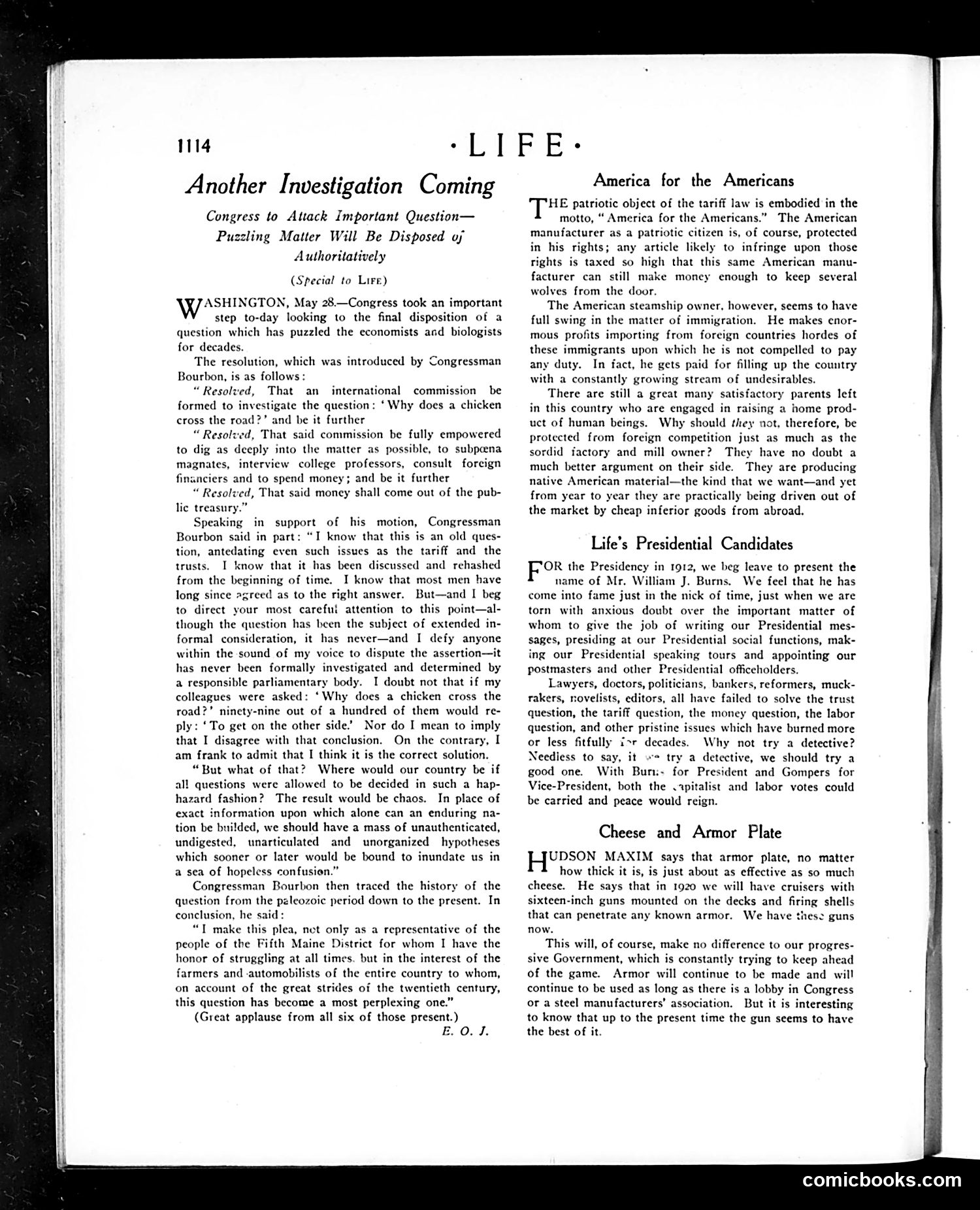
This page satirizes government inefficiency through two pieces: **"Another Investigation Coming"** mocks Congress's tendency to over-investigate trivial matters with absurd bureaucratic formality. Congressman Bourbon proposes an international commission to "scientifically" determine why a chicken crosses the road—a joke question everyone already knows the answer to ("to get on the other side"). The satire ridicules how Congress wastes public money conducting formal investigations into settled questions while ignoring genuinely important issues like the tariff and trusts. The phrase "Great applause from all six of those present" emphasizes the futility—only six congressmen attend. **"America for the Americans"** critiques hypocrisy in protectionist tariff policy. While American manufacturers are heavily protected with tariffs against foreign goods, American steamship owners profit enormously by importing cheap immigrant labor without tariffs or restrictions. The satire highlights the double standard: protective barriers shield goods but not workers, allowing exploitation of immigration for corporate profit while claiming patriotic "America First" principles. Both pieces target government corruption and inconsistency in early 20th-century American policy.
📄 Transcribed text from this page (OCR, searchable)
Machine-transcribed from the original scan — historical spelling and the odd misread are preserved.
1114 Another Investigation Coming Congress to Attack Important Question— Puzzling Matter Will Be Disposed of Authoritatively (Special to Lire) SHINGTON, May 28.—Congress took an important step to-day looking to the final disposition of a question which has puzzled the economists and biologists for decades The resolution, which was introduced by Congressman Bourbon, is as follows: “Resolved, That an international commission be formed to investigate the question: ‘Why does a chicken cross the road?’ and be it further “ Resolved, That said commission be fully empowered to dig as deeply into the matter as possible, to subpana magnates, interview college professors, consult forcign financiers and to spend money; and be it further “ Resolved, That said money shall come out of the pub- lic treasury. Speaking in support of his motion, Congressman Bourbon said in part: “I know that this is an old ques- tion, antedating even such issues as the tariff and the trusts. know that it has been discussed and rehashed from the beginning of time. I know that most men have long since agreed as to the right answer. But—and I beg to direct your most careful attention to this point—al- though the question has been the subject of extended in- formal consideration, it has never—and I defy anyone within the sound of my voice to dispute the assertion—it has never been formally investigated and determined by a responsible parliamentary body. I doubt not that if my colleagues were asked: ‘Why does a chicken cross the road?’ ninety-nine out of a hundred of them would re- ply: ‘To get on the other side.” Nor do I mean to imply that I disagree with that conclusion. On the contrary, I am frank to admit that I think it is the correct solution. “But what of that?) Where would our country be if all questions were allowed to be decided in such a hap- hazard fashion? The result would be chaos. In place of exact information upon which alone can an enduring na- tion be builded, we should have a mass of unauthenticated, undigested, unarticulated and unorganized hypotheses which sooner or later would be bound to inundate us in a sea of hopeless confusion.” Congressman Bourbon then traced the history of the question from the paleozoic period down to the present. In conclusion, he said: “T make this plea, net only as a representative of the people of the Fifth Maine District for whom I have the honor of struggling at all times. but in the interest of the farmers and automobilists of the entire country to whom, on account of the great strides of the twentieth century, this question has become a most perplexing one.” (Great applause from all six of those present.) E.0. J. *LTPE> America for the Americans HE patriotic object of the tariff law is embodied in the motto, “ America for the Americans.” The American manufacturer as a patriotic citizen is, of course, protected in his rights; any article likely to infringe upon those rights is taxed so high that this same American manu- facturer can still make money enough to keep several wolves from the door. The American steamship owner, however, seems to have full swing in the matter of immigration. He makes enor- mous profits importing from foreign countries hordes of these immigrants upon which he is not compelled to pay any duty. In fact, he gets paid for filling up the country with a constantly growing stream of undesirables. There are still a great many satisfactory parents left in this country who are engaged in raising a home prod- uct of human beings. Why should they not, therefore, be protected from foreign competition just much as the sordid factory and mill owner? They have no doubt a much better argument on their side. They are producing native American material—the kind that we want—and yet from year to year they are practically being driven out of the market by cheap inferior goods from abroad. Life’s Presidential Candidates ‘OR the Presidency in 1912, we beg leave to present the name of Mr, William J. Burns. We feel that he has come into fame just in the nick of time, just when we are torn with anxious doubt over the important matter of whom to give the job of writing our Presidential mes- sages, presiding at our Presidential social functions, mak- ing our Presidential speaking tours and appointing our postmasters and other Presidential officeholders. Lawyers, doctors, politicians, bankers, reformers, muck- rakers, novelists, editors, all have failed to solve the trust question, the tariff question, the money question, the labor question, and other pristine issues which have burned more or less fitfully i>r decades. Why not try a detective? Needless to say, it »* try a detective, we should try a good one. With Bur:- for President and Gompers for Vice-President, both the .apitalist and labor votes could be carried and peace would reign. Cheese and Armor Plate UDSON MAXIM says that armor plate, no matter how thick it is, is just about as effective as so much cheese. He says that in 1920 we will have cruisers with sixteen-inch guns mounted on the decks and firing shells that can penetrate any known armor. We have these guns now. This will, of course, make no difference to our progres- sive Government, which is constantly trying to keep ahead of the game. Armor will continue to be made and will continue to be used as long as there is a lobby in Congress or a steel manufacturers’ association. But it is interesting to know that up to the present time the gun seems to have the best of it. comicbooks.com