
A complete issue · 44 pages · 1912
Life — May 23, 1912
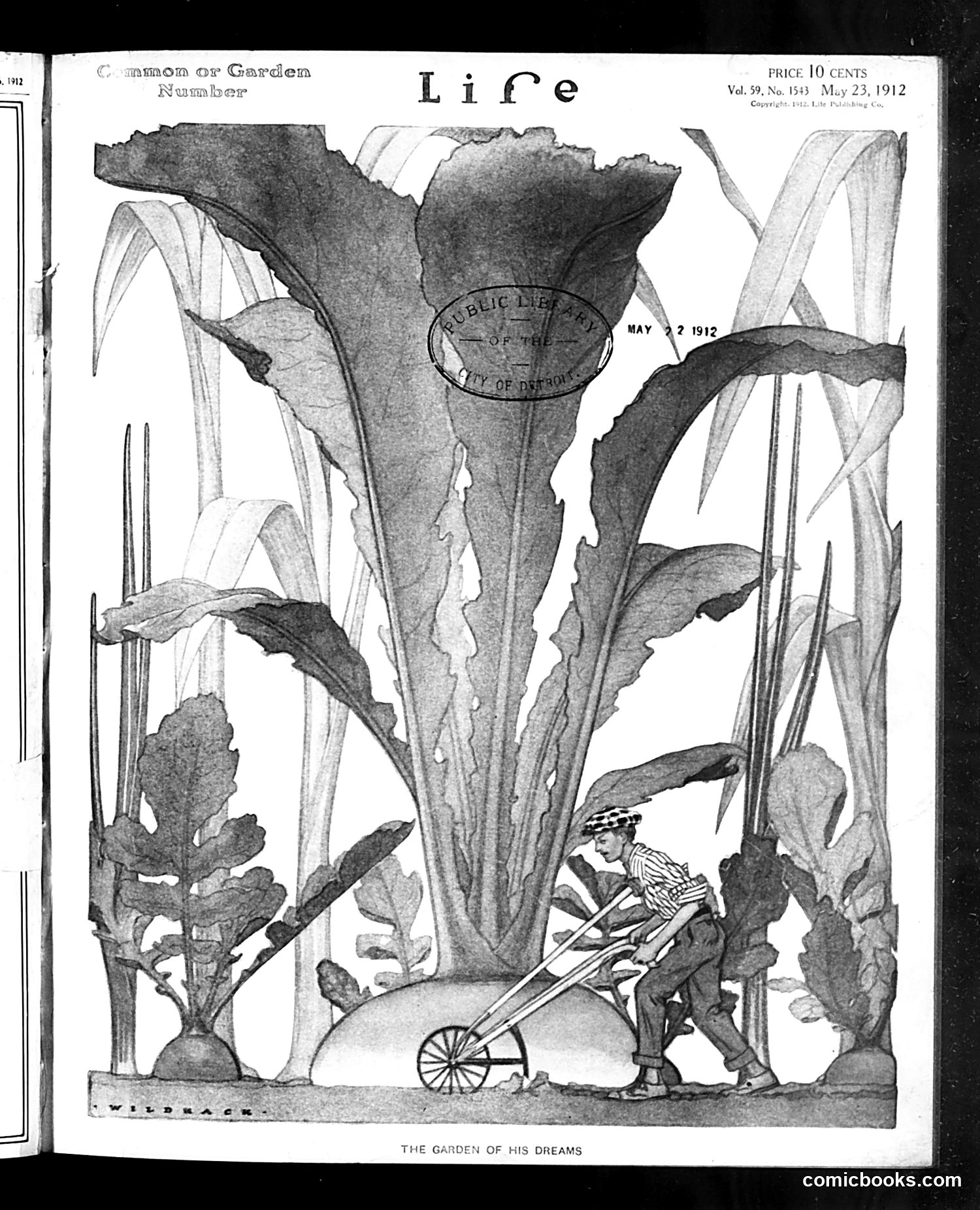
This 1912 *Life* magazine cover depicts a man with a wheelbarrow tending an enormous garden of giant vegetables and plants. The title "The Garden of His Dreams" presents an optimistic, almost fantastical vision of agricultural abundance. The cartoon likely satirizes American enthusiasm for progressive-era agricultural reform and scientific farming. The dramatically oversized produce suggests either aspirational dreams about modern farming's potential or, possibly, skepticism about exaggerated claims regarding agricultural innovation and yields. The gardener's modest scale compared to the massive plants emphasizes either human ambition or the gap between farming reality and idealistic promises. Without clearer context about specific 1912 agricultural debates, the precise satirical target remains unclear, though the theme fits *Life*'s typical commentary on contemporary American optimism and progress.
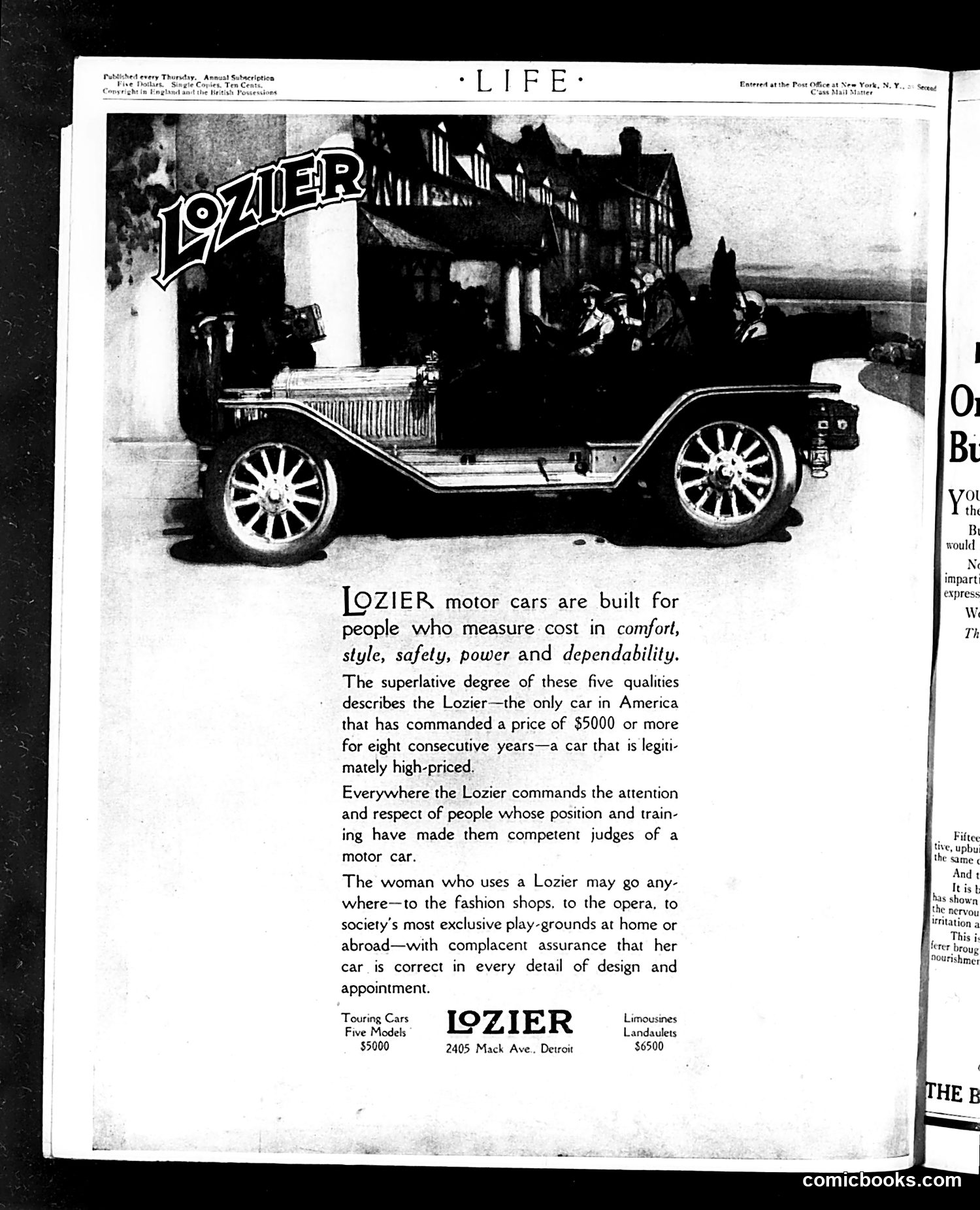
This page is primarily a **luxury automobile advertisement**, not political satire. It promotes the Lozier motor car, manufactured in Detroit, positioning it as an exclusive vehicle for wealthy, sophisticated buyers. The advertisement emphasizes five qualities: comfort, style, safety, power, and dependability. It claims the Lozier is "the only car in America that has commanded a price of $5000 or more for eight consecutive years," targeting affluent consumers who judge automobiles by prestige rather than practicality. The copy appeals to upper-class women, suggesting a Lozier owner can confidently visit "fashion shops," "the opera," and "society's most exclusive play-grounds." The vintage illustration depicts an early 1900s automobile with passengers in formal dress, reinforcing the car's association with wealth and social status.
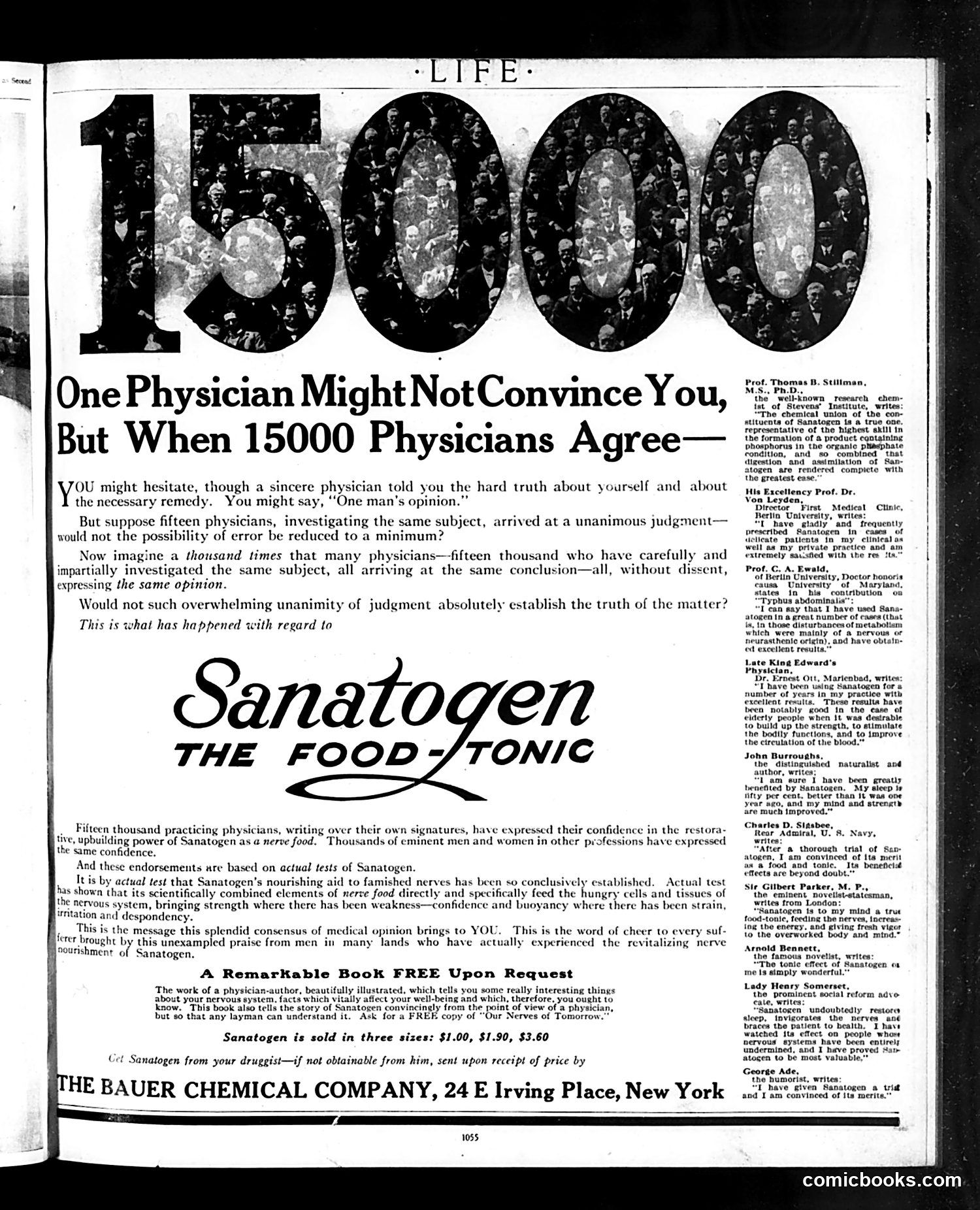
This is **not a political cartoon** but rather a **patent medicine advertisement** for Sanatogen, a "food-tonic" product. The large "15000" at the top represents 15,000 physicians who allegedly endorsed the product. The advertisement uses a persuasion technique common in early 20th-century marketing: it argues that while one doctor's opinion might be doubted, unanimous agreement among 15,000 doctors would "absolutely establish the truth." The right column contains quoted testimonials from named physicians and public figures claiming Sanatogen improved their health, sleep, and nerve function. This reflects an era when such unverified medical claims and doctor endorsements were legal marketing tactics. The page illustrates how manufacturers exploited appeals to medical authority to sell dubious tonics.
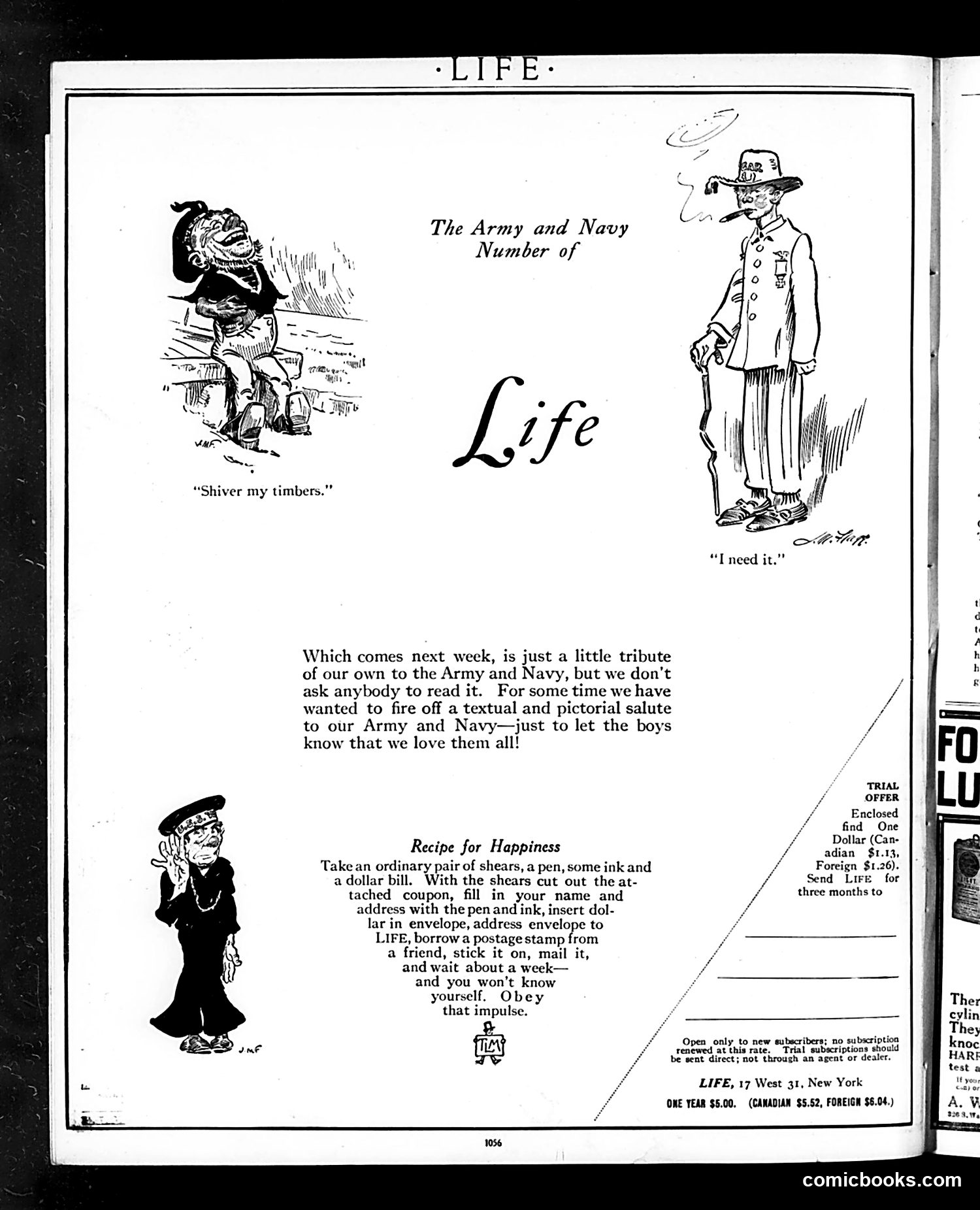
This page celebrates the Army and Navy with two cartoon vignettes. The left figure, a sailor saying "Shiver my timbers," appears to be a traditional nautical character. The right figure, an Army officer saying "I need it," represents military personnel. The text announces an upcoming special tribute issue to the armed forces, framed as a patriotic gesture rather than promotional content. The "Recipe for Happiness" is humorous filler—instructions for cutting out and mailing a coupon to Life magazine, presented as an absurd but binding commitment. The overall tone is lighthearted patriotism mixed with self-promotion. The magazine positions itself as supporting troops while encouraging subscriptions through a combination of sentiment and satire typical of Life's editorial approach.
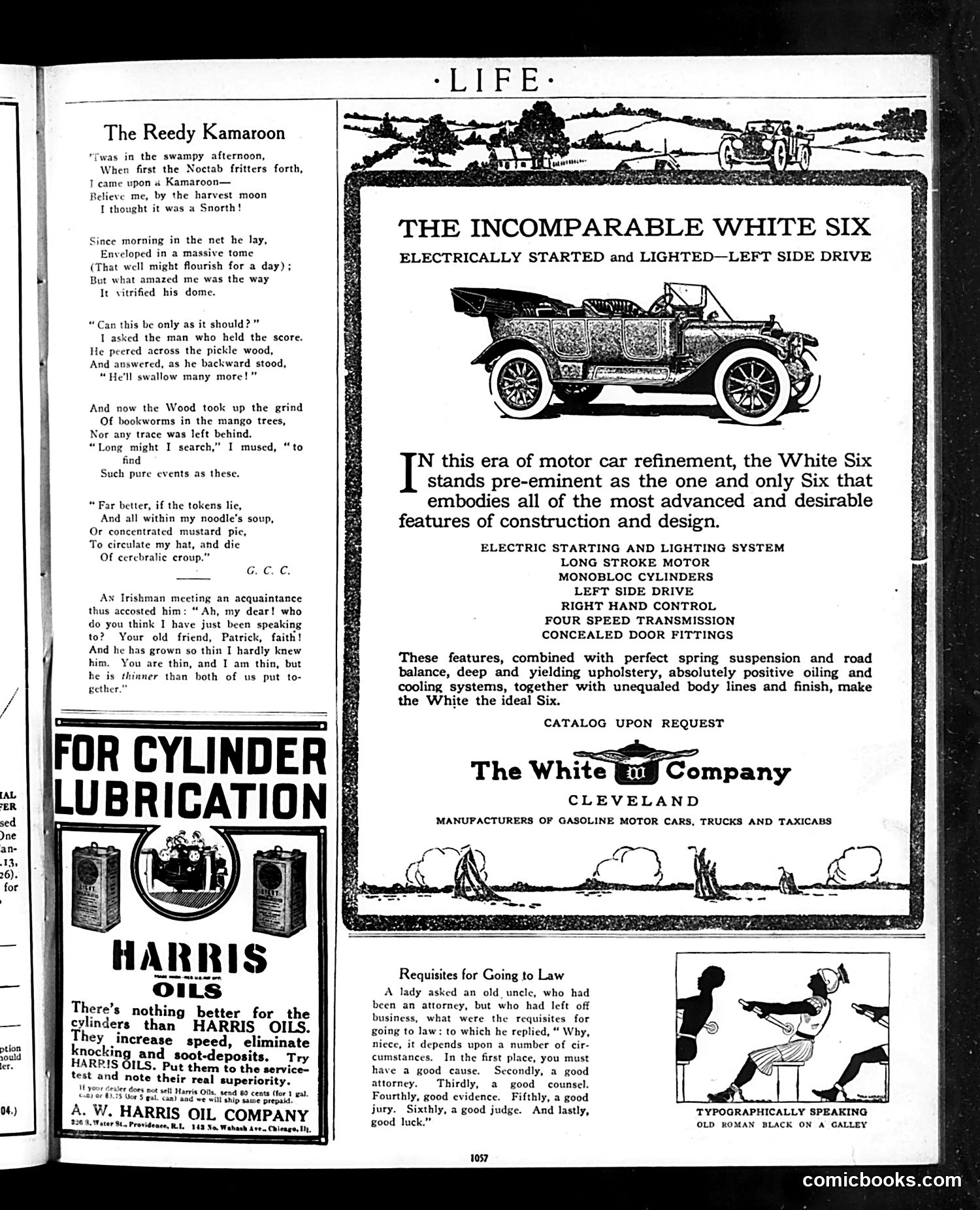
This page is primarily **advertising**, not satire or political commentary. The dominant content features a White automobile company advertisement promoting "The Incomparable White Six" with technical specifications (electric starting, left-side drive, four-speed transmission). The left sidebar contains a **Harris Oils advertisement** for cylinder lubrication, and a brief humorous anecdote titled "The Reedy Kamaroon" (appears to be satirical verse about hunting or nature observation), credited to G.C.C. At bottom right is a small cartoon labeled "Typographically Speaking: Old Roman Black on a Galley"—a printing industry joke about typography, showing silhouetted figures. The page reflects **1910s-20s consumer culture** more than political satire, showcasing automotive and industrial product marketing to affluent readers.
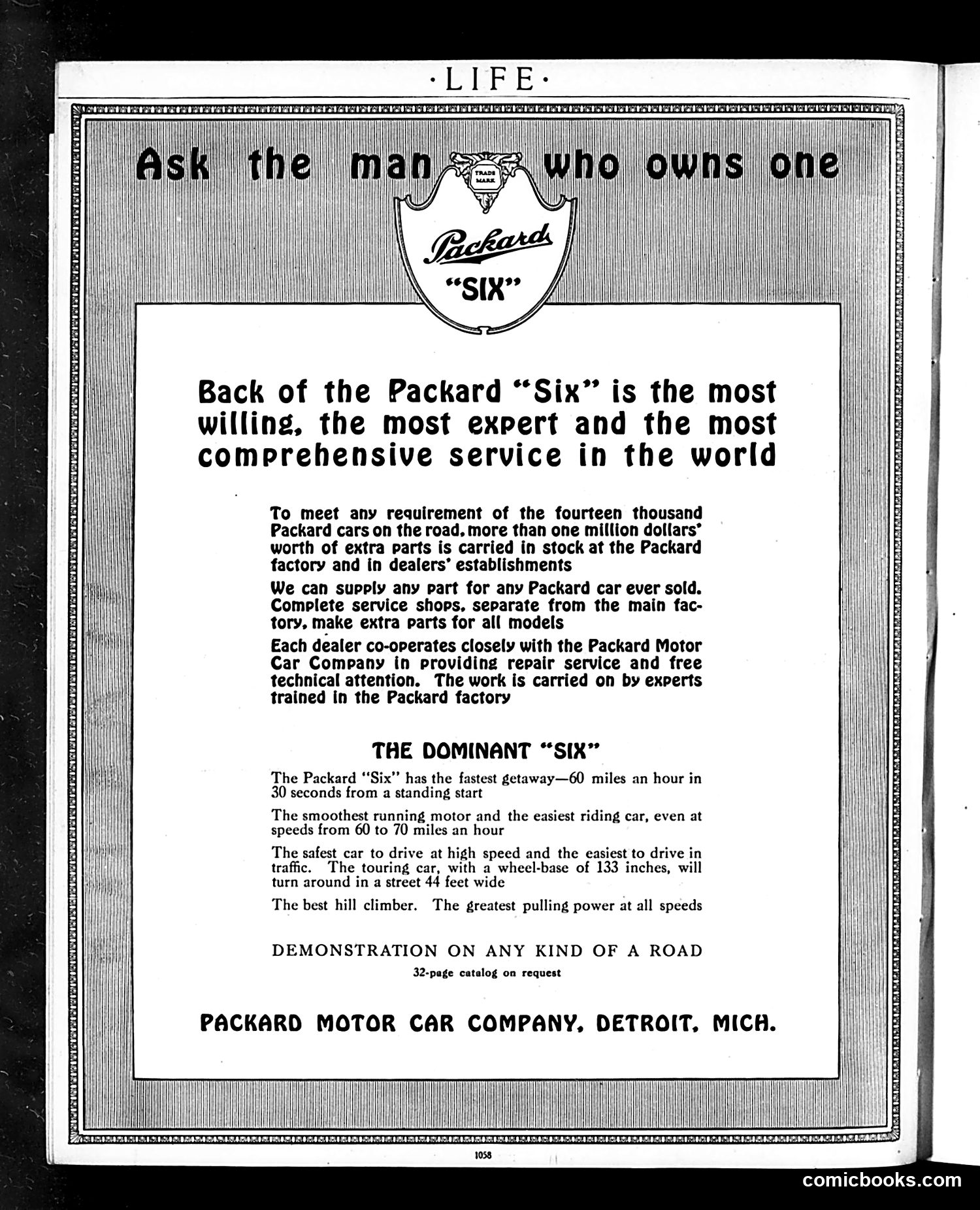
This page is **primarily an advertisement**, not satirical content. It's a full-page ad for the Packard Motor Car Company promoting their "Six" automobile model. The ad uses the framing "Ask the man who owns one"—a famous Packard slogan—to establish credibility. Rather than depicting specific political figures or satirizing current events, it makes straightforward marketing claims: the car offers superior service, impressive speed (60 mph in 30 seconds), smooth handling, and hill-climbing ability. The decorative header and "LIFE" masthead indicate this ran in Life magazine, but the content itself is commercial advertising rather than satire or social commentary. Packard was a luxury American automaker competing in the early automotive market.
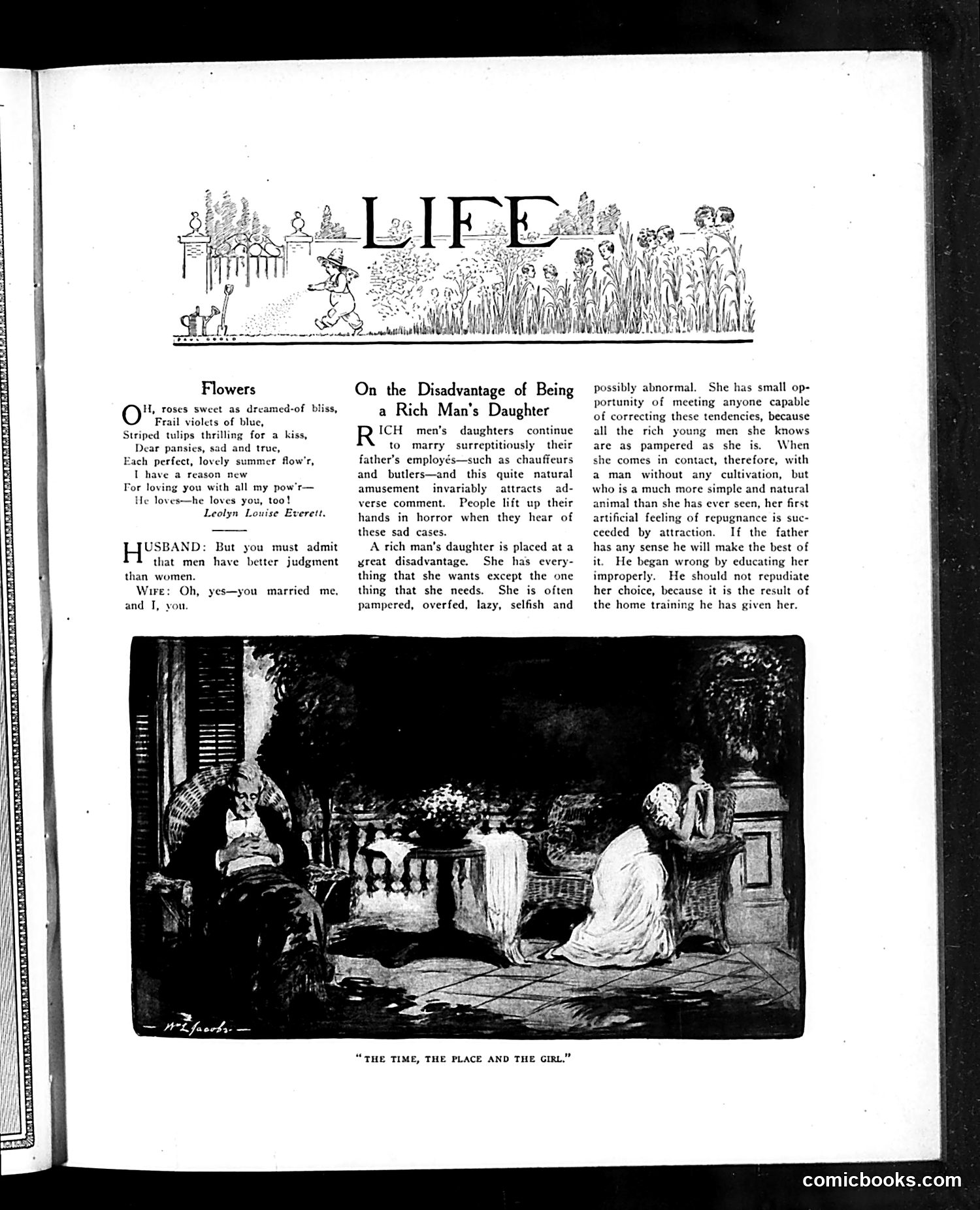
This page contains two pieces of satirical content about gender and marriage in early 20th century America. **"Flowers"** (top left): A poem by Loelyn Louie Everett praising roses and violet—likely romantic metaphors—followed by a brief marital dialogue mocking men's judgment. The wife's final line ("and I, you") suggests wives tolerate their husbands' poor decisions. **"On the Disadvantage of Being a Rich Man's Daughter"** (top right): This essay satirizes wealthy fathers who over-indulge their daughters, creating spoiled, lazy, selfish women. The author argues such girls lack genuine suitors—men pursue them for money, not character. The satire critiques both paternal indulgence and the resulting female entitlement. **"The Time, The Place and The Girl"** (illustration): An intimate nighttime scene, likely illustrating romantic courtship themes discussed above.
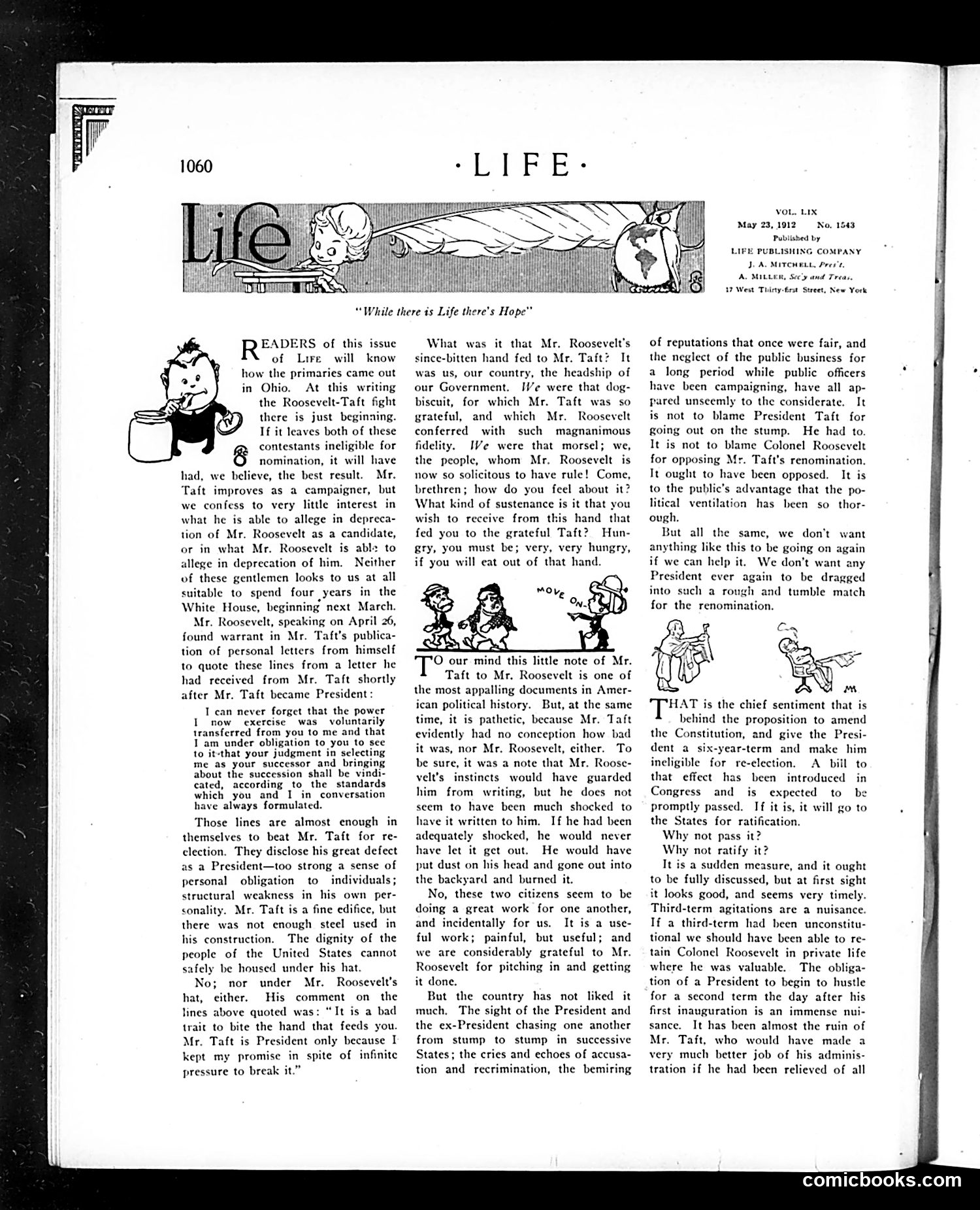
This editorial page discusses the 1912 presidential election aftermath. The text references Roosevelt, Taft, and a letter Roosevelt wrote to Taft that became public—described as "one of the most appalling documents in American political history." The left illustration shows a caricatured figure (likely representing Taft) angrily reading correspondence, suggesting his reaction to Roosevelt's critical letter. The small cartoon sketches in the center appear to depict the contentious dynamic between the two former allies turned rivals during the split Republican campaign of 1912, when Roosevelt's Progressive "Bull Moose" party challenged Taft's renomination. The page's masthead quote—"While there is Life there's Hope"—ironically frames the political chaos as the magazine advocates for constitutional amendment limiting presidents to one term, positioning itself as concerned with restoring governmental dignity.
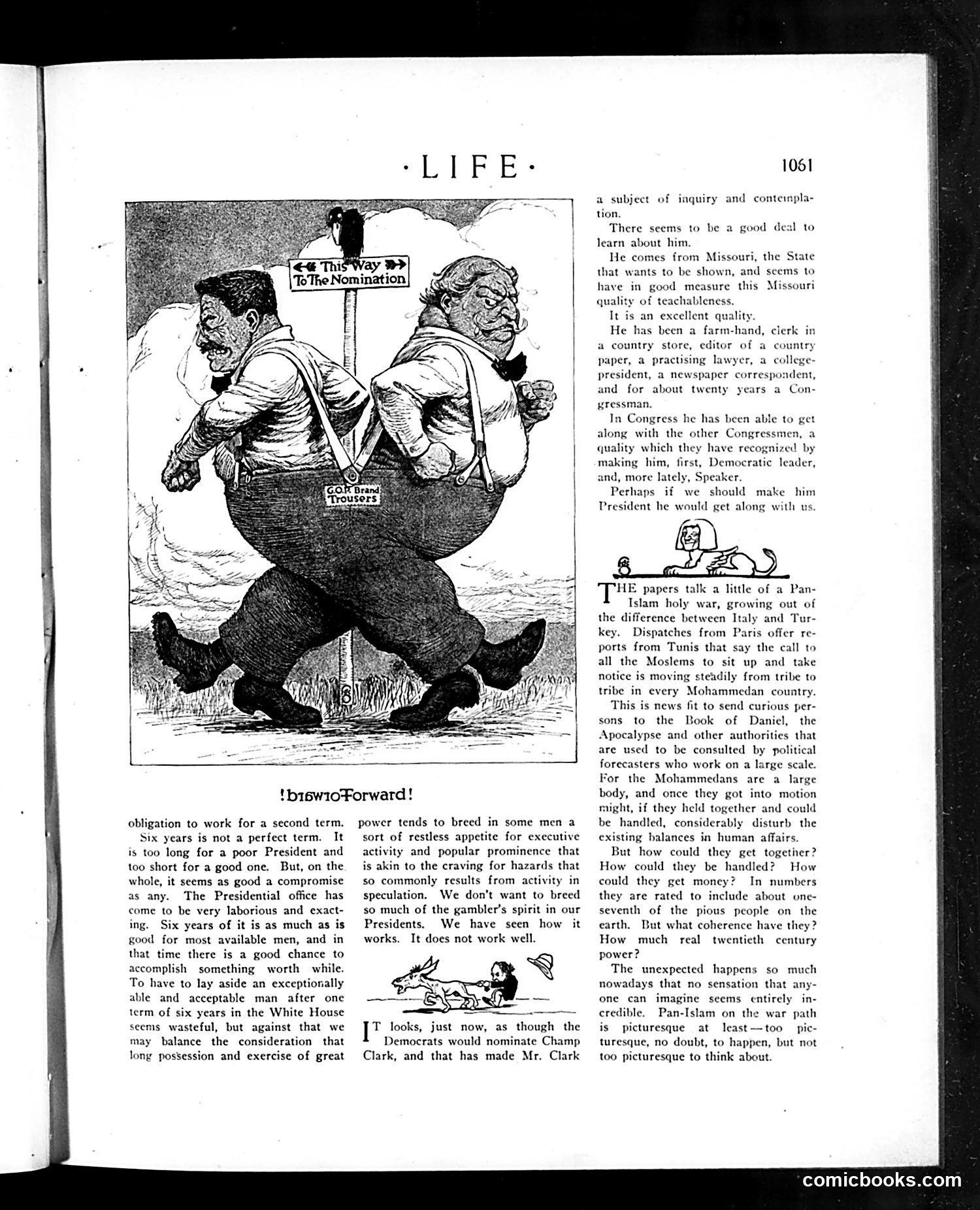
This Life magazine page features a caricature labeled "Bring Forward!" depicting a figure carrying two grotesque characters in a basket toward "This Way to The Nomination." The accompanying text discusses a Congressman from Missouri being considered for presidential nomination, praised for his practical experience as a farm-hand, newspaper editor, lawyer, and twenty-year congressional veteran. The cartoon satirizes the Democratic Party's potential nomination of this candidate. The exaggerated, unflattering caricatures suggest the satirist views him as an unsuitable or problematic choice. The title "Bring Forward!" mocks the push to nominate him, implying the party is dragging forward an undesirable candidate rather than one of genuine merit. The text also discusses Pan-Islamic tensions and political forecasting—typical Life magazine content of the era.
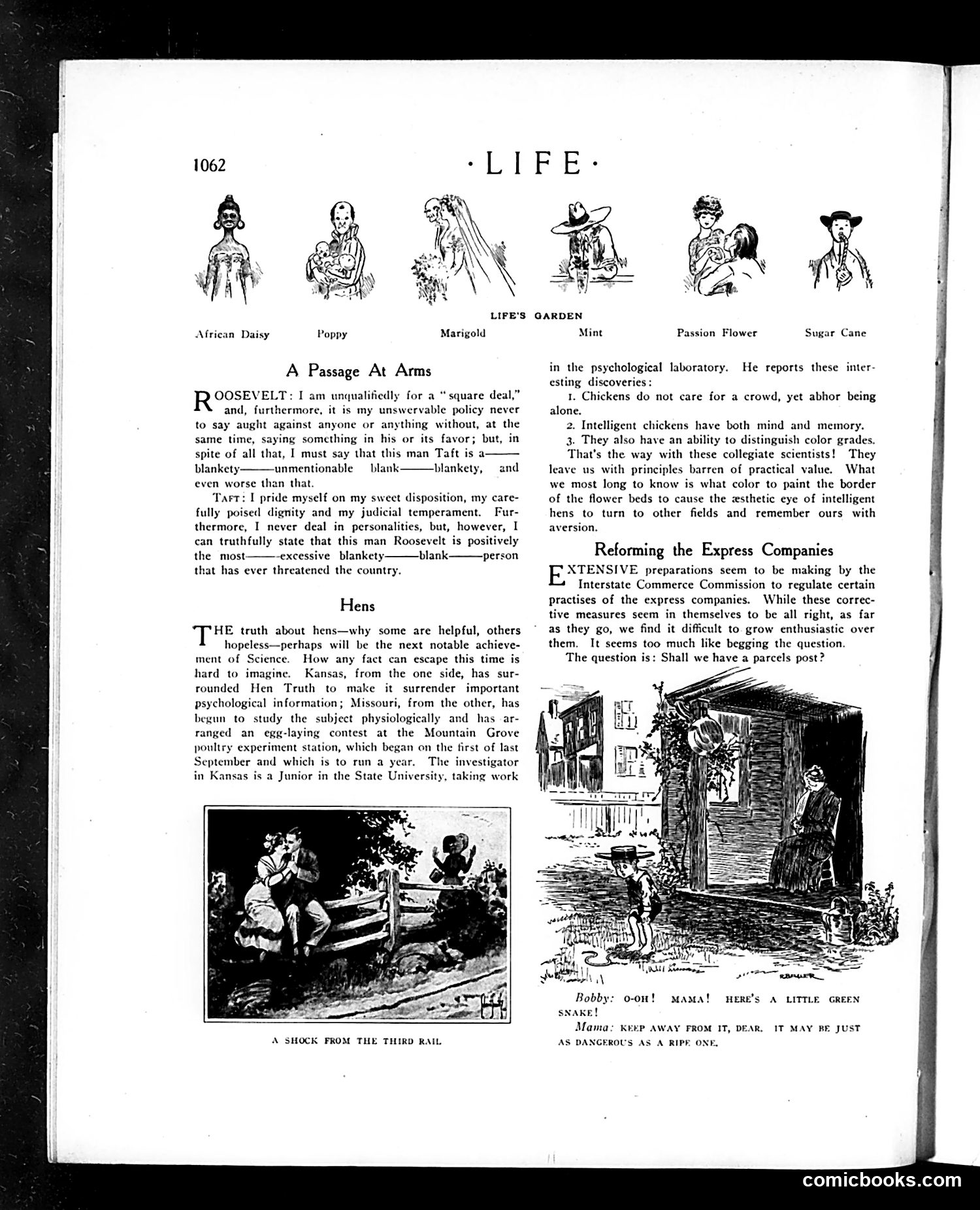
This page contains two distinct sections: **"A Passage at Arms"** presents a satirical attack on President Roosevelt, with the author (identified only as "Taft") claiming Roosevelt is a dangerous "blanketty-blank" threat to the country. The critique focuses on Roosevelt's allegedly aggressive temperament and willingness to attack anyone. **"Hens"** discusses scientific experiments in Kansas and Missouri studying chicken behavior and psychology, including an egg-laying contest. This appears to be genuine scientific reporting rather than satire. The page also contains two illustrations: one showing people startled by a train ("A Shock from the Third Rail") and another depicting a humorous domestic scene with a child warning his mother about a snake. The political content reflects early 20th-century debates about Roosevelt's presidency and temperament.
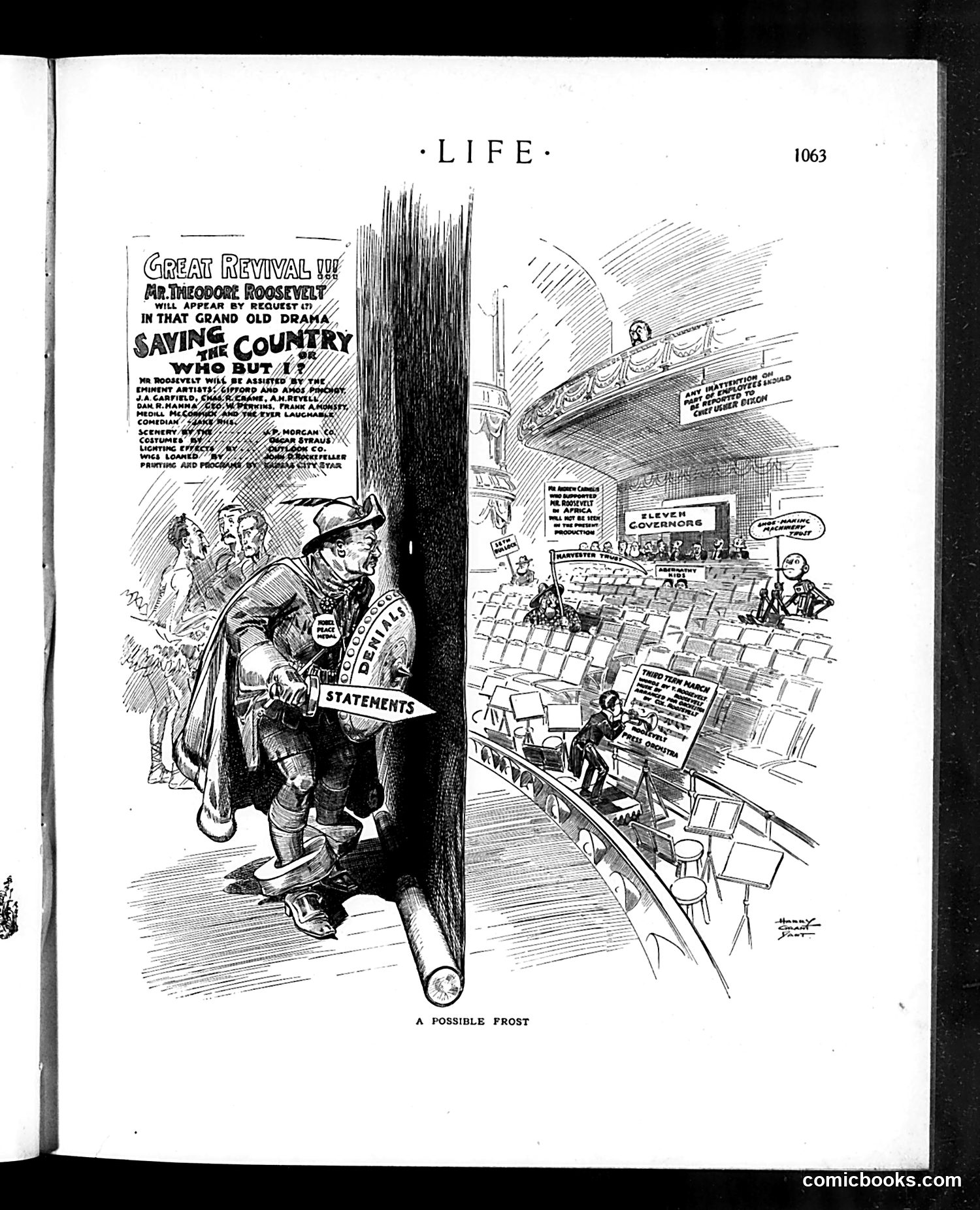
This page contains two cartoons satirizing Theodore Roosevelt's political comeback. The left cartoon advertises a film revival of Roosevelt's earlier political drama "Saving the Country." The right cartoon, titled "A Possible Frost," depicts a theater scene with "Eleven Governors" on stage. The imagery suggests tension between Roosevelt (represented by the figure at left) and current Republican leadership. The "frost" metaphor refers to a potential cooling of relations or conflict emerging within the party. Given Roosevelt's 1912 Progressive Party split from Republicans, this cartoon likely satirizes anxieties about another divisive Roosevelt intervention in Republican politics, potentially freezing party unity. The theatrical staging emphasizes the performative nature of political posturing.
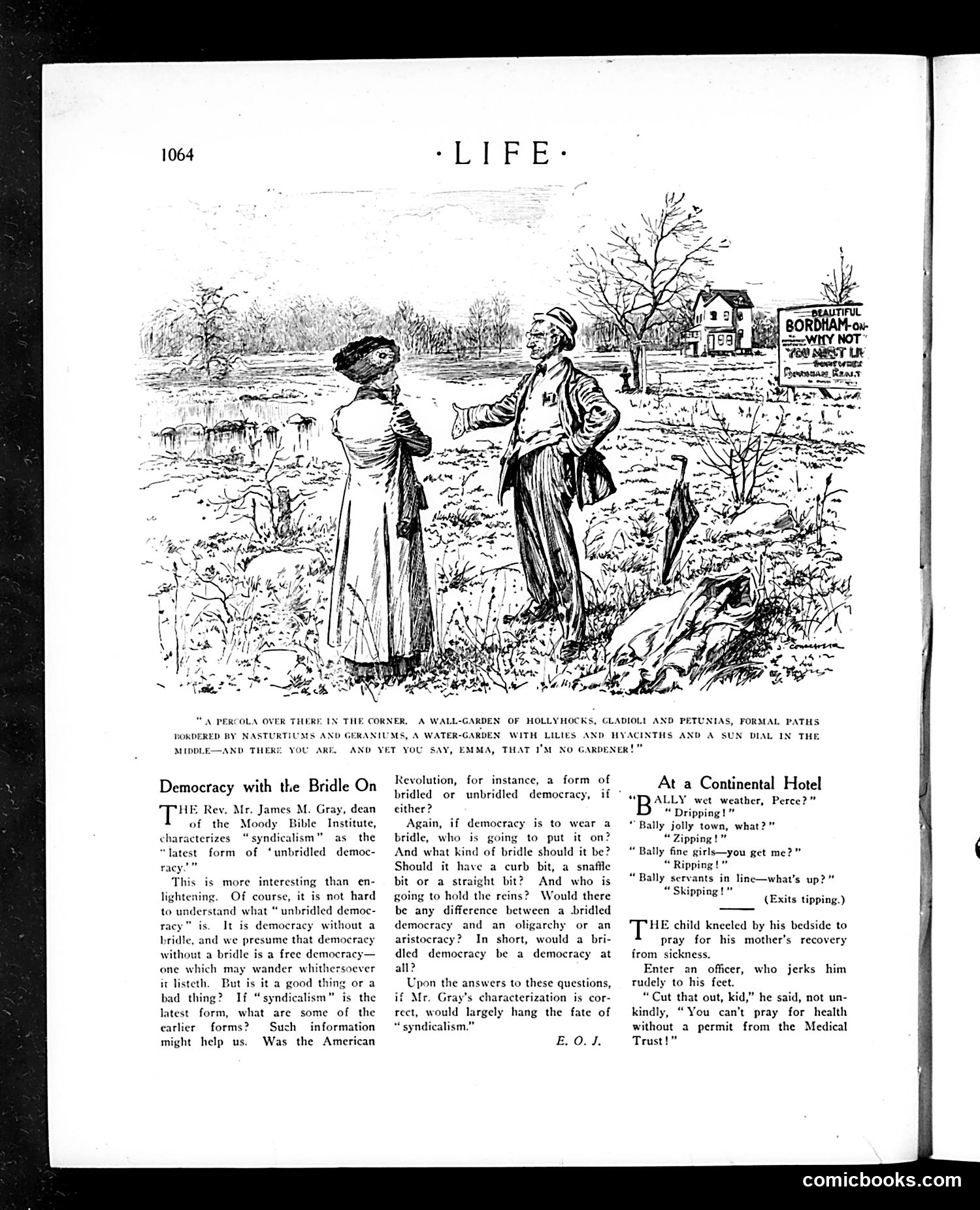
The main illustration depicts a man and woman in a rural landscape discussing democratic governance. The accompanying article by Rev. James G. K. McClure critiques "syndicalism" as an "untried democracy"—essentially democracy without institutional checks. The cartoon's point: the author argues that pure, unbridled democracy is problematic, comparing it to a horse needing a bridle. He questions whether democracy should have "a curb bit, a snaffle bit or a straight bit," using equestrian metaphors to suggest that democratic systems require restraints and guidance structures. The piece addresses early 20th-century anxieties about radical democracy and labor movements, warning against governance without proper institutional "bridles" or constitutional safeguards. The rural setting suggests concerns about American democratic fundamentals.
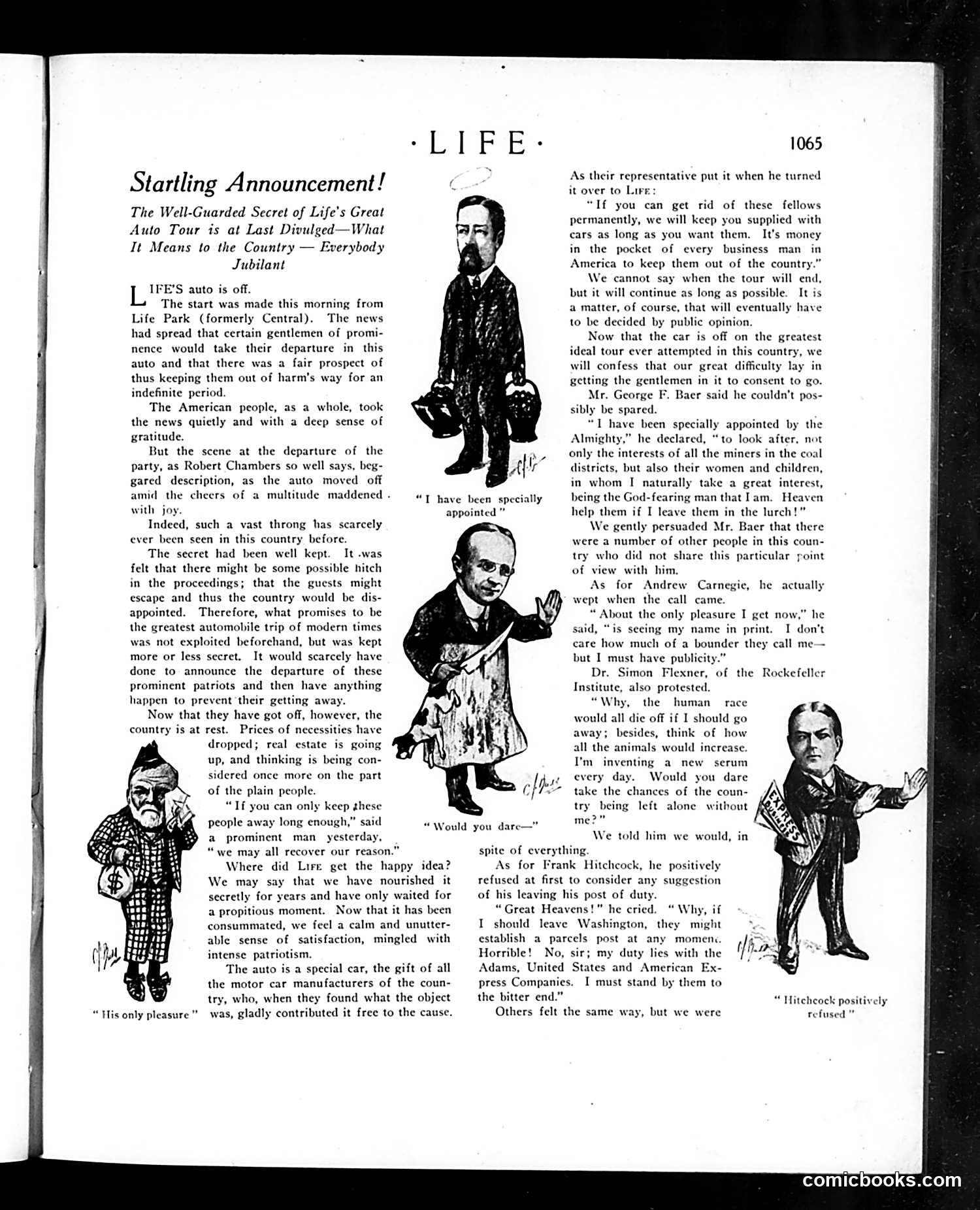
This 1910s satirical piece mocks a proposed cross-country automobile tour meant to promote American unity and industry. The cartoon ridicules prominent figures who refused to participate—including what appears to be Andrew Carnegie (labeled "Would you dare—") and Frank Hitchcock (noted as "positively refused"). The satire targets wealthy industrialists and politicians who, while publicly supporting American causes, privately avoided public commitment. The caricatured figures represent the hypocrisy of business leaders who claim patriotism but dodge inconvenient public gestures. The recurring phrase "His only pleasure was, gladly contributed it free to the cause" undercuts claims of genuine patriotic support, suggesting these figures gave only token assistance while protecting their reputations and comfort.
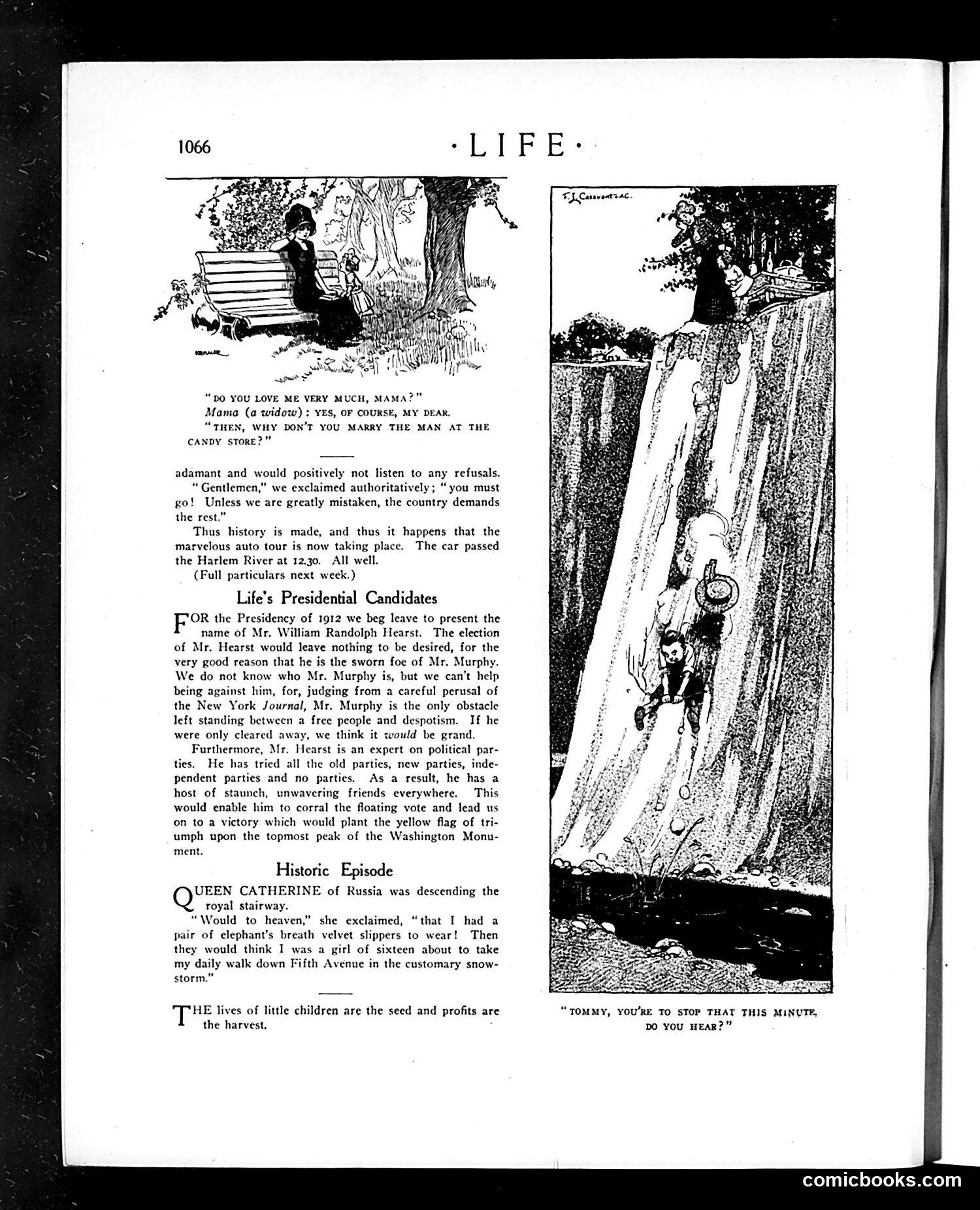
This 1912 *Life* magazine page contains political satire about the presidential election. The main section, "Life's Presidential Candidates," proposes William Randolph Hearst as a candidate, sarcastically claiming he'd be better than the "obstacle" candidate Murphy (likely referring to Charles Murphy of Tammany Hall). The satire suggests Hearst, a powerful newspaper magnate, could unite fractured political parties and win decisively. The top cartoon depicts a woman asking her mother if she loves her, then jokingly suggests she marry "the man at the candy store"—a humorous non-sequitur about mothers' expectations. The "Historic Episode" references Queen Catherine of Russia descending stairs in luxurious slippers, illustrating the satirical point that "the lives of little children are the seed and profits are the harvest"—critiquing how the wealthy live in excess.
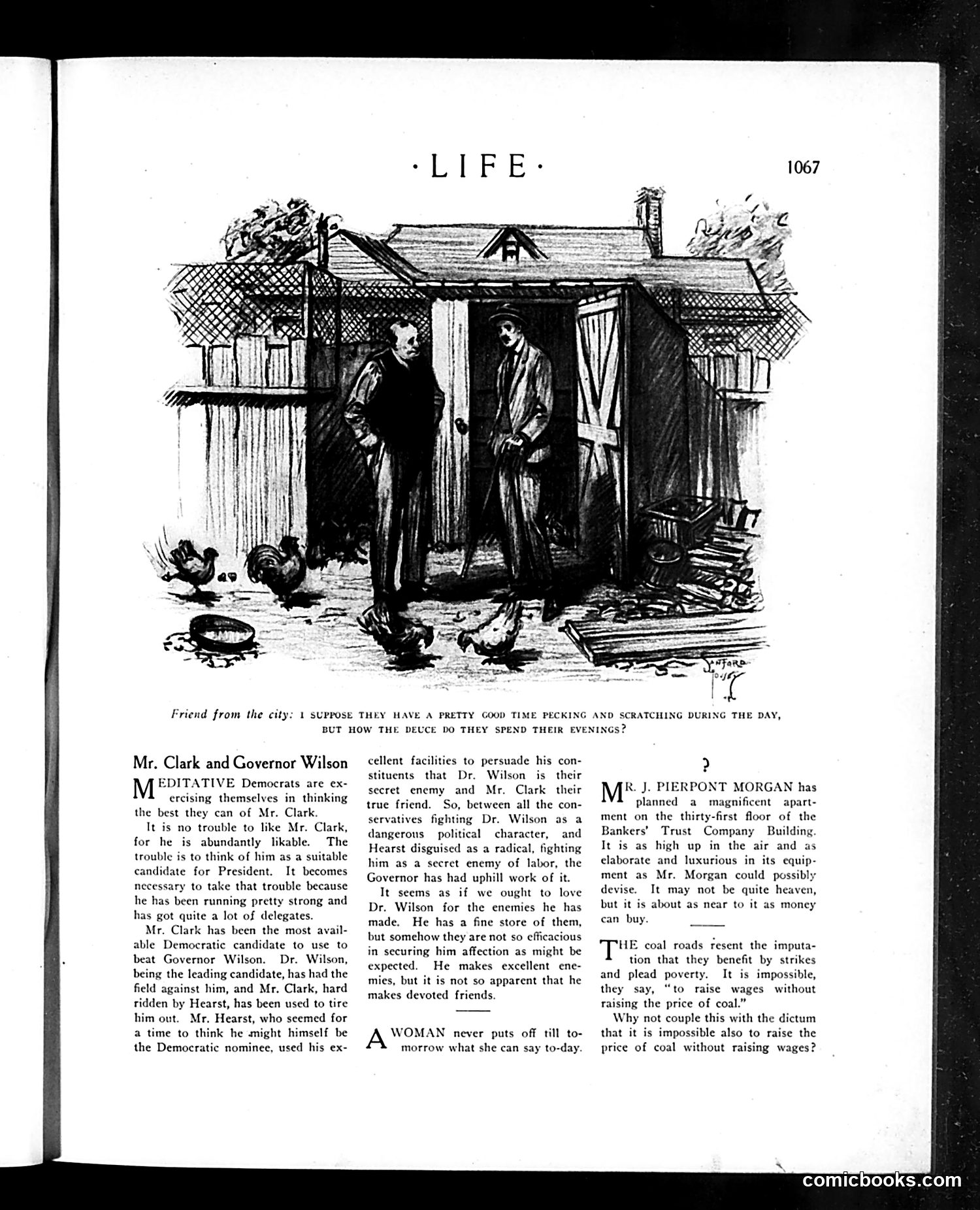
This page contains political commentary on the 1912 Democratic presidential race. The main article discusses **Mr. Clark versus Governor Wilson** as competing Democratic candidates. The text reveals that conservatives and publisher **William Randolph Hearst** (appearing to support Clark) strategically used Clark as a rival to damage Wilson's candidacy, viewing Wilson as a "dangerous political character." The irony is that Wilson's many powerful enemies—intended to weaken him—paradoxically demonstrate his integrity, though they don't translate into devoted supporters. The opening cartoon makes a crude joke about rural life and leisure time. The secondary items include brief satirical jabs at **J.P. Morgan's** luxurious apartment plans and coal industry hypocrisy—railroads claim they cannot raise wages without raising coal prices, yet logic suggests the reverse should also be true. The satire targets political manipulation and economic inequality characteristic of the Progressive Era.
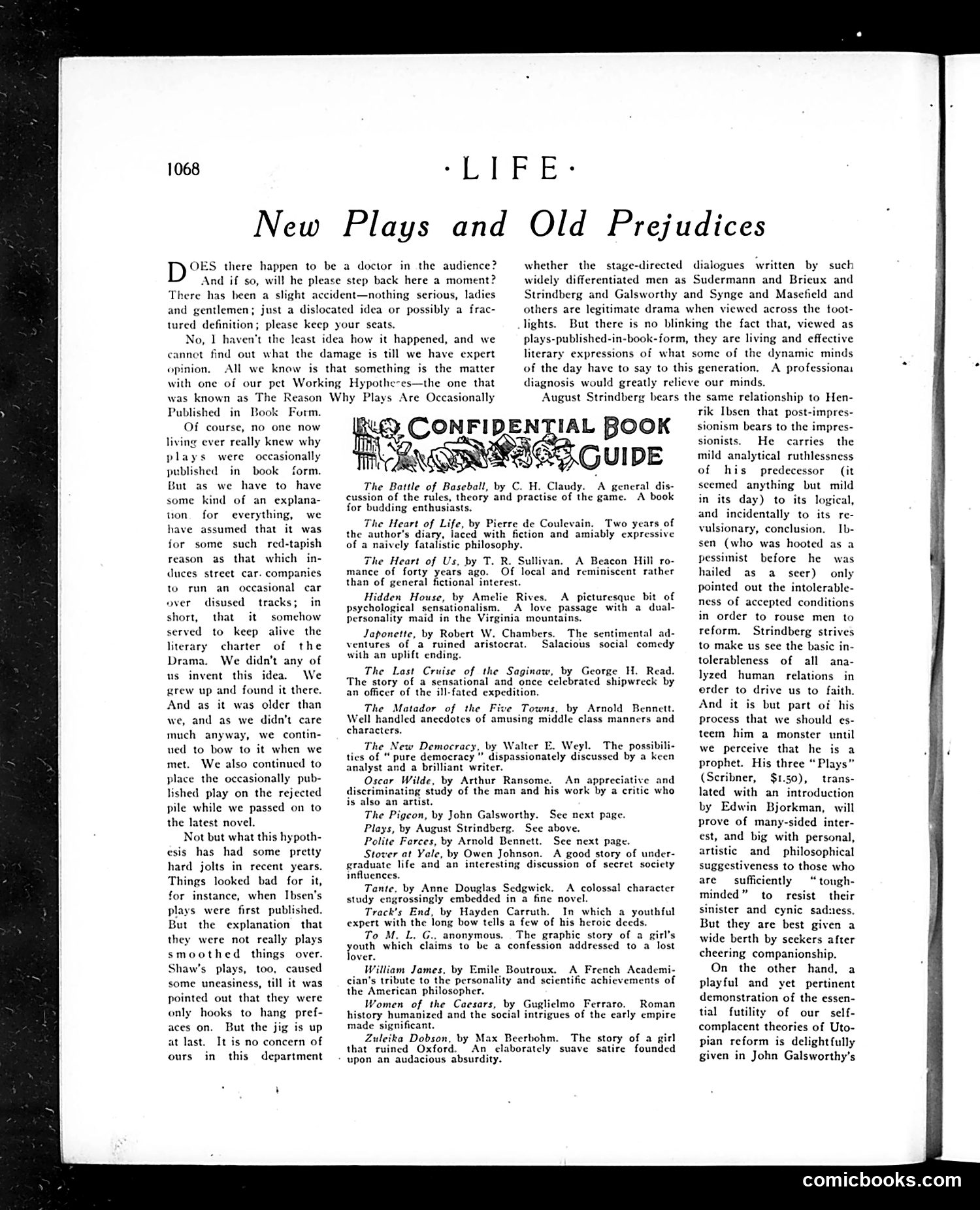
This is a literary essay, not a cartoon. The author humorously examines an outdated assumption: that plays published as books served no real purpose except to maintain Drama's "literary charter." The piece identifies a "working hypothesis" now collapsing: that stage plays shouldn't count as legitimate literature. Recent publication of works by Ibsen and Shaw challenged this prejudice. Ibsen's plays were dismissed because "they were not really plays"; Shaw's excused as "books to hang prefaces on"—polite dismissals that no longer hold. The author's ironic opening (calling a "doctor" for the injured hypothesis) mocks how defenders cling to outdated literary classifications. The point: dynamic modern playwrights like Sudermann, Strindberg, and Galsworthy have proven that stage-directed drama *is* legitimate literature worthy of book publication—despite conservative literary gatekeepers' resistance. It's a defense of modern dramatic literature against entrenched literary snobbery.
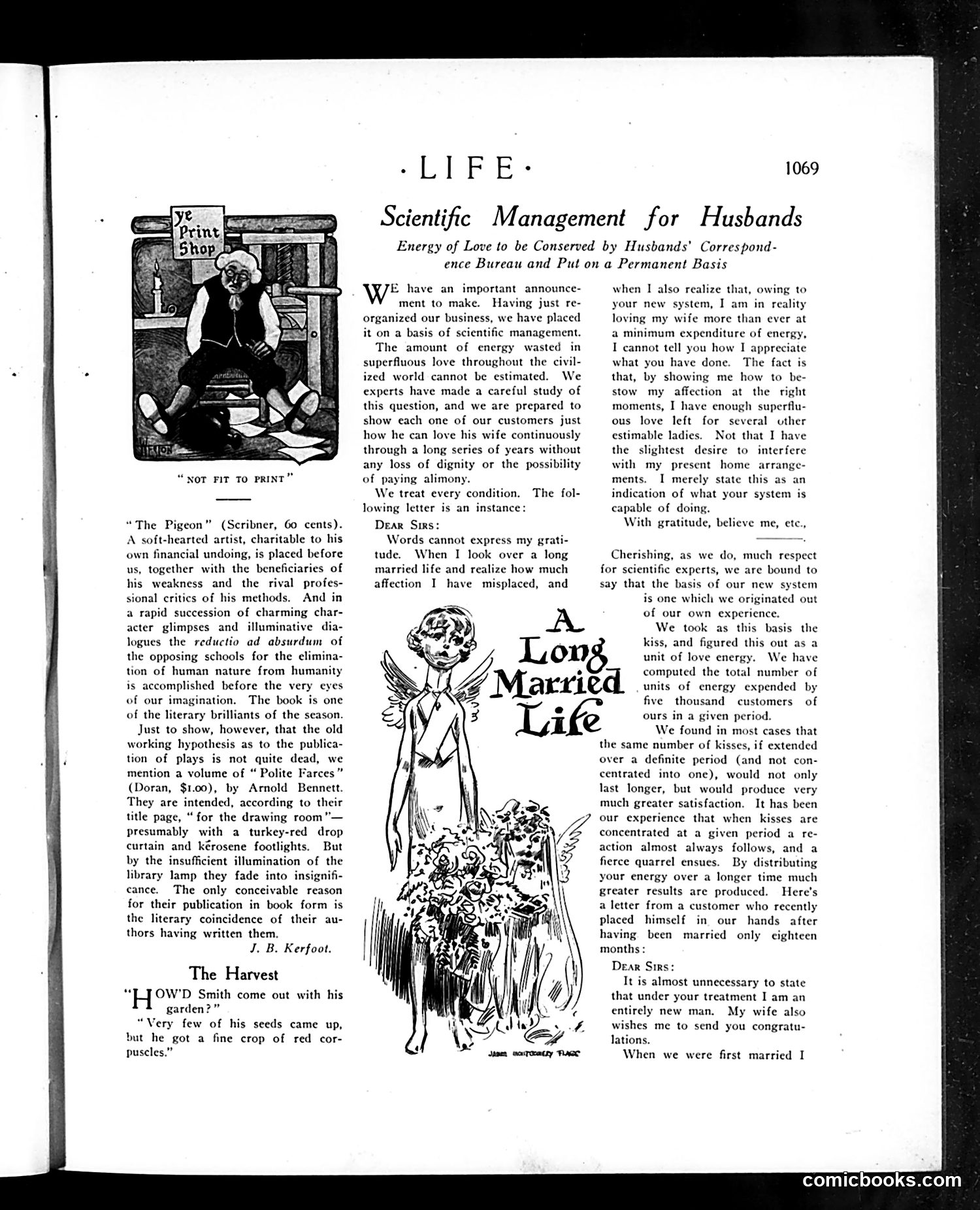
This page satirizes the early 20th-century "scientific management" movement (applying factory efficiency to all aspects of life). The main article mocks the absurd idea of a "Correspondence Bureau" that teaches husbands to ration their affection scientifically—literally measuring love in "kiss units" to maximize satisfaction while minimizing emotional and financial expenditure (avoiding alimony). The satire targets how corporate management ideology was being applied to intimate relationships. A testimonial letter from a satisfied customer boasts that the system allows him to distribute his "superfluous love" to other women while maintaining his marriage—revealing the cynical, transactional view underlying the "scientific" approach. The joke is that love cannot and should not be industrialized or rationed. The cartoons and literary reviews above offer complementary critiques of misguided modern philosophies (eliminating human nature from life, insufficiently "illuminating" art).
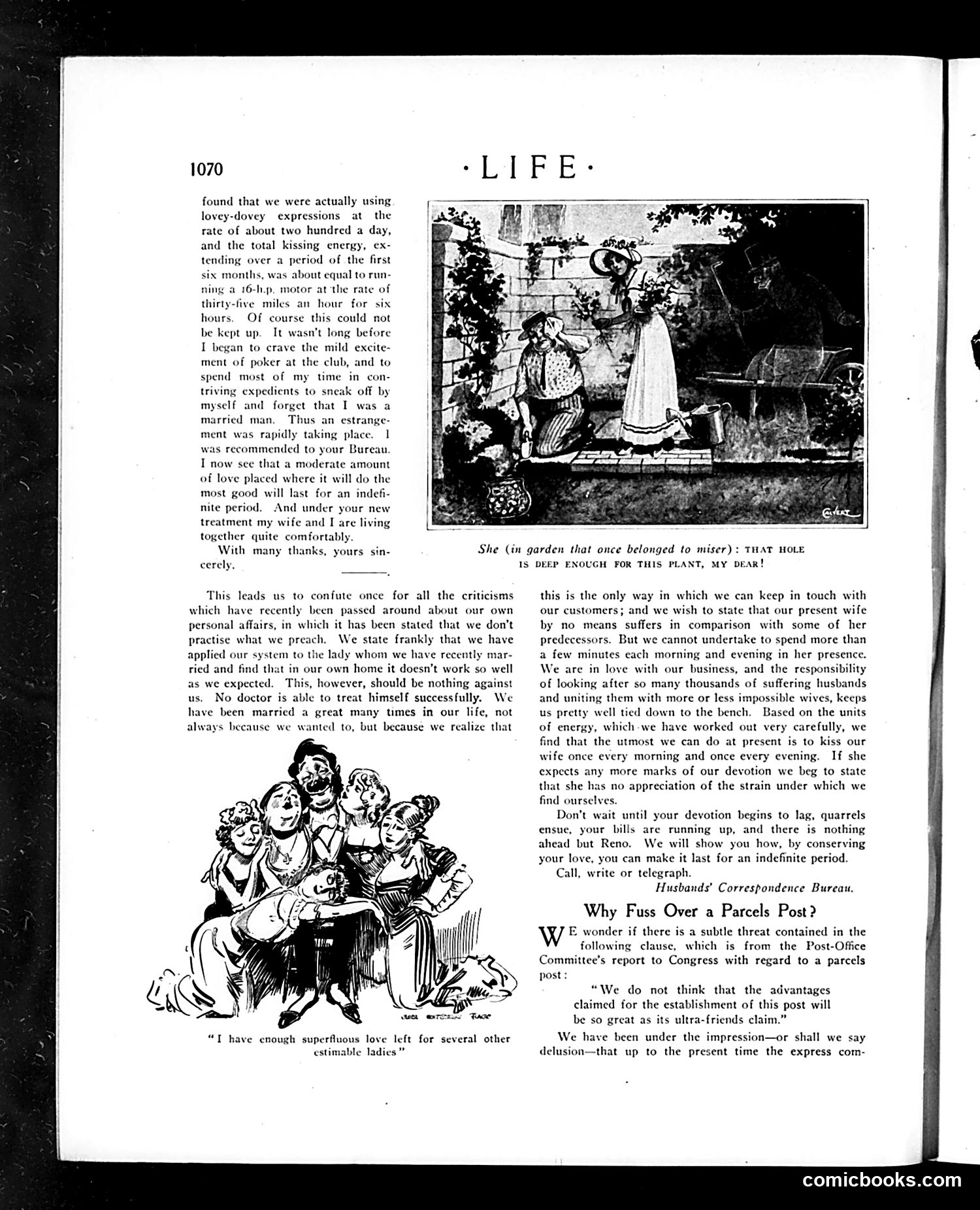
This page satirizes a fictional "Husbands' Correspondence Bureau"—an advice service claiming to help marriages by scientifically rationing affection. The main cartoon shows a couple in a garden; the wife comments the hole is deep enough for planting, while the husband appears inattentive, illustrating the Bureau's admission that their own marriage fails despite their system. The satire targets early-20th-century pseudo-scientific approaches to relationships. The Bureau boasts of calculating "kissing energy" in mechanical terms (16-h.p. motors) and prescribes minimal contact—one kiss morning and evening—to preserve marital "energy." The joke exposes the absurdity: their system doesn't work in their own home, yet they continue selling it. A secondary cartoon depicts a man surrounded by women, claiming "superfluous love" for "several other estimable ladies," mocking the Bureau's frequent remarriages. The final brief section questions a parcels-post proposal with similar satirical skepticism about government initiatives.
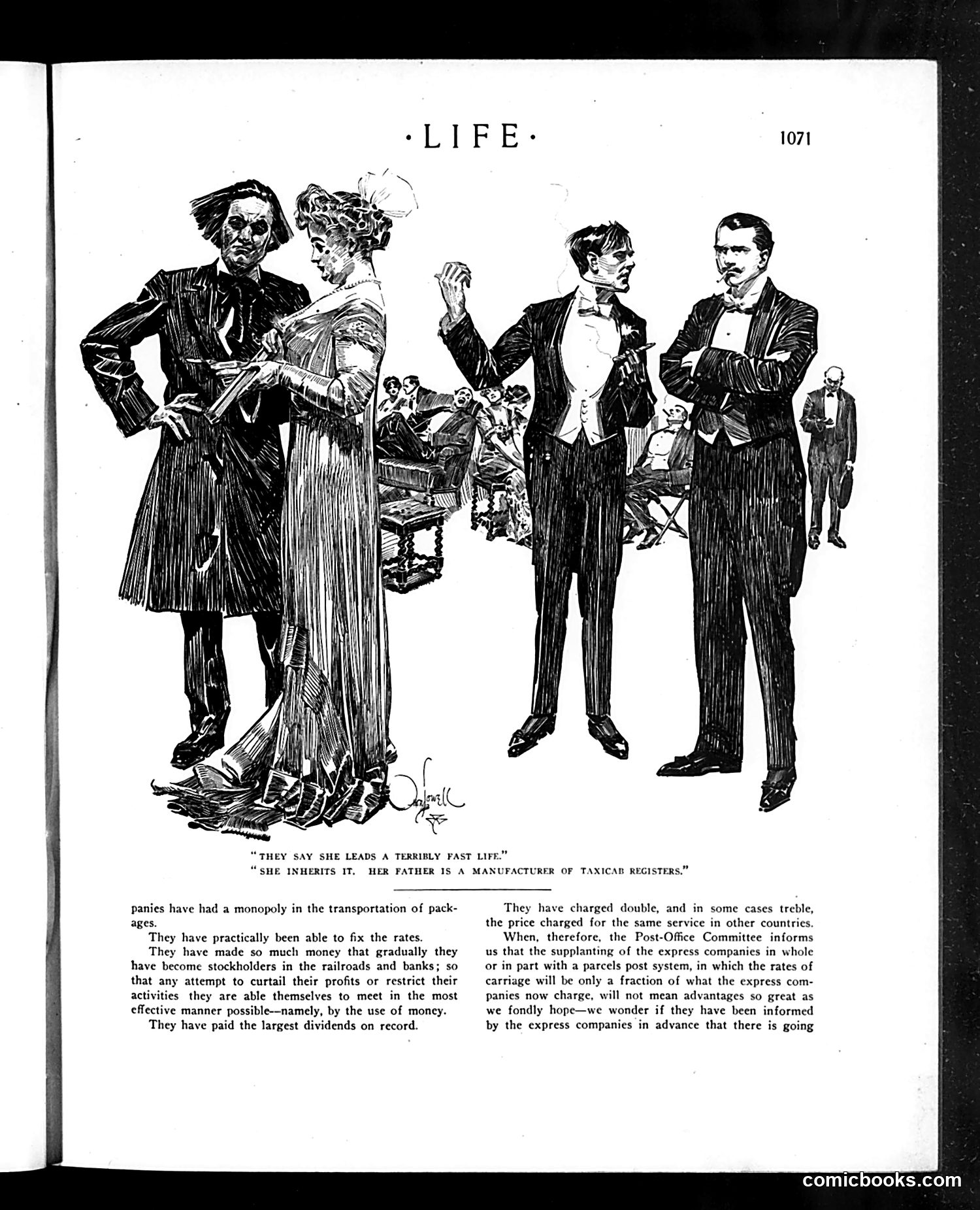
This satirical cartoon critiques the monopolistic power of express delivery companies. The caption reveals the joke: a woman leads "a terribly fast life," but the punchline reveals her father manufactures taxicab registers—suggesting her "fast life" is inherited wealth from a businessman profiting from transportation. The accompanying text argues that express companies have achieved monopolistic control over package transportation, fixing rates and earning enormous dividends. They've become so wealthy and influential that they own railroad and bank stock, enabling them to block regulatory efforts through financial pressure. The cartoon's broader point: these companies are so entrenched and powerful that they can influence government policy (specifically Post-Office Committee decisions about parcels post reform) to protect their lucrative monopoly, preventing more affordable shipping alternatives from displacing them.
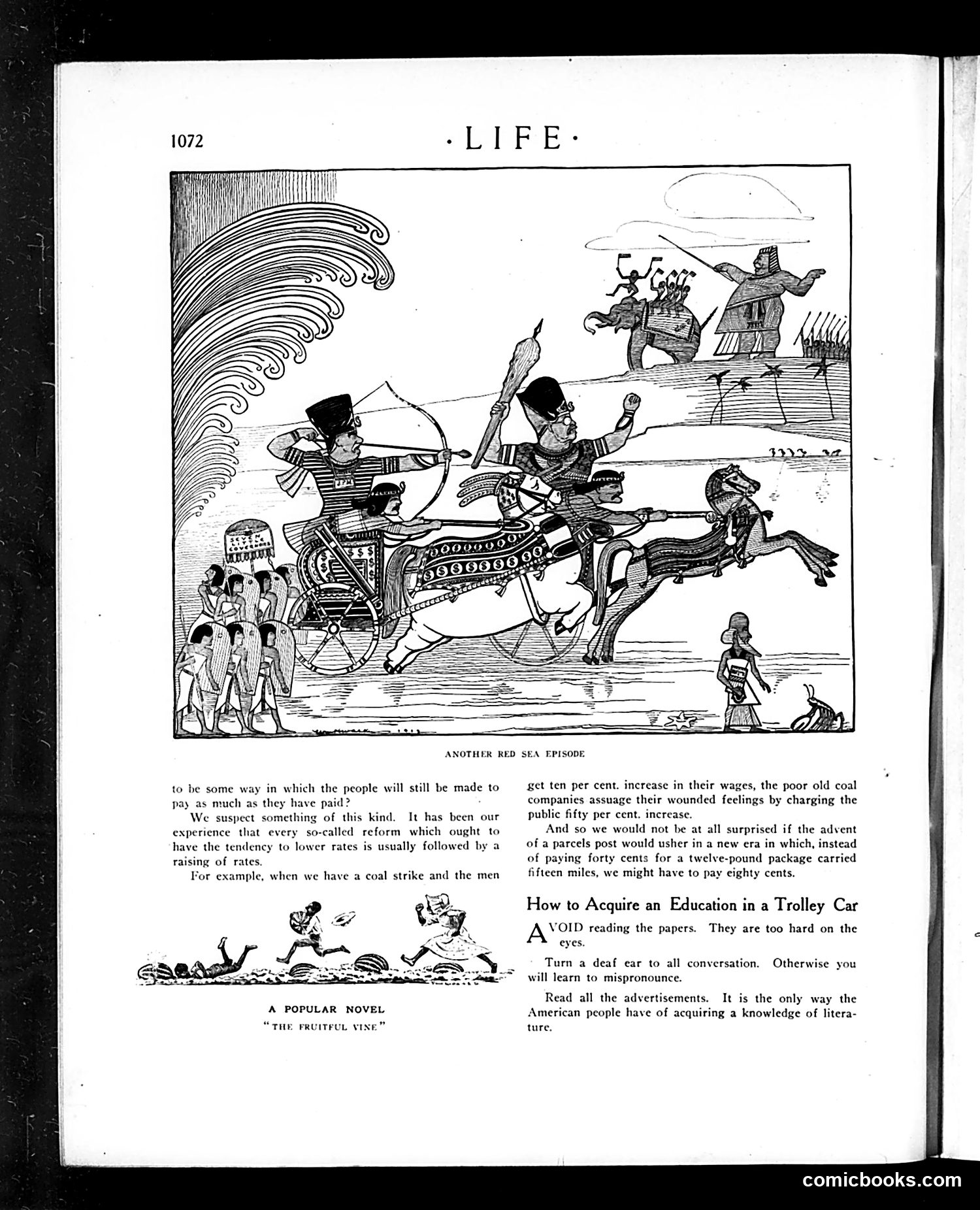
The main cartoon depicts Egyptian figures in a chariot being pursued across water, likely referencing the biblical Red Sea parting. The satire targets labor reform and rate-setting: Life argues that despite reforms supposedly benefiting workers and consumers—like wage increases for coal miners or a new parcels post system—companies simply pass costs to the public through price hikes. When miners gained a 10% wage increase, coal companies supposedly raised public prices 50%. The cartoon suggests this cyclical pattern will repeat with the parcels post: rather than lowering shipping costs from forty cents, prices may double to eighty cents. The page also includes humorous advice on "acquiring an education in a trolley car"—satirizing American life by suggesting people learn only through advertisements, avoid newspapers and conversation—mocking contemporary consumer culture and reading habits.
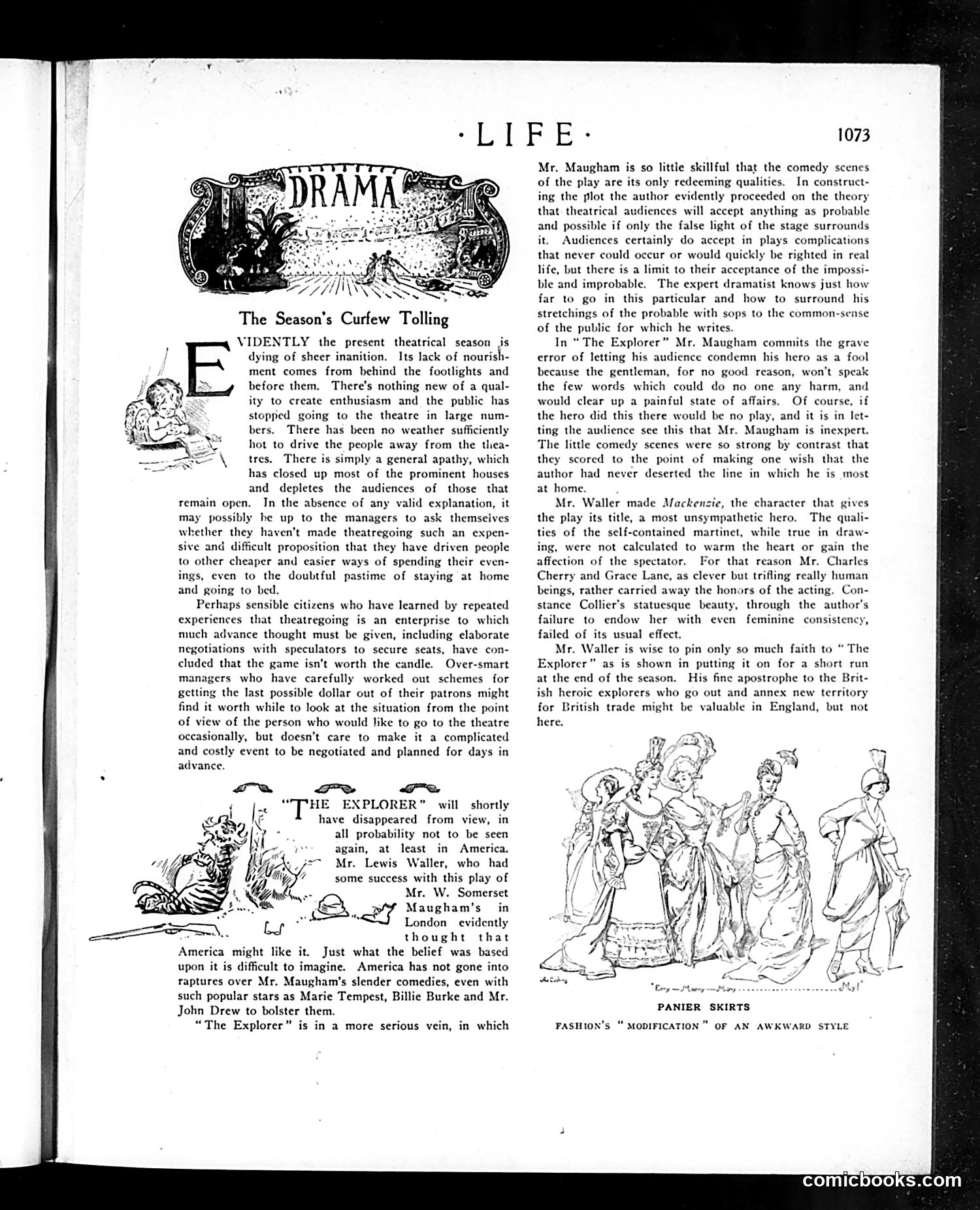
This page contains theater criticism addressing two problems: **"The Season's Curfew Tolling"** critiques the theatrical season's decline. The author argues that theater attendance has collapsed not due to weather or public indifference, but because managers have made theater-going prohibitively expensive and logistically burdensome—requiring advance planning, expensive ticket negotiations with speculators, and significant expenditure. The satire suggests managers have priced out casual patrons, driving them toward cheaper home entertainment. **"The Explorer"** reviews a W. Somerset Maugham play starring Lewis Waller. The critique faults Maugham's dramatic construction: the hero refuses to speak words that would resolve the plot for no compelling reason, making him seem foolish rather than sympathetic. The reviewer argues this reveals Maugham's inexperience—he doesn't understand how far audiences will suspend disbelief. While the comedy scenes were strong, they highlighted the play's fundamental dramatic weakness. The illustration shows fashionably dressed women in "pannier skirts," an awkward period fashion.
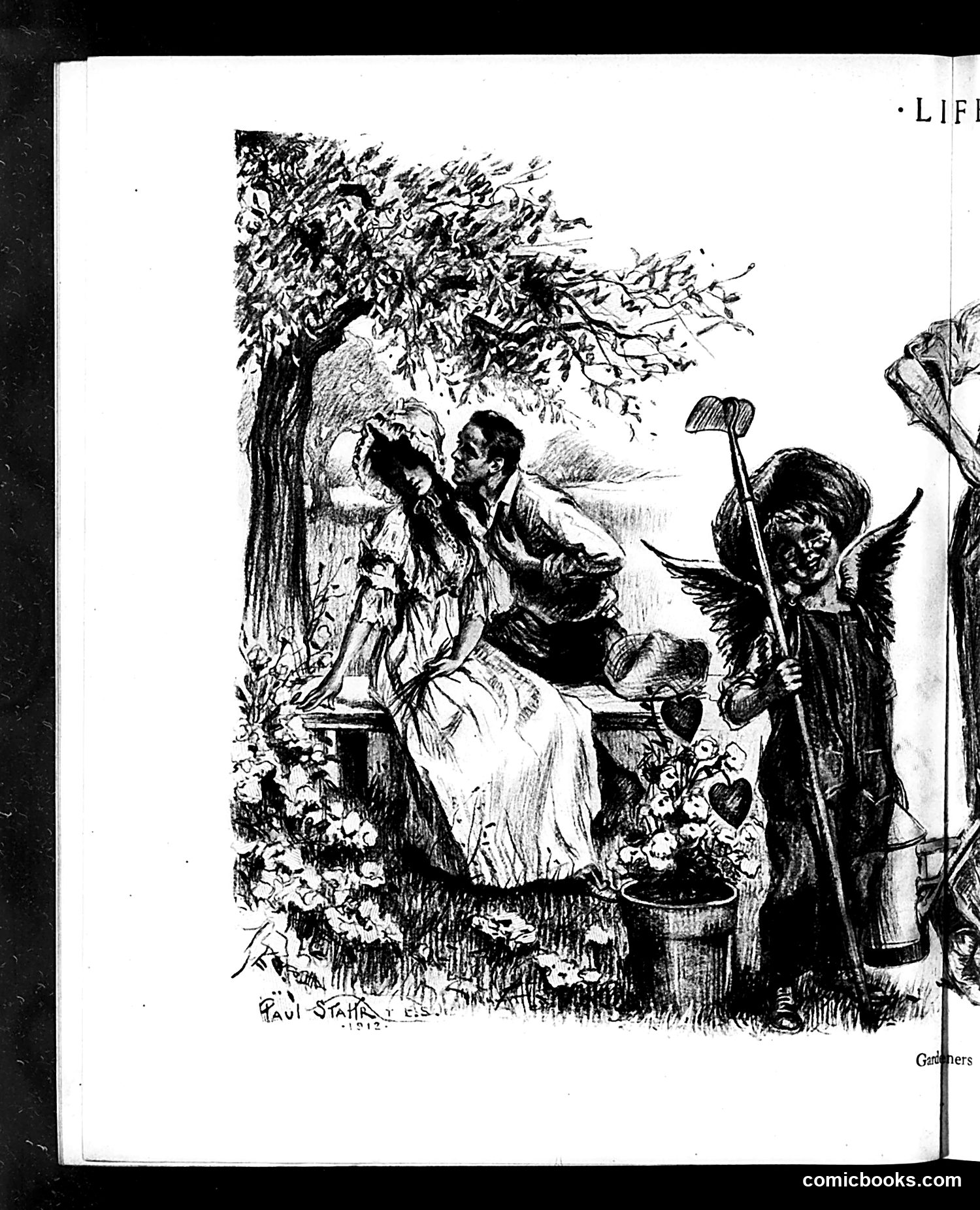
This pen-and-ink illustration by Paul Stahlly (dated 1912) depicts figures tending a garden beneath a gnarled tree. The image appears to be political allegory, likely commenting on governance or social management of the era. The composition—with winged figures (possibly representing ideals or supernatural forces) alongside human gardeners working the soil—suggests themes of cultivation, growth, or stewardship. The dead or dying tree overhead may symbolize decay or failed old systems, while the gardening activity below suggests renewal or alternative approaches. Without additional context from the magazine issue, the specific political target remains unclear, though the 1912 date suggests possible connection to that year's U.S. presidential election or Progressive Era reform debates.
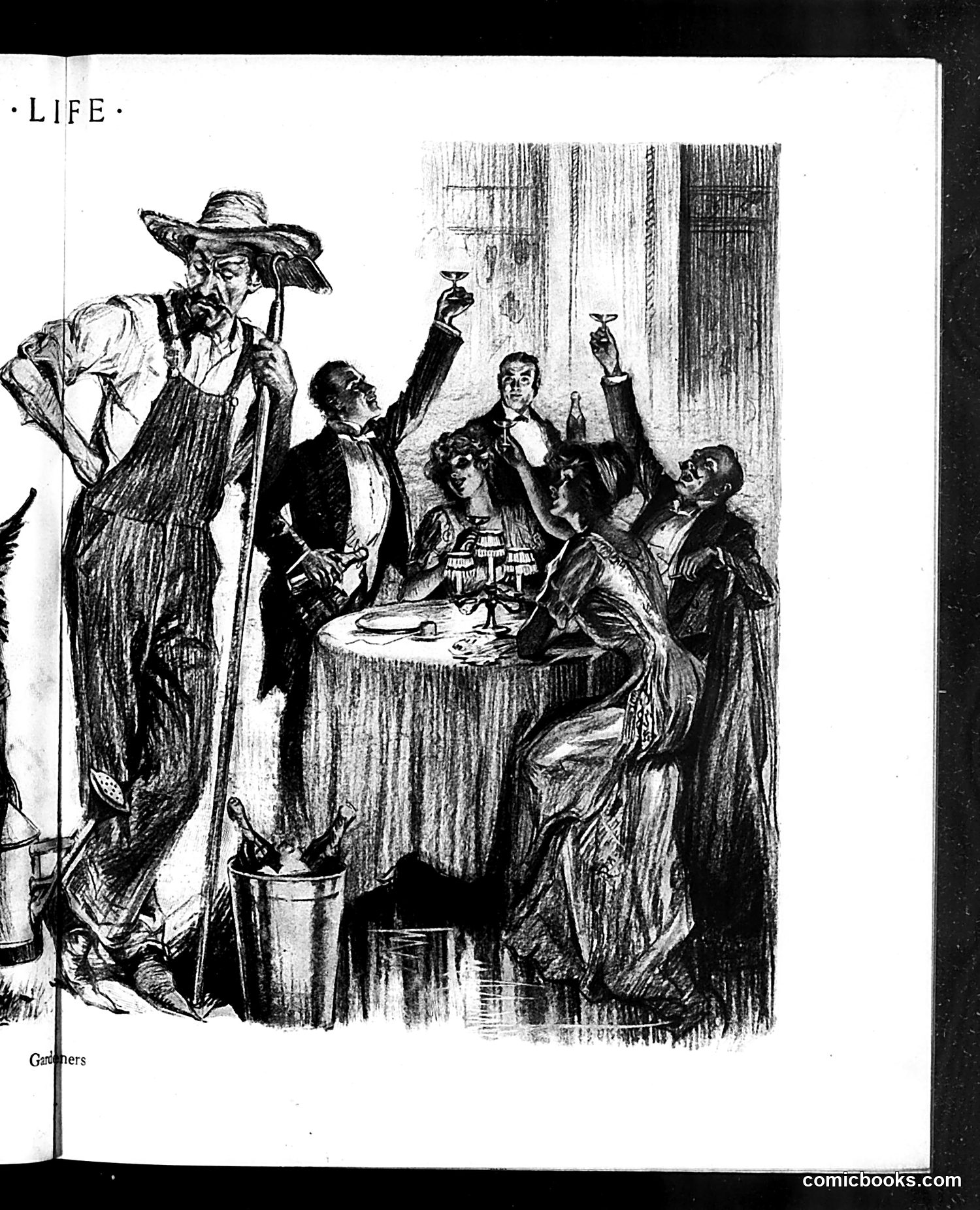
This page from *Life* magazine shows a satirical illustration of what appears to be a formal dinner or social gathering. A tall, gaunt figure on the left (wearing a cowboy hat and long coat) stands apart from a group of well-dressed men and women seated around a table, raising glasses in a toast. The contrast suggests social commentary about class divisions or outsider status. The OCR text is largely corrupted and illegible, making it impossible to identify the specific figures or political context with certainty. The artistic style and formal dress suggest early-to-mid 20th century American satire, but without readable captions or clearer context, the specific targets of the satire remain unclear. The signature appears to read "Gathers" or similar.
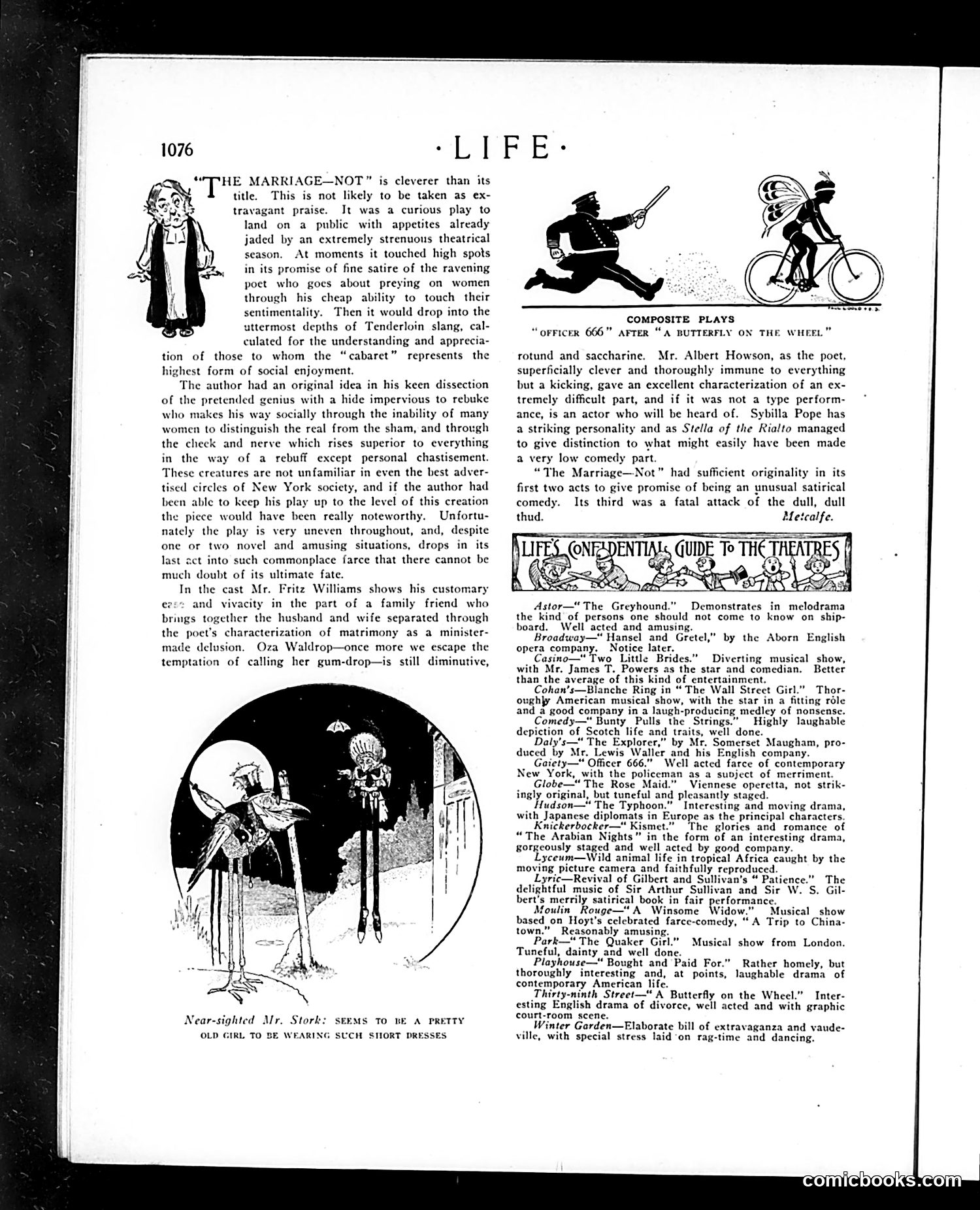
This page reviews "The Marriage—Not," a Broadway play about a manipulative poet who seduces women through fake sentiment. The critic finds it uneven: promising social satire in acts one and two, but collapsing into cheap "Tenderloin slang" (red-light district humor) by act three. The cartoon captioned "Near-sighted Mr. Stork" is a visual joke about modern women's fashion. It depicts a stork (the mythological bird that delivers babies) unable to recognize a woman from behind because her extremely short dress—apparently a contemporary trend—makes her indistinguishable from a child or "pretty old girl." The satire mocks both the absurdity of the fashion and society's apparent blindness to it. The page also lists other Broadway productions with brief assessments, giving readers a theatrical overview of the season.
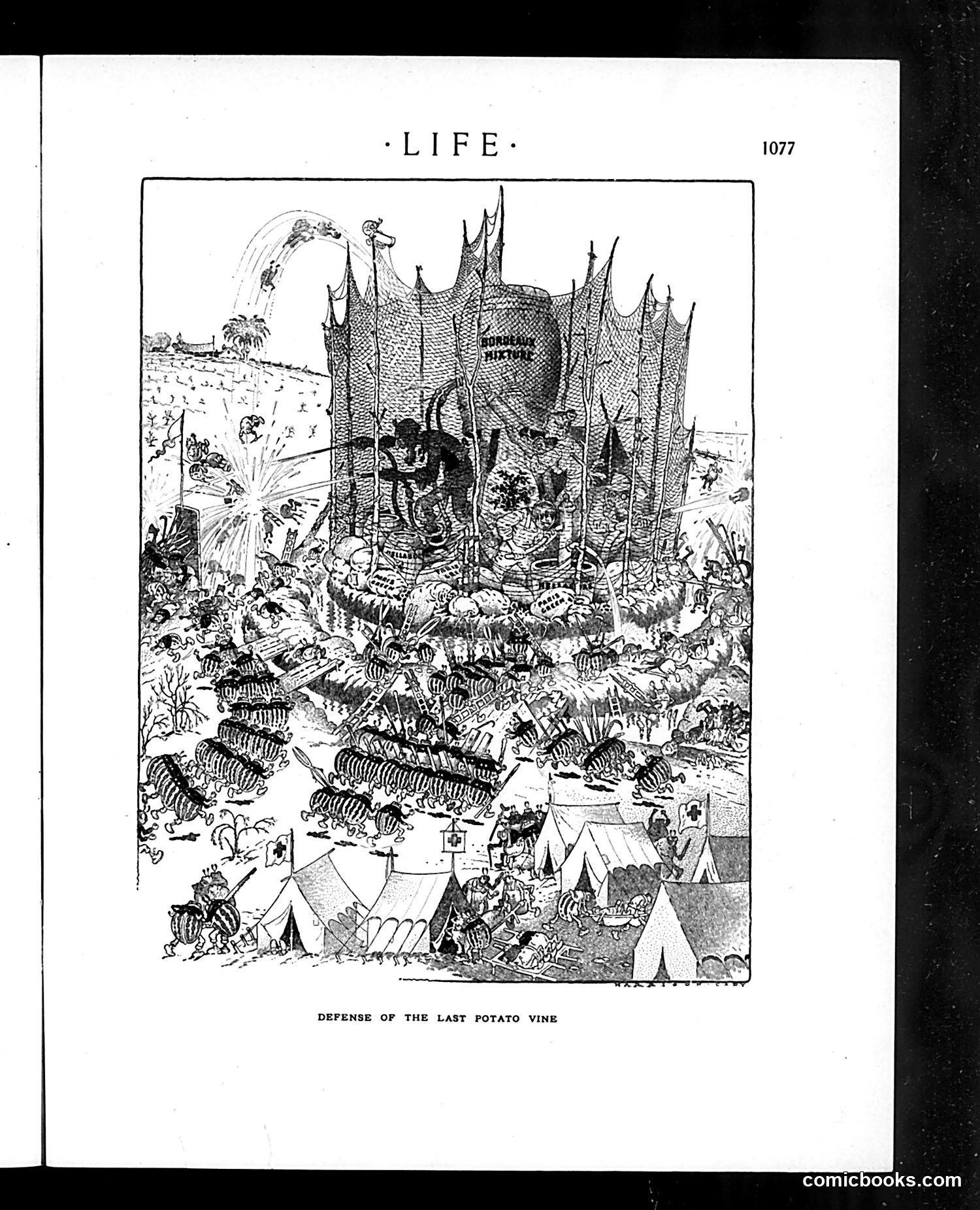
This satirical cartoon depicts a heavily fortified, castle-like structure defending a single potato vine against what appears to be an army of insects or pests. The fortress bristles with defensive spikes and towers, while soldiers man the ramparts and tents dot the surrounding landscape. The satire likely mocks either wartime agricultural rationing or exaggerated concerns about crop destruction by pests (possibly the Colorado potato beetle, a known agricultural threat). The "last" potato vine suggests scarcity—treating a trivial crop remnant as worthy of massive military fortification is absurdly disproportionate. This reflects early-20th-century Life magazine's tendency toward humorous social commentary, using hyperbole to mock either government overreach, wartime hysteria, or the anxiety surrounding food security.
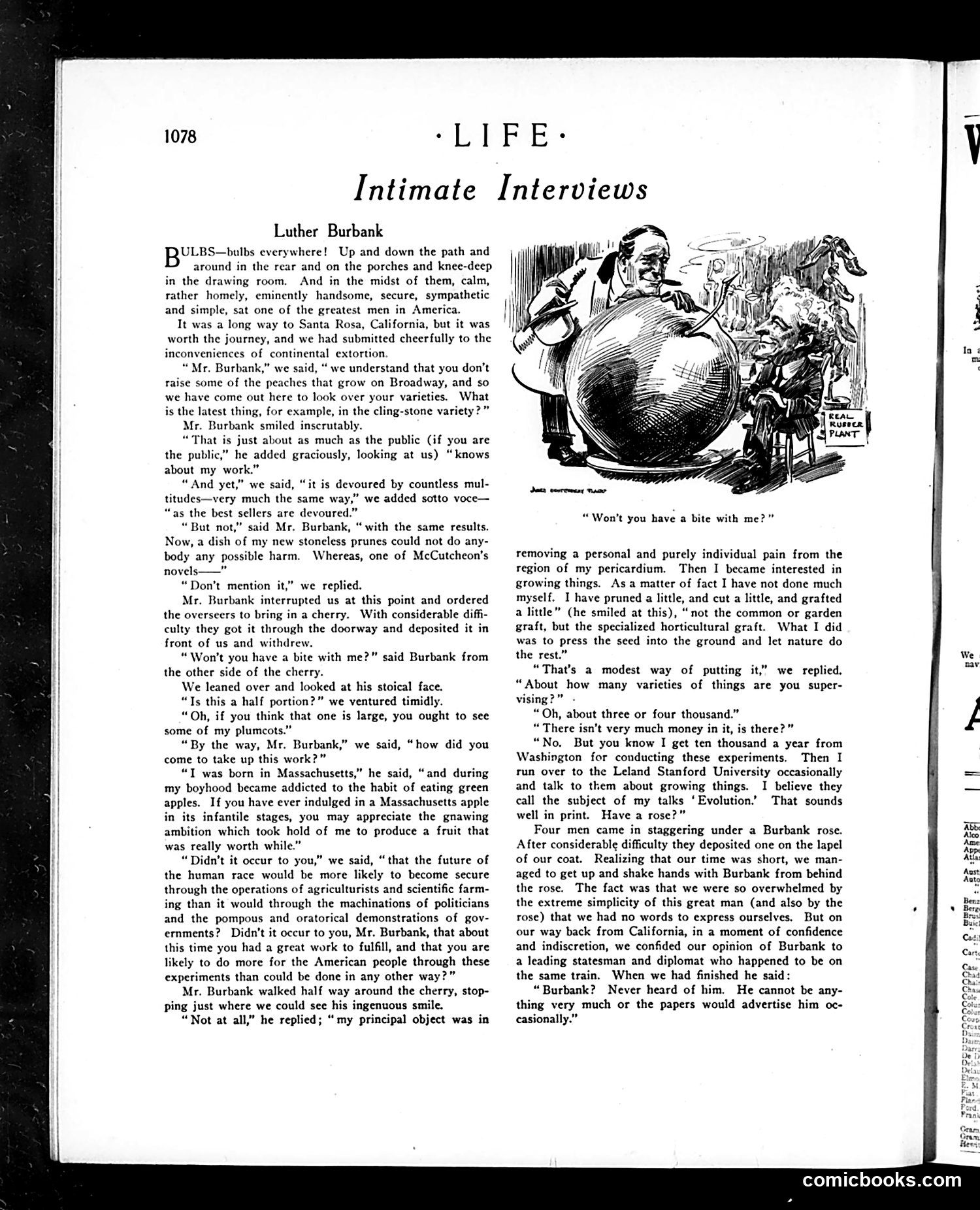
This is a humorous profile interview with Luther Burbank, the famous plant scientist and horticulturist. The joke centers on Burbank's massive, oversized produce—the cartoon shows him offering a comically enormous cherry to the interviewer, with a caption "Won't you have a bite with me?" The satire gently mocks both Burbank's modesty about his accomplishments and the interviewer's overly earnest, flattering questions about his contributions to humanity. Burbank deflates pretension by claiming he started simply to avoid eating bad Massachusetts apples, and that his real contribution was "pressing seed into the ground and let[ting] nature do the rest"—downplaying his role despite producing thousands of plant varieties. The piece also contains a dig at contemporary novelist George Barrie McCutcheon (referenced as harmful "like best sellers"), typical of Life's satirical culture criticism. The overall tone celebrates Burbank as genuinely great precisely *because* he's unpretentious about his work.
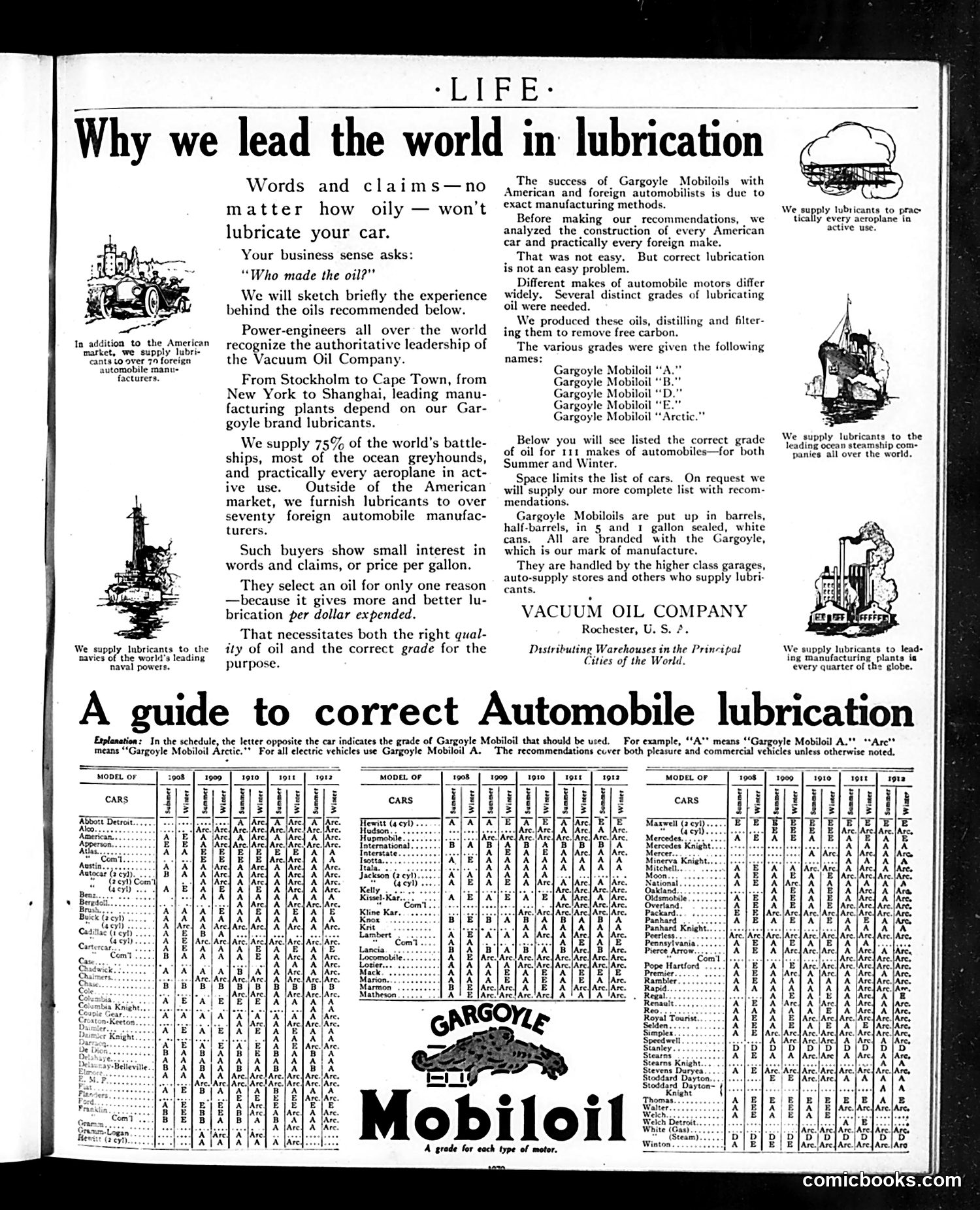
This is primarily a **Gargoyle Mobiloil lubricant advertisement**, not satirical content. The "Life" magazine branding appears to be part of the ad layout rather than editorial material. The page advertises Vacuum Oil Company's motor oil products by claiming market dominance: they supply lubricants to 75% of the world's battleships, ocean liners, aircraft, and seventy foreign automakers. The implicit argument is that if military and commercial industries trust their product, consumers should too. The humor—mild by modern standards—lies in the pun "oily" (describing both oil and insincere claims): "Words and claims—no matter how oily—won't lubricate your car." This deflates marketing hype while promoting their supposedly science-based approach. The bulk of the page is a technical **lubrication guide chart** listing 111 automobile makes (Abbott Detroit, Alco, Apperson, etc.) with recommended oil grades (A, B, D, E, Arctic) for different years (1908-1913). The small illustrations of ships, factories, and planes reinforce the advertiser's claims about industrial reach. This reflects early 1910s-era marketing emphasizing technological credibility and global scale.
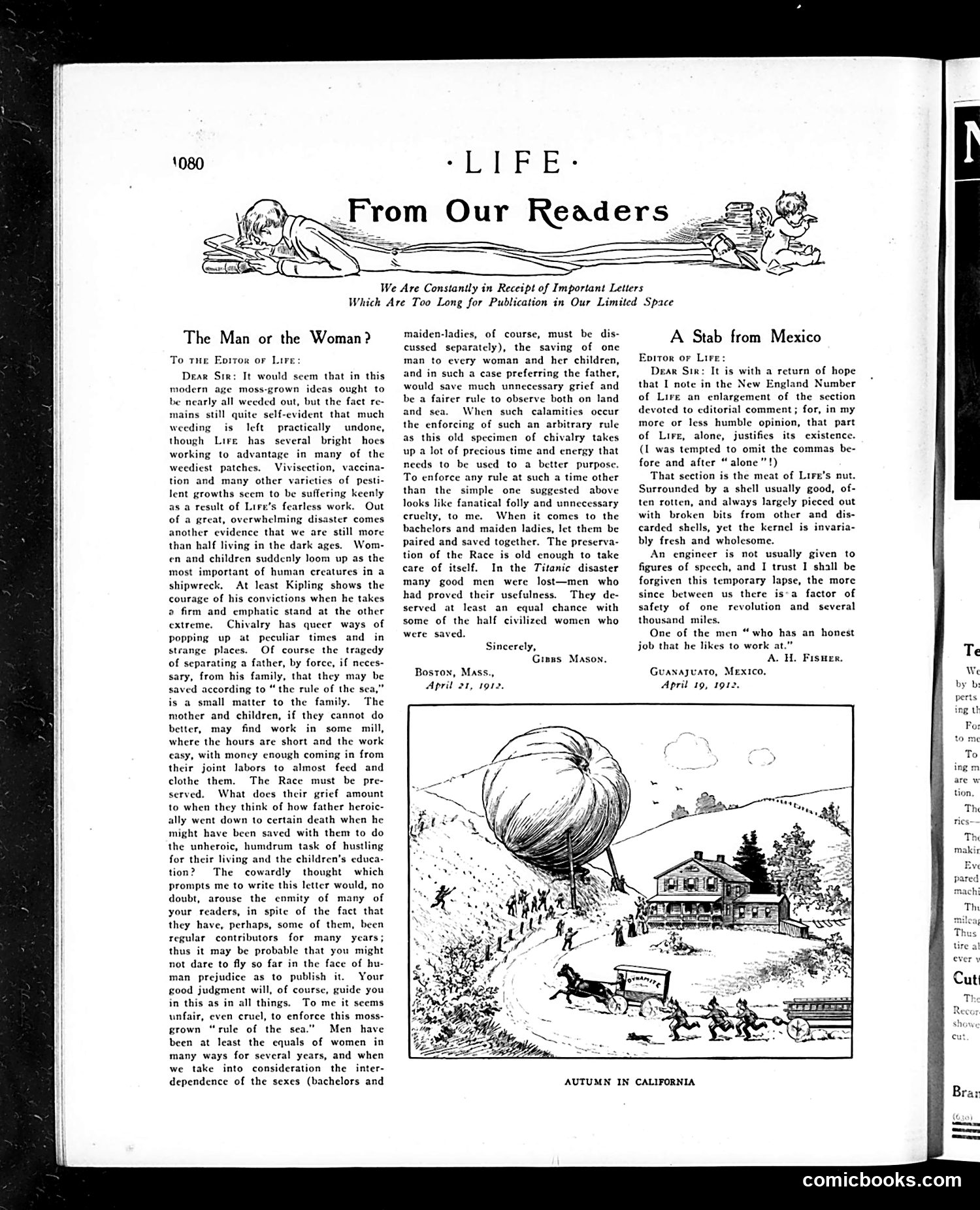
This "From Our Readers" page features two reader letters debating social issues of the early 20th century. **"The Man or the Woman?"** addresses maritime law and gender roles, likely sparked by the Titanic disaster (1912). The writer challenges the "women and children first" evacuation rule as archaic chivalry. He argues this arbitrary gender preference is cruel to families and illogical—that preserving useful men (proven contributors) makes more sense than saving "half civilized women." The letter sarcastically notes chivalry conveniently appears during disasters while ignoring women's economic hardship in normal times. **"A Stab from Mexico"** (incomplete here) appears to comment on Mexican affairs, though the full context is cut off. The cartoon "Autumn in California" depicts a hot-air balloon above a rural farmhouse—likely illustrating leisure/escape from industrial life, a common Life magazine theme. These letters reflect early Progressive Era debates about gender equality, with the first explicitly challenging Victorian chivalry codes as outdated and impractical.
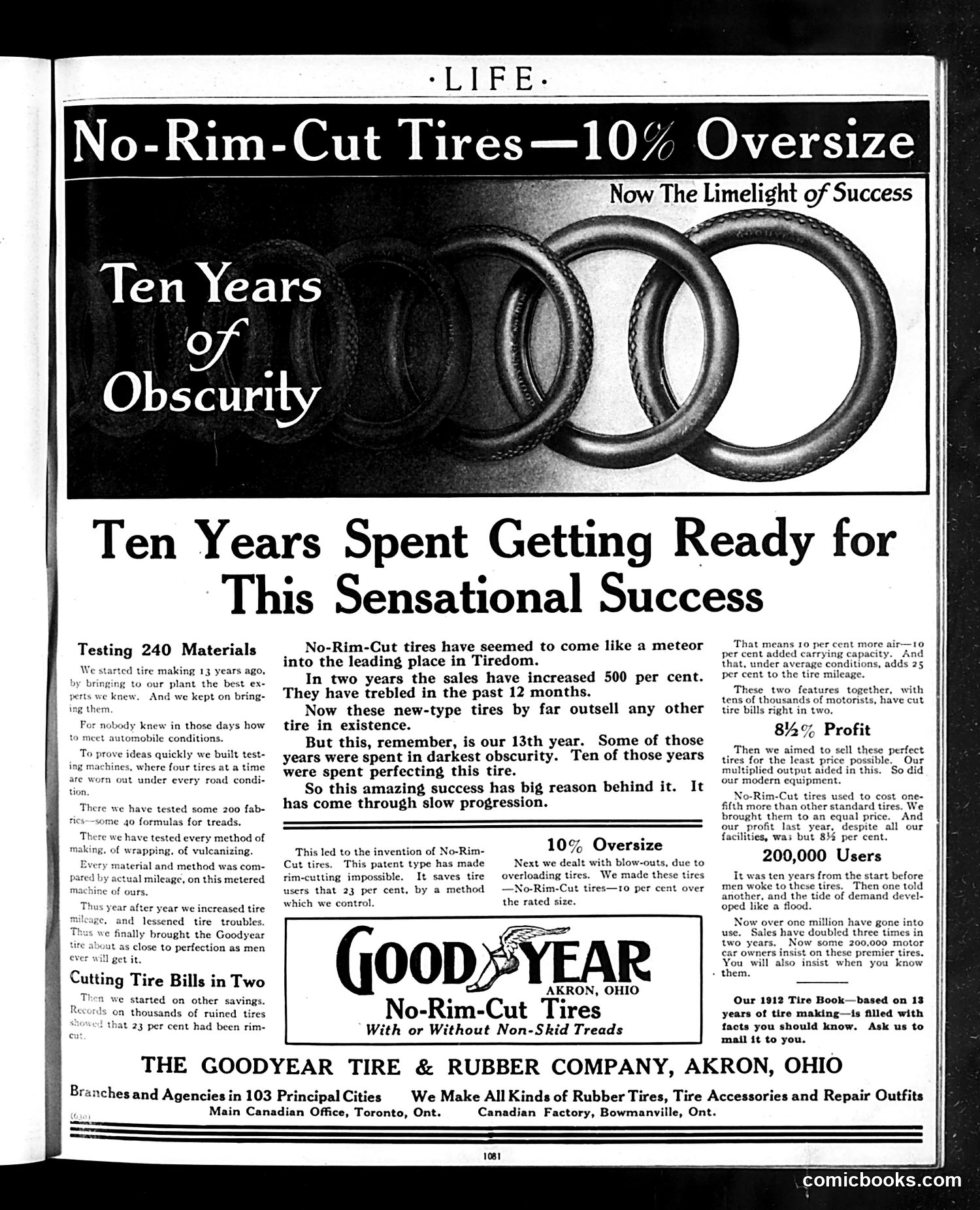
This is a **full-page advertisement**, not satire or political commentary. It's a Goodyear Tire & Rubber Company promotion for their "No-Rim-Cut" tires, published in *Life* magazine. The visual metaphor shows five tires progressing from dark to light, illustrating the company's narrative: ten years of obscure development ("darkest obscurity") before sudden market success. The ad emphasizes that this overnight success was actually built on a decade of testing 240 materials and 40 tread formulas. Key selling points highlighted: - **No-Rim-Cut design** prevents rim damage (saves 23% tire wear) - **10% Oversized** for greater load capacity (adds 25% mileage) - Sales increased 500% in two years; 200,000 users now - Price reduced from premium to equal competitors despite superior performance - Company maintained only 8½% profit margin This reflects early automotive-era marketing: emphasizing rigorous scientific development to justify premium pricing and build consumer confidence in an evolving technology.
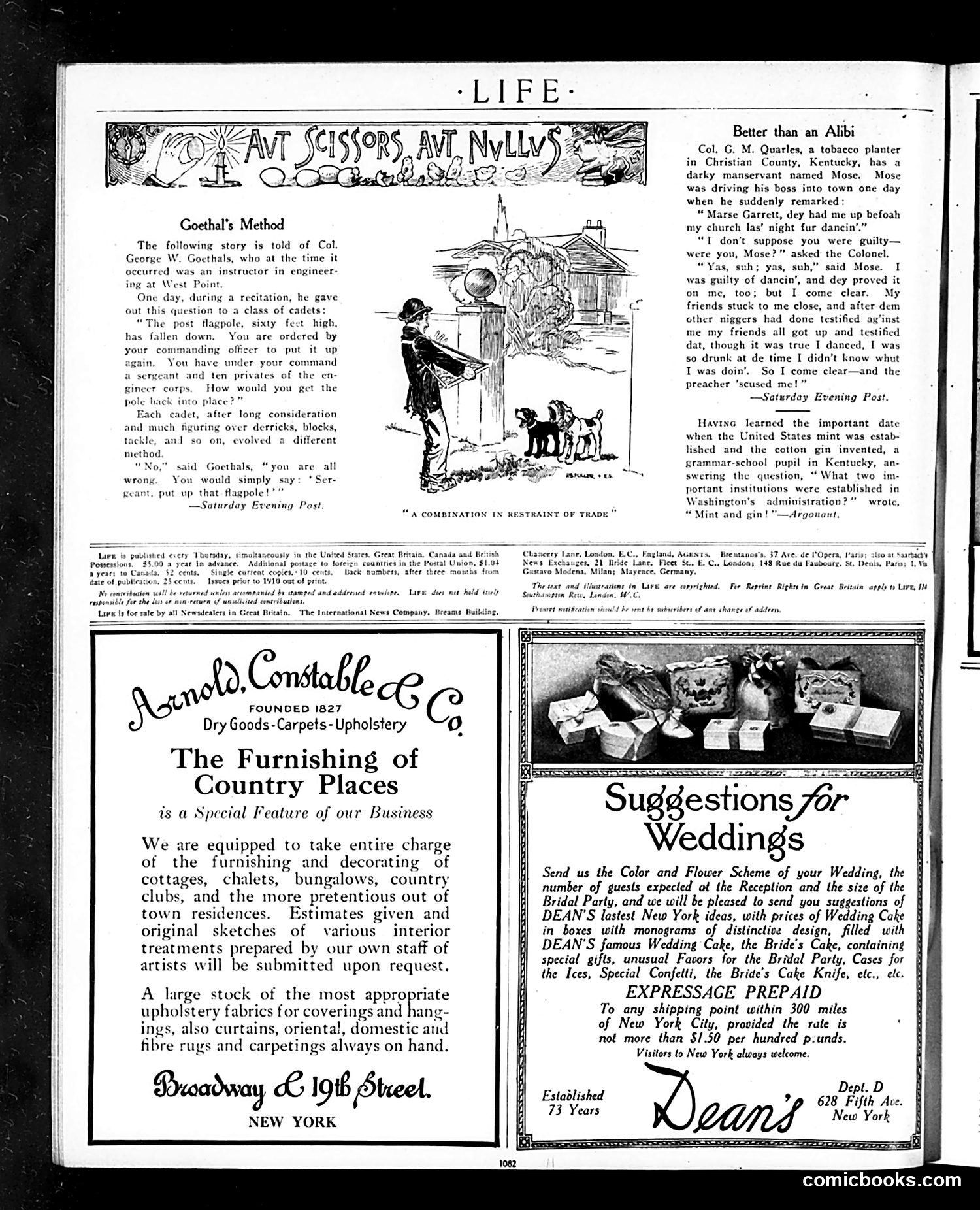
This page contains three brief humorous anecdotes rather than political cartoons. **"Goethal's Method"** mocks military over-complication. Col. Goethals, an engineering instructor at West Point, posed cadets an elaborate problem about raising a fallen flagpole using derricks and tackle. His punchline: simply order the sergeant to do it. The joke satirizes military bureaucracy and unnecessary complexity. **"Better than an Alibi"** uses period dialect humor (transcribed in contemporary racist language) about a Black servant named Mose who dodged church discipline for dancing by claiming drunkenness—his friends' testimony that he was too intoxicated to know his actions secured his pardon. The humor relies on stereotypes about Black speech and behavior. **The schoolchild anecdote** presents wordplay: when asked which two important institutions were established in Washington's administration, a student answers "Mint and gin"—confusing the U.S. Mint and cotton gin (actual inventions) with alcoholic beverages. The page is primarily advertisements for Arnold, Constable & Co. and Dean's Wedding Services.
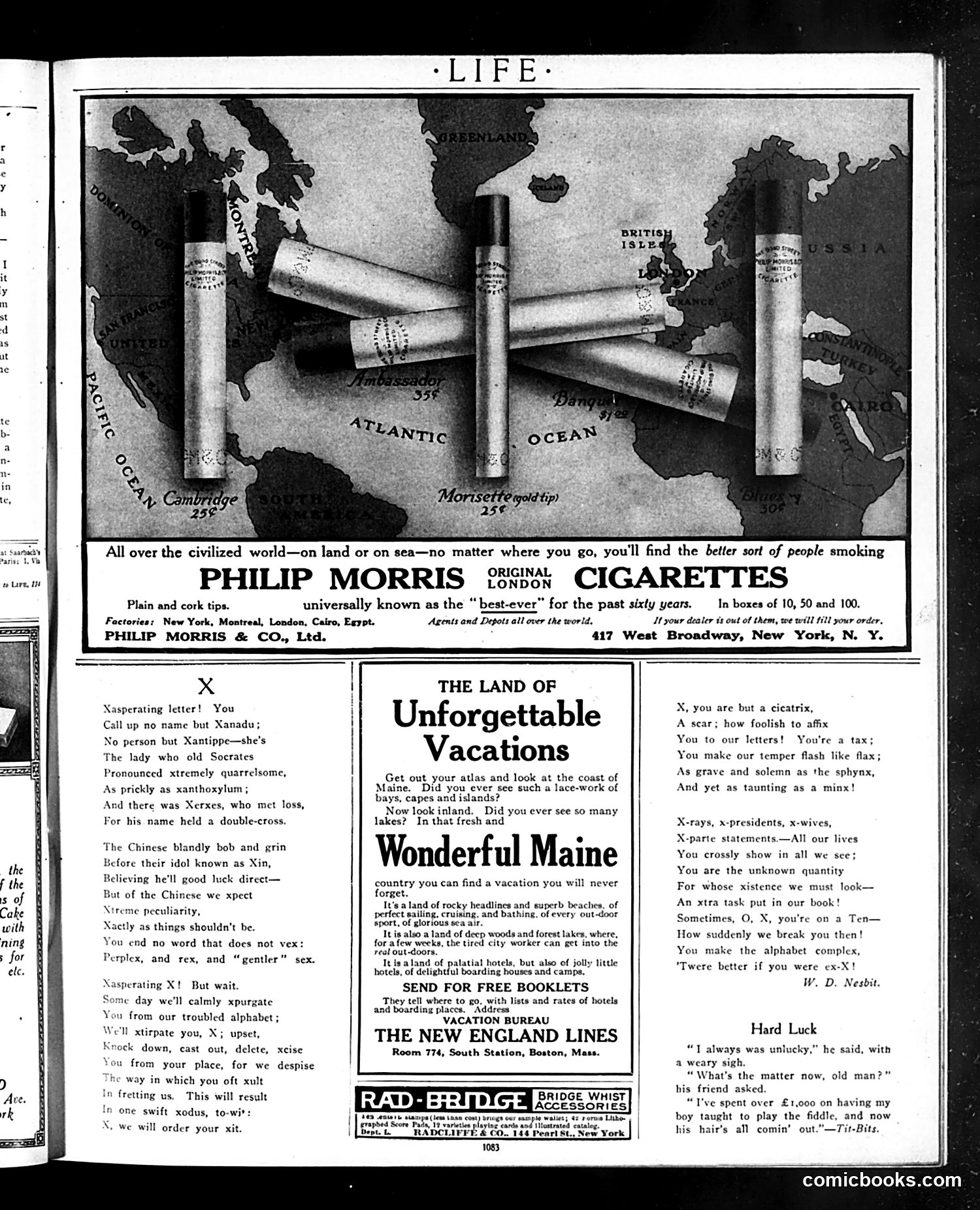
This page is primarily **advertising and light humor**, not political satire. The top features a **Philip Morris cigarette advertisement** using a globe map with cigarettes positioned as trade routes, claiming their product is smoked by "the better sort of people" worldwide—a common early 20th-century marketing pitch positioning cigarettes as markers of sophistication. Below are three separate pieces: 1. **"X" poem** by W.D. Nesbit: A humorous complaint about the letter X in English, calling it irritating, useless, and difficult. It's wordplay satire of language itself, not politics. 2. **Maine vacation advertisement**: A travel bureau promoting Maine's attractions—beaches, lakes, hotels—straightforward tourism marketing. 3. **"Hard Luck" joke**: A brief anecdote about a man who spent £1,000 teaching his son violin, only for the boy to lose his hair—a joke about wasted money and ironic misfortune, not political commentary. The page reflects early 20th-century Life magazine's mix of advertising, light verse, and humor rather than serious political cartooning.
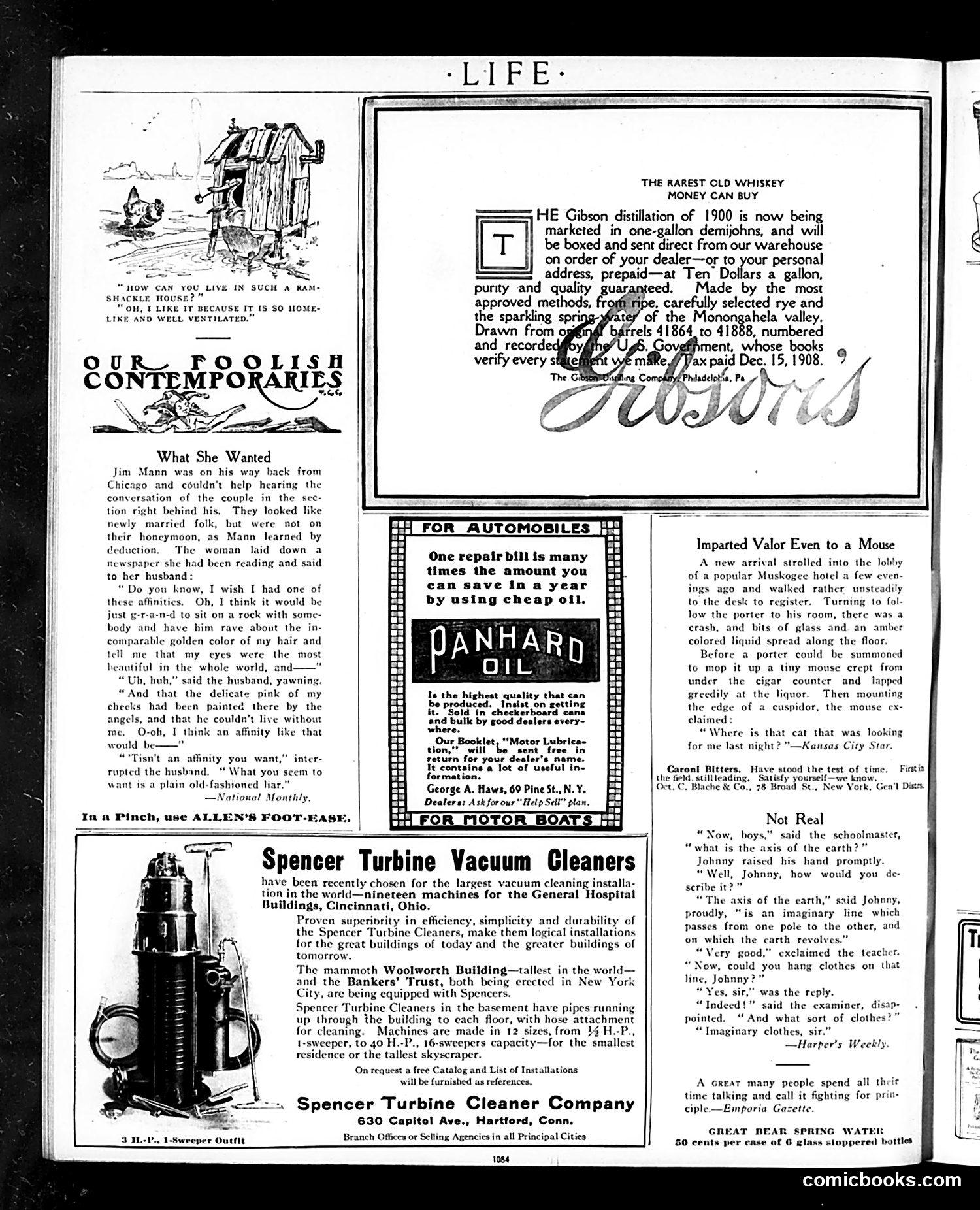
This page contains several distinct humor pieces typical of Life's satirical format: **"What She Wanted"** presents a marital comedy: a newly married couple overhear a woman tell her husband she wishes for romantic flattery—someone to praise her beauty and declare he cannot live without her. The husband's deadpan response—that she wants "a plain old-fashioned liar"—mocks both romantic sentimentality and marital disillusionment. The joke targets the gap between women's romantic ideals and husbands' skeptical practicality. **"Imparted Valor Even to a Mouse"** is a brief, absurdist anecdote: a drunk hotel guest spills whiskey; a mouse drinks it, becomes emboldened, and cheekily asks where the cat went. The humor relies on personification and the incongruity of a drunk mouse displaying unexpected bravado. **"Not Real"** features a schoolmaster asking about Earth's axis. Johnny's definition—"an imaginary line"—suggests it's literally fictional rather than physically real, playing on the distinction between abstract concepts and material reality. The page is otherwise dominated by advertisements for whiskey, automobile oil, and vacuum cleaners.
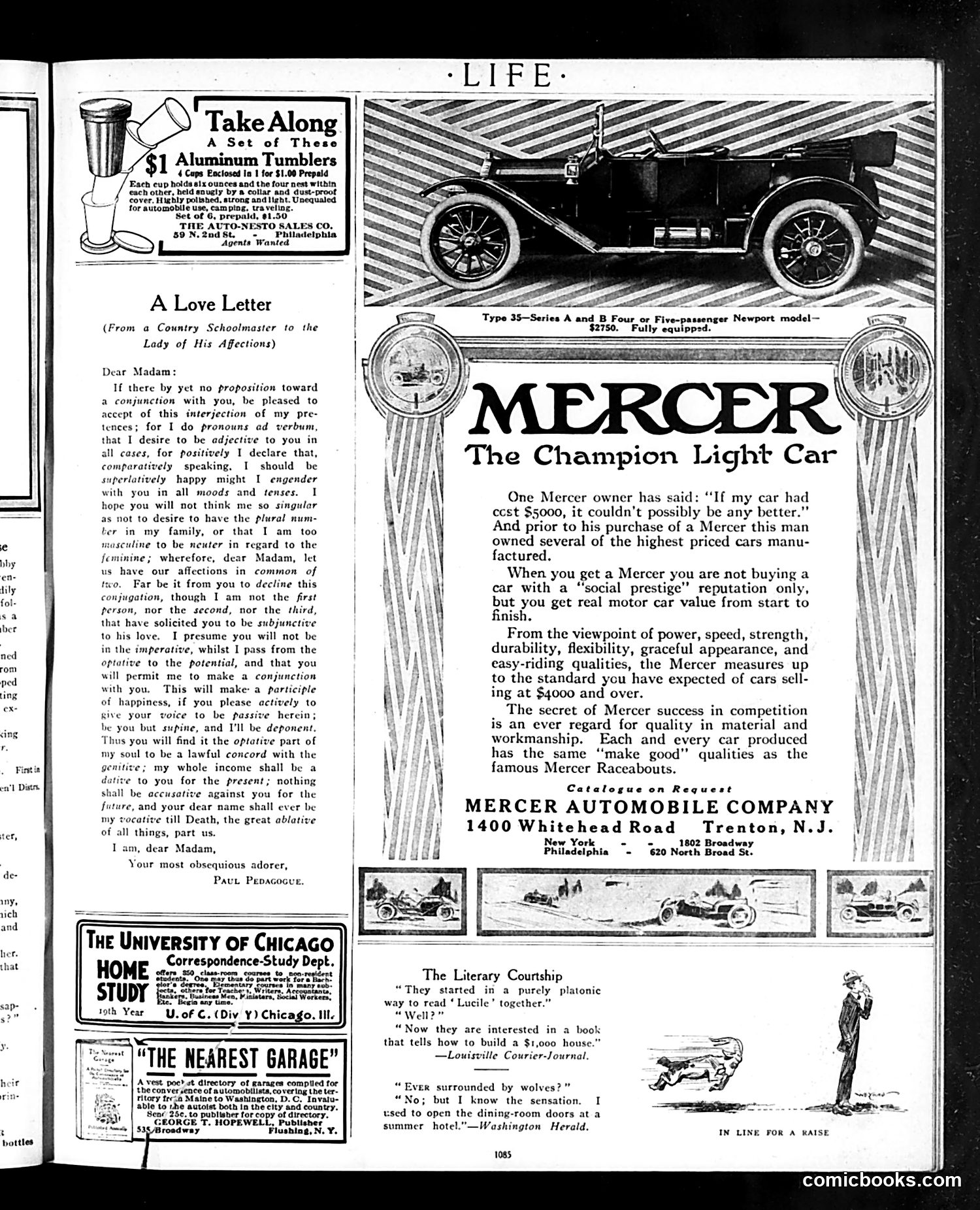
This page is primarily **advertising and light humor** rather than political satire. The main elements are: **"A Love Letter"**: A genteel parody of grammatically-correct courtship. A country schoolmaster proposes marriage using elaborate grammatical terminology ("conjunction," "subjunctive," "dative"). The joke is the absurd formality and pretension of expressing affection through linguistic jargon—satirizing overly intellectual or affected speech in romantic contexts. **"The Literary Courtship"**: A brief comic snippet about a couple who shared literary interests, now interested in practical home-building, mocking romantic idealism versus real-world concerns. **"In Line for a Raise"**: A man jokes about sensing wolves surrounding him—revealing he once opened dining-room doors at a hotel, comparing the sensation to feeling threatened. This is mild workplace humor. The page also features substantial **car and correspondence-school advertisements**, indicating this is a commercial magazine issue mixing editorial humor with paid promotions. No specific political references or caricatures are evident.
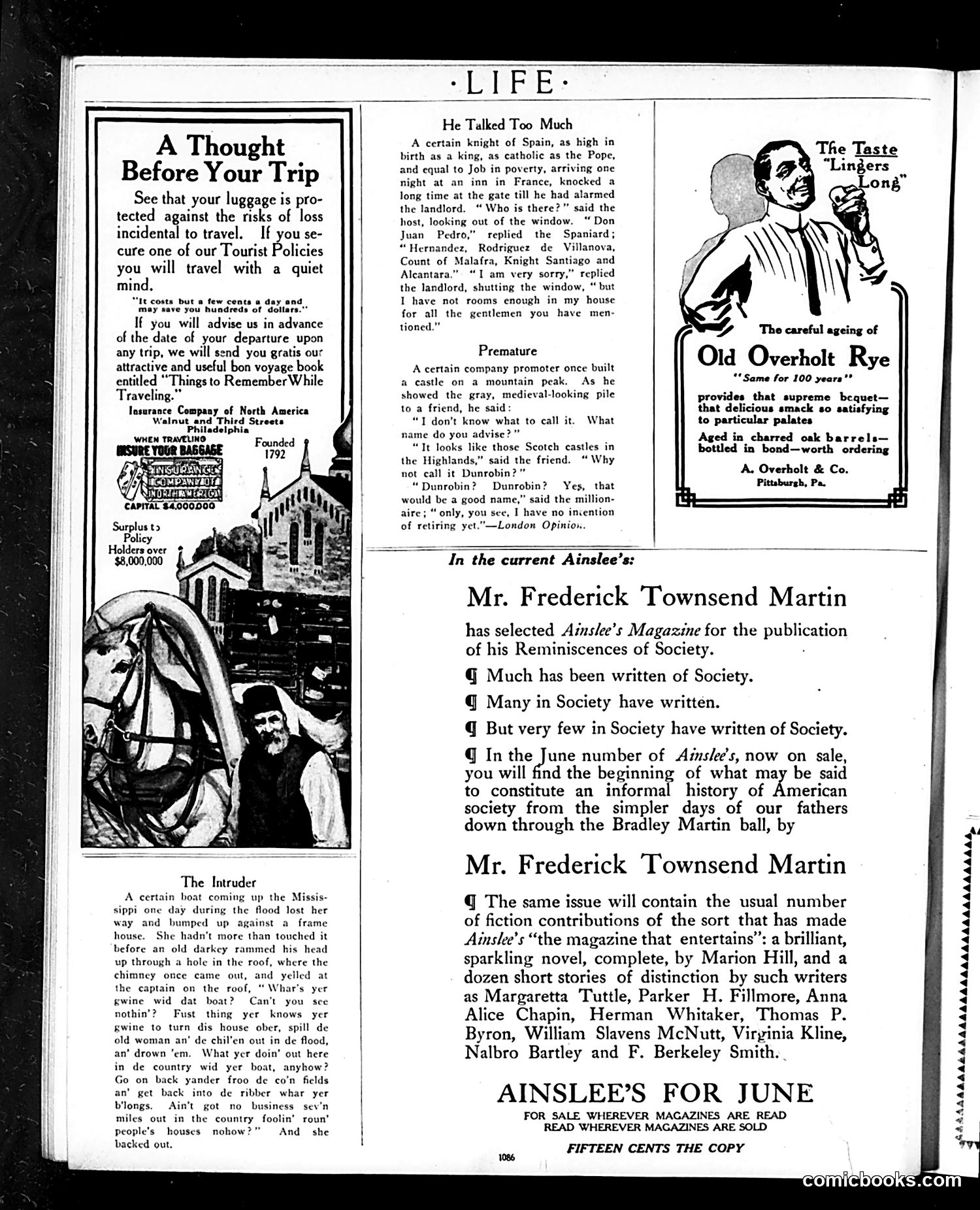
This page contains three humor anecdotes and period advertisements. **"The Intruder"** is a dialect humor piece featuring a stereotypical African American character (rendered in exaggerated dialect) who confronts a steamboat captain for threatening a house during a Mississippi flood. The "joke" relies on the era's popular "darkey" humor—caricatured Black speech presented as comic relief. **"He Talked Too Much"** mocks a Spanish nobleman whose excessively long list of titles and names causes a French innkeeper to refuse him lodging, claiming insufficient rooms for "all the gentlemen you have mentioned." **"Premature"** satirizes a wealthy industrialist who names his newly-built castle "Dunrobin" but admits he has no intention of retiring—the joke being he's prematurely adopting the trappings of inherited aristocratic leisure. The advertisements promote travel insurance and Old Overholt whiskey. A section advertises *Ainslee's Magazine*'s upcoming Frederick Townsend Martin society memoir series.
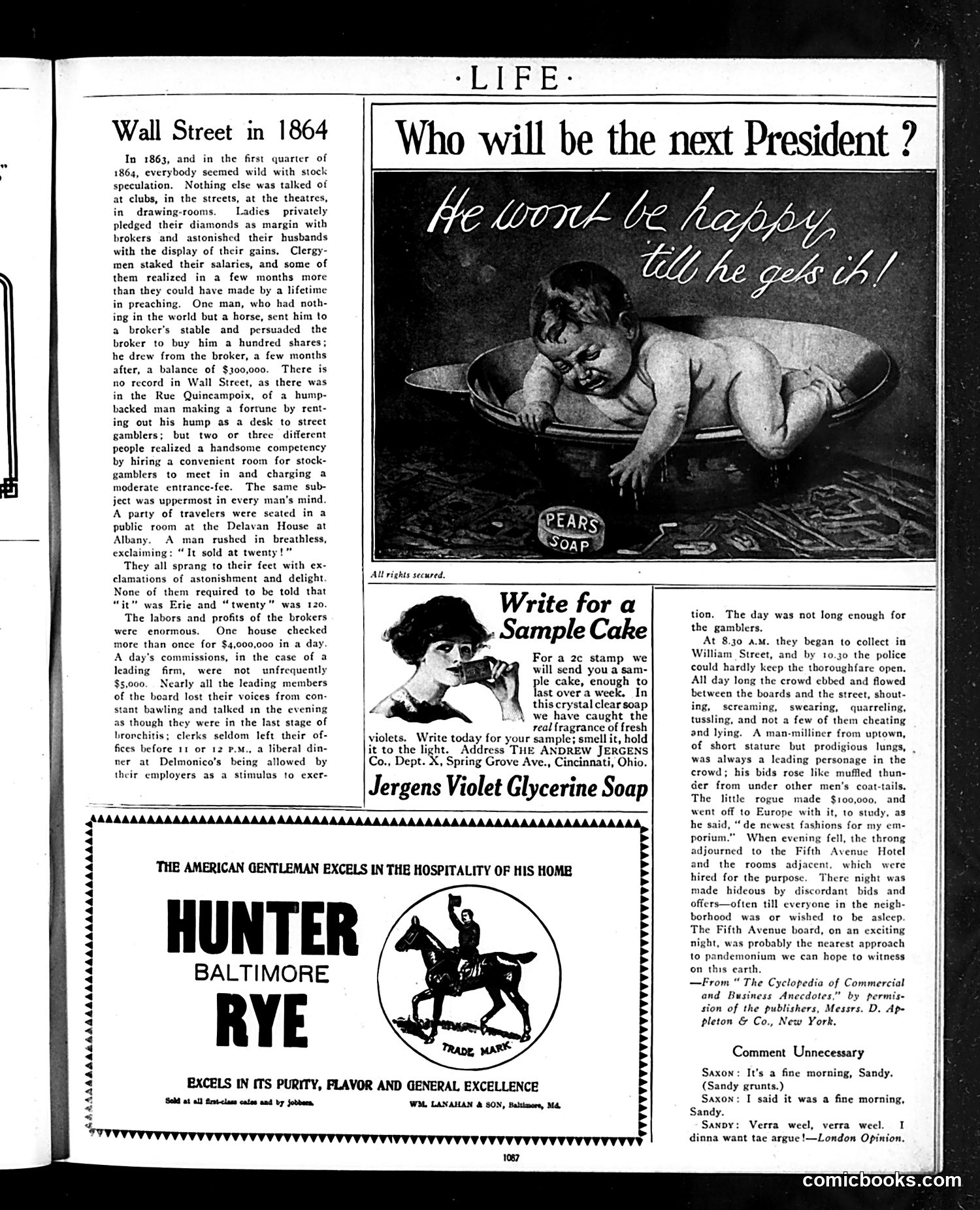
This page from Life magazine addresses the 1864 presidential election amid the Civil War's final year. The headline "Who will be the next President?" accompanies an image of a sleeping figure labeled with Pears Soap—a satirical commentary suggesting the electorate is indifferent or complacent about the choice ahead. The left column recounts Wall Street speculation during 1863-1864, depicting frenzied stock gambling where even clergy and society women wagered fortunes on Erie Railroad shares. A broker allegedly made $4,000,000 commissions daily. This describes a financial bubble driven by wartime profiteering. The satire suggests a disconnect: while the nation faces existential crisis (Civil War), Americans obsess over stock speculation rather than presidential governance. The sleeping figure implies public apathy toward selecting war leadership, preferring commercial opportunity instead. The remainder contains period advertisements (Jergens Soap, Hunter Baltimore Rye), standard for Life's revenue model.
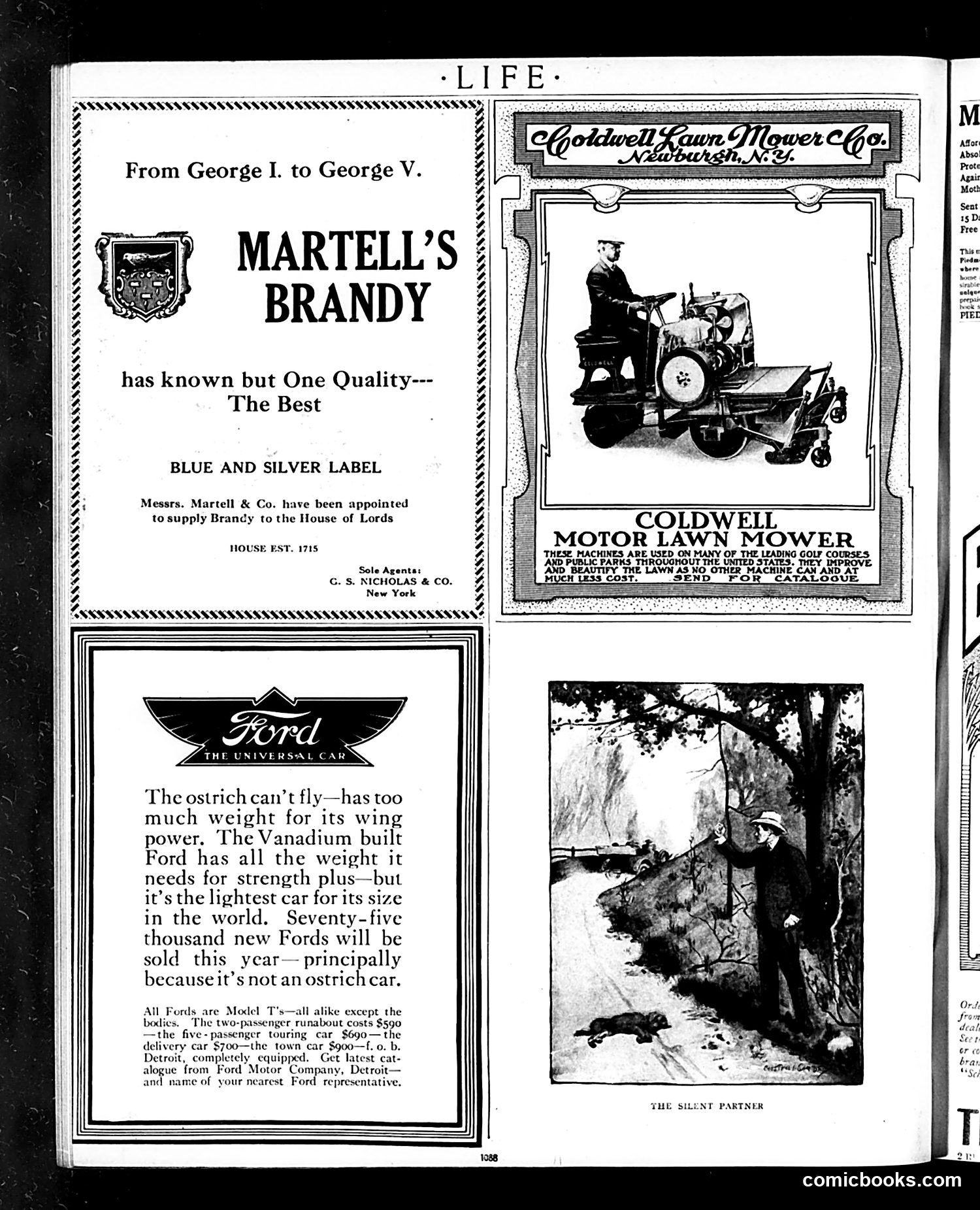
This page is primarily **advertising**, not editorial satire. It contains four advertisements: 1. **Martell's Brandy**: Claims centuries of quality ("From George I. to George V."), referencing British monarchs to suggest historical prestige and royal patronage to the House of Lords. 2. **Coldwell Motor Lawn Mower**: Features machinery used on golf courses, targeting wealthy consumers. 3. **Ford Model T**: The only piece with satirical commentary. Ford's text humorously defends the car against implicit criticism by comparing it to an ostrich—"it can't fly" because it's too heavy, but the Ford is "the lightest car for its size," thus practical rather than pretentious. The joke undercuts luxury car competitors by embracing Ford's utilitarian design. 4. **Untitled photograph** ("The Silent Partner"): Unclear without caption what this depicts. The Ford ad's humor lies in its self-aware defensiveness about the Model T's spartan design, positioning practicality as superiority over flashier alternatives.
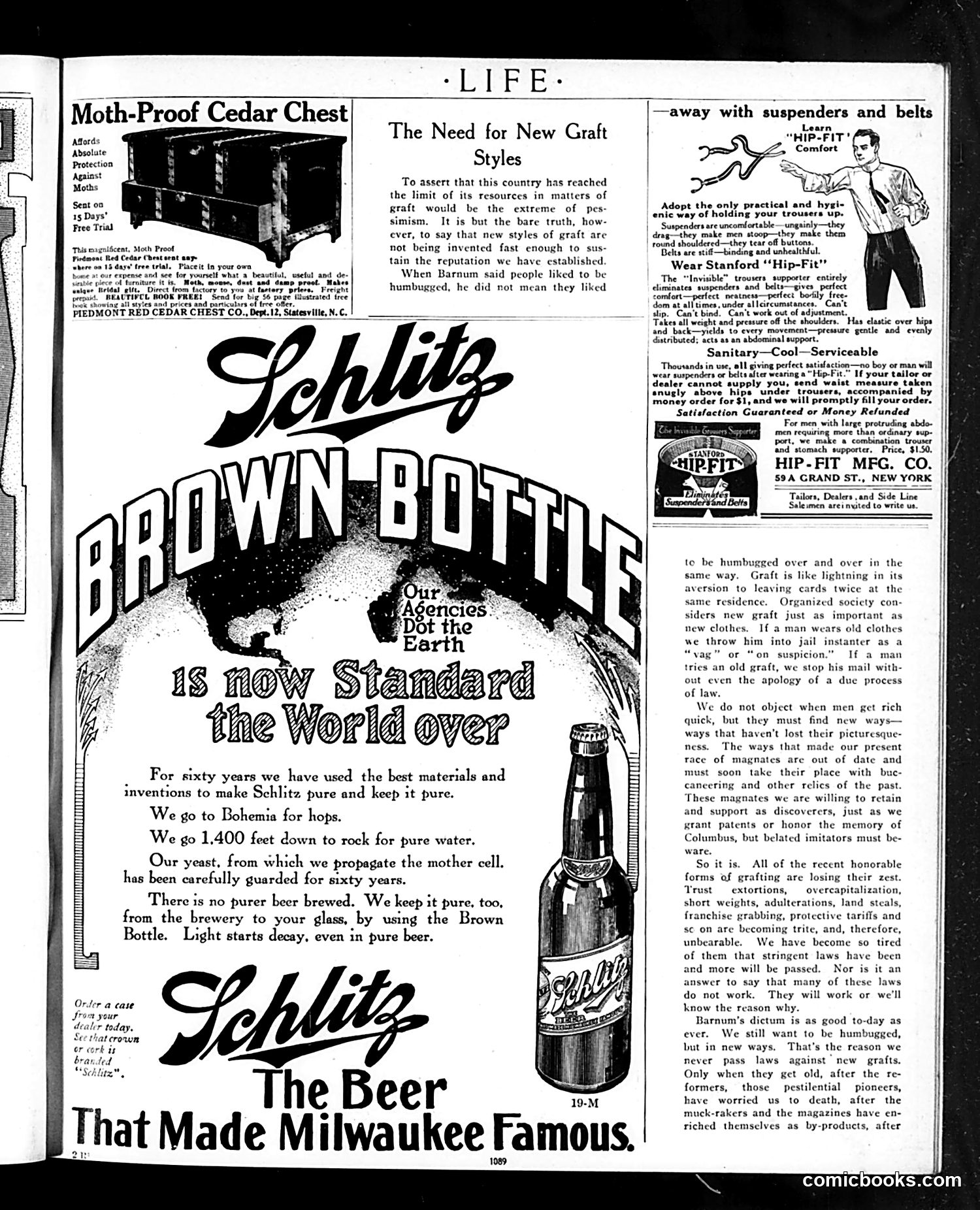
This page combines advertisements with satirical commentary on American corruption. **The Main Satire:** "The Need for New Graft Styles" mocks how American society tolerates wealth-building through dishonest means—"graft"—as long as the methods are novel. The author argues that old corruption methods (used by current "magnates") have become tired and legally restricted, so society essentially demands criminals invent *new* schemes. References to Barnum and P.T. Barnum's philosophy about people enjoying being "humbugged" underscore the cynical view that deception is central to American life. **The Point:** Early-20th-century corruption has become so normalized that the real complaint isn't graft itself, but *repetitive* graft. The piece satirizes how the wealthy face legal consequences only when their schemes become dated enough to offend public sensibilities. **Advertisements:** The page also features typical era ads for a cedar chest (moth-proof storage) and "Hip-Fit" trouser supporters—practical goods marketed to male readers. The satire reflects Progressive Era anxiety about unchecked corporate corruption and hypocrisy.
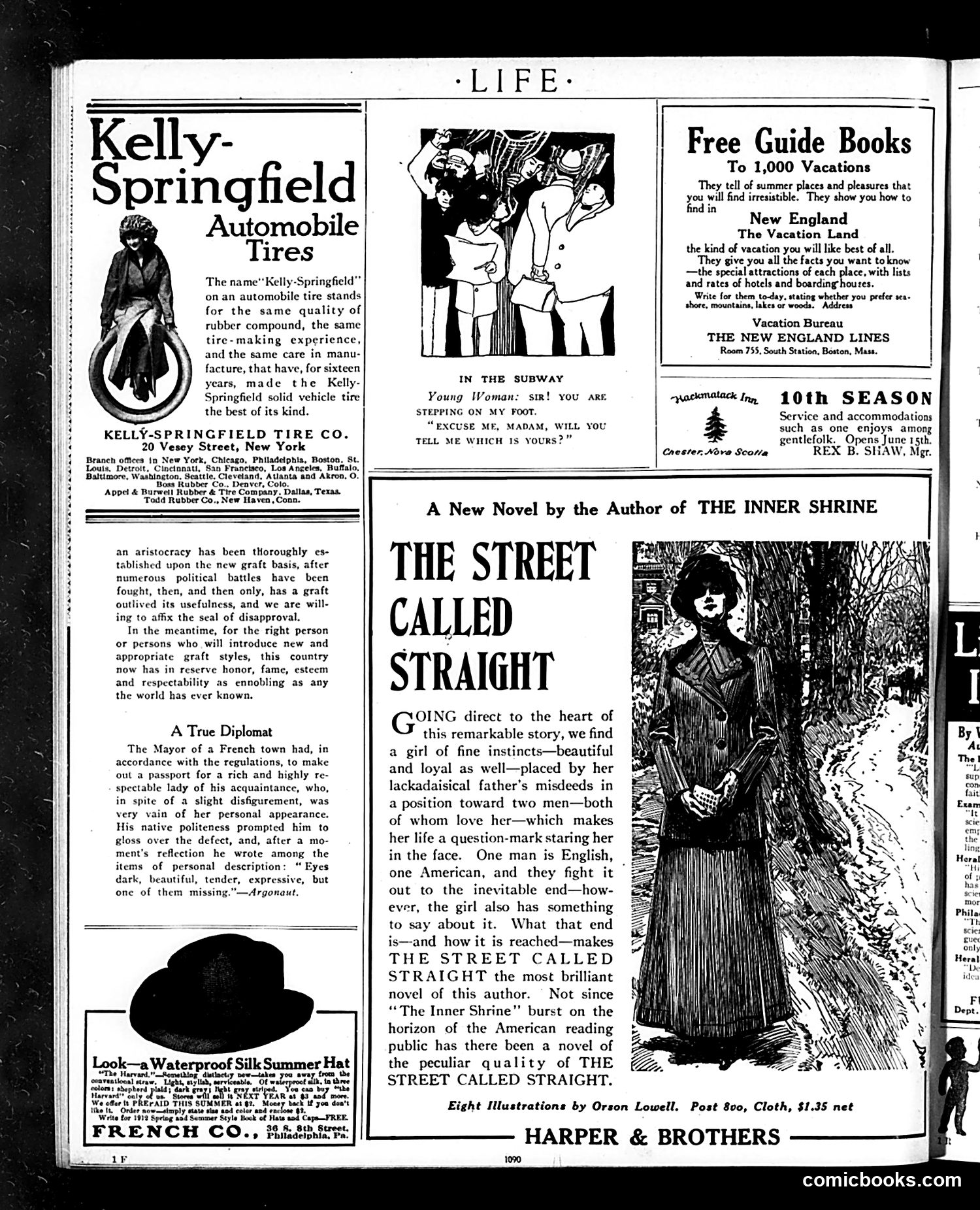
This page is primarily **advertising and literary promotion** rather than political satire. The main content includes: **The "Subway" Cartoon** (center): A humorous social observation showing a crowded subway where a woman complains a man is stepping on her foot. His response—asking which foot is hers amid the crush—is a joke about urban anonymity and overcrowding, not political commentary. **"A True Diplomat"** (left column): A satirical anecdote about a French mayor tactfully describing a vain woman's facial disfigurement as "tender, expressive" in her passport. The humor lies in diplomatic politeness masking unflattering truths—a gentle jab at social conventions. **Remaining content**: Mostly advertisements for Kelly-Springfield tires, vacation guides, summer hats, and—prominently—Harper & Brothers' novel "The Street Called Straight." A brief editorial note about establishing "new graft styles" appears satirical but lacks clear political specificity. The page reflects early 20th-century *Life* magazine's blend of light social satire, humor, and commercial content.
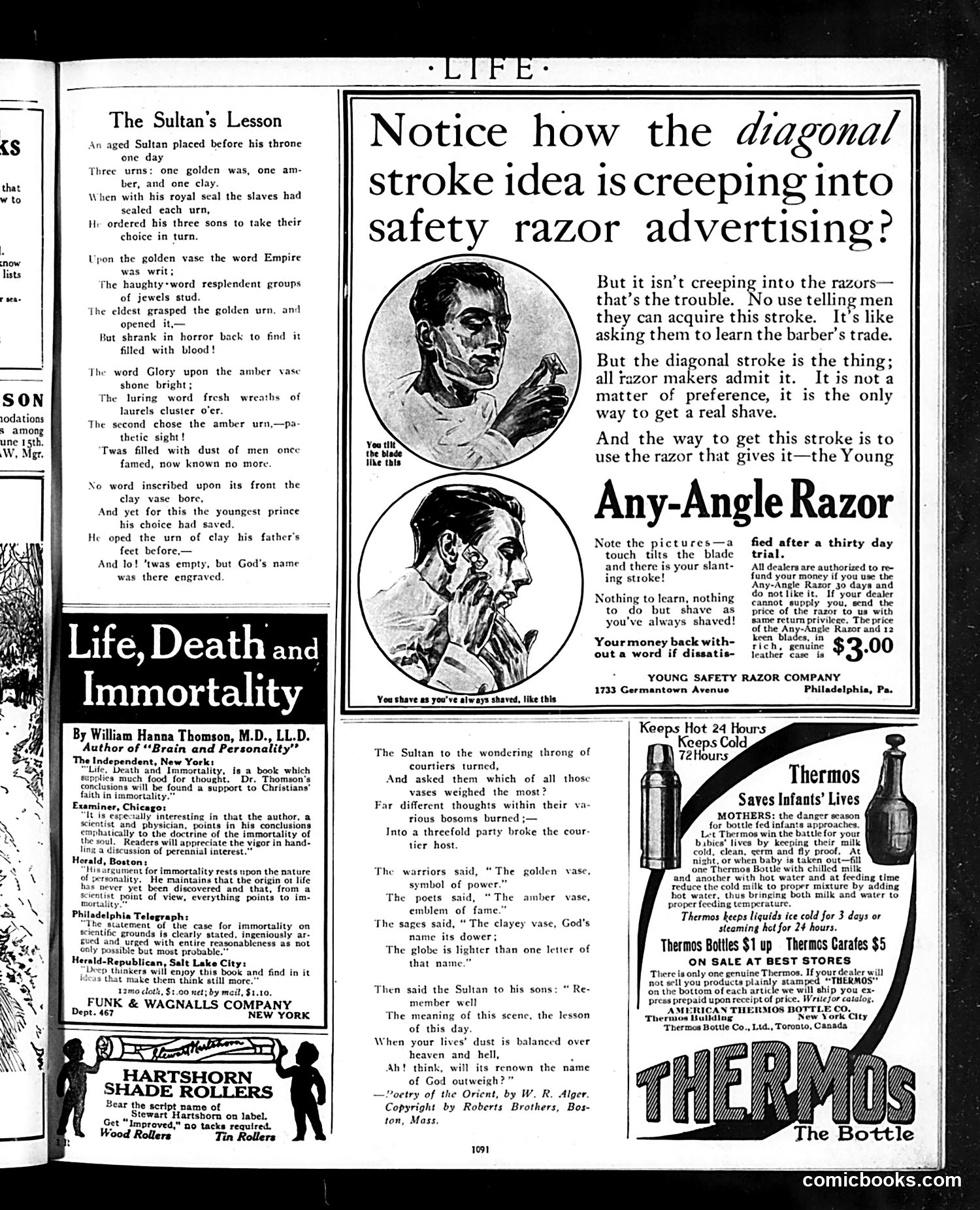
This page primarily contains **advertisements and literary content** rather than political cartoons. **Main Content:** - A poem, "The Sultan's Lesson," retelling an Oriental moral tale about three urns representing Empire (filled with blood), Glory (filled with dust of dead men), and God's name (empty but sacred). The lesson warns that earthly power and fame are hollow compared to divine purpose. - A book advertisement for *Life, Death and Immortality* by William Hanna Thomson, M.D., promoting Christian perspectives on immortality. **Advertisements:** - The **Any-Angle Razor** ad critiques competitors for claiming a "diagonal stroke" is important while failing to actually deliver it. The ad argues only the Any-Angle Razor achieves this necessary shaving technique. - **Thermos bottles** ("Keeps Hot 24 Hours") marketed as saving infants' lives by maintaining proper milk temperature. - **Hartshorn Shade Rollers** for window blinds. The page reflects early 20th-century concerns: consumer product differentiation, infant health/mortality, and moral/spiritual reflection—typical of *Life* magazine's mix of satire, literature, and advertising.
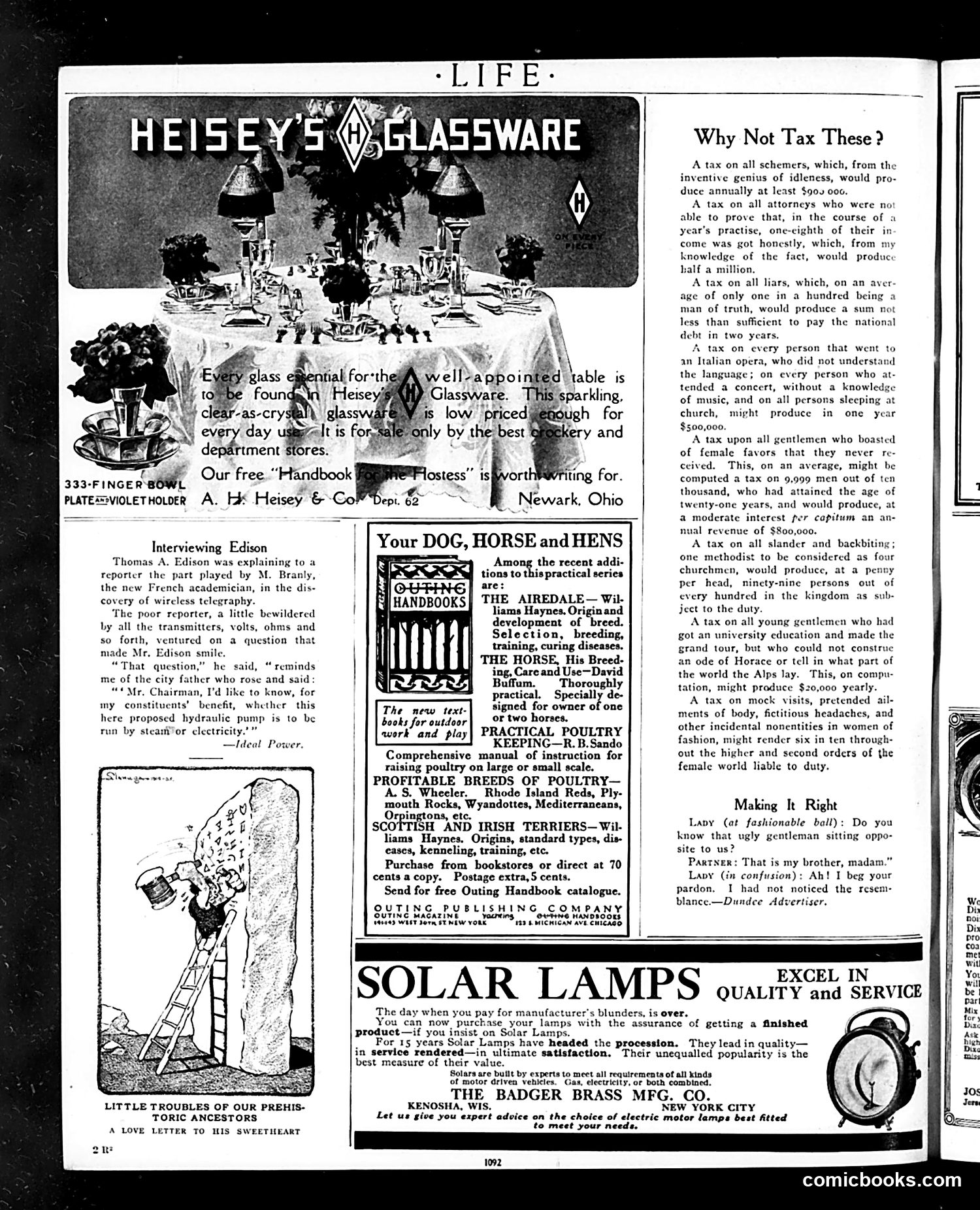
This page contains mostly **advertisements and satirical humor pieces** typical of early Life magazine. The main satirical content is **"Why Not Tax These?"**—a tongue-in-cheek proposal to impose taxes on various social vices and foolishness: schemers, dishonest lawyers, liars, people attending operas without understanding Italian, concert-goers ignorant of music, people sleeping in church, men falsely boasting of romantic conquests, and gossipers. The humor lies in the absurdist premise that such taxes could solve national debt and fund government services—mocking both human folly and the era's enthusiasm for taxation as a solution to social problems. **"Interviewing Edison"** is a brief anecdote mocking a city official's ignorance, where a politician asks whether a proposed hydraulic pump runs on "steam or electricity"—poking fun at politicians' technical incompetence during the industrial age. **"Making It Right"** is a short joke about a woman mistaking an ugly gentleman for someone else, then awkwardly apologizing when told he's her partner's brother. The remainder consists of product advertisements (glassware, animal husbandry books, solar lamps).
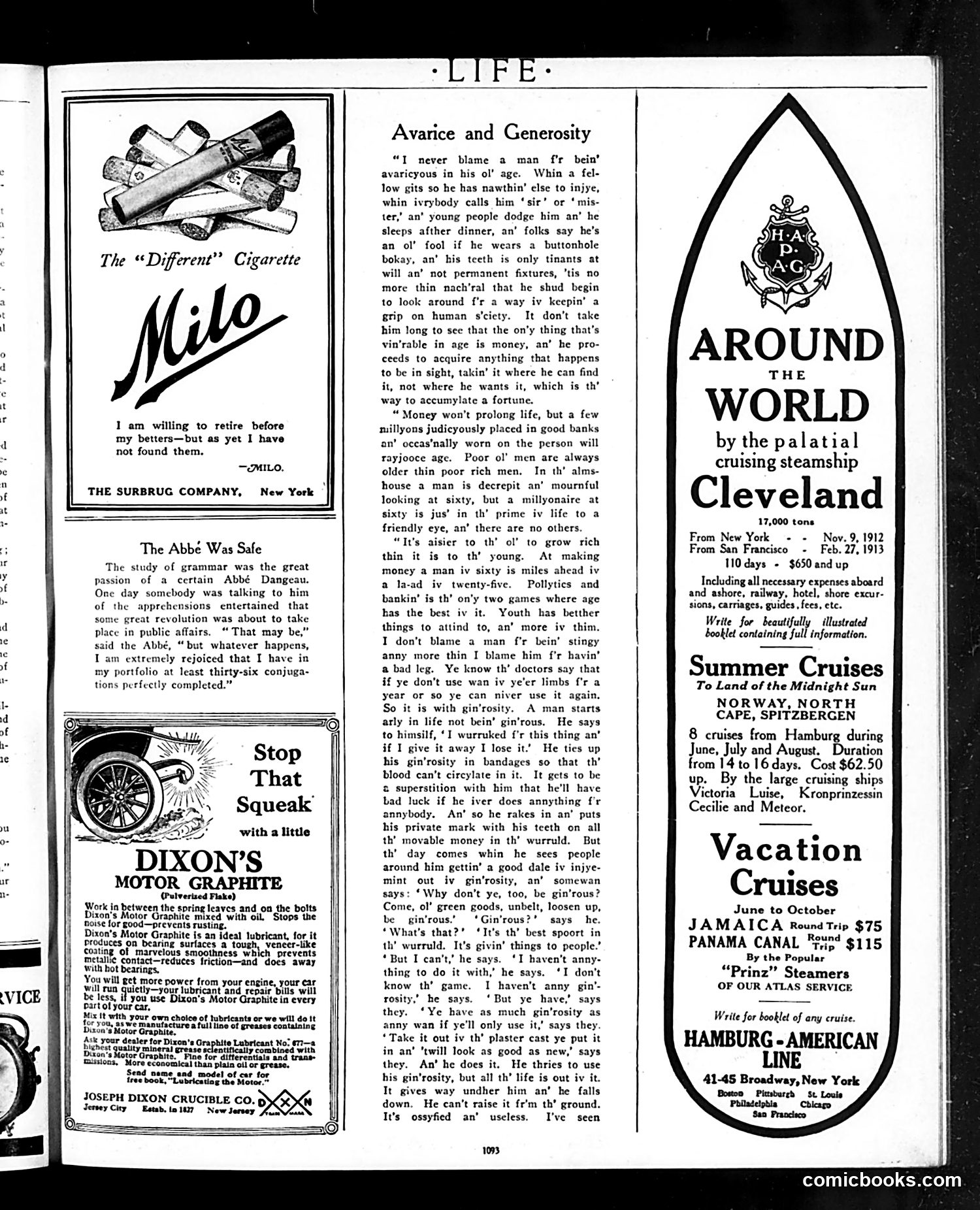
This page from *Life* magazine (a satirical weekly) features mostly **advertisements and humorous social commentary** rather than political cartoons. The main content is "Avarice and Generosity"—a dialect piece written in exaggerated Irish-American vernacular that offers wry observations about aging and money. The unnamed speaker argues that avarice in old age is natural (since the elderly lose other sources of status and pleasure) and that stinginess results from disuse of generosity, like an unused muscle. It's satirical social criticism dressed as folksy wisdom. The page also includes ads for **Milo cigarettes** (featuring a self-congratulatory pitch), **Dixon's Motor Graphite** lubricant, and **luxury cruise lines**—typical of the magazine's era (appears to be 1910s based on the Cleveland steamship ad). The humor relies on **vernacular speech patterns** and **gentle social satire** about human nature rather than targeting specific political figures or events.
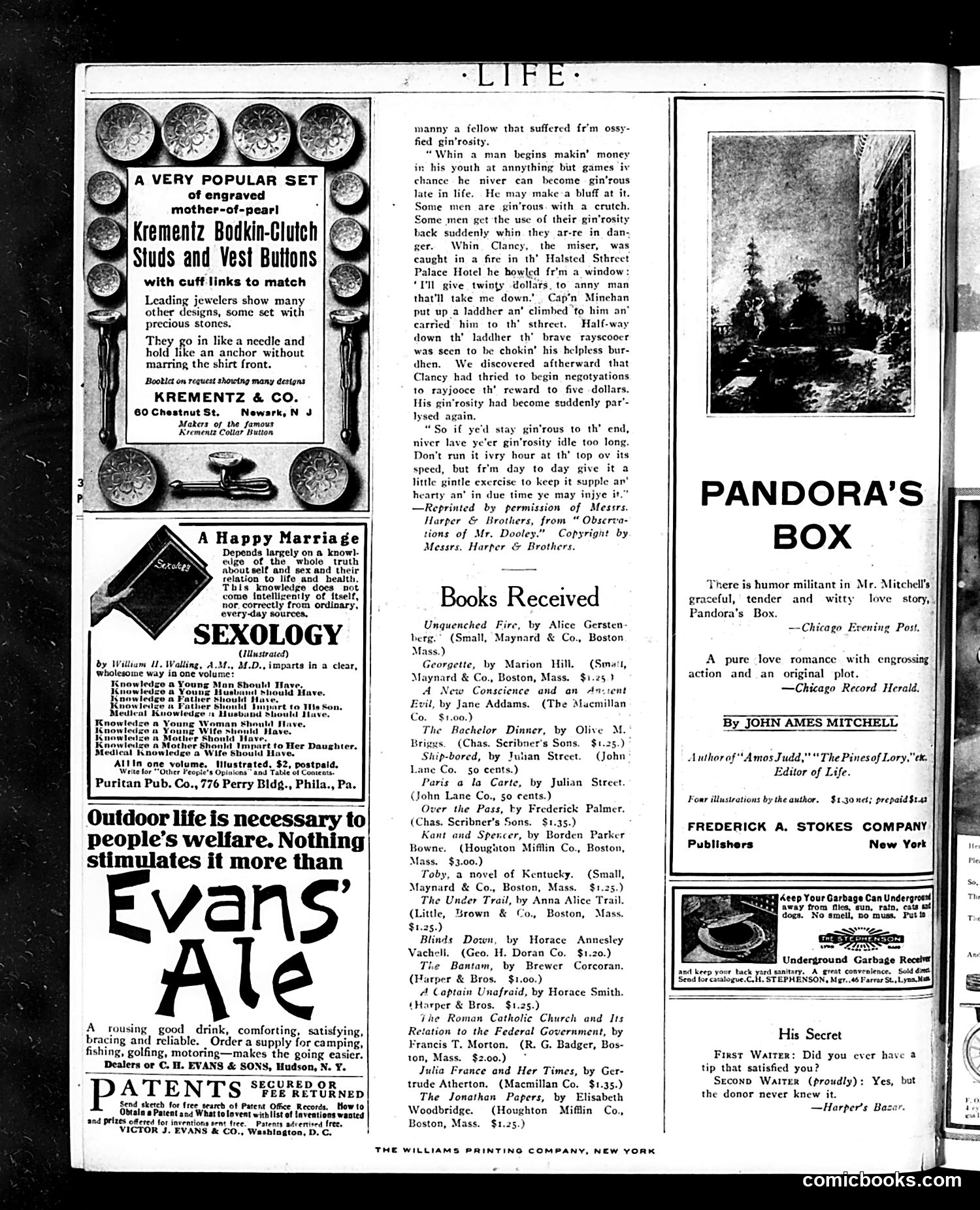
This page consists primarily of **advertisements and book reviews** rather than political cartoons. However, it contains a notable **Mr. Dooley column**—a recurring Irish-immigrant character created by Finley Peter Dunne, whose dialect-heavy commentary on American life was widely syndicated in this era. The excerpt shown satirizes **social hypocrisy around generosity**. Through Dooley's thick brogue, it mocks wealthy men—particularly a miser named Clancy—who claim benevolence but reveal their stinginess when actually tested. When Clancy is rescued from a hotel fire, his promised reward shrinks as danger passes. The satire targets the gap between **professed virtue and actual character**, a common Dooley theme. The column suggests that true generosity must be practiced consistently, not performed for show or during crises. The page also advertises books on **marriage advice and sexuality** (Sexology), jewelry, beer, and patent services—typical early-20th-century LIFE magazine content.
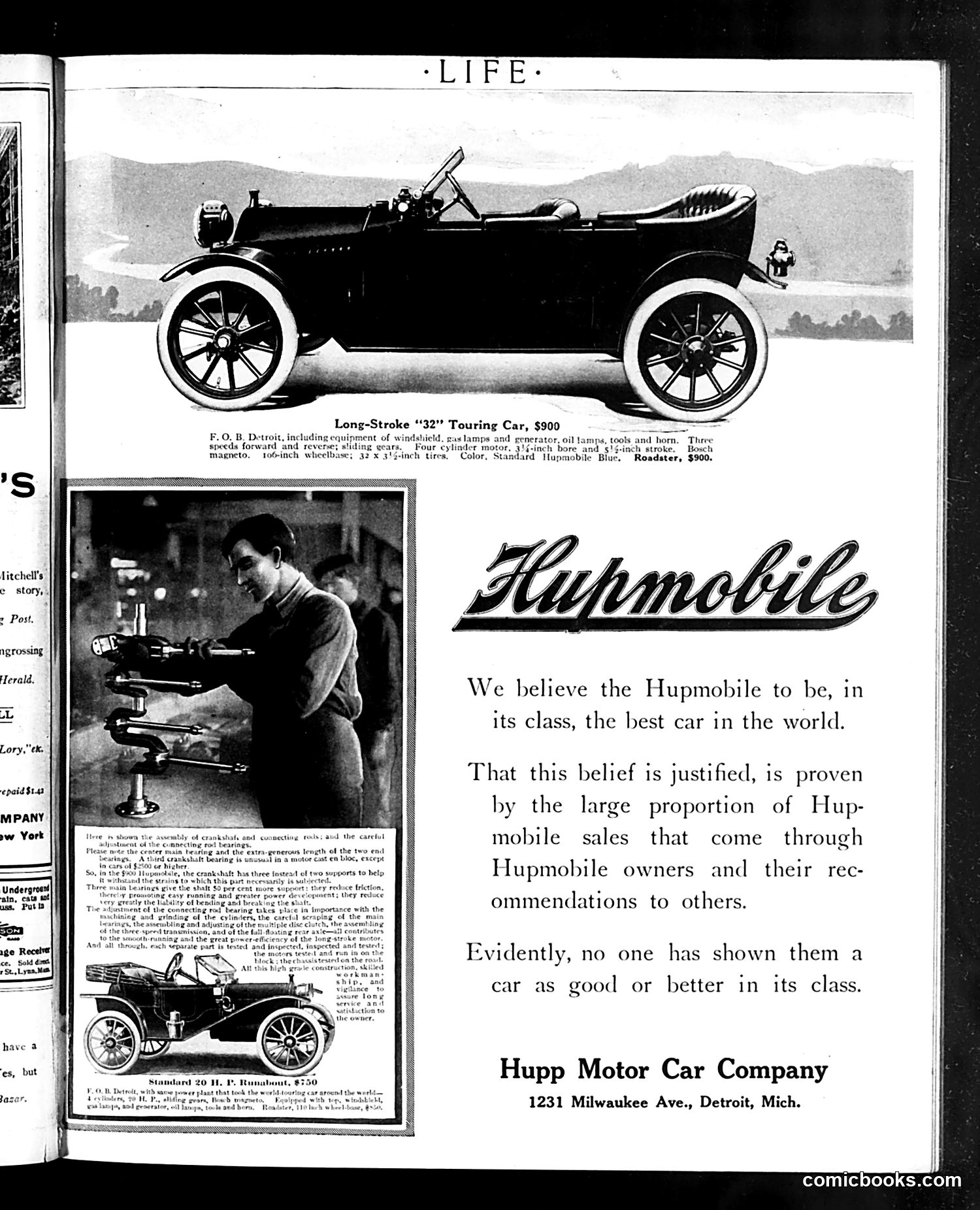
This page is **primarily an automobile advertisement**, not political satire. It features a Hupmobile car advertisement from the Hupp Motor Car Company in Detroit. The page shows: 1. **Top image**: A Long-Stroke "32" Touring Car priced at $900, depicted in a side-view illustration typical of early automotive advertising. 2. **Bottom left**: A photograph of a man examining mechanical engine parts, emphasizing the car's engineering quality. 3. **Bottom right**: A smaller "Standard 20 H.P. Hupmobile" model at $750. 4. **Text**: Marketing copy asserting the Hupmobile is "the best car in its class," supported by owner recommendations and repeat sales. This represents early 1900s automotive marketing strategy—emphasizing quality engineering, owner satisfaction, and competitive pricing. There is no political cartoon or satire present. The page simply demonstrates how manufacturers used *Life* magazine (which mixed editorial content with advertising) to promote their products to affluent readers.
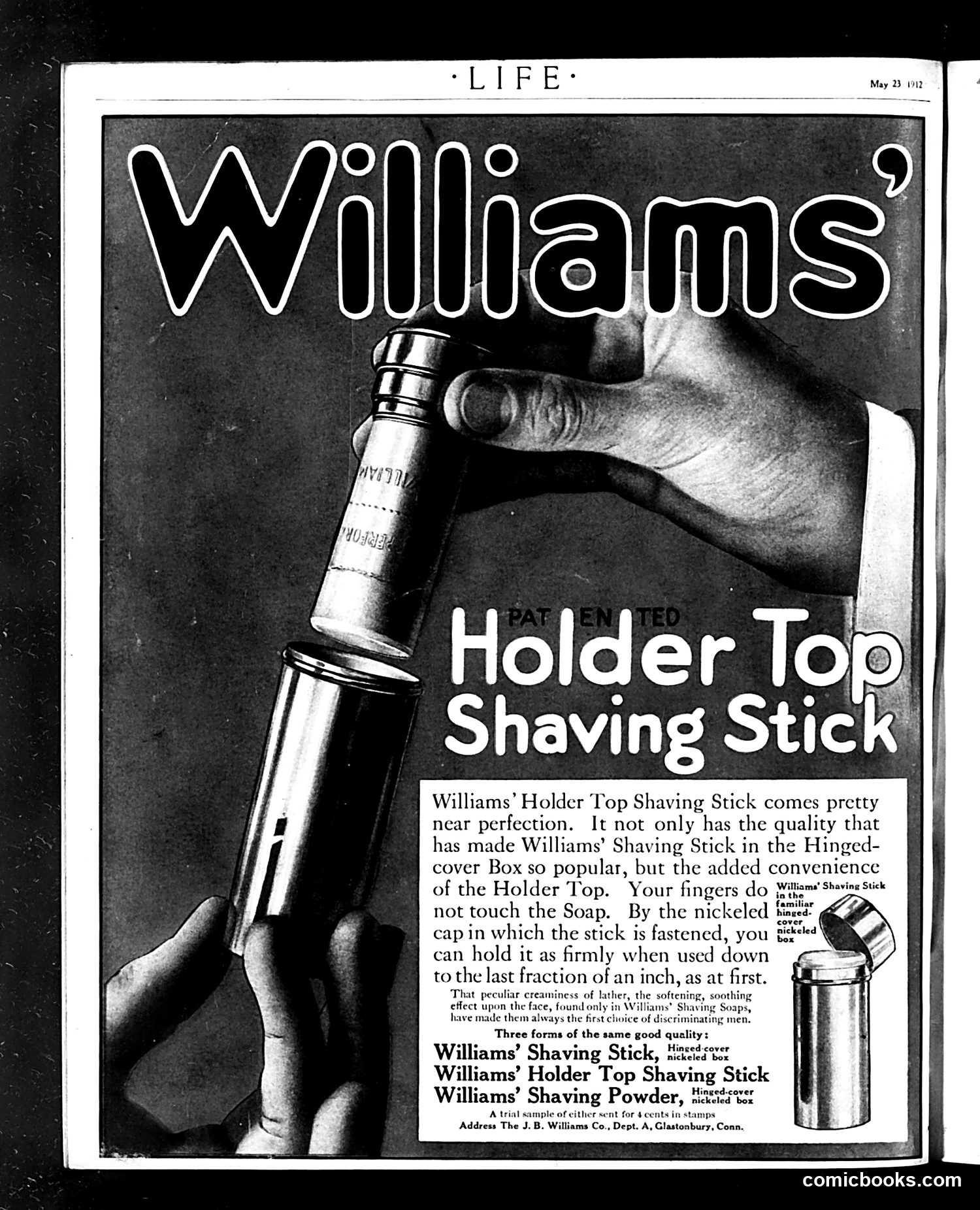
This is **not a political cartoon or satire** — it's a straightforward advertisement for Williams' shaving products, appearing in *Life* magazine's May 23, 1912 issue. The page advertises the "Holder Top Shaving Stick," a grooming product innovation. The image shows a man's hand holding the shaving stick with its nickeled cap, demonstrating the key selling point: users can grip it firmly down to the last fraction of an inch without their fingers touching the soap itself. The ad emphasizes three product variants (shaving stick in hinged-cover box, the new holder-top version, and shaving powder) and highlights the "peculiar creamine lather" quality that allegedly made Williams' soaps "always the first choice of discriminating men." This reflects early 20th-century advertising conventions: product innovation, hygiene concerns, and appeals to masculine refinement. The offer of a trial sample for cents in stamps was typical marketing of the era.