
Life, 1912-05-23 · page 13 of 44
Life — May 23, 1912 — page 13: what you’re looking at
What you’re looking at
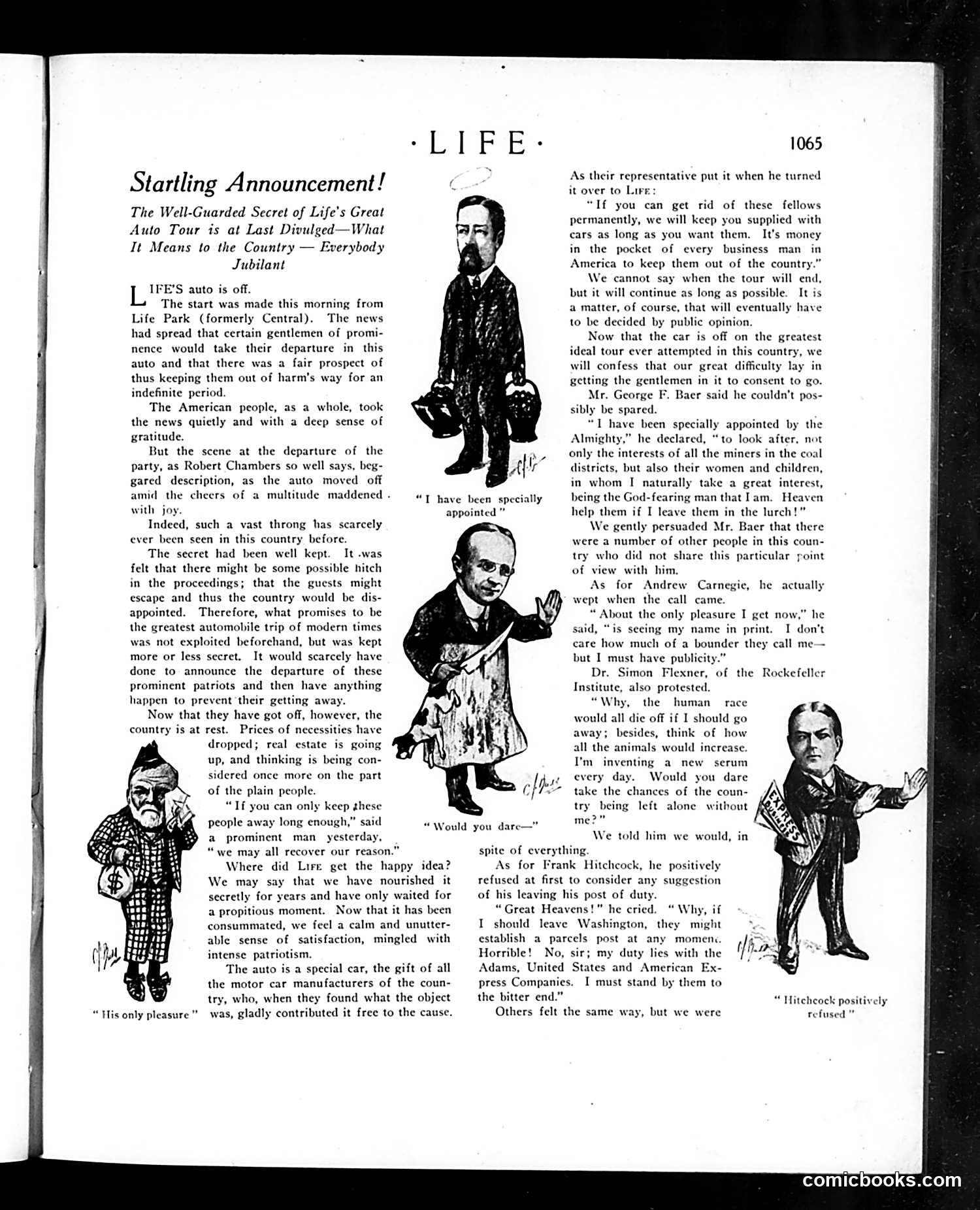
This 1910s satirical piece mocks a proposed cross-country automobile tour meant to promote American unity and industry. The cartoon ridicules prominent figures who refused to participate—including what appears to be Andrew Carnegie (labeled "Would you dare—") and Frank Hitchcock (noted as "positively refused"). The satire targets wealthy industrialists and politicians who, while publicly supporting American causes, privately avoided public commitment. The caricatured figures represent the hypocrisy of business leaders who claim patriotism but dodge inconvenient public gestures. The recurring phrase "His only pleasure was, gladly contributed it free to the cause" undercuts claims of genuine patriotic support, suggesting these figures gave only token assistance while protecting their reputations and comfort.
📄 Transcribed text from this page (OCR, searchable)
Machine-transcribed from the original scan — historical spelling and the odd misread are preserved.
f = Startling Announcement! The Well-Guarded Secret of Life’s Great Auto Tour is at Last Divulged—What It Means to the Country — Everybody Jubilant IFE'S auto is off. The start was made this morning from Life Park (formerly Central). The news had spread that certain gentlemen of promi- nence would take their departure in this auto and that there was a fair prospect of thus keeping them out of harm’s way for an indefinite period. The American people, as a whole, took the news quietly and with a deep sense of gratitude. But the scene at the departure of the party, as Robert Chambers so well says, beg- gared description, as the auto moved off amid the cheers of a multitude maddened - with joy. Indeed, such a vast throng has scarcely ever been seen in this country before. The secret had been well kept. It .was felt that there might be some possible hitch in the proceedings; that the guests might escape and thus the country would be dis- appointed. Therefore, what promises to be the greatest automobile trip of modern times was not exploited beforehand, but was kept more or less secret. It would scarcely have done to announce the departure of these prominent patriots and then have anything happen to prevent their getting away. Now that they have got off, however, the country is at rest. Prices of necessities have dropped; real estate is going up, and thinking is being con- sidered once more on the part of the plain people. “Tf you can only keep ghese people away long enough,” said a prominent man_ yesterday, “we may all recover our reason.” We may sa Where did Lire get the happy ide that we have nourished it -LIFE- “T have been specially appointed ” “Would you dare—" spite of everything. As for Frank Hitchcock, he positively refused at first to consider any suggestion 1065 As their representative put it when he turned it over to Lr “If you can get rid of these fellows permanently, we will keep you supplied with cars as long as you want them. It’s money in the pocket of every business man in America to keep them out of the country.” We cannot say when the tour will end, but it will continue as long as possible. It is a matter, of course, that will eventually have to be decided by public opinion. Now that the car is off on the greatest ideal tour ever attempted in this country, we will confess that our great difficulty lay in getting the gentlemen in it to consent to go. Mr. George F. Baer said he couldn't pos- sibly be spared. “I have been specially appointed by the Almighty,” he declared, “to look after, not only the interests of all the miners in the coal districts, but also their women and children, in whom I naturally take a great inter being the God-fearing man that !am. Heaven help them if I leave them in the lurch!” We gently persuaded Mr. Baer that there were a number of other people in this coun- try who did not share this particular point of view with him. As for Andrew Carnegie, he actually wept when the call came. About the only pleasure I get now,” he said, “is seeing my name in print. I don't care how much of a bounder they call me— but I must have publicity Dr. Simon Flexner, of the Rockefeller Institute, also protested. “Why, the human race would all die off if I should go away; besides, think of how all the animals would increase. I'm inventing a new serum every day. Would you dare take the chances of the coun- try being left alone without m " We told him we would, in “ His only pleasure” secretly for years and have only waited for a propitious moment. Now that it has been consummated, we feel a calm and unutter- able sense of satisfaction, mingled with intense patriotism. The auto is a special car, the gift of all the motor car manufacturers of the coun- try, who, when they found what the object was, gladly contributed it free to the cause. of his leaving his post of duty. “Great Heavens!” he cried. “ Why, if I should leave Washington, they might establish a parcels post at any momenc. Horrible! No, sir; my duty lies with the Adams, United States and American Ex- press Companies. I must stand by them to the bitter end.” Others felt the same way, but we were “ Hitchcock positively refused” comicbooks.com