
Life, 1912-05-23 · page 8 of 44
Life — May 23, 1912 — page 8: what you’re looking at
What you’re looking at
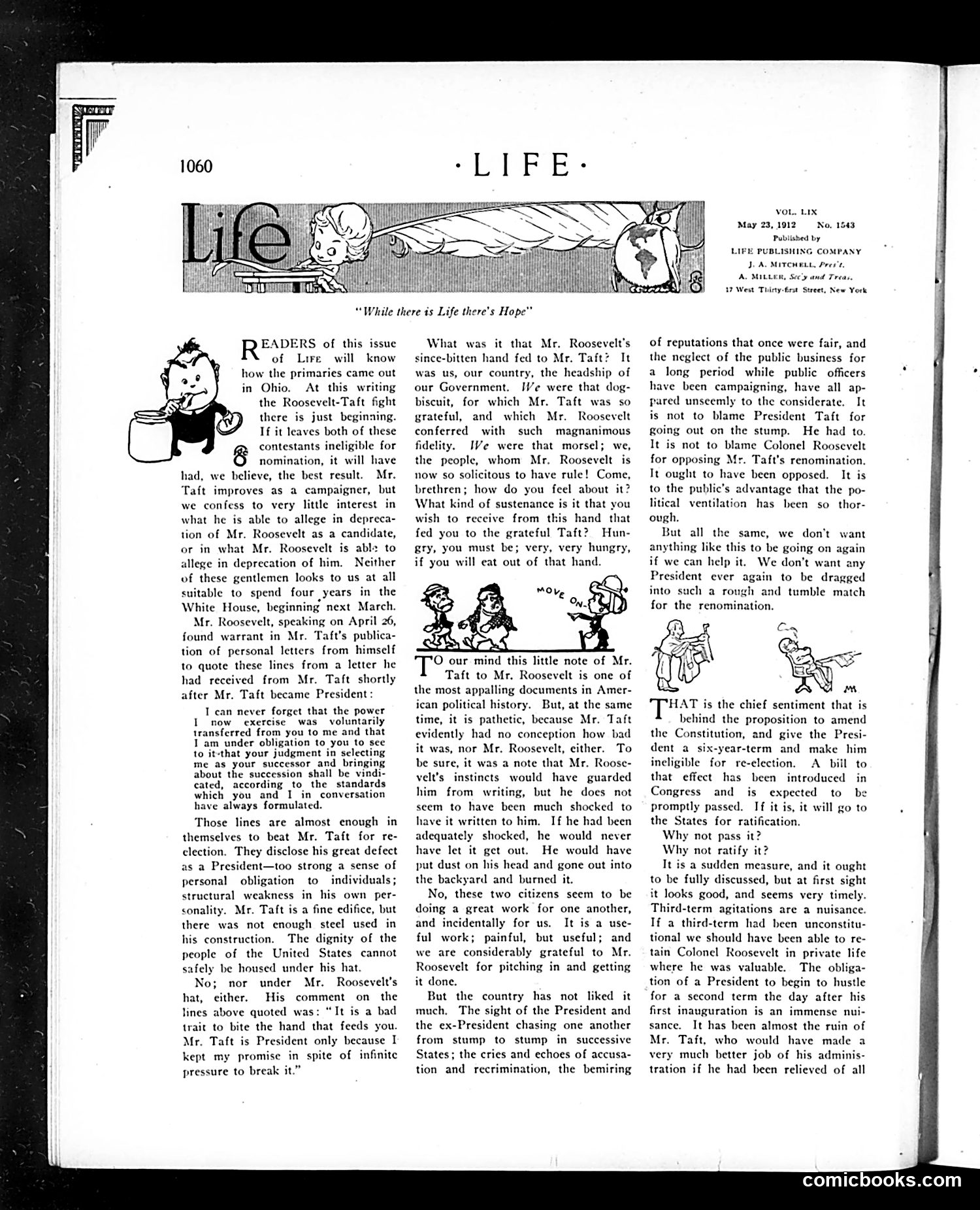
This editorial page discusses the 1912 presidential election aftermath. The text references Roosevelt, Taft, and a letter Roosevelt wrote to Taft that became public—described as "one of the most appalling documents in American political history." The left illustration shows a caricatured figure (likely representing Taft) angrily reading correspondence, suggesting his reaction to Roosevelt's critical letter. The small cartoon sketches in the center appear to depict the contentious dynamic between the two former allies turned rivals during the split Republican campaign of 1912, when Roosevelt's Progressive "Bull Moose" party challenged Taft's renomination. The page's masthead quote—"While there is Life there's Hope"—ironically frames the political chaos as the magazine advocates for constitutional amendment limiting presidents to one term, positioning itself as concerned with restoring governmental dignity.
📄 Transcribed text from this page (OCR, searchable)
Machine-transcribed from the original scan — historical spelling and the odd misread are preserved.
As ut MH “While there is Life there's Hope” EADERS of this issue of Lire will know how the primaries came out in Ohio. At this writing the Roosevelt-Taft fight there is just beginning. If it leaves both of these contestants ineligible for § nomination, it will have had, we believe, the best result. Mr. Taft improves as a campaigner, but we confess to very little interest in what he is able to allege in depreca- tion of Mr. Roosevelt as a candidate, or in what Mr. Roosevelt is able to allege in deprecation of him. Neither of these gentlemen looks to us at all suitable to spend four years in the White House, beginning next March. Mr. Roosevelt, speaking on April 26, found warrant in Mr. Taft's publica- tion of personal letters from himself to quote these lines from a letter he had received from Mr. Taft shortly after Mr. Taft became President: T can never forget that the power 1 now exercise. was voluntarily transferred from you to me and that I under obligation to you to see to it-that your judgment in selecting me as your successor and bringing about the succession shall be vindi- cated, according to the standards which you and I in conversation have always formulated. Those lines are almost enough in themselves to beat Mr. Taft for re- election. They disclose his great defect as a President—too strong a sense of personal obligation to individuals; structural weakness in his own per- sonality. Mr. Taft is a fine edifice, but there was not enough steel used in his construction. The dignity of the people of the United States cannot safely be housed under his hat. No; nor under Mr. Roosevelt's hat, either. His comment on the lines above quoted was: “It is a bad trait to bite the hand that feeds you. Mr. Taft is President only because I kept my promise in spite of infinite pressure to break it.” What was it that Mr. Roosevelt's since-bitten hand fed to Mr. Taft? It was us, our country, the headship of our Government. MWe were that dog- biscuit, for which Mr. Taft was so grateful, and which Mr. Roosevelt conferred with such magnanimous fidelity. MWe were that morsel; we, the people, whom Mr. Roosevelt is now so solicitous to have rule! Come, brethren; how do you feel about it? What kind of sustenance is it that you wish to receive from this hand that fed you to the grateful Taft? Hun- gry, you must be; very, very hungry, if you will eat out of that hand. 'O our mind this little note of Mr. Taft to Mr. Roosevelt is one of the most appalling documents in Amer- ican political history. But, at the same time, it is pathetic, because Mr. Taft evidently had no conception how bad it was, nor Mr. Roosevelt, either. To be sure, it was a note that Mr. Roose- velt’s instincts would have guarded him from writing, but he does not seem to have been much shocked to have it written to him. If he had been adequately shocked, he would never have let it get out. He would have put dust on his head and gone out into the backyard and burned it. No, these two citizens seem to be doing a great work for one another, and incidentally for us. It is a use- ful work; painful, but useful; and we are considerably grateful to Mr. Roosevelt for pitching in and getting it done. But the country has not liked it much, The sight of the President and the ex-President chasing one another from stump to stump in successive States; the cries and echoes of accusa- tion and recrimination, the bemiring VoL. LIX May 23, 1912 Published by LIFE PUBLISHING COMPANY J. AL MITCHELL, Pres’t A. MILLER, See'y and Treas, 1543 17 West Thirty-first Street, New York of reputations that once were fair, and the neglect of the public business for a long period while public officers have been campaigning, have all ap- pared unseemly to the considerate. It is not to blame President Taft for going out on the stump. He had to. It is not to blame Colonel Roosevelt for opposing Mr. Taft’s renomination, It ought to have been opposed. It is to the public's advantage that the po- litical ventilation has been so thor- ough, But all the same, we don’t want anything like this to be going on again if we can help it. We don’t want any President ever again to be dragged into such a rough and tumble match for the renomination. HAT is the chief sentiment that is behind the proposition to amend the Constitution, and give the Presi- dent a six-year-term and make him ineligible for re-election. A Dill to that effect has been introduced in Congress and is expected to be promptly passed. If it is, it will go to the States for ratification. Why not pass it? Why not ratify it? It is a sudden measure, and it ought to be fully discussed, but at first sight it looks good, and seems very timely. Third-term agitations are a nuisance. If a third-term had been unconstitu- tional we should have been able to re- tain Colonel Roosevelt in private life where he was valuable. The obliga- tion of a President to begin to hustle for a second term the day after his first inauguration is an immense nui- sance. It has been almost the ruin of Mr. Taft, who would have made a very much better job of his adminis- tration if he had been relieved of all comicbooks.com