
Life, 1912-05-23 · page 21 of 44
Life — May 23, 1912 — page 21: what you’re looking at
What you’re looking at
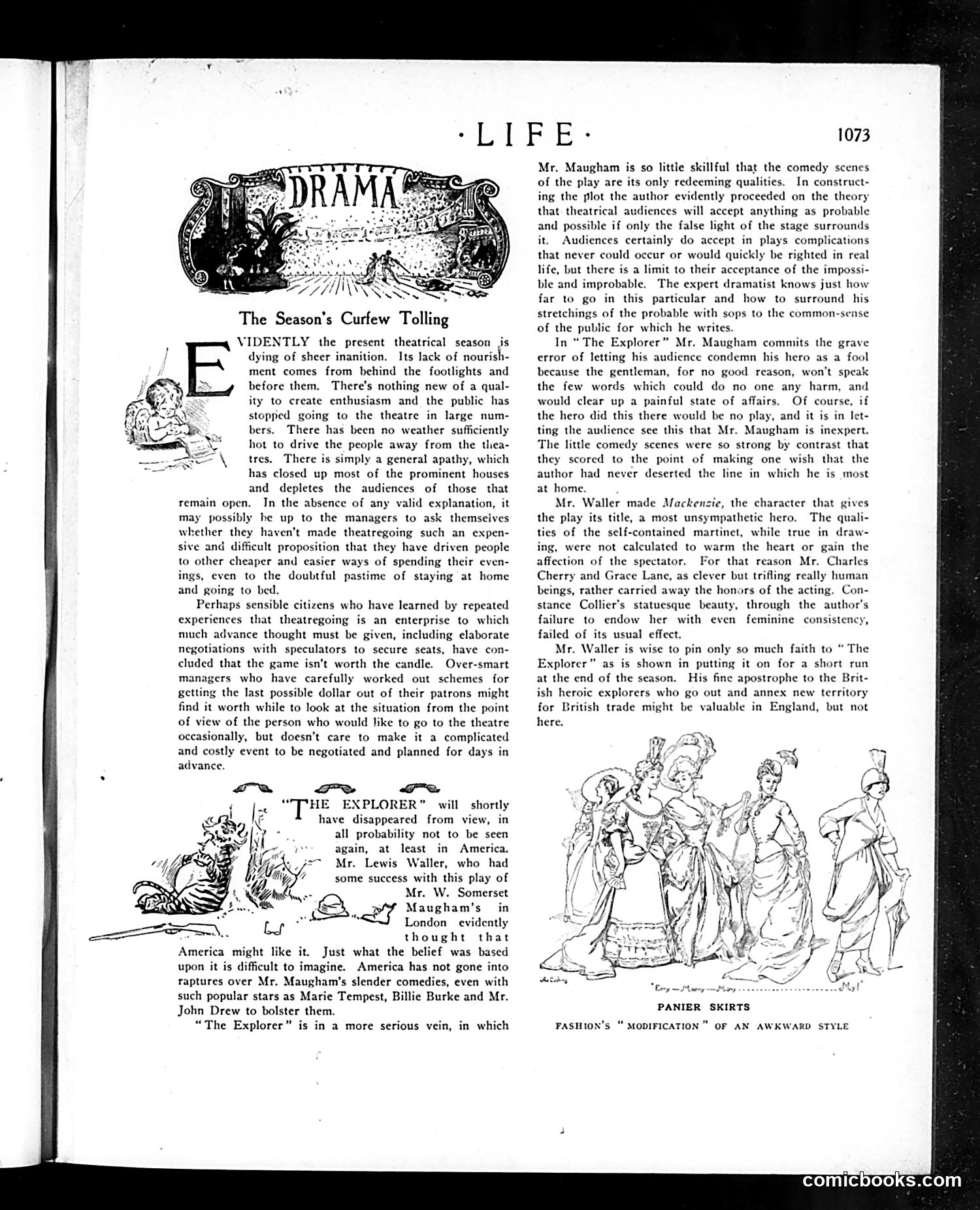
This page contains theater criticism addressing two problems: **"The Season's Curfew Tolling"** critiques the theatrical season's decline. The author argues that theater attendance has collapsed not due to weather or public indifference, but because managers have made theater-going prohibitively expensive and logistically burdensome—requiring advance planning, expensive ticket negotiations with speculators, and significant expenditure. The satire suggests managers have priced out casual patrons, driving them toward cheaper home entertainment. **"The Explorer"** reviews a W. Somerset Maugham play starring Lewis Waller. The critique faults Maugham's dramatic construction: the hero refuses to speak words that would resolve the plot for no compelling reason, making him seem foolish rather than sympathetic. The reviewer argues this reveals Maugham's inexperience—he doesn't understand how far audiences will suspend disbelief. While the comedy scenes were strong, they highlighted the play's fundamental dramatic weakness. The illustration shows fashionably dressed women in "pannier skirts," an awkward period fashion.
📄 Transcribed text from this page (OCR, searchable)
Machine-transcribed from the original scan — historical spelling and the odd misread are preserved.
Sh EEE The Season’s Curfew Tolling VIDENTLY the present theatrical season is dying of sheer inanition. Its lack of nourish- ment comes from behind the footlights and before them. There’s nothing new of a qual- ity to create enthusiasm and the public has stopped going to the theatre in large num- bers. There has been no weather sufficiently hot to drive the people away from the thea- tres. There is simply a general apathy, which has closed up most of the prominent houses and depletes the audiences of those that remain open. In the absence of any valid explanation, it may possibly he up to the managers to ask themselves whether they haven't made theatregoing such an expen- sive and difficult proposition that they have driven people to other cheaper and easier ways of spending their even- ings, even to the doubtful pastime of staying at home and going to bed. Perhaps sensible citizens who have learned by repeated experiences that theatregoing is an enterprise to which much advance thought must be given, including elaborate negotiations with speculators to secure seats, have con- cluded that the game isn’t worth the candle. Over-smart managers who have carefully worked out schemes for getting the last possible dollar out of their patrons might find it worth while to look at the situation from the point of view of the person who would like to go to the theatre occasionally, but doesn’t care to make it a complicated and costly event to be negotiated and planned for days in advance. Fra “CHE PLORER” will shortly have disappeared from view, in all probability not to be seen again, at least in America. Mr. Lewis Waller, who had some success with this play of Mr. W. Somerset Maugham’s_ in London evidently thought that America might like it. Just what the belief was based upon it is difficult to imagine. America has not gone into Taptures over Mr. Maugham’s slender comedies, even with such popular stars as Marie Tempest, Billie Burke and Mr. John Drew to bolster them. “The Explorer” is in a more serious vein, in which 1073 Mr. Maugham is so little skillful that the comedy scenes of the play are its only redeeming qualities. In construct- ing the plot the author evidently proceeded on the theory that theatrical audiences will accept anything as probable and possible if only the false light of the stage surrounds it. Audiences certainly do accept in plays complications that never could occur or would quickly be righted in real life, but there is a limit to their acceptance of the impossi- ble and improbable. The expert dramatist knows just how far to go in this particular and how to surround his stretchings of the probable with sops to the common-sense of the public for which he writes. In “The Explorer” Mr. Maugham commits the grave error of letting his audience condemn his hero as a fool because the gentleman, for no good reason, won't speak the few words which could do no one any harm, and would clear up a painful state of affairs. Of course, if the hero did this there would be no play, and it is in let- ting the audience see this that Mr. Maugham is inexpert. The little comedy scenes were so strong by contrast that they scored to the point of making one wish that the author had never deserted the line in which he is most at home. Mr. Waller made Mackenzie, the character that gives the play its title, a most unsympathetic hero. The quali- ties of the self-contained martinet, while true in draw- ing, were not calculated to warm the heart or gain the affection of the spectator. For that reason Mr. Charles Cherry and Grace Lane, as clever but trifling really human beings, rather carried away the honors of the acting. Con- stance Collier's statuesque beauty, through the author's failure to endow her with even feminine consistency, failed of its usual effect. Mr. Waller is wise to pin only so much faith to “ The Explorer” as is shown in putting it on for a short run at the end of the season. His fine apostrophe to the Brit- ish heroic explorers who go out and annex new territory for British trade might be valuable in England, but not here, PANIER SKIRTS FASHION’S “ MODIFICATION” OF AN AWKWARD STYLE comicbooks.com