
Life, 1912-05-23 · page 26 of 44
Life — May 23, 1912 — page 26: what you’re looking at
What you’re looking at
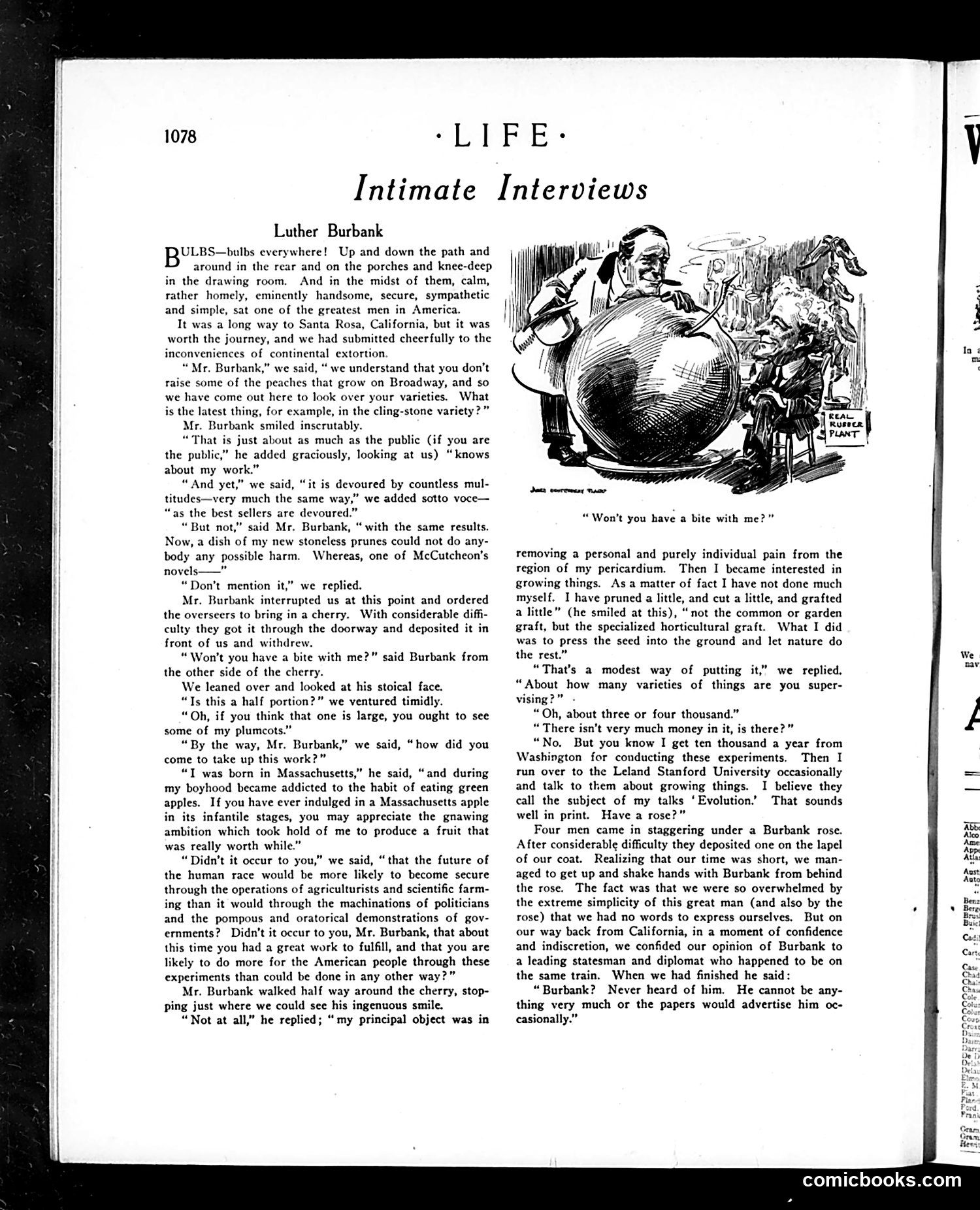
This is a humorous profile interview with Luther Burbank, the famous plant scientist and horticulturist. The joke centers on Burbank's massive, oversized produce—the cartoon shows him offering a comically enormous cherry to the interviewer, with a caption "Won't you have a bite with me?" The satire gently mocks both Burbank's modesty about his accomplishments and the interviewer's overly earnest, flattering questions about his contributions to humanity. Burbank deflates pretension by claiming he started simply to avoid eating bad Massachusetts apples, and that his real contribution was "pressing seed into the ground and let[ting] nature do the rest"—downplaying his role despite producing thousands of plant varieties. The piece also contains a dig at contemporary novelist George Barrie McCutcheon (referenced as harmful "like best sellers"), typical of Life's satirical culture criticism. The overall tone celebrates Burbank as genuinely great precisely *because* he's unpretentious about his work.
📄 Transcribed text from this page (OCR, searchable)
Machine-transcribed from the original scan — historical spelling and the odd misread are preserved.
“PRE « Intimate Interviews Luther Burbank ULBS—bulbs everywhere! Up and down the path and around in the rear and on the porches and knee-deep in the drawing room. And in the midst of them, calm, rather homely, eminently handsome, secure, sympathetic and simple, sat one of the greatest men in America. It was a long way to Santa Rosa, California, but it was worth the journey, and we had submitted cheerfully to the inconveniences of continental extortion. “Mr. Burbank,” we said, “ we understand that you don’t raise some of the peaches that grow on Broadway, and so we have come out here to look over your varieties. What is the latest thing, for example, in the cling-stone variety?” Mr. Burbank smiled inscrutably. “That is just about as much as the public (if you are the public,” he added graciously, looking at us) “knows about my work.” “And yet,” we said, “it is devoured by countless mul- titudes—very much the same way,” we added sotto voce— “as the best sellers are devoured.” “But not,” said Mr. Burbank, “with the same results. Now, a dish of my new stoneless prunes could not do any- body any possible harm. Whereas, one of McCutcheon’s novels——” “Don’t mention it,” we replied. Mr. Burbank interrupted us at this point and ordered the overseers to bring in a cherry. With considerable diffi- culty they got it through the doorway and deposited it in front of us and withdrew. “Won't you have a bite with me?” said Burbank from the other side of the cherry. We leaned over and looked at his stoical face. “Ts this a half portion?” we ventured timidly. “Oh, if you think that one is large, you ought to see some of my plumcots.” “By the way, Mr. Burbank,” we said, “how did you come to take up this work?” “T was born in Massachusetts,” he said, “and during my boyhood became addicted to the habit of eating green apples. If you have ever indulged in a Massachusetts apple in its infantile stages, you may appreciate the gnawing ambition which took hold of me to produce a fruit that was really worth while.” “Didn't it occur to you,” we said, “that the future of the human race would be more likely to become secure through the operations of agriculturists and scientific farm- ing than it would through the machinations of politicians and the pompous and oratorical demonstrations of gov- ernments? Didn't it occur to you, Mr. Burbank, that about this time you had a great work to fulfill, and that you are likely to do more for the American people through these experiments than could be done in any other way?” Mr. Burbank walked half way around the cherry, stop- ping just where we could see his ingenuous smile, “Not at all,” he replied; “my principal object was in “Won't you have a bite with me?” removing a personal and purely individual pain from the region of my pericardium. Then I became interested in growing things. Asa matter of fact I have not done much myself. I have pruned a little, and cut a little, and grafted a little” (he smiled at this), “not the common or garden graft, but the specialized horticultural graft. What I did was to press the seed into the ground and let nature do the rest.” “That’s a modest way of putting it,” we replied. “About how many varieties of things are you super- vising?" - “Oh, about three or four thousand.” “There isn’t very much money in it, is there?” “No, But you know I get ten thousand a year from Washington for conducting these experiments. Then I run over to the Leland Stanford University occasionally and talk to them about growing things. I believe they call the subject of my talks ‘Evolution.’ That sounds well in print. Have a rose?” Four men came in staggering under a Burbank rose. After considerable difficulty they deposited one on the lapel of our coat. Realizing that our time was short, we man- aged to get up and shake hands with Burbank from behind the rose. The fact was that we were so overwhelmed by the extreme simplicity of this great man (and also by the rose) that we had no words to express ourselves. But on our way back from California, in a moment of confidence and indiscretion, we confided our opinion of Burbank to a leading statesman and diplomat who happened to be on the same train. When we had finished he said: “Burbank? Never heard of him. He cannot be any- thing very much or the papers would advertise him oc- casionally.” y comicbooks.com