
Life, 1912-05-23 · page 24 of 44
Life — May 23, 1912 — page 24: what you’re looking at
What you’re looking at
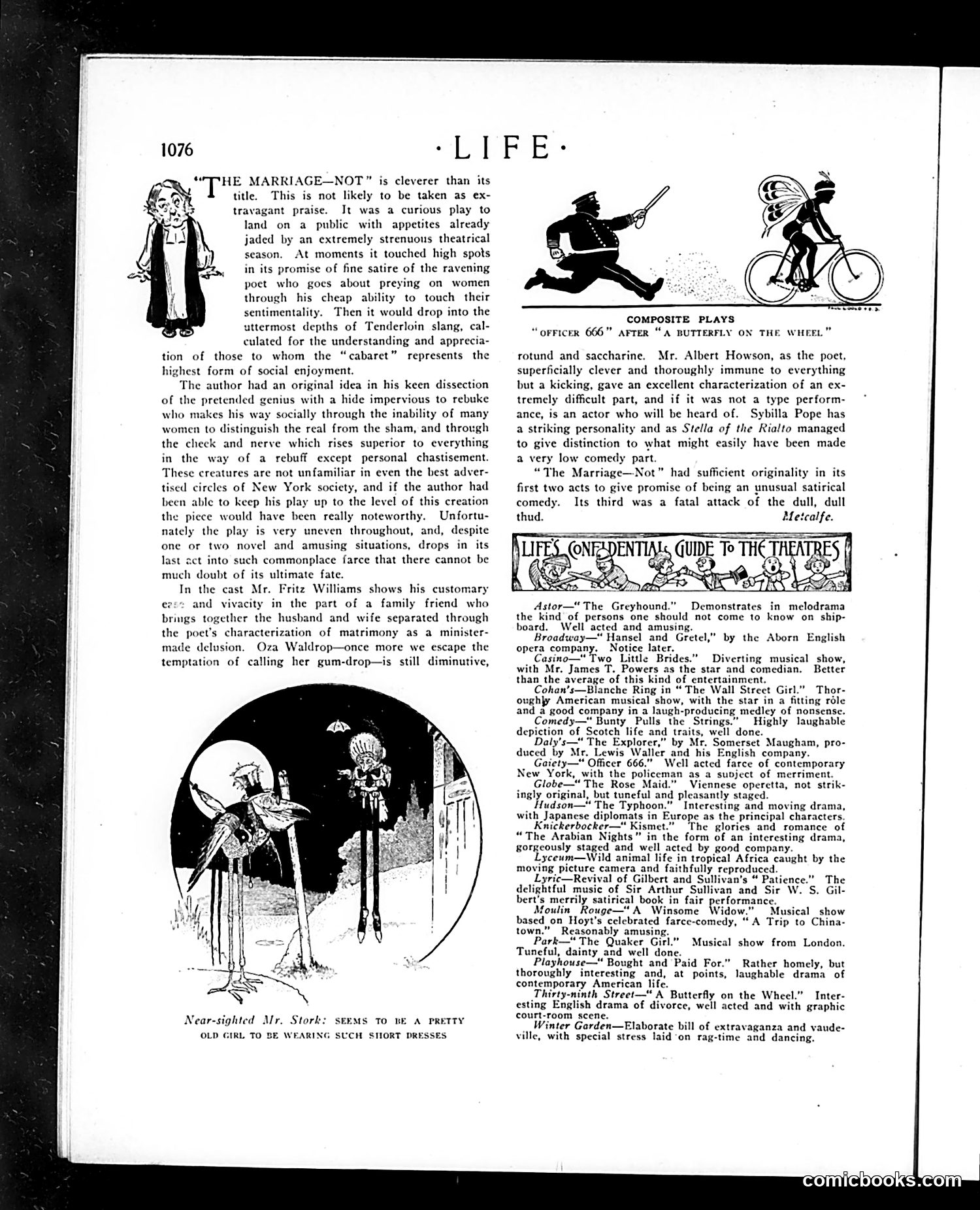
This page reviews "The Marriage—Not," a Broadway play about a manipulative poet who seduces women through fake sentiment. The critic finds it uneven: promising social satire in acts one and two, but collapsing into cheap "Tenderloin slang" (red-light district humor) by act three. The cartoon captioned "Near-sighted Mr. Stork" is a visual joke about modern women's fashion. It depicts a stork (the mythological bird that delivers babies) unable to recognize a woman from behind because her extremely short dress—apparently a contemporary trend—makes her indistinguishable from a child or "pretty old girl." The satire mocks both the absurdity of the fashion and society's apparent blindness to it. The page also lists other Broadway productions with brief assessments, giving readers a theatrical overview of the season.
📄 Transcribed text from this page (OCR, searchable)
Machine-transcribed from the original scan — historical spelling and the odd misread are preserved.
HE MARRIAGE—NOT” is cleverer than its title. This is not likely to be taken as ex- travagant praise. It was a curious play to land on a public with appetites already jaded by an extremely strenuous theatrical season. At moments it touched high spots in its promise of fine satire of the ravening poct who gocs about preying on women through his cheap ability to touch their sentimentality. Then it would drop into the uttermost depths of Tenderloin slang, cal- culated for the understanding and apprecia- tion of those to whom the “cabaret” represents the highest form of social enjoyment. The author had an original idea in his keen dissection of the pretended genius with a hide impervious to rebuke who makes his way socially through the inability of many women to distinguish the real from the sham, and through the check and nerve which rises superior to everything in the way of a rebuff except personal chastisement. These creatures are not unfamiliar in even the best adver- tised circles of New York society, and if the author had been able to keep his play up to the level of this creation the piece would have been really noteworthy. Unfortu- nately the play is very uneven throughout, and, despite one or two novel and amusing situations, drops in its last act into such commonplace farce that there cannot be much doubt of its ultimate fate. In the cast Mr. Fritz Williams shows his customary evs: and vivacity in the part of a family friend who brings together the husband and wife separated through the poet’s characterization of matrimony as a minister- made delusion. Oza Waldrop—once more we escape the temptation of calling her gum-drop—is still diminuti $ TO RE A PRETTY CH STIORT DRESSES Near-sighted Mr. Stork OLD GIRL TO BE WEARING “LEE COMPOSITE PLAYS “OFFICER 666" AFTER “A BUTTERFLY ON THE WHEEL” rotund and saccharine. Mr. Albert Howson, as the poet, superficially clever and thoroughly immune to everything but a kicking, gave an excellent characterization of an ex- tremely difficult part, and if it was not a type perform- ance, is an actor who will be heard of. Sybilla Pope has a striking personality and as Stella of the Rialto managed to give distinction to what might easily have been made a very low comedy part. “The Marriage—Not” had sufficient originality in its first two acts to give promise of being an unusual satirical Its third was a fatal attack of the dull, dull Metcalfe. comedy. thud. Astor—" The Greyhound.” Demonstrates in melodrama the kind of persons one should not come to know on ship- board. Well acted and amusing. Broadway— Hansel and Gretel,” by the Aborn English opera iam 5 Notice later. Casino— Two Little Brides.” with Mr. James T. Powers as the star and comedian. than the average of this kind of entertainment. Cohan’s—Blanche Ring in “ The Wall Street Girl.” Thor- oughly American musical show, with the star in a fitting role and a good company in a laugh-producing medley of nonsense. Comedy—" Bunty Pulls the Strings.” Highly laughable depiction of Scotch life and traits, well done. Daly’s—" The Explorer,” by Mr. Somerset Maugham, pro- duced by Mr. Lewis Waller and his English company. Gaiety—* Officer 666." Well acted farce of contemporary New York, with the policeman as a subject of merriment. Globe—“ The Rose Maid.” Viennese operetta, not strik- ingly original, but tuneful and pleasantly stage _ Hudson—" The Typhoon.” Interesting and moving drama, with Japanese diplomats in Europe as the principal characters. Knickerbocker—" Kismet.” The glories and romance of “The Arabian Nights” in the form of an interesting drama, gorgeously staged and well acted by good company. Lyceum—Wild animal life in tropical Africa caught by the moving picture camera and faithfully reproduced. Lyric—Revival of Gilbert and Sullivan's “ Patience.” The delightful music of Sir Arthur Sullivan and Sir W. S. Gil- bert’s merrily satirical book in fair tere nce. Moulin Rouge—" A Winsome Wido Musical show based on Hoyt’s celebrated farce-comedy, “A Trip to China- town.” Reasonably amusing. Park—" The Quaker Girl.” Musical show from London. Tuneful, dainty and well done. Playhouse— Bought and Paid For.” Rather homely, but thoroughly interesting and, at points, laughable drama of contemporary American life. Thirty-ninth Street— A Butterfly on the Wheel.” Inter- esting English drama of divorce, well acted and with graphic court-room scene. Winter Garden—Elaborate bill of extravaganza and vaude- ville, with special stress laid “on rag-time and dancing. Diverting musical show, Better