
Life, 1912-05-23 · page 28 of 44
Life — May 23, 1912 — page 28: what you’re looking at
What you’re looking at
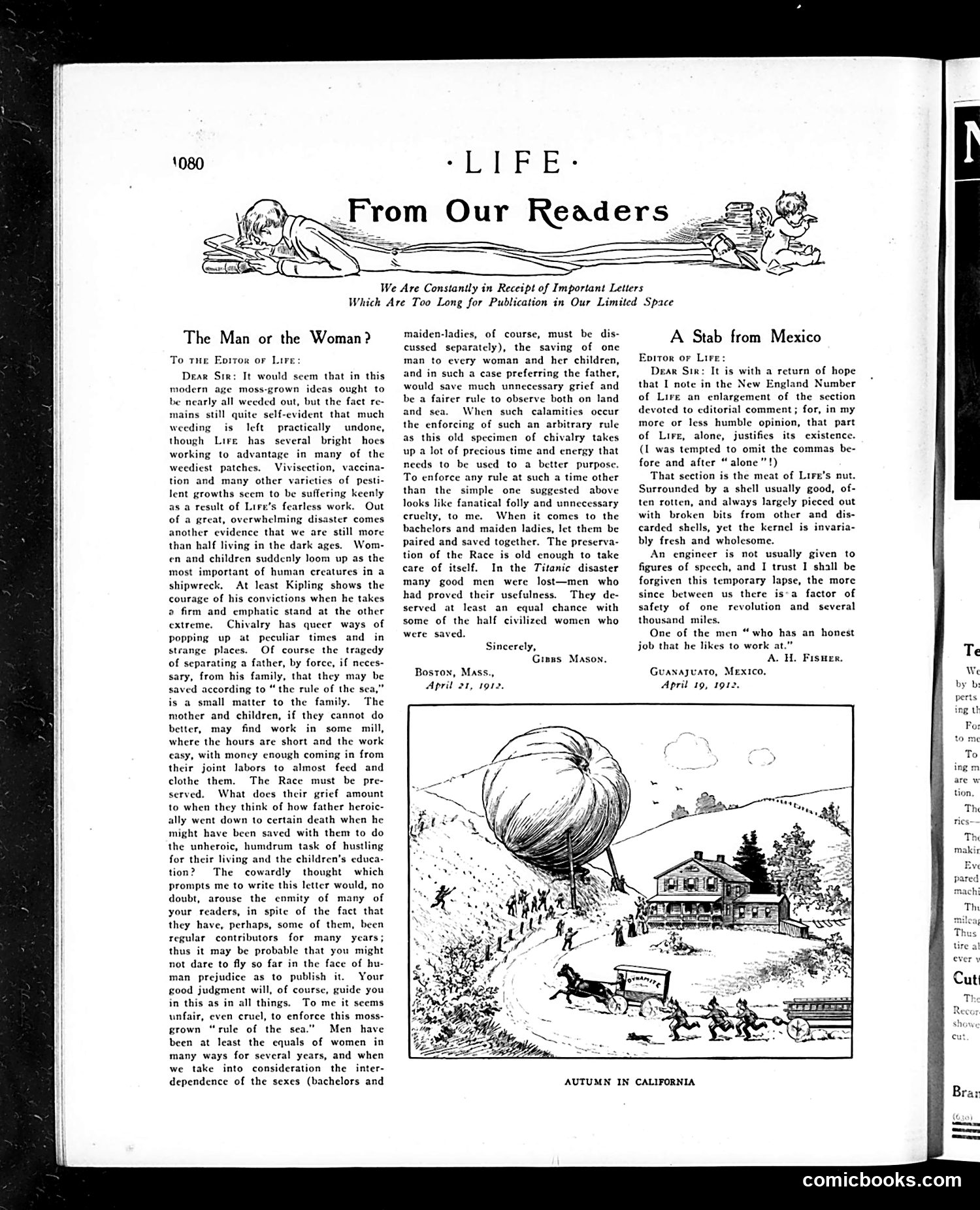
This "From Our Readers" page features two reader letters debating social issues of the early 20th century. **"The Man or the Woman?"** addresses maritime law and gender roles, likely sparked by the Titanic disaster (1912). The writer challenges the "women and children first" evacuation rule as archaic chivalry. He argues this arbitrary gender preference is cruel to families and illogical—that preserving useful men (proven contributors) makes more sense than saving "half civilized women." The letter sarcastically notes chivalry conveniently appears during disasters while ignoring women's economic hardship in normal times. **"A Stab from Mexico"** (incomplete here) appears to comment on Mexican affairs, though the full context is cut off. The cartoon "Autumn in California" depicts a hot-air balloon above a rural farmhouse—likely illustrating leisure/escape from industrial life, a common Life magazine theme. These letters reflect early Progressive Era debates about gender equality, with the first explicitly challenging Victorian chivalry codes as outdated and impractical.
📄 Transcribed text from this page (OCR, searchable)
Machine-transcribed from the original scan — historical spelling and the odd misread are preserved.
From Our Readers Lal P EB « = We Are Constantly in Receipt of Important Letters Which Are Too Long for Publication in Our Limited Space The Man or the Woman? To rue Eorror oF Lire: Dear Sir: It would seem that in this modern age moss-grown ideas ought to be nearly all weeded out, but the fact re- mains still quite self-evident that much weeding is left practically undone, though Lire has several bright hoes working to advantage in many of the weediest patches. Viviscction, vaccina tion and many other varieties of pesti- lent growths scem to be suffering keenly as a result of Lire’s fearless work. Out of a great, overwhelming disaster comes another evidence that we are still more than half living in the dark ages. Wom- en and children suddenly loom up as the most important of human creatures in a shipwreck. At least Kipling shows the courage of his convictions when he takes a firm and emphatic stand at the other extreme. Chivalry has queer ways of popping up at peculiar times and in strange places. Of course the tragedy of separating a father, by force, if neces- sary, from his family, that they may be saved according to “the rule of the sea, is a small matter to the family. The mother and children, if they cannot do better, may find work in some mill, where the hours are short and the work casy, with money enough coming in from their joint labors to almost feed and clothe them. The Race must be pre- served. What does their grief amount to when they think of how father heroic- ally went down to certain death when he might have been saved with them to do the unheroic, humdrum task of hustling for their living and the children’s educa- tion? The cowardly thought which prompts me to write this letter would, no doubt, arouse the enmity of many of your readers, in spite of the fact that they have, perhaps, some of them, regular contributors for many y thus it may be probable that you might not dare to fly so far in the face of hu- man prejudice as to publish it. Your good judgment will, of course, guide you in this as in all things. To me it scems unfair, even cruel, to enforce this moss- grown “rule of the sea.” Men have been at least the equals of women in many ways for several years, and when we take into consideration the inter- dependence of the sexes (bachelors and maiden-ladies, of course, must be dis- cussed separately), the saving of one man to every woman and her children, and in such a case preferring the father, would save much unnecessary grief and be a fairer rule to observe both on land and sea. When such calamities occur the enforcing of such an arbitrary rule as this old spccimen of chivalry takes up a lot of precious time and energy that needs to be used to a better purpose. To enforce any rule at such a time other than the simple one suggested above looks like fanatical folly and unnecessary cruelty, to me. When it comes to the bachelors and maiden ladies, let them be paired and saved together. The preserva- tion of the Race is old enough to take care of itself. In the Titanic disaster many good men were lost—men who had proved their usefulness. They de- served at least an equal chance with some of the half civilized women who were saved. Sincerely, Ginns Mason. Bostox, Mass April 21, 191 A Stab from Mexico Eprtor or Lire: Dear Sir: It is with a return of hope that I note in the New England Number of Lire an enlargement of the section devoted to editorial comment; for, in my more or less humble opinion, that part of Lire, alone, justifies its existence. (L was tempted to omit the commas be- fore and after “ alone That section is the meat of Lire’s nut. Surrounded by a shell usually good, of- ten rotten, and always largely pieced out with broken bits from other and d carded shells, yet the kernel is invaria- bly fresh and wholesome. ‘An engineer is not usually given to figures of specch, and I trust I shall be forgiven this temporary lapse, the more since between us there is*a factor of safety of one revolution and several thousand miles, One of the men “who has an honest job that he likes to work at.” A. H. Fisuer. Guanajuato, Mexico. April 19, 1912. AUTUMN IN CALIFORNIA comicbooks.com