
Life, 1912-05-23 · page 16 of 44
Life — May 23, 1912 — page 16: what you’re looking at
What you’re looking at
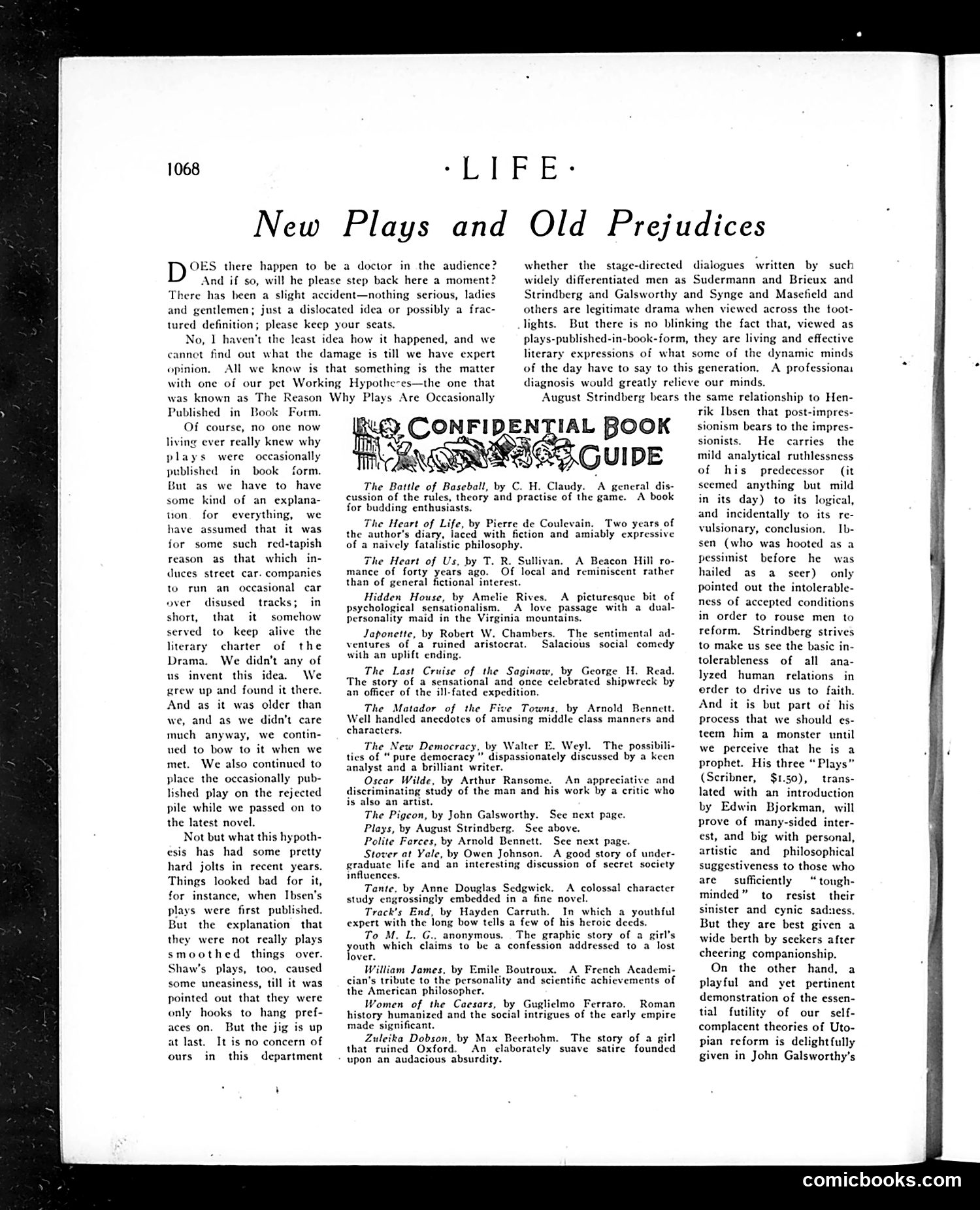
This is a literary essay, not a cartoon. The author humorously examines an outdated assumption: that plays published as books served no real purpose except to maintain Drama's "literary charter." The piece identifies a "working hypothesis" now collapsing: that stage plays shouldn't count as legitimate literature. Recent publication of works by Ibsen and Shaw challenged this prejudice. Ibsen's plays were dismissed because "they were not really plays"; Shaw's excused as "books to hang prefaces on"—polite dismissals that no longer hold. The author's ironic opening (calling a "doctor" for the injured hypothesis) mocks how defenders cling to outdated literary classifications. The point: dynamic modern playwrights like Sudermann, Strindberg, and Galsworthy have proven that stage-directed drama *is* legitimate literature worthy of book publication—despite conservative literary gatekeepers' resistance. It's a defense of modern dramatic literature against entrenched literary snobbery.
📄 Transcribed text from this page (OCR, searchable)
Machine-transcribed from the original scan — historical spelling and the odd misread are preserved.
‘LIFE: New Plays and Old Prejudices OES there happen to be a doctor in the audience? And if so, will he please step back here a moment? There has been a slight accident—nothing serious, ladies and gentlemen; just a dislocated idea or possibly a frac- tured definition; please keep your seats. No, 1 haven't the least idea how it happened, and we cannot find out what the damage is till we have expert opinion. All we know is that something is the matter with one of our pet Working Hypothe-es—the one that whether the stage-directed dialogues written by such widely differentiated men as Sudermann and Brieux and Strindberg and Galsworthy and Synge and Masefield and others are legitimate drama when viewed across the toot- lights. But there is no blinking the fact that, viewed as plays-published-in-book-form, they are living and effective literary expressions of what some of the dynamic minds of the day have to say to this generation. A professiona: diagnosis would greatly relieve our minds. was known Published in Book Form. Of course, no one now living ever really knew why plays were occasionally published in book form. But as we have to have some kind of an explana- tion for everything, we have assumed that it was for some such red-tapish reason as that which in- duces street car. companies to run an occasional car over disused tracks; in short, that it somehow served to keep alive the literary charter of the Drama. We didn’t any of us invent this idea. We grew up and found it there. And as it was older than we, and as we didn’t care much anyway, we contin- ued to bow to it when we met. We also continued to place the occasionally pub- lished play on the rejected pile while we passed on to the latest novel. Not but what this hypoth- esis has had some pretty hard jolts in recent years. Things looked bad for it, for instance, when Ibsen's plays were first published. But the explanation that they were not really plays smoothed things over. Shaw's plays, too, caused some uneasiness, till it was pointed out that they were only hooks to hang pref- aces on. But the jig is up at last. It is no concern of ours in this department The Reason Why Plays Are Occasionally CONFIDENTIAL BOOK BUGIS SS GUIDE The Battle of Baseball, by C. H. Claudy. A general dis- cussion of the rules, theory and practise of the game. book for budding enthusiasts. The Heart of Life, by Pierre de Coulevain, Two years of the author's diary, laced with fiction and amiably expressive of a naively fatalistic philosophy. The Heart of Us, by T. R. Sullivan. A Beacon Hill ro- mance of forty years ago. Of local and reminiscent rather than of general fictional interest. Hidden House, by Amelie Rives. A picturesque bit of psychological sensationalism. A love passage with a dual- personality maid in the Virginia mountains. Japonette, by Robert W. Chambers. The sentimental ad- ventures of a ruined aristocrat. Salacious social comedy with an uplift ending. The Last Cruise of the Saginaw, by George H. Read. The story of a sensational and once celebrated shipwreck by an officer of the ill-fated expedition. The Matador of the Five Towns, by Arnold Bennett. Well handled anecdotes of amusing middle class manners and characters. The New Democracy, by Walter E. Weyl. The possibili- tics of “ pure democracy ” dispassionately discussed by a keen analyst and a brilliant writer. Oscar Wilde, by Arthur Ransome. An appreciative and discriminating study of the man and his work by a critic who is also an artist. The Pigeon, by John Galsworthy. See next page. Plays, by August Strindberg. See above. Polite Farces, by Arnold Bennett. See next page. Stover at Yale, by Owen Johnson. A good story of under- graduate life and’ an interesting discussion of secret society influences. Tante, by Anne Douglas Sedgwick. A colossal character study engrossingly embedded in a fine novel. Track’s End, by Hayden Carruth. In which a youthful expert with the long bow tells a few of his heroic deeds. To M. L. G., anonymous. The graphic story of a girl's outh which claims to be a confession addressed to a lost lover. William James, by Emile Boutroux, A. French Academi- cian’s tribute to the personality and scientific achievements of the American philosopher. Women of the Caesars, by Guglielmo Ferraro, Roman history humanized and the social intrigues of the early empire made significant. Zuleika Dobson, by Max Beerbohm. The story of a girl that ruined Oxford. An claborately suave satire founded upon an audacious absurdity. August Strindberg bears the same relationship to Hen- rik Ibsen that post-impres- sionism bears to the impres- sionists. He carries the mild analytical ruthlessness of his predecessor (it seemed anything but mild in its day) to its logical, and incidentally to its re- vulsionary, conclusion. Ib- sen (who was hooted as a pessimist before he was hailed as a seer) only pointed out the intolerable- ness of accepted conditions in order to rouse men to reform. Strindberg strives to make us see the basic in- tolerableness of all ana- lyzed human relations in erder to drive us to faith. And it is but part of his Process that we should es- teem him a monster until we perceive that he is a prophet. His three “Plays” (Scribner, $1.50), trans- lated with an introduction by Edwin Bjorkman, will prove of many-sided inter- est, and big with personal, artistic and philosophical suggestiveness to those who are sufficiently“ tough- minded” to resist their sinister and cynic saduess. But they are best given a wide berth by seckers after cheering companionship. On the other hand, a playful and yet pertinent demonstration of the essen- tial futility of our self- complacent theories of Uto- pian reform is delightfully given in John Galsworthy’s comicbooks.com