
A complete issue · 44 pages · 1911
Life — November 9, 1911
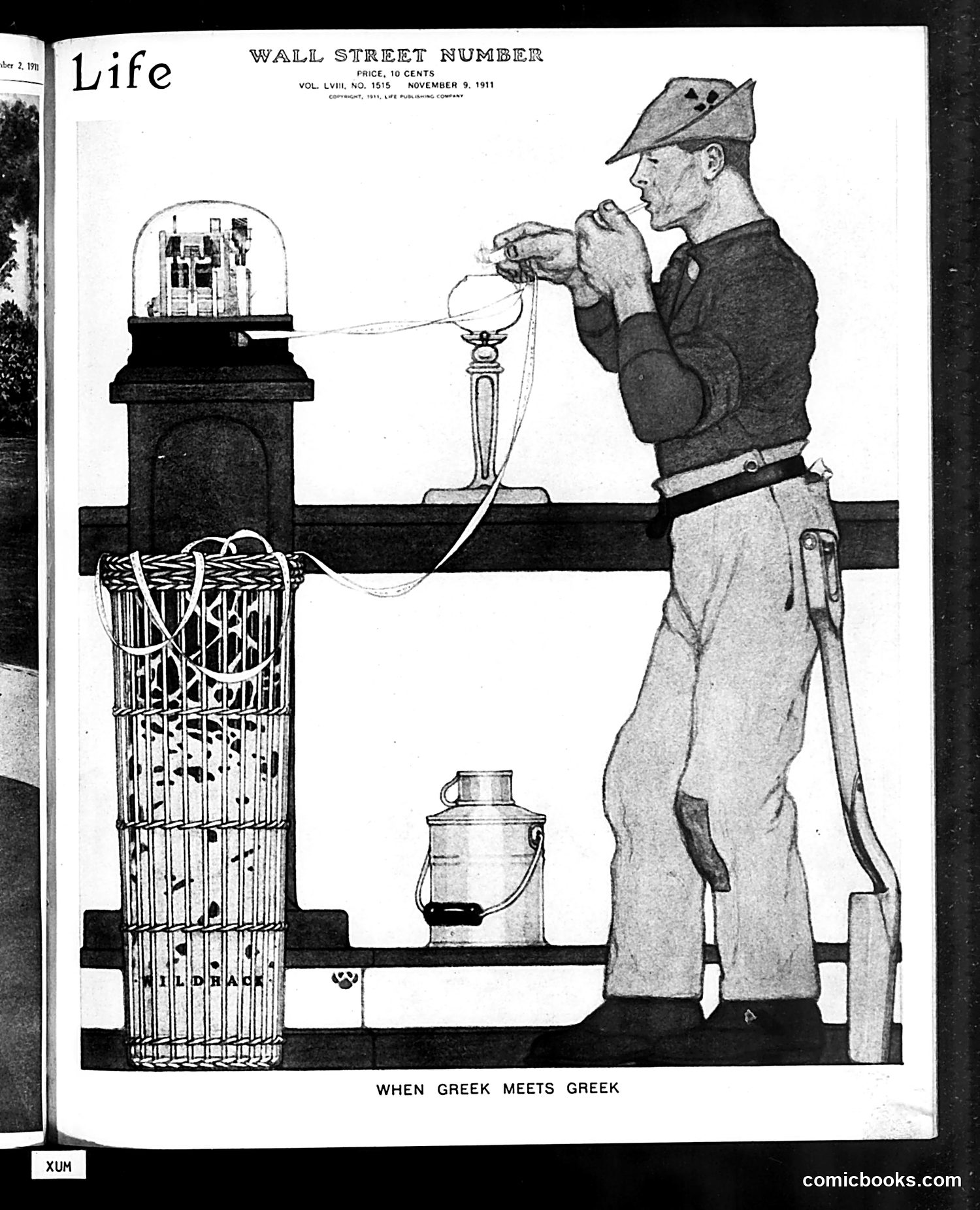
This cartoon satirizes a confrontation between two figures using Greek imagery. The title "When Greek Meets Greek" is a classical allusion meaning when equals or rivals clash. The setup depicts a man in work clothes operating some kind of mechanical apparatus—possibly representing labor or industrial activity—facing off against a domed structure containing what appears to be wealthy interests or establishment power (suggested by the enclosed, elevated position and architectural formality). The visual joke likely comments on class conflict or labor disputes common in 1911 America, when strikes and union organizing were major social tensions. The "Greek meets Greek" phrase implies this is a confrontation between equally-matched opposing forces, though the cartoon's specific reference to a contemporary event remains unclear without additional historical context.
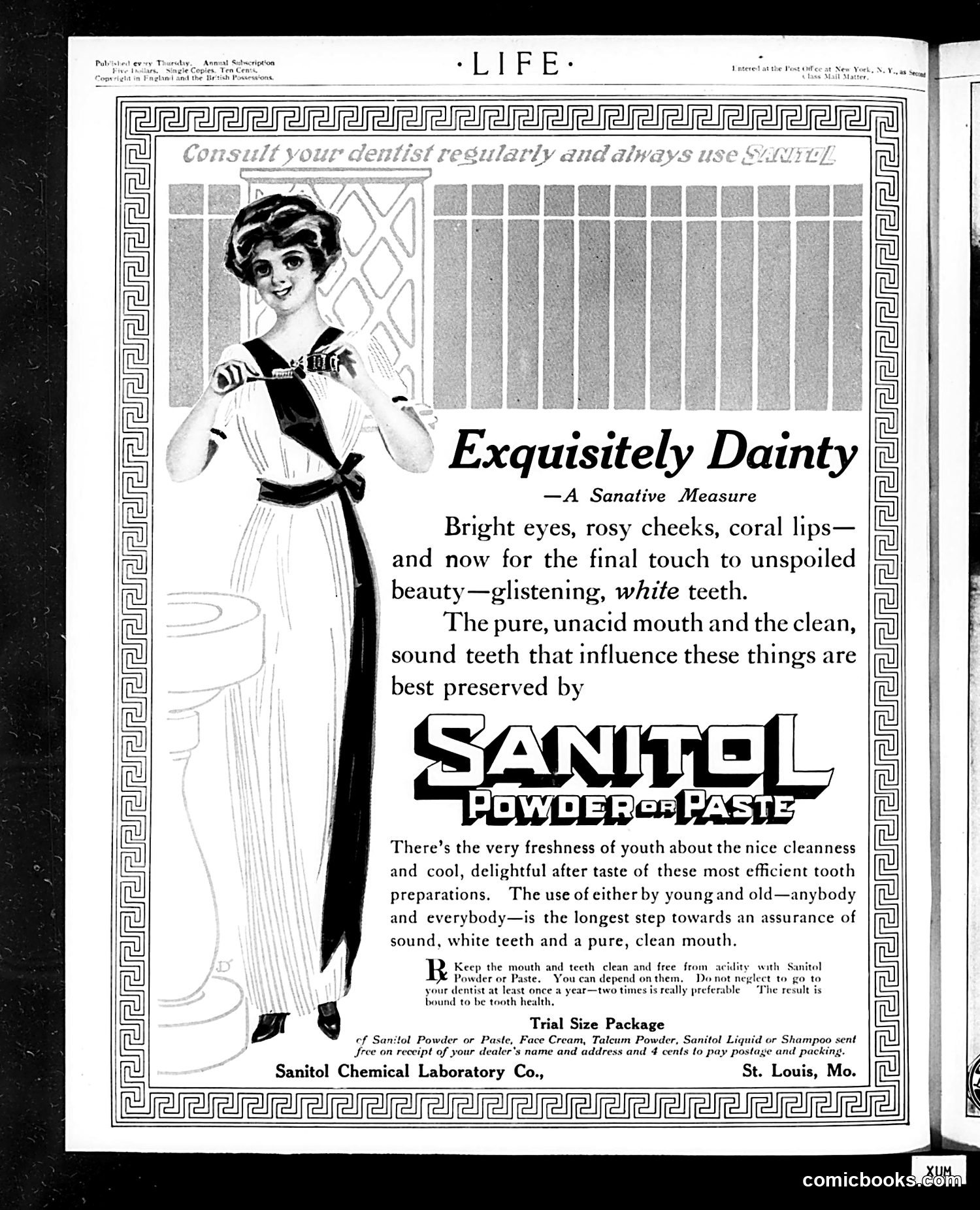
This is primarily an **advertisement**, not editorial content or satire. It promotes Sanitol brand tooth powder and paste from the Sanitol Chemical Laboratory Company in St. Louis, Missouri. The page features an illustrated woman in early 1900s fashion (high-collared white dress, dark sash) as an idealized beauty standard. The ad's messaging connects dental hygiene to feminine attractiveness—"bright eyes, rosy cheeks, coral lips—and now for the final touch to unspoiled beauty—glistening, white teeth." The "sanative measure" framing presents tooth cleaning as health-related rather than purely cosmetic, which was common marketing language of the era. The ad emphasizes freshness, cleanliness, and youth as desirable outcomes. This reflects early 20th-century advertising that tied personal grooming products to social respectability and romantic appeal.
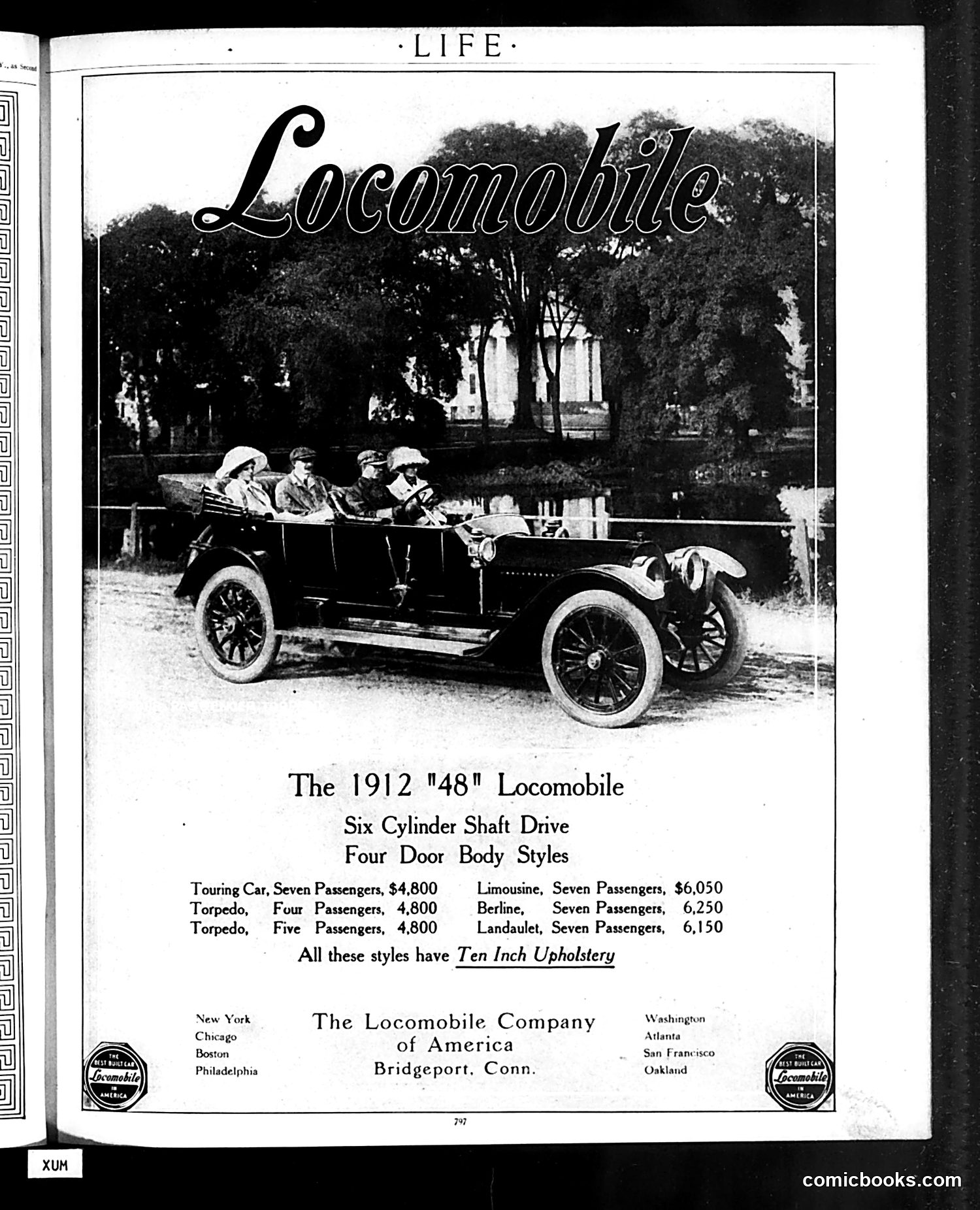
This is **not a cartoon or satire page**, but rather a **straightforward automobile advertisement** from *Life* magazine circa 1912. The image shows the Locomobile Company of America advertising their "48" model—a six-cylinder automobile available in multiple body styles. The photograph depicts the vehicle with well-dressed passengers in a park setting, emphasizing luxury and leisure. The ad lists various configurations (Touring Car, Limousine, Torpedo, Berline, Landaulet) with prices ranging from $4,800 to $6,050—substantial sums in 1912, positioning this as a premium vehicle for wealthy buyers. The "Ten Inch Upholstery" feature is highlighted as a selling point. This is period commercial content, not political commentary or satire.
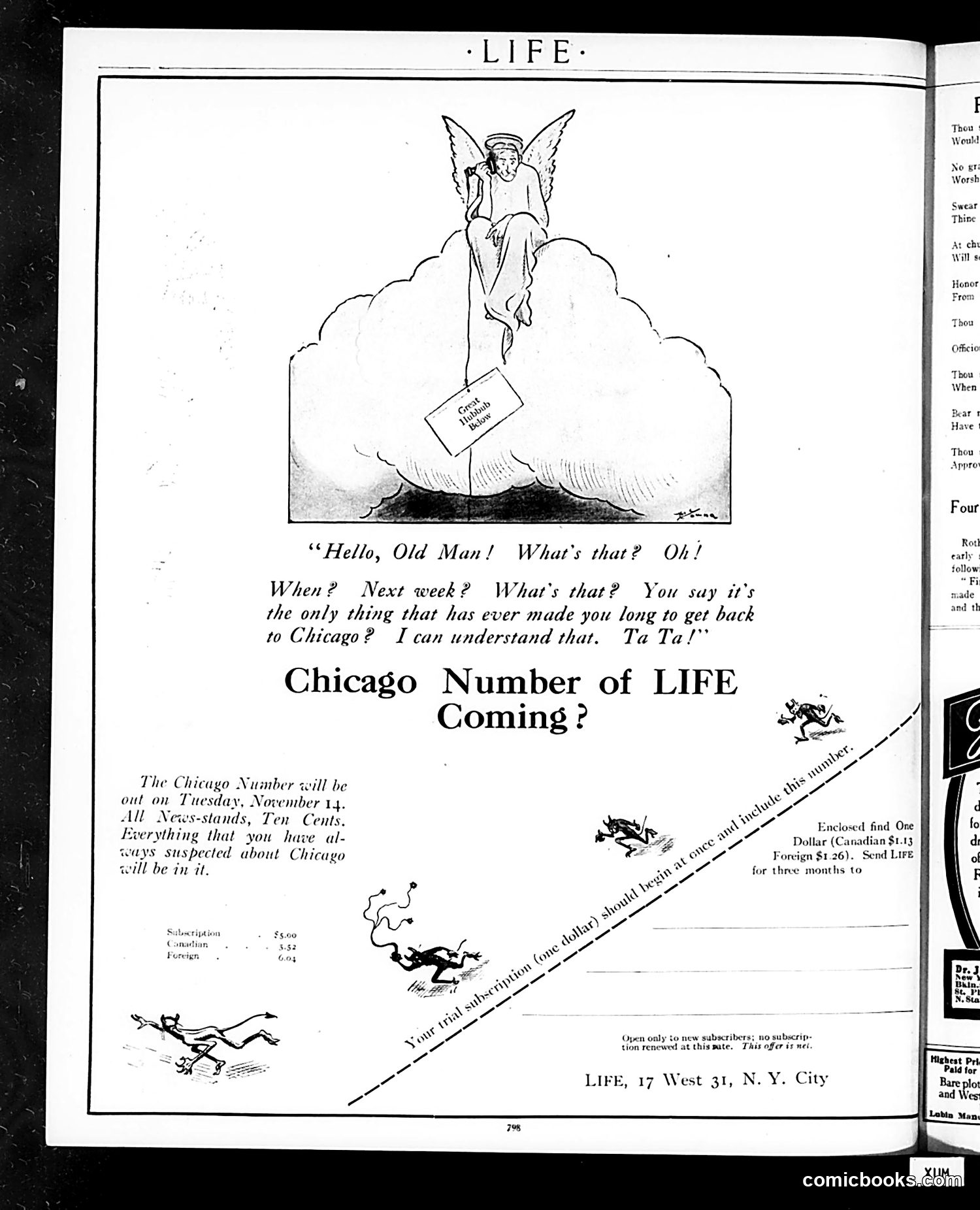
This is primarily a **subscription advertisement** for *Life* magazine's Chicago edition, not a political cartoon. The image shows an angel sitting on a cloud holding a letter labeled "Good News from Heaven," speaking to an old man below. The angel's dialogue humorously suggests that Chicago—which the old man longs to return to—is "the only thing that has ever made you long to get back." The joke plays on **civic pride**: it's a lighthearted appeal to Chicago residents' nostalgia and attachment to their city, using the conceit that even heavenly beings recognize Chicago's appeal. This was a common advertising approach of the era—leveraging local patriotism to boost subscriptions. The ad announces the Chicago edition launching Tuesday, November 14, priced at ten cents at newsstands.
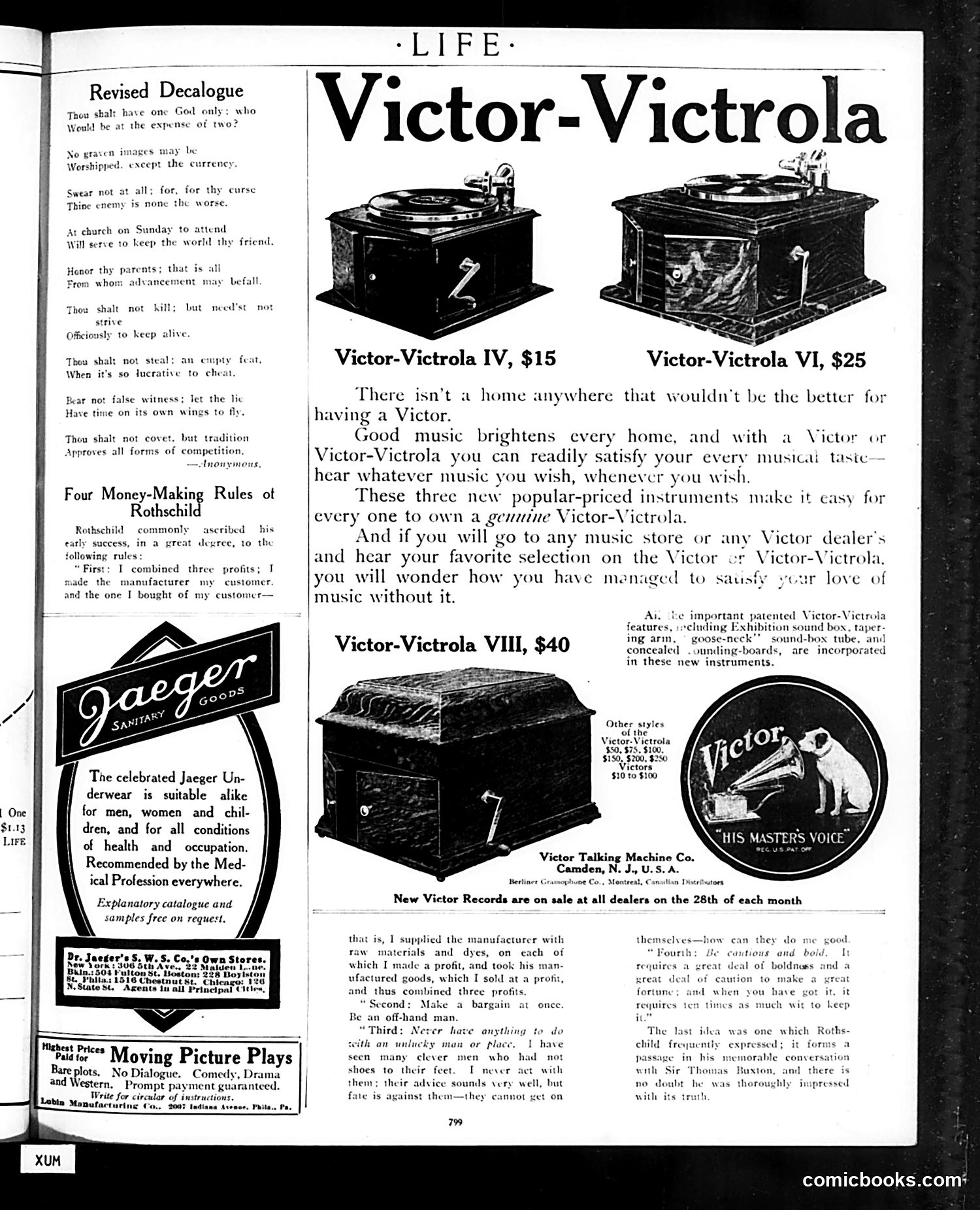
This page is primarily **advertising**, not political satire. The dominant content features three Victor-Victrola phonograph models (priced $15-$40) with promotional text emphasizing how music "brightens every home." The left column contains a "Revised Decalogue" (ten commandments parody) and "Four Money-Making Rules of Rothschild"—light satirical pieces about wealth and business ethics, likely reflecting general 1910s-era attitudes toward commerce rather than specific political targets. Below is an advertisement for Jaeger underwear and Moving Picture Plays. The page reflects early 20th-century consumer culture, showcasing how phonographs were marketed as essential home entertainment while surrounding it with miscellaneous commercial and mildly satirical content typical of Life magazine's format.
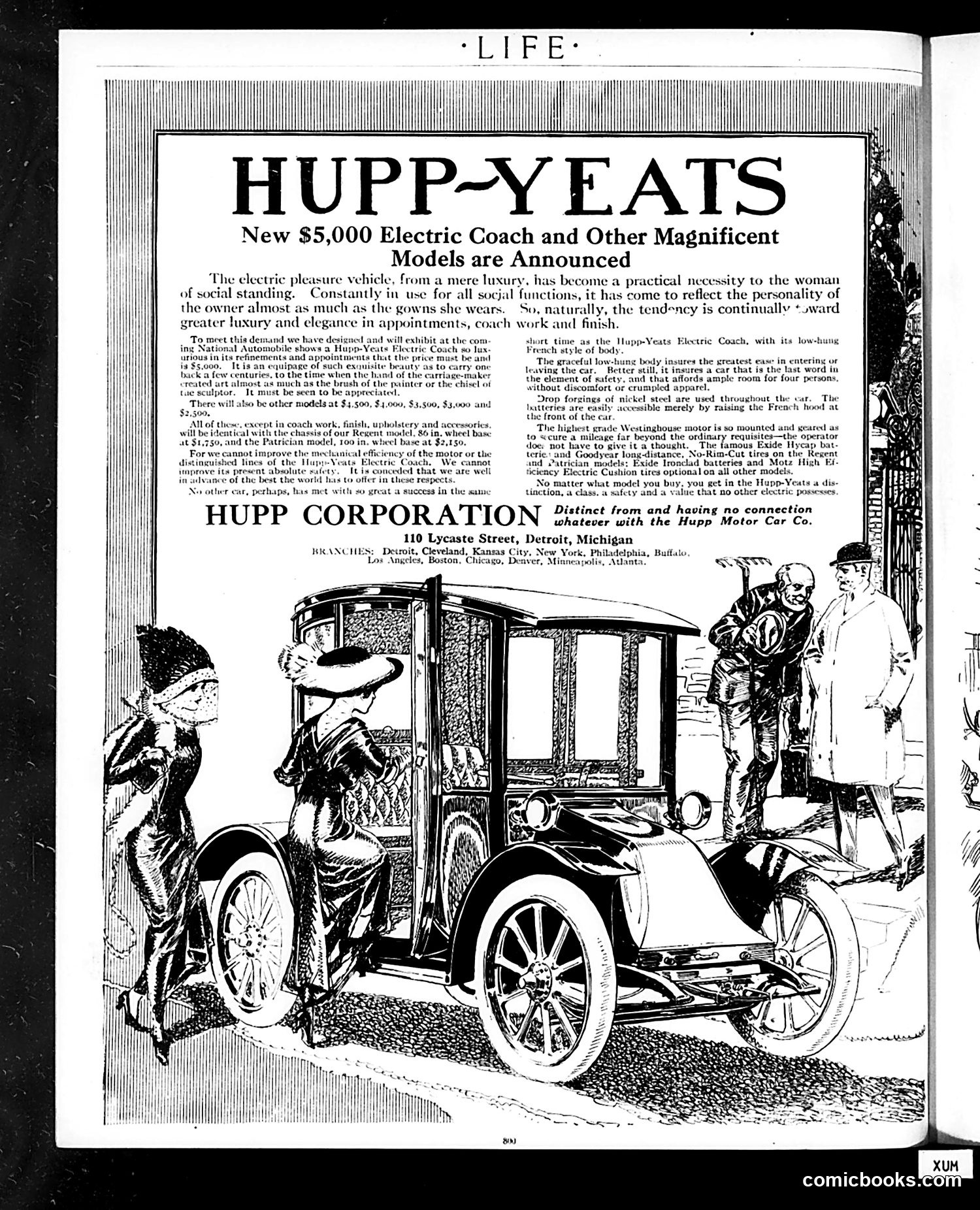
This is primarily a **product advertisement**, not political satire. The Hupp Corporation promotes their new $5,000 electric coach automobile, marketed specifically to wealthy women as a practical necessity for "social standing." The illustrated scene shows well-dressed figures admiring the enclosed electric vehicle—a status symbol of the era. The text emphasizes luxury features: beautiful upholstery, a high-grade Westinghouse motor, and safety innovations like "Goodyear long-distance" tires. The advertisement's framing as "Hupp-Yeats" and the mention of "no connection with the Hupp Motor Car Co." suggests a branding distinction, though the historical details are unclear from the text alone. This reflects early 1900s attitudes positioning automobiles as essential luxury goods for the affluent.
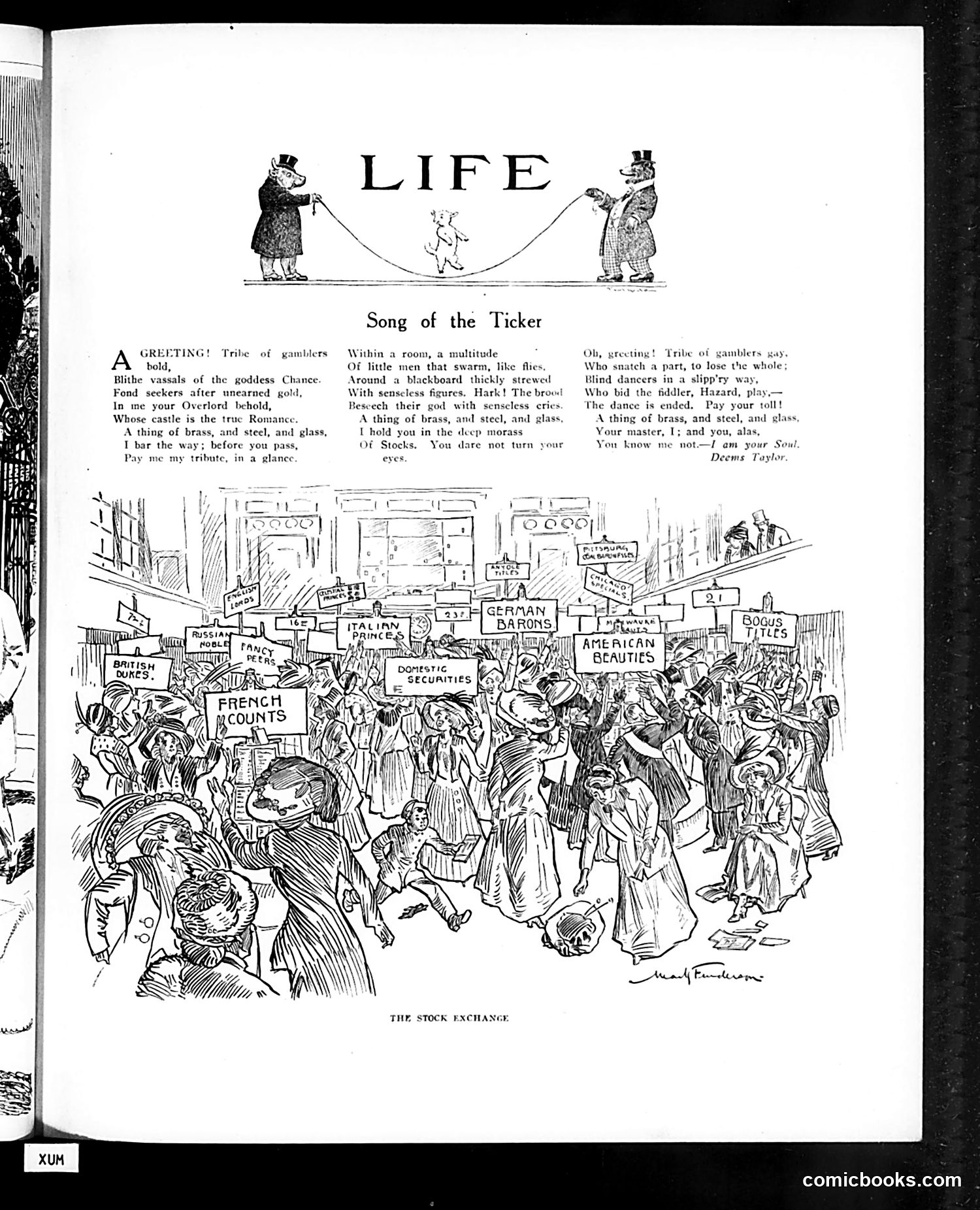
This *Life* magazine page satirizes financial speculation and the chaotic stock market. The poem at top mocks gamblers pursuing wealth through "Chance" rather than honest work, warning against greed. The illustration below depicts "The Stock Exchange" as a crowded, frenzied marketplace. Signs visible include "French Accounts," "Italian Princes," "American Beauties," "Bogus Titles," and "Bond Securities"—suggesting the market trafficked in dubious foreign investments and worthless securities that duped American investors. The cartoon criticizes how ordinary people ("little men that swarm, like flies") engaged in speculative trading, driven by senseless figures spouting meaningless jargon. The overall message: the stock market is a con game where ordinary people lose money chasing false promises of wealth.
This page from *Life* magazine (Vol. LVIII, No. 1515) discusses Iowa Senator Albert B. Cummins and his political record. The text critiques Cummins as an ambitious politician who uses reform rhetoric but prioritizes personal advancement and government connections over genuine principle. The article contrasts Cummins with Senator La Follette (likely Robert M. La Follette of Wisconsin), suggesting La Follette is more genuinely committed to reform. It attacks Cummins' shift from law practice to politics, noting his government salary dependence and lack of personal wealth despite his political success. The small cartoon illustrations appear to show political figures in satirical poses, typical of *Life*'s editorial style, though specific identities are unclear from the image alone.
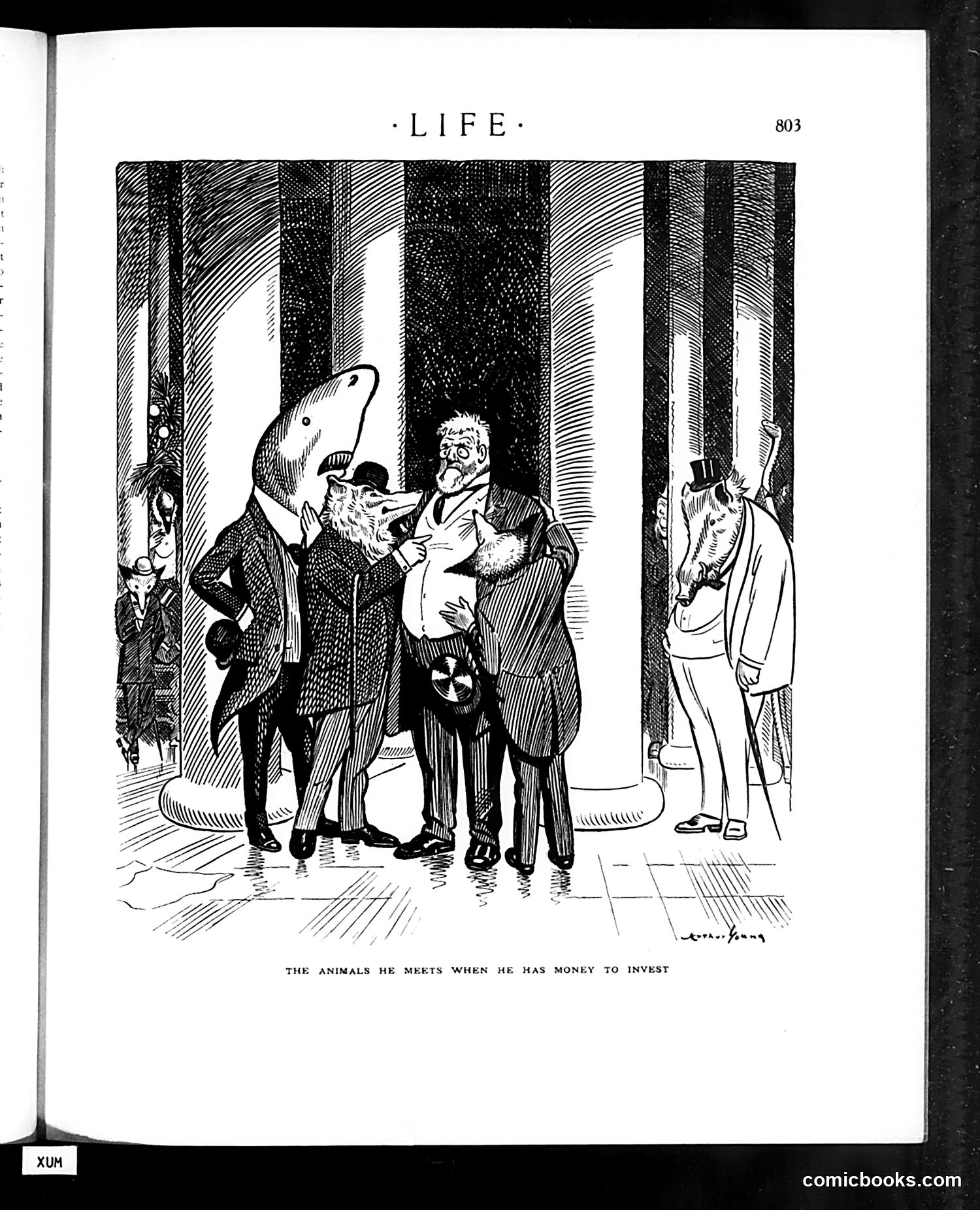
This satirical cartoon depicts a well-dressed man encountering various predatory figures in what appears to be a columned building or financial district. The caption's metaphorical language—calling the figures "animals"—suggests these are financial operators or con artists who specifically target investors with capital. The cartoon satirizes how men with money attract unsavory characters seeking to exploit them. The figures surrounding the investor appear menacing and predatory, illustrated with exaggerated features suggesting moral corruption. This reflects early 20th-century anxieties about financial fraud, investment schemes, and unscrupulous businessmen who targeted wealthy individuals. The satire critiques both the predatory nature of such operators and the vulnerability of investors to manipulation and deception.
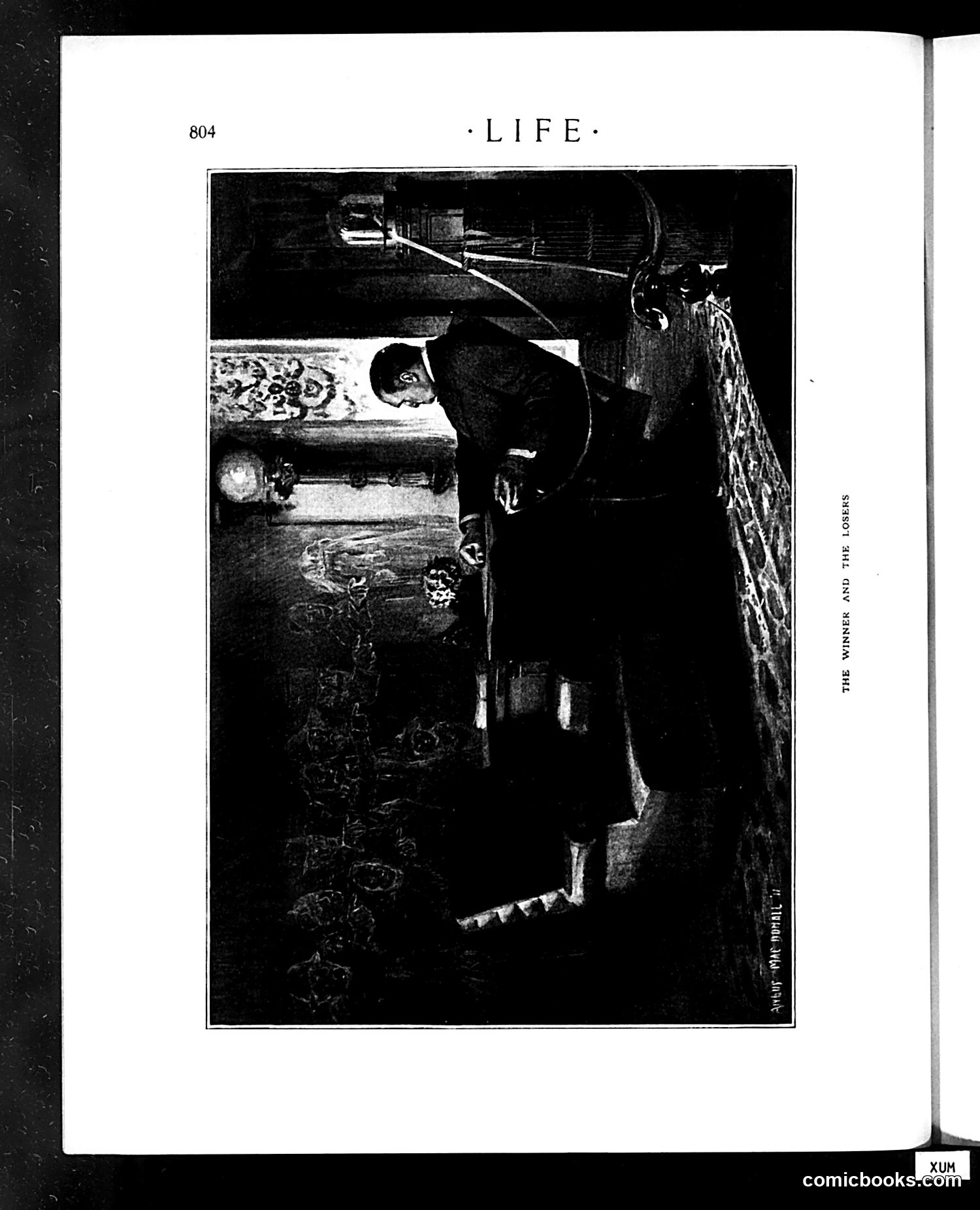
This page from *Life* magazine shows a black-and-white photograph titled "THE WARRIOR AND THE LOAFERS." The image depicts a man in dark clothing bending over what appears to be garden plants or vegetables. The caption's reference to "warrior" and "loafers" suggests social commentary about work and idleness. Without additional context about the publication date or clearer OCR text, the exact satirical target remains unclear. However, the juxtaposition of a laboring "warrior" against "loafers" likely critiques attitudes toward manual labor or agricultural work versus leisure—possibly commentary on class distinctions or wartime labor expectations. The photograph's documentary style was typical of *Life*'s approach to social satire in this era.
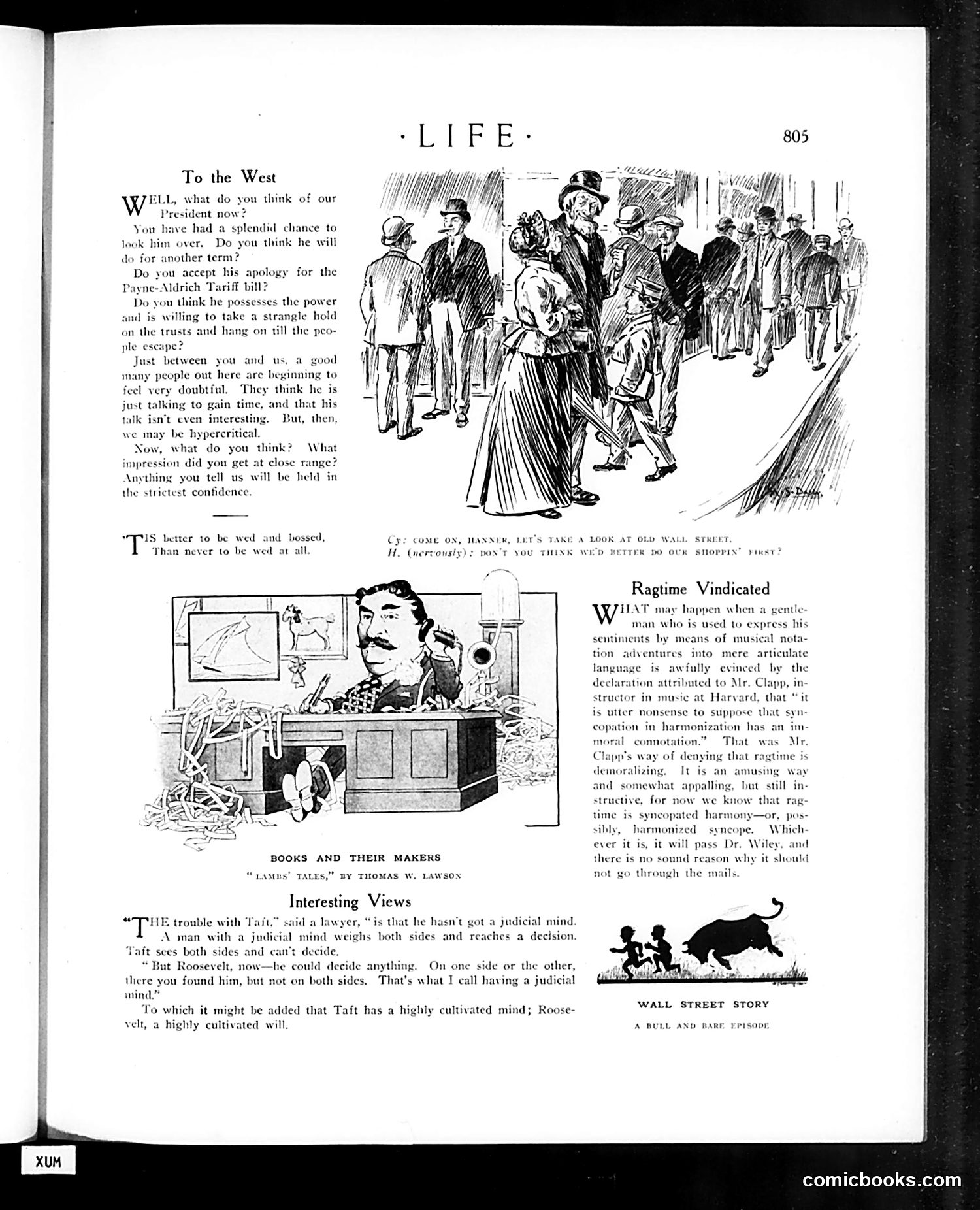
The top cartoon depicts "To the West," asking a Western visitor's opinion of the President (likely Theodore Roosevelt, given Life's era). It satirizes Roosevelt's contradictions: the questioner notes the President claims he won't run again yet possesses "power and willing to take a strange hold" on people—suggesting he'll escape his own term-limit pledge. The joke is that Roosevelt is hypocritical about his political ambitions. The lower section includes "Ragtime Vindicated," defending ragtime music against a Harvard music instructor's criticism that it's immoral. The article ironically suggests ragtime will inevitably pass through "the mails" despite moral objections—a period-specific reference to postal censorship debates. The "Taft" section compares President Taft unfavorably to Roosevelt regarding decisiveness.
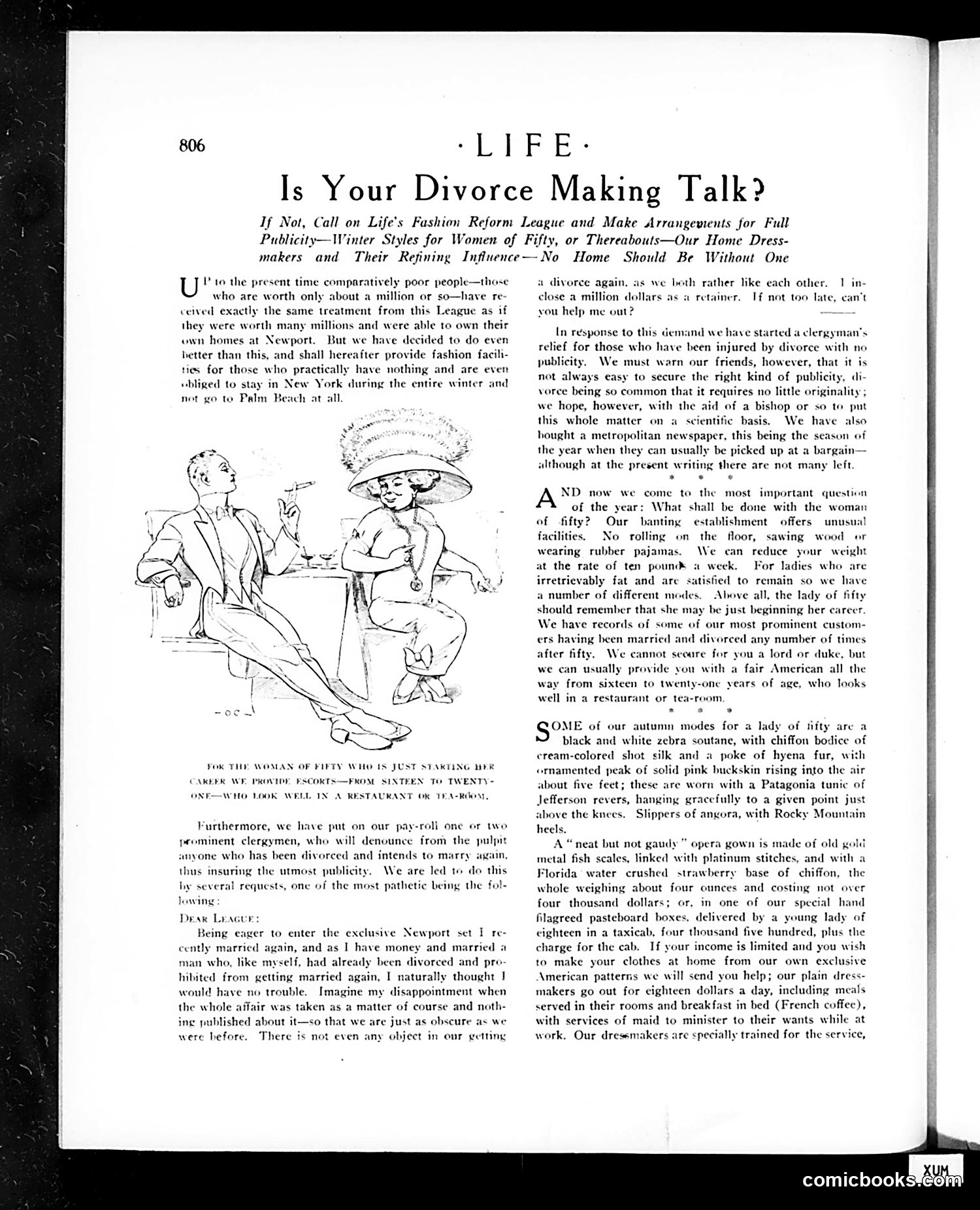
This Life magazine article satirizes wealthy divorced women of the 1920s Jazz Age. The cartoon depicts two fashionably dressed women gossiping—likely representing society figures whose divorces generate scandal and newspaper publicity. The article mocks the "Fashion Reform League," which apparently offers services to divorced women, including: weight-loss programs ("ten pounds a week"), employment placement as restaurant or tea-room staff, and custom dressmaking. The satire targets both the idle wealthy women seeking reinvention after divorce and the opportunistic services exploiting them. The tone suggests divorce among the rich was scandalous enough to require "rehabilitation" through work and fashion makeovers. The piece ridicules both the subjects and the commercial industries profiting from their social disgrace.
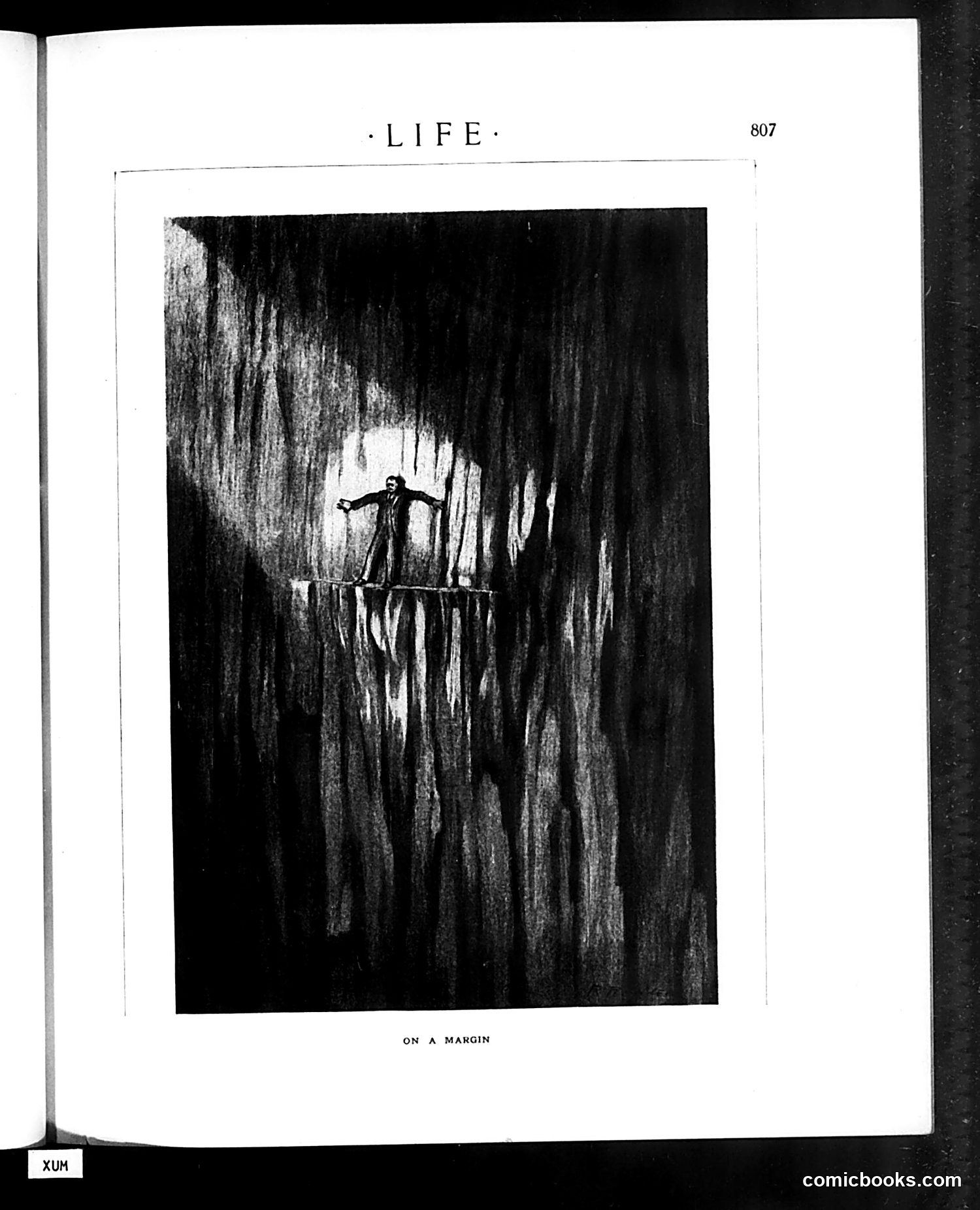
This political cartoon depicts a solitary figure standing precariously on a narrow ledge or precipice, with arms outstretched for balance against a dark, ominous background. The title "On a Margin" suggests the figure exists in a precarious position—financially, politically, or socially unstable. The dramatic composition emphasizes vulnerability and danger. Without additional context or caption identifying the specific figure, the cartoon appears to comment generally on someone or some group living dangerously close to collapse or ruin. The expressionistic style—with its dark, streaked background—conveys anxiety and instability. This was likely satirizing a contemporary political or economic figure facing uncertain circumstances, though the specific identity requires additional historical context beyond what's visible here.
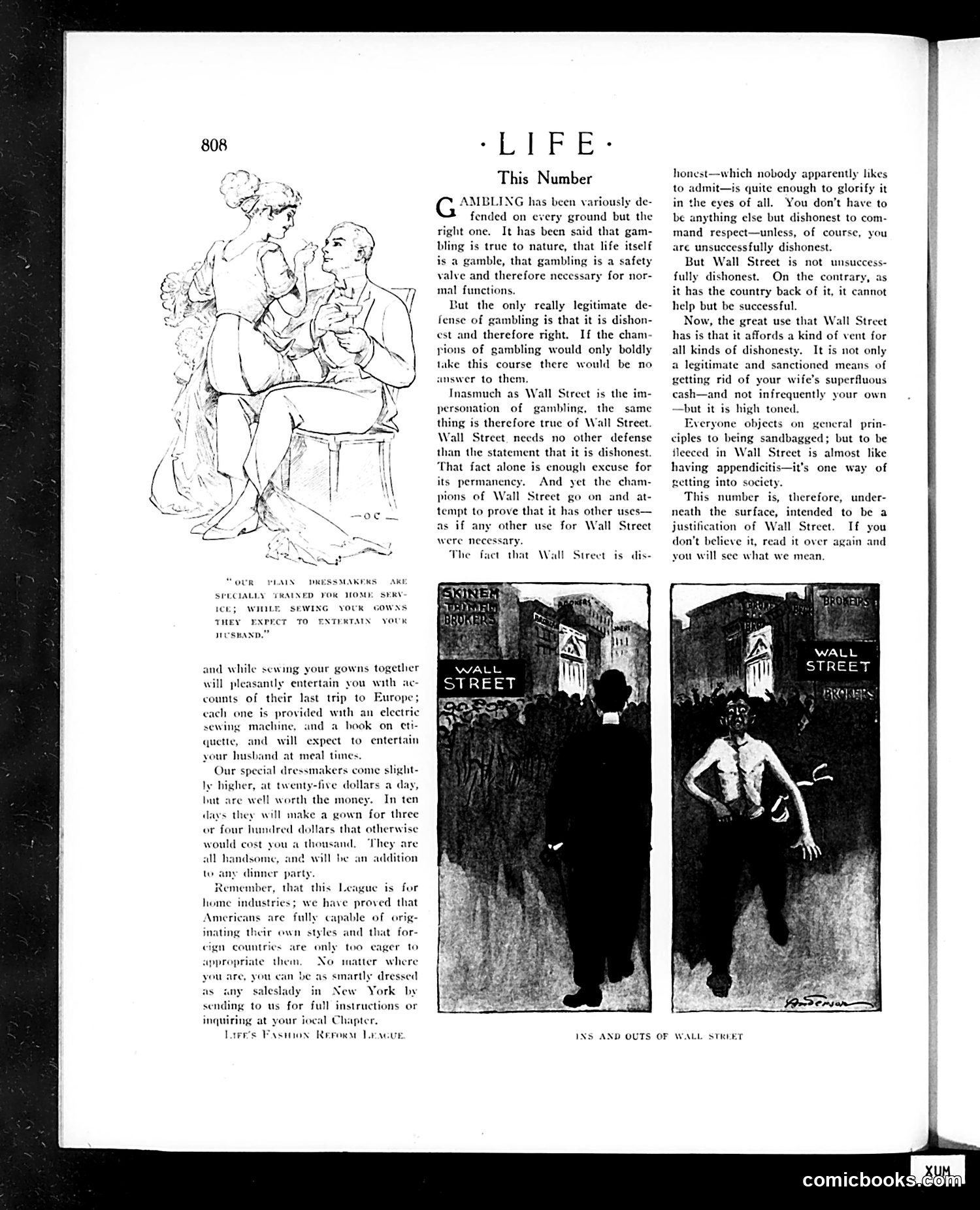
This page satirizes Wall Street and financial speculation during the 1920s. The main article defends gambling on Wall Street as "honest" and necessary, arguing it provides a "vent for all kinds of dishonesty" and shouldn't require further justification. The two cartoon panels titled "Ins and Outs of Wall Street" (illustrated by what appears to be a signature reading "O.C." or similar) use silhouettes to depict the dramatic financial swings affecting ordinary people. The figures shown entering and exiting suggest the volatility and human cost of stock market participation—fortunes made and lost. The accompanying advertisement for "Liris Fashion Bureau" promotes dressmaking services, illustrating how financial institutions marketed aspirational lifestyles to the middle class during the speculative boom era.
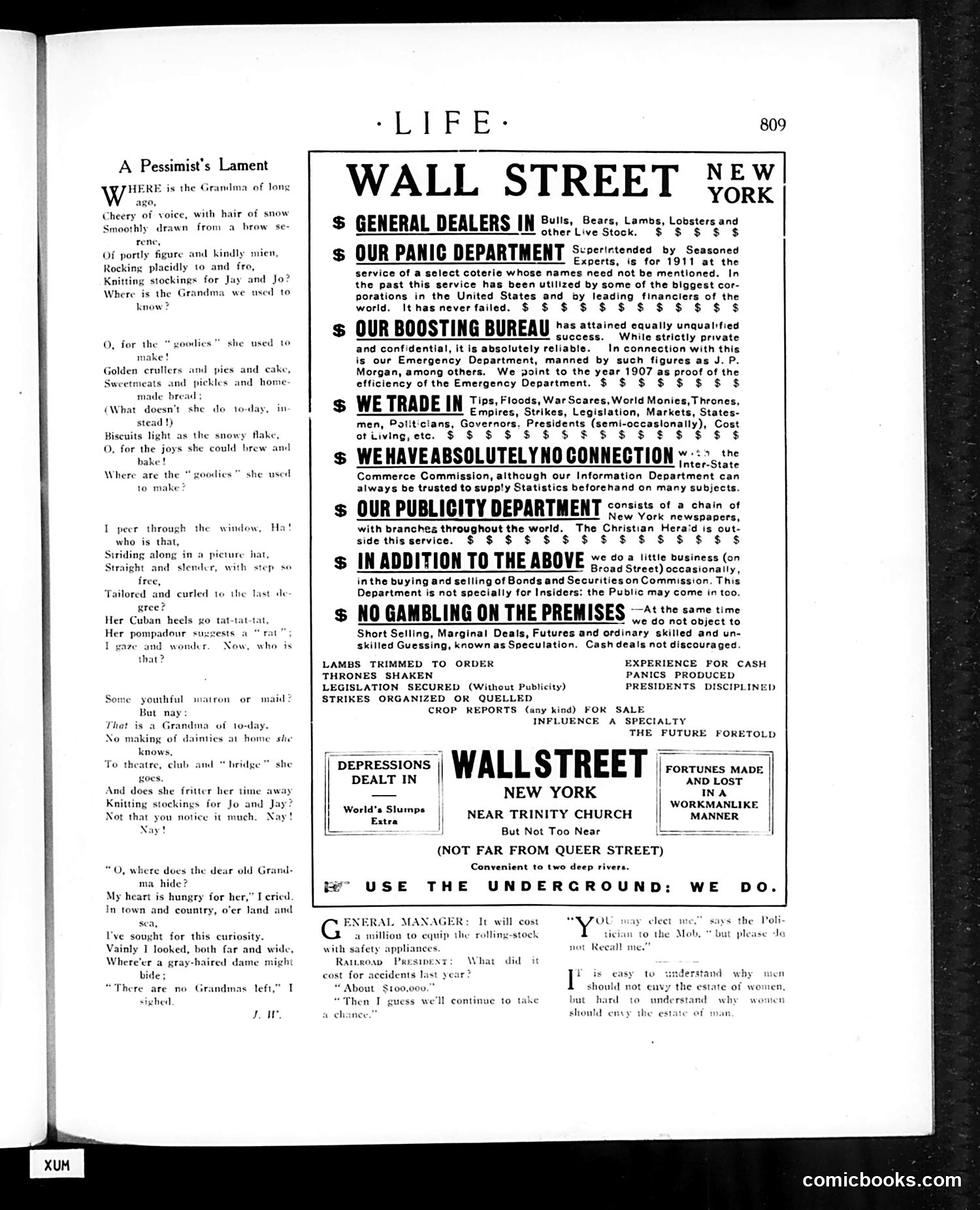
This page contains a satirical advertisement mocking Wall Street financial practices during the pre-Depression era. The fake "business listing" for a Wall Street operation parodies the corrupt, manipulative nature of high finance by explicitly advertising services—panic creation, market manipulation, legislative influence-peddling, and "lambs trimmed to order" (defrauding inexperienced investors). The satire references real figures like J.P. Morgan and critiques the 1907 financial panic. Key targets include: - **Speculation and market manipulation** ("Tips, Floods, War Scares") - **Insider trading and political corruption** ("Presidents disciplined," "Legislation secured") - **Predatory practices** toward ordinary investors ("lambs") The heading "NO GAMBLING ON THE PREMISES" ironically acknowledges that speculation *is* gambling. The accompanying poem laments the "modern grandmother" who abandons domestic duties for social activities—a separate social commentary reflecting period anxieties about changing women's roles. This represents *Life* magazine's role as a vehicle for progressive political satire criticizing financial oligarchy and corporate malfeasance.
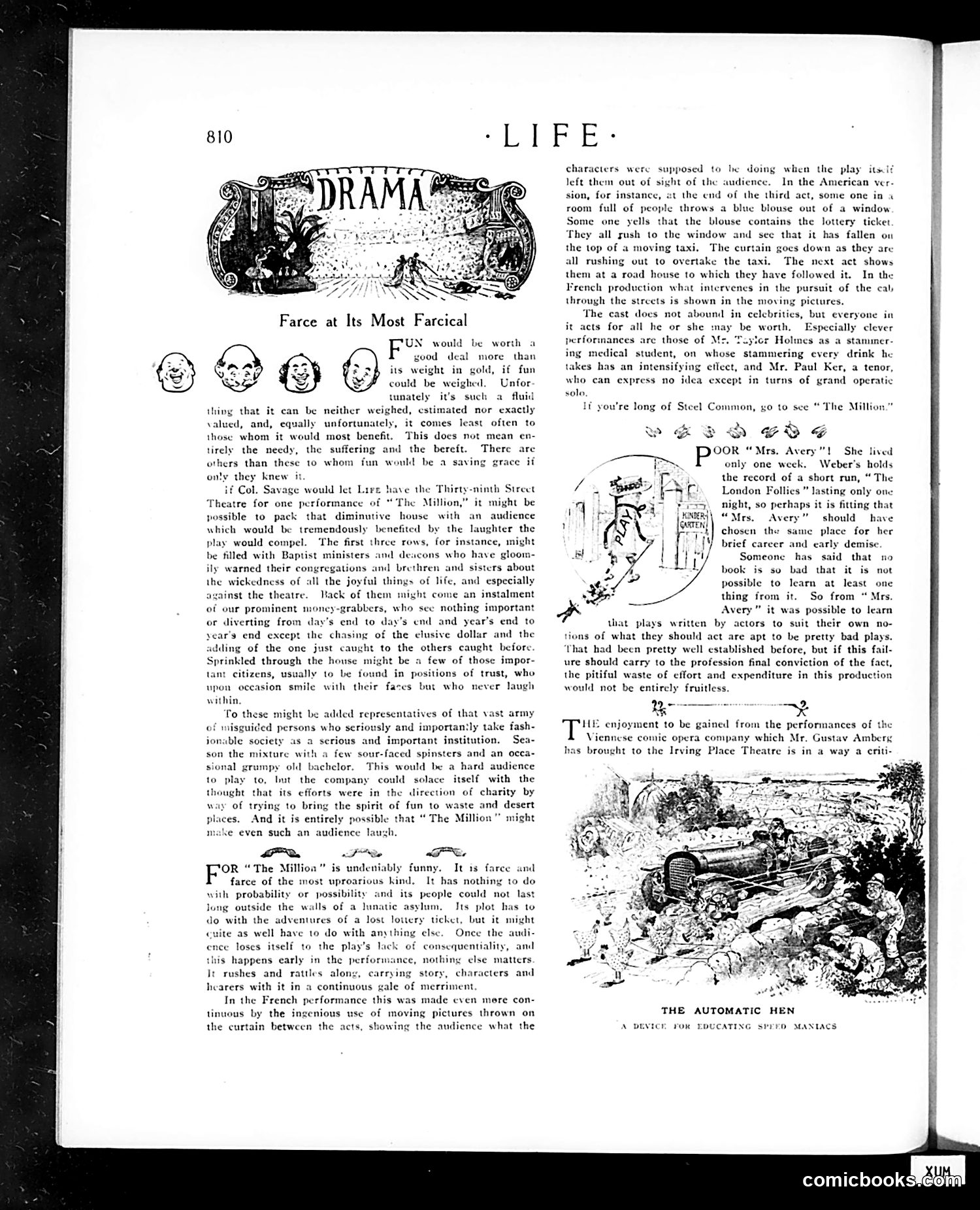
This is a theater review of the farce "The Million," praising its comedic value. The article humorously proposes filling the theater's first rows with people who "need" fun most: stern Baptist ministers who denounce theatrical wickedness, money-obsessed businessmen focused only on profit, corrupt politicians, status-conscious socialites, and perpetually scowling spinsters and bachelors. The satire targets American hypocrisy and joylessness—those who condemn entertainment while grinding through loveless, profit-driven existences. The review notes the French production cleverly used moving pictures between acts to show offstage action (a taxi chase), filling gaps the American version leaves to imagination. The core joke: even the most humorless, self-righteous people would benefit from simple laughter.
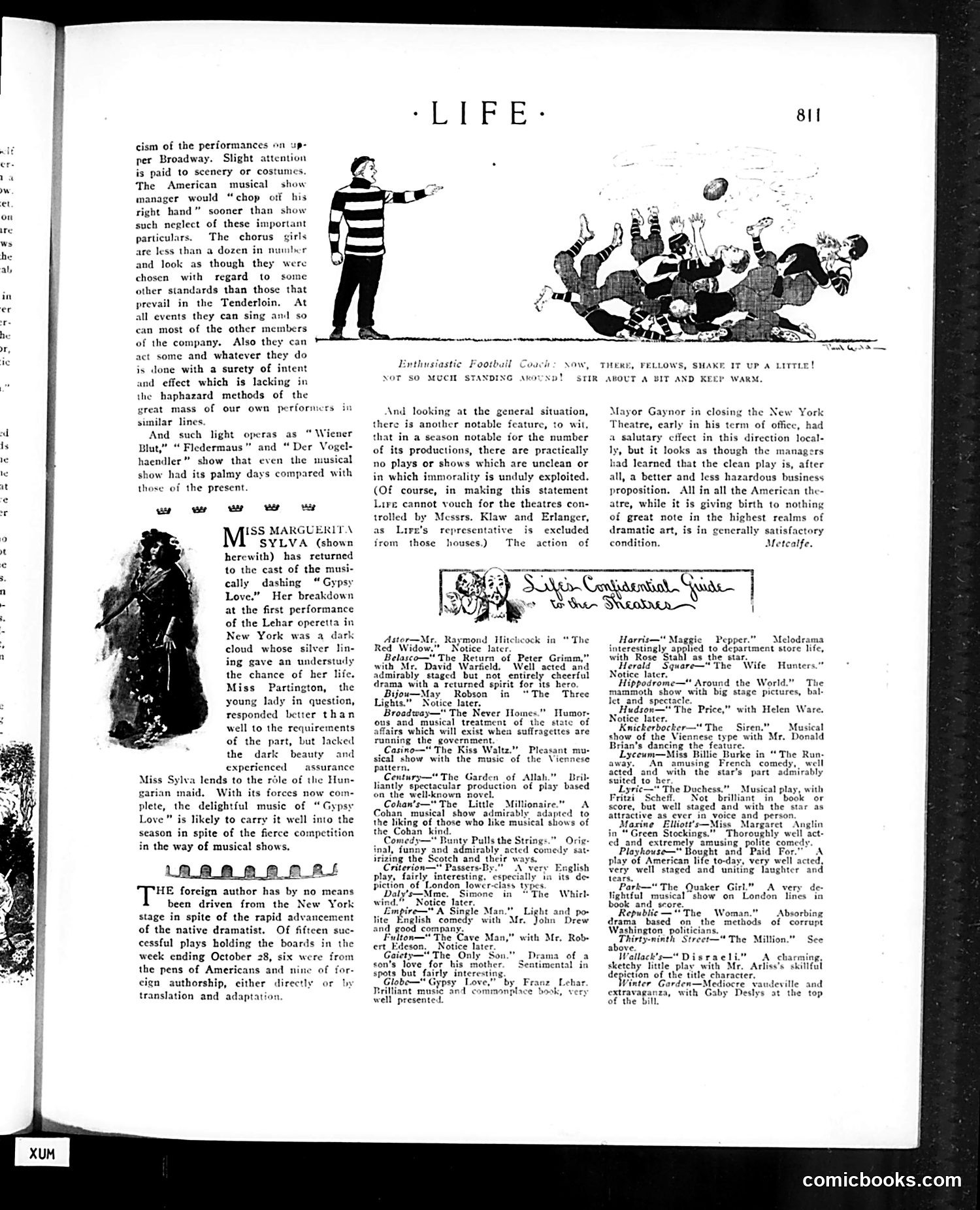
## Main Cartoon The top illustration shows a football coach directing enthusiastic players who are tumbling over each other. The caption "ENTHUSIASTIC FOOTBALL COACH: 'NOW, THERE, FELLOWS, SHAKE IT UP A LITTLE!'" is satirical—the coach's instruction to "shake it up" has literally caused chaotic pandemonium rather than organized improvement. This mocks overwrought coaching rhetoric that sounds dynamic but produces disorder. ## Article Content The page primarily reviews New York theater productions, comparing American and European theatrical standards. The text criticizes American musical theater's sloppy production values (scenery, costumes, chorus quality) compared to European operettas like "Wiener Blut." A photograph shows actress Marguerite Sylva, whose return to "Gypsy Love" is noted positively. The article also notes that of fifteen successful Broadway plays that week, nine were foreign-authored versus six American—reflecting early 20th-century American theatrical dependence on European works. **No overt political satire appears on this page; it's primarily entertainment criticism.**
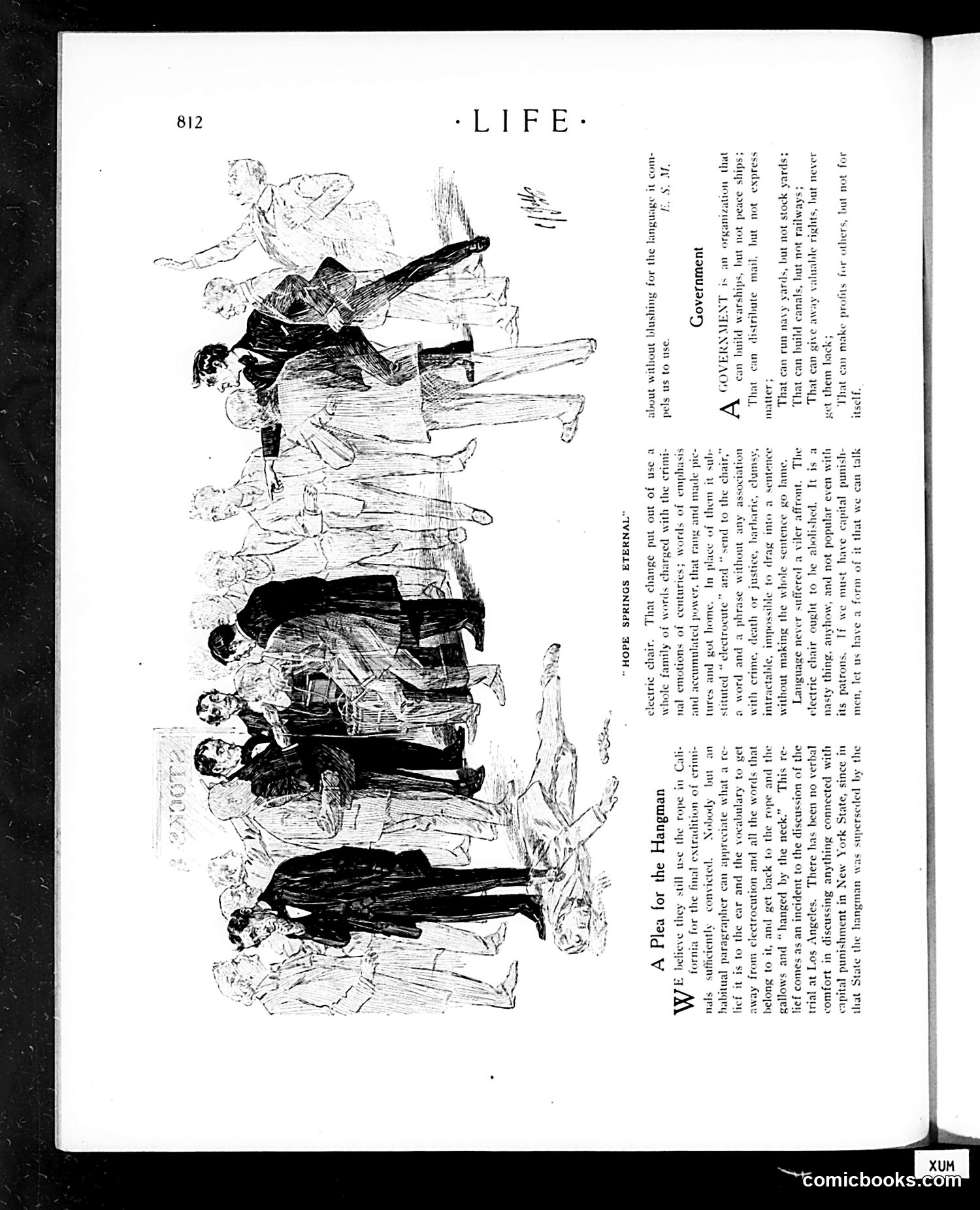
This page features a satirical illustration titled "A Government" showing a vertical stack of figures in formal dress, appearing to support or balance one another precariously. The composition suggests governmental hierarchy or instability. The accompanying text (partially legible) discusses how "these charges put use a charge" and references "Government" structures, with commentary about officials' relationships and responsibilities. The satire appears to critique governmental organization and interdependence—suggesting that government functions through awkward, unstable arrangements where officials depend on each other's continued cooperation. The stacked arrangement implies fragility: remove one figure and the entire structure collapses. Without clearer text or specific caricature identification, the exact political figures or situation referenced remain unclear, but the general critique targets bureaucratic inefficiency or political instability.
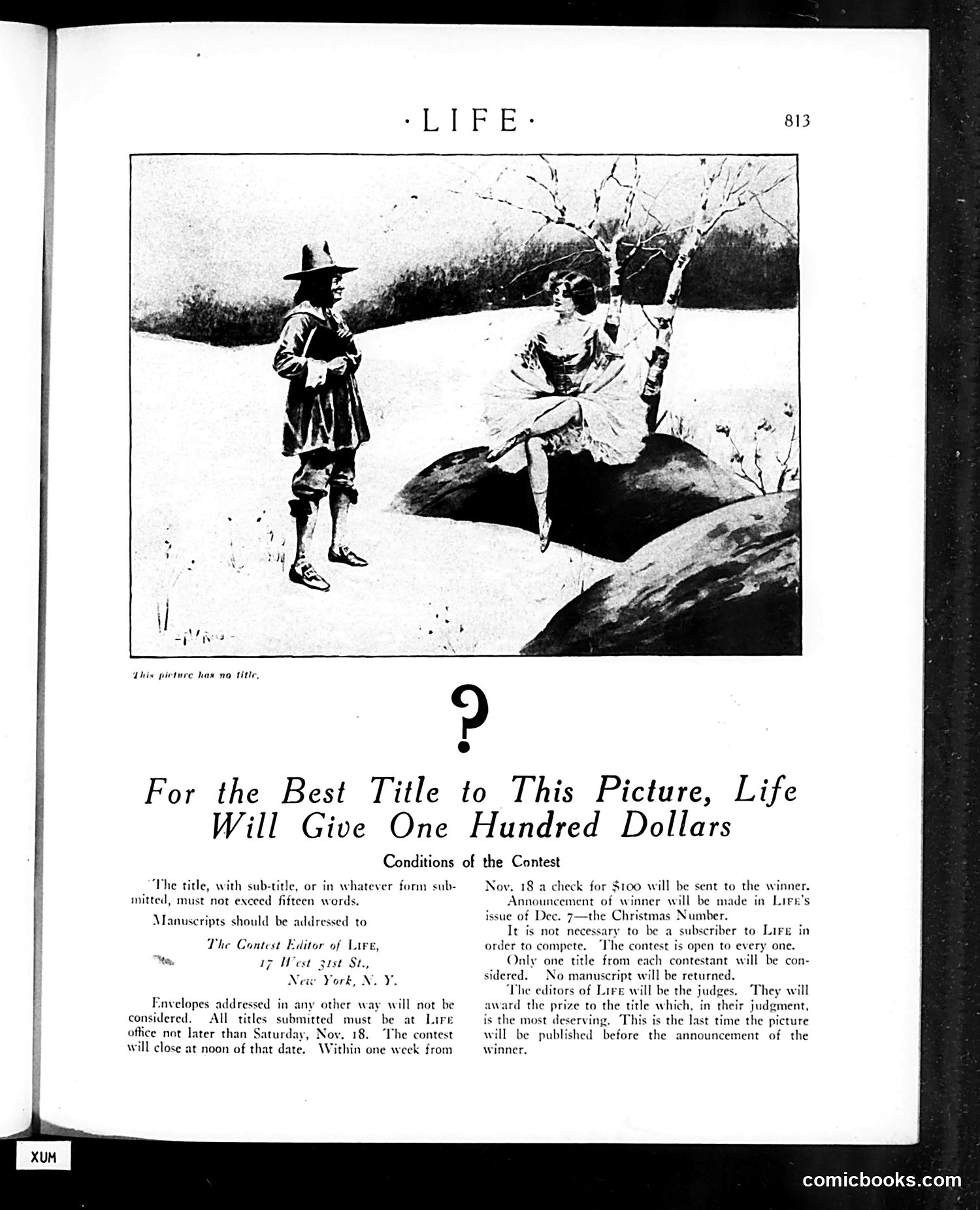
This page presents a visual puzzle from *Life* magazine's satirical humor section. The black-and-white illustration shows a man in formal attire (appearing to be a gentleman or soldier) standing beside a woman in a ballet tutu positioned near a hole in snowy ground, with bare birch trees visible. The magazine is running a $100 contest asking readers to submit titles for this untitled image—the implication being that the absurd juxtaposition demands explanation through wit. The humor likely derives from the incongruity: a ballerina in an inappropriate setting (winter landscape with a suspicious hole), or perhaps a commentary on theatrical pretension meeting reality. Readers had until November 18 to submit fifteen-word-maximum titles. This was a popular *Life* feature that invited audience participation while showcasing the magazine's satirical sensibility about modern social situations and human behavior.
This satirical short story mocks wealthy couples' hollow commitment to economizing. Mr. Opdyke attempts to suggest household budget cuts, but his wife Mrs. Opdyke deflects every criticism—her bridge playing (which she claims generates income through winnings), her hat and cab expenses, her florist bills—are all framed as necessities. Meanwhile, Mr. Opdyke refuses to sacrifice his clubs or Adirondack hunting camp, claiming they're business/health necessities. The joke culminates when, after agreeing to "economize in a general way" (meaning nothing specific), Opdyke casually mentions he's bought an expensive new touring car. The satire targets the self-deception of the leisure class: they discuss economy while remaining completely unwilling to actually reduce spending, merely rationalizing every extravagance as essential.
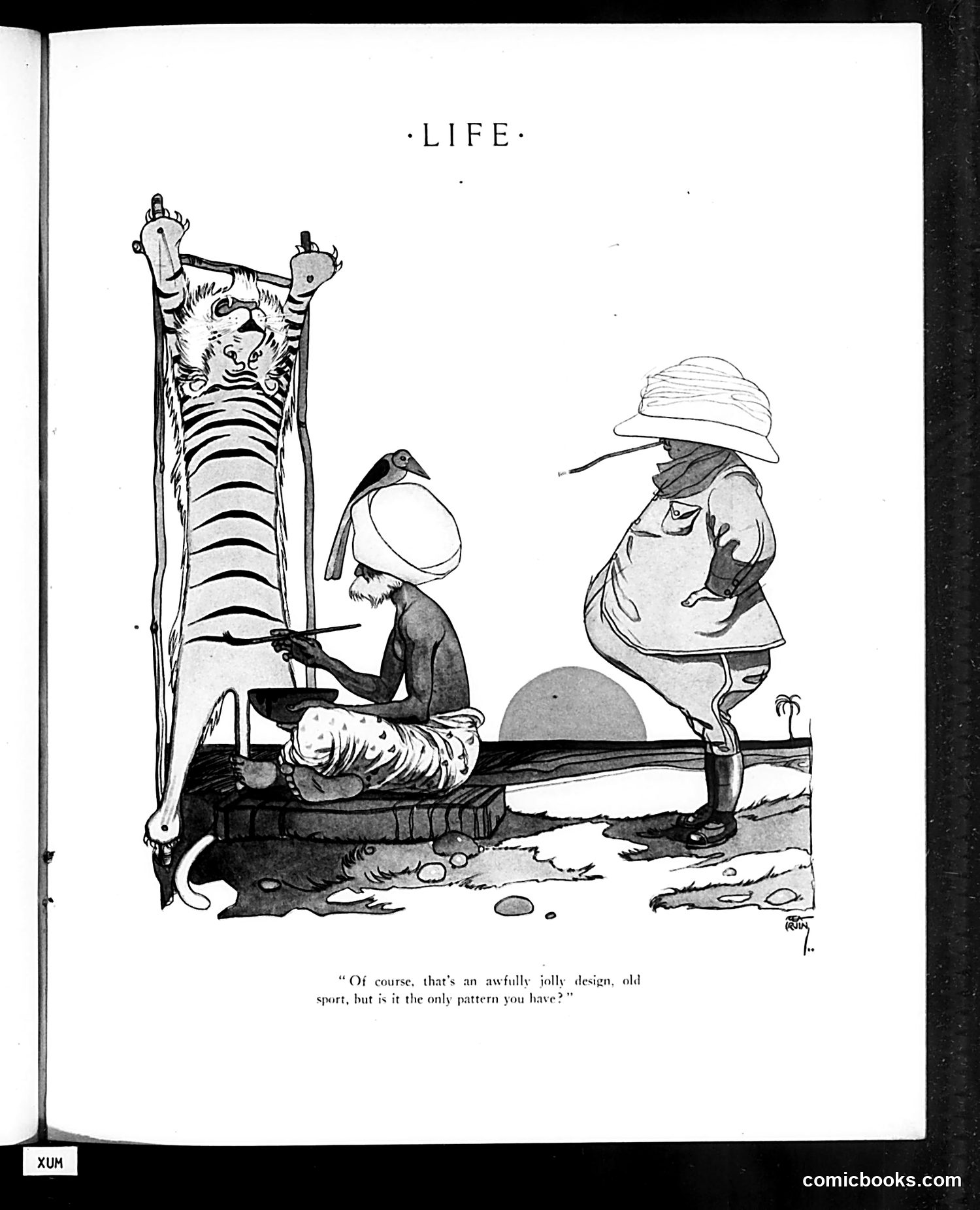
This is a satirical cartoon from *Life* magazine depicting a colonial or imperial-era scene. Two figures in pith helmets and colonial dress appear to be examining a large, grotesque totem or idol with an exaggerated face and raised arms. One seated figure asks the other if this "jolly design" is "the only pattern you have." The satire likely mocks Western colonial attitudes toward indigenous peoples and their art—specifically the dismissive, condescending tone with which colonizers viewed non-Western cultures. The phrase "awfully jolly design" reflects the casual, patronizing language colonials might use when encountering indigenous religious or artistic objects, while the question implies colonial expectations that indigenous peoples should have diverse "designs" available for Western consumption or approval. The cartoon critiques colonial ignorance and cultural arrogance.
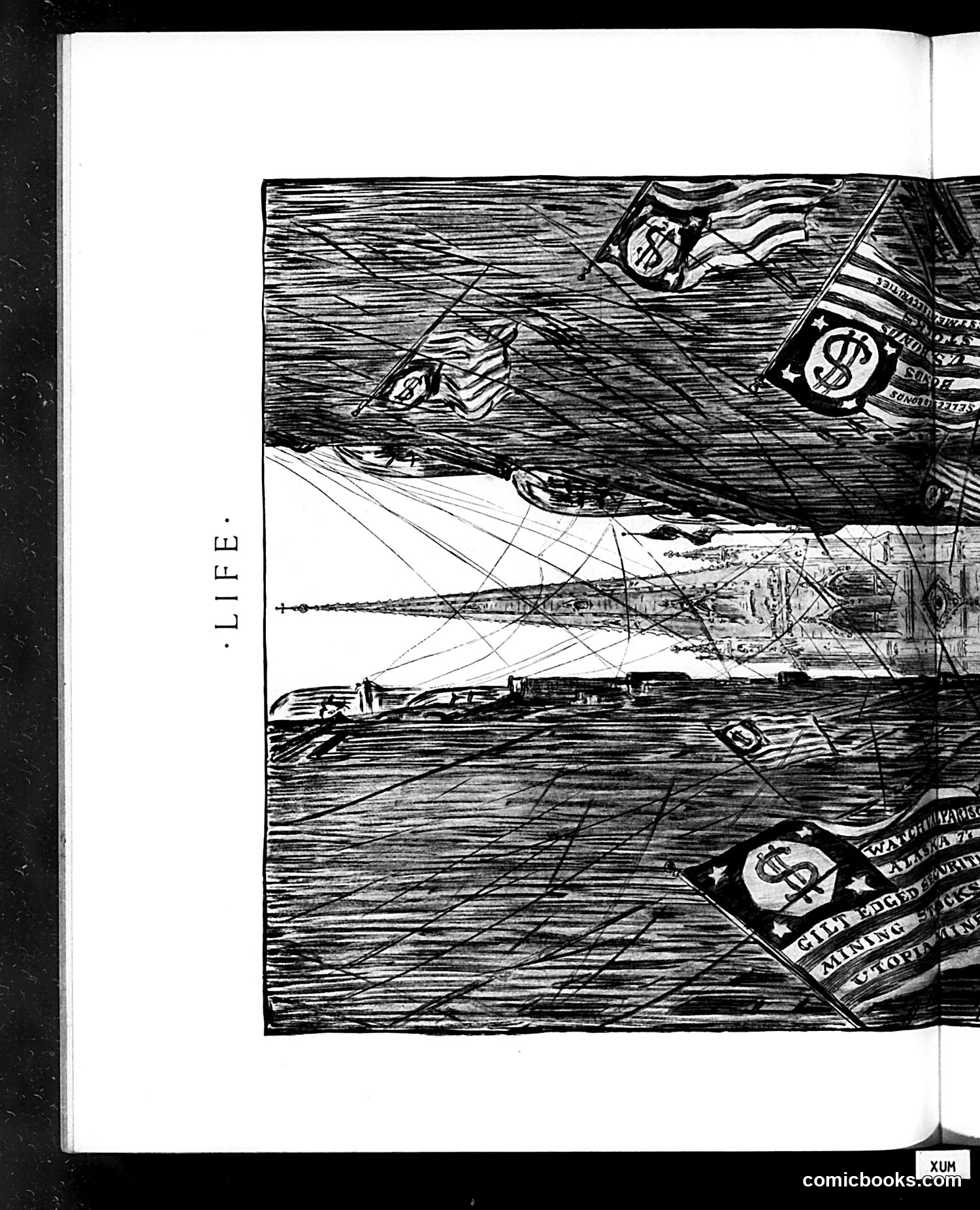
This page displays a woodcut-style illustration titled ".LIFE" (visible on the left margin). The image appears to be a satirical political cartoon rendered in stark black and white with heavy cross-hatching. The composition shows what appears to be a naval or maritime scene with ships, flags bearing dollar signs, and money imagery scattered throughout. The style suggests critique of commercialism or financial interests related to naval/military affairs—likely commentary on war profiteering or the influence of money in military/political decisions. However, without visible dates, specific figure identifications, or clearer contextual text, I cannot definitively identify which historical event, political figures, or specific scandal this references. The dollar-sign symbolism and ship imagery suggest early-to-mid 20th century American political satire concerning military-industrial or financial interests.
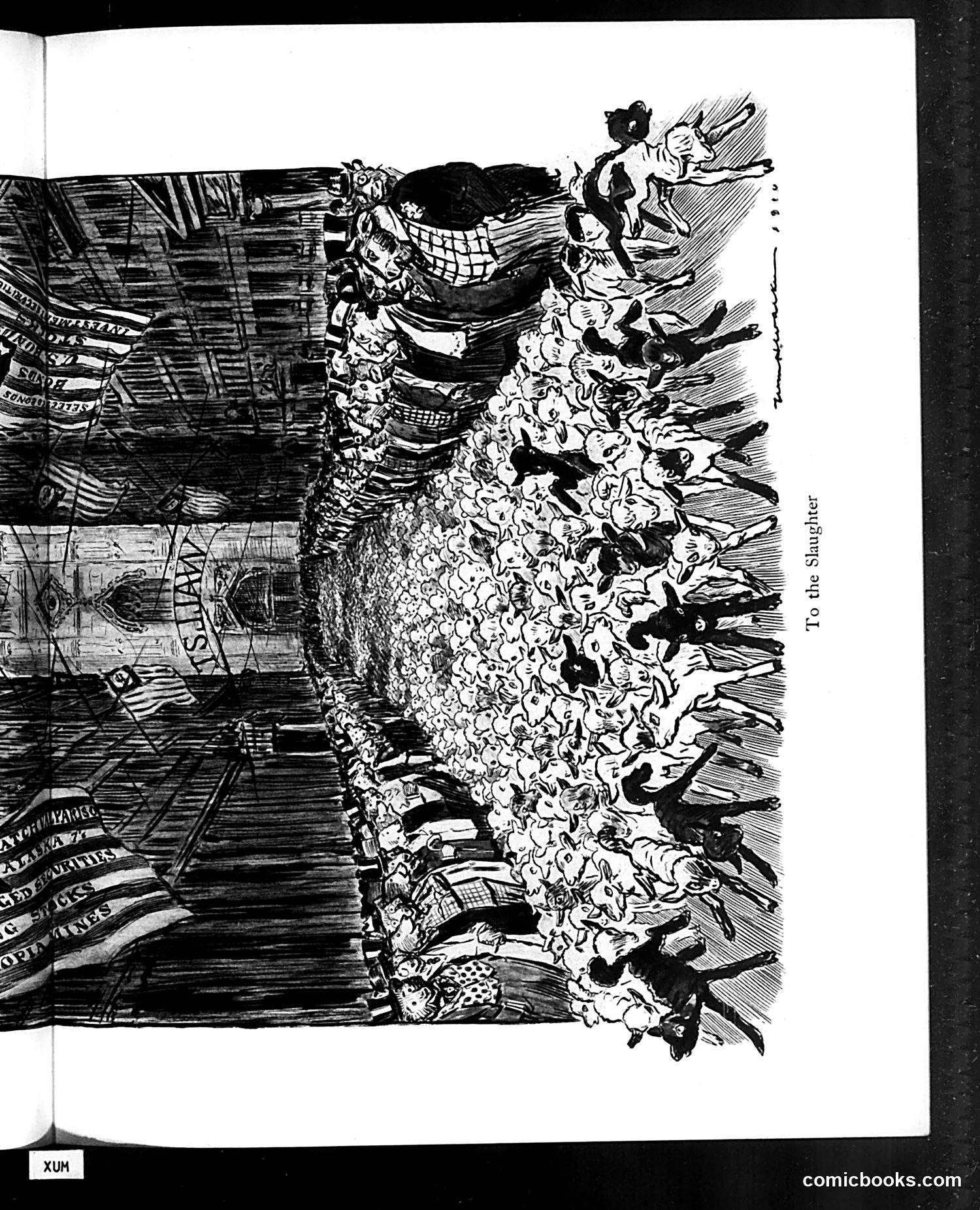
This political cartoon depicts a large crowd of people being driven toward slaughter like livestock. The title "To the Slaughter" suggests the figures represent citizens or soldiers being sent to their deaths, likely in war. The cartoon appears to be satirizing either: - Military conscription or forced deployment - A government or leader sending people to war without their consent - The dehumanizing nature of mass mobilization for conflict The densely packed crowd, the herding imagery, and the slaughterhouse reference all emphasize how individuals lose agency and become expendable in such systems. Without more specific historical context (publication date, visible identifying details), the exact political event referenced remains unclear, though the anti-war sentiment is evident.
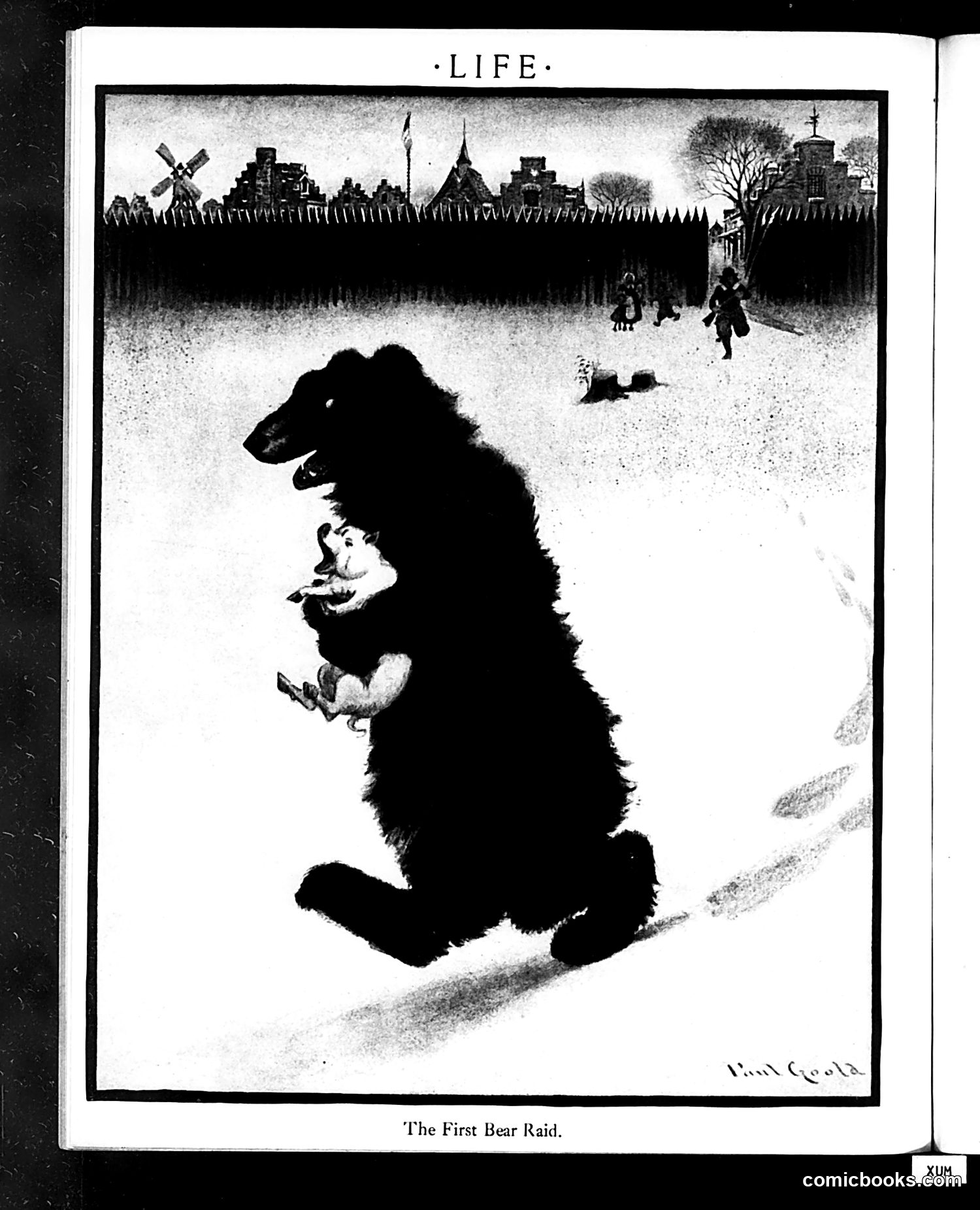
This cartoon depicts a large bear descending upon a medieval walled village. The bear appears menacing and aggressive, carrying what looks like a human figure in its mouth. Village inhabitants can be seen fleeing or reacting in the background near fortified walls and buildings. The title "The First Bear Raid" likely refers to an actual historical event or recent news incident involving a bear attack on a settlement. Without additional context from the magazine's date and surrounding articles, the specific historical reference is unclear. The cartoon may satirize either a real attack or use it metaphorically to comment on some contemporary threat or crisis. The medieval setting could suggest either historical commentary or allegorical meaning beyond a literal bear attack.
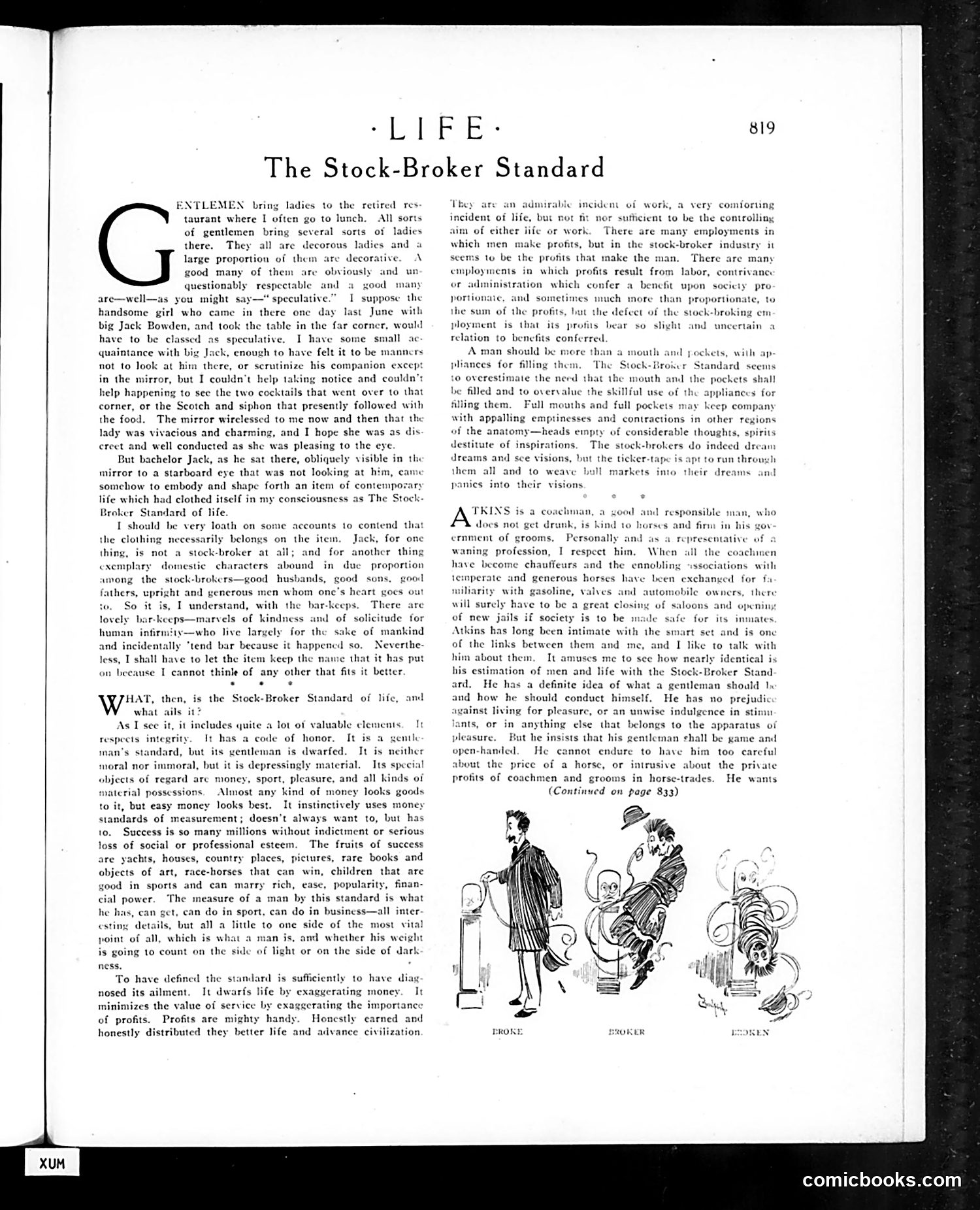
This article critiques the values of early 20th-century American upper-middle-class life, using "stock-broker" as shorthand for a materialistic worldview. The author observes a gentleman ("big Jack Bowden") with a woman at a restaurant and uses this as a jumping-off point to dissect what he calls the "Stock-Broker Standard of life." The satire identifies the problem: this standard measures human worth by wealth, possessions (yachts, houses, race-horses), and business success rather than character or moral substance. The author argues it "dwarfs life by exaggerating money" and minimizes genuine service and community contribution. The three cartoon figures at bottom (labeled "Broke," "Broker," and "Bushed") likely illustrate the cycle or consequences of this money-obsessed philosophy. The critique reflects Progressive Era concerns about materialism undermining traditional values and authentic human relationships.
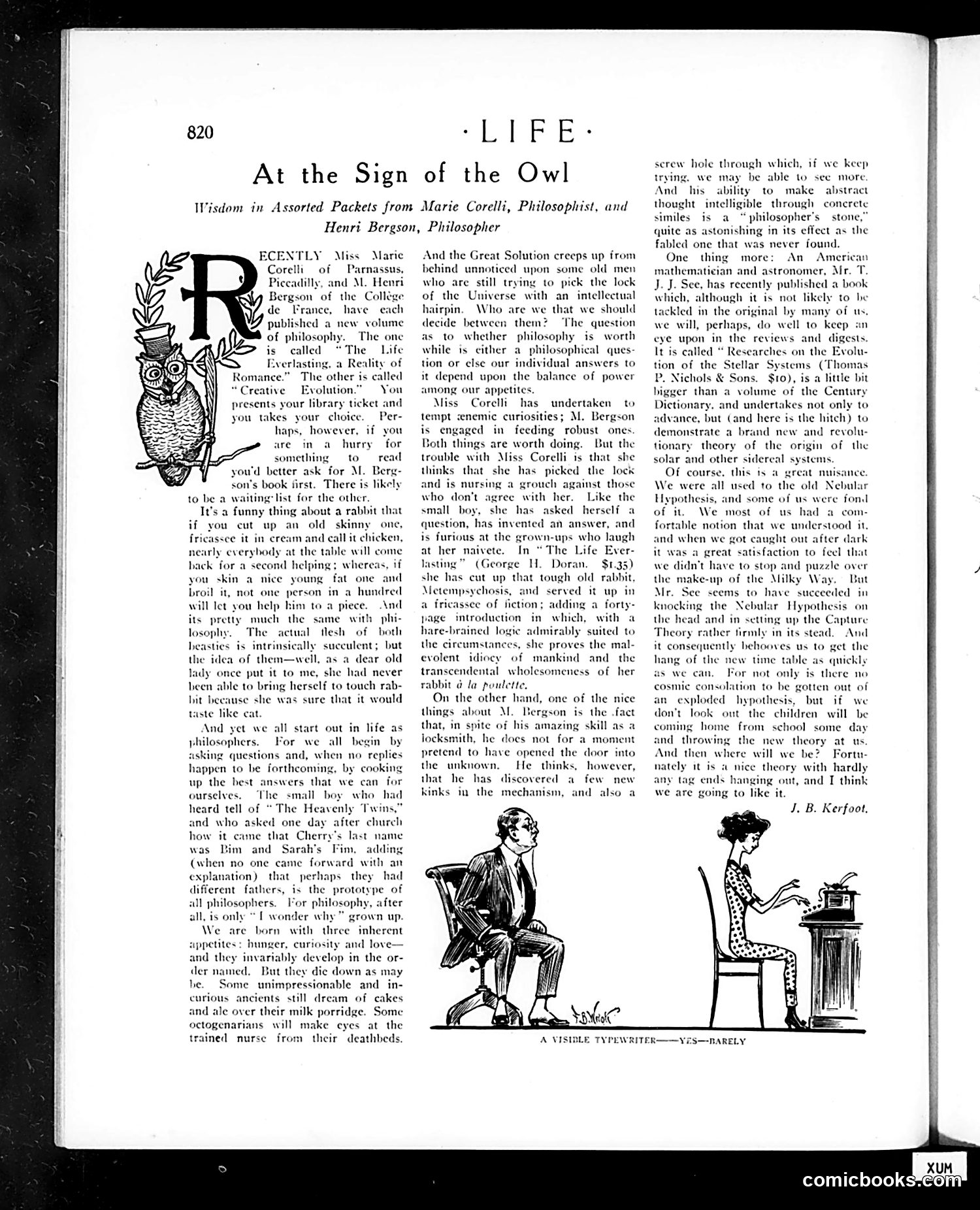
This page reviews two recently published philosophical works: Marie Corelli's "The Life Everlasting" and Henri Bergson's "Creative Evolution." The author uses extended metaphors to critique both authors' approaches. The central satire compares philosophy to cooking rabbit—Corelli's work is "fricasseed" (disguised in fiction), making unpalatable ideas more digestible through literary embellishment. The author mocks her certainty: she claims to have "picked the lock" of the Universe and dismisses skeptics like a petulant child. By contrast, Bergson is praised as honest about philosophy's limits. Though skillful as a "locksmith," he admits the door to ultimate truth remains unopened, only discovering "new kinks" in understanding's mechanism. The cartoons illustrate this: a man hunched over (representing philosophical struggle), and a woman at a typewriter (likely representing Corelli's prolific output). The satire suggests that Corelli mistakes confident assertions for genuine wisdom, while Bergson maintains appropriate intellectual humility.
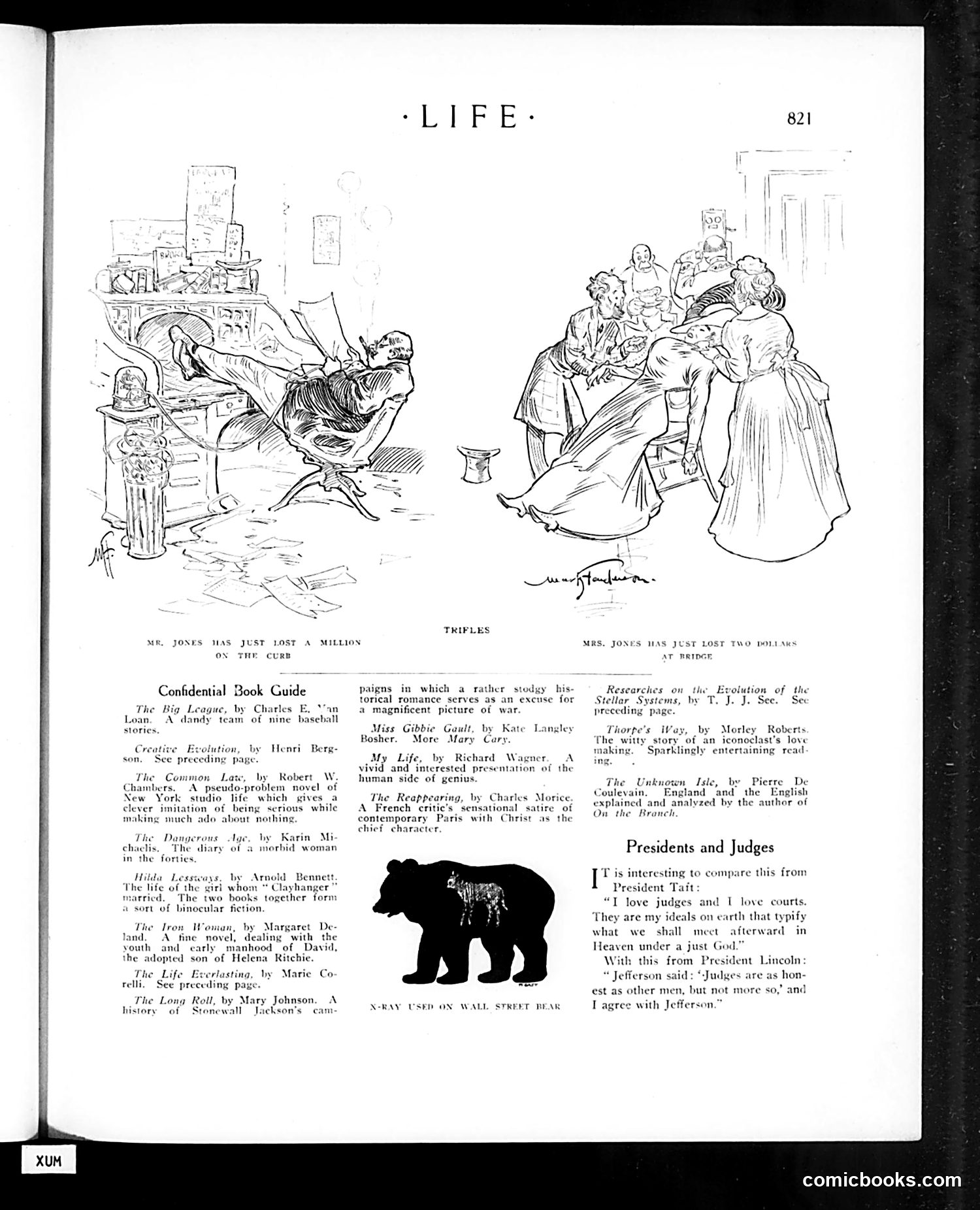
**The Cartoons:** Two satirical drawings depict a man named Jones experiencing financial losses. The left cartoon shows Jones collapsed at his desk amid scattered papers and financial documents, having "just lost a million on the curb" (likely referring to curb trading—informal stock market speculation). The right cartoon shows Mrs. Jones at a bridge game, having "just lost two dollars." **The Satire:** The joke contrasts the magnitude of losses: Mr. Jones loses an enormous fortune through speculative investing, while Mrs. Jones loses a trivial amount at a social card game. This mocks both the recklessness of Wall Street speculation (then causing market turmoil) and the domestic frivolity of wealthy women's leisure activities. The humor lies in the disproportion—Mrs. Jones's modest loss seems almost comical compared to her husband's catastrophic one. **Context:** This reflects early 1900s anxieties about stock market volatility and Wall Street's dangers to family wealth, contrasted with contemporary attitudes toward women's gambling as harmless social entertainment.
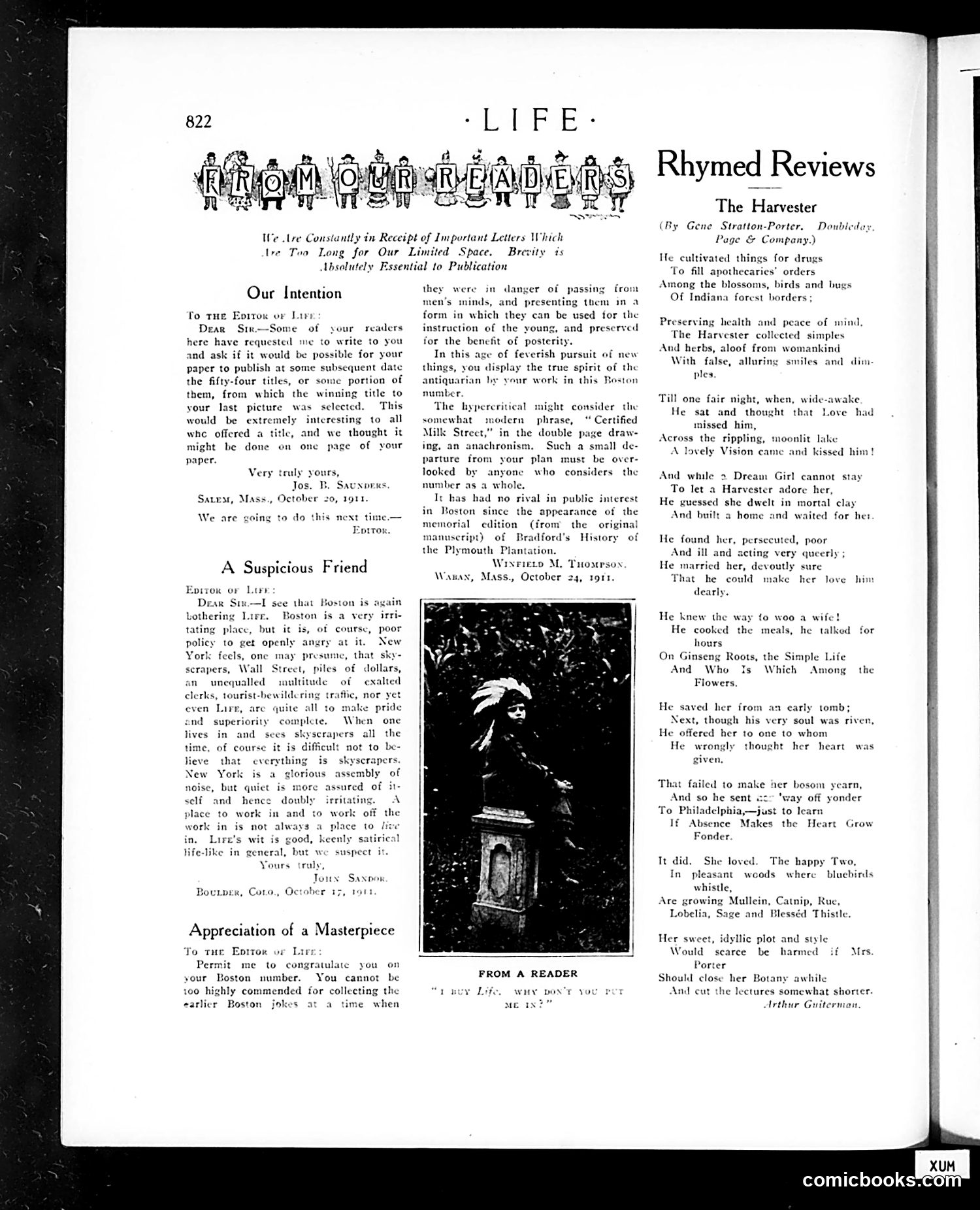
This page contains **reader correspondence** rather than political cartoons. The editors print three letters responding to Life's recent "Boston number" — apparently a satirical issue mocking Boston. **The letters reveal:** - Readers appreciated Life's collection of Boston jokes, requesting the winning title be published alongside rejected submissions - One correspondent expresses mild annoyance that Boston keeps "bothering" Life, though acknowledges New York's own absurdities (skyscrapers, Wall Street excess) - Another praises the Boston issue as historically valuable, comparing it to important historical documents, while quibbling that "Certified Mills Street" uses anachronistic language **The cartoon** (captioned "From a Reader") shows a figure outside a building asking "I buy Life. Why don't you put me in?" — a meta-joke about readers wanting their letters published in the magazine's limited space. **The right column** is a "Rhymed Review" of Gene Stratton-Porter's novel *The Harvester*, summarizing its plot in verse about a rural herbalist who finds love. The page primarily documents early 1900s reader engagement with Life's satirical content about Boston rivalry with New York.
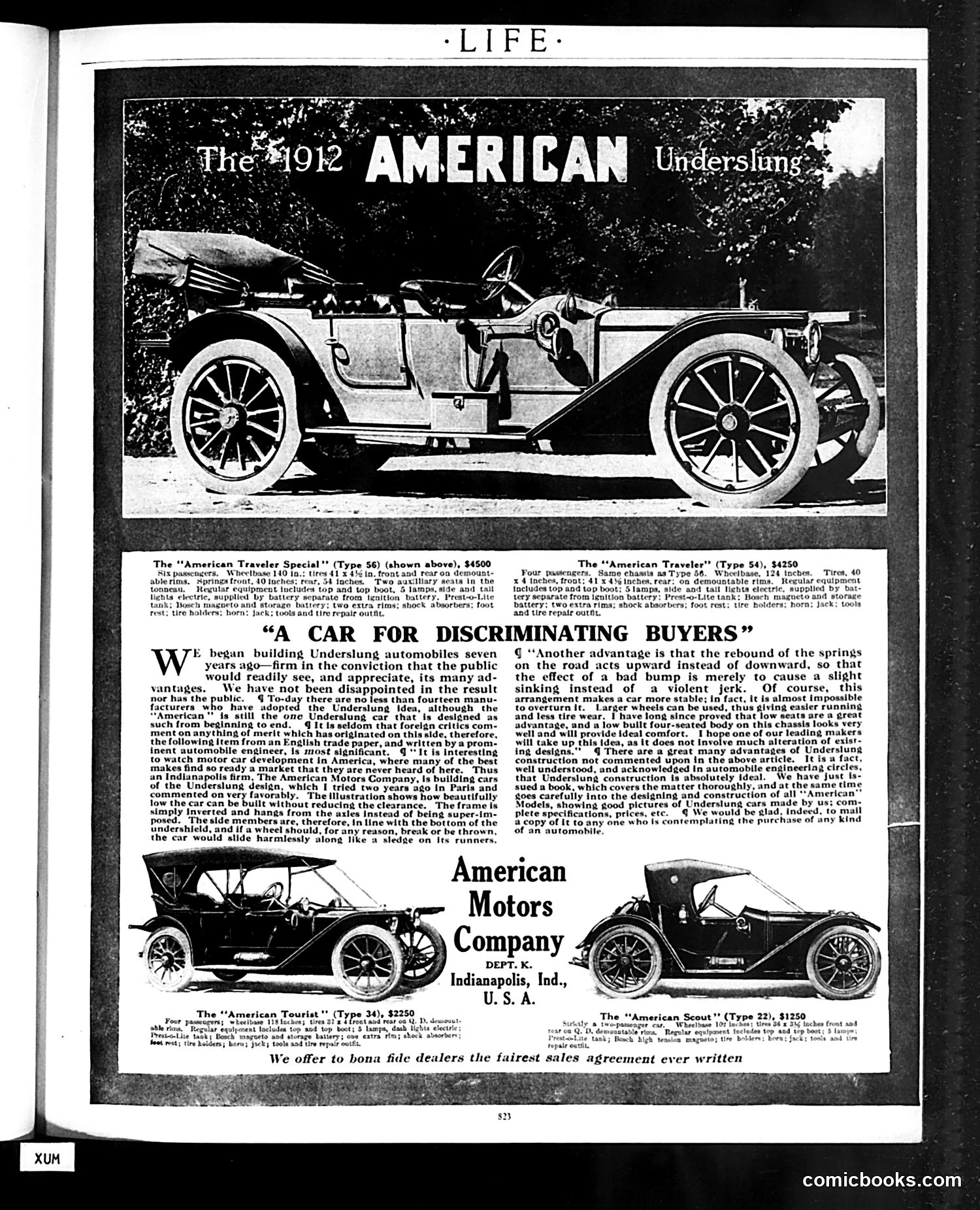
This is primarily **advertising**, not satire. The page promotes American Motors Company's "Underslung" automobile design—a technical innovation where the car's frame hangs *below* the axles rather than above them, lowering the vehicle's center of gravity. The text includes a lengthy quote from an unnamed "prominent automobile engineer" in an English trade paper, praising American ingenuity. This serves as third-party validation—a marketing tactic suggesting European expertise endorses the American design. Three car models are pictured with prices ($2,250–$4,550), emphasizing the cars' technical advantages: stability, easier handling, comfort, and safety. The phrase "A Car for Discriminating Buyers" positions these vehicles as premium products for sophisticated consumers who appreciate engineering excellence over mere fashion. There is **no political cartoon or satire** on this page—it's a straightforward (if lengthy and technical) product advertisement from a 1912 magazine.
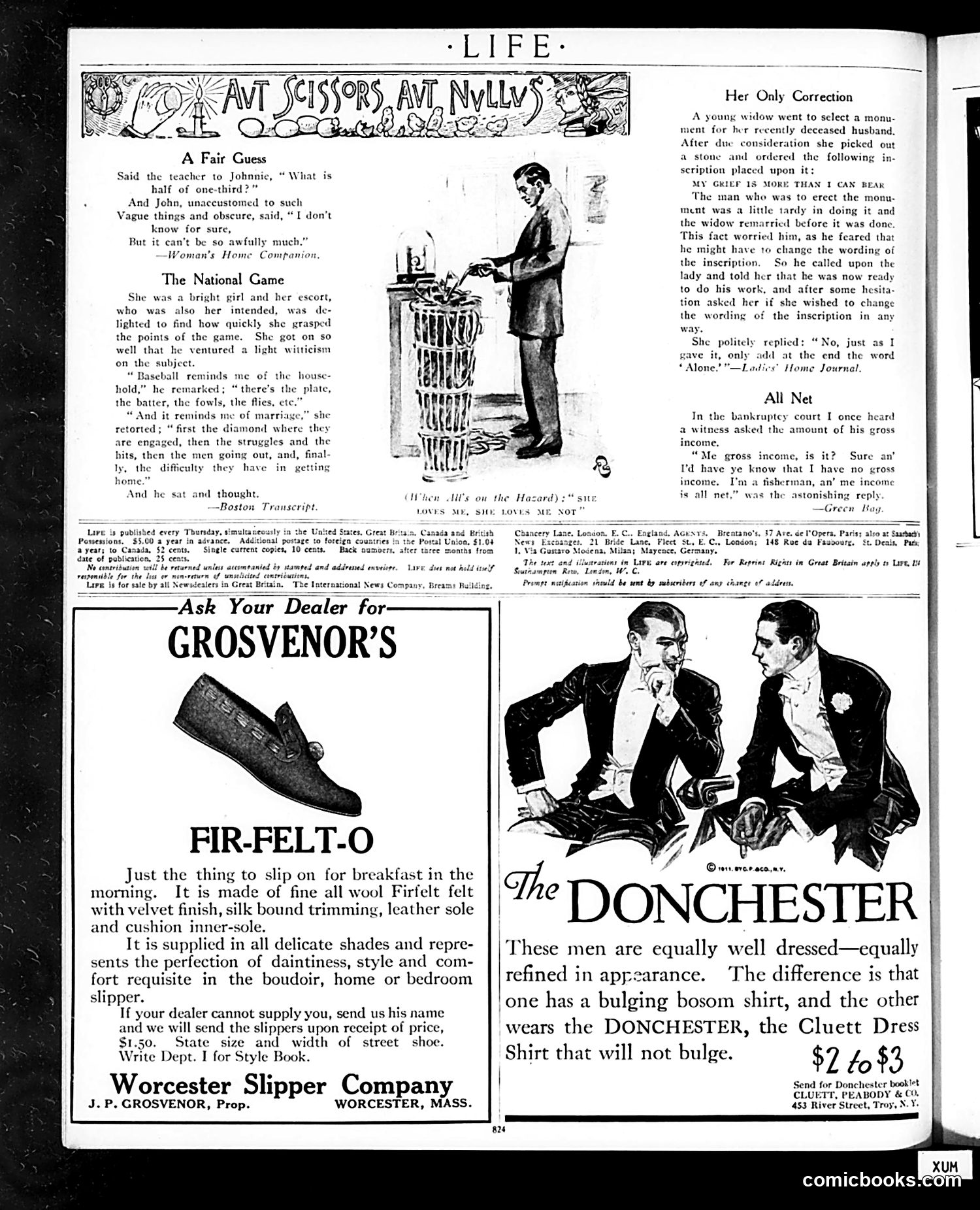
This page contains three brief humorous anecdotes typical of early 20th-century Life magazine's satirical humor: **"A Fair Guess"**: A child's confused response to a math question—satire of vague teaching methods. **"The National Game"**: A man compares baseball to household objects and marriage, suggesting baseball's domestic familiarity. The joke likely plays on marriage's complications (diamonds, struggles, difficulty "getting home"). **"Her Only Correction"**: Dark humor about a widow remarrying before her late husband's monument is erected. She requests the inscription end with "Alone"—ironically, she's no longer alone, making the addition grimly comedic. The page also contains period advertisements: Grosvenor's Fir-Felt-O slippers and Donchester dress shirts that "will not bulge." These ads reflect early 1900s consumer culture and men's fashion concerns about appearance. The cartoons represent Life's formula: brief, domestic-focused jokes targeting educated middle-class readers familiar with home life, courtship, and social conventions.
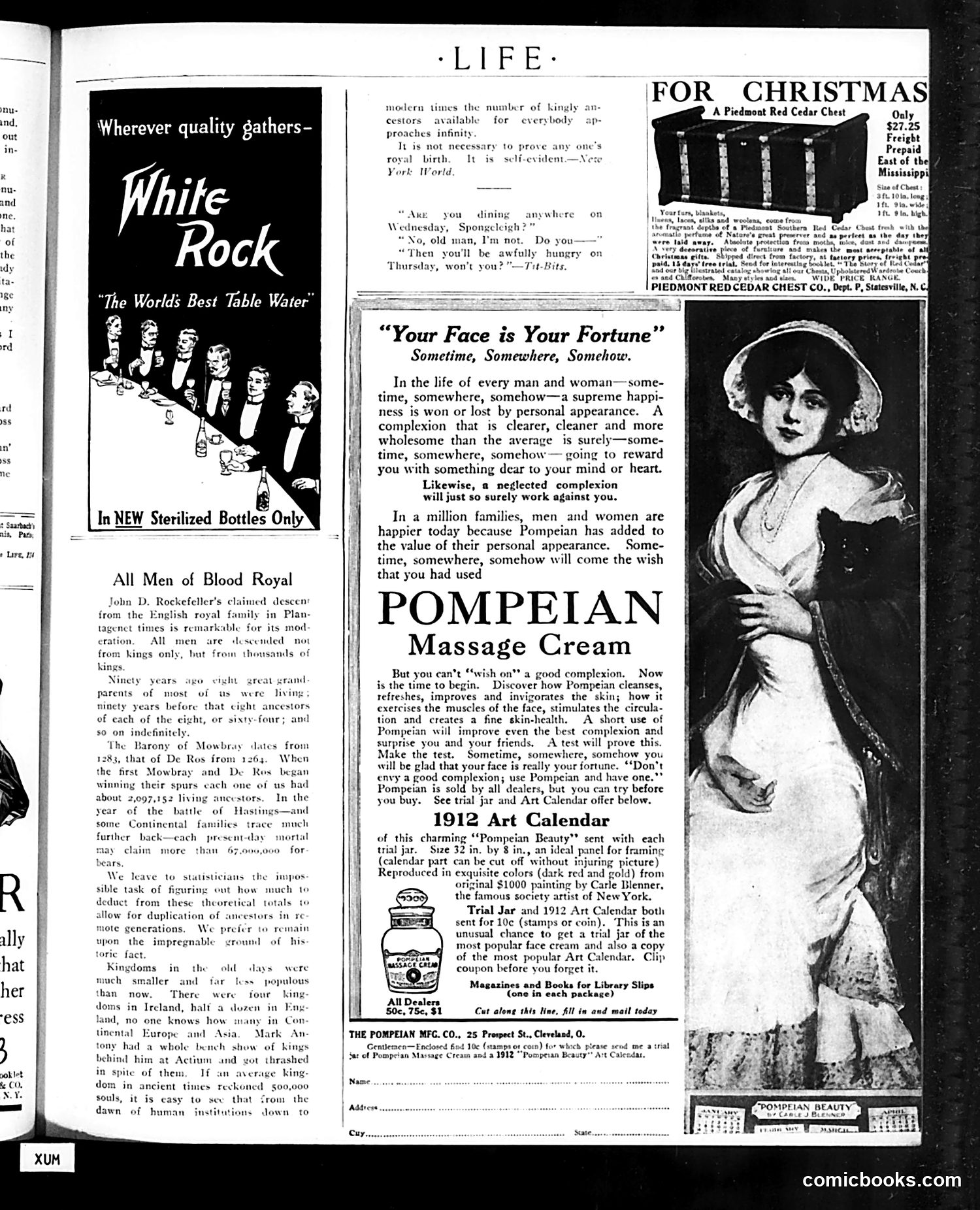
This page mixes editorial content with advertising. **"All Men of Blood Royal"** is a satirical essay, likely responding to John D. Rockefeller's claimed descent from English nobility. The piece argues that mathematically, *everyone* has thousands of royal ancestors going back through history. The satire undercuts aristocratic pretension: if you trace ancestry far enough, common people share the same royal lineage as the wealthy, making claims of special "blood" ridiculous. **The advertisements** are period pieces: White Rock table water marketed as hygienic ("sterilized bottles"), a Piedmont cedar chest for Christmas gifts, and prominently, Pompeian Massage Cream—a beauty product using the era's common marketing trope that a woman's appearance determines her romantic/social fortune. The Pompeian ad includes a 1912 calendar reproduction of a society portrait, targeting affluent readers. The page reflects early 1900s concerns: germ theory anxiety, class consciousness, and beauty culture's emerging dominance in women's magazines.
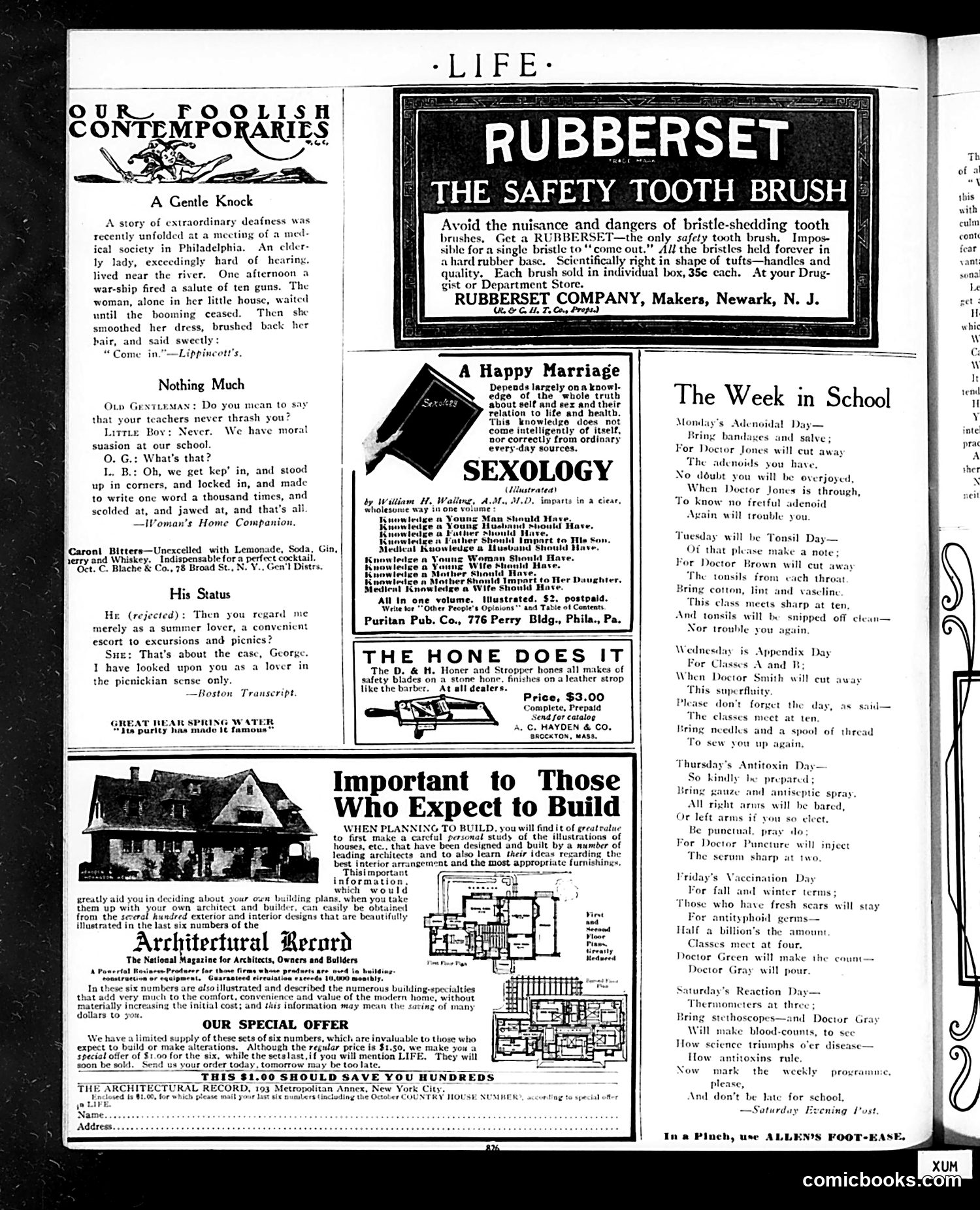
This page is primarily **advertising and light humor**, not political satire. The content includes: **Main Features:** - Advertisement for Rubberset safety toothbrush (bristles won't shed) - Several short humorous anecdotes: "A Gentle Knock" (deaf elderly woman mishears cannon fire as visitors), "Nothing Much" (dialogue about school discipline), and "His Status" (romantic misunderstanding) - Advertisement for Sexology book (appears to be educational material on relationships) - Advertisement for building plans from Architectural Record magazine - "The Week in School" — a satirical weekly schedule where each day names a different childhood medical procedure (tonsils removed Monday, appendix Tuesday, vaccination Friday, etc.) **The Satire:** "The Week in School" gently mocks the era's routine surgical interventions on children—tonsillectomies and appendectomies were extremely common procedures, often performed with minimal justification. The joke is that school week is organized around these medical events rather than academics. This reflects genuine historical practice: early-to-mid 20th century medicine routinely removed children's tonsils and appendixes as preventive measures.
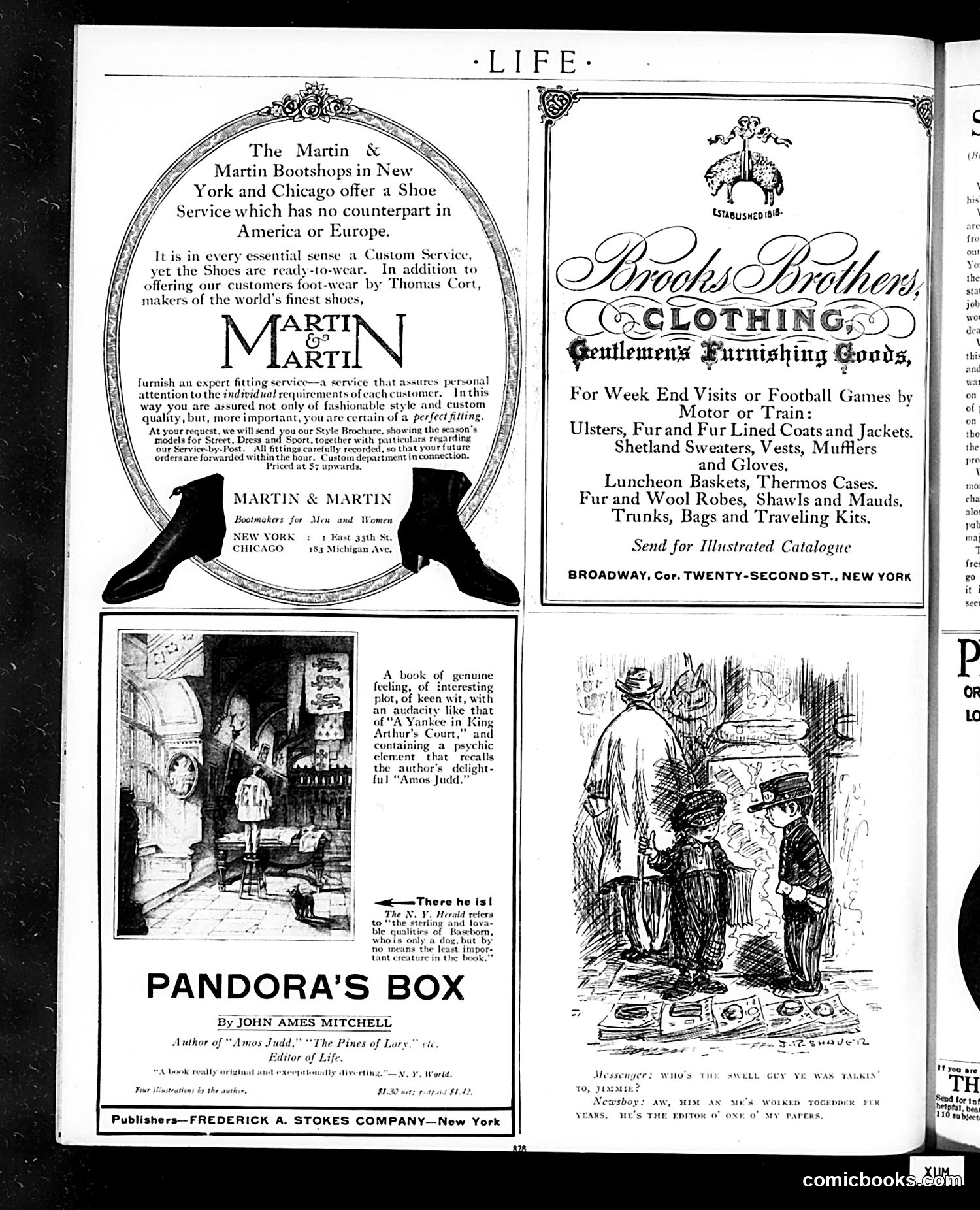
This page is primarily **advertising** for luxury goods (custom bootshops, Brooks Brothers clothing, and a book), interspersed with a small cartoon illustration. The cartoon at bottom right depicts a messenger boy speaking to a newsboy named "Jimmie." The messenger explains he worked with someone for years—"he's the editor of one of my papers"—using exaggerated working-class dialect ("Wio's," "Woiked," "Togedder"). The joke appears to satirize **newspaper hierarchy and class pretension**: the messenger casually name-drops his connection to an editor as if it's unremarkable, while the broader page context (luxury goods marketed to the wealthy) contrasts with these working-class characters' street-level perspective. The humor lies in the disconnect between the messenger's apparent pride in this association and the casual, rough vernacular he uses to describe it. The page overall reflects early 20th-century American consumer culture and Life magazine's satirical approach to class dynamics.
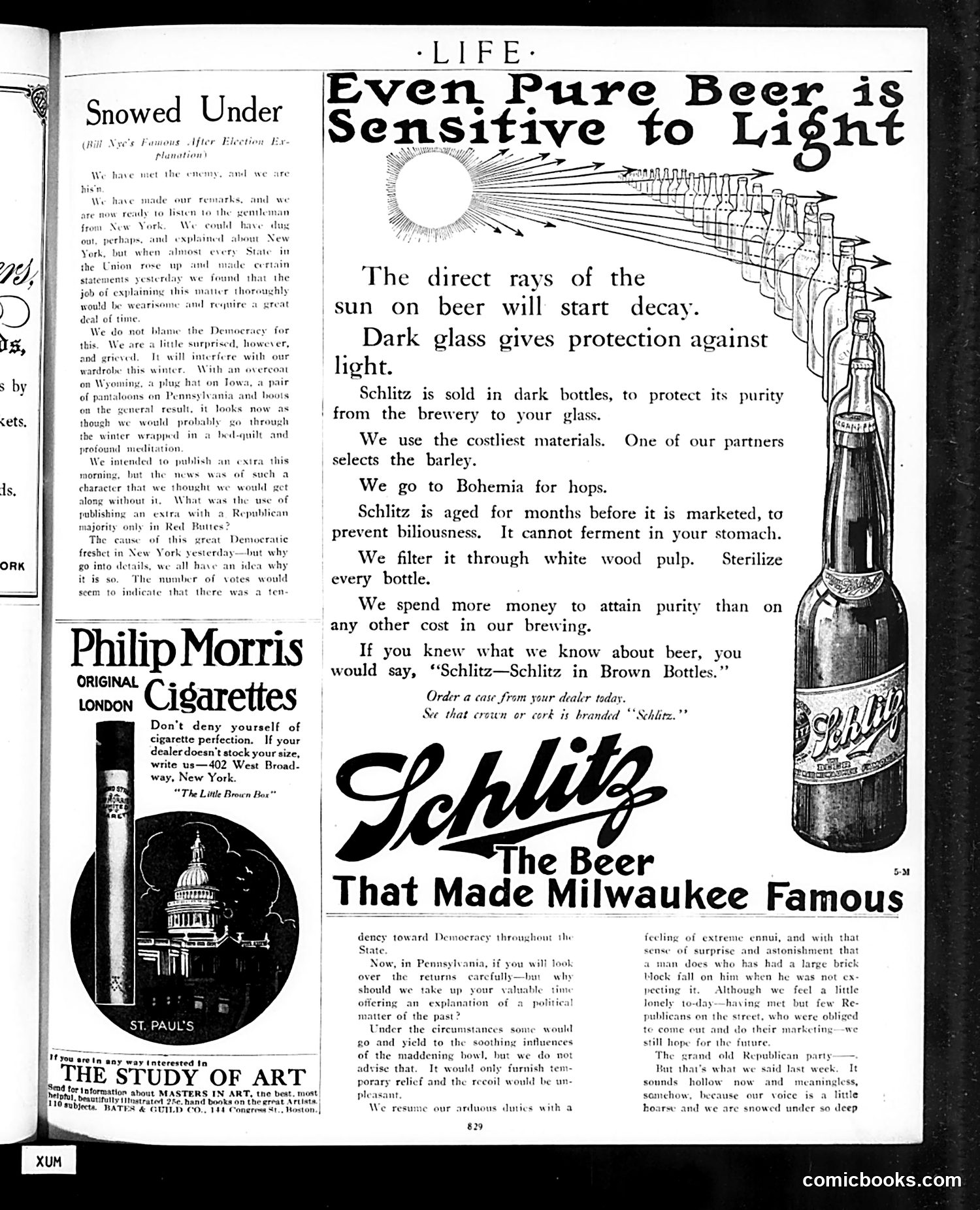
This page combines political satire with advertising. The left column's "Snowed Under" is a humorous editorial responding to recent election results showing Democratic victories across multiple states (references to New York, Pennsylvania, Wyoming, Iowa). The author adopts a mock-defeated tone, joking that they're so overwhelmed by these losses that they can't even muster the energy to explain them to readers—they're literally "snowed under." The main content is a Schlitz beer advertisement disguised as educational text, explaining why the beer uses dark bottles (to protect against light damage) and emphasizing purity through expensive materials and careful aging. This reflected Prohibition-era messaging, when breweries heavily advertised their product quality and respectability to counter anti-alcohol sentiment. The Philip Morris cigarette ad below is standard period advertising with no satirical element.

This page is primarily **advertising**, not satire or political commentary. It contains: **Left side:** Classical product advertisements (Boston Garter socks, French Bulldogs, Rad-Bridge playing cards, Dr. Givens' Sanitarium) interspersed with two brief humorous anecdotes—one about a betting dispute and another about a man named Binks who forgets a woman's name ("Fish") at a reception. **Center/Right:** A substantial advertisement for *The Northwestern Agriculturist*, a farm publication that conducted a statistical survey of 3,456 farms across the American Northwest. The ad emphasizes the value of "exact knowledge" over guesswork for advertising campaigns, promoting a book titled "What Farmers Use" containing data on farm machinery, clothing, watches, and household goods. **The point:** This is a trade publication page showcasing how advertisers can use empirical data about consumer behavior—a relatively novel concept in this era—to guide marketing decisions effectively.
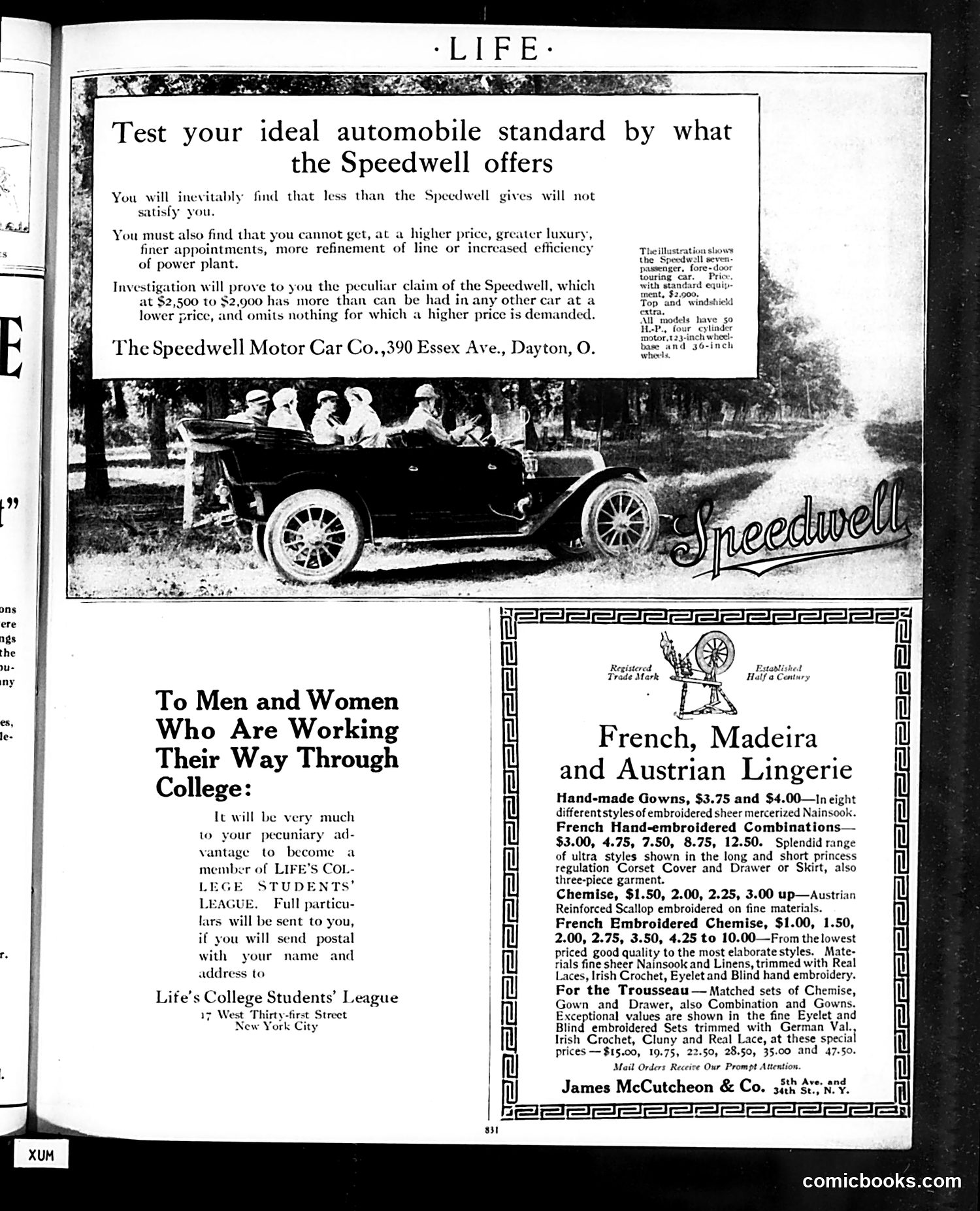
This page is primarily **advertising**, not satirical content. It contains three distinct advertisements: 1. **Speedwell Motor Car** (top): A car manufacturer promoting their vehicle as offering superior value—claiming customers get more luxury and features at $2,500-$2,900 than competitors charge for higher prices. The image shows a touring car with passengers. 2. **Life's College Students' League** (bottom left): A recruitment appeal for college students to join a membership program, offering unspecified financial advantages to those working their way through school. 3. **James McCutcheon & Co.** (bottom right): A lingerie retailer advertising French, Madeira, and Austrian undergarments, hand-embroidered gowns, chemises, and trousseau sets at various price points ($1.50-$47.50). There is no political cartoon or satire visible. The page reflects early 20th-century consumer culture and advertising conventions.
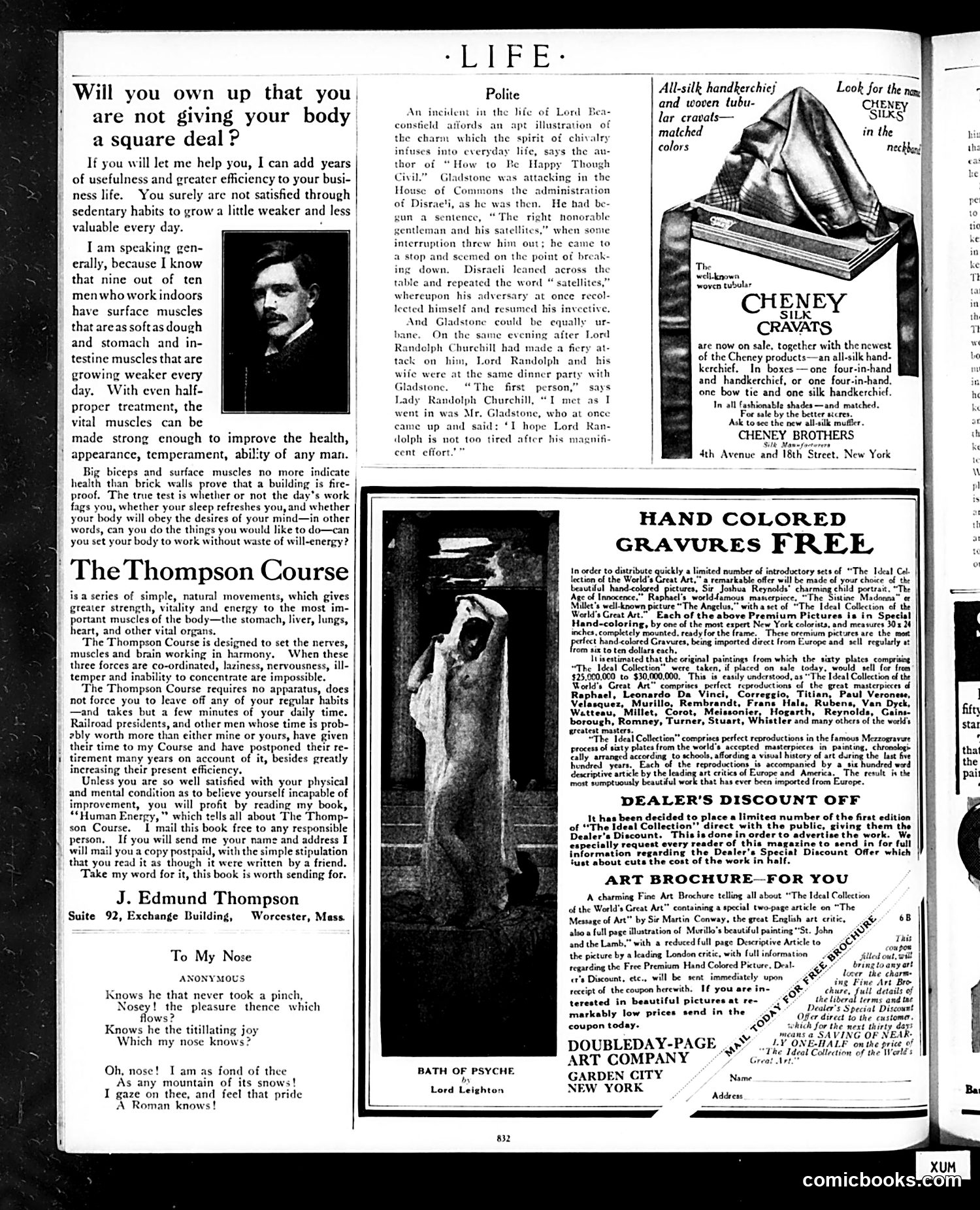
This page combines advertisements with editorial content typical of early 20th-century Life magazine. **Main Content:** The "Polite" anecdote describes a Victorian-era incident where British Prime Minister William Gladstone graciously complimented his political rival Lord Randolph Churchill after Churchill's aggressive parliamentary attack. The story illustrates gentlemanly conduct—despite bitter political opposition, Gladstone demonstrated courtesy and magnanimity. This reflects the magazine's satirical commentary on civility in public discourse. **Advertisements:** The page features multiple product ads: J. Edmund Thompson's fitness course promoting physical vigor for businessmen; Cheney silk handkerchiefs; and various art reproductions and services. The humor lies in the contrast—while the anecdote celebrates political restraint, the advertisements aggressively push self-improvement and consumption to readers concerned about their vitality and status. The "To My Nose" poem appears to be humorous filler celebrating an unusual subject.
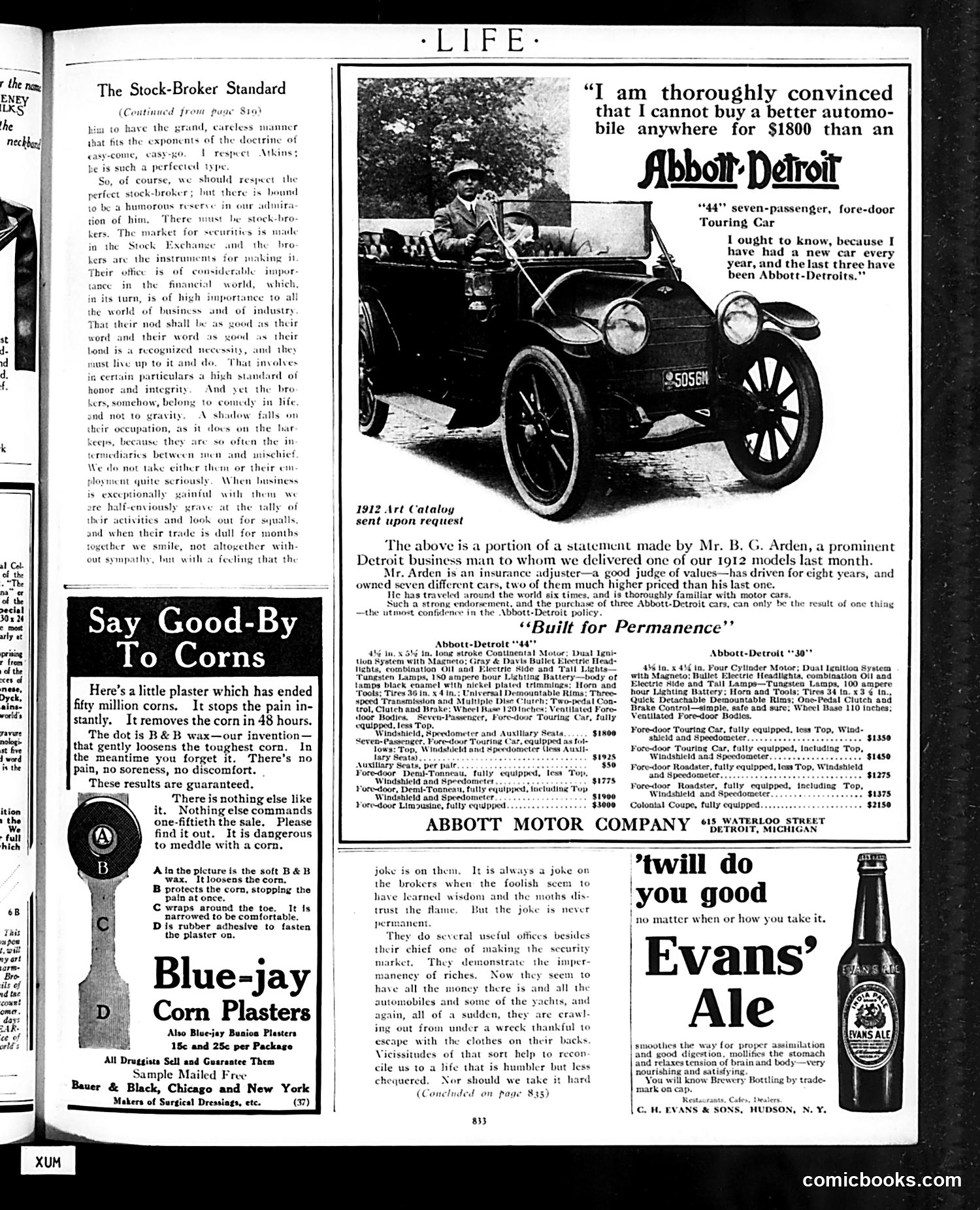
This page is primarily **advertising masquerading as editorial content**—a common early 20th-century practice. The Abbott-Detroit car company features a testimonial from "B. G. Arden," a Detroit businessman claiming he's owned seven different cars but found none better than their $1,800 model. The ad emphasizes reliability ("Built for Permanence") and lists technical specifications to convince buyers of quality. The top-left article, "The Stock-Broker Standard," is satirical commentary on Wall Street traders—suggesting they deserve respect for their financial importance, yet their dramatic mood swings (grave when business is good, comedic when it's slow) make them partially ridiculous figures worthy of gentle mockery. The remaining advertisements (Blue-jay corn plasters, Evans' Ale) are typical period product marketing. **The satire operates on class humor**: stockbrokers are simultaneously important and absurd, their emotions outsized. Modern readers might miss how seriously early-1900s audiences took financial professionals' social standing.
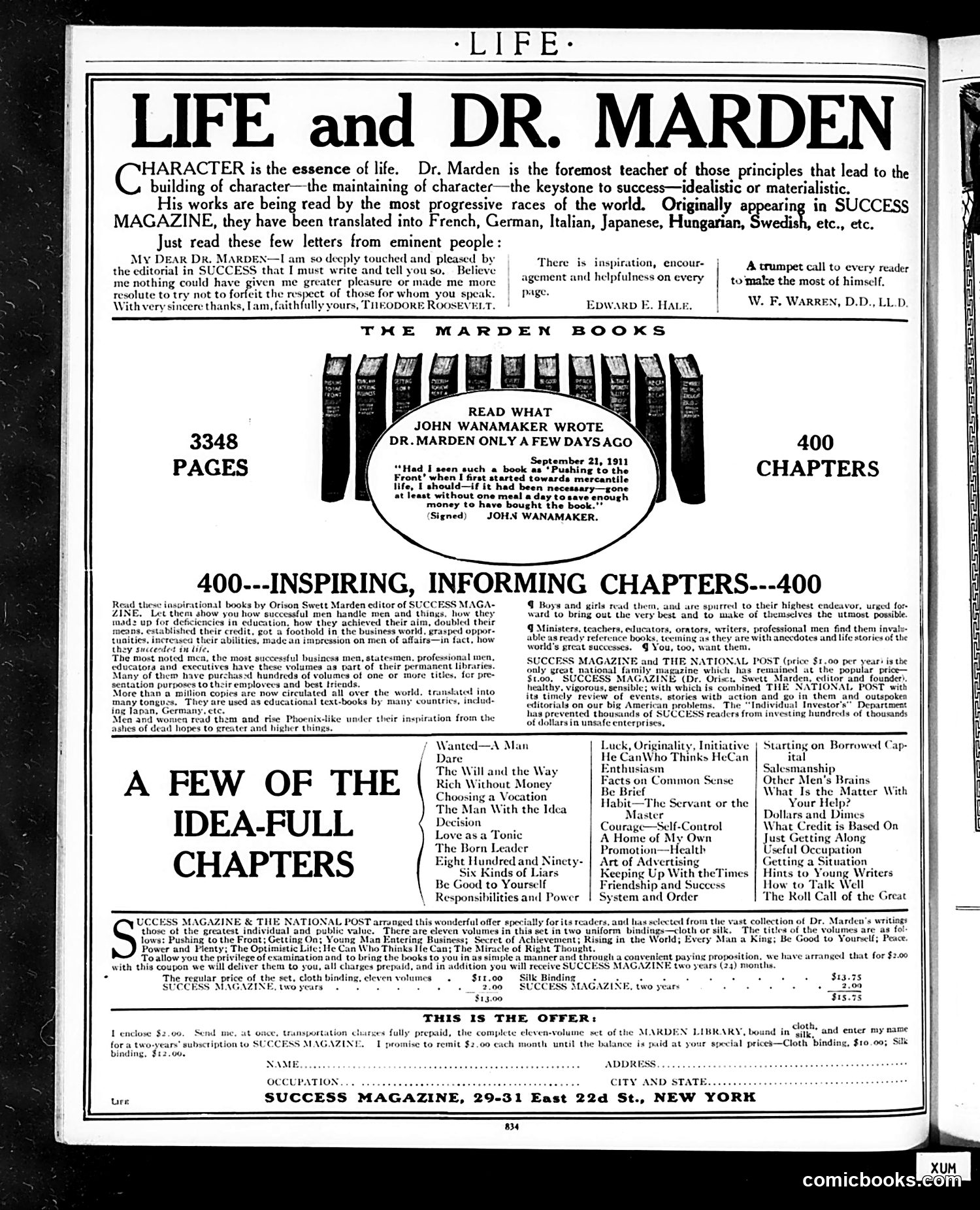
This is primarily a **full-page advertisement**, not a political cartoon. It promotes Dr. Orison Swett Marden's self-help books and SUCCESS MAGAZINE. The page features endorsements from prominent figures: Theodore Roosevelt praises Marden's editorial on character-building, and department store magnate John Wanamaker testifies that he would pay significant money to own the complete works. The advertisement emphasizes that these books are read by "the most progressive races of the world" and have been translated into multiple languages. It claims over one million copies are circulated globally and used as educational texts in many countries. The pitch targets both individual readers and institutional buyers—noting that successful businessmen, educators, and executives purchase hundreds of volumes for distribution to employees and friends. This reflects early 20th-century American self-improvement culture, where character development and practical success principles were marketed as universal solutions to personal and professional advancement.
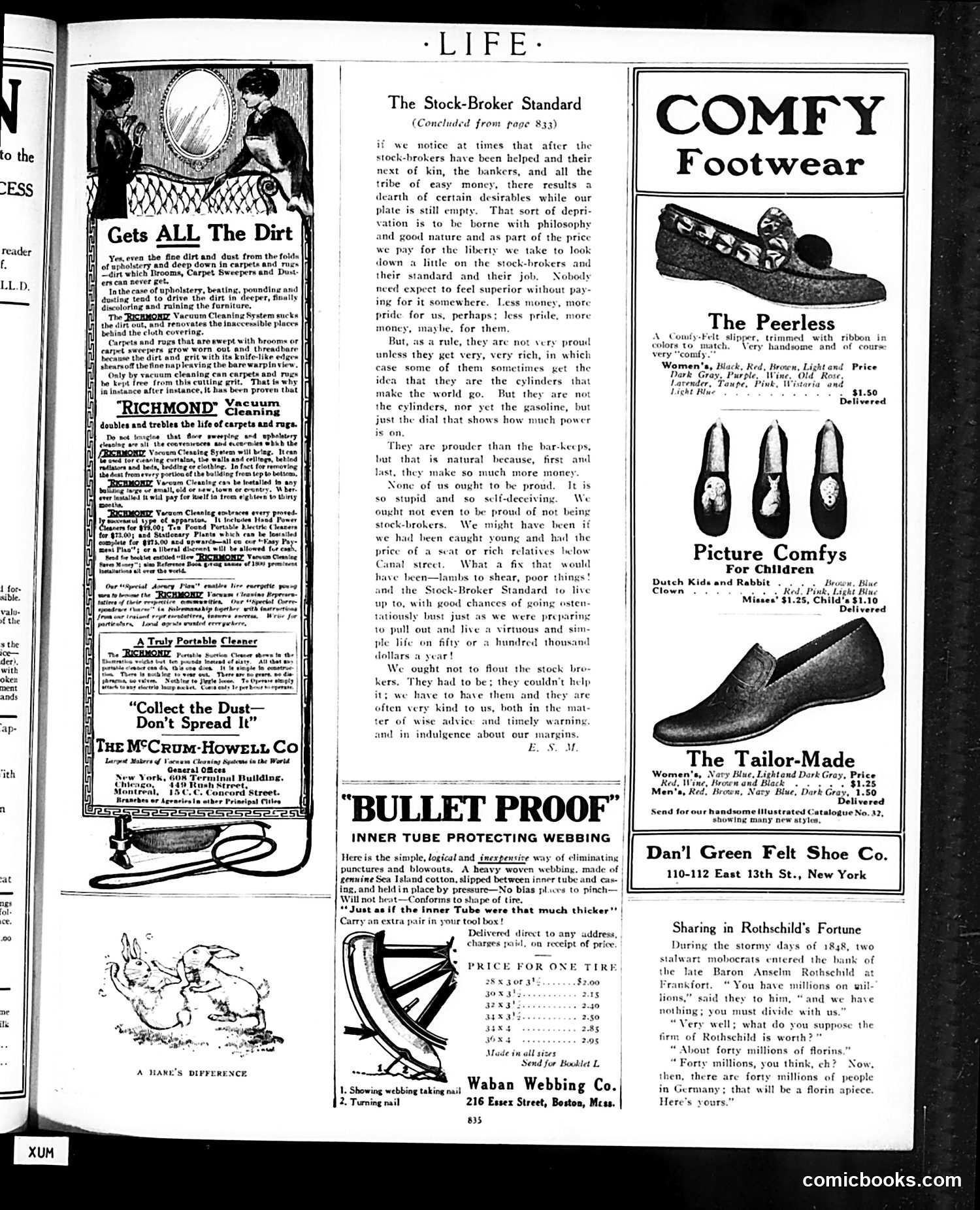
This page is primarily **advertising**, not political satire. The left side features a long advertisement for the Richmond Vacuum Cleaning System, emphasizing its superiority over brooms and carpet sweepers for removing embedded dirt. The right side advertises "Comfy Footwear" — various slipper and shoe styles for women and children. The only editorial content is a brief article titled "The Stock-Broker Standard" (concluded from a previous page). This is **social satire**, not political cartooning. The unnamed author gently mocks stock-brokers for their pride and self-importance, arguing they deserve no special respect despite their wealth. The piece suggests they're merely "the dial that shows how much power is on"—indicators rather than engines of economic activity. The tone is witty but forgiving, acknowledging stock-brokers' usefulness while deflating their pretensions. There are no identifiable caricatures or specific political figures referenced.
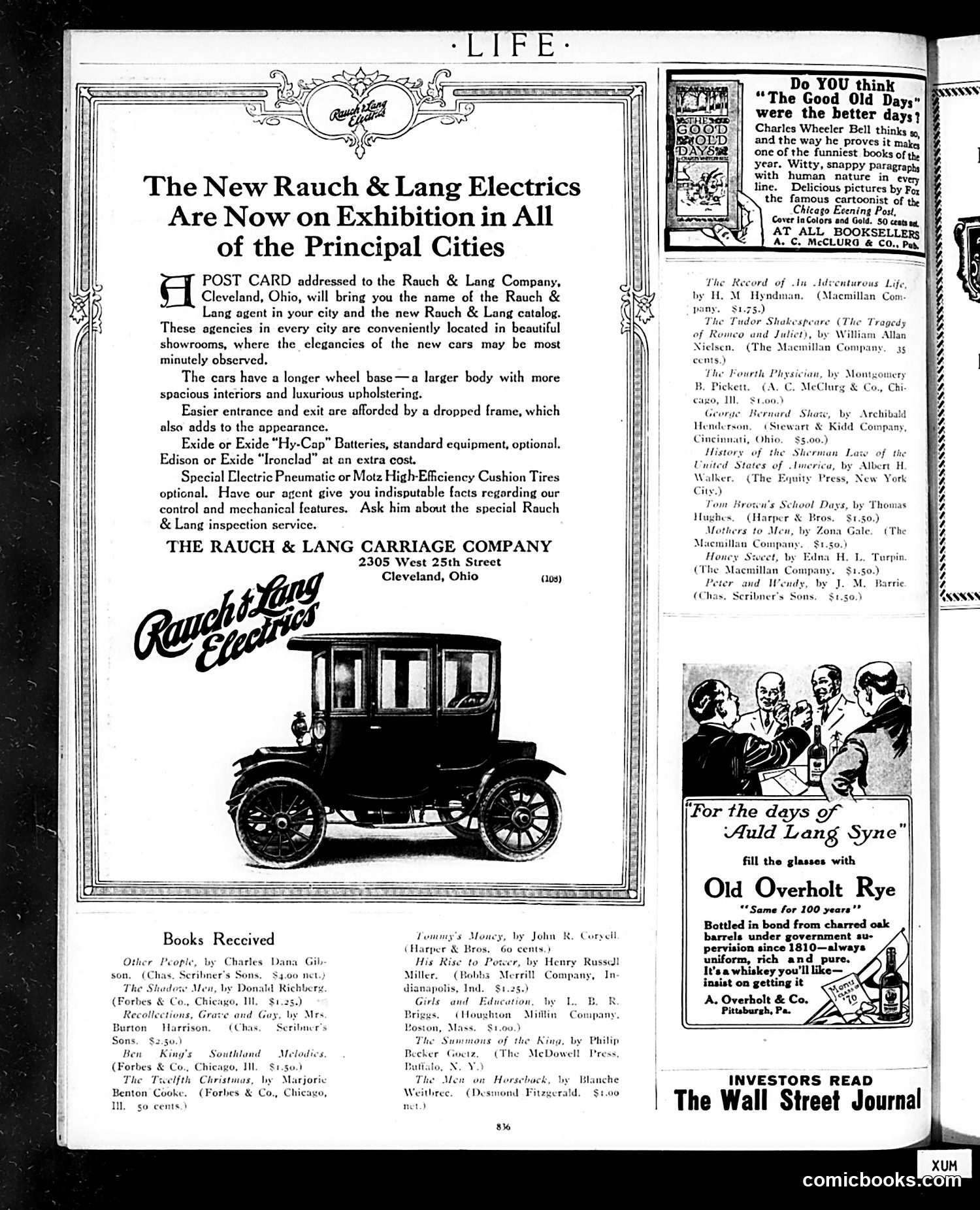
This page is primarily **advertising**, not satire. The dominant content promotes the Rauch & Lang electric automobile—a real early-1900s vehicle manufacturer highlighting their new models' features (longer wheelbase, luxurious upholstery, electric batteries). The small cartoon visible in the upper right appears to be unrelated advertising for a book called *"The Good Old Days"* by Charles Wheeler Bell, featuring illustrations by a Chicago cartoonist. Below that are book advertisements and reviews, followed by a whiskey advertisement for Old Overholt Rye, claiming continuity since 1810. The page demonstrates **early-20th-century Life magazine's mixed content model**: satirical editorial material alongside substantial advertising revenue. The electric car advertisement is notable historically—electric vehicles were luxury items competing with gasoline cars before the Model T made combustion engines dominant. No significant political satire or social commentary is visible on this particular page.
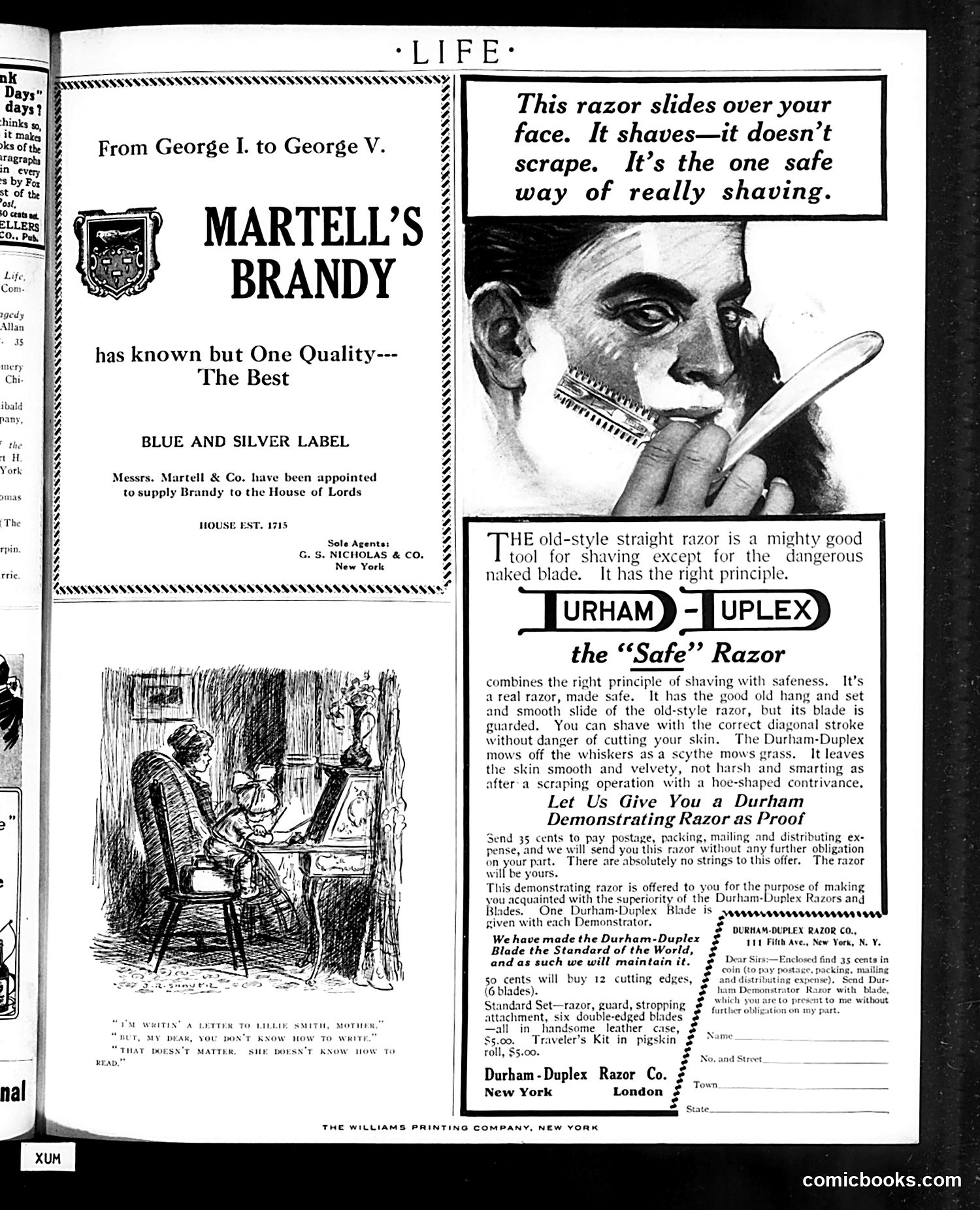
This page contains two advertisements rather than satirical cartoons. **Left side:** Martell's Brandy ad, emphasizing its quality ("One Quality—The Best") and heritage dating to 1715. It includes a sketch of a period interior scene, likely referencing the product's French origins and long history. **Right side:** Durham-Duplex safety razor advertisement. The ad features an illustration of a man shaving and emphasizes the razor's safety features—the blade is "guarded" unlike traditional straight razors, making it safer for home use. The copy contrasts this with "old-style straight razor" dangers, positioning the Durham-Duplex as a modern innovation. The ad includes an offer for a demonstrating razor sent free to interested customers. Both ads target upscale male consumers of the era.
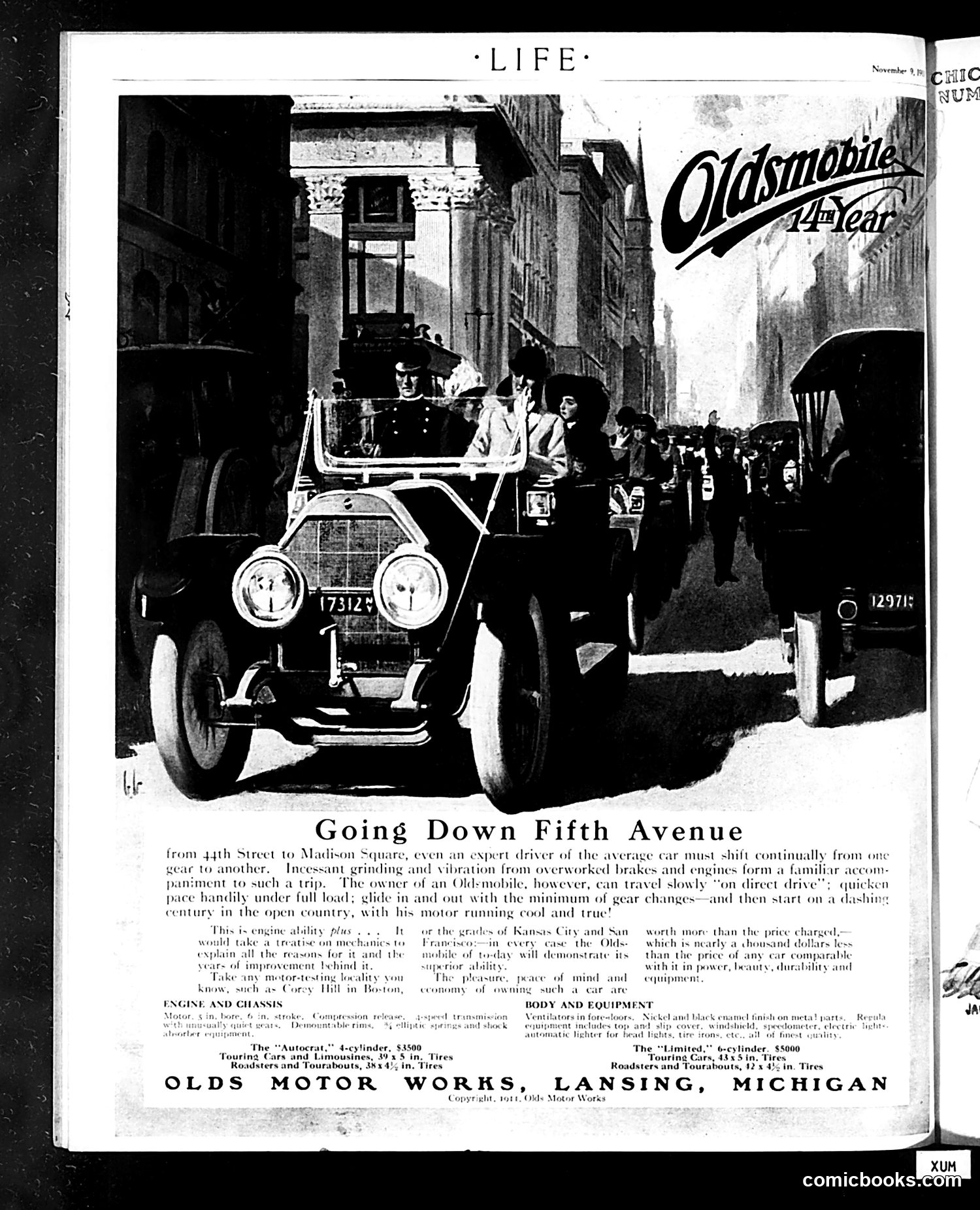
This is primarily an **automobile advertisement**, not political satire. The image shows an Oldsmobile-14 touring car navigating Fifth Avenue in New York City, from 44th Street toward Madison Square. The "satire" is commercial, not political: it contrasts the Oldsmobile's supposedly superior engineering against unnamed competitors. The text claims that while average car drivers must constantly shift gears on crowded city streets and hills, the Oldsmobile's direct-drive system allows smooth, efficient travel with minimal gear changes and engine strain. The advertisement cites real testing grounds (Corey Hill in Boston, Kansas City, San Francisco grades) to establish credibility. Specific model variants and prices are listed. **For modern readers:** This reflects early 1910s automotive competition, when transmission technology varied significantly between manufacturers. The ad's appeal to smooth urban driving and durability addresses genuine contemporary concerns about vehicle reliability on unpaved, congested city streets.