
Life, 1911-11-09 · page 16 of 44
Life — November 9, 1911 — page 16: what you’re looking at
What you’re looking at
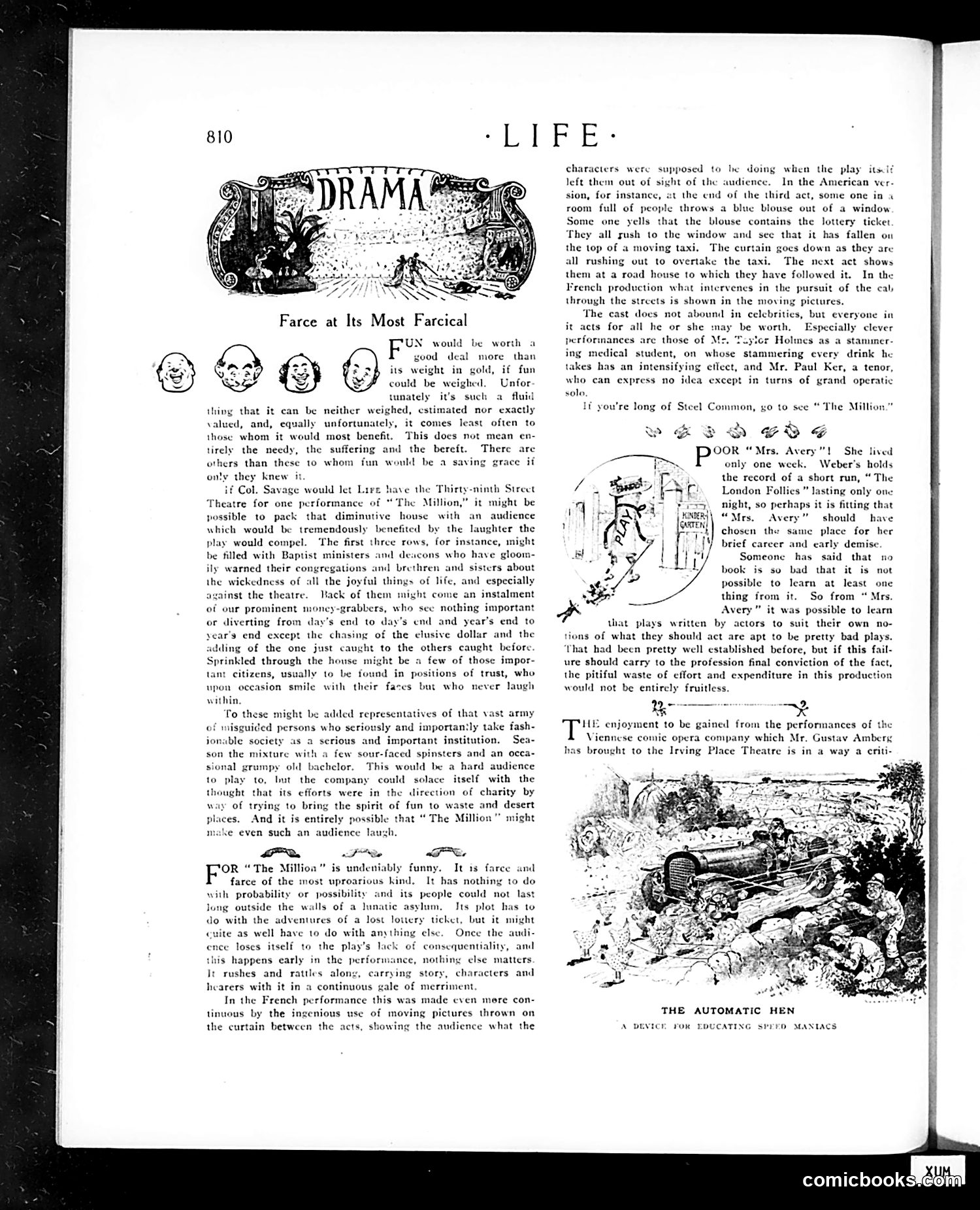
This is a theater review of the farce "The Million," praising its comedic value. The article humorously proposes filling the theater's first rows with people who "need" fun most: stern Baptist ministers who denounce theatrical wickedness, money-obsessed businessmen focused only on profit, corrupt politicians, status-conscious socialites, and perpetually scowling spinsters and bachelors. The satire targets American hypocrisy and joylessness—those who condemn entertainment while grinding through loveless, profit-driven existences. The review notes the French production cleverly used moving pictures between acts to show offstage action (a taxi chase), filling gaps the American version leaves to imagination. The core joke: even the most humorless, self-righteous people would benefit from simple laughter.
📄 Transcribed text from this page (OCR, searchable)
Machine-transcribed from the original scan — historical spelling and the odd misread are preserved.
*‘LIFE* Farce at Its Most Farcical UN would be worth a good deal more than its weight in gold, if fun could be weighed. Unfor nately it’s such a fluid thing that it can be neither weighed, estimated nor exactly valued, and, equally unfortunately, it comes least often to those whom it would most benefit. This docs not mean en- tirely the needy, the suffering and the bereft. There are others than these to whom fun would be a saving grace if onty they knew i if Col. Savage would let Lire have the Thirty-ninth Street Theatre for one performance of “The Million,” it might be possible to pack that diminutive house with an audience which would be tremendously benefited by the laughter the play would compel. ‘The first three rows, for instance, might be filled with Baptist ministers and deacons who have gloom- ily warned their congregations and brethren and sisters about the wickedness of all the joyful things of life, and especially ainst the theatre. Hack of them might come an instalment of our prominent moncy-grabbers, who see nothing important or diverting from day’s end to day’s end and year’s end to year's end except the chasing of the elusive dollar and the adding of the one just caught to the others caught before Sprinkled through the house might be a few of those impor- tant citizens, usually to be found in positions of trust, who upon oceasion smile with their faces but who never laugh within, To these might be added representatives of that vast army of misguided persons who seriously and importantly take fash- jonable society as a serious and important institution. Sea- son the mixture with a few sour-faced spinsters and an occa- sional grumpy old bachelor. This would be a hard audience to play to, but the company could solace itself with the thought that its efforts were in the direction of charity by way of trying to bring the spirit of fun to waste and desert places. And it is entirely possible that “The Million” might make even such an audience laugh. Fr «Se FE OR “The Million” is undeniably funny. It is farce and farce of the most uproarious kind. It has nothing to do with probability or possibility nd its people could not last long outside the walls of a lunatic asylum, Its plot has to do with the adventures of a lost louery ticket, but it might cuite as well have 10 do with anything else. Once the audi- cnce loses itself to the play’s lick of consequentiality, and his happens early in the performance, nothing else matters It rushes and rattles along, carrying story, characters and hearers with it in a continuous gale of merriment. In the French performance this was made even more con- tinuous by the ingenious use of moving pictures thrown on the curtain between the acts, showing the audience what the characters were supposed to he doing when the play. itstf left them out of sight of the audience. In the American ver sion, for instance, at the end of the third act, some one in « room full of people throws a bluc blouse out of a window Some one yells that the blouse contains the lottery ticket They all sush to the window and sec that it has fallen on the top of a moving taxi. The curtain goes down as they are all rushing out to overtake the taxi, The next act shows them at a road house to which they have followed it. In the French production what intervenes in the pursuit of the cal, through the strcets is shown in the moving pictures. The cast does not abound in celebrities, but everyone in it acts for all he or she may be worth, Especially clever tor Holmes as a staminer- ing medical student, on whose stammering every drink he takes has an intensifying efleet, and Mr. Paul Ker, a tenor, who can express no idea except in turns of grand operatic solo, performances are those of Mr. If you're long of Steel Common, go to see “ The Million.” OOR “Mrs, Avery"! She lived only one week, Weber's holds the record of a short run, “ The London Follies ” lasting only one night, so perhaps it is fitting that “Mrs. Avery” should have chosen the same place for her brief career and early demise. Someone has said that no book is so bad that it is not possible to learn at least one thing from it. So from “ Mrs. Avery" it was possible to learn that plays written by actors to suit their own no- ns of what they should act are apt to be pretty bad plays. ‘That had been pretty well established before, but if this fai ure should carry to the profession final conviction of the fact, the pitiful waste of effort and expenditure in this production would not be entircly fruitless. Lr . ILE enjoyment to be gained from the performances of the Viennese comic opera company which Mr. Gustav Amberg has brought to the Irving Place Theatre is in a way a criti- THE AUTOMATIC HEN A DEVICE FOR EDUCATING SPFED MANIACS comicbookMen |