
Life, 1911-11-09 · page 26 of 44
Life — November 9, 1911 — page 26: what you’re looking at
What you’re looking at
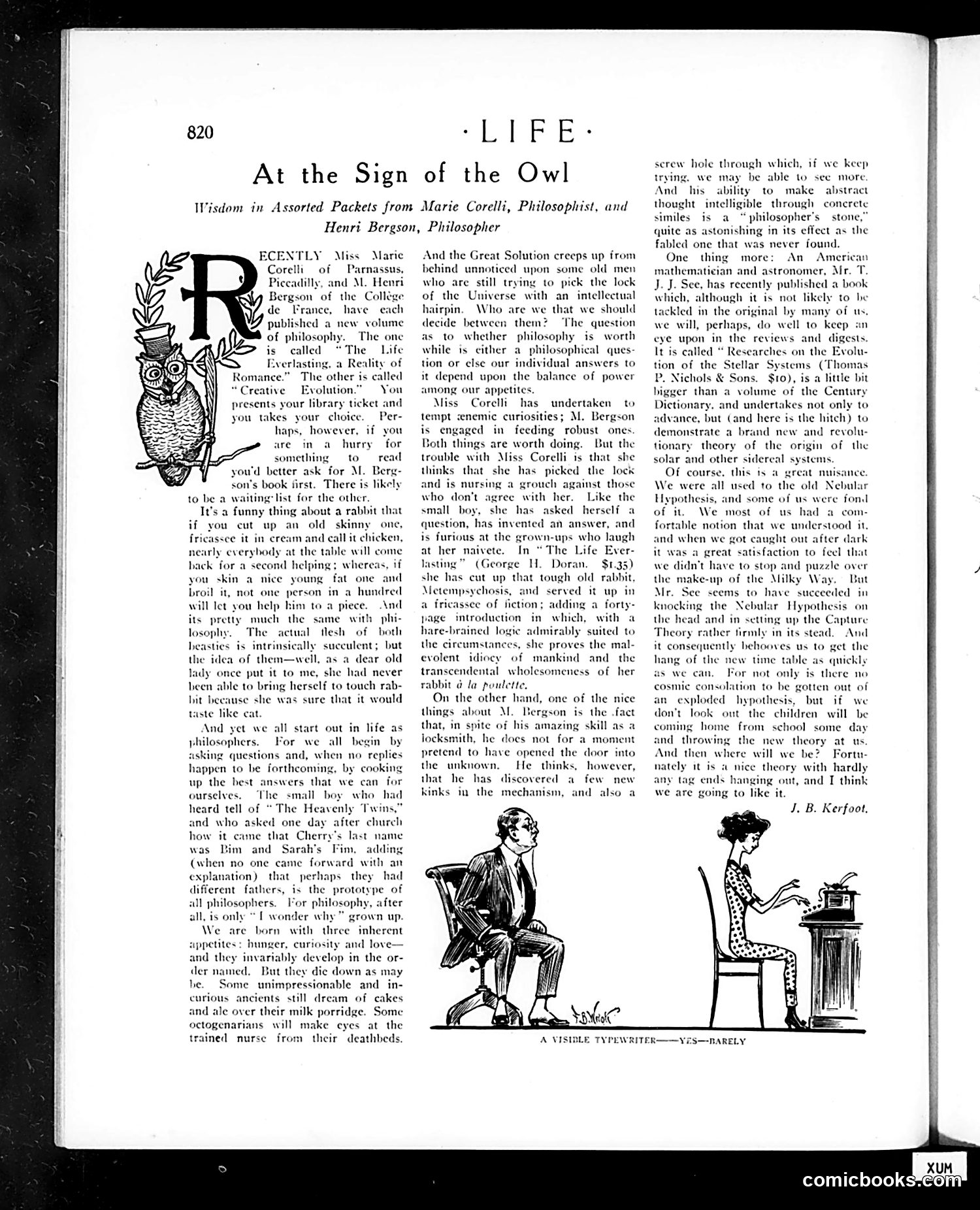
This page reviews two recently published philosophical works: Marie Corelli's "The Life Everlasting" and Henri Bergson's "Creative Evolution." The author uses extended metaphors to critique both authors' approaches. The central satire compares philosophy to cooking rabbit—Corelli's work is "fricasseed" (disguised in fiction), making unpalatable ideas more digestible through literary embellishment. The author mocks her certainty: she claims to have "picked the lock" of the Universe and dismisses skeptics like a petulant child. By contrast, Bergson is praised as honest about philosophy's limits. Though skillful as a "locksmith," he admits the door to ultimate truth remains unopened, only discovering "new kinks" in understanding's mechanism. The cartoons illustrate this: a man hunched over (representing philosophical struggle), and a woman at a typewriter (likely representing Corelli's prolific output). The satire suggests that Corelli mistakes confident assertions for genuine wisdom, while Bergson maintains appropriate intellectual humility.
📄 Transcribed text from this page (OCR, searchable)
Machine-transcribed from the original scan — historical spelling and the odd misread are preserved.
ECENTLY Miss Marie Corelli of Parnassus, Piccadilly, and M. Henri Bergson of the College de France, have each published a new: volume of philosophy. The one is called “The Life Everlasting, a Reality of Romance.” The other is called “Creative Evolution.” You presents your library ticket and you takes your choice. Per- haps, however, if you are in’ a hurry for something to read you'd better ask for M. son's book first. There is likely waiting: list for the other It’s a funny thing about a rabbit that you cut up an old skinny one, fricassce it in cream and call it chicken, nearly everybody at the table will come back for a second helping; whereas, if you skin a nice young one and broil it, not one person in a hundred will Ict you help him to a piece. And its pretty much the same with phi- losophy, The actual flesh of both beasties is intrinsically succulent; but the idea of them—well, as a dear old lady once put it to me, she had never heen able to bring herself to touch rab- hit heeause she was sure that it would taste like cat. And yet we all start out in life as philosophers. For we all begin by asking questions and, when no rep happen to be forthcoming, by cooking up the best answers that we can for ourselves. The small boy who had heard tell of “ The Heavenly Twins,” and who asked one day after church how it came that Cherry's last name was Bim and Sarah's Fim, adding (when no one came forward with an explanation) that perhaps they had different fathers, is the prototype of all philosophers. For philosophy, after all, is only “f wonder why” grown up. We are born with three inherent nctites: hunger, curiosity and love— and they invariably develop in the or- der named. But they die down as may he. Some unimpressionable and in- curious ancients still dream of cakes and ale over their milk porridge. Some octogenarians will make eyes at the trained nurse from their deathbeds Berg- *LIPE« At the Sign of the Owl Wisdom in Assorted Packets from Marie Corelli, Philosophist, and Henri Bergson, Philosopher And the Great Solution creeps up from behind unnoticed upon some old men who are still trying to pick the lock of the Universe with an_ intellectual hairpin. Who are we that we should decide between them? The question as to whether philosophy is worth while is cither a philosophical ques tion or else our individual answers to it depend upon the balance of power among our appetites. Miss Corelli has undertaken to tempt cenemic curiosities; M. Bergson is engaged in feeding robust ones Both things are worth doing. But the trouble with Miss Corelli is that she thinks that she has picked the lock and is nursing a grouch against those who don't agree with her. Like the small boy, she has asked herself a question, has invented an answer, and is furious at the grown-ups who laugh at her naivete. In “The Life Ever- lasting” (George H. Doran. $1.33) she has cut up that tough old rabbit, Metempsychosis, and served it up in a fricassee of fiction; adding a forty- page introduction in which, with a hare-brained logic admirably suited t the circumstances, she proves the mal- evolent idiocy of mankind and the transcendental wholesomeness of her rabbit é la poulett On the other hand, one of the nice things about M. Bergson is the .fact that, in spite of his amazing skill as a locksmith, he does not for a moment pretend to have opened the door into the unknown. He thinks, however, he has discovered few new kinks in the mechanism, and also a serew hole through which, if we keep trying, we may be able to see more And his ability to make abstract thought intelligible through conerete similes is a “philosopher's stone,” quite as astonishing in its effect as the fabled one that was never found. One thing more: An American mathematician and astronomer, Mr. T. J. J. See, has recently published a book which, although it is not likely to be led in the original by many of us, we will, perhaps, do well to keep in eye upon in the reviews and digests. It is called “ Researches on the Evolu- tion of the Stellar Systems (‘Thomas P. Nichols & Sons. $10), is a little bit higger than a volume of the Century Dictionary, and undertakes not only to advance, but (and here is the hitch) to demonstrate a brand new and revolu- tionary theory of the origin of the solar and other sidereal systems. Of course, this is a great nuisance: We were all used to the old Nebular Hypothesis, and some of us were fond of it. We most of us had a com- fortable notion that we understood it, and when we got caught out after dark it was a great satisfaction to feel that we didn’t have to stop and puzzle over the make-up of the Milky Way. But Mr. See seems to have succeeded in knocking the Nebular Hypothesis on the head and in setting up the Capture Theory rather firmly in its stead. And it cons hang of the as we can. quently behooves us to get the ew time table as quickly For not only is there no cosmic consolation to be gotten out of an exploded hypothesis, but if we don't look out the children will be coming home from school some and throwing the new theory at us. And then where will we be? Fortu- nately it is a nice theory with hardly any tag ends hanging out, and T think we are going to like it. J. B. Kerfoot, A VISIBLE TYPEWRITER——YZS—DARELY