
A complete issue · 52 pages · 1911
Life — September 21, 1911
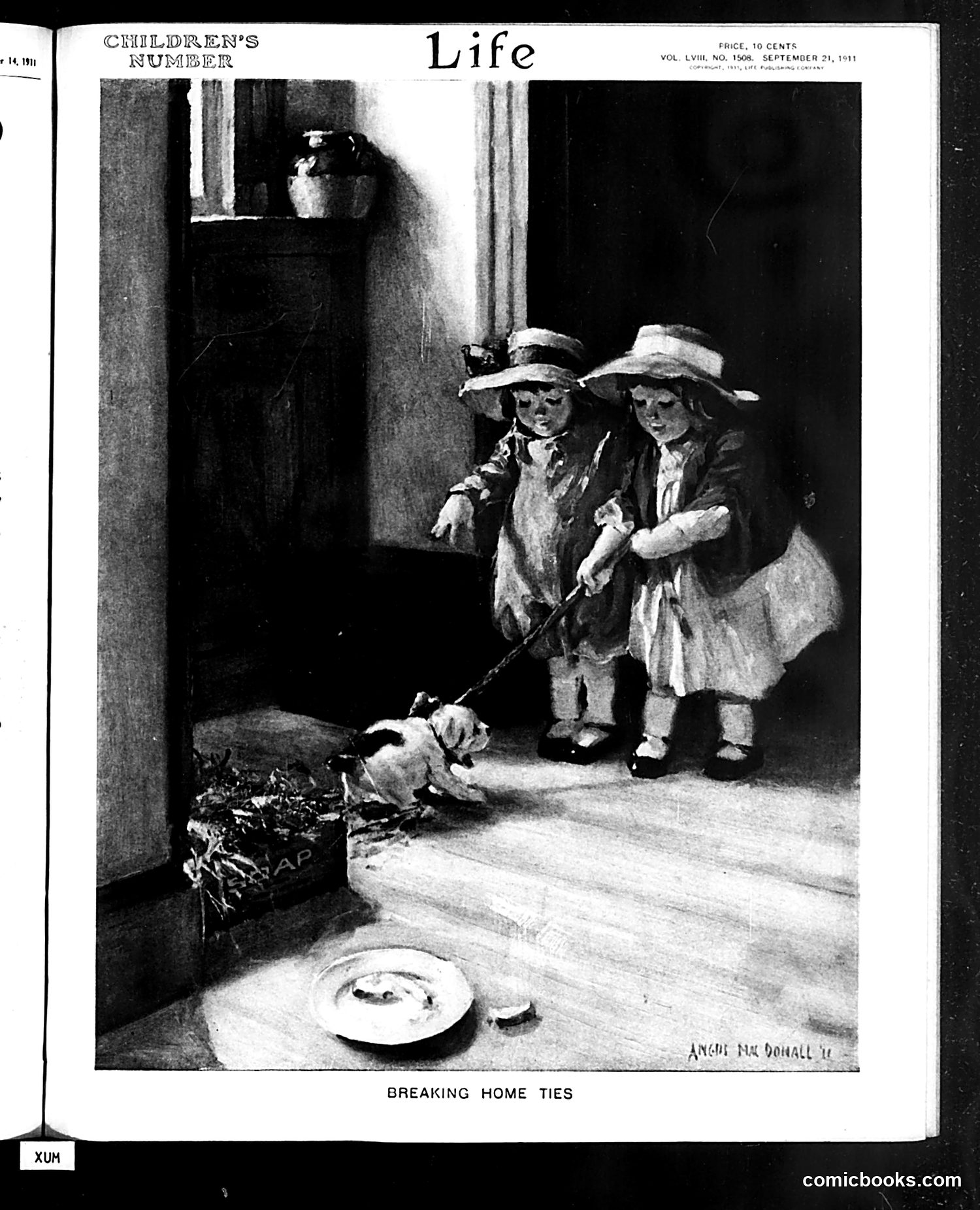
This is a "Children's Number" cover from Life magazine (September 21, 1911). The illustration, titled "Breaking Home Ties," depicts two young children in straw hats pulling on a rope attached to a dog, while a figure watches from a doorway above. The satire appears to commentary on childhood mischief and the tension between parental authority and children's independence. The "breaking home ties" title suggests the children are testing boundaries or rebelling against domestic control. The dog serves as both a victim of their play and perhaps symbolizes loyalty or companionship pulling them away from home discipline. This reflects early 20th-century anxieties about child-rearing, obedience, and the proper role of parental supervision during a period of changing social values.
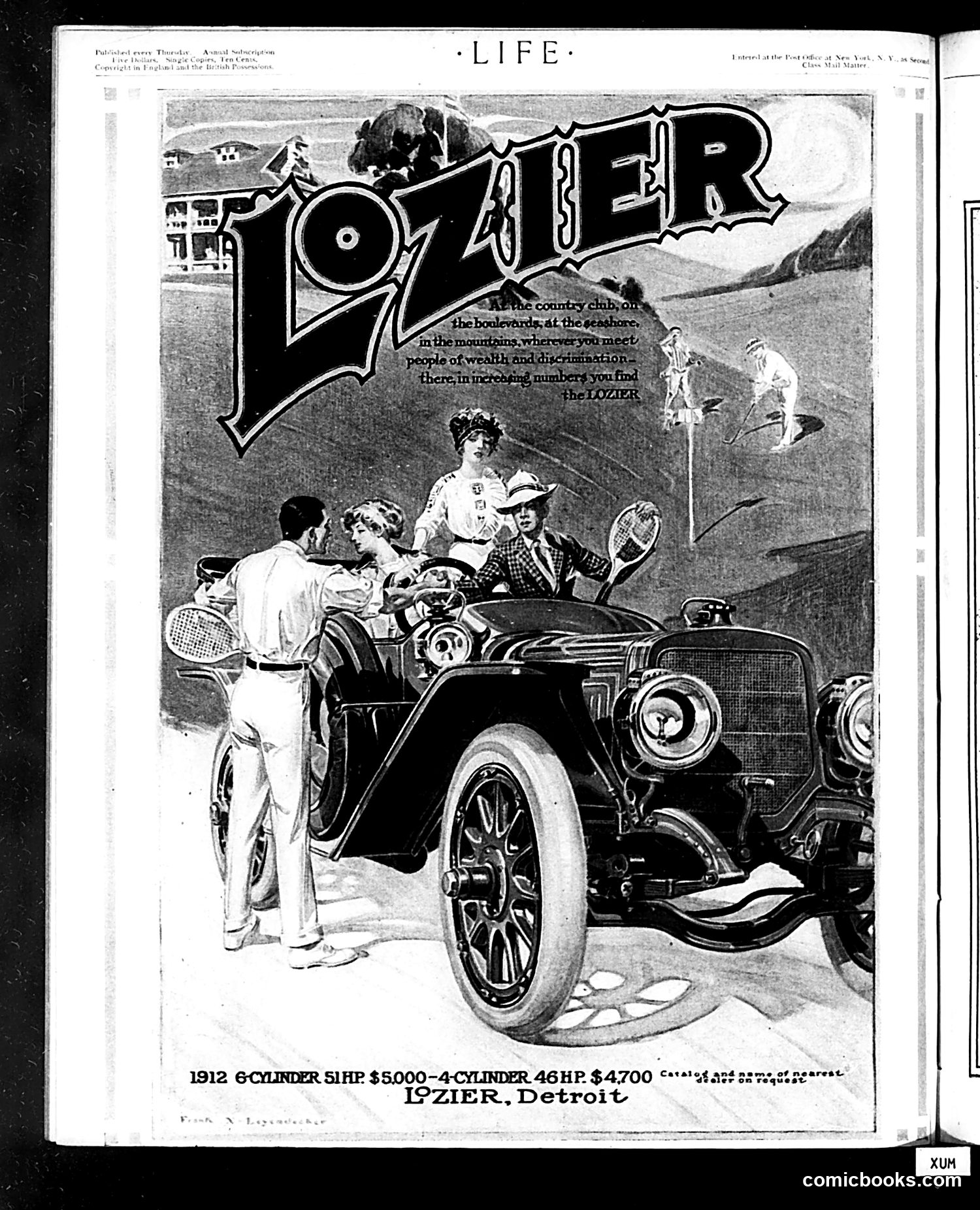
This is primarily a **Lozier automobile advertisement** from Life magazine, not political satire. The large "LOZIER" masthead dominates the page, with decorative text describing the car's appeal to wealthy buyers ("on the boulevards, at the seashore, in the mountains, wherever you meet people of wealth and discrimination—there, in increasing numbers you find the LOZIER"). The illustration depicts an affluent social scene: well-dressed men and women with tennis rackets beside a luxury automobile, establishing the car's association with leisure and upper-class status. Two 1912 Lozier models are listed with prices ($5,000 for the 6-cylinder, $4,700 for the 4-cylinder), positioning it as a premium vehicle. The "satire" is implicit rather than explicit: the ad satirizes consumer aspirations by suggesting that owning a Lozier signals wealth and social standing.
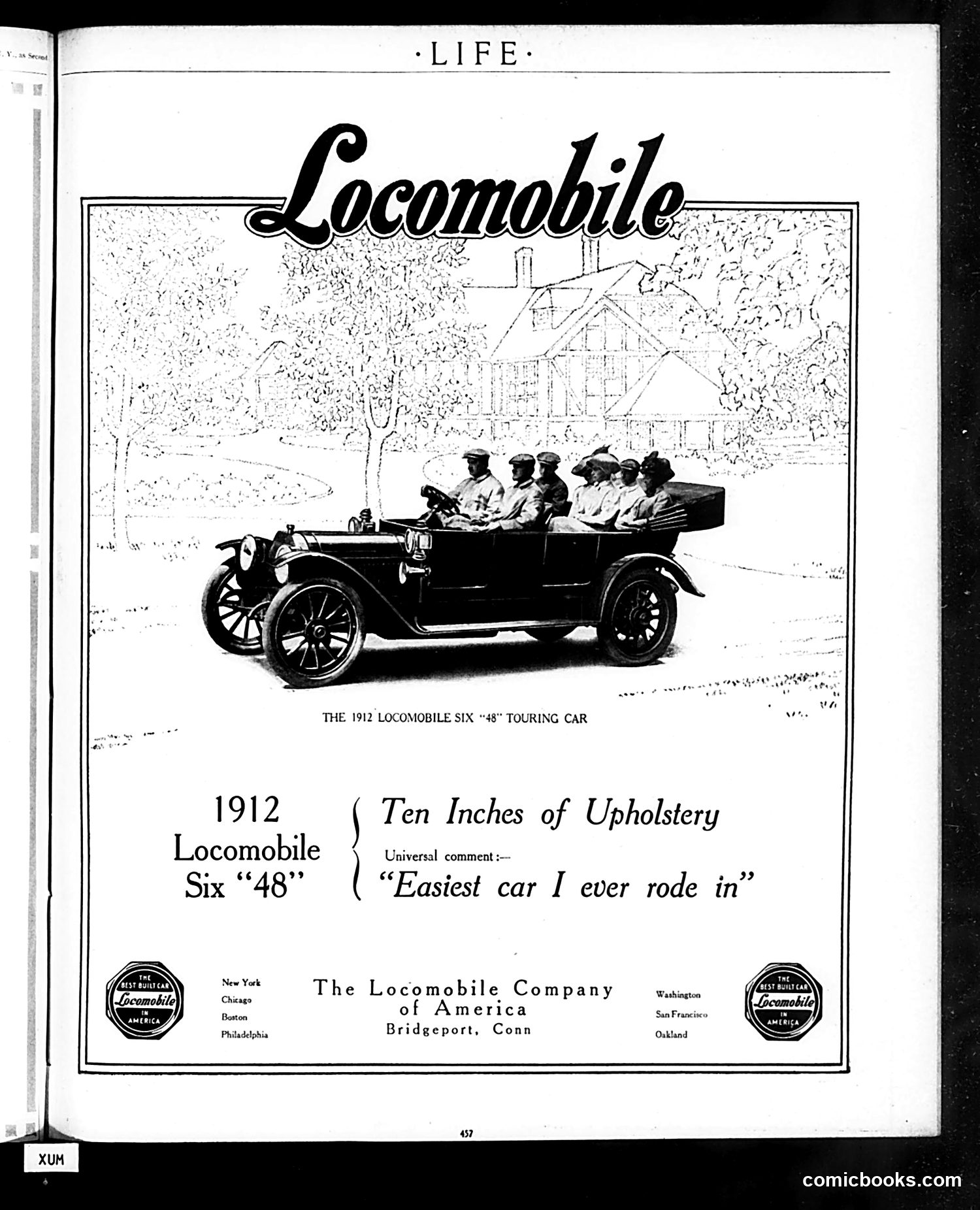
This page is **primarily an advertisement**, not political satire. It features a 1912 Locomobile Six "48" touring car, showing six passengers enjoying a ride past a large estate house. The marketing pitch emphasizes comfort: "Ten Inches of Upholstery" with the slogan "Easiest car I ever rode in." This appeals to early automotive consumers prioritizing luxury and smoothness. The illustration depicts affluent Americans—likely the target demographic—demonstrating the car's spacious interior and passenger capacity. The Locomobile Company of America, based in Bridgeport, Connecticut, was a maker of high-end automobiles. **This is commercial promotion, not editorial commentary.** It reflects early 1910s consumer culture and the automobile's status as a luxury good for the wealthy.
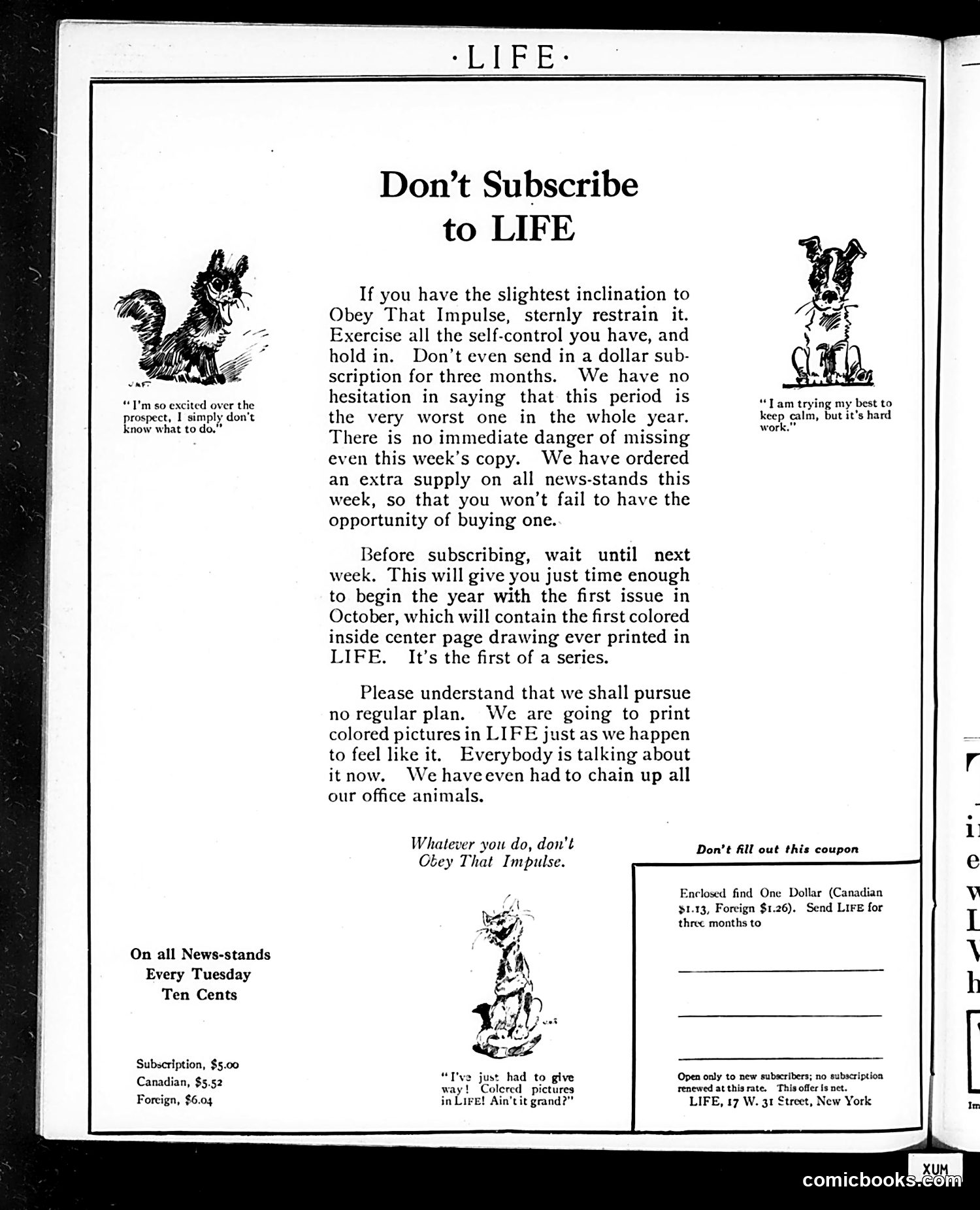
This page is primarily an **advertisement for LIFE magazine subscriptions**, not political satire. The headline "Don't Subscribe to LIFE" uses reverse psychology to promote subscriptions. The three cartoon animals (squirrel, dog, and cat) illustrate the supposed difficulty of *resisting* the impulse to subscribe—they're comedic mascots representing human self-control struggles, not political figures or caricatures. The satire here is **meta-advertising**: LIFE ironically discourages subscription while simultaneously highlighting why readers *should* want it—mentioning upcoming colored center-page drawings and other features. The tone is lighthearted and self-aware rather than political. The coupon at right facilitates new subscriptions at $5.00 annually (U.S.), $5.52 (Canada), or $6.04 (Foreign).
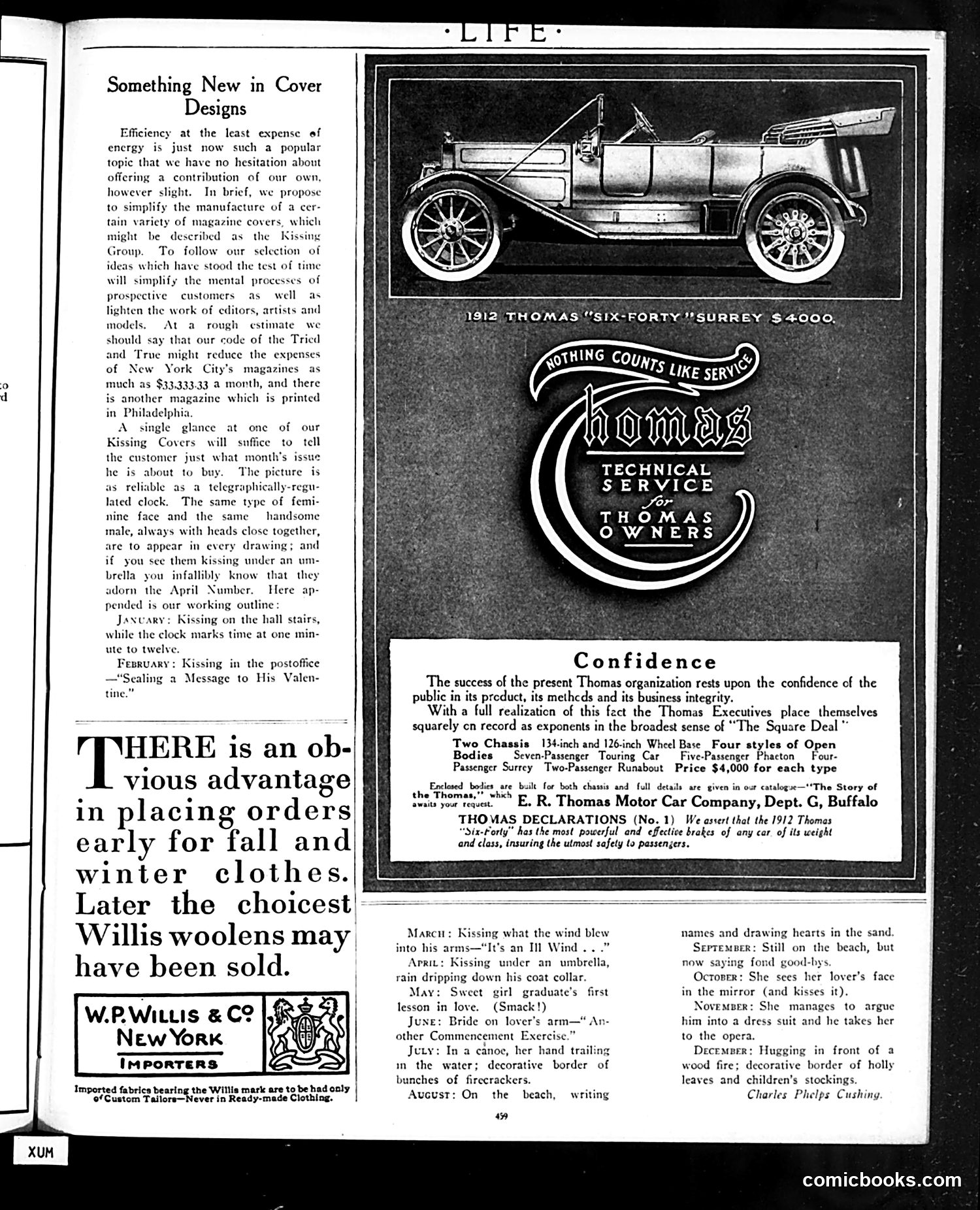
This page is primarily **advertising and editorial content** rather than political satire. The main elements are: 1. **Editorial article** ("Something New in Cover Designs"): Discusses the *Kissing Group* magazine cover concept, which features the same couple kissing in different monthly scenarios (hall stairs, post office, under umbrella, etc.). This appears to be a humorous recurring feature about romance. 2. **Thomas automobile advertisement**: Showcases a 1912 Thomas "Six-Forty" Surrey with technical service information for owners. 3. **Willis woolens advertisement**: Promotes early ordering of fall/winter clothing. The "kissing" references throughout are lighthearted domestic humor typical of early-1900s Life magazine—not political satire. The page reflects Edwardian-era attitudes toward romance and consumer culture.
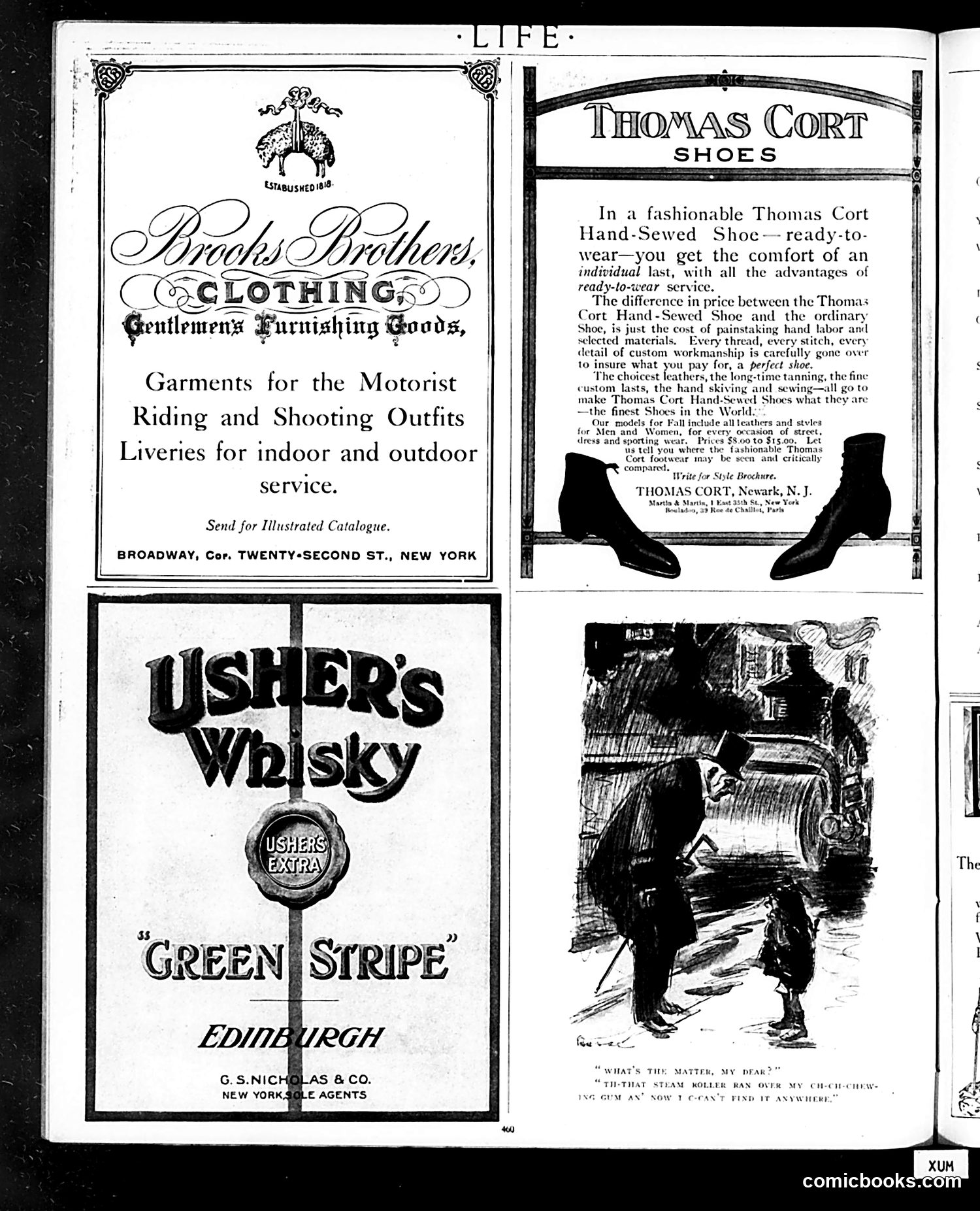
This page is primarily **advertising**, not editorial content or political satire. The ads feature: 1. **Brooks Brothers** - clothing for motorists, riders, and shooters 2. **Thomas Cort Shoes** - hand-sewn footwear for men 3. **Usher's Whisky** - "Green Stripe" brand from Edinburgh The only illustration with narrative content is a small sketch accompanying the Usher's ad, showing two figures in what appears to be a comedic domestic scene. The dialogue suggests a humorous domestic dispute, likely playing on the product as a solution or explanation for marital troubles—common advertising humor of this era. The page reflects early 20th-century consumer culture and advertising conventions rather than political commentary.
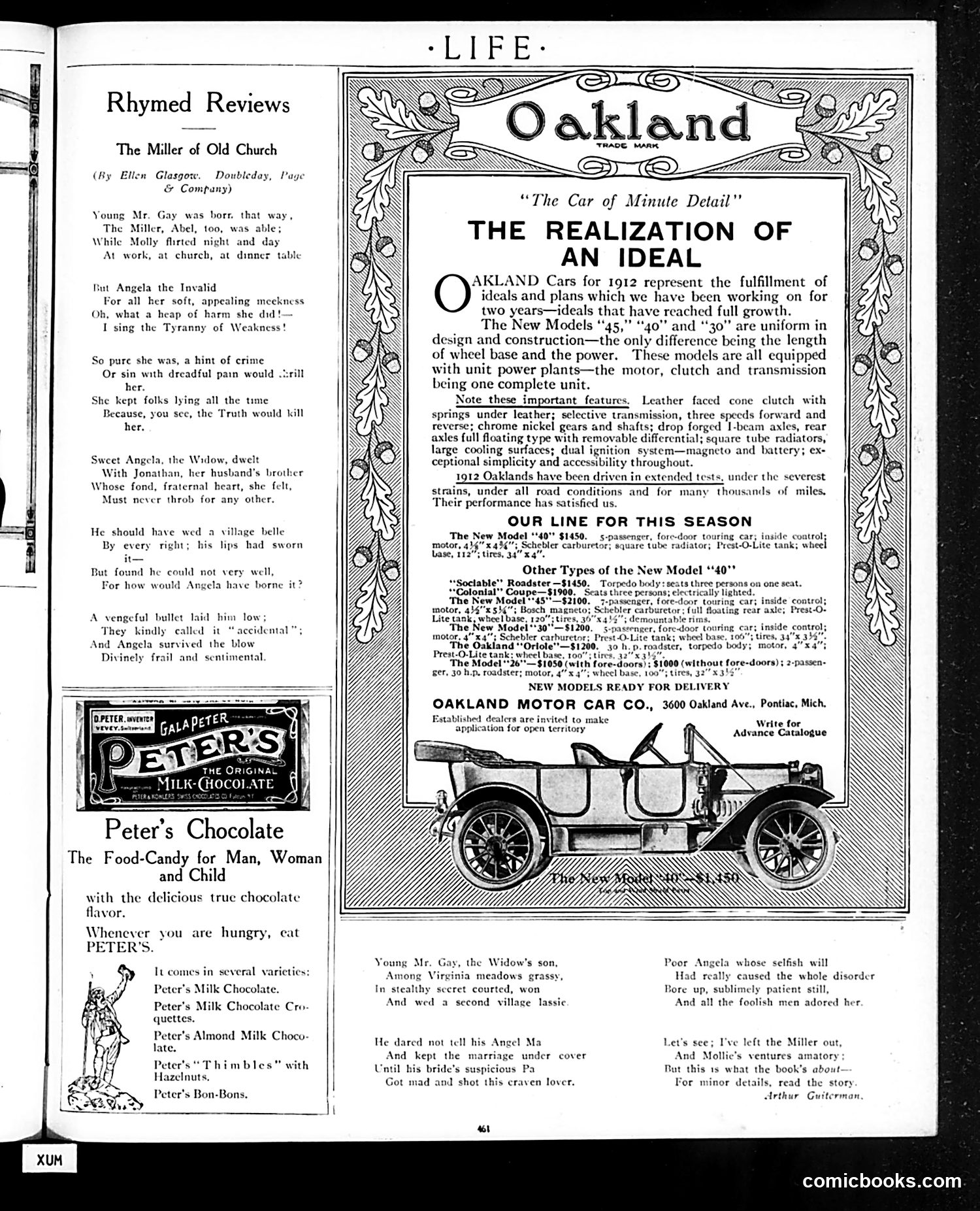
This Life magazine page is primarily **advertising and light entertainment** rather than political satire. The left column features a **rhymed poem review** titled "The Miller of Old Church" by Ellen Glasgow, telling a morality tale about a miller and a woman named Angela who endures hardship with patience. Below is an advertisement for **Peter's Milk Chocolate**. The right side contains a large **Oakland automobile advertisement** promoting the 1912 model as "The Realization of an Ideal." The ad highlights technical features and lists various body styles available, with pricing around $1,150-$1,300. There is no discernible political cartoon or satirical commentary visible. The page represents typical early-20th-century magazine content mixing literary pieces with product advertisements.
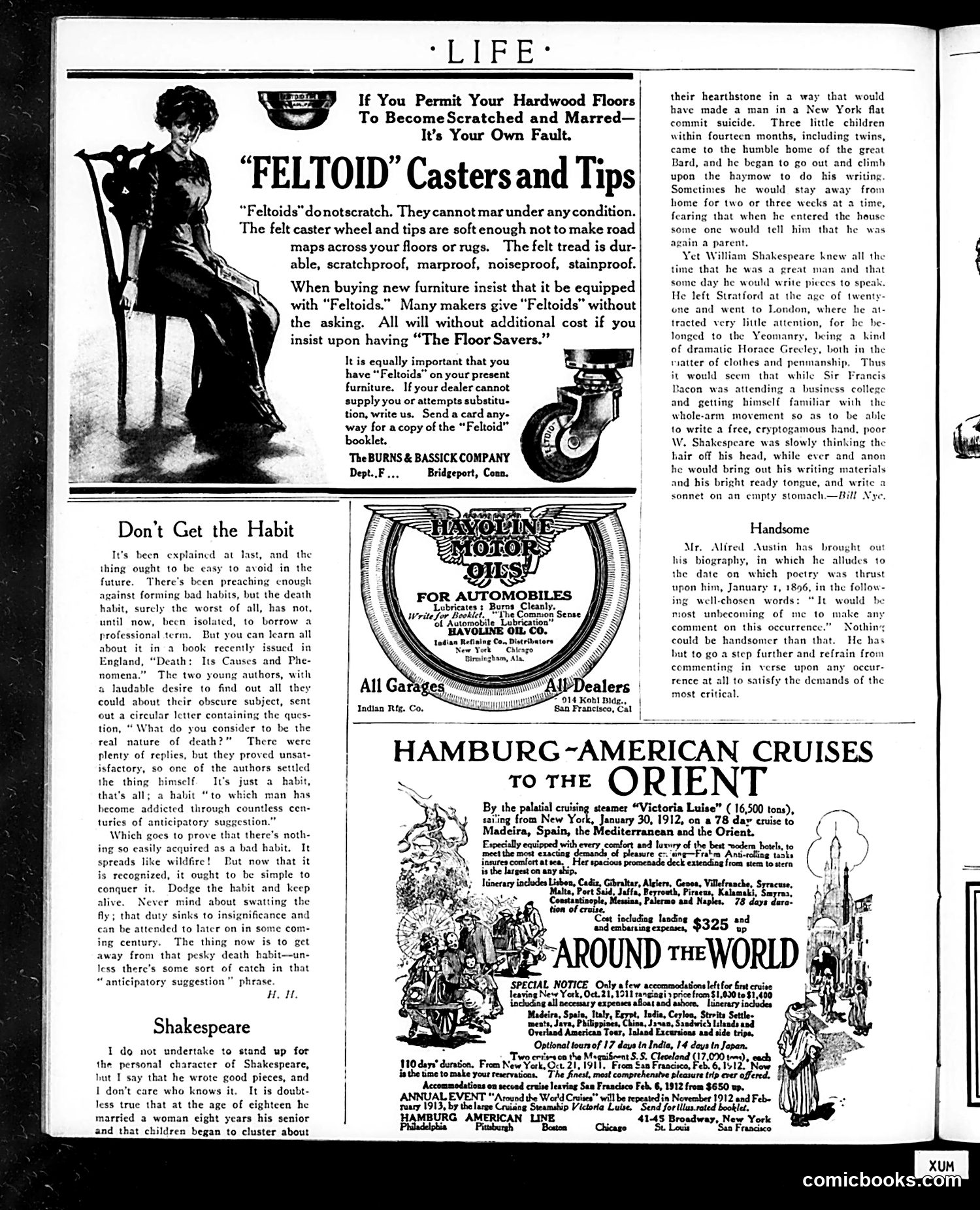
This page is primarily **advertising and articles** rather than political satire. The main advertisements are: - **Feltoid Casters and Tips** (furniture hardware) - **Havoline Motor Oils** (automotive products) - **Hamburg-American Cruises to the Orient** (luxury travel, departing January 30, 1912) The editorial content includes articles titled "Don't Get the Habit" (about bad habits) and "Shakespeare" (discussing the playwright's personal character and prolific output). There is **no political cartoon** on this page. The imagery is commercial—a woman sitting on furniture, automotive lubricant branding, and cruise ship promotional illustrations. The "Life" magazine format included advertisements alongside editorial content, which this page exemplifies. The 1912 cruise advertisement dates this publication.
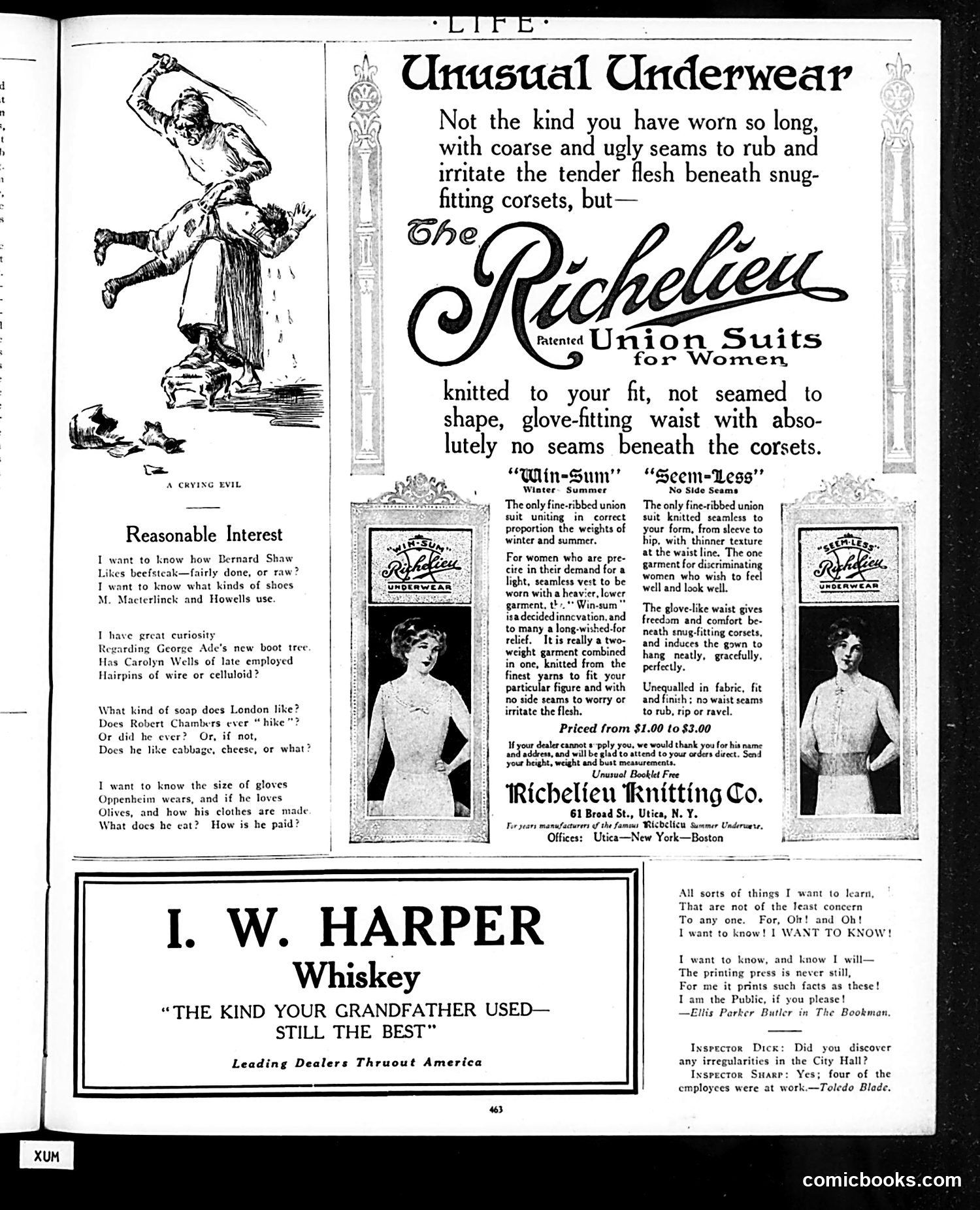
This page is primarily **advertising**, not satire or political commentary. The main content features two ads: 1. **Richelieu Union Suits for Women** - advertises seamless underwear marketed as superior to traditional corsetry, promoting comfort and freedom from irritating seams. The accompanying illustration ("A Crying Evil") appears to critique poorly-designed undergarments that chafe skin. 2. **I.W. Harper Whiskey** - a simple product advertisement claiming their brand was "the kind your grandfather used." The left column contains **"Reasonable Interest,"** a letters section where readers ask questions about unrelated topics (Bernard Shaw, George Ade's boot tree, London soap preferences, etc.). The page reflects early 20th-century consumer culture and product marketing rather than political or social satire.
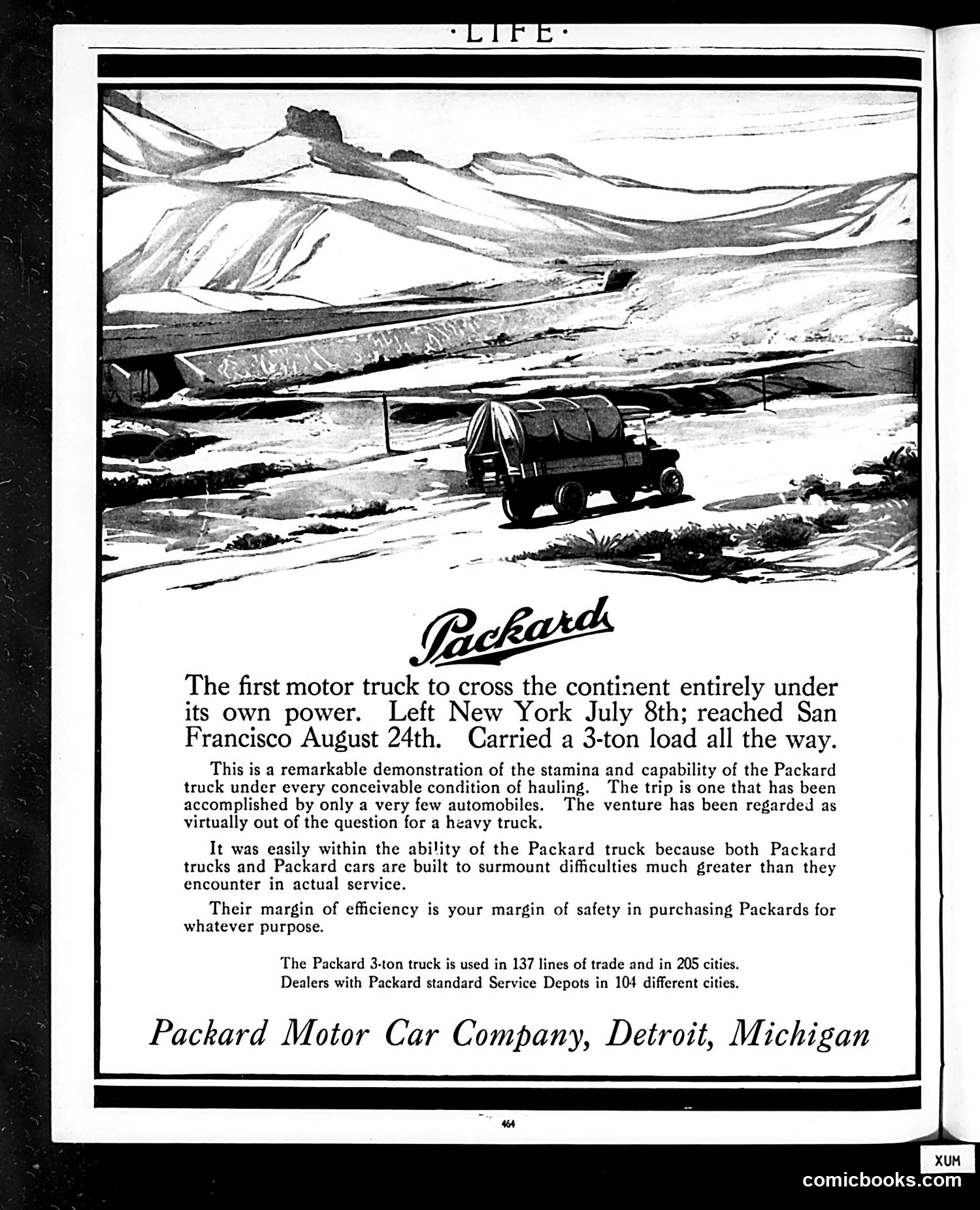
This is a **Packard Motor Car Company advertisement**, not satire or political commentary. The ad celebrates a remarkable feat: a Packard truck becoming "the first motor truck to cross the continent entirely under its own power," departing New York July 8th and arriving in San Francisco August 24th while carrying a 3-ton load throughout. The accompanying illustration shows the truck navigating dramatic desert/mountain terrain, emphasizing the vehicle's durability and capability under extreme conditions. The ad's central argument: Packard trucks are built to "surmount difficulties much greater than they encounter in actual service," making them a safe, reliable investment. The company notes its 3-ton trucks operate in 137 trade lines across 205 cities, supported by service depots in 104 cities—positioning Packard as an established, trustworthy manufacturer for commercial hauling purposes.
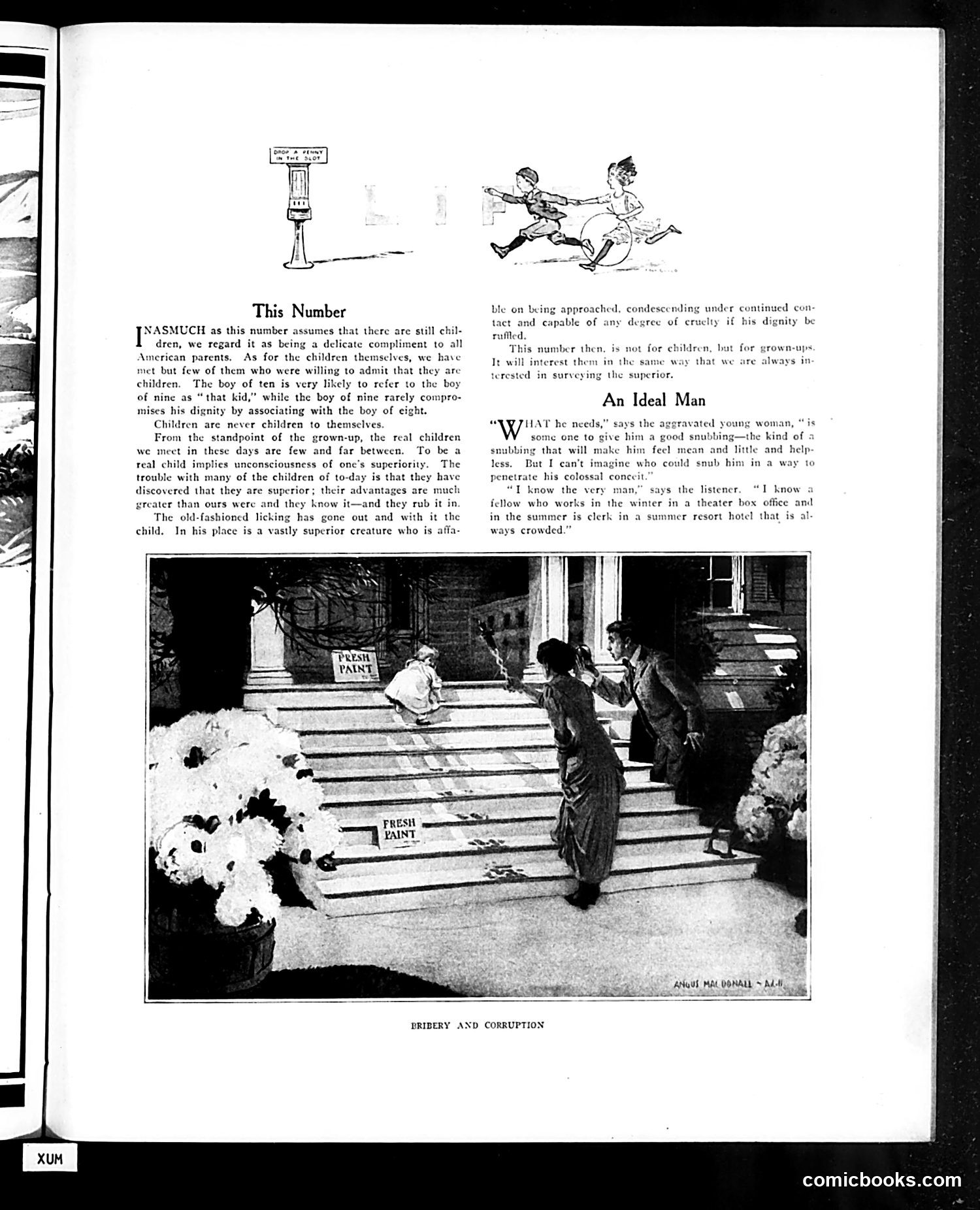
The page contains two satirical pieces. "This Number" discusses the number nine, drawing a humorous distinction between children and "the boy of nine," suggesting nine-year-old boys occupy a peculiar developmental stage—neither fully childish nor grown. "An Ideal Man" satirizes contemporary expectations for men. An "aggravated young woman" describes seeking a man who is helpful yet unobtrusive, ambitious yet emotionally available—qualities the text suggests are contradictory or impossible to find. The illustration captioned "Bribery and Corruption" shows people attempting to cross wet paint on steps while women stand nearby, apparently using femininity to influence or distract the workers. The satire appears to mock both casual corruption and gender-based manipulation in everyday situations.
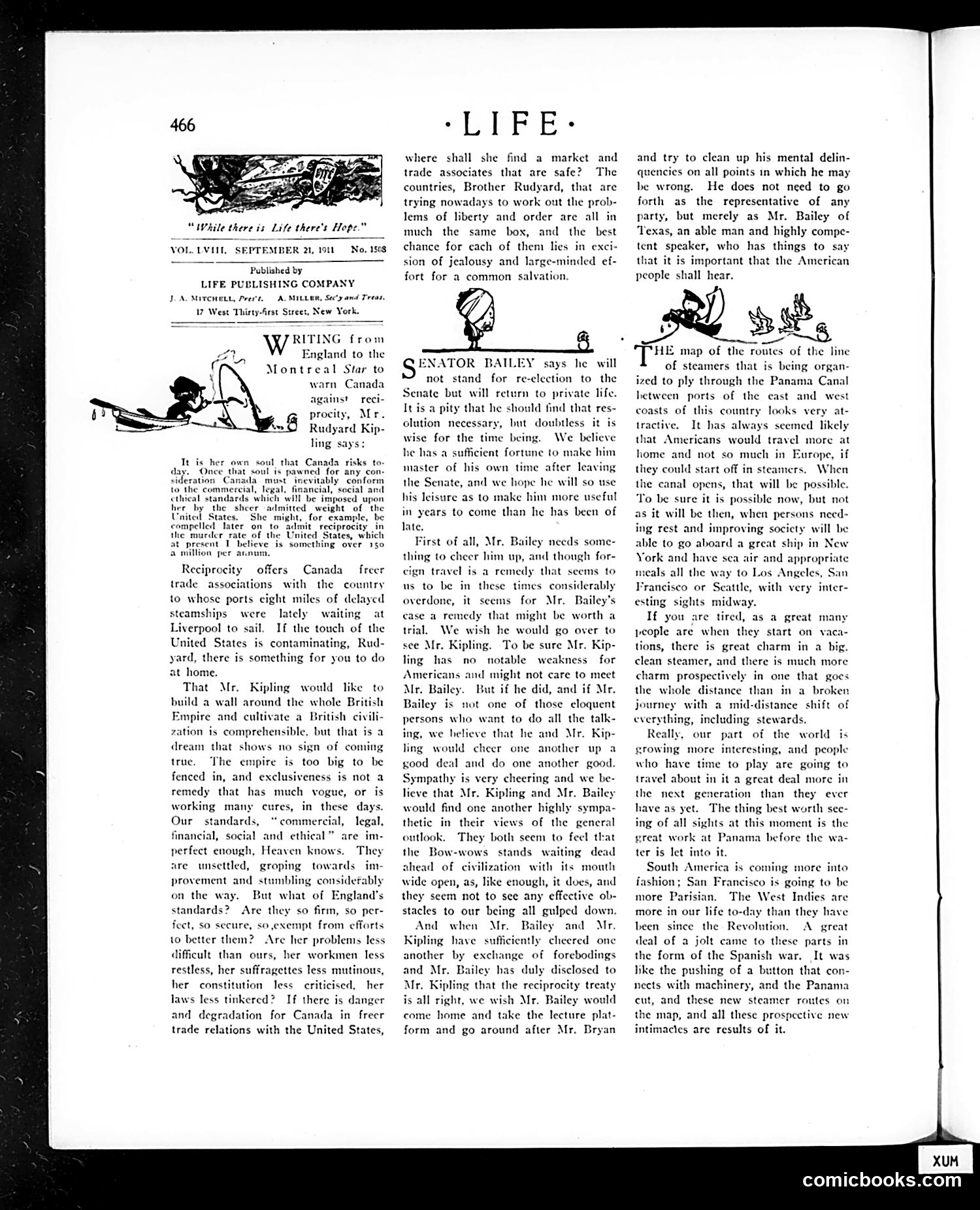
The page contains two editorial pieces. The left column features a cartoon titled "Writing from England to the Montreal Star to warn Canada against reciprocity" showing a figure (likely representing a Canadian or British interest) warning against trade reciprocity with the United States. The accompanying text criticizes this position, defending reciprocity as beneficial to Canada while mocking the notion that closer US trade relations threaten British imperial interests. The right column discusses Senator Bailey's decision not to seek re-election, praising his character and suggesting he lecture internationally. It also covers the Panama Canal's impact on steamship routes between US coasts. Both pieces reflect early 20th-century debates over free trade and American imperial expansion.
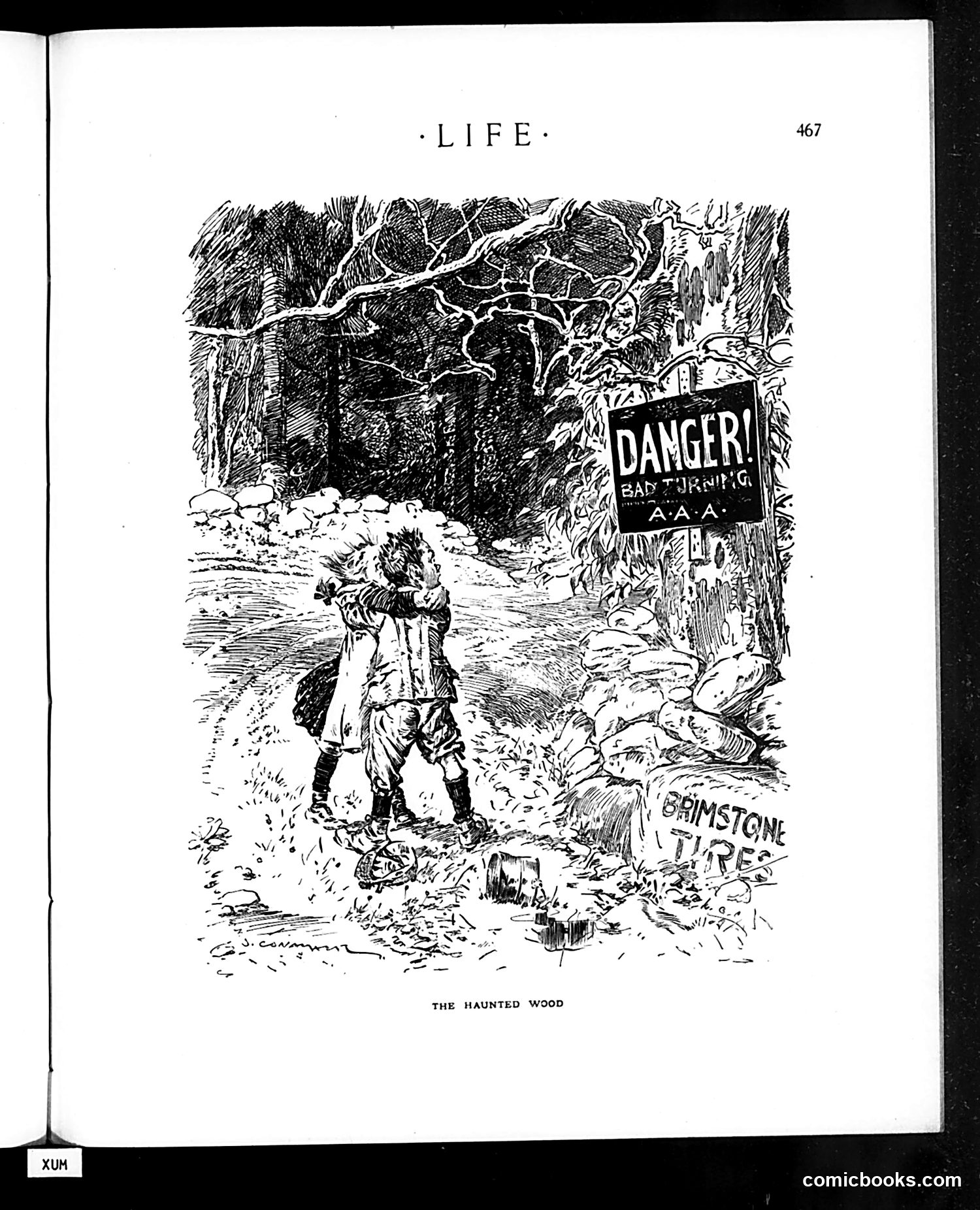
This illustration depicts a traveler in a forest encountering a warning sign reading "DANGER! BAD TURNING A.A.A." (likely referring to the American Automobile Association). The figure appears startled or lost. The satire likely critiques early automobile tourism and road conditions—particularly bad or poorly-marked roads that could endanger drivers. The "haunted wood" framing suggests these dangerous routes were common hazards for motorists. The AAA sign indicates the organization's role in rating or warning about problematic roads. This reflects early 20th-century concerns about automobile safety infrastructure and the growing tension between automotive expansion and roadway conditions. The comical treatment mocks both driver anxiety and inadequate road guidance systems of the era.
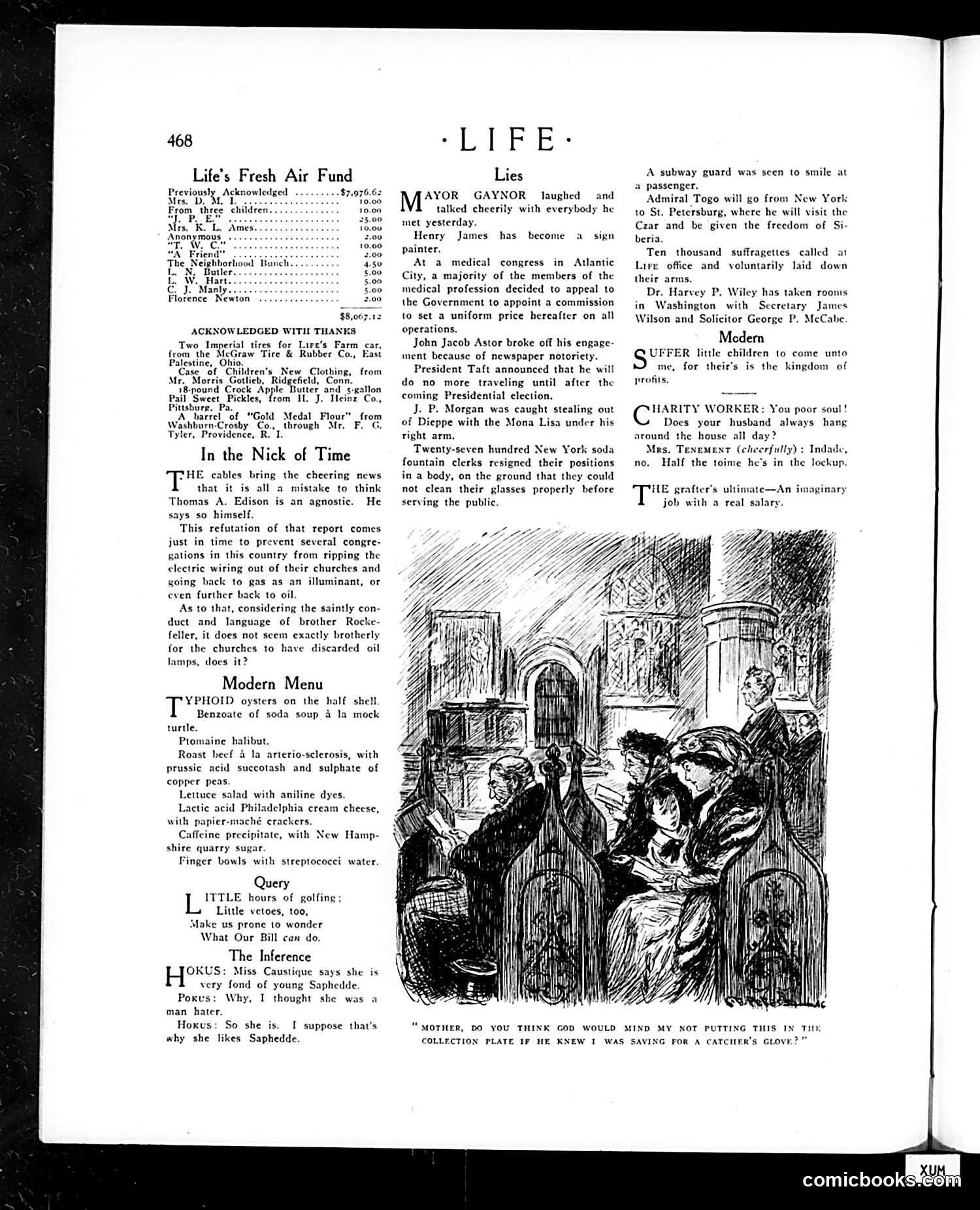
The page contains miscellaneous content including donation acknowledgments, brief news items, and humor columns—not primarily political cartoons. The main illustration shows a church interior scene with a mother and child, captioned: "Mother, do you think God would mind my not putting this in the collection plate if he knew I was saving for a catcher's glove?" **The satire:** This gentle joke mocks both childhood priorities (sporting equipment over religious charity) and parental anxiety about teaching moral values. It reflects Depression-era concerns about making ends meet, since saving for even modest items like baseball gloves required sacrifice. The humor comes from the child's naive attempt to rationalize selfish behavior through theological logic. The remaining content consists of short humorous anecdotes and a "Modern Menu" section—typical Life magazine miscellany.
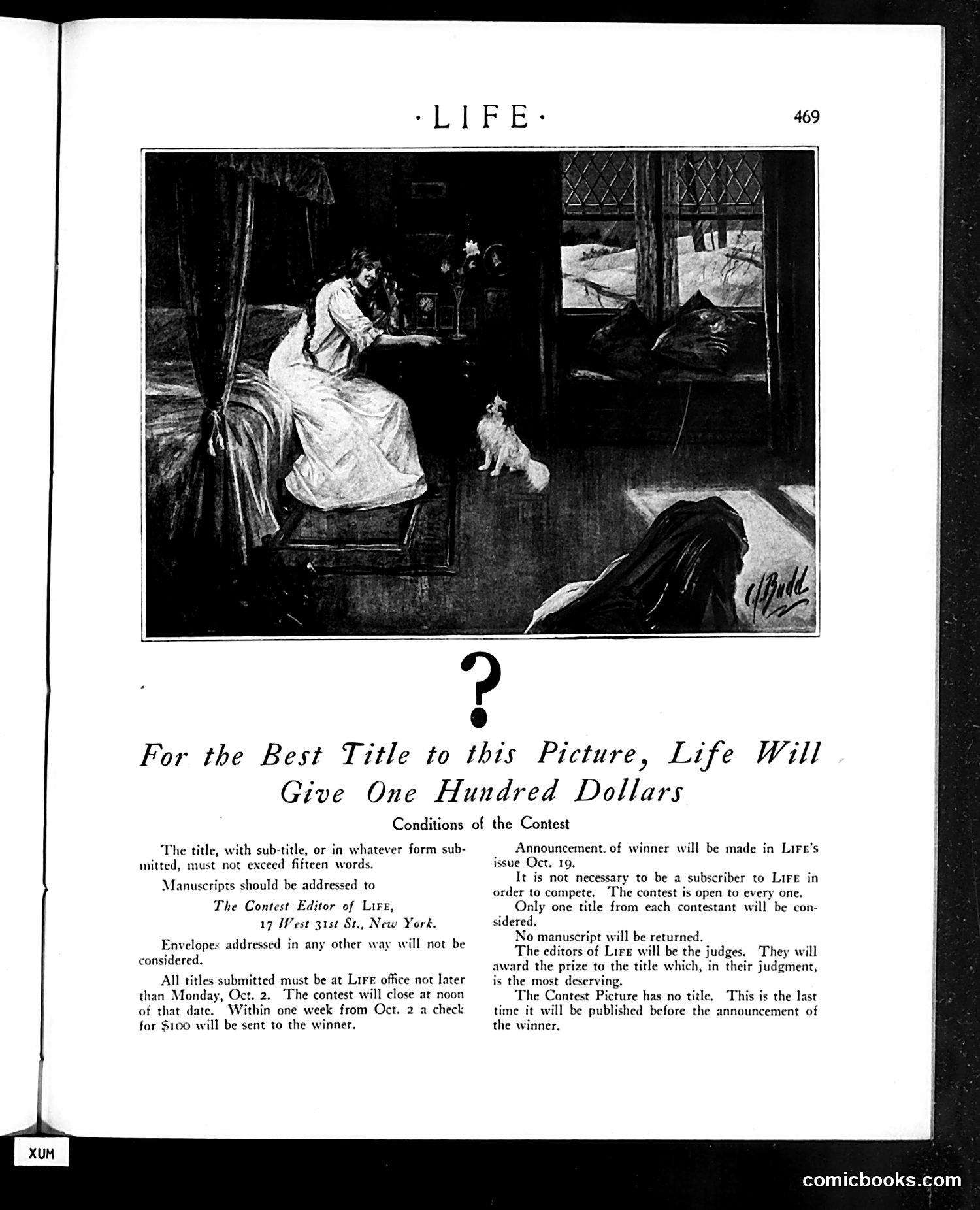
This is a **title-writing contest**, not a political cartoon. Life magazine presented an untitled illustration and challenged readers to submit the best caption, offering $100 as the prize. The image depicts an interior domestic scene: a woman sits at a desk or vanity, apparently writing or reading by lamplight, while a small dog stands nearby. Another figure lies on a bed or couch in the background. The setting appears to be a bedroom or private chamber, rendered in dramatic shadow and light. The contest invited creative interpretations of what this scene represents—readers had to guess the narrative or emotional meaning the artist intended. This was a popular form of reader engagement in early 20th-century magazines, allowing audiences to participate while generating content ideas. The contest closed October 2, with winners announced October 19.
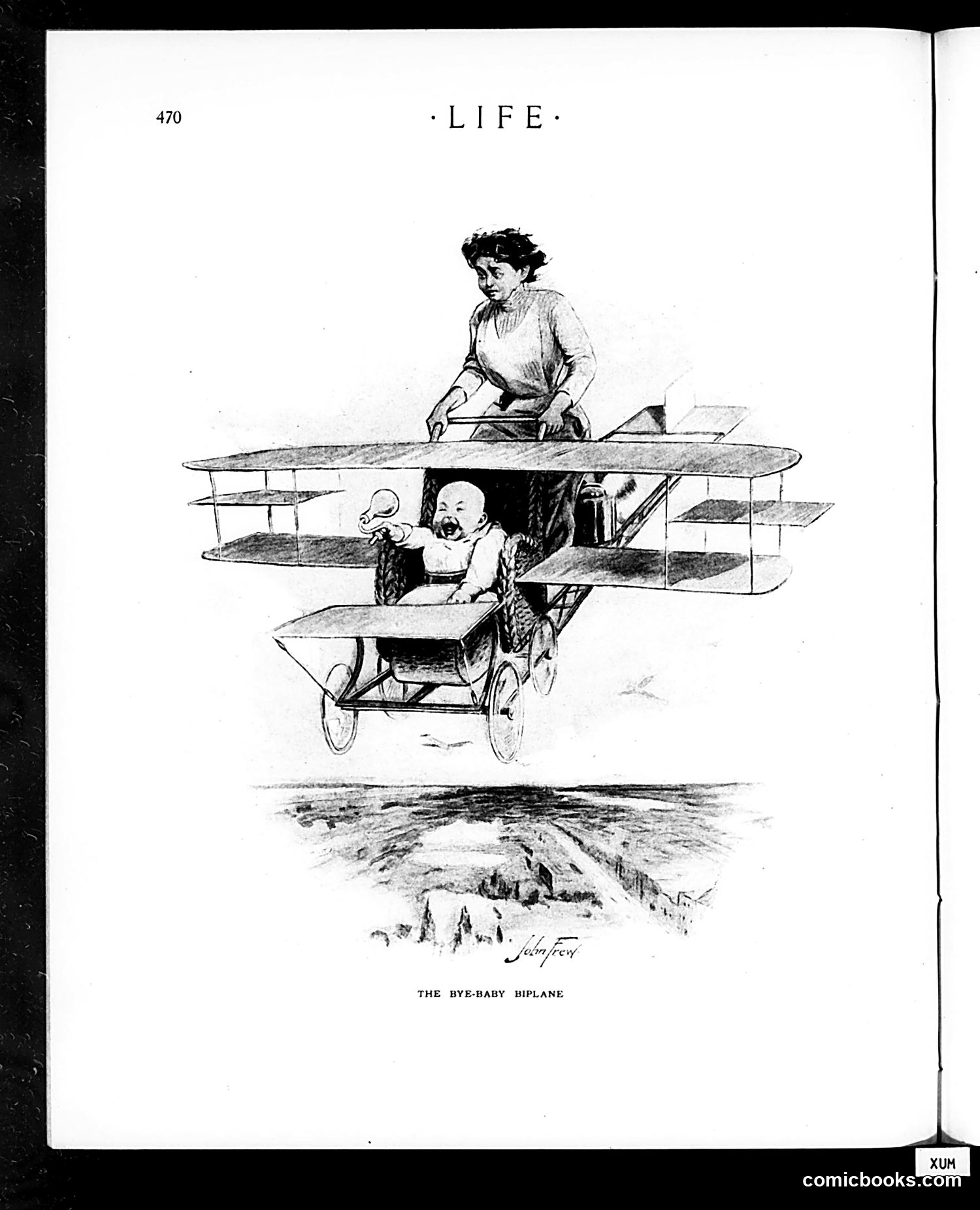
This satirical cartoon depicts a woman operating an early airplane while a baby sits in a carriage suspended beneath it. The title "The Bye-Baby Biplane" is a pun on the lullaby "Bye, Baby, Bunting." The satire targets the early aviation craze of the early 1900s, mocking the combination of dangerous new aircraft technology with domestic childcare. It presents an absurd scenario where a mother attempts to use a biplane as a baby-rocking device—suggesting both the recklessness of early aviation enthusiasts and perhaps anxieties about women operating dangerous machinery. The cartoon likely comments on the tension between rapid technological progress and traditional domestic roles, using humor to highlight the impracticality and danger of applying cutting-edge aviation to everyday parenting.
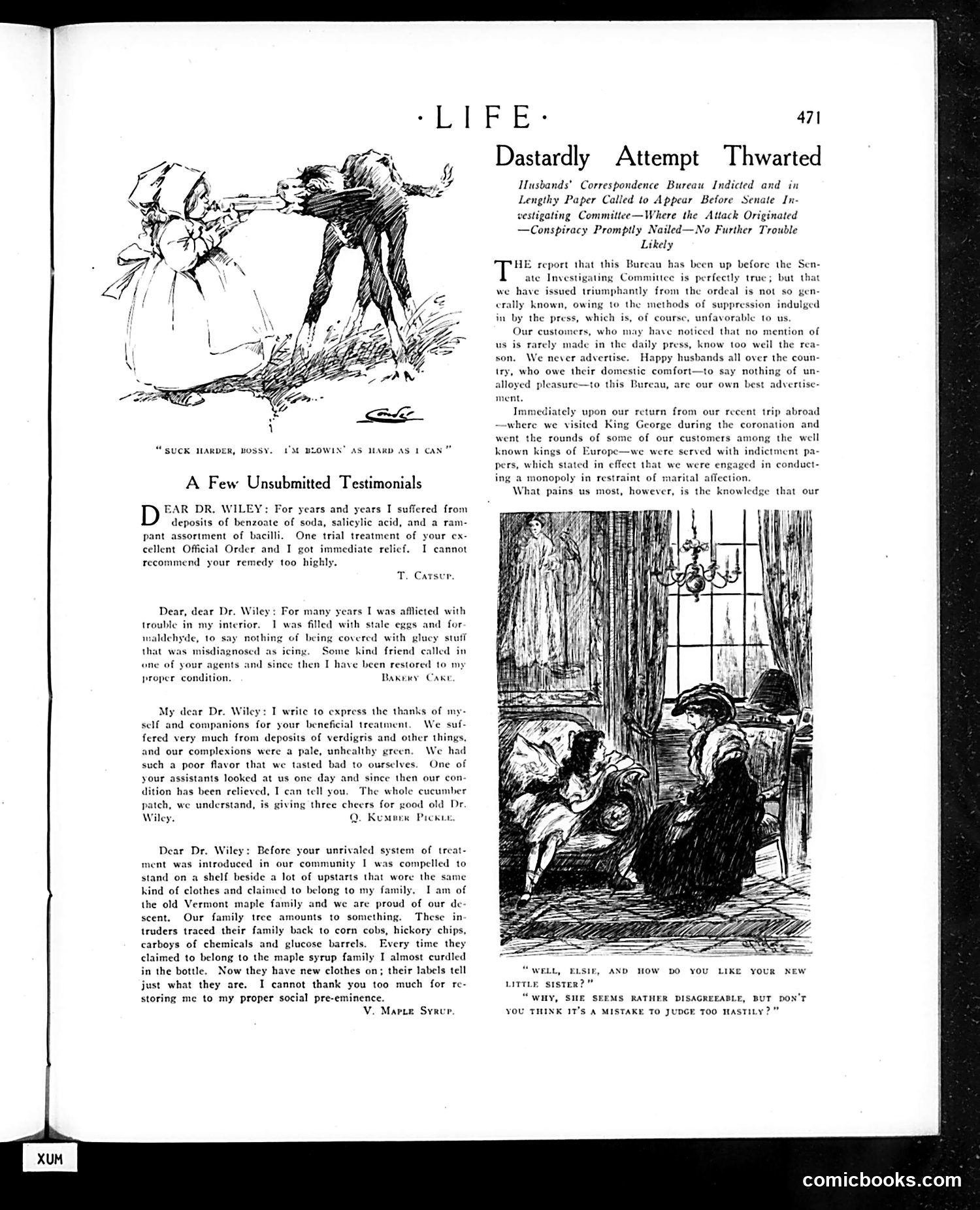
This page satirizes Dr. Harvey Wiley's Pure Food and Drug Administration investigations of the early 1900s. The headline mocks a fictional "Husbands' Correspondence Bureau" supposedly under Senate investigation—a humorous stand-in for real food and product manufacturers facing Wiley's scrutiny. The "testimonials" parody Wiley's expose of food adulteration. Signatories like "T. Catsup," "Bakery Cake," and "V. Maple Syrup" are personified foods thanking "Dr. Wiley" for removing harmful additives (benzoate, formaldehyde, etc.). The joke inverts reality: instead of condemning manufacturers, these fake testimonials present Wiley's reforms as beneficial to the products themselves. The cartoons show domestic scenes, likely commenting on marital discord—the "Bureau's" supposed specialty. The satire defends commercial interests against what Life considered excessive government regulation of American business and consumer goods.
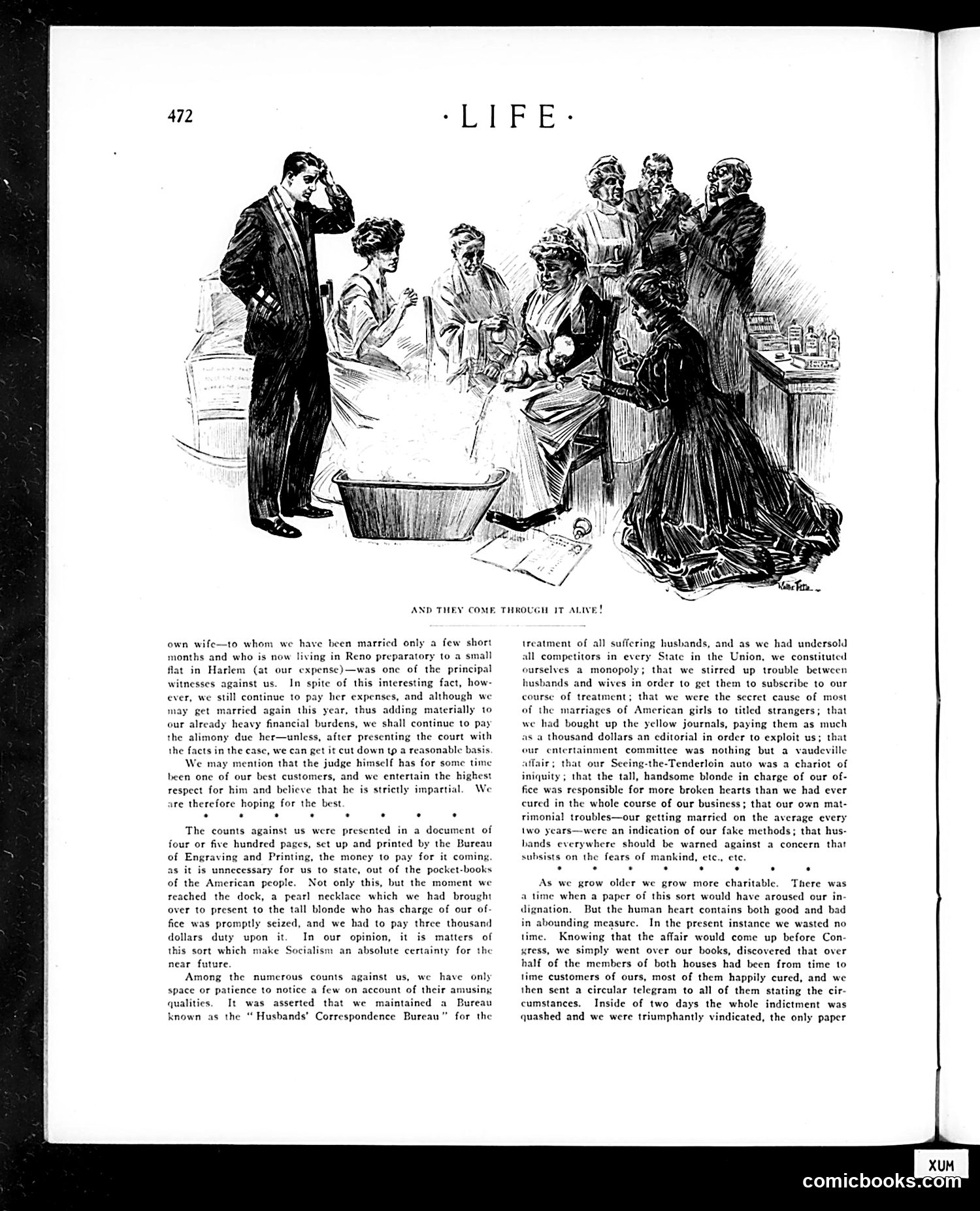
This satirical piece mocks marital discord and the emerging divorce industry of early 20th-century America. The illustration shows a man (likely representing a divorce profiteer or "marriage counselor") presenting his case to a court surrounded by women and officials. The text describes a fictional "Husbands' Correspondence Bureau"—a scam business accused of deliberately creating marital strife to sell "treatments" to desperate husbands. The satire targets: - The commercialization of divorce and relationship problems - Yellow journalism's sensationalism - Corrupt judges and congressmen allegedly patronizing such services - The absurdity of a monopoly on marital misery The narrator's casual admission that half of Congress were "customers" suggests widespread corruption. The headline "AND THEY COME THROUGH IT ALIVE" implies the scheme survives despite exposure—satirizing how money and connections shield wrongdoing from accountability.
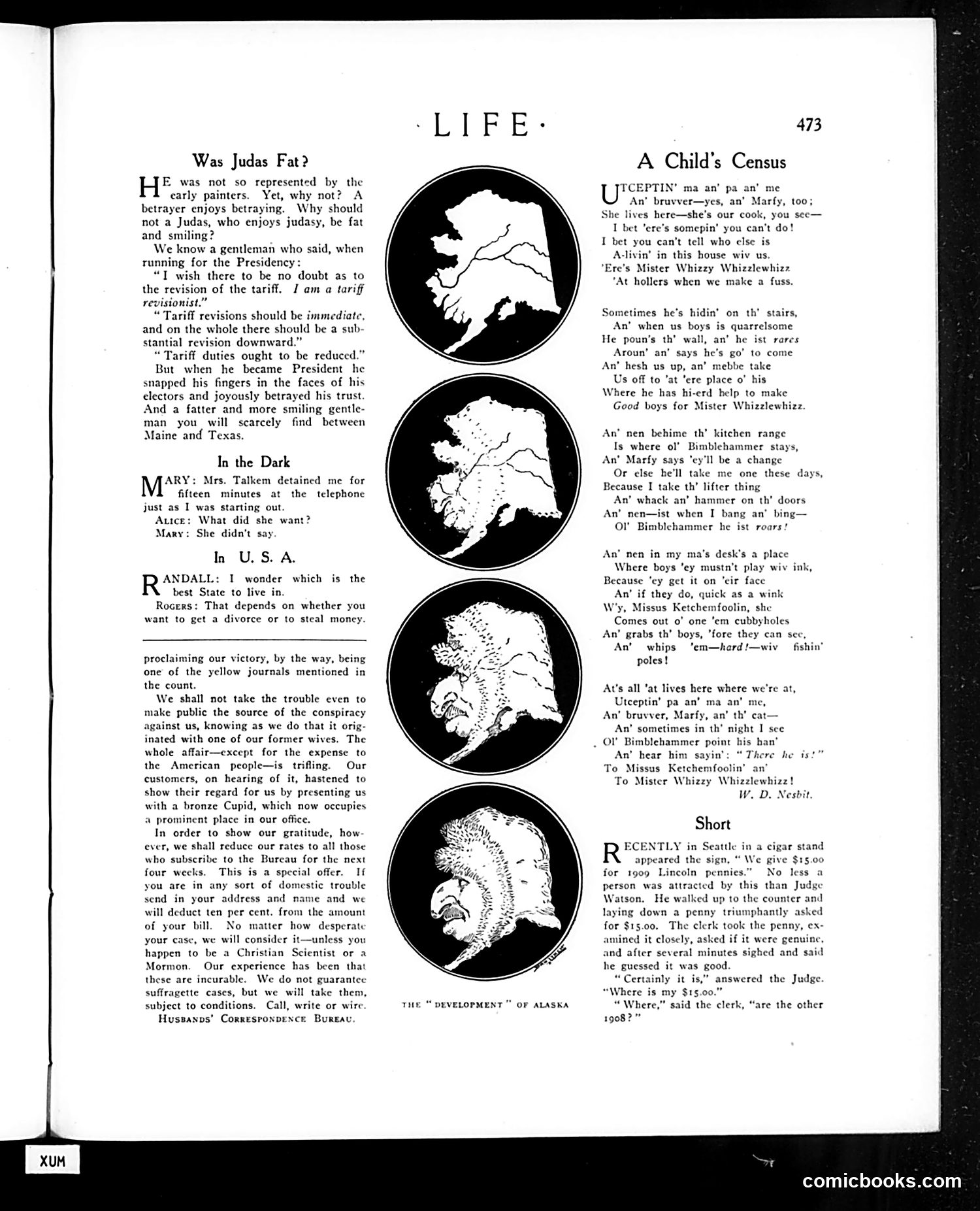
This page contains satirical commentary on American politics and social customs circa early 1900s. **"Was Judas Fat?"** mocks a presidential candidate (likely Theodore Roosevelt) who campaigned as a tariff revisionist but reversed course upon election, "joyously betrayed his trust." The satire compares this political betrayal to Judas's treachery. **"In U.S.A."** is a two-line joke about American state laws, suggesting certain states are known for easy divorces or enabling financial crimes—a dark commentary on perceived legal corruption. **"A Child's Census"** is a whimsical poem by W.D. Nesbit listing imaginary household residents: "Mister Whizzy Whizzlewhizz" (punishment/discipline), "Bimblehammer" (chaos/mischief), and "Missus Ketchemfoolin" (consequences)—personified concepts meant to humorously explain child-rearing to young readers. The four circular illustrations show **"Development of Alaska,"** depicting territorial evolution through maps.
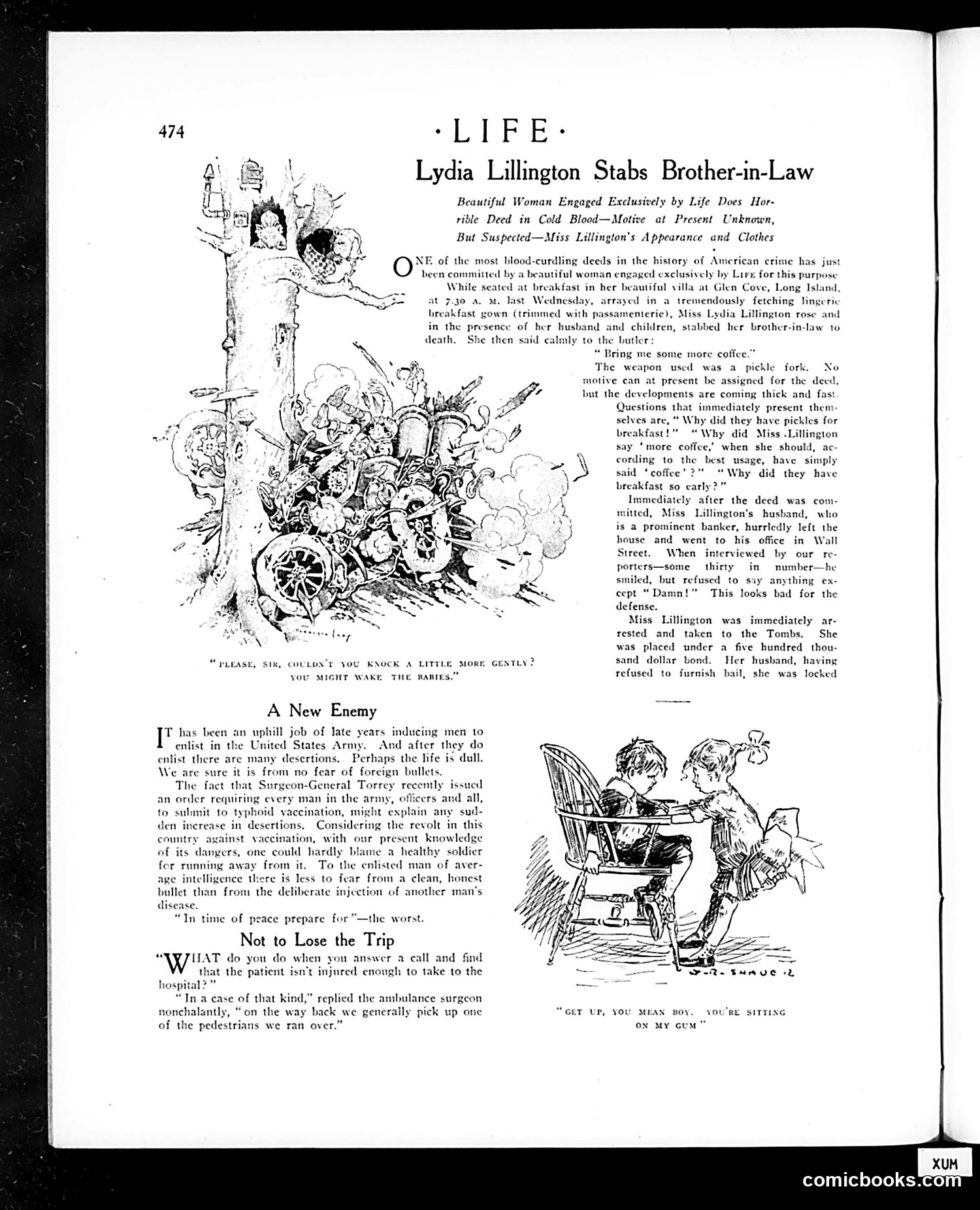
This page contains three separate satirical pieces mocking American social institutions: **"Lydia Lillington Stabs Brother-in-Law"** is Life's fictional crime story—a humorous "scoop" fabricated to parody sensational crime reporting. The joke is that Life itself "engaged exclusively" the beautiful Miss Lillington to commit murder for publicity. The satire mocks breathless newspaper coverage that obsesses over trivial details (why a pickle fork? why say "more coffee"?) while ignoring actual motives, and the absurdity of a wealthy banker refusing bail. **"A New Enemy"** criticizes mandatory typhoid vaccination in the U.S. Army, suggesting soldiers fear the shot more than bullets. It parodies anti-vaccination sentiment by claiming the injection is worse than honest combat. **"Not to Lose the Trip"** is a dark joke about ambulance drivers: when called to an injury that doesn't warrant hospitalization, they deliberately hit pedestrians on the return trip to justify the ambulance ride. All three pieces use exaggeration and absurdism to satirize institutional incompetence, sensationalism, and public irrationality.
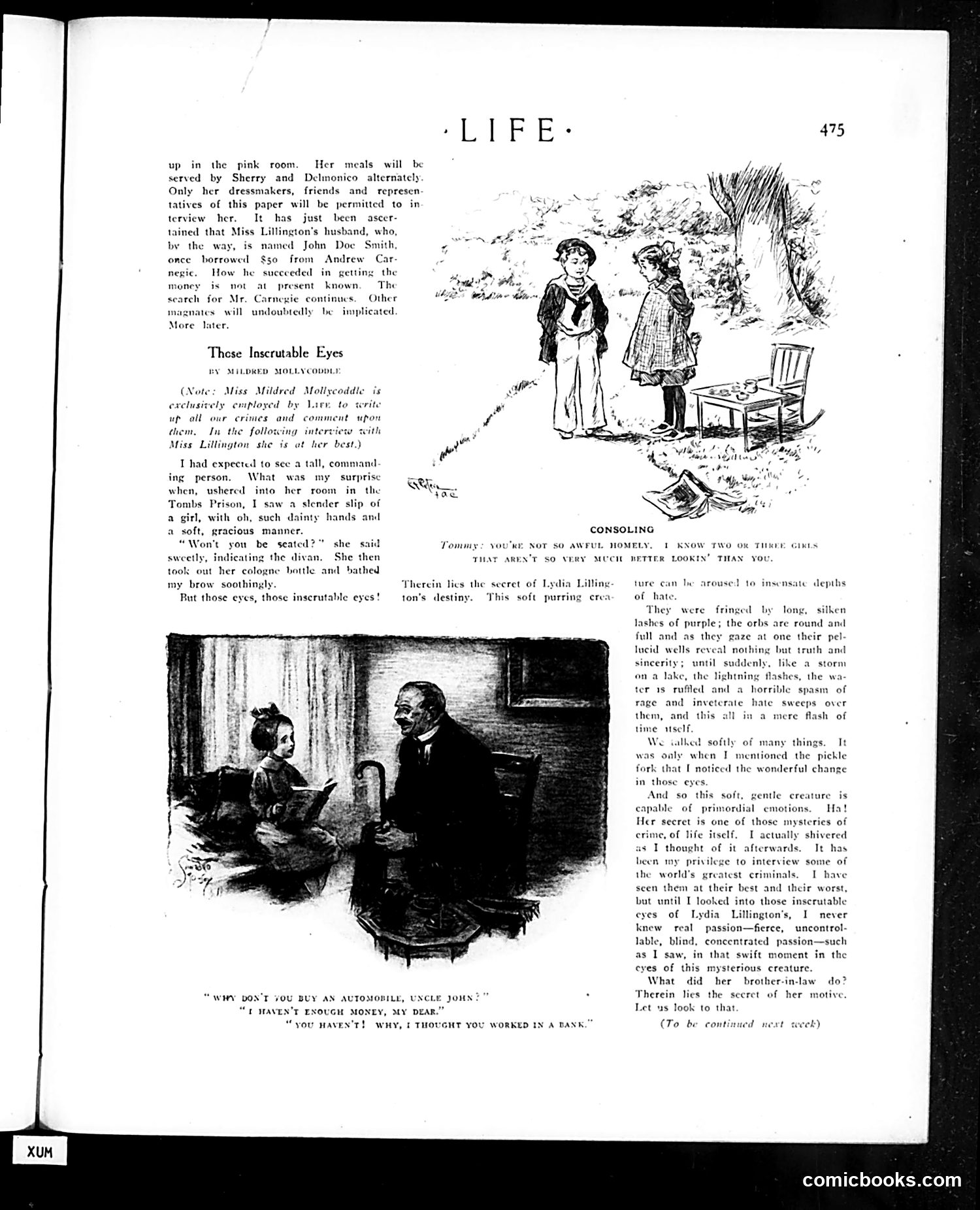
This page satirizes the sensational media coverage of a high-society crime. The article follows "Miss Lillington," apparently imprisoned in the Tombs (a notorious New York jail), who is being treated like a celebrity prisoner—served by fancy restaurants (Sherry and Delmonico), permitted only select visitors, and interviewed by society journalists. The satire targets: 1. **Yellow journalism**: The breathless, overwrought tone of the interview ("Those Inscrutable Eyes") mocks how newspapers sensationalize criminals, especially wealthy or attractive ones. 2. **Class hypocrisy**: The mention that her husband "borrowed $30 from Andrew Carnegie" (America's richest man) and the search continuing for Carnegie suggests satirizing how the wealthy escape consequences while the poor face prosecution. 3. **The cartoon caption** about the automobile reflects consumerism and financial pretense—claiming bank work while unable to afford luxuries. The overall point: American media and society were obsessed with glamorizing crime when the accused had social standing, creating a spectacle rather than pursuing justice.
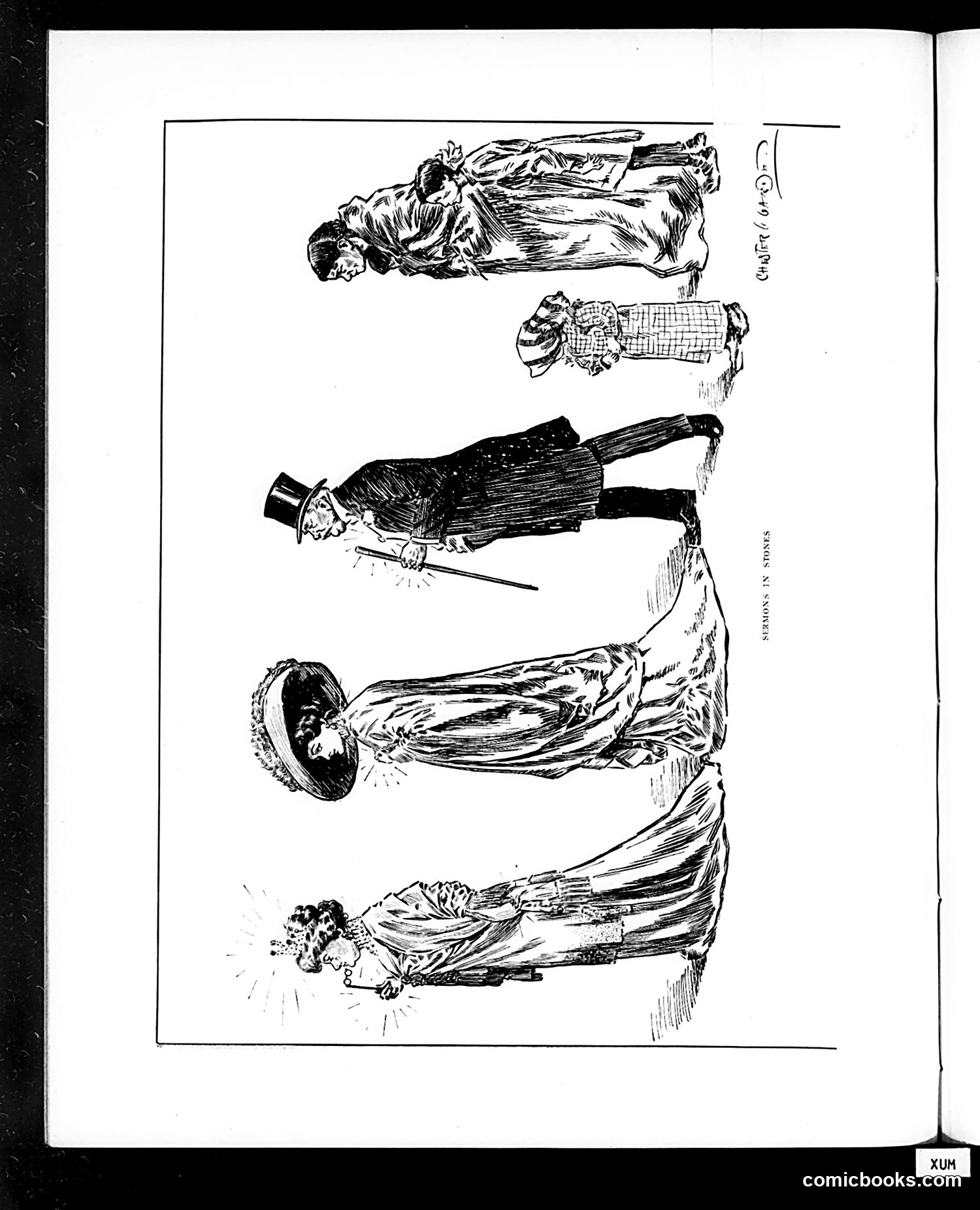
I can see this page contains five figure sketches arranged vertically, drawn in a classical ink-sketch style. The figures appear to be in various poses and period costumes, suggesting they might be character studies or costume designs rather than political satire. However, the OCR text is too corrupted to read clearly ("com comicbooks. C8 Gey9 7 ba) SANOLS NES"), making it impossible to determine the specific context, subject matter, or satirical intent. Without legible text identifying these figures or explaining the page's purpose, I cannot reliably explain what social or political commentary, if any, these sketches represent to a modern reader. The artistic quality suggests this is likely illustrative content from *Life* magazine, but the specific meaning remains unclear.
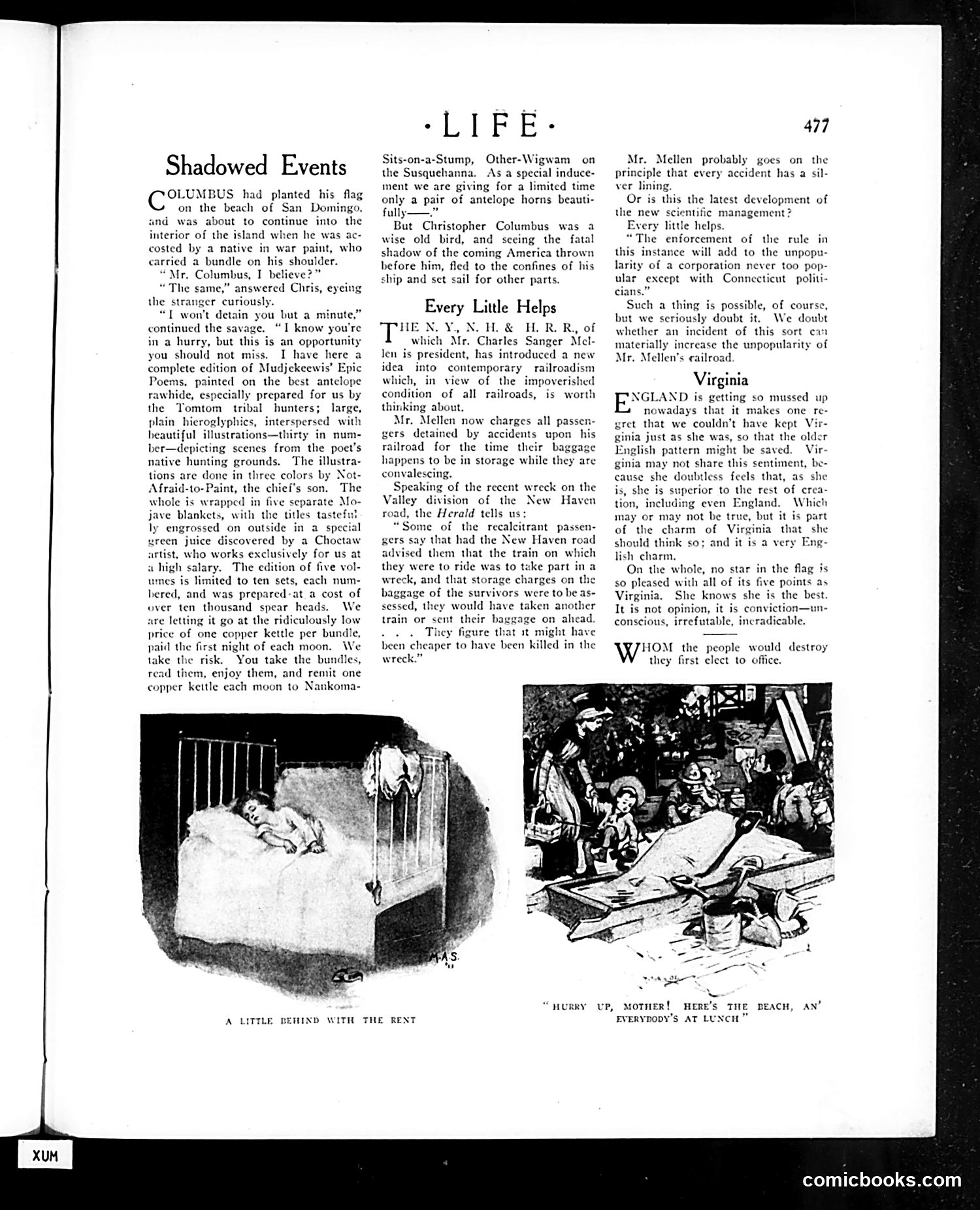
This page contains two satirical pieces mocking American business practices circa early 1900s. **"Shadowed Events"** uses Columbus meeting a Native American salesman as an anachronistic joke. The native pitches "Mudjcekeewis' Epic Poems"—an absurd fabrication of indigenous "high culture"—in commercial language, foreshadowing how America will exploit and commercialize everything, including Native American heritage. Columbus flees, recognizing the "fatal shadow of the coming America." **"Every Little Helps"** directly attacks Charles Sanger Mellen, president of the New York, New Haven & Hartford Railroad. The satire reports that Mellen now charges stranded accident victims storage fees for their baggage during recovery. The Herald quote sardonically suggests passengers might prefer death to such charges. The piece mocks Mellen's cost-cutting as both absurd and typical of corporate greed indifferent to human suffering. Both pieces critique American capitalism's relentless commercialization and railroads' notorious unpopularity with the public.
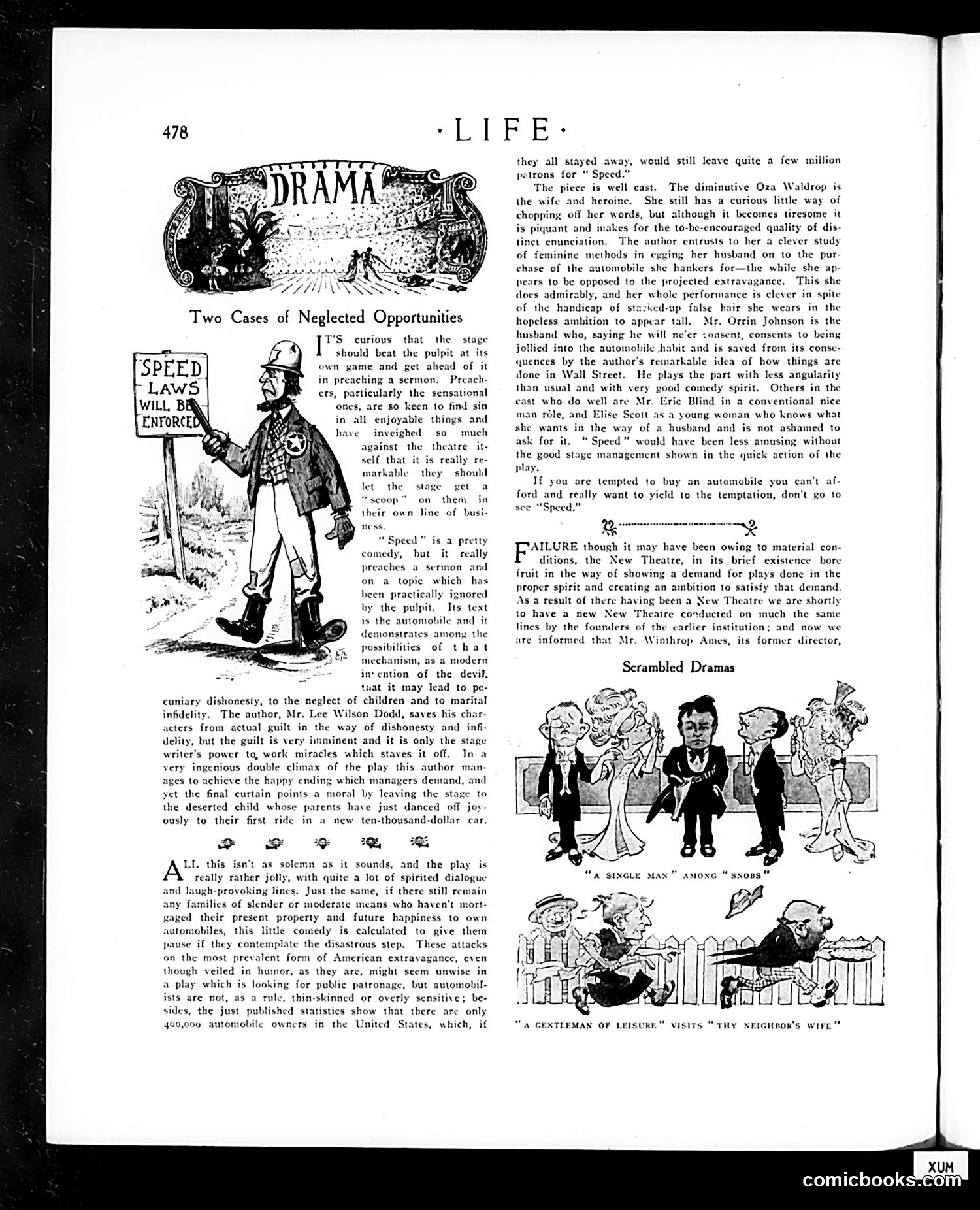
This page reviews the play *"Speed"* by Lee Wilson Dodd, using it to satirize modern consumer excess. The cartoon's central joke: automobiles represent moral danger—specifically tempting people toward dishonesty, infidelity, and financial ruin. The reviewer notes the irony that a *theater* (traditionally condemned by preachers as sinful) is preaching morality better than actual churches, warning audiences against automobiles' seductive appeal. The play's moral point: parents abandon their neglected child to joyride in a new luxury car, illustrating how this "modern invention of the devil" corrupts values. The critic praises the cast, particularly actress Oza Waldrop's clever portrayal of a wife manipulating her reluctant husband into the purchase. The satire targets early-1900s automobile mania among the wealthy—only 400,000 owners existed then—as frivolous extravagance that threatens family stability.
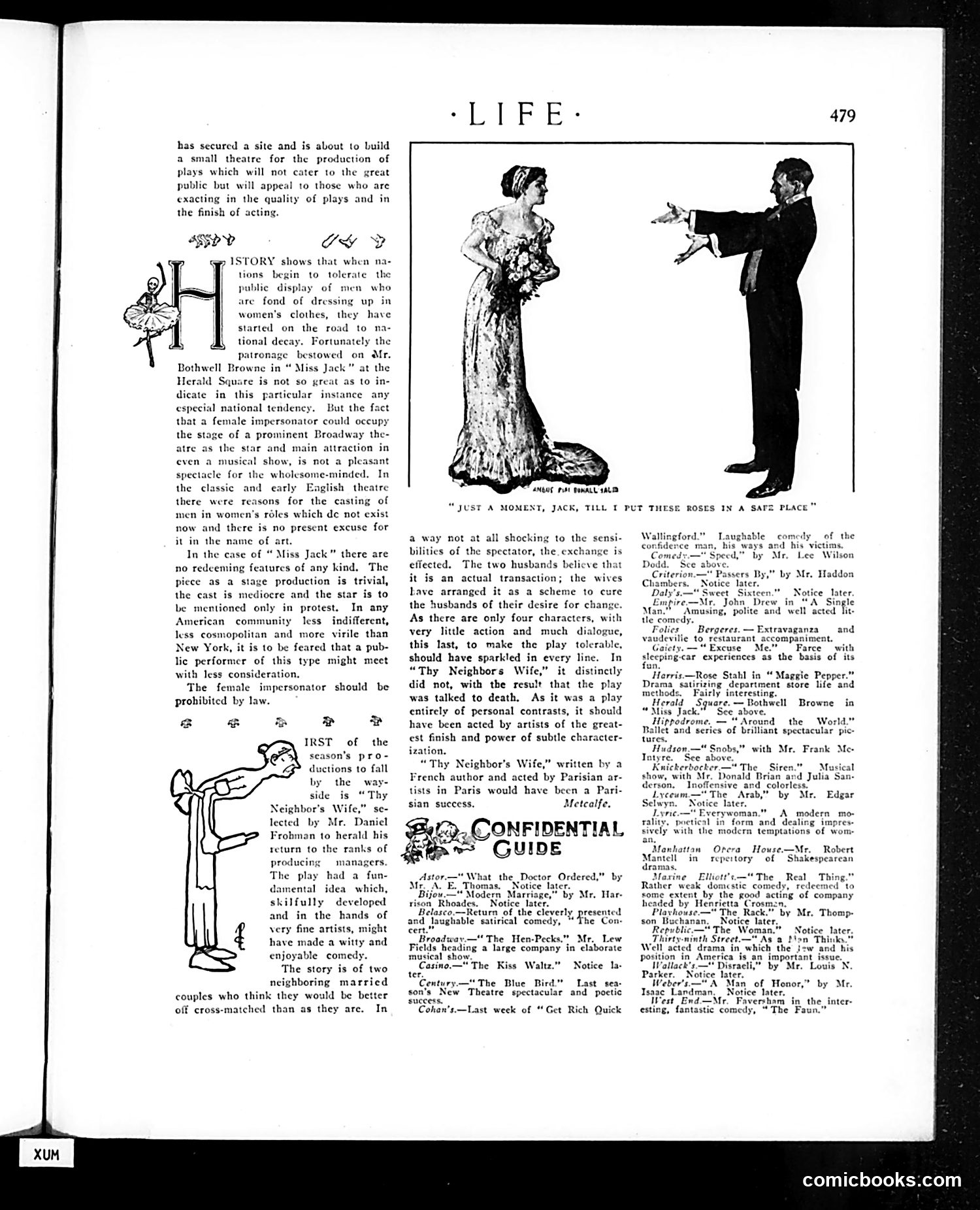
This page contains theatrical criticism and a satirical illustration attacking female impersonation in Broadway performance. The main cartoon shows a man in formal dress gesturing disapprovingly at a woman in an elegant gown, with the caption "Just a moment, Jack, till I put these roses in a safe place." The accompanying text condemns Mr. Bothwell Browne's performance in the musical "Miss Jack," where a male actor played a female lead role. The critic argues this represents moral decay, claiming such cross-dressing performances—even when performed by "artists of the greatest finish"—lack artistic justification in modern theater (unlike classical drama's practical reasons for male actors in women's roles). The author advocates legal prohibition of female impersonators. This reflects early-20th-century anxieties about gender presentation and morality, viewing the practice as degenerate rather than artistic. The rest of the page contains brief theatrical notices for various Broadway productions.
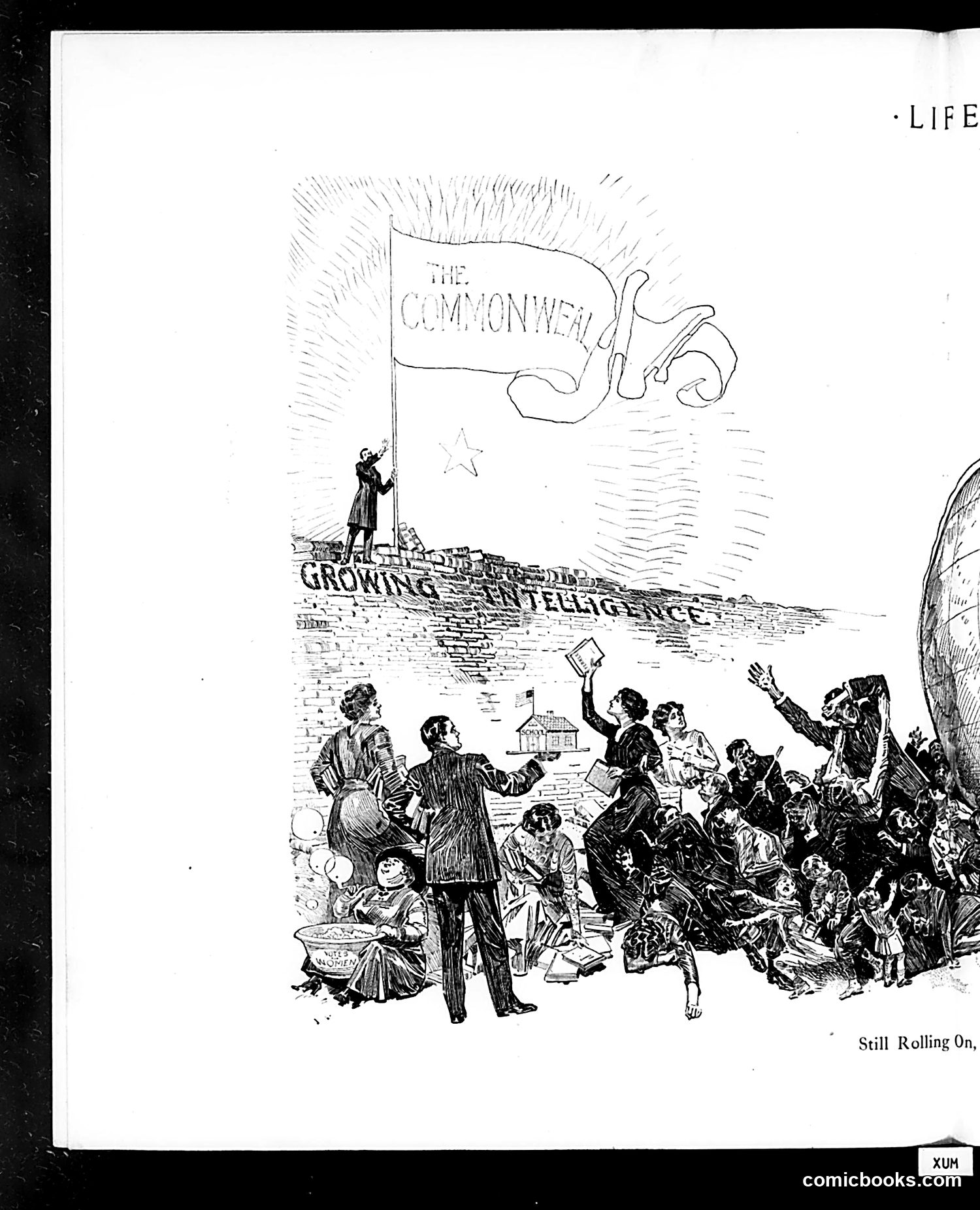
This political cartoon depicts "The Commonwealth" as a large banner or flag being carried forward by a lone figure standing atop a hill labeled "Growing Intelligence." Below, a diverse crowd of people—men, women, and children—gesture enthusiastically, apparently following or supporting this movement. The satire appears to celebrate progress through public education and intellectual development. The "Commonwealth" likely references a democratic or collective ideal, while the "Growing Intelligence" suggests that an informed populace drives national advancement. The crowd's varied composition emphasizes broad democratic participation. The caption "Still Rolling On" suggests unstoppable momentum. This appears to be optimistic propaganda for education-based social progress, though without a specific date or publication context, the precise historical moment remains unclear.
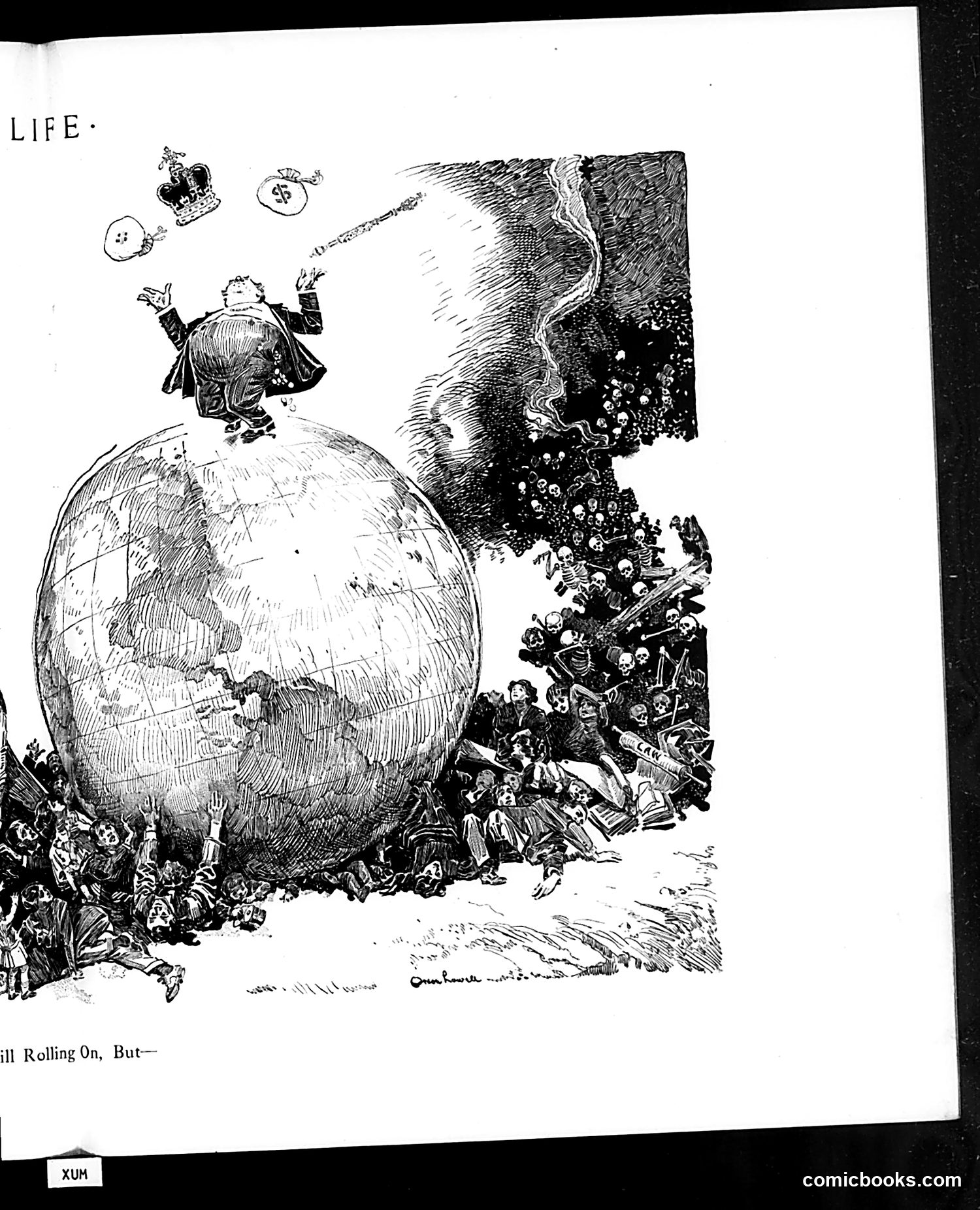
This is a political cartoon from *Life* magazine titled "Still Rolling On, But—" The image depicts a large globe being pushed by masses of humanity at its base, while a figure stands triumphantly atop it, juggling what appear to be symbols of wealth or power (a crown, money bags, and other objects). The cartoon satirizes **unchecked capitalism and inequality**: despite civilization's apparent progress ("still rolling on"), the system enriches a privileged few at the top while the multitudes below bear the burden of supporting this structure. The juggling figure represents the wealthy or powerful maintaining their advantage through the labor of common people below. The satire critiques how economic systems continue despite their fundamental injustice—suggesting progress is illusory when wealth and power remain so concentrated.
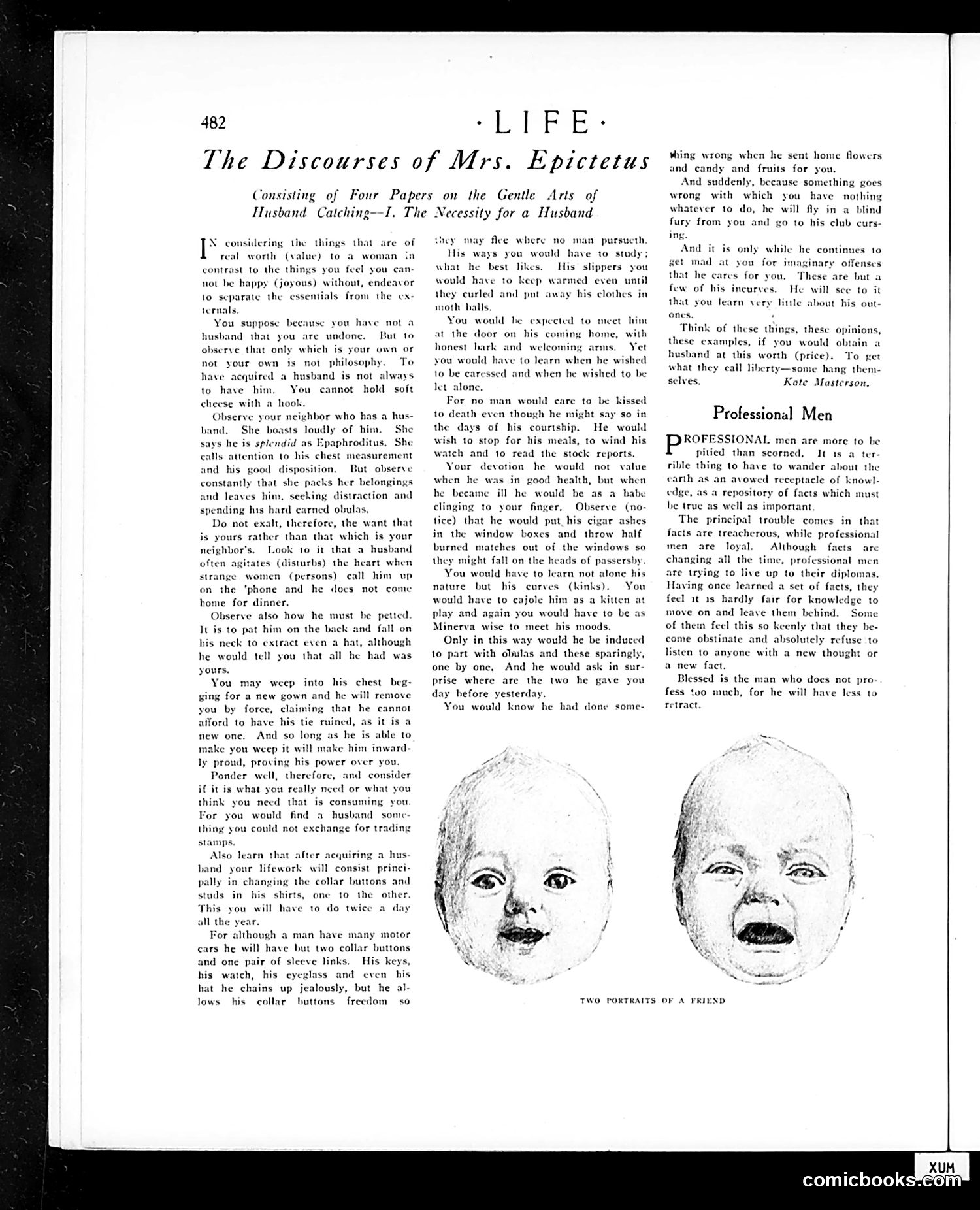
This page presents a mock-philosophical text parodying Epictetus, the ancient Stoic philosopher, but applied to marriage advice for women. The satire targets the reality of married life versus romantic courtship ideals. The piece humorously catalogs a husband's controlling behaviors and domestic frustrations: he jealously guards his possessions while expecting a wife's complete devotion; he neglects her emotionally when healthy but demands care when ill; he refuses to provide money for necessities while secretly proving his power through her emotional distress; he leaves cigar ash and matches everywhere; and he constantly loses track of money he's given her. The accompanying illustration—"Two Portraits of a Friend"—shows two baby faces (one happy, one crying), likely representing a husband's emotional volatility or dual nature. The satire's point: marriage requires a woman to manage an emotionally erratic, financially controlling man while performing endless domestic labor—a sharp critique of women's constrained marital roles in early 20th-century society.
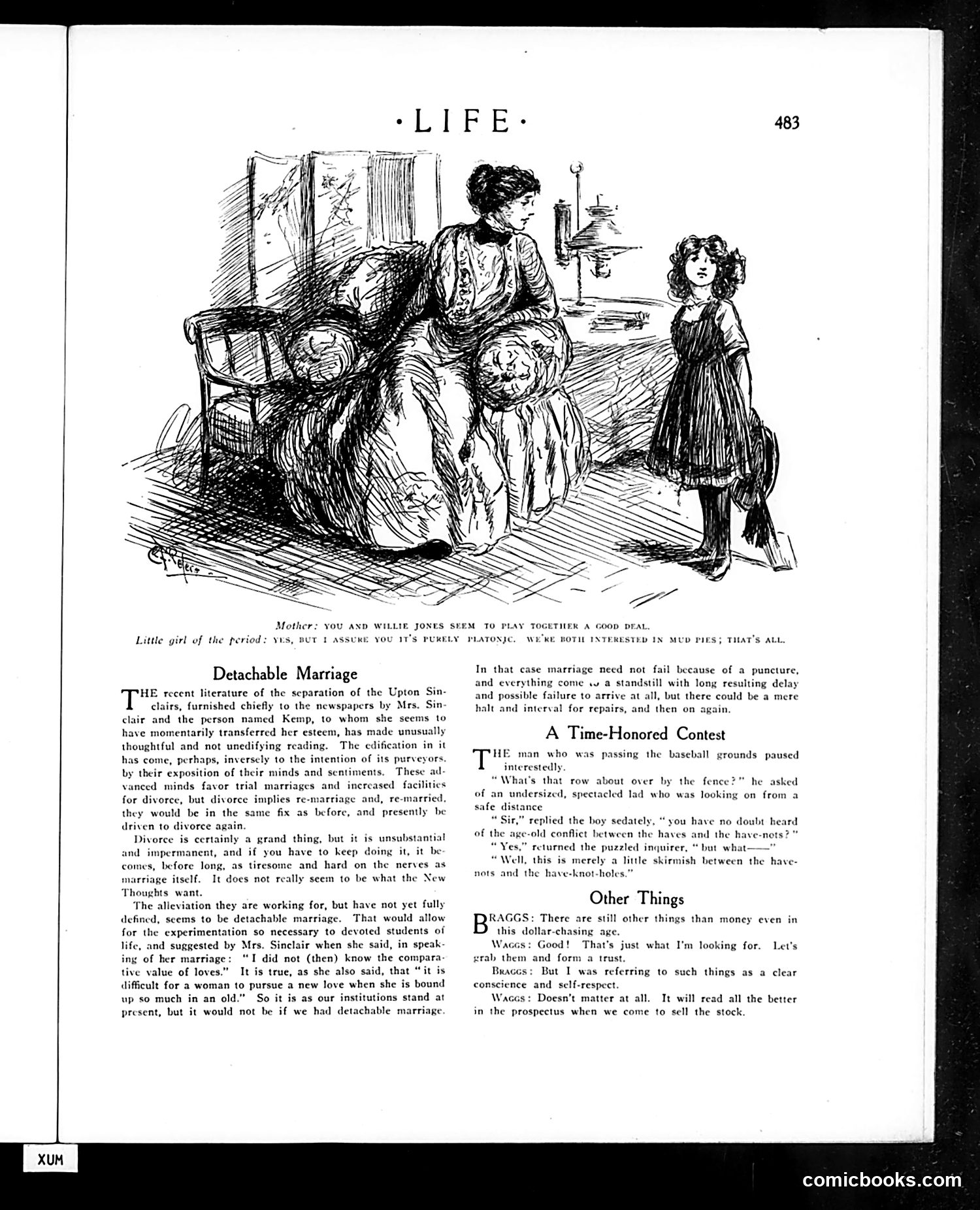
This page contains three satirical pieces typical of early 20th-century American humor: **"Detachable Marriage"** critiques the Upton Sinclair divorce case (recently in newspapers). The article mocks "advanced minds" advocating trial marriages and easy divorce as impractical solutions. It sarcastically proposes "detachable marriage"—marriages that could be temporarily suspended for "repairs" like a broken automobile—ridiculing the logical absurdity of their position. **The cartoon** shows a mother and children discussing "Willie Jones," with the girl calling their relationship "purely platonic," satirizing how even children adopt trendy adult concepts without understanding them. **"A Time-Honored Contest"** jokes about class conflict: a boy explains a "row" between "haves and have-nots" is actually just kids fighting over access to holes in the fence to watch baseball—reducing grand social struggle to petty playground disputes. **"Other Things"** presents a con-artist dialogue where characters exploit idealistic language ("conscience," "self-respect") as marketing for dubious stock schemes. All pieces mock contemporary progressive ideas and social pretension.
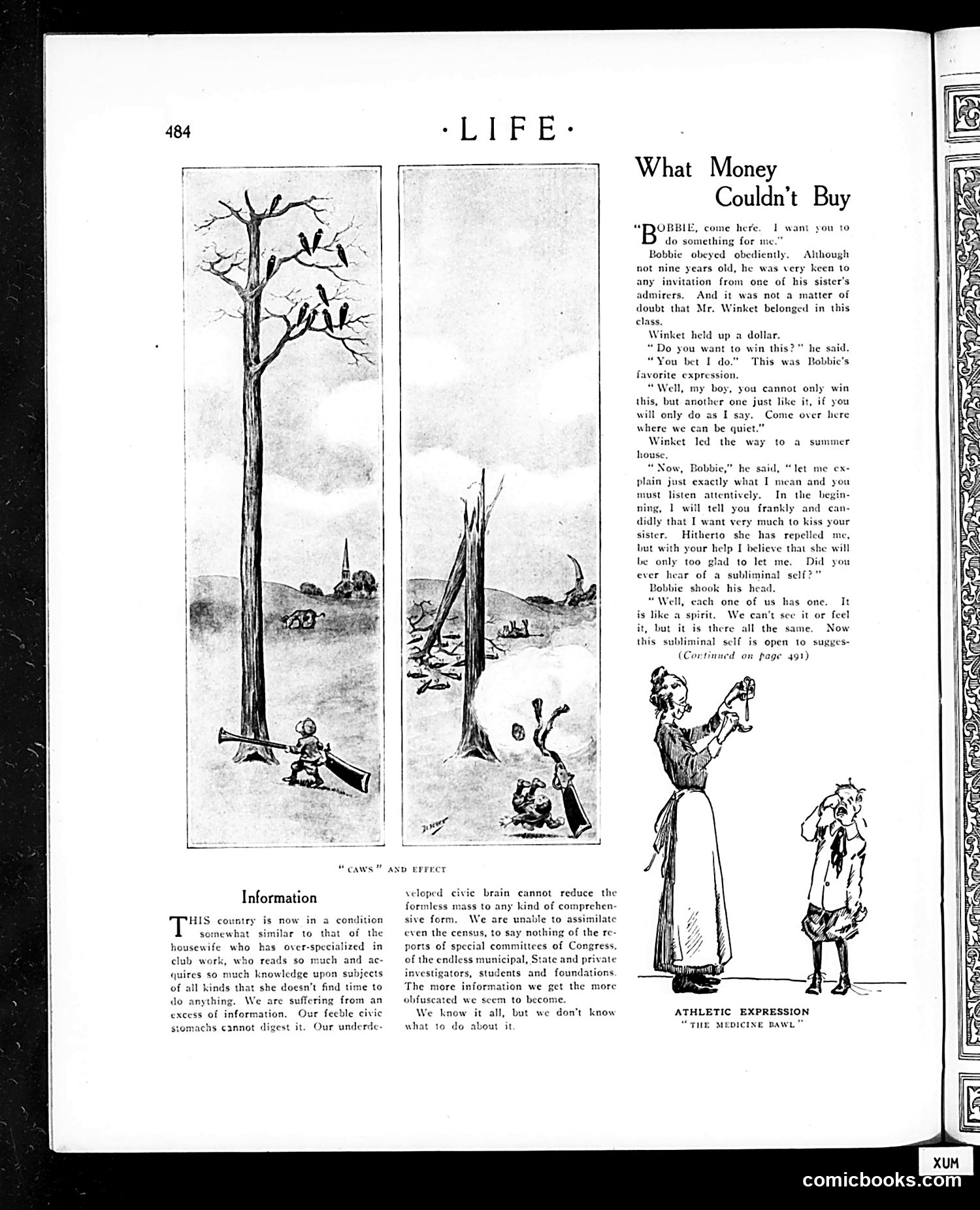
This page contains two distinct pieces: **"Information" (left):** A commentary on information overload. The text criticizes how modern citizens—particularly club women—consume excessive specialized knowledge without time to act on it. The "cause and effect" illustration shows bare trees with birds, likely depicting the uselessness of accumulated but undigested information. The satire suggests civic engagement has become paralyzed by data. **"What Money Couldn't Buy" (right):** A story beginning where a man (Winket) attempts to manipulate a young boy (Bobbie) into helping seduce Bobbie's older sister by exploiting the pseudo-scientific concept of the "subliminal self"—a then-popular psychological notion. The satire mocks both the charlatanism of amateur psychology and the brazen attempts to corrupt youth for seduction. The illustration "The Medicine Bawl" appears to relate to athletic or social expression themes. Both pieces critique early 20th-century American society's susceptibility to information glut and pseudo-intellectual manipulation.
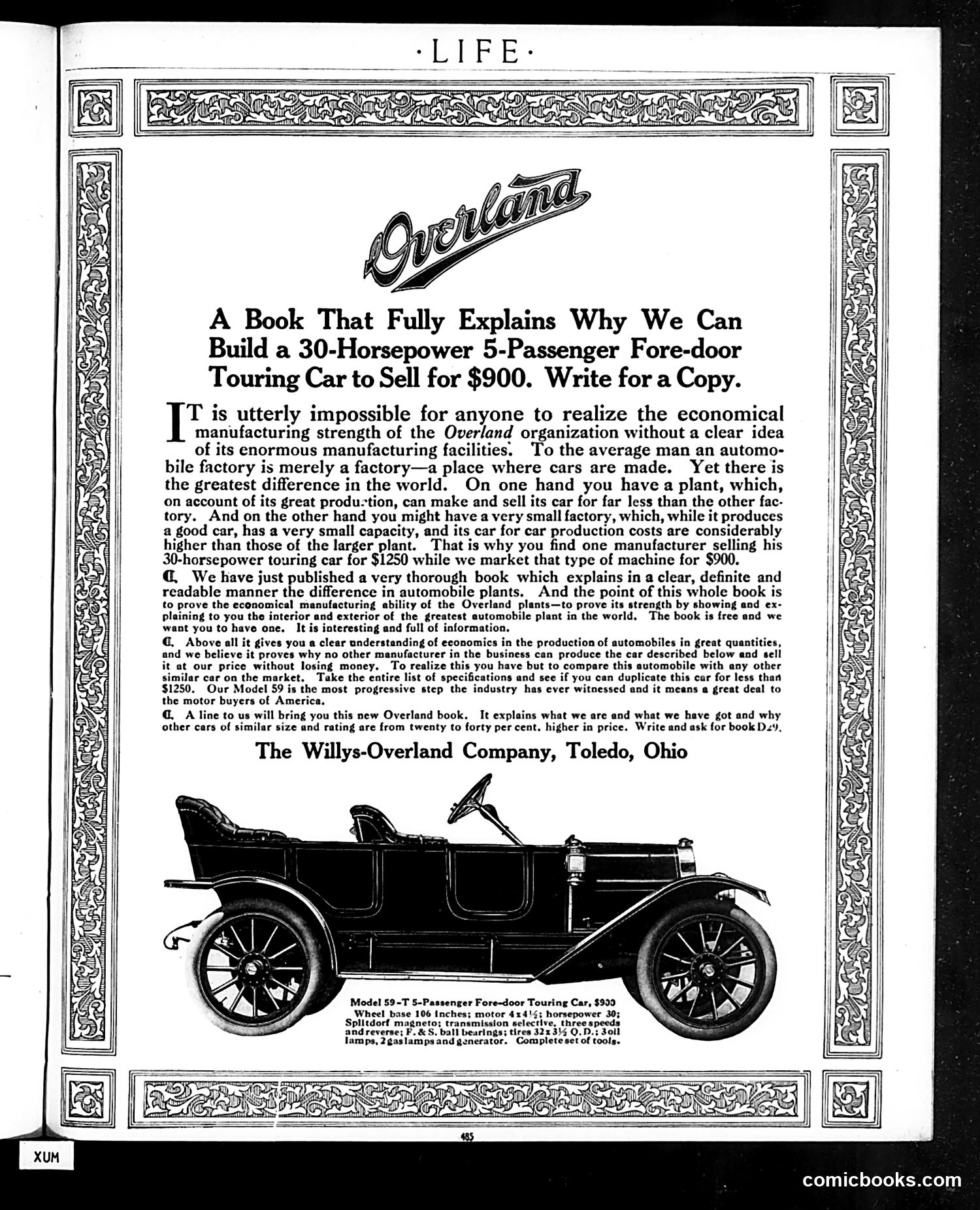
This is **not a cartoon or satire**—it's a straightforward automobile advertisement masquerading as editorial content in *Life* magazine. The Willys-Overland Company advertises their Model 59 touring car, priced at $900, emphasizing manufacturing efficiency as the reason for undercutting competitors charging $1,250 for similar vehicles. The ad's central claim: their large-scale production facilities enable lower costs than smaller manufacturers. The "book" referenced is promotional literature explaining Overland's manufacturing advantages. The advertisement repeatedly stresses economies of scale—a genuine business principle—to justify the price difference. **For modern readers**: This represents early 20th-century automotive competition and *Life*'s willingness to publish paid advertisements alongside editorial content, a common practice then. The detailed technical specifications (horsepower, wheel base, magneto type) appeal to an era when car features weren't yet standardized and buyers scrutinized mechanical details. No political satire or caricature appears here—merely commercial persuasion framed as informational content.
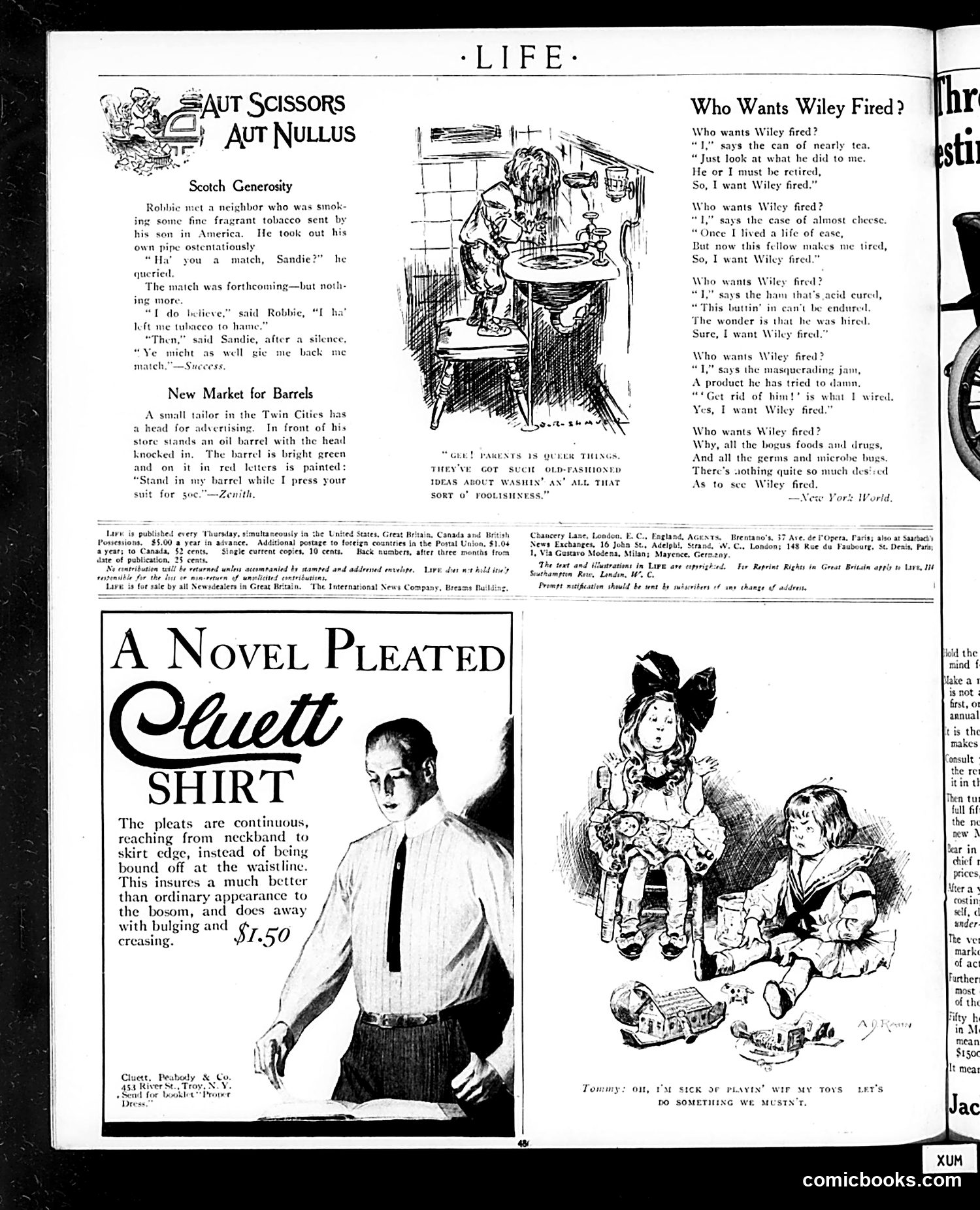
This page contains several satirical pieces reflecting early 20th-century American life: **"Who Wants Wiley Fired?"** is a poem satirizing Harvey W. Wiley, the U.S. Food and Drug Administration's chief chemist. Various processed foods (tea, cheese, ham, jam) personified as "characters" complain about Wiley's consumer protection efforts and food purity regulations. The satire mocks how food manufacturers opposed Wiley's inspection and safety standards, portraying them as self-interested rather than concerned with public health. This reflects real Progressive Era tensions over food safety regulation. **"Scotch Generosity"** is a brief humorous anecdote about Scottish frugality—a man borrows another's tobacco without reciprocating. **"New Market for Barrels"** describes a tailor's advertising gimmick using a painted barrel. The **Cluett shirt advertisement** promotes a pleated shirt design. The bottom cartoon shows children misbehaving, with minimal contextual information visible on this page.
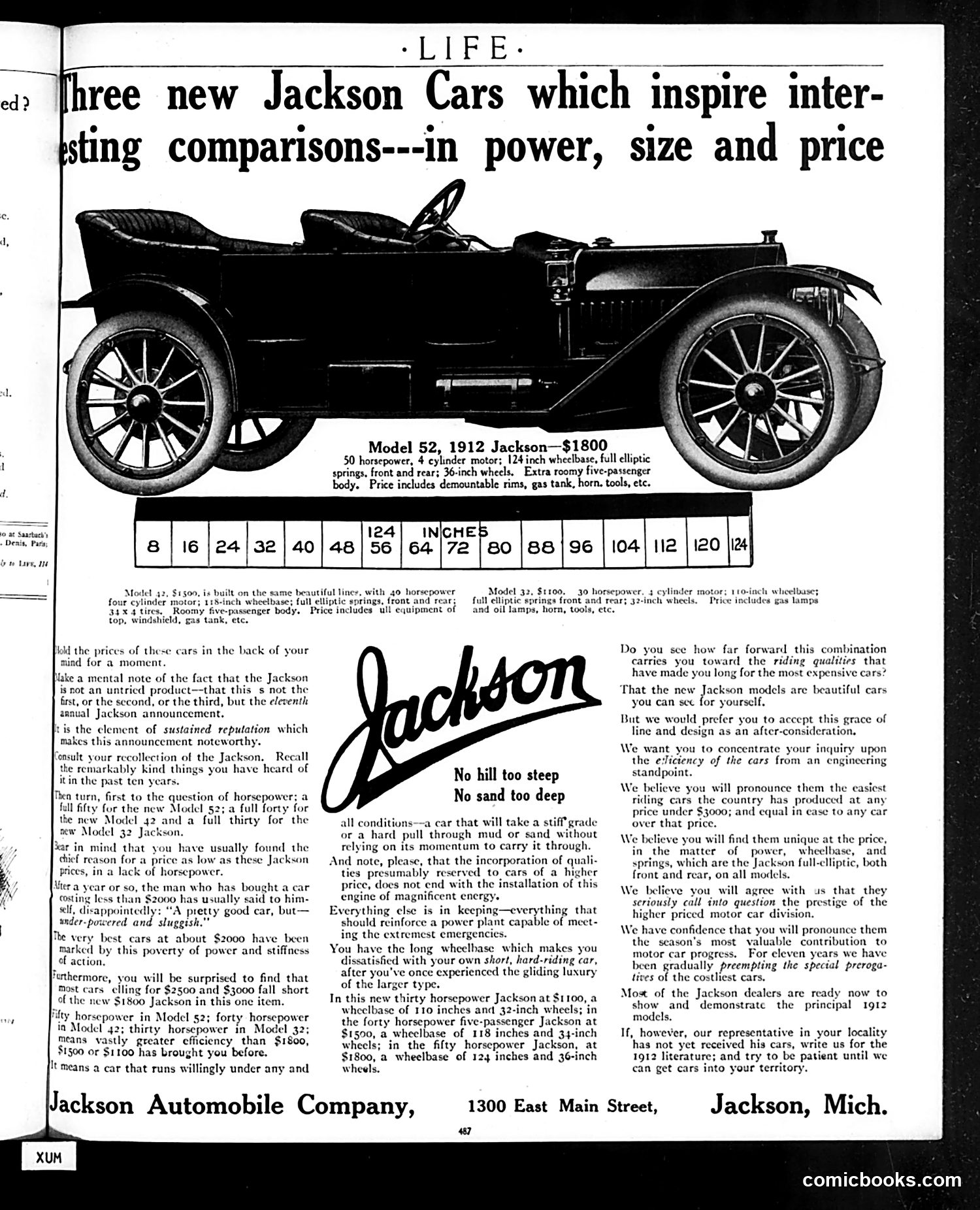
This is **not a cartoon or satire** — it's a straightforward automobile advertisement from *Life* magazine, circa 1912. The Jackson Automobile Company showcases three new car models (priced $1100–$1800) with technical specifications compared via scale diagrams. The advertisement emphasizes that Jackson offers exceptional **power and performance at lower prices** than competitors. The key pitch: Jackson cars feature 30–50 horsepower across three models — competitive with cars costing $2500–$3000. The slogan "No hill too steep / No sand too deep" promises reliability on poor roads (relevant for 1912 infrastructure). The text argues Jackson's sustained reputation (this is their "eleventh annual announcement") proves reliability, countering buyer skepticism about cheaper cars being underpowered or sluggish. This represents early automotive marketing emphasizing engineering specifications and value — selling the practical virtues of American car manufacturing to middle-class buyers.
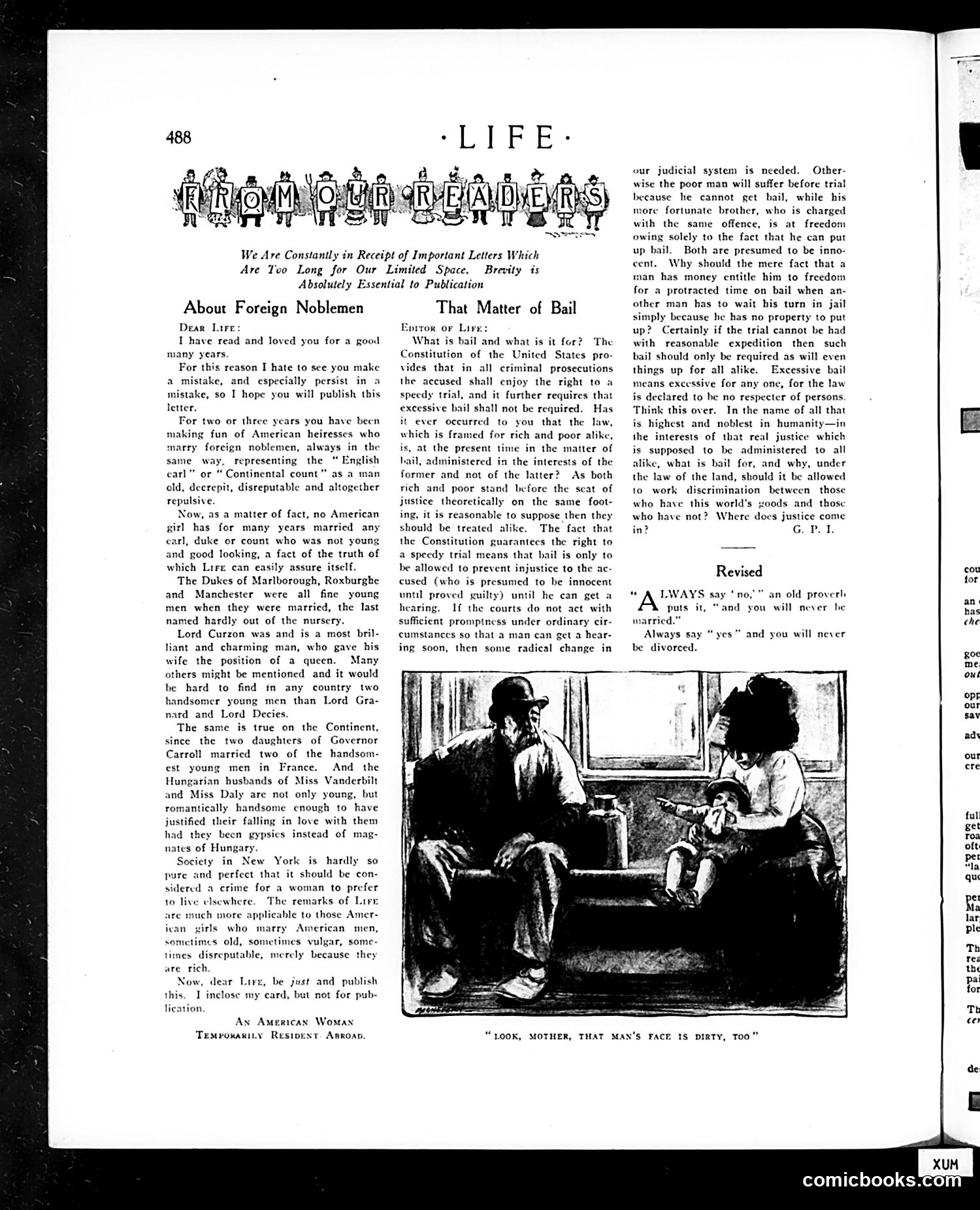
This page contains two reader letters debating social issues of the era. **"About Foreign Noblemen"** defends American heiresses marrying European aristocrats. The letter-writer corrects Life's satire, arguing the magazine has unfairly portrayed foreign nobles as "old, decrepit, disreputable" when, in fact, recent marriages involved "handsome" young men—naming Lord Curzon, the Dukes of Marlborough and Manchester, and Hungarian nobles who married Vanderbilt and Daly daughters. The writer argues Life should instead criticize American women marrying wealthy American men "sometimes old, sometimes vulgar, sometimes disreputable, merely because they are rich." **"That Matter of Bail"** raises class-based criminal justice concerns: wealthy defendants can afford bail and remain free awaiting trial, while poor defendants languish in jail. The letter argues this violates the constitutional principle that rich and poor should be treated equally before the law. The cartoon shows a woman with a dirty-faced man, captioned "Look, Mother, that man's face is dirty, too"—likely satirizing hypocrisy or double standards.
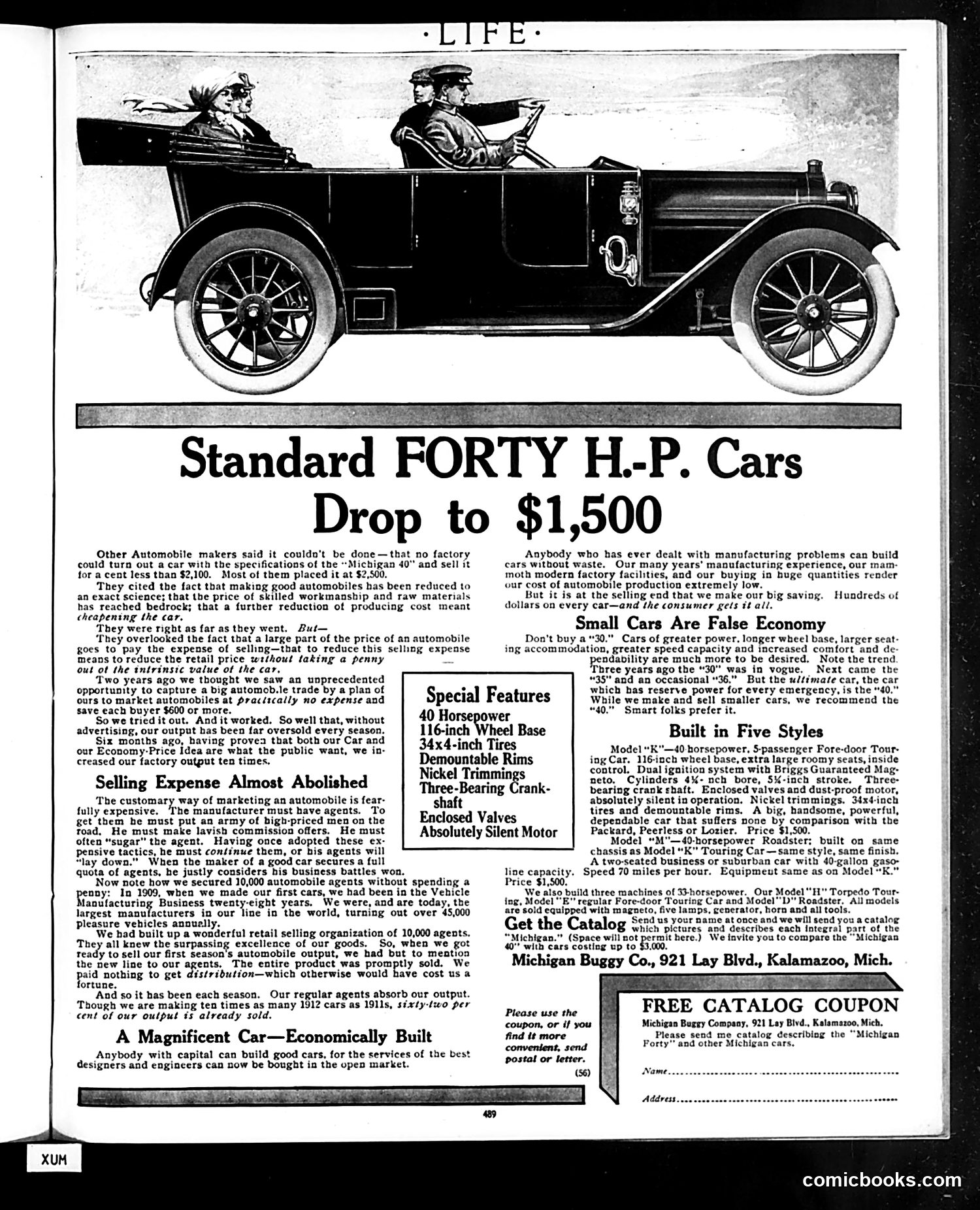
This is primarily a **car advertisement**, not a political cartoon. The image shows a early 1910s automobile with two men in it, illustrating the Michigan Buggy Company's "Standard Forty" vehicle being sold for $1,500. **The "Satire" (if any):** The ad sarcastically challenges competitors who claimed such an affordable, quality car was impossible. The company argues they achieved the low price not through inferior materials but by **eliminating expensive sales intermediaries**—they sold directly through their existing network of 10,000 retail agents from their buggy business, avoiding costly commission structures. **Key context for modern readers:** This represents early automotive manufacturing strategy during the pre-Model T era (pre-1908). The "economy car" market was emerging. The company's argument—that manufacturing costs were fixed but **sales expenses were the real price driver**—reflects genuine business strategy of that period, before mass production became standard. The ad contains no political reference, just commercial self-promotion typical of Life magazine's advertising section.
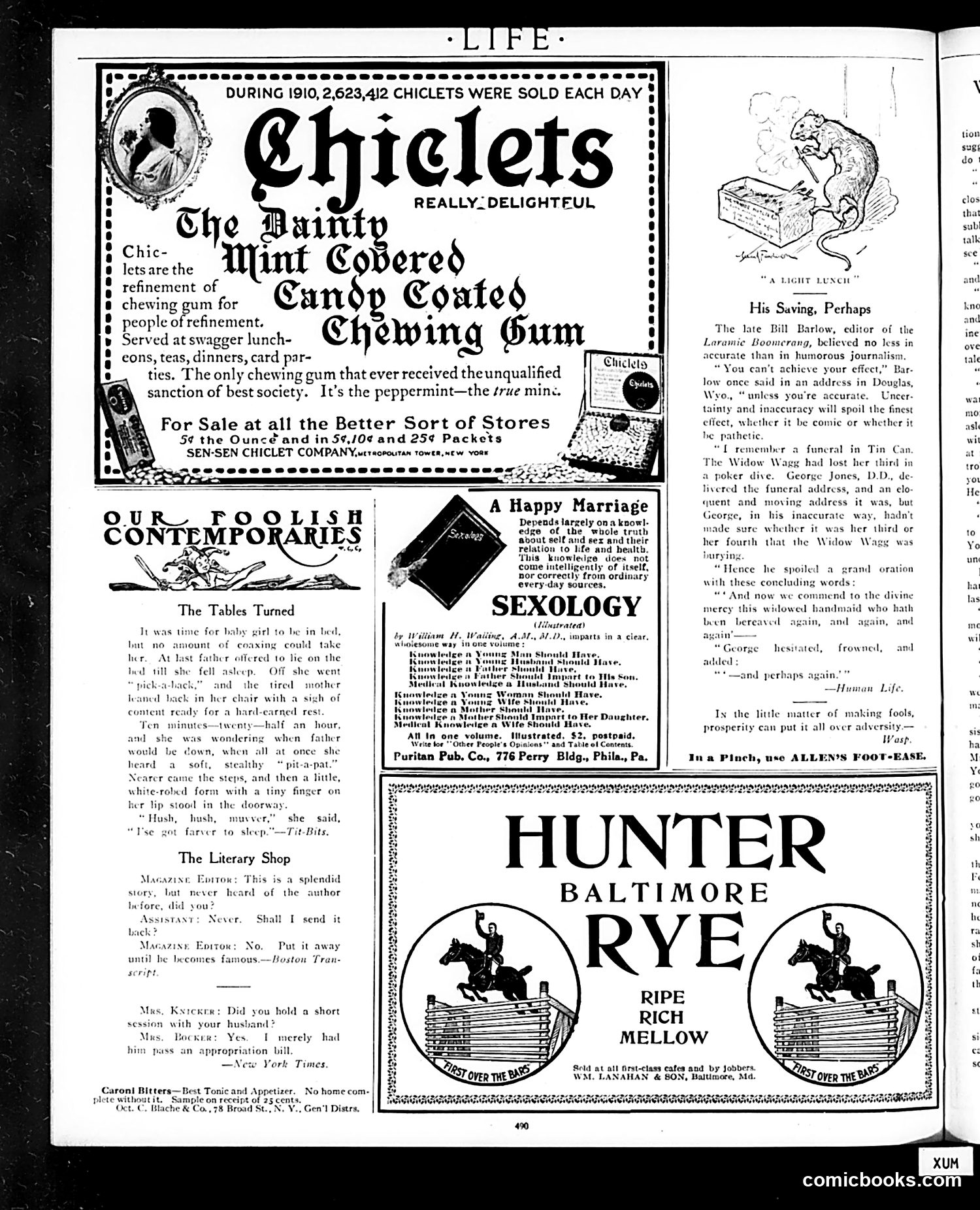
This page is primarily **advertising with brief humorous filler content**, typical of 1910s magazines. **Main Advertisement:** Chiclets chewing gum dominates the top, claiming 2.6 million sold daily in 1910. The copy positions Chiclets as refined, mint-flavored gum for "people of refinement"—appealing to early 20th-century class consciousness. **Humorous Sections:** Short, unrelated jokes fill the lower portion: - "The Tables Turned": A child pretends to comfort her sleeping father (role reversal humor) - "The Literary Shop": A editor refuses unpublished work until the author becomes famous (satire on publishing gatekeeping) - A brief Mrs. Knicker/Mrs. Bockee exchange about marital "sessions" (mild domestic humor) **Additional Ads:** A "Sexology" instructional book and Hunter Baltimore Rye whiskey advertise below. The page reflects 1910s magazine format: advertisements subsidized content, with light satirical humor providing entertainment between product pitches targeting middle and upper-class readers.
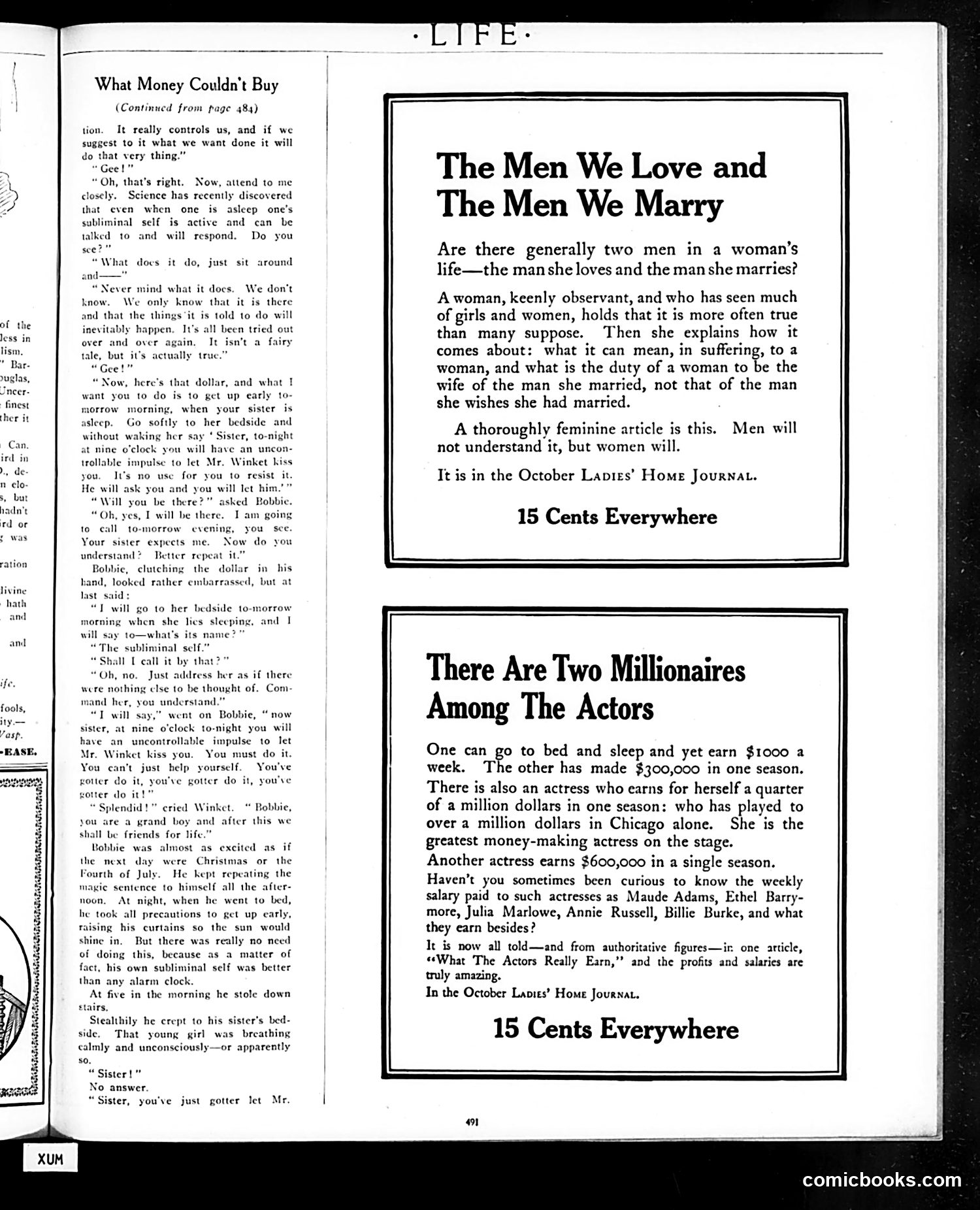
This page contains **advertisements and article previews** rather than political satire or cartoons. **Left column:** Concludes a serialized story titled "What Money Couldn't Buy," featuring a character named Winket attempting to manipulate a young woman through pseudoscientific psychology—specifically, by instructing a boy to suggest hypnotic commands to his sleeping sister. The narrative satirizes both romantic manipulation and pseudo-scientific "subliminal self" theories that were apparently circulating in the early 20th century. **Right column:** Two advertisement boxes promote articles from the **Ladies' Home Journal**: 1. "The Men We Love and The Men We Marry"—addressing the supposed common experience of women loving one man while marrying another 2. "There Are Two Millionaires Among The Actors"—highlighting wealthy stage performers and actresses' earning power Both ads cost 15 cents and target female readers interested in relationships and entertainment industry gossip.
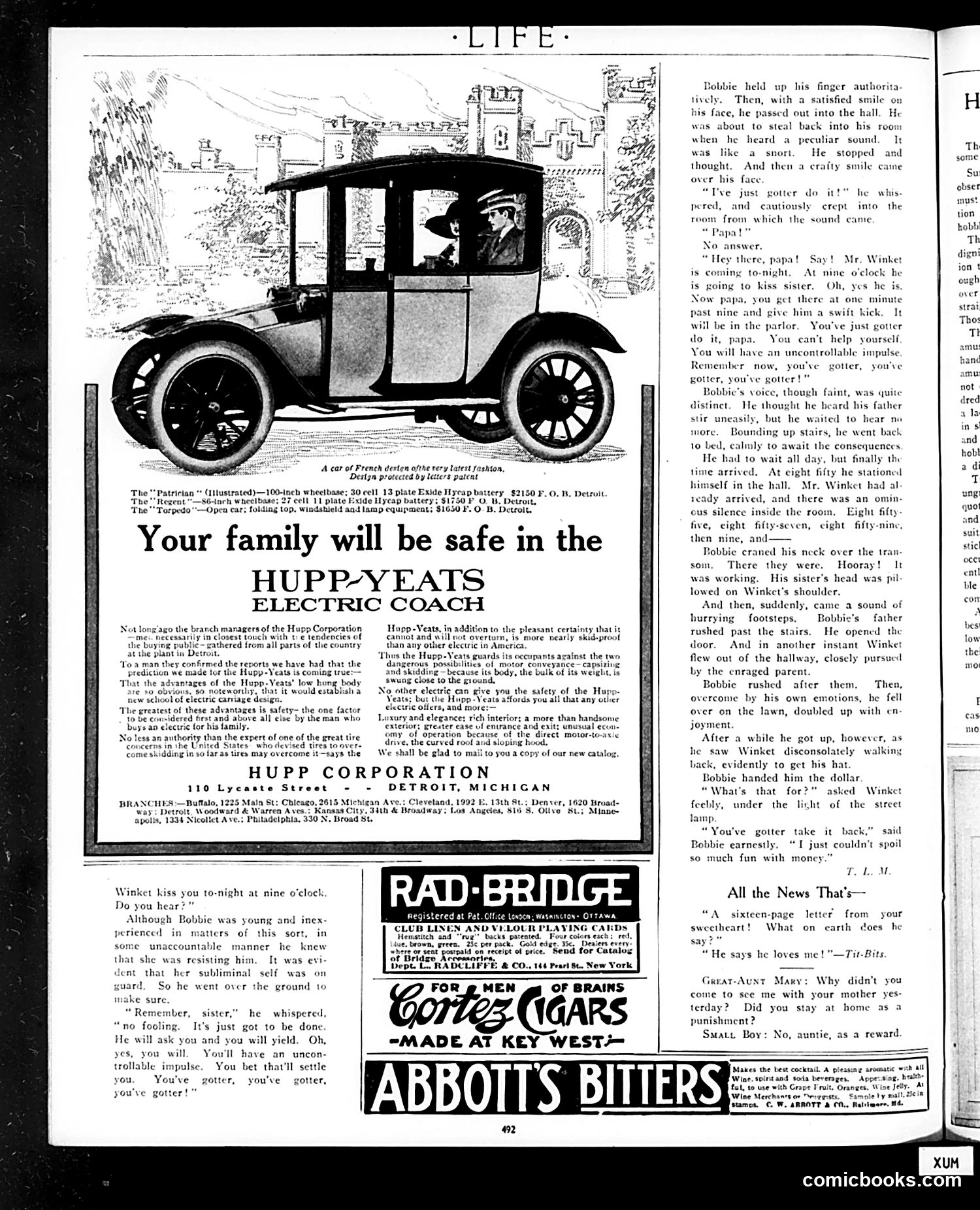
This page mixes a serialized comic story with period automobile advertising. The narrative (left side) depicts a humorous domestic scene: a boy named Bobbie tricks his father into physically attacking his sister's suitor, Mr. Winket, by hypnotic suggestion—a comedic premise relying on slapstick and the father's protective rage toward his daughter's romantic interests. The **Hupp-Yeats Electric Coach advertisement** (center) exemplifies early-1900s automotive marketing, emphasizing safety features—the vehicle's low center of gravity preventing capsizing—and stability. The car is marketed as suitable for families, particularly appealing to safety-conscious buyers. Period advertisements frequently highlighted technical specifications and family security as selling points. The lower advertisements (Rad-Bridge playing cards, Goofee Cigars, Abbott's Bitters) are typical commercial clutter of the era. Together, the page reflects Life magazine's dual purpose: satirical storytelling mixed with revenue-generating advertisements.
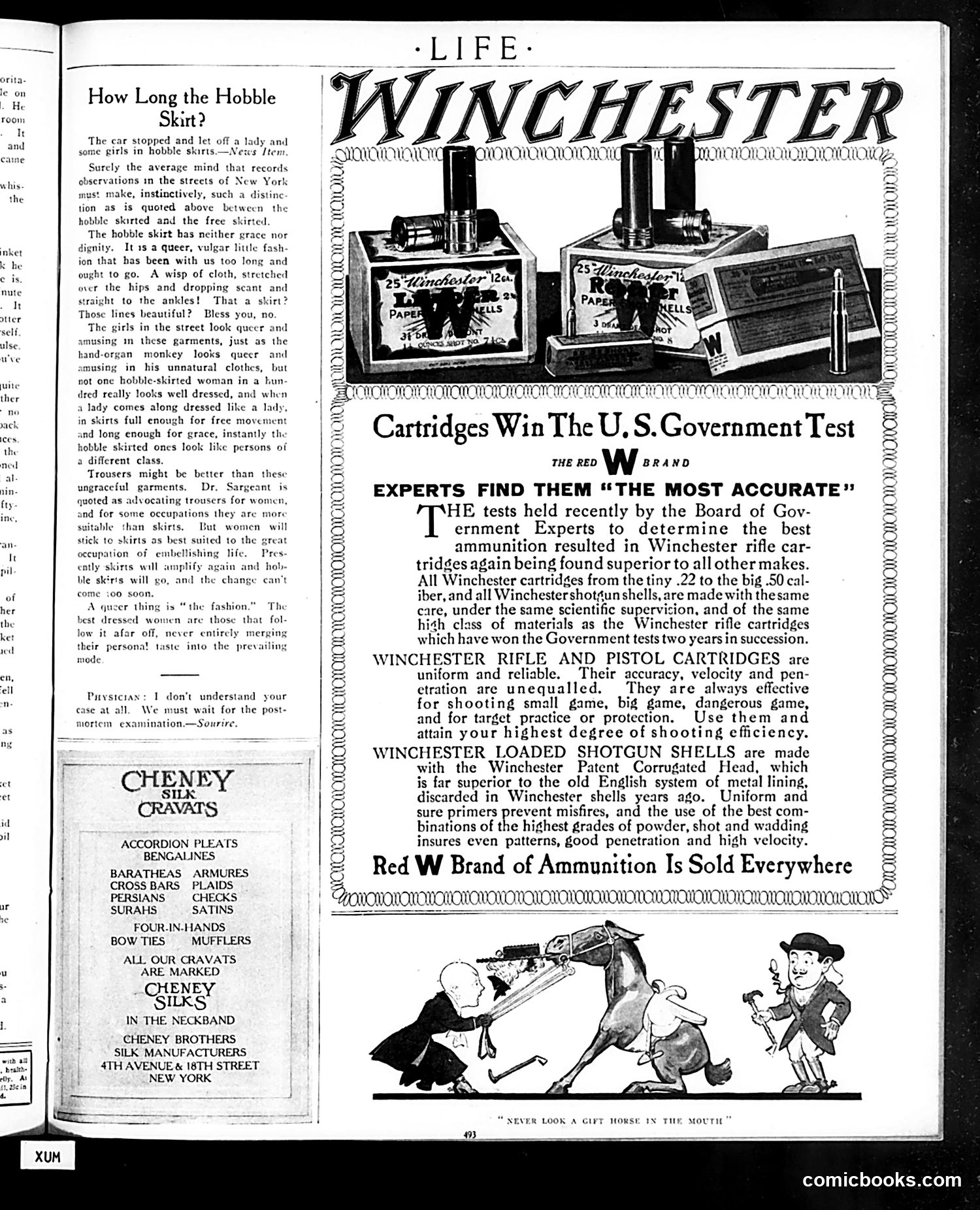
This page contains two distinct elements: social commentary and advertising. **Left side:** An editorial critique of the "hobble skirt," a fashionable but restrictive women's garment popular in the early 1900s. The writer argues it's ugly, impractical, and suggests trousers would be preferable. The accompanying cartoon (bottom) appears to show the absurdity of the garment—a woman in a hobble skirt struggling to walk naturally, contrasted with men moving freely. The caption "Never Look a Gift Horse in the Mouth" suggests accepting fashion regardless of practicality. **Right side:** A Winchester ammunition advertisement claiming government testing proved their cartridges "the most accurate." The ad emphasizes reliability and superiority over competitors. **Context for modern readers:** The hobble skirt restricted leg movement severely; critics saw it as impractical and socially limiting. The page juxtaposes fashion criticism with an ad promoting a product of male-dominated warfare/hunting—reflecting early 20th-century gender dynamics and commercial marketing strategies in *Life* magazine.
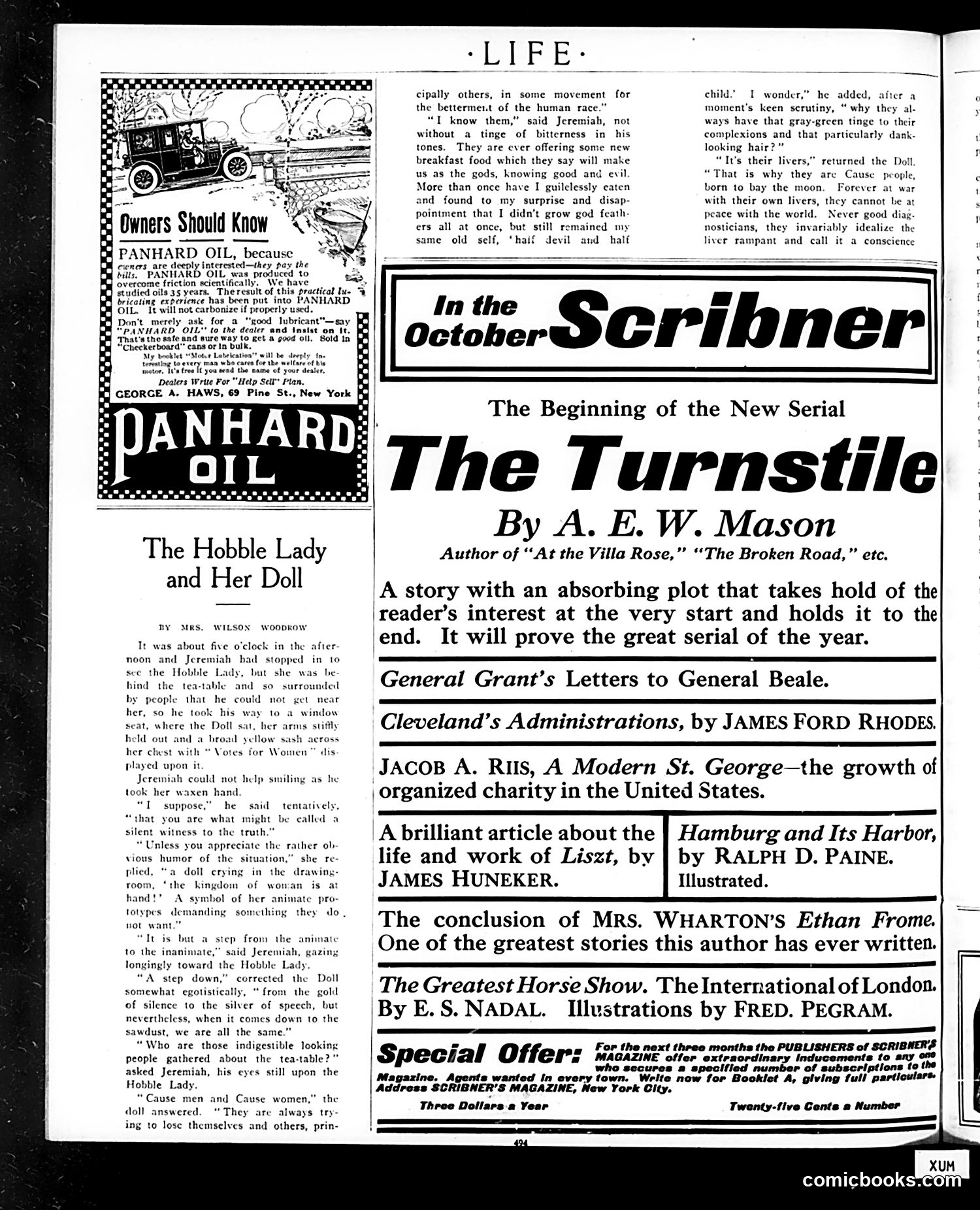
This page is primarily **advertising and literary content** rather than political satire. The main elements are: **"The Hobble Lady and Her Doll"** (left side): A serialized story by Mrs. Wilson Woodrow featuring dialogue between Jeremiah and an animated doll. The "Hobble Lady" wears a suffrage sash reading "Votes for Women"—a contemporary reference to the women's voting rights movement. The doll represents a symbol of feminist activism, while Jeremiah dismisses both "Cause people" (reform activists) and the breakfast-food promoters who promise transformation. The satire mocks reformers' earnestness and their physical appearance (gray-green complexions, bad hair). **Right side**: Advertisements for Panhard Oil and promotion of Scribner's Magazine's upcoming serial "The Turnstile" by A.E.W. Mason, plus articles on historical figures and subjects. The page's humor targets progressive activists and their utopian promises rather than specific political figures.
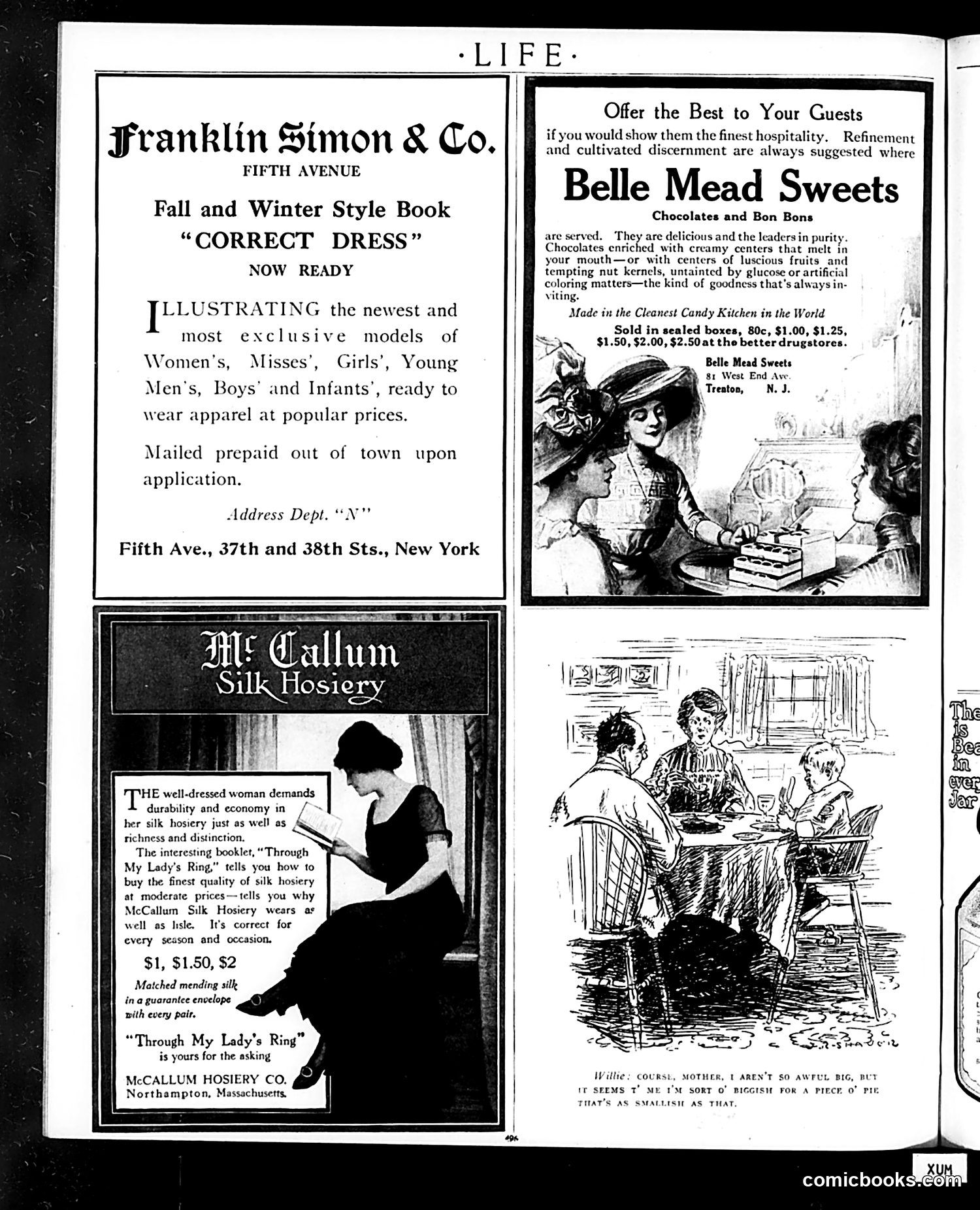
This page is primarily **advertising**, not political satire. It contains four commercial advertisements typical of early 20th-century publications: 1. **Franklin Simon & Co.** promotes a fall/winter fashion catalog for women's, men's, and children's clothing. 2. **McCallum Silk Hosiery** markets women's stockings, emphasizing durability and quality at moderate prices—appealing to middle-class women's desire for both economy and refinement. 3. **Belle Mead Sweets** advertises chocolates and bon bons as appropriate gifts for entertaining guests, positioning candy as a marker of refined hospitality. 4. **The cartoon** (bottom right) shows a humorous family dinner scene where a boy named Willie requests a large piece of pie despite claiming he's "not so awful big," suggesting the pie portion seems disproportionately large even for someone his size—a gentle joke about appetite and portion sizes. The page reflects consumer culture priorities: fashion, grooming, hospitality, and domestic humor—not political commentary.
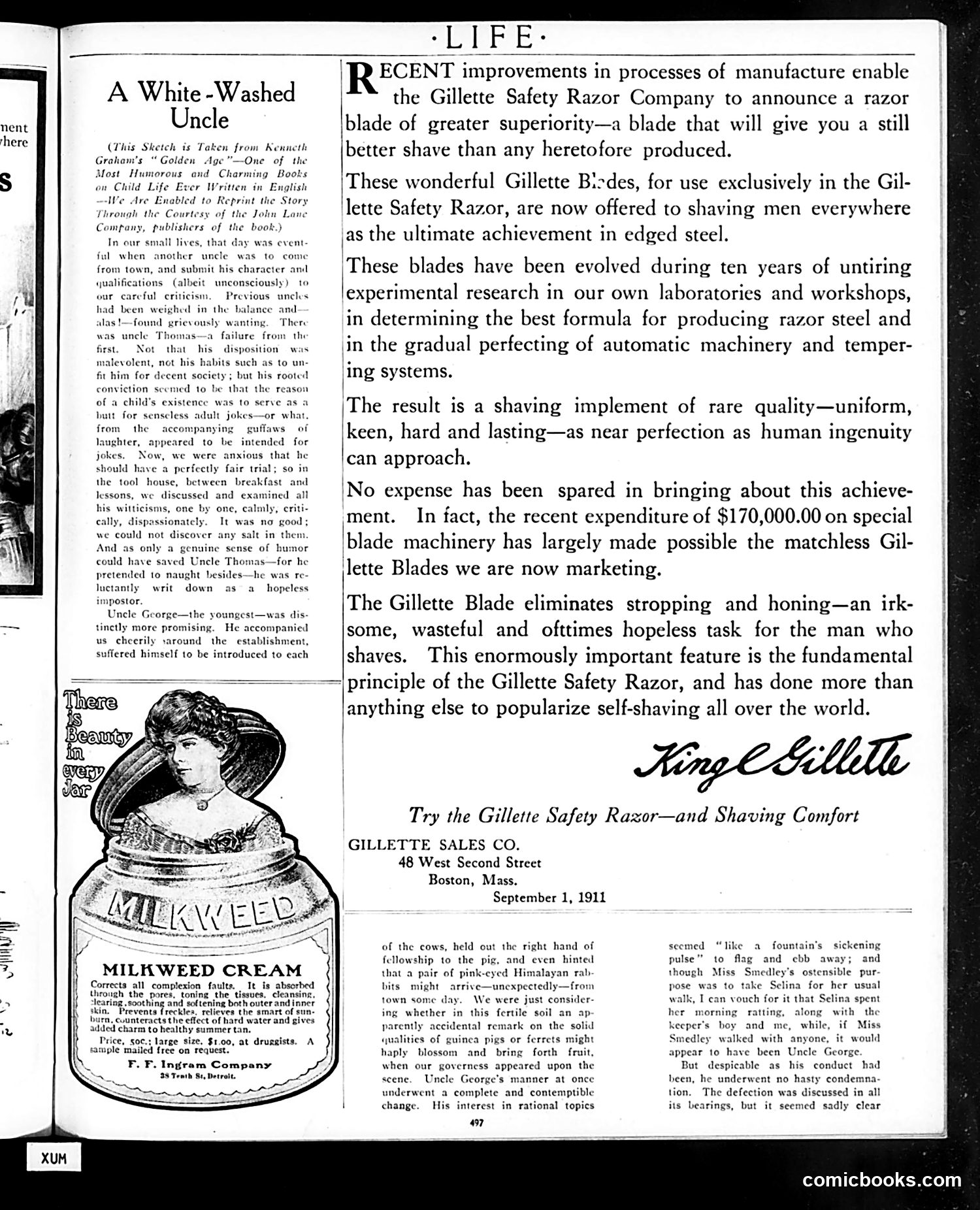
This page mixes literary content with advertising. The left column features "A White-Washed Uncle," a sketch adapted from Kenneth Grahame's *The Golden Age*, a beloved children's book. The excerpt humorously describes children evaluating visiting uncles as social failures—Uncle Thomas for his unfunny jokes, Uncle George as more promising. It's gentle satire on how children judge adults by rigid standards. The right side contains a Gillette Safety Razor advertisement signed by King Gillette himself, promoting new blade technology developed after $170,000 in machinery investment. The ad emphasizes that Gillette blades eliminate tedious stropping and honing, making self-shaving accessible to all men. The lower left advertises Milkweed Cream, a complexion product. The page reflects early 1900s consumer culture: mass-market safety razors were revolutionary, enabling widespread self-shaving rather than barber dependence.
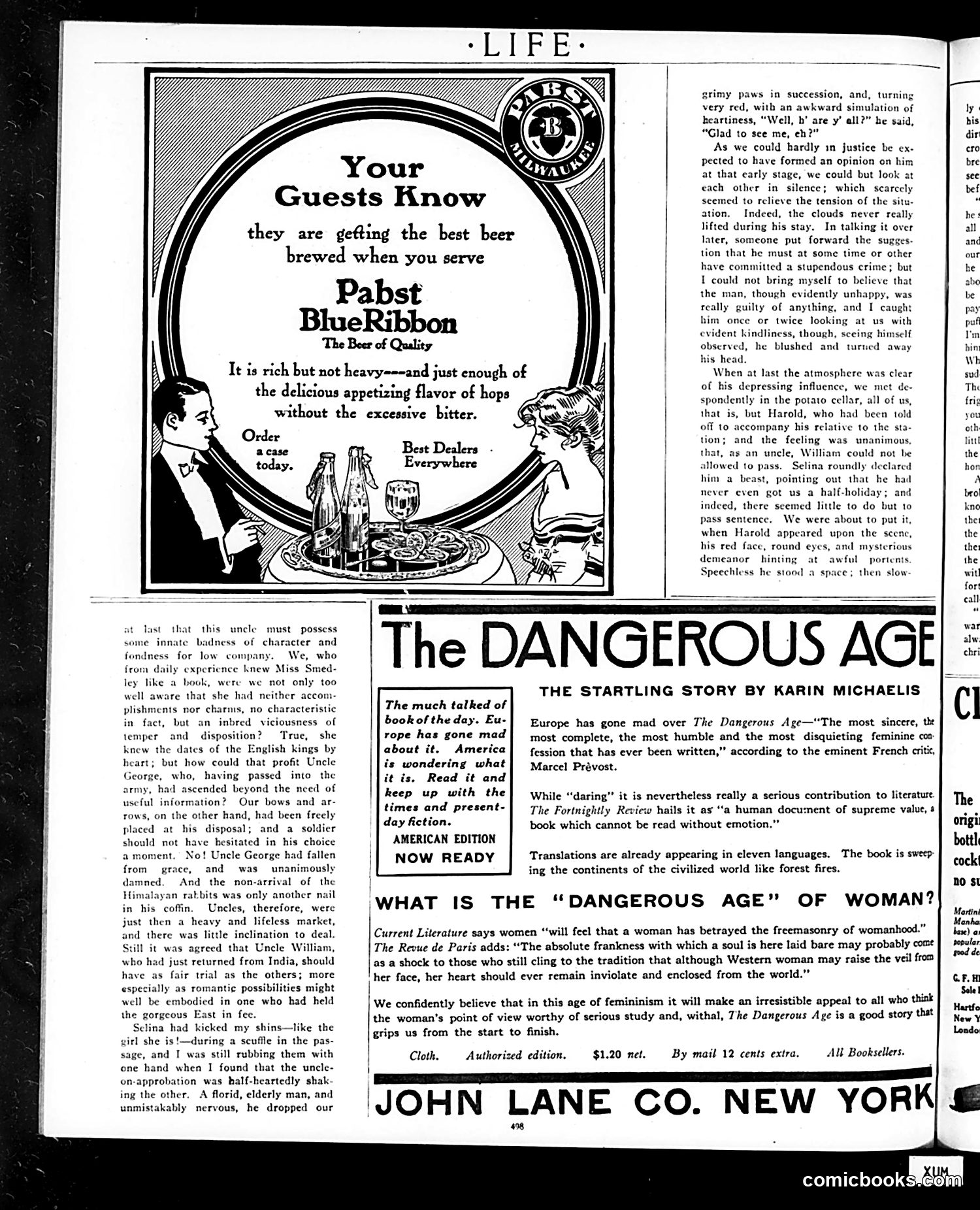
This page contains two distinct elements: a **Pabst Blue Ribbon beer advertisement** and promotional material for a book called **"The Dangerous Age"** by Karin Michaelis. ## The Advertisement The top half shows a stylized illustration of a man and woman dining, with the tagline "Your Guests Know they are getting the best beer brewed when you serve Pabst Blue Ribbon." This is straightforward early-20th-century consumer advertising emphasizing quality and social respectability—serving good beer to guests was a mark of hospitality. ## The Book Promotion The lower section announces the American edition of "The Dangerous Age," a Scandinavian novel creating European controversy. The text describes it as addressing women's dissatisfaction and "feminism," presenting what modern readers would recognize as an early feminist critique of women's traditional roles. The promotion emphasizes its serious literary merit while acknowledging its provocative subject matter about women questioning their life choices and social constraints.
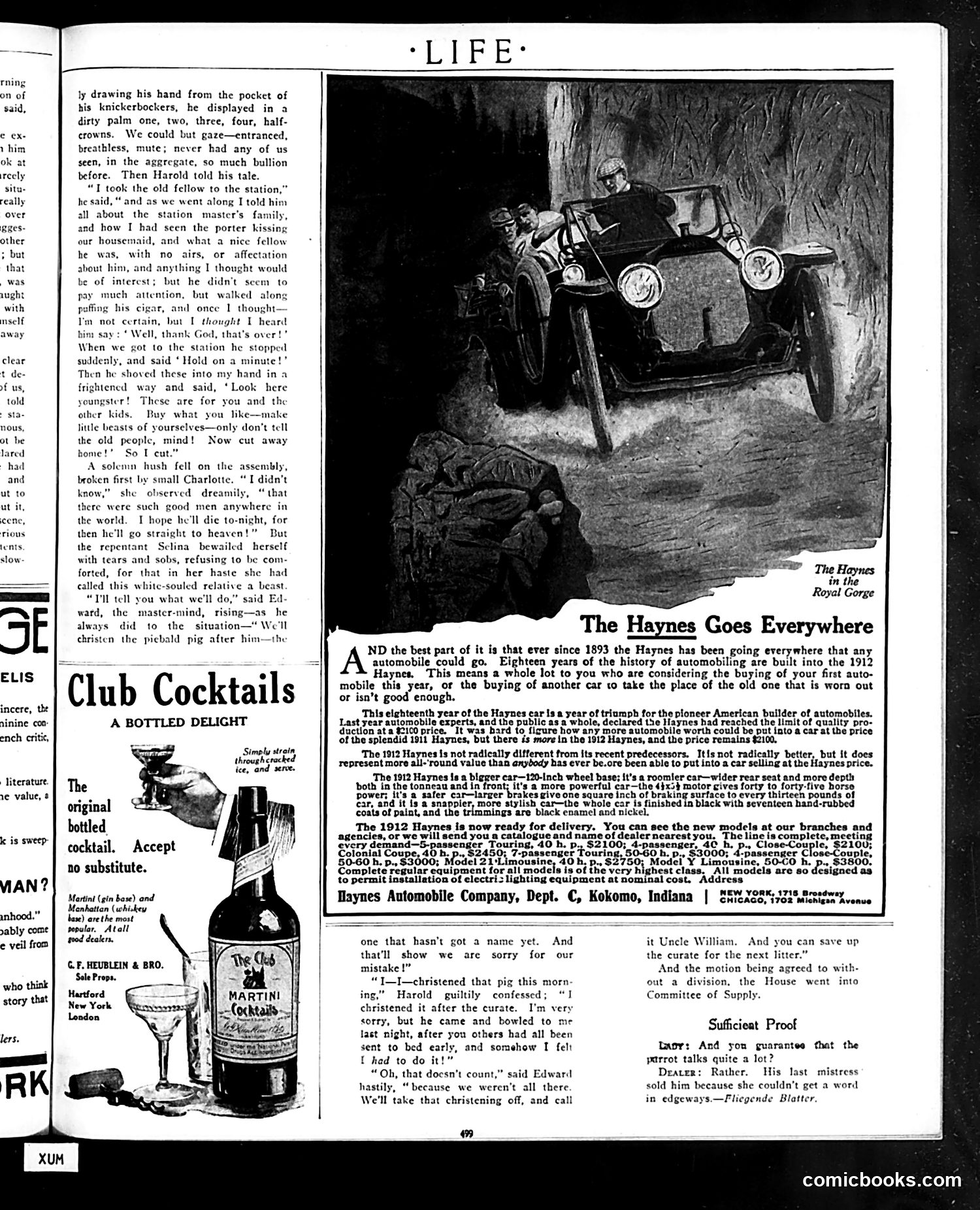
This page contains a serialized story about children receiving money from a relative, alongside period advertisements. **The Main Story:** A narrative describes Harold recounting how an elderly relative gave him and his siblings half-crowns (British currency) with instructions to buy treats and keep it secret from their parents. The children are deeply moved, with one girl hoping he dies tonight so he'll "go straight to heaven." Edward, the practical child, proposes naming their pig after him. **The Satire:** The humor targets Victorian sentimentality and children's moral exaggeration. The children's overwrought emotional response to modest pocket money—and their twisted logic that the man deserves death as a heavenly reward—mocks both sentimental literature and childish reasoning. **Advertisements:** The page includes a Haynes automobile advertisement emphasizing 18 years of manufacturing reliability (since 1893), and a Heublein Club Cocktails ad promoting bottled cocktails as convenient alternatives to hand-made drinks. The page reflects early 1900s American magazine content: serialized fiction alongside consumer advertising targeting middle-class readers.
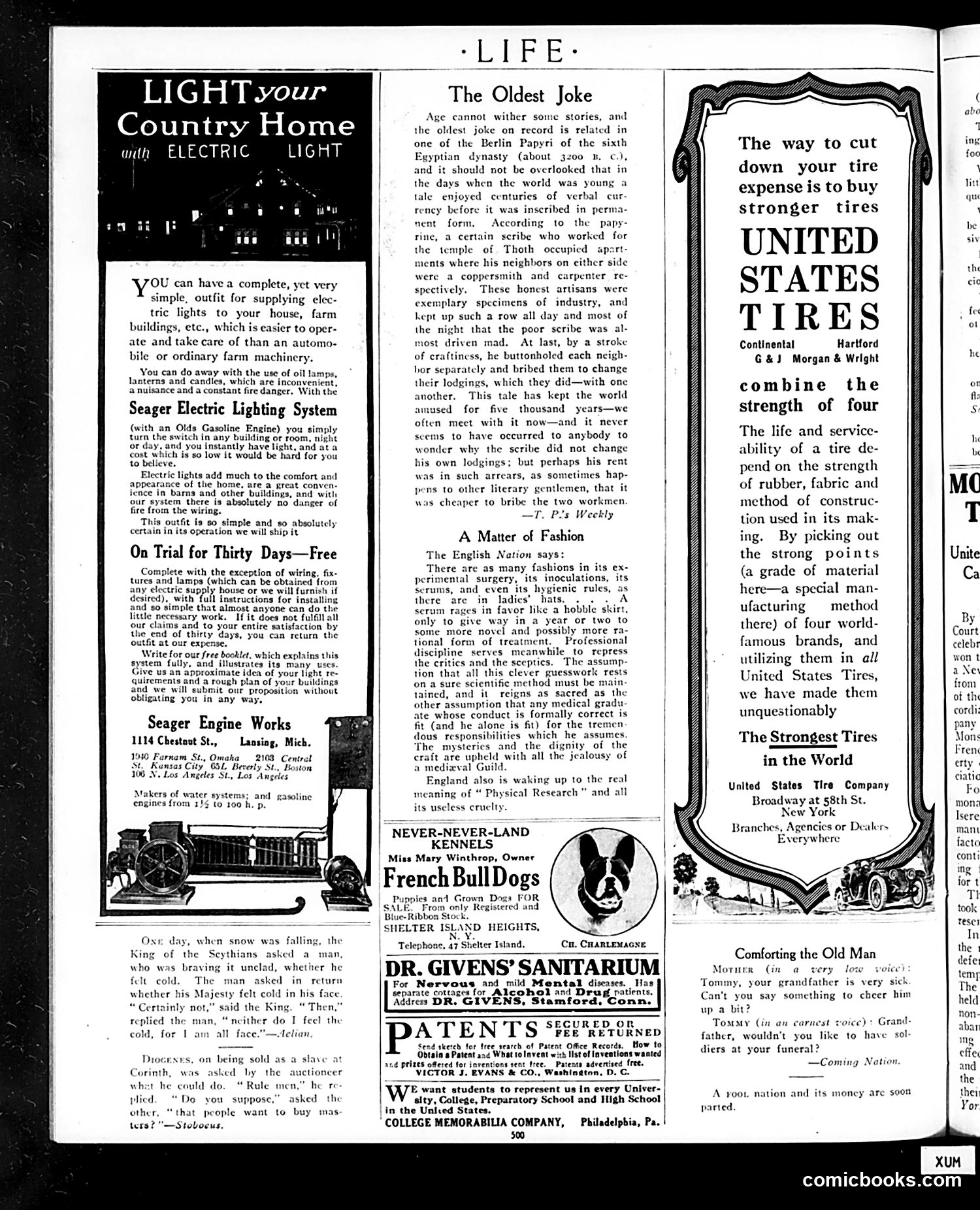
This page is primarily **advertising and articles**, not political satire. The content includes: **Main features:** - Advertisement for electric lighting systems for homes - "The Oldest Joke" — an article about an ancient Berlin papyrus containing the world's oldest recorded joke (about a scribe) - "A Matter of Fashion" — discussing medical fashion trends in surgery - Advertisements for United States Tires, French Bulldogs, Dr. Givens' Sanitarium, and a college memorabilia company **Social context:** The electrical lighting ad reflects early 20th-century modernization of American homes. The fashion article satirizes how doctors adopt trendy practices without scientific basis. **Note:** There is no political cartoon visible. This appears to be a typical Life magazine page mixing light humor, social commentary, and commercial advertising from the early 1900s.
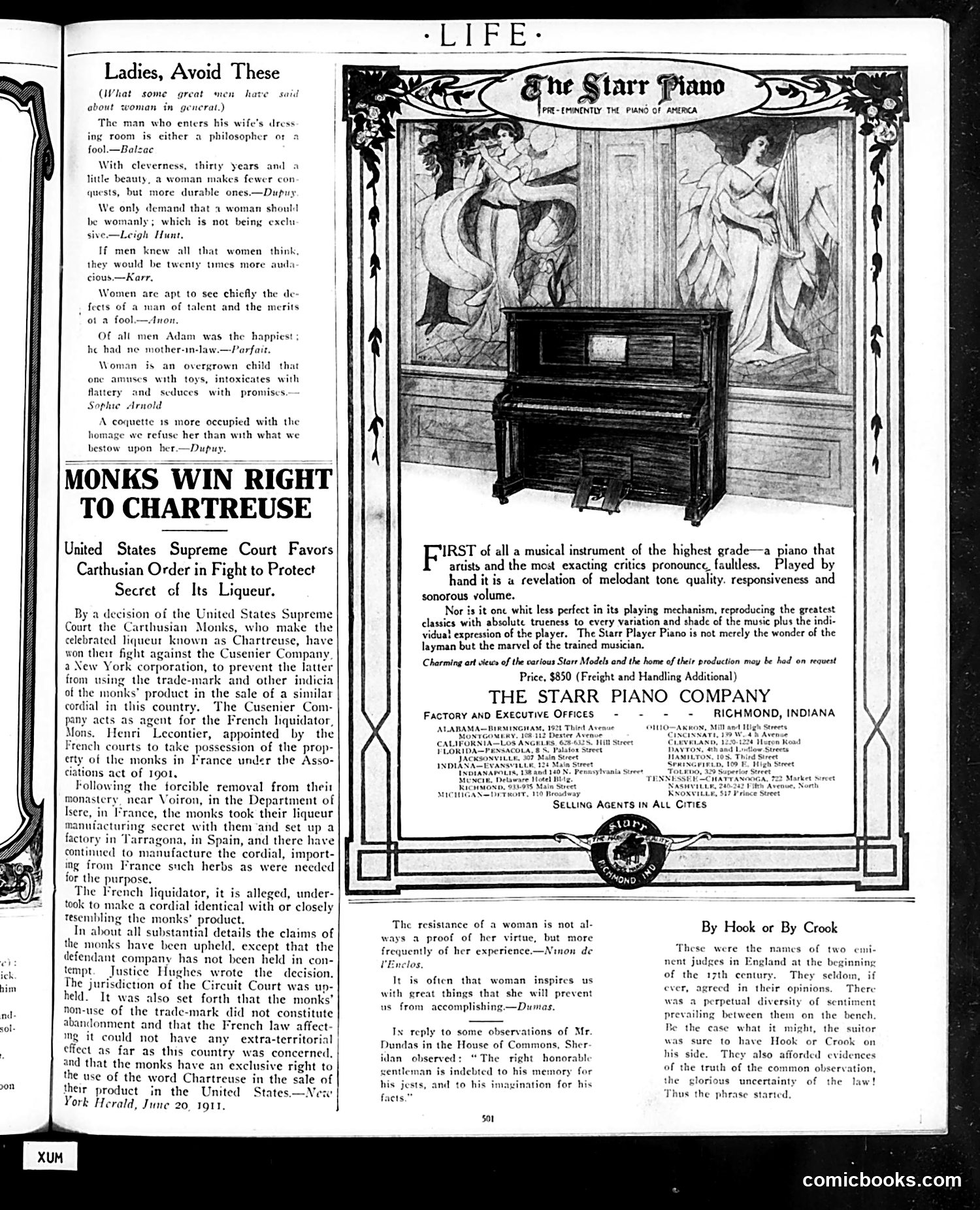
This page contains two distinct elements: **social satire** and **advertising**. The left column presents "Ladies, Avoid These"—misogynistic quotations from famous men (Balzac, Karr, etc.) disparaging women's intelligence, independence, and character. Life's satirical point is ironic: by collecting these contemptuous statements together, the magazine exposes the absurdity and hypocrisy of celebrated male thinkers. The effect is darkly comedic, showing how pervasive and socially accepted such views were. The "Monks Win Right to Chartreuse" article reports a U.S. Supreme Court ruling protecting French Carthusian monks' trademark against a competitor, despite French government seizure of their monastery property. The right side features a **Starr Piano advertisement** showcasing an upright piano with classical allegorical imagery above it—women in flowing garments playing instruments. This juxtaposes ironically with the page's misogynistic quotations, as pianos were marketed primarily to women as accomplishments.
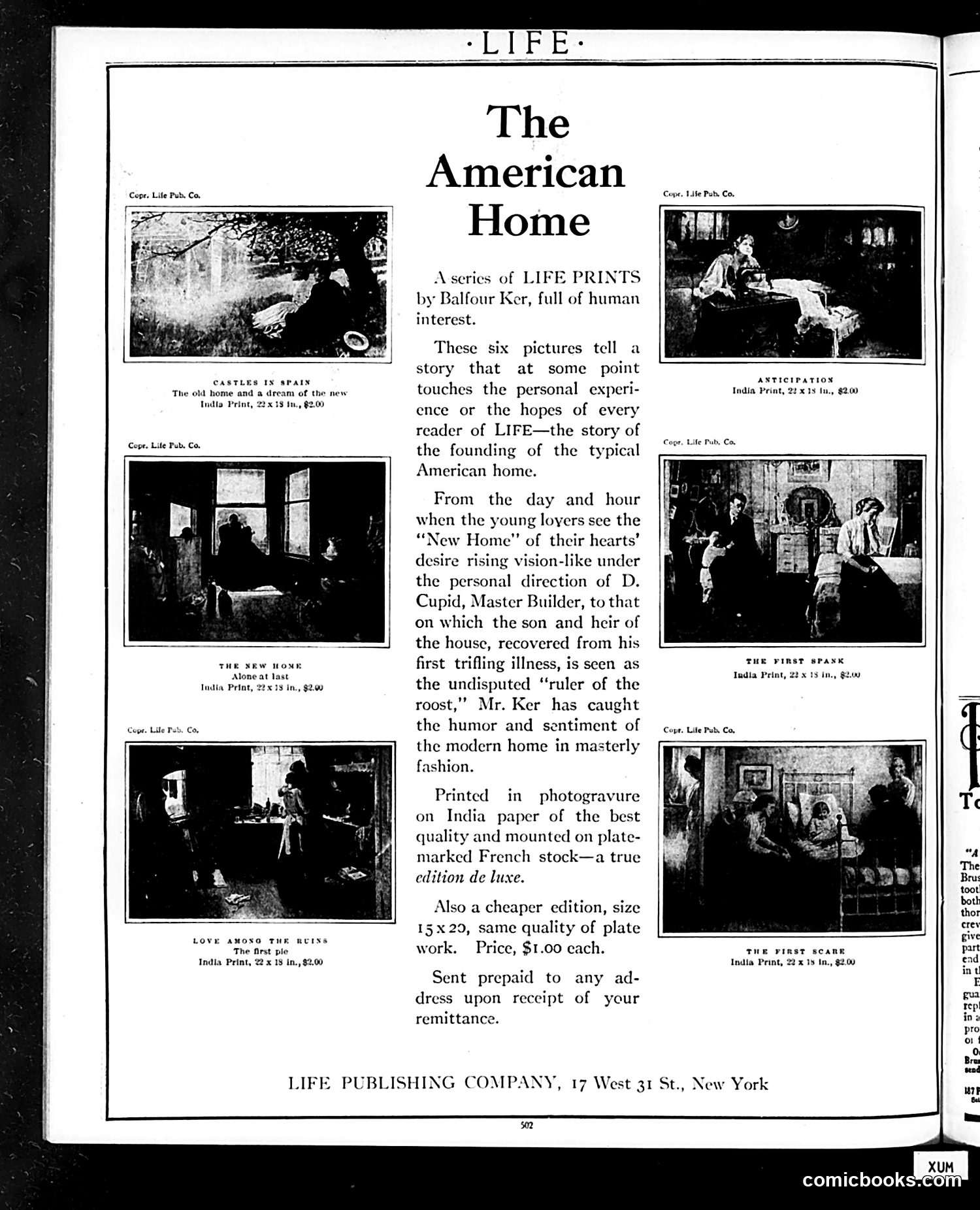
This is primarily an **advertisement**, not political satire. Life Publishing Company is marketing a six-print series by artist Balfour Ker depicting the arc of establishing a typical American home. The prints tell a sentimental narrative: young lovers envision their new house (with "Cupid, Master Builder" as guide), through domestic milestones—"The New Home," romantic moments ("Love Among the Ruins"), a child's birth ("The First Spank"), and childhood illness ("The First Scare")—culminating in the son becoming "ruler of the roost." The humor is gentle domestic comedy about modern American life and family aspirations. The prints were available in two editions: a luxury photogravure on fine India paper mounted on French stock, and a cheaper $1.00 version. The advertisement appeals to middle-class readers' personal experiences and hopes regarding homeownership and family life—standard advertising strategy of the era.
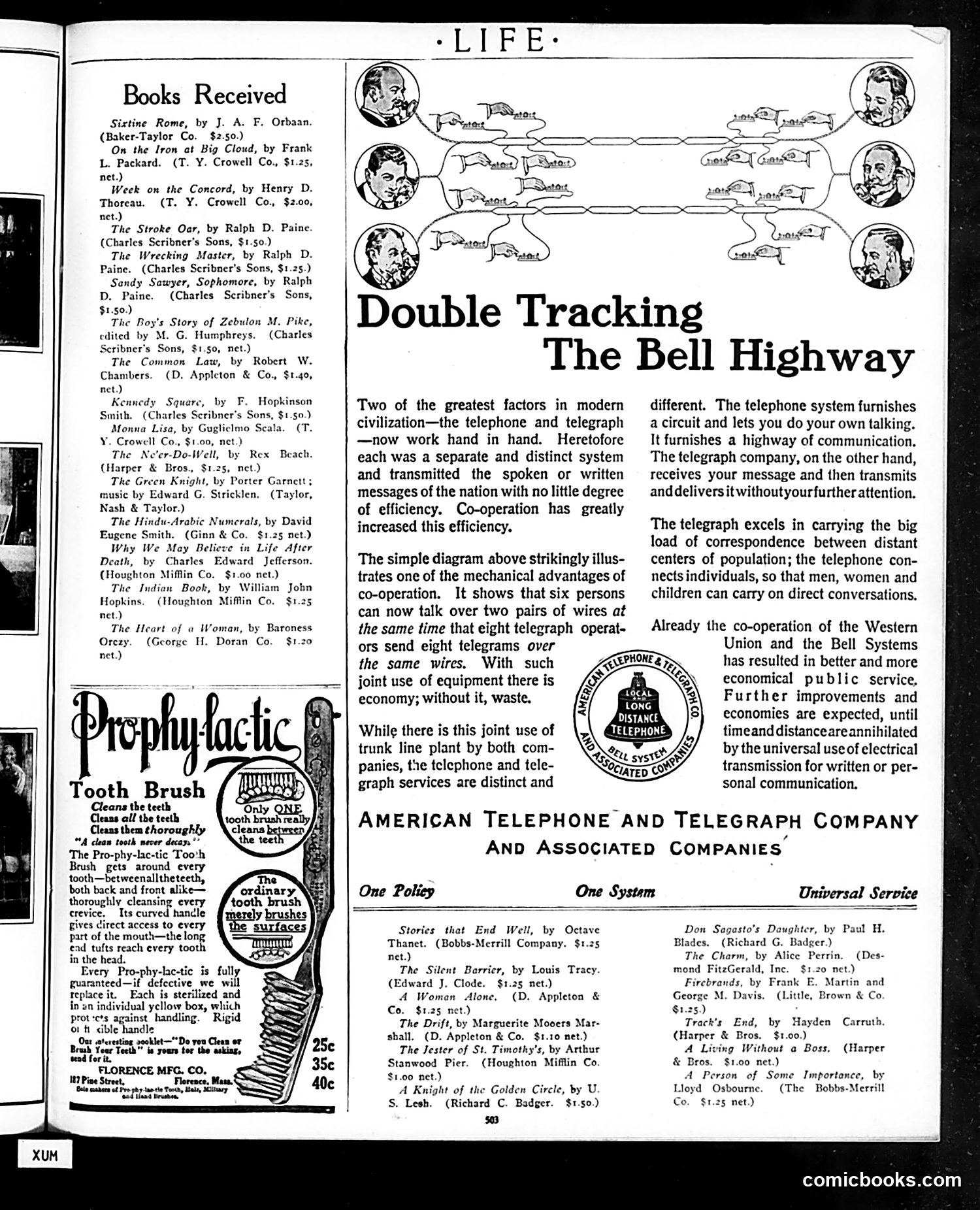
This page is primarily **advertising and business promotion**, not political satire. The main content is a corporate advertisement for the American Telephone and Telegraph Company celebrating the operational cooperation between the Bell telephone system and Western Union telegraph system. The diagram with six portrait medallions illustrates how shared infrastructure ("double tracking") allows six people to conduct simultaneous telephone conversations while eight telegraph operators send eight telegrams over the **same physical wires**—demonstrating efficiency gains through cooperation. The rhetoric emphasizes that each service remains "distinct and different": telephones let users communicate directly; telegraphs require operators as intermediaries. The advertisement promotes this as modern progress and "economical public service." The page also includes book reviews and a **Prophylactic toothbrush advertisement**—typical magazine filler of the era. There is no political cartoon or satire present.
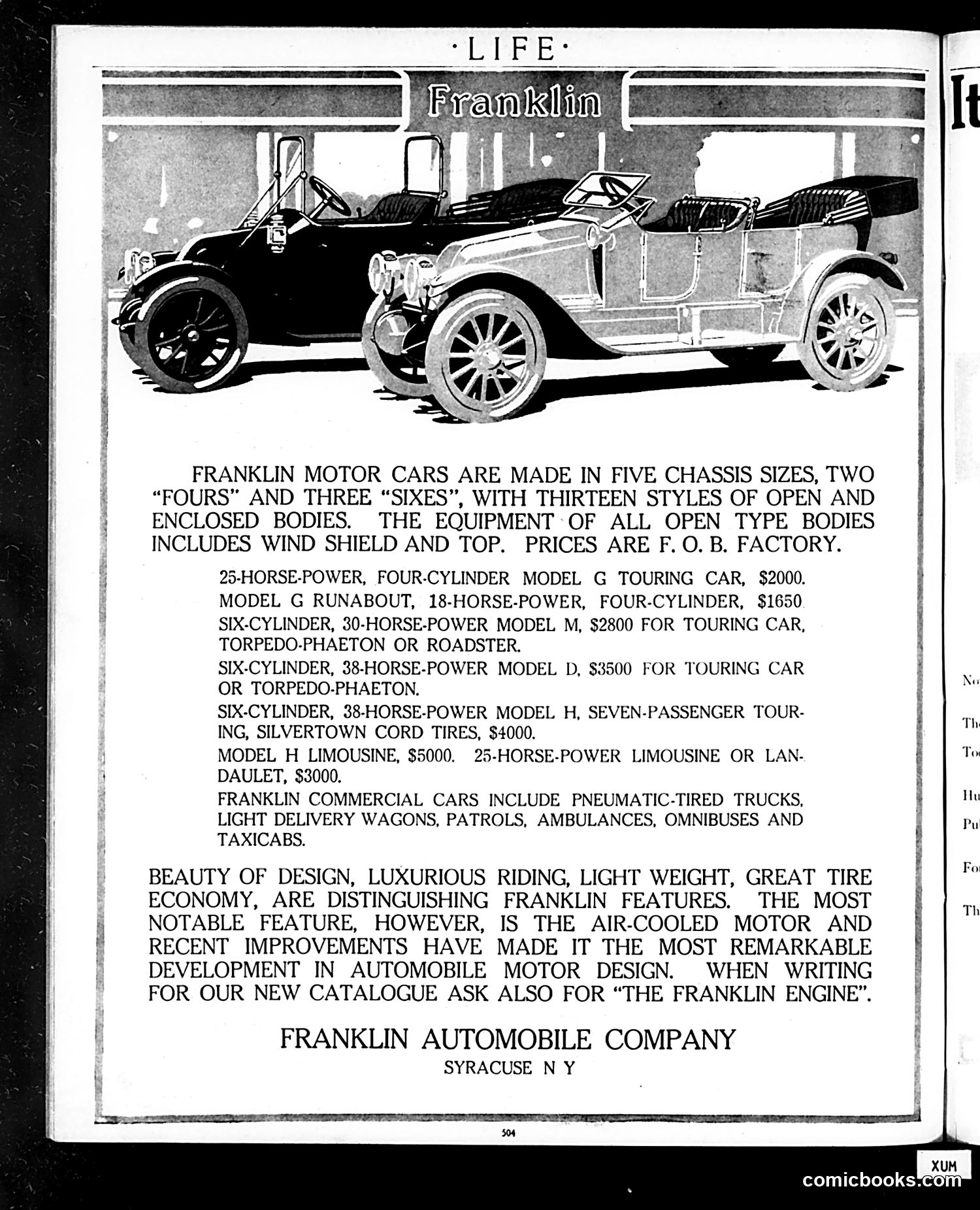
This is a straightforward **product advertisement**, not political satire. It's a full-page ad for Franklin Motor Cars, a Syracuse, New York manufacturer, showcasing their automobile lineup. The page displays two car illustrations at top—one dark sedan and one light open-air touring car—representing Franklin's range of models. The text emphasizes Franklin's key selling points: multiple chassis sizes and body styles (priced $1,650–$5,000), luxurious features, and notably, their **air-cooled motor**, which they highlight as their most innovative distinction. The ad targets wealthy consumers, listing various body types: touring cars, roadsters, limousines, and commercial vehicles (trucks, ambulances, taxicabs). There is no satire or political commentary present—this is genuine period advertising typical of Life magazine's revenue model, promoting automobile manufacturing during the early automotive era.
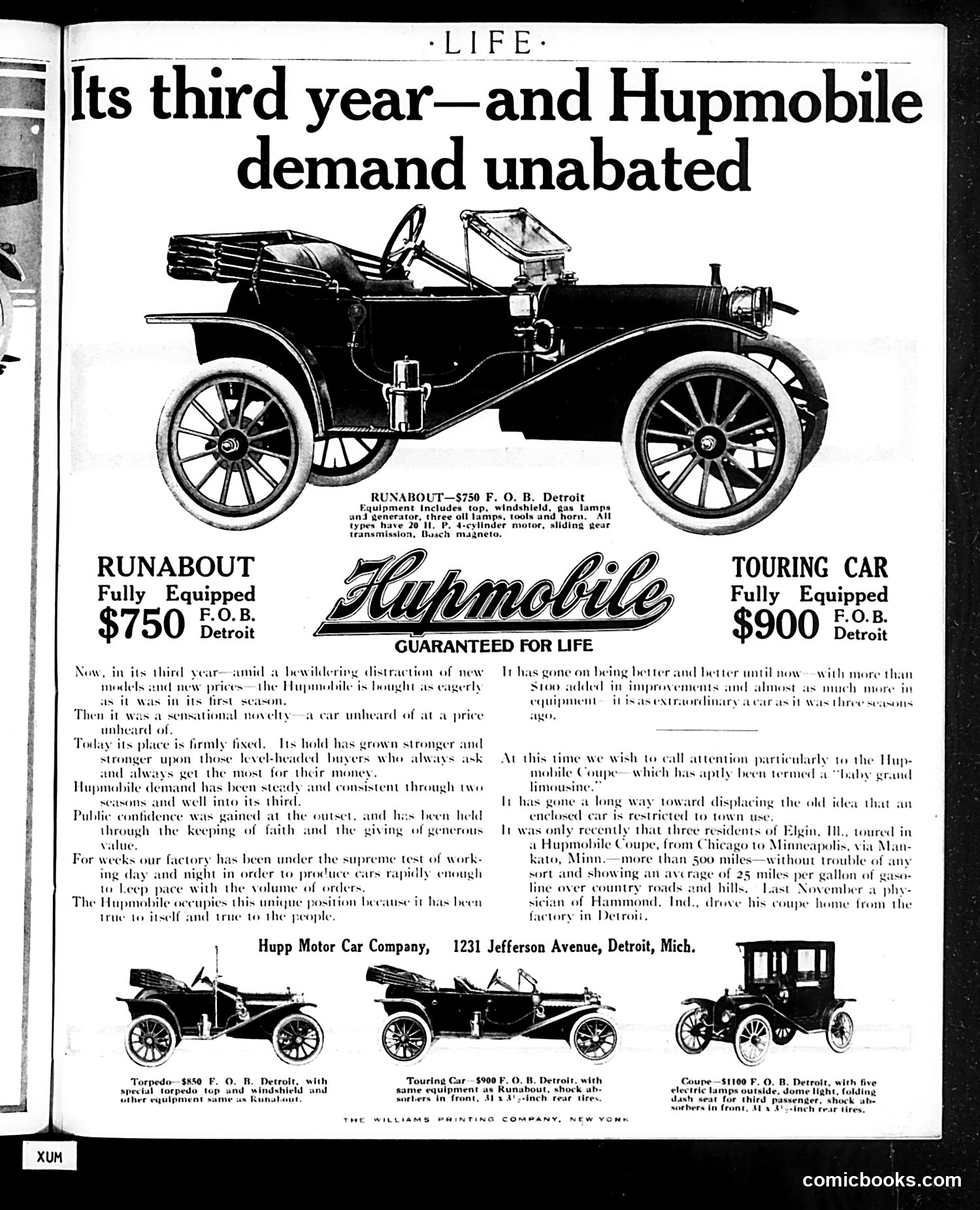
This is **not a cartoon or satire**—it's a straightforward automobile advertisement from Life magazine's third year of publication (early 1900s). The page promotes Hupmobile vehicles, a now-defunct American car brand. The ad emphasizes the brand's success and reliability: the Hupmobile is in its third year of production with "unabated demand," having moved from "sensational novelty" to "firmly fixed" market position. The manufacturer highlights customer loyalty among practical buyers and boasts factory production running day and night to meet orders. Notable claims include that an enclosed Hupmobile Coupe successfully traveled 500+ miles from Chicago to Minneapolis, and a physician drove one home from the Detroit factory—countering the prevailing assumption that enclosed cars were impractical for long distances. Three models are shown with prices ($750–$1,100 F.O.B. Detroit) and detailed specifications. The "Guaranteed for Life" slogan emphasizes durability and customer confidence.
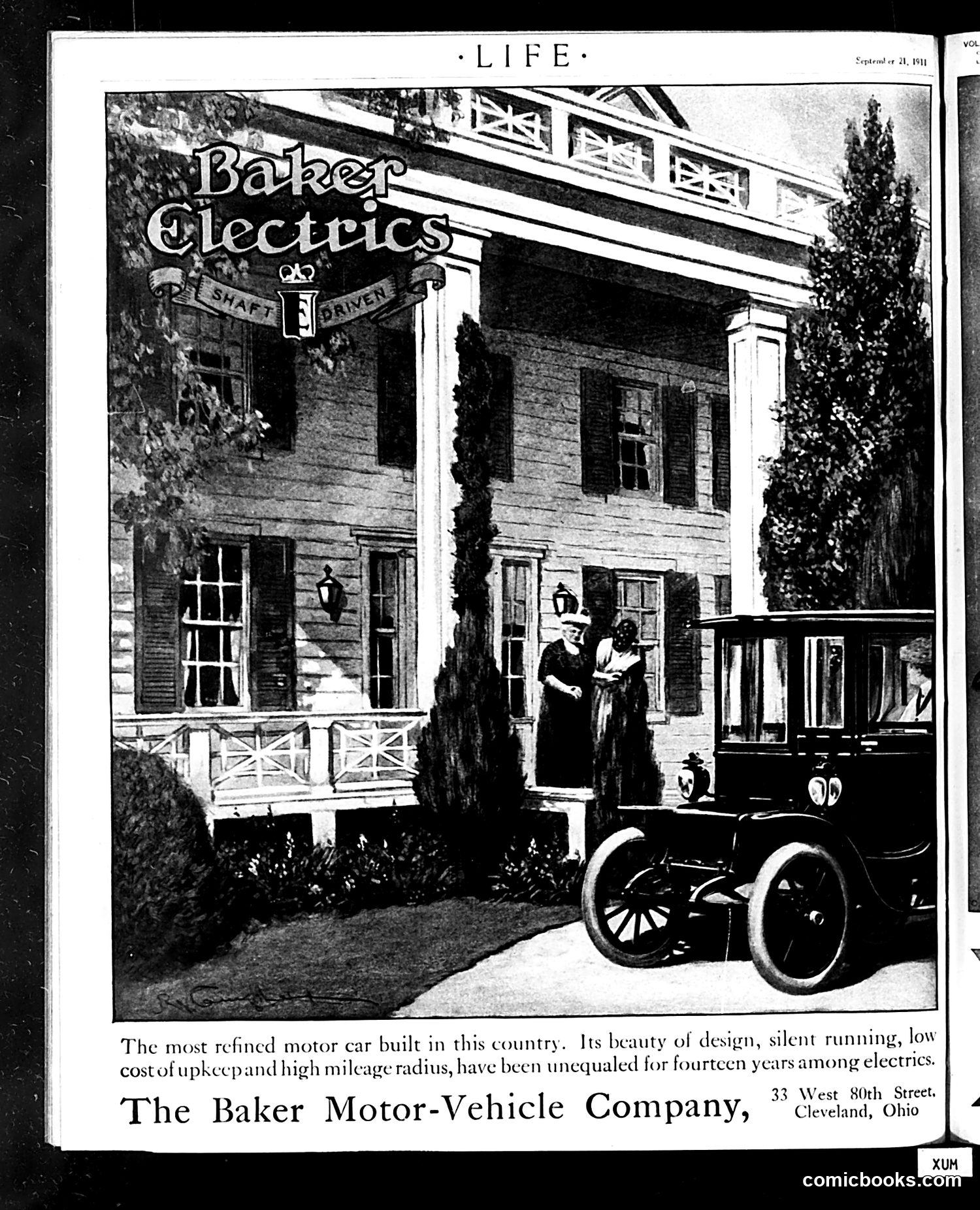
This is **an advertisement, not political satire**. The page promotes Baker Electric automobiles from Cleveland, Ohio, dated September 1911. The image shows an elegant early automobile parked before a refined residential building, with well-dressed figures on the porch. The ad emphasizes the Baker's "beauty of design, silent running, low cost of upkeep and high mileage radius" — practical selling points for electric vehicles, which were competitive with gasoline cars during this era. The "shaft driven" notation visible on the sign refers to mechanical transmission technology. No satire or political commentary is present; this is straightforward period advertising targeting affluent consumers seeking luxury and reliability. Electric cars were prestigious and popular before gasoline engines became dominant.