
Life, 1911-09-21 · page 49 of 52
Life — September 21, 1911 — page 49: what you’re looking at
What you’re looking at
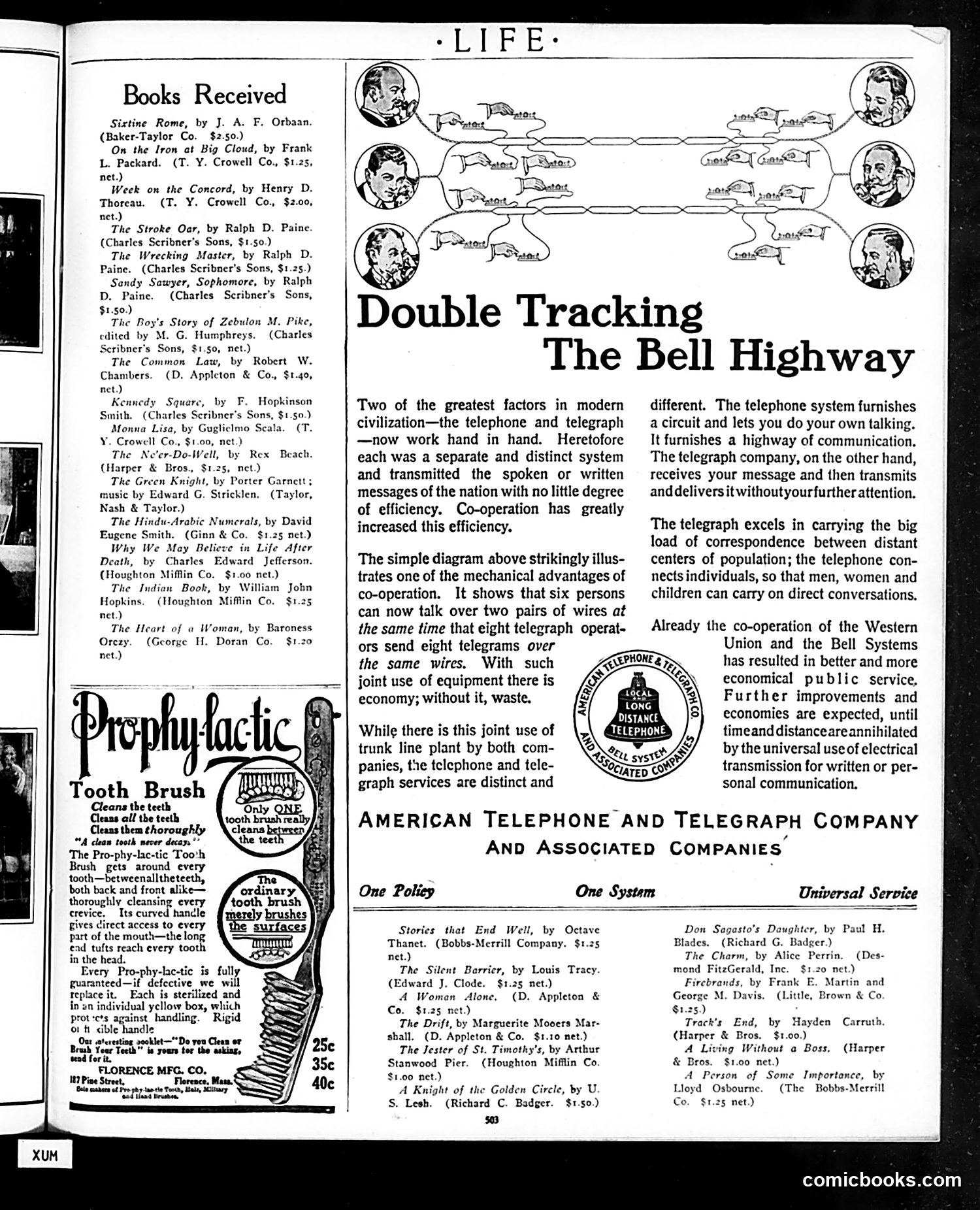
This page is primarily **advertising and business promotion**, not political satire. The main content is a corporate advertisement for the American Telephone and Telegraph Company celebrating the operational cooperation between the Bell telephone system and Western Union telegraph system. The diagram with six portrait medallions illustrates how shared infrastructure ("double tracking") allows six people to conduct simultaneous telephone conversations while eight telegraph operators send eight telegrams over the **same physical wires**—demonstrating efficiency gains through cooperation. The rhetoric emphasizes that each service remains "distinct and different": telephones let users communicate directly; telegraphs require operators as intermediaries. The advertisement promotes this as modern progress and "economical public service." The page also includes book reviews and a **Prophylactic toothbrush advertisement**—typical magazine filler of the era. There is no political cartoon or satire present.
📄 Transcribed text from this page (OCR, searchable)
Machine-transcribed from the original scan — historical spelling and the odd misread are preserved.
Books Received Sistine Rome, by J. A. F. Orbaan. (Baker-Taylor Co. $2.50.) On the Iron at Big Cloud, by Frank L. Packard. (T. Y. Crowell Co., $1.25, net.) Week on the Concord, by Henry D. Thoreau. (T. Y. Crowell Co. $2.00, net.) The Stroke Oar, by Ralph D. Paine. (Charles Scribner's Sons, $1.50.) The Wrecking Master, by Ralph D. Paine. (Charles Scribner's Sons, $1.25.) Sandy Sawyer, Sophomore, by Ralph D. Paine. (Charles Scribner's Sons, $1.50.) The Boy's Story of Zebulon M. Pike, edited by M. G. Humphreys, (Charles Scribner's Sons, $1.50, net.) The Common Law, by Robert W. Chambers. (D. Appleton & Co., $1.40, net.) Kennedy Square, by F, Hopkinson Smith. (Charles Scribner's Sons, $1.50.) Monna Lisa, by Gugliclmo Scala. (T. Y. Crowell Co., $1.00, net.) The Ne'er-Do-Well, by Rex Beach. (Harper & Bros. $1.25, net.) The Green Knight, by Porter Garnett ; music by Edward G. Stricklen. (Taylor, Nash & Taylor.) The Hindu-Arabic Numerals, by David Eugene Smith. (Ginn & Co. $1.25 net.) Why We May Believe in Life After Death, by Charles Edward Jefferson. (Houghton Mifflin Co. $1.00 net.) The Indian Book, by William Jobn Hopkins. (Houghton Mifflin Co. $1.25 net.) The Heart of a Woman, by Baroness Orezy. (George H. Doran Co. $1.20 Tooth Brush Cleans the teeth Cleans all the teeth Cleans them thoroughly “A clean tooth never decays”” The Pro-phy-lac-tic Too’h Brush gets around every tooth—betweenalltheteeth, both back and front alike— thoroughly cleansing every crevice. Its curved handle gives direct access to every part of the mouth—the long end tufts reach every tooth in the head. Every Pro-phy-lac-tic is fully guaranteed—if defective we will replace it. Each is sterilized and in an individual ycllow box, which prot:cts against handling.” Rigid o1 ft cible handle Oct sateresting sooklet—Do you Clean oF Brush Year Teeth” Brosh Tour ia youre tor the asking, FLORENCE MFG. CO. 127 Pine Street, Florence, Mass, (da maen Frwy tne eth al Ma ouble Tracking The Bell Highway Two of the greatest factors in modern civilization—the telephone and telegraph —now work hand in hand. Heretofore each was a separate and distinct system and transmitted the spoken or written messages of the nation with no little degree of efficiency. Co-operation has greatly increased this efficiency. The simple diagram above strikingly illus- trates one of the mechanical advantages of co-operation. It shows that six persons can now talk over two pairs of wires at the same time that eight telegraph operat- ors send eight telegrams over the same wires. With such joint use of equipment there is economy; without it, waste. While there is this joint use of trunk line plant by both com- panies, the telephone and tele- graph services are distinct and different. The telephone system furnishes a circuit and lets you do your own talking. It furnishes a highway of communication. The telegraph company, on the other hand, receives your message and then transmits and delivers it withoutyourfurther attention. The telegraph excels in carrying the big load of correspondence between distant centers of population; the telephone con- nects individuals, so that men, women and children can carry on direct conversations. Already the co-operation of the Western Union and the Bell Systems has resulted in better and more economical public service, Further improvements and economies are expected, until timeanddistanceareannihilated by the universal use of electrical transmission for written or per- sonal communication. AMERICAN TELEPHONE AND TELEGRAPH COMPANY AND ASSOCIATED COMPANIES. One System Oniversal Service Stories that End Well, by Octave Thanet. (Bobbs-Merrill Company. $1.25 net.) The Silent Barrier, by Louis Tracy. (Edward J. Clode. $1.25 net.) A Woman Alone, (D. Appleton & Co. $1.25 net.) The Drift, by Marguerite Mooers Mar- shall. (D. Appleton & Co. $1.10 net.) The Jester of St. Timothy's, by Arthur Stanwood Pier. (Houghton Mifflin Co. $1.00 net.) A Knight of the Golden Circle, by U. S. Lesh. (Richard C. Badger. $1.50.) Don Sagasto’s Daughter, by Paul H. Blades. (Richard G. Badger.) The Charm, by Alice Perrin. (Des- mond FitzGerald, Inc. $1.20 net.) Firebrands, by Frank E. Martin and George M. Davis, (Little, Brown & Co. $1.25.) : Track’s End, by Hayden Carruth. (Harper & Bros. $1.00.) Without a Boss. (Harper $1.00 net.) A Person of Some Importance, by Lloyd Osbourne. (The Bobbs-Merrill Co. $1.25 net.) comicbooks.com