
Life, 1911-09-21 · page 25 of 52
Life — September 21, 1911 — page 25: what you’re looking at
What you’re looking at
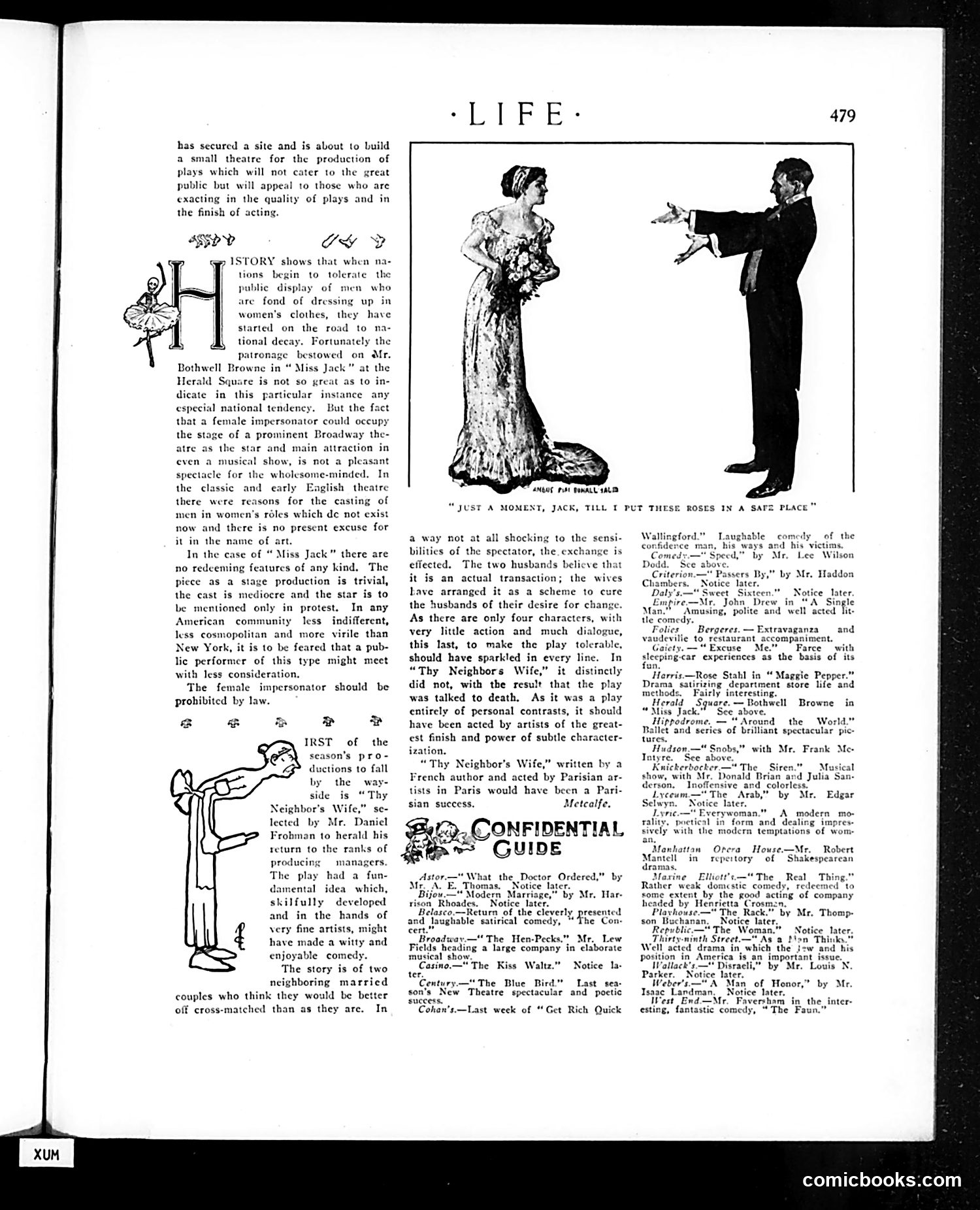
This page contains theatrical criticism and a satirical illustration attacking female impersonation in Broadway performance. The main cartoon shows a man in formal dress gesturing disapprovingly at a woman in an elegant gown, with the caption "Just a moment, Jack, till I put these roses in a safe place." The accompanying text condemns Mr. Bothwell Browne's performance in the musical "Miss Jack," where a male actor played a female lead role. The critic argues this represents moral decay, claiming such cross-dressing performances—even when performed by "artists of the greatest finish"—lack artistic justification in modern theater (unlike classical drama's practical reasons for male actors in women's roles). The author advocates legal prohibition of female impersonators. This reflects early-20th-century anxieties about gender presentation and morality, viewing the practice as degenerate rather than artistic. The rest of the page contains brief theatrical notices for various Broadway productions.
📄 Transcribed text from this page (OCR, searchable)
Machine-transcribed from the original scan — historical spelling and the odd misread are preserved.
has secured a site and is about to build a small theatre for the production of plays which will not ¢: public but will appeal to those who are exacting in the quality of plays and in the finish of acting. SOV ter to the great oy 2 tions begin to public display of men who are fond of dressing up in women’s clothes, they have started on the road to na- tional decay. Fortunately the Patronage bestowed on Mr. Bothwell Browne in “ Miss Jack” at the Herald Square is not so great as to in- dicate in this particular instance any especial national tendency. But the fact that a female impersonator could occupy the stage of a prominent Broadway the- atre as the star and main attraction in even a musical show, is not a pleasant spectacle for the wholesome-minded. In the classic and early English theatre there were reasons for the casting of men in women’s roles which de not exist now and there is no present excuse for it in the name of art. In the case of “ Miss Jack” there are no redeeming features of any kind, The piece as a stage production is trivial, the cast is mediocre and the star is to be mentioned only in protest. In any American community less indifferent, less cosmopolitan and more virile than New York, it is to be feared that a pub- lic performer of this type might meet with less consideration, The female impersonator should be prohibited by law. 2 2 IRST of the season's pro- ductions to fall by the w side is “Thy Neighbor's Wife,” se- lected by Mr. Daniel Frohman to herald his return to the ranks of managers. had a fun- damental idea which, skilfully developed and in the hands of very fine artists, might have made a witty and enjoyable comedy. The story is of two neighboring married couples who think they would be better off cross-matched than as they are. In producin, The play ANQOE PBL RMALL ALD “JUST A MOMENT, JACK, TILL f PUT THESE ROSES IN A SATE PLACE” a way not at all shocking to the sen: bilities of the spectator, the exchange is effected, The two husbands belicve that it is an actual transaction have arranged it as a scheme to cure the husbands of their desire for change. As there are only four characters, with very little action and much dialogue, this last, to make the play tolerable, should have sparkled in every line. In “Thy Neighbors Wif stinctly did not, with the result that the play was talked to death. As it was a play entirely of personal contrasts, it should have been acted by artists of the great- est finish and power of subtle character- ization. “Thy Neighbor’s W written by a French author and acted by Parisian ar- tists in Paris would have been a Pari- sian success. Metcalfe, 2. (CONFIDENTIAL Beane Astor-—"What the Doctor Ordered,” by Mr. A. E. Thomas. Notice later. Bijow.—* Modern Marriage,” by Mr. Har- rison Rhoades. Notice later. Belasco.—Return of the cleverly, present and laughable satirical comedy, “The Con- cert.” Broadwav.—" The Hen-Pecks.” Mr. Lew Fields heading a large company in elaborate musical sh Casino.—" The Kiss Waltz. ter, Century —" The Blue Bird.” son’s New Theatre spectacular success, Cohan's.—Last week of “Get Rich Quick the wives ‘otice la- Last_sea- and. poetic Wallingford.” ghal dy of the confider nd his victims, Comedy— Lee Wilson Dodd. Se Criterio Chambers. Passers By,” by Mr. Haddon fotice later. Daly's.—"" Sweet Sixteen." Notice later. Empire-—Mr. John “A Single Manc?”“Kmusing, polite and well acted fite tle comedy, Folies Bergeres. — Extravaganza vaudeville to. restaurant accompaniment. Gaiety. — “ Excuse Farce with slecping-car experiences a3 the basis of its ‘an, Harris—Rose Stahl in “ Maggie Pepper.” Drama satirizing department store life and methods. Fairly interesting. Herald Square. — Bothwell Browne in “Miss Jack."* See above. Hippodrome. — Around the World.” Ballet and serics of brilliant spectacular pic- tures, Hudson.—" Snobs,” with Mr. Frank Me- Intyre. See above. Knickerbocker —" The Siren." Musical show, with Mr. Donald Brian ard Julia San- derson. Inoffensive and colorless: Lyceum—"The Arab,” by Mr. Edgar te ywoman.” A modern mo- poctical in form and dealing impres- ely with the modern temptations of wom- and jattan Opera Howse.—Mr. Robert I in repertory of | Shakespearean Marine Ellictt’.—" Ti Rather weak domestic con some extent by the good headed by Henrietta Cros house-—" The. Rack.’ uchanan, | Notice later, —"The Woman.” Notice later, th Street.—" Asa Mon Thinks.” Well acted drama in. which the j2w and his position in America is an important issue. Wallack’s —"" Disraeli,” by Mr. Louis N. Parker. | Notice later. Weber's.—" A Man of Honor,” by Isaac Landman, Notice later. Mr. Faversham in the, comedy, “The Faun ng of company y Mr. Thomp- comicbooks:com