
Life, 1911-09-21 · page 34 of 52
Life — September 21, 1911 — page 34: what you’re looking at
What you’re looking at
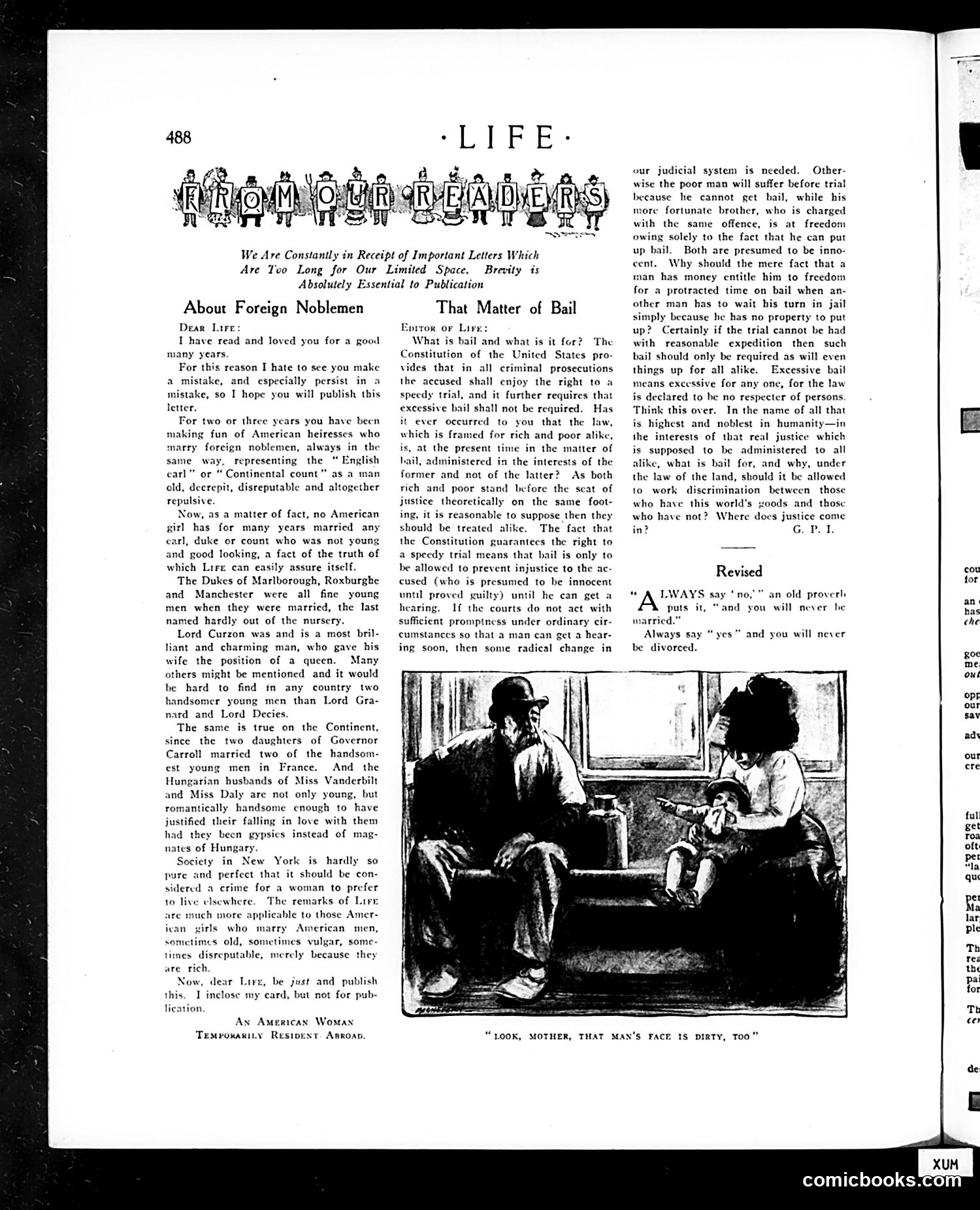
This page contains two reader letters debating social issues of the era. **"About Foreign Noblemen"** defends American heiresses marrying European aristocrats. The letter-writer corrects Life's satire, arguing the magazine has unfairly portrayed foreign nobles as "old, decrepit, disreputable" when, in fact, recent marriages involved "handsome" young men—naming Lord Curzon, the Dukes of Marlborough and Manchester, and Hungarian nobles who married Vanderbilt and Daly daughters. The writer argues Life should instead criticize American women marrying wealthy American men "sometimes old, sometimes vulgar, sometimes disreputable, merely because they are rich." **"That Matter of Bail"** raises class-based criminal justice concerns: wealthy defendants can afford bail and remain free awaiting trial, while poor defendants languish in jail. The letter argues this violates the constitutional principle that rich and poor should be treated equally before the law. The cartoon shows a woman with a dirty-faced man, captioned "Look, Mother, that man's face is dirty, too"—likely satirizing hypocrisy or double standards.
📄 Transcribed text from this page (OCR, searchable)
Machine-transcribed from the original scan — historical spelling and the odd misread are preserved.
We Are Constantly in Receipt of Important Letters Which Are Too Long for Our Limited Space. Brevity is Absolutely Essential to Publication About Foreign Noblemen Dear Lire: I have read and loved you for a good many year For this reason I hate to see you make a mistake, and especially persist. in a mistake, so I hope you will publish this letter. For two or three years you have been making fun of American heiresses who marry foreign noblemen, always in the same way, representing the “ English carl” or “ Continental count” as a man old, decrepit, disreputable and altogether repulsive Now, as a matter of fact, no American girl has for many years married any carl, duke or count who was not young and good looking, a fact of the truth of which Lire can easily assure itself. The Dukes of Marlborough, Roxburghe and Manchester were all fine young men when they were married, the last named hardly out of the nursery. Lord Curzon was and is a most bril- liant and charming man, who gave his wife the position of a queen. Many others might be mentioned and it would be hard to find im any country two handsomer young men than Lord Gra- nard and Lord Decies The same is true on the Continent, since the two daughters of Governor Carroll married two of the handsom- est young men in France. And the Hungarian husbands of Miss Vanderbilt and Miss Daly are not only young, but romantically handsome enough to have justified their falling in love with them had they been gypsics instead of mag- nates of Hungary. Society in New York is hardly so pure and perfect that it should be con- sidered a crime for a woman to prefer to live elsewhere. The remarks of Lire are mutch more applicable to those Amer- ican girls. who marry American men, sometimes old, sometimes vulgar, some- times disreputable, mercly because they are rich Now, dear Lire, be just and publish this. I inclose my card, but not for pub- lication. Ay Americax Womax Temroxanity Resioest Aaroan. That Matter of Bail Eprror or Lire: What is bail and what is it for? The Constitution of the United States pro- vides that in all criminal prosecutions the accused shall enjoy the right to a speedy trial, and it further requires that excessive bail shall not be required. Has it ever occurred to you that the law, which is framed for rich and poor alike, is, at the present time in the matter of ail, administered in the interests of the former and not of the latter? As both rich and poor stand before the scat of justice theoretically on the same foot- ing, it is reasonable to suppose then they should be treated alike. The fact that the Constitution guarantees the right to a speedy trial means that bail is only to be allowed to prevent injustice to the ac- cused (who is presumed to be innocent until proved guilty) until he can get a hearing. If the courts do not act with sufficient promptness under ordinary cir- cumstances so that a man can get a hear- ing soon, then some radical change in our judicial system is needed. Other- wise the poor man will suffer before trial because he cannot get bail, while his more fortunate brother, who is charged with the same offence, is at freedom owing solely to the fact that he can put up bail. Both are presumed to be inno- cent. Why should the mere fact that a man has money entitle him to freedom for a protracted time on bail when an- other man has to wait his turn in jail simply because he has no property to put up? Certainly if the trial cannot be had with reasonable expedition then such bail should only be required as will even things up for all alike. Excessive bail means excessive for any one, for the law is declared to he no respecter of persons. Think this over, In the name of all that is highest and noblest in humanity—in the interests of that real justice which is supposed to be administered to all alike, what is bail for, and why, under the law of the land, should it be allowed to work discrimination between those who have this world’s xoods and those who have not? Where does justice come in? G. PT Revised ALWAYS say ‘no,"" an old prover! puts it, “and you will never he married.” Always say “yes” and you will never be divorced. “LOOK, MOTHER, THAT MAN'S FACE 1S DIRTY, TOO” comicbooks co