
A complete issue · 52 pages · 1911
Life — February 2, 1911
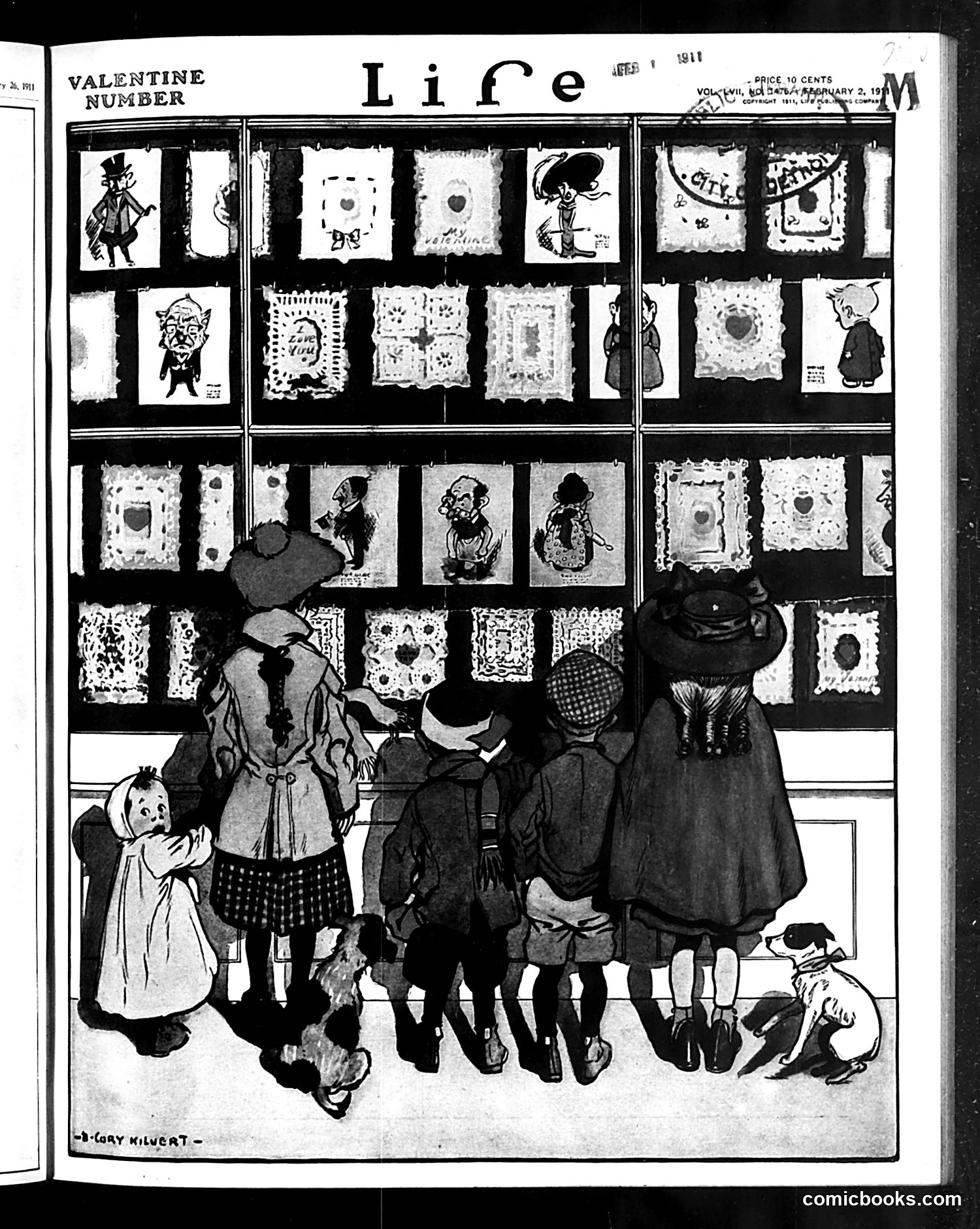
This is a "Valentine Number" cover from Life magazine (February 2, 1918), priced at 10 cents. The illustration shows children and adults viewing a storefront display window filled with valentine cards and decorations—a common commercial sight during the Valentine's Day season. The satirical point appears to be gentle social commentary on commercialization: the contrast between the innocent wonder of children peering at mass-produced valentines and the economic machinery of holiday marketing. The detailed display of varied card designs suggests how thoroughly Valentine's Day had become a commercialized consumer event by 1918, transforming personal affection into purchasable commodities. The artist is credited as "Gary Wilvert" (or similar). This reflects early 20th-century American consumer culture and the growing role of retail in holiday observance.
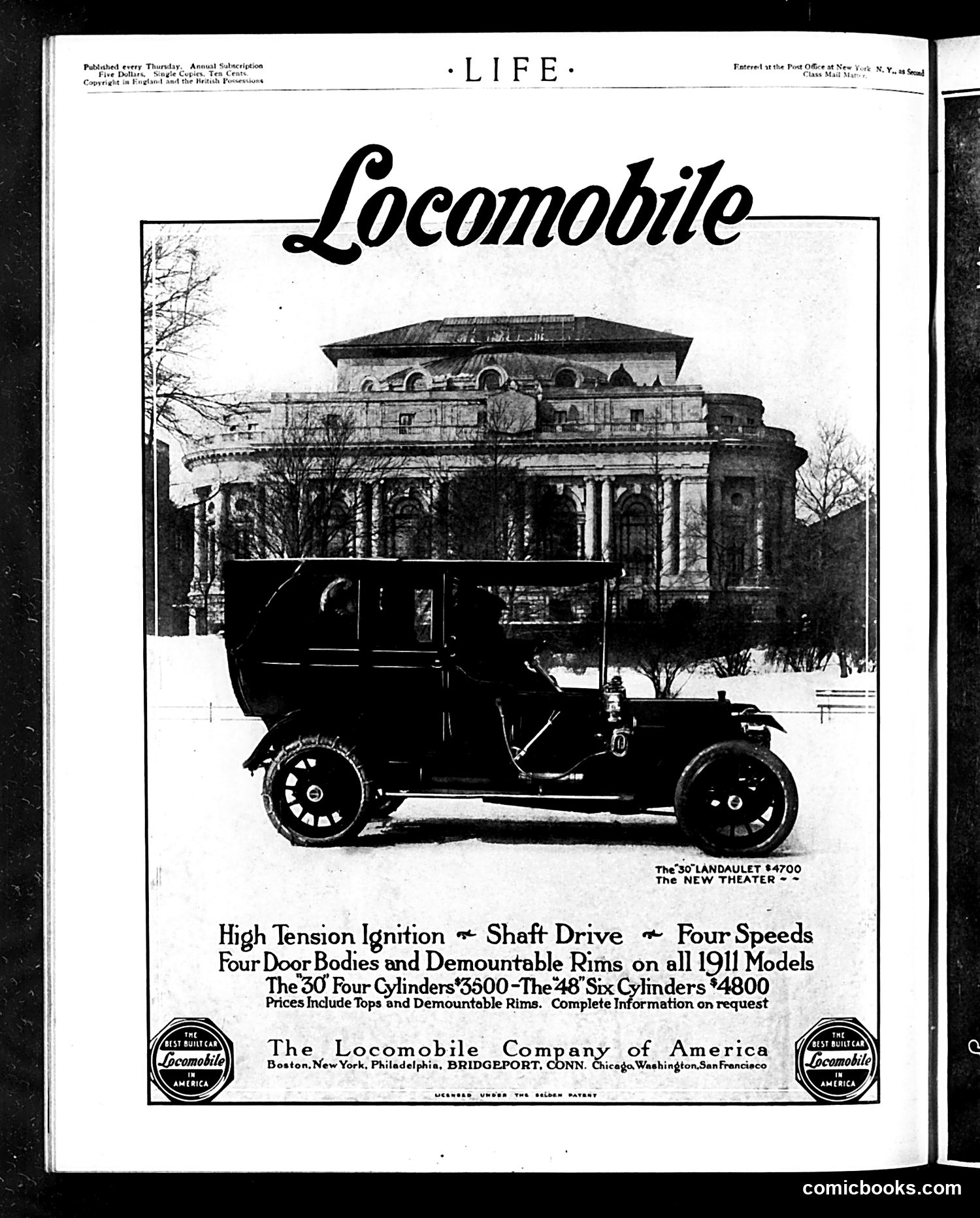
This page is **primarily an advertisement**, not political satire. It's a 1911 Locomobile automobile ad from *Life* magazine, featuring the "30" model priced at $4,700. The image shows a luxury car positioned in front of what appears to be a neoclassical public building (possibly a theater, given the caption mentioning "The New Theater"). The juxtaposition contrasts the modern automobile with classical architecture, emphasizing the car's modernity and sophistication. The ad emphasizes mechanical features: "High Tension Ignition," "Shaft Drive," "Four Speeds," and "Four Door Bodies." The Locomobile Company of America marketed this as a premium vehicle for affluent buyers. **No satirical content is present** — this is straightforward luxury goods advertising targeting wealthy readers of *Life* magazine.
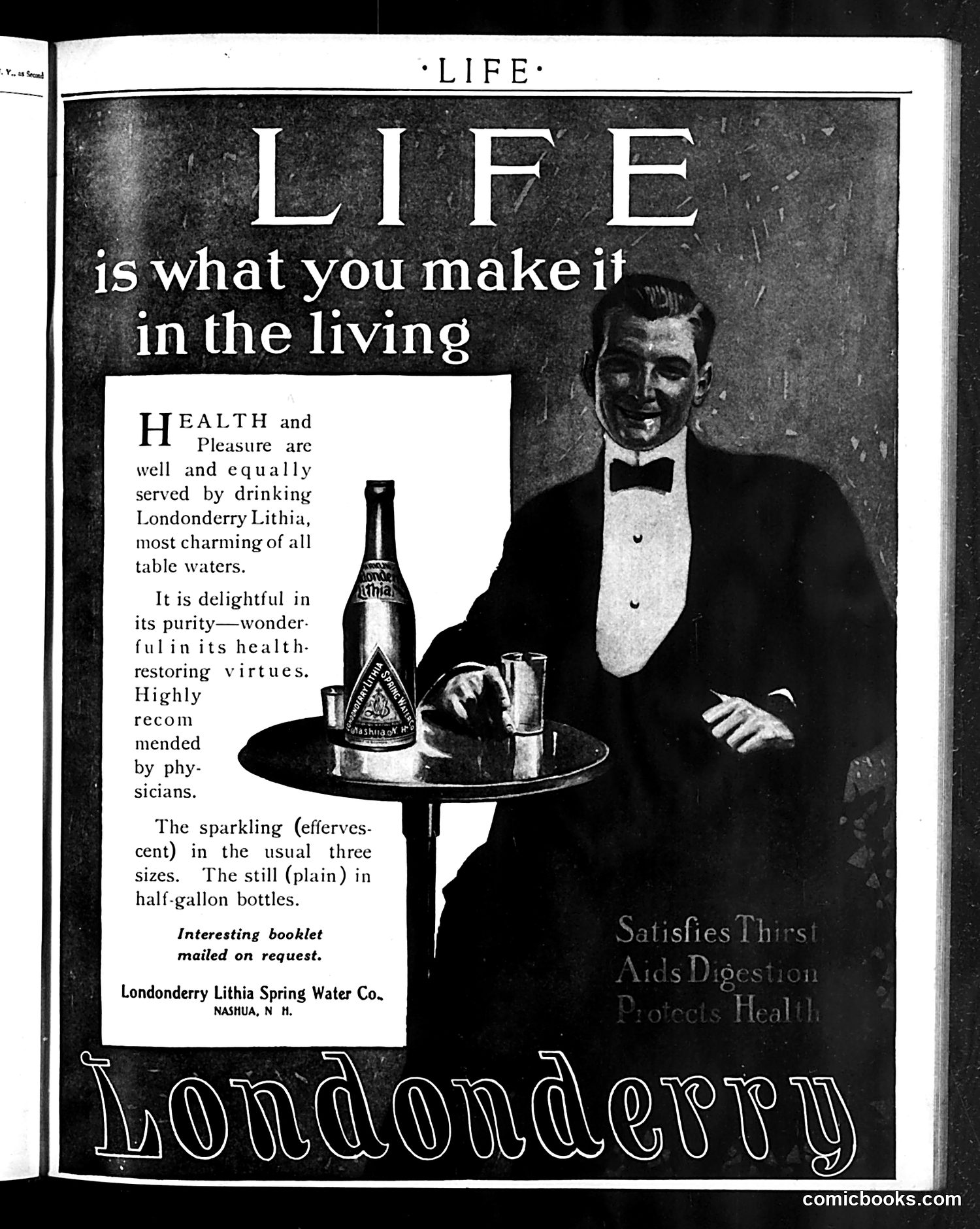
This is primarily a **product advertisement**, not satire or political commentary. It advertises Londonderry Lithia Spring Water from Nashua, New Hampshire. The ad uses a well-dressed man in formal attire (tuxedo and bow tie) as an aspirational figure representing success and refined living. The headline "LIFE is what you make it in the living" suggests that consuming this product is part of achieving an upscale lifestyle. The copy claims health benefits—purity, "health-restoring virtues," aiding digestion—and notes physician endorsement. It emphasizes availability in sparkling and still versions in various bottle sizes. The mysterious text overlay ("Satisfies Thirst / Aids Digestion / Protects Health") reinforces marketing claims typical of early 20th-century patent medicine-style advertising, when mineral waters were heavily promoted for medicinal properties.
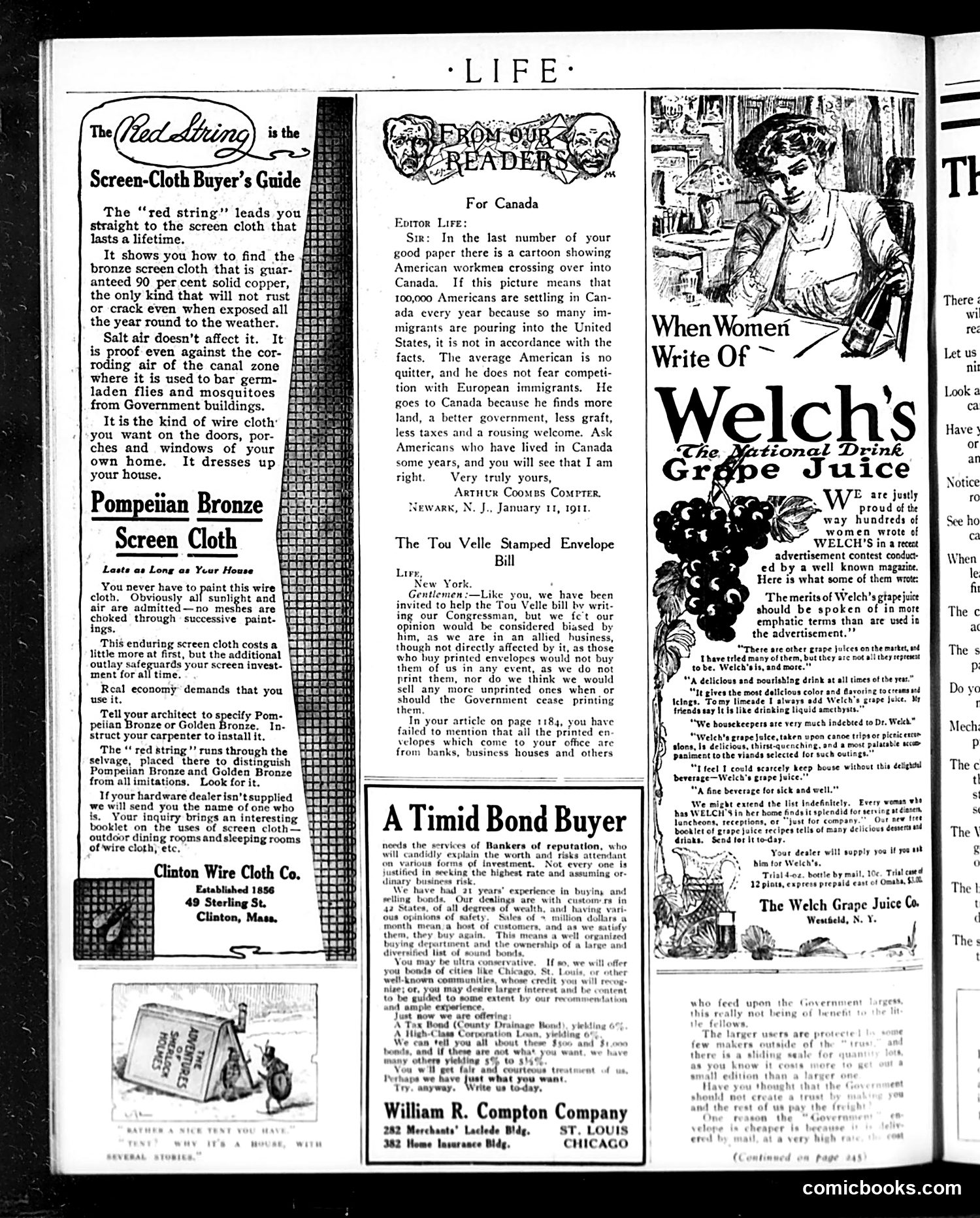
This page contains primarily **advertisements** rather than political cartoons. The main content includes ads for Pompeiian Bronze Screen Cloth, Clinton Wire Cloth Co., and Welch's Grape Juice, alongside a "From Our Reader" section addressing Canadian immigration. The reader's letter presents an **anti-immigration argument**, claiming that American workmen crossing into Canada disproves the notion that 100,000 Americans emigrate to Canada yearly. The writer argues Americans leave Canada due to superior opportunities in the U.S., characterizing Canadian government as corrupt ("graft") and less welcoming to business. The letter's nationalist tone reflects early 1900s anxieties about emigration and international competitiveness, though the satire—if any exists—remains unclear from the text alone.
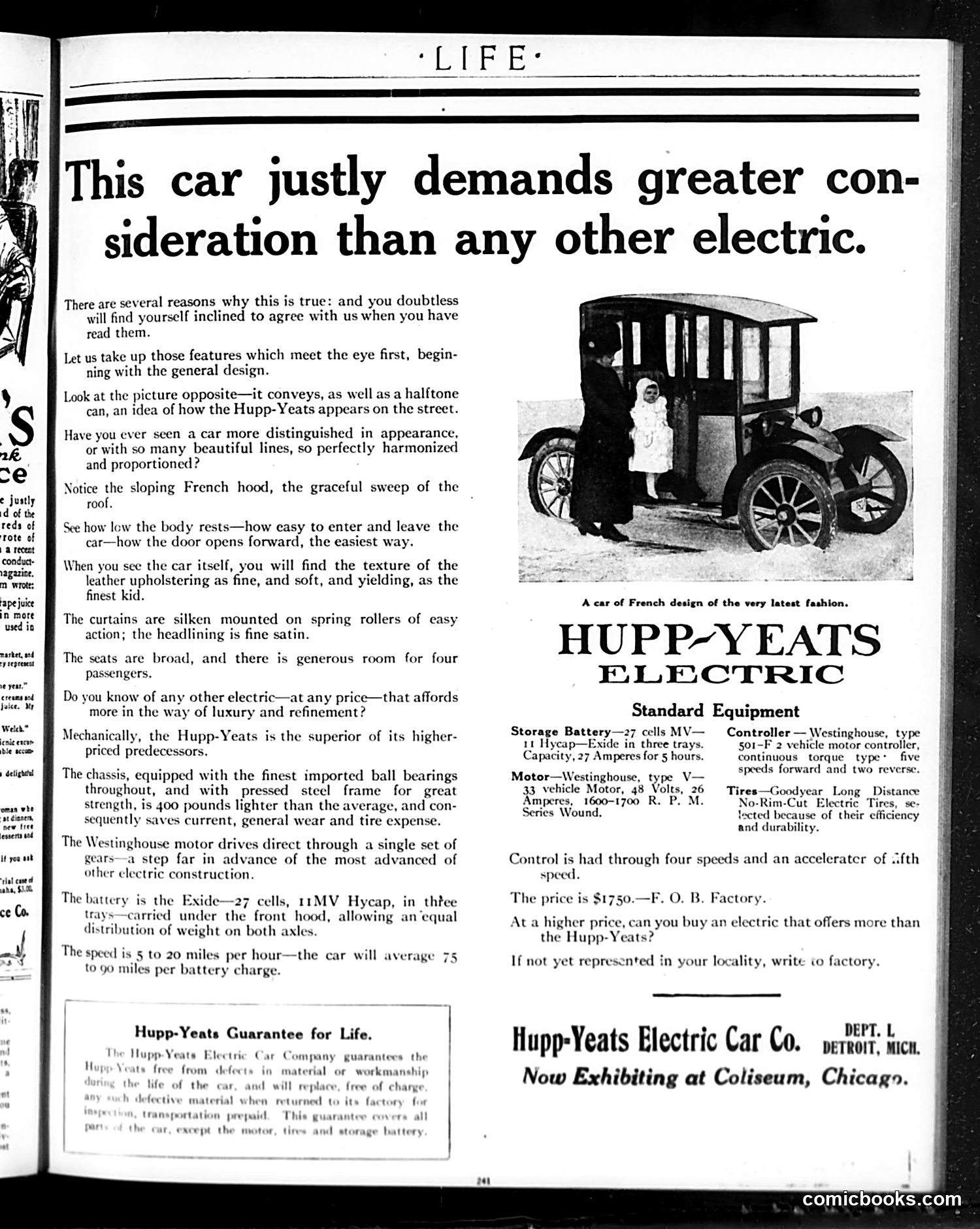
This page is **not a cartoon or satire**—it's a straightforward advertisement for the Hupp-Yeats Electric automobile, published in *Life* magazine. The ad promotes an early electric car with features appealing to wealthy buyers: French design, luxurious leather upholstery, easy entry/exit, and refinement. The photograph shows a well-dressed woman entering the vehicle, emphasizing elegance and ease of use. Key details advertised include: 27-cell battery, Westinghouse motor, 5-20 mph speed, $1,750 price tag, and a "Guarantee for Life" warranty. This reflects the historical moment when electric vehicles were serious competitors to gasoline cars, particularly marketed toward affluent consumers and women drivers who appreciated the quiet, clean operation.
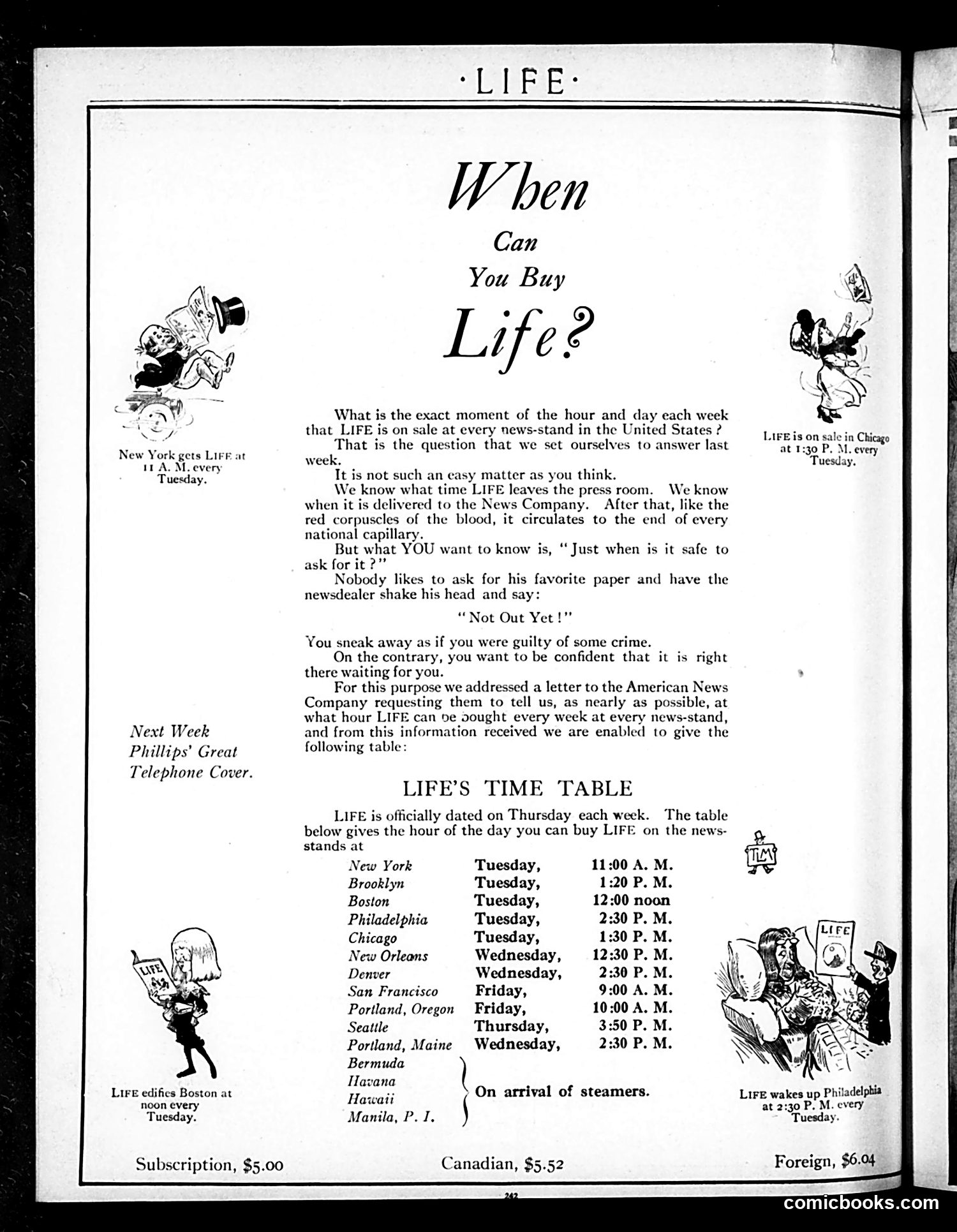
This page is primarily **informational advertising** for Life magazine itself, not political satire. The central content is a practical "Time Table" answering readers' frequent question: when exactly can they purchase the latest issue at newsstands across America? Life was officially dated Thursday but distributed earlier in various cities. The small cartoons are generic illustrations—figures buying or reading Life—not specific caricatures of identifiable people. They simply reinforce the magazine's availability. The tone is tongue-in-cheek: readers apparently felt guilty or sneaky asking newsboys "Not Out Yet!" The page humorously acknowledges this social awkwardness while providing the straightforward distribution schedule. This reflects Life's prominent place in American popular culture and readers' eagerness for each new issue.
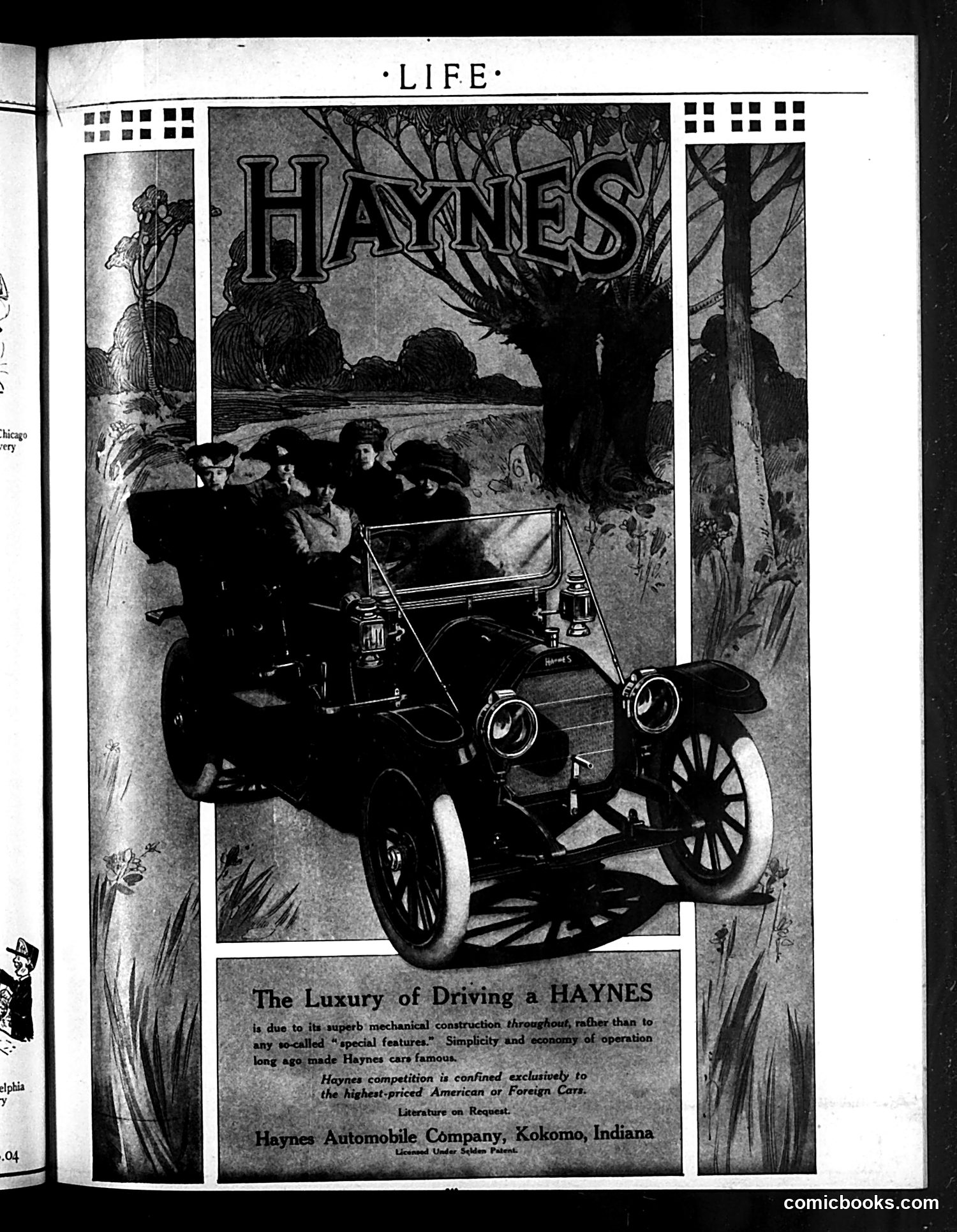
This is a **full-page advertisement**, not political satire. It promotes the Haynes automobile, manufactured in Kokomo, Indiana. The ad features an illustration of an early motorcar carrying well-dressed passengers through a scenic landscape with trees. The marketing copy emphasizes that the Haynes' appeal comes from "superb mechanical construction" rather than flashy "special features," highlighting "simplicity and economy of operation." A key claim states that "Haynes competition is confined, exclusively to the highest-priced American or Foreign Cars"—positioning it as a luxury vehicle despite its practical design philosophy. The ad represents early automotive marketing, targeting affluent buyers seeking reliable, well-engineered automobiles during the era when cars were still luxury goods.
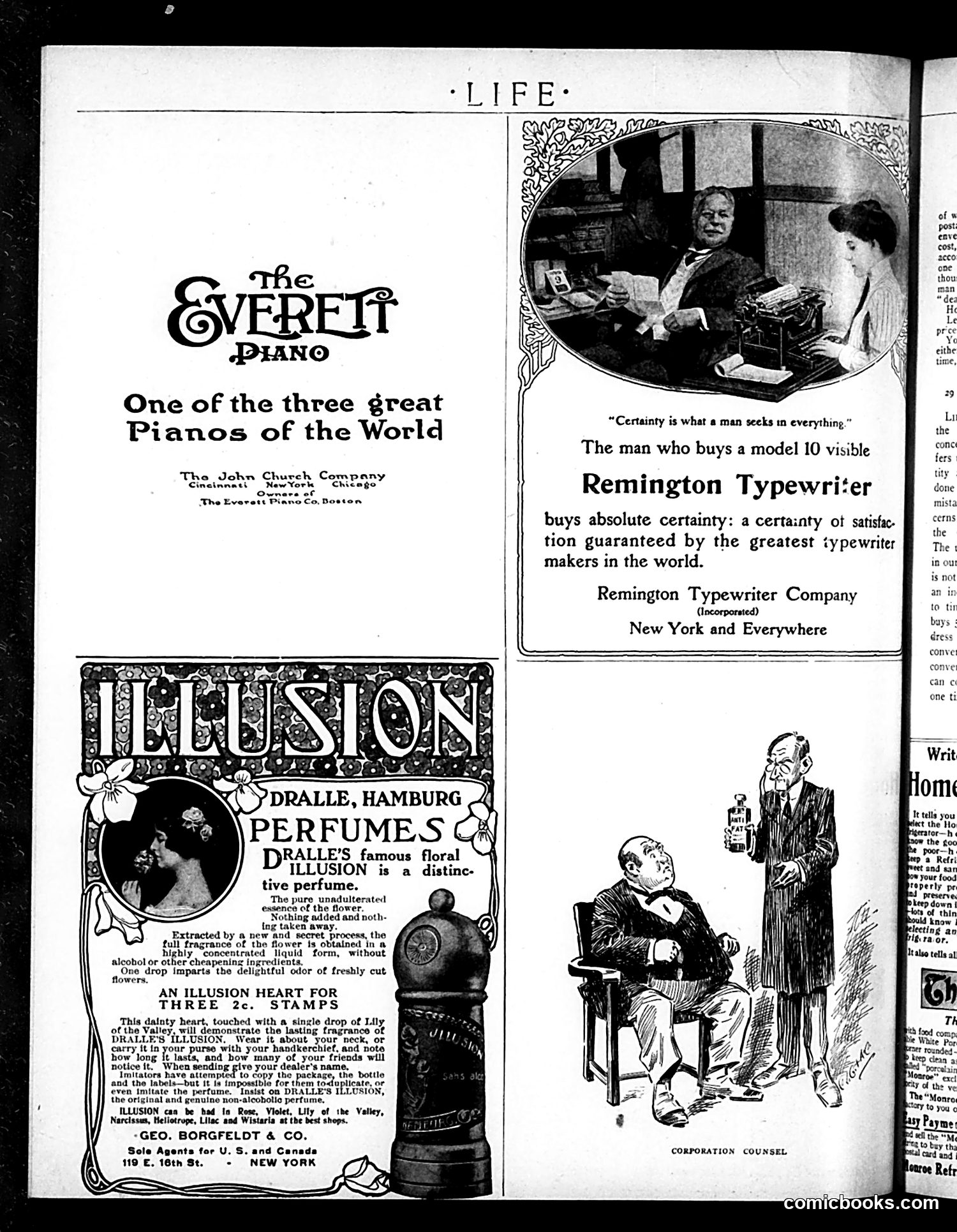
This page is primarily **advertising content** from Life magazine, not political satire or editorial cartoons. The page features three advertisements: 1. **Everett Piano** — promotes it as "one of the three great Pianos of the World" 2. **Dralle's Illusion Perfume** — ornate ad emphasizing its floral fragrance and purity 3. **Remington Typewriter** — advertises the "Model 10" with an image of an office scene Below is a sketch labeled **"Corporation Counsel"** showing two men in business attire — appears to be a generic illustration about business dealings rather than satire of specific historical figures. The page is a typical early 20th-century magazine spread mixing consumer goods advertising with minimal editorial content. No clear political commentary or satirical intent is evident.
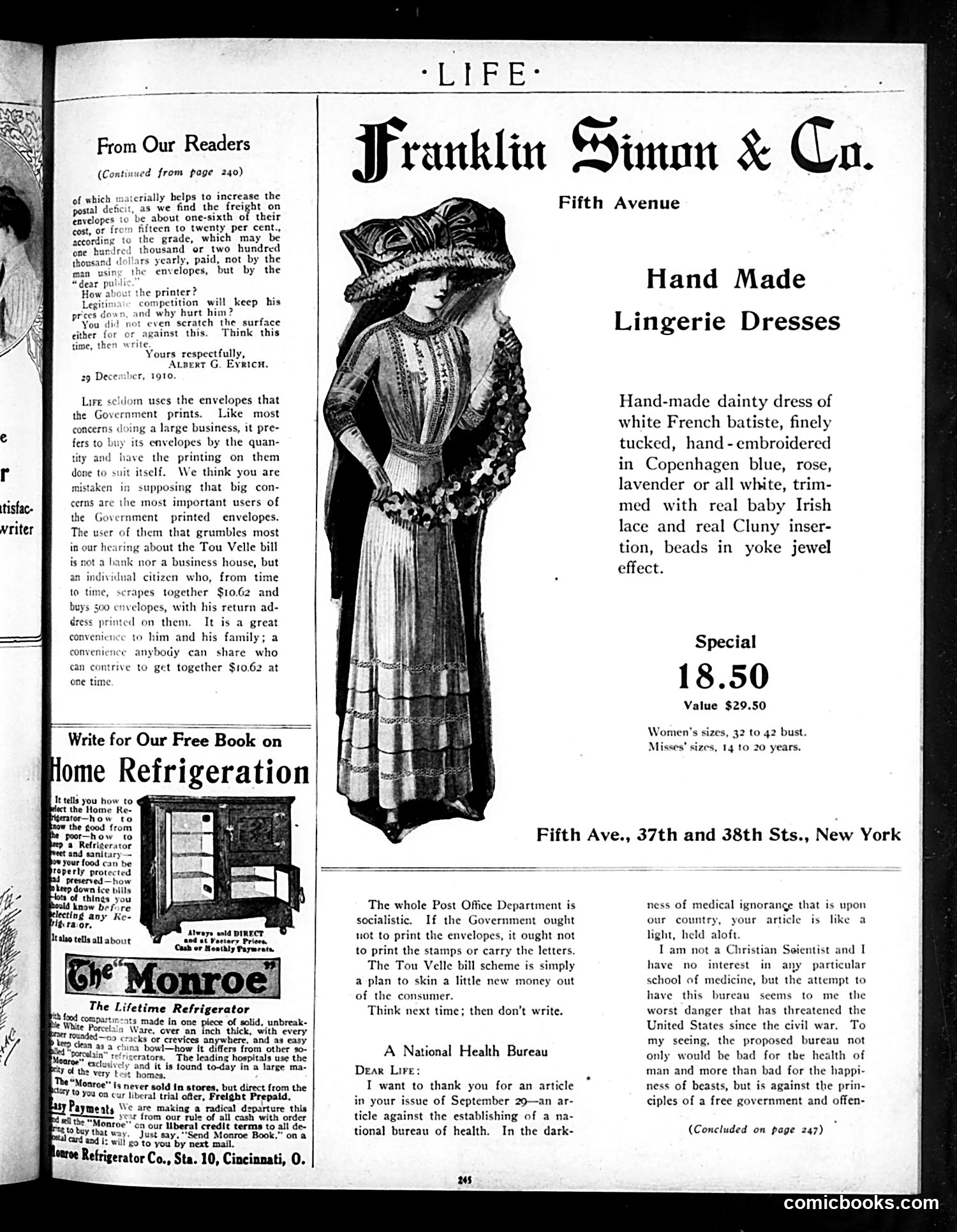
This page is primarily **advertising and reader letters**, not satirical content. The main visual is a **fashion advertisement** for Franklin Simon & Co. showing an elegantly dressed woman in a hand-made lingerie dress priced at $18.50 (marked down from $29.50). The illustration is typical early 20th-century fashion advertising with no political or satirical intent. The left column contains reader correspondence debating **government postal practices**—specifically whether the Post Office should print envelopes and whether this represents wasteful spending. One letter argues the practice is economical; another defends it against criticism. A secondary ad promotes Monroe brand **home refrigerators**. The page reflects contemporary commercial and civic debates but contains **no cartoon, caricature, or satire** requiring historical context beyond recognizing this as vintage advertising and opinion correspondence.
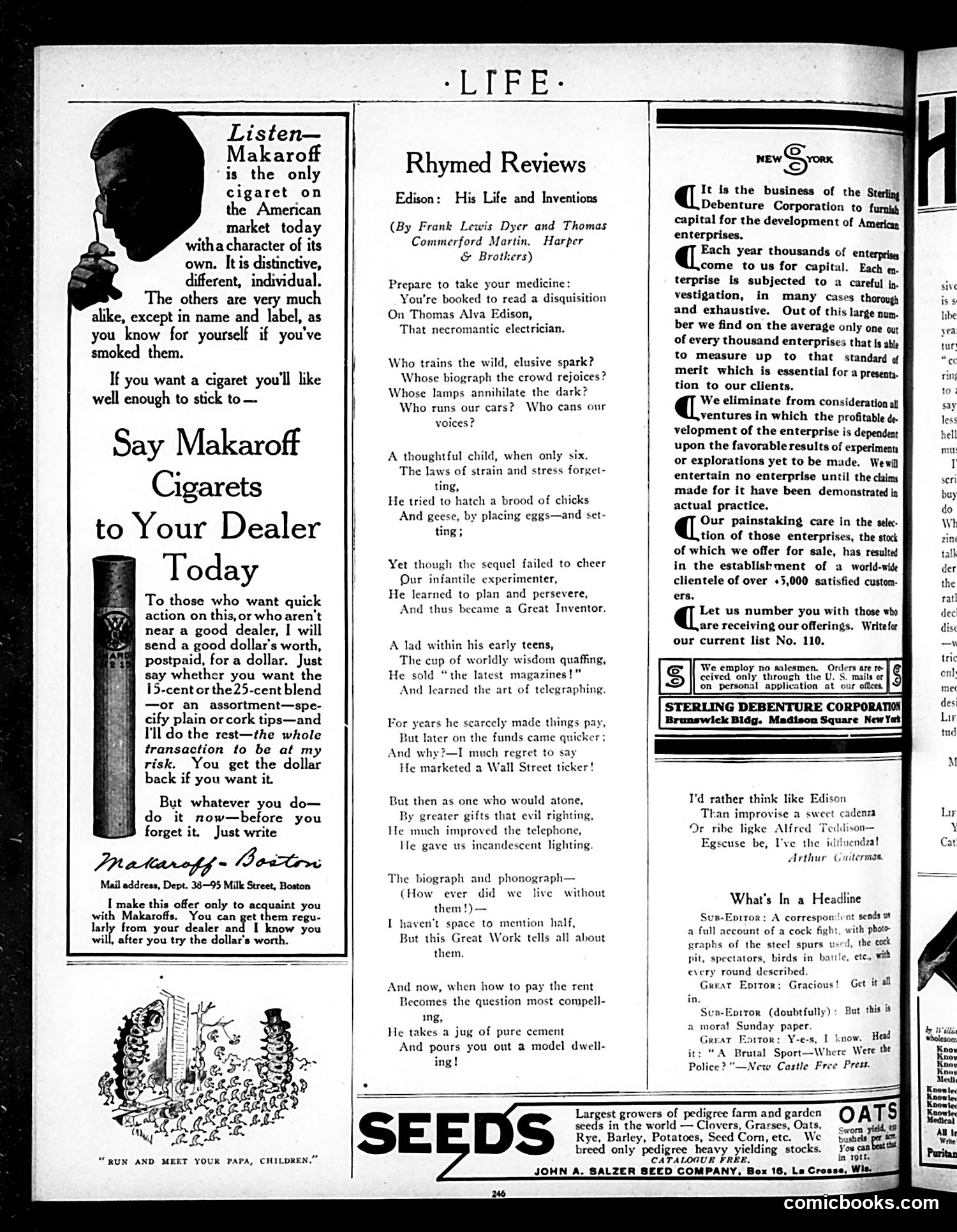
This page is primarily **advertising and editorial content** rather than political satire. The left side features a **Makaroff Cigarettes advertisement** with a silhouetted male figure smoking, emphasizing the product's distinctive character. The center contains **"Rhymed Reviews: Edison: His Life and Inventions,"** a humorous poem about Thomas Edison by Frank Lewis Dyer and Thomas Commerford Martin. The verse humorously catalogs Edison's inventions—the lightbulb, telephone improvements, and motion picture technology—using rhymed couplets to celebrate his achievements as "a Great Inventor." The right side includes business advertisements for the **Sterling Debenture Corporation** and seed companies. There is no significant political cartoon or social satire on this page—it's a standard early 20th-century magazine layout mixing advertising with light entertainment content.
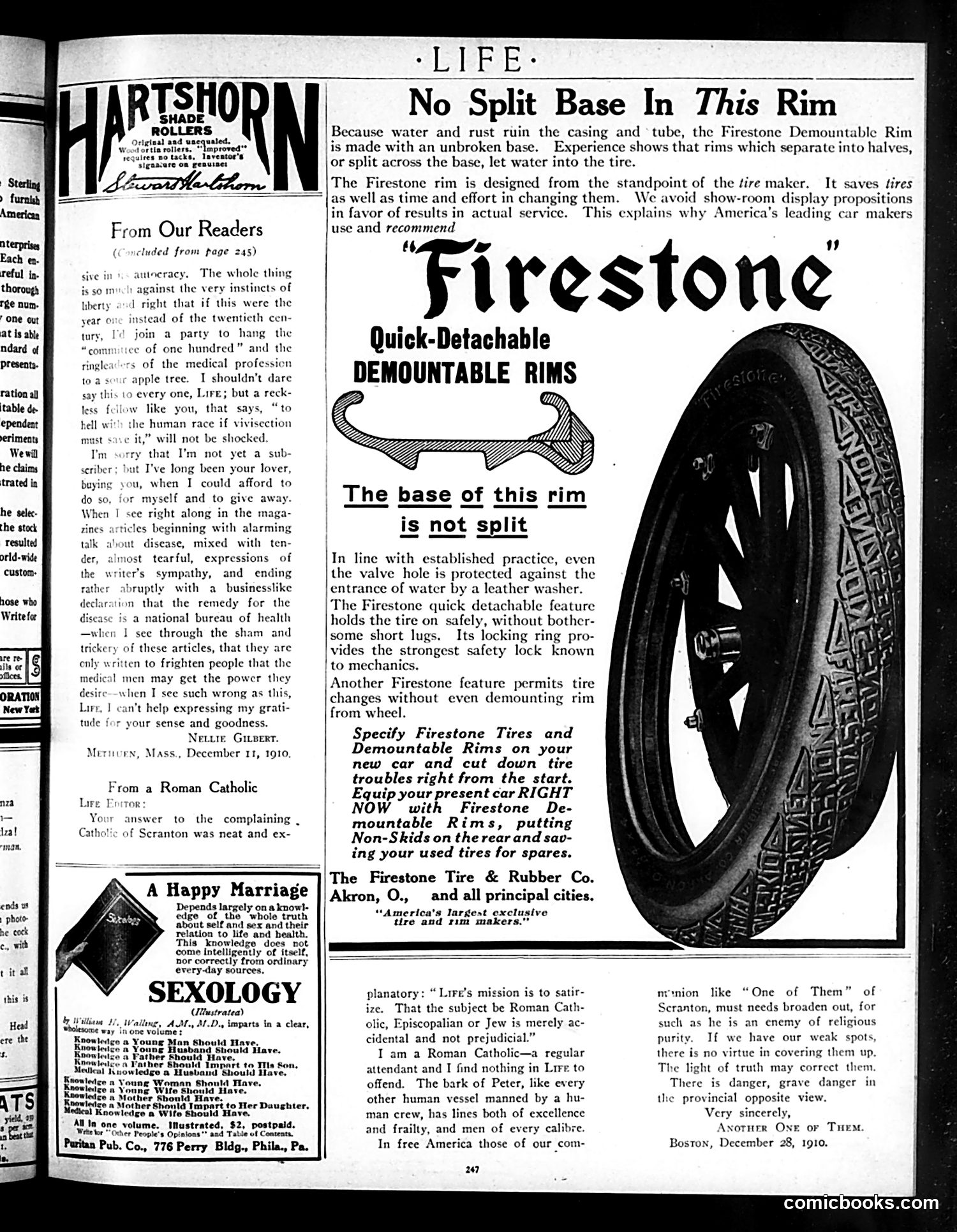
This page is primarily **advertising**, not satire or editorial cartooning. The dominant content is a full-page Firestone tire advertisement showcasing their "Quick-Detachable Demountable Rims" with the key selling point: "The base of this rim is not split." The ad emphasizes practical benefits—preventing water damage, easier tire changes, and safety features—aimed at early automotive owners who frequently dealt with tire maintenance. The left column contains reader letters and a small book advertisement for "Sexology," unrelated to the tire ad. There is no political cartoon or satire on this page. It represents typical early-twentieth-century *Life* magazine content: humor publication interspersed with commercial advertisements targeting middle-class consumers.
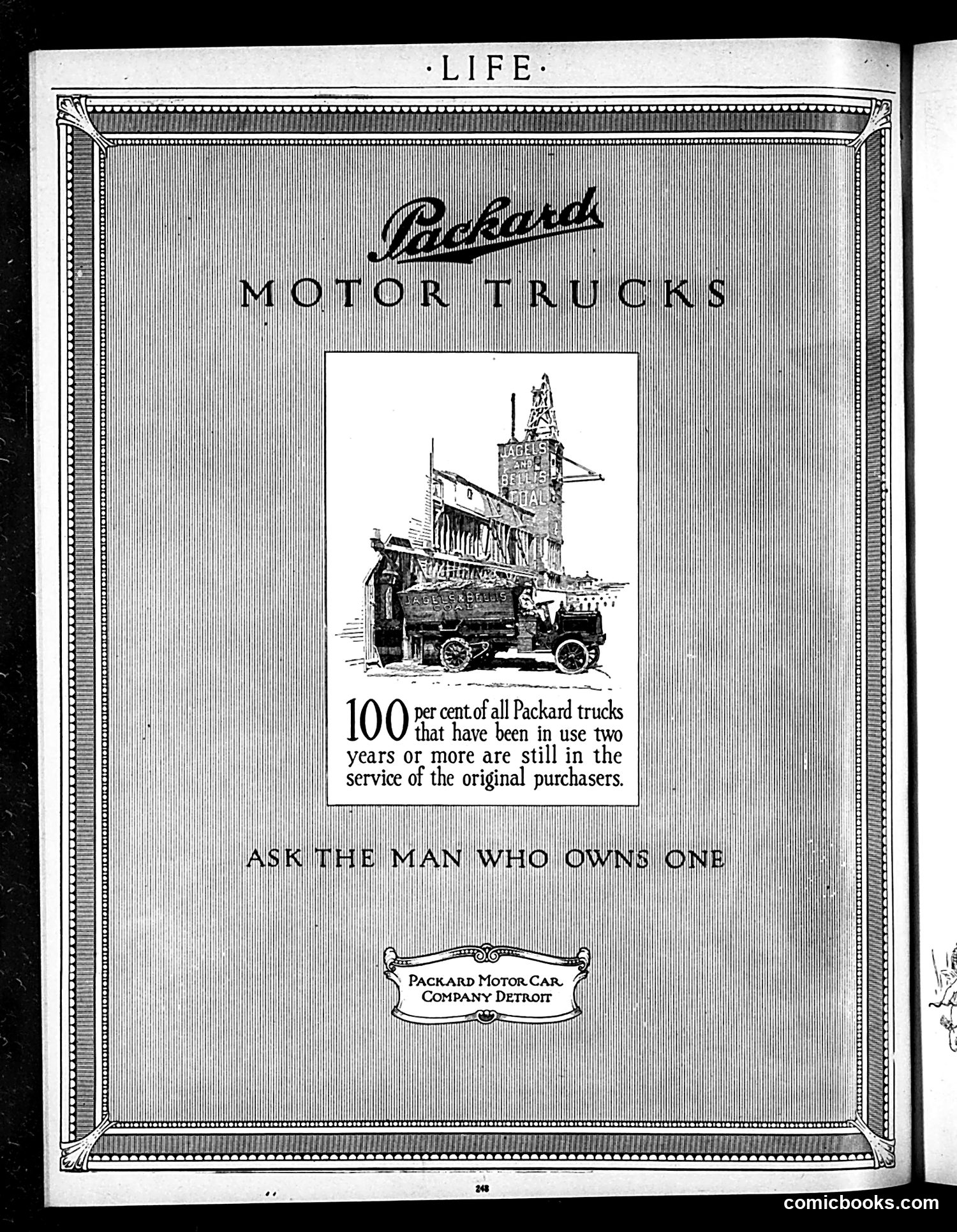
This is a **Packard Motor Truck advertisement**, not satirical content. The page appears in *Life* magazine and promotes Packard's commercial vehicles. The ad features an illustration of a Packard truck positioned in front of an ornate building (possibly a civic or institutional structure), emphasizing the vehicle's sturdy, reliable appearance. The advertisement's central claim is that **100% of all Packard trucks in use for two or more years remain in original service with their first owners**—a durability assertion meant to convince potential business buyers of the product's quality and longevity. The closing line, "ASK THE MAN WHO OWNS ONE," was Packard's actual marketing slogan, positioning owner testimony as proof of reliability. This is straightforward commercial advertising rather than satire or political commentary.
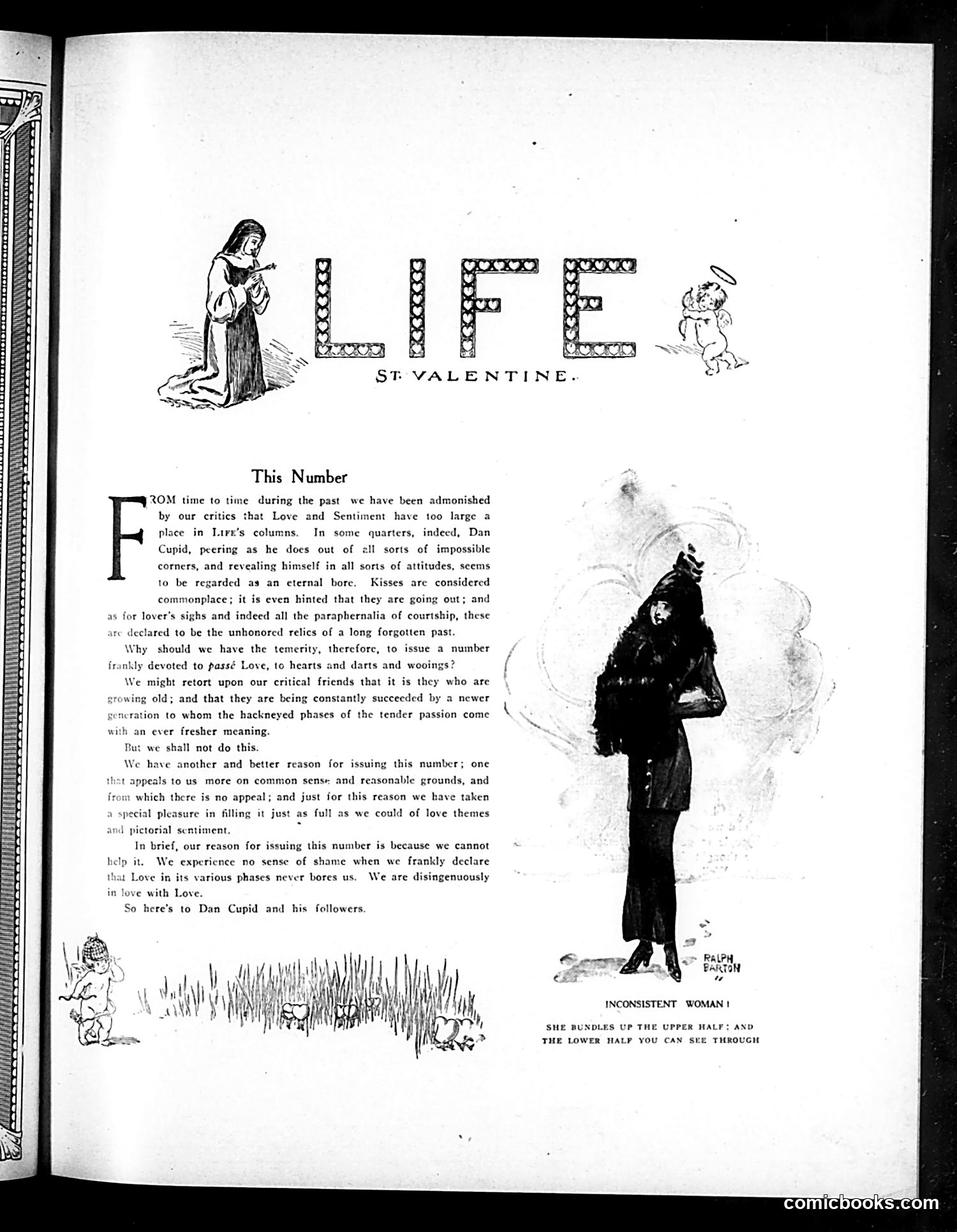
This is a St. Valentine's Day special issue of *Life* magazine. The editorial introduction defends the magazine's decision to devote an entire issue to love and sentiment, responding to critics (apparently including humorist Dan Cupid) who claim such topics are outdated and overly sentimental. The editors argue that love remains eternally relevant and that cynics are simply growing old. They assert there's "no sense of shame" in celebrating love's various expressions. The cartoon on the right, captioned "Inconsistent Woman," depicts a bundled female figure from behind—showing her upper half wrapped warmly while the lower half remains visible through transparent material. This appears to be a visual joke about contradictory female behavior or fashion choices, typical of *Life*'s satirical humor targeting social conventions and gender relations of the era.
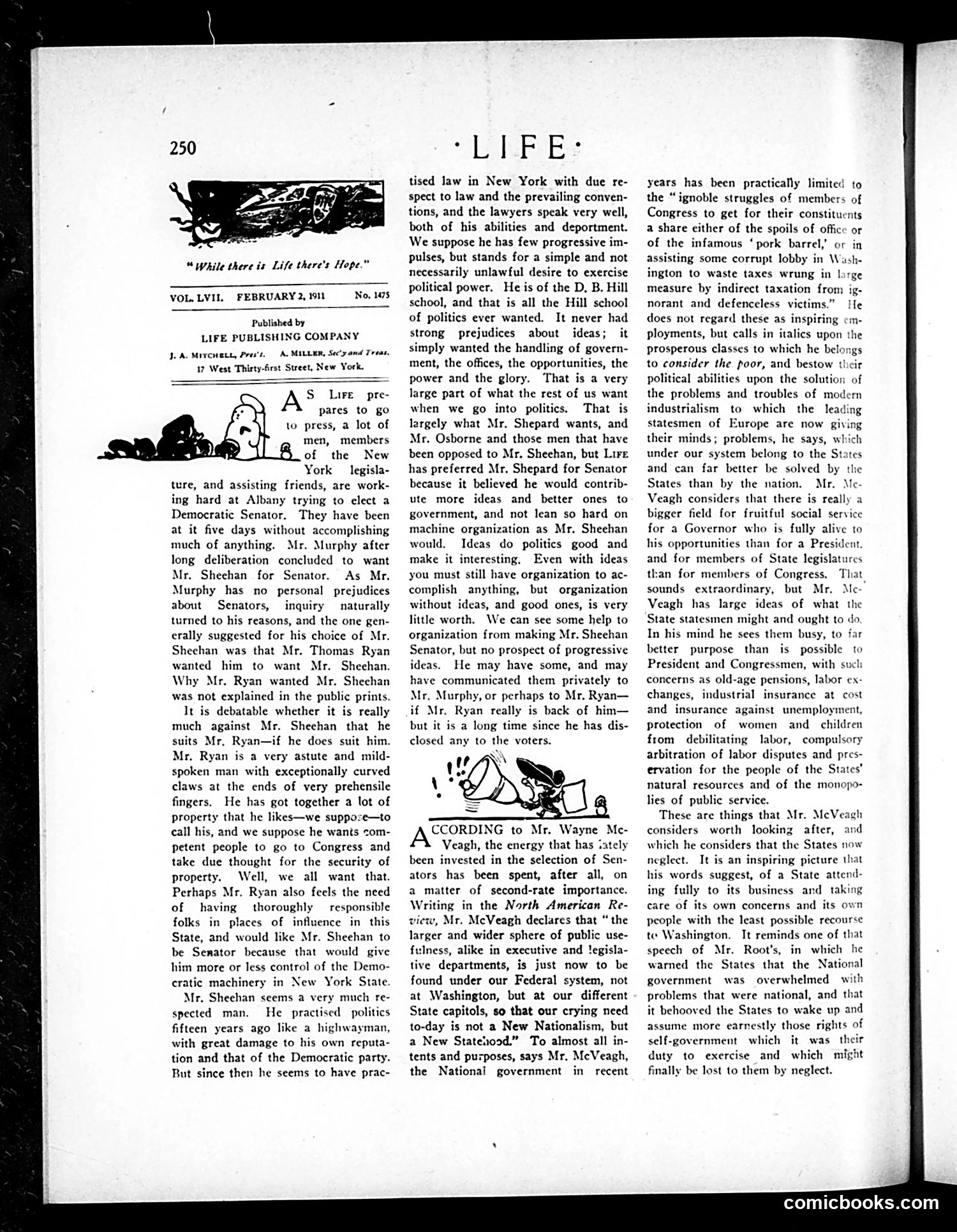
This page satirizes the 1911 New York State Democratic Senate election. The piece attacks political machine control, specifically targeting: **The Setup:** Machine boss **Charles F. Murphy** wants to elect **William F. Sheehan** as Senator, allegedly at the behest of wealthy financier **Thomas Ryan**, whose influence over candidates Life finds concerning. **The Satire:** Life criticizes Sheehan as representing the old "D. B. Hill school" of politics—interested only in power and patronage, lacking progressive ideas. Though respecting Sheehan's recent legal practice, Life prefers candidate **Shepard** (or **Osborne**) for bringing actual ideas to government, not just machine organization. **The Cartoon** (left, partially visible) appears to mock this backroom wheeling. **The Point:** Life argues that property-holder Ryan and machine politician Murphy control candidates without regard for genuine reform or public interest—a classic Progressive Era critique of political corruption and corporate influence over nominations.
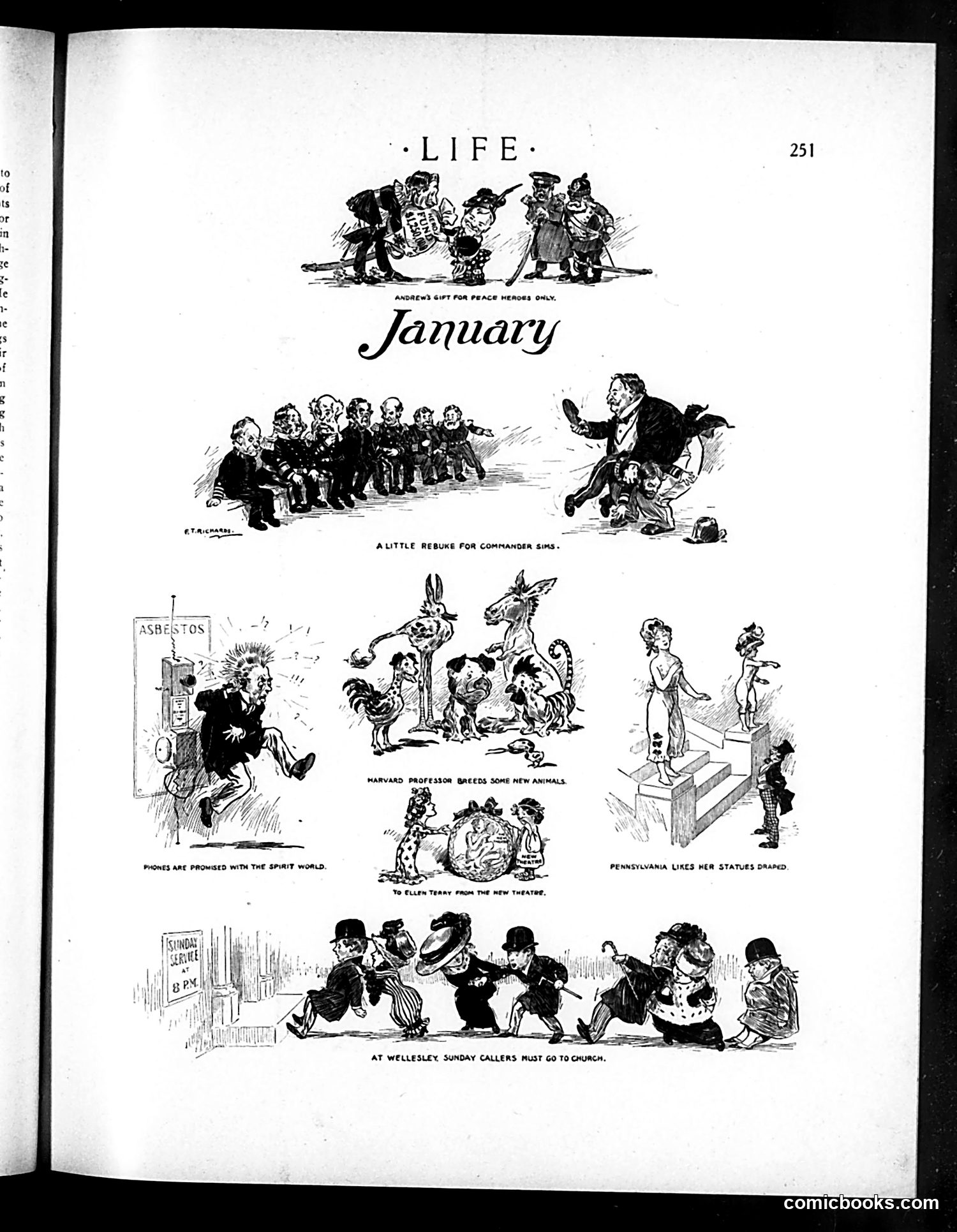
This page contains several satirical cartoons commenting on early 20th-century social and political issues: **Top cartoon**: "Andrews' Gift for Peace Heroes Only" appears to mock peace advocates or pacifists. **Middle section**: References Harvard professors acquiring "new animals," Pennsylvania's statue unveiling, and "Ether Theory from the New Thespian" (theatrical reference). **Key cartoon**: "A Little Rebuke for Commander Sims" targets a naval commander for some controversial action. **Phones and spirit world**: One cartoon jokes about spiritualism being "in fashion." **Bottom cartoon**: "At Wellesley, Sunday Callers Must Go to Church" satirizes strict social rules at the women's college, showing visitors forced to attend services—likely mocking rigid institutional morality or dating restrictions. The cartoons are typical Life magazine fare: social commentary through caricature targeting institutions, public figures, and genteel American customs.
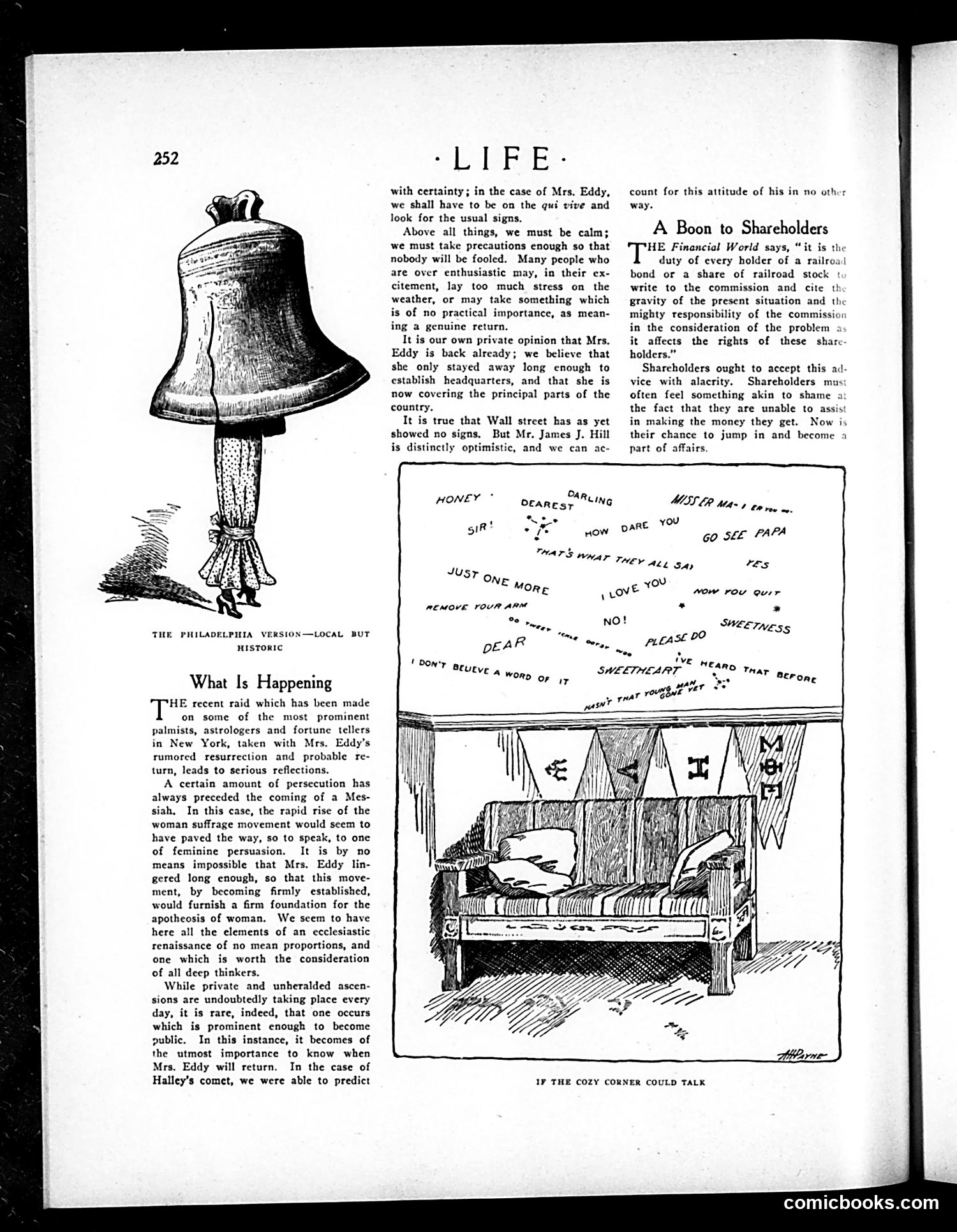
This page contains two distinct satirical pieces: **"What Is Happening"** mocks the mystical fervor surrounding Mary Baker Eddy (founder of Christian Science) and contemporary spiritualism. The text humorously suggests her rumored "return" parallels messianic prophecy, comparing prediction of her reappearance to calculating Halley's Comet. The piece satirizes both credulous believers and Wall Street's optimism, implying financial interests exploit spiritual movements. **"The Philadelphia Version"** is an illustration satirizing a bell—likely referencing the Liberty Bell—depicted as "local but historic," mocking Philadelphia's obsession with its historical monuments. **"If the Cozy Corner Could Talk"** (bottom cartoon) shows a couple in bed surrounded by sentimental love notes and messages. The satire appears to mock excessive sentimentality and the gap between romantic declarations and marital reality—the cozy domesticity doesn't match the passionate language adorning the bedroom. The page overall ridicules early 1900s American gullibility toward spiritualism, romantic excess, and self-deception.
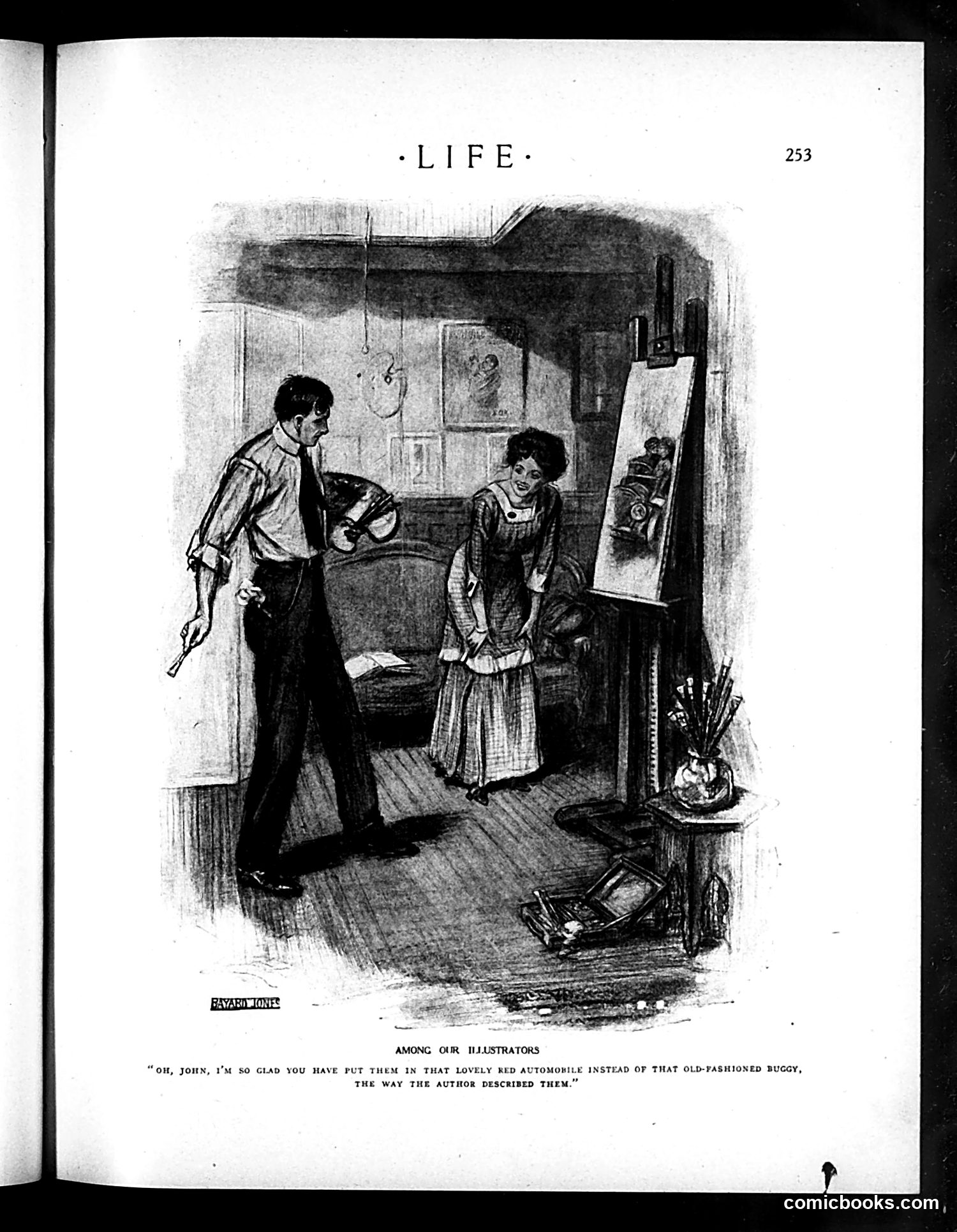
This is a behind-the-scenes satirical piece about book illustration. It shows an illustrator (John) with a woman viewing his artwork on an easel. The joke critiques the illustrator's creative liberty: he's depicted characters in a modern red automobile rather than the old-fashioned buggy the author originally described in the text. The woman's comment is sarcastic—she's praising his decision to modernize the scene, but the satire suggests illustrators were taking unauthorized liberties with authors' work, substituting contemporary details (the automobile was still relatively new/fashionable) for what was actually written. This reflects early 20th-century tensions between authors and illustrators over artistic interpretation and fidelity to source material.
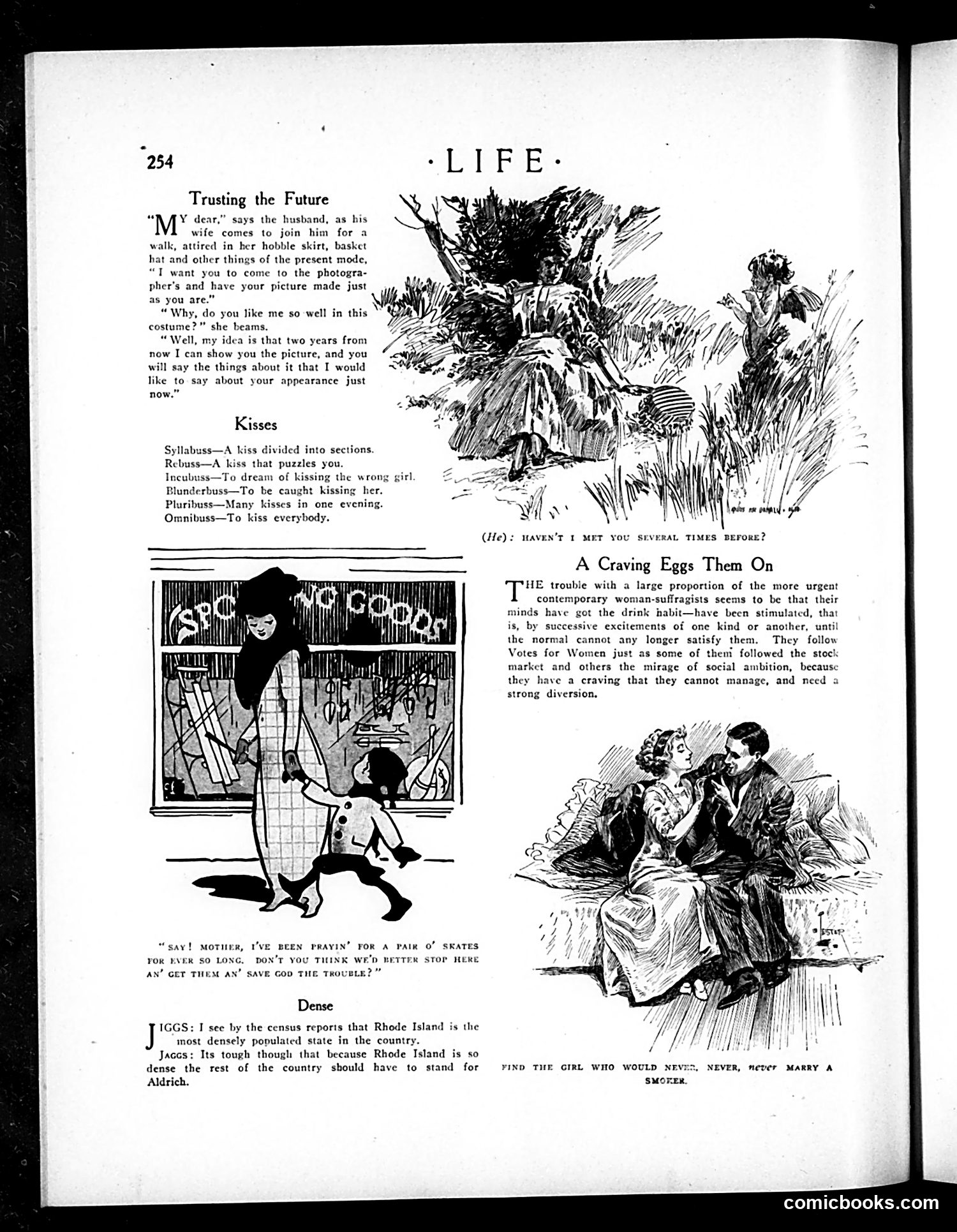
This page contains three separate satirical pieces from Life magazine: **"Trusting the Future"**: A husband convinces his wife to be photographed in her current fashionable outfit (hobble skirt, basket hat)—implying that in two years he'll want to mock how ridiculous her present-day fashion choices look. This satirizes the rapid changes in women's fashion during this era and male condescension toward women's style. **"A Craving Eggs Them On"**: This attacks women's suffragists, comparing their desire for voting rights to an addictive "drink habit" that requires constant stimulation. The piece dismisses suffragism as mere excitement-seeking rather than legitimate political activism. This reflects anti-suffrage propaganda common before women gained voting rights. **"Dense"**: A brief joke playing on the word "dense"—Rhode Island's population density versus the intellectual density of a character named Aldrich (likely a political figure, unclear from context). The cartoons reflect early 20th-century attitudes: mockery of women's fashion, hostility toward women's suffrage, and casual sexism.
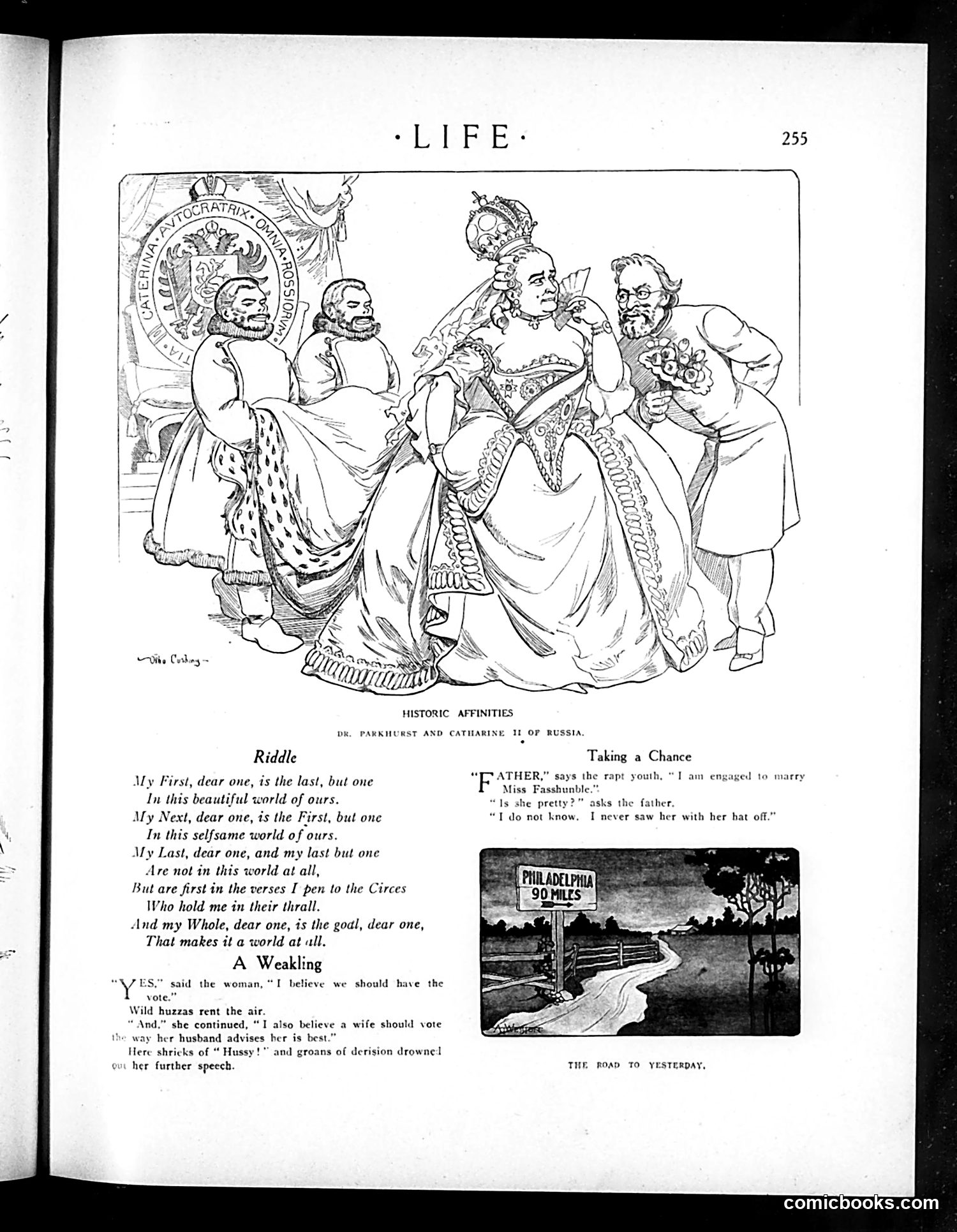
The page contains three satirical pieces typical of early Life magazine: **"Historic Affinities"** compares Dr. Parkhurst (a real New York reformer/clergyman) with Catherine II of Russia through caricature, likely mocking his authoritarian reformist tendencies by equating them to autocratic rule. **"Riddle"** is a wordplay poem, unrelated to satire. **"A Weakling"** mocks women's suffrage advocates by presenting a woman who supports voting rights but then undermines herself by saying wives should vote as husbands advise—satirizing the perceived weakness or inconsistency of pro-suffrage arguments. **"Taking a Chance"** jokes about a young man engaged to a woman whose appearance he's never seen without her hat—satirizing either women's elaborate fashion/hats of the era or the foolishness of marrying without truly knowing one's fiancée. **"The Road to Yesterday"** (image caption) is unclear without seeing the full illustration, but appears nostalgic in tone. The overall page reflects early 20th-century anxieties about women's rights, fashion, and marriage customs.
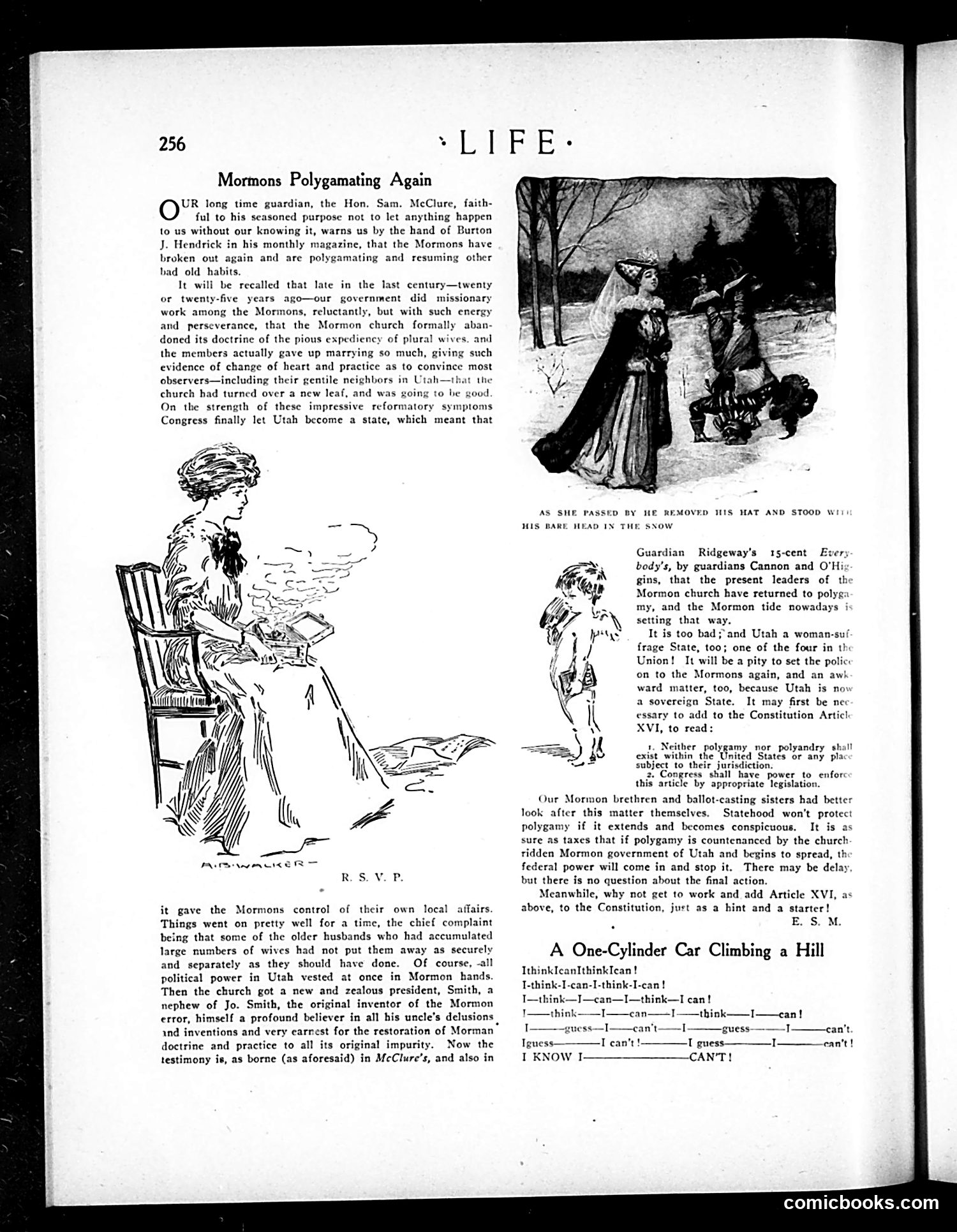
This article satirizes the resurgence of polygamy among Mormon (Latter-day Saint) leadership in Utah. The text explains that after the U.S. government pressured the Mormon church to abandon polygamy in the late 1800s, they formally renounced it, allowing Utah statehood. However, the new Mormon president (apparently a nephew of founder Joseph Smith) has allegedly returned to practicing plural marriage. The satire's barb: Utah recently became a woman-suffrage state—one of only four in the Union—yet remains controlled by a church embracing polygamy. The author argues federal intervention may be necessary and sarcastically suggests adding a Constitutional amendment to prevent it. The accompanying illustrations (a woman in winter, a man removing his hat respectfully) appear to depict scenes from Mormon life, though their specific narrative is unclear from the OCR'd caption.
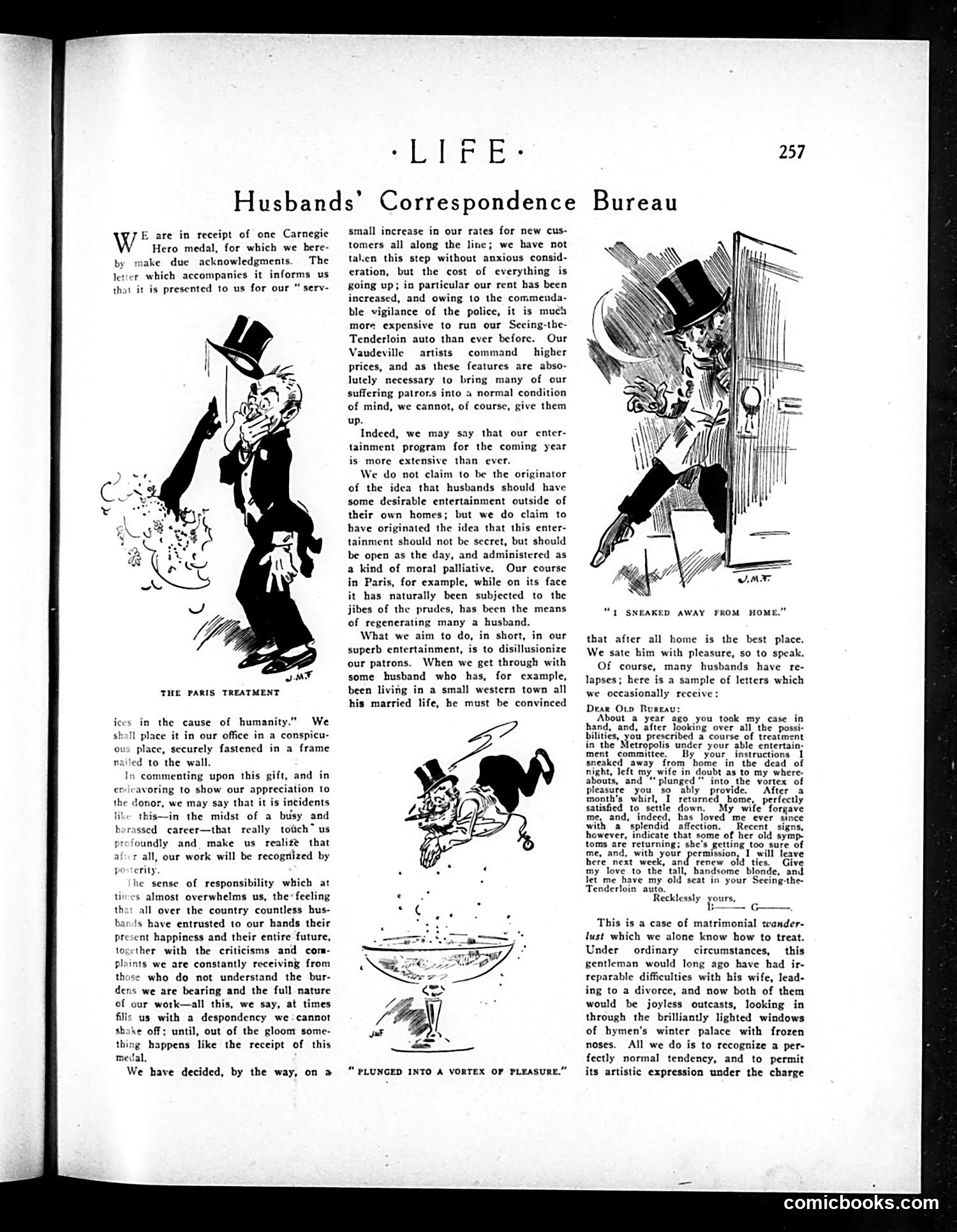
This is satirical commentary on a fictional service purporting to "treat" restless husbands through sanctioned infidelity and entertainment. The bureau claims to operate as a moral institution—providing "entertainment" (implying affairs, visits to red-light districts like Paris's Tenderloin) to prevent marital dissolution. The cartoons show men sneaking away and indulging in vices while the bureau presents this as therapeutic. The sample letter depicts a husband who, after being deliberately sent away to experience pleasure, returns "satisfied" and his wife consequently loves him more—an absurd premise satirizing male entitlement and hypocrisy. The satire targets turn-of-the-century attitudes: the double standard allowing men secret escapades while wives remain faithful, the cynical marketing of vice as marital preservation, and the notion that infidelity somehow strengthens marriage. The "Carnegie Hero Medal" opening mockingly suggests the bureau deserves recognition for this "humanitarian" work.
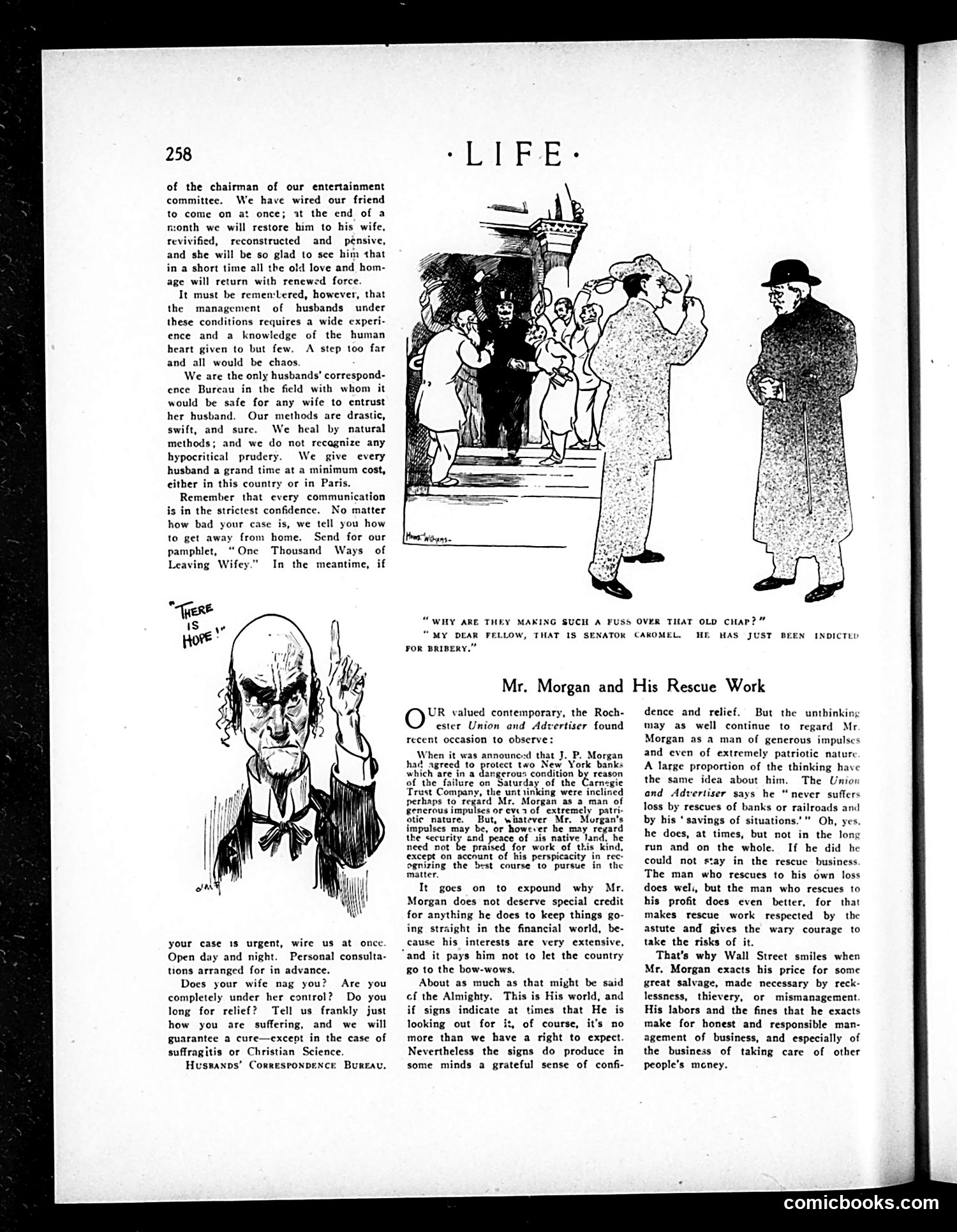
This page contains two distinct satirical pieces: **Top cartoon:** A mock advertisement for a "Husbands' Correspondence Bureau" — a fake service claiming to "rescue" nagging husbands by temporarily removing them from their wives (sending them to Paris for a month). The satire targets early 20th-century marital discord and mocks both henpecked husbands and women's increasing social authority. The bureau humorously promises results except in cases of "suffragitis" (a dig at women's suffrage activists) or Christian Science. **Bottom cartoon & article:** Criticizes financier J.P. Morgan for receiving public praise for "rescuing" failing New York banks. The piece argues Morgan deserves no special credit—he's merely protecting his own financial interests, not acting from patriotism or generosity. The satire suggests that those praising Morgan are "unthinking," while acknowledging that self-interested rescue work is still useful to society. Both pieces mock naive public perception and self-serving behavior dressed up as virtue.
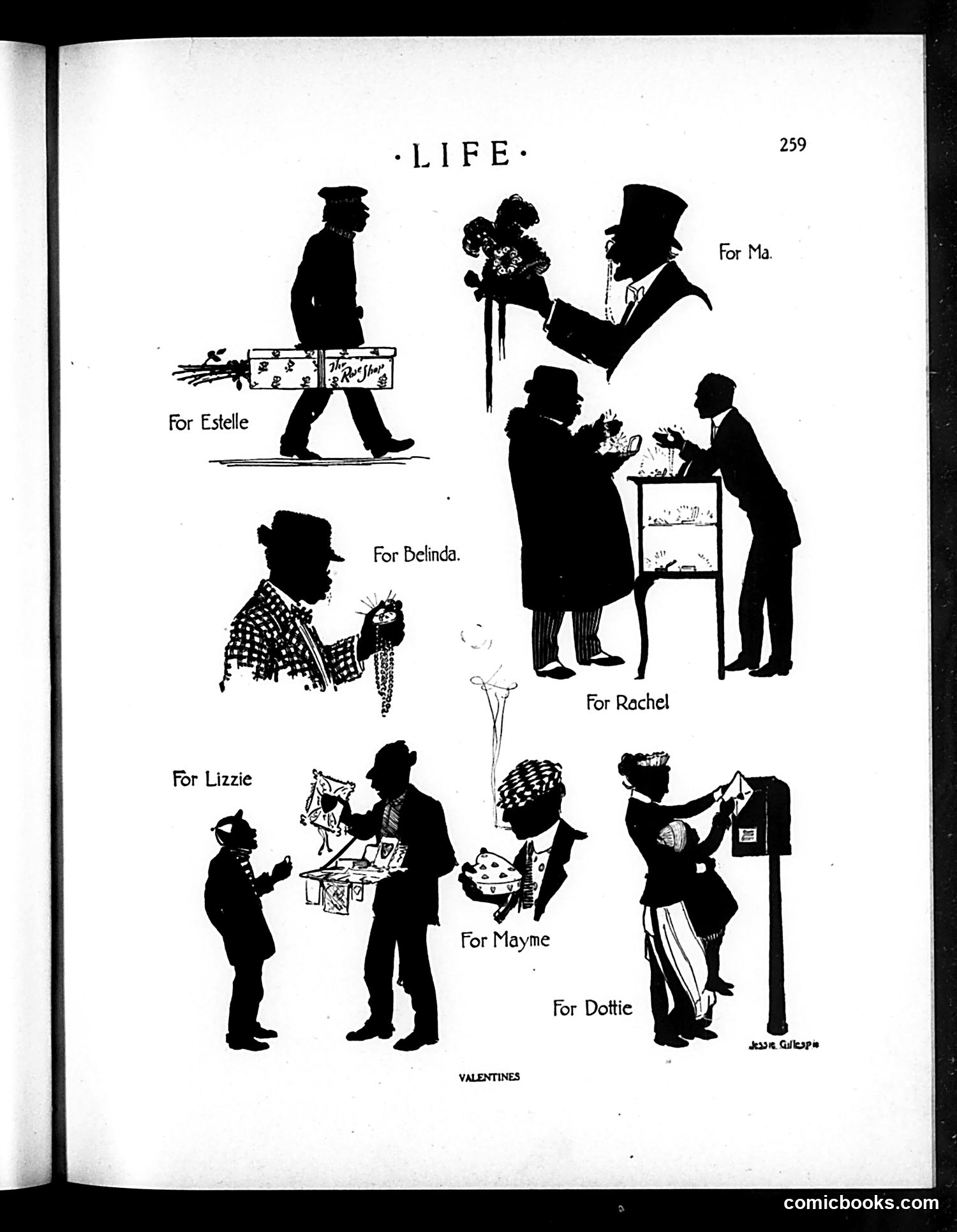
This is a humorous Valentine's Day illustration from *Life* magazine (page 259) showing silhouetted figures giving gifts labeled for various women: Estelle, Belinda, Rachel, Lizzie, Mayme, Dottie, and Ma. The joke appears to be satirizing men's romantic gestures and gift-giving. Each figure presents different items—flowers, jewelry boxes, potted plants, clothing—with labels indicating these are ostensibly for different women. The repetition and variety suggest either a man juggling multiple romantic interests simultaneously, or satirizing the commercialization of Valentine's Day through gift-giving conventions. The silhouette style and formal dress indicate this is upper-class courtship behavior being gently mocked. Without additional context, the specific identities of these women remain unclear, though they may reference contemporary public figures or represent archetypal romantic interests.
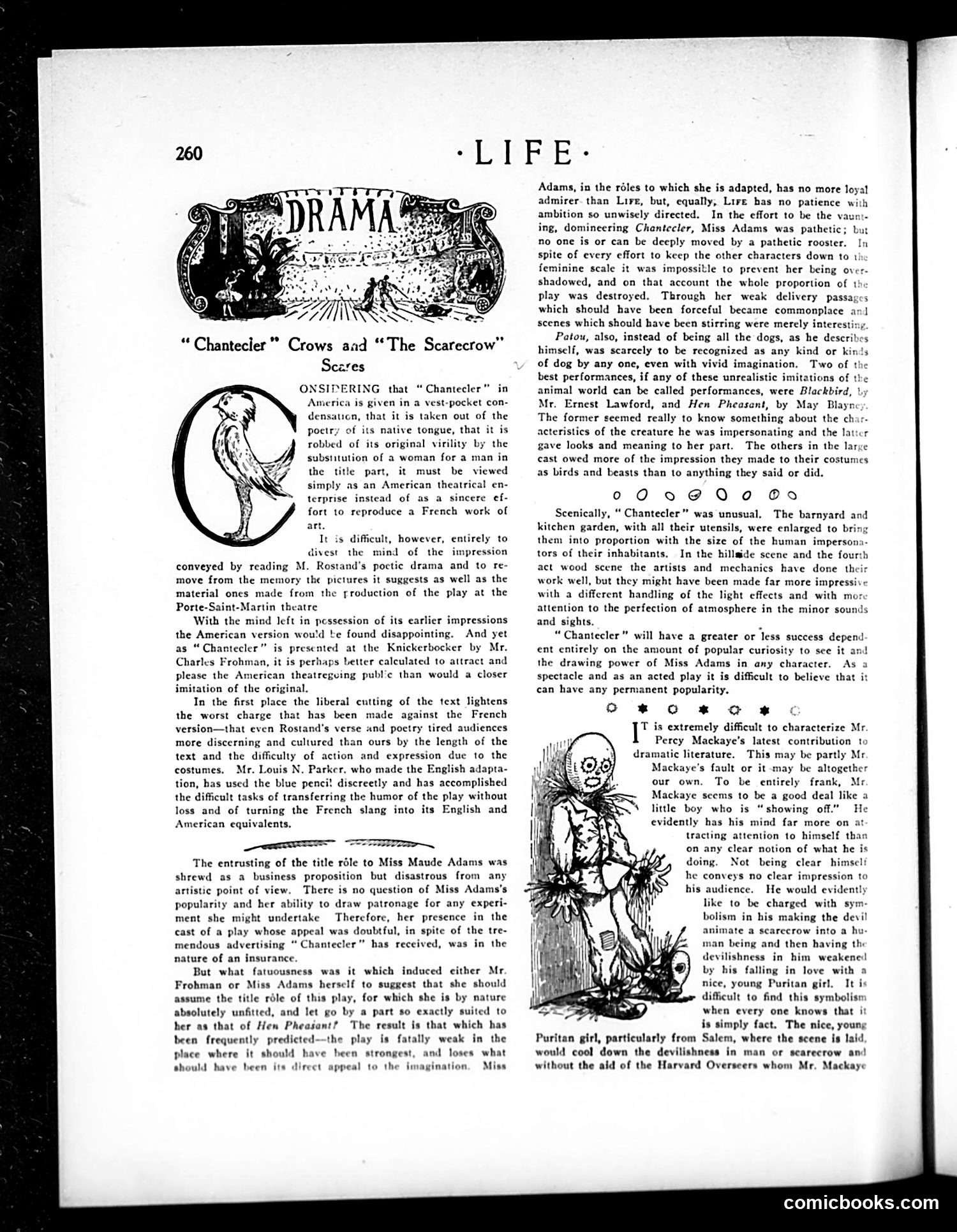
This is a theater review critiquing the American production of Edmond Rostand's French play *Chanticleer*. The key complaint: **Maude Adams, a popular American actress, was miscast in the title role.** The reviewer argues that while Adams excels in other roles and draws audiences reliably, she was "absolutely unfitted" to play the domineering rooster Chanticleer. Her performance was "pathetic," and casting her weakened the entire production—especially scenes meant to be forceful became commonplace. The reviewer notes she would have been perfectly suited to play "Hen Pheasant" instead. The cartoon of the scarecrow (right) appears to illustrate this casting disaster—a poorly constructed figure representing the hollowed-out dramatic effect of misplaced talent. The review acknowledges Adams' star power helped market the play but argues this commercial decision sacrificed artistic integrity.
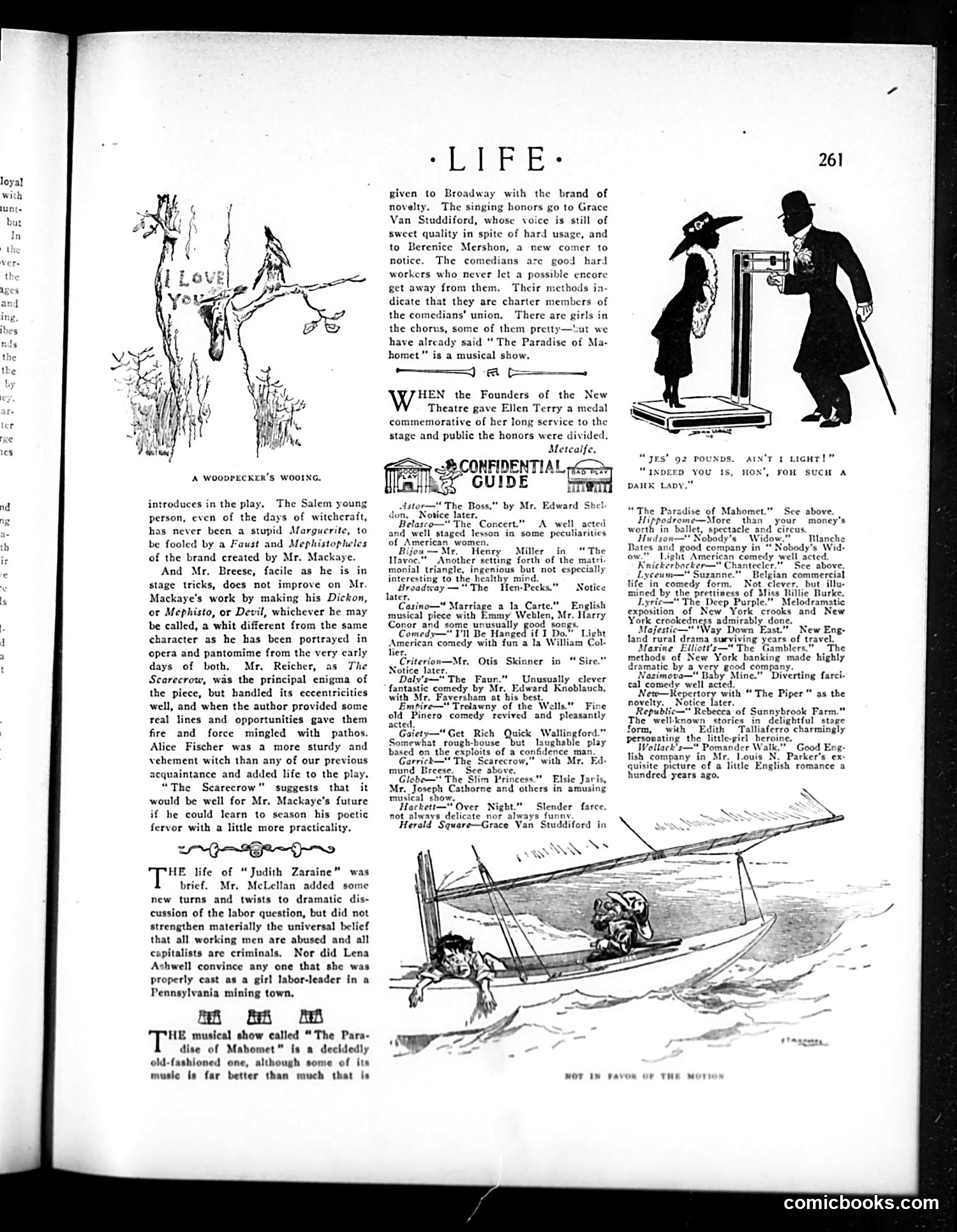
This page contains theater reviews and two satirical cartoons about entertainment and social commentary. **"A Woodpecker's Wooing"** (top left): A simple line drawing showing a woodpecker carving "I LOVE" into a tree trunk—a gentle nature joke about courting rituals. **The silhouette cartoon** (top right): Depicts a woman in a dark dress speaking to a man in formal attire near a mirror or doorway, with the caption "JES' 92 POUNDS, AIN'T I LIGHT! / 'INDEED YOU IS, HON', FOH SUCH A DARK LADY.'" This appears to mock racial stereotypes and weight-consciousness, using exaggerated dialect. **"Not in Favor of the Motion"** (bottom): A sketch of a capsized boat, likely commenting on theatrical or social controversy. The page itself reviews contemporary Broadway productions including "The Paradise of Mahomet" (musical), "The Scarecrow" (drama), and various comedies, offering critical commentary on performances and production quality typical of Life's theater criticism.
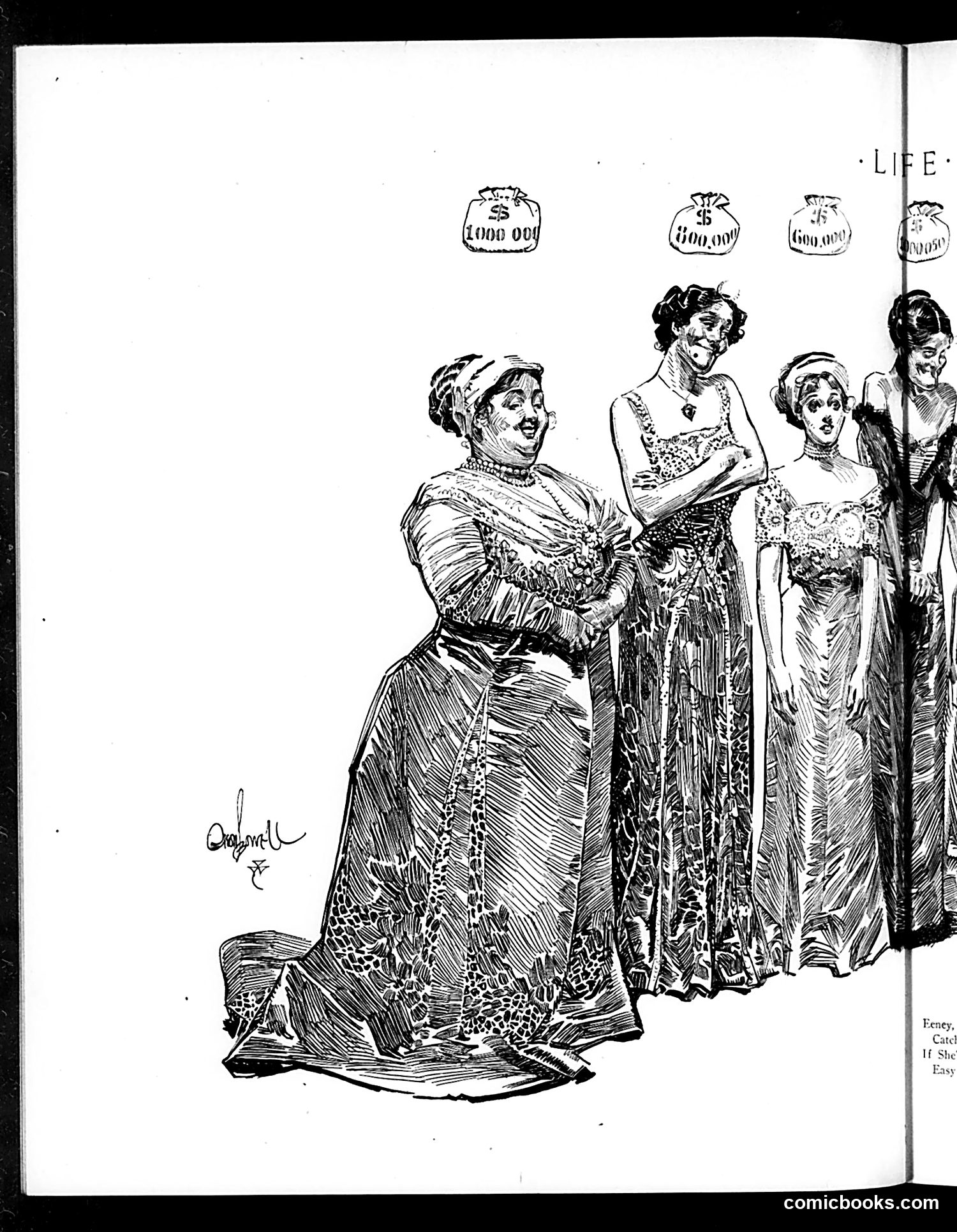
This is a satirical illustration showing a wealthy woman in an elaborate gown kneeling before a line of other elegantly dressed women. Money bags labeled with large sums (1,000,000, 800,000, 600,000, etc.) float above, suggesting financial amounts or dowries. The cartoon appears to satirize **wealth-based social hierarchy and marriage markets among the wealthy elite**. The kneeling woman's supplicant posture and the descending money amounts suggest she's either seeking favor from or ranked below these other women based on financial status. The signature reads "Ceswell" (or similar). Without the article's text or date, the exact social commentary remains unclear, but it likely critiques how money determined women's social standing and marriageability in early 20th-century high society.
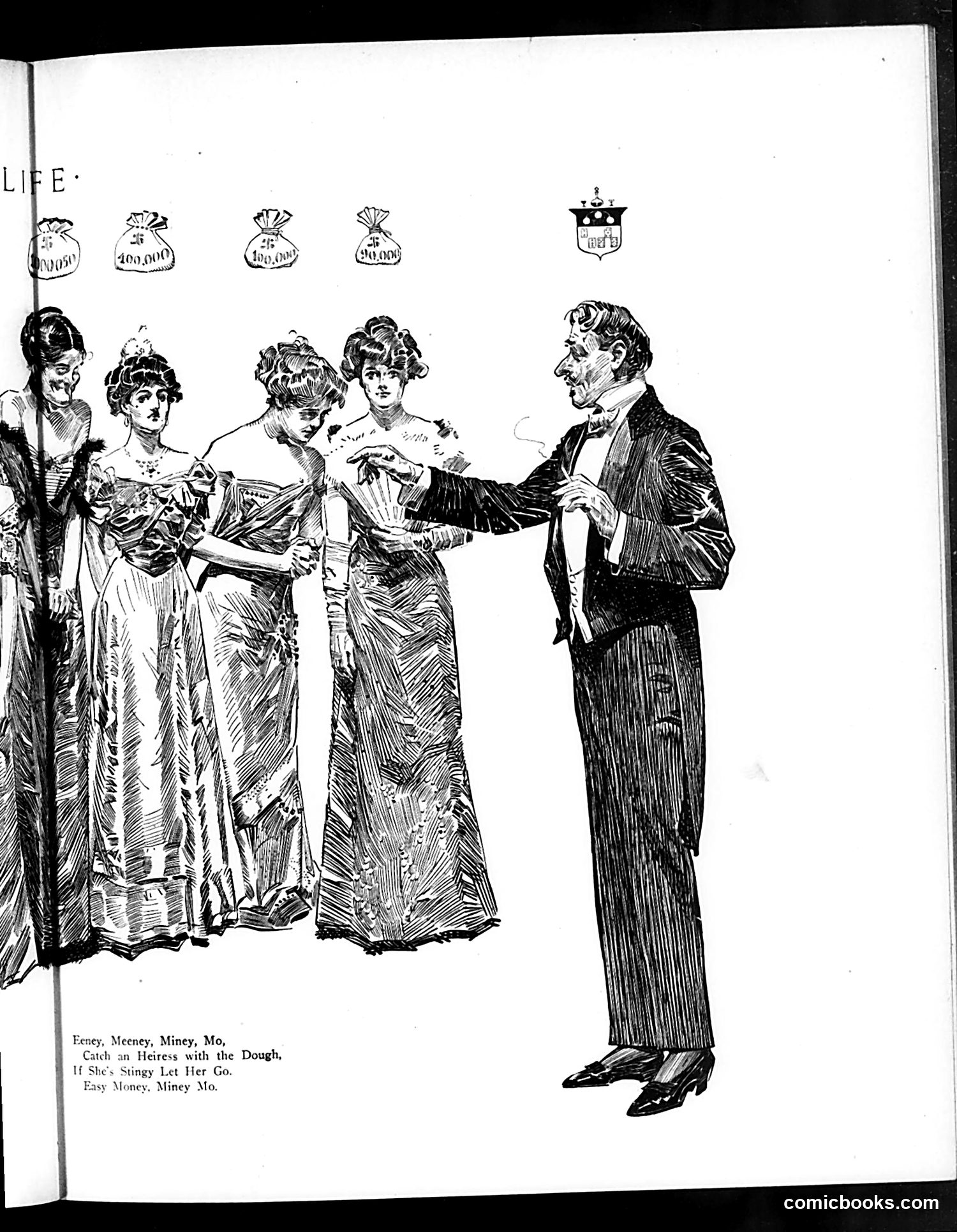
This page satirizes wealthy heiresses and fortune-hunting suitors. The illustration shows a well-dressed man addressing three elaborately-gowned women, with money bags labeled with large sums (240,000, 180,000, 200,000) displayed above them. The text is a parody of the children's counting rhyme "Eeny, Meeny, Miny, Moe," rewritten to mock the matrimonial market: the man should "catch an heiress with the dough" but release her "if she's stingy." This reflects early 20th-century social anxieties about wealth-driven marriages and the commercialization of courtship among the upper classes. The numbered purses suggest women are being evaluated primarily by their financial worth rather than personal qualities—a pointed satire of Gilded Age marriage customs.
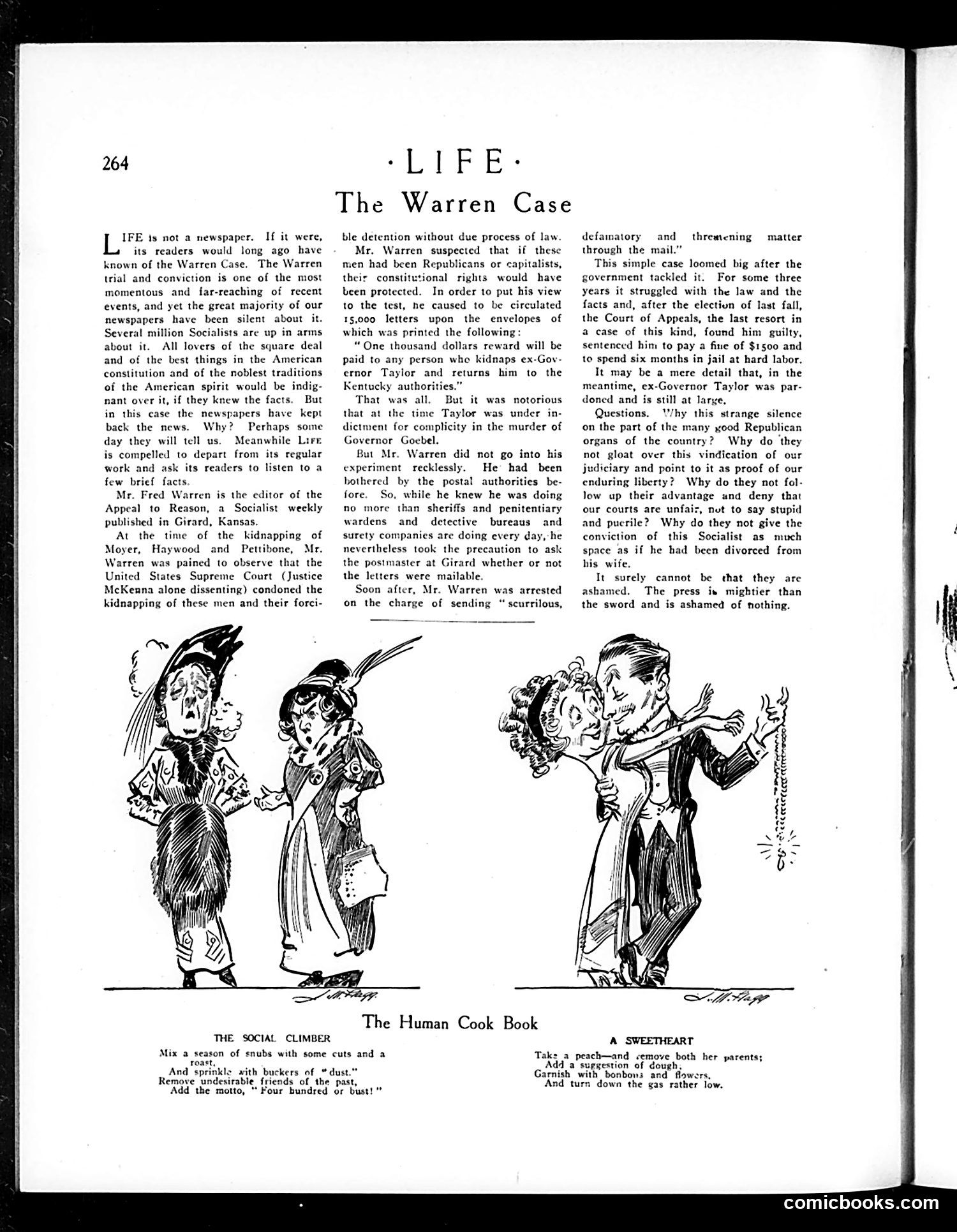
This article attacks press censorship surrounding Fred Warren's prosecution. Warren, editor of the Socialist weekly *Appeal to Reason*, mailed 15,000 letters offering a $1,000 reward for kidnapping ex-Governor Taylor (then under indictment for murder) to test whether constitutional protections applied equally to political enemies of the powerful. Warren was convicted and imprisoned, while Taylor was pardoned and remains free—a stark double standard. Life's satire condemns Republican newspapers for ignoring this case while claiming to defend liberty and judicial fairness. The piece argues the press's silence exposes their hypocrisy: they won't publicize a conviction that embarrasses the establishment, proving "the press is mightier than the sword and is ashamed of nothing." The cartoons below (unrelated recipes) are typical Life humor filler.
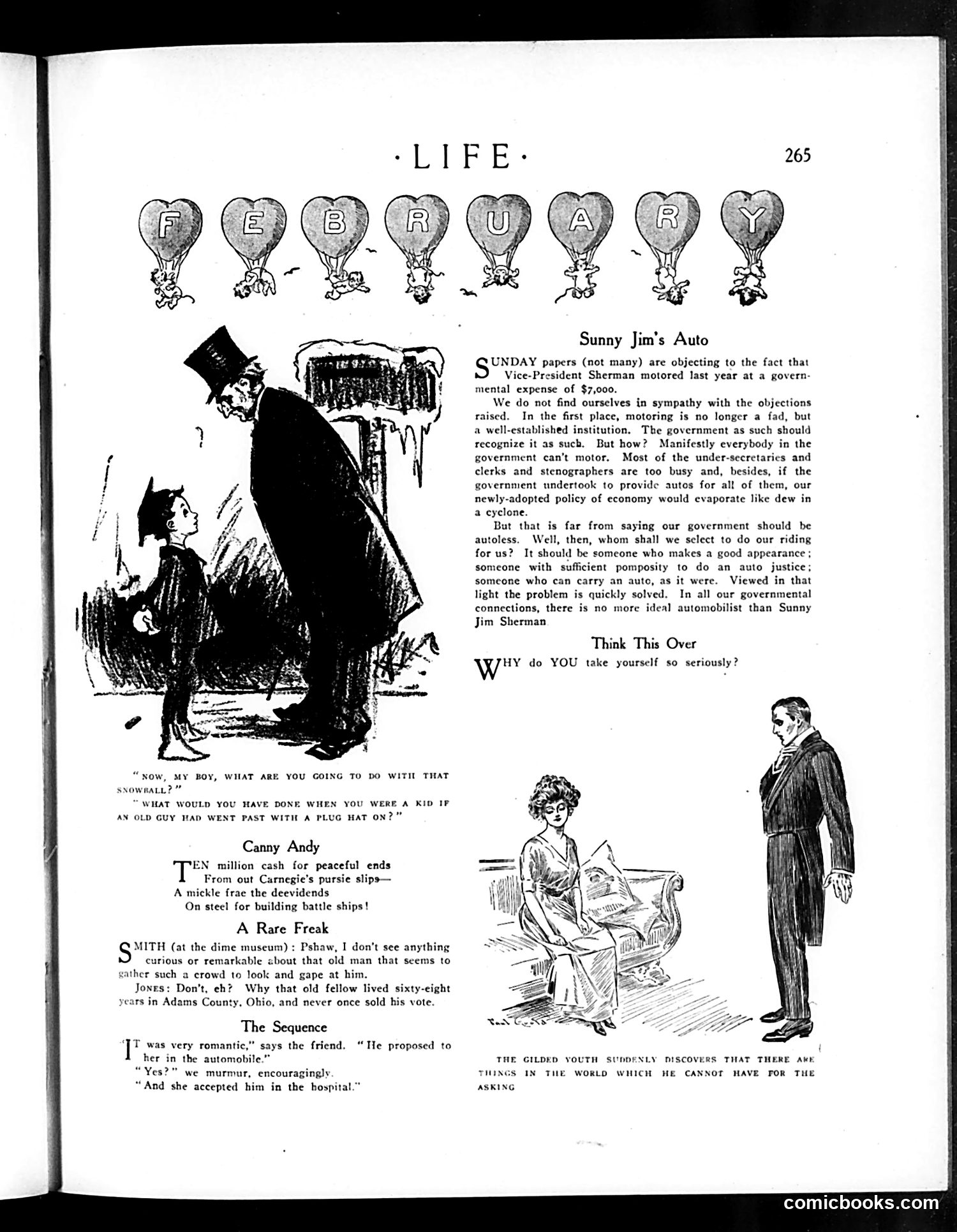
This page from *Life* magazine contains several satirical pieces mocking American politics and society circa 1909-1912. **"Sunny Jim's Auto"** defends Vice-President James Sherman's $7,000 governmental auto expense by sarcastically suggesting he's the *only* government official pompous enough to "carry" a car properly—a backhanded insult wrapped in mock praise. **"A Rare Freak"** jokes that an Ohio man who lived 68 years without selling his vote is a museum curiosity—satirizing endemic vote-buying corruption. **"Canny Andy"** critiques Andrew Carnegie's philanthropic hypocrisy: he donates millions for "peaceful ends" while his steel profits fund battleship construction. The remaining short pieces ("Think This Over," "The Sequence") are lighter humor about childhood mischief and romantic mishaps. The balloon-topped imagery at the page header spells "FEBRUARY," suggesting this is a February issue mixing political criticism with gentler social observation.
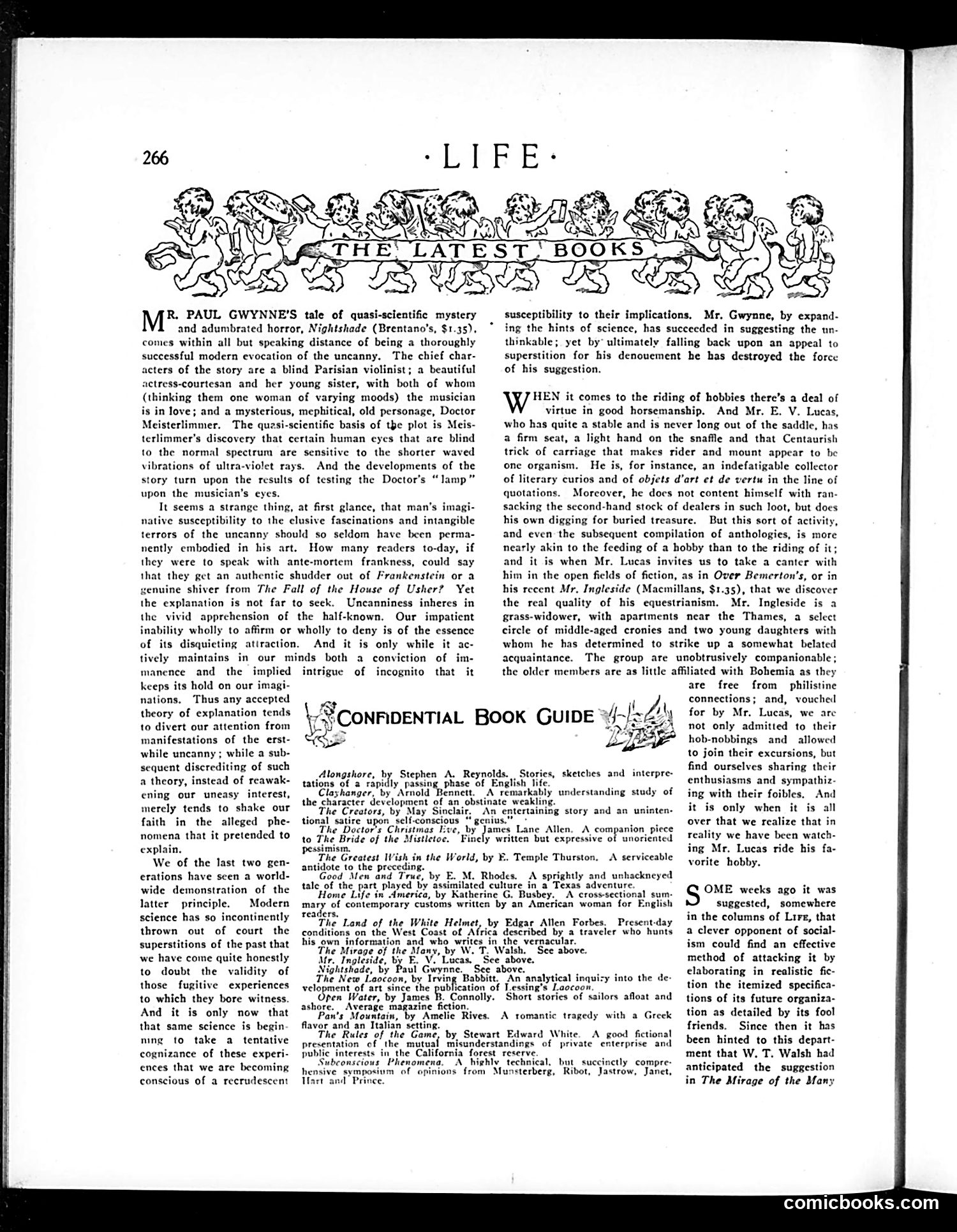
This is a **book review section**, not a political cartoon. The page features literary criticism of contemporary novels, particularly Paul Gwynne's *Nightshade*, a quasi-scientific mystery novel about a blind Parisian violinist and a doctor who discovers that blind human eyes can perceive ultraviolet rays. The critic discusses why horror fiction often fails: once scientific explanations are offered for supernatural phenomena, the uncanniness dissipates. Gwynne initially creates intrigue through mysterious science but undermines it by ultimately resorting to superstition for his ending. The page also praises E.V. Lucas's skill as a writer and collector of literary curiosities. The ornamental header with cherubs reading "The Latest Books" is typical decorative typography for *Life* magazine's book review section from this era.
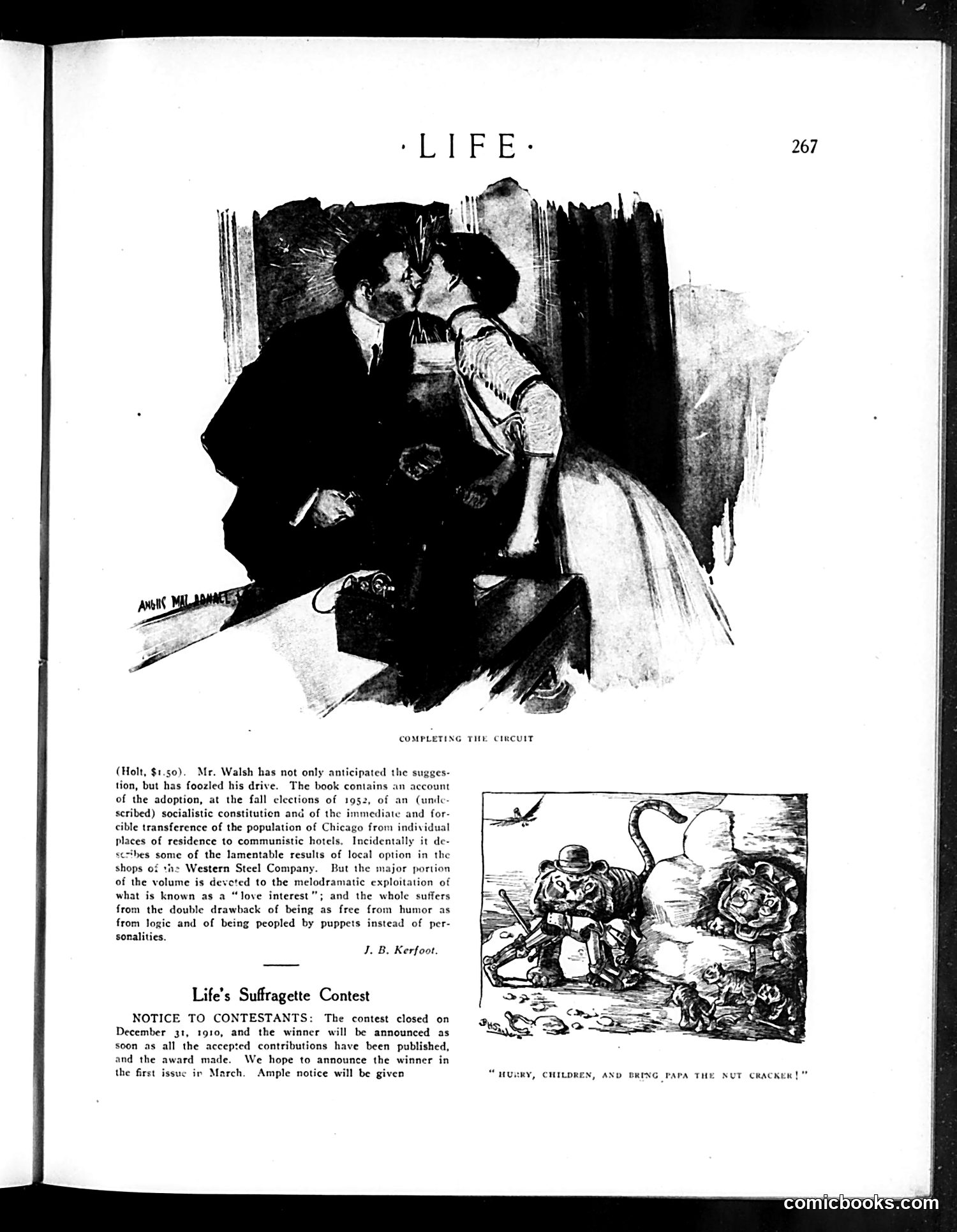
**Top Cartoon ("Completing the Circuit"):** Shows a man and woman in an intimate moment. The title suggests completing a romantic "circuit"—likely satirizing predictable courtship narratives of the era. **Book Review:** A scathing review of a novel by Walsh (priced $1.50) depicting a dystopian 1952 Chicago where the government forcibly relocates residents to communistic hotels following adoption of a socialist constitution. The reviewer criticizes the work as humorless, illogical, and populated by flat characters rather than believable people. This reflects early 20th-century anxieties about socialism and government overreach. **Bottom Illustration & Caption:** Depicts children and animals around a cracked nut, with caption "Hurry, children, and bring papa the nut cracker!" The humor appears to be domestic/family-oriented wordplay typical of Life's satirical style. **Suffragette Contest Notice:** Announces a closed contest with winner to be announced in March, suggesting Life's engagement with contemporary women's rights debates.
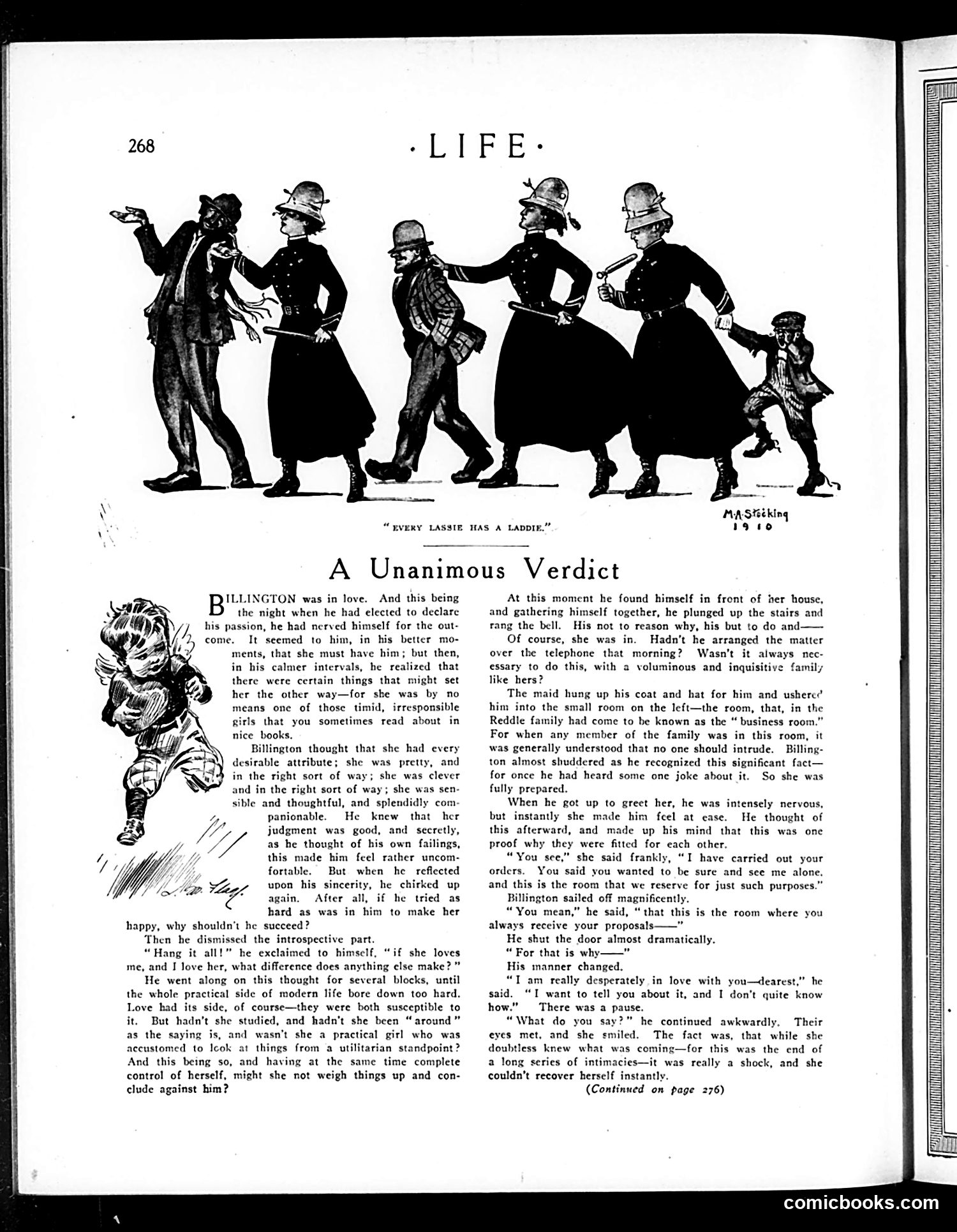
This is a serialized romantic fiction story (not a political cartoon), illustrated with a decorative header showing silhouetted figures in period dress. The caption "Every Lassie Has a Laddie" suggests early 20th-century courtship humor. The story follows Billington, an anxious suitor preparing to propose to his girlfriend. The narrative explores his internal conflict: he loves her, but worries she's too sensible and practical to accept him—she "weighs things up" rationally rather than acting on emotion alone. Modern readers would recognize this as a period piece capturing Edwardian-era dating anxiety and class consciousness (note the maid, the family's "business room" reserved for formal occasions). The story's tension derives from whether a woman of intelligence and independent judgment will choose love over practicality—a surprisingly modern concern for the era.
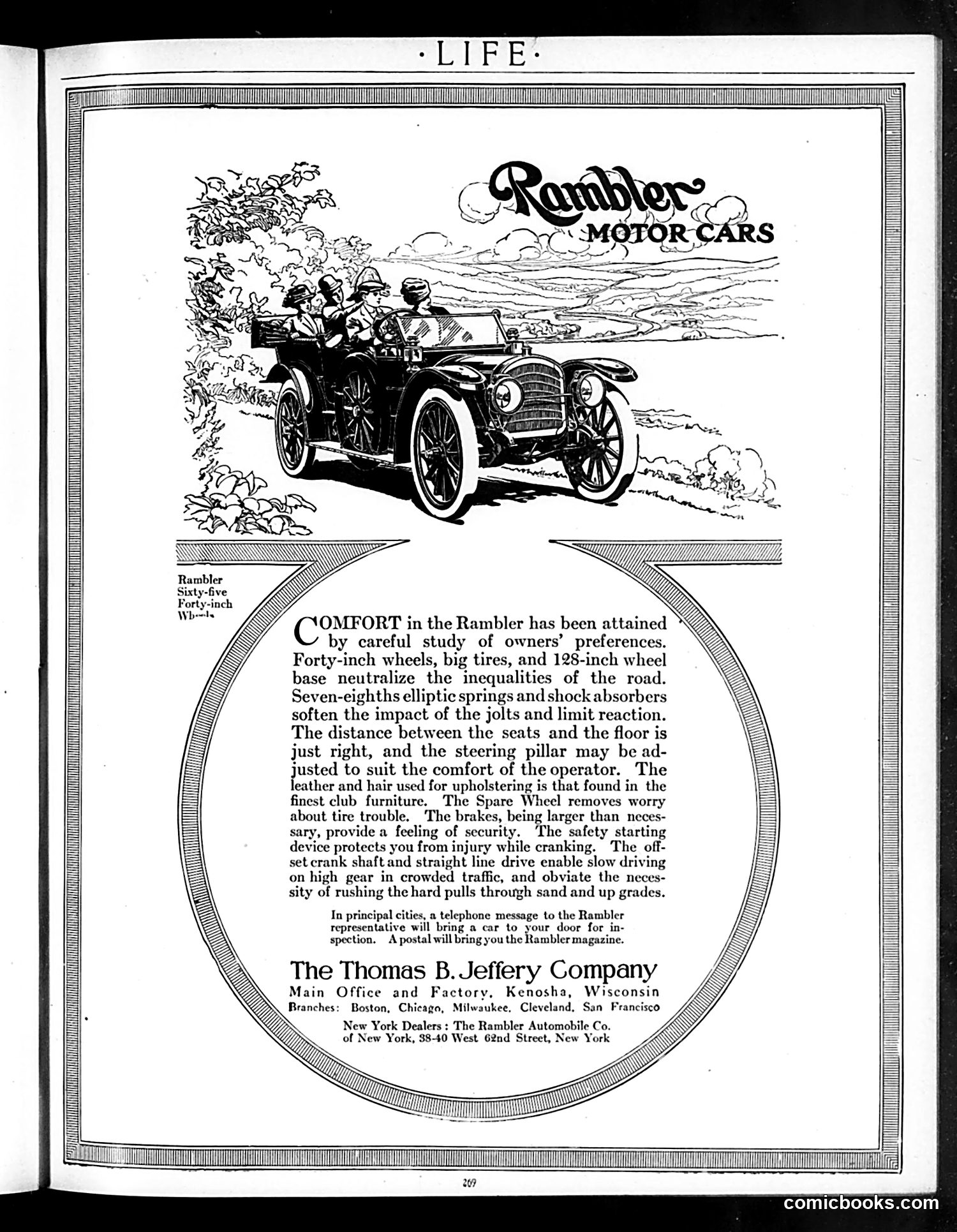
This is **not a cartoon or satire**—it's a straightforward automobile advertisement from Life magazine's advertising section. The page promotes the Rambler, manufactured by the Thomas B. Jeffery Company of Kenosha, Wisconsin. The illustration shows an early 1900s open-air motorcar with four passengers enjoying a scenic drive. The accompanying text is earnest marketing copy detailing the vehicle's comfort features: large wheels, springs, shock absorbers, spacious seating, quality upholstery, spare wheel, and safety mechanisms. Notable is the claim that a telephone call to a Rambler representative will bring a demonstration car to your door—an early form of customer service marketing. The ad emphasizes reliability and comfort as selling points to early automobile buyers, reflecting the era when cars were luxury goods requiring reassurance about safety and ease of operation.
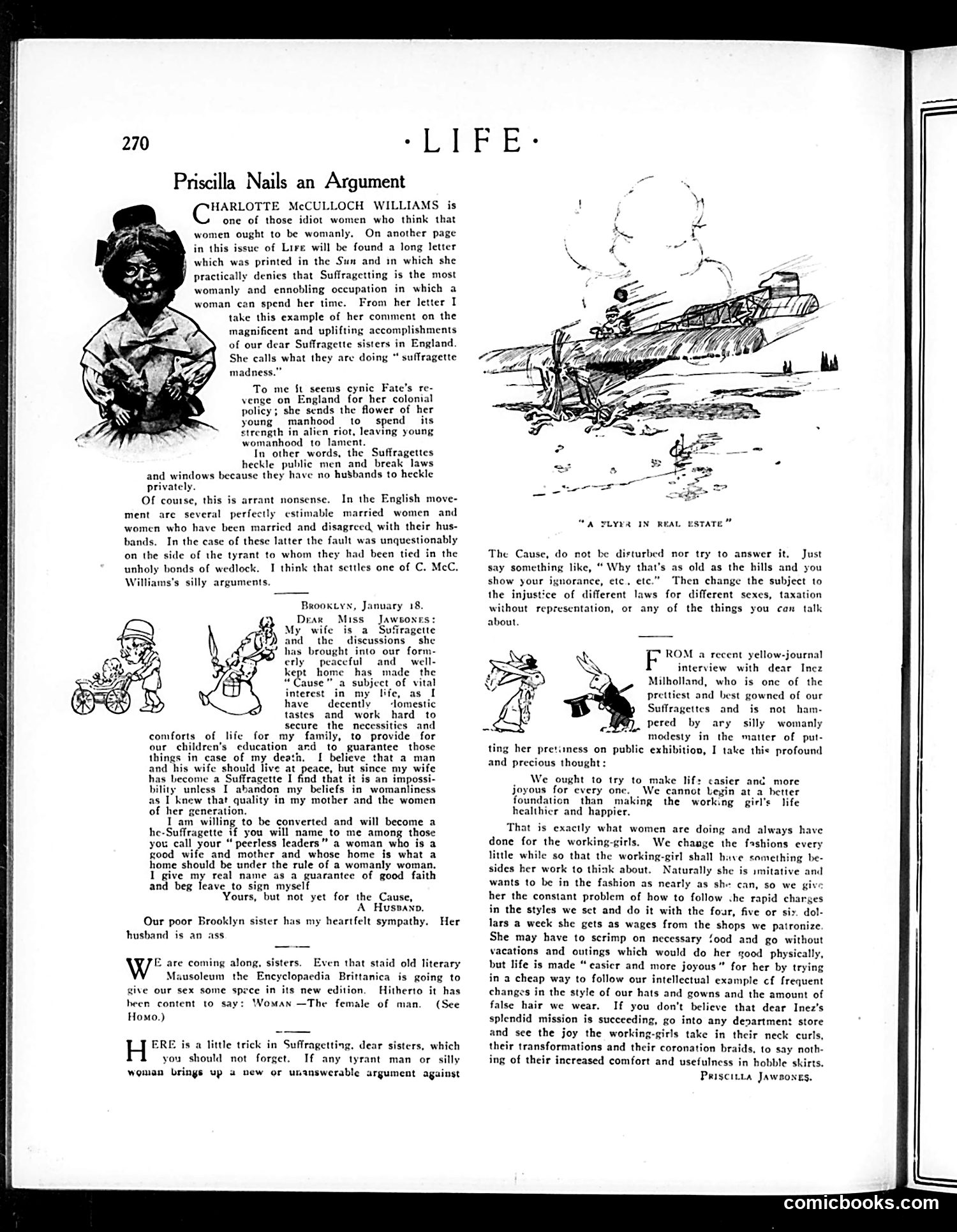
This page satirizes the women's suffrage movement through mock letters and commentary. The central target is suffragette activism in England, which the author characterizes as destructive and unwomanly. **Key figures/references:** - Charlotte McCulloch Williams: a real critic of suffragettes who argued for traditional femininity - Generic suffragettes: portrayed as hecklers and vandals who break windows - Inez Milholland: an actual prominent American suffragette, mocked for publicly displaying her attractiveness **The satire's points:** The author argues suffragettes act out only because they lack husbands to quarrel with privately. He presents a sympathetic "husband" letter claiming suffragette activism destroys domestic peace. A cartoon titled "A Plea in Real Estate" accompanies this. **The joke:** Life magazine ridicules suffragettes as simultaneously claiming to promote women's dignity while engaging in unladylike behavior and vanity. The proposed "trick" of deflecting arguments by calling them old-fashioned reveals the author's contempt for their rhetorical methods. This reflects anti-suffrage sentiment common in American media circa 1910s.
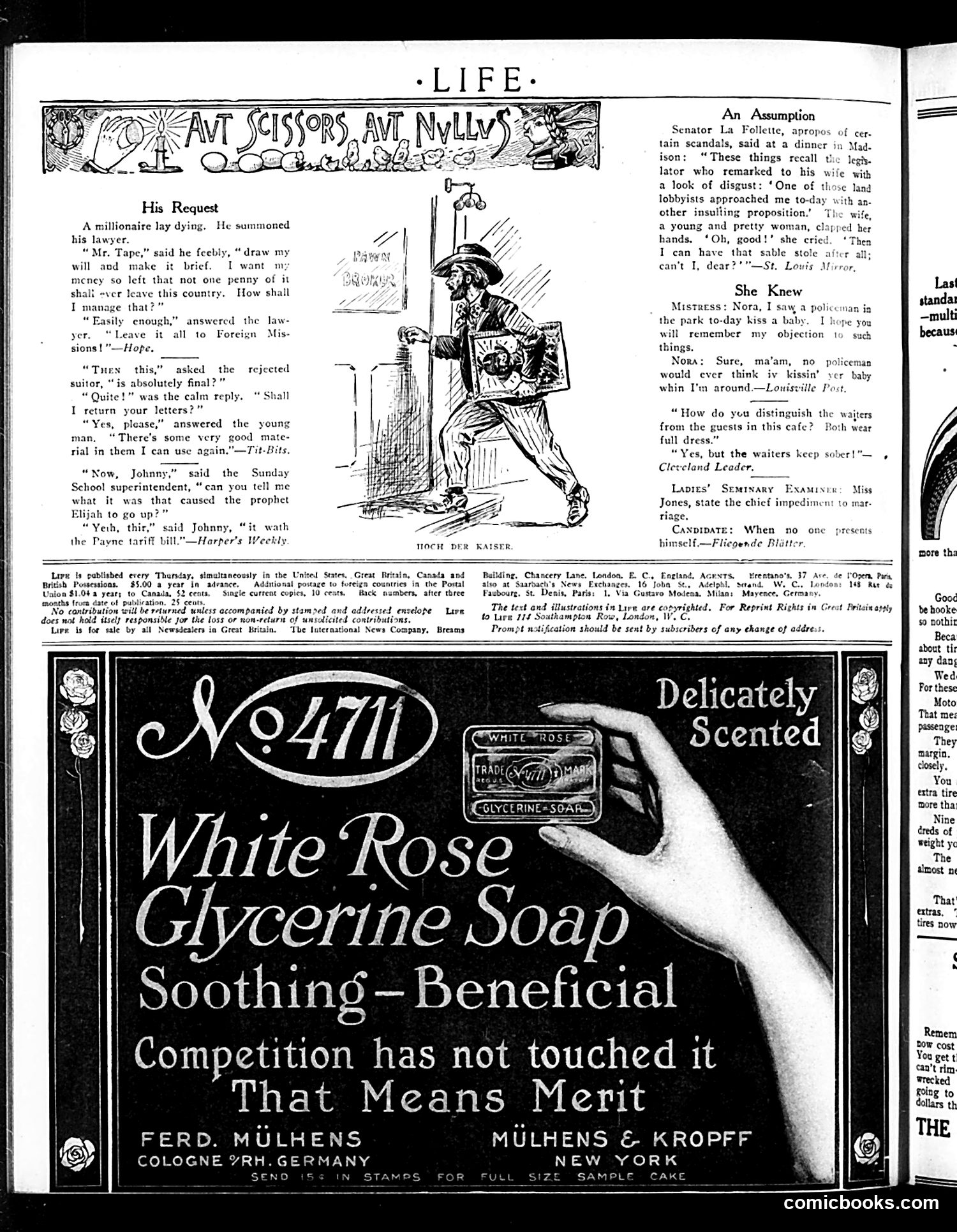
The main cartoon, titled "HOCH DER KAISER," depicts a German military figure (likely Kaiser Wilhelm II, given the title) in an exaggerated, aggressive pose—appearing to kick or lunge violently. This is wartime satire, likely from WWI era, mocking German militarism and the Kaiser's aggressive foreign policy. The page contains multiple brief satirical anecdotes mocking: - **Political corruption**: Senator La Follette's story about a legislator disgusted by lobbyists - **Greed and immorality**: A dying millionaire more concerned with his mistress's inheritance than his wife - **Social hypocrisy**: Various absurd scenarios exposing human weakness The humor relies on cynicism about human nature—people's petty self-interest overrides principle. The Johnny/Payne tariff joke references contemporary political controversy, mocking protectionist trade policy. The page also contains period advertising for White Rose Glycerine Soap, typical of Life's mixed content format.
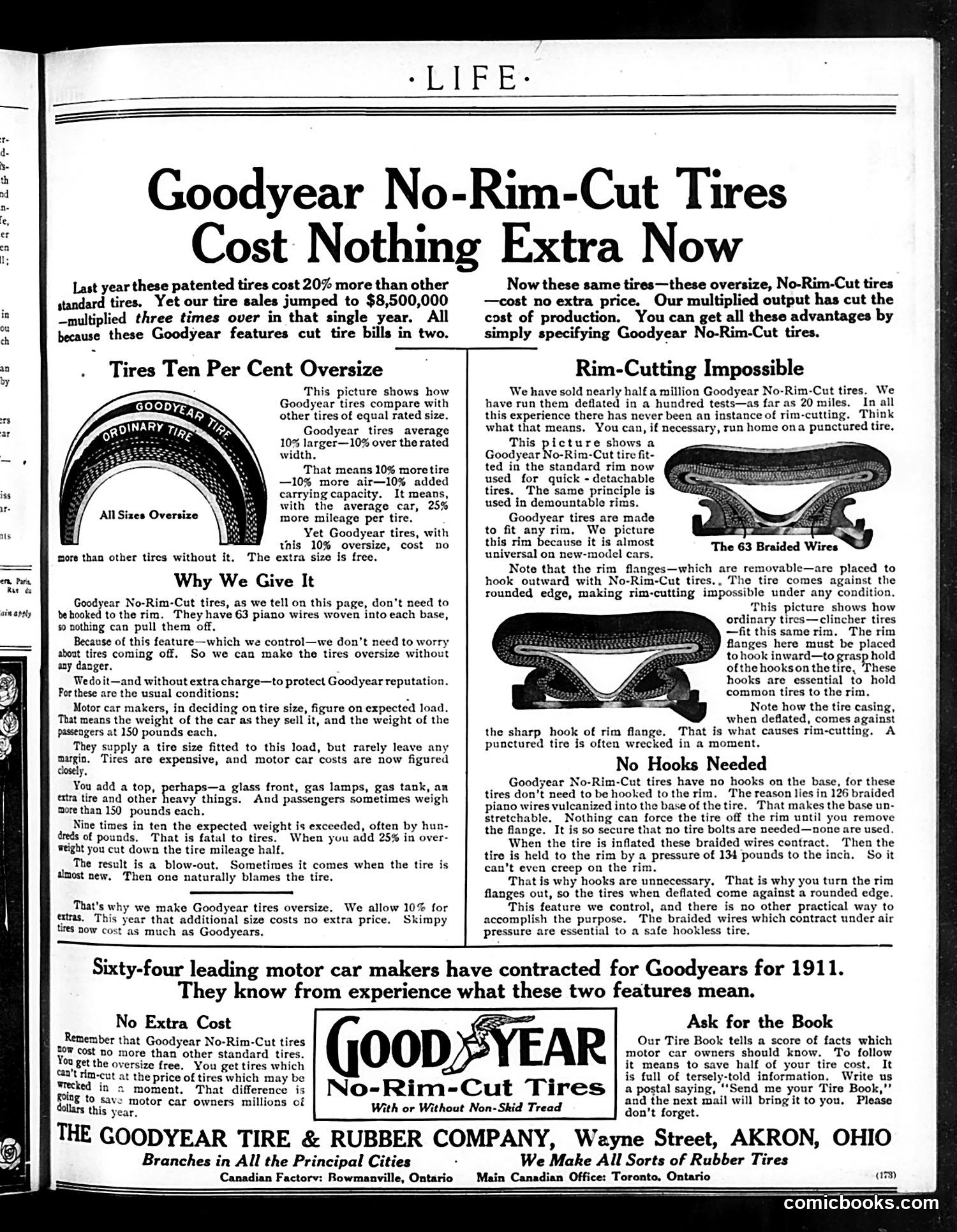
This is **not satire or political commentary**—it's a straightforward **automobile tire advertisement** from the early 1900s. The Goodyear Tire & Rubber Company is promoting their patented "No-Rim-Cut" tires, which cost 20% more last year but now cost the same as competitors. The key selling points are technical: the tires are 10% oversized (offering 25% more mileage), incorporate 63 braided wires to prevent rim damage, and cannot be "cut" when deflated—allowing drivers to limp home on a punctured tire instead of suffering immediate failure. The page uses diagrams comparing their design to "ordinary" tires, explaining why their engineering prevents rim-cutting. The text emphasizes that 64 major automakers have contracted with Goodyear, lending credibility through testimonial. This reflects early automotive industry concerns: tire reliability was critical when repair options were limited. The "no extra cost" headline highlights competitive pricing for superior technology—a standard advertising approach then and now.
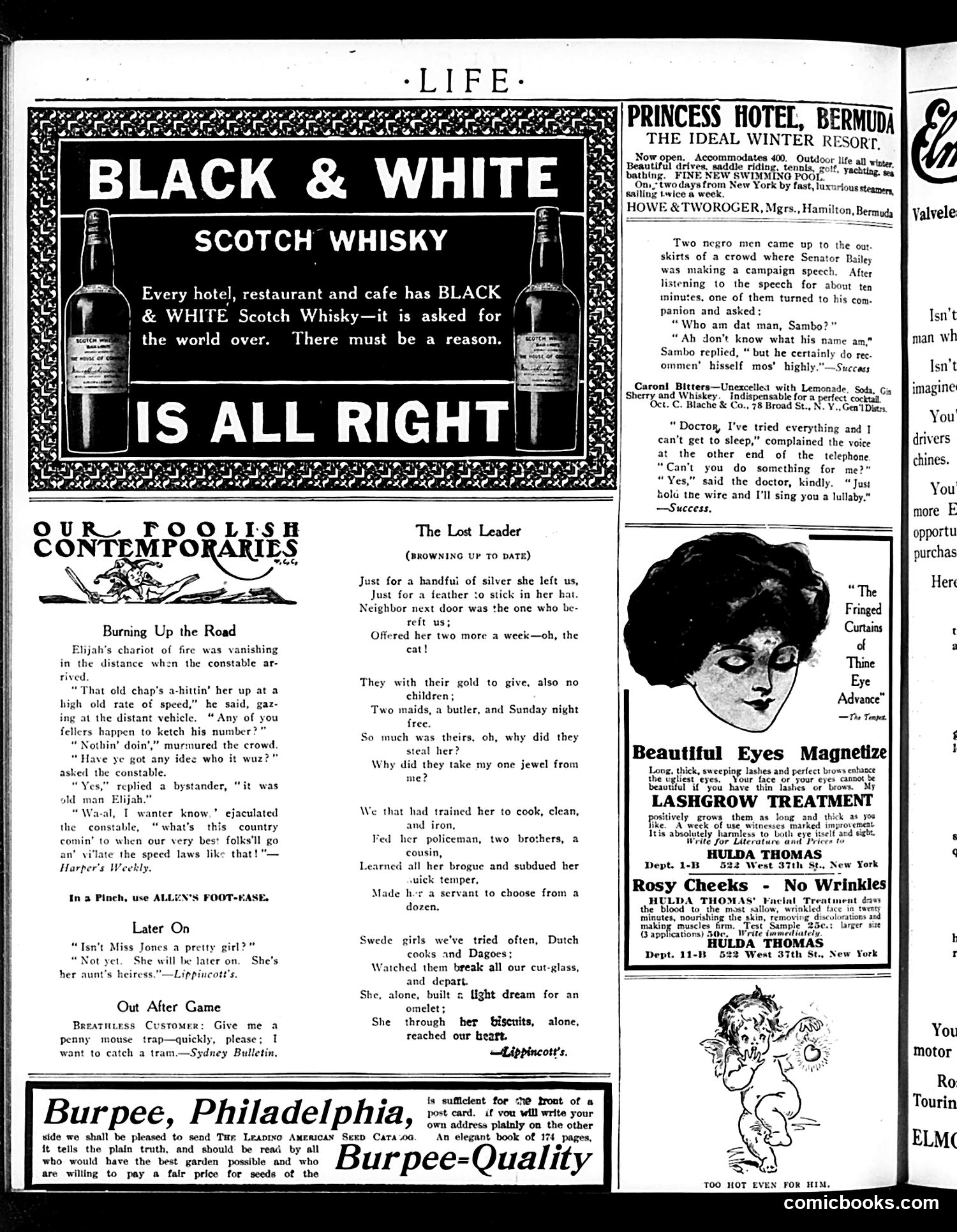
This page from *Life* magazine (undated but early 20th century based on style) contains primarily **light humor and advertisements** rather than political satire. The main content includes comic vignettes: - **"Burning Up the Road"**: A rural humor piece where a constable observes someone driving recklessly, referencing the biblical Elijah's fiery chariot. The joke plays on old-fashioned speech patterns and speeding as a modern vice. - **"The Lost Leader"**: A sentimental poem about a servant woman who abandons her employer's household for better wages elsewhere—commentary on changing labor relations and servants' mobility. - **Later short jokes** about courtship and domestic life using period-appropriate humor. The page also includes a **racist anecdote** about two Black men at a political speech (Senator Bailey), using heavy dialect for comic effect—reflecting the casual racism of the era. The remainder is **advertising**: Black & White Scotch Whisky, beauty treatments, hotels, and seeds. This was typical *Life* content: satirical writing mixed with substantial ad revenue.
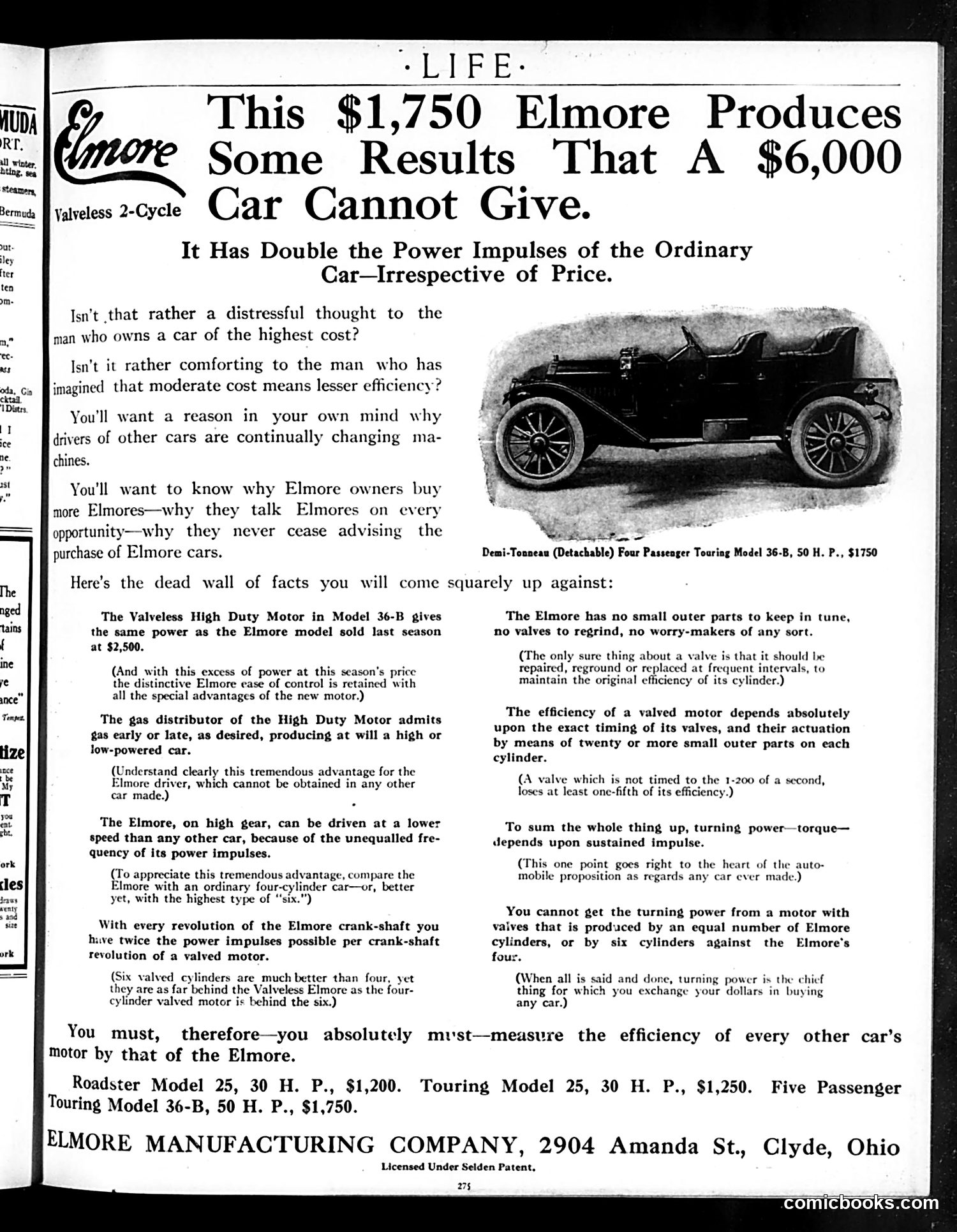
This is a **car advertisement**, not satire or political content. The Elmore Manufacturing Company promotes its $1,750 automobile by claiming technical superiority over more expensive competitors (implicitly $6,000 luxury cars). The pitch targets middle-class buyers with anxiety about spending: a cheaper car outperforms expensive ones because its **valveless 2-cycle engine** produces "double the power impulses" of conventional 4-cylinder motors. The ad contrasts Elmore owners' loyalty ("buy more Elmores") against wealthy car owners' constant upgrades. The technical claims are the selling point—no valve maintenance, superior torque, lower operating costs—framed as objective facts that supposedly make price irrelevant to quality. The repeated parenthetical "proof" statements attempt to preempt skepticism. This reflects early 1900s automotive competition when engine technology varied widely and consumer knowledge was limited. The Elmore company ultimately failed, suggesting these claims didn't withstand market reality.
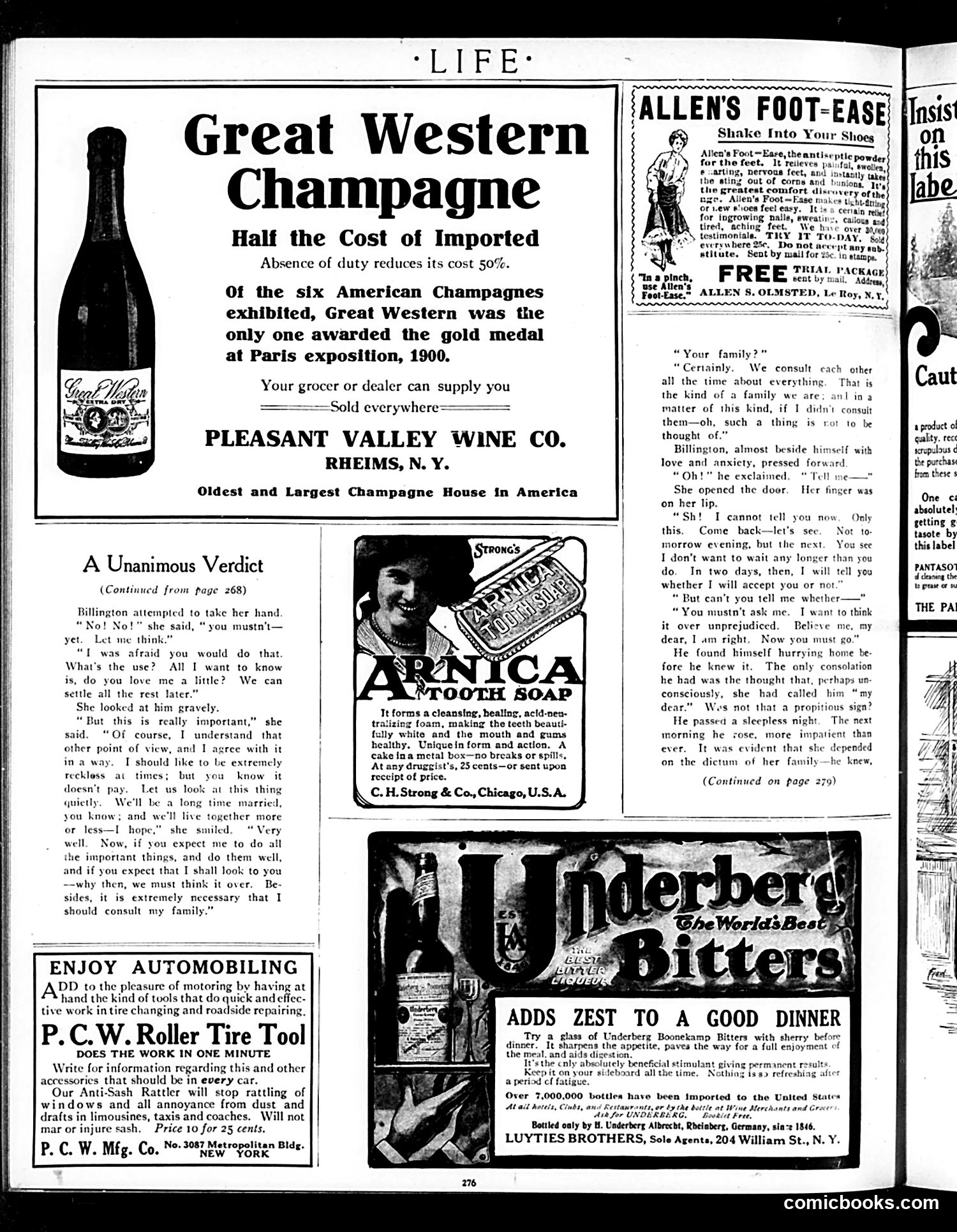
This page is primarily **advertising and serialized fiction**, typical of early 1900s Life magazine. The main content is a serialized romantic story ("A Unanimous Verdict," continued from page 268) about a man named Billington proposing to a woman who insists on consulting her family before answering—a satirical jab at the Victorian convention of family consultation in courtship decisions. The humor lies in her refusing to give a simple yes/no answer and demanding a two-day delay to "think it over unprejudiced." The rest consists of period advertisements: - **Great Western Champagne** (domestic, cheaper than imports due to no import duty) - **Allen's Foot-Ease** (foot powder) - **Arnica soap** (tooth cleaner) - **P.C.W. Roller Tire Tool** (automobile accessory) - **Underberg Bitters** (digestive liqueur) These ads reflect early 1900s consumer goods and emerging automobile culture. The page contains no political cartoons or satirical illustrations—it's a commercial/entertainment page rather than editorial content.
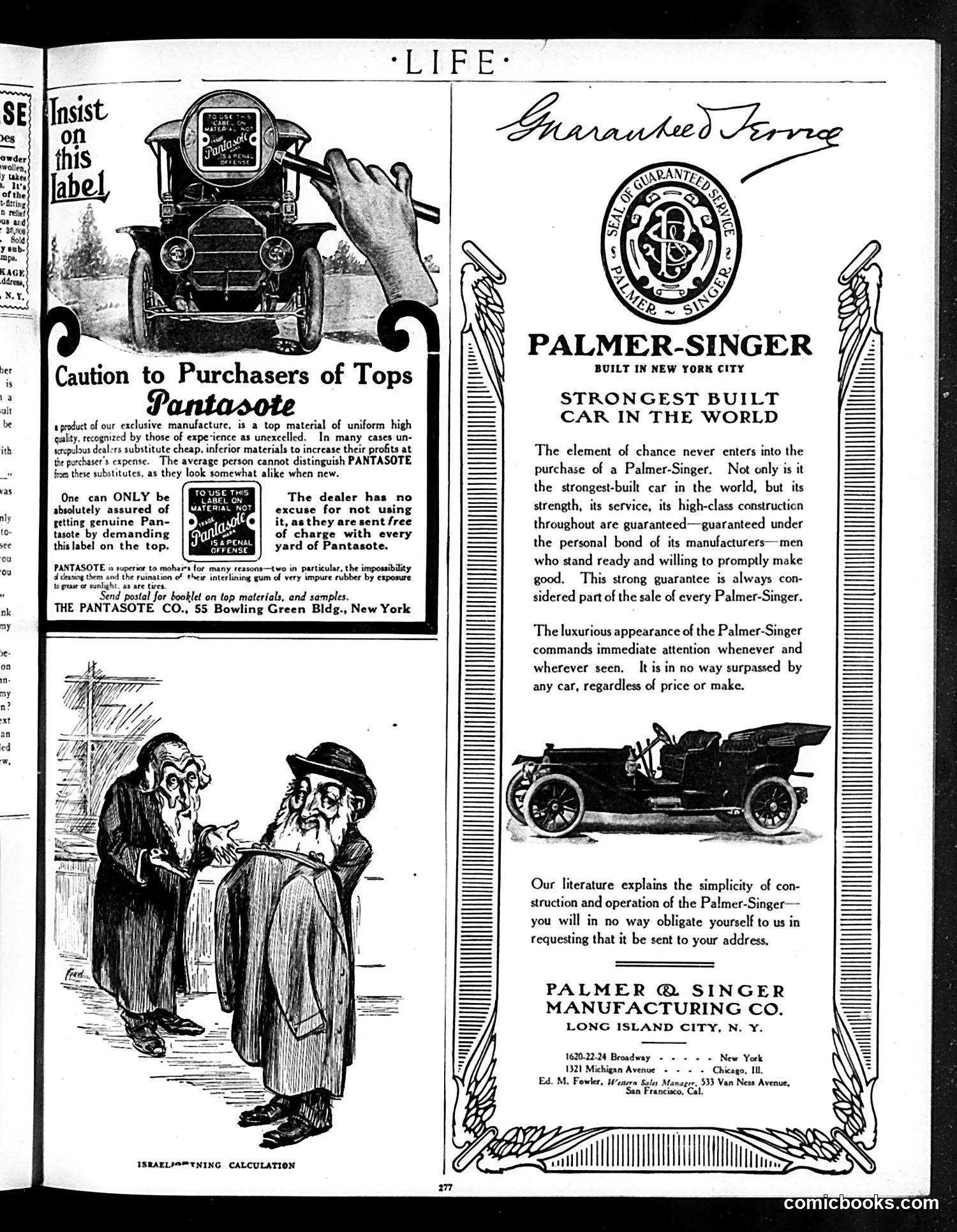
This is primarily an **advertising page** from Life magazine, containing two distinct advertisements: 1. **Pantasote (left)**: A cautionary ad warning consumers against counterfeit automobile top materials. It emphasizes that unscrupulous dealers substitute cheap imitations, and urges buyers to demand the genuine Pantasote label. The small cartoon below shows two figures in conversation, labeled "Israeli@™tning Calculation"—its meaning is unclear from the visible context. 2. **Palmer-Singer (right)**: A luxury automobile advertisement highlighting the car's strength, construction quality, and manufacturer guarantees. It emphasizes reliability over chance, positioning Palmer-Singer as the "strongest built car in the world." Both ads target early 20th-century automobile buyers concerned with quality and authenticity—reflecting an era when mass manufacturing made counterfeit parts a genuine consumer problem. The page contains no political satire or social commentary; it is straightforward commercial messaging.
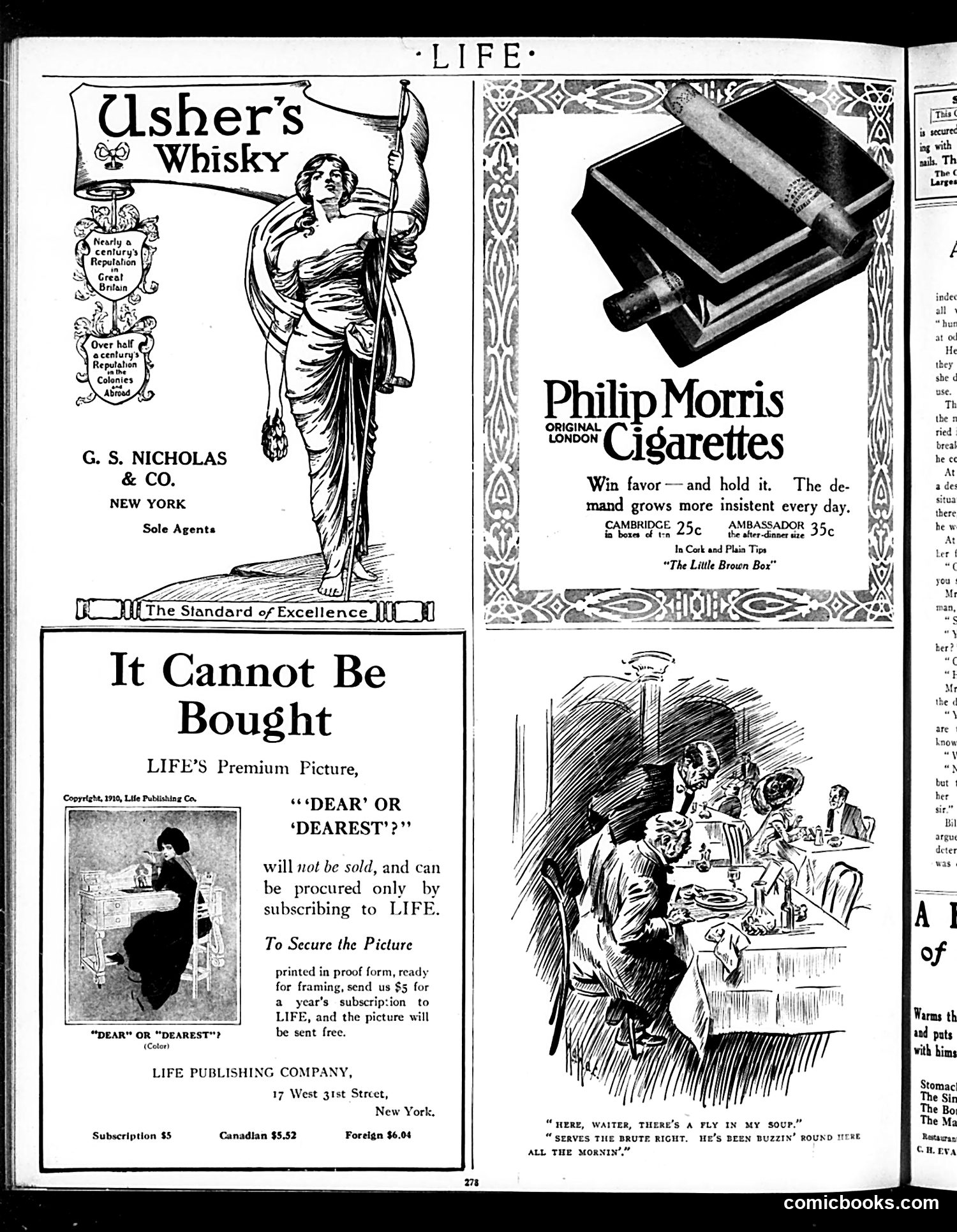
This page combines advertisements with satirical content typical of Life magazine's format. **Left side:** Usher's Whisky advertisement featuring a classical allegorical female figure representing "The Standard of Excellence." **Center:** Life Publishing promotes a subscription incentive—a framed picture titled "Dear" or "Dearest?" (showing a woman at a desk, likely contemplative). The joke plays on romantic ambiguity: subscribers must pay $5 for a year's subscription to obtain this premium picture, which cannot be purchased separately. The title's question mark suggests interpretive mystery about the woman's emotional state. **Right side:** Philip Morris cigarettes advertisement and a cartoon about restaurant service. The cartoon shows a waiter dismissing a customer's complaint about a fly in soup with crude humor—the fly "deserves it" for buzzing around all morning. This reflects early 20th-century attitudes toward service standards and working-class irreverence. The page exemplifies Life's mix of consumer advertising and satirical humor targeting contemporary social customs.
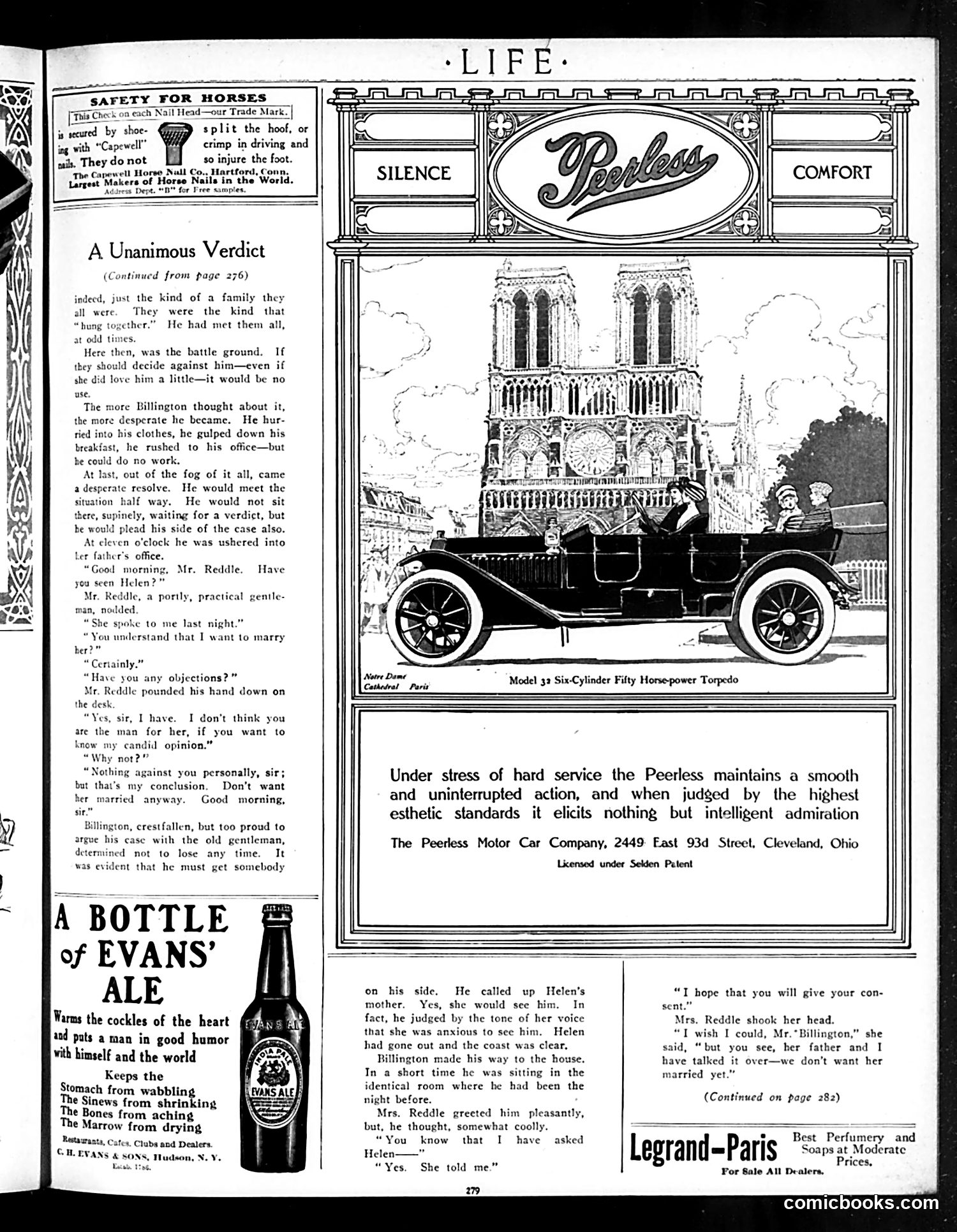
This page is primarily **serialized fiction with advertising**, not political satire. The main content is "A Unanimous Verdict," a romantic drama about a man named Billington seeking family approval to marry Helen. After her father Mr. Reddle rejects him, Billington attempts to win over Helen's mother—a common narrative trope of the era. The story explores class or social status tensions (suggested by the father's objections despite the couple's affection). The page includes period advertisements: Evans' Ale (marketed as healthful), Capewell Horse Nails (safety product), Peerless automobiles (luxury car), and Legrand-Paris perfumes. **No political cartoons appear here.** This is a typical Life magazine interior page from roughly the 1910s-1920s, mixing serialized romantic fiction with branded product advertisements. The "unanimous verdict" refers to family judgment, not political commentary.
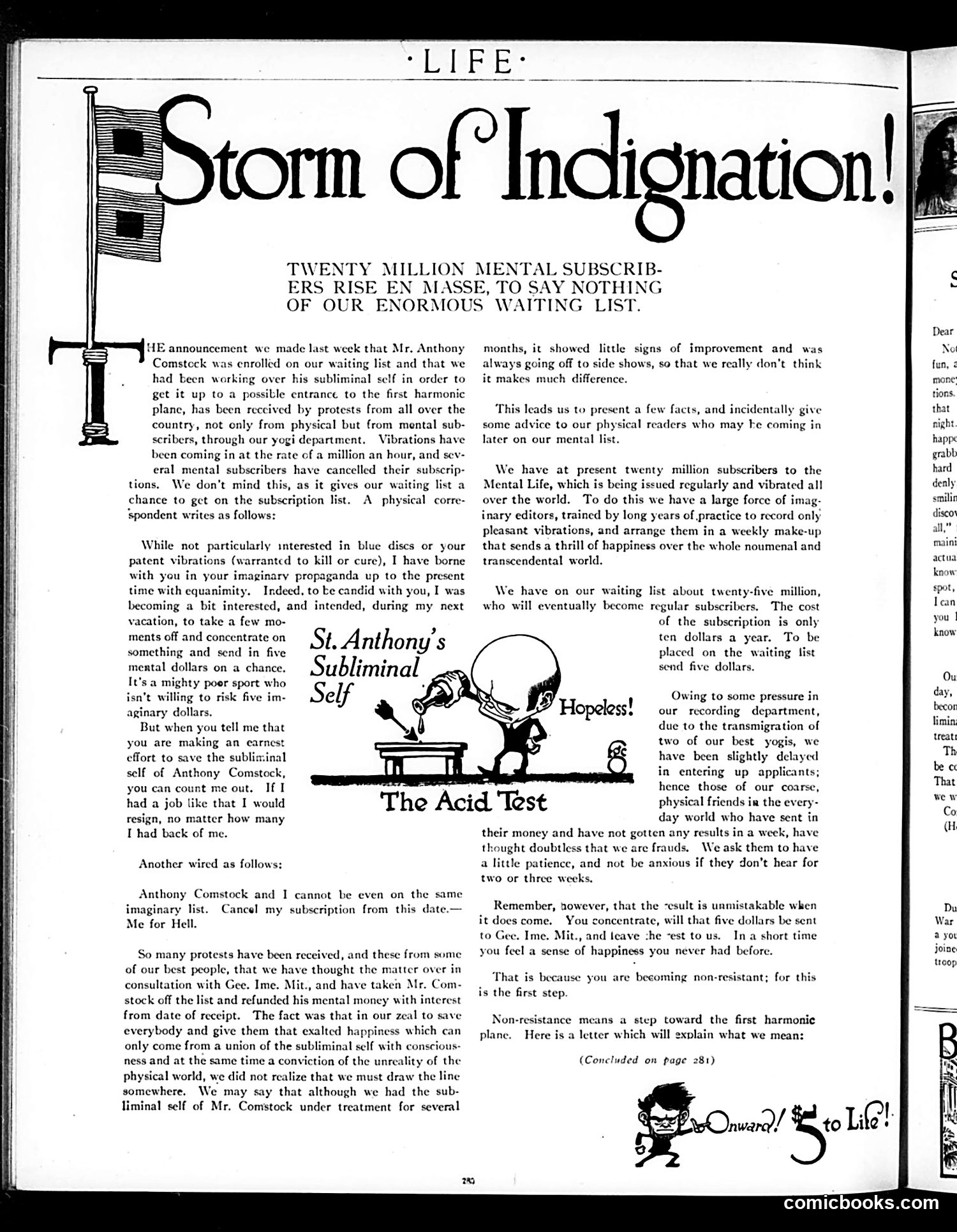
This is a satirical attack on **Anthony Comstock**, the real-life American moral crusader and anti-obscenity activist. Life magazine is mocking him by pretending he's a subscriber to their fictional "Mental Life" publication—a pseudoscientific journal about vibrations, yogis, and "subliminal selves" that represents New Age spiritualism. The joke: When Life announced they were improving Comstock's "subliminal self," subscribers were so outraged that they cancelled in protest. The satire works on two levels: (1) mocking Comstock's self-righteous censorship by treating him as absurdly unsuitable for spiritual improvement, and (2) ridiculing contemporary spiritualist fads that Life's readers apparently believed in. The cartoon of Comstock being vibrated into submission ("Hopeless!") and "The Acid Test" illustration reinforce that he's beyond redemption—a dig at his rigidity and perceived hypocrisy. This reflects genuine cultural conflict between progressive magazines and conservative moral guardians of the early 20th century.
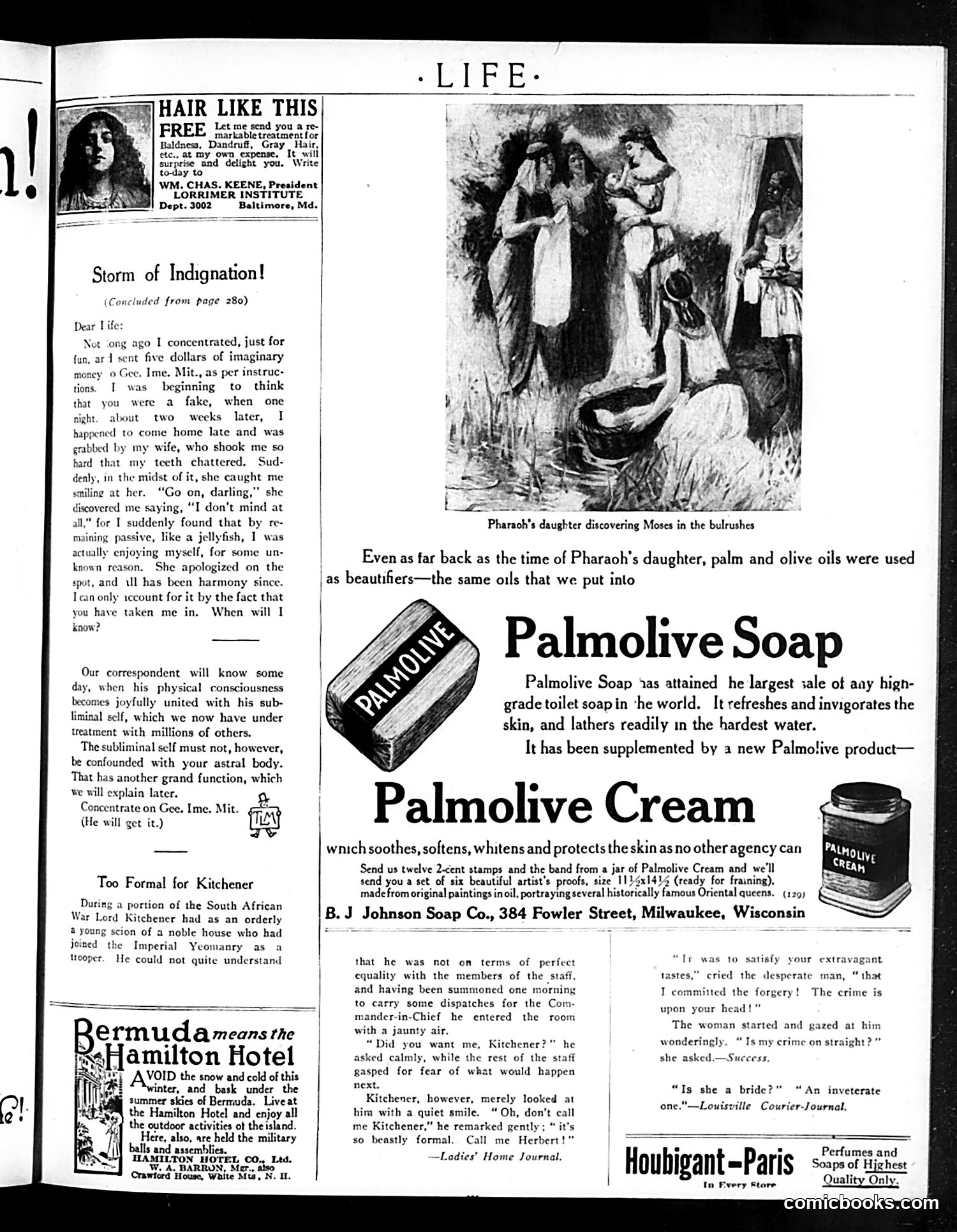
This Life magazine page contains three main sections: **Left Column - "Storm of Indignation"**: A humorous reader letter about a man who sent five dollars to "Gee. Ime. Mit." (likely a spiritualist or self-help instructor) for imaginary money instruction. His wife attacked him upon his return, but he discovered—by remaining passive—he actually enjoyed the experience. The satire mocks both spiritualism/pseudoscience and marital discord. **Center Section - "Too Formal for Kitchener"**: An anecdote about a British officer during the South African War who casually addresses Lord Kitchener by his first name. The humor lies in the young officer's shocking informality with a stern military superior; Kitchener's gentle response ("Call me Herbert!") subverts expectations of rigid military hierarchy. **Right Column**: Primarily advertising (Palmolive Soap/Cream, Bermuda's Hamilton Hotel, Houbigant Perfumes). The Palmolive ad uses biblical imagery (Pharaoh's daughter) to suggest ancient origins of beauty oils. The page reflects early 20th-century humor: satirizing spiritualism, military formality, and marketing claims.
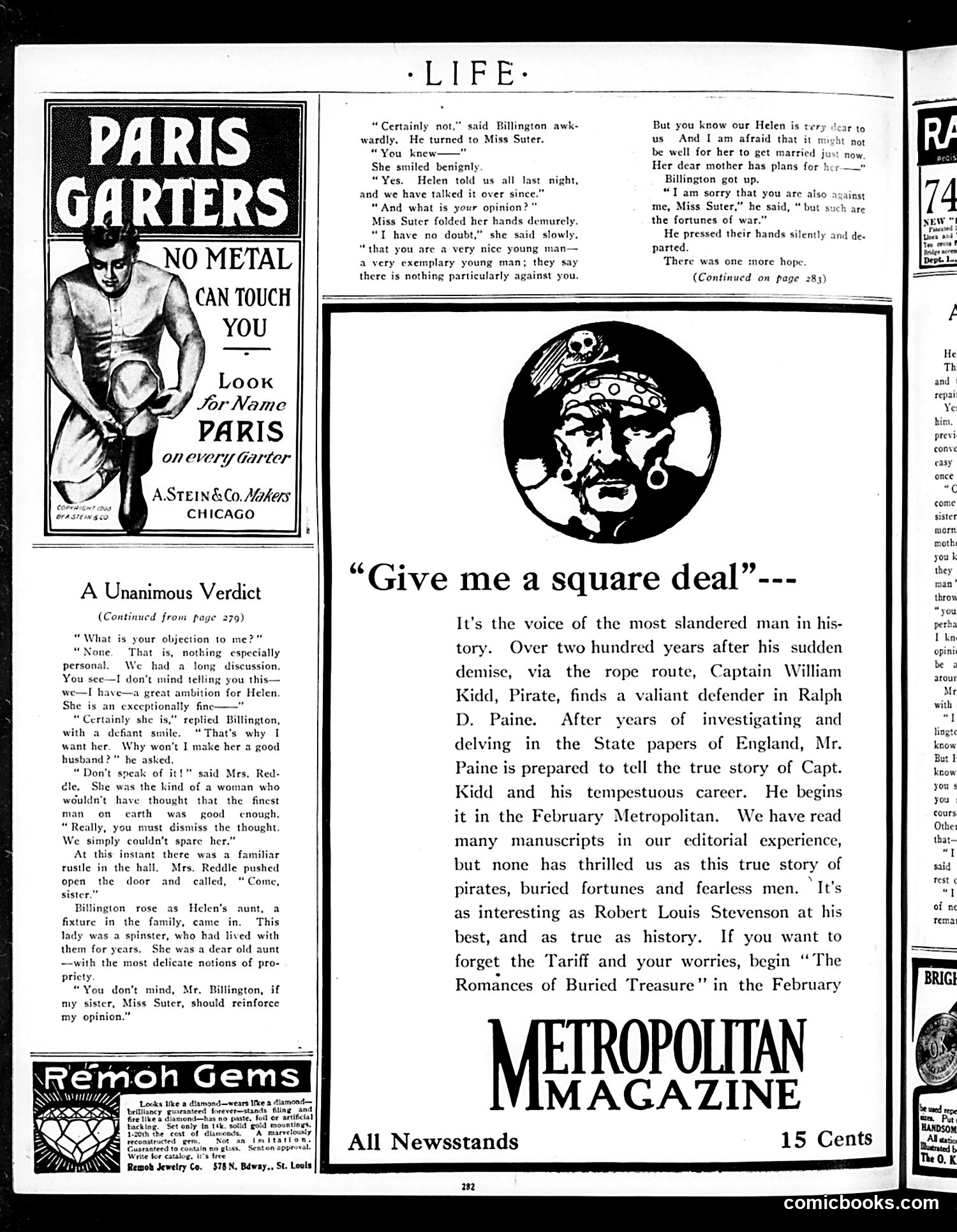
This page contains **satirical fiction and advertising**, not political cartoons. The main content is a serialized short story about a marriage proposal, featuring dialogue between a suitor named Billington and the Suter family. The narrative humor derives from social conventions of the era—the awkward courtship ritual, the mother's controlling influence over her daughter Helen, and the suitor's clumsy attempts at persuasion. The **pirate illustration** advertises Metropolitan Magazine's upcoming serialization of Ralph D. Paine's article about Captain William Kidd, the 17th-century pirate. The caption "Give me a square deal" references Kidd's historical plea for fair treatment; the ad positions his true story as thrilling adventure literature comparable to Robert Louis Stevenson. The **Paris Garters advertisement** uses classical imagery (the god Paris) as a brand name and promises magical protective properties ("No Metal Can Touch You"). The **Remoh Gems ad** at bottom promotes jewelry with pseudo-mystical marketing language about diamonds' properties. This is primarily **advertising revenue** with light serialized fiction—typical magazine filler of the era.
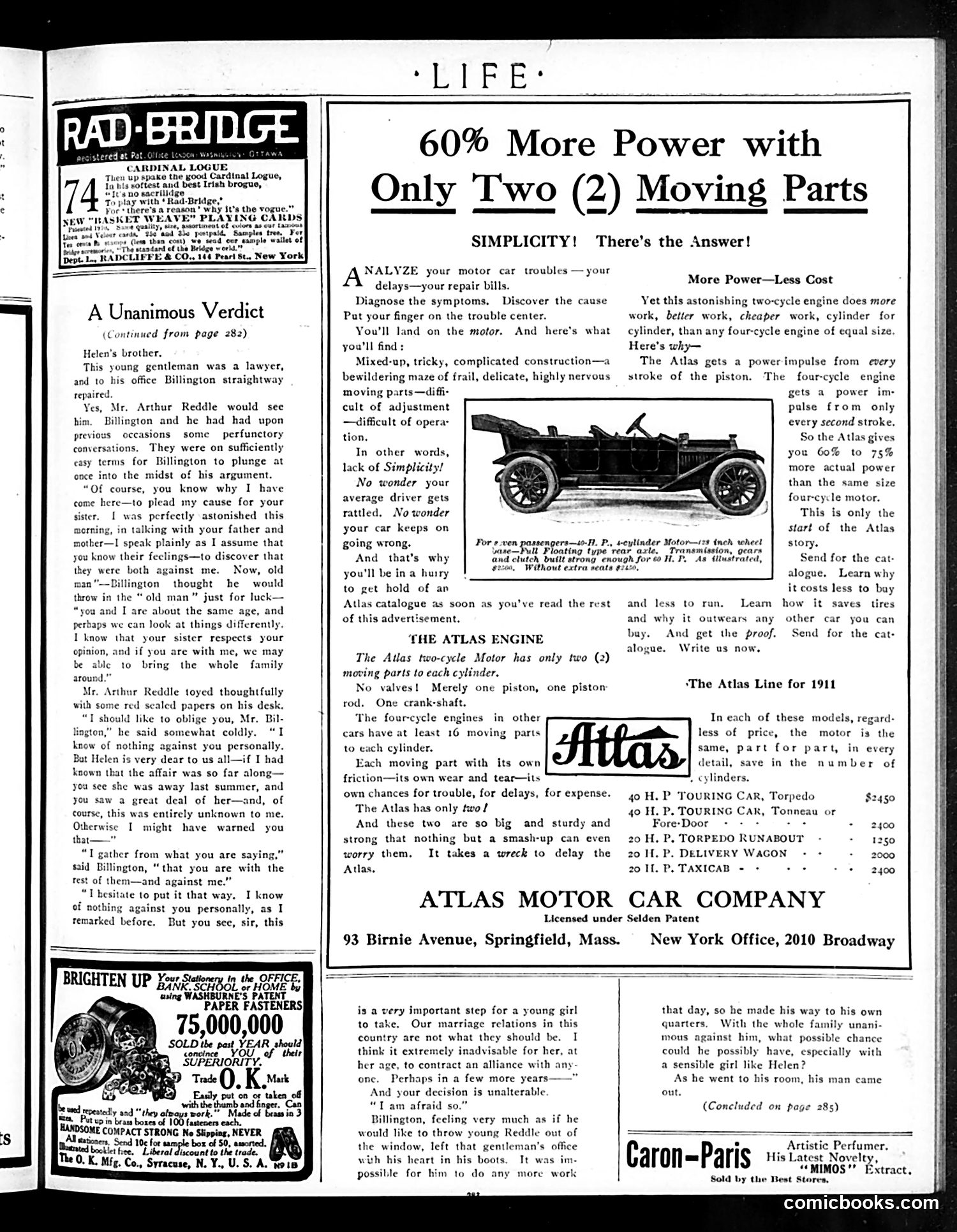
This page contains primarily **advertising content** rather than editorial satire or cartoons requiring historical context. The main element is a large **Atlas Motor Car Company advertisement** promoting their two-cycle engine, which they claim delivers "60% More Power with Only Two (2) Moving Parts." The ad contrasts their engine's simplicity (2 moving parts per cylinder) against conventional four-cycle engines (16 moving parts), positioning simplicity as superior reliability and cost-effectiveness. The left column contains the continuation of a serialized fiction story titled "A Unanimous Verdict," involving characters named Billington, Arthur Reddle, and Helen—a domestic drama about courtship and family opposition. At the bottom is a small ad for **Washburne's Patent** fasteners. There is a brief reference to **Cardinal Logue** (likely Archbishop of Armagh, a real Irish ecclesiastical figure), but the context is unclear from this excerpt alone. The page reflects early 1910s automotive marketing and serialized fiction typical of *Life* magazine's commercial mix.
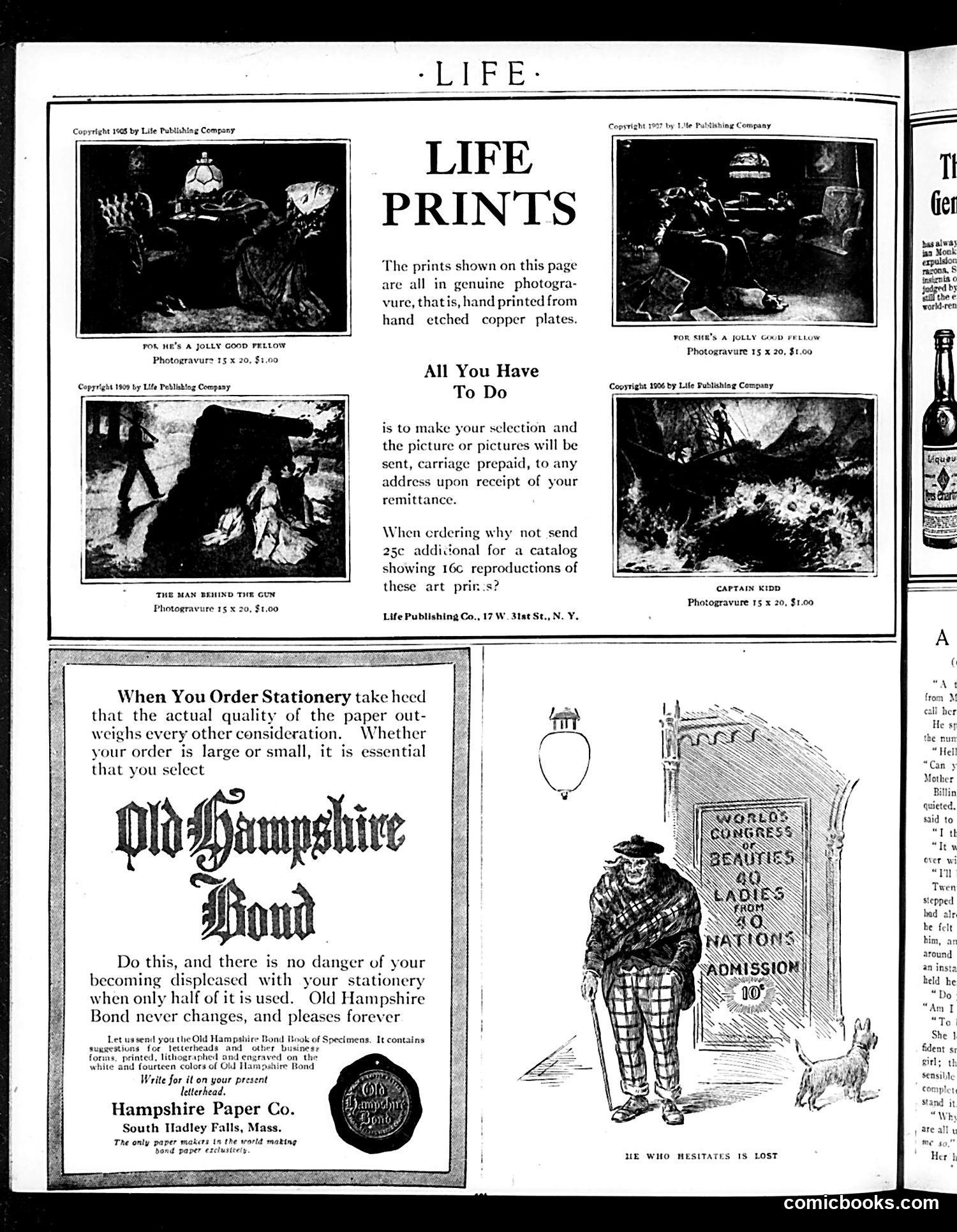
This is primarily an **advertising and product catalog page** rather than political satire. The page showcases Life Publishing Company's art print offerings for sale. The four photogravure prints advertised are titled "For He's a Jolly Good Fellow" (two versions), "The Man Behind the Gun," and "Captain Kidd"—these appear to be sentimental or historical scenes rendered as fine art reproductions. The page emphasizes their authenticity as hand-printed copper-plate photogravures. The lower half contains two unrelated advertisements: one for Old Hampshire Bond stationery (emphasizing paper quality) and one for Hampshire Paper Co. The cartoon "He Who Hesitates Is Lost" depicts a man observing a sign for "World's Congress of Beauties" at 10¢ admission—likely a humorous commentary on indecision regarding entertainment or leisure spending. **There is no significant political satire on this page**—it's primarily commercial advertising typical of early 1900s Life magazine.
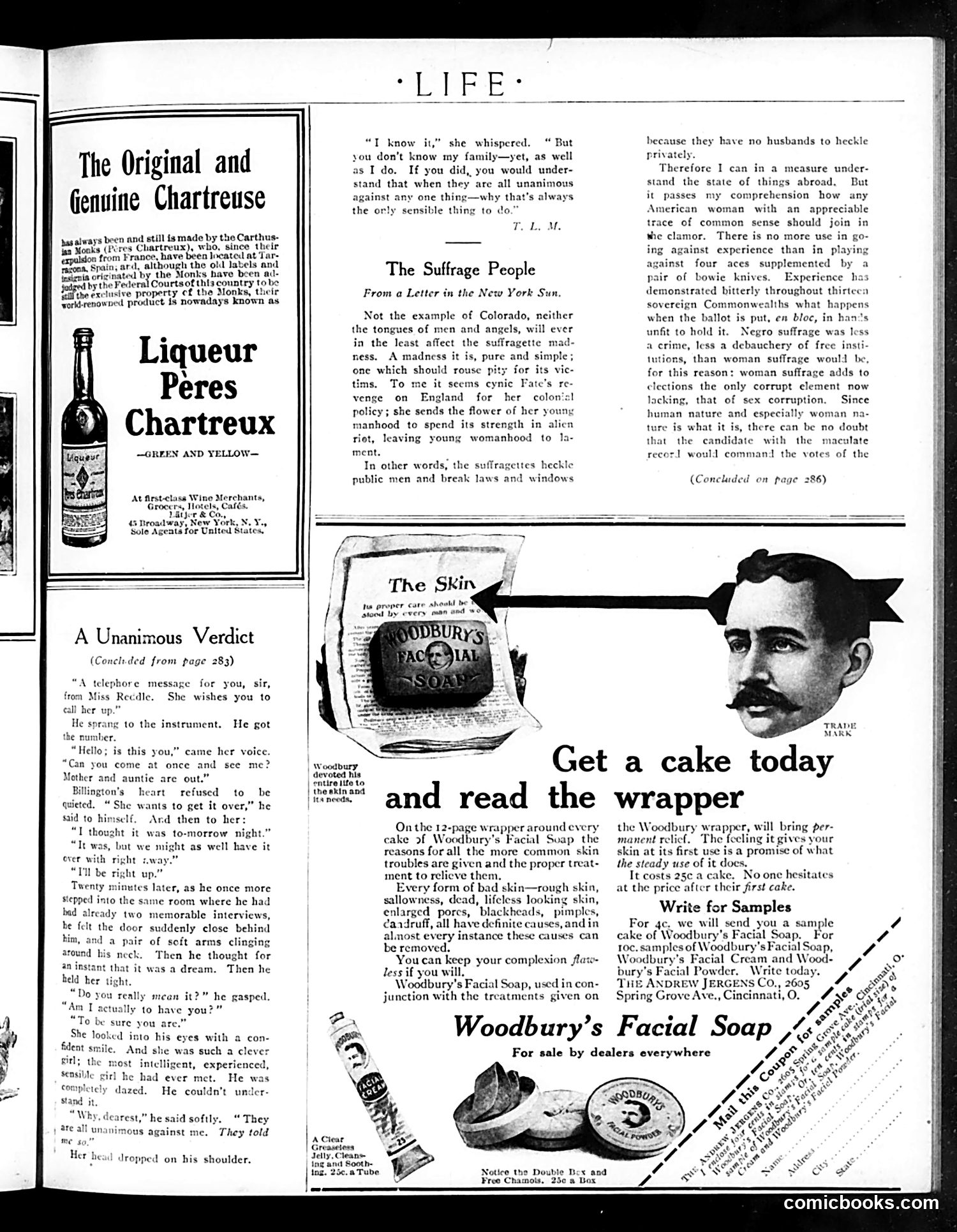
This *Life* magazine page contains multiple elements: a political argument against women's suffrage disguised as a letter to the editor, advertisements (Chartreuse liqueur, Woodbury's Facial Soap), and a romantic fiction excerpt ("A Unanimous Verdict"). The main satirical content is **"The Suffrage People,"** a letter opposing women's voting rights. The author argues that giving women the ballot would be worse than Reconstruction-era Black male suffrage because women allegedly represent "sex corruption" and lack sense. He dismisses female activists ("suffragettes") as emotional and destructive (breaking windows, heckling politicians). This reflects actual anti-suffrage rhetoric from the early 1900s—the period before women gained voting rights (1920). The piece uses pseudo-logical arguments common to that era: women are naturally unsuited for politics; their participation corrupts elections; their activism is irrational mob behavior. The juxtaposition with beauty-soap advertising is unintentional irony by modern standards but typical of the era's conflation of femininity with domesticity, not citizenship.
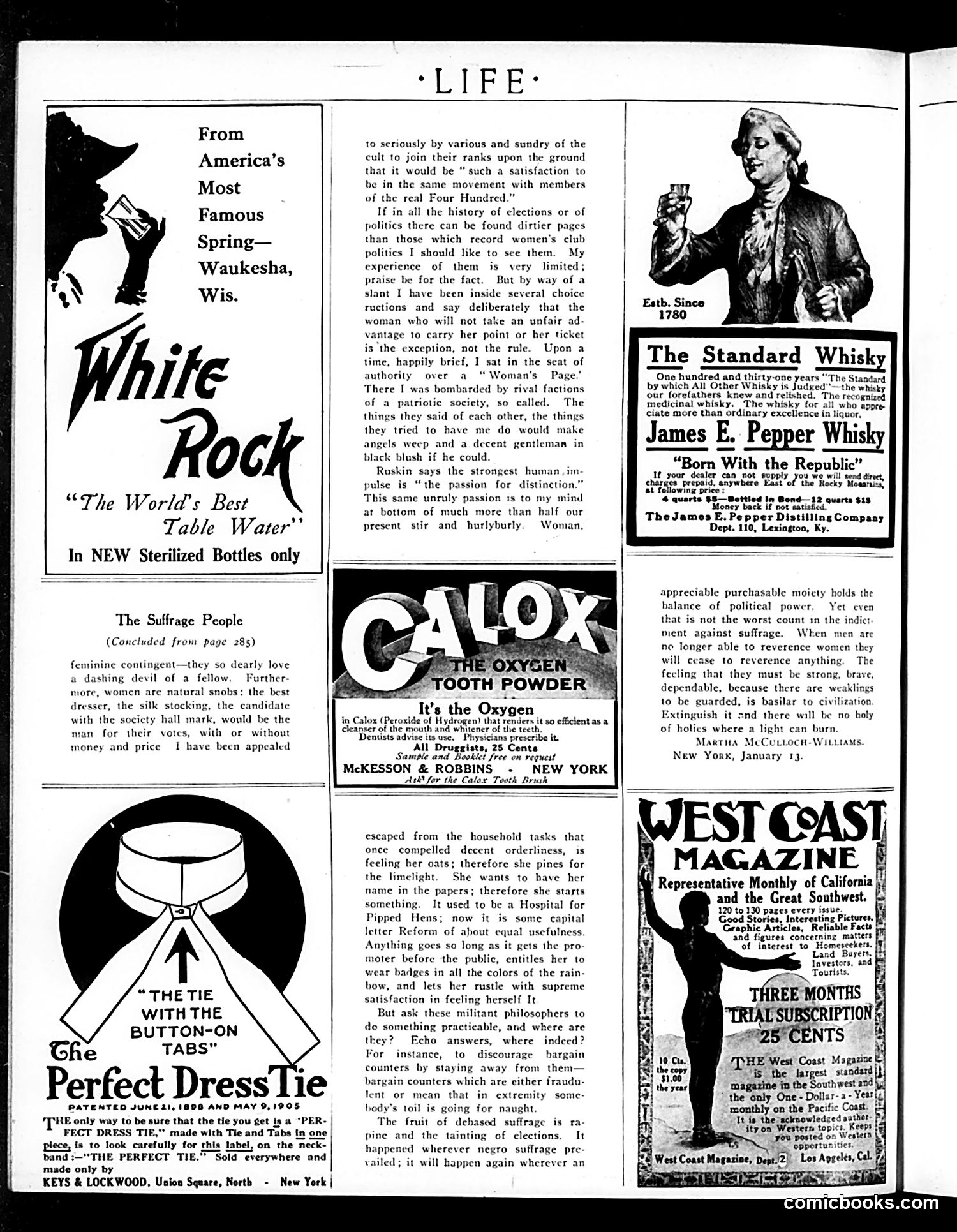
This page contains a satirical article titled "The Suffrage People" (continued from page 285) attacking women's suffrage activism. The author—identified in the visible text as **Martin McCulloch-Williams**—expresses contempt for female political organizing, claiming women are "natural snobs" who use "unfair advantage" in club politics and are motivated by vanity rather than principle. The piece ridicules women's political involvement as driven by "passion for distinction" and warns that if men stop "reverencing women," civilization will collapse. The author suggests women escaping household duties now seek public attention through reform movements. **Context for modern readers:** This represents anti-suffrage sentiment from the eve of the 19th Amendment's ratification (February 1920). The page's advertisements (whisky, tooth powder, dress ties, magazines) are period ephemera. The satire reflects widespread male anxieties about female political participation and independence during this pivotal moment in American women's rights history.
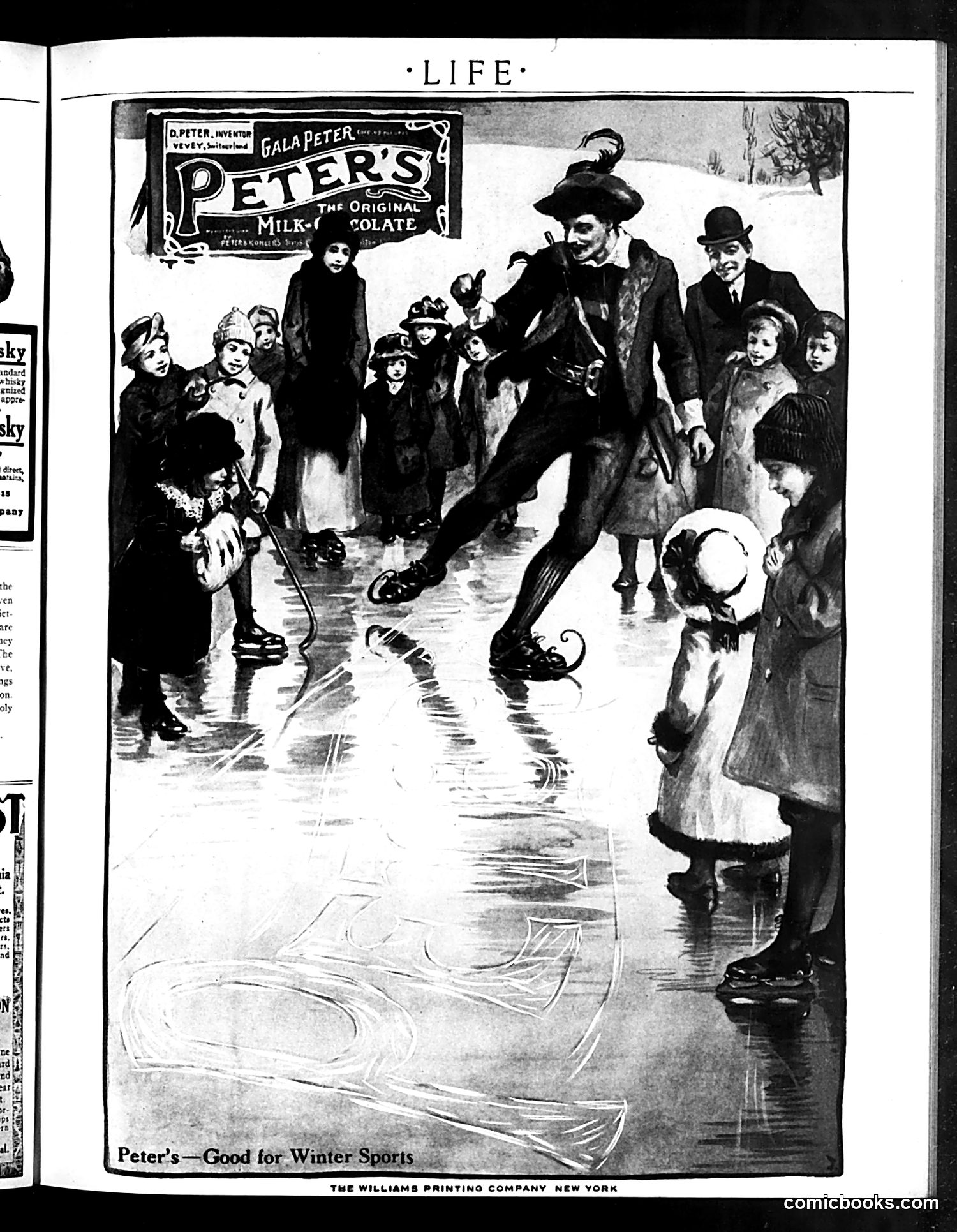
This is a Peter's chocolate advertisement from *Life* magazine, not a political cartoon. The image shows a well-dressed man and woman ice-skating with a group of children gathered around them on a frozen pond or lake. A "Gala Peter's—The Original Chocolate" advertisement banner appears at the top. The ad's tagline reads "Peter's—Good for Winter Sports," suggesting chocolate as an energizing product for cold-weather activities. The composition emphasizes wholesome family entertainment and leisure, with the elegantly dressed adults as focal points. This reflects early 20th-century advertising's use of aspirational imagery to market consumer goods to middle and upper-class readers of *Life* magazine.
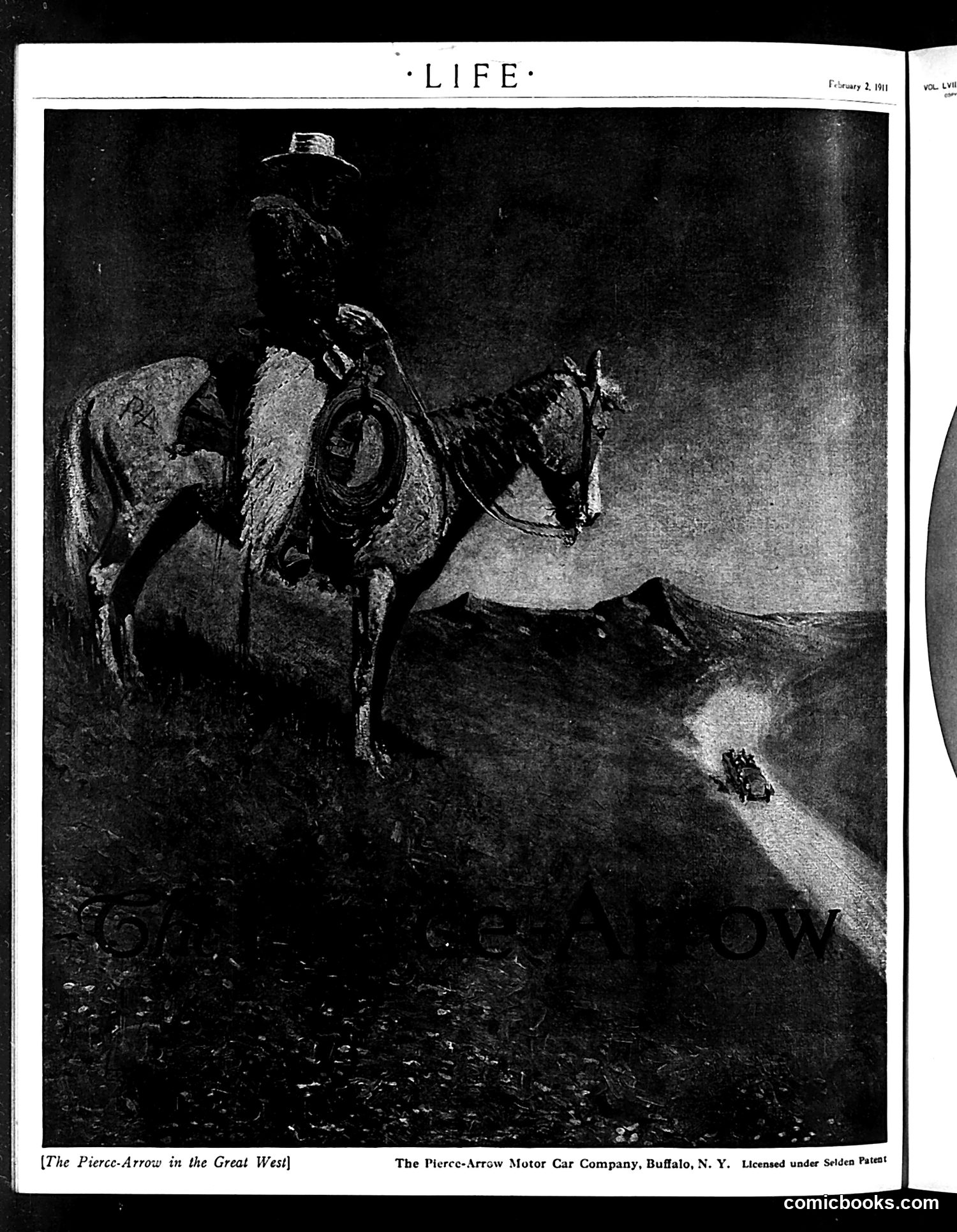
This is **advertisement, not satire**. The image depicts a cowboy on horseback in a dramatic Western landscape, gazing toward distant mountains and what appears to be an automobile in the distance on a road. The ad promotes the **Pierce-Arrow Motor Car Company** (Buffalo, New York), a luxury automobile manufacturer. The juxtaposition of the traditional cowboy with the modern automobile suggests the car's ability to traverse and conquer the American frontier—positioning Pierce-Arrow vehicles as suitable for both rugged Western terrain and modern progress. The reference to the "**Selden Patent**" indicates the company operated under licensing agreements with the patent holder, a common business practice in early automotive manufacturing. The "Great West" framing appeals to American ideals of exploration and expansion.