
Life, 1911-02-02 · page 25 of 52
Life — February 2, 1911 — page 25: what you’re looking at
What you’re looking at
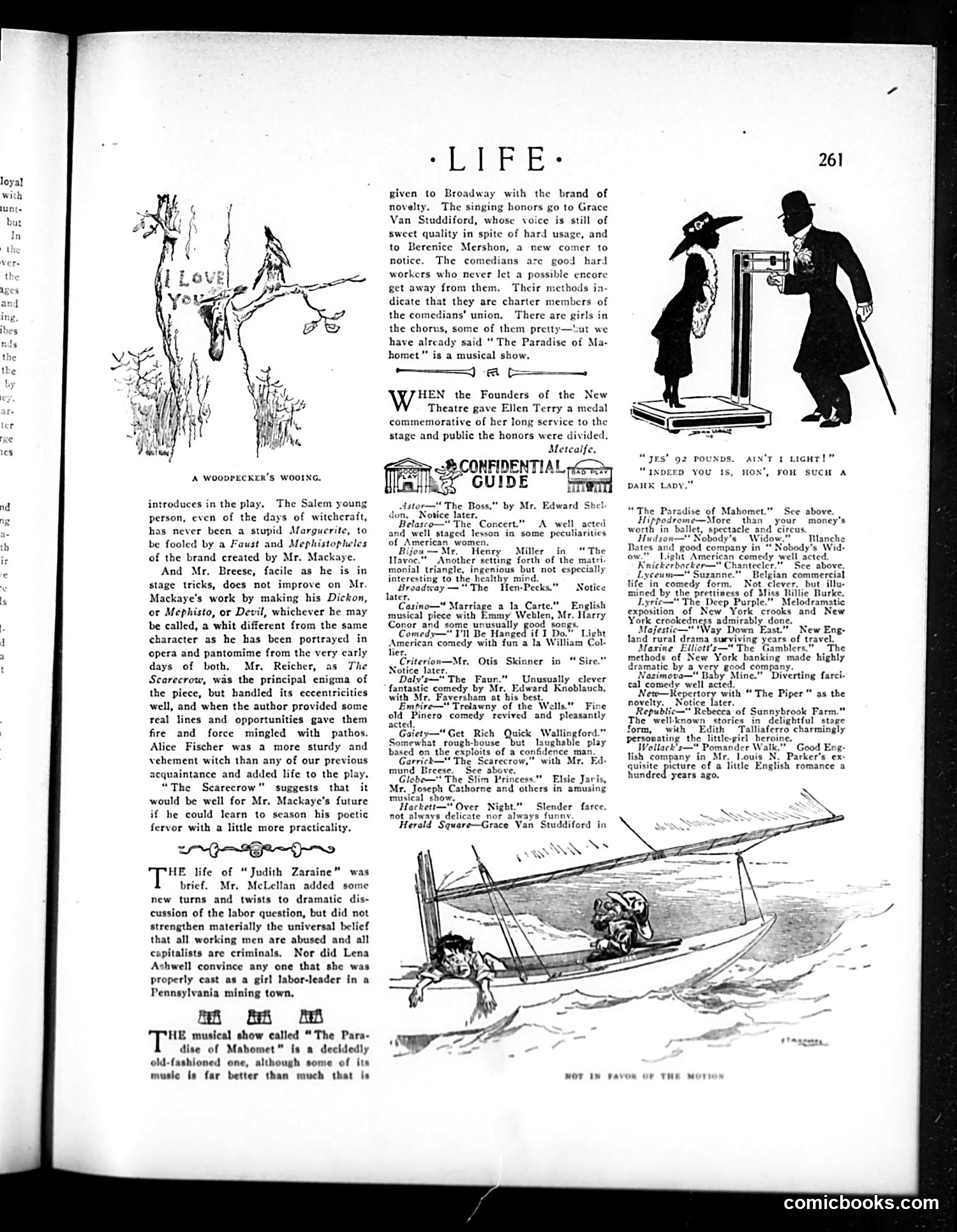
This page contains theater reviews and two satirical cartoons about entertainment and social commentary. **"A Woodpecker's Wooing"** (top left): A simple line drawing showing a woodpecker carving "I LOVE" into a tree trunk—a gentle nature joke about courting rituals. **The silhouette cartoon** (top right): Depicts a woman in a dark dress speaking to a man in formal attire near a mirror or doorway, with the caption "JES' 92 POUNDS, AIN'T I LIGHT! / 'INDEED YOU IS, HON', FOH SUCH A DARK LADY.'" This appears to mock racial stereotypes and weight-consciousness, using exaggerated dialect. **"Not in Favor of the Motion"** (bottom): A sketch of a capsized boat, likely commenting on theatrical or social controversy. The page itself reviews contemporary Broadway productions including "The Paradise of Mahomet" (musical), "The Scarecrow" (drama), and various comedies, offering critical commentary on performances and production quality typical of Life's theater criticism.
📄 Transcribed text from this page (OCR, searchable)
Machine-transcribed from the original scan — historical spelling and the odd misread are preserved.
A WOODPECKER’S WOOING. roduces in the play. The Salem young person, even of the days of witchcraft, has never been a stupid Marguerite, to be fooled by a Faust and Mephistopheles of the brand created by Mr. Mackaye. And Mr. Breese, facile as he is in stage tricks, does not improve on Mr. Mackaye’s work by making his Dickon, or Mephisto, or Devil, whichever he may be called, a whit different from the same character as he has been portrayed in opera and pantomime from the very carly days of both, Mr, Reicher, as The Scarecrow, was the principal enigma of the piece, but handled its eccentricities well, and when the author provided some real lines and opportunities gave them fire and force mingled with pathos. Alice Fischer was a more sturdy and vehement witch than any of our previous acquaintance and added life to the play. “The Scarecrow” suggests that it would be well for Mr. Mackaye’s future if he could learn to season his poetic fervor with a little more practicality. UO Gefen HE life of “Judith Zaraine” was brief. Mr. McLellan added some new turns and twists to dramatic dis- cussion of the labor question, but did not strengthen materially the universal belief that all working men are abused and all capitalists are criminals, Nor did Lena Ashwell convince any one that she was properly cast as a girl labor-leader in a Pennsylvania mining town, A BA MA HE musical show called “The Para- dise of Mahomet” is a decidedly old-fashioned one, although some of its musle is far better than much that is Bal lege given to Broadway with the brand of novelty, The singing honors go to Grace Van Studdiford, whose voice is still of sweet quality in spite of hard usage, and to Berenice Mershon, a new comer to notice. The comedians are good hard workers who never let a possible encore get away from them. Their methods in- dicate that they are charter members of the comedians’ union. There are girls in the chorus, some of them pretty—but we have already said “The Paradise of Ma- homet" is a musical show. ————S. a HEN the Founders of the New Theatre gave Ellen Terry a medal commemorative of her long service to the stage and public the honors were divided. Metcalfe. =e PONRPENTIAL rn [mikes GUIDE ire mane. Boss,” by Mr. Edward Shel. The Concert.’ A well nd well staged lesson in some peculiarities of American womer | ry Miller in The setting forth of the matri rious but not especially thy mind, Hen-Pecks.” Notice Casino— Marriage a la Carte.” English musical piece with Emmy Weblen, Mr. Harry Conor and some unusually good song: Comedy—" I'll Be Hanged if I Do.” Light j\merican comedy with fun a ta William Col ier. Criterion—Me, Otis Skinner in “Sire.” Notice later. Daly's—" The Faur.” Unusually clever fantastic comedy by Mr, Edward Knoblauch, with Mr. Faversham at his best. Empire—“ Trelawny of the Wells." Fine old pinero! comedy revived and pleasantly acted Gaiety—" Get Rich Quick Wallingford.” Somewhat rough-house but laughable play based on the exploits of a confidence man. “The Scarecrow,” with Mr, Ed- ie. See above. Globe—"* The Slim Princess.” Elsie Jari: Mr. Joseph Cathorne and others in amusing musical sho Hackett—*“ Over ght.” Slender farce. not always delicai always funny Herald Square—Grace Van Studdiford in “ Jes’ 92 POUNDS, AIN'T I LIGHT “INDEED YOU 1S, HON’, FOH SUCH A DAMK Lapy.” “The Paradise of Mahomet.” Sce above. Hippodrome—More than your money's worth in ballet, spectacle and circus. Hudson—" Nobody's “Blanche Bates and good company in “ Nobody's Wid- ow.” Light American comedy well acted. r ntecler.” See above, Lyceum—" Suzanne.” Belgian commercial life’ in comedy form, Not clever, but illu- ed by the prettiness of Miss Billie Burke. Lyric—" The Deep Purple.” Melodramatic exposition of New York crooks and New York crookedness admirably done. Majestic—*'Way Down East.” New Eng- land rural drama surviving years of travel. Maxine Elliott’s—"The Gamblers.” The methods of New York banking made highly dramatic by a very good company. . Nazimova—" Baby Mine.” Diverting farci- cal comedy well acted. New—Kepertory with “The Piper” as the novelty. Notice fater. Republic—" Rebecca of Sunnybrook Farm.” The well-known stories in delightful stage form, with ith Taliaferro charmingly personating the little-girl heroine. Wollack’s—" Pomander Walk.” Good Eng- lish company in Mr. Louis N. Parker's ex- quisite picture of a little English romance a hundred years ago. NOT IN FAVOR OF THE MOT comicbooks.com